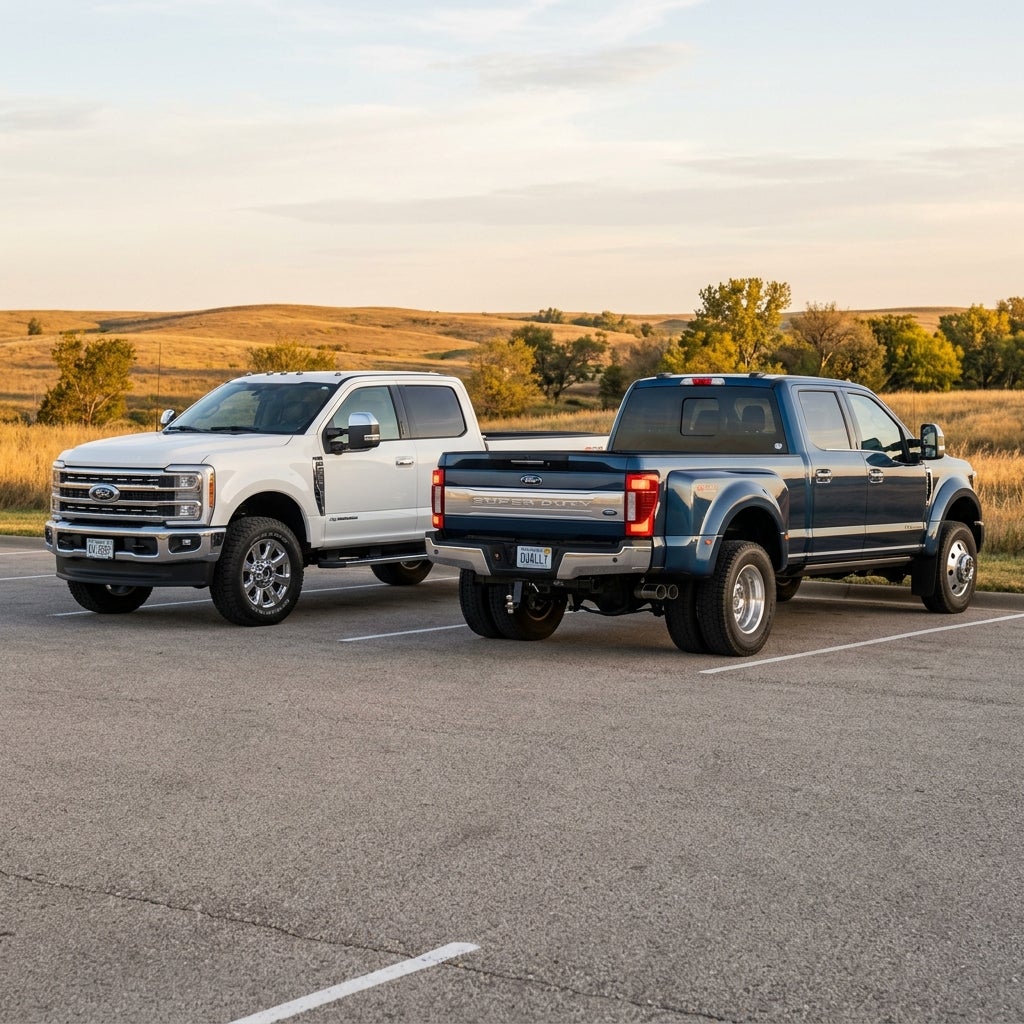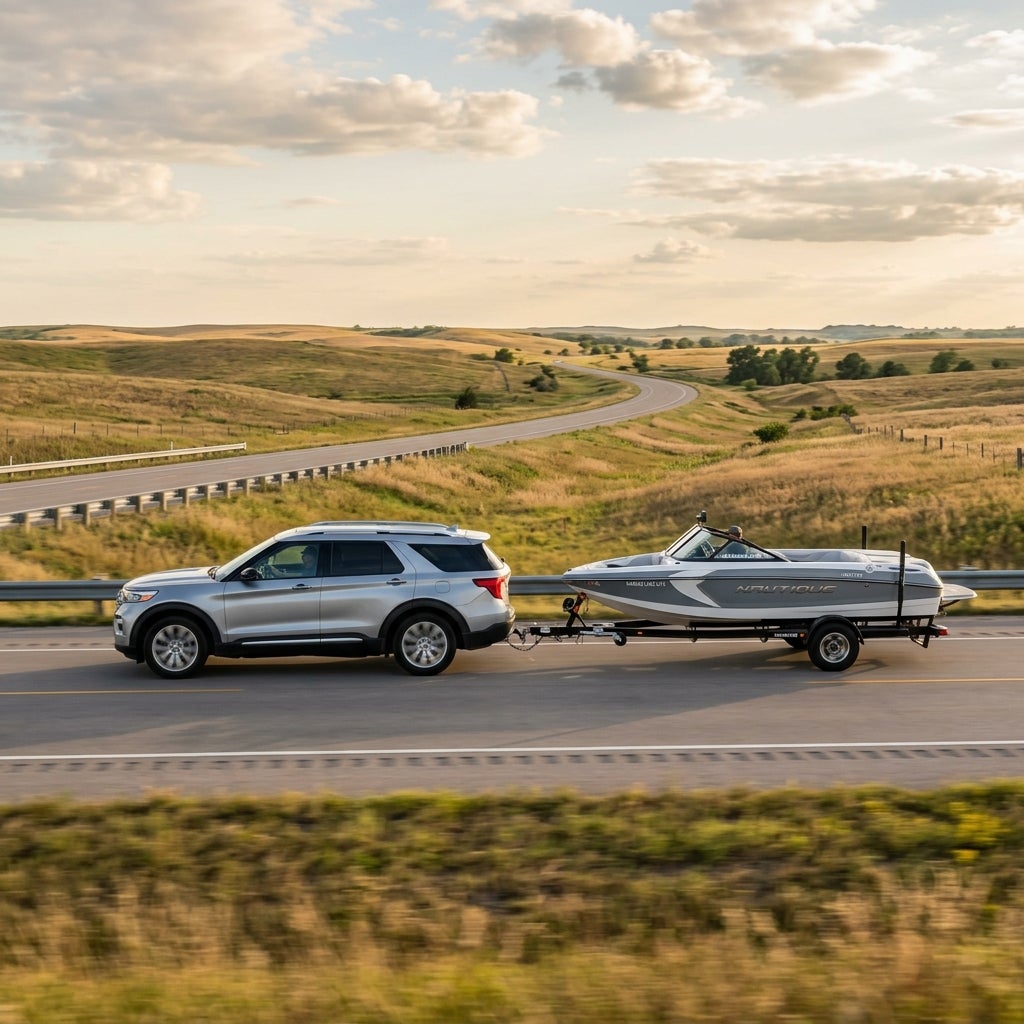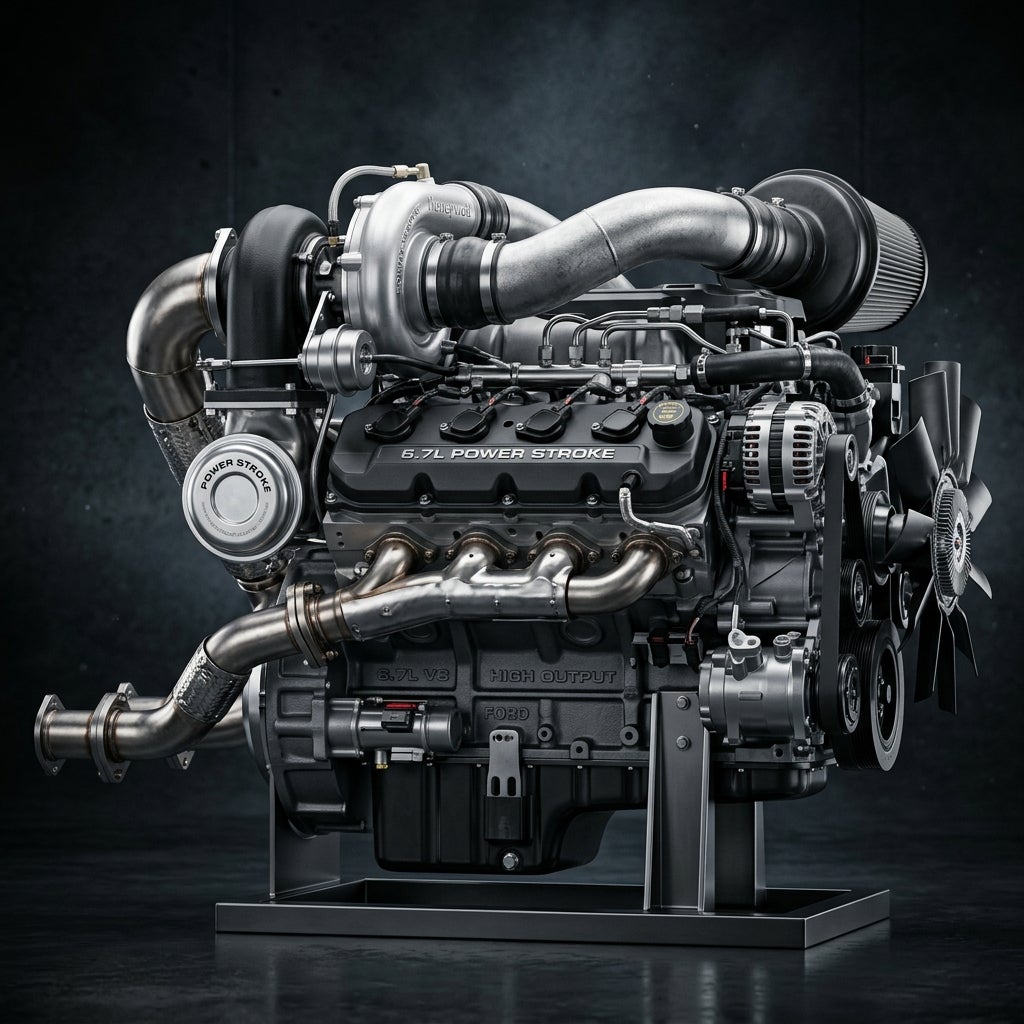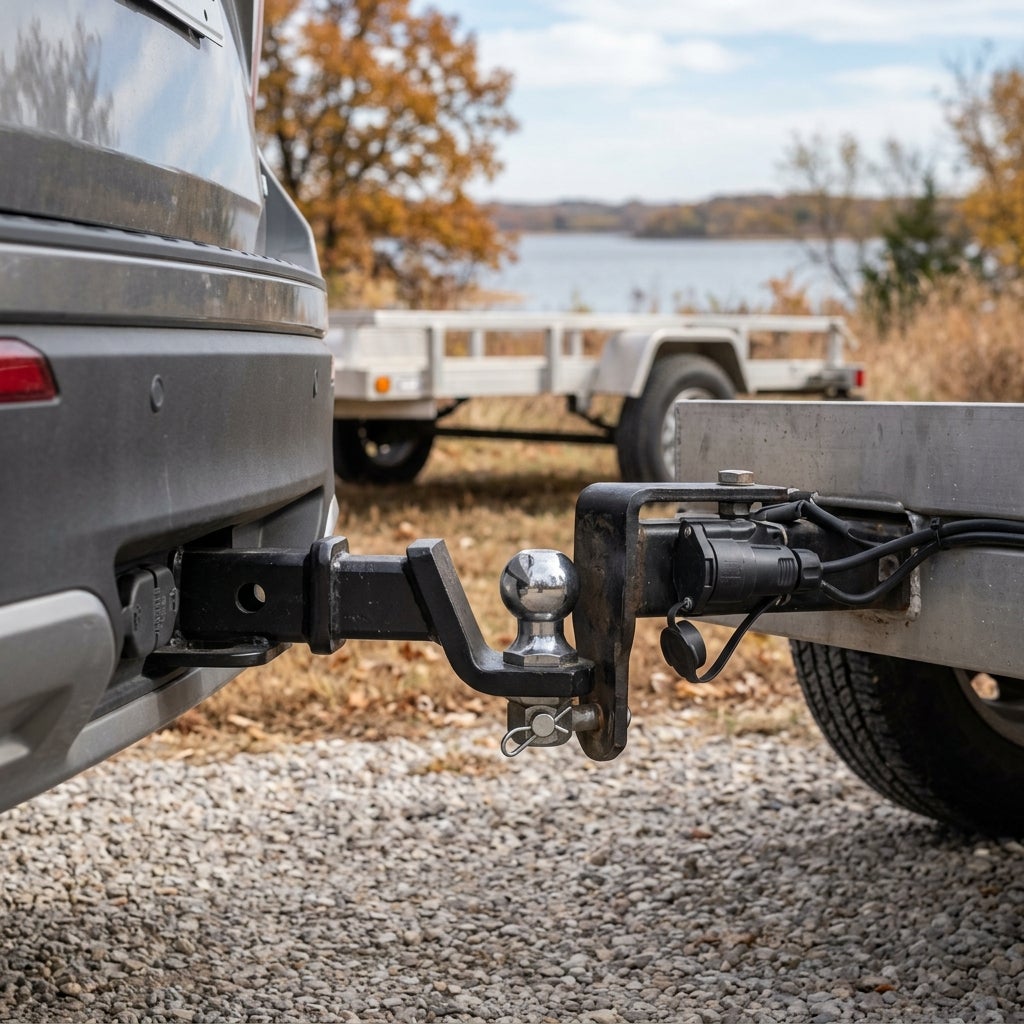

What Is the Payload Capacity Difference Between the Ford F-250 and F-350 Super Duty? Key Takeaway: When comparing the 2025 Ford F-250 and Ford F-350 Super Duty, the fundamental difference lies in Gross Vehicle Weight Rating (GVWR) class limits and rear-axle suspension hardware. In equivalent Single Rear Wheel (SRW) configurations, the 2025 F-350 delivers a net payload advantage of roughly 1,000 to 1,800 lbs over an F-250. When stepping up to an F-350 Dual Rear Wheel (DRW) configuration, that gap expands to over 3,700 lbs, reaching a maximum payload rating of up to 8,000 lbs versus the F-250's maximum SRW rating of 4,260 lbs. Payload is calculated using a straightforward formula: Payload = Gross Vehicle Weight Rating (GVWR) - Curb Weight. Because the standard F-250 is capped at a Class 2b ceiling of 10,000 lbs GVWR (though high-capacity trailer tow packages can raise it to 10,600–10,900 lbs), its legal payload is limited by law and factory certification. The Class 3 F-350 SRW jumps to a GVWR range between 11,400 lbs and 12,400 lbs without adding significant vehicle mass, directly converting that GVWR increase into extra bed payload and fifth-wheel pin capacity. Super Duty Model Vehicle Class Max GVWR (lbs) Max Payload Rating (lbs) Rear Axle Type 2025 F-250 SRW Standard Class 2b 10,000 3,800 - 4,260 Sterling 10.5 / Dana M275 2025 F-250 SRW High-Capacity Class 2b / Class 3 10,600 - 10,900 3,900 - 4,300 Dana M275 2025 F-350 SRW Class 3 11,400 - 12,400 4,500 - 5,090 Dana M275 2025 F-350 DRW (Dually) Class 3 14,000 6,500 - 8,000 Dana M300 Wide-Track Expert Interview: 20 Years of Super Duty Insights with Mike Hogg at Valor Ford To understand how these mathematical weight ratings perform under real-world stress, we sat down with Mike Hogg, Service Director at Valor Ford in Junction City, KS. With over 20 years of hands-on experience diagnosing, servicing, and optimizing heavy-duty trucks across Central Kansas, Mike has seen every imaginable payload configuration. "Around Dickinson County and Fort Riley, our customers don't treat Super Duty trucks as simple passenger vehicles—they are primary tools for agriculture, military logistics, and heavy construction," explains Mike. "Whether you're hauling round hay bales across gravel ranch roads or pulling a 40-foot fifth-wheel camper down I-70, understanding your actual payload margin is critical for safety, legal compliance, and long-term vehicle health." In this comprehensive interview, Mike breaks down the engineering differences, suspension geometry, fuel economy trade-offs, and state registration nuances between the 2025 F-250 and F-350. Q: What is the typical real-world payload advantage of a 2025 Ford F-350 over an F-250? Interviewer: Mike, buyers often see brochures advertising max payloads over 4,000 lbs on F-250 and wonder why anyone needs an F-350. What is the real-world payload difference when two comparably equipped trucks drive off the lot? Mike Hogg: Brochure numbers represent ideal, strip-down regular cab 4x2 gas models. In the real world, 85% of our buyers at Valor Ford choose a Crew Cab 4x4 with a luxury trim like Lariat, King Ranch, or Platinum. That added trim equipment and transfer case weight consumes available payload. On a standard 2025 F-250 Crew Cab 4x4 with a 6.7L Power Stroke diesel, your GVWR is paper-capped at 10,000 lbs. Once you subtract the heavy diesel motor, transfer case, scale weight of 4x4 components, and luxury interior gear, the actual curb weight sits right around 8,100 lbs. That leaves you with a real-world net payload of roughly 1,900 lbs. Mike Hogg (continued): Now take that exact same truck specification—Crew Cab 4x4 6.7L Diesel—in an F-350 Single Rear Wheel (SRW). Because the F-350 SRW carries a factory GVWR rating of 11,500 to 12,400 lbs depending on package options, its curb weight is almost identical (only about 50 to 75 lbs heavier due to stiffer leaf springs and rear hardware). That means your net real-world payload jumps from ~1,900 lbs up to 3,300 to 3,800 lbs! That 1,400 to 1,800 lb payload advantage is huge. It means being able to carry a full bed of seed sacks or a heavy fifth-wheel hitch without exceeding legal axle limits. Always check the tire and loading information sticker on the driver door jamb to know your exact vehicle rating. Q: How do rear suspension and axle designs differ between the 2025 F-250 and F-350? Leaf Spring Packs Standard F-250 models utilize a 3-leaf main spring pack designed for compliant unladen ride quality. The F-350 adds an auxiliary overload leaf spring mounted above the primary pack, engaging frame pads under heavy compression to control ride height and squat. Axle Assemblies & Ring Gears Gasoline F-250s feature the Sterling 10.5-inch axle. High-capacity F-250 diesel and F-350 SRW models upgrade to the beefier Dana M275 axle with a 10.8-inch ring gear and thicker axle tubes. The F-350 DRW steps up to the commercial-grade Dana M300. Spring Rates & Bump Stops The F-350 uses stiffer primary spring rates and taller factory rear blocks to maintain stance under heavy tongue loads. If you need OEM replacement leaves, heavy-duty sway bars, or factory hardware, Order Genuine Ford Parts directly through our service counter. Order Genuine Ford Parts Q: How do you calculate pin weight for a fifth-wheel trailer on an F-250? Interviewer: Many Fort Riley active-duty families and outdoor enthusiasts in Kansas tow fifth-wheel campers. How should a driver calculate fifth-wheel kingpin weight against their available payload? Mike Hogg: Pin weight calculation is where many truck owners accidentally exceed legal specs. Fifth-wheel trailers place 15% to 25% of their total Gross Trailer Weight Rating (GTWR) directly onto the truck bed over the rear axle. Let's run a realistic calculation: 1. Trailer GTWR: 14,000 lbs fifth-wheel camper. 2. Pin Weight (at 20%): 14,000 x 0.20 = 2,800 lbs of vertical bed weight. 3. Hitch Equipment: Fifth-wheel hitch mechanism = 150 lbs. 4. Occupants & Cargo: 4 passengers (600 lbs) + bed toolbox (150 lbs) = 750 lbs. 5. Total Payload Required: 2,800 + 150 + 750 = 3,700 lbs. Mike Hogg (continued): If you attempt to tow that 14,000 lb RV with an F-250 Crew Cab Diesel that only has 2,000 lbs of certified door-sticker payload, you are over capacity by 1,700 lbs! Even though the engine can easily pull the trailer down the highway, your rear axle, tires, and frame are overloaded, creating severe stability hazards. That specific scenario is why I recommend the F-350 SRW or F-350 DRW for anyone pulling a fifth-wheel RV over 12,000 lbs. If you're evaluating your current towing setup, feel free to bring your rig into Valor Ford or Call us at (785) 238-5114 to consult with our service team before buying. Q: How does diesel fuel economy compare to the 7.3L Godzilla V8 gas engine under payload? Interviewer: Engine selection plays a surprising role in available payload capacity. Mike, how does choosing the 6.7L Power Stroke V8 Diesel versus the 7.3L Godzilla V8 Gas engine impact net payload and fuel efficiency when loaded? Mike Hogg: Engine choice is the single biggest factor affecting vehicle curb weight. The 6.7L Power Stroke V8 Turbo Diesel is an absolute torque monster (1,050 lb-ft standard / 1,200 lb-ft High Output), but its heavy cast-iron block, turbochargers, emissions equipment, and dual batteries add roughly 800 lbs of extra weight to the front axle compared to the 7.3L Godzilla gas V8. Because GVWR is fixed by class, every pound of engine weight directly subtracts from available payload. If payload capacity is your absolute highest priority and you tow under 15,000 lbs, a 7.3L Godzilla V8 gas F-250 or F-350 will actually give you up to 800 lbs MORE payload capacity than an identical diesel truck! However, under heavy payload or towing conditions, the Power Stroke diesel delivers superior fuel efficiency—averaging 12-15 MPG while working, compared to 8-10 MPG for the 7.3L gas V8 under high load. If you drive over 20,000 miles a year pulling heavy loads across rural Kansas, the diesel's fuel savings and exhaust braking outweigh the curb weight trade-off. Q: Why do some states classify the F-250 and F-350 differently for registration? Class 2b Threshold (10k GVWR) The federal government classifies trucks with a 10,000 lb GVWR or lower as Class 2b. This threshold allows F-250 owners in many states to avoid commercial registration fees, weight station stops, and mandatory commercial insurance policies. Class 3 Category (10,001+ lbs) The F-350 is classified as a Class 3 medium-duty truck (GVWR 10,001 to 14,000 lbs). In Kansas and neighboring states, Class 3 vehicles may require weight-based tag tiers or commercial licensing if operated for commercial farm or business purposes. Tax & Financing Strategy Both F-250 and F-350 trucks with a GVWR above 6,000 lbs qualify for Section 179 tax deductions. To explore commercial fleet financing and vehicle classification options, you can Contact us for financing information online. Contact us for financing information Q: When should a Dickinson County buyer choose an F-350 Dual Rear Wheel (DRW) over Single Rear Wheel? Interviewer: Dually trucks have a distinct look and footprint. At what point does a local farmer, rancher, or contractor in Dickinson County cross the line from a Single Rear Wheel (SRW) to a Dual Rear Wheel (DRW) F-350? Mike Hogg: It comes down to two factors: lateral stability and ultimate payload requirements. A Single Rear Wheel F-350 tops out around 4,500–5,000 lbs of payload. That’s plenty for standard gooseneck livestock trailers or moderate equipment trailers. However, when you step up to an F-350 Dual Rear Wheel (DRW), you gain a 14,000 lb GVWR ceiling and two extra tires on the rear axle. That unlocks up to 8,000 lbs of maximum payload capacity. Mike Hogg (continued): Beyond sheer numbers, the dually's wider rear track prevents sway in high Kansas crosswinds when pulling high-profile grain trailers or heavy 40ft+ fifth-wheels. If you haul heavy loads daily on highways or unpaved farm roads, the dually is unmatched. Q: Can you upgrade an F-250 rear suspension to legally match an F-350 payload capacity? Interviewer: This is a common question in truck forums: 'If I install aftermarket air bags or helper springs on my F-250, did I just turn it into an F-350?' Mike Hogg: Mechanical leveling vs legal capacity are two completely different things. Installing rear air helper springs, heavy-duty bump stops, or aftermarket leaf packs will help an F-250 sit level under load and reduce body roll. However, aftermarket suspension modifications DO NOT change the legal GVWR printed on the Ford door-jamb label. Federal safety standards and state DOT regulations dictate that your vehicle’s legal payload limit is strictly defined by the original manufacturer’s door sticker. Mike Hogg (continued): If you get pulled over by state highway patrol or get involved in an accident while exceeding the door-sticker GVWR, having air bags won't protect you from fines or insurance claim denials. Furthermore, modifying suspension geometry without re-engineering axle ratings or brake sweep area can compromise braking distances. If you anticipate needing F-350 payload levels, buy the factory F-350 from day one. You can check our Trade In Evaluation tool to see what your current truck is worth toward an upgrade. Q: How do engine choices like the 6.8L V8, 7.3L V8, and 6.7L Power Stroke shift payload specs? 6.8L V8 GAS Horsepower: 405 hp Torque: 445 lb-ft Payload Benefit: Lightest engine weight available. Ideal for XL work trucks requiring maximum payload efficiency on a standard value. 7.3L GODZILLA V8 GAS Horsepower: 430 hp Torque: 485 lb-ft Payload Benefit: Best payload-to-towing ratio for gas buyers. Saves ~800 lbs curb weight over diesel while providing muscular push for bed loads. 6.7L POWER STROKE DIESEL Horsepower: Up to 500 hp Torque: Up to 1,200 lb-ft Payload Benefit: Extreme low-end torque. Highest gross combined weight ratings (GCWR) for heavy towing; paired best with F-350 SRW/DRW. To explore full spec sheets and available configurations, check out our detailed guide on Research Ford F-250 model specifications. Research Ford F-250 Super Duty Mike Hogg’s Super Duty Buyer Checklist: F-250 High-Capacity vs F-350 SRW vs F-350 DRW To wrap up our interview, Mike Hogg compiled a decision framework based on 20 years of real-world service feedback at Valor Ford: Your Hauling Need Recommended Model Key Reason Daily driving, bumper pull trailers under 12,000 lbs, bed loads under 2,000 lbs F-250 SRW Compliant ride comfort, lower registration fees, standard 10,000 lb GVWR cap. Fifth-wheel RVs (12k-16k lbs), heavy equipment trailers, high-capacity diesel beds F-350 SRW Provides 1,200-1,800 lbs extra payload over F-250 without extra vehicle width. Agricultural hay/grain hauling, heavy goosenecks, fifth-wheel RVs over 16,000 lbs F-350 DRW (Dually) Unlocks up to 8,000 lbs payload, maximum lateral stability in Kansas crosswinds. Ready to test drive or inspect door-sticker specs in person? Visit Valor Ford at 1825 Goldenbelt Blvd, Junction City, KS 66441 or Schedule Ford Service Today with Mike Hogg and our master certified technicians. Schedule Ford Service Today