Blog / Repair & Parts

Blog

All Repair & Parts Buying Guides Maintenance & Service New Vehicle Reviews Technology & Innovation Financing & Insurance Safety Features Model Comparisons Used Vehicle Guides Seasonal Driving Tips Seasonal Vehicle Care Valor Ford Models Heavy-Duty Truck Care Junction City New Vehicle Sales Automotive Parts & Accessories Seasonal Vehicle Maintenance Towing & Trailer Technology Vehicle Ownership Tips Financing & Incentives Trade-In & Negotiation Tips KS Community Valor Ford Service Off-Road Packages & Accessories Trade-In & Pre-Approval Processes Automotive Repair Valor Ford Vehicle Pricing Strategies Vehicle Repair & Parts Vehicle Sales Diesel Engine Care Manhattan Ford Dealer Manhattan Ford Service Military & Special Customer Programs Parts & Repairs Performance & Powertrain Tire Care & Management Vehicle Trade-In Tips Agricultural Vehicle Maintenance Commercial Truck Financing Dealership Transparency Family SUVs Heavy-Duty Truck Guides Heavy-Duty Truck Upkeep Manhattan Used Cars Preventative Vehicle Inspections Technology & Innovation in Truck Service Agricultural Fleet Service Automotive Recalls & Repairs Certified Pre-Owned Programs Diesel Engine Maintenance Genuine OEM Parts & Accessories Military & Student Moving Tips Service Tips & Guides Vehicle Utility & Cargo Solutions All-Weather Driving & 4x4 Readiness Automotive News Classic Car Restoration Dealership Promotions & Events Farm & Ranch Equipment Reviews Genuine Parts & Accessories Hybrid & Electric Vehicles Winter Driving Tips
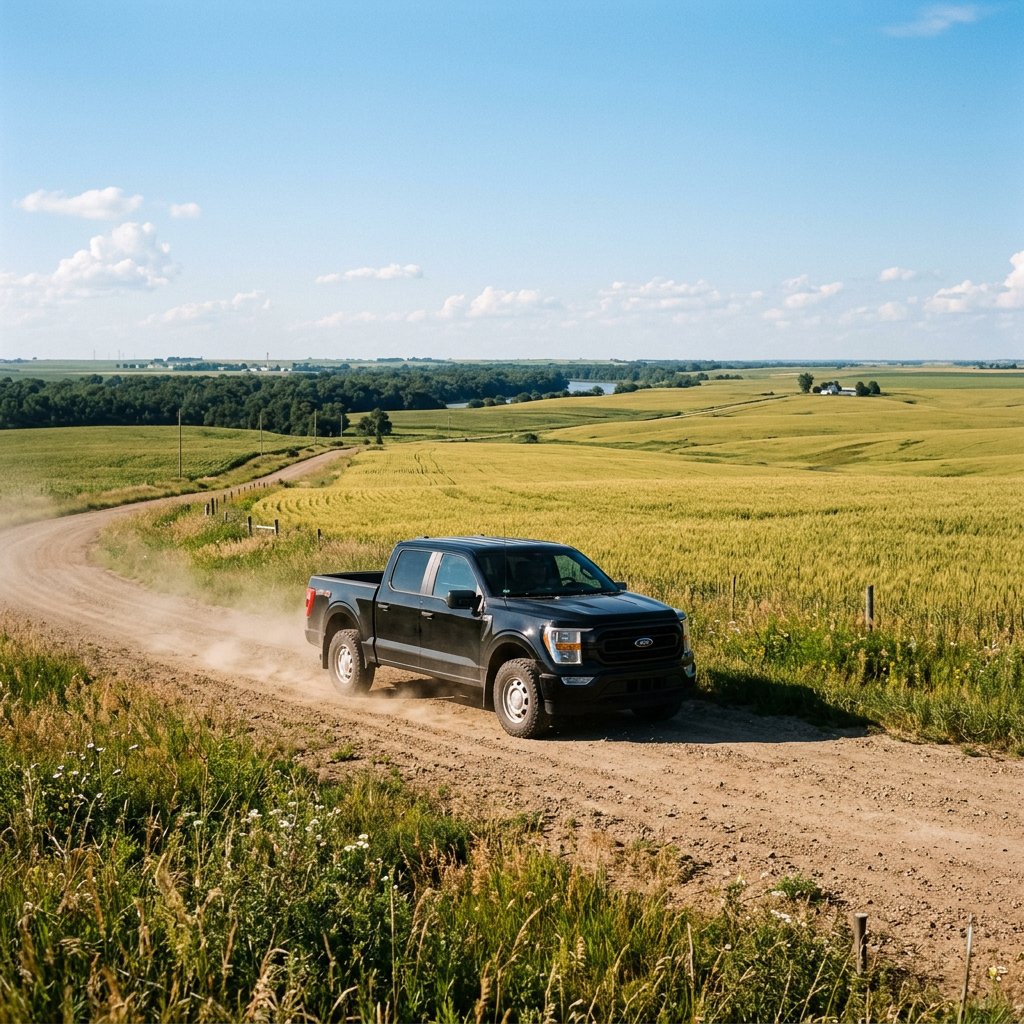
Buy 3 Tires Get the 4th for $1 at Valor Ford in Junction City, KS

Buy 3 Tires Get the 4th for $1 at Valor Ford in Junction City, KS

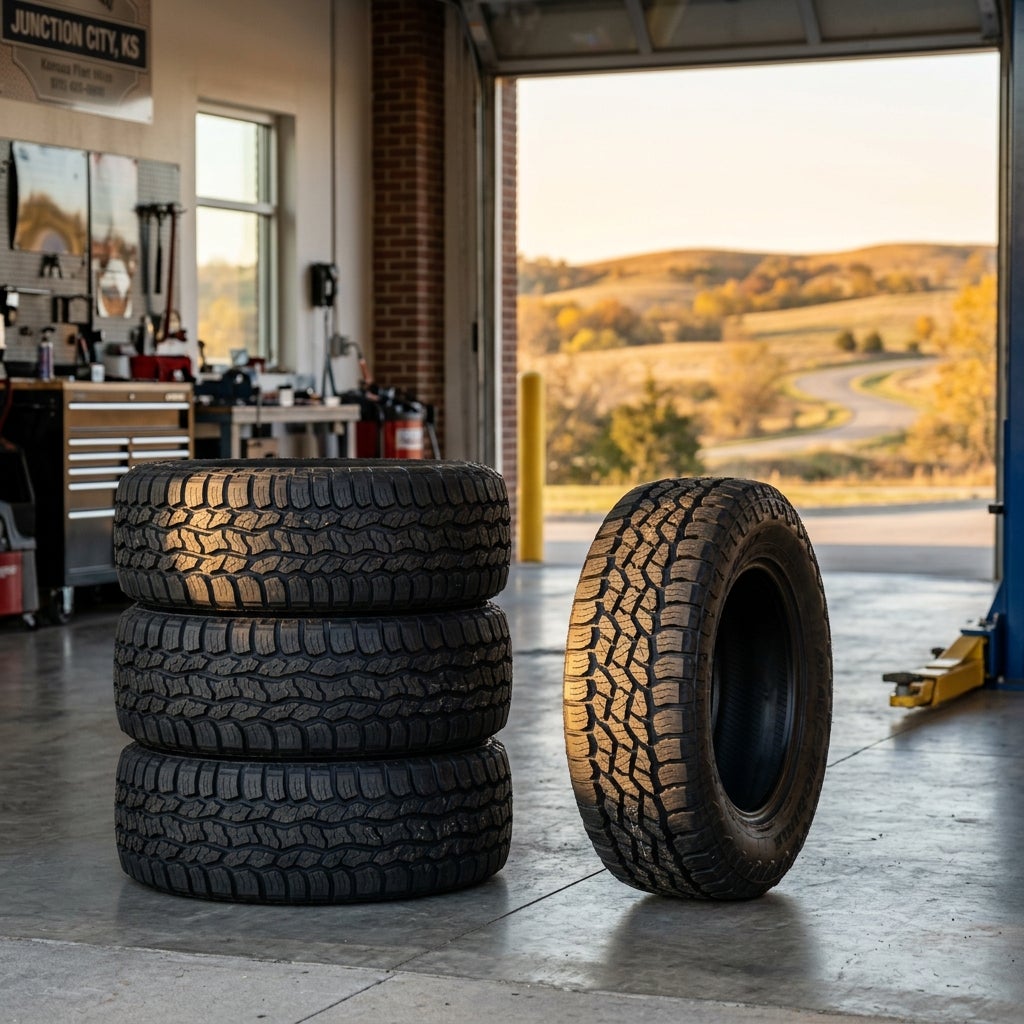
Schedule Tire Service at Valor Ford in Junction City, KS Don't let worn tread compromise your safety or fuel efficiency this season! currently available during our premier Fall Tire Sales Event at Valor Ford, when you purchase four select qualifying tires at regular price. Positioned right here at 1825 Goldenbelt Blvd in Junction City, KS, Valor Ford is your authorized service destination for unmatched savings on top tire brands. Whether you drive a rugged Ford F-150, a versatile Explorer, a heavy-duty Super Duty, a spacious Expedition, or a sleek Escape, this extraordinary event delivers maximum value directly to your wallet. Driving conditions across Geary County and the surrounding Flint Hills region demand dependable traction. From unpredictable fall rains to early winter frost, having four premium tires with deep, fresh tread is essential for road safety. Take advantage of direct savings of up to $250 or more depending on your vehicle's tire size and brand selection. Appointments are available through our certified service center, and availability may vary. Call us at (785) 238-5114 today or claim your offer online below! Schedule Ford Service Today How the Tire Service Offer Works Simple, Transparent Savings at Checkout We believe in straightforward pricing without hidden catches. Here is exactly how easy it is to save at Valor Ford: 1. Choose 4 Qualifying Tires: Select a set of four matching tires from our extensive inventory of major national brands. 2. Pay Regular Price for 3: Purchase the first three tires at our everyday competitive retail price. Get the 4th tire included with your qualifying tire purchase: Your service advisor can review current tire package details with you. 4. Enjoy Low-Price Guarantee & Expert Installation: Benefit from our Ford Service Price Match Guarantee on major brands, along with factory-trained assembly, precise balancing, and professional mounting. Tire Model Package Regular Set Price (4) Service Package Price Total Instant Savings Standard All-Season (Sedan/CUV) $640 Contact dealership for current pricing $159 Instant Savings All-Terrain Truck/SUV (F-150/Bronco) $960 Contact dealership for current pricing $239 Instant Savings Heavy-Duty Highway (Super Duty) $1,120 Contact dealership for current pricing Contact dealership for current pricing This limited-time offer applies to top-tier, name-brand tires suitable for light trucks, SUVs, crossover vehicles, and sedans. Installation, mounting, wheel balancing, valve stems, and applicable local recycling fees are clearly calculated so there are no surprises when you pick up your keys. Top Tire Brands Included in the Junction City Tire Sale At Valor Ford, we carry an extensive inventory of tire brands specifically engineered to complement your vehicle's handling, payload capacity, and ride quality. During this sales event, choose from industry-leading manufacturers tailored for your daily drive. Goodyear & Michelin Goodyear Tires: Renowned for durability and quiet highway performance. Excellent fitment options for Research Ford F-150 trucks and Research Ford Explorer SUVs needing dependable wet and dry traction. Michelin Tires: Premium longevity and fuel efficiency. Michelin Defender and Premier series deliver ultra-smooth rides for commuting on I-70 or traveling around Kansas. Continental & BFGoodrich Continental Tires: Exceptional stopping power and responsive cornering grip. Ideal for Ford Escape, Edge, and Research Ford Maverick drivers who value precise control. BFGoodrich Tires: Tough, aggressive off-road tread patterns like the All-Terrain T/A KO2, built to conquer gravel roads, farm trails, and muddy Kansas terrain. Pirelli & Hankook Pirelli Tires: Performance-driven rubber designed for responsive steering and high-speed stability. Perfect match if you Research Ford Mustang models. Hankook Tires: High-value performance with exceptional all-season capabilities, providing reliable durability for heavy work duty on Research Ford F-250 Super Duty vehicles. Why Proper Tire Tread and Alignment Matter for Flint Hills Driving Driving in Junction City, Fort Riley, and throughout Dickinson County presents unique challenges across every season. Between rolling hills, unpaved rural gravel, sudden autumn rainstorms, and icy winter highways like I-70, your vehicle's safety depends entirely on the small contact patch where your tires touch the pavement. Enhanced Hydroplaning Resistance: Fresh tire tread channels water away from the tire footprint, maintaining traction during heavy rainstorms. Shorter Stopping Distances: Replacing tires worn down to 3/32" or lower can dramatically reduce your stopping distance by up to two car lengths on wet roads. Improved Fuel Economy & Tire Life: Pairing your new set of tires with a digital wheel alignment ensures even tire wear, lower rolling resistance, and maximum miles per gallon. Schedule Ford Service Today Schedule Service Online Before Event Slots Fill Up Appointment availability in our Valor Ford Quick Lane and certified service bays may be limited. Drivers across Junction City, Manhattan, Abilene, and Fort Riley recognize this as the best tire pricing event of the year. To guarantee your preferred date and time, we strongly encourage utilizing our intuitive online scheduling tool. You can pick your vehicle model, select your desired tire package, and secure your appointment in less than two minutes. Can't make it to the dealership during your busy workday? Take advantage of our convenient Ford Pickup & Delivery option, where our team collects your vehicle, completes the tire replacement, and returns it directly to your driveway or workplace! Schedule Pickup and Delivery Service Complementary Maintenance Checks Included With Your Tire Purchase At Valor Ford, we go above and beyond simple tire installation. Every customer participating in our 4th Tire for $1 promotion receives a suite of complementary vehicle health checks performed by our Ford-trained technicians. Multi-Point Inspection Comprehensive vehicle check covering fluid levels, belts, hoses, wipers, battery strength, and exhaust components to catch potential issues early. Brake & TPMS Reset Detailed measurement of brake pad thickness and rotor condition, along with electronic recalibration of your Tire Pressure Monitoring System (TPMS). Alignment Quick-Check Digital laser alignment check to verify proper wheel geometry, preventing premature wear on your brand-new set of tires before you leave. Exclusive Offers for Fort Riley Service Members and Families Valor Ford takes immense pride in supporting the brave active-duty personnel, veterans, and military families stationed right next door at Fort Riley, home of the 1st Infantry Division. We understand the unique scheduling demands, field training exercises, and frequent relocations experienced by our military community. During our $1 Tire Event, military members receive priority service scheduling, expedited lane turnarounds, and streamlined shuttle options back to post. We also offer specialized advice for out-of-state vehicles to ensure your tires meet rigid cross-country driving demands whether traveling home for leave or preparing for your next PCS move. Military Customer Benefits at Valor Ford: • Expedited service scheduling for active military • Convenient shuttle service to and from Fort Riley gates • Complimentary multipoint safety inspection on all family vehicles • Assistance with Ford Rewards points accumulation and redemption • Transparent, hassle-free pricing guaranteed on every tire brand Flexible Financing Options for Tires and Service Upgrades Replacing four tires along with routine vehicle maintenance is an important investment in your safety, but it doesn't have to strain your monthly budget. Valor Ford offers flexible service financing solutions designed to fit your cash flow. With the Ford Service Credit Card, qualified buyers can enjoy promotional 0% APR financing on major service and tire purchases over $250. Spread your payments into manageable monthly installments while outfitting your car, truck, or SUV with top-quality tires today. Plus, cardholders earn valuable Ford Rewards points that can be redeemed toward future oil changes, routine maintenance, or genuine Ford parts. Get Pre-Approved for Financing Trade In Your Vehicle or Upgrade During the Tire Sales Event Maximizing Your Current Vehicle's Value Thinking about trading in your current ride for a brand-new or certified pre-owned Ford? While your vehicle is in our service bay receiving new tires or inspection, our appraisal team can provide a quick, zero-obligation Trade In Evaluation. Used vehicle values remain remarkably strong in Geary and Riley counties. Applying the equity in your current vehicle toward a new purchase could get you into a newer model with lower monthly payments and full warranty coverage. Explore Latest Ford Models on the Lot Take a test drive while you wait! Explore our latest showroom line-up, including: • Tough and capable off-roaders: Shop New Ford Bronco Inventory • Quality pre-owned cars, trucks, and SUVs: Browse Used Inventory • Next-generation heavy duty trucks: Research Ford F-250 Whether servicing your current vehicle or driving home a brand-new Ford, Valor Ford is committed to offering unmatched customer service. Seasonal Road Preparation for Dickinson County Agriculture and Commuting Living in Central Kansas requires vehicle tires versatile enough to handle diverse conditions—from dusty harvest fields and agricultural towing to freezing winter highway commutes on I-70. Selecting the right tire type ensures optimal fuel efficiency and maximum traction. All-Season Highway Tires Engineered for quiet rides, smooth highway handling, and extended tread life. Ideal for commuters traveling between Junction City, Manhattan, and Topeka along main interstates. All-Terrain & Off-Road Featuring reinforced sidewalls and aggressive tread block designs. Essential for agricultural work, farm property navigation, dirt roads, and heavy trailering. Winter-Rated / 3-Peak Tires stamped with the 3-Peak Mountain Snowflake (3PMSF) symbol offer specialized rubber compounds that remain flexible in freezing temperatures, providing superior grip on snow and ice. Frequently Asked Questions About the $1 Tire Promotion Q: Does the 4th tire for $1 include installation charges? A: The fourth tire purchase is included with your qualifying tire package. Standard mounting, balancing, valve stem installation, and disposal fees apply to all four tires to guarantee proper safety standards. Q: Can I combine this offer with manufacturer mail-in rebates? A: In many cases, yes! Several tire manufacturers offer national mail-in or online rebates during seasonal events that can be stacked on top of dealership savings. Ask our service advisors for current brand rebate forms. Q: Are non-Ford vehicles eligible for this tire sale? A: Absolutely! While we specialize in Ford cars, trucks, and SUVs, our Quick Lane tire center services all makes and models. Drivers of Chevrolet, Ram, Toyota, Honda, and other vehicles can fully participate. Q: What is the Ford Service Price Match Guarantee? A: If you find a lower advertised price on an identical tire from a local competitor within 30 days of purchase, we will match it! Need custom replacement parts or accessories? You can easily Order Genuine Ford Parts directly through our parts department. Order Genuine Ford Parts Claim Your $1 Tire Offer at Valor Ford Today Contact us to schedule your vehicle's essential road maintenance. Save hundreds of dollars by getting your fourth tire for just $1 at Valor Ford in Junction City, KS! Visit our state-of-the-art facility located conveniently on Goldenbelt Blvd, or contact our service department directly to schedule your installation appointment. 📍 Get Directions to Valor Ford: 1825 Goldenbelt Blvd, Junction City, KS 66441 📞 Call us at (785) 238-5114 to speak directly with a certified tire advisor. Schedule Ford Service Today
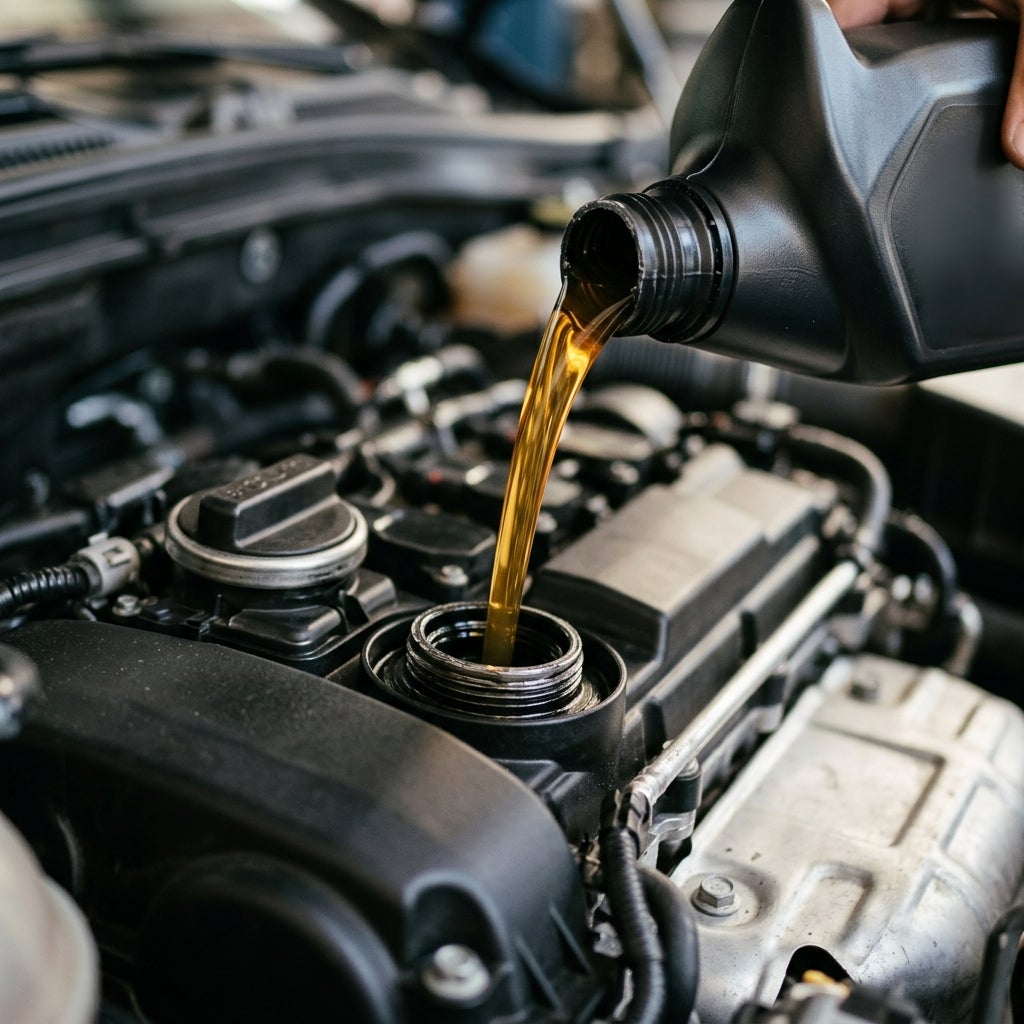
Understanding Motor Oil Viscosity Ratings: What Numbers Like 5W-30 Mean for Your Engine

Understanding Motor Oil Viscosity Ratings: What Numbers Like 5W-30 Mean for Your Engine

Understanding Motor Oil Viscosity Ratings: What Numbers Like 5W-30 Mean for Your Engine When you pull out the dipstick or look at a bottle of motor oil on the shelf in Junction City, those alphanumeric codes—like 5W-20, 5W-30, or 0W-20—can feel like a secret mechanical dialect. In simple terms, a motor oil viscosity rating measures the fluid's internal resistance to flow. Think of viscosity as the liquid's thickness: high-viscosity fluids flow slowly like warm molasses, while low-viscosity fluids flow rapidly like water. For your engine, maintaining the precise balance of fluid flow is the single most critical factor in preventing metal-to-metal contact, reducing mechanical friction, and dissipating destructive friction heat. Modern internal combustion engines operate under extreme pressure with tolerances measured in thousandths of a millimeter. The oil must be thin enough during a cold morning start in Kansas to instantly pump up into the top cylinder heads and overhead camshafts. Yet, once your vehicle reaches peak operating temperature while cruising along I-70, that very same oil must remain thick enough to form a durable protective cushion between rapidly moving internal components. Understanding how multi-grade viscosity works empowers you to make informed decisions for your vehicle's long-term health. If your engine is due for fresh fluid, you can easily Schedule Ford Service with our factory-trained specialists. Decoding the Numbers: How Cold-Flow and High-Temp Viscosity Protect Engine Parts The Society of Automotive Engineers (SAE) established the standardized numerical scale used on motor oil containers worldwide. Multi-grade oils use a two-number rating system separated by the letter 'W'. The 'W' strictly stands for **Winter**, not weight. The first number preceding the 'W' (such as 0W, 5W, or 10W) indicates the oil's flow capability at low winter temperatures. A lower number means better cold-flow performance, allowing the oil to reach engine bearings instantly upon ignition during freezing weather in Junction City. The second number following the hyphen (such as 20, 30, or 40) represents the oil's kinematic viscosity at 100°C (212°F)—the standard operating temperature of a fully warmed engine. Higher numbers indicate a thicker oil film at elevated temperatures, providing robust barrier protection under severe thermal strain. Using an oil with the incorrect cold rating can lead to dry startups, while an incorrect hot rating can cause oil film breakdown under heavy acceleration. How Kansas Weather and Flint Hills Driving Impact Oil Viscosity Performance Driving conditions across Dickinson County and Geary County put unique demands on your vehicle's lubrication system. Mid-western weather shifts dramatically throughout the year—from sub-zero winter blasts to scorching 100°F heat waves in peak summer. Extreme cold causes low-quality oils to thicken excessively, starving key components during start-up. Conversely, blistering summer heat accelerates thermal oxidation, causing oil molecules to break down into varnish and sludge. Furthermore, tackling steep inclines across the Flint Hills or pulling heavy equipment requires sustained high RPMs. This mechanical stress subjects the engine oil to extreme shear forces, which can physically tear apart polymer viscosity modifiers. When towing heavily in a truck like the powerful Research Ford F-150, oil sump temperatures rise rapidly. If the viscosity degrades below factory specifications, oil pressure drops, exposing crank journals and connecting rod bearings to dangerous metal contact. Regular fluid checks and timely oil changes ensure your engine maintains strong shear stability no matter how demanding the road or weather conditions become in central Kansas. Which Engine Types Strictly Require Full Synthetic Motor Oil? Turbocharged EcoBoost® Systems Turbochargers spin up to 200,000 RPM and are cooled directly by engine oil. Conventional oils can coking or char inside hot turbo bearings when turned off. Full synthetic oil provides superior thermal resistance, protecting turbo shaft seals against extreme heat degradation. Direct-Injection & High Compression Modern gasoline direct-injection (GDI) engines operate at elevated internal pressures and are prone to Low-Speed Pre-Ignition (LSPI). Full synthetic formulations meet strict API SP/ILSAC GF-6 standards engineered specifically to eliminate damaging LSPI knock events. Hybrid & Auto Stop-Start Vehicles Vehicles with automatic stop-start technology or hybrid powertrains, such as those found in the Research Ford Explorer, frequently cycle the engine on and off. Ultra-low viscosity synthetic oils ensure instant oil pressure delivered within milliseconds of restarting. Schedule Synthetic Oil Service What Components Are Inspected During a Standard Full-Service Oil Change? A standard oil change at Valor Ford is much more than simply draining old oil and pouring in fresh fluid. Every routine service includes a comprehensive evaluation designed to keep your vehicle running in peak condition: 1. **Drain & Replace Motor Oil:** Draining worn engine oil and refilling with exact OEM-recommended viscosity. 2. **Filter Replacement:** Installing a high-efficiency replacement filter. You can also Order Genuine Ford Parts directly through our parts center. 3. **Fluid Inspection & Top-Off:** Checking windshield washer fluid, engine coolant, brake fluid, and power steering levels. 4. **Belts & Hoses Check:** Inspecting serpentine belts and radiator hoses for cracks, swelling, or tension loss. 5. **Tire Pressure & Tread Depth:** Adjusting all four tires to correct PSI and measuring remaining tread thickness. 6. **Multi-Point Vehicle Health Inspection:** Reviewing battery health, wiper blades, intake air filters, and suspension alignment points. What Happens If I Delay or Skip Oil Changes Recommended by Junction City Service Advisors? Postponing your scheduled maintenance intervals triggers a chain reaction of mechanical wear inside your engine. Over time, heat exposure causes chemical breakdown of the oil's additive package. Anti-wear zinc compounds deplete, detergent additives saturate, and the base oil oxidizes into thick black engine sludge. As sludge accumulates, narrow lubrication passages—such as variable camshaft timing solenoids and oil pick-up screens—become clogged. Deprived of steady oil pressure, precision components begin friction-grinding against each other, creating metallic debris that circulates throughout the entire system. Skipping oil changes also severely impacts fuel economy. Worn, oxidized oil increases internal fluid friction, forcing your engine to work significantly harder just to turn the crankshaft. Piston rings can become gummed up and stick, leading to cylinder wall scoring, excessive oil consumption, loss of compression, and eventual catastrophic engine overheating. Protecting your investment requires maintaining steady drain intervals tailored to your specific driving habits in Junction City. What Factors Most Affect the Price of an Oil Change in Junction City, KS? Fluid Type & Formulation Full synthetic oils cost more upfront than synthetic blends or conventional oils due to advanced chemical refinement, but they offer significantly longer protection intervals and superior cold-weather flow. Engine Sump Capacity A compact sedan may require only 4 to 5 quarts of oil, whereas heavy-duty trucks like the PowerStroke® diesel require up to 13 to 15 quarts, directly impacting total fluid material costs. Filter Specification Genuine Motorcraft® high-efficiency filters utilize synthetic blend media designed to trap micro-particulates without restricting oil volume, offering premium protection over generic aftermarket filters. View Service Pricing Are Independent Garages Near Junction City Good Alternatives to Dealership Service? While quick-lube shops and corner independent repair garages are widespread, they often utilize one-size-fits-all bulk oils that fail to meet strict OEM engineering specs. Using a bulk 5W-30 formulation that lacks vehicle-specific chemical approvals can degrade engine seals and void factory oil life monitors. At Valor Ford, our service department is staffed by Senior Master-certified technicians who specialize exclusively in your vehicle's exact engine platform. We utilize specialized Ford Integrated Diagnostic System (IDS) tools, OEM recalibration software, and exact-fit Motorcraft fluids formulated specifically for your powertrain. Do Independent Auto Service Centers Void Manufacturer Vehicle Warranties? Under the federal **Magnuson-Moss Warranty Act**, vehicle owners are legally allowed to perform routine maintenance at independent facilities without automatically voiding their original manufacturer factory warranty. However, if an independent garage uses substandard fluid, incorrect viscosity, or an unapproved filter that leads to mechanical failure, the manufacturer reserves the right to deny warranty coverage for that repair. Furthermore, independent shops require you to manually collect, organize, and store physical paper receipts to prove maintenance compliance if a warranty claim arises years down the road. Servicing your vehicle at Valor Ford provides complete administrative peace of mind. Every service visit, fluid type, and multi-point inspection record is logged directly into Ford's centralized nationwide OASIS database. If you ever need warranty repairs anywhere in North America, your maintenance history is instantly verified with zero hassle or paperwork required. Why Should I Schedule an Oil Change Appointment Instead of Just Walking In? Reserved Bay Access Scheduling guarantees immediate vehicle check-in and dedicated service bay access, eliminating long waiting room delays for active military personnel from nearby Fort Riley. Pickup & Delivery Convenience Busy schedule? You can easily Schedule Pickup and Delivery Service where we pick up your vehicle from your home or office and return it fully serviced. Staged OEM Parts Pre-booked appointments allow our parts department to stage your exact motor oil viscosity specification and OEM filter prior to your arrival for rapid turnaround times. Reserve Your Service Time Slot Junction City Service & Oil Change Excellence: The Valor Ford Difference At Valor Ford, we take immense pride in serving the automotive needs of drivers throughout Junction City, Manhattan, and surrounding Kansas communities. Our commitment to vehicle longevity starts with our dedicated team of factory-certified service experts who treat your vehicle with the care and precision it deserves. Whether you need an exact-fit Motorcraft oil change, routine maintenance, or general diagnostic care, our modern service center provides service information and comfortable amenities. Stop by our dealership today or get in touch with our advisors: 📍 Get Directions to Valor Ford at 1825 Goldenbelt Blvd, Junction City, KS 66441. 📞 Questions? Call us at (785) 238-5114 to speak directly with a service advisor. Protect Your Engine: Schedule Your Next Oil Change at Valor Ford in Junction City Keep your engine performing at its best. Ensuring your vehicle uses the correct motor oil viscosity rating is the easiest way to preserve engine performance, maximize fuel economy, and extend vehicle lifespan. Experience the professional care, genuine Motorcraft components, and customer-first service that set Valor Ford apart. Schedule Factory-Backed Oil Service Today

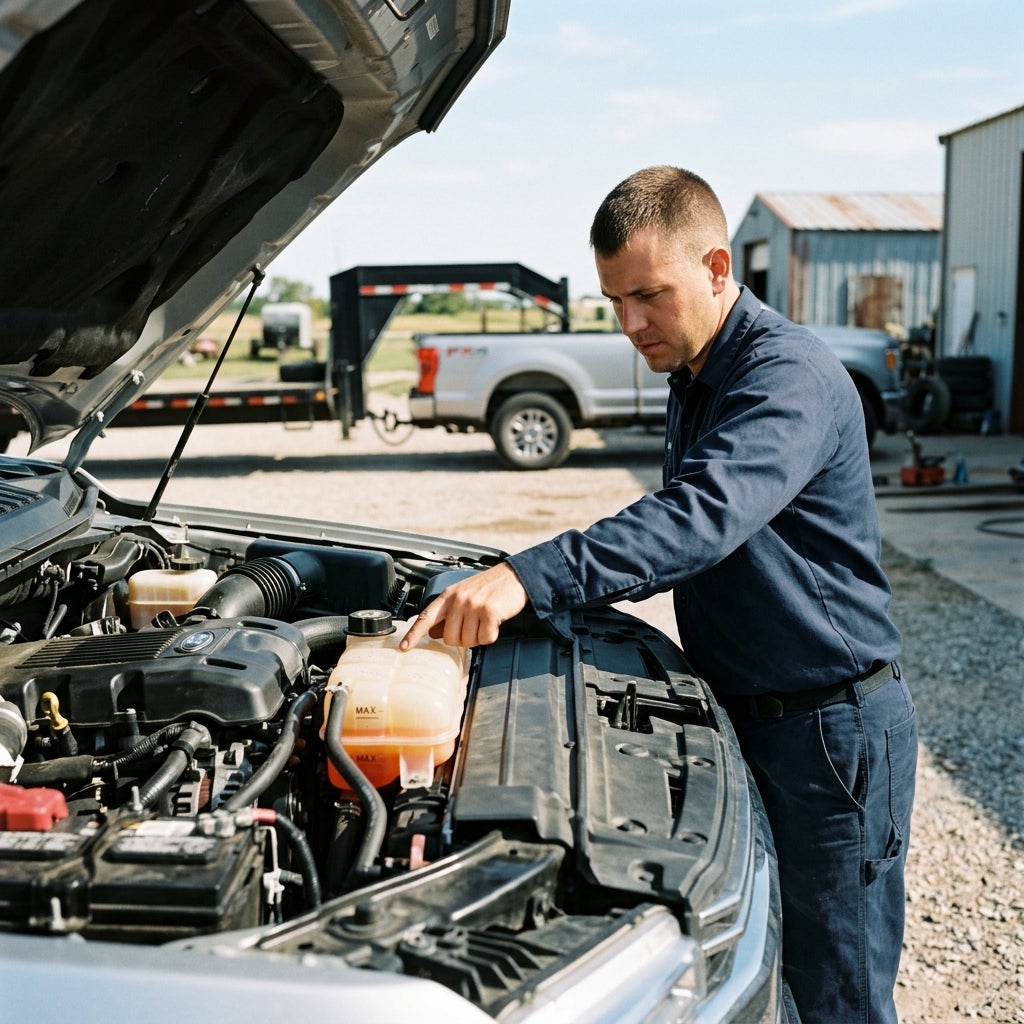
A mechanic in a blue uniform points to the coolant reservoir tank under the open hood of a silver pickup truck. (Representative image for illustration purposes only. Actual vehicle may vary based on trim and configuration.)

Signs Your Super Duty Cooling System Needs Immediate Service Before Towing

Signs Your Super Duty Cooling System Needs Immediate Service Before Towing When you rely on a Ford Super Duty to haul multi-ton excavators, livestock trailers, or fifth-wheel RVs across Junction City and through the Flint Hills, your engine operates under extreme thermal loads. As Service Director at Valor Ford with two decades of hands-on diesel experience, I can tell you that 80% of summer diesel breakdowns on I-70 are entirely preventable. Before you latch onto a heavy load, taking five minutes to run through a quick walkaround inspection of your primary and secondary cooling systems can save you thousands of dollars and days of downtime. The modern 6.7L Power Stroke diesel engine is a engineering marvel, but its dual-cooling system architecture requires vigilant care. Key warning signs that warrant an immediate pause before hitching up include dropping fluid levels in either the primary or secondary degas bottles, a distinct sweet-smelling vapor drifting from under the hood after a test warm-up, dry crusty orange or yellow Motorcraft coolant residue around quick-connect fittings, unusual fan clutch resistance, and upper radiator hoses that feel either rock-hard under pressure or spongy and soft when cool. Catching these early indicators protects your head gaskets, EGR coolers, and turbochargers from catastrophic heat distortion. Schedule Super Duty Inspection Meet Mike Hogg: 20 Years of Super Duty Heavy-Duty Diesel Service Hello, I'm Mike Hogg, Service Director here at Valor Ford in Junction City. Over the past 20 years, my career has been dedicated to keeping Ford heavy-duty trucks running at peak reliability across North Central Kansas. From local agricultural operations in Dickinson and Geary counties to commercial transport contractors and military equipment haulers servicing Fort Riley, I've diagnosed and repaired every thermal issue imaginable on Power Stroke diesel platforms. When you work in heavy towing, your cooling system isn't just an accessory—it's the heart of your truck's durability. A small pinhole leak or failing fan clutch during mild cruising becomes a catastrophic thermal runaway when you're pulling 20,000 pounds up an 8% grade in August. My team and I are passionate about proactive maintenance because we know that preventing an engine overhaul starts before the truck ever leaves the staging yard. Feel free to Call us at (785) 238-5114 anytime to talk through your truck's maintenance needs. Why Is Pre-Work Cooling Inspection Especially Important Before Towing? Towing heavy gooseneck trailers or maximum payload box beds pushes your Ford Super Duty engine into sustained high-boost operating zones. Under heavy load, peak combustion temperatures soar, and the engine generates exponentially higher thermal energy that must be dissipated through the cooling stack immediately. If your cooling system has even a 5% drop in efficiency—due to degraded fluid, trapped air pockets, or partially restricted radiator fins—the heat accumulation outpaces heat rejection. In normal commuter driving without payload, a compromised cooling system might hide its flaws. The fan clutch might kick in late, or the secondary circuit might run slightly elevated without causing an immediate check engine light. However, the moment you put the truck under heavy load on Kansas highways, heat levels spike in seconds. Pre-work checks ensure your primary and secondary cooling loops maintain maximum thermal headroom, preventing sudden derate modes or warped components miles away from help. Furthermore, modern Power Stroke engines feature sophisticated electronic safeguards that will automatically pull engine torque and boost when cylinder head or oil temperatures cross threshold limits. Imagine pulling out onto Highway 77 with a heavy load, only for your truck to enter reduced power mode midway up a hill because the secondary coolant loop couldn't chill the charge air cooler. Performing a thorough cold check before your workday starts prevents these frustrating and dangerous highway power drops. Whether you are operating an older 6.7L model or considering upgrading to a newer model like when you Research Ford F-250 options, keeping tabs on thermal health is vital. Taking proactive steps gives you complete confidence when embarking on tough jobsite assignments across Junction City. Critical Visual Flags: What Pre-Work Inspection Signs Indicate Immediate Service? 1. Crusty Coolant Residue Look for chalky, dried orange, pink, or yellow deposits around hose connections, thermostat housings, radiator end-tanks, and water pump seams. This residue is evaporated coolant escaping under system pressure. 2. Hose Swelling or Softness Squeeze radiator hoses when cold. Spongy, overly soft, or bulged sections indicate oil contamination or inner liner breakdown. Excessively hard hoses indicate calcification or high pressure buildup. 3. Degas Tank Stress Cracks Inspect plastic degas surge bottles for yellowing micro-fractures along heat-stressed molded seams. A compromised degas tank cannot hold pressure, lowering coolant boiling points dramatically. Order Genuine Motorcraft Coolant & Parts What Does a Coolant Puddle Under Your Super Duty Usually Indicate? Discovering a bright yellow, orange, or green fluid puddle on your driveway or shop floor is a clear warning sign. On Ford Super Duty diesel trucks, fluid location provides valuable diagnostic clues before turning the key. Fluid dripping near the front center of the engine crossmember often points to a failing water pump shaft seal weeping through its lower relief port. Leaks spotted near the front passenger or driver corners typically originate from primary radiator plastic end-tank crimp seams or lower radiator hose quick-connector O-rings. Over time, heavy thermal expansion cycling fatigues the rubber O-rings inside plastic quick-connect fittings, causing cold-weather seepage that expands under pressure. If you notice drips dripping down the rear of the engine block near the bellhousing, the culprit is often a leaking secondary turbo cooling line fitting or EGR cooler supply connection. These high-heat zones quickly degrade standard seals. Never ignore small drips; fluid loss reduces hydraulic head pressure, creating air pockets that induce severe localized hotspot boiling inside cylinder heads. If you are unsure where a puddle originates, bring your vehicle in for professional pressure diagnostics. You can Get Directions to Valor Ford and our certified diesel specialists will pinpoint the exact source. Understanding Fluid Capacities: How Much Coolant Does a 6.7L Power Stroke Hold? To properly service and maintain a 6.7L Power Stroke V8 Turbo Diesel, you must understand its specialized dual-cooling system architecture. Unlike standard gasoline light trucks that use a single cooling loop, Super Duty diesel trucks utilize two independent cooling systems operating at different thermal ranges with separate degas tanks, radiators, and water pumps. Cooling Circuit Target Components Fluid Capacity (Approx.) Recommended Fluid Spec Primary High-Temp Circuit Engine Block, Cylinder Heads, Turbo Housing 27.8 – 30.7 Quarts (7.0 – 7.7 Gal) Motorcraft Yellow Prediluted 50/50 Secondary Low-Temp Circuit Charge Air Cooler (Intercooler), Transmission Cooler, Fuel Cooler 11.7 – 13.0 Quarts (2.9 – 3.2 Gal) Motorcraft Yellow Prediluted 50/50 Combined, a 6.7L Power Stroke holds over 10 total gallons of coolant! Mixing unapproved universal coolants or tap water with high mineral content can corrode internal heat exchangers and create scale buildup. Always verify that you are topping off with genuine Motorcraft Yellow coolant formulated specifically for Ford high-output diesels. What Kinds of Damage Can Happen If You Keep Driving a Super Duty Hot? Ignoring temperature warnings on a heavy-duty diesel engine leads to severe financial consequences. When a Super Duty engine operates past thermal thresholds under load, aluminium cylinder heads undergo thermal expansion that distorts deck flatlines. This warp breaks head gasket fire rings, allowing high-pressure combustion gases to pressurize the cooling system. Simultaneously, extreme exhaust gas recirculation (EGR) temperatures can crack internal stainless steel EGR cooler tubes. Once cracked, pressurized coolant is forced directly into the exhaust stream or intake manifold, creating white exhaust smoke and risk of hydraulic lock in engine cylinders. Uncontrolled heat also cooks turbocharger center-housing bearings, coking engine oil and starving bearings of critical lubrication. What starts as a simple quick-connect O-ring leak can spiral into a major repair costing significantly more over time. Prioritizing pre-work inspections safeguards your investment. Expert Service Perspective: Preventing $10,000 Overhauls with 5-Minute Checks "In my 20 years managing Ford heavy-duty service bays, the single most cost-effective habits I coach commercial fleet managers on are quick, cold morning visual checks. Pop the hood before starting the truck. Look at both degas tank cold fill lines. Give the upper hose a firm squeeze. Check the front bumper air intake for farm dust or debris. Spending 300 seconds doing this every morning saves you $10,000 in major diesel engine overhauls down the road." — Mike Hogg, Service Director at Valor Ford Schedule Pickup and Delivery Service What Should Be Inspected in the Cooling System Before Putting Your Super Duty to Work? Phase 1: Fluid & Caps Verify primary and secondary degas fluid levels are exactly at the cold fill line. Inspect pressure cap seals for dried crust or torn rubber gaskets. Replace degas caps every 3 years to maintain 16 PSI baseline pressure. Phase 2: Belt & Fan Clutch Examine the serpentine belt for glazing, rib cracking, or wear indicator misalignment on the tensioner arm. Spin the viscous fan clutch manually when cold; it should offer smooth, moderate resistance without axial play. Phase 3: Airflow Stack Shine a flashlight through the front grille mesh to inspect the radiator, AC condenser, and charge air cooler. Clear out farm chaff, dried mud, insects, and straighten bent fins that restrict critical Ram airflow. How Kansas Terrain and Towing Loads Accelerate Super Duty Cooling Wear Operating trucks around Junction City, Fort Riley, and throughout Dickinson County presents unique environmental challenges. The rolling topography of the Flint Hills forces repeated high-torque engine pulls, causing thermal cycling in aluminum and plastic cooling components. Summer ambient temperatures regularly exceed 95°F with high humidity, reducing radiant cooling efficiency. Agricultural pasture work introduces airborne chaff, dust, and seed heads that clog cooling stack fins. Dust mixes with ambient moisture to form a concrete-like barrier across heat exchangers, cutting air volume dramatically. Regular maintenance is essential for trucks operating in these severe regional conditions. Professional Super Duty Cooling Diagnostics and Maintenance at Valor Ford Factory-Trained Master Techs Our service department is staffed by specialized Ford Senior Master Diesel Technicians who understand every detail of Power Stroke engine platforms. Advanced Pressure Testing We utilize pneumatic pressure diagnostic tools to simulate high-load thermal stress, identifying micro-leaks before they cause highway failures. OEM Motorcraft Parts We stock genuine Ford Motorcraft coolant, heavy-duty hoses, water pumps, and thermostat assemblies built to OEM specifications. Schedule Ford Service Today Schedule Your Super Duty Pre-Work Cooling Inspection in Junction City Today Don't leave your truck's reliability to chance when pulling heavy loads across Kansas. Whether you need a simple system pressure test, a Motorcraft Yellow coolant flush, or a complete pre-season inspection, the expert team at Valor Ford is ready to assist you. Contact us today or drop by our facility at 1825 Goldenbelt Blvd in Junction City. Book Service Appointment

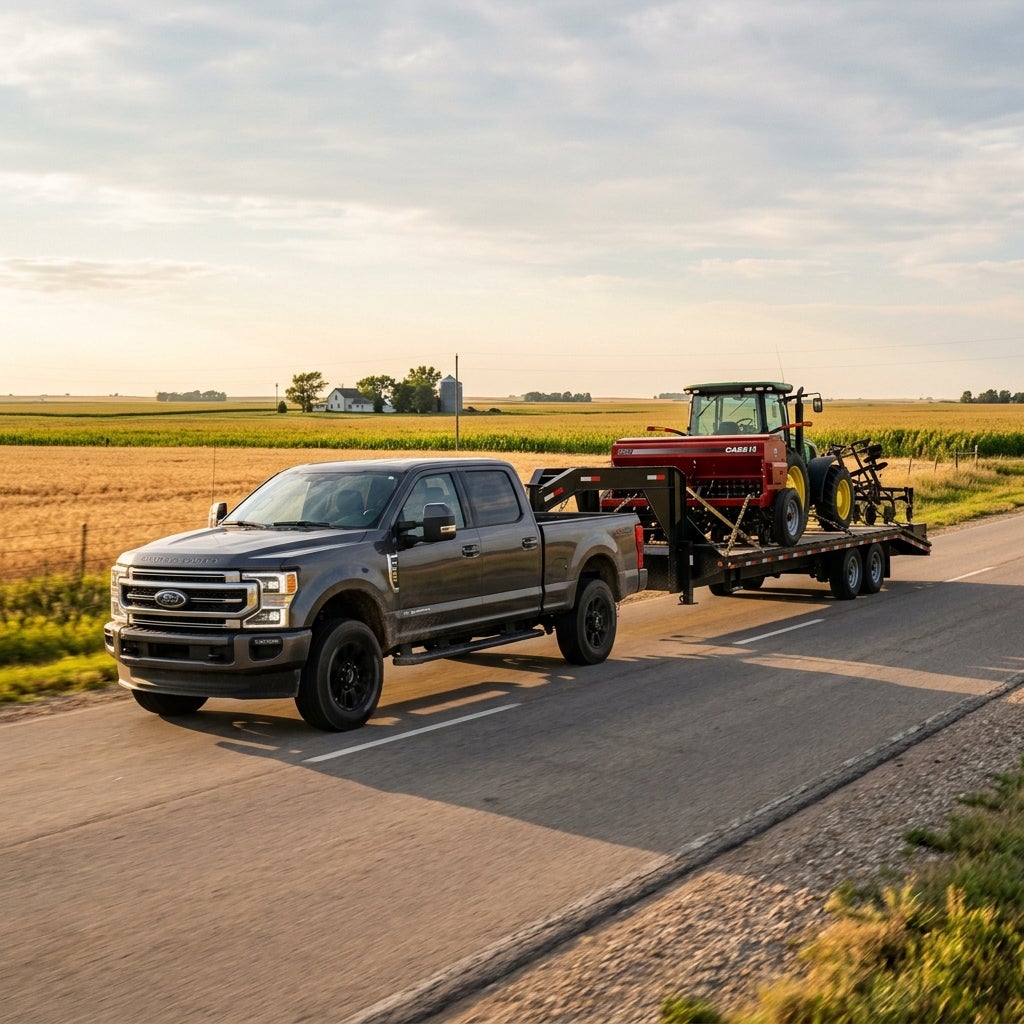
A dark grey Ford Super Duty pickup truck towing a gooseneck trailer with farm equipment down a rural road. (Representative image for illustration purposes only. Actual vehicle may vary based on trim and configuration.)

2022 Ford Super Duty 6.7L Power Stroke Diesel Maintenance Intervals: Official Service Schedule & Direct Expert Guide

2022 Ford Super Duty 6.7L Power Stroke Diesel Maintenance Intervals: Official Service Schedule & Direct Expert Guide Direct Answer First: Maintaining the third-generation 6.7L Power Stroke V8 Turbo Diesel in your 2022 Ford Super Duty F-250, F-350, or F-450 requires strict adherence to fluid and filter service lifecycles. Under normal operating conditions, recommended factory service intervals dictate performing engine oil and filter changes every 7,500 to 10,000 miles (or when triggered by the Intelligent Oil Life Monitor system, not to exceed 1 year or 350 engine hours). Dual fuel filters (both the primary frame-mounted water separator and secondary engine-mounted filter) must be replaced every 15,000 to 22,500 miles (or every second oil change). Engine air filter elements require inspection every 15,000 miles and mandatory replacement at 30,000 miles. Engine coolant (yellow OAT) must be tested every 20,000 miles or 1000 hours and flushed at 105,000 miles. Brake fluid requires a complete system flush every 3 years regardless of mileage. The 10R140 TorqShift 10-speed automatic transmission fluid and internal filter require service at 150,000 miles under light use, though heavy agricultural towing, commercial enterprise, or frequent idling reduces this threshold to 60,000 miles. The 2022 model year represents the pinnacle of the third-generation 6.7L Power Stroke architecture, featuring a hardened steel-piston engine block, upgraded variable-geometry turbocharger, and a 36,000-psi common-rail fuel injection system. Delivering an astounding 475 horsepower and 1,050 lb-ft of torque, this powerplant demands disciplined preventive maintenance to maintain peak thermal efficiency, protect emission control devices (DPF, SCR, and EGR), and prevent premature wear on high-pressure hydraulic and fuel delivery components. Whether your truck spends its life cruising Interstate 70 or pulling heavy livestock trailers through Dickinson County dirt roads, keeping rigorous service logs ensures long-term operational reliability. Service Task Normal Duty Interval Severe Duty / Towing Interval Critical Notes & Specs Engine Oil & Filter 7,500 – 10,000 Miles / 1 Yr 5,000 Miles / 200 Engine Hours 13.0 Qts 5W-40 Synthetic (CK-4 Spec) Dual Fuel Filters (Primary & Secondary) 15,000 – 22,500 Miles 10,000 – 15,000 Miles Must drain water separator monthly Engine Air Filter Element 30,000 Miles (Inspect at 15k) 10,000 – 15,000 Miles Inspect weekly in dusty agricultural use Engine Coolant (Yellow OAT) 105,000 Miles (Test at 20k) 60,000 Miles (Test at 15k) Test corrosion inhibitor strength 10R140 TorqShift Transmission Fluid 150,000 Miles 60,000 Miles Requires Motorcraft ULV Transmission Fluid Front & Rear Differential Axle Lube 150,000 Miles 60,000 Miles Synthetic 75W-140 / 75W-85 gear oil Brake Fluid Flush 3 Years (Time-based) 3 Years (Time-based) DOT 4 Low Viscosity Synthetic Expert Perspectives: 20 Years of Power Stroke Service Leadership with Mike Hogg When evaluating diesel longevity, theoretical service tables only tell half the story. Practical wrench time, master diagnostics, and geographic experience define actual truck health. As Service Director at Valor Ford in Junction City, KS, Mike Hogg brings over 20 years of dedicated Ford diesel engineering and hands-on maintenance leadership to truck owners across Dickinson County, Geary County, and the active duty military community at Fort Riley. "Over two decades servicing Ford Super Duty platform generations—from the early 7.3L and 6.0L days to the sophisticated third-generation 6.7L Power Stroke—I've seen firsthand how real-world usage dictates component lifespan," notes Mike Hogg. "Central Kansas presents a brutal operating environment. Our summers feature ambient temperatures pushing past 100 degrees during harvest season, while our winters hit sub-zero conditions with biting winds. Add in heavy gooseneck livestock hauling, commercial grain transport, and frequent high-dust field work, and standard maintenance schedules quickly become insufficient." At Valor Ford, Mike Hogg leads a team of Senior Master Technicians who specialize in modern diesel powertrain calibration, exhaust post-treatment restoration, and preventive driveline servicing. If you ever have questions about your maintenance schedule or require expert diagnostic support, you can Call us at (785) 238-5114 or stop by our service bay. What Engine Options and Towing Specs Define the 2022 Ford Super Duty Lineup? The 2022 Ford Super Duty family was engineered to provide unparalleled capability across diverse commercial, agricultural, and personal applications. Ford offered three distinct engine powertrains in 2022, each tailored to specific payload demands, duty cycles, and operating budgets. 6.7L Power Stroke V8 Diesel Output: 475 HP @ 2,600 RPM Torque: 1,050 lb-ft @ 1,600 RPM Transmission: TorqShift 10-Speed Automatic Max Towing: Up to 37,000 lbs (Gooseneck F-450) Key Feature: Steel pistons, 36k-psi injection, variable geometry turbo. Designed for maximum long-distance heavy towing. 7.3L Godzilla V8 Gas Output: 430 HP @ 5,500 RPM Torque: 475 lb-ft @ 4,000 RPM Transmission: TorqShift 10-Speed Automatic Max Towing: Up to 21,200 lbs conventional Key Feature: Pushrod V8 design with cast-iron block. Ideal for fleet operators seeking gas simplicity with heavy commercial output. 6.2L Boss V8 Gas Output: 385 HP @ 5,750 RPM Torque: 430 lb-ft @ 3,800 RPM Transmission: TorqShift 6-Speed / 10-Speed Max Towing: Up to 15,800 lbs Key Feature: Proven SOHC workhorse architecture standard on XL/XLT F-250 trims, optimized for everyday municipal and trade work. While all three engines demonstrate exceptional durability, the 6.7L Power Stroke Turbo Diesel remains the leading option for heavy gooseneck and fifth-wheel trailering. When paired with the high-strength boxed steel frame, upgraded axle shafts, and integrated fifth-wheel hitch prep package on the F-250 and F-350, the diesel powertrain unlocks maximum payload and towing ratings that gas engines simply cannot match over steep elevation changes or long highway hauls. To explore vehicle specs further, check out our in-depth research guides for the Research Ford F-250 lineup. How Does Normal Schedule Compare to Severe Duty Maintenance for Kansas Agriculture and Heavy Towing? Understanding Ford's definition of Special Operating Conditions (Severe Duty) is essential for Central Kansas Super Duty owners. Standard oil change intervals of 7,500 to 10,000 miles assume smooth highway travel without excessive payload, idle time, or environmental hazards. However, if your 2022 Power Stroke operates under any of the following parameters, Ford mandates transitioning to severe duty maintenance cycles: • Frequent Towing or Heavy Payload: Towing trailers exceeding 50% of the gross combined weight rating (GCWR) for extended distances. • Extensive Engine Idling: Operating the truck at low idle speeds for prolonged periods (e.g., job site power generation, stationary PTO use, or military staging at Fort Riley). • Dusty & Unpaved Environment: Driving on gravel ranch roads, farm lanes, or dirt access routes throughout Dickinson County during harvest. • Off-Road & Low-Speed Operation: Consistent operation in low-range 4x4 or frequent short trips under 10 miles in ambient freezing weather. Under severe duty, oil degradation occurs significantly faster due to soot accumulation and thermal breakdown. Ford specifies reducing oil change intervals to 5,000 miles or 200 engine hours, while cutting transmission, transfer case, and differential fluid change intervals by more than 50%. Schedule Ford Service Today Mike Hogg’s Golden Rule for 6.7L Power Stroke Longevity: Dual Fuel Filters and Clean DEF "If I could give every diesel truck owner in Kansas just one single piece of advice to help reduce the risk of unexpected repairs, it would be this: never compromise on your fuel filtration and DEF handling," states Service Director Mike Hogg. "The modern 6.7L Power Stroke utilizes a high-pressure common rail fuel injection system operating at pressures up to 36,000 psi. At these ultra-high hydraulic pressures, even microscopic water droplets or fine rust particulates passing through dirty filters can cause catastrophic pump cavitation or galling. Replacing fuel filters every 15,000 miles—or sooner if you purchase bulk farm fuel—is cost-effective protection compared to a $10,000 fuel system overhaul." Key Diesel Fuel & DEF Care Rules from Mike Hogg: 1. Drain the Water Separator Monthly: Located on the primary frame-mounted fuel filter module, the water drain valve should be opened monthly into a clear container to purge trapped condensation before water sensors trigger warning lights. 2. Use Genuine Motorcraft Filters: Aftermarket fuel filters frequently exhibit inferior micron filtration ratings or improper O-ring sealing dimensions, allowing unmetered fuel bypass directly into delicate piezo fuel injectors. 3. Store Diesel Exhaust Fluid (DEF) Properly: DEF consists of 67.5% deionized water and 32.5% high-purity urea. DEF degrades rapidly when exposed to direct sunlight or temperatures exceeding 85°F. Always use fresh DEF from sealed containers or verified retail pumps to prevent SCR catalyst crystallisation and dosing valve clogging. 4. Winterizing with Anti-Gel Additives: When ambient temperatures approach 20°F in Junction City, ultra-low sulfur diesel (ULSD) forms wax paraffin crystals that clog fuel filter media. Always add Motorcraft Anti-Gel & Cetane Booster at every fill-up during winter months. What Should You Inspect When Test-Driving a Used 2022 Ford Super Duty? Shopping for a pre-owned 2022 Ford Super Duty diesel offers extraordinary capability, but buyer diligence is essential. Before signing paperwork, perform these crucial expert inspection steps developed by our Senior Master Technicians: 1. Cold Start & Engine Integrity Insist on starting the truck when the engine block is completely cold. Watch the tailpipe for heavy white smoke (unburnt fuel/coolant) or blue smoke (oil burning). Remove the oil filler cap while idling—excessive engine blowby escaping from the valve cover indicates worn piston rings or cylinder wall scuffing. 2. Transmission & Drivetrain Evaluate shift engagement through all 10 gears of the TorqShift transmission. Test for gear hunting, harsh downshifts, or delayed forward engagement. Shift the transfer case into 4H and 4L on loose gravel to confirm electronic hub engagement and front differential quietness. 3. History & Frame Condition Inspect the bed for telltale signs of commercial fifth-wheel or gooseneck hitch mounting. Examine the rear hitch receiver for elongated pin holes. Request complete OASIS service records to verify fuel filter replacement frequency and past recall completion. What Trim Levels and Interior Technology Updates Were Introduced in the 2022 Ford Super Duty? The 2022 model year brought substantial technological refinements to the Super Duty interior, establishing a new benchmark for heavy-duty cabin connectivity and driver comfort across six available trim levels: • XL: Rugged work truck trim with durable vinyl flooring, heavy-duty cloth seats, and SYNC 3 4.2-inch interface. • XLT: The popular multi-purpose trim featuring 18-inch aluminum wheels, Ford Co-Pilot360 safety technology, and available 12-inch touchscreen. • Lariat: Adds premium leather seating, B&O Sound System, power-sliding rear window, and standard SYNC 4. • King Ranch: Distinctive Kingsville antique leather interior, real wood trim accents, and trailer reverse guidance. • Platinum: Luxury features including massaging multi-contour front seats, satin chrome exterior accents, and LED headlights. • Limited: The ultimate luxury heavy-duty package with Highland Tan leather, twin-panel moonroof, and adaptive steering. SYNC 4 Technology Breakthrough: Standard on Lariat trims and above, the standout update for 2022 was the debut of the SYNC 4 infotainment system on a massive 12-inch center touchscreen. Featuring twice the computing power of previous systems, SYNC 4 offers wireless Apple CarPlay and Android Auto integration, customizable split-screen multitasking, enhanced natural voice recognition, and cloud-connected navigation for real-time traffic and trailer routing. Browse Used Inventory How Does the 2022 Ford Super Duty Compare to the 2022 Chevy Silverado HD? When pitting the 2022 Ford Super Duty 6.7L Power Stroke against the 2022 Chevy Silverado 2500/3500 HD with the 6.6L Duramax L5P diesel, both trucks represent exceptional engineering achievements. However, notable differences exist in powertrain metrics and routine service maintenance requirements. Power Output: Ford's 6.7L Power Stroke generates 475 hp and 1,050 lb-ft of torque, outperforming the Silverado HD Duramax (445 hp and 910 lb-ft of torque) by 30 hp and 140 lb-ft of torque. This torque advantage is immediately noticeable when starting heavy loads on uphill highway grades. Filter & Serviceability: Ford's dual-filter fuel architecture provides robust secondary defense against water contamination, whereas GM utilizes a single frame-mounted fuel filter module. Both trucks require specialized synthetic low-ash heavy-duty diesel engine oils, but Ford's Intelligent Oil Life Monitor utilizes actual engine operating parameters (fuel burn, thermal history, idle hours) rather than simple mileage counters. Metric / Feature 2022 Ford Super Duty (6.7L) 2022 Chevy Silverado HD (6.6L) Horsepower 475 HP @ 2,600 RPM 445 HP @ 2,800 RPM Torque Rating 1,050 lb-ft @ 1,600 RPM 910 lb-ft @ 1,600 RPM Transmission 10-Speed TorqShift 10-Speed Automatic Transmission Max Gooseneck Towing Up to 37,000 lbs Up to 36,000 lbs Fuel System Filter Dual Filters (Frame + Engine) Single Primary Frame Filter Oil Capacity 13.0 Quarts 10.0 Quarts How Does the 2022 Ford Super Duty Compare to the 2022 Ram 2500 and 3500? Comparing the 2022 Ford Super Duty 6.7L V8 Power Stroke to the 2022 Ram 2500/3500 Cummins 6.7L Inline-6 Turbo Diesel highlights fundamental design philosophies: Engine Architecture & Gearing: Ram uses an inline-6 configuration, while Ford utilizes a hot-V CGI (compacted graphite iron) block V8 design. Ford pairs every 2022 Power Stroke with the heavy-duty 10-speed TorqShift transmission, whereas Ram 2500 models rely on a 6-speed 68RFE transmission (with the 6-speed Aisin reserved for High-Output 3500 models). The extra four gear ratios in Ford's TorqShift maintain optimal engine RPM bands during acceleration under load. Payload & Service Costs: Because of lighter overall aluminum-alloy body construction, the Ford Super Duty yields higher payload capacity on comparable GVWR configurations. From a long-term operational cost perspective, both trucks require strict dual fuel filter maintenance, but Ford's front-end suspension design (Twin-Coil Monobeam axle) demonstrates superior steering ball joint longevity under heavy farm loader use. Transmissions, Differentials, and Transfer Cases: Essential Fluid Care for Heavy Hauling 10R140 Transmission Care The TorqShift 10-speed transmission requires ultra-low viscosity Motorcraft ULV fluid. Operating thermal range is tightly regulated. Fluid pan drops and internal filter replacement should occur every 60,000 miles on severe duty trucks to prevent valve body solenoid varnish. Axle Differential Lube Rear Dana M275/M300 or Sterling 10.5 axles demand synthetic 75W-140 gear lubricant. Replace fluid every 60,000 miles when towing continuously. Inspect housing vent tubes regularly to prevent pressure seal blowouts when launching boats or crossing deep mud. Transfer Case & PTO The electronic shift-on-the-fly 4x4 transfer case utilizes Motorcraft LV fluid. Fluid replacement is scheduled at 60,000 miles for severe duty. Live-drive Power Take-Off (PTO) units require separate gear housing inspections during routine chassis lubrication. Order Genuine Ford Parts Preparing Your 2022 Power Stroke for Winter and Farm Work in Junction City and Fort Riley Operating a diesel truck in Junction City, Fort Riley, and surrounding Kansas communities requires specialized seasonal awareness. Extreme temperature fluctuations between summer field work and winter sub-zero freezes place heavy demands on your electrical and cold-start systems. Cold Weather Readiness: Ensure your engine block heater cord is inspected before November. Modern 6.7L engines utilize ceramic glow plugs that reach over 1,000°C in seconds, but dual heavy-duty AGM batteries must maintain optimal cold cranking amps (CCA) to spin high-compression diesel starters in sub-zero weather. Have your batteries load-tested annually at Valor Ford. Harvest Dust & Air Filtration: During autumn sorghum and corn harvest, ambient dust levels skyrocket. Check your air filter restriction gauge weekly. A clogged intake filter starves the turbocharger, increasing exhaust gas temperatures (EGTs) and triggering premature DPF regeneration cycles. Your Partner in Heavy-Duty Reliability: At Valor Ford, we understand that your truck isn't just transportation—it's your livelihood, your farm machinery, or your mission-critical transport. Service Director Mike Hogg and our factory-certified diesel team are here to help you protect your investment with genuine Motorcraft parts, master diagnostics, and tailored maintenance schedules. Whether you need to Schedule Pickup and Delivery Service for routine oil maintenance or visit our service center in person, getting here is easy. Get Directions to Valor Ford located at 1825 Goldenbelt Blvd, Junction City, KS 66441, or Call us at (785) 238-5114 to consult directly with our diesel service specialists today. Valor Ford | 1825 Goldenbelt Blvd, Junction City, KS 66441 | Service Phone: (785) 238-5114 | Serving Geary County, Dickinson County, and Fort Riley military families.

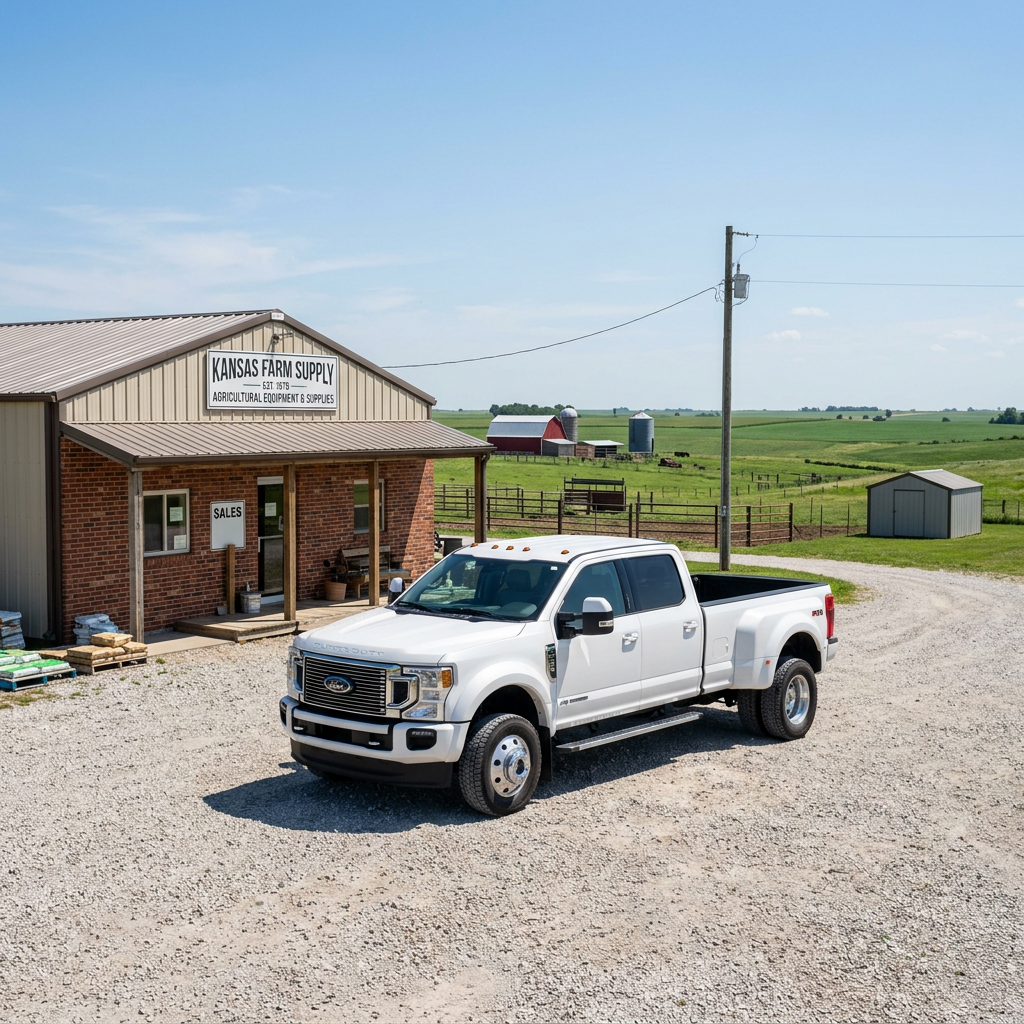
A white Ford Super Duty dually truck parked in front of a rural Kansas Farm Supply building. (Representative image for illustration purposes only. Actual vehicle may vary based on trim and configuration.)

Should I Change My Super Duty's Differential Fluid Before Agricultural Towing in Junction City?

Should I Change My Super Duty's Differential Fluid Before Agricultural Towing in Junction City? As the summer heat settles deep over Dickinson County and the Flint Hills, local farmers and ranchers know that the demands of the agricultural calendar are about to peak. Whether you are hauling massive round bales of hay, moving livestock to fresh pasture, or preparing to transport heavy tillage equipment, your Ford Super Duty is the undisputed backbone of your operation. It is built to handle incredible vertical tongue weights and immense pulling forces. However, before you hitch up that 15,000-pound trailer and head out onto the rolling gravel roads around Junction City, there is one critical maintenance question every truck owner must confront: Is your rear differential fluid ready for the brutal thermal cycle it is about to experience? Many truck owners focus heavily on engine oil, transmission fluid, and coolant levels before embarking on heavy towing seasons. While those fluids are undeniably crucial, the rear differential is often forgotten until it begins to sing, whine, or worse, seize. The differential is the final point of torque transfer before the power hits the dirt. In a Super Duty, this component works under extreme physical pressures. Proactive fluid maintenance is not just a minor checkbox on your to-do list; it is the single most effective way to prevent catastrophic axle failures that can derail your harvest schedule and cost thousands of dollars in unscheduled downtime. At Valor Ford, we understand that a work truck is not just a vehicle—it is a vital business asset. When the harvest window is open, every hour your truck spends in the shop is money lost. That is why we advocate for preventive maintenance schedules tailored specifically to the unique, punishing conditions of Kansas agricultural operations. In this comprehensive guide, we will break down the science of gear lubrication, explain why heavy towing alters your fluid change intervals, and help you determine whether your truck needs a differential service before your next major haul. If you are ready to ensure your truck is fully prepared, you can easily Schedule Ford Service Today with our team of heavy-duty specialists. Why Is Differential Fluid Especially Important for Heavy-Duty Towing on a Super Duty? To understand why differential fluid is so vital, you must first look at the incredible physical forces at play inside your Super Duty's rear axle housing. When you are pulling a fully loaded livestock trailer up a steep incline or dragging a heavy flatbed through a soft, muddy field, your engine generates massive torque. This torque is sent through the transmission and driveshaft directly to the pinion gear. The pinion gear, which is relatively small, must mesh perfectly with the much larger ring gear to rotate your rear axles. Because of the extreme gear reduction and the sheer weight of agricultural loads, the contact points between the teeth of the ring and pinion gears experience mind-boggling pressure. This contact is known as sliding friction. Without an incredibly robust boundary layer of high-viscosity gear oil, the metal teeth of these gears would physically weld themselves together and tear apart in a matter of seconds. Under normal driving conditions, the fluid manages this friction with ease, maintaining a thin, protective film that prevents direct metal-on-metal contact. However, heavy towing changes the equation entirely. As load increases, the pressure between the gear teeth spikes dramatically, generating extreme localized heat. Under heavy-duty towing, rear differential fluid temperatures can easily soar past 220 degrees Fahrenheit, and under severe loads on hot Kansas summer days, they can climb even higher. This extreme heat initiates a process called thermal degradation, where the fluid's molecular structure begins to break down, causing it to lose its viscosity and shear strength. Once the fluid thins out or burns, its ability to cushion the gear teeth diminishes. This leads to accelerated wear, micro-pitting, and eventually, catastrophic gear failure. Furthermore, Super Duty axles are often equipped with limited-slip differentials or locking mechanisms that rely on precise fluid friction properties to function. Old, degraded fluid can cause these mechanisms to chatter, slip, or fail to engage when you need traction most in a slick pasture. Keeping fresh, highly viscous fluid in your axle is the ultimate defense against these destructive forces. How Does Normal Driving Compare to Frequent Towing in Differential Maintenance Needs? Consider a Super Duty that spends most of its time as a daily commuter or light utility vehicle around Fort Riley and Junction City. It carries light payloads in the bed, occasionally runs down the highway, and rarely pulls anything heavier than a small utility trailer or a couple of ATVs. In this scenario, the rear axle operates under what engineers call "light-duty" or "normal" service. The axle housing stays cool, the gear oil experiences very little shear stress, and water or dust contamination is minimal. Under these benign conditions, the factory-filled synthetic gear oil can easily last for over 100,000 miles without losing its protective qualities. Now, contrast that with a Super Duty dedicated to agricultural operations. This truck is frequently hooked to gooseneck trailers loaded with 15,000 to 20,000 pounds of cattle, tractors, or square hay bales. It travels slowly through dusty, unpaved Kansas farm fields, navigates muddy low-water crossings in Dickinson County, and climbs steep gravel roads in the midday summer heat. This is the definition of "severe duty." The constant high torque and slow speeds mean there is less airflow under the truck to cool the differential housing, causing the oil to bake. Frequent severe-duty towing accelerates fluid degradation exponentially. When a truck operates under constant high loads, the fluid's additives—such as anti-wear agents, friction modifiers, and anti-foaming agents—deplete rapidly. If you continue to tow with compromised fluid, you risk permanent damage to the ring and pinion gears. To check out your options for upgrading to a newer, more capable towing rig, you can Browse Used Inventory at Valor Ford to find a truck built to handle your specific agricultural requirements. What Is the Normal Differential Fluid Change Interval, and How Does Heavy Towing Change It? Ford's official maintenance schedule for the Super Duty provides guidelines for both normal and severe operating conditions. While modern synthetic gear lubricants are incredibly durable, the manufacturer explicitly shortens the service intervals when the vehicle is subjected to frequent towing, heavy payloads, or operation in dusty and off-road environments. Understanding these differences is key to planning your maintenance schedule before the busy harvest season begins. Normal Service Schedule For a Super Duty that is driven primarily on paved highways with minimal towing or heavy payload hauling, Ford typically recommends inspecting the rear differential fluid level and condition every 30,000 miles, with a complete fluid replacement interval of 150,000 miles. This long interval is made possible by high-quality factory synthetic oils that maintain stable viscosity over years of light-duty use in moderate climates. Severe Service Schedule If your truck is used for frequent agricultural towing, operates in dusty environments, or frequently idles for long periods, Ford recommends shifting to the severe-duty schedule. Under these conditions, the rear differential fluid should be inspected at every oil change and fully replaced every 30,000 to 50,000 miles. Proactively changing the fluid within this window ensures that fresh additives are always present to protect your gears. The Agricultural Reality For local Kansas operations, we often recommend changing the rear differential fluid every 30,000 miles, or at least once every two years, regardless of mileage. The combination of intense summer heat, high-humidity cycles, heavy towing, and dirt road dust accelerates fluid breakdown much faster than standard highway driving. Changing fluid before harvest prevents costly in-field failures when time is at an absolute premium. Schedule Your Pre-Harvest Service Appointment What Weight and Type of Differential Fluid Does a Ford Super Duty Require? Using the correct fluid specification is absolutely non-negotiable for a modern Ford Super Duty. These trucks are equipped with highly engineered, high-torque axles designed to work with very specific lubricant formulations. Pouring the wrong gear oil into your axle housing can lead to immediate lubrication failure, excessive noise, and rapid gear wear. Most modern Ford Super Duty trucks (F-250 and F-350) utilize high-performance rear axles that require synthetic gear lubricants. For standard rear axles, Ford typically specifies Motorcraft SAE 75W-85 Premium Synthetic Hypoid Gear Lubricant. However, for trucks equipped with larger rear axles, dual rear wheels (duallies), or those frequently used for severe-duty towing, Ford often specifies Motorcraft SAE 75W-140 Synthetic Rear Axle Lubricant. This heavier weight fluid provides a much thicker protective film at high operating temperatures, ensuring that the ring and pinion teeth remain cushioned even under extreme agricultural loads. Another critical detail is the presence of a limited-slip differential. If your Super Duty is equipped with a traction-lok rear axle, it requires a specific friction modifier additive (such as Motorcraft Additive Friction Modifier XL-3) mixed with the gear oil. This additive ensures that the internal clutch packs engage smoothly without chattering or binding during tight turns on paved roads. When we service your truck at Valor Ford, we always verify your specific axle code on the door jamb placard to ensure we use the exact OEM-specified fluids and additives. If you are doing the job yourself, you can easily Order Genuine Ford Parts directly from our parts department to guarantee compatibility. What Specific Fluid Issues Should I Look for That Require Service Before Towing? Before you hook up your trailer for a heavy haul, it is wise to perform a quick visual inspection of your rear axle. There are several warning signs that indicate your differential fluid is compromised and needs immediate replacement. Ignoring these symptoms can lead to severe mechanical damage on the road. Milky or Cloudy Appearance If you pull the fill plug and find that the fluid has a milky, cloudy, or frothy appearance, this is a clear indication of water contamination. This is common for farm trucks that negotiate creek crossings or low-water crossings in the Flint Hills. Water emulsifies with the gear oil, drastically reducing its lubricating capacity and leading to rapid rust and gear wear. Burnt Smell & Dark Color Healthy synthetic gear oil has a strong, distinct chemical smell, but it should not smell burnt. If you pull the dipstick or fill plug and are greeted by a pungent, acrid, burnt aroma accompanied by dark, blackish fluid, the oil has undergone severe thermal breakdown. This means the fluid has lost its viscosity and is no longer protecting your gears from high-load friction. Metal Shavings on Magnet Most Super Duty differential plugs have a built-in magnet designed to catch fine metallic wear particles. While a very fine metallic paste on the magnet is normal over tens of thousands of miles, finding actual metal flakes, slivers, or chunks is a major red flag. This indicates that gear teeth or bearings are actively disintegrating, requiring immediate professional inspection. What Extra Checks Might a Shop Perform During a Differential Service for a Work Truck? When you bring your Super Duty to a professional shop like Valor Ford for a differential service, you get far more than a simple fluid drain and fill. A professional technician approach is comprehensive, looking at the entire rear-end assembly to ensure absolute reliability under load. First, the technician will thoroughly inspect the axle housing vent tube. When a differential gets hot during towing, the air inside expands. The vent tube allows this pressure to escape safely. If the vent tube is clogged with Kansas mud, dust, or insect nests, the expanding pressure will force its way out through the weakest points—typically the pinion seal or outer wheel seals. Cleaning this vent is a critical, often-overlooked step that prevents costly oil leaks. Next, the technician will inspect the condition of the axle shaft seals and pinion seal for any signs of weeping or active leakage. Even a minor leak can lead to a low fluid condition over a long towing season, which is the fast track to a melted axle. They will also inspect the wheel bearings for play and check the driveshaft universal joints (U-joints) for wear, slop, or binding. A worn U-joint can cause driveline vibrations that mimic a tire balance issue but can eventually lead to catastrophic driveshaft failure under heavy torque. Furthermore, if the differential cover is removed, the technician can perform a visual check of the gear wear patterns and measure backlash to ensure the ring and pinion are still in perfect alignment. This level of diagnostic inspection is something you simply cannot replicate with a quick driveway fluid swap. To have our experts look over your entire driveline, you can book an appointment for Schedule Pickup and Delivery Service to have us handle your truck maintenance with zero disruption to your daily farm routine. What Are the Basic Steps for a DIY Rear Differential Fluid Change on a Heavy-Duty Truck? For the hands-on truck owner, changing the rear differential fluid on a Super Duty is a manageable DIY project, though it can be quite messy and requires a few specific tools. Before you begin, make sure you have the correct gear oil (typically 3 to 4 quarts of synthetic 75W-140 or 75W-85 depending on your axle), a new differential cover gasket or high-quality RTV silicone sealant, a drain pan, a socket set, a scraper, brake cleaner, and a fluid transfer pump. First, park the truck on a level surface, set the parking brake, and block the wheels. It is a good idea to drive the truck for a few miles beforehand to warm up the fluid, which helps it drain more quickly and carry away suspended contaminants. Locate the fill plug on the front or side of the differential housing and loosen it *before* you drain the fluid. This is a critical safety step—if you drain the fluid first and then find that the fill plug is seized or stripped, your truck is stranded until you can get it open. Next, place your drain pan under the rear differential. If your axle housing has a drain plug at the bottom, simply remove it and let the fluid drain. If it does not, you will need to loosen all the bolts on the differential cover, leaving the top two bolts loosely threaded. Carefully pry the bottom of the cover away from the housing with a flathead screwdriver to break the seal, allowing the old oil to drain into your pan. Once the draining slows, remove the top bolts and take the cover completely off. With the cover off, use a scraper and brake cleaner to thoroughly clean the old gasket material or RTV sealant off both the housing mating surface and the cover. Be extremely careful not to let debris fall into the open differential gears. Clean the inside of the housing and wipe down the magnetic fill plug to remove any metallic paste. Inspect the gears for any visible chips, pitting, or unusual wear patterns. Once everything is clean and dry, apply a bead of high-quality RTV silicone sealant (such as Motorcraft TA-35-B) to the cover flange, looping around the bolt holes, or position your new gasket. Reinstall the cover and torque the bolts in a star pattern to the manufacturer's specified torque (usually around 30-35 lb-ft, but always verify for your specific model year). Allow the RTV to cure according to the package instructions. Finally, use a fluid transfer pump to fill the differential with fresh synthetic gear oil until the level reaches the bottom of the fill plug hole (or the specified fill line on modern covers). Reinstall the fill plug, clean up any spilled oil, and check for leaks after your first drive. Preparing Your Super Duty for the Kansas Harvest: A Complete Towing Checklist Differential fluid is just one part of a reliable towing setup. To help our local Junction City and Dickinson County farming community prepare for the high-intensity harvest season, our service team has compiled this comprehensive pre-towing vehicle inspection checklist. 1. Driveline & Fluid Check - Inspect front and rear differential fluid levels and quality. - Check transmission fluid level and color (should be pink, not brown or burnt). - Inspect transfer case fluid on 4WD models. - Check engine oil level and coolant concentration. - Inspect driveshaft U-joints and carrier bearings for play. 2. Tires, Brakes & Suspension - Inspect truck and trailer tires for wear, dry rot, and correct inflation pressure. - Verify tires are rated for heavy load capacities (Load Range E or higher). - Inspect brake pads, rotors, and calipers on the truck. - Check trailer brake shoes and test the integrated trailer brake controller. - Inspect leaf springs and air helpers. 3. Hitching & Electrical Connection - Inspect the gooseneck ball, fifth-wheel hitch, or bumper receiver for cracks. - Check safety chains, breakaway cables, and hitch pin locks. - Clean and grease hitch connection points. - Test all trailer lights, turn signals, and brake lights. - Ensure the 7-way electrical connector is clean and securely plugged in. Why Local Farmers Trust Valor Ford for Heavy-Duty Fleet and Towing Maintenance At Valor Ford, we don't just sell and service vehicles; we are active members of the Junction City, Fort Riley, and broader Dickinson County communities. We understand that agricultural work operates on tight schedules dictated by weather and season. When a truck goes down, it does not just mean a minor inconvenience—it can halt an entire harvesting or seeding operation. That is why our service department is designed to cater to the specific needs of commercial fleet owners and local farmers. Our technicians are factory-trained and highly experienced in diagnosing and repairing Ford Super Duty trucks, from the F-250 up to the heavy-duty F-550 chassis cabs. We maintain a large inventory of genuine Motorcraft parts, filters, and synthetic fluids, ensuring that your vehicle is serviced to exact manufacturer specifications. Whether you need a simple differential fluid flush, an axle seal replacement, or complete transmission diagnostic, we have the specialized heavy-duty lifts, diagnostic equipment, and technical expertise to get the job done right the first time. In addition to our mechanical expertise, we offer convenient service solutions like our pickup and delivery service, allowing you to keep working on the farm while we handle your truck's maintenance in town. If you are looking to expand your agricultural fleet or upgrade to a more capable towing vehicle, we invite you to explore our lineup. You can easily Research Ford F-250 specifications online or visit our showroom to see our heavy-duty inventory in person. We also offer financing assistance, and you can contact our team to learn more about current financing options and requirements. We pride ourselves on transparent communication, fair pricing, and a commitment to minimizing your truck's downtime. When you partner with Valor Ford, you are choosing a team that values your hard work and is dedicated to keeping your agricultural operation moving forward. Contact Us About Financing Options Schedule Your Super Duty Service at Valor Ford in Junction City Before Your Next Big Haul Don't wait for a grinding noise, a burning smell, or an unexpected axle failure in the middle of a busy harvest day to think about your differential fluid. Proactive maintenance is the key to preserving your truck's capability, protecting your expensive drivetrain components, and keeping your farm operations running smoothly. Whether you want our certified diesel technicians to perform a comprehensive fluid service and multi-point inspection, or you simply need to purchase the correct Motorcraft synthetic lubricants and friction modifiers for a weekend DIY project, the team at Valor Ford is here to support you. Our service department is located at 1825 Goldenbelt Blvd, Junction City, KS 66441. Feel free to stop by, Get Directions to Valor Ford, or Call us at (785) 238-5114 to speak directly with one of our service advisors. Let's make sure your Ford Super Duty is fully prepared to handle the heaviest agricultural loads this summer and fall. Schedule Differential Service Evaluate Your Current Truck's Value

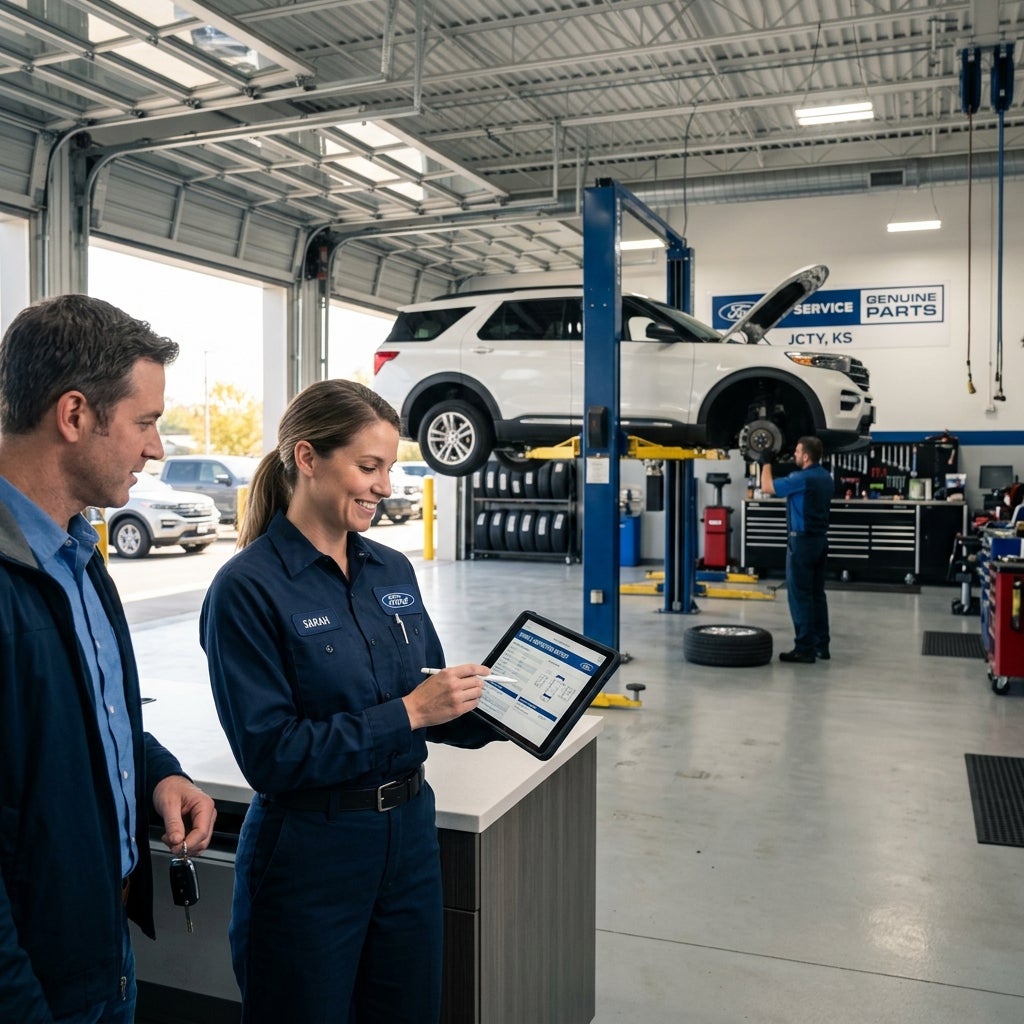
A female Ford service advisor shows a tablet to a male customer inside a bright, modern auto repair garage. (Representative image for illustration purposes only. Actual vehicle may vary based on trim and configuration.)

Demystifying Car Maintenance: Why Plain Language Service Matters in Junction City

Demystifying Car Maintenance: Why Plain Language Service Matters in Junction City Let's be honest: taking your vehicle in for service shouldn't feel like you are sitting through an advanced lecture in aerospace engineering. Too often, the automotive industry wraps simple, straightforward concepts in confusing jargon, leaving you wondering what you are actually paying for. At Valor Ford, we believe in a completely different approach. We believe that clear, honest, and plain-language communication is the foundation of trust. Whether you are active-duty military personnel stationed at Fort Riley preparing for a long deployment, a dedicated farmer in Dickinson County managing thousands of acres, or a busy parent juggling school drop-offs right here in Junction City, you deserve to know exactly what is happening under the hood of your vehicle. Our commitment to the community goes beyond just fixing engines; it is about empowering you with the knowledge needed to make smart, confident decisions about your transportation. When our factory-trained technicians inspect your vehicle, we don't just hand you a checklist of mysterious codes and expensive-sounding parts. We take the time to explain the 'why' and the 'how' in terms that make practical sense. We want to make sure you understand which services keep you safe on the highway, which ones improve your fuel efficiency during hot Kansas summers, and which ones can wait until your next budget cycle. If you ever have questions or want to speak with our service advisors directly, feel free to Call us at (785) 238-5114 or visit our dealership at 1825 Goldenbelt Blvd. What Is Normally Included in a comprehensive service Compared to a Basic One? Understanding the difference between a basic service and a comprehensive full car service is key to saving money and keeping your car running smoothly. Think of a basic service as your vehicle's routine check-up, much like a quick dental cleaning. It is designed to be performed frequently—typically every 5,000 to 7,500 miles—to keep critical fluids fresh and catch obvious wear-and-tear items before they escalate. A full car service, on the other hand, is a deep-dive medical physical. It is a thorough, bumper-to-bumper examination that inspects hidden mechanical systems, electrical networks, and structural components to ensure long-term reliability over tens of thousands of miles. The Basic Service Package A basic service focuses heavily on the lifeblood of your engine: the oil. During a basic visit, technicians will drain your old, worn-out engine oil and replace it with fresh, high-quality synthetic or semi-synthetic fluid. They will also swap the oil filter to ensure no microscopic metal shavings or carbon deposits circulate back into the clean oil. Additionally, a basic service includes a tire rotation to promote even tread wear across all four wheels, adjusting tire pressures to their optimal levels, and conducting a visual walk-around. This walk-around covers windshield wipers, fluid levels (like windshield washer fluid and coolant), and a quick check of your exterior lights to keep you legal and visible on the road. The Full Service Package A full car service includes everything from the basic service but adds extensive layers of diagnostic testing and preventative maintenance. Technicians will perform comprehensive fluid flushes, replacing aged brake fluid, transmission fluid, and power steering fluid that have absorbed moisture or broken down from heat. They will perform a highly detailed brake inspection, measuring brake pad thickness, examining rotors for warping, and inspecting calipers. Furthermore, they will check engine air filters, cabin air filters, spark plugs, suspension linkages, steering joints, and the exhaust system. This is also when we connect computerized diagnostic tools to read the health of your engine management systems and battery charging output. How Regular Servicing Affects Your Car’s Reliability and Fuel Economy There is a direct, scientifically proven link between how regularly you service your car and how much money you spend at the gas pump or on emergency towing services. When your car is neglected, its engine has to work significantly harder to perform basic tasks. This added friction, resistance, and strain translates directly to wasted fuel, decreased horsepower, and a drastically shortened lifespan for critical components. By performing simple preventative maintenance, you keep your vehicle running at its absolute peak physical efficiency. 1. Fresh Oil and Reduced Engine Friction Engine oil is designed to coat moving metal parts with a micro-thin protective barrier, preventing them from grinding together. Over time, heat and pressure break down this oil, turning it thin and watery, or thick and sludgy. Fresh oil drastically reduces internal friction. When your engine parts glide effortlessly, the engine draws less fuel to move the car, maximizing your MPG during those daily commutes from Fort Riley or weekend road trips across Kansas. 2. Air Filters and Clean Combustion Your engine needs a precise mixture of oxygen and fuel to create combustion. An engine air filter blocks dust, dirt, and agricultural debris from entering the cylinders. However, a clogged filter suffocates the engine, forcing it to burn excess gasoline to compensate for the lack of air. Replacing a dirty air filter can instantly restore lost fuel mileage, reduce tailpipe emissions, and prevent engine hesitation or rough idling. 3. Tire Pressure and Rolling Resistance Driving on under-inflated tires is like trying to ride a bicycle with flat tires—it takes a tremendous amount of physical energy to move forward. Properly inflated and balanced tires minimize rolling resistance against the asphalt. This simple adjustment ensures your vehicle rolls smoothly, optimizing fuel efficiency and preventing uneven tire wear that leads to premature (and highly expensive) tire replacements. What Happens If I Skip Regular Oil Changes or Use the Wrong Oil? Skipping a scheduled oil change might seem harmless in the short term, but it is one of the quickest ways to cause catastrophic, irreversible engine damage. As oil ages, it loses its ability to lubricate, cool, and clean the engine. The intense heat of combustion begins to 'cook' the remaining oil, turning it into a thick, black, tar-like substance known as engine sludge. This sludge clogs the narrow oil passages, starving critical moving parts of lubrication. Pistons can weld themselves to cylinder walls, bearings can seize, and camshafts can snap. In the blink of an eye, a simple oil change neglect can turn into a costly engine replacement bill. Furthermore, using the wrong oil viscosity (thickness) can be just as damaging. Modern engines are built with incredibly tight tolerances—spaces between moving parts that are thinner than a human hair. If you use oil that is too thick, it won't flow quickly enough to protect these tight areas, especially during freezing cold Kansas winter mornings. Conversely, if you use oil that is too thin during a blistering hot summer day in Junction City, it won't provide a thick enough barrier to prevent metal-on-metal wear. Adhering to the manufacturer's exact specifications is crucial for preserving your factory warranty and ensuring peak performance. Don't risk your engine's health; let our certified experts handle it with ease. Schedule Your Worry-Free Oil Change Today The Pros and Cons of Doing Your Own Oil Change Versus Using a Professional Shop The DIY Route: Hands-on but Demanding Doing your own oil change can be a deeply satisfying weekend hobby for car enthusiasts. It gives you a hands-on connection to your vehicle and lets you control exactly what brands of oil and filter are used. However, it requires a significant initial investment in specialized tools, including a sturdy hydraulic jack, high-quality jack stands, oil filter wrenches, a drain pan, and hand tools. You must also deal with the messy reality of crawling under a heavy vehicle, dealing with hot, dripping fluids, and properly disposing of the toxic used motor oil at an approved recycling center in Geary or Dickinson County. Additionally, if you strip the oil pan drain plug or fail to seal the filter correctly, you bear 100% of the financial liability for any damage. The Professional Route: Speed, Safety, and Records Choosing a professional shop like Valor Ford offers unmatched convenience, speed, and peace of mind. Our certified technicians complete the job in a fraction of the time, keeping your hands clean and your weekend free. More importantly, professional service comes with factory-certified expertise and complete digital maintenance records. These records are automatically logged to CARFAX and Ford's network, proving to future buyers that your vehicle was meticulously maintained. Furthermore, every professional oil change at our shop includes a complimentary multi-point safety inspection. This means highly trained eyes are examining your brakes, belts, hoses, and suspension components, catching minor issues before they become larger concerns on the road. What Is the Difference Between OEM and Aftermarket Car Parts? When your vehicle needs a replacement part—whether it is a simple brake pad, an alternator, or a complex suspension strut—you will generally face a choice between two categories: Original Equipment Manufacturer (OEM) parts and aftermarket parts. Understanding the difference in engineering, testing, and longevity is key to protecting your vehicle's performance and long-term durability. OEM Parts: Built to Exact Specs OEM parts are made directly by the vehicle's manufacturer (such as Ford) and are the exact components that were installed on your vehicle when it rolled off the assembly line. They offer a flawless fit, are built from identical materials, and perform exactly as intended. There is no guesswork involved; the part is literally made for your specific model, year, and trim level, ensuring your car's safety features and performance ratings remain completely uncompromised. Aftermarket: A Wildcard in Quality Aftermarket parts are manufactured by third-party companies. While they are often cheaper, they are built to fit a wide variety of different vehicles, meaning they are built as 'one-size-fits-most' components. This lack of precise engineering can lead to poor fitment, premature wear, and unexpected noise or vibrations. While some aftermarket parts are high quality, separating the reliable manufacturers from the sub-par ones is an unpredictable gamble. Warranty and Durability OEM parts come backed by a robust manufacturer warranty that is honored at dealerships nationwide. At Valor Ford, our genuine parts give you complete security on the road. If an aftermarket part fails, it rarely covers the labor costs to replace it, and in some cases, installing a non-certified aftermarket part can actually void your original vehicle warranty. If you need a reliable component, you can easily Order Genuine Ford Parts through us. Do Maintenance Plans Usually Save Money on Regular Services? Pre-paid maintenance plans are becoming incredibly popular among car owners, and for very good financial reasons. Put simply, these plans allow you to lock in today's labor and parts rates for future services, effectively shielding you from the rising costs of inflation. When you purchase a maintenance plan, you are bundling your routine services—like oil changes, tire rotations, cabin filter replacements, and multi-point inspections—into a single upfront package. This package is offered at a value-oriented rate compared to paying for each service individually over time. Beyond direct financial savings, maintenance plans provide psychological and behavioral benefits. When your routine maintenance is already paid for, you are far more likely to stick strictly to your vehicle's recommended service intervals. You won't find yourself putting off a critical oil change or tire rotation just because your monthly budget is a little tight. This consistency prevents minor, unaddressed issues from snowballing into massive, budget-breaking mechanical breakdowns down the road. If you are buying a vehicle or planning for long-term ownership, you can even package these maintenance plans into your financing. To learn more about setting up your vehicle budget, you can Get Pre-Approved for Financing today. How the Flint Hills Terrain and Kansas Weather Shape Your Service Schedule The Heavy Toll of Flint Hills Dust and Gravel Living and driving in the beautiful Flint Hills region of Kansas means your vehicle is exposed to unique environmental challenges. The dusty, unpaved rural roads throughout Dickinson County throw up a constant cloud of fine, abrasive limestone dust. This dust quickly penetrates engine air intakes, cabin ventilation systems, and suspension components. It clogs filters at twice the normal rate and can act like sandpaper on rubber bushings and seals. Because of this, what the manufacturer defines as 'severe driving conditions' is actually the daily norm for most Junction City and Fort Riley drivers, requiring more frequent filter changes and chassis lubrication. Extreme Kansas Seasons: Summer Heat & Winter Cold Our Kansas weather is notoriously volatile, swinging from freezing winters to intense, humid summers. In the blistering heat of July, your engine's cooling system operates under extreme pressure to prevent overheating while running the air conditioning. Batteries degrade rapidly under thermal stress, often failing as soon as the first cold snap hits. In the winter, road salt and brine spray accumulate on your vehicle's undercarriage, accelerating rust and corrosion on brake lines and suspension parts. Regular washing, undercarriage rinses, and seasonal fluid checks are absolutely critical to protect your investment from these brutal environmental shifts. Schedule Pickup & Delivery Service Understanding the Multi-Point Inspection: What Do Those Green, Yellow, and Red Ratings Mean? Whenever your vehicle is serviced at Valor Ford, we perform a comprehensive multi-point inspection. We present the results using a simple, intuitive 'stoplight' color system of Green, Yellow, and Red. Here is exactly what those colors mean, translating complex mechanical jargon into a clear, actionable plan for your peace of mind: Green: Excellent Shape A green rating means the component has been thoroughly checked, meets all manufacturer specifications, and is in excellent operating condition. No attention, adjustment, or replacement is needed. You are good to go, and you can drive with absolute confidence knowing these parts are solid. Yellow: Plan for the Future A yellow rating indicates the component is showing signs of normal wear and tear, but does not present an immediate safety risk. It does not need to be replaced today, but you should budget and plan for it in the near future. This allows you to manage maintenance expenses without surprises. Red: Immediate Attention A red rating means the component has failed, is severely worn, or poses an immediate safety hazard. These issues require urgent, same-day attention to keep your vehicle safe, legal, and operational. We will always clearly explain the exact risk and prioritize these repairs for you. How Routine Maintenance Protects Your Vehicle’s Trade-In Value The Real Value of a Clean Service History When it comes time to upgrade to a new vehicle, nothing influences your current vehicle's trade-in value quite like a complete, documented service history. When a dealership or a private buyer looks at your vehicle, they are looking for reassurance that it wasn't abused or neglected. A vehicle with consistent, professionally documented oil changes, tire rotations, and multi-point safety checks is worth thousands of dollars more than an identical vehicle with no service history. This paperwork proves that you prioritized preventative maintenance, meaning the engine, transmission, and structural elements are far less likely to fail prematurely. It turns your car from a risky gamble into a highly desirable, premium used vehicle. Unlock Your Vehicle's Current Equity At Valor Ford, we make it incredibly easy to see exactly how much your diligent maintenance has paid off. Our transparent trade-in evaluation process looks at your vehicle's mechanical health, aesthetic condition, and local market demand to give you a competitive offer. You can use this equity to transition seamlessly into a brand-new vehicle or a reliable pre-owned model. Whether you are ready to trade today or are just curious about your car's current financial standing, we invite you to complete our quick, hassle-free online form for a personalized Trade In Evaluation from our expert valuation team. Why Military Families at Fort Riley Trust Valor Ford for Transparent Service Serving those who serve our country is one of our deepest points of pride at Valor Ford. Located right next door to Fort Riley, we understand the unique pressures, tight timelines, and unexpected transitions that military families face daily. From sudden deployments and PCS moves across the country to managing a busy household while a spouse is training, we know that your time is extremely valuable and your scheduling needs are highly dynamic. You cannot afford to worry about vehicle breakdowns or deal with slow, untrustworthy service centers. That is why we offer specialized services tailored directly to our military community, including flexible scheduling options, clear and transparent repair cost breakdowns, and direct communication lines with service advisors. We take the stress out of vehicle care by providing honest, expert recommendations using only genuine parts that keep your warranty fully intact. If you are preparing for a move, transitioning back to civilian life, or simply need your vehicle inspected before a long road trip, our team is here to support you every step of the way. Stop by and see us, or Get Directions to Valor Ford to experience our transparent military-friendly service first-hand. A Simple Checklist for Your Next Scheduled Maintenance Visit What to Prepare and Bring Before you head to your service appointment, spending just five minutes preparing can make the entire process significantly smoother. Be sure to gather your vehicle's registration, insurance card, and any existing maintenance records if you are new to our shop. If your vehicle has a wheel lock key (often stored in the glove compartment or with the spare tire), make sure it is easily accessible so our technicians can perform tire rotations and brake inspections. Additionally, clear out any personal belongings from the front passenger seat and center console area so our technicians can safely work on interior items like cabin filter replacements. Questions to Ask Your Advisor When you sit down with your service advisor, do not hesitate to ask clarifying questions in plain English. Good questions to ask include: 'What are the most urgent safety items on my multi-point inspection today?', 'Are there any outstanding manufacturer safety recalls on my vehicle model?', and 'How do my brakes and tire tread depths look compared to last visit?'. If you are experiencing a weird sound, vibration, or warning light, try to describe it in simple terms—like 'a high-pitched squeak when braking' or 'a minor shudder at 60 MPH.' Our team is trained to translate those physical descriptions into accurate diagnostic steps. Schedule Pickup and Delivery Service Schedule Your Next Worry-Free Service at Valor Ford in Junction City Today At Valor Ford, we make car maintenance completely transparent, stress-free, and straightforward. No confusing industry jargon, no hidden fees, and absolutely no high-pressure sales tactics. From simple, quick oil changes to deep-dive engine diagnostics and preventative fluid flushes, our factory-trained and certified technicians have the expertise to keep your vehicle running perfectly. We proudly serve drivers throughout Junction City, Fort Riley, and Dickinson County, helping you protect your investment, maximize your fuel economy, and preserve your vehicle's trade-in value. For routine care—schedule your next service online today or give our friendly service desk a call to experience the Valor Ford difference. Schedule Ford Service Today Schedule Pickup and Delivery

A black pickup truck driving down a dirt road through rolling green and yellow hills. (Representative image for illustration purposes only. Actual vehicle may vary based on trim and configuration.)

Why the Ford F-150 Remains a Trusted Workhorse in Junction City For generations, the landscape of Geary County has been shaped by hard work, determination, and an unwavering commitment to community. Whether you are a military family stationed at Fort Riley preparing for your next move, an agricultural operator managing hundreds of acres of fertile soil along the Kansas River, or a local contractor keeping the infrastructure of Junction City moving forward, you need a machine that works as tirelessly as you do. That machine is, and has always been, the Ford F-150. It is more than just a truck; it is a vital tool of the trade, a sanctuary after a grueling twelve-hour shift, and a dependable family companion that feels right at home parked outside local businesses on Washington Street. At Valor Ford, we understand that choosing a light-duty pickup is not a decision to be taken lightly. The demands of our local environment require a unique combination of structural integrity, smart technology, and raw mechanical capability. From freezing, wind-swept Kansas winters to the intense heat of mid-July, your truck must adapt to changing circumstances in an instant. The Ford F-150 has earned its legendary status not by resting on past laurels, but by constantly evolving to meet the real-world demands of drivers right here in our community. If you would like to explore this truck firsthand, you can Get Directions to Valor Ford and visit our showroom today. In this comprehensive guide, we will break down the engineering marvels, towing capacities, payload ratings, powertrain options, and real-world utility features that place the newest F-150 in a class of its own. We will dive deep into the specific configurations that make sense for different lifestyles in Dickinson and Geary counties, ensuring you have all the facts necessary to make an informed decision. Let's look closely at why this pickup continues to reign supreme on Kansas highways and rural county roads alike. What is the Towing Capacity of the 2026 Ford F-150? When it comes to raw utility, towing capacity is often the ultimate benchmark for truck owners in Kansas. The 2026 Ford F-150 is engineered to deliver strong capability, allowing you to pull horse trailers, heavy agricultural machinery, commercial flatbeds, or recreational boats out to Milford Lake with absolute confidence. The engineering team at Ford has achieved a maximum available towing capacity of up to 13,500 pounds when properly equipped, ensuring that no job is too large for your daily driver. This exceptional towing performance is not a one-size-fits-all metric. It is the result of careful pairing between advanced engine options, robust transmission tuning, and structural reinforcement. By distributing the mechanical stress across a high-strength, military-grade aluminum-alloy body and a fully boxed high-strength steel frame, the F-150 maintains its poise even when operating at its absolute mechanical limits on steep highway inclines. To help you understand how different engine configurations impact your overall pulling power, we must look at the specific capacities across the lineup. For instance, the legendary 3.5L EcoBoost® V6 engine serves as the absolute powerhouse for heavy-duty trailering, while the versatile 5.0L Ti-VCT V8 offers a classic exhaust note and exceptional heavy-hauling performance. Even the incredibly efficient 2.7L EcoBoost® V6 punches far above its weight class, providing more than enough capability for the vast majority of recreational and light commercial tasks. When you are pulling a heavy load down Interstate 70, stability is just as important as pull power. The F-150 utilizes sophisticated electronic systems to continuously monitor trailer sway and apply selective braking to keep your load tracked perfectly behind you. This proactive approach to safety ensures that wind gusts, passing semi-trucks, and uneven road surfaces do not compromise your control behind the wheel. Engine Configuration Horsepower Torque (lb-ft) Max Towing Capacity (lbs) 2.7L EcoBoost® V6 325 hp 400 lb-ft 8,400 lbs 5.0L Ti-VCT V8 400 hp 410 lb-ft 13,000 lbs 3.5L EcoBoost® V6 400 hp 500 lb-ft 13,500 lbs 3.5L PowerBoost™ Full Hybrid 430 hp 570 lb-ft 11,200 lbs Which F-150 Engine Offers the Highest Payload for Geary County Worksites? While towing refers to what you can pull behind the truck, payload capacity dictates how much weight you can carry directly in the bed and cabin. For agricultural operators in Dickinson County loading seed bags, or construction crews in Junction City carrying heavy tools and masonry supplies, maximizing payload is crucial. The strong option for maximum payload capability within the F-150 lineup is the legendary 5.0L Ti-VCT V8 engine, delivering up to a staggering 2,230 pounds of carrying capacity when properly configured. Understanding the distinct difference between towing and payload is essential to protecting your vehicle's suspension, brakes, and drivetrain. When you overload a truck bed, you change its center of gravity and place immense stress on the rear axle. This is why Ford engineers have developed sophisticated payload monitoring tools, including available onboard scales that visually indicate how close you are to your vehicle's maximum cargo capacity directly through the smart taillamps or the central touchscreen display. To achieve these maximum payload figures, you must pay close attention to cab style, bed length, and optional packages. A regular cab configuration with an eight-foot bed and two-wheel drive will consistently deliver higher payload ratings than a fully loaded Crew Cab with four-wheel drive, as the lighter structural weight of the smaller cab leaves more room for cargo capacity. Our team can help you configure the perfect layout to match your specific worksite needs. Does the F-150 PowerBoost Hybrid Have a Lower Towing Capacity? One of the most persistent myths surrounding electrified pickups is that choosing a hybrid powertrain means sacrificing capability. The Ford F-150 3.5L PowerBoost™ Full Hybrid completely dismantles this misconception. By combining the proven strength of the twin-turbocharged 3.5L EcoBoost engine with a highly sophisticated 35-kilowatt electric motor, the PowerBoost system actually delivers the highest torque output in the entire standard F-150 lineup: an incredible 570 pound-feet. This massive torque is available almost instantly, providing exceptional off-the-line acceleration even when pulling a maximum tow load of 11,200 pounds. Rather than feeling sluggish, the hybrid powertrain provides a remarkably smooth, effortless towing experience. The transmission seamlessly blends gas and electric power to maintain consistent momentum, whether you are climbing rolling hills or merging onto the highway. Beyond its pure mechanical strength, the PowerBoost hybrid introduces a game-changing feature that standard gasoline trucks simply cannot match: Pro Power Onboard. This system transforms your truck into a mobile generator, offering up to 7.2kW of exportable electricity. It features multiple 120V and 240V outlets built directly into the truck bed, allowing you to power heavy-duty power tools at a remote job site, run entire campsites at Milford Lake, or keep crucial household appliances running during unexpected summer storm power outages. When you choose the PowerBoost Hybrid, you are not choosing efficiency over power; you are getting both in a single, highly advanced package. It is a highly capable example of modern truck utility, proving that sustainable technology can elevate heavy-duty capability to exciting new heights. To see how your current vehicle measures up against this powerhouse, we invite you to complete a quick Trade In Evaluation online. Discover the 2026 Ford F-150 Lineup What Equipment is Required for Maximum Towing on Kansas Highways? Unlocking the absolute maximum towing limits of the Ford F-150 requires more than just selecting the largest engine option. To safely and legally haul up to 13,500 pounds across the vast Kansas highway network, your vehicle must be configured with specific performance-enhancing packages and mechanical upgrades. The most critical component is the Max Trailer Tow Package, which integrates crucial cooling systems, electronic axle upgrades, and structural enhancements designed to manage the extreme thermal and kinetic stresses of heavy trailering. This package typically includes an upgraded rear bumper, a Class IV trailer hitch receiver, a smart trailer tow connector, and an integrated trailer brake controller that allows you to fine-tune the braking pressure applied to your trailer's wheels. Additionally, choosing the correct axle ratio is vital. A shorter gear ratio, such as the 3.55 or 3.73 electronic-locking rear axle, keeps the engine in its optimal power band, providing the mechanical leverage needed to move heavy loads from a complete stop and climb highway grades without constantly hunting for gears. For drivers who frequently tow near the vehicle's maximum limits, we also highly recommend upgrading to the available telescoping trailer tow mirrors. These power-folding, power-extending mirrors significantly improve rearward visibility, eliminating dangerous blind spots when pulling wide horse trailers or enclosed commercial cargo units. At Valor Ford, our truck specialists are always ready to help you navigate these configuration details to ensure your new vehicle is perfectly prepared for the heavy demands of your specific towing operations. How Does the Pro Trailer Hitch Assist Work in Real-World Conditions? Anyone who has ever tried to align a truck's receiver hitch with a trailer coupler solo knows how stressful and time-consuming the process can be. It often involves a tedious cycle of shifting into reverse, backing up an inch, putting the truck in park, hopping out to check the alignment, and repeating the process over and over. The Ford F-150 solves this age-old frustration with an incredibly advanced suite of driver-assist technologies: Pro Trailer Hitch Assist and Pro Trailer Backup Assist. Pro Trailer Hitch Assist utilizes the rear-facing camera and sophisticated radar sensors to identify the trailer coupler automatically. Once you activate the system, the truck takes full control of the steering, acceleration, and braking, backing up with absolute precision until the ball is positioned directly underneath the trailer coupler. All you have to do is hold down the button and watch the magic happen on your vibrant 12-inch center screen. Once hooked up, Pro Trailer Backup Assist makes reversing your trailer just as simple. Instead of trying to remember which way to turn the steering wheel to guide the trailer in the desired direction, you simply rotate a tactile control knob on the dashboard. Turn the knob in the direction you want the trailer to go, and the F-150 automatically manages the steering wheel movements to guide the trailer exactly where you want it. It turns a highly stressful task into a relaxed, one-handed operation. These cutting-edge features are not just about convenience; they are about safety and efficiency. They reduce the risk of low-speed bumper damage and eliminate the frustration of hitching up alone in cramped workspaces or crowded boat ramps. It is just another example of how Ford uses purposeful technology to make hard work easier and more accessible for everyone. Comparing the Horsepower of the 3.5L PowerBoost Hybrid and EcoBoost Lineup To truly appreciate the engineering achievements of the modern F-150, we have to look closely at performance metrics. The traditional 3.5L EcoBoost V6 is a highly respected engine, generating an impressive 400 horsepower and 500 pound-feet of torque. This twin-turbocharged powerhouse has long been the gold standard for drivers who require sustained high-performance capability under heavy-duty workloads. However, when you step up to the 3.5L PowerBoost Full Hybrid, the inclusion of the electric motor elevates total system output to an outstanding 430 horsepower and 570 pound-feet of torque. This makes the PowerBoost the second most powerful engine in the entire lineup, trailing only the extreme, high-performance Raptor models. The way this hybrid power is delivered is what truly sets it apart from traditional powertrains. Because electric motors deliver maximum torque instantly, the PowerBoost provides immediate, pin-you-to-your-seat acceleration that feels incredibly responsive in city traffic or when merging onto busy highways. This combination of raw horsepower, instant torque, and fuel efficiency makes the PowerBoost an exceptionally versatile choice for modern truck buyers who refuse to compromise on performance. Get Pre-Approved for Your F-150 Is the 3.3L V6 Engine Still Available, and What are Your Current Powertrain Options? In recent design cycles, Ford has significantly streamlined the powertrain offerings for the F-150 to ensure that every buyer receives class-leading power and modern technology right out of the gate. As part of this transition, the older, naturally aspirated 3.3L V6 engine has been officially phased out. In its place, the incredibly popular 2.7L EcoBoost® V6 now serves as the standard entry-level engine for the lineup. This transition represents a massive upgrade for entry-level buyers. Compared to the old 3.3L engine, the 2.7L EcoBoost delivers a substantial increase in torque and much better low-end acceleration, ensuring that even the most affordable work trucks feel highly capable and responsive under load. This change reflects Ford's commitment to delivering advanced turbocharged technology across the entire model spectrum. Today's powertrain options are designed to cover every possible use case. If you prefer the classic, linear power delivery and legendary exhaust note of a traditional V8, the 5.0L Ti-VCT V8 remains a popular option. For maximum towing capability, the twin-turbocharged 3.5L EcoBoost V6 is the undisputed king. And for those seeking the ultimate combination of high torque, fuel economy, and mobile generator capabilities, the 3.5L PowerBoost Full Hybrid stands ready to deliver. No matter which engine you select, it is paired with Ford's advanced 10-speed SelectShift® automatic transmission. This gearbox is designed with optimized gear spacing to ensure smooth shifts, excellent fuel economy, and maximum power delivery when pulling heavy loads. If you are considering a pre-owned model with the classic 3.3L V6 or want to experience the modern EcoBoost lineup, you can Browse Used Inventory online today. What is the Fuel Economy for the 2.7L EcoBoost on Daily Commutes? For many truck owners in Junction City, Abilene, and Manhattan, their pickup is not just a tool for the weekend or the worksite; it is their daily driver. This means that real-world fuel economy is a major factor in their overall ownership costs. The 2.7L EcoBoost® V6 has become incredibly popular specifically because of its ability to balance robust, turbocharged performance with outstanding efficiency during highway commuting. When configured with two-wheel drive, the 2.7L EcoBoost achieves an EPA-estimated fuel economy rating of up to 20 mpg in the city and 26 mpg on the highway, with a combined rating of 22 mpg. Even when you add the advanced four-wheel-drive system, the numbers remain highly impressive, offering up to 19 mpg city and 24 mpg highway. These figures allow you to navigate your daily commutes without feeling constant strain at the fuel pump. This efficiency is achieved through clever engineering, including standard Auto Start-Stop technology that seamlessly shuts off the engine when you are idling at traffic lights on Goldenbelt Boulevard, instantly restarting the moment you release the brake pedal. The engine's lightweight construction and advanced fuel injection systems also ensure that every drop of fuel is utilized as efficiently as possible, whether you are cruising at highway speeds or navigating city traffic. Choosing the 2.7L EcoBoost means you can enjoy the spacious cabin and exceptional utility of a full-size pickup without the heavy fuel economy penalties typically associated with older V8 engines. It is an ideal option for families, daily commuters, and light-duty commercial operators who want to maximize their needs. To see how our team can help you drive home in this exceptionally efficient truck, we encourage you to Call us at (785) 238-5114. Choosing the Right F-150 Trim for Agriculture, Military Life, and Family Adventures XL & XLT: The Smart Value For hard worksites and active military families, the XL and XLT trims offer exceptional value. The XL is a durable, easy-to-clean work truck built for the toughest tasks. Stepping up to the XLT introduces popular comfort and convenience features, including the comprehensive Ford Co-Pilot360™ safety suite, premium interior finishes, and advanced connectivity options that make daily commuting a pleasure. Lariat & Tremor: Premium Performance The Lariat trim represents the perfect sweet spot between rugged capability and premium comfort, featuring leather-trimmed seating, a premium audio system, and advanced driver-assist features. If your adventures take you off the beaten path, the Tremor trim is specifically engineered for off-road dominance, featuring upgraded suspension, specialized terrain management modes, and aggressive all-terrain tires. King Ranch & Platinum: Uncompromising Luxury For those who want the absolute pinnacle of luxury and refinement, the King Ranch and Platinum trims are designed to exceed your highest expectations. Featuring unique leather upholstery, genuine wood accents, active motion massaging seats, and class-leading trailering technology, these trims transform every journey into a first-class travel experience. Expert Maintenance Tips to Keep Your F-150 Performing at Its Peak A high-performance machine like the Ford F-150 is engineered to last for hundreds of thousands of miles, but achieving that legendary longevity requires consistent, high-quality care. This is especially true for trucks that operate under heavy work cycles, such as regular towing, carrying heavy payloads, or navigating dusty farm roads and off-road worksites. Following a structured maintenance routine is the single best investment you can make in your vehicle's future. Regular engine oil and filter changes are the foundation of proper maintenance. For modern turbocharged EcoBoost and PowerBoost hybrid engines, clean oil is critical to protecting delicate internal components and turbocharger bearings. We highly recommend utilizing genuine Motorcraft synthetic blend or full synthetic oil, which is engineered specifically to meet Ford's strict performance standards. You can easily Schedule Ford Service Today to keep your engine running perfectly. Beyond basic oil changes, you must also pay close attention to transmission service, brake inspections, and cooling system maintenance. When towing heavy loads, your transmission operates under increased thermal stress, making fluid flushes crucial to preventing premature wear. Similarly, maintaining a healthy braking system is essential to ensuring you can safely stop heavy trailer loads on steep highway inclines. When your truck does require repair or replacement parts, never compromise on quality. Always utilize original equipment manufacturer (OEM) parts, which are engineered to the exact specifications of your vehicle to ensure a perfect fit and long-lasting durability. Our team is always here to help you Order Genuine Ford Parts, or you can take advantage of our convenient Schedule Pickup and Delivery Service to have your truck serviced without interrupting your busy workday. Schedule Professional Ford Service Test Drive the Legendary Ford F-150 at Valor Ford in Junction City Today There is a reason the Ford F-150 has been the popular pickup in America for many years: it is built to handle the real-world challenges of hard-working drivers just like you. No amount of reading can compare to the actual experience of sitting behind the wheel, feeling the immediate response of the turbocharged engine, and exploring the highly advanced interior technology in person. At Valor Ford, we make it simple and stress-free to discover the perfect truck to fit your lifestyle, budget, and work demands. We invite you to browse our extensive inventory of new and pre-owned models, complete our simple credit application online, and visit our showroom located at 1825 Goldenbelt Blvd, Junction City, KS 66441. Our professional, friendly team is dedicated to providing an exceptional car-buying experience from start to finish, helping you navigate financing options, trade-in values, and custom configurations with absolute transparency. Stop by today or give us a call to schedule your test drive and experience the legendary F-150 difference for yourself. Explore New F-150 Inventory Get Directions to Valor Ford

Contact Us

Fill out this form below and we'll contact you shortly
*Required Fields