
Blog / Commercial Truck Financing

Blog

All Commercial Truck Financing Buying Guides Maintenance & Service New Vehicle Reviews Technology & Innovation Financing & Insurance Model Comparisons Safety Features Used Vehicle Guides Seasonal Driving Tips Valor Ford Models Seasonal Vehicle Care Vehicle Ownership Tips New Vehicle Sales Heavy-Duty Truck Care Junction City Towing & Trailer Technology Automotive Parts & Accessories Performance & Powertrain Seasonal Vehicle Maintenance Financing & Incentives Repair & Parts Trade-In & Negotiation Tips KS Community Trade-In & Pre-Approval Processes Valor Ford Service Off-Road Packages & Accessories Vehicle Sales Automotive Repair Parts & Repairs Valor Ford Vehicle Pricing Strategies Vehicle Repair & Parts Vehicle Trade-In Tips Diesel Engine Care Family SUVs Manhattan Ford Dealer Manhattan Ford Service Military & Special Customer Programs Tire Care & Management Agricultural Vehicle Maintenance Automotive Recalls & Repairs Dealership Transparency Heavy-Duty Truck Guides Heavy-Duty Truck Upkeep Manhattan Used Cars Preventative Vehicle Inspections Technology & Innovation in Truck Service Agricultural Fleet Service Automotive News Certified Pre-Owned Programs Diesel Engine Maintenance Genuine OEM Parts & Accessories Military & Student Moving Tips Service Tips & Guides Vehicle Utility & Cargo Solutions All-Weather Driving & 4x4 Readiness Classic Car Restoration Dealership Promotions & Events Engine & Performance Farm & Ranch Equipment Reviews Genuine Parts & Accessories Hybrid & Electric Vehicles Off-Road & 4x4 Features Winter Driving Tips
Bottom-Line Answer: Do You Need a CDL to Drive a Ford F-350?

Bottom-Line Answer: Do You Need a CDL to Drive a Ford F-350?

Bottom-Line Answer: Do You Need a CDL to Drive a Ford F-350? For the vast majority of personal, non-commercial drivers in Kansas and across the United States, the short answer is NO, you do not need a Commercial Driver License (CDL) to drive a Ford F-350 Super Duty. Standard state driver licenses allow citizens to operate personal vehicles with a Gross Vehicle Weight Rating (GVWR) up to 26,000 pounds. Because a standard single rear wheel (SRW) or dual rear wheel (DRW) Ford F-350 factory rating stays under this threshold, driving the truck itself for household chores, commuting, or weekend recreation requires only a standard Class C operator license. However, federal and state DOT laws look at the total gross weight ratings when you attach a heavy trailer or operate the vehicle in furtherance of a commercial business. A CDL becomes legally mandatory under specific federal FMCSA regulations if: (1) your F-350 is used for commercial purposes and its GVWR combined with a trailer's GVWR exceeds 26,001 lbs (where the towed unit exceeds 10,000 lbs GVWR), or (2) you are operating a heavy commercial fleet vehicle with a standalone GVWR over 26,000 lbs. If you have questions about commercial specifications, feel free to Call us at (785) 238-5114 to consult our heavy-duty truck specialists at Valor Ford. Understanding GVWR and GCWR: When Does Driving a Ford F-350 Legally Require a CDL? Key Weight Definitions You Must Know: • GVWR (Gross Vehicle Weight Rating): The maximum allowed total weight of the truck alone, including payload, passengers, fuel, and cargo. A 2026 Ford F-350 typically ranges from 10,000 lbs to 14,000 lbs GVWR depending on cab and axle choices. • GCWR (Gross Combined Weight Rating): The maximum allowable total weight of the truck, trailer, cargo, and occupants combined. Ford F-350 trucks offer GCWR ratings reaching up to 43,500+ lbs on select dually configurations. • The Magic 26,001-lb Threshold: Federal regulations specify that Class A CDLs are required when operating a combination vehicle with a Gross Combination Weight Rating (GCWR) of 26,001 or more pounds, provided the towed unit has a GVWR of more than 10,000 pounds when used commercially. Real-World Math Examples for F-350 Operators: 1. Scenario A (No CDL Needed): You drive a 2026 F-350 DRW (GVWR: 14,000 lbs) pulling a personal camper trailer (GVWR: 11,500 lbs). Total Combined Rating = 25,500 lbs. Because this is under 26,001 lbs and purely personal, no CDL is required. 2. Scenario B (Class A CDL Required): You operate a commercial construction business driving an F-350 DRW (GVWR: 14,000 lbs) pulling a flatbed equipment trailer carrying a skid steer (Trailer GVWR: 14,000 lbs). Total GCWR = 28,000 lbs. Since it is commercial and exceeds 26,001 lbs with a trailer over 10,000 lbs, your driver MUST hold a Class A CDL. If you are considering lighter payload options that stay comfortably away from heavy trailer classifications, you can also Research Ford F-250 specifications with our team. Commercial Use vs. Personal Use: How CDL Rules Apply to F-350 Drivers The boundary between personal driving and commercial hauling is one of the most critical factors officers evaluate during roadside inspections in Dickinson County, Geary County, and along I-70 near Fort Riley. Personal Recreation Exemption: If you are towing a personal fifth-wheel RV, horse trailer for non-profit leisure, or ski boat for weekend trips, federal regulations explicitly exempt non-commercial recreational vehicles from CDL mandates regardless of gross combined weight in most states. Commercial Hauling & Hotshot Trucking: If you receive compensation, haul items to market for profit, display business decals on your F-350, or operate hotshot transport services across state lines, you fall directly under FMCSA rules. Commercial vehicles over 10,000 lbs GVWR also require USDOT numbers, medical cards, and safety equipment even if total weight stays below CDL cutoffs. What Engine Options Are Available in the 2026 Ford F-350 Super Duty? 6.8L V8 & 7.3L Godzilla V8 Standard Gas Power: The 6.8L DEVCT NA PFI V8 generates robust low-end torque for daily fleet work. 7.3L Godzilla V8: Produces 430 horsepower and 485 lb-ft of torque. Ideal for heavy gas payloads, lower maintenance costs, and exceptional longevity without requiring diesel exhaust fluid (DEF). 6.7L Power Stroke V8 Diesel Standard Power Stroke Diesel: Pushes out 475 horsepower and 1,050 lb-ft of torque. Features a heavy-duty 10-speed TorqShift automatic transmission, integrated exhaust braking for steep downhill mountain towing, and relentless pulling power under heavy sustained loads. 6.7L High-Output Power Stroke High Diesel Performance: Delivers an astounding 500 horsepower and 1,200 lb-ft of torque. Features a unique water-cooled turbocharger and stainless steel exhaust headers designed specifically for maximum gooseneck and 5th-wheel pulling capability. Contact Us for F-350 Financing Information What Is the Maximum Towing Capacity of a 2026 Ford F-350? When properly equipped with the 6.7L High-Output Power Stroke Turbo Diesel engine and the Max Tow Package, the 2026 Ford F-350 Super Duty leads the heavy-duty segment with unmatched pulling capability across conventional, 5th-wheel, and gooseneck hitch setups. Conventional Bumper Towing: Up to 28,000 lbs on select DRW configurations. 5th-Wheel Towing: Up to 38,000+ lbs. Gooseneck Towing: Maximum towing capacity reaches up to 40,000 lbs on Regular Cab DRW 4x2 models equipped with high-capacity axle options. Compared against rival one-ton trucks like the Chevrolet Silverado 3500HD and Ram 3500, the Ford F-350 consistently offers top-tier gross combination ratings, making it the preferred choice for commercial operators and heavy equipment haulers in Junction City, KS. Configuration Max Conventional Max Gooseneck Max Payload F-350 SRW Gas 7.3L 18,200 lbs 22,500 lbs 4,958 lbs F-350 SRW Diesel 6.7L HO 23,000 lbs 27,200 lbs 4,310 lbs F-350 DRW Gas 7.3L 21,500 lbs 22,200 lbs 8,000 lbs F-350 DRW Diesel 6.7L HO 28,000 lbs 40,000 lbs 7,640 lbs Why Would Someone Choose an F-250 Over an F-350? Ride Quality & Unloaded Comfort The F-250 features softer rear leaf springs tuned for daily commuter comfort without heavy loads in the bed. If you rarely haul over 3,000 lbs of payload, the F-250 provides a smoother, less rigid highway ride when empty. Purchase Cost Comparison An F-250 typically carries a lower sticker price compared to an equivalently optioned F-350. Buyers who pull modest boats, bumper-pull horse trailers, or 25-foot travel trailers can reduce overall costs while retaining full Super Duty capability. Commercial & Weight Tier Limits In certain municipalities and commercial fleets, keeping a truck's GVWR under 10,000 lbs (standard F-250 classification) avoids elevated commercial vehicle registration fees, strict toll tariffs, and DOT medical card triggers required for heavier fleet units. What Are the Maintenance Cost Differences Between Gas and Diesel F-350 Trucks? Choosing between gas (6.8L / 7.3L V8) and Power Stroke diesel engines in your Ford F-350 affects long-term ownership expenses and maintenance schedules: Gas Engine Maintenance Profile: • Standard 7-13 quart synthetic oil changes at lower unit costs. • Simple air and oil filter replacements without fuel filter water-separator maintenance. • Lower initial purchase price and more economical routine service intervals. • Slightly lower fuel economy when pulling heavy loads. Diesel Engine Maintenance Profile: • Requires 13-15 quarts of specialized heavy-duty diesel oil. • Regular Fuel Filter Kit changes every 15,000 to 25,000 miles to protect high-pressure fuel injectors. • Periodic Diesel Exhaust Fluid (DEF) refills. • Exceptional resale value and enhanced fuel economy while towing heavy trailers over long highway distances. To keep your Super Duty performing at factory standards, you can Schedule Ford Service Today at our factory-certified maintenance center. Schedule Pickup and Delivery Service Farm, Military, and Recreational CDL Exemptions in Central Kansas 1. Kansas Covered Farm Vehicle Exemption: Agricultural producers operating within Dickinson County and surrounding Kansas farming communities enjoy specific CDL exemptions. Under state and federal law, active farmers, family members, and farm employees driving a farm-registered F-350 pulling stock trailers or grain wagons within 150 air miles of their farm do NOT require a CDL, provided the vehicle is transporting agricultural products, livestock, or machinery for farm operations. 2. Active Duty Military Exemption: Service members stationed at Fort Riley operating government-owned military tactical vehicles or heavy transports are exempt from civilian CDL requirements under 49 CFR 383.3 regulations. 3. Personal RV & Camper Exemption: If you are pulling a 40-foot 5th-wheel luxury camper or large horse trailer for personal pleasure across Kansas highways, state law grants a complete recreational vehicle exemption from CDL licensing requirements regardless of total combined gross weight. Important Caveat: Farm and recreational exemptions apply specifically to non-commercial operations. The moment you haul cargo for hire or conduct third-party commercial transport, full FMCSA CDL rules re-apply instantly. If you have an existing vehicle you want to upgrade for heavy farm or ranch duty, start by completing a quick Trade In Evaluation on our website. Single Rear Wheel vs. Dual Rear Wheel: Selecting the Right F-350 Configuration Single Rear Wheel (SRW) • GVWR: 10,000 – 12,400 lbs • Easier daily parking and narrow lane maneuverability. • Excellent off-road traction in mud and snow. • Ideal for bumper-pull trailers and moderate 5th-wheel campers up to 18,000 lbs. Dual Rear Wheel (DRW Dually) • GVWR: 14,000 lbs • Unmatched lateral stability in severe highway crosswinds. • Massive payload capacity up to 8,000 lbs in the bed. • Essential for heavy gooseneck trailers, multi-car haulers, and commercial construction fleets. Daily Drivability Balance Choosing between SRW and DRW comes down to your primary towing frequency. SRW models fit standard automatic car washes and suburban garages, while DRW duallys provide unmatched heavy-weight confidence on open interstate stretches. Financing, Trade-Ins, and Custom Ordering Your F-350 at Valor Ford At Valor Ford, we make acquiring your commercial fleet or personal Super Duty straightforward and tailored to your specific budget. • Commercial Vehicle Financing & Fleet Credit: We partner with Ford Credit Commercial Solutions to provide lines of credit, TRAC leases, and flexible commercial loan terms designed for small businesses and independent contractors. • Transparent Trade-In Appraisals: Upgrade your current truck or pre-owned vehicle with our competitive market valuations. • Factory Custom Ordering: Need a specific axle ratio (3.31, 3.55, 3.73, or 4.10 limited slip), 5th-Wheel/Gooseneck Prep Package, or Pro Power Onboard generator system? Our Super Duty ordering experts walk you through every option code to build your perfect rig directly from the assembly plant. If you want to explore pre-owned heavy-duty options, you can Browse Used Inventory available on our lot today. Value Your Trade-In Online Super Duty Towing Checklist: Weights, Registration, and Safety Steps 1. Verify Door-Jamb Tags Check your driver door-jamb Safety Compliance Certification Label. Confirm the exact GVWR and GAWR (Gross Axle Weight Rating) numbers before hooking up a new trailer setup. 2. Configure Trailer Brakes Set the Ford Integrated Trailer Brake Controller gain on your digital instrument cluster. Verify electric or surge trailer brake activation before entering high-speed highway traffic. 3. Check Safety Hitch Hardware Cross your heavy safety chains, connect the breakaway cable, check hitch pin torque, and ensure all LED trailer light connections function properly. If you need OEM towing components, you can Order Genuine Ford Parts directly through our dealership. Test Drive and Explore the Ford F-350 Super Duty at Valor Ford in Junction City Ready to experience the raw pulling power, advanced towing tech, and refined cabin comfort of the 2026 Ford F-350 Super Duty? Visit our showroom at 1825 Goldenbelt Blvd in Junction City, KS. Our heavy-duty truck specialists are here to analyze your payload demands, verify weight classifications, and help you select the exact axle ratio and engine package for your work or recreation. Get Directions to Valor Ford or contact our team directly at Call us at (785) 238-5114. Whether you are driving in from Fort Riley, Manhattan, Salina, or Abilene, Valor Ford is your premier Central Kansas destination for Super Duty excellence. Contact Valor Ford Truck Specialists
FORD Core Trucks & Workhorses

FORD Core Trucks & Workhorses

Which Ford Trucks Are Best Suited for Heavy Towing and Daily Commercial Work? Selecting the right vehicle for demanding commercial operations requires balancing max towing ratings, payload capacity, engine durability, and everyday operational costs. For enterprise buyers, agricultural operators, and job-site contractors across Kansas, the Ford Super Duty line—comprising the F-250, F-350, and F-450—stands out as the benchmark for heavy-duty towing and rigorous daily duty cycles. When configured with either the 7.3L Godzilla V8 gas engine or the formidable 6.7L High-Output Power Stroke® Turbo Diesel, these trucks deliver unmatched capability under extreme stresses. For lighter trade fleets and mobile service technicians needing maximum fuel efficiency paired with agile handling around urban job sites, the standard Ford F-150 remains a formidable asset. However, when payload demands surpass 4,000 pounds or gross combined weight ratings (GCWR) call for pulling heavy equipment trailers, agricultural equipment, or multi-car transports across Kansas highways, stepping up to the Super Duty family is essential. If you want to explore available configurations in person or review spec sheets with enterprise truck specialists, you can always Get Directions to Valor Ford in Junction City. Quick Summary of Optimal Work Configurations: • F-150: Light trades, municipal inspection, and service routes under 10,000 lbs towing. • F-250 Super Duty: Balanced daily driving, high payload requirements, and bumper-pull trailers up to 22,000 lbs. • F-350 Super Duty: The gold standard for commercial gooseneck towing, heavy machinery, dual-rear-wheel stability, and heavy payloads. • F-450 / Chassis Cab: Extreme commercial haulers requiring upfitted service bodies, dump beds, and Class 4 towing capabilities. Decoding the Core Ford Workhorse Trucks Across the Commercial Lineup Ford builds a specialized tool for every commercial application. Matching your vehicle purchase to your duty cycle ensures you do not overspend on capacity you do not need—or under-spec a vehicle and risk premature wear, safety issues, or costly fleet downtime. Here is how Ford positions its core truck models across the enterprise landscape. F-150 & F-250 Capabilities The Ford F-150 is ideal for field supervisors, electrical contractors, and residential trade fleets. With Pro Power Onboard generating mobile AC electricity, it acts as a rolling generator. Learn more when you Research Ford F-150 specifications. Stepping up to the F-250 Super Duty unlocks three-quarter-ton heavy-duty axles and upgraded frame rails, perfect for utility trailers, skid steers, and heavy payload boxes while retaining manageable ride quality. F-350 Heavy Towing Workhorse The F-350 Super Duty is the backbone of regional construction and agricultural enterprises. Available in Single Rear Wheel (SRW) and Dual Rear Wheel (DRW) configurations, it manages massive vertical tongue loads associated with fifth-wheel cattle trailers and gooseneck excavators. Read additional details when you Research Ford F-250 and F-350 specs. F-450 & Chassis Cab For maximum extreme-duty performance, the F-450 pickup and Chassis Cab variants provide commercial-grade wide-track front axles, tighter turning radii, 19.5-inch commercial tires, and massive brake rotors. These trucks are engineered for heavy upfits including service cranes, mechanics bodies, dump beds, and multi-car haulers. Powertrain Performance: 7.3L Gas V8 vs. 6.7L High-Output Power Stroke Diesel The engine under your truck's hood dictates not only how fast you can pull a hill with 20,000 pounds attached, but also your routine maintenance costs, fuel expenses, and overall operational budget. 7.3L 'Godzilla' Pushrod Gas V8: Engine design simplicity meets massive low-end power. Built with a cast-iron block, forged steel crankshaft, and variable cam timing, the 7.3L V8 delivers outstanding long-term durability with lower initial acquisition costs and simpler routine maintenance compared to modern diesels. It is widely favored by fleets that experience high idle times or short stop-and-go driving profiles where diesel exhaust fluid (DEF) systems might face challenges. 6.7L High-Output Power Stroke® Turbo Diesel: The undisputed champion of commercial pulling power. Generating a staggering 500 horsepower and 1,200 lb-ft of torque, this engine utilizes a water-jacketed turbocharger, upgraded exhaust manifolds, and high-pressure fuel injection to pull extreme loads effortlessly across rolling Kansas highways. Engine Option Displacement & Type Horsepower Torque (lb-ft) Best Commercial Application 6.8L DEVCT Gas V8 6.8L Pushrod Gas 405 hp @ 5,000 rpm 445 lb-ft @ 4,000 rpm Light fleet utility, municipal service, daily trade support 7.3L Godzilla V8 7.3L Pushrod Gas 430 hp @ 5,500 rpm 485 lb-ft @ 4,000 rpm Heavy payload utility, moderate gooseneck, high idle duty 6.7L Power Stroke V8 6.7L Turbo Diesel 475 hp @ 2,600 rpm 1,050 lb-ft @ 1,600 rpm Long-haul heavy equipment towing, high-mileage highway work 6.7L High-Output Diesel 6.7L HO Turbo Diesel 500 hp @ 2,600 rpm 1,200 lb-ft @ 1,600 rpm Maximum GCWR gooseneck/5th wheel loads, extreme commercial haul Why the Ford Super Duty XL Trim Features Make It a True Commercial Workhorse While luxury consumer trims emphasize soft leather and ambient lighting, commercial fleet operators value durability, ease of maintenance, and high functional utility. The Ford Super Duty XL trim is designed specifically from the ground up to handle demanding job-site conditions without unnecessary cost inflations. Key features standard on or available for XL commercial models include: • Heavy-Duty Black Vinyl Flooring: Built to endure mud, gravel, and heavy work boots, allowing effortless hose-out cleaning after a day in the field. • Durable High-Wear Cloth or Heavy Vinyl Seating: Designed to resist tearing and staining under severe daily trade use. • Standard Integrated Trailer Brake Controller: Fully syncs electric-over-hydraulic or electronic trailer brakes with truck pedal pressure for smooth stopping. • Ford Pro™ Telematics Integration: Every XL trim features embedded 5G Wi-Fi modems enabling fleet managers to monitor GPS tracking, driver behavior, fuel consumption, and proactive maintenance alerts in real time. • High-Strength Steel Frame & Aluminum-Alloy Cab: Combines structural rigidity under full frame twist with non-corroding body panels that resist severe Kansas winter road salt. • Upfitter Switches (6 Overhead): Factory-installed 15-amp to 40-amp fused circuits make connecting warning strobes, aux lighting, winches, and hydraulic pumps clean and seamless. To review fleet purchasing options or evaluate current stock, you can Call us at (785) 238-5114 to speak directly with our commercial desk. Contact us for commercial financing information How Ford Super Duty Reliability Stacks Up Against Silverado HD and Ram 2500/3500 In the competitive heavy-duty pickup market, uptime and long-term operating costs determine true vehicle value. When comparing Ford Super Duty trucks to heavy-duty entries from Chevrolet and Ram, key engineering distinctions highlight how Ford compares in commercial fleet applications. Military-Grade Aluminum Body Unlike Chevrolet Silverado HD and Ram 2500/3500 which utilize traditional steel cabs, Ford uses high-strength, military-grade aluminum alloy. This can help reduce body rust concerns from magnesium chloride winter de-icing and saves substantial weight that Ford reinvests into thicker box-frame steel rails, heavy axles, and higher gross vehicle weight ratings (GVWR). TorqShift® 10-Speed Transmission Ford's heavy-duty TorqShift 10-speed automatic features select gear ratios and selectable drive modes (Tow/Haul, Eco, Slippery, Deep Sand/Snow) optimized for high payload demands. Its thermal management system keeps transmission fluid cool under sustained steep uphill towing, providing smoother shift logic and higher durability than competitive 6-speed or 8-speed automatics. Axle Ratings & Brake Hardware Ford Super Duty models feature massive Sterling and Dana® rear axles rated for rigorous continuous weight cycles. Coupled with larger four-wheel disc brake rotors and heavy-duty brake pads, Ford trucks are designed to provide strong stopping performance and fade resistance when descending long highway grades under full GCWR capacity. Pricing and Trim Breakdown for Commercial Buyers and Business Fleets When evaluating commercial trucks, prudent business owners calculate Total Cost of Ownership (TCO) rather than focusing solely on upfront MSRP. Factors such as fuel efficiency, resale retention, warranty coverage, tax advantages, and maintenance schedule intervals play major roles in overall profitability. Trim Level Breakdown for Enterprise Operations: • XL Trim: The entry point for commercial operations. Offers maximum payload margin per dollar spent. Designed for standard job-site abuse with easy-clean interiors and robust exterior utility. • XLT Trim: Adds key convenience features like power cloth seats, power towing mirrors, SYNC® 4 touchscreen infotainment, and chrome grille accents. Popular among owner-operators and trade contractors who use their work truck as a mobile office and daily driver. • Lariat Trim: Merges heavy work capacity with premium luxury. Features leather seats, 360-degree camera views, power running boards, and advanced driver-assist features for operators who spend 8+ hours a day behind the wheel. Trim Level Key Target Audience Primary Standard Equipment TCO Advantage Super Duty XL Commercial Fleets, Municipal, Ag Vinyl flooring, SYNC 4, Trailer Brake Controller, 5G Telematics Lowest acquisition cost, maximum payload allowance, easy clean Super Duty XLT Subcontractors, Skilled Trades, Craftsmen Power driver seat, carpet floor, chrome trim, Co-Pilot360 High resale value retention, strong driver comfort balance Super Duty Lariat Business Owners, Enterprise Fleet Managers Leather upholstery, 360-deg camera, B&O Sound, PowerScope mirrors Premium driver retention tool, multi-purpose executive work truck Section 179 Tax Benefits & Capital Depreciation: Because Ford Super Duty F-250, F-350, and F-450 models feature Gross Vehicle Weight Ratings exceeding 6,000 pounds, qualifying business entities can may be eligible for certain tax deductions or accelerated depreciation, subject to IRS rules and your tax professional's advice under IRS Section 179 and Bonus Depreciation rules. Consult your tax professional to see how purchasing or leasing a new Super Duty as needed optimizes your fleet's tax position. Honest Pros and Cons of Owning a Ford Super Duty for Daily Commercial Operations Key Operational Advantages (Pros) • Class-Leading Pulling Capacity: Gooseneck towing limits up to 40,000 lbs on select F-450 configurations mean many trailer needs can be handled. • Pro Trailer Hitch Assist: Automatically aligns the hitch ball directly under the trailer coupler at the touch of a button. • Spacious SuperCrew Cabs: Best-in-class rear seat legroom allows four to five crew members to ride in total comfort with gear stored safely inside. • Unmatched Upfit Compatibility: Standardized frame widths and electrical pass-through grommets lower body-builder mounting times and cost. Real-World Considerations (Cons) • Wide Turning Radius on Long Wheelbase Models: Dual-rear-wheel Crew Cab models require extra maneuverability space in tight urban alleys or dense job sites. • Higher Diesel Maintenance Requirements: Fuel filters for 6.7L diesels require routine replacement every 15,000 miles, alongside ongoing DEF refills. • Overall Ride Stiffness When Empty: Heavy multi-leaf rear suspension springs are tuned for extreme payload weights, resulting in a firmer ride when driven unloaded. Request a Fleet Trade-In Valuation Work-Focused Truck Configurations Frequently Stocked Near Junction City and Dickinson County Central Kansas enterprise operations face unique climate conditions and terrain challenges. Between agricultural demands in Dickinson and Geary Counties, military infrastructure projects around Fort Riley, and regional highway transport along the I-70 corridor, commercial trucks must be spec'd for specific local duties. Agricultural 4x4 Configurations Kansas farming and ranching operations rely on F-250 and F-350 4x4 Crew Cabs equipped with the 7.3L gas or 6.7L diesel. Electronic shift-on-the-fly four-wheel drive and rear locking differentials ensure traction when traversing muddy pasture terrain and unpaved county roads. Fort Riley Military Contractors Federal contractors and infrastructure teams around Fort Riley require F-350 and F-450 service body upfits. Equipped with Knapheide or Reading utility bodies, onboard generator systems, and heavy vice mounts, these trucks serve as mobile repair bays. DRW Gooseneck Haulers For long-haul machinery transport along I-70, F-350 DRW (Dual Rear Wheel) models equipped with factory 5th-Wheel/Gooseneck Prep Packages provide lateral stability against high plains crosswinds while maintaining highway cruising speeds easily. Gooseneck vs. Conventional Towing Setup Guidelines for Heavy Workload Safety Operating heavy commercial trailers safely across Kansas requires a strict understanding of axle weight distribution, hitch mechanisms, and Gross Combined Weight Ratings (GCWR). Towing incorrectly risks vehicle instability, transmission strain, and regulatory fines. Conventional Bumper-Pull Towing: Ideal for loads under 20,000 lbs, such as enclosed cargo trailers, skid loaders on tandem-axle trailers, or commercial mowers. Always ensure weight-distributing hitch bars and sway control arms are utilized for tongue weights exceeding 10% of total trailer weight. Gooseneck & Fifth-Wheel Setup: Placing trailer tongue weight directly over the rear axle center point eliminates rear lever-arm strain, dramatically enhancing steering control and lateral trailer stability. Ford's factory 5th-Wheel/Gooseneck Prep Package includes five recessed bed mounting points flush with the load floor, allowing seamless conversion between flat box hauling and gooseneck towing. Axle Ratio Selection: Selecting a 3.73, 4.10, or 4.30 rear axle ratio determines your mechanical leverage advantage. Lower (higher numerical) axle ratios increase off-the-line pulling power and steep-grade climbing, whereas taller ratios maximize highway fuel economy. Maximizing Commercial Uptime with Scheduled Service and Fleet Care For commercial operators, time off the road equals lost revenue. Severe-duty operations—including heavy towing, dusty agricultural environments, high idle times, and extreme hot/cold seasonal swings—demand rigorous preventative maintenance adherence. Our dedicated technical team can help you maintain optimal fleet reliability; simply Schedule Ford Service Today to keep your fleet operating at peak performance. Service Item Standard Duty Interval Severe Workload / Commercial Interval Key Fleet Impact Engine Oil & Filter Change 7,500 – 10,000 miles 5,000 miles / 250 Engine Hours Prevents turbocharger sludge build-up & protects bearing surfaces Diesel Fuel Filters (Dual System) 20,000 miles 15,000 miles Protects high-pressure fuel injectors from water & particulate contamination TorqShift Transmission Fluid 60,000 miles 30,000 – 45,000 miles Maintains crisp gear shifts under sustained heavy towing load Front/Rear Differential Fluid 100,000 miles 50,000 miles Prevents differential gear scoring during high torque load distribution To further streamline business maintenance routines, commercial clients can Schedule Pickup and Delivery Service or utilize OEM replacement components directly through our team to Order Genuine Ford Parts for in-house fleet maintenance technicians. Schedule Commercial Fleet Maintenance Evaluating Upfits and Bed Options for Kansas Agriculture and Construction Trades A commercial truck cab and frame chassis are only as versatile as the upfit body attached to them. Ford's clean cab-to-axle (CA) frame dimensions enable seamless installation of specialized commercial bed bodies: • Flatbed Platform Bodies: Vital for agricultural hay transport, lumber yards, and pipe suppliers requiring unobstructed side-loading access via forklifts. • Service & Utility Bodies: Lockable weatherproof side compartments store high-value hand tools, diagnostic equipment, and pneumatic fittings safely on job sites. • Dump Bodies: Hydraulic dump beds on F-350 and F-450 chassis cabs allow quick offloading of gravel, topsoil, mulch, and demolition debris. Pro Power Onboard System Integration: Modern Ford Super Duty trucks offer exportable electrical power up to 2.0 kW directly from bed outlets. This allows field crews to run chop saws, air compressors, battery chargers, and floodlights directly off the truck's engine without hauling bulky standalone gasoline generators. Fleet Financing, Trade-In Valuations, and Inventory Access at Valor Ford Securing capital for business expanding operations requires flexible financing solutions tailored to commercial cash flow schedules. Valor Ford works directly with corporate financial institutions, Ford Credit Commercial Lending, and municipal purchasing boards to deliver custom commercial lines of credit, master leases, and TRAC leasing options. If you are rotating older enterprise units out of service, complete a quick online Trade In Evaluation to see how much equity you can roll directly into your new Super Duty purchase. Business owners seeking pre-owned vehicles can also Browse Used Inventory for certified commercial options. Commercial fleet managers can also look into other specialized models in the broader Ford lineup—whether you need light-duty support or executive transportation—such as when you Research Ford Maverick, Research Ford Explorer, Shop New Ford Bronco Inventory, or even Research Ford Mustang models for personal use. Build and Support Your Commercial Fleet with Valor Ford in Junction City Whether you need a single Ford Super Duty F-250 for your growing trade business or a fleet of F-350 dual-rear-wheel gooseneck haulers for regional agricultural transport, Valor Ford is your trusted commercial vehicle partner in central Kansas. Our dedicated enterprise team understands chassis cab specs, towing load matchings, upfit body installations, and commercial financing structures. Visit our showroom today at 1825 Goldenbelt Blvd, Junction City, KS 66441, or connect with our commercial sales specialists directly to schedule a test drive under load conditions. Get Directions to Valor Ford Call Commercial Team: (785) 238-5114

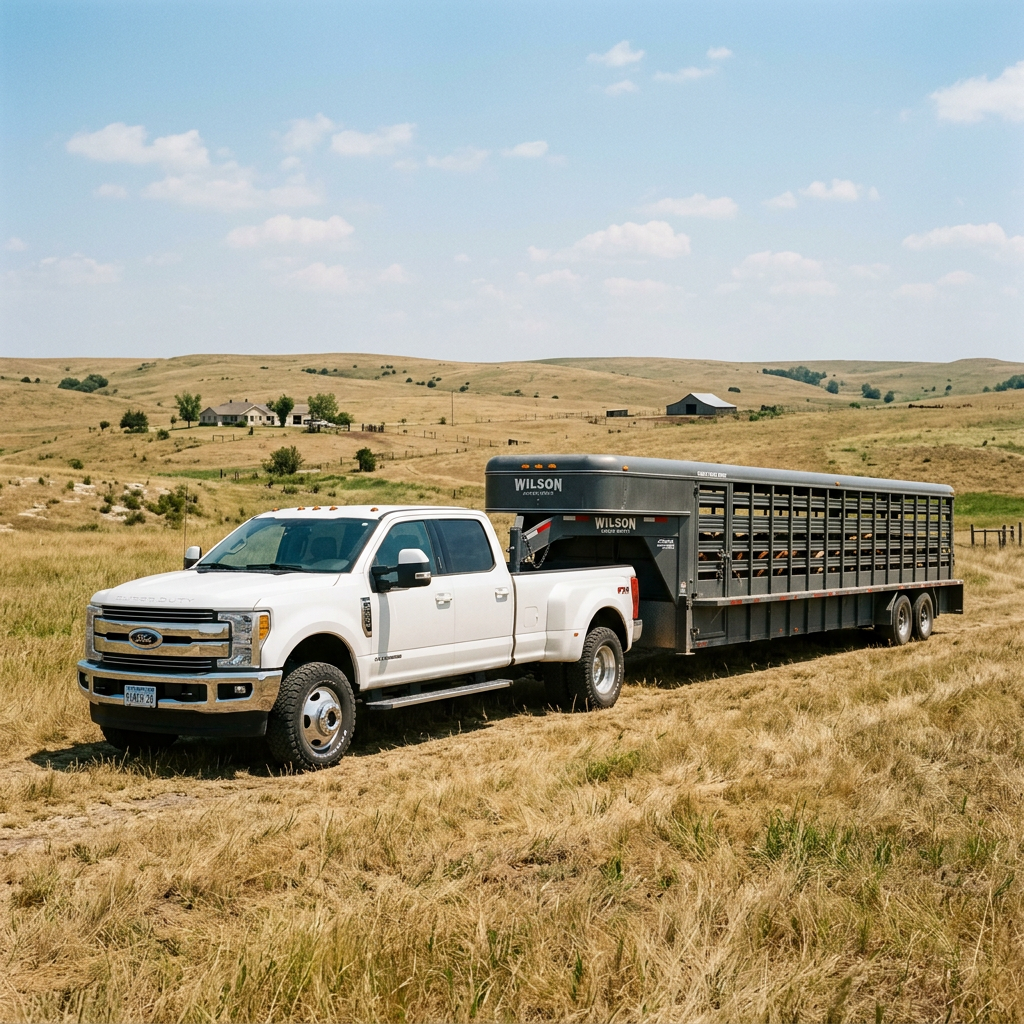
A white Ford Super Duty truck pulling a gray Wilson livestock trailer filled with cattle in a grassy pasture. (Representative image for illustration purposes only. Actual vehicle may vary based on trim and configuration.)

The Ultimate Heavy-Duty Towing Guide for Pottawatomie and Clay County Ranchers

A Heavy-Duty Towing Guide for Pottawatomie and Clay County Ranchers Operating a working cattle ranch or agricultural operation across the sweeping Flint Hills of Pottawatomie County and the fertile river valleys of Clay County is not a lifestyle for the faint of heart. It is a demanding, sun-up to sun-down commitment that requires grit, resilience, and equipment that simply refuses to quit. Out here in America's heartland, your heavy-duty truck is not just a daily commuter; it is a vital business partner, a mobile command center, and the lifeline that moves your livelihood from pasture to market. Whether you are hauling massive gooseneck stock trailers packed with black Angus cattle, shifting flatbeds loaded with thousands of pounds of fresh alfalfa bales, or transporting heavy excavators to clear out brush lines, you need more than just raw horsepower. You need a comprehensive understanding of heavy-duty towing principles, weight limits, and mechanical endurance. As the summer heat of July 2026 beats down on our Kansas pastures, the demands on your vehicle fleet multiply. High ambient temperatures, dusty gravel roads, and challenging topography can quickly push an under-prepared truck past its breaking point. That is where professional-grade engineering and local expertise come together. At Valor Ford, located proudly in Junction City, KS 66441, we have spent years working alongside local producers to understand the exact, uncompromising demands of Kansas agriculture. We know that when a thunderstorm is brewing on the horizon and you have fifty head of cattle to move, you cannot afford a transmission slip or a braking failure. This guide is built to serve as your definitive resource for mastering heavy-duty towing, choosing the absolute best rig configurations, and keeping your machinery running safely through every challenging season. If you are ready to experience this level of capability first-hand, feel free to Get Directions to Valor Ford and visit our showroom today. Our team is always on hand to talk payload, trailering setups, and powertrain choices. If you prefer to speak to a heavy-duty truck specialist directly from the comfort of your tractor cab, you can Call us at (785) 238-5114 to discuss your specific fleet needs. What is the maximum towing capacity of a 2026 Ford F-350 Super Duty for ranch work? When evaluating the sheer muscle required for serious agricultural work, the 2026 Ford F-350 Super Duty stands as an undisputed titan. For ranchers operating in Clay and Pottawatomie counties, understanding the absolute upper limits of your truck's capabilities is critical to both operational efficiency and on-road safety. Towing capacity is not just a single, static number printed on a brochure; it is a dynamic spectrum governed by your engine choice, axle ratio, drivetrain configuration, and the type of hitch mechanism you employ. To maximize your productivity, you must look closely at how conventional bumper-pull towing compares to gooseneck and fifth-wheel setups, which are the absolute lifelines of modern ranching operations. When configured with the legendary 6.7L High-Output Power Stroke® V8 Turbo Diesel engine, the 2026 F-350 is engineered to redefine what a heavy-duty truck can achieve. In a dual-rear-wheel (DRW) configuration with a gooseneck setup, the F-350 boasts an astronomical maximum towing capacity of up to 40,000 pounds. This massive rating allows you to pull the largest multi-car haulers, triple-axle cattle trailers packed with heavy mature bulls, or massive industrial flatbeds loaded down with dual-wheel tractors and tillage equipment. Even with conventional bumper towing, the F-350 achieves a class-leading capacity of up to 28,000 pounds when properly equipped. This means bumper-pull stock trailers, heavy-duty utility trailers, and large mobile fuel tanks can be moved around the farm without a second thought. For those who prefer the simplicity and quick throttle response of a gasoline engine, the 2026 F-350 offers the formidable 7.3L "Godzilla" V8. While diesel remains the undisputed king of absolute maximum pulling power, this heavy-duty gas engine is no slouch, delivering outstanding conventional and gooseneck towing limits that easily exceed 20,000 pounds. This makes it an incredibly cost-effective, low-maintenance workhorse for ranchers who run shorter local routes between the pasture and the local sale barn, or who need a reliable backup truck that can sit for periods without worrying about modern diesel emissions systems. No matter which powertrain you choose, matching the right gear ratio—such as the 3.55 or 4.10 limited-slip or electronic-locking rear axles—is key to unlocking these extreme tow ratings. To put these capacities in perspective, consider the real-world math of a Kansas cattle ranch. A standard 24-foot steel gooseneck stock trailer weighs roughly 6,000 to 7,000 pounds empty. Load it up with 25 feeder steers weighing an average of 800 pounds each, and you are looking at a total trailer weight of 26,000 to 27,000 pounds. A single-rear-wheel F-350 can handle this load comfortably, but stepping up to a dual-rear-wheel model provides that crucial safety margin and unmatched stability when crosswinds hit you on Highway 24. Knowing your limits prevents premature wear on your transmission, keeps your brakes from overheating, and ensures you remain fully legal and safe on public roads. Engine Option Max Conventional Towing Max Gooseneck/5th-Wheel Towing Best Suited Agricultural Task 6.7L HO Power Stroke V8 Diesel 28,000 lbs 40,000 lbs Hauling heavy livestock trailers & major commercial machinery over long distances 6.7L Standard Power Stroke Diesel 25,000 lbs 35,000 lbs Everyday stock hauling, heavy hay bale transport, and construction equipment 7.3L 'Godzilla' V8 Gasoline 21,000 lbs 22,500 lbs Frequent short-haul trips, feed delivery, utility work, and winter pasture idling 6.8L 2-Valve Devict V8 Gasoline 17,500 lbs 18,800 lbs Light-to-medium utility towing, fleet operations, and general farm service duties Does a dually ride significantly rougher than a single-rear-wheel truck when empty? This is one of the most common dilemmas we hear from ranchers standing on our showroom floor: 'If I buy a dual-rear-wheel (DRW) truck to handle my heaviest loads, am I going to regret it every time I drive it empty into town?' It is a highly practical question. Many farm trucks serve double-duty as the family vehicle, taking trips to the grocery store, running the kids to school events in Junction City, or making long supply runs to Manhattan. Historically, dually trucks had a well-deserved reputation for riding like an unloaded dump truck when there was nothing in the bed. The stiff rear leaf springs, designed to support massive payloads, had very little give, resulting in a jarring, bouncy ride over uneven pavement, washboard gravel roads, and deep pasture ruts. However, modern engineering has dramatically closed the comfort gap between single-rear-wheel (SRW) and DRW trucks. The 2026 Ford Super Duty lineup utilizes advanced, progressive-rate leaf springs and sophisticated shock tuning. When the truck is empty, only the primary spring pack is engaged, allowing for a surprisingly compliant and cushioned ride that mimics a standard heavy-duty pickup. It is only when you drop a heavy gooseneck trailer onto the ball or load up the bed with salt blocks that the helper springs engage to provide the extreme load-bearing support required. While you will still feel a slightly firmer response over sharp bumps compared to an SRW truck—primarily due to the wider, stiffer footprint of four rear tires—it is no longer the bone-jarring experience of the past. Where the dually truly shines, and where it easily earns its keep, is in its unparalleled lateral stability. If you have ever towed a double-deck stock trailer filled with shifting livestock down Highway 77 during a classic Kansas windstorm, you know the white-knuckle feeling of sway. A single-rear-wheel truck, while capable of pulling the weight, has more sidewall flex in the rear tires, allowing the trailer to steer the truck. A dually virtually eliminates this issue. The massive, wide stance of the dual rear wheels acts as an anchor, resisting lateral forces and keeping your rig tracking straight and true. For many ranchers, the absolute peace of mind and safety provided during those windy, high-stress hauls far outweigh the minor difference in unloaded ride quality. To help you decide which configuration is right for your ranch, let's look at a quick comparison of the trade-offs: • Single Rear Wheel (SRW): Easier to park in town, fits through standard automatic car washes, slightly better fuel economy when empty, and a smoother unloaded ride on rough gravel roads. • Dual Rear Wheel (DRW): Maximum payload capacity for heavy pin weights, unmatched stability against crosswinds and moving livestock, and extra safety redundancy (if you get a flat tire on one rear tire while hauling, the other can support the load until you reach safety). Find Your Next Workhorse in Our Heavy-Duty Inventory Whether your daily chores demand the ultimate pulling power of a dual-rear-wheel F-350 or the versatile, everyday capability of a single-rear-wheel F-250, Valor Ford has the rugged inventory to back you up. We specialize in configuring trucks that are purpose-built for the unique demands of Kansas agricultural operations. If you are looking for a truck that fits the job—get the exact powertrain, suspension, and towing package your ranch deserves. Explore our options online or stop by to test drive our current selection of heavy-duty trucks. Explore New Ford Super Duty Inventory Which truck offers better engine braking for descending steep grades with a heavy trailer? Towing a heavy trailer is only half the battle; stopping it safely is where the real engineering challenges lie. For ranchers in the Kansas River valley and the rolling hills of Clay County, descending steep, winding gravel roads with a fully loaded livestock trailer can quickly become dangerous if you rely solely on your service brakes. Friction brakes can overheat rapidly under heavy loads, leading to brake fade—a terrifying condition where the brakes lose their stopping power entirely. To combat this, modern heavy-duty trucks utilize engine braking systems to control downhill speed, save wear on your brake pads, and keep your rig under complete control. When it comes to pure, unrelenting engine braking performance, the 6.7L Power Stroke® V8 Turbo Diesel is the undisputed champion. Ford's diesel engine features a driver-activated smart exhaust brake. Unlike older, simpler exhaust brakes, this system utilizes a variable-geometry turbocharger (VGT) to restrict exhaust flow, creating backpressure in the cylinders. This backpressure forces the pistons to work harder against the compressed air, effectively slowing the vehicle's wheels through the drivetrain. The system operates in two modes: 'On' for continuous maximum braking, and 'Auto,' which monitors your speed and brake pedal application to automatically maintain your current speed down the hill. It is incredibly smooth and provides massive holding power, allowing you to descend steep pasture trails or highway grades without ever touching the brake pedal. Gasoline engines, such as the 7.3L V8, rely on a different physical mechanism called vacuum braking or compression braking. When you release the throttle on a gas truck, the throttle body closes, creating a strong vacuum in the intake manifold. The engine has to work hard to draw air against this closed valve, which creates a natural braking effect. Ford pairs this with aggressive tow/haul transmission programming, which automatically downshifts the 10-speed TorqShift® automatic transmission to raise engine RPMs and maximize this vacuum braking force. While highly effective for moderate loads and rolling hills, a gasoline engine simply cannot match the sheer retardation force generated by a turbocharged diesel exhaust brake. For agricultural operations that regularly tow near or above 15,000 pounds, the diesel exhaust brake is a game-changing safety feature. It not only prevents catastrophic brake failure but also drastically reduces your long-term maintenance costs. Instead of replacing warped rotors and worn brake pads every season due to heavy hauling, the exhaust brake handles the majority of the deceleration work, preserving your service brakes for when you truly need to come to a complete, sudden stop. If your ranching routes involve navigating the rolling terrain surrounding Tuttle Creek Lake or the steep descents down to the Kansas River, investing in the Power Stroke diesel with its smart exhaust brake is one of the smartest safety decisions you can make. How do you properly adjust an integrated trailer brake controller? Step 1: Connect and Verify Before making any adjustments, ensure your trailer is securely coupled, safety chains are crossed, and the electrical umbilical cord is firmly plugged into your truck's 7-pin connector. Start your Ford Super Duty and look at the productivity screen on your dashboard. The system should display a message confirming 'Trailer Connected.' If you see a warning or no connection message, double-check your physical connection and inspect the plug for any dirt, corrosion, or bent pins—common issues on working ranch trucks. Next, navigate the driver information screen using your steering wheel controls to select the correct trailer profile. Ford's advanced system allows you to save settings for multiple trailers, such as 'Gooseneck Stock' or 'Flatbed Utility.' This saves you from having to recalibrate from scratch every time you swap equipment. Step 2: Set Initial Gain Locate the integrated trailer brake controller on your center instrument panel. It features a manual squeeze-squeeze slider and physical '+' and '-' buttons to adjust the 'Gain' setting. Gain represents the amount of electrical power sent to the trailer's electric or electric-over-hydraulic brakes when you press the truck's brake pedal. For a starting point, set the gain to a moderate level, typically 5.0 on a scale of 1 to 10. If you are towing an exceptionally heavy or fully loaded livestock trailer, you may want to start slightly higher, around 6.5. If the trailer is empty or very light, start lower, around 3.0, to prevent the trailer tires from immediately locking up and dragging. Step 3: Road Test and Calibrate Find a safe, flat, open area with minimal traffic, such as an empty gravel staging area or a quiet country road. Accelerate your rig to approximately 20 to 25 mph. Keeping your hands on the steering wheel, use your right hand to gently but firmly squeeze the manual trailer brake slider completely together. Do not press the truck's foot brake pedal. Pay close attention to how the rig responds. If the trailer brakes lock up and slide the tires, your gain is set too high; press the '-' button to decrease the gain by 0.5. If the trailer barely slows the truck down, your gain is too low; press the '+' button to increase it. Repeat this test until you achieve maximum braking force just short of trailer wheel lock-up. This ensures the truck and trailer work in perfect harmony, stopping as a single, cohesive unit. Are there tax write-offs for heavy-duty ranch trucks under Section 179? Owning and operating a ranch is not just a way of life; it is a highly capital-intensive business. To remain profitable, smart financial management is just as important as good animal husbandry. Fortunately, the United States tax code offers a powerful incentive for agricultural producers looking to upgrade their work vehicles: Section 179 of the Internal Revenue Code. This tax provision allows qualifying businesses, including family farms and commercial ranches, to deduct the full purchase price of qualifying equipment—including heavy-duty trucks—directly from their gross income in the tax year the vehicle is purchased and placed into service. To qualify for the maximum Section 179 deduction, the vehicle must meet specific gross vehicle weight rating (GVWR) thresholds set by the IRS. Passenger cars and light-duty crossovers face strict caps on write-offs. However, vehicles with a GVWR between 6,000 pounds and 14,000 pounds—which includes the entire Ford F-250 and F-350 Super Duty lineup—qualify for substantial immediate expensing. For heavy-duty work trucks that are equipped with a cargo bed of at least six feet in interior length, or those modified for specific agricultural use (such as a flatbed feed truck), you can potentially deduct up to 100% of the purchase price in year one, subject to overall business income limits and annual deduction ceilings. This represents an incredible opportunity for ranchers in Clay and Pottawatomie counties to significantly lower their tax liability while simultaneously modernizing their fleet with safer, more capable towing machines. If you are operating with an older, unreliable truck that requires constant repairs, the tax savings from a Section 179 write-off can offset a massive portion of the acquisition cost of a brand-new 2026 Super Duty. Of course, because tax laws are complex and individual farm financial structures vary, we always advise consulting with a certified public accountant (CPA) or agricultural tax specialist who knows Kansas farm tax regulations inside and out to ensure you maximize your eligible savings. If you are planning to leverage these tax advantages before the end of the fiscal year, getting pre-approved for your commercial vehicle loan is a smart first step. Our finance department makes the process incredibly straightforward and transparent. You can easily Get Pre-Approved for Financing online from your office, allowing you to lock in competitive rates and contact our finance team for current financing options and terms. Apply for Commercial Financing Now How often should you grease the chassis and suspension components on a farm truck? The Harsh Reality of Farm Use Farm trucks operate in environments that would make standard highway vehicles shudder. Muddy pastures, deep river crossings, fine limestone dust on county roads, and winter road salt create a highly abrasive slurry that constantly attacks your truck's moving parts. Under these severe operating conditions, standard manufacturer maintenance schedules designed for average highway drivers simply do not apply. If you wait for the standard service interval to grease your chassis, you are likely setting yourself up for premature component failure, steering play, and dangerous trailering breakdowns. The Recommended Interval For farm trucks undergoing daily heavy agricultural use, you should inspect and grease key chassis and suspension components every 3,000 to 5,000 miles, or at least twice a year—ideally before the heavy spring planting season and ahead of the harsh winter freeze. If you frequently navigate deep mud or water crossings that submerge your axles, you should grease these components immediately afterward to purge any trapped water and contaminants. Regular greasing keeps steering responsive, prevents metal-on-metal wear, and ensures your heavy towing rig remains structurally sound. Critical Points to Grease When performing service, pay close attention to the following high-wear areas: • Tie-rod ends and steering drag links • Upper and lower ball joints (if greaseable) • Front drive axle U-joints (on 4x4 models) • Driveshaft slip yokes and universal joints Using a high-quality, water-resistant lithium complex grease is essential to provide lasting protection against the elements. If you prefer to have certified experts handle this, or need parts to do it yourself, you can easily Order Genuine Ford Parts from Valor Ford to ensure your truck gets the exact lubricants and replacement components it needs to survive the Kansas range. Schedule Your Next Heavy-Duty Service at Valor Ford Keeping your work truck in prime mechanical condition shouldn't take time away from your busy ranch schedule. At Valor Ford, our certified diesel and heavy-duty technicians understand the value of your time and the importance of a dependable truck. From routine chassis lubes and transmission flushes to complex diesel diagnostics, we handle it all with precision. To make maintenance completely hassle-free, we encourage you to Schedule Pickup and Delivery Service, allowing us to service your truck while you keep your operations moving on the farm. Schedule Ford Service Today Essential Rigging: Gooseneck vs. Fifth-Wheel Hitches for Agricultural Hauling Choosing the right physical connection between your truck and your trailer is one of the most critical decisions in heavy-duty towing. In the agricultural world, the choice almost always comes down to two primary systems: the gooseneck hitch and the fifth-wheel hitch. While both systems mount directly inside the truck bed over the rear axle to maximize stability and weight distribution, they are designed for vastly different use cases. Understanding these differences can save you countless hours of frustration when hooking up in muddy pastures or navigating tight, enclosed farmyards. The gooseneck hitch is the undisputed king of the working ranch. It utilizes a simple 2-5/16 inch ball that mounts directly in the center of your truck bed, coupling with a long tubular coupler on the trailer. The primary advantage of a gooseneck is its incredible versatility and off-road articulation. The ball-and-socket design allows the trailer to twist and tilt independently of the truck, which is absolutely essential when pulling a heavy cattle trailer through uneven pasture gates, deep ditches, or terraced fields. Furthermore, when you aren't towing, you can easily remove the ball or flip it upside down (using Ford's under-bed prep package), leaving you with a completely flat, unobstructed truck bed to load up with hay bales, feed bags, or fencing supplies. The fifth-wheel hitch, on the other hand, utilizes a massive horseshoe-shaped plate mechanism similar to those found on commercial semi-trucks, which couples with a kingpin on the trailer. Fifth-wheel hitches are engineered primarily for maximum on-road stability and smoothness, making them the preferred choice for massive RVs and heavy commercial flatbeds. However, they have major drawbacks for daily farm work. The hitch assembly itself is incredibly heavy, bulky, and difficult to remove from the truck bed when you need cargo space. Additionally, fifth-wheel hitches offer very limited lateral pivot, meaning that if you try to pull one over a steep ditch or uneven pasture terrain, you risk putting immense twisting stress on your truck's frame or damaging the hitch itself. For 90% of ranchers in Clay and Pottawatomie counties, the gooseneck is the clear winner. Ford makes utilizing this system easier than ever with the available 5th-Wheel/Gooseneck Hitch Prep Package, which includes five under-bed attachment points integrated directly into the frame. This allows you to drop in a gooseneck ball or a fifth-wheel hitch in seconds, giving you the ultimate flexibility to tackle any trailering job that comes your way. Get an Accurate Trade-In Value on Your Current Farm Truck Is your current farm truck struggling to keep up with the demands of the season? Upgrading your agricultural fleet doesn't have to be a hassle. At Valor Ford, we make trading in your old workhorse incredibly easy and transparent. We appreciate the value of solid, hard-working vehicles, and we want to ensure you get top dollar for your trade. Use our quick online valuation tool to get an instant, fair assessment, and let us help you transition into a powerful new Ford Super Duty designed to dominate the Kansas range. Get Your Trade-In Evaluation Dominate the Kansas Range with a Super Duty from Valor Ford Navigating the heavy-duty demands of agricultural life in Pottawatomie and Clay counties requires a truck that is as dedicated, resilient, and uncompromising as the ranchers who drive them. From understanding the raw limits of a 2026 Ford F-350's towing capacity to mastering the nuances of chassis maintenance and trailer brake calibration, being an informed owner is the key to a safe, productive, and profitable operation. As your local heavy-duty truck headquarters, Valor Ford is deeply committed to supporting the agricultural communities of Junction City, Geary County, and all surrounding ranchlands with the vehicles, parts, and expert service you need to succeed. Don't leave your towing safety and ranch productivity to chance. Whether you want to explore our rugged pre-owned truck fleet by checking out our Browse Used Inventory page, or you are ready to build a brand-new, customized workhorse, our team is here to help you every step of the way. Stop by our dealership today or get in touch with our commercial vehicle experts to find the perfect truck to power your ranching operations for years to come. Visit Valor Ford in Junction City

Contact Us

Fill out this form below and we'll contact you shortly
*Required Fields