
Blog / Diesel Engine Care

Signs Your Super Duty Cooling System Needs Immediate Service Before Towing

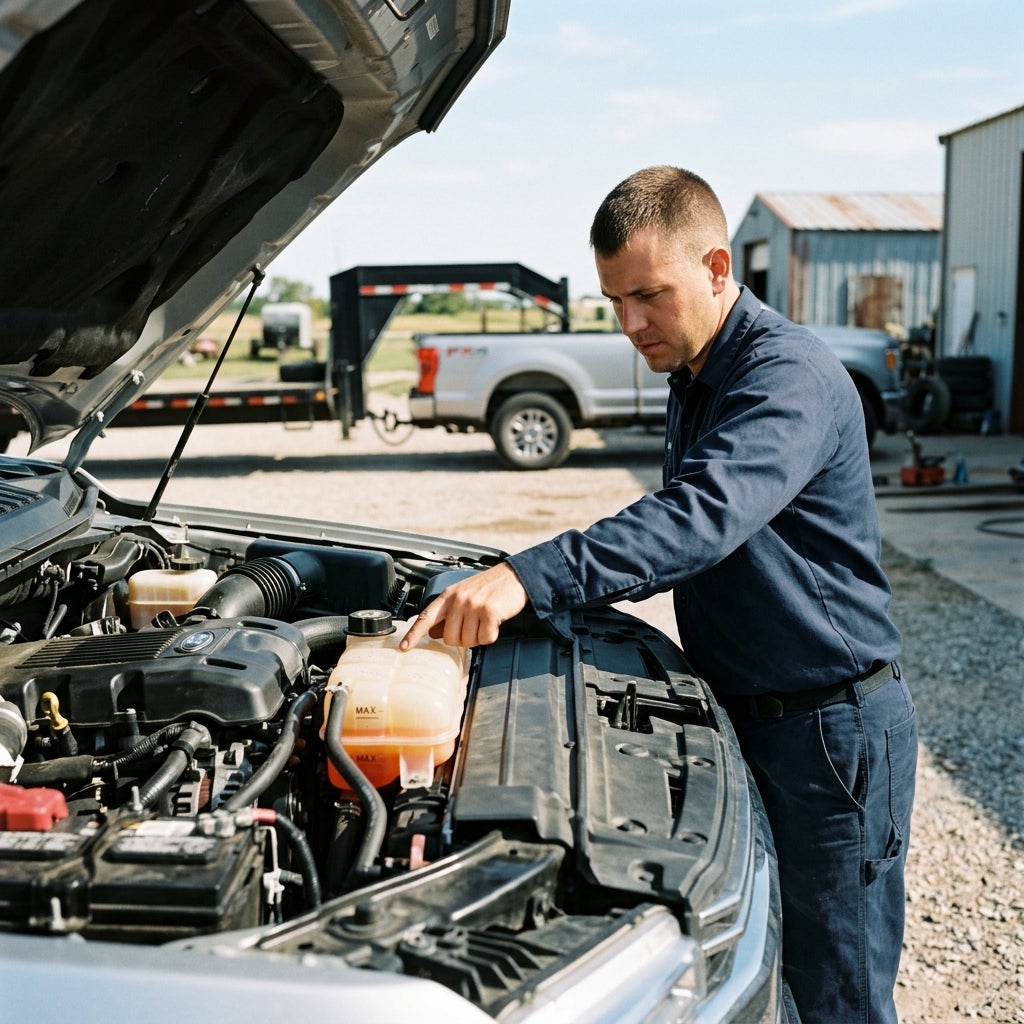
A mechanic in a blue uniform points to the coolant reservoir tank under the open hood of a silver pickup truck. (Representative image for illustration purposes only. Actual vehicle may vary based on trim and configuration.)

Signs Your Super Duty Cooling System Needs Immediate Service Before Towing

When you rely on a Ford Super Duty to haul multi-ton excavators, livestock trailers, or fifth-wheel RVs across Junction City and through the Flint Hills, your engine operates under extreme thermal loads. As Service Director at Valor Ford with two decades of hands-on diesel experience, I can tell you that 80% of summer diesel breakdowns on I-70 are entirely preventable. Before you latch onto a heavy load, taking five minutes to run through a quick walkaround inspection of your primary and secondary cooling systems can save you thousands of dollars and days of downtime.
The modern 6.7L Power Stroke diesel engine is a engineering marvel, but its dual-cooling system architecture requires vigilant care. Key warning signs that warrant an immediate pause before hitching up include dropping fluid levels in either the primary or secondary degas bottles, a distinct sweet-smelling vapor drifting from under the hood after a test warm-up, dry crusty orange or yellow Motorcraft coolant residue around quick-connect fittings, unusual fan clutch resistance, and upper radiator hoses that feel either rock-hard under pressure or spongy and soft when cool. Catching these early indicators protects your head gaskets, EGR coolers, and turbochargers from catastrophic heat distortion.

Meet Mike Hogg: 20 Years of Super Duty Heavy-Duty Diesel Service

Man in a red polo shirt standing in front of a Valor Automotive logo backdrop.
Hello, I'm Mike Hogg, Service Director here at Valor Ford in Junction City. Over the past 20 years, my career has been dedicated to keeping Ford heavy-duty trucks running at peak reliability across North Central Kansas. From local agricultural operations in Dickinson and Geary counties to commercial transport contractors and military equipment haulers servicing Fort Riley, I've diagnosed and repaired every thermal issue imaginable on Power Stroke diesel platforms.
When you work in heavy towing, your cooling system isn't just an accessory—it's the heart of your truck's durability. A small pinhole leak or failing fan clutch during mild cruising becomes a catastrophic thermal runaway when you're pulling 20,000 pounds up an 8% grade in August. My team and I are passionate about proactive maintenance because we know that preventing an engine overhaul starts before the truck ever leaves the staging yard. Feel free to Call us at (785) 238-5114 anytime to talk through your truck's maintenance needs.

Why Is Pre-Work Cooling Inspection Especially Important Before Towing?

Towing heavy gooseneck trailers or maximum payload box beds pushes your Ford Super Duty engine into sustained high-boost operating zones. Under heavy load, peak combustion temperatures soar, and the engine generates exponentially higher thermal energy that must be dissipated through the cooling stack immediately. If your cooling system has even a 5% drop in efficiency—due to degraded fluid, trapped air pockets, or partially restricted radiator fins—the heat accumulation outpaces heat rejection.
In normal commuter driving without payload, a compromised cooling system might hide its flaws. The fan clutch might kick in late, or the secondary circuit might run slightly elevated without causing an immediate check engine light. However, the moment you put the truck under heavy load on Kansas highways, heat levels spike in seconds. Pre-work checks ensure your primary and secondary cooling loops maintain maximum thermal headroom, preventing sudden derate modes or warped components miles away from help.
Furthermore, modern Power Stroke engines feature sophisticated electronic safeguards that will automatically pull engine torque and boost when cylinder head or oil temperatures cross threshold limits. Imagine pulling out onto Highway 77 with a heavy load, only for your truck to enter reduced power mode midway up a hill because the secondary coolant loop couldn't chill the charge air cooler. Performing a thorough cold check before your workday starts prevents these frustrating and dangerous highway power drops.
Whether you are operating an older 6.7L model or considering upgrading to a newer model like when you Research Ford F-250 options, keeping tabs on thermal health is vital. Taking proactive steps gives you complete confidence when embarking on tough jobsite assignments across Junction City.

Critical Visual Flags: What Pre-Work Inspection Signs Indicate Immediate Service?
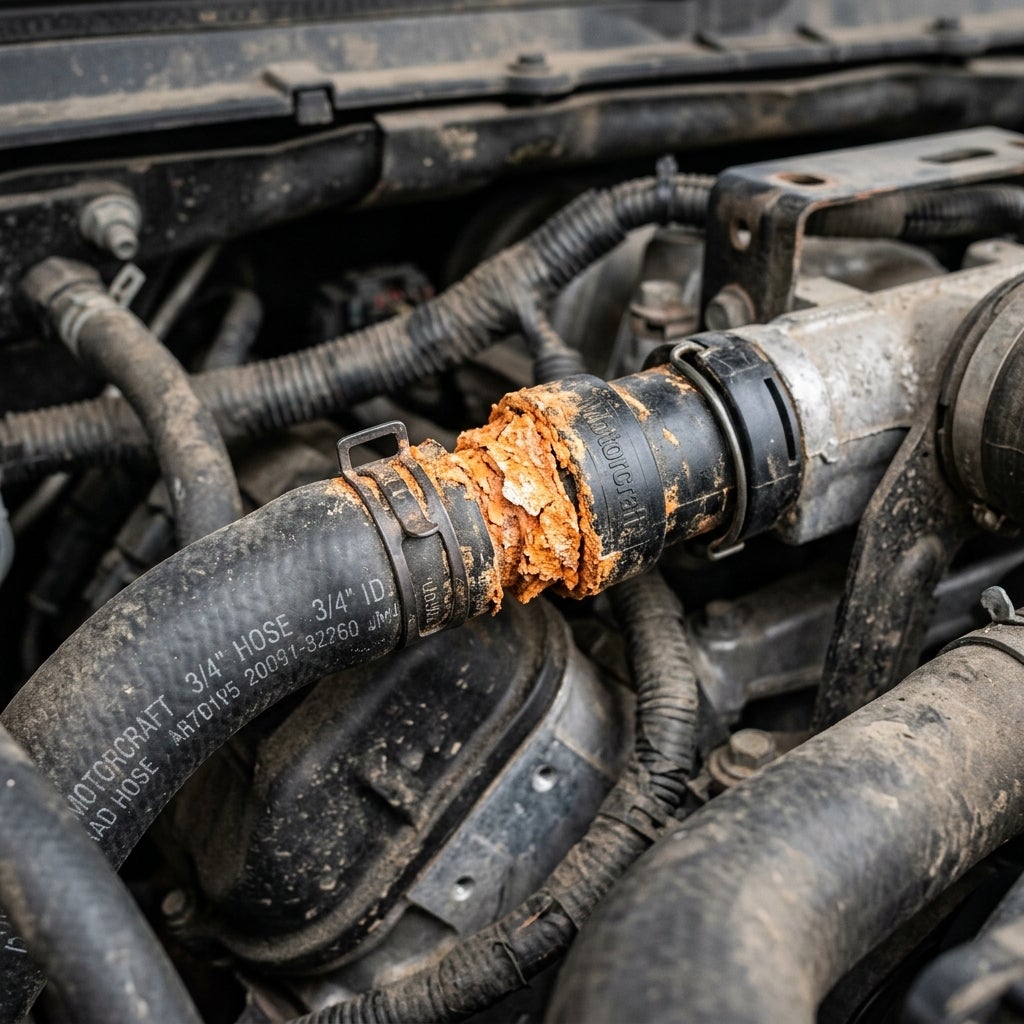
Damaged black rubber engine hose with heavy orange crusty coolant corrosion and metal hose clamp. (Representative image for illustration purposes only. Actual vehicle may vary based on trim and configuration.)

1. Crusty Coolant Residue

Look for chalky, dried orange, pink, or yellow deposits around hose connections, thermostat housings, radiator end-tanks, and water pump seams. This residue is evaporated coolant escaping under system pressure.
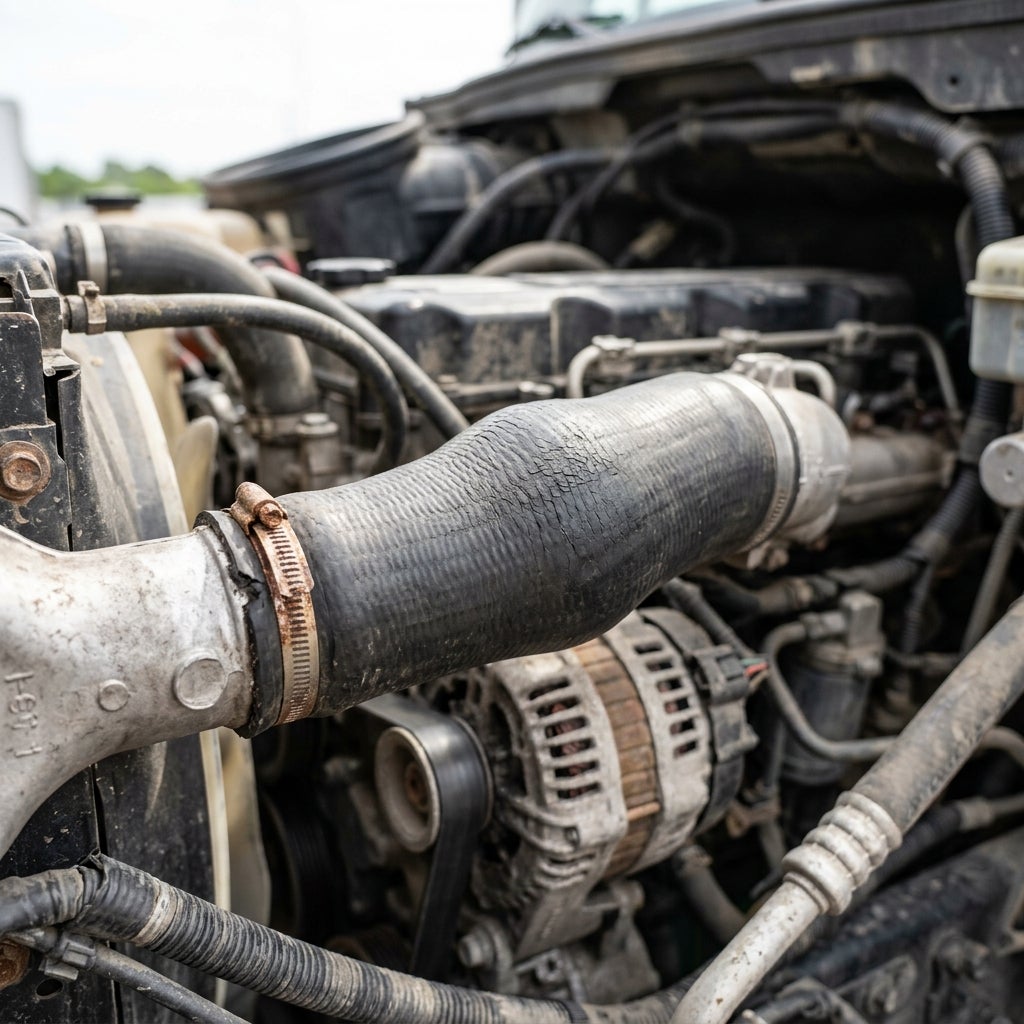
Severely dry-rotted and cracked black rubber engine hose connected to a metal pipe with a rusty hose clamp. (Representative image for illustration purposes only. Actual vehicle may vary based on trim and configuration.)

2. Hose Swelling or Softness

Squeeze radiator hoses when cold. Spongy, overly soft, or bulged sections indicate oil contamination or inner liner breakdown. Excessively hard hoses indicate calcification or high pressure buildup.
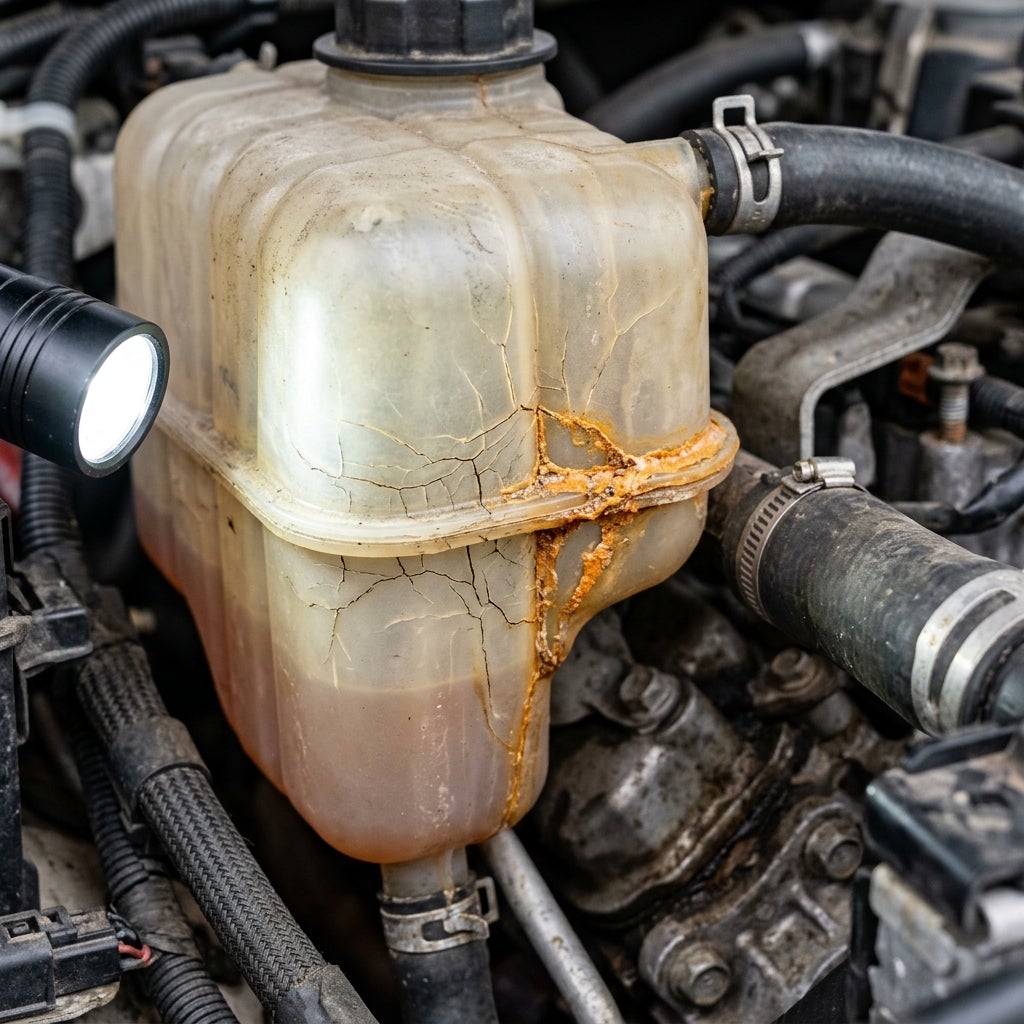
Cracked plastic engine coolant expansion tank with dried orange coolant residue leaking along deep stress fractures. (Representative image for illustration purposes only. Actual vehicle may vary based on trim and configuration.)

3. Degas Tank Stress Cracks

Inspect plastic degas surge bottles for yellowing micro-fractures along heat-stressed molded seams. A compromised degas tank cannot hold pressure, lowering coolant boiling points dramatically.

What Does a Coolant Puddle Under Your Super Duty Usually Indicate?

Discovering a bright yellow, orange, or green fluid puddle on your driveway or shop floor is a clear warning sign. On Ford Super Duty diesel trucks, fluid location provides valuable diagnostic clues before turning the key. Fluid dripping near the front center of the engine crossmember often points to a failing water pump shaft seal weeping through its lower relief port.
Leaks spotted near the front passenger or driver corners typically originate from primary radiator plastic end-tank crimp seams or lower radiator hose quick-connector O-rings. Over time, heavy thermal expansion cycling fatigues the rubber O-rings inside plastic quick-connect fittings, causing cold-weather seepage that expands under pressure.
If you notice drips dripping down the rear of the engine block near the bellhousing, the culprit is often a leaking secondary turbo cooling line fitting or EGR cooler supply connection. These high-heat zones quickly degrade standard seals. Never ignore small drips; fluid loss reduces hydraulic head pressure, creating air pockets that induce severe localized hotspot boiling inside cylinder heads.
If you are unsure where a puddle originates, bring your vehicle in for professional pressure diagnostics. You can Get Directions to Valor Ford and our certified diesel specialists will pinpoint the exact source.

Understanding Fluid Capacities: How Much Coolant Does a 6.7L Power Stroke Hold?

To properly service and maintain a 6.7L Power Stroke V8 Turbo Diesel, you must understand its specialized dual-cooling system architecture. Unlike standard gasoline light trucks that use a single cooling loop, Super Duty diesel trucks utilize two independent cooling systems operating at different thermal ranges with separate degas tanks, radiators, and water pumps.

Cooling Circuit

Target Components

Fluid Capacity (Approx.)

Recommended Fluid Spec

Primary High-Temp Circuit

Engine Block, Cylinder Heads, Turbo Housing

27.8 – 30.7 Quarts (7.0 – 7.7 Gal)

Motorcraft Yellow Prediluted 50/50

Secondary Low-Temp Circuit

Charge Air Cooler (Intercooler), Transmission Cooler, Fuel Cooler

11.7 – 13.0 Quarts (2.9 – 3.2 Gal)

Motorcraft Yellow Prediluted 50/50

Combined, a 6.7L Power Stroke holds over 10 total gallons of coolant! Mixing unapproved universal coolants or tap water with high mineral content can corrode internal heat exchangers and create scale buildup. Always verify that you are topping off with genuine Motorcraft Yellow coolant formulated specifically for Ford high-output diesels.

What Kinds of Damage Can Happen If You Keep Driving a Super Duty Hot?

Ignoring temperature warnings on a heavy-duty diesel engine leads to severe financial consequences. When a Super Duty engine operates past thermal thresholds under load, aluminium cylinder heads undergo thermal expansion that distorts deck flatlines. This warp breaks head gasket fire rings, allowing high-pressure combustion gases to pressurize the cooling system.
Simultaneously, extreme exhaust gas recirculation (EGR) temperatures can crack internal stainless steel EGR cooler tubes. Once cracked, pressurized coolant is forced directly into the exhaust stream or intake manifold, creating white exhaust smoke and risk of hydraulic lock in engine cylinders.
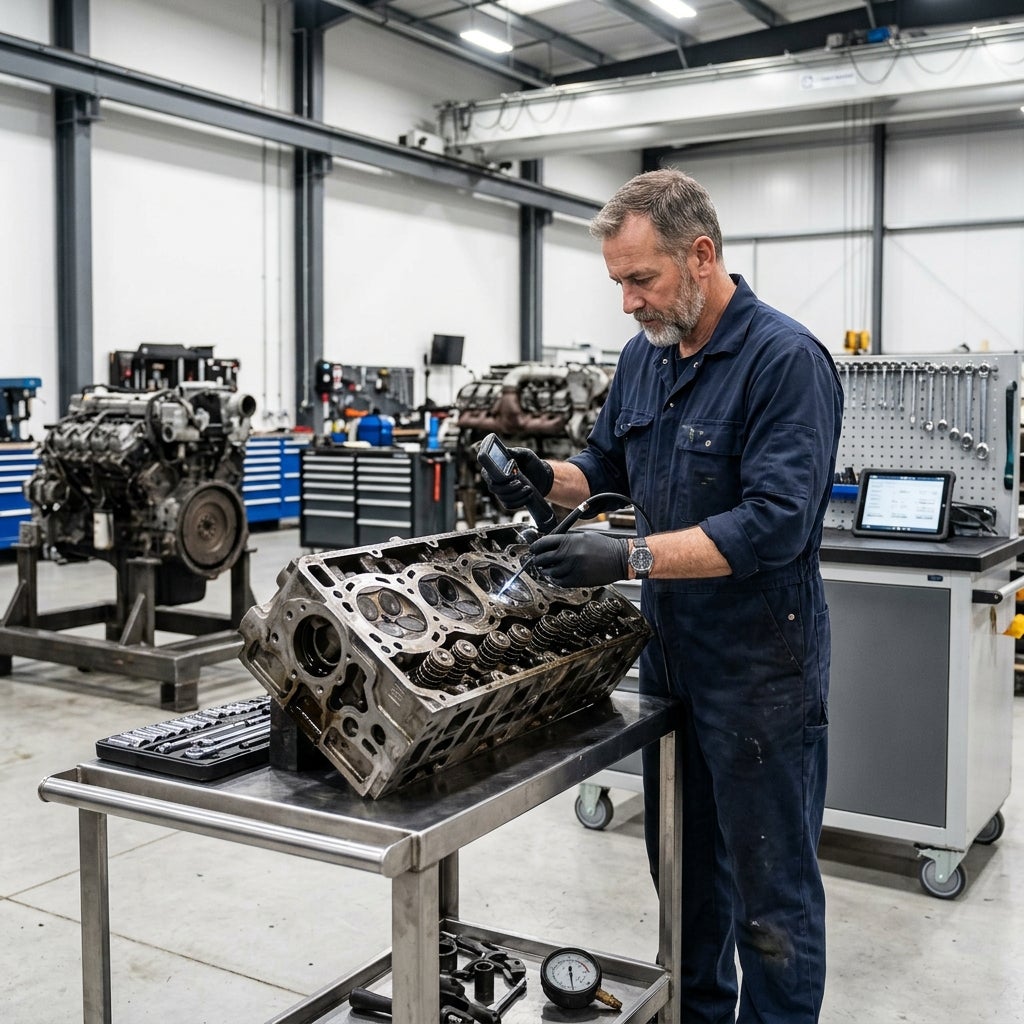
A mechanic in blue overalls uses a digital borescope to inspect an engine cylinder head on a metal workbench. (Representative image for illustration purposes only. Actual vehicle may vary based on trim and configuration.)
Uncontrolled heat also cooks turbocharger center-housing bearings, coking engine oil and starving bearings of critical lubrication. What starts as a simple quick-connect O-ring leak can spiral into a major repair costing significantly more over time. Prioritizing pre-work inspections safeguards your investment.

Expert Service Perspective: Preventing $10,000 Overhauls with 5-Minute Checks

"In my 20 years managing Ford heavy-duty service bays, the single most cost-effective habits I coach commercial fleet managers on are quick, cold morning visual checks. Pop the hood before starting the truck. Look at both degas tank cold fill lines. Give the upper hose a firm squeeze. Check the front bumper air intake for farm dust or debris. Spending 300 seconds doing this every morning saves you $10,000 in major diesel engine overhauls down the road." — Mike Hogg, Service Director at Valor Ford

What Should Be Inspected in the Cooling System Before Putting Your Super Duty to Work?

Phase 1: Fluid & Caps

Verify primary and secondary degas fluid levels are exactly at the cold fill line. Inspect pressure cap seals for dried crust or torn rubber gaskets. Replace degas caps every 3 years to maintain 16 PSI baseline pressure.

Phase 2: Belt & Fan Clutch

Examine the serpentine belt for glazing, rib cracking, or wear indicator misalignment on the tensioner arm. Spin the viscous fan clutch manually when cold; it should offer smooth, moderate resistance without axial play.

Phase 3: Airflow Stack

Shine a flashlight through the front grille mesh to inspect the radiator, AC condenser, and charge air cooler. Clear out farm chaff, dried mud, insects, and straighten bent fins that restrict critical Ram airflow.
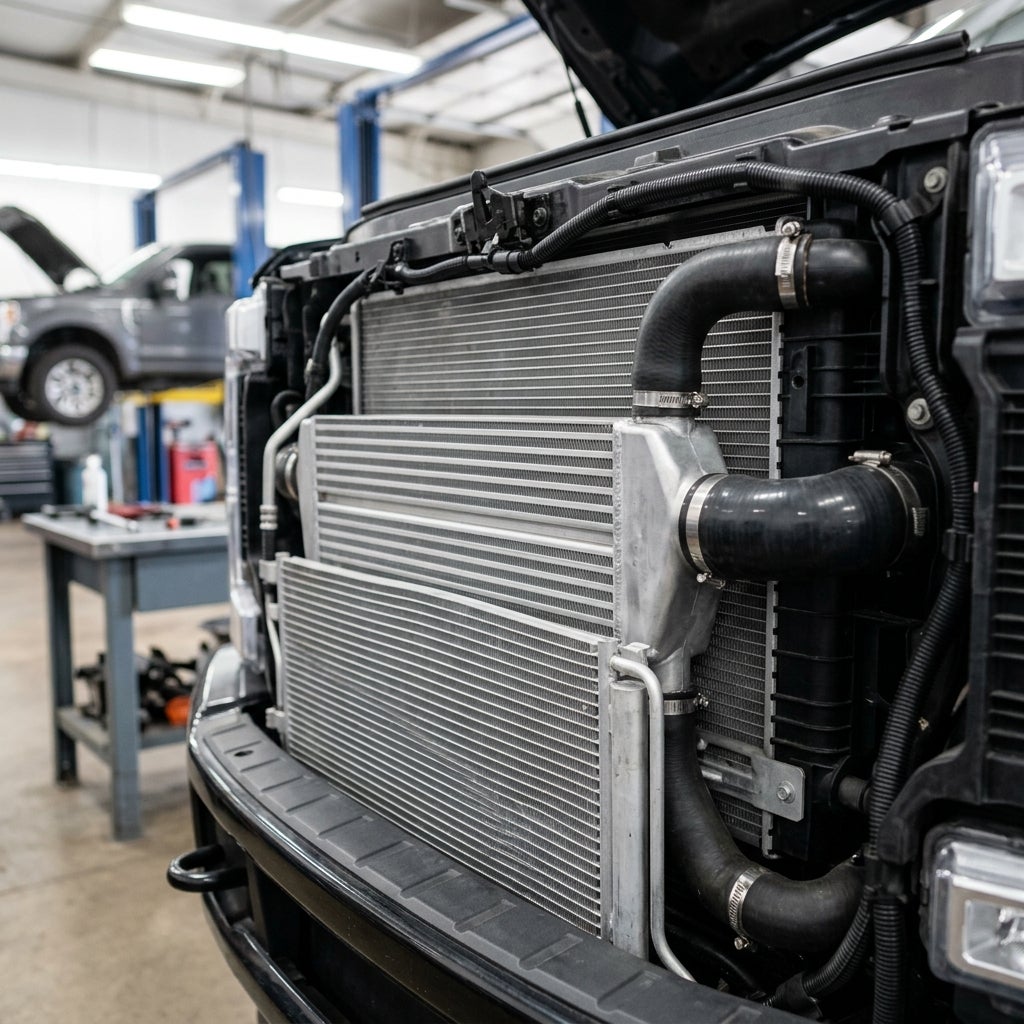
Exposed intercooler, radiator, and heavy-duty cooling hoses on the front of a truck in a mechanic shop. (Representative image for illustration purposes only. Actual vehicle may vary based on trim and configuration.)

How Kansas Terrain and Towing Loads Accelerate Super Duty Cooling Wear

Operating trucks around Junction City, Fort Riley, and throughout Dickinson County presents unique environmental challenges. The rolling topography of the Flint Hills forces repeated high-torque engine pulls, causing thermal cycling in aluminum and plastic cooling components. Summer ambient temperatures regularly exceed 95°F with high humidity, reducing radiant cooling efficiency.
Agricultural pasture work introduces airborne chaff, dust, and seed heads that clog cooling stack fins. Dust mixes with ambient moisture to form a concrete-like barrier across heat exchangers, cutting air volume dramatically. Regular maintenance is essential for trucks operating in these severe regional conditions.

Professional Super Duty Cooling Diagnostics and Maintenance at Valor Ford

Factory-Trained Master Techs

Our service department is staffed by specialized Ford Senior Master Diesel Technicians who understand every detail of Power Stroke engine platforms.

Advanced Pressure Testing

We utilize pneumatic pressure diagnostic tools to simulate high-load thermal stress, identifying micro-leaks before they cause highway failures.

OEM Motorcraft Parts

We stock genuine Ford Motorcraft coolant, heavy-duty hoses, water pumps, and thermostat assemblies built to OEM specifications.

Schedule Your Super Duty Pre-Work Cooling Inspection in Junction City Today

Don't leave your truck's reliability to chance when pulling heavy loads across Kansas. Whether you need a simple system pressure test, a Motorcraft Yellow coolant flush, or a complete pre-season inspection, the expert team at Valor Ford is ready to assist you. Contact us today or drop by our facility at 1825 Goldenbelt Blvd in Junction City.
Logo for Valor Automotive featuring a blue and silver shield with 'VA' and the company name with a red star.
Posted in:

Related Posts

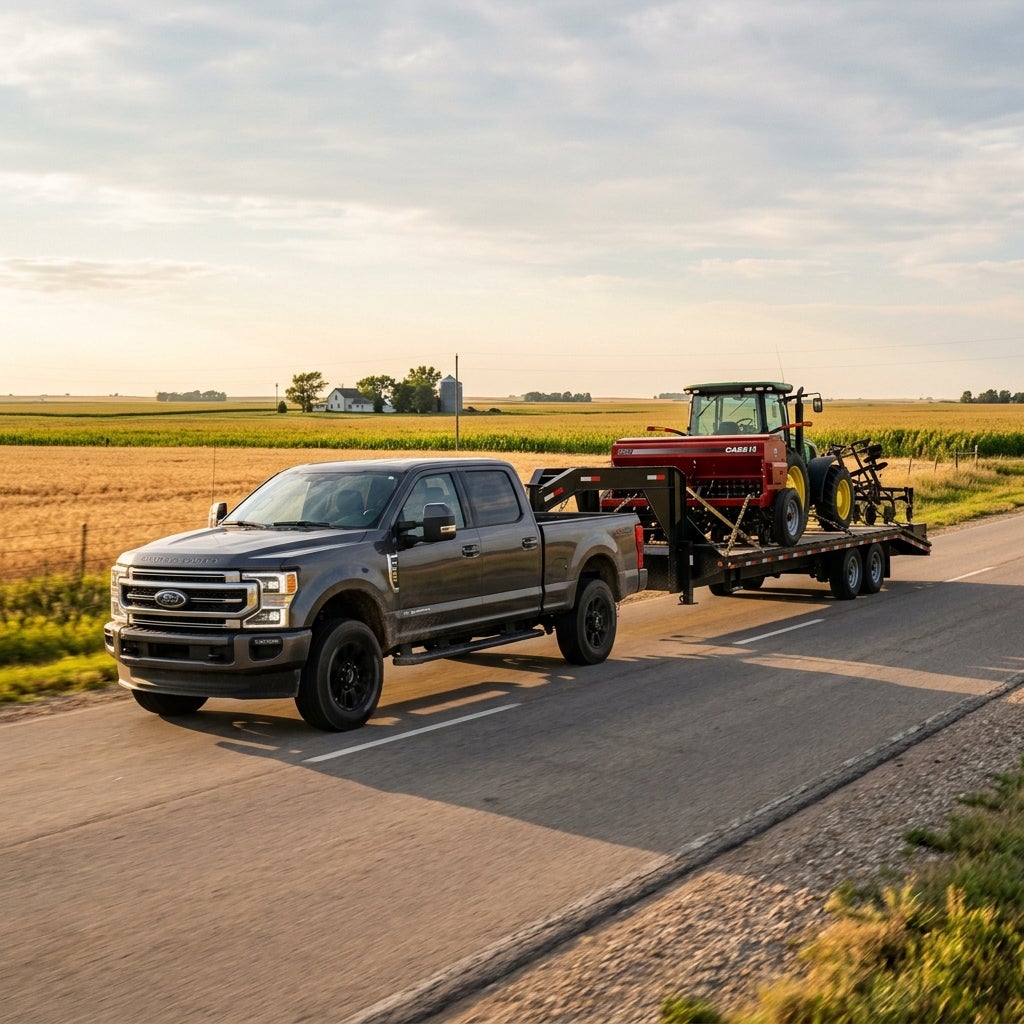
A dark grey Ford Super Duty pickup truck towing a gooseneck trailer with farm equipment down a rural road. (Representative image for illustration purposes only. Actual vehicle may vary based on trim and configuration.)

2022 Ford Super Duty 6.7L Power Stroke Diesel Maintenance Intervals: Official Service Schedule & Direct Expert Guide

2022 Ford Super Duty 6.7L Power Stroke Diesel Maintenance Intervals: Official Service Schedule & Direct Expert Guide Direct Answer First: Maintaining the third-generation 6.7L Power Stroke V8 Turbo Diesel in your 2022 Ford Super Duty F-250, F-350, or F-450 requires strict adherence to fluid and filter service lifecycles. Under normal operating conditions, recommended factory service intervals dictate performing engine oil and filter changes every 7,500 to 10,000 miles (or when triggered by the Intelligent Oil Life Monitor system, not to exceed 1 year or 350 engine hours). Dual fuel filters (both the primary frame-mounted water separator and secondary engine-mounted filter) must be replaced every 15,000 to 22,500 miles (or every second oil change). Engine air filter elements require inspection every 15,000 miles and mandatory replacement at 30,000 miles. Engine coolant (yellow OAT) must be tested every 20,000 miles or 1000 hours and flushed at 105,000 miles. Brake fluid requires a complete system flush every 3 years regardless of mileage. The 10R140 TorqShift 10-speed automatic transmission fluid and internal filter require service at 150,000 miles under light use, though heavy agricultural towing, commercial enterprise, or frequent idling reduces this threshold to 60,000 miles. The 2022 model year represents the pinnacle of the third-generation 6.7L Power Stroke architecture, featuring a hardened steel-piston engine block, upgraded variable-geometry turbocharger, and a 36,000-psi common-rail fuel injection system. Delivering an astounding 475 horsepower and 1,050 lb-ft of torque, this powerplant demands disciplined preventive maintenance to maintain peak thermal efficiency, protect emission control devices (DPF, SCR, and EGR), and prevent premature wear on high-pressure hydraulic and fuel delivery components. Whether your truck spends its life cruising Interstate 70 or pulling heavy livestock trailers through Dickinson County dirt roads, keeping rigorous service logs ensures long-term operational reliability. Service Task Normal Duty Interval Severe Duty / Towing Interval Critical Notes & Specs Engine Oil & Filter 7,500 – 10,000 Miles / 1 Yr 5,000 Miles / 200 Engine Hours 13.0 Qts 5W-40 Synthetic (CK-4 Spec) Dual Fuel Filters (Primary & Secondary) 15,000 – 22,500 Miles 10,000 – 15,000 Miles Must drain water separator monthly Engine Air Filter Element 30,000 Miles (Inspect at 15k) 10,000 – 15,000 Miles Inspect weekly in dusty agricultural use Engine Coolant (Yellow OAT) 105,000 Miles (Test at 20k) 60,000 Miles (Test at 15k) Test corrosion inhibitor strength 10R140 TorqShift Transmission Fluid 150,000 Miles 60,000 Miles Requires Motorcraft ULV Transmission Fluid Front & Rear Differential Axle Lube 150,000 Miles 60,000 Miles Synthetic 75W-140 / 75W-85 gear oil Brake Fluid Flush 3 Years (Time-based) 3 Years (Time-based) DOT 4 Low Viscosity Synthetic Expert Perspectives: 20 Years of Power Stroke Service Leadership with Mike Hogg When evaluating diesel longevity, theoretical service tables only tell half the story. Practical wrench time, master diagnostics, and geographic experience define actual truck health. As Service Director at Valor Ford in Junction City, KS, Mike Hogg brings over 20 years of dedicated Ford diesel engineering and hands-on maintenance leadership to truck owners across Dickinson County, Geary County, and the active duty military community at Fort Riley. "Over two decades servicing Ford Super Duty platform generations—from the early 7.3L and 6.0L days to the sophisticated third-generation 6.7L Power Stroke—I've seen firsthand how real-world usage dictates component lifespan," notes Mike Hogg. "Central Kansas presents a brutal operating environment. Our summers feature ambient temperatures pushing past 100 degrees during harvest season, while our winters hit sub-zero conditions with biting winds. Add in heavy gooseneck livestock hauling, commercial grain transport, and frequent high-dust field work, and standard maintenance schedules quickly become insufficient." At Valor Ford, Mike Hogg leads a team of Senior Master Technicians who specialize in modern diesel powertrain calibration, exhaust post-treatment restoration, and preventive driveline servicing. If you ever have questions about your maintenance schedule or require expert diagnostic support, you can Call us at (785) 238-5114 or stop by our service bay. What Engine Options and Towing Specs Define the 2022 Ford Super Duty Lineup? The 2022 Ford Super Duty family was engineered to provide unparalleled capability across diverse commercial, agricultural, and personal applications. Ford offered three distinct engine powertrains in 2022, each tailored to specific payload demands, duty cycles, and operating budgets. 6.7L Power Stroke V8 Diesel Output: 475 HP @ 2,600 RPM Torque: 1,050 lb-ft @ 1,600 RPM Transmission: TorqShift 10-Speed Automatic Max Towing: Up to 37,000 lbs (Gooseneck F-450) Key Feature: Steel pistons, 36k-psi injection, variable geometry turbo. Designed for maximum long-distance heavy towing. 7.3L Godzilla V8 Gas Output: 430 HP @ 5,500 RPM Torque: 475 lb-ft @ 4,000 RPM Transmission: TorqShift 10-Speed Automatic Max Towing: Up to 21,200 lbs conventional Key Feature: Pushrod V8 design with cast-iron block. Ideal for fleet operators seeking gas simplicity with heavy commercial output. 6.2L Boss V8 Gas Output: 385 HP @ 5,750 RPM Torque: 430 lb-ft @ 3,800 RPM Transmission: TorqShift 6-Speed / 10-Speed Max Towing: Up to 15,800 lbs Key Feature: Proven SOHC workhorse architecture standard on XL/XLT F-250 trims, optimized for everyday municipal and trade work. While all three engines demonstrate exceptional durability, the 6.7L Power Stroke Turbo Diesel remains the leading option for heavy gooseneck and fifth-wheel trailering. When paired with the high-strength boxed steel frame, upgraded axle shafts, and integrated fifth-wheel hitch prep package on the F-250 and F-350, the diesel powertrain unlocks maximum payload and towing ratings that gas engines simply cannot match over steep elevation changes or long highway hauls. To explore vehicle specs further, check out our in-depth research guides for the Research Ford F-250 lineup. How Does Normal Schedule Compare to Severe Duty Maintenance for Kansas Agriculture and Heavy Towing? Understanding Ford's definition of Special Operating Conditions (Severe Duty) is essential for Central Kansas Super Duty owners. Standard oil change intervals of 7,500 to 10,000 miles assume smooth highway travel without excessive payload, idle time, or environmental hazards. However, if your 2022 Power Stroke operates under any of the following parameters, Ford mandates transitioning to severe duty maintenance cycles: • Frequent Towing or Heavy Payload: Towing trailers exceeding 50% of the gross combined weight rating (GCWR) for extended distances. • Extensive Engine Idling: Operating the truck at low idle speeds for prolonged periods (e.g., job site power generation, stationary PTO use, or military staging at Fort Riley). • Dusty & Unpaved Environment: Driving on gravel ranch roads, farm lanes, or dirt access routes throughout Dickinson County during harvest. • Off-Road & Low-Speed Operation: Consistent operation in low-range 4x4 or frequent short trips under 10 miles in ambient freezing weather. Under severe duty, oil degradation occurs significantly faster due to soot accumulation and thermal breakdown. Ford specifies reducing oil change intervals to 5,000 miles or 200 engine hours, while cutting transmission, transfer case, and differential fluid change intervals by more than 50%. Schedule Ford Service Today Mike Hogg’s Golden Rule for 6.7L Power Stroke Longevity: Dual Fuel Filters and Clean DEF "If I could give every diesel truck owner in Kansas just one single piece of advice to help reduce the risk of unexpected repairs, it would be this: never compromise on your fuel filtration and DEF handling," states Service Director Mike Hogg. "The modern 6.7L Power Stroke utilizes a high-pressure common rail fuel injection system operating at pressures up to 36,000 psi. At these ultra-high hydraulic pressures, even microscopic water droplets or fine rust particulates passing through dirty filters can cause catastrophic pump cavitation or galling. Replacing fuel filters every 15,000 miles—or sooner if you purchase bulk farm fuel—is cost-effective protection compared to a $10,000 fuel system overhaul." Key Diesel Fuel & DEF Care Rules from Mike Hogg: 1. Drain the Water Separator Monthly: Located on the primary frame-mounted fuel filter module, the water drain valve should be opened monthly into a clear container to purge trapped condensation before water sensors trigger warning lights. 2. Use Genuine Motorcraft Filters: Aftermarket fuel filters frequently exhibit inferior micron filtration ratings or improper O-ring sealing dimensions, allowing unmetered fuel bypass directly into delicate piezo fuel injectors. 3. Store Diesel Exhaust Fluid (DEF) Properly: DEF consists of 67.5% deionized water and 32.5% high-purity urea. DEF degrades rapidly when exposed to direct sunlight or temperatures exceeding 85°F. Always use fresh DEF from sealed containers or verified retail pumps to prevent SCR catalyst crystallisation and dosing valve clogging. 4. Winterizing with Anti-Gel Additives: When ambient temperatures approach 20°F in Junction City, ultra-low sulfur diesel (ULSD) forms wax paraffin crystals that clog fuel filter media. Always add Motorcraft Anti-Gel & Cetane Booster at every fill-up during winter months. What Should You Inspect When Test-Driving a Used 2022 Ford Super Duty? Shopping for a pre-owned 2022 Ford Super Duty diesel offers extraordinary capability, but buyer diligence is essential. Before signing paperwork, perform these crucial expert inspection steps developed by our Senior Master Technicians: 1. Cold Start & Engine Integrity Insist on starting the truck when the engine block is completely cold. Watch the tailpipe for heavy white smoke (unburnt fuel/coolant) or blue smoke (oil burning). Remove the oil filler cap while idling—excessive engine blowby escaping from the valve cover indicates worn piston rings or cylinder wall scuffing. 2. Transmission & Drivetrain Evaluate shift engagement through all 10 gears of the TorqShift transmission. Test for gear hunting, harsh downshifts, or delayed forward engagement. Shift the transfer case into 4H and 4L on loose gravel to confirm electronic hub engagement and front differential quietness. 3. History & Frame Condition Inspect the bed for telltale signs of commercial fifth-wheel or gooseneck hitch mounting. Examine the rear hitch receiver for elongated pin holes. Request complete OASIS service records to verify fuel filter replacement frequency and past recall completion. What Trim Levels and Interior Technology Updates Were Introduced in the 2022 Ford Super Duty? The 2022 model year brought substantial technological refinements to the Super Duty interior, establishing a new benchmark for heavy-duty cabin connectivity and driver comfort across six available trim levels: • XL: Rugged work truck trim with durable vinyl flooring, heavy-duty cloth seats, and SYNC 3 4.2-inch interface. • XLT: The popular multi-purpose trim featuring 18-inch aluminum wheels, Ford Co-Pilot360 safety technology, and available 12-inch touchscreen. • Lariat: Adds premium leather seating, B&O Sound System, power-sliding rear window, and standard SYNC 4. • King Ranch: Distinctive Kingsville antique leather interior, real wood trim accents, and trailer reverse guidance. • Platinum: Luxury features including massaging multi-contour front seats, satin chrome exterior accents, and LED headlights. • Limited: The ultimate luxury heavy-duty package with Highland Tan leather, twin-panel moonroof, and adaptive steering. SYNC 4 Technology Breakthrough: Standard on Lariat trims and above, the standout update for 2022 was the debut of the SYNC 4 infotainment system on a massive 12-inch center touchscreen. Featuring twice the computing power of previous systems, SYNC 4 offers wireless Apple CarPlay and Android Auto integration, customizable split-screen multitasking, enhanced natural voice recognition, and cloud-connected navigation for real-time traffic and trailer routing. Browse Used Inventory How Does the 2022 Ford Super Duty Compare to the 2022 Chevy Silverado HD? When pitting the 2022 Ford Super Duty 6.7L Power Stroke against the 2022 Chevy Silverado 2500/3500 HD with the 6.6L Duramax L5P diesel, both trucks represent exceptional engineering achievements. However, notable differences exist in powertrain metrics and routine service maintenance requirements. Power Output: Ford's 6.7L Power Stroke generates 475 hp and 1,050 lb-ft of torque, outperforming the Silverado HD Duramax (445 hp and 910 lb-ft of torque) by 30 hp and 140 lb-ft of torque. This torque advantage is immediately noticeable when starting heavy loads on uphill highway grades. Filter & Serviceability: Ford's dual-filter fuel architecture provides robust secondary defense against water contamination, whereas GM utilizes a single frame-mounted fuel filter module. Both trucks require specialized synthetic low-ash heavy-duty diesel engine oils, but Ford's Intelligent Oil Life Monitor utilizes actual engine operating parameters (fuel burn, thermal history, idle hours) rather than simple mileage counters. Metric / Feature 2022 Ford Super Duty (6.7L) 2022 Chevy Silverado HD (6.6L) Horsepower 475 HP @ 2,600 RPM 445 HP @ 2,800 RPM Torque Rating 1,050 lb-ft @ 1,600 RPM 910 lb-ft @ 1,600 RPM Transmission 10-Speed TorqShift 10-Speed Automatic Transmission Max Gooseneck Towing Up to 37,000 lbs Up to 36,000 lbs Fuel System Filter Dual Filters (Frame + Engine) Single Primary Frame Filter Oil Capacity 13.0 Quarts 10.0 Quarts How Does the 2022 Ford Super Duty Compare to the 2022 Ram 2500 and 3500? Comparing the 2022 Ford Super Duty 6.7L V8 Power Stroke to the 2022 Ram 2500/3500 Cummins 6.7L Inline-6 Turbo Diesel highlights fundamental design philosophies: Engine Architecture & Gearing: Ram uses an inline-6 configuration, while Ford utilizes a hot-V CGI (compacted graphite iron) block V8 design. Ford pairs every 2022 Power Stroke with the heavy-duty 10-speed TorqShift transmission, whereas Ram 2500 models rely on a 6-speed 68RFE transmission (with the 6-speed Aisin reserved for High-Output 3500 models). The extra four gear ratios in Ford's TorqShift maintain optimal engine RPM bands during acceleration under load. Payload & Service Costs: Because of lighter overall aluminum-alloy body construction, the Ford Super Duty yields higher payload capacity on comparable GVWR configurations. From a long-term operational cost perspective, both trucks require strict dual fuel filter maintenance, but Ford's front-end suspension design (Twin-Coil Monobeam axle) demonstrates superior steering ball joint longevity under heavy farm loader use. Transmissions, Differentials, and Transfer Cases: Essential Fluid Care for Heavy Hauling 10R140 Transmission Care The TorqShift 10-speed transmission requires ultra-low viscosity Motorcraft ULV fluid. Operating thermal range is tightly regulated. Fluid pan drops and internal filter replacement should occur every 60,000 miles on severe duty trucks to prevent valve body solenoid varnish. Axle Differential Lube Rear Dana M275/M300 or Sterling 10.5 axles demand synthetic 75W-140 gear lubricant. Replace fluid every 60,000 miles when towing continuously. Inspect housing vent tubes regularly to prevent pressure seal blowouts when launching boats or crossing deep mud. Transfer Case & PTO The electronic shift-on-the-fly 4x4 transfer case utilizes Motorcraft LV fluid. Fluid replacement is scheduled at 60,000 miles for severe duty. Live-drive Power Take-Off (PTO) units require separate gear housing inspections during routine chassis lubrication. Order Genuine Ford Parts Preparing Your 2022 Power Stroke for Winter and Farm Work in Junction City and Fort Riley Operating a diesel truck in Junction City, Fort Riley, and surrounding Kansas communities requires specialized seasonal awareness. Extreme temperature fluctuations between summer field work and winter sub-zero freezes place heavy demands on your electrical and cold-start systems. Cold Weather Readiness: Ensure your engine block heater cord is inspected before November. Modern 6.7L engines utilize ceramic glow plugs that reach over 1,000°C in seconds, but dual heavy-duty AGM batteries must maintain optimal cold cranking amps (CCA) to spin high-compression diesel starters in sub-zero weather. Have your batteries load-tested annually at Valor Ford. Harvest Dust & Air Filtration: During autumn sorghum and corn harvest, ambient dust levels skyrocket. Check your air filter restriction gauge weekly. A clogged intake filter starves the turbocharger, increasing exhaust gas temperatures (EGTs) and triggering premature DPF regeneration cycles. Your Partner in Heavy-Duty Reliability: At Valor Ford, we understand that your truck isn't just transportation—it's your livelihood, your farm machinery, or your mission-critical transport. Service Director Mike Hogg and our factory-certified diesel team are here to help you protect your investment with genuine Motorcraft parts, master diagnostics, and tailored maintenance schedules. Whether you need to Schedule Pickup and Delivery Service for routine oil maintenance or visit our service center in person, getting here is easy. Get Directions to Valor Ford located at 1825 Goldenbelt Blvd, Junction City, KS 66441, or Call us at (785) 238-5114 to consult directly with our diesel service specialists today. Valor Ford | 1825 Goldenbelt Blvd, Junction City, KS 66441 | Service Phone: (785) 238-5114 | Serving Geary County, Dickinson County, and Fort Riley military families.

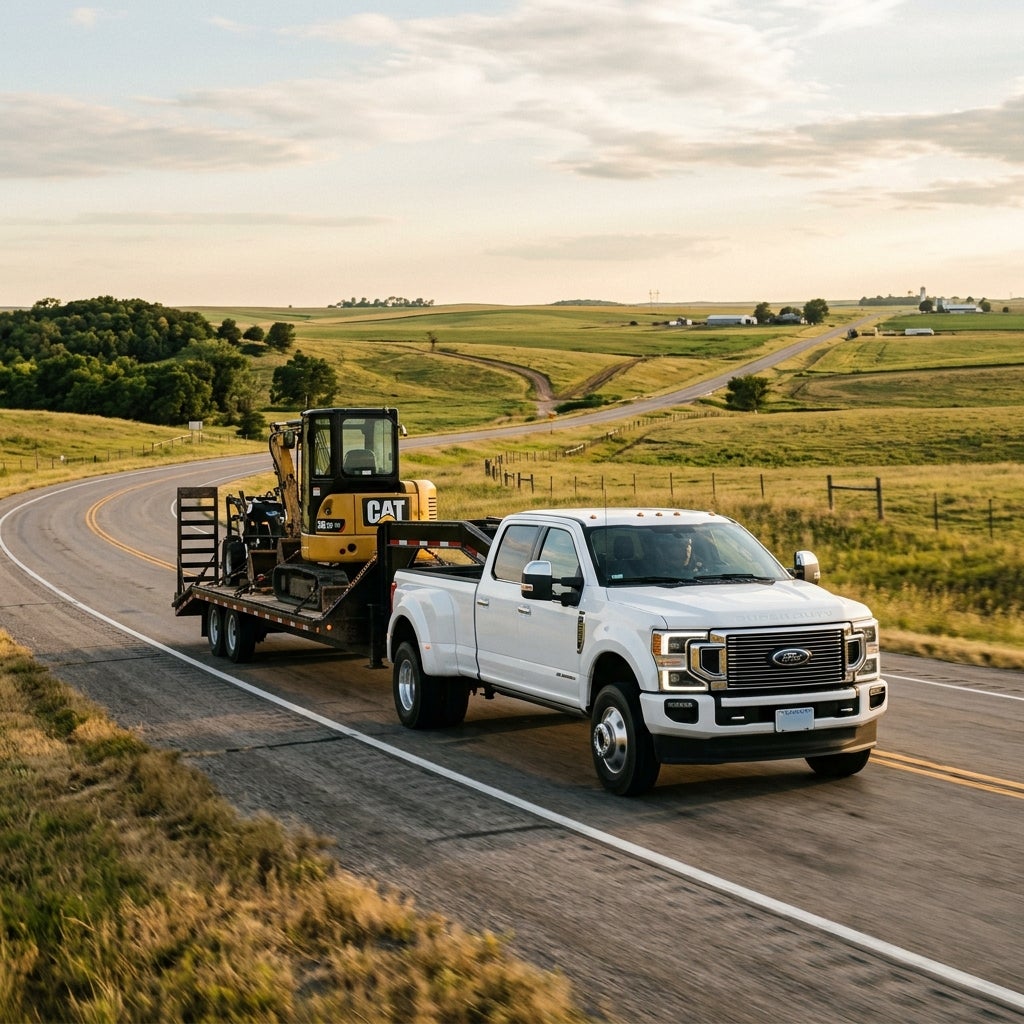
White Ford Super Duty dually truck towing a CAT excavator on a scenic winding road through rolling hills. (Representative image for illustration purposes only. Actual vehicle may vary based on trim and configuration.)

The Heavy Hauling Dilemma: Which Engine Actually Saves You Money Under Load?

The Heavy Hauling Dilemma: Which Engine Actually Saves You Money Under Load? Whether you are pulling a horse trailer through the rolling Flint Hills, transporting heavy agricultural machinery across Dickinson County, or hauling construction materials near Fort Riley, anyone who has ever hooked up a trailer knows the immediate anxiety of watching the fuel gauge drop. It is a fundamental truth of physics: the moment you hitch thousands of pounds of deadweight to the back of your vehicle, your fuel economy will suffer. However, the exact rate of that decline—and the actual dollar amount you spend at the pump—depends almost entirely on the mechanical heartbeat of your truck. For generations, drivers throughout Junction City and beyond have debated the ultimate towing question: which engine configuration truly stands up to heavy loads while keeping your operating costs at a minimum? Historically, the decision was simple. If you had serious work to do, you bought a diesel. If you were driving back and forth to town with occasional light chores, you stuck with a gasoline V8. But today, the landscape is far more complex. Modern engineering has introduced high-tech turbocharged gasoline powerplants, high-torque hybrid systems, and highly refined turbo-diesels that challenge traditional assumptions. These advanced powerplants do not just change how a truck drives; they alter the thermodynamic math of fuel consumption. Understanding this math is crucial to choosing a vehicle that matches your daily routine and budget. At Valor Ford, we interact daily with local farmers, active-duty military personnel, and business owners who rely on their trucks to make a living. They do not just want marketing slogans; they need hard data and practical mechanical realities. In this comprehensive guide, we will break down the physical forces, thermodynamic realities, and long-term financial impacts of towing and hauling. By examining how different engine architectures handle the stress of heavy payloads, we hope to help you make an informed decision for your fleet or family. If you want to research specific trucks, you can Research Ford F-150 or delve into heavy-duty options with our guide to Research Ford F-250. Why Do Diesel Engines Generally Get Better Fuel Economy Than Gas Engines Under Heavy Load? To understand why diesel fuel economy remains remarkably resilient under a heavy load, we have to look closely at the physics of combustion. A diesel engine functions under the principle of compression ignition, whereas a gasoline engine relies on spark ignition. Because diesel engines do not use spark plugs, they must compress the intake air to an extreme degree—often achieving compression ratios ranging from 15:1 up to 20:1 or more. This immense compression heats the air to temperatures where fuel ignites instantly upon injection. This high compression ratio directly translates to superior thermal efficiency, extracting more kinetic energy from every single droplet of fuel. Furthermore, diesel fuel itself is denser and contains roughly 10% to 15% more energy content per gallon than gasoline. While gasoline contains about 114,000 BTUs of energy per gallon, diesel delivers approximately 129,500 to 138,500 BTUs. Because of this inherent chemical advantage, a diesel engine has to burn less physical volume of fuel to produce the same amount of raw work. When you are pulling a heavy flatbed trailer, that extra thermal energy per drop is what prevents your fuel gauge from plummeting rapidly. Another massive physical differentiator is how diesel engines manage intake air. In a conventional gasoline engine, a throttle valve limits the intake air to control engine speed, which creates vacuum resistance (known as pumping losses) as the pistons pull air past the restriction. Diesels operate without a throttle valve; they intake a full volume of unthrottled air and control engine speed purely by regulating the amount of fuel injected. This lack of throttling restrictions dramatically reduces pumping losses, keeping the engine exceptionally efficient even when working hard to pull heavy loads. Finally, the torque delivery of a diesel engine is highly advantageous for towing. Because diesels generate maximum torque at incredibly low rotational speeds (often between 1,600 and 2,200 RPM), they can maintain highway speeds in their highest gears. A gasoline engine, by comparison, must spin at much higher rotational speeds (often 3,500 to 5,000 RPM) to make its peak power, requiring frequent transmission downshifts that burn excessive fuel. Under heavy load, keeping RPMs low is the ultimate secret to preserving fuel economy. Comparing Gas, Turbocharged, and Diesel Powertrains on Central Kansas Highways To see how these concepts function in the real world, let us contrast three distinct modern engine philosophies that you will find navigating the highways of Central Kansas. Each design approaches the challenges of heavy towing with a different set of strengths, mechanical limitations, and fuel consumption profiles. Naturally Aspirated V8 Gas Traditional naturally aspirated gasoline V8 engines, like Ford's legendary 5.0L Coyote or the heavy-duty 7.3L 'Godzilla' V8, rely purely on displacement to build power. They are incredibly reliable and structurally uncomplicated, making them a favorite for fleet owners. However, because they lack forced induction, they must rev high to reach their power bands. When climbing an incline with a trailer, the transmission will downshift, pushing the engine into high-RPM ranges where fuel consumption increases dramatically to maintain momentum. Turbocharged EcoBoost Gas Ford's EcoBoost technology has completely revolutionized the gasoline truck segment. By utilizing twin turbochargers, engines like the 3.5L EcoBoost generate diesel-like low-end torque starting under 2,500 RPM. This allows them to tow heavy trailers without excessive downshifting. However, under heavy load, turbocharged gas engines must inject extra fuel to cool the combustion chambers and prevent pre-ignition. This cooling strategy is highly effective for engine health, but it causes fuel economy to drop significantly when hauling heavy loads over long distances. Turbo-Diesel Power Stroke The Power Stroke Turbo Diesel represents the pinnacle of sustained towing efficiency. Combining the physical benefits of compression ignition with advanced variable-geometry turbocharging, diesels like the 6.7L Power Stroke deliver massive torque at idle and low RPMs. This engine handles heavy loads effortlessly, keeping its gear locked and keeping RPMs low even when pulling heavy equipment up steep inclines. The fuel consumption of a diesel remains remarkably steady, dropping by a far smaller percentage than its gasoline rivals. At-A-Glance Powertrain Comparison under Load Engine Philosophy Peak Torque RPM Thermal Efficiency Towing Fuel Economy Drop Best Fit Scenario Naturally Aspirated V8 Gas High (3,800 - 4,500 RPM) Moderate (~25-30%) High (Drops by 40-50%) Light to moderate occasional towing Turbocharged Gas (EcoBoost) Low-to-Mid (2,250 - 3,000 RPM) Good (~30-35%) Significant (Drops by 35-45%) Frequent medium towing & daily commuting Turbo-Diesel (Power Stroke) Very Low (1,600 - 2,200 RPM) Excellent (~40-45%) Minimal (Drops by 15-25%) Continuous, heavy, long-distance towing Find the Right Workhorse for Your Fleet at Valor Ford in Junction City No matter which engine philosophy aligns with your towing requirements, Valor Ford is here to make your selection seamless. Our experienced team in Junction City understands the unique needs of Kansas drivers, from heavy commercial hauling to weekend recreation. We invite you to explore our expansive inventory, consult with our product specialists, and find the perfect configuration for your lifestyle. To get started today, you can Get Pre-Approved for Financing online or take a look at our current selection to Browse Used Inventory and discover competitive pricing on dependable pre-owned workhorses. Get Pre-Approved for Financing Why Are Large-Displacement Diesel Engines Preferred for Long-Haul Heavy Loads? For long-haul operations involving substantial trailer weights, large-displacement diesel engines—such as the Ford 6.7L Power Stroke V8—remain the undisputed gold standard. The reason goes beyond simple fuel economy; it is a matter of longevity, thermal control, and mechanical durability. When an engine operates under a continuous, heavy load, it generates massive amounts of internal heat. Large-displacement diesel engines are engineered with robust iron or compacted graphite iron (CGI) blocks, heavy-duty cooling jackets, and high-capacity oiling systems specifically designed to manage this thermal stress over hundreds of thousands of miles. Sustained low-RPM operation is another vital benefit of a large-displacement diesel. When pulling a heavy fifth-wheel or commercial flatbed at highway speeds, a large diesel can comfortably sit in its top gear at 1,600 RPM. Because the engine is not spinning rapidly, frictional losses within the cylinder walls and valvetrain are minimized. Over a long-distance haul across Kansas or neighboring states, this reduction in internal friction adds up to substantial fuel savings and reduces mechanical wear, extending the overall lifespan of the powerplant. Additionally, large-displacement diesels offer unmatched auxiliary control when descending steep grades or slowing down on highway exits. Integrated exhaust braking systems use the engine's turbocharger to restrict exhaust flow, creating backpressure that slows the truck down without relying on the physical brakes. This not only prevents brake fade and extends the life of your brake pads, but it also improves safety when hauling heavy loads. It is a comprehensive system designed to handle heavy work with absolute composure. When Does a Diesel Pickup Make More Sense Than a Hybrid or Turbo Gas Engine? Choosing the right truck is not about finding the 'best' engine in a vacuum—it is about finding the engine that matches your specific driving habits and business model. For some drivers, a diesel's higher initial purchase price and maintenance costs are easily offset by fuel savings. For others, a highly versatile turbocharged or hybrid gas engine is far more practical. Let's look at three distinct driving profiles to see which option makes the most financial sense. Short-Trip & Commuter Use If your daily routine involves short trips around Junction City, commuting to Fort Riley, or running quick errands with only occasional, light towing, a hybrid or compact turbocharged gasoline engine is your best option. Diesel engines require long, hot highway trips to keep their exhaust filtration systems clean. Short, stop-and-go trips can prevent a diesel from reaching operating temperature, leading to clogged particulate filters and increased maintenance. A hybrid or small gas engine thrives in these conditions, delivering excellent city efficiency. Frequent Mixed Use For drivers who use their truck as a daily commuter but regularly tow trailers, boats, or campers on the weekends, a turbocharged gas engine like Ford's 3.5L EcoBoost represents the perfect sweet spot. The EcoBoost provides exceptional low-end torque for towing when you need it, but avoids the higher upfront cost of a diesel. When you aren't towing, it operates as an efficient, comfortable daily driver without the need for diesel exhaust fluid (DEF) or specialized diesel maintenance. If you want a truck that can do a bit of everything, you should check out our inventory and Research Ford F-150 options. Continuous Heavy Hauling If your truck's primary purpose is hauling heavy payloads, towing commercial trailers, or covering long highway distances under load, a diesel is the clear and logical choice. The upfront premium for a Power Stroke diesel is quickly recouped through superior fuel economy under load and the sheer longevity of the powertrain. If you routinely tow loads exceeding 10,000 pounds, the diesel's massive torque, exhaust braking, and sustained highway efficiency make it an irreplaceable tool for your business or farm. If this sounds like your workload, we encourage you to Research Ford F-250 to see what these heavy-duty workhorses can do. What Is the Average Annual Maintenance Cost Difference Between Gas and Diesel Trucks? While diesel engines offer undisputed fuel economy advantages under load, any honest financial comparison must account for long-term ownership and maintenance costs. Diesel engines are highly specialized machines with complex emissions systems, high-pressure fuel networks, and massive fluid capacities. For example, a standard gasoline V8 engine typically requires 5 to 8 quarts of engine oil per service. In contrast, a 6.7L Power Stroke diesel requires 13 quarts of specialized oil. This difference alone nearly doubles the cost of a routine oil change. Furthermore, diesel engines rely on highly sophisticated fuel filtration systems to protect their high-pressure fuel pumps from water and microscopic debris. These dual fuel filters must be replaced regularly—often every 15,000 to 22,500 miles—adding to your annual service bill. You must also factor in the cost of Diesel Exhaust Fluid (DEF), which must be replenished regularly to keep the truck compliant with environmental regulations. If a component in the complex exhaust aftertreatment system (like the DPF or SCR) fails out of warranty, repair costs can be substantial. Gasoline engines, on the other hand, enjoy much lower routine maintenance costs. Spark plugs, ignition coils, and standard oil filters are relatively inexpensive and simple to replace. However, for high-mileage towing, the lower maintenance costs of a gas truck may be entirely offset by the extra money spent on fuel. If you are driving 25,000 miles a year while towing heavy loads, the diesel's superior fuel economy will easily save you thousands of dollars at the pump, outweighing the higher service costs. If you need replacement parts for either engine type, you can easily Order Genuine Ford Parts through our dealership. Keep Your Towing Rig Running Efficiently with Valor Ford's Service Center Whether you drive a high-torque EcoBoost gas truck or a heavy-duty Power Stroke diesel, routine preventative maintenance is the absolute key to preserving fuel economy and protecting your investment. Simple issues like a dirty air filter, worn spark plugs, clogged fuel filters, or misaligned tires can cause a massive drop in fuel economy, especially when pulling heavy loads. Our factory-trained technicians at Valor Ford in Junction City possess the specialized tools and diagnostics required to keep your tow rig operating at peak efficiency. To experience our convenient convenience, you can Schedule Pickup and Delivery Service or simply click to Schedule Ford Service Today. Schedule Ford Service Today Order Genuine Ford Parts What Is the Optimal Speed for Fuel Economy When Towing? Regardless of whether you choose a gas or diesel engine, the single most influential factor affecting your fuel economy while towing is your speed. It comes down to a fundamental physical law: aerodynamic drag. As your speed increases, the aerodynamic resistance acting on your truck and trailer does not rise in a straight line—it increases exponentially. Specifically, the power required to overcome aerodynamic drag increases with the cube of your velocity. This means that driving just a few miles per hour faster requires a massive increase in engine power and fuel consumption. For the vast majority of tow rigs, the optimal speed sweet spot on Kansas highways like Interstate 70 is between 60 and 65 mph. At this speed, your engine is able to comfortably maintain its highest possible gear, keeping the transmission's torque converter locked. This lock-up prevents mechanical slippage and ensures that 100% of the engine's power is transferred directly to the rear wheels, maximizing overall efficiency. When you push your speed up to 70 or 75 mph, the aerodynamic drag becomes immense. To maintain this speed, a gasoline engine will often downshift one or two gears, spinning at high RPMs and burning through fuel. A diesel may be able to hold its top gear due to its immense torque, but it still must inject significantly more fuel to overcome the heavy wind resistance. By simply slowing down to 62 mph, you can easily save 15% to 25% on fuel costs over a long journey, while also reducing wear on your tires and transmission. What Driving Techniques Help Any Engine Use Less Fuel When Hauling Heavy Loads? While engine selection sets the baseline for your fuel economy, your driving habits ultimately determine the final numbers on your trip computer. By adopting a few simple, professional driving techniques, you can significantly reduce fuel consumption regardless of what is under the hood of your truck. Progressive Acceleration The easiest way to waste fuel is by accelerating aggressively from a complete stop. When you have several thousand pounds hitched to your truck, stomping on the gas or diesel pedal forces the engine to run at peak load, pouring fuel into the cylinders to get the heavy mass moving. Instead, practice progressive acceleration. Imagine there is an egg under your pedal and ease into the throttle, allowing the truck to build momentum gradually. This simple change can save a significant amount of fuel over a day of driving. Using Tow/Haul Mode Modern trucks are equipped with specialized 'Tow/Haul' modes that adjust transmission shift patterns to handle heavy loads. Some drivers avoid this mode because they think it holds gears too long and burns more fuel. However, Tow/Haul mode actually prevents the transmission from 'hunting' (constantly shifting back and forth between gears), which generates excessive heat and wastes fuel. It also provides aggressive engine braking on descents, which keeps your brakes cool and ensures you maintain safe control of your load. Maintaining Momentum To maximize fuel efficiency, you must learn to look ahead and read the road. When approaching a hill, build up a little extra speed before you reach the incline, rather than trying to accelerate once you are already climbing. On the highway, leave plenty of space between you and the vehicle ahead. This allows you to ease off the accelerator when traffic slows down, rather than slamming on your brakes and wasting the kinetic energy you worked hard to build. Smooth driving is efficient driving. Tackling the Flint Hills: How Local Kansas Terrain Impacts Your Engine's Efficiency The geography of Central Kansas has a profound, daily impact on how your truck performs. While some outsiders imagine Kansas as completely flat, local drivers know that the rolling topography of the Flint Hills and the terrain surrounding Junction City, Fort Riley, and Dickinson County present unique challenges. Climbing these steady, repeating inclines with a heavy trailer requires an engine with robust low-end torque. If your engine lacks this low-end grunt, it will be forced to downshift repeatedly, sending its RPMs skyward and causing fuel economy to suffer. In this specific environment, the difference between gas and diesel engines becomes highly visible. A diesel engine can often pull a heavy trailer up a Flint Hills incline without downshifting, maintaining its highest gear and keeping its fuel consumption stable. A naturally aspirated gas engine, meanwhile, must drop gears to climb, causing its fuel economy to drop sharply. Modern turbocharged gas engines, like Ford's EcoBoost, handle these hills beautifully due to their low-end torque, but they must inject extra fuel to cool their cylinders, resulting in higher fuel consumption than a diesel. Additionally, our local Kansas winds play a massive role in fuel economy. Anyone who has driven down I-70 knows that a strong Kansas headwind can act like an invisible hill, forcing your engine to work significantly harder to maintain highway speed. Because diesel engines are inherently more efficient at overcoming resistance, their fuel economy is much less affected by these strong headwinds than a gasoline-powered truck. No matter what you tow, being mindful of the local terrain and wind conditions is key to planning an efficient route. Ready to Upgrade Your Towing Setup? Visit Valor Ford Today Deciding between a gas, hybrid, or diesel engine is a significant choice, and you do not have to make it alone. At Valor Ford, we are proud to serve as your trusted community resource. We invite you to visit our showroom in Junction City, KS, to explore our extensive inventory of new and pre-owned Ford trucks. Whether you want to test drive a highly versatile F-150 EcoBoost or experience the capability of a Super Duty F-250 Power Stroke diesel, our friendly team is here to help. You can easily start your journey by getting a Trade In Evaluation for your current vehicle or stop by our dealership to speak with our finance and sales professionals in person. Get Trade-In Evaluation Browse Used Inventory Valor Ford 1825 Goldenbelt Blvd, Junction City, KS 66441 Phone: Call us at (785) 238-5114 Get Directions to Valor Ford

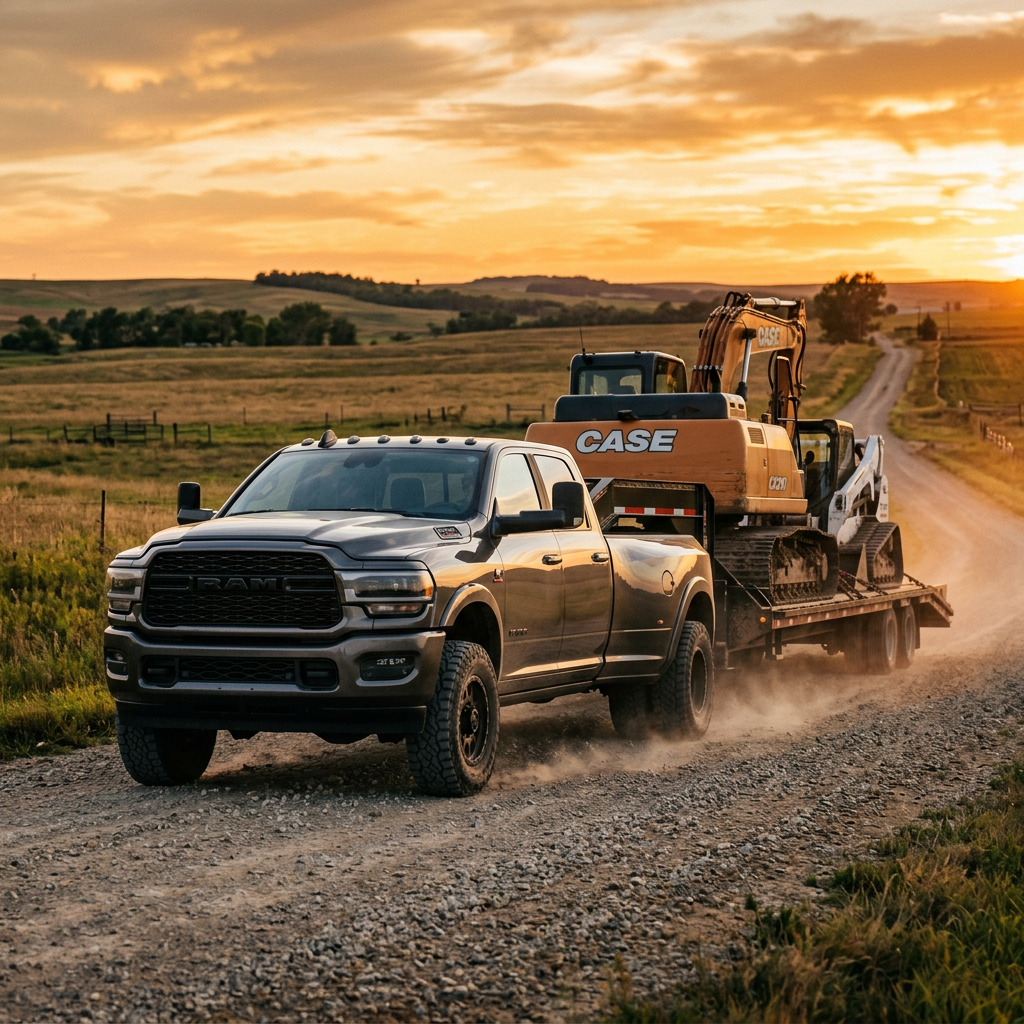
A grey Ram dually truck towing a trailer with a Case excavator down a gravel country road at sunset. (Representative image for illustration purposes only. Actual vehicle may vary based on trim and configuration.)

Keeping Your Ford Super Duty Running Strong: The Ultimate Guide to Power Stroke Fuel Filter Maintenance

Keeping Your Ford Super Duty Running Strong: The Ultimate Guide to Power Stroke Fuel Filter Maintenance When you own a Ford Super Duty equipped with the legendary 6.7L Power Stroke diesel engine, you are piloting a highly capable, high-torque truck. Whether you are hauling massive trailers down the highway, operating heavy equipment in Junction City, or managing a demanding agricultural workload in Dickinson County, your truck relies on a highly advanced, ultra-high-pressure common-rail injection system to deliver its staggering horsepower and torque. This system operates at pressures exceeding 30,000 PSI. At these extreme tolerances, even the smallest speck of dirt, rust, or microscopic water droplet can act like a sandblaster inside your fuel injectors, leading to catastrophic engine damage and immense repair bills. That is why clean diesel fuel is not just a preference—it is an absolute necessity for the survival of your Power Stroke engine. Operating conditions around Fort Riley and Junction City present a unique set of challenges for diesel truck owners. From intense summer heat and dust on gravel roads to freezing winter temperatures that cause fuel tank condensation, your fuel filters work overtime to protect your engine's fuel system. In this comprehensive guide, we will break down exactly how often you should change your fuel filters, why the dual-filter system is designed the way it is, the science behind OEM filtration, and how proactive maintenance at Valor Ford can save you thousands of dollars over the lifetime of your truck. How Often Should You Change the Fuel Filters on a Ford Super Duty Power Stroke Diesel? Ford Motor Company outlines a standardized maintenance schedule for the 6.7L Power Stroke diesel engine, recommending that both fuel filters be replaced every 15,000 to 22,500 miles, or every third oil change, or every 600 hours of engine operation—whichever comes first. However, this general recommendation is split into two distinct categories: 'Normal Operating Conditions' and 'Severe Duty Operating Conditions.' Knowing which category your driving habits fall into is critical for maintaining optimal fuel system health and ensuring your warranty remains fully intact. For drivers who primarily use their Super Duty for long-distance highway cruising with minimal cargo, normal operating intervals of up to 22,500 miles may be sufficient. But in Kansas, very few heavy-duty trucks experience such an easy life. Most local truck owners find that their daily routines push their vehicles directly into the severe duty category, which demands much stricter maintenance timelines. What constitutes severe duty? If you frequently tow heavy trailers, idle for extended periods (common on job sites and military maneuvers around Fort Riley), operate in dusty off-road environments, or use B20 biodiesel blends, Ford recommends changing your fuel filters at the 15,000-mile mark. Agricultural hauling across Dickinson County is a prime example of severe duty. Pulling grain trailers or stock trailers through dirt roads exposes your fuel system to fine particulate dust, while frequent stop-and-go heavy hauling increases fuel throughput and subjects filters to a larger volume of potentially contaminated fuel. To keep track of your vehicle's health easily, we recommend checking the Intelligent Oil-Life Monitor on your dashboard, but always track your mileage manually for fuel filters, as the truck does not always have a direct sensor to measure physical filter clogging until fuel pressure drops. How Many Fuel Filters Does a 6.7L Power Stroke Diesel Have? To provide maximum protection for the ultra-precise high-pressure fuel pump and common-rail injectors, Ford utilizes a dual-filter architecture on the 6.7L Power Stroke diesel engine. This means your truck has two distinct fuel filters that must *always* be replaced together as a matched set. Replacing only one filter defeats the purpose of the dual-stage system and leaves your fuel system highly vulnerable to premature wear or sudden failure. 1. Primary Filter / Water Separator The primary filter is housed within the Diesel Fuel Conditioner Module (DFCM), which is mounted directly to the vehicle's frame rail underneath the driver's side cab. Because diesel fuel naturally attracts moisture, water contamination is a constant threat. This primary filter acts as a water separator, utilizing hydrophobic media to repel water droplets, causing them to pool at the bottom of the housing where they can be drained safely. It also screens out larger debris, rust, and tank scale before the fuel is pumped forward. 2. Secondary Under-Hood Filter The secondary fuel filter is located directly in the engine bay, mounted near the top-front of the engine block. After fuel passes through the primary frame filter, it is sent under low pressure to this secondary unit. The secondary filter is designed to catch ultra-fine particulates that are too small for the primary filter. It serves as the final line of defense, ensuring that only the cleanest, completely water-free fuel enters the high-pressure fuel pump (CP4) and the fuel injection rails. What Micron Rating Do the Motorcraft 6.7L Power Stroke Fuel Filters Have? Filtration efficiency is measured in microns (one-millionth of a meter). To put this in perspective, a single strand of human hair is approximately 70 microns in diameter, and the human eye cannot typically see anything smaller than 40 microns. However, within the common-rail fuel system of your Power Stroke diesel, clearances between moving parts are as tight as 1 to 2 microns. This is why standard filtration is simply not enough. Genuine OEM Motorcraft filters are engineered to meet strict Ford engineering specifications. The primary frame-mounted filter features a 10-micron rating, meaning it filters out larger debris and holds the bulk of the particulate load. The secondary under-hood filter possesses a highly advanced 4-micron rating, designed to capture microscopic contaminants before they can damage the high-pressure pump or clog the fuel injector nozzles. Many aftermarket filters claim to fit the 6.7L Power Stroke, but they often utilize inferior filter media with higher micron ratings (such as 15 or 20 microns) or lack the necessary water-coalescing properties. Using an aftermarket filter with improper micron specifications allows abrasive particles to flow directly into the high-pressure system, causing premature wear, fuel injector tip erosion, and eventual pump failure. To safeguard your investment, it is highly recommended to only use genuine OEM Motorcraft filters. Ready to pick up a set of factory-certified Motorcraft filters for your truck? You can easily Order Genuine Ford Parts directly through the Valor Ford Parts Department in Junction City, ensuring your fuel system has the exact protection Ford engineers designed for it. Order Genuine OEM Motorcraft Fuel Filters How Do You Know When It Is Time to Change the Fuel Filters on a Power Stroke Diesel? While mileage is the most reliable metric for filter replacements, your truck will often communicate when its fuel flow is restricted. Recognizing these warning signs early can help you avoid being stranded on the side of the road with a clogged fuel system. Loss of Power Under Load: If you are pulling a heavy trailer up a hill and feel the truck hesitating or failing to accelerate, restricted fuel filters are a primary suspect. The engine demands high fuel volume under load, and clogged filters choke that supply. Engine Hesitation and Rough Idle: Restricted fuel flow causes pressure drops in the common rail, leading to uneven fuel delivery, rough idling, or brief engine stumbles during acceleration. Hard Starting or Extended Cranking: If your Power Stroke takes longer to fire up in the morning, it may be struggling to build the initial fuel rail pressure required for combustion due to restricted filters. 'Water in Fuel' Dashboard Alert: This critical alert indicates that the water separator chamber in your frame-mounted DFCM is full. It must be drained immediately. If the light persists after draining, the primary filter media is likely saturated and requires replacement. Low Fuel Pressure Trouble Codes: A restricted filter can trigger diagnostic codes like P0087 (Fuel Rail Pressure Too Low), illuminating the check engine light. Is It Cost-Effective to Change the Fuel Filter More Often Than the Minimum Recommendation? To put it simply: absolutely yes. Many diesel owners wonder if changing fuel filters early is just an unnecessary expense. To understand the financial math, we must look at the cost of proactive maintenance versus the catastrophic cost of fuel system failure. On a 6.7L Power Stroke, the high-pressure fuel pump (CP4.2) is lubricated solely by the diesel fuel passing through it. If fuel flow is restricted, or if microscopic water bypasses a saturated filter, the pump will lose lubrication. When a CP4 pump runs dry or becomes contaminated, it physically self-destructs, sending a torrent of microscopic metal shavings throughout the entire fuel system. Once metal shavings enter the fuel lines, they contaminate the fuel rails, the return lines, the fuel tank, and all eight precision injectors. To repair this, the entire fuel system must be stripped, cleaned, or replaced entirely, which includes buying a new high-pressure pump, eight new injectors, high-pressure lines, and thoroughly dropping and cleaning the fuel tank. Repair costs can vary widely depending on parts and labor. By contrast, a genuine Motorcraft fuel filter kit costs a fraction of that amount, and replacing them takes less than an hour. Changing your filters every 15,000 miles (or even 10,000 miles if you operate in extremely dusty Kansas agricultural conditions) is one of the most cost-effective maintenance choices for your Power Stroke engine. Maintenance Action Estimated Cost Range Frequency / Impact Long-Term Protection Value OEM Motorcraft Fuel Filter Kit $80 - $120 (Parts Only) Every 15,000 Miles Excellent - Prevents water & debris bypass Professional Filter Service at Valor Ford $180 - $280 (Parts & Labor) Every 15,000 Miles Outstanding - Done by certified diesel techs, worry-free warranty Catastrophic CP4 Pump Failure Repair $8,000 - $12,000+ Occurs due to fuel starvation, water, or poor filtration None - Catastrophic financial and operational loss What Tools Are Required to Perform a DIY Fuel Filter Change on a Power Stroke? Required Hand Tools To change the fuel filters on your 6.7L Power Stroke, you will need a few specific tools to make the job clean and safe: 32mm Socket: Essential for removing the primary filter cap under the frame rail without stripping the plastic hex nut. Socket Extensions & Ratchet: A 3/8-inch or 1/2-inch drive ratchet with a medium extension to reach the frame housing comfortably. 8mm Socket: Required to remove the small mounting bracket bolts on certain model year under-hood filters. Safety & Clean-Up Gear Diesel fuel is highly slippery, hard to wash out of clothing, and can irritate skin upon prolonged contact. Make sure you have: Fuel Catch Pan: A wide-mouth oil or fuel drain pan to catch escaping diesel fuel from the DFCM water drain. Nitrile Gloves & Safety Glasses: Protects your skin and eyes from pressurized fuel spray. Shop Rags or Microfiber Towels: For wiping down fuel lines and the housing areas to prevent dirt entry. While changing fuel filters is a popular weekend project for experienced DIYers, doing it incorrectly can lead to severe fuel leaks, air introduction into the high-pressure system, or cracked plastic filter housings. If you prefer to bypass the mess and let factory-certified diesel technicians handle the job with professional precision, we invite you to Schedule Ford Service Today with the experts at Valor Ford. Schedule Professional Diesel Service The Proper Procedure to Change Both Power Stroke Fuel Filters Safely Step 1: Drain the Water Separator Housed in the DFCM Before unscrewing any housings, place your fuel catch pan underneath the frame-mounted DFCM filter. Locate the yellow drain valve on the bottom of the housing. Slowly turn the valve counter-clockwise to allow the fuel and settled water to drain fully into your catch pan. Once the flow stops, turn the drain valve clockwise to close it securely. This prevents a massive, messy splash when you proceed to remove the filter cap. Step 2: Remove the Frame-Mounted Filter Cap Using your 32mm socket and extension, place it squarely onto the plastic nut molded into the bottom of the frame-mounted filter cap. Slowly turn counter-clockwise. The housing cap may feel stiff initially, but proceed carefully to avoid cracking the plastic. Once unscrewed, pull the cap and the attached filter cartridge straight down. Pop the old filter element out of the cap, clean the inside of the cap thoroughly with a clean rag, and install the new O-ring included in your Motorcraft kit. Crucial Tip: Lubricate the new O-ring with clean diesel fuel or clean engine oil to ensure a perfect, airtight seal. Click the new filter cartridge into the cap, then screw the assembly back onto the DFCM housing, hand-tightening it first, then torquing it to 19 lb-ft (or until the cap stops rotating against the physical stop). Do not overtighten. Step 3: Replace the Under-Hood Secondary Fuel Filter Move to the engine bay. Locate the secondary filter near the front-left of the engine. Wipe down the quick-connect fuel fittings to prevent any dust or dirt from falling into the open lines. Disconnect the fuel line clips by squeezing the colored tabs and pulling gently. Some residual fuel may spray slightly, so keep a rag handy. Once the lines are disconnected, unbolt the filter bracket or twist the filter assembly counter-clockwise (depending on your specific model year) to remove it. Install the new secondary filter in reverse order, ensuring the mounting bracket is secure, and firmly click the quick-connect fuel lines back into place. You will hear an audible click when they lock. Double-check that the line clips are fully engaged to prevent fuel leaks under pressure. What Is the Proper Procedure to Prime the Fuel System After Replacing the Power Stroke Fuel Filters? Once both fuel filters are replaced, the fuel lines and filter housings are filled with air instead of fuel. Do not start the engine immediately after replacing the filters. Attempting to start the truck dry will pull air into the high-pressure fuel pump (CP4), causing metal-on-metal friction and immediate, catastrophic damage. You must prime the fuel system using the low-pressure fuel pump to purge all air back to the fuel tank. To prime the system correctly, follow this simple sequence: Insert your key into the ignition (or use the push-button start without pressing your foot on the brake pedal). Turn the ignition to the 'ON' (or Run) position. Do *not* crank the engine. You will hear the electric low-pressure fuel pump hum from underneath the cab. Let it run for 30 seconds until the hum stops. Turn the ignition back to the 'OFF' position. Repeat this cycle 6 to 10 times. You will hear the pitch of the pump change as the housings fill with fuel and air bubbles are pushed back to the tank. After completing 8 to 10 key cycles, press the brake pedal and crank the engine. It should start smoothly within a few seconds. If the engine starts but stumbles or dies immediately, you likely have trapped air left in the system. Turn the truck off and perform another 5 priming cycles before attempting to restart. Once the engine is running smoothly, let it idle for a couple of minutes. Slide under the truck and inspect the frame-mounted primary filter cap, and check the under-hood connections to ensure there are absolutely no active fuel leaks. If you notice any wet spots or fuel dripping, shut down the engine immediately, clean the area, and verify the O-ring seals or quick-connect fittings are seated correctly. Why Junction City, Fort Riley, and Dickinson County Conditions Demand Stricter Maintenance Agricultural Dust & Gravel Roads Dickinson County is home to active farming, ranching, and miles of dry gravel roads. As trucks traverse these dusty paths during planting and harvesting seasons, microscopic airborne dust settles on the fuel tank filler neck. When refueling, this fine agricultural dust can fall directly into the tank, accelerating fuel filter restriction and requiring more frequent replacements. Military Training & Heavy Towing Fort Riley military families and contractors utilize Super Duty trucks for demanding, high-load towing operations and extended off-grid utility work. Heavy payloads and prolonged engine idling dramatically increase the volume of fuel passing through the filter media. More fuel processed means more particulate capture, reducing the effective life of the filter. Extreme Kansas Temperature Swings Kansas is famous for dramatic seasonal temperature swings. Warm, humid days followed by cool nights create condensation inside steel and plastic fuel tanks. Water in diesel fuel breeds microbial growth and forms slime that quickly plugs fuel filters. Ensuring fresh filters are installed before major seasonal transitions is key to avoiding issues. Don't let Kansas weather and tough road conditions compromise your Power Stroke's performance. For peace of mind, let us perform a complete diesel system check-up. You can easily book a hassle-free appointment online by choosing our convenient Schedule Pickup and Delivery Service, allowing you to stay focused on your busy day while we handle the dirty work. Schedule Pickup and Delivery Service When Fuel System Wear Suggests It May Be Time to Consider an Upgrade for Your Super Duty While regular maintenance keeps a 6.7L Power Stroke running strong for hundreds of thousands of miles, older models—especially high-mileage first-generation 6.7L trucks or older 6.0L and 6.4L platforms—can eventually reach a point where fuel system wear becomes an ongoing, expensive headache. Injector bodies wear down internally, high-pressure pumps lose efficiency, and fuel tank linings can degrade. When you find yourself facing major repair bills for high-pressure pumps, injectors, or advanced emissions equipment, it is often highly cost-effective to consider upgrading to a newer, more efficient model. Modern Ford Super Duty models boast significantly upgraded fuel delivery systems, redesigned high-pressure pumps with vastly improved reliability, and robust factory warranties that eliminate the fear of unexpected, multi-thousand-dollar repair bills. If you are curious about what your current truck is worth in today's strong truck market, we can help. Our team at Valor Ford offers a straightforward, transparent Trade In Evaluation to give you a fair, competitive value for your current rig. From there, you can explore our cutting-edge heavy-duty lineup, including the robust and incredibly capable Ford F-250 models. Whether you decide to check out our Research Ford F-250 page or want to browse our extensive and ready-to-work Browse Used Inventory, our expert finance and sales teams are here to help you make the smartest financial decision for your business, farm, or family. Keep Your Power Stroke Performing Flawlessly at Valor Ford in Junction City At the end of the day, your Ford Super Duty is more than just a truck—it is your livelihood, your adventure machine, and your partner on the demanding roads of Kansas. Taking care of its advanced fuel system by performing timely, high-quality fuel filter changes with genuine Motorcraft components is the absolute key to unlocking maximum engine longevity, fuel efficiency, and legendary performance. Don't leave your fuel system's survival to chance with inferior aftermarket filters or delayed maintenance schedules. Our team of factory-trained, certified Ford diesel technicians at Valor Ford has the specialized knowledge, state-of-the-art diagnostic tools, and genuine OEM parts inventory required to keep your Power Stroke performing flawlessly. Whether you need a quick filter replacement, a comprehensive multi-point inspection, or are ready to explore upgrading to a brand new Super Duty, we are proud to serve as your premier local diesel resource. Stop by our dealership today, Get Directions to Valor Ford, or Call us at (785) 238-5114 to chat with our friendly service coordinators. Schedule Your Power Stroke Service Now