
Blog / Buying Guides

The Heavy Hauling Dilemma: Which Engine Actually Saves You Money Under Load?

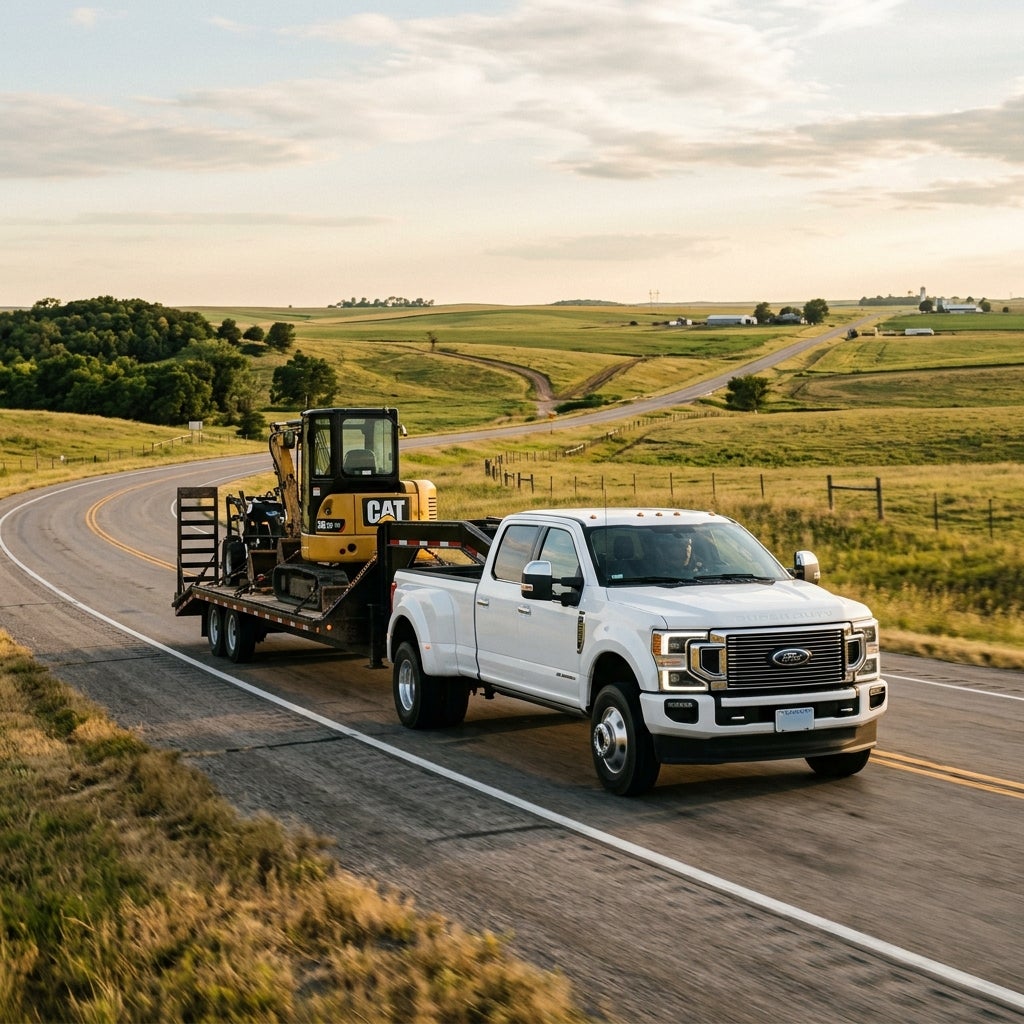
White Ford Super Duty dually truck towing a CAT excavator on a scenic winding road through rolling hills. (Representative image for illustration purposes only. Actual vehicle may vary based on trim and configuration.)

The Heavy Hauling Dilemma: Which Engine Actually Saves You Money Under Load?

Whether you are pulling a horse trailer through the rolling Flint Hills, transporting heavy agricultural machinery across Dickinson County, or hauling construction materials near Fort Riley, anyone who has ever hooked up a trailer knows the immediate anxiety of watching the fuel gauge drop. It is a fundamental truth of physics: the moment you hitch thousands of pounds of deadweight to the back of your vehicle, your fuel economy will suffer. However, the exact rate of that decline—and the actual dollar amount you spend at the pump—depends almost entirely on the mechanical heartbeat of your truck. For generations, drivers throughout Junction City and beyond have debated the ultimate towing question: which engine configuration truly stands up to heavy loads while keeping your operating costs at a minimum?

Historically, the decision was simple. If you had serious work to do, you bought a diesel. If you were driving back and forth to town with occasional light chores, you stuck with a gasoline V8. But today, the landscape is far more complex. Modern engineering has introduced high-tech turbocharged gasoline powerplants, high-torque hybrid systems, and highly refined turbo-diesels that challenge traditional assumptions. These advanced powerplants do not just change how a truck drives; they alter the thermodynamic math of fuel consumption. Understanding this math is crucial to choosing a vehicle that matches your daily routine and budget.

At Valor Ford, we interact daily with local farmers, active-duty military personnel, and business owners who rely on their trucks to make a living. They do not just want marketing slogans; they need hard data and practical mechanical realities. In this comprehensive guide, we will break down the physical forces, thermodynamic realities, and long-term financial impacts of towing and hauling. By examining how different engine architectures handle the stress of heavy payloads, we hope to help you make an informed decision for your fleet or family. If you want to research specific trucks, you can Research Ford F-150 or delve into heavy-duty options with our guide to Research Ford F-250.

Why Do Diesel Engines Generally Get Better Fuel Economy Than Gas Engines Under Heavy Load?

To understand why diesel fuel economy remains remarkably resilient under a heavy load, we have to look closely at the physics of combustion. A diesel engine functions under the principle of compression ignition, whereas a gasoline engine relies on spark ignition. Because diesel engines do not use spark plugs, they must compress the intake air to an extreme degree—often achieving compression ratios ranging from 15:1 up to 20:1 or more. This immense compression heats the air to temperatures where fuel ignites instantly upon injection. This high compression ratio directly translates to superior thermal efficiency, extracting more kinetic energy from every single droplet of fuel.

Furthermore, diesel fuel itself is denser and contains roughly 10% to 15% more energy content per gallon than gasoline. While gasoline contains about 114,000 BTUs of energy per gallon, diesel delivers approximately 129,500 to 138,500 BTUs. Because of this inherent chemical advantage, a diesel engine has to burn less physical volume of fuel to produce the same amount of raw work. When you are pulling a heavy flatbed trailer, that extra thermal energy per drop is what prevents your fuel gauge from plummeting rapidly.

Another massive physical differentiator is how diesel engines manage intake air. In a conventional gasoline engine, a throttle valve limits the intake air to control engine speed, which creates vacuum resistance (known as pumping losses) as the pistons pull air past the restriction. Diesels operate without a throttle valve; they intake a full volume of unthrottled air and control engine speed purely by regulating the amount of fuel injected. This lack of throttling restrictions dramatically reduces pumping losses, keeping the engine exceptionally efficient even when working hard to pull heavy loads.

Finally, the torque delivery of a diesel engine is highly advantageous for towing. Because diesels generate maximum torque at incredibly low rotational speeds (often between 1,600 and 2,200 RPM), they can maintain highway speeds in their highest gears. A gasoline engine, by comparison, must spin at much higher rotational speeds (often 3,500 to 5,000 RPM) to make its peak power, requiring frequent transmission downshifts that burn excessive fuel. Under heavy load, keeping RPMs low is the ultimate secret to preserving fuel economy.

Comparing Gas, Turbocharged, and Diesel Powertrains on Central Kansas Highways

To see how these concepts function in the real world, let us contrast three distinct modern engine philosophies that you will find navigating the highways of Central Kansas. Each design approaches the challenges of heavy towing with a different set of strengths, mechanical limitations, and fuel consumption profiles.

Naturally Aspirated V8 Gas

Traditional naturally aspirated gasoline V8 engines, like Ford's legendary 5.0L Coyote or the heavy-duty 7.3L 'Godzilla' V8, rely purely on displacement to build power. They are incredibly reliable and structurally uncomplicated, making them a favorite for fleet owners. However, because they lack forced induction, they must rev high to reach their power bands. When climbing an incline with a trailer, the transmission will downshift, pushing the engine into high-RPM ranges where fuel consumption increases dramatically to maintain momentum.

Turbocharged EcoBoost Gas

Ford's EcoBoost technology has completely revolutionized the gasoline truck segment. By utilizing twin turbochargers, engines like the 3.5L EcoBoost generate diesel-like low-end torque starting under 2,500 RPM. This allows them to tow heavy trailers without excessive downshifting. However, under heavy load, turbocharged gas engines must inject extra fuel to cool the combustion chambers and prevent pre-ignition. This cooling strategy is highly effective for engine health, but it causes fuel economy to drop significantly when hauling heavy loads over long distances.

Turbo-Diesel Power Stroke

The Power Stroke Turbo Diesel represents the pinnacle of sustained towing efficiency. Combining the physical benefits of compression ignition with advanced variable-geometry turbocharging, diesels like the 6.7L Power Stroke deliver massive torque at idle and low RPMs. This engine handles heavy loads effortlessly, keeping its gear locked and keeping RPMs low even when pulling heavy equipment up steep inclines. The fuel consumption of a diesel remains remarkably steady, dropping by a far smaller percentage than its gasoline rivals.

At-A-Glance Powertrain Comparison under Load

Engine Philosophy

Peak Torque RPM

Thermal Efficiency

Towing Fuel Economy Drop

Best Fit Scenario

Naturally Aspirated V8 Gas

High (3,800 - 4,500 RPM)

Moderate (~25-30%)

High (Drops by 40-50%)

Light to moderate occasional towing

Turbocharged Gas (EcoBoost)

Low-to-Mid (2,250 - 3,000 RPM)

Good (~30-35%)

Significant (Drops by 35-45%)

Frequent medium towing & daily commuting

Turbo-Diesel (Power Stroke)

Very Low (1,600 - 2,200 RPM)

Excellent (~40-45%)

Minimal (Drops by 15-25%)

Continuous, heavy, long-distance towing

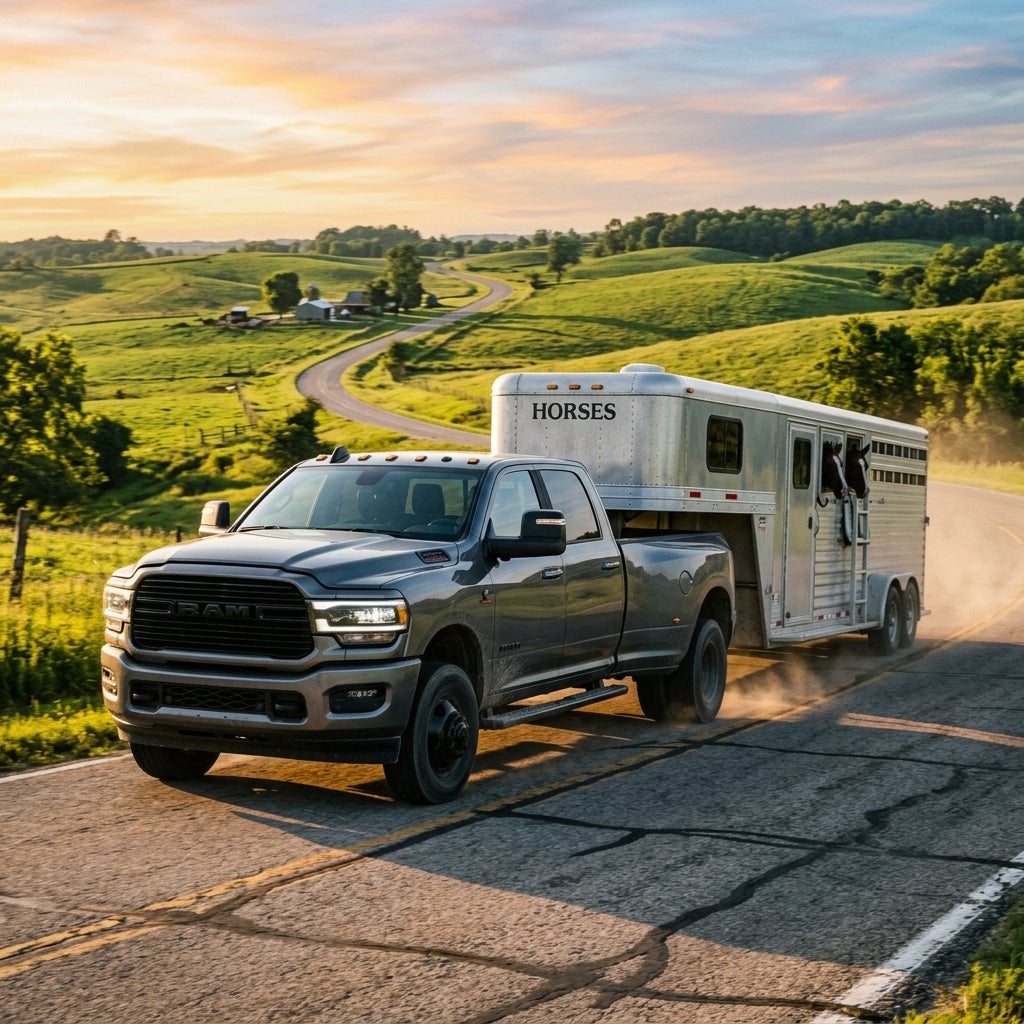
A gray Ram dually truck towing a silver horse trailer on a winding country road at sunset. (Representative image for illustration purposes only. Actual vehicle may vary based on trim and configuration.)

Find the Right Workhorse for Your Fleet at Valor Ford in Junction City

No matter which engine philosophy aligns with your towing requirements, Valor Ford is here to make your selection seamless. Our experienced team in Junction City understands the unique needs of Kansas drivers, from heavy commercial hauling to weekend recreation. We invite you to explore our expansive inventory, consult with our product specialists, and find the perfect configuration for your lifestyle. To get started today, you can Get Pre-Approved for Financing online or take a look at our current selection to Browse Used Inventory and discover competitive pricing on dependable pre-owned workhorses.

Why Are Large-Displacement Diesel Engines Preferred for Long-Haul Heavy Loads?

For long-haul operations involving substantial trailer weights, large-displacement diesel engines—such as the Ford 6.7L Power Stroke V8—remain the undisputed gold standard. The reason goes beyond simple fuel economy; it is a matter of longevity, thermal control, and mechanical durability. When an engine operates under a continuous, heavy load, it generates massive amounts of internal heat. Large-displacement diesel engines are engineered with robust iron or compacted graphite iron (CGI) blocks, heavy-duty cooling jackets, and high-capacity oiling systems specifically designed to manage this thermal stress over hundreds of thousands of miles.

Sustained low-RPM operation is another vital benefit of a large-displacement diesel. When pulling a heavy fifth-wheel or commercial flatbed at highway speeds, a large diesel can comfortably sit in its top gear at 1,600 RPM. Because the engine is not spinning rapidly, frictional losses within the cylinder walls and valvetrain are minimized. Over a long-distance haul across Kansas or neighboring states, this reduction in internal friction adds up to substantial fuel savings and reduces mechanical wear, extending the overall lifespan of the powerplant.

Additionally, large-displacement diesels offer unmatched auxiliary control when descending steep grades or slowing down on highway exits. Integrated exhaust braking systems use the engine's turbocharger to restrict exhaust flow, creating backpressure that slows the truck down without relying on the physical brakes. This not only prevents brake fade and extends the life of your brake pads, but it also improves safety when hauling heavy loads. It is a comprehensive system designed to handle heavy work with absolute composure.
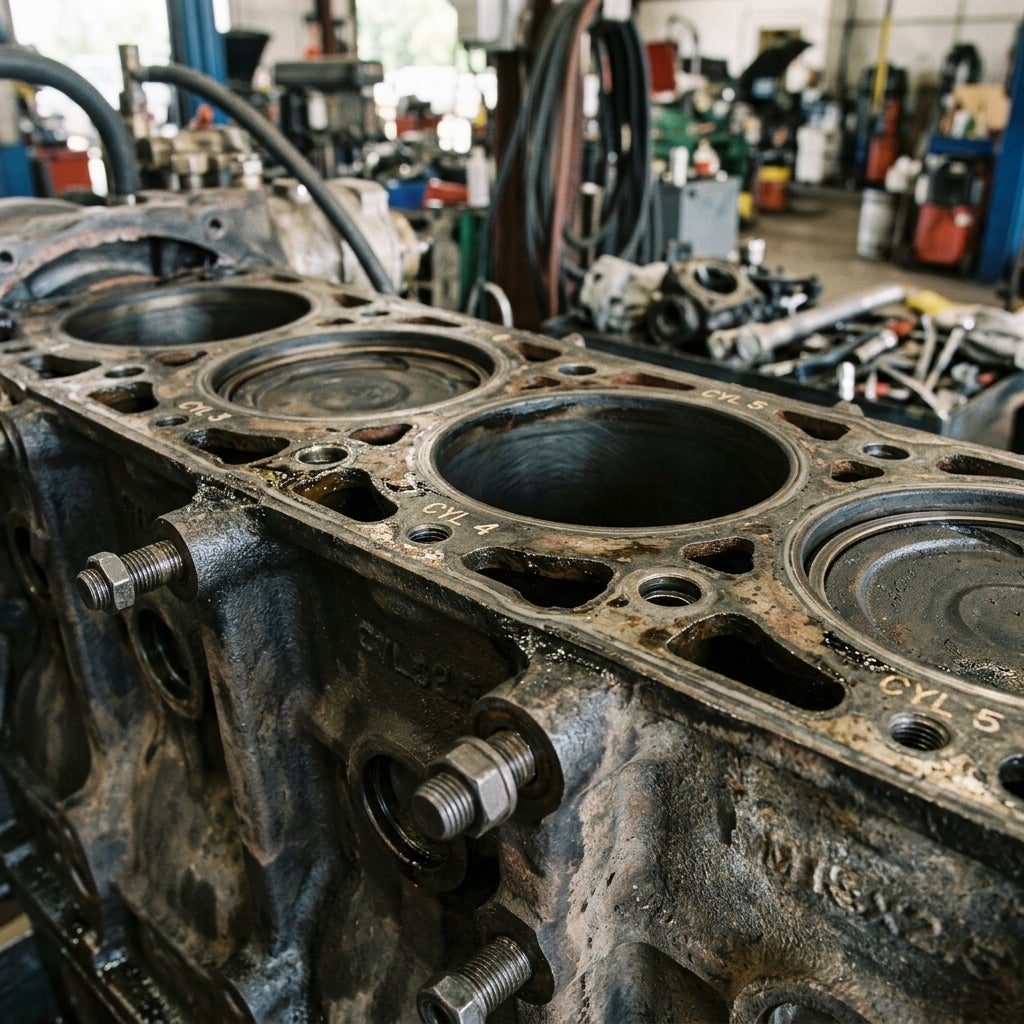
Close-up of a disassembled engine block showing cylinder bores and pistons in a mechanic's shop. (Representative image for illustration purposes only. Actual vehicle may vary based on trim and configuration.)

When Does a Diesel Pickup Make More Sense Than a Hybrid or Turbo Gas Engine?

Choosing the right truck is not about finding the 'best' engine in a vacuum—it is about finding the engine that matches your specific driving habits and business model. For some drivers, a diesel's higher initial purchase price and maintenance costs are easily offset by fuel savings. For others, a highly versatile turbocharged or hybrid gas engine is far more practical. Let's look at three distinct driving profiles to see which option makes the most financial sense.

Short-Trip & Commuter Use

If your daily routine involves short trips around Junction City, commuting to Fort Riley, or running quick errands with only occasional, light towing, a hybrid or compact turbocharged gasoline engine is your best option. Diesel engines require long, hot highway trips to keep their exhaust filtration systems clean. Short, stop-and-go trips can prevent a diesel from reaching operating temperature, leading to clogged particulate filters and increased maintenance. A hybrid or small gas engine thrives in these conditions, delivering excellent city efficiency.

Frequent Mixed Use

For drivers who use their truck as a daily commuter but regularly tow trailers, boats, or campers on the weekends, a turbocharged gas engine like Ford's 3.5L EcoBoost represents the perfect sweet spot. The EcoBoost provides exceptional low-end torque for towing when you need it, but avoids the higher upfront cost of a diesel. When you aren't towing, it operates as an efficient, comfortable daily driver without the need for diesel exhaust fluid (DEF) or specialized diesel maintenance. If you want a truck that can do a bit of everything, you should check out our inventory and Research Ford F-150 options.

Continuous Heavy Hauling

If your truck's primary purpose is hauling heavy payloads, towing commercial trailers, or covering long highway distances under load, a diesel is the clear and logical choice. The upfront premium for a Power Stroke diesel is quickly recouped through superior fuel economy under load and the sheer longevity of the powertrain. If you routinely tow loads exceeding 10,000 pounds, the diesel's massive torque, exhaust braking, and sustained highway efficiency make it an irreplaceable tool for your business or farm. If this sounds like your workload, we encourage you to Research Ford F-250 to see what these heavy-duty workhorses can do.

What Is the Average Annual Maintenance Cost Difference Between Gas and Diesel Trucks?

While diesel engines offer undisputed fuel economy advantages under load, any honest financial comparison must account for long-term ownership and maintenance costs. Diesel engines are highly specialized machines with complex emissions systems, high-pressure fuel networks, and massive fluid capacities. For example, a standard gasoline V8 engine typically requires 5 to 8 quarts of engine oil per service. In contrast, a 6.7L Power Stroke diesel requires 13 quarts of specialized oil. This difference alone nearly doubles the cost of a routine oil change.

Furthermore, diesel engines rely on highly sophisticated fuel filtration systems to protect their high-pressure fuel pumps from water and microscopic debris. These dual fuel filters must be replaced regularly—often every 15,000 to 22,500 miles—adding to your annual service bill. You must also factor in the cost of Diesel Exhaust Fluid (DEF), which must be replenished regularly to keep the truck compliant with environmental regulations. If a component in the complex exhaust aftertreatment system (like the DPF or SCR) fails out of warranty, repair costs can be substantial.

Gasoline engines, on the other hand, enjoy much lower routine maintenance costs. Spark plugs, ignition coils, and standard oil filters are relatively inexpensive and simple to replace. However, for high-mileage towing, the lower maintenance costs of a gas truck may be entirely offset by the extra money spent on fuel. If you are driving 25,000 miles a year while towing heavy loads, the diesel's superior fuel economy will easily save you thousands of dollars at the pump, outweighing the higher service costs. If you need replacement parts for either engine type, you can easily Order Genuine Ford Parts through our dealership.
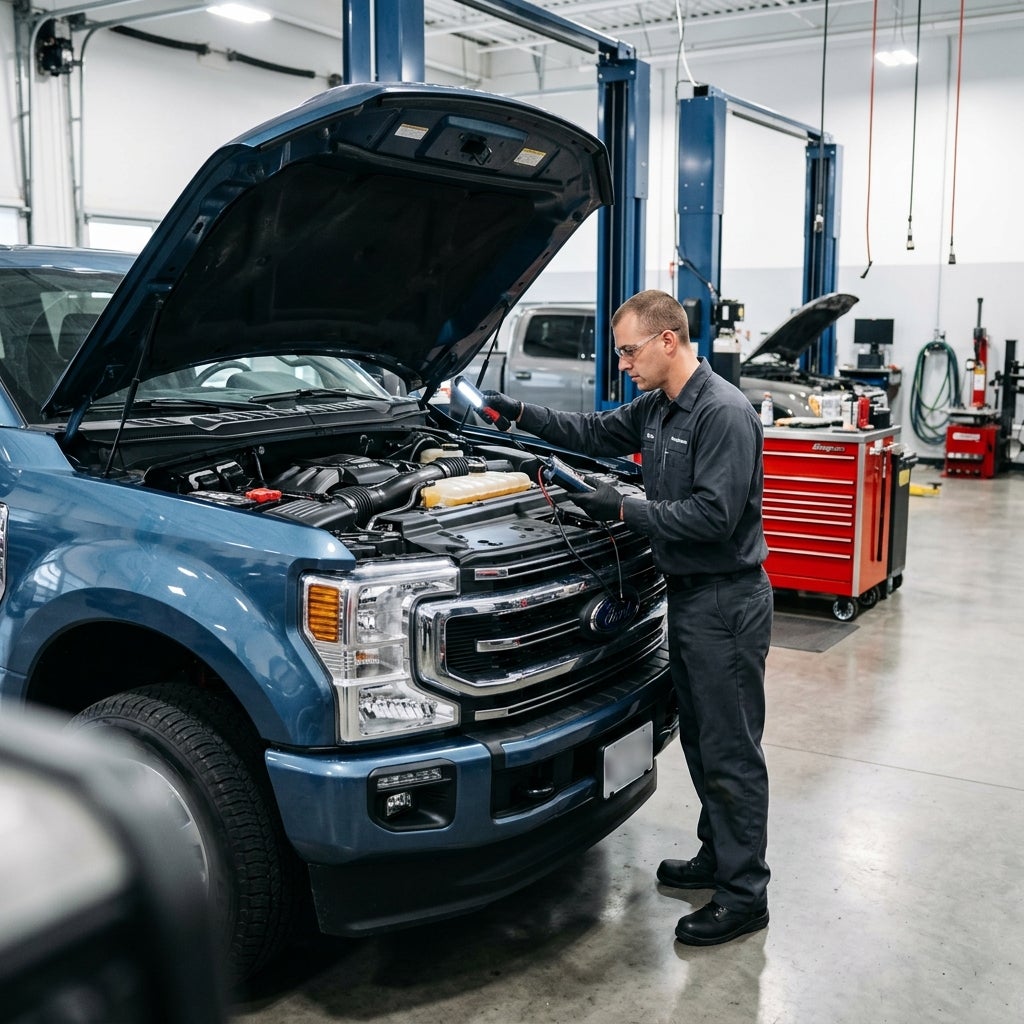
A mechanic in a grey uniform uses a diagnostic tool to inspect the engine of a blue Ford truck with its hood open. (Representative image for illustration purposes only. Actual vehicle may vary based on trim and configuration.)

Keep Your Towing Rig Running Efficiently with Valor Ford's Service Center

Whether you drive a high-torque EcoBoost gas truck or a heavy-duty Power Stroke diesel, routine preventative maintenance is the absolute key to preserving fuel economy and protecting your investment. Simple issues like a dirty air filter, worn spark plugs, clogged fuel filters, or misaligned tires can cause a massive drop in fuel economy, especially when pulling heavy loads. Our factory-trained technicians at Valor Ford in Junction City possess the specialized tools and diagnostics required to keep your tow rig operating at peak efficiency. To experience our convenient convenience, you can Schedule Pickup and Delivery Service or simply click to Schedule Ford Service Today.

What Is the Optimal Speed for Fuel Economy When Towing?

Regardless of whether you choose a gas or diesel engine, the single most influential factor affecting your fuel economy while towing is your speed. It comes down to a fundamental physical law: aerodynamic drag. As your speed increases, the aerodynamic resistance acting on your truck and trailer does not rise in a straight line—it increases exponentially. Specifically, the power required to overcome aerodynamic drag increases with the cube of your velocity. This means that driving just a few miles per hour faster requires a massive increase in engine power and fuel consumption.

For the vast majority of tow rigs, the optimal speed sweet spot on Kansas highways like Interstate 70 is between 60 and 65 mph. At this speed, your engine is able to comfortably maintain its highest possible gear, keeping the transmission's torque converter locked. This lock-up prevents mechanical slippage and ensures that 100% of the engine's power is transferred directly to the rear wheels, maximizing overall efficiency.

When you push your speed up to 70 or 75 mph, the aerodynamic drag becomes immense. To maintain this speed, a gasoline engine will often downshift one or two gears, spinning at high RPMs and burning through fuel. A diesel may be able to hold its top gear due to its immense torque, but it still must inject significantly more fuel to overcome the heavy wind resistance. By simply slowing down to 62 mph, you can easily save 15% to 25% on fuel costs over a long journey, while also reducing wear on your tires and transmission.
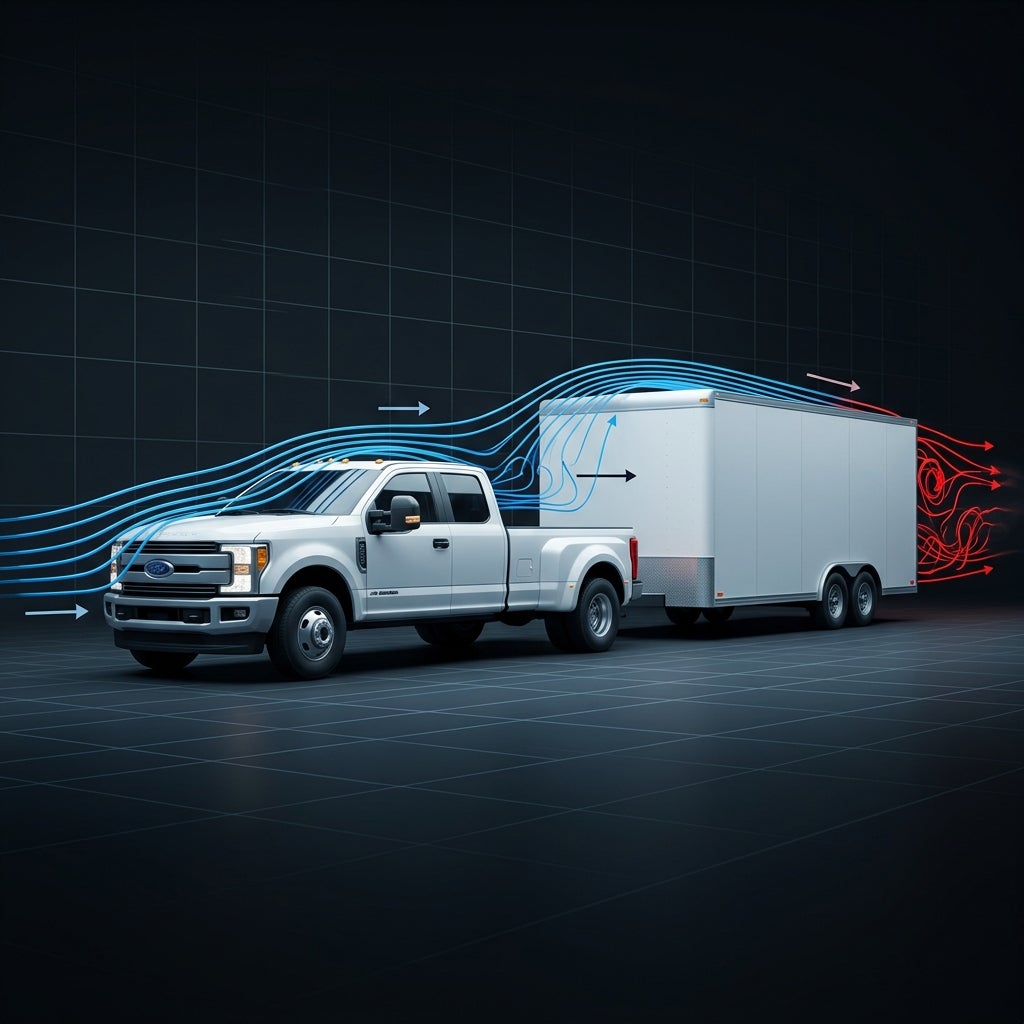
White pickup truck towing a trailer in a wind tunnel simulation showing aerodynamic airflow lines. (Representative image for illustration purposes only. Actual vehicle may vary based on trim and configuration.)

What Driving Techniques Help Any Engine Use Less Fuel When Hauling Heavy Loads?

While engine selection sets the baseline for your fuel economy, your driving habits ultimately determine the final numbers on your trip computer. By adopting a few simple, professional driving techniques, you can significantly reduce fuel consumption regardless of what is under the hood of your truck.

Progressive Acceleration

The easiest way to waste fuel is by accelerating aggressively from a complete stop. When you have several thousand pounds hitched to your truck, stomping on the gas or diesel pedal forces the engine to run at peak load, pouring fuel into the cylinders to get the heavy mass moving. Instead, practice progressive acceleration. Imagine there is an egg under your pedal and ease into the throttle, allowing the truck to build momentum gradually. This simple change can save a significant amount of fuel over a day of driving.

Using Tow/Haul Mode

Modern trucks are equipped with specialized 'Tow/Haul' modes that adjust transmission shift patterns to handle heavy loads. Some drivers avoid this mode because they think it holds gears too long and burns more fuel. However, Tow/Haul mode actually prevents the transmission from 'hunting' (constantly shifting back and forth between gears), which generates excessive heat and wastes fuel. It also provides aggressive engine braking on descents, which keeps your brakes cool and ensures you maintain safe control of your load.

Maintaining Momentum

To maximize fuel efficiency, you must learn to look ahead and read the road. When approaching a hill, build up a little extra speed before you reach the incline, rather than trying to accelerate once you are already climbing. On the highway, leave plenty of space between you and the vehicle ahead. This allows you to ease off the accelerator when traffic slows down, rather than slamming on your brakes and wasting the kinetic energy you worked hard to build. Smooth driving is efficient driving.

Tackling the Flint Hills: How Local Kansas Terrain Impacts Your Engine's Efficiency

The geography of Central Kansas has a profound, daily impact on how your truck performs. While some outsiders imagine Kansas as completely flat, local drivers know that the rolling topography of the Flint Hills and the terrain surrounding Junction City, Fort Riley, and Dickinson County present unique challenges. Climbing these steady, repeating inclines with a heavy trailer requires an engine with robust low-end torque. If your engine lacks this low-end grunt, it will be forced to downshift repeatedly, sending its RPMs skyward and causing fuel economy to suffer.

In this specific environment, the difference between gas and diesel engines becomes highly visible. A diesel engine can often pull a heavy trailer up a Flint Hills incline without downshifting, maintaining its highest gear and keeping its fuel consumption stable. A naturally aspirated gas engine, meanwhile, must drop gears to climb, causing its fuel economy to drop sharply. Modern turbocharged gas engines, like Ford's EcoBoost, handle these hills beautifully due to their low-end torque, but they must inject extra fuel to cool their cylinders, resulting in higher fuel consumption than a diesel.

Additionally, our local Kansas winds play a massive role in fuel economy. Anyone who has driven down I-70 knows that a strong Kansas headwind can act like an invisible hill, forcing your engine to work significantly harder to maintain highway speed. Because diesel engines are inherently more efficient at overcoming resistance, their fuel economy is much less affected by these strong headwinds than a gasoline-powered truck. No matter what you tow, being mindful of the local terrain and wind conditions is key to planning an efficient route.
Logo for Valor Automotive featuring a silver shield with red 'V' and white 'A' monogram inside, over a blue background.

Ready to Upgrade Your Towing Setup? Visit Valor Ford Today

Deciding between a gas, hybrid, or diesel engine is a significant choice, and you do not have to make it alone. At Valor Ford, we are proud to serve as your trusted community resource. We invite you to visit our showroom in Junction City, KS, to explore our extensive inventory of new and pre-owned Ford trucks. Whether you want to test drive a highly versatile F-150 EcoBoost or experience the capability of a Super Duty F-250 Power Stroke diesel, our friendly team is here to help. You can easily start your journey by getting a Trade In Evaluation for your current vehicle or stop by our dealership to speak with our finance and sales professionals in person.

Valor Ford
1825 Goldenbelt Blvd, Junction City, KS 66441
Phone: Call us at (785) 238-5114
Get Directions to Valor Ford
Posted in:

Related Posts

Grey Ford F-150 truck driving on a gravel dirt road through rolling hills at sunset. (Representative image for illustration purposes only. Actual vehicle may vary based on trim and configuration.)

Ford F-150 Special Offer Event at Valor Ford: Direct Savings & Financing Terms

Ford F-150 Special Offer Event at Valor Ford: Direct Savings & Financing Terms The summer sales event of the year has officially arrived in Junction City, KS! Valor Ford is proud to announce exclusive factory incentives, massive direct dealer discounts, and unbeatable low APR financing terms across our entire fleet of new Ford F-150 pickup trucks. Whether you need a dependable workhorse for the farm, a robust towing platform for equipment, or a feature-packed luxury truck for weekend family trips, there has never been a better time to upgrade your ride. For a limited time through August 31, 2026, take advantage of factory customer cash allowances, low promotional financing rates through Ford Credit, and enhanced trade-in valuations designed to put maximum money back in your pocket. Visit Valor Ford today at 1825 Goldenbelt Blvd in Junction City to explore our extensive F-150 inventory, compare package features, and take a personalized VIP test drive before these seasonal savings expire. View New Ford F-150 Sales Inventory How Much Can You Save on a New Ford F-150 During This Event? During the Ford F-150 Special Offer Event at Valor Ford, total customer savings combine national factory rebates, regional promotional bonus cash, and exclusive dealer discounts to deliver unmatched bottom-line value. Shoppers can choose between attractive low-APR financing packages or substantial direct cash back options. Whether you are interested in a classic Regular Cab, a versatile SuperCab, or a spacious SuperCrew, our pricing specialists will help you stack eligible incentives. Take a moment to Research Ford F-150 trim options to see how factory discounts apply across different cab configurations and bed lengths. F-150 Configuration Promotional Financing Customer Cash Allowance Estimated Total Savings Regular Cab (XL / XLT) Low APR Options Up to $1,500 Up to $3,500 SuperCab (XLT / STX) Low APR Options Up to $2,250 Up to $4,500 SuperCrew (Lariat / King Ranch) Low APR Options Up to $3,000 Up to $6,000 Which Ford F-150 Trims Are Included in the Junction City Sales Event? Work-Ready XL & XLT Engineered for maximum utility, durability, and daily efficiency. Standard SYNC 4 touchscreen technology, heavy-duty payload ratings, and Ford Co-Pilot360 suite make these models ideal for commercial work and everyday dependability across Kansas roads. Luxurious Lariat & King Ranch Experience premium leather seating, B&O Unleashed Sound Systems, heated and ventilated seats, and advanced highway towing assistance. Perfect for truck owners who demand high-end luxury without sacrificing full-size pickup performance. Off-Road Tremor & Raptor Conquer rugged terrain and off-road trails with specialized suspension setups, Fox Racing shocks, high-ground-clearance skid plates, and Trail Control systems. Available with special event upgrade packages at Valor Ford. Exclusive Military Bonus Cash & Savings for Fort Riley Service Members Valor Ford is proud to serve the men and women stationed at Fort Riley and surrounding military installations. During the F-150 Special Offer Event, active duty personnel, military retirees, veterans, and eligible family members can stack the Ford Military Recognition Bonus Cash directly on top of current sales event discounts. Our finance specialists understand military pay structures and offer expedited paperwork handling for active duty service members. Bring your military ID or DD-214 form to unlock these exclusive stacked savings on your new Ford F-150. Reserve Your F-150 Event Savings Voucher and Book a Test Drive High demand trim configurations and popular color choices are selling fast during this promotional window. Don't risk missing out on maximum event incentives. Reserve your personalized savings voucher online and lock in a priority VIP test drive appointment at Valor Ford today. Claim Your Event Savings Voucher Maximize Your Trade-In Value Towards a New Ford F-150 Pre-owned vehicle market values remain exceptionally high, and Valor Ford is offering aggressive trade-in bonuses throughout this event. By trading in your current car, truck, or SUV, you can substantially reduce your loan amount, lower your monthly payment, or cover your down payment entirely. Use our quick online tool for a complimentary Trade In Evaluation report in minutes, or bring your vehicle to our Junction City dealership for an instant top-dollar appraisal cash offer. F-150 Towing and Hauling Specs for Dickinson County Farms and Work Sites Farmers, contractors, and outdoor enthusiasts throughout Dickinson County and Geary County demand hard-working capabilities. The Ford F-150 features high-strength, military-grade aluminum-alloy body design paired with a fully boxed high-strength steel frame to handle severe payloads and heavy towing requirements. With innovative features like Pro Power Onboard mobile generator power outlets, Smart Hitch weight distribution sensors, and Pro Trailer Backup Assist, the F-150 turns tough jobs into manageable tasks. Engine Option Max Towing Capacity Max Payload Rating Pro Power Onboard 3.5L EcoBoost V6 Up to 13,500 lbs Up to 2,445 lbs 2.0 kW Available 5.0L Ti-VCT V8 Up to 13,000 lbs Up to 2,230 lbs 2.0 kW Available 3.5L PowerBoost Hybrid Up to 12,700 lbs Up to 2,120 lbs Up to 7.2 kW Standard/Avail. PowerBoost Hybrid vs. 3.5L EcoBoost vs. 5.0L V8 Engine Deal Comparison 3.5L PowerBoost Hybrid Delivers 430 horsepower and 570 lb-ft of torque. Combines gas efficiency with serious towing grunt and built-in electrical power for work tools or camping gear. 3.5L EcoBoost Twin-Turbo V6 Packs 400 horsepower and 500 lb-ft of torque. The go-to option for maximum towing rating and instant low-end torque pull for heavy trailering. 5.0L Ti-VCT V8 Classic V8 exhaust note producing 400 horsepower and 410 lb-ft of torque. Proven reliability with high payload capacity for traditional heavy haulers. Get Pre-Approved for Low APR Financing Online Before Visiting Valor Ford Save time at the dealership by starting your purchase from home. Complete our quick, encrypted application to Get Pre-Approved for Financing in minutes. Our finance specialists work with Ford Credit and multiple lending institutions to secure competitive interest rates and customized repayment terms for every budget. Start Online Finance Application Custom Accessories and Work-Ready Upgrades Available During the Sale Bed Protection & Covers Tough spray-in bedliners, folding hard tonneau covers, and bed cargo management systems bundleable directly into your new truck purchase package. Towing & Suspension Gear Heavy-duty trailer hitch receivers, integrated brake controllers, side step running boards, and enhanced off-road shock upgrades. Interior Protection All-weather floor liners, custom seat covers, and under-seat storage vaults. You can easily Order Genuine Ford Parts through our dealership catalog. What Checklist Documents Should You Bring to the F-150 Sales Event? To ensure a seamless, rapid delivery process on the day of your purchase, please bring the following key documents with you to Valor Ford: • Valid government-issued driver's license • Current auto insurance card • Recent pay stub or proof of income (or LES for active duty military) • Title and current registration for your trade-in vehicle If you plan to claim military discounts, remember your Military ID or DD-214 form. Having these items ready allows our team to finalize financing approvals and vehicle registration rapidly so you can drive home in your new F-150 without delay. Event Schedule, Location Hours, and Directions to Valor Ford in Junction City Valor Ford is conveniently located at 1825 Goldenbelt Blvd, Junction City, KS 66441. We are easily accessible from I-70, Fort Riley, Manhattan, and Abilene. Showroom Hours: Monday – Friday: 8:00 AM – 7:00 PM Saturday: 8:00 AM – 6:00 PM Sunday: Closed Have questions before your visit? Call us at (785) 238-5114 to speak with an F-150 specialist, or click here to Get Directions to Valor Ford directly on your mobile device. Claim Your Special Offer on a New Ford F-150 at Valor Ford Today The Ford F-150 Special Offer Event ends August 31, 2026. Don't wait until preferred trim levels, engine options, and color choices are claimed by someone else. Contact Valor Ford in Junction City now to secure maximum seasonal savings, competitive financing rates, and exceptional customer service. Claim Your F-150 Special Offer Now

2026 Ford Bronco Outer Banks

2026 Ford Bronco Outer Banks: Built for Kansas Roads and Beyond

2026 Ford Bronco Outer Banks: Built for Kansas Roads and Beyond The 2026 Ford Bronco Outer Banks is the right pick for military families, working professionals, and rural Kansas drivers who need genuine off-road capability without sacrificing daily comfort. The in-stock Avalanche Gray model at Valor Ford is equipped with the 2.3L EcoBoost four-cylinder producing 275 horsepower, a 10-speed automatic transmission, four-wheel drive, and the Sasquatch Package — all at an MSRP of $56,530. It returns 18 city / 22 highway MPG and seats five in leather-trimmed comfort. Shop New Ford Bronco Inventory How Well Does the 2026 Ford Bronco Outer Banks Serve Local Lifestyles? The 2026 Ford Bronco Outer Banks is purpose-built for exactly the kind of life Junction City and Fort Riley families actually live — balancing structured weekday routines with weekend freedom on Kansas's open terrain. This is not a crossover that merely looks rugged; it is engineered to back up that appearance with real-world versatility that matters when your week includes a school run, a base commute, and a Saturday trail drive through the Flint Hills. Military families stationed at Fort Riley often find themselves needing a vehicle that transitions seamlessly from on-base errands to off-road recreation. The Bronco Outer Banks does exactly that. Its part-time four-wheel drive system and Sasquatch Package upgrades make quick work of the rolling grasslands and gravel back roads that define this region's outdoor character, while the leather-trimmed interior keeps daily drives civilized and comfortable for the whole family. For farming households in Dickinson County, the Bronco's rugged build and cargo-ready layout translate directly to practical value — hauling gear to county fairs, navigating unpaved farm lanes, and loading up for hunting season all fall within this truck-inspired SUV's natural skill set. Shoppers who want to compare the Bronco's family-hauling credentials against a more traditional option can explore the 2026 Ford Explorer research page, while those with heavier towing or work-truck needs might find the 2026 Ford F-150 overview or the 2026 Ford F-250 guide equally useful for comparison. The Bronco Outer Banks sits in a distinct category of its own — a body-on-frame-inspired adventure SUV that doubles as a genuine family vehicle for the Kansas lifestyle. Rugged Looks Built for Trails and City Streets The Outer Banks trim sits at a compelling point in the Bronco lineup — it brings a more refined, coastal-influenced aesthetic to the Bronco's unmistakably tough silhouette. The boxy, upright body, flat hood, and round headlights are all deliberate design nods to the original Bronco's heritage, and they translate into a vehicle that looks at home whether it is parked outside a historic building in downtown Junction City or pointed toward a Flint Hills trailhead. The in-stock unit at Valor Ford wears Avalanche Gray, a neutral, sophisticated tone that reads as purposeful rather than flashy — a fitting choice for buyers who want presence without ostentation. Paired with the Black Appearance Package, the exterior takes on a sharper, more aggressive character: blacked-out trim elements create a high-contrast look against the gray body that stands out on both city streets and open prairie roads. Ride height, flared fenders, and the Sasquatch Package's upgraded wheel and tire combination give the Outer Banks a stance that signals capability before a single trail is attempted. The 18-inch Bright Machined Aluminum Wheels add a polished detail that keeps the truck from feeling purely utilitarian — a balance the Outer Banks trim is specifically designed to strike. Buyers who prefer to explore pre-owned options before committing to a new build can browse our pre-owned inventory to see what is currently available. For those ready to step into a new Outer Banks, the Avalanche Gray unit on the lot at Valor Ford is ready to drive today. Browse Used Inventory Powertrain That Handles Fort Riley Training Grounds and Prairie Roads Under the hood of the Valor Ford Outer Banks unit sits the 2.3L EcoBoost turbocharged four-cylinder engine — Ford's own marketing name for a powerplant that has earned a strong reputation for balancing output with efficiency in demanding applications. This engine produces 275 horsepower and pairs with a 10-speed automatic transmission to deliver smooth, confident power across a wide range of driving conditions. Specification Detail Engine EcoBoost 2.3L I-4, DOHC, Ti-VCT, intercooled turbo Horsepower 275 HP Transmission 10-Speed Automatic Drivetrain Four-Wheel Drive (Part-time 4WD) Fuel Type Regular Unleaded City MPG 18 Highway MPG 22 The part-time 4WD system is a key asset for this region. When the pavement gives way to gravel county roads, muddy river banks along the Kansas River, or the uneven terrain of the Flint Hills, engaging four-wheel drive transforms the Bronco from a capable daily driver into a confident trail machine. The Sasquatch Package further enhances this off-road readiness with hardware upgrades designed to handle terrain that would stop a standard crossover cold. Fuel economy of 18 city and 22 highway MPG is realistic for a vehicle of this capability and size. For Fort Riley personnel running daily base commutes or Junction City families managing multiple school and errand runs each week, that figure represents a reasonable trade-off for everything the Bronco brings to the table. Drivers who are weighing an upgrade from an older truck or SUV can start by getting a clear picture of what their current vehicle is worth using our trade-in evaluation tool — a straightforward first step before visiting the showroom. The 10-speed automatic deserves specific mention: it keeps the EcoBoost engine in its optimal power band whether you are accelerating onto a highway on-ramp or crawling through a technical off-road section at low speed. That range of capability in a single powertrain is exactly what makes the Bronco Outer Banks such a well-rounded choice for Kansas drivers. Trade In Evaluation Spacious Cabin for Military Families and Weekend Picnics Step inside the Outer Banks and the first thing that registers is that this is a truck-inspired interior done right. The leather and leatherette front seat upholstery — finished in a Venom Smoke Truffle and Black Seats combination — gives the cabin a polished feel that punches above the Bronco's adventure-ready exterior. It is the kind of interior that a military spouse can appreciate after a long day, and that holds up equally well when muddy boots climb in after a Flint Hills hike. The four-door body style provides genuine rear-seat access, making the Bronco Outer Banks a practical choice for families with children in car seats or teenagers who need legroom. The rear seat center 3-point seatbelt is a standard safety detail that matters for full five-passenger use, whether that is a school run or a weekend drive to the Kansas River for a family picnic. Storage and cargo capacity are practical considerations for buyers in this market. Farming families in Dickinson County who haul gear to local agricultural events, or military households that pack for weekend camping, will find the Bronco's cargo area functional and accessible. The upright body design maximizes interior volume relative to the vehicle's footprint, and the removable door and roof options — hallmarks of the Bronco platform — open up the cabin experience when Kansas weather cooperates. The 2 12V power outlets keep devices charged on longer drives, and the overall ergonomic layout keeps the driver oriented without distraction. For owners who want to personalize or protect the cabin over time, genuine Ford parts and accessories are available through Valor Ford to keep the interior in factory-quality condition. Air conditioning is standard, which matters during Kansas summers when temperatures climb and a loaded family vehicle needs to cool down quickly. The Outer Banks cabin is designed to be a comfortable home base for whatever the day brings. Order Genuine Ford Parts Smart Tech That Keeps Personnel Connected on and off Base The 2026 Bronco Outer Banks comes equipped with a technology package that meets the practical connectivity needs of military families and working professionals without overcomplicating the driving experience. The 7-speaker audio system delivers clear sound quality for daily commutes, long highway drives, and weekend trail runs alike — a meaningful upgrade over base-level setups. The Equipment Group 312A Mid Package included on the Valor Ford unit bundles a collection of technology and convenience upgrades that elevate the Outer Banks experience beyond the standard configuration. Retained accessory power keeps devices and accessories running after the ignition is off, a small but genuinely useful feature for anyone who regularly uses the vehicle as a mobile workspace or charging station. Smartphone integration is central to how Fort Riley personnel and Junction City residents stay connected during busy days. The Bronco's infotainment system supports the kind of hands-free connectivity that keeps a driver's attention on the road while staying in contact with family, work, and base communications. Navigation, media, and communication functions are accessible through the central display, reducing the need to reach for a phone while driving. The all-in-one remote fob consolidates key functions into a single, streamlined device — a practical convenience for busy households juggling multiple schedules. Accessory power management ensures that the vehicle's electrical system supports the modern driver's device-heavy lifestyle without unnecessary drain. For families who spend significant time in the vehicle — carpooling kids, running between base appointments, or covering ground across Dickinson County's rural roads — having reliable, intuitive technology reduces friction in daily life. The Bronco Outer Banks delivers these tools in a straightforward, driver-focused layout that does not require a learning curve to use effectively. Safety Built to Protect You on Kansas Plains and Stormy Days The 2026 Bronco Outer Banks arrives with a solid foundation of active and passive safety systems that are particularly relevant for Kansas driving conditions — where sudden weather changes, long open-road stretches, and occasional gravel surfaces all demand a vehicle that can respond predictably. Four-wheel antilock brakes (ABS) with a four-channel system are standard, providing controlled, stable stopping performance whether the road surface is dry pavement, wet grass, or loose gravel. This is not a minor detail in a region where unpaved roads are common and afternoon rain can change surface conditions without warning. The 4-wheel disc brake setup supports confident, even braking force distribution across all four corners of the vehicle. Passive safety is addressed through the Bronco's structural design and seatbelt system. The rear seat center 3-point seatbelt ensures that all five seating positions have proper restraint — a critical feature for families who regularly carry a full passenger load. The Bronco's body construction is engineered with occupant protection in mind, providing a robust safety cell around the cabin. The retained accessory power system, while primarily a convenience feature, also supports safety-adjacent functions by keeping vehicle systems accessible when needed after the engine is off. For military families who drive in all conditions — early morning base runs in fog, afternoon storms rolling across the plains, or evening returns from a Flint Hills trail — the Bronco's braking and stability systems provide a meaningful layer of protection. The part-time 4WD system also contributes to safety in low-traction situations, giving drivers the ability to engage additional grip when road conditions deteriorate. The Bronco Outer Banks is not just capable — it is designed to bring its occupants home safely, regardless of what Kansas weather or terrain puts in the way. Breaking Down 2026 Ford Bronco Outer Banks Pricing Buyers The Valor Ford Outer Banks unit carries an MSRP of $56,530, and that number reflects a well-equipped configuration — not a stripped base build. The included Sasquatch Package, Black Appearance Package, Equipment Group 312A Mid Package, and leather-trimmed interior represent significant added value over a base Outer Banks configuration, making this a strong starting point for buyers who want capability and comfort without spending time building out a custom order. Feature Detail MSRP $56,530 Exterior Color Avalanche Gray Interior Leather/Leatherette, Venom Smoke Truffle/Black Seats Key Packages Sasquatch Package, Black Appearance Package, Equipment Group 312A Mid Engine EcoBoost 2.3L I-4, 275 HP Transmission 10-Speed Automatic Drivetrain Part-time 4WD Fuel Economy 18 City / 22 Hwy MPG Condition New, 21 miles For military families operating on a structured household budget, understanding exactly what is included at this price point matters. The Sasquatch Package alone adds substantial off-road hardware that would otherwise require aftermarket investment — meaning buyers get trail-ready capability from the factory, not as an add-on expense down the road. Buyers who want to see the full current selection of new Bronco units at Valor Ford can browse our new Bronco inventory to compare available configurations and colors. For those ready to move forward, the first financial step is straightforward: getting pre-approved online takes just a few minutes and gives buyers a clear picture of their purchase position before stepping onto the lot. The Outer Banks trim occupies a premium position in the Bronco lineup, and the Valor Ford unit's equipment level justifies every dollar of its asking price. For Junction City and Fort Riley buyers who want a vehicle that handles the full range of Kansas life without compromise, this configuration delivers. Contact Us for Financing Information Warranty and Maintenance Insights for Long-Term Ownership Long-term ownership confidence matters especially for military families who may face PCS orders, deployment cycles, or other life changes that make reliability non-negotiable. Ford's factory warranty coverage provides a structured safety net for Bronco Outer Banks buyers, though specific coverage terms should be confirmed at the time of purchase since program details can vary. Generally speaking, Ford's new vehicle warranty program includes bumper-to-bumper coverage for the initial ownership period and powertrain coverage that extends beyond that — protecting the engine, transmission, and drivetrain components that are central to the Bronco's capability. For a vehicle equipped with the EcoBoost turbocharged engine and Sasquatch Package hardware, having that powertrain coverage in place is meaningful reassurance. Ford Roadside Assistance is included with new vehicle purchase, providing manufacturer-backed emergency support when a breakdown or flat tire occurs away from home. This is particularly relevant for Bronco owners who regularly venture onto unpaved terrain or rural roads where immediate help is not always nearby. Having factory-level roadside support — rather than relying on a third-party service — means technicians who understand the Bronco's specific systems are part of the response. Routine maintenance scheduling is a practical ownership consideration that is easy to overlook at purchase time but becomes important quickly. Staying current on oil changes, brake inspections, and drivetrain service keeps the Bronco performing at the level its engineering promises. Valor Ford's service team is equipped to handle all of this for Bronco owners, and scheduling Ford service is straightforward through the dealership's online system. For buyers who plan to use their Bronco hard — trail runs, farm roads, heavy cargo loads — maintaining the vehicle on schedule is the most cost-effective long-term ownership strategy. The Bronco is built to last, but it rewards owners who treat maintenance as part of the ownership experience, not an afterthought. Schedule Ford Service Today 2026 Ford Bronco Outer Banks Buyer Questions Answered for Kansas Drivers Q: What is the MSRP of the 2026 Ford Bronco Outer Banks at Valor Ford? The in-stock 2026 Ford Bronco Outer Banks at Valor Ford is priced at an MSRP of $56,530. That figure reflects a fully equipped unit in Avalanche Gray with the Sasquatch Package, Black Appearance Package, and Equipment Group 312A Mid Package all included. This is a new vehicle with 21 miles on the odometer, available now at 1825 Goldenbelt Blvd, Junction City, KS 66441. Buyers can stop by or (785) 238-5114 to confirm availability before making the drive. Q: Is the 2026 Bronco Outer Banks capable off-road, or is it mainly a street SUV? The Outer Banks is genuinely capable off-road, especially in the configuration on Valor Ford's lot. The Sasquatch Package adds hardware-level upgrades — including upgraded suspension and larger tires — that prepare the Bronco for the rolling Flint Hills terrain and gravel back roads common throughout this region. The part-time 4WD system with low-range capability handles technical off-road situations that would stop a standard crossover. This is a real trail vehicle, not a lifestyle prop. Q: What is the fuel economy on the 2026 Bronco Outer Banks? The EcoBoost 2.3L four-cylinder engine in the Outer Banks returns 18 MPG city and 22 MPG highway on regular unleaded fuel. For a four-wheel-drive SUV with 275 horsepower and genuine off-road hardware, those figures represent a practical balance between capability and efficiency. Buyers who run primarily highway miles between Junction City and surrounding areas will see economy closer to the higher end of that range. Q: What packages are included on the Valor Ford Outer Banks unit? The stock unit (VIN: 1FMEE8BH3TLB10631, Stock #26FT96) includes the Sasquatch Package, Black Appearance Package, and Equipment Group 312A Mid Package — three meaningful factory upgrades that add off-road hardware, visual distinction, and technology features respectively. These packages are built into the $56,530 MSRP, so buyers are not paying for a stripped vehicle and then adding options separately. Q: How do I get started purchasing the Bronco Outer Banks at Valor Ford? The simplest path is to visit Valor Ford at 1825 Goldenbelt Blvd in Junction City for a test drive, or give the team a call at (785) 238-5114 to ask about the current unit's availability and any applicable military purchase programs. Customers like Justin Grabouski have noted that the team "made everything easy and straightforward" — and that experience starts from the first contact, not just at signing. © 2026 Valor Ford. All rights reserved.

A professional automotive commercial photograph of a midsize two-row SUV and a larger three-row crossover SUV parked side-by-side on a polished asphalt apron outside a contemporary dealership showroom in Junction City, Kansas. The two-row crossover features a sleek, aerodynamic profile in magnetic metallic blue, while the three-row SUV exhibits a bold, robust stance in agate black. Warm late-summer golden hour light casts long soft shadows across the paved lot, highlighting the distinct body lines, chrome accents, and alloy wheels of both vehicles. In the background, clean modern glass dealership architecture reflects the warm Kansas sky and rolling Flint Hills terrain in the soft distance. Eye-level three-quarters front perspective, sharp focus on both vehicles, with no license plates, readable text, or brand badges. (Representative image for illustration purposes only. Actual vehicle may vary based on trim and configuration.)

Edge vs. Explorer: Which Ford SUV Fits Your Junction City to Manhattan Commute?

Edge vs. Explorer: Which Ford SUV Fits Your Junction City to Manhattan Commute? The Quick Answer: For solo commuters, university staff, and K-State campus drivers seeking exceptional two-row agility, urban maneuverability, and refined fuel economy, the Ford Edge stands out as a midsize dynamic SUV. Conversely, for expanding families, structured carpool organizers, and regional travelers needing three rows of versatile seating, higher towing capacity (up to 5,000+ lbs), and maximum stability along wind-swept stretches of I-70 and K-18, the Ford Explorer delivers unmatched capability. Every morning, thousands of drivers embark on the 20-mile drive from Junction City and Fort Riley toward Manhattan, Kansas. Navigating this corridor requires a vehicle that balances high-speed highway composure across the Flint Hills with agile handling around busy campus streets like Anderson Avenue and Denison Avenue. Whether you are daily commuting to the university, managing military duties at Fort Riley, or shuttling weekend sports gear to local parks, choosing between the Ford Edge and Ford Explorer comes down to how you balance interior space, efficiency, utility, and driving feel. At Valor Ford, located conveniently at 1825 Goldenbelt Blvd in Junction City, we help regional commuters find the perfect SUV tailored to their exact routine. If you are comparing your daily travel demands against long-term vehicle ownership costs, this comprehensive comparison breaks down driving dynamics, fuel math, winter weather capability, technology, and overall value. For direct navigation to our showroom, feel free to Get Directions to Valor Ford or Call us at (785) 238-5114. Is the Ford Edge or Ford Explorer Better for Daily Commuting Between Junction City and Manhattan, KS? Ford Edge: Campus Agility & Commuter Comfort The Ford Edge shines bright during high-frequency urban driving and tight parking situations. Measuring with a shorter overall bumper-to-bumper footprint than the Explorer, the Edge turns effortlessly into parking structures near K-State Student Union and manages narrow multi-story garages with complete ease. Its fully independent suspension filters out pavement expansion joints along Highway 18, offering a car-like ride height that feels planted and car-like. Inside, the Edge features acoustic-laminated glass and active noise cancellation technology that dampens crosswinds roaring off the Flint Hills ridge lines. For single commuters or couples who rarely carry more than three passengers, the interior yields impressive front and rear stretch-out room without carrying around the extra bulk of an unneeded third row. Ford Explorer: Command Position & Highway Stability Built on a rear-wheel-drive architecture (with intelligent 4WD standard across local Kansas trims), the Ford Explorer provides an elevated command view of the road. On high-speed stretches of Interstate 70 and K-18 where crosswinds can exceed 35 mph, the Explorer’s longer wheelbase and Side-Wind Stabilization system provide confidence-inspiring tracking that reduces driver steering fatigue. While navigating campus requires a slightly wider turning circle than the Edge, standard front and rear parking sensors coupled with a 360-degree camera system eliminate guesswork when parallel parking along Manhattan streets. To examine our current selection of versatile three-row crossovers, feel free to Research Ford Explorer models online. How Do Fuel Efficiency and Mpg Ratings Compare for Junction City Commuters? Ford Edge 2.0L EcoBoost The Ford Edge standard 2.0L Twin-Scroll EcoBoost engine paired with standard Intelligent AWD achieves an EPA-estimated rating of roughly 21 mpg city / 28 mpg highway. For a daily 40-mile round trip between Fort Riley/Junction City and Manhattan, fuel consumption averages roughly 1.5 to 2 gallons per commute, making it efficient for daily year-round driving. Ford Explorer Powertrains The Ford Explorer comes powered by a standard 2.3L EcoBoost 4-cylinder delivering 20 mpg city / 27 mpg highway with 4WD, matching the Edge closely on open highway runs. Drivers seeking higher mileage or maximum performance can evaluate available hybrid or 3.0L EcoBoost V6 variants. For current fuel-cost comparisons, contact the dealership for details. Explore New Vehicle Inventory What Are the Seating Capacity and Cargo Space Differences Between the Ford Edge and Ford Explorer? Edge 2-Row Luxury Space The Ford Edge prioritizes high-volume comfort for 5 occupants. Rear seat passengers enjoy a expansive 40.6 inches of second-row legroom—outpacing many larger competitive 3-row SUVs in row-two space. Behind the second row, you get 39 cubic feet of cargo volume, easily accommodating luggage, campus research gear, groceries, or sports equipment. Folding the second row down expands total volume to 73 cubic feet. Explorer 3-Row Versatility The Ford Explorer accommodates 6 to 7 passengers across three flexible rows. Configure the cabin with second-row captain's chairs or a 3-passenger bench. Cargo space behind the third row sits at 18 cubic feet—perfect for backpack storage during school runs. Collapsing the third row opens 48 cubic feet, while dropping both rear rows maxes out at a massive 88 cubic feet for move-in day at K-State dorms or hauling tailgate supplies to Bill Snyder Family Stadium. If you are upgrading an older trade-in to meet your family's space demands, check your vehicle's updated market value with our quick Trade In Evaluation tool before visiting our dealership. What Factors Should a Junction City Commuter Weigh When Choosing Between Edge and Explorer? Selecting between these two standout Ford SUVs requires evaluating your routine beyond the morning commute. Weighing key lifestyle parameters will help clarify which model offers optimal day-to-day satisfaction across Geary, Riley, and Dickinson counties: Decision Factor Ford Edge Focus Ford Explorer Focus Primary Occupancy 1-4 occupants daily; maximum 5 seating 5-7 occupants; ideal for carpools & growing families Garage & Parking Space Fits easily in tight garages & campus decks Requires longer garage depth (approx. 198.8 in length) Maximum Towing Capacity Up to 3,500 lbs (Class II Trailer Tow Pkg) Up to 5,000–5,600 lbs when properly equipped Drivetrain Architecture Front-wheel drive based Intelligent AWD Rear-wheel drive based Intelligent 4WD Infotainment Display Standard 12-inch SYNC 4A vertical screen Standard 13.2-inch touchscreen with Google Built-In Household Dynamics: If you routinely organize carpools for fellow soldiers at Fort Riley or transport kids plus teammates to sports tournaments in Manhattan, the Explorer’s third row is indispensable. If your daily travel is solo or partner-focused, the Edge avoids paying for unused seats while maximizing second-row luxury. How Do Edge and Explorer Handle Flint Hills Winter Weather and Highway Passing? Winter Traction & All-Wheel Drive Systems Kansas winters bring sudden ice patches, blowing snow, and freezing rain across open Flint Hills topography. Both SUVs feature advanced Ford Intelligent AWD/4WD systems that monitor wheel spin dozens of times per second, seamlessly transferring torque to wheels with traction before slippage occurs. The Ford Explorer adds a terrain management system with selectable drive modes including Slippery and Deep Snow/Sand, giving drivers elevated confidence when departing unplowed rural neighborhoods around Junction City early in the morning. Highway Passing Power on K-18 Merges Merging onto 70 mph traffic on K-18 requires responsive engine power. The Ford Edge delivers 250 horsepower and 280 lb-ft of torque from its twin-scroll EcoBoost engine, providing swift acceleration. The high-performance Edge ST boosts output to 335 horsepower with a twin-turbo V6. Ford Co-Pilot360 Features That Elevate Highway Commuting Along K-18 Driver-Assist Safety Both vehicles come standard with Ford Co-Pilot360 technology. Key commuter highlights include Blind Spot Information System (BLIS) with Cross-Traffic Alert, Lane-Keeping System, and Pre-Collision Assist with Automatic Emergency Braking to help mitigate highway hazards. Infotainment & Sync Stay connected with wireless Apple CarPlay and Android Auto integration. The Edge showcases a center-mounted 12-inch vertical SYNC 4A screen, while modern Explorer models feature expansive widescreen digital cockpit layouts for effortless turn-by-turn navigation. Smart Highway Cruise Available Adaptive Cruise Control with Stop-and-Go and Lane Centering takes stress out of heavy shift-change commuter slowdowns near Ogden and the Fort Riley gates. Ready to purchase? Get Pre-Approved for Financing online in minutes. Apply for Pre-Approval Which Offers Better Overall Value for Money, the Ford Edge or Ford Explorer? Ford Edge Pricing & Trim Value The Ford Edge offers strong value compared to many three-row SUVs. Because AWD comes standard on Edge models, buyers receive high winter value without paying extra for optional drivetrain packages. Popular SEL and ST-Line trims deliver premium synthetic leather seating, power liftgates, and heated front seats as a strong value proposition. Ford Explorer Investment & Resale Value The Ford Explorer commands a slightly higher initial investment, but historically yields strong long-term resale value due to perpetual demand for 3-row family utility vehicles in military communities and Midwestern markets. Routine service costs remain closely aligned across both models thanks to shared EcoBoost engine components. What Should Commuters Look for During a Highway Test Drive Between Junction City and Manhattan? When test driving at Valor Ford, we encourage taking the vehicle onto K-18 toward Manhattan to simulate your true daily environment. Use this practical evaluation checklist during your road test: 1. Seat Ergonomics & Driver Comfort: Adjust power seating controls and lumbar support. Ensure sightlines to mirrors and touchscreen controls feel comfortable without straining. 2. Highway Wind & Cabin Quietness: Accelerate to 70 mph on K-18. Note interior quietness, tire noise over textured asphalt, and steering wheel stability in crosswinds. 3. Blind-Spot & Lane Visibility: Test lane changes using the BLIS side-mirror indicators. 4. Low-Speed Maneuverability: Practice turning and parking in tight spaces to experience steering weight and camera clarity. Regional Driving Beyond the Commute: Towing and Weekend Trips Across Kansas Milford Lake Towing Capabilities Living near Milford Lake means weekend recreation is a major priority. The Ford Explorer boasts a maximum towing rating up to 5,600 lbs when equipped with the Class IV Trailer Tow Package, easily hauling ski boats, pontoon craft, or midsize camper trailers. The Ford Edge offers a respectable 3,500-lb towing capacity with its optional tow package—ideal for jet skis, utility trailers, or light popup campers. Maintenance & OEM Accessories Keep your SUV operating at peak efficiency throughout all four Kansas seasons. You can easily Schedule Ford Service Today with certified factory technicians right here at Valor Ford. Schedule Service Online Which Ford SUV Is the Smarter Buy for Junction City Commuters: Edge or Explorer? Choose Ford Edge If: • You commute solo or with 1-2 regular passengers • You prioritize two-row legroom and easy campus parking • Standard Intelligent AWD is a top priority • You prefer vertical 12-inch SYNC 4A screen layouts Choose Ford Explorer If: • You need 6 or 7 seats for carpooling or family growth • You plan to tow boats or heavy trailers above 3,500 lbs • You prefer a commanding high-seated road view • You desire maximum rear cargo volume (up to 88 cu ft) Test Drive the Ford Edge and Explorer at Valor Ford in Junction City The best way to decide between the Ford Edge and Ford Explorer is to experience both behind the wheel on regional roads. Our team at Valor Ford is ready to walk you through trim features, demonstrate intelligent safety technology, and set up back-to-back highway test drives. Visit us at 1825 Goldenbelt Blvd in Junction City, KS 66441, or contact our sales department directly to get started today. You can Get Directions to Valor Ford or Call us at (785) 238-5114. Schedule Your Highway Test Drive