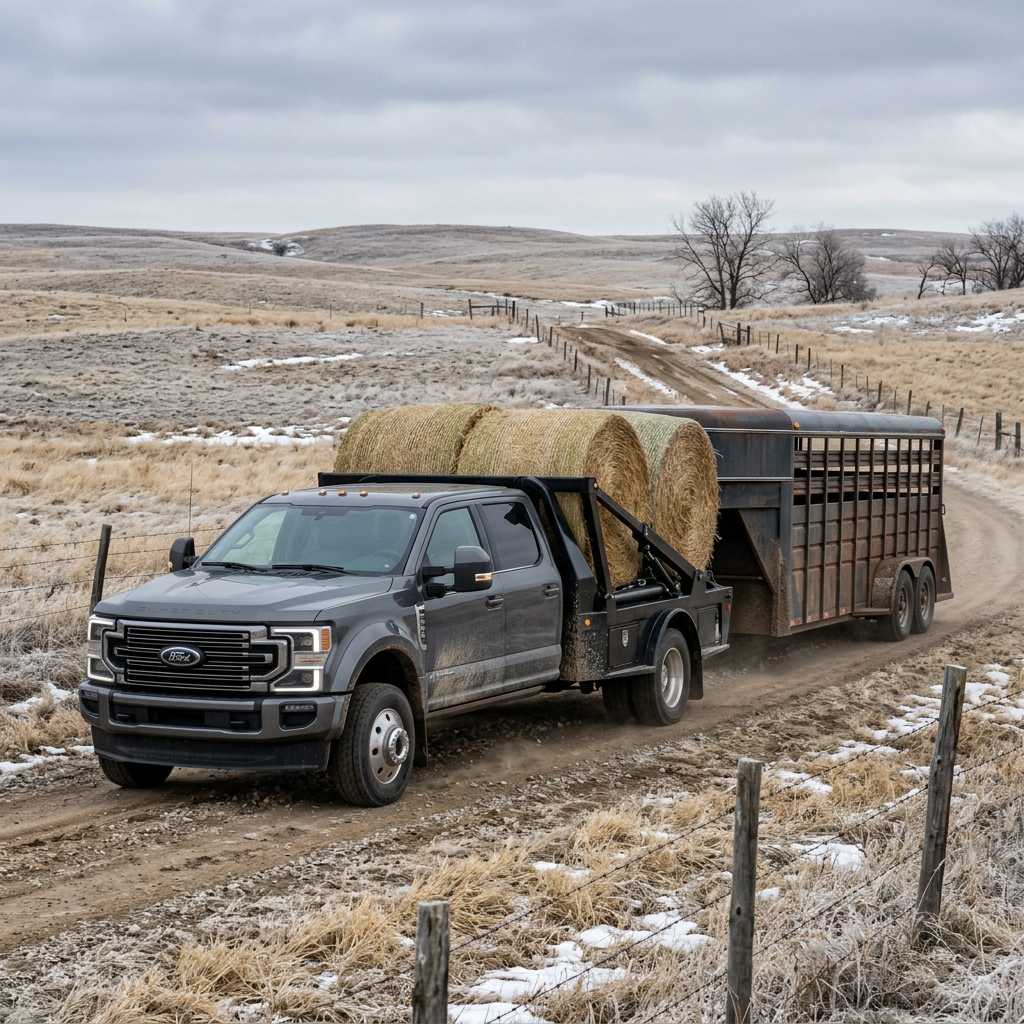
Key Takeaways: Calculating 2027 Ford Super Duty Payload and Towing Capacity for Bale Beds and Gooseneck Trailers Outfitting a heavy-duty truck for dual-purpose winter cattle feeding and commercial trailer hauling requires a precise mathematical understanding of gross axle weight ratings, frame loading, and dynamic weight transfer. When installing a hydraulic bale bed weighing between 1,500 lbs and 2,500 lbs on a 2027 Ford Super Duty, you immediately consume a significant portion of your factory payload capacity before adding a single round bale or hitching a loaded stock trailer.
To safely carry two 1,500 lb hay bales on the bed while simultaneously pulling an 18,000 to 25,000 lb gooseneck trailer, an F-350 or F-450 Dual Rear Wheel (DRW) configuration with a minimum rear Gross Axle Weight Rating (GAWR) of 9,990 lbs is strictly required. Single Rear Wheel (SRW) trucks, while highly capable for standard ranch duties, rapidly exceed their rear axle ratings when subjected to combined bed loads and high gooseneck pin pressures (20% to 25% of trailer weight). Working with our team at Valor Ford in Junction City, KS ensures your truck configuration matches your daily winter workload without risking safety, structural integrity, or warranty compliance. 2027 Ford Super Duty Weight Ratings & Capacities Breakdown Super Duty Model & Configuration Max Payload Range Rear GAWR Bale Bed + 2 Bales Load Remaining Payload for Pin Weight Recommended Gooseneck Max F-250 SRW 6.7L Diesel 3,300 - 3,800 lbs 6,340 lbs 4,500 lbs OVERLOADED (-700 lbs) Not Recommended for Dual Bale + Heavy Gooseneck F-350 SRW 6.7L Diesel 4,000 - 4,600 lbs 7,280 lbs 4,500 lbs 100 - 400 lbs Light Stock Trailers (<10,000 lbs) F-350 DRW 6.7L High Output 6,200 - 7,100 lbs 9,990 lbs 4,500 lbs 1,700 - 2,600 lbs 18,000 - 22,000 lbs F-450 DRW 6.7L High Output 6,250 - 6,450 lbs 9,990 lbs 4,500 lbs 1,750 - 1,950 lbs 22,000 - 25,000+ lbs As shown in the technical comparison above, calculating total payload demands strict addition: subtract the dead weight of the flatbed/bale bed (approx. 2,000 lbs), two heavy alfalfa round bales (3,000 lbs combined), fuel, tools, driver, and passengers. On an F-250 or F-350 SRW, zero payload headroom remains for the 4,000+ lb tongue weight of a loaded 24-foot gooseneck trailer. Choosing an F-350 or F-450 Dual Rear Wheel chassis guarantees compliance with Kansas Highway Patrol safety checks and protects critical drivetrain components from severe premature wear. Rear Gross Axle Weight Rating (GAWR): Selecting Between F-250, F-350, and F-450 Dual Rear Wheel Models Understanding rear GAWR is the single most critical factor when engineering a bale bed haul rig. The rear Gross Axle Weight Rating represents the absolute maximum weight that the rear axle assembly, including housing, differential, axle shafts, bearings, wheel hubs, tires, and leaf springs, can safely support. In single rear wheel configurations (F-250 and F-350 SRW), rear GAWR limits max out between 6,340 lbs and 7,280 lbs. While this provides ample capacity for standard box payloads, installing a heavy steel hydraulic bale bed immediately concentrates 1,800+ lbs directly over the rear axle. Spear arms, hydraulic reservoirs, fluid pumps, and heavy-gauge steel crossmembers sit over or behind the rear axle centerline, creating a severe leverage effect. When you spike two 1,500 lb round bales, you add 3,000 lbs of static mass. In an SRW truck, your rear axle is already supporting over 6,200 lbs of static load before adding occupants, diesel fuel, or hitch weight. Attempting to drop a loaded gooseneck stock trailer onto the ball creates a catastrophic axle overload condition, straining axle seals, overheating differential fluid, and causing tire sidewall flex that drastically degrades vehicle control on highway routes around Junction City. By stepping up to an F-350 DRW or F-450 DRW chassis, rear GAWR increases dramatically to 9,990 lbs (or up to 10,000 lbs depending on specific axle package codes). The dual rear wheel configuration doubles the tire contact footprint, increasing rear lateral stability and spreading heavy vertical loads across four load-range E or F tires. Furthermore, the F-450 DRW features commercial-grade Dana M300 wide-track rear axles, massive 15.75-inch rear brake rotors, and heavy-duty 10-lug wheel hubs. This heavy commercial hardware absorbs high torque spikes during low-speed pasture maneuvers while carrying maximum load ratings. For producers balancing daily winter feeding with heavy livestock hauling, the dual rear wheel architecture provides an essential margin of mechanical safety. What Configuration Details Must Be Verified Before Choosing a 2027 Super Duty for Heavy Gooseneck Towing? 1. Axle Ratio & Drivetrain Selecting the proper rear axle ratio is essential for pulling heavy trailers out of soft mud and deep snow. The 2027 Super Duty offers 3.55, 3.73, 4.10, and 4.30 limited-slip axle options. For dual-bale setups pulling 20,000+ lb goosenecks, the 4.10 (F-350 DRW) or 4.30 (F-450 DRW) limited-slip rear axle is highly recommended. The numerical ratio optimizes engine RPM in the 6.7L Power Stroke V8 Turbo Diesel's peak torque curve (1,050 to 1,200 lb-ft), reducing transmission torque converter heat build-up during low-speed pasture operations. 2. Gooseneck Prep & Flatbed Build Verify factory Gooseneck Hitch Prep Package (Option 53W) inclusion or determine flatbed crossmember integration. Aftermarket bale beds feature their own subframe structure with integrated 30,000 lb rated gooseneck hitch wells. Ensure the flatbed manufacturer's mounting brackets match Ford's recommended frame attachment points for pickup box delete or chassis cab platforms. Installing an aftermarket bed onto high-strength steel frame rails requires specific shear-plate mounts to avoid frame stress risers. 3. Frame Type & GVWR Class Distinguish between Pickup Box Delete (factory pickup frame with C-channel rear extension) and Chassis Cab (flat high-strength steel frame rails with standard 60-inch Cab-to-Axle dimension). Pickup box delete models retain the higher engine horsepower output (up to 500 hp / 1,200 lb-ft in High Output configuration), whereas Chassis Cab models offer straight frame rails ideal for heavy utility beds. Review GVWR class targets (14,000 lbs vs 16,500+ lbs) with Valor Ford sales specialists. Research Ford Super Duty Models Does Installing a Bale Bed Interfere with Factory Ford Blind Spot and Backup Sensors? Modern 2027 Ford Super Duty trucks rely on advanced driver assistance safety networks, including Ford Co-Pilot360 Technology, Blind Spot Information System (BLIS) with trailer coverage, Rear Parking Sensors, and 360-Degree Camera packages. Removing the OEM factory pickup bed disables radar modules housed inside the factory taillight assemblies and disconnects ultrasonic sensors embedded in the rear bumper. Without proper recalibration and hardware relocation, sensor errors will illuminate diagnostic trouble codes on the 12-inch digital instrument cluster and deactivate crucial driver-assist functionality. Fortunately, top-tier bale bed manufacturers offer integrated sensor housing cutouts and wiring extension harnesses specifically designed for Ford's architecture. Key integration components include: - **Taillight BLIS Module Relocation Brackets**: Transfer factory radar sensors into protective steel pockets built directly into the bale bed rear skirt. - **Sonar Sensor Harness Adapters**: Plug-and-play extensions that mount four rear ultrasonic park sensors into custom-drilled bumper ports. - **Tailgate Camera Relocation**: Re-mounting the factory high-definition tailgate camera beneath the bale bed tailboard or onto the gooseneck arch for clear hitch view visibility. At Valor Ford Service Center, our master certified technicians perform Ford IDS/FDRS computer re-flashing and sensor recalibrations following flatbed installation. This ensures BLIS with Trailer Coverage accurately measures your gooseneck trailer length, providing real-time radar monitoring along adjacent highway lanes when traveling down I-70 or Highway 77. How Does the Engine Block Heater and Supplemental Cab Heater Work in Sub-Zero Temperatures? Engine Block Heater System The factory-installed 110V/750W engine block heater warms engine coolant surrounding the 6.7L Power Stroke cylinder block. In sub-zero Dickinson County mornings, plugging the unit in 2 to 3 hours prior to startup maintains coolant temperatures near 100°F. This drastically reduces cold-cranking resistance, ensures rapid engine oil pressure build-up to protect turbocharger bearings, and prevents wax gelling inside diesel fuel lines during extreme arctic cold snaps. Rapid-Heat Supplemental Cab Heater Diesel engines heat up slowly at idle. Ford's Rapid-Heat Supplemental Cab Heater utilizes an electric ceramic PTC (Positive Temperature Coefficient) heating element built directly into the HVAC plenum. Activated automatically in freezing conditions, it delivers immediate warm airflow to the cabin and windshield within seconds of starting, defrosting ice and keeping operators comfortable during early 5:00 AM cattle feeding runs. Dual AGM Battery & Glow Plugs The 2027 Super Duty diesel powertrain includes heavy-duty dual 780 CCA (Cold Cranking Amps) AGM batteries paired with high-output alternators (up to dual 410-amp capacity). Super-fast ceramic glow plugs energize within milliseconds, achieving temperatures above 1,800°F to guarantee instant ignition without long cranking cycles, providing reliable electrical power for high-draw hydraulic bale bed pump motors. How Does Dual Rear Wheel Stability Compare on Icy Unpaved Pasture Roads in Rural Kansas? Navigating frozen, rutted pastures and slick dirt roads across the Flint Hills presents demanding physical challenges. When unrolling a 1,500 lb round bale on a steep, icy hillside, the center of gravity of your vehicle shifts dynamically. A single rear wheel truck on side-slopes experiences immense lateral tire sidewall roll, creating severe instability that can cause the rear axle to slide downhill. A Dual Rear Wheel (DRW) Super Duty widens the rear track width by nearly 20 inches compared to SRW models. This broad stance creates a wide anti-roll footprint that firmly anchors the truck when unrolling heavy hay bales on uneven ground. The four rear tires distribute vehicle and bale weight over twice the surface area, preventing deep rut penetration in soft mud during winter thaws. Key traction features in the 2027 Super Duty include: - **Electronic-Locking Rear Differential**: Locks both rear dual wheel sets together to deliver equal torque to all four dual tires on ice. - **Selectable Drive Modes**: Deep Sand/Snow and Slippery modes optimize throttle response, transmission shift schedules, and ABS brake vectoring. - **Hill Descent Control**: Maintains controlled creep speeds when descending steep, slick timber draws with loaded trailers. Furthermore, when hauling a 24-foot gooseneck livestock trailer through blustery Kansas crosswinds along Highway 18 or rural routes outside Fort Riley, the dual rear axle completely eliminates the fishtailing roll motion common to single rear wheel trucks. The rigid dual tire sidewalls withstand crosswind forces, keeping your heavy rig planted straight on icy pavement. Kansas Winter Cattle Feeding: Super Duty Bale Bed and Heavy Towing Setup Guide Executing a seamless winter feeding operation requires configuring your truck setup with precision before severe weather arrives. Balancing daily round bale loading, unrolling tasks, and commercial stock trailer hauling requires strict attention to chassis setup, tire management, and suspension tuning.
### 1. Dynamic Load Shift & Hydraulic Arm Leverage
When lifting a heavy 1,500 lb bale from ground level using hydraulic bed arms, the dynamic load exerted on the rear axle temporarily exceeds the static weight of the bale itself. The hydraulic cylinders act as leverage pivots, transferring weight off the front axle and concentrating up to 2,800 lbs of dynamic force onto the rear leaf springs. Operating an F-350 or F-450 DRW ensures your frame rails withstand these repeated torsional twisting forces without structural fatigue.
### 2. Tire Inflation Pressure (PSI) Management
Proper tire inflation is vital when operating under max payload conditions. Front steer tires on heavy diesel Super Duty trucks should maintain cold pressure settings (typically 75–80 PSI). For dual rear tires, running exact matched pressures (typically 65 PSI cold depending on load table placard ratings) prevents outer tire scuffing and ensures equal load distribution across all four rear dual tires. Contact the parts team at Order Genuine Ford Parts for factory tire pressure monitoring sensors compatible with aftermarket dual wheel rims.
### 3. Suspension Upgrades: Rear Air Helper Springs
For producers frequently transitioning between carrying two heavy round bales and towing a 22,000 lb gooseneck trailer, installing rear air helper spring kits (airbags) provides adjustable leveling. Air helper springs mount between the frame rail and rear axle housing, allowing you to adjust pressure from 10 PSI (empty) to 90 PSI (fully loaded). This keeps your Super Duty level, maintaining correct headlight aiming, steering geometry, and driveshaft driveline angles under heavy loads.
### 4. Dynamic Weight Distribution Checklist
- **Front Axle Minimum**: Ensure front axle retains at least 30% of total vehicle weight during maximum gooseneck load for precise steering control.
- **Gooseneck Pin Placement**: Mount ball hitch 1 to 2 inches forward of the rear axle centerline on flatbeds to distribute pin weight to the front axle.
- **Trailer Brake Controller Settings**: Adjust integrated Super Duty trailer brake gain setting (typically 7.5 to 9.5 for heavy stock trailers) for smooth proportional braking on slick rural gravel roads. Get Pre-Approved for Financing What Is the Average Price Range for Aftermarket Super Duty Bale Bed Installations? Standard Electric-Hydraulic Units **Contact us for current installed pricing** Entry to mid-level hydraulic bale beds utilize an 12V electric-over-hydraulic pump motor housed inside a weatherproof toolbox cabinet. Features typically include heavy-tube lift arms, 30,000 lb rated gooseneck hitch wells, drop-side headache racks, LED lighting, and wireless remote controls. Ideal for light to medium daily feeding workloads. Heavy-Duty Engine Belt-Driven Beds **Contact us for current installed pricing** Commercial-grade bale beds feature continuous-duty engine belt-driven hydraulic pumps or high-flow clutch pumps. These systems provide faster arm cycle times, higher lifting capacity (up to 3,500 lbs per arm set), underbody toolboxes, integrated dual-side hay unroller spinners, auxiliary hydraulic remotes for post-hole diggers, and heavy steel skirts. Valor Ford Package Financing **Contact us for current financing options**
At Valor Ford (785) 238-5114, we partner with leading commercial upfitters to streamline your purchasing experience. You can include your brand-new bale bed, bumper sensors, auxiliary lights, and installation costs directly into your new vehicle Ford Credit loan or lease agreement, simplifying tax depreciation and commercial accounting. Schedule Ford Service Today