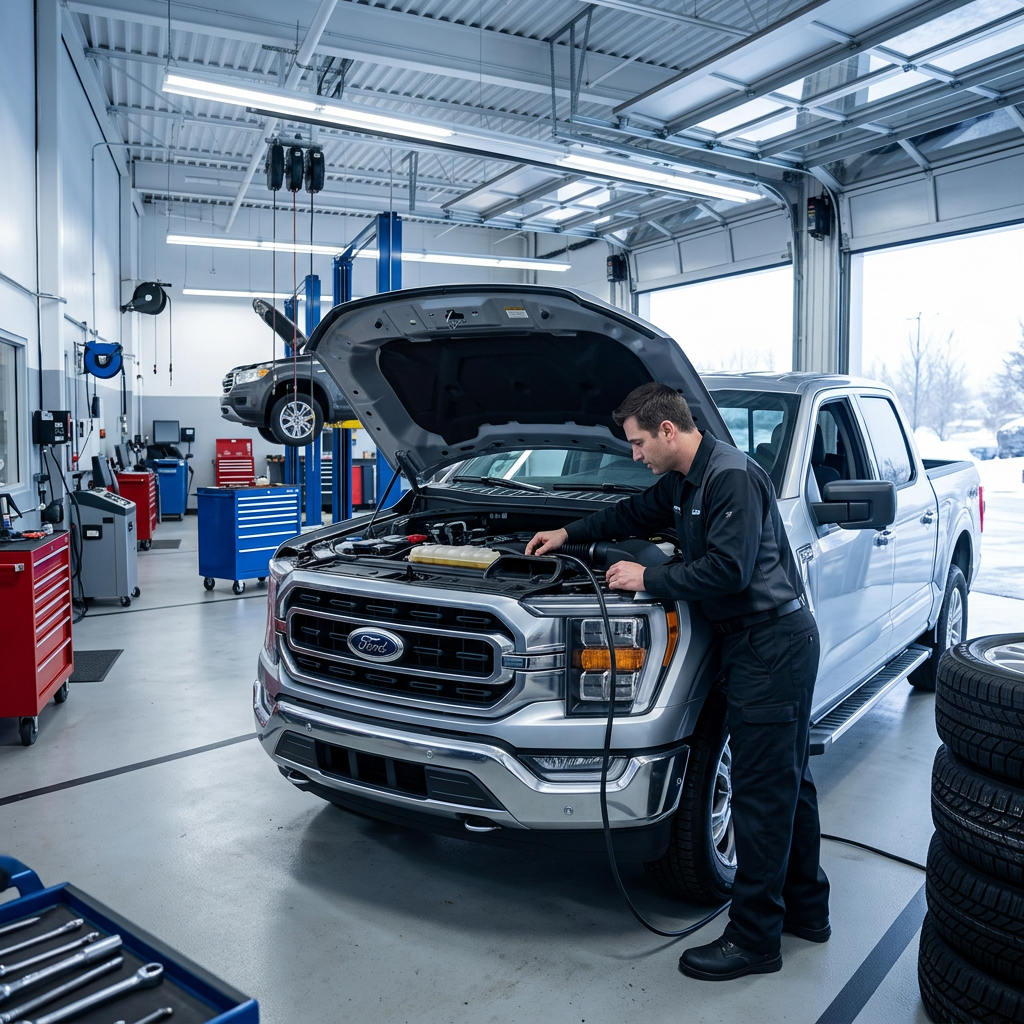

Preparing Your 4WD Ford Truck for Kansas Winter: Expert Service Advice from Valor Ford What is the Cost to Install an Engine Block Heater on a Ford F-150? Installing an engine block heater on a Ford F-150 typically costs between $150 and $350 for parts and labor when completed at a factory-authorized service center, whereas ordering the heating element pre-installed from the factory on a new truck build generally costs around $90 to $120. The total retrofit cost depends on your truck's engine configuration and whether additional wiring harnesses or coolant flushes are required during installation. In my 20 years managing truck maintenance in our service department, I have found that an engine block heater is one of the most cost-effective winter additions you can make for hard Kansas freezes. The heating element sits directly in an engine block freeze plug port, submerging into the engine coolant jacket. When plugged into a standard 110-volt household outlet, it warms the engine block and internal fluids, allowing motor oil to maintain fluid viscosity before you turn the key. Retrofitting an aftermarket heater requires draining the engine cooling system, removing a freeze plug or threading into a designated port on blocks like the 3.5L EcoBoost V6, mounting the element, routing the heavy-duty power cord safely through the front grille, and performing a full coolant vacuum refill. If you are reviewing 2026 Ford F-150 service details or getting your current truck ready for sub-zero mornings, our shop can complete this procedure in a single afternoon. For drivers scheduling maintenance in town, you can check our service center location or give us a quick call at (785) 238-5114 to verify current labor rates and part availability for your model year. Beyond effortless morning ignition, a block heater significantly reduces starter motor draw and cold-start cylinder wear. Because the engine block reaches operating temperature faster, your truck's climate control system starts blowing warm air into the cabin almost immediately, eliminating long idling periods on frozen driveways. Table of Contents How Long Should an Engine Block Heater Be Plugged In Before Starting? What is the Difference Between 4A and 4H and Which is Better on Icy Highways? Do 3-Peak Mountain Snowflake (3PMSF) Rated All-Terrain Tires Work Well in Kansas Winters? Are Dedicated Snow Tires Better Than All-Terrain Tires for Kansas Driving? Which 4WD-Specific Checks and Operating Cautions Matter Before Kansas Winter? How Long Should an Engine Block Heater Be Plugged In Before Starting? An engine block heater only needs to be plugged in for 2 to 3 hours prior to starting your truck to heat the engine block and coolant to optimal starting temperature. Leaving the heater plugged in all night provides no additional thermal benefit and unnecessarily increases your monthly electric bill. The heat transfer inside the engine reaches thermal equilibrium after roughly three hours. Once the block and coolant reach roughly 100 to 120 degrees Fahrenheit above ambient temperature, heat dissipates into the surrounding cold air as fast as the heating element generates it. Plugging the truck in for eight hours overnight simply draws electricity without raising engine oil or coolant temperatures any further. To simplify your morning routine, I always recommend using a heavy-duty outdoor grounding timer rated for at least 15 amps. You can set the timer to energize three hours before your morning commute. If you need a replacement power cord or factory terminal cap, our team can help you with ordering genuine Ford parts and accessories designed specifically for your truck's front bumper harness. Using a block heater for those two to three hours keeps internal engine lubricants flowing freely the moment the crankshaft turns. Standard motor oil thickens when ambient temperatures drop toward zero, forcing the oil pump to work harder to build upper valvetrain pressure. Pre-heating the engine protects vital internal bearings, Turbocharger feed lines, and valve actuators during those crucial first few seconds of cold operation. What is the Difference Between 4A and 4H and Which is Better on Icy Highways? The mechanical difference between 4A and 4H is that 4A (4WD Auto) utilizes an electronically controlled center clutch pack to dynamically distribute torque between the front and rear axles on demand, whereas 4H (4WD High) mechanically locks the front and rear driveshafts together at a rigid 50/50 torque split. For driving on icy highways with variable road conditions, 4A is vastly superior and safer because it allows the front and rear axles to rotate at different speeds during turns, eliminating dangerous driveline binding. Highway driving during a Midwestern winter rarely presents uniform surface conditions. You often encounter alternating stretches of packed snow, wet slush, black ice on bridge decks, and completely bare, dry asphalt. Operating in 4H on dry pavement causes severe driveline binding because your front tires must travel along a wider turning radius than your rear tires during lane changes or gentle curves. On high-traction surfaces, the locked transfer case cannot slip, forcing tires to hop—a phenomenon known as crowhopping—which places immense mechanical strain on axle shafts, universal joints, and internal transfer case gears. In contrast, 4A mode continuously monitors wheel speed sensors, throttle position, and steering angle. The system operates primarily in rear-wheel drive to optimize fuel efficiency, but instantly energizes the electromagnetic clutch to direct torque forward the millisecond rear wheel slip is detected. Across the rolling farmland and open prairie roads of Dickinson County, where ground winds drift snow across dry pavement without warning, 4A gives drivers automatic front-wheel pull precisely when needed without requiring manual lever or dial adjustments while driving. Reserve 4H strictly for continuous, unpaved ice or deep, unbroken snow where maximum, uninterrupted four-wheel traction is required at lower speeds. Do 3-Peak Mountain Snowflake (3PMSF) Rated All-Terrain Tires Work Well in Kansas Winters? 3-Peak Mountain Snowflake (3PMSF) rated all-terrain tires perform exceptionally well in Kansas winter conditions, delivering reliable acceleration and cornering stability in deep snow, slush, and light ice without the need to swap tires every spring. Unlike standard M+S (Mud and Snow) branded tires, 3PMSF-certified tires undergo rigorous standardized industry testing to prove they deliver at least 10 percent greater acceleration traction on medium-packed snow. The performance gap comes down to tread rubber compounding and siping density. Standard all-season tire rubber hardens when ambient temperatures drop below 45 degrees Fahrenheit, becoming stiff and losing its ability to grip subtle road imperfections. 3PMSF-rated all-terrain tires feature advanced silica-infused rubber compounds that remain flexible in sub-freezing temperatures, allowing the tread blocks to conform to icy road surfaces. Modern 3PMSF all-terrain tires incorporate high-density zigzag sipes—microscopic slits cut into the tread blocks—that bite into hard-packed snow and create snow-on-snow traction. Aggressive outer shoulder lugs and deep perimeter grooves also channel thick slush away from the tire footprint, preventing high-speed slushplaning on highway lanes. For truck owners who haul trailers, drive on gravel roads, or use their vehicles for work throughout the year, a 3PMSF-rated all-terrain tire offers impressive multi-season versatility. If you want to check your current tire tread depth or rubber pliability before winter hits, consider scheduling a winter tire inspection online with our certified technicians. Are Dedicated Snow Tires Better Than All-Terrain Tires for Kansas Driving? Dedicated winter snow tires outperform all-terrain tires on glare ice, hard-packed snow, and frozen asphalt because they utilize soft rubber compounds and dense siping designed exclusively for freezing friction. On sheer ice, dedicated winter tires can reduce braking distances by up to 30 percent compared to standard or all-terrain tires. While 3PMSF all-terrain tires excel in deep snow and off-road slush, dedicated winter tires feature a much softer tread compound packed with specialized microscopic sipes across every square inch of the tread face. These sipes create thousands of biting edges that slice through the microscopic water film created by friction on ice, granting superior lateral grip during emergency lane changes and sudden stops. Tire Type Best Surface Application Sub-Zero Rubber Flexibility Ice Braking Performance Year-Round Driving Suitability All-Season Tires Mild rain and dry pavement above 45°F Hardens in cold weather Moderate to poor stopping distances Excellent summer and fall wear 3PMSF All-Terrain Tires Deep snow, slush, gravel, and trail use Remains flexible below 45°F Strong snow traction; moderate ice grip Excellent year-round option Dedicated Snow Tires Glare ice, packed snow, and sub-zero roads Maximum softness in extreme cold Shortest stopping distance on ice Low (soft rubber wears fast above 45°F) The primary downside of dedicated winter tires on a heavy truck is rapid tread wear when driven on dry, warm asphalt. If you frequently tow heavy loads or drive long highway distances once roads clear, the ultra-soft rubber of a dedicated snow tire wears quickly. For most Kansas pickup owners, a high-quality 3PMSF-rated all-terrain tire provides the best practical balance between winter safety and long-term tread life. Which 4WD-Specific Checks and Operating Cautions Matter Before Kansas Winter? Preparing your truck's four-wheel-drive system for winter requires inspecting transfer case and differential fluids, testing integrated wheel end (IWE) vacuum actuators, verifying battery cold-cranking capacity, and calibrating terrain management modes like Slippery mode. Performing these checks before freezing weather arrives prevents slow front-axle engagement, vacuum leaks, and unexpected mechanical fault codes on frozen roads. Low ambient temperatures increase fluid viscosity inside driveline components. If your transfer case or differential fluid is old or contaminated with moisture, cold weather makes the fluid thick and sludge-like, delaying internal clutch engagement. Servicing transfer cases with factory-specified lubricants like Motorcraft MERCON LV protects internal planetary gear sets and multi-plate clutch packs from premature wear. Technicians also test front hub vacuum lines and IWE actuators to ensure smooth hub engagement when switching drive modes. Battery health is equally critical for modern electronic 4WD systems. Cold weather slows down internal battery chemical reactions, reducing cold-cranking amps right when the engine requires maximum electrical energy to turn over. Electronic transfer case shift motors and electromagnetic engagement clutches draw significant electrical current; a marginal battery can cause voltage drops that prevent the 4WD system from engaging properly during a cold start. Winter Driveline Inspection Checklist: 1. Transfer Case Lubricant: Check fluid level and clarity (recommend MERCON LV replacement every 30,000 to 60,000 miles). 2. Front & Rear Differentials: Inspect gear oil levels and check housing seals for fluid weeping. 3. Hub Actuators & Vacuum Lines: Test Integrated Wheel End (IWE) engagement and vacuum line integrity. 4. Battery Load Test: Verify Cold Cranking Amps (CCA) output and clean battery terminal posts. 5. Electronic Drive Modes: Test selector dial function to confirm smooth switching between 2H, 4A, 4H, and Slippery mode. In our shop, owners ask whether leaving 4A mode engaged full-time drops fuel economy during cold snaps—it can slightly lower efficiency depending on driving conditions, but the instant traction on variable winter roads is well worth it. For drivers managing daily commutes around Junction City, taking time for a seasonal driveline checkup ensures complete confidence when winter storms roll in. To get your truck ready for the cold months ahead, stop by for a quick checkup by visiting our dealership or reach out to our service team at (785) 238-5114 to reserve your appointment. © 2026 Valor Ford. All rights reserved. Vehicle specification data © JATO Dynamics Limited.