Blog / Maintenance & Service

Average Cost to Purchase and Install Winter Tires on a 4WD Truck or SUV

Average Cost to Purchase and Install Winter Tires on a 4WD Truck or SUV

Average Cost to Purchase and Install Winter Tires on a 4WD Truck or SUV

When winter weather settles over Central Kansas, drivers across Junction City, Manhattan, and Fort Riley face a familiar seasonal dilemma: how to keep heavy four-wheel-drive trucks and SUVs planted securely on ice-slicked highways and unplowed county roads. If you are asking what it costs to outfit a 4WD truck or SUV with a full set of four dedicated winter tires, the short answer is that most drivers spend between $800 and $1,800+ total. This complete investment accounts for both the price of four light truck or SUV winter tires ($150 to $380+ per tire depending on size and load rating) and professional mounting, computer balancing, valve stem service, tire pressure monitoring system (TPMS) relearning, and local disposal fees ($100 to $250 total).
For full-size pickups such as the Ford F-150 or Super Duty, as well as midsize to large SUVs like the Ford Bronco and Explorer, tire pricing heavily correlates with wheel diameter, load rating (Standard Load vs. Extra Load or Load Range E for towing), and specialized tread technologies. Standard 17-inch or 18-inch tires land on the lower side of the price curve, while 20-inch or 22-inch fitments naturally sit at the premium end. At Valor Ford, located at 1825 Goldenbelt Blvd in Junction City, KS 66441, our certified master technicians ensure your winter tire setup is selected, mounted, and calibrated specifically for your vehicle's weight, towing demands, and drivetrain engineering. To speak directly with our service center specialists, feel free to Call us at (785) 238-5114 today.
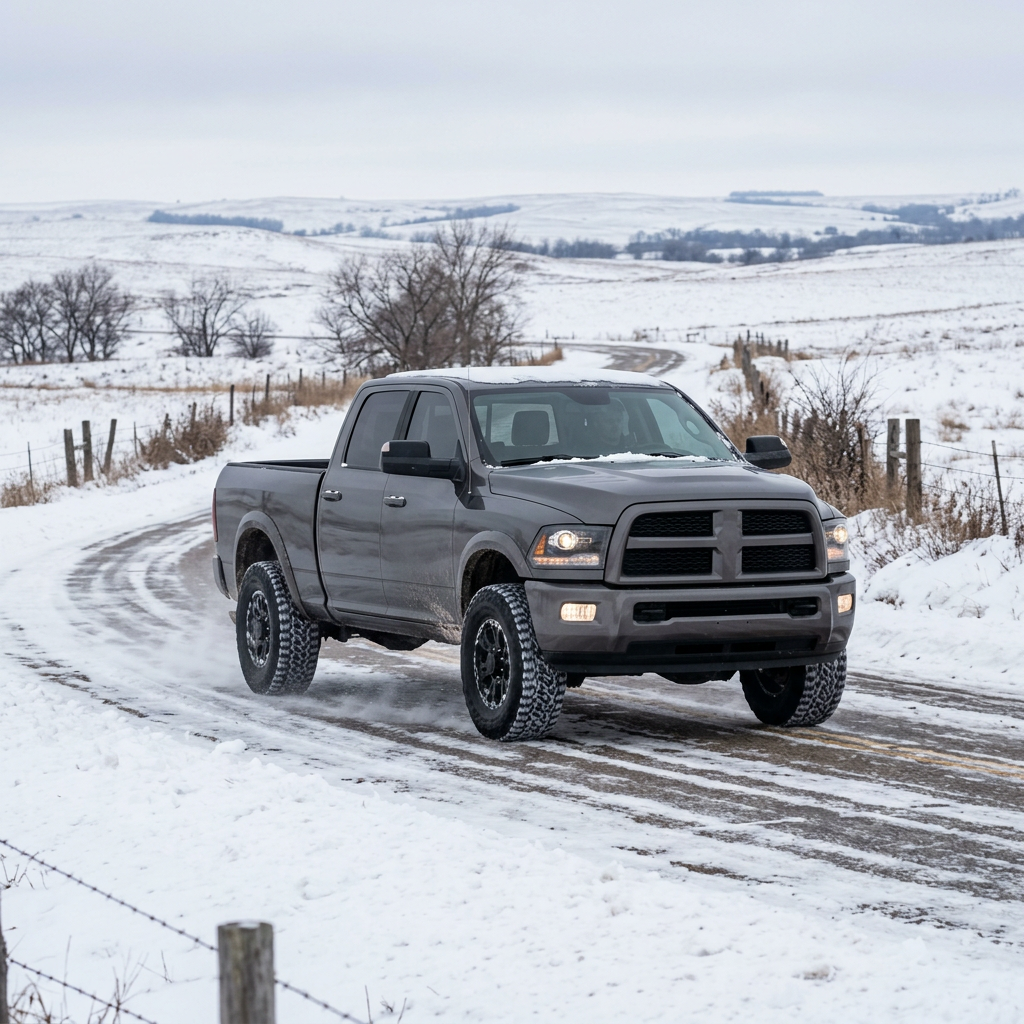
A dark grey pickup truck driving on a snowy, icy rural road through rolling winter hills. (Representative image for illustration purposes only. Actual vehicle may vary based on trim and configuration.)

Cost Breakdown: Tire Prices, Mounting, Balancing, and Installation Fees

Understanding where every dollar goes helps truck and SUV owners make smart choices when preparing for winter. A complete tire replacement consists of two primary elements: the raw hardware (the rubber tires themselves) and the expert shop labor required to mount, balance, and configure the assembly for high-speed highway safety on corridors like I-70.
Here is a breakdown of average itemized costs encountered across the Flint Hills region for 4WD trucks and SUVs: • 17" to 18" Winter Tires:$160 – $260 per tire ($640 – $1,040 for four) • 19" to 20" Winter Tires:$240 – $380+ per tire ($960 – $1,520+ for four) • Mounting & Computer Balancing:$20 – $40 per wheel ($80 – $160 total) • TPMS Sensor Reset / Relearn:$15 – $35 total package • Rubber Valve Stems / Maintenance Kits:$5 – $10 per wheel ($20 – $40 total) • Kansas Tire Recycling & Disposal Fee: $3 – $5 per tire ($12 – $20 total)
If you require genuine manufacturer replacement parts or upgraded factory accessories for your Ford model during installation, you can easily order directly through our dedicated portal to Order Genuine Ford Parts.
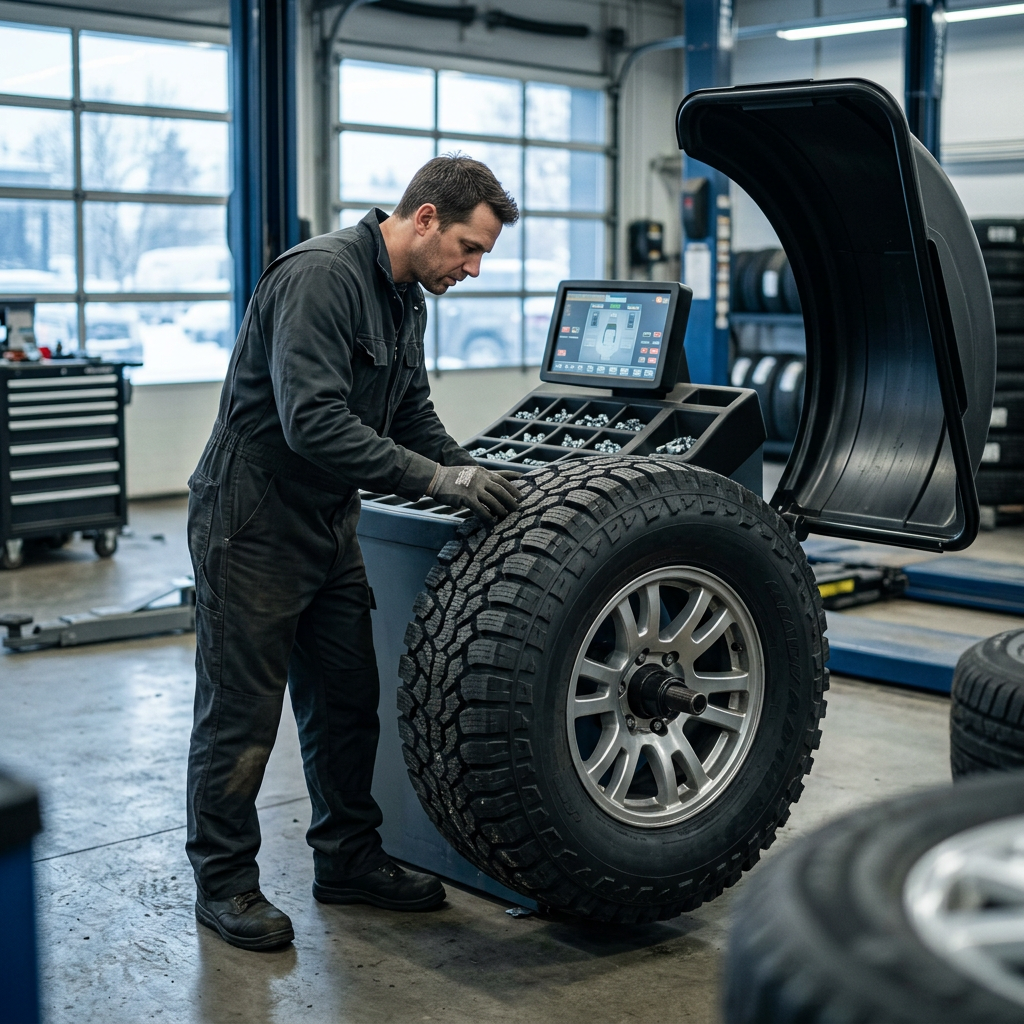
Mechanic in dark coveralls operating a wheel balancer machine with a large off-road tire mounted in an auto shop. (Representative image for illustration purposes only. Actual vehicle may vary based on trim and configuration.)

Service or Item Component

Estimated Unit Cost

Set of 4 Estimated Total

Key Functional Purpose

Light Truck / SUV Winter Tires (17"-18")

$160 – $260

$640 – $1,040

Provides deep siping and cold-weather rubber flexibility

Heavy Duty / Low-Profile Winter Tires (20"+)

$240 – $380+

$960 – $1,520+

Delivers high load ratings for heavy SUVs and payload vehicles

Professional Mount & Road Force Balance

$20 – $40

$80 – $160

Eliminates high-speed vibration and ensures even tread wear

TPMS Sensor Sync & Relearn

$15 – $35 (Flat)

$15 – $35

Calibrates vehicle computer to monitor exact winter tire pressure

Environmental Disposal / Recycling Fee

$3 – $5

$12 – $20

Mandatory state recycling compliance for outgoing tires

Comparing Budget, Mid-Range, and Premium Winter Tires for Heavy Vehicles

Budget Winter Tier

Price Range:$600 – $850 (Set of 4 installed) Popular Options: Sailun IceBlazer, GT Radial Champiro Winterpro, Mastercraft Glacier. Characteristics: Budget winter tires feature aggressive tread directional patterns that evacuate slush effectively. While vastly superior to standard all-season tires on snow, their rubber compounds tend to stiffen slightly earlier in sub-zero temperatures and wear faster under heavy 4WD torque. Ideal for light seasonal mileage and local urban commutes around town.

Mid-Range Winter Tier

Price Range:$850 – $1,250 (Set of 4 installed) Popular Options: Firestone Winterforce 2 UV, General AltiMAX Arctic 12, Cooper Discoverer True North. Characteristics: Striking the ideal balance between initial investment and long-term endurance, mid-range tires incorporate silica-rich tread formulas, high density 3D siping, and pinned tread blocks for optional tire studs. Excellent for truck drivers carrying moderate cargo loads across Dickinson and Geary counties.

Premium Winter Tier

Price Range:$1,250 – $1,850+ (Set of 4 installed) Popular Options: Bridgestone Blizzak LT / DM-V2, Michelin X-Ice Snow SUV, Nokian Hakkapeliitta R5 SUV. Characteristics: The gold standard in severe cold weather performance. Features advanced hydrophilic multi-cell compounds that suck moisture away from micro-ice films. Essential for maximum stopping distance reduction, maximum lateral control, and heavy payload or towing applications on icy highways.

Do 3PMSF-Rated All-Terrain Tires Perform as Well as Dedicated Winter Tires on Ice?

A common point of confusion among 4WD truck and SUV owners is whether a set of 3-Peak Mountain Snowflake (3PMSF) rated all-terrain tires (such as those found on off-road trim levels like the Ford Bronco Badlands or F-150 Tremor) renders dedicated winter tires unnecessary. While 3PMSF all-terrain tires represent a giant leap forward compared to traditional highway all-season tires, they are not a complete substitute for dedicated winter rubber on glare ice.
All-terrain tires rated 3PMSF achieve their rating by passing a straight-line acceleration test on medium-packed snow. However, their rubber compound is engineered to withstand hot summer asphalt and sharp off-road rocks without shredding. This requires a firmer rubber matrix that hardens when ambient temperatures drop below freezing. In contrast, dedicated winter tires remain soft and pliable even at sub-zero temperatures, utilizing thousands of hair-thin micro-sipes to create friction on sheer ice surface films. Independent braking tests show dedicated winter tires can stop up to 30 feet shorter on wet ice from 30 mph than 3PMSF all-terrain tires.
Looking to upgrade your off-road rig or upgrade to a capable winter vehicle? Take a look at our current inventory to Shop New Ford Bronco Inventory or explore pre-owned models.
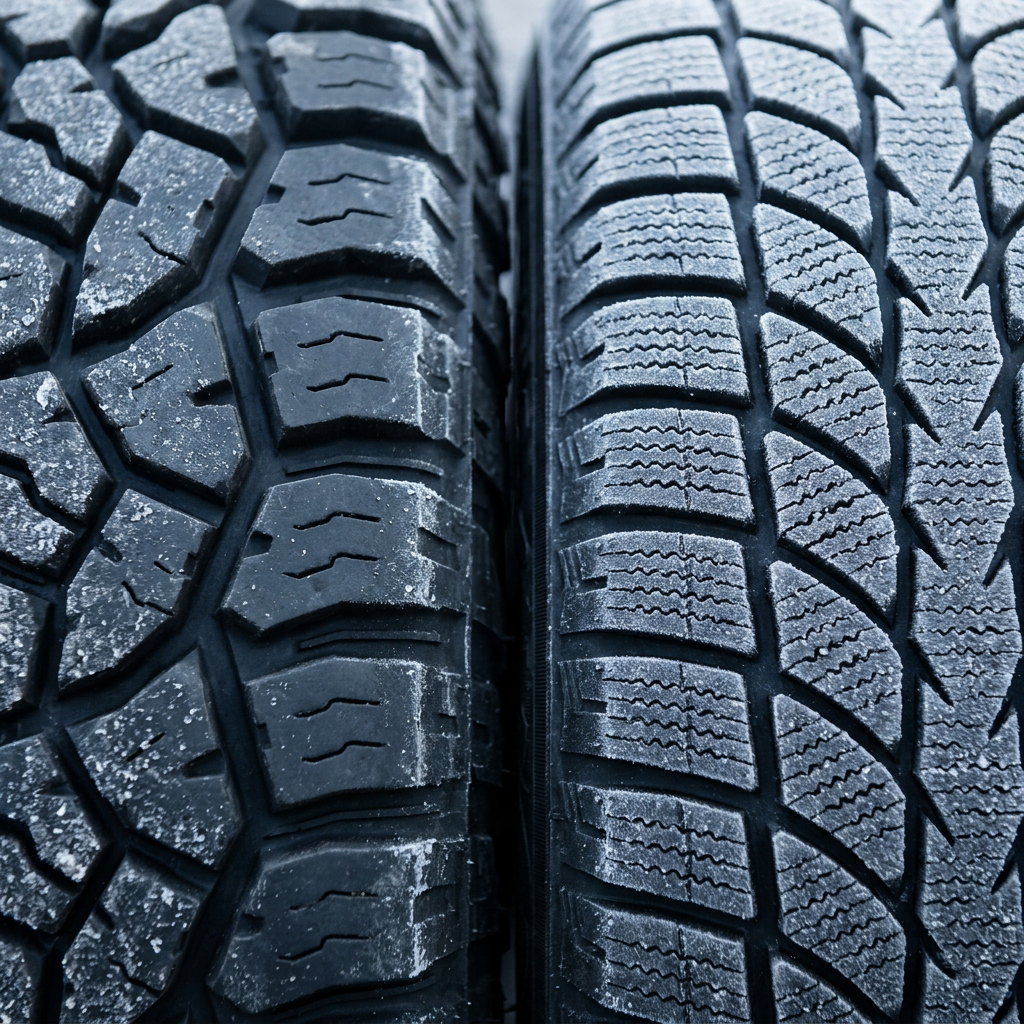
Side-by-side close-up view of two distinct frosted winter tire tread patterns. (Representative image for illustration purposes only. Actual vehicle may vary based on trim and configuration.)

What the 3-Peak Mountain Snowflake (3PMSF) Symbol Indicates on Winter Tires

The Three-Peak Mountain Snowflake (3PMSF) icon—a snowflake molded inside a six-peak mountain outline on a tire's sidewall—is an industry mark designating severe snow service capability. Unlike the legacy 'M+S' (Mud and Snow) branding, which is simply based on a tread geometry formula requiring 25% open tread void area, the 3PMSF rating requires physical performance testing.
To earn the 3PMSF rating, a tire must demonstrate a minimum of 110% of the traction of a standardized reference tire during accelerated snow traction testing under U.S. ASTM F-1805 standards. What makes true winter tires special is the chemical engineering behind the rubber compound. Cold-weather winter compounds utilize high concentrations of silica and specialized polymers designed to remain pliable below 45 degrees Fahrenheit (7 degrees Celsius). Standard summer or all-season compounds experience a phenomenon known as 'glass transition' at low temperatures, turning rigid and slick like hard plastic.
Understanding this distinction helps 4WD vehicle owners make informed choices when traveling down winter highways in Central Kansas. If you're interested in analyzing replacement options for your truck or SUV, check out our guide to Research Ford F-150 specifications or review options for heavier platforms like our page to Research Ford F-250 towing and tire ratings.

What Is the Difference Between 4WD and AWD for Winter Weather Near K-State?

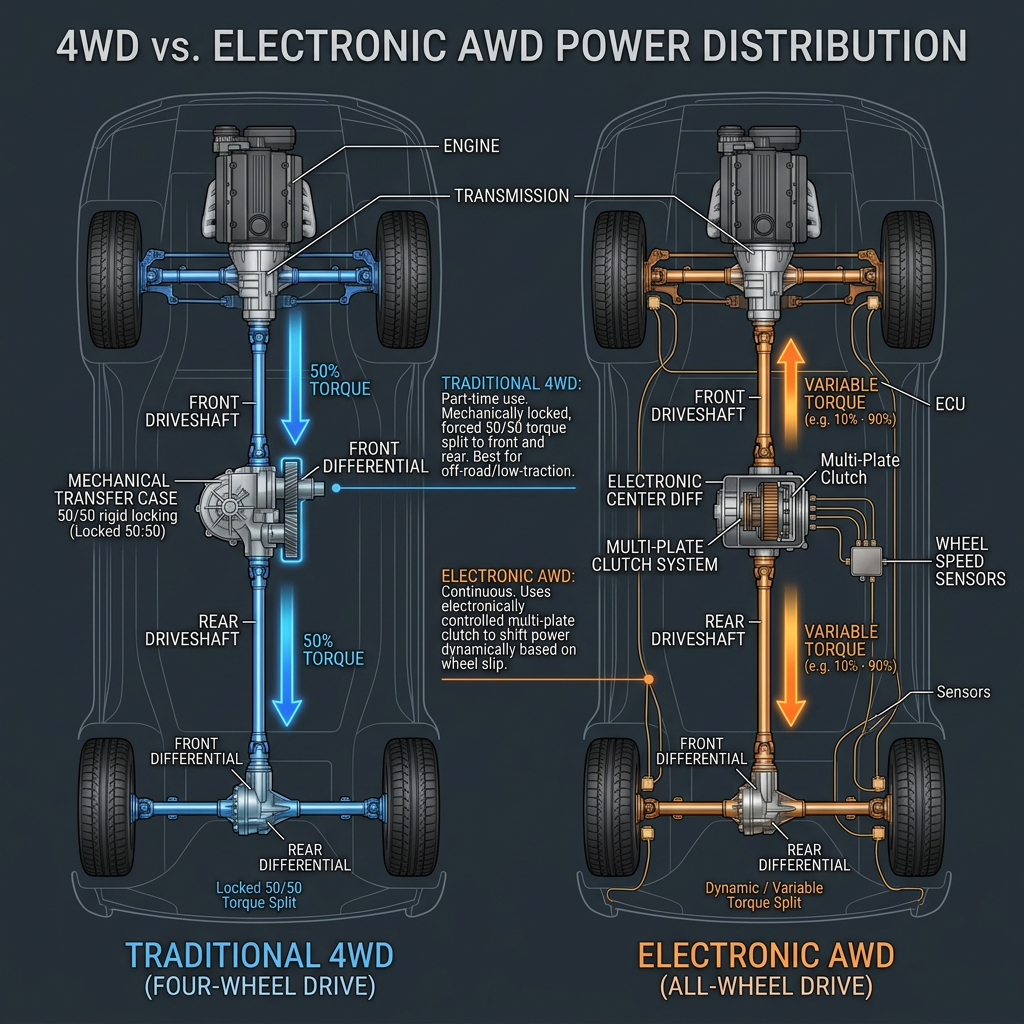
Comparison diagram showing mechanical components and power distribution of Traditional 4WD versus Electronic AWD. (Representative image for illustration purposes only. Actual vehicle may vary based on trim and configuration.)
For students navigating K-State's Manhattan campus or military personnel commuting from Fort Riley along K-18 and US-40, drivetrain configuration plays a major role in winter road handling. However, four-wheel drive (4WD) and all-wheel drive (AWD) operate on fundamentally different mechanical principles.
Traditional Part-Time 4WD: Locks the front and rear driveshafts together at a fixed 50/50 power split via a mechanical transfer case. Because both driveshafts are locked at identical rotational speeds, traditional 4WD provides maximum traction in deep snow or mud. However, because front wheels must travel faster than rear wheels when turning corners, part-time 4WD requires tire slip to operate without mechanical stress. All-Wheel Drive (AWD): Employs a center differential or electronically controlled multi-plate clutch pack that continuously modulates torque between the front and rear axles. AWD systems automatically send power to wheels with grip while allowing seamless speed differences during tight maneuvers on mixed dry/icy pavement.
Whether your SUV uses intelligent AWD like a Ford Explorer or part-time 4WD, remember that 4WD helps you accelerate—it does not help you stop faster on ice! Dedicated winter tires supply the stopping traction that no drivetrain can produce on its own. Drivers looking to evaluate midsize crossover capabilities can Research Ford Explorer drivetrain systems on our site.

Can Part-Time 4WD Be Left Engaged on Dry or Patchily Icy Pavement?

A crucial mechanical warning for owners of traditional part-time 4WD trucks: do not leave 4WD High engaged on dry or patchily clear asphalt. Operating a locked 4WD transfer case on high-traction surfaces creates a severe mechanical issue known as driveline bind or wheel crowhop.
When turning on dry pavement, the outer front wheel must trace a wider arc and rotate significantly faster than the inner rear wheel. In a part-time 4WD system, the front and rear driveshafts are locked together. Without slippery ice or snow to allow the tires to scuff or slide, rotational force builds up inside the transfer case, front axle shafts, and universal joints.
This intense mechanical binding leads to severe tire scrubbing, accelerated tread wear, reduced fuel economy, and potential internal transfer case failure or snapped axle shafts. On patchy winter roads where dry pavement alternates with ice patches, drivers should disengage 4WD High back to 2WD once clear stretches appear—or opt for vehicles equipped with an 4A (4WD Auto) electronic transfer case mode, available on Select Ford models.
If you are considering upgrading your vehicle to one featuring automatic 4WD control, feel free to submit a Trade In Evaluation to see what your current truck or SUV is worth toward a new model.

Fort Riley & K-State Winter Driving Guide: Selecting and Servicing 4WD Vehicles for New Residents

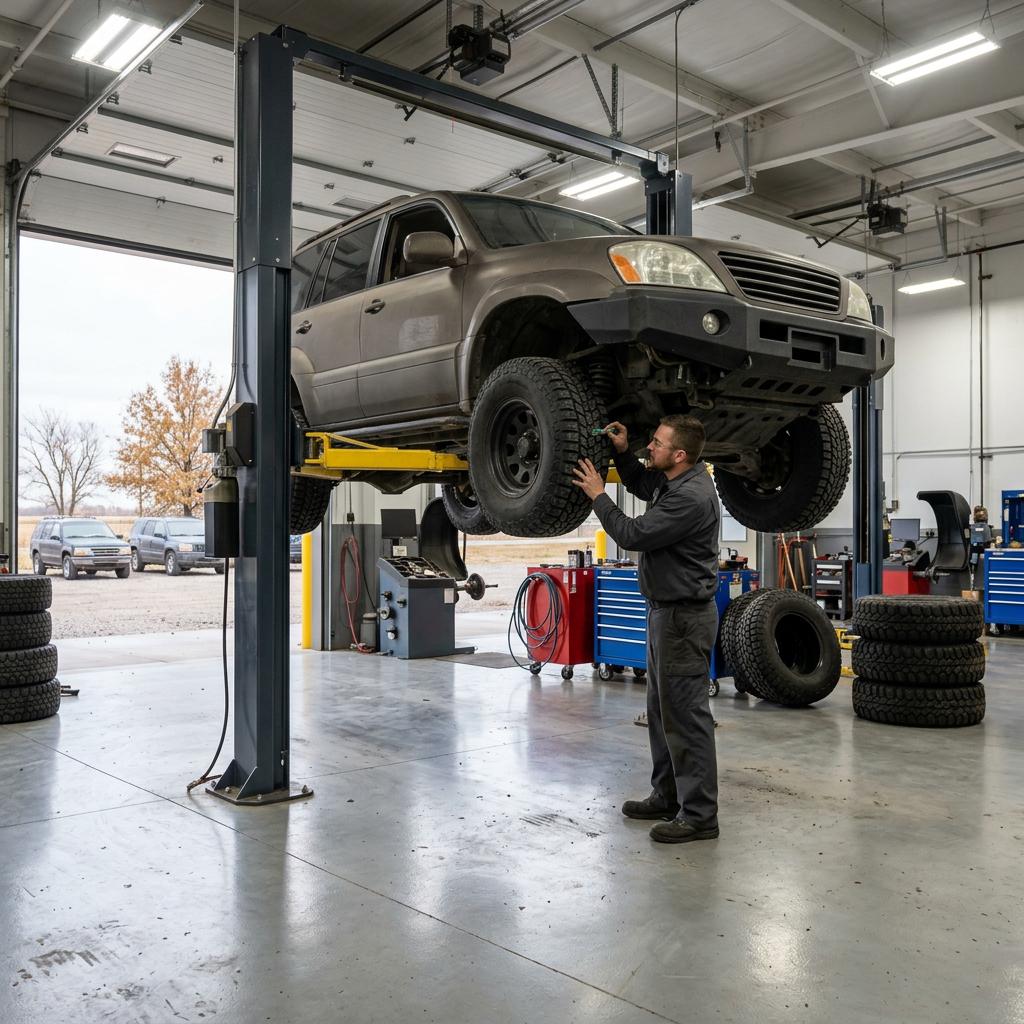
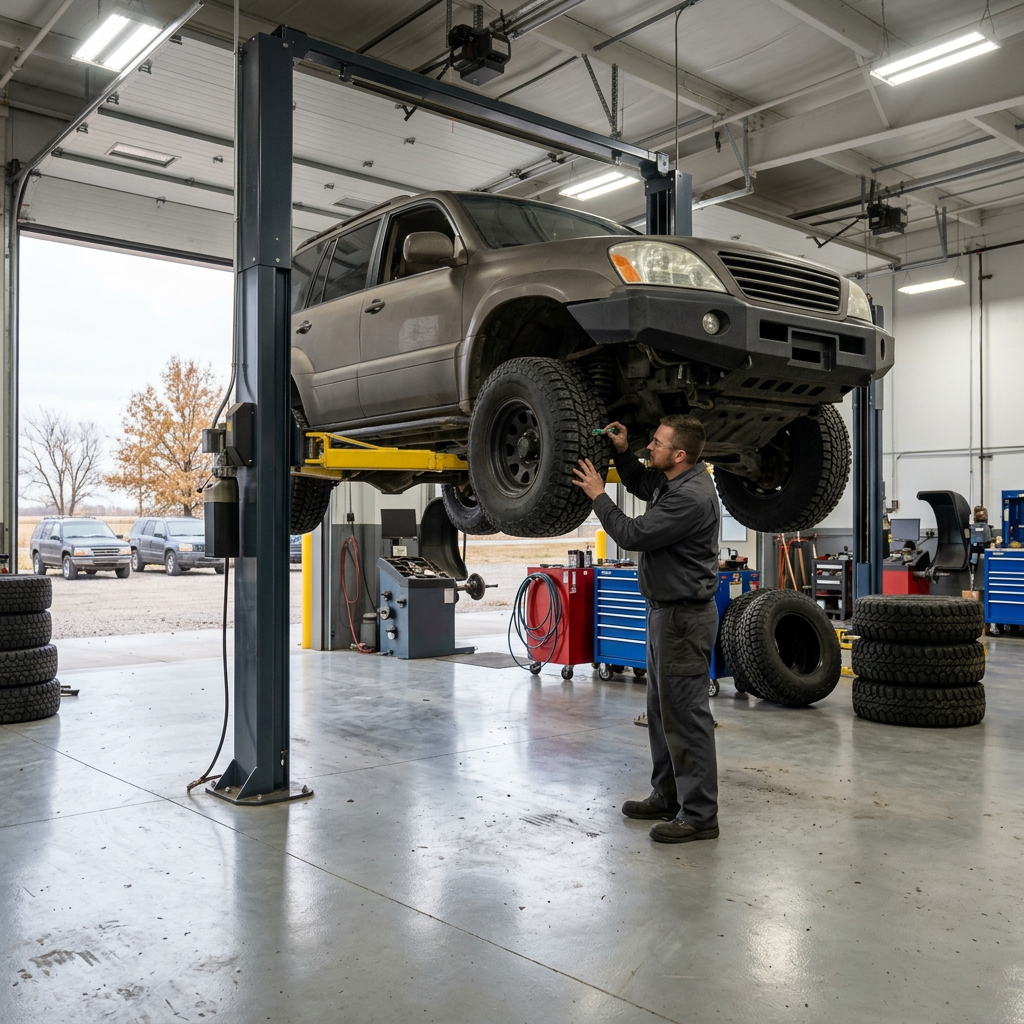
Mechanic standing in an auto repair shop measuring the tire tread depth of an SUV raised on a hydraulic lift. (Representative image for illustration purposes only. Actual vehicle may vary based on trim and configuration.)

1. Seasonal Tire Swap

For soldiers arriving at Fort Riley or students relocating to Kansas State University from milder climates, Kansas winter storms bring sudden ice glaze and high prairie winds. Transitioning to dedicated winter tires in late October or November ensures optimal handling before freezing rain strikes.

2. Battery & Fluid Check

Freezing temperatures dramatically reduce battery Cold Cranking Amps (CCA). Have your battery load-tested, inspect your engine coolant concentration for sub-zero protection, and switch to de-icer rated windshield washer fluid before severe cold sets in.

3. Winter Emergency Kit

Always carry essential gear in your 4WD bed or trunk: tow straps, portable jump starter pack, heavy-duty ice scraper, compact snow shovel, folding traction mats, thermal blankets, and a bag of sand or cat litter for instant weight and tire traction.
Busy military or academic schedule? Valor Ford makes vehicle upkeep stress-free: learn how you can Schedule Pickup and Delivery Service directly from your home or office.

How Weight Distribution Affects Vehicle Handling on Icy Kansas Highways

Full-size pickup trucks suffer from an inherent weight bias: heavy iron or aluminum V8/EcoBoost engines sit directly over the front axle, while an unladen steel or aluminum truck bed leaves very little weight over the rear wheels. When driving unloaded down icy routes like I-70 or rural roads in Dickinson County, this uneven weight ratio (often 60/40 front-to-rear) leads to sudden rear traction loss, fish-tailing, or spin-outs during cornering and braking.
To counteract this imbalance, experienced Kansas truck owners place 200 to 300 pounds of secure ballast (such as sandbags or specialized water-filled weight bags) directly over or slightly ahead of the rear axle inside the bed. Combining proper bed ballast with dedicated winter tires featuring aggressive siping provides balanced four-wheel mechanical traction, allowing your 4WD system to deliver smooth power without premature rear wheel slip.
If you drive a midsize truck like the Ford Maverick, lightweight engineering changes traction dynamics further. You can learn more by choosing to Research Ford Maverick configurations and payload specs.

Dedicated Winter Wheel Packages vs. Mounting Tires on Factory Rims

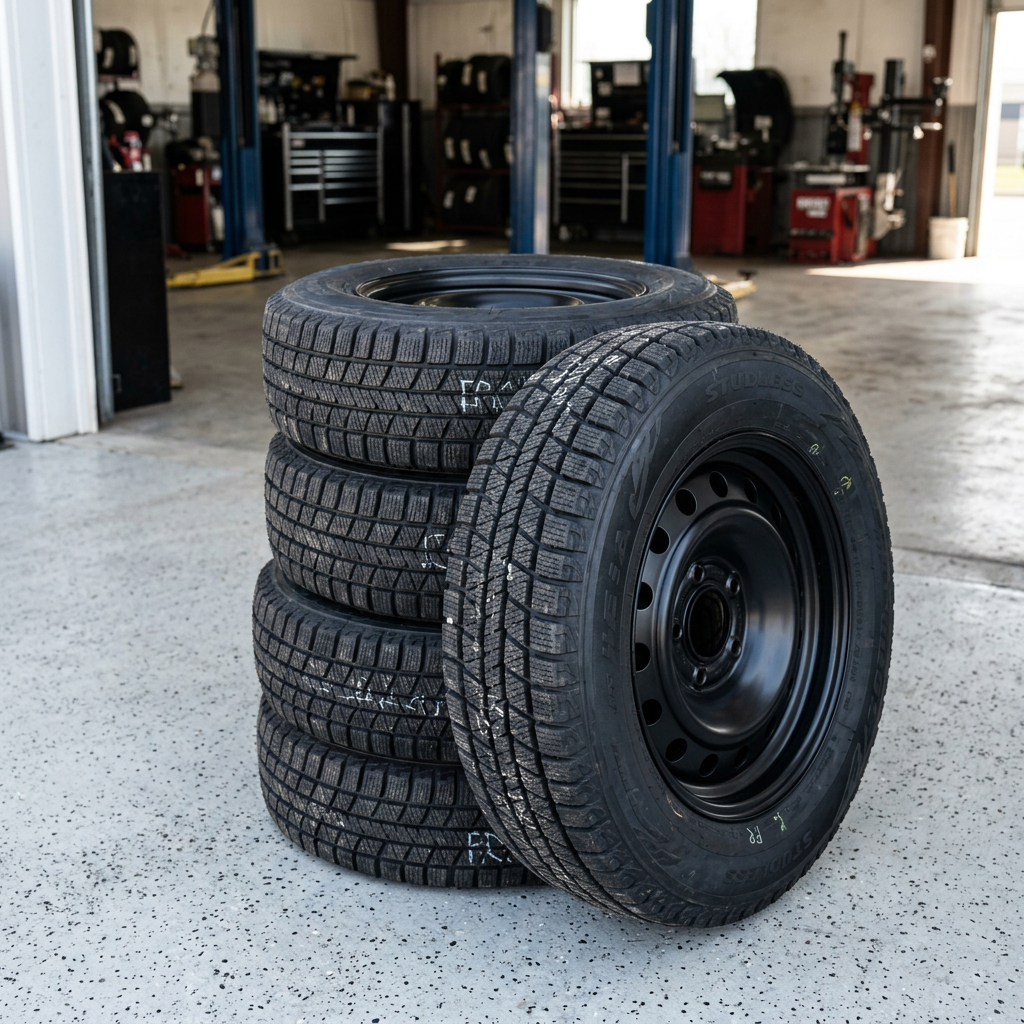
A stack of winter tires mounted on black steel rims standing in an auto repair shop bay. (Representative image for illustration purposes only. Actual vehicle may vary based on trim and configuration.)

Option A: Dismount / Remount

Upfront Cost: Lower initial purchase (buy 4 tires only). Annual Cost:$160 – $320 per year (paying twice-yearly mounting & balancing fees). Drawbacks: Repeated tire dismounting stresses tire beads and exposes factory alloy wheels to potential scratches and road salt corrosion during winter months.

Option B: Dedicated Wheel Package

Upfront Cost: Higher initial investment ($400 – $800 for 4 steel/aluminum wheels + $150 TPMS sensors). Annual Cost:$40 – $80 per year (simple wheel swap fee). Benefits: Protects factory wheels from road salt, allows rapid 30-minute seasonal bolt-on swaps, and pays for itself within 3 to 4 winter seasons.

Financial Breakdown

Over a 5-year vehicle ownership period, a dedicated winter wheel package costs virtually the same total money while sparing your factory wheels from winter damage and making seasonal changeovers significantly faster and easier.

Maintaining Winter Tires: PSI Adjustments, Tread Depth, and Off-Season Storage

Proper maintenance maximizes both the life of your winter tires and your safety on icy highways: • Cold Weather Pressure Drop: For every 10 degree drop in ambient temperature, tire pressure decreases by approximately 1 to 2 PSI. Check tire pressures regularly when tires are cold. • Minimum Winter Tread Depth: Standard tires can run down to 2/32" of tread, but winter tires lose critical snow traction once tread wears below 4/32". Replace winter tires before reaching this limit. • Proper Off-Season Storage: Store unmounted winter tires stacked flat in a cool, dry, dark basement or climate-controlled garage away from direct sunlight and electric motors that generate ozone.
Need financial flexibility for your upcoming vehicle maintenance, repair, or accessory purchases? Take a minute to Contact us for current financing information through our finance center.

Schedule Your Winter Tire Installation at Valor Ford in Junction City, KS

Don't wait for the first severe winter blizzard to equip your 4WD vehicle for severe cold weather. The certified tire and service team at Valor Ford is ready to help drivers across Junction City, Fort Riley, Manhattan, and surrounding Kansas communities select, mount, and precision-balance the ultimate winter tire setup for their truck or SUV.
Valor Automotive logo featuring a metallic shield with red V and white A monogram above bold black text.
Visit us at 1825 Goldenbelt Blvd, Junction City, KS 66441 or click here to Get Directions to Valor Ford. Give our tire specialists a call today at Call us at (785) 238-5114 or reserve your installation slot online.

Posted in:

Related Posts

Engine Oil Viscosity Explained: Expert Maintenance Advice from Valor Ford

Engine Oil Viscosity Explained: Expert Maintenance Advice from Valor Ford

Engine Oil Viscosity Explained: Expert Maintenance Advice from Valor Ford You should generally not switch to a higher viscosity oil as an engine gets older, because modern powertrains rely on precise internal tolerances and hydraulic variable valve timing systems designed for specific oil flow rates. Instead of replacing a recommended 5W-20 or 5W-30 with a heavier grade, using a high-mileage synthetic formulation in the factory-recommended viscosity protects seals and reduces oil consumption without compromising critical cold-start lubrication. We sat down with Mike Hogg, Service Director at Valor Ford with 20 years of experience, to answer the most critical engine oil viscosity questions drivers face. Q: Should You Switch to Higher Viscosity Oil as an Engine Gets Older? A: The idea of switching to a thicker motor oil as an engine accumulates miles comes from older engine designs built with much looser manufacturing tolerances. In modern vehicles, moving to a heavier oil to cure minor oil burning or leaks usually causes far more harm than good. Contemporary engines like the 2.3L EcoBoost in the 2026 Ford Explorer or the twin-turbo 3.5L EcoBoost in the 2026 Ford F-150 rely on ultra-tight bearing clearances and hydraulic camshaft phasers that require immediate fluid flow upon startup. Introducing a high-viscosity oil restricts fluid circulation through these narrow passages, delaying lubrication during critical warmup periods and accelerating valve train wear. When older engines begin consuming oil, the issue typically stems from hardened valve stem seals or worn piston rings rather than an incorrect fluid grade. High-mileage synthetic oils are specifically blended with seal conditioners and extra anti-wear additives while maintaining the original factory-recommended viscosity. These specialized formulations restore flexibility to rubber seals and reduce oil loss through volatile evaporation without increasing fluid drag inside the crankcase. If an older engine develops excessive mechanical play or persistent consumption issues, the correct approach is a mechanical diagnosis rather than altering the oil viscosity grade. Drivers noticing oil level drops between scheduled intervals while traveling near Fort Riley can visit our Junction City service center address or contact our service department team by phone to inspect crankcase ventilation systems and internal seal integrity. Q: What Do the Numbers in Engine Oil Viscosity Ratings Like 5W-30 Mean? A: Motor oil labels display a standardized rating developed by the Society of Automotive Engineers that describes fluid flow performance across fluctuating operating temperatures. In a multi-grade rating like 5W-30, the number preceding the letter 'W' indicates the oil's low-temperature flow characteristics during winter cold starts. A lower winter rating means the oil pumps quickly through engine galleries at freezing temperatures, protecting vital components from metal-to-metal contact during startup. The second number in the sequence measures kinematic viscosity at normal engine operating temperature, standardized at 212 degrees Fahrenheit. For instance, a 5W-30 oil flows like a lightweight 5-weight oil in cold weather to ease starter motor resistance and reaches critical components instantly, then resists excessive thinning like a conventional 30-weight oil once the engine achieves steady operating temperatures. Multi-grade oils achieve this variable flow performance through specialized polymer viscosity index improvers added to the synthetic base stock. Engine designers select specific viscosity requirements based on internal oil pump pressure, bearing clearances, and thermal management targets. Compact turbocharged powertrains such as the 1.5L engine in the 2026 Ford Escape require rapid fluid velocity to cool turbocharger bearings and protect engine components. Vehicle owners handling their own fluid top-offs can easily order genuine Motorcraft oil and filters online to ensure exact compliance with OEM specifications. Q: Can You Mix 5W-20 and 5W-30 Oil in Your Engine During an Emergency? A: Mixing 5W-20 and 5W-30 motor oil during an emergency will not damage your engine as long as both products meet API service certifications and manufacturer material standards. Combining these two viscosity grades produces an intermediate operating viscosity without causing chemical separation or foaming. If your oil level drops below the minimum mark on the dipstick and you only have access to a single bottle of an adjacent grade, adding it immediately is far safer than running the engine low on fluid. "Mixing oil grades in an emergency protects your engine from running low, but restoring the factory-recommended viscosity during your next service keeps your internal components protected long-term." While mixing adjacent viscosity grades prevents low-oil starvation, it should remain a temporary fix until your next scheduled maintenance interval. Combining different grades slightly alters the engineered fluid dynamics, which can marginally impact fuel economy or hydraulic actuator response times over extended mileage. Flushing the system and filling it with the exact factory-specified oil grade restores optimal engine efficiency and protects long-term durability. Q: Can You Use 0W-20 Instead of 0W-16 if 0W-16 Is Out of Stock? A: Using 0W-20 as a short-term substitute in an engine calibrated for 0W-16 is generally acceptable when the specified grade is completely unavailable, but it should not become a permanent habit. Modern low-viscosity oils like 0W-16 and 0W-8 are designed alongside modern engine architectures featuring hyper-precise machining tolerances to minimize internal fluid friction and maximize thermal efficiency. Substituting a slightly thicker 0W-20 increases hydrodynamic drag on internal rotating assemblies, which can lead to a slight drop in fuel economy. Extended operation on a higher viscosity fluid than recommended can also affect variable displacement oil pumps designed to regulate internal oil pressure within narrow margins. While a single maintenance cycle on 0W-20 won't cause catastrophic component damage, returning to the factory-recommended 0W-16 viscosity during the subsequent oil change ensures your powertrain maintains its engineered balance of component protection and fuel efficiency. Q: How Do You Find the Exact Recommended Engine Oil Viscosity for Your Ford? A: Finding the correct oil specification for your vehicle requires checking official manufacturer documentation rather than relying on general rule-of-thumb recommendations. The most reliable source is your owner's manual under the engine oil maintenance section, which details the required SAE viscosity grade alongside specific Ford material standards, such as WSS specifications. Additionally, the recommended viscosity grade is permanently stamped directly onto the engine oil filler cap inside the engine bay for quick reference during routine checks. Modern Ford vehicles take fluid management a step further by using the Intelligent Oil-Life Monitor system. This system monitors engine operating temperatures, towing loads, idle time, and ambient conditions to calculate real-time oil degradation rather than relying solely on a fixed mileage counter. Under normal driving conditions, oil change intervals average around 7,500 miles or six months, though heavy-duty towing or frequent short trips around Junction City may prompt the monitor to request service earlier. Q: What Are the Long-Term Service Risks of Using the Wrong Oil Viscosity? A: Operating an engine with incorrect oil viscosity introduces severe long-term mechanical risks that compromise vehicle reliability and elevate ownership costs. Utilizing oil that is too thick restricts initial oil flow during startup, delaying pressure delivery to camshaft phasers, hydraulic lifters, and turbocharger bearings. Over time, this momentary oil starvation accelerates timing chain wear, causes noisy valve train operation, and can trigger diagnostic trouble codes related to variable valve timing performance. Conversely, using an oil that is too thin at high operating temperatures leads to fluid film breakdown under heavy engine loads. When the protective oil film thins excessively, internal components experience increased friction and elevated operating temperatures, accelerating bearing wear and increasing the risk of thermal oil breakdown. Maintaining the exact manufacturer-specified viscosity grade ensures balanced oil film strength across all driving demands. Preventing viscosity-related engine wear requires adhering to scheduled fluid changes with OEM-approved Motorcraft oils and filters. To maintain your vehicle's factory warranty and internal component health, shoppers can get directions to our service center location, reach out to our service advisors by phone, or conveniently schedule a service appointment online today. © 2026 Valor Ford. All rights reserved. Vehicle specification data © JATO Dynamics Limited.

What Safety Recalls Affect the 2023 Ford Explorer?

What Safety Recalls Affect the 2023 Ford Explorer?

What Safety Recalls Affect the 2023 Ford Explorer? Primary safety recalls affecting the 2023 Ford Explorer center on two critical vehicle systems: the rearview camera display and the automatic transmission parking mechanism. Rearview camera recalls involve software errors, wiring harness faults, or 360-degree camera module glitches that cause a blue screen, blank display, or frozen image while reversing. Transmission recalls address a potential loose transmission bolt or parking pawl engagement issue that may prevent the vehicle from holding Park, creating a potential rollaway risk. All recall inspections and repairs are completed free of charge by factory-trained technicians at authorized Ford dealerships. When safety notices are released by the manufacturer, addressing open campaigns quickly preserves vehicle reliability and ensures driver safety. The stop-and-go driving along Washington Street in Junction City puts regular stress on reversing systems and drivetrain components, making routine safety checks vital for local drivers. Ford issues safety recalls whenever a component fails to meet federal motor vehicle safety standards or presents an unreasonable safety hazard during daily vehicle operation. Vehicle owners can inspect their service status at any time by checking their 17-digit Vehicle Identification Number (VIN). Our certified service department provides complete campaign verifications and performs all authorized factory repairs using specialized diagnostic equipment and OEM components. For complete details regarding open campaigns or to schedule an inspection, contact our team by calling (785) 238-5114 or visit our service center location at 1825 Goldenbelt Blvd, Junction City, KS 66441. Table of Contents What Are the Primary Rearview Camera and Transmission Recalls for the 2023 Ford Explorer? What Safety Ratings Did the 2023 Ford Explorer Receive Despite Recalls? How Does 2023 Ford Explorer Ownership and Service Compare to the 2023 Toyota Highlander? How Can You Verify Your VIN and Receive Free 2023 Ford Explorer Recall Repairs? Common Questions About 2023 Ford Explorer Recalls and Maintenance How to Schedule 2023 Ford Explorer Recall Service at Valor Ford in Junction City What Are the Primary Rearview Camera and Transmission Recalls for the 2023 Ford Explorer? The primary recalls for the 2023 Ford Explorer involve digital rearview camera signal loss and automatic transmission parking mechanism faults. Camera issues stem from manufacturing defects in the camera wiring harness, software glitches within the Image Processing Module, or internal failures in 360-degree camera units that lead to a blue screen or black display when shifting into Reverse. Transmission safety campaigns target a loose internal fastening bolt or park rod mechanism within the 10-speed automatic transmission, which can prevent the transmission from mechanically locking into Park even if the rotary gear shifter indicates the vehicle is parked. Factory remedies for the rearview camera vary depending on the specific build date and equipped camera package: Standard Rearview Camera Wiring Harness: Technicians inspect the wiring harness for loose splices or inadequate connectivity, repairing electrical leads or replacing damaged harness sections at no charge. Rearview Camera Software Update: For models experiencing digital processing delay or frozen image output, technicians reprogram the Image Processing Module with updated software to restore instant camera feeds. 360-Degree Camera Replacement: Models fitted with surround-view systems receive a full camera module replacement when internal video processing hardware loses signal output. Service members and families commuting from nearby Fort Riley rely on dependable parking engagement when staging loaded vehicles on sloped Flint Hills terrain, making transmission recall compliance essential. Recall 23S06 specifically covers transmission engagement safety. During this service visit, certified technicians inspect the transmission assembly to confirm the parking pawl and internal fasteners are secure. If damage or improper torque is detected, technicians replace affected park mechanism components or install a replacement transmission assembly if required. Our technicians frequently note during routine maintenance that owners often ask whether a camera glitch requires replacing the entire central infotainment display or simply updating module software. In most cases, targeted software reflashing or specific camera replacement fully resolves the display fault without disrupting the primary SYNC display console. Review comprehensive Ford Explorer technical details to learn more about standard vehicle features and mechanical specifications. What Safety Ratings Did the 2023 Ford Explorer Receive Despite Recalls? Despite active safety recalls, the 2023 Ford Explorer earned a 5-Star Overall Safety Rating from the National Highway Traffic Safety Administration (NHTSA) and was designated a Top Safety Pick by the Insurance Institute for Highway Safety (IIHS). Crash test evaluations performed by NHTSA yielded top marks across major crash categories, demonstrating exceptional structural integrity and occupant protection. Evaluation Category NHTSA Star Rating Assessment Summary Overall Safety Rating 5 Out of 5 Stars Combined rating across all crash impact tests Frontal Crash 5 Out of 5 Stars Evaluates driver and front passenger protection in head-on collisions Side Crash 5 Out of 5 Stars Combines side barrier and side pole collision testing Rollover Resistance 4 Out of 5 Stars Measures single-vehicle rollover risk during loss-of-control maneuvers Standard active safety technologies further reinforce safety performance. The standard Ford Co-Pilot360 driver-assist suite equips every model with driver-assist technologies engineered to prevent collisions before they occur: Pre-Collision Assist with Automatic Emergency Braking and Pedestrian Detection Blind Spot Information System (BLIS) with Rear Cross-Traffic Alert Lane-Keeping System with Lane Departure Warning Auto High-Beam Headlamps and Rear Parking Sensors When higher trim levels like the Limited, ST, or Platinum are equipped with optional Ford Co-Pilot360 Assist+, drivers benefit from Adaptive Cruise Control with Stop-and-Go, Lane Centering, and Evasive Steering Assist. These crash-avoidance systems operate independently of recall-affected systems like the rearview camera harness or mechanical transmission park pawl, providing active driver protection on every journey. How Does 2023 Ford Explorer Ownership and Service Compare to the 2023 Toyota Highlander? The 2023 Ford Explorer delivers higher standard horsepower, greater towing capacity, and a rear-wheel-drive platform architecture compared to the front-wheel-drive platform and lower power output of the 2023 Toyota Highlander. Powered by a standard 2.3L EcoBoost turbocharged 4-cylinder engine producing 300 hp and 310 lb-ft of torque paired with a SelectShift 10-speed automatic transmission, the Explorer outpowers the Highlander's standard 2.4L turbocharged 4-cylinder engine rated at 265 hp and 310 lb-ft of torque. Specification / Feature 2023 Ford Explorer ( 2.3L EcoBoost) 2023 Toyota Highlander (2.4L Turbo) Standard Horsepower 300 hp 265 hp Standard Torque 310 lb-ft 310 lb-ft Transmission 10-Speed SelectShift Automatic 8-Speed Automatic Maximum Towing Capacity 5,300 lbs ( 2.3L) / 5,600 lbs (V6) 5,000 lbs Standard Drive Architecture Rear-Wheel Drive (AWD Available) Front-Wheel Drive (AWD Available) EPA Fuel Economy (RWD/FWD) 20 city / 27 hwy mpg 22 city / 29 hwy mpg Front Legroom 43.0 inches 42.0 inches Maximum Cargo Volume 87.8 cubic feet 84.3 cubic feet From a maintenance and long-term ownership perspective, both three-row SUVs require strict adherence to scheduled fluid changes, tire rotations, and brake system care. The Explorer model's 5,300 lbs towing capacity on standard turbocharged models (increasing to 5,600 lbs on ST and Platinum twin-turbo V6 models) gives it an advantage for hauling heavy utility trailers compared to the Highlander model's 5,000-lb limit. Proper service care for the SelectShift transmission, including fluid inspections and prompt recall updates, preserves smooth shifting and optimal power delivery over high mileages. Owners can easily schedule Ford service online to keep engine, transmission, and braking systems operating at factory standards. How Can You Verify Your VIN and Receive Free 2023 Ford Explorer Recall Repairs? You can verify whether your 2023 Ford Explorer has open safety recalls by entering your vehicle's 17-character Vehicle Identification Number (VIN) into the official Ford Owner recall portal or the NHTSA recall lookup tool. The VIN is a unique alphanumeric code that identifies your specific vehicle build, option package, and production date. To locate your vehicle's VIN, check these primary locations: Lower Driver-Side Windshield: Look at the corner where the dashboard meets the windshield glass, readable from outside the car. Driver-Side Door Pillar: Locate the safety certification label attached to the door jamb inside the driver's door frame. Official Documentation: Review your state vehicle registration card, auto insurance policy card, or vehicle title paperwork. Federal law mandates that all safety recall inspections, software updates, and replacement parts must be provided completely free of charge to vehicle owners when performed at an authorized Ford dealership. There are no out-of-pocket costs for parts or factory labor associated with completing a recall campaign. If an inspection during a recall repair reveals worn related components that fall outside the campaign parameters, owners can also order genuine Ford parts through our parts department to ensure every repair utilizes factory-certified components. Common Questions About 2023 Ford Explorer Recalls and Maintenance Q: Are all recall repairs for the 2023 Ford Explorer completely free of charge? Yes, all safety recall repairs, software updates, and component replacements are performed at zero cost to the vehicle owner. Federal regulations require vehicle manufacturers to cover 100 percent of parts and labor expenses for safety recall campaigns when service is completed at an authorized dealership, regardless of vehicle mileage or current warranty expiration status. Q: How long does it take to complete the rearview camera and transmission recall service? Service duration depends on the specific campaign applicable to your VIN. A rearview camera software update typically takes under an hour, whereas physical wiring harness inspections or camera module replacements take between one and two hours. Transmission inspections usually take one to two hours; if full internal mechanism repair or assembly replacement is needed, service may require a full day. Q: Why does my 2023 Ford Explorer rearview camera display a blue or blank screen? A blue or blank display during reversing is caused by signal loss between the camera hardware and the central SYNC display screen. This failure stems from a manufacturing fault in the camera wiring harness splices, internal processing failure inside 360-degree camera modules, or a software glitch in the Image Processing Module that interrupts video transmission when Reverse gear is engaged. Q: Can I continue driving my 2023 Ford Explorer if it has an open recall notice? While many vehicles remain drivable, open safety recalls should be addressed as quickly as possible. A transmission rollaway recall presents a potential safety risk if the vehicle fails to hold Park on an incline. Drivers should always engage the electronic parking brake firmly when parking until the recall inspection and service are completed by a factory-certified technician. Q: Will completing a recall repair extend or affect my Ford factory warranty? Completing a safety recall does not shorten or alter your standard factory warranty coverage. The 2023 Ford Explorer includes a 3-year/36,000-mile bumper-to-bumper warranty and a 5-year/60,000-mile powertrain warranty. Recall repairs are documented in Ford's national service database, maintaining your complete vehicle service history and ensuring ongoing warranty compliance. How to Schedule 2023 Ford Explorer Recall Service at Valor Ford in Junction City Resolving active safety recalls on your 2023 Ford Explorer is straightforward when trusting our specialized service department. Our factory-trained technicians possess specific diagnostic equipment, specialized tools, and direct access to genuine OEM parts required to perform camera software updates, wiring repairs, and transmission inspections efficiently. Completing these open service actions ensures your vehicle operates according to factory specifications while protecting your family on every commute. Our service team provides convenient appointment scheduling, clear service timelines, and comprehensive multi-point vehicle inspections with every recall visit. To confirm open recalls for your VIN or reserve your service appointment, give our team a call at (785) 238-5114. For drivers planning a visit, get simple directions to our dealership at 1825 Goldenbelt Blvd, Junction City, KS 66441 and let our certified technicians keep your Ford running safely. © 2026 Valor Ford. All rights reserved. Vehicle specification data © JATO Dynamics Limited.

How Should You Prepare a Ford Battery for Sub-Freezing Kansas Weather?

How Should You Prepare a Ford Battery for Sub-Freezing Kansas Weather?

How Should You Prepare a Ford Battery for Sub-Freezing Kansas Weather? The Bottom Line: To prepare your Ford battery for sub-freezing Kansas weather, schedule a comprehensive digital load test before the first severe freeze hits Geary and Dickinson counties. Clean any surface terminal corrosion with a baking soda wash, verify a minimum Cold Cranking Amps (CCA) rating of at least 650 CCA for sedans or 750–850 CCA for Ford F-150 and Super Duty trucks, maintain continuous open-circuit voltage above 12.4V, and upgrade to an Absorbent Glass Mat (AGM) battery if your vehicle is parked outdoors overnight near Fort Riley or Junction City. Early cold-weather prep guarantees reliable morning starts when arctic cold fronts sweep across the Flint Hills. When sub-zero arctic air masses drop southward across the Kansas plains, automotive batteries face a severe double whammy: internal chemical reactions slow down dramatically while engine oil thickens, requiring significantly higher amperage to turn over the crankshaft. A battery that functioned adequately during mild October autumn mornings can fail without warning when temperatures drop into the single digits along the I-70 corridor. Taking proactive measures—testing state-of-charge, inspecting cables, securing terminal connections, and assessing cold cranking capacity—prevents sudden winter strandings at home, at work, or on rural gravel roads. Schedule Ford Battery Test Today Meet the Expert: Service Director Mike Hogg on Kansas Winter Preparedness For over 20 years, Service Director Mike Hogg has guided vehicle owners across Junction City, Fort Riley, and surrounding Dickinson County through demanding Kansas weather extremes. Having handled thousands of winter service appointments, Mike understands how sudden overnight freezes impact vehicle electrical systems, turbos, fluids, and mechanical components. "Kansas winters are notoriously unforgiving because of extreme temperature swings," notes Mike. "You can go from 60°F on Tuesday afternoon down to 4°F with wind chills well below zero by Wednesday morning. That rapid thermal contraction puts immense strain on battery plates, terminal post seals, and starting systems. My goal in this Q&A is to give Ford drivers practical, actionable advice that prevents cold-weather breakdowns before they happen." Whether you commute daily across Geary County, tow livestock trailers along rural unpaved routes, or park on base at Fort Riley during field training deployments, Mike's real-world insights provide the blueprint for uninterrupted winter mobility. Q: How Should You Prepare a Ford Battery for Sub-Freezing Kansas Weather and What CCA Rating Is Recommended? Interviewer: Mike, let's dive right into the core issue. When Kansas weather plunges below zero, why do so many batteries suddenly fail, and how should Ford owners prepare their vehicles ahead of time? Mike Hogg: It comes down to basic electrochemistry and mechanical resistance. At 32°F, a standard lead-acid battery loses approximately 20% of its available starting power. When the thermometer drops to 0°F, that loss jumps to roughly 50%. At the exact moment your battery has lost half its capacity, your engine requires up to twice as much current to crank over because motor oil thickens in cold temperatures. To prepare properly, start with a professional conductive digital load test—not just a simple voltmeter check. Voltmeter readings only tell you surface voltage, whereas a digital load test measures the internal conductance and reserve capacity of the cell plates. Secondly, ensure your battery cable terminals are completely free of oxidation and torqued tightly. Corrosion creates electrical resistance, which generates heat and reduces amperage delivery to your starter motor. Interviewer: What Cold Cranking Amperage (CCA) ratings do you recommend for drivers in Junction City and Fort Riley? Mike Hogg: Cold Cranking Amps measure the number of amperes a 12-volt battery can deliver at 0°F for 30 seconds while maintaining a voltage of at least 7.2 volts. Here is what we mandate for Midwest winter driving: • Sedans & Compact Crossovers (e.g., Ford Escape, Fusion): Minimum 650 CCA. An AGM battery with 700 CCA is ideal. • Mid-Size SUVs & Light Trucks (e.g., Ford Explorer, Ranger, Maverick): Minimum 700 to 750 CCA. • Full-Size Trucks & Heavy Duty (e.g., Ford F-150, F-250, F-350 Super Duty): Minimum 750 to 850+ CCA per battery. For Super Duty Power Stroke Diesel models equipped with dual-battery setups, both batteries must be tested together and replaced in matched pairs to prevent uneven charging loads. If you park outdoors overnight in Dickinson or Geary County, upgrading to a high-CCA Motorcraft AGM battery is one of the single best investments you can make. Ford Vehicle Category Recommended Minimum CCA Battery Type Recommendation Primary Kansas Winter Benefit Compact SUV / Sedan (Escape, Edge, Fusion) 650 - 700 CCA Motorcraft Tested Tough MAX / AGM Reliable daily starting in sub-zero driveways Mid-Size SUV / Truck (Explorer, Ranger, Maverick) 700 - 750 CCA Motorcraft AGM High reserve capacity for heated seats & defrost Full-Size Truck (F-150 EcoBoost / V8) 750 - 800 CCA Motorcraft AGM Group 65/48 Supplies auto start-stop & high starting load Super Duty Diesel (F-250 / F-350 6.7L) 800 - 850 CCA (Dual Array) Dual Matched Motorcraft AGM Powers glow plugs & grid heaters in sub-zero cold Q: What Specific Services Are Included in Ford's Winter Maintenance Package? Interviewer: Mike, when a customer books a winter readiness inspection at Valor Ford, what technical checks and maintenance services are performed to safeguard their vehicle? Electrical & Battery Diagnostics We conduct a comprehensive Motorcraft digital conductance test checking CCA capacity, internal cell resistance, starter draw, and alternator charging output. We clean terminal posts, apply anti-corrosion protection sealant, and verify battery tie-down security against rough gravel road vibrations. Coolant & Fluid Freeze Protection Using a calibrated optical refractometer, we test your Ford Yellow Coolant concentration to guarantee freeze protection down to -35°F or lower. Diluted engine coolant can freeze inside radiator cores or engine blocks, leading to catastrophic internal cracks during deep Kansas freezes. Safety, Brakes & Visibility We perform a thorough 83-point check inspecting brake pad thickness, hydraulic lines, wiper blade rubber flexibility, washer fluid reservoir fill with sub-zero de-icing fluid (-20°F rated), suspension bushings, headlight clarity, and tire tread depth across all four wheels. Prevent unexpected breakdown expense by scheduling your seasonal inspection early. Drivers can easily Schedule Ford Service Today at Valor Ford online or Call us at (785) 238-5114 to speak directly with our service desk. Schedule Winter Service Package Q: What Belongs on a Pre-Winter Readiness Checklist for Kansas Freeze and Gravel Roads? Interviewer: Rural driving around Dickinson County presents unique challenges like unpaved corrugated gravel, mud slush, and sudden drifts. What essential items belong on every driver's winter checklist? Mike Hogg: Driving in central Kansas requires preparing for both cold weather and rugged surface conditions. Here is our master checklist: 1. Battery Open-Circuit Voltage & Mount Inspection: Verify static voltage is above 12.4V (ideally 12.6V+). Gravel road vibration can loosen battery hold-down brackets, causing internal plate damage. Ensure the battery clamp is secure. 2. Tire Pressure Monitoring (TPMS): Ambient temperature drops reduce tire pressure by roughly 1 PSI for every 10°F drop. Underinflated tires wear rapidly on gravel roads and reduce traction on snow. 3. Suspension & Shock Absorber Inspection: Washboards on county gravel roads beat up strut mounts, ball joints, and shocks. Worn shocks reduce tire contact patch area on slick ice. 4. Sub-Zero Washer Fluid Top-Off: Summer washer fluid will freeze solid, cracking fluid reservoirs and pump lines. Fill with -20°F or -30°F rated de-icer fluid. 5. Winter Emergency Roadside Kit: Tow strap, heavy jumper cables, portable lithium booster pack, thermal blankets, flashlight, folding shovel, and traction sand or cat litter. Q: Are 3-Peak Mountain Snowflake Rated All-Terrain Tires Adequate for Kansas Winters? Interviewer: Many Ford truck and SUV owners fit 3-Peak Mountain Snowflake (3PMSF) rated all-terrain tires like the BFGoodrich KO2 or Falken Wildpeak. Are these adequate for Kansas winters, or should drivers invest in dedicated snow tires? Mike Hogg: That is one of our most common customer questions. The short answer is: 3PMSF all-terrain tires are excellent for about 85% of Kansas winter conditions, especially on packed snow, light slush, and muddy unpaved roads. However, drivers need to understand the technical distinctions. The 3PMSF rating certifies that a tire meets or exceeds a specific acceleration traction threshold on medium-packed snow. The rubber compound in a 3PMSF all-terrain tire remains more flexible in cold weather than standard all-season highway tires. If you drive a Ford F-150 or Ford Bronco on rural gravel and highway routes around Junction City, high-quality 3PMSF all-terrain tires provide strong multi-season versatility. Mike Hogg (continued): Where dedicated winter tires (like the Bridgestone Blizzak or Michelin X-Ice) outperform 3PMSF all-terrains is on pure black ice and hard-packed freezing rain, particularly on high-speed bridges like the Kansas River overpasses on I-70 or Highway 77. Dedicated winter tires utilize ultra-soft hydrophilic rubber compounds infused with millions of microscopic sipes that create micro-pumping action to suck away thin surface water films on ice. A 3PMSF all-terrain tire has stiffer tread blocks designed for rock and gravel durability, so it cannot match a dedicated winter tire's stopping distance on smooth glare ice. If your daily commute involves early morning highway driving before salt trucks arrive, dedicated winter tires offer maximum stopping confidence. If you frequently drive unpaved gravel roads with heavy rock wear, a durable 3PMSF all-terrain tire is often the more practical year-round choice. Q: Is It Cheaper to Install Winter Tires on Spare Wheels for Seasonal Swapping? Interviewer: Mike, is it more cost-effective over time to buy a dedicated set of spare steel or OEM wheels for winter tires, or should owners just demount and remount tires twice a year on their factory wheels? Twice-Yearly Remount Costs Demounting, mounting, balancing, and replacing valve stems twice per year costs roughly $120 to $180 per season ($240-$360 annually). Over a 4-year tire lifespan, labor alone totals $960 to $1,440. Repeated dismounting also increases wear on aluminum wheel bead seats and rubber TPMS seals. Dedicated Wheel Package Purchasing dedicated OEM Ford steel wheels or takeoff rims with pre-programmed TPMS sensors requires an upfront investment, but pre-mounted seasonal swaps only cost $30-$50 per visit (or can be performed easily in your home garage). The package pays for itself in under 3 years. In addition to direct labor savings, dedicated winter wheels protect your expensive primary factory alloy wheels from harsh magnesium chloride road salts, flying gravel chips, and curb scrapes during winter ice storms. You can easily Order Genuine Ford Parts including OEM steel wheels, winter wheel packages, and TPMS sensors directly through Valor Ford. Order OEM Winter Wheels & Parts Q: What Is the Difference Between Rubberized and Oil-Based Rust Undercoating? Interviewer: Kansas highway departments heavily treat I-70, US-77, and local roads with liquid magnesium chloride and rock salt. What undercoating method provides superior protection for Ford boxed frames and underbody components? Mike Hogg: Rust protection is critical for long-term vehicle durability in Kansas. The two primary aftermarket technologies are hard rubberized undercoating and fluid oil-based (or lanolin-based) rust inhibitors. Understanding how each behaves over time is key to preserving your vehicle. Rubberized Undercoating: Traditional rubberized coatings dry into a hard, thick black outer shell. While they look great initially, gravel impact on unpaved roads can chip or crack the hardened layer. Moisture, salt brine, and dirt then seep behind the cracked rubber shell, trapping liquid directly against bare frame steel. Because the outer rubber traps the moisture inside, rust can silently eat away frame metal underneath completely unnoticed. Oil-Based / Lanolin Undercoating: Liquid-wax and lanolin-based compounds (such as Woolwax or Fluid Film) do not harden. They remain active, self-healing, creeping barrier films. When gravel strikes an oil-treated frame, the surrounding oil creeps back over the exposed metal. Key advantages of oil-based undercoating: • Active Creep: Penetrates tight frame boxed sections, pinch welds, rocker panels, and electrical ground points. • Moisture Displacement: Active petroleum/lanolin molecules displace standing water and air, preventing oxidation. • No Moisture Trapping: Will never chip, dry out, or trap corrosive saltwater against vehicle steel. For trucks like the Ford F-250 Super Duty or Ford Maverick that regularly encounter highway salt spray and gravel roads, we strongly recommend active oil-based undercoating treatments applied annually each fall. Q: What Features Make Ford Vehicles Well-Suited for Winter Driving and Gravel Roads in Kansas? Interviewer: From an engineering standpoint, what factory features give modern Ford trucks and SUVs an edge when navigating winter weather and gravel roads? Intelligent 4WD & Slippery Mode Ford's Terrain Management System features dedicated Selectable Drive Modes like Slippery and Deep Snow/Sand. Slippery mode softens throttle response, optimizes 4WD torque split, and adjusts traction control intervention thresholds to prevent wheel spin on snow and wet gravel. Active Grille Shutters Automatic active grille shutters close off air entry into the engine compartment during cold start-ups. This allows EcoBoost and V8 engines to reach optimum operating temperature up to 30% faster in sub-freezing weather, delivering rapid cabin heat and reducing cold-engine cylinder wear. Heavy-Duty Motorcraft AGM Ford equips modern vehicles with Absorbent Glass Mat (AGM) batteries engineered with micro-glass fiber separators. AGM units endure 3x the cycle life of traditional flooded batteries and offer superior resistance to intense chassis vibration caused by washboard gravel roads. Models like the Ford Explorer and Ford Super Duty F-250 combine intelligent mechanical engineering with robust cold-climate electronic controls to deliver unmatched stability across central Kansas. Q: How Should Active-Duty Military at Fort Riley and Rural Commuters Prevent Winter Battery Drain? Interviewer: Junction City is home to many active-duty military personnel serving at Fort Riley who face multi-week field deployments where vehicles sit outdoors in arctic cold. What strategies prevent battery drain while deployed or during long shift parking? Mike Hogg: Parasitic parasitic battery drain is a huge concern for soldiers deployed to the field or shift workers parked in open lots at Fort Riley. Modern Ford vehicles maintain active telemetry modules, security sensors, and keyless entry receivers that slowly draw 20 to 50 milliamperes continuous current. When a vehicle sits parked in 10°F weather for two to three weeks without starting, that continuous parasitic draw combined with cold capacity loss will deplete even a healthy battery down below starting threshold. Mike Hogg's Practical Battery Maintenance Tips: 1. Use a Smart Trickle Charger / Battery Tender: If parked near an outlet, attach a microprocessor-controlled 1.5A to 3A smart tender. It monitors state-of-charge and automatically enters float mode without overcharging. 2. Ford App Remote Pre-Conditioning: For daily commuters, schedule automatic start times via the Ford App while plugged in or parked. Pre-conditioning warms the battery, engine block, and cabin prior to driving, reducing battery discharge during startup. 3. Solar Maintenance Chargers: For vehicles parked on base without AC outlet access, quality dashboard solar trickle chargers plugged into non-switched power ports help offset parasitic telemetry draw. 4. Valor Pickup & Delivery Service: If deployed or working long shift hours, utilize our convenient concierge service. You can Schedule Pickup and Delivery Service and our team will pick up your Ford, perform winter maintenance, and return it safely to your residence. Schedule Pickup & Delivery Service Q: What Signs Indicate Your Motorcraft Battery Needs Immediate Replacement Before Winter? Interviewer: Mike, what early warning signs should drivers look and listen for that indicate a battery is about to fail before they get stranded in a cold parking lot? Mike Hogg: Batteries rarely fail without giving subtle warning signals first. Paying attention to these symptoms in October and November will save you from stranded mornings in December and January: • Sluggish Engine Crank: If the engine turns over slowly ("rrm... rrm... vroom") instead of crisp immediate starting, battery reserve capacity is depleted. • Dim Headlights or Flickering Cabin Displays: Headlights that brighten when revving the engine indicate the alternator is carrying electrical load because the battery cannot hold charge. • Battery Age Over 3 to 5 Years: The average lifespan of a vehicle battery in Midwest heat and cold cycles is 3 to 4 years. If your battery is over 36 months old, get it tested immediately. • Swollen or Bulging Battery Case: Extreme summer heat causes internal plate warping and case swelling, which accelerates sudden cold-weather short circuits. • Pungent Sulfur / Rotten Egg Smell: Indicates internal overheating and gas venting, requiring immediate replacement. Key Takeaways: Expert Summary for Winter-Proofing Your Ford in Junction City To summarize Service Director Mike Hogg's expert advice for winterizing your Ford vehicle before sub-freezing Kansas weather arrives: 1. Test Before the Freeze: Schedule a digital conductance load test at Valor Ford before temperatures hit 32°F. 2. Verify CCA Ratings: Ensure at least 650 CCA for sedans, 750 CCA for light trucks, and 800+ CCA dual arrays for Super Duty diesels. 3. Upgrade to AGM: Absorbent Glass Mat batteries resist gravel road vibration and hold voltage far better in extreme sub-zero cold. 4. Protect Frame Steel: Choose active oil-based undercoating over hard rubberized coatings to avoid trapping corrosive magnesium chloride road salt. 5. Dedicated Winter Wheels: Mounting winter tires on spare OEM steel wheels saves money long-term and protects alloy rims. 6. Inspect Coolant & Fluids: Verify engine coolant concentration guarantees freeze protection down to -35°F. 7. Maintain Smart Charging: Utilize FordPass pre-conditioning and smart trickle chargers during Fort Riley deployments. Schedule Your Winter Battery Test and Inspection at Valor Ford Today Don't wait for the first severe Kansas freeze to leave you stranded. The factory-certified service team at Valor Ford is ready to inspect your battery, test coolant strength, check tires, and prepare your vehicle for winter driving across Junction City, Fort Riley, and Dickinson County. Visit our state-of-the-art service center at 1825 Goldenbelt Blvd, Junction City, KS 66441 or contact our team directly. Get Directions to Valor Ford or Call us at (785) 238-5114. You can also explore our pre-owned inventory with a Browse Used Inventory link or check trade values with a Trade In Evaluation. Schedule Ford Service Today