Blog / Used Vehicle Guides

How Vehicle Condition Directly Impacts Your Trade-In Value: Key Takeaways

How Vehicle Condition Directly Impacts Your Trade-In Value: Key Takeaways

How Vehicle Condition Directly Impacts Your Trade-In Value: Key Takeaways

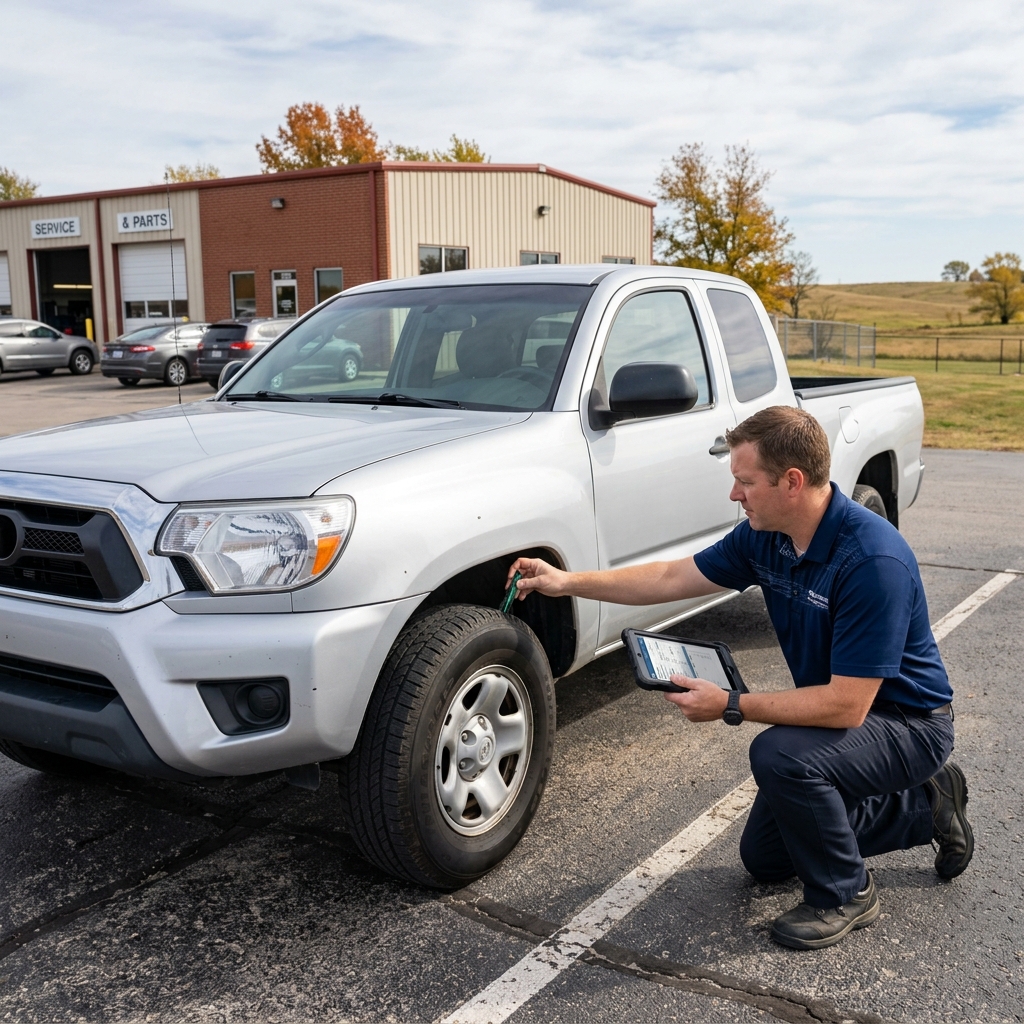
Automotive technician checking tire tread depth on a silver pickup truck using a gauge and digital tablet. (Representative image for illustration purposes only. Actual vehicle may vary based on trim and configuration.)
When you decide to upgrade your ride, one fundamental question determines your purchasing power: How does overall condition affect a car's trade-in value? At Valor Ford, we believe in complete transparency throughout the valuation process. The simple truth is that overall vehicle condition directly dictates wholesale appraisal pricing because it establishes the precise reconditioning expenses required to make a car safe, reliable, and ready for retail sale.
Every trade-in appraisal evaluates three critical pillars: mechanical health, cosmetic appearance, and certified vehicle history. When these three elements align, your vehicle lands in top valuation tiers, maximizing the trade equity you can apply directly toward a new vehicle purchase or lease.
Understanding how appraisers analyze wear and tear empowers you to make smart pre-appraisal decisions. Whether you drive a rugged truck suited for Kansas terrain or an efficient commuter sedan, taking intentional steps to present your vehicle in its best light directly protects your bottom line.

How Dealerships Define Car Condition: From Excellent to Rough Tiers

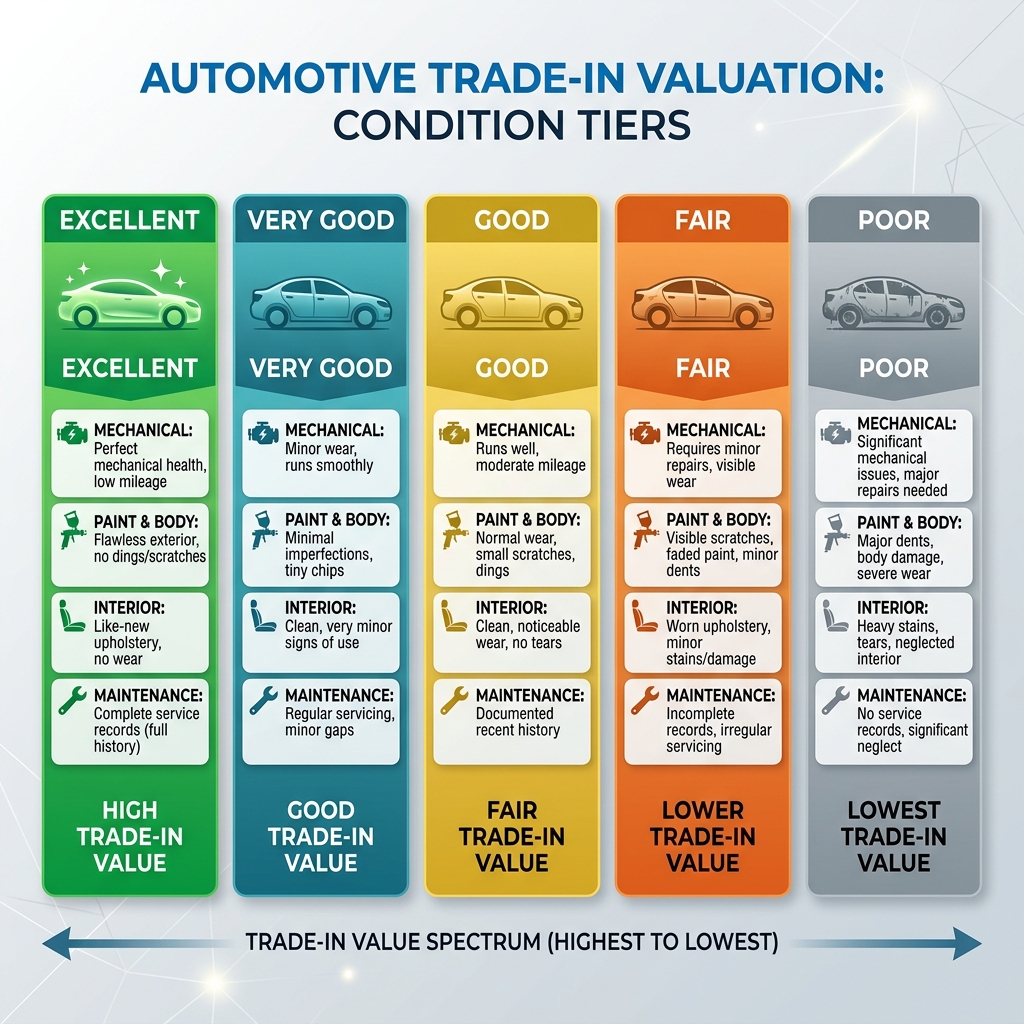
Industry-standard valuation guides establish five core condition categories: Excellent, Very Good, Good, Fair, and Poor (or Rough). Many vehicle owners assume their pampered vehicle automatically qualifies as 'Excellent,' but professional appraisals follow stringent criteria.
In reality, fewer than 5% of trade-ins meet true 'Excellent' condition standards. An Excellent vehicle looks and drives virtually as if it just rolled off the factory floor, featuring flawless paint, pristine interior upholstery, zero mechanical defects, full matching tire tread depth, and complete documented maintenance records.
The vast majority of well-maintained pre-owned vehicles fall into the Very Good or Good tiers. Understanding where your vehicle stands helps set realistic expectations before visiting our appraisal center in Junction City.
Infographic detailing five automotive trade-in condition tiers: Excellent, Very Good, Good, Fair, and Poor. (Representative image for illustration purposes only. Actual vehicle may vary based on trim and configuration.)

Condition Tier

Percentage of Trade-Ins

Mechanical & Physical Standards

Typical Reconditioning Needed

Excellent

< 5%

Like-new condition, zero blemishes, matching premium tires, pristine cabin.

Minor detailing only.

Very Good

25% - 30%

Minor cosmetic defects, exceptional mechanical health, clear title & history.

Standard oil change, wiper blades, light interior detail.

Good

40% - 50%

Normal wear for age/mileage, minor dings or scratches, sound mechanicals.

New brake pads, fresh tires, paint touch-ups, deep cleaning.

Fair

15% - 20%

Visible body damage, worn tires, needed mechanical repairs, interior wear.

Significant mechanical reconditioning, body panel repairs.

Poor / Rough

< 5%

Severe mechanical problems, frame/structural damage, major body rust.

Major overhaul or wholesale auction disposition.

Mechanical Function vs. Cosmetic Wear: What Matters Most to Appraisers?

When professional appraisers inspect a vehicle, they weigh mechanical integrity far more heavily than superficial visual blemishes. While a minor door ding or stone chip on the bumper is inexpensive to address during standard detailing, mechanical issues require skilled labor and costly OEM parts.
Mechanical Safety Issues: An active illuminated Check Engine Light, slipping transmission, worn suspension components, leaking head gaskets, or grinding brake rotors trigger substantial appraisal deductions. Dealerships must fix all safety and performance defects prior to offering a vehicle for retail resale, and those reconditioning costs directly reduce the initial trade-in offer.
Cosmetic Blemishes: Minor surface scratches, small parking lot dings, slight seat bolster wear, or light carpet scuffs are considered expected wear for age and mileage. Appraisers factor in basic cosmetic refurbishment as routine operational expenses.
However, severe cosmetic neglect—such as torn leather seats, heavy interior smoke odor, cracked dashboards, or deep body dents spanning multiple panels—can push a vehicle down from 'Good' to 'Fair' condition, costing owners thousands in lost equity.

How Does Vehicle Mileage Affect Trade-In Value Alongside Condition?

The Mileage Benchmark

Industry standards calculate average vehicle usage at 12,000 to 15,000 miles per year. Vehicles significantly above this threshold face depreciation adjustments, while lower-mileage vehicles command premium valuations.

Condition Trumps Odometer

A high-mileage vehicle with flawless maintenance, fresh fluids, clean tires, and spotless interior can easily out-value a low-mileage car suffering from deferred maintenance, oil leaks, and body rust.

Component Wear Expectations

Appraisers evaluate mileage alongside key maintenance milestones (e.g., timing belt replacement, transmission service, spark plugs). Proving these services protects high-mileage appraisal values.
Driver's perspective of a sports car digital dashboard and steering wheel looking out onto a rural landscape. (Representative image for illustration purposes only. Actual vehicle may vary based on trim and configuration.)

What Is the Difference Between Wholesale Trade-In Value and Retail Value?

Car owners often research online retail listing prices for similar models and feel surprised when a dealership's trade-in offer is lower. Understanding the structural gap between Wholesale Trade-In Value and Retail Listing Price removes frustration and sets clear expectations.
Wholesale Trade-In Value is the immediate cash purchase price a dealership pays to acquire your vehicle as-is. The dealership assumes full financial risk, holding costs, interest expense, and the labor costs required to recondition the car to safety standards.
Retail List Price reflects the final sticker price after comprehensive multi-point safety inspections, mechanical repairs, new tires/brakes if required, deep professional detailing, warranty coverage, and retail marketing expenses.
At Valor Ford, we transparently break down your vehicle's appraisal report so you see exact reconditioning allowances. You can also explore our Browse Used Inventory page to see how pre-owned vehicles are certified and prepared for sale.

Should You Repair Damages Before Trading In or Sell As-Is?

High ROI Quick Fixes

Low-cost cosmetic tasks yield strong returns: repairing minor windshield chips, restoring foggy headlight lenses, replacing burnt tail bulbs, and thorough interior cabin detailing return far more value than they cost.

High-Cost Body Repairs

Paying retail rates for major body shop repairs or full panel paint work rarely yields a positive return. Dealerships perform body and paint reconditioning at wholesale internal costs far cheaper than retail customer rates.

Routine Service Updates

Addressing minor maintenance needs—such as topping off fluids or clear wiper blade replacements—shows careful stewardship. Need assistance? Schedule Ford Service Today with our certified mechanics.
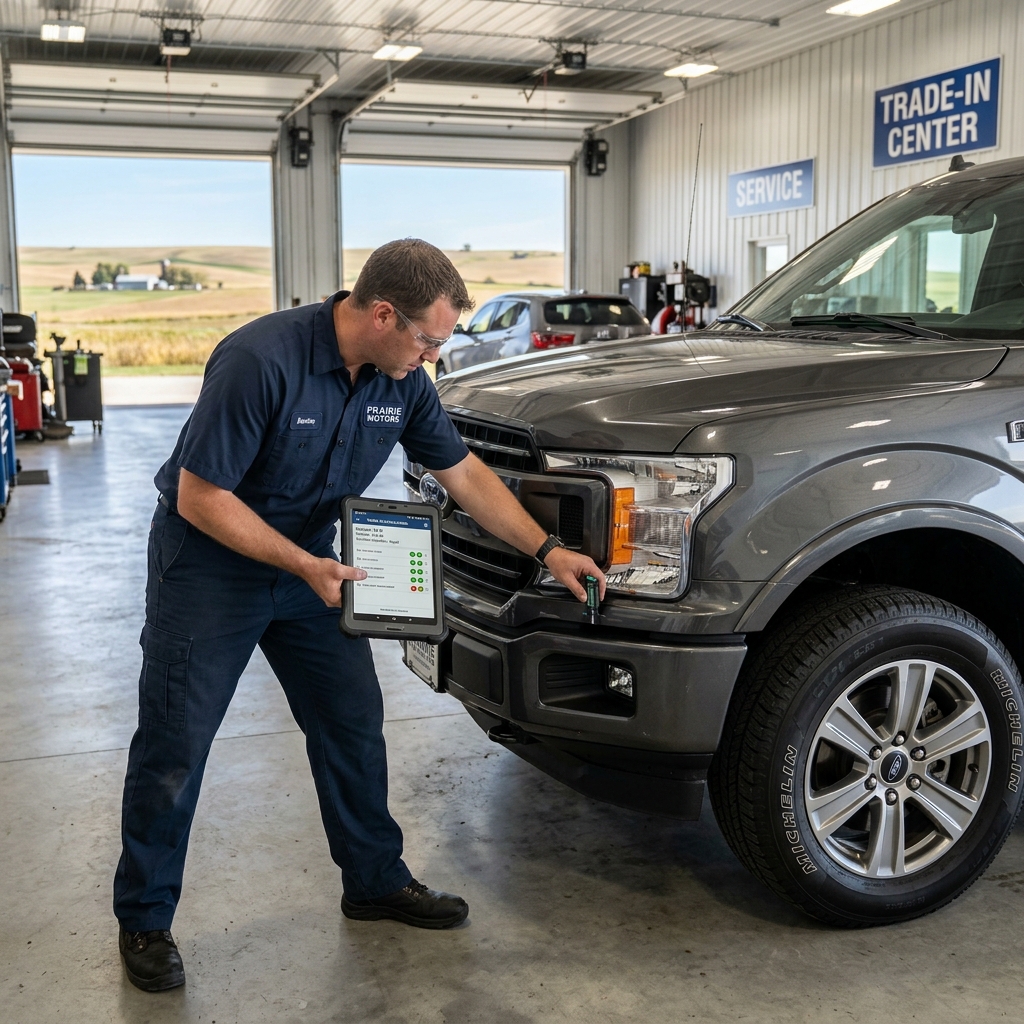
A mechanic holding a tablet inspects the front bumper of a dark grey pickup truck inside a service garage. (Representative image for illustration purposes only. Actual vehicle may vary based on trim and configuration.)

Is It Better to Trade In a Vehicle or Sell It Privately?

Private Sale Realities

Selling a vehicle privately might fetch a slightly higher gross price on paper, but it comes with substantial time investment and personal safety risks. Private sellers must manage online listings, screen tire-kickers, host test drives with strangers, handle payment verification risks (cashier check fraud), and navigate state title transfers independently.
For busy military personnel at nearby Fort Riley and local families across Dickinson County, spending weeks coordinating meetings and test drives simply isn't practical.

The Valor Ford Advantage

Trading in at Valor Ford streamlines everything into a single, effortless appointment. We handle your remaining loan payoff, manage all Kansas DMV title paperwork, and apply your trade equity directly toward your purchase.
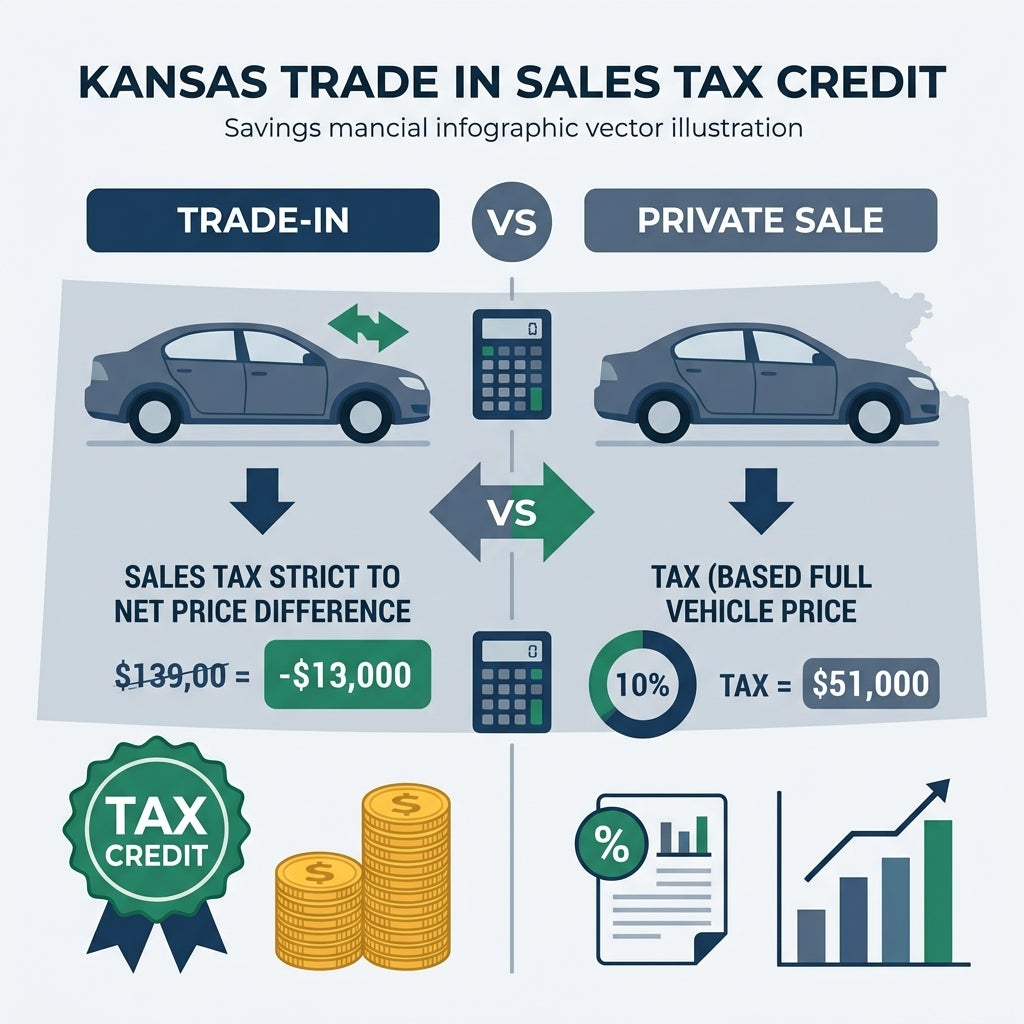
When you factor in the Kansas trade-in sales tax credit, trading in may offer a strong net financial result with added convenience.

How Does the Trade-In Sales Tax Credit Work in Kansas?

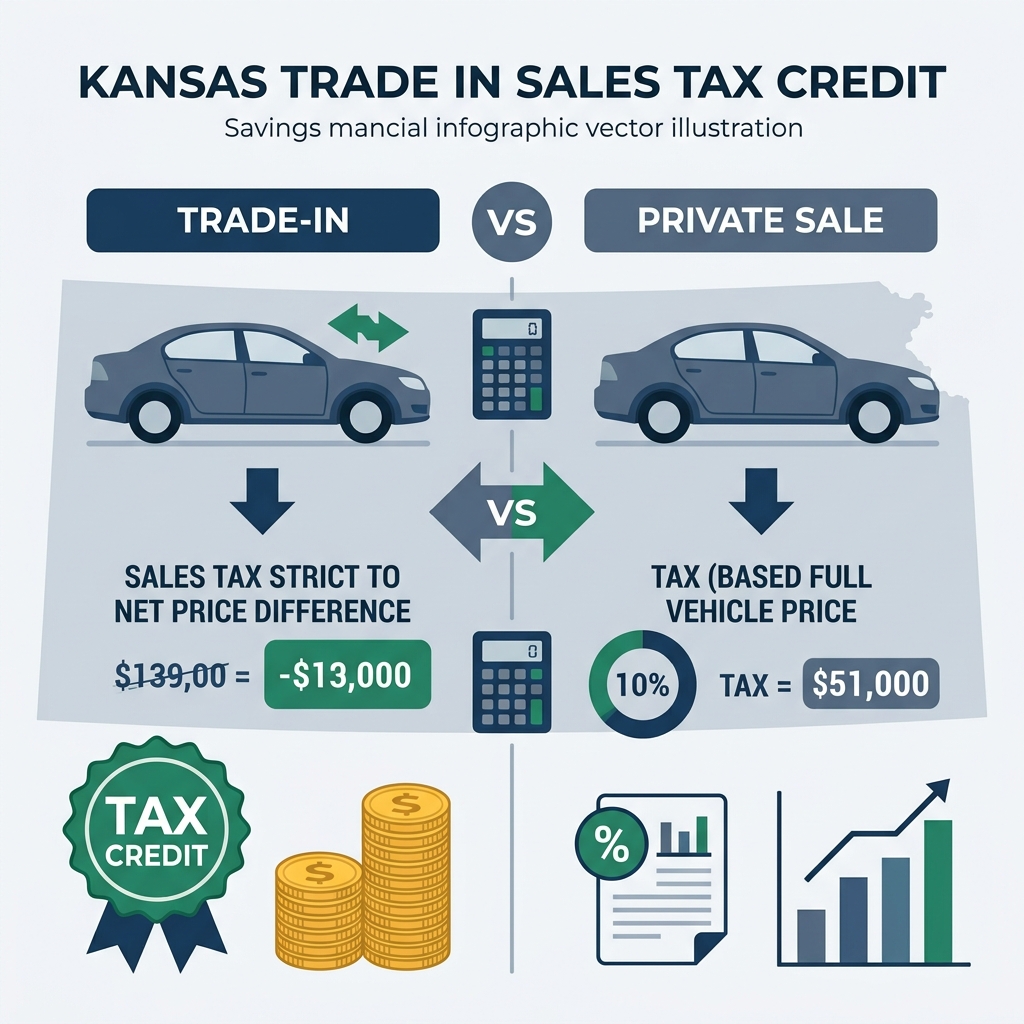
Infographic comparing trade-in sales tax credit versus private sale tax calculations in Kansas. (Representative image for illustration purposes only. Actual vehicle may vary based on trim and configuration.)
One of the largest financial benefits of trading in your car at a dealership in Junction City, KS is the Kansas Trade-In Sales Tax Credit. Under Kansas tax law, when you trade in a vehicle toward the purchase of another, state and local sales tax is assessed ONLY on the net price difference—not the full purchase price of the new vehicle.
Real-World Example: Suppose you purchase a new vehicle and your trade-in is appraised at a certain amount. Instead of paying local Kansas sales tax on the full purchase price, you pay tax only on the difference, which may reduce your total tax burden depending on the transaction and local tax rate.
When selling privately, you do not receive this state tax offset unless you complete complex tax paperwork within tight state deadlines. Trading in at Valor Ford locks in these savings automatically on your sales agreement.

How Service Records and Maintenance Logs Protect Your Vehicle's Worth

If condition is king in car appraisal, documentation is its crown. Detailed maintenance logs provide undeniable proof that a vehicle has received consistent, quality care throughout its operational life.
When you produce organized service receipts for synthetic oil changes, tire rotations, brake replacements, transmission fluid flushes, and scheduled factory inspections, appraisers can confidently place your car into the top condition tier.
Without maintenance records, appraisers must assume potential deferred maintenance, pricing in conservative risk buffers for unseen internal component wear.
If you need maintenance before your upcoming appraisal, Schedule Ford Service Today with our certified technician team to ensure your records are up to date. You can also Order Genuine Ford Parts for quick replacement needs.

Step-by-Step Checklist for Maximizing Your Trade Value Prior to Appraisal

1. Deep Clean & Presentation

Wash the exterior, vacuum all carpets and seats, clean interior glass streak-free, remove all personal items, and clear trash from door pockets and trunk compartments.

2. Gather Key Documentation

Assemble all service records, vehicle title (or current lien payoff information), active registration cards, owner manuals, and all original factory key fobs.

3. Perform Basic Touch-Ups

Fix minor windshield chips, top off essential fluids, replace dead key fob batteries, and clear any warning lights triggered by minor sensors.
A woman sitting at a wooden table sorting through car documents, a Toyota RAV4 manual, and car keys. (Representative image for illustration purposes only. Actual vehicle may vary based on trim and configuration.)

Regional Factors Affecting Trade Appraisals in Junction City and Dickinson County

Vehicle valuations in Central Kansas are influenced by distinct regional driving conditions and buyer preferences. Driving across Flint Hills terrain, rural agricultural routes, and unpaved gravel roads subjects undercarriages to unique environmental wear.
Appraisers look specifically for gravel dust accumulation in engine air filters, wheel arch rust from winter road salt, and underbody wear. Vehicles with clean undercarriages and active corrosion protection command premium values locally.
Local market demand in Geary and Dickinson counties heavily favors four-wheel-drive (4WD) and all-wheel-drive (AWD) trucks and SUVs. Strong regional demand for dependable utility vehicles helps hold higher resale values for trucks like the Ford F-150 and rugged SUVs.
Ready to explore model options suited for Kansas roads? You can Research Ford F-150, explore the versatile Research Ford Maverick, or review heavy-duty capability with Research Ford F-250.

Get Your Instant Trade Appraisal at Valor Ford in Junction City

Female auto service advisor writing on a clipboard next to a silver Honda SUV inside a bright service bay. (Representative image for illustration purposes only. Actual vehicle may vary based on trim and configuration.)
Ready to discover exactly what your vehicle is worth in today's active pre-owned market? Valor Ford makes the appraisal process fast, fair, and completely transparent. Use our online Trade In Evaluation tool to receive a preliminary offer in minutes, or visit our dealership in person for an instant, no-obligation inspection.
Our team is conveniently located at 1825 Goldenbelt Blvd, Junction City, KS 66441. Get Directions to Valor Ford or Call us at (785) 238-5114 to speak directly with an appraisal specialist today.
Interested in upgrading your drive? Check out popular new options like the Shop New Ford Bronco Inventory or Research Ford Explorer. You can also ask about our convenient Schedule Pickup and Delivery Service for service appointments.

Posted in:

Related Posts

What to Look for in a Used Ford EcoSport: Reliability, Pricing, and Utility

What to Look for in a Used Ford EcoSport: Reliability, Pricing, and Utility

What to Look for in a Used Ford EcoSport: Reliability, Pricing, and Utility What Is a Fair Used Ford EcoSport Price Benchmark in Junction City? A fair price benchmark for a used Ford EcoSport ranges from around $10,000 for higher-mileage early model years up to $18,000 or $19,000 for a well-maintained, lower-mileage 2021 or 2022 Titanium trim with under 40,000 miles on the odometer. Mid-tier SE and SES trims from the 2019 to 2021 model years typically sit between $13,000 and $16,000 depending on overall condition, mileage, and drivetrain configuration. Evaluating where a specific vehicle falls within this valuation band requires examining both the trim level and the underlying maintenance history. The Ford EcoSport entered the North American market for the 2018 model year and concluded its run in 2022. Because of standard subcompact crossover depreciation curves, used EcoSports offer an accessible entry point for drivers seeking an elevated seating position and crossover versatility without a large financial outlay. Lower-tier S trims with higher odometer readings sit at the bottom of the price spectrum, while late-model Titanium trims equipped with leather seating and enhanced audio systems represent the upper boundary. Shopping local pre-owned listings in Junction City reveals that mileage and condition remain the primary drivers of price variance. When evaluating a listing, cross-referencing vehicle history reports is essential to ensure the asking price reflects the car's true condition. Pre-owned buyers should verify service records, accident histories, and regional driving backgrounds before committing. If you are comparing pre-owned listings in the area or looking to inspect a model in person, our team at our showroom on Goldenbelt Blvd can walk you through available vehicle history reports, or you can give our sales department a direct call to ask about current arrivals. Table of Contents How Does Ford Intelligent AWD Handle Kansas Winters and Local Roads? Which Engines, Fuel Economy, and Trims Work Best for Local Commuters? Does the Used Ford EcoSport Offer Apple CarPlay and SYNC 3 Tech? What Are the Most Common Mechanical Issues and Maintenance Needs on Used EcoSports? How Does the Used EcoSport Compare to Competitors Like the Honda HR-V and Hyundai Kona? How Functional Is the EcoSport Side-Hinged Tailgate and Resale Value Over Time? How Does Ford Intelligent AWD Handle Kansas Winters and Local Roads? Ford's Intelligent AWD system continuously monitors traction conditions and transfers engine torque to the rear wheels before front-wheel slippage occurs, providing excellent stability across icy highways, rain-slicked pavement, and snow-covered country roads. By assessing wheel speed, throttle position, and steering angle every few milliseconds, the system seamlessly adjusts torque distribution between the front and rear axles to maintain forward momentum without requiring any manual lever or button engagement from the driver. Powering the all-wheel-drive configuration is the naturally aspirated 2.0L Ti-VCT four-cylinder engine, which generates 166 horsepower and 149 lb-ft of torque. Unlike front-wheel-drive EcoSport models that rely exclusively on the smaller three-cylinder engine, models equipped with the 2.0L engine paired with Intelligent AWD deliver steady power delivery when navigating unpaved routes or slushy roads. On dry pavement, the system routes power primarily to the front wheels to preserve fuel efficiency, shifting power rearward only when road conditions demand extra traction. Driving across rural agricultural corridors and unpaved prairie back roads in Dickinson County during winter freezes demands a vehicle that can handle unpredictable surfaces. The EcoSport offers 6.5 inches of ground clearance, allowing it to clear light snow accumulation and modest rutted paths with ease. For shoppers looking for even greater off-road capability or larger winter-ready crossovers, exploring our new Ford Bronco inventory provides a helpful benchmark for heavier-duty four-wheel-drive engineering. Which Engines, Fuel Economy, and Trims Work Best for Local Commuters? Used Ford EcoSport models equipped with the 1.0L EcoBoost three-cylinder engine achieve EPA ratings of 27 mpg city / 29 mpg highway, while models with the naturally aspirated 2.0L Ti-VCT four-cylinder engine and standard Intelligent AWD post 23 mpg city / 29 mpg highway and 25 mpg combined. Commuters prioritizing maximum fuel efficiency on highway stretches often lean toward the front-wheel-drive 1.0L engine, whereas drivers wanting extra mechanical traction and higher horsepower opt for the 2.0L powertrain. The EcoSport lineup consists of four primary trim configurations: S: The entry-level base trim featuring essential power amenities, a 4.2-inch display screen, cloth seating, and 16-inch sparkled silver painted aluminum wheels. SE: The popular mid-level trim that adds an 8-inch SYNC 3 touchscreen, automatic climate control, a power moonroof, heated front seats, and reverse parking sensors. SES: The sport-oriented trim featuring the 2.0L engine with Intelligent AWD as standard equipment, a sport-tuned suspension, blind-spot monitoring, ambient interior lighting, and distinctive exterior accents. Titanium: The top-tier trim offering leather-trimmed seating, a premium Bang & Olufsen 10-speaker sound system, heated steering wheel, navigation, and chrome exterior detailing. For most daily commuters, the SE trim represents the optimal balance between price and everyday comfort features. Selecting the 2.0L engine on the SE trim or moving up to the SES or Titanium trims grants all-weather confidence alongside essential cabin tech. Buyers planning their vehicle purchase can prequalify online for financing to help plan your purchase before visiting the dealership. Does the Used Ford EcoSport Offer Apple CarPlay and SYNC 3 Tech? Yes, Apple CarPlay and Android Auto integration comes standard on used Ford EcoSport SE, SES, and Titanium trims fitted with the 8-inch SYNC 3 capacitive touchscreen, whereas the base S trim uses a smaller 4.2-inch non-touch display without smartphone mirroring. The SYNC 3 system allows drivers to seamlessly connect their smartphones via USB, displaying navigation apps, messaging interfaces, and music streaming services directly on the center dashboard screen. The SYNC 3 interface is widely appreciated for its clean layout, fast response times, and intuitive menu structures. Drivers can use pinch-to-zoom gestures on navigation maps or command functions using natural voice control buttons located on the steering wheel. Dual fast-charging USB ports positioned beneath the climate controls ensure mobile devices stay powered during longer road trips, while built-in Bluetooth wireless connectivity allows quick hands-free calling. In addition to smartphone connectivity, higher EcoSport trims offer upgraded audio and driver-assist technologies. The Titanium trim includes a 10-speaker B&O sound system tuned specifically for the crossover's cabin layout. Driver-assist features such as Blind Spot Information System with Cross-Traffic Alert are available on SE models and standard on SES and Titanium trims. To explore pre-owned models equipped with these features, buyers can review our pre-owned vehicle inventory, or visit our parts department to order genuine Ford parts and accessories like all-weather floor liners to protect the interior. What Are the Most Common Mechanical Issues and Maintenance Needs on Used EcoSports? The primary mechanical concern on used Ford EcoSports involves the wet oil pump drive belt on the 1.0L EcoBoost three-cylinder engine, which can experience material degradation and clog the engine oil pickup screen over time, whereas the 2.0L Ti-VCT four-cylinder engine paired with the six-speed SelectShift automatic transmission demonstrates significantly greater long-term durability. The wet belt system on early 1.0L engines runs submerged in engine oil, making strict adherence to oil change intervals and oil specification standards critical to preventing premature belt wear. In our service bays, our technicians frequently inspect oil pressure history and timing belt health on pre-owned three-cylinder models, helping buyers select well-maintained vehicles or steer toward the four-cylinder powertrain for long-term peace of mind. Other minor issues reported on used EcoSports include occasional infotainment screen freezing, which can usually be resolved through software updates, and routine wear on front brake pads due to urban stop-and-go driving. When properly maintained with high-quality synthetic oil and routine filter replacements every 5,000 to 7,500 miles, an EcoSport powertrain can reliably achieve 150,000 to 200,000 miles of service life. Checking transmission fluid condition and ensuring cooling system services are performed according to factory maintenance schedules further protects vehicle longevity. Owners seeking professional inspection or maintenance services can easily schedule a Ford service appointment with our certified technician team. How Does the Used EcoSport Compare to Competitors Like the Honda HR-V and Hyundai Kona? The used Ford EcoSport provides a higher command seating position, a tighter turning radius of 35 feet, and standard Intelligent AWD on later model years compared to subcompact rivals like the Honda HR-V with 141 hp and Hyundai Kona with 147 hp, while offering an impressive 2,000 pounds maximum towing capacity when equipped with the 2.0L engine. These traits make the EcoSport particularly easy to maneuver through tight parking lots and narrow alleys. Compared to class rivals, key distinctions include: Command Seating and Visibility: The EcoSport positions the driver higher off the road than the Hyundai Kona, offering an upright SUV-like view of traffic rather than a hatchback-like posture. Towing Capability: While most subcompact crossovers are restricted to 1,000 or 1,500 pounds of towing, the 2.0L EcoSport handles up to 2,000 pounds, making it capable of pulling a small utility trailer or light watercraft. Maneuverability: With an overall length of just 161 inches, the EcoSport is shorter than both the Honda HR-V and Hyundai Kona, simplifying parallel parking and tight garage storage. Interior Passenger Space: The Honda HR-V offers slightly more rear legroom and overall passenger volume, making it better suited for tall adult rear passengers, though the EcoSport provides competitive front headroom and driver legroom. Drivers comparing subcompact crossovers find that while competitors emphasize car-like handling, the EcoSport focuses on traditional SUV upright seating, compact exterior dimensions, and robust light-towing versatility. How Functional Is the EcoSport Side-Hinged Tailgate and Resale Value Over Time? The Ford EcoSport utilizes a unique side-hinged rear tailgate that swings open horizontally to reveal up to 20 cubic feet of cargo space behind the second row and 50 cubic feet with the 60/40-split rear seats folded, while its overall resale value reflects standard subcompact crossover depreciation of roughly 45% to 50% over five years, making used listings highly accessible. The side-swing tailgate opens from right to left using a latch release handle integrated inside the driver-side taillight housing. This side-hinged design provides distinct real-world advantages and considerations: Low-Clearance Overhead Utility: Unlike traditional liftgates that swing upward and can strike low garage doors, parking structure pipes, or ceiling racks, the EcoSport's door swings horizontally without height restrictions. Easy Loading Access: Short drivers or individuals who struggle to reach elevated overhead liftgates can easily open and close the rear door without straining. Parallel Parking Awareness: Because the door swings outward to the left, drivers must leave roughly three to four feet of clearance behind the bumper when parallel parking on tight streets to open the door fully. From a value perspective, the EcoSport's standard depreciation curve works in favor of pre-owned buyers. Because the vehicle has already completed its initial steep depreciation drop during its first three years, used buyers acquire a feature-packed crossover with available Intelligent AWD, SYNC 3 technology, and comfortable seating at a fraction of its original window sticker price. If you are considering trading in your current vehicle toward a pre-owned EcoSport, you can value your trade-in online to see what your vehicle is worth. To test drive a model or discuss financing options in person, stop by our dealership address or contact our sales staff directly to assist with your search. © 2026 Valor Ford. All rights reserved.

What I Tell Buyers About 2026 Ford Ranger XLT Resale Value and Tax Credits

What I Tell Buyers About 2026 Ford Ranger XLT Resale Value and Tax Credits

What I Tell Buyers About 2026 Ford Ranger XLT Resale Value and Tax Credits What Current Dealer Pricing Helps Estimate a 2026 Ford Ranger XLT Depreciation Basis? Starting MSRP for the 2026 Ford Ranger XLT sits at $36,075 for rear-wheel drive and $39,575 for four-wheel drive, along with a $1,895 destination charge. However, calculating your true depreciation basis requires starting from the actual negotiated purchase price rather than the sticker price on the window. Current pricing and incentives can vary, so contact the dealership for details, giving owners a lower financial baseline and protecting future equity when trading in down the road. As Finance Manager at Valor Ford, I routinely walk buyers through how their initial pricing structure shapes long-term ownership costs. When estimating depreciation on a 2026 Ford Ranger XLT, starting with sticker price alone distorts the math. If you purchase an XLT 4x4 with an MSRP of $39,575 but confirm current pricing with the dealership, your five-year cost of ownership drops significantly because you never financed or absorbed that initial gap. Understanding this distinction helps midsize truck buyers avoid paying unnecessary finance charges on money they do not need to spend. If you want to review pricing structures on current inventory or review current payment options, give our team a quick call or drop by our Junction City location to compare invoice structures side by side. Table of Contents What Is the Expected Resale Value of a 2026 Ford Ranger XLT After Five Years? How Does the 2026 Ranger XLT Resale Value Compare to the Toyota Tacoma TRD Sport? What Transmission and Powertrain Options Come Paired with the 2026 Ford Ranger XLT? Does the 2026 Ford Ranger XLT Qualify for Federal EV Tax Credits? What Features Are Included in the Ford Ranger Advanced Towing Package? How Does High Mileage Impact Trade-In Value on a Ford Ranger XLT? What Is the Expected Resale Value of a 2026 Ford Ranger XLT After Five Years? The 2026 Ford Ranger XLT is projected to retain approximately 55% to 60% of its original purchase price after five years of typical driving. According to resale evaluation data from Kelley Blue Book, the Ranger SuperCrew holds an above-average residual value for the midsize pickup segment, outperforming key rivals like the Chevrolet Colorado while maintaining strong trade-in values. In my experience financing trucks in Kansas, residual strength comes down to cab configuration, drivetrain, and desirable option packages. The Ranger XLT trim hits a sweet spot for resale because it combines essential modern technology—like the 12-inch touchscreen center display and SYNC 4A —with midsize truck capability without creeping into luxury-trim pricing territory. Across the model lineup, pricing spans from the base XL SuperCrew 5' Box at $33,550 up to the high-performance Raptor 4x4 SuperCrew 5' Box at $57,270, with the mid-tier XLT providing the ideal balance of equipment and equity retention. Buyers considering trade-in projections across our lineup frequently compare midsize truck residuals against midsize SUVs. While models like the Ford Explorer retain solid market demand, midsize four-wheel-drive trucks generally command stronger secondary market prices due to persistent utility demand. If you want to explore other durable options, you can check our Ford Explorer research guides or browse our new Ford Bronco inventory for additional off-road choices. Pricing Pricing by trim Trim Base MSRP Destination charge Lariat 4x4 SuperCrew 5' Box $47,455 $1,895 Lariat SuperCrew 5' Box $43,955 $1,895 Raptor 4x4 SuperCrew 5' Box $57,270 $1,895 XL 4x4 SuperCrew 5' Box $37,050 $1,895 XL SuperCrew 5' Box $33,550 $1,895 XLT 4x4 SuperCrew 5' Box $39,575 $1,895 XLT SuperCrew 5' Box $36,075 $1,895 Fuel Economy Fuel economy and range by trim Trim MPG Lariat 4x4 SuperCrew 5' Box 19 city / 24 hwy / 21 combined Lariat SuperCrew 5' Box 21 city / 25 hwy / 23 combined Raptor 4x4 SuperCrew 5' Box 16 city / 18 hwy / 17 combined XL 4x4 SuperCrew 5' Box 19 city / 24 hwy / 21 combined XL SuperCrew 5' Box 21 city / 25 hwy / 23 combined XLT 4x4 SuperCrew 5' Box 19 city / 24 hwy / 21 combined XLT SuperCrew 5' Box 21 city / 25 hwy / 23 combined How Does the 2026 Ranger XLT Resale Value Compare to the Toyota Tacoma TRD Sport? The Toyota Tacoma TRD Sport retains a slightly higher percentage of its value over five years, holding near 65% compared to the 2026 Ford Ranger XLT projected 55% to 60% retention. However, the Ranger XLT balances this gap with a lower initial acquisition price, standard 270 hp and 310 lb-ft of torque from its 2.3L EcoBoost engine, and superior maximum available payload capacity. When customers ask me in the finance office how these two midsize trucks stack up on paper, I explain that resale percentage is only half the financial equation. The Tacoma often commands a higher upfront market premium, whereas the Ranger XLT 4x4 delivers higher standard torque ( 310 lb-ft) and standard SelectShift 10-speed automatic transmission performance that makes daily driving and towing more efficient. The agricultural dirt roads throughout Dickinson County put real stress on truck chassis, and the Ranger's fully boxed steel frame helps maintain structural integrity that secondhand buyers look for years down the road. For buyers interested in value retention across pre-owned options, you can explore our pre-owned vehicle inventory to see how past model years perform in the secondary market. Engine & Performance Powertrain specs by trim Feature Lariat 4x4 SuperCrew 5' Box Lariat SuperCrew 5' Box Raptor 4x4 SuperCrew 5' Box XL 4x4 SuperCrew 5' Box XL SuperCrew 5' Box XLT 4x4 SuperCrew 5' Box Engine 2.3L 2.3L 3L 2.3L 2.3L 2.3L Horsepower 270 hp 270 hp 405 hp 270 hp 270 hp 270 hp Torque 310 lb-ft 310 lb-ft 430 lb-ft 310 lb-ft 310 lb-ft 310 lb-ft Transmission SelectShift® SelectShift® SelectShift® SelectShift® SelectShift® SelectShift® Drivetrain Four-wheel drive Rear-wheel drive Four-wheel drive Four-wheel drive Rear-wheel drive Four-wheel drive Engine & Performance (continued) Feature XLT SuperCrew 5' Box Engine 2.3L Horsepower 270 hp Torque 310 lb-ft Transmission SelectShift® Drivetrain Rear-wheel drive What Transmission and Powertrain Options Come Paired with the 2026 Ford Ranger XLT? Every 2026 Ford Ranger XLT comes equipped standard with a 10-speed SelectShift automatic transmission paired with a 2.3L EcoBoost four-cylinder engine producing 270 hp and 310 lb-ft of torque. Buyers can select between rear-wheel drive and four-wheel drive configurations, or upgrade to an available 2.7L EcoBoost V6 engine generating 315 hp and 400 lb-ft of torque. The 10-speed SelectShift automatic transmission is a major driver of both performance and longevity in the midsize truck segment. By keeping the turbocharged engine in its optimal power band, it delivers responsive acceleration while maintaining EPA fuel economy ratings of 19 mpg city / 24 hwy. This transmission setup also features progressive range select and tow/haul modes to prevent hunting between gears when towing heavy loads. If you are evaluating powertrain needs for towing or heavy hauling, you can learn more by viewing our Ford F-150 capability overview to see how full-size and midsize powertrains compare. Does the 2026 Ford Ranger XLT Qualify for Federal EV Tax Credits? No, the 2026 Ford Ranger XLT does not qualify for federal clean vehicle tax credits because it is a gasoline-powered pickup truck. Furthermore, federal IRC §30D, §25E, and §45W clean vehicle tax credits were officially terminated on September 30, 2025 under Public Law 119-21, meaning no newly acquired gasoline or electric vehicle purchased today qualifies for these federal tax incentives. I frequently clear up confusion around vehicle tax credits for buyers in our office. Because the 2026 Ford Ranger XLT relies on a conventional internal combustion powertrain, it was never eligible for clean vehicle tax credits under prior regulations. While federal EV tax credits ended on September 30, 2025, buyers purchasing a truck for business or commercial use may still explore federal Section 179 depreciation deductions with their qualified tax preparer. To structure your purchase payments effectively without relying on expired tax subsidies, you can start by choosing to prequalify for online financing before visiting our dealership. What Features Are Included in the Ford Ranger Advanced Towing Package? The Ford Ranger Advanced Towing Package (often combined with the Class IV Trailer Tow Package) includes a Class IV trailer hitch receiver, 4-pin and 7-pin wiring harnesses, Pro Trailer Backup Assist, an integrated trailer brake controller, and BLIS with Trailer Coverage. These features unlock the 2026 Ford Ranger XLT maximum towing capacity of 7,500 lbs. From a trade-in standpoint, factory-installed towing equipment is one of the highest-return options you can add to a midsize truck. Secondhand buyers specifically search for factory brake controllers and trailer backing assistance because adding aftermarket setups later is costly and complex. If your trailering demands exceed midsize limits, you can review our Ford F-250 heavy-duty truck specs to see what full-size Super Duty capability offers. How Does High Mileage Impact Trade-In Value on a Ford Ranger XLT? Accumulating mileage above the national average of 12,000 to 15,000 miles per year reduces a 2026 Ford Ranger XLT trade-in value by approximately 5% to 8% annually for every extra 10,000 miles. However, maintaining documented service records, protecting the bed and interior, and equipping desirable options like the FX4 Off-Road Package significantly offset high-mileage trade-in deductions. When appraising trucks that come back to our lot, mileage is just one variable in the valuation formula. A well-maintained Ranger XLT with 75,000 miles and full service history often fetches a higher trade-in offer than a neglected truck with 45,000 miles. Keeping up with routine care ensures the 2.3L EcoBoost engine and 10-speed SelectShift automatic transmission stay in peak operating condition. When you are ready to evaluate your current vehicle equity, you can value your trade-in online, give our finance department a quick call, or visit our Junction City showroom for a professional in-person appraisal. Keep Your Vehicle Running Strong Keep your vehicle performing at its best with our service team: Schedule Pickup and Delivery Service Schedule Ford Service Today Order Genuine Ford Parts © 2026 Valor Ford. All rights reserved. Vehicle specification data © JATO Dynamics Limited.
What I Tell Drivers About 2023 Ford Mustang Engines and Transmissions

What I Tell Drivers About 2023 Ford Mustang Engines and Transmissions

What I Tell Drivers About 2023 Ford Mustang Engines and Transmissions How Does the Tremec Manual Transmission Differ From the Standard 2023 Mustang GT Manual? The TREMEC® TR-3160 six-speed manual transmission in the 2023 Ford Mustang Mach 1 is engineered for track endurance, featuring a twin-disc clutch, external transmission oil cooler, rev-matching, and heavy-duty gears derived from the Shelby GT350. By contrast, the standard Getrag MT-82 six-speed manual transmission in the Mustang GT uses a single-disc clutch setup optimized for daily street driving, which feels lighter at the pedal but produces more heat under hard, repeated track use. In my 25 years of experience at Valor Ford, performance enthusiasts who come to us usually want to know if the upgraded gear set is worth it. When drivers take a vehicle out toward the open stretches around Fort Riley, the difference in gear engagement is immediate. The TREMEC® TR-3160 six-speed manual transmission offers shorter, positive throws with a robust mechanical feel that resists high-rpm lockout when shifting near the 7,500 rpm redline. The internal cooling circuit makes the biggest long-term reliability difference for aggressive driving. The Mustang Mach 1 routes gear oil through a dedicated air-to-liquid heat exchanger mounted behind the front fascia, keeping gear oil temperatures stable during open-track sessions or aggressive back-road runs. If you want to compare how both manual boxes feel back-to-back, you can stop by our showroom on Goldenbelt Boulevard or give our sales team (785) 238-5114 to set up a road test. Table of Contents What Engine and Transmission Options Power the 2023 Ford Mustang Lineup? Does the 2023 Ford Mustang EcoBoost Offer High-Performance Upgrades and Range? What Comes With the Mustang GT Performance Package and Active Exhaust? Does the 10-Speed Automatic in the Mustang Mach 1 Feature Custom Tuning? How Does the 2023 Ford Mustang GT Compare to the Chevrolet Camaro SS? What Engine and Transmission Options Power the 2023 Ford Mustang Lineup? The 2023 Ford Mustang lineup features two primary powerplants across its core models: a 2.3L EcoBoost turbocharged four-cylinder producing 310 hp and 350 lb-ft of torque, and a 5.0L Ti-VCT V8 generating 460 hp and 420 lb-ft of torque in the GT Coupe and GT Coupe Premium, or 480 hp and 420 lb-ft of torque in the Mustang Mach 1. Power is delivered to the rear wheels through either a six-speed manual transmission or an optional 10-speed SelectShift automatic transmission. Let's talk about how these powertrain combinations split across the body styles and trim levels. The EcoBoost Coupe, EcoBoost Premium Convertible, and GT Fastback come standard with a six-speed manual transmission that delivers classic sports car engagement. For drivers seeking maximum acceleration without shifting manually, the 10-speed SelectShift automatic transmission features wide-ratio gear changes and steering-wheel-mounted paddle shifters across all models. From my experience working with local buyers, matching the right engine to your commute pattern is essential. Drivers who want aggressive muscle car sound along I-70 usually lean toward the 5.0L Ti-VCT V8, while commuters looking for lower operating costs often start by exploring pre-owned vehicle inventory or checking our Ford Mustang research overview. If you need a completely different style of utility alongside your sports car, our team can also walk you through our new Ford Bronco inventory. Engine & Performance Powertrain specs by trim Feature EcoBoost Convertible EcoBoost Coupe EcoBoost Coupe Premium EcoBoost Premium Convertible:--:--:--:--:-- Engine 2.3L 2.3L 2.3L 2.3L Horsepower 310 hp 310 hp 310 hp 310 hp Torque 350 lb-ft 350 lb-ft 350 lb-ft 350 lb-ft Transmission manual 6-speed manual 6-speed manual 6-speed manual 6-speed Drivetrain Rear-wheel drive Rear-wheel drive Rear-wheel drive Rear-wheel drive Engine & Performance (continued) Feature GT Convertible Premium GT Coupe GT Coupe Premium Mach 1:--:--:--:--:-- Engine 5L 5L 5L 5L Horsepower 460 hp 460 hp 460 hp 480 hp Torque 420 lb-ft 420 lb-ft 420 lb-ft 420 lb-ft Transmission manual 6-speed manual 6-speed manual 6-speed TREMEC® Drivetrain Rear-wheel drive Rear-wheel drive Rear-wheel drive Rear-wheel drive Does the 2023 Ford Mustang EcoBoost Offer High-Performance Upgrades and Range? The 2023 Ford Mustang EcoBoost delivers up to an EPA-estimated 20 mpg city / 27 mpg highway and a total highway driving range of roughly 434 miles on its 16.0-gallon fuel tank when equipped with the 10-speed SelectShift automatic transmission. Drivers seeking extra track capability can equip the 2.3L High Performance Package, which increases output to 330 hp and adds active exhaust, larger front brakes, and GT-derived suspension tuning. Now, when it comes to forced-induction performance, the 2.3L High Performance Package swaps in a larger twin-scroll turbocharger compressor housing and a cast-aluminum radiator. This package broadens the torque curve across the mid-range, giving drivers stronger pull when accelerating out of turns. It also includes a strut-tower brace, a thicker rear sway bar, and a Torsen limited-slip differential with a 3.55 axle ratio. This combination works exceptionally well for daily driving around Junction City, offering sharp throttle response alongside manageable fuel bills. To keep these turbocharged engines running at peak output, our service department regularly handles oil changes, spark plug replacements, and intake inspections. You can easily schedule a service appointment online, or evaluate your trade-in online if you are considering upgrading your current car. Fuel Economy Fuel economy and range by trim Feature EcoBoost Convertible EcoBoost Coupe EcoBoost Coupe Premium EcoBoost Premium Convertible:--:--:--:--:-- MPG 20 city / 27 hwy / 23 combined 21 city / 29 hwy / 24 combined 21 city / 29 hwy / 24 combined 20 city / 27 hwy / 23 combined Fuel Economy (continued) Feature GT Convertible Premium GT Coupe GT Coupe Premium Mach 1:--:--:--:--:-- MPG 15 city / 23 hwy / 18 combined 15 city / 24 hwy / 18 combined 15 city / 24 hwy / 18 combined 14 city / 22 hwy / 17 combined What Comes With the Mustang GT Performance Package and Active Exhaust? The Mustang GT Performance Package upgrades the Mustang GT with Brembo six-piston front brakes, heavy-duty front springs, a Torsen limited-slip differential with a 3.73 gear ratio for manuals or 3.55 for automatics, a larger radiator, a K-brace, and strut-tower braces. When paired with the optional Active Valve Performance Exhaust, drivers get four selectable exhaust noise modes: Quiet, Normal, Sport, and Track. Here's what you need to know about how these systems function on the road. The Active Valve Performance Exhaust uses electronically controlled butterfly valves inside the tailpipes to alter exhaust backpressure and tone on demand. The Quiet Mode can be programmed on a timer, allowing early-morning cold starts without disturbing your neighbors before opening up the full V8 rumble on highway entrance ramps. For suspension tuning, the package can be optioned with the MagneRide Damping System, which uses magnetorheological fluid inside the dampers to adjust shock firmness thousands of times per second. This system keeps the chassis flat under heavy braking and cornering without creating a harsh ride over pavement joints. If you are planning your purchase budget, you can get pre-approved for financing on our website to see how package options fit into your payment goals. Does the 10-Speed Automatic in the Mustang Mach 1 Feature Custom Tuning? The 10-speed SelectShift automatic transmission in the 2023 Ford Mustang Mach 1 includes custom calibration, featuring specialized shift mapping, a heavy-duty torque converter, and a dedicated auxiliary transmission fluid cooler. These modifications allow the transmission to execute faster, firm gear shifts during aggressive track driving while maintaining stable fluid temperatures under heavy engine loads. Another important thing to know about the Mustang Mach 1 automatic is how the transmission control module interacts with the drive modes. In Track mode, the transmission holds gears through high-G cornering, preventing unwanted upshifts mid-bend that could upset chassis balance. Downshifts match revs automatically under braking, giving drivers precise engine braking when setting up for corner entry. The mechanical durability of this automatic transmission is supported by a second air-to-oil transmission cooler mounted behind the lower grille, providing 75 percent more cooling capacity than a standard Mustang GT. This keeps the synthetic transmission fluid within optimal operating temperature windows during extended performance use. If you perform your own track preparation or fluids maintenance, our parts team can help you order genuine Ford parts direct from the factory. How Does the 2023 Ford Mustang GT Compare to the Chevrolet Camaro SS? The 2023 Ford Mustang GT features a 5.0L Ti-VCT V8 producing 460 hp and 420 lb-ft of torque with a starting base MSRP of $38,345 (plus a $1,395 destination charge), compared to the Chevrolet Camaro SS's 6.2L V8 generating 455 hp and 455 lb-ft of torque. While the Camaro SS offers slightly more low-end torque, the Mustang GT features higher engine rev limits, superior outboard driver visibility, and a larger about 13.5 cubic feet cargo trunk. One thing I always tell customers comparing these two pony cars is to look closely at interior ergonomics and trim pricing. The Mustang GT Coupe Premium starts at a base MSRP of $43,365, while the open-top GT Convertible Premium starts at $48,865. For buyers entering the lineup, the EcoBoost Coupe begins at $27,770 base MSRP, the EcoBoost Coupe Premium starts at $32,795, the EcoBoost Convertible starts at $33,270, and the EcoBoost Premium Convertible sits at $38,295. The top-tier Mustang Mach 1 comes in at $55,570 base MSRP. 2023 Ford Mustang Trim Base MSRP EcoBoost Coupe $27,770 EcoBoost Coupe Premium $32,795 EcoBoost Convertible $33,270 GT Coupe $38,345 EcoBoost Premium Convertible $38,295 GT Coupe Premium $43,365 GT Convertible Premium $48,865 Mach 1 $55,570 When driving both vehicles back-to-back, drivers frequently point out that the Mustang GT is easier to position on narrow roads due to its lower cowl height and larger side glass. The dual-overhead-cam design of the 5.0L Ti-VCT V8 also loves to rev, delivering continuous power past 7,000 rpm. If you want to experience the power delivery of the 2023 Ford Mustang lineup for yourself, visit Valor Ford on Goldenbelt Boulevard or give our sales team a call at (785) 238-5114 today. © 2026 Valor Ford. All rights reserved. Vehicle specification data © JATO Dynamics Limited.