Blog / All-Weather Driving & 4x4 Readiness

Key Takeaways for All-Weather 4x4 Readiness and Family Road Trips

Key Takeaways for All-Weather 4x4 Readiness and Family Road Trips

Key Takeaways for All-Weather 4x4 Readiness and Family Road Trips

Preparing your family for long-distance highway travel across changing seasons requires a comprehensive approach to vehicle safety, drivetrain mechanics, tire performance, and interior versatility. Whether navigating sudden early-autumn thunderstorms along Interstate 70 or powering through unexpected winter sleet near Fort Riley, having a vehicle equipped to handle unpredictable Midwest weather transforms high-stress driving into a relaxed, confident journey. True all-weather readiness is not merely about pressing a 4WD button; it is about harmonizing intelligent power distribution, high-friction rubber compounds, cargo ergonomics, and active driver-assist safety systems.
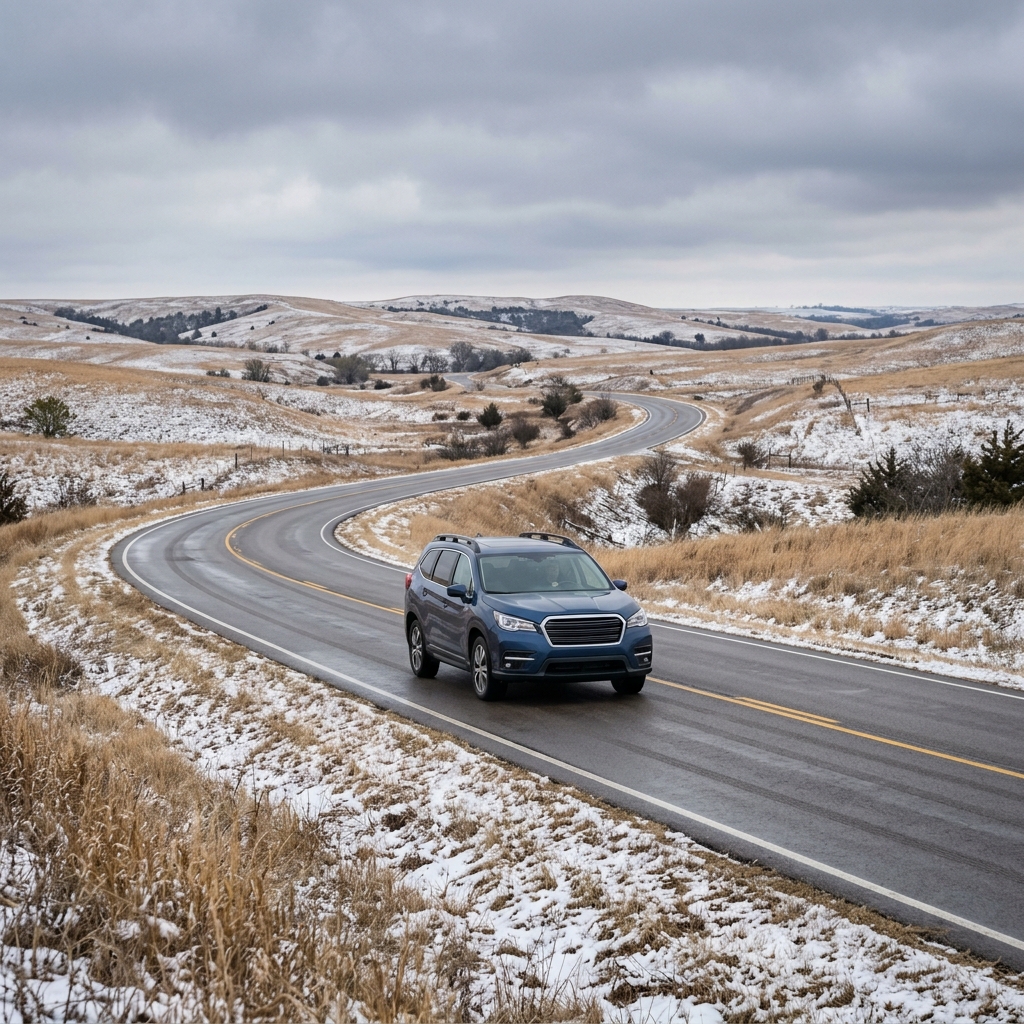
Blue SUV driving along a winding paved road through snowy rolling hills under a cloudy sky. (Representative image for illustration purposes only. Actual vehicle may vary based on trim and configuration.)
To guarantee total road trip confidence, smart family planners prioritize four core mechanical and structural pillars before setting out from Junction City:

Core Readiness Pillar

Technical & Functional Requirement

Real-World Family Road Trip Benefit

Drivetrain Matching

Intelligent AWD vs. Part-Time / Full-Time 4WD with Terrain Management

Instant traction on patchy ice, muddy gravel bypasses, or dry highway cruising.

Severe-Snow Rated Tires

Three-Peak Mountain Snowflake (3PMSF) certified rubber compounds

Up to 25% shorter stopping distances on hard-packed snow and icy bridge decks.

3rd-Row & Cargo Capacity

20+ cu. ft. behind 3rd row with under-floor storage management

Stows bulky luggage, strollers, and emergency gear without obscuring rear sightlines.

Driveline Disconnect

Automatic front-axle disconnect during steady high-speed cruising

Eliminates parasite drag to maximize long-distance interstate fuel economy.

At Valor Ford in Junction City, our dedicated team works closely with local drivers, military families stationed at Fort Riley, and cross-country road trippers to select and prepare vehicles that master every operational climate. From evaluating tread depth to matching drive modes with Flint Hills topography, taking an answer-first approach ensures your passengers remain safe, warm, and comfortable every mile of the way.

What Is the Difference Between AWD and 4WD for Winter Family Road Trips?

Understanding the mechanical distinction between All-Wheel Drive (AWD) and Four-Wheel Drive (4WD) is crucial when selecting the right vehicle for winter family road trips across Kansas and the broader Midwest. While both systems deliver power to all four wheels, they operate on vastly different mechanical principles tailored to distinct road conditions and driver inputs.
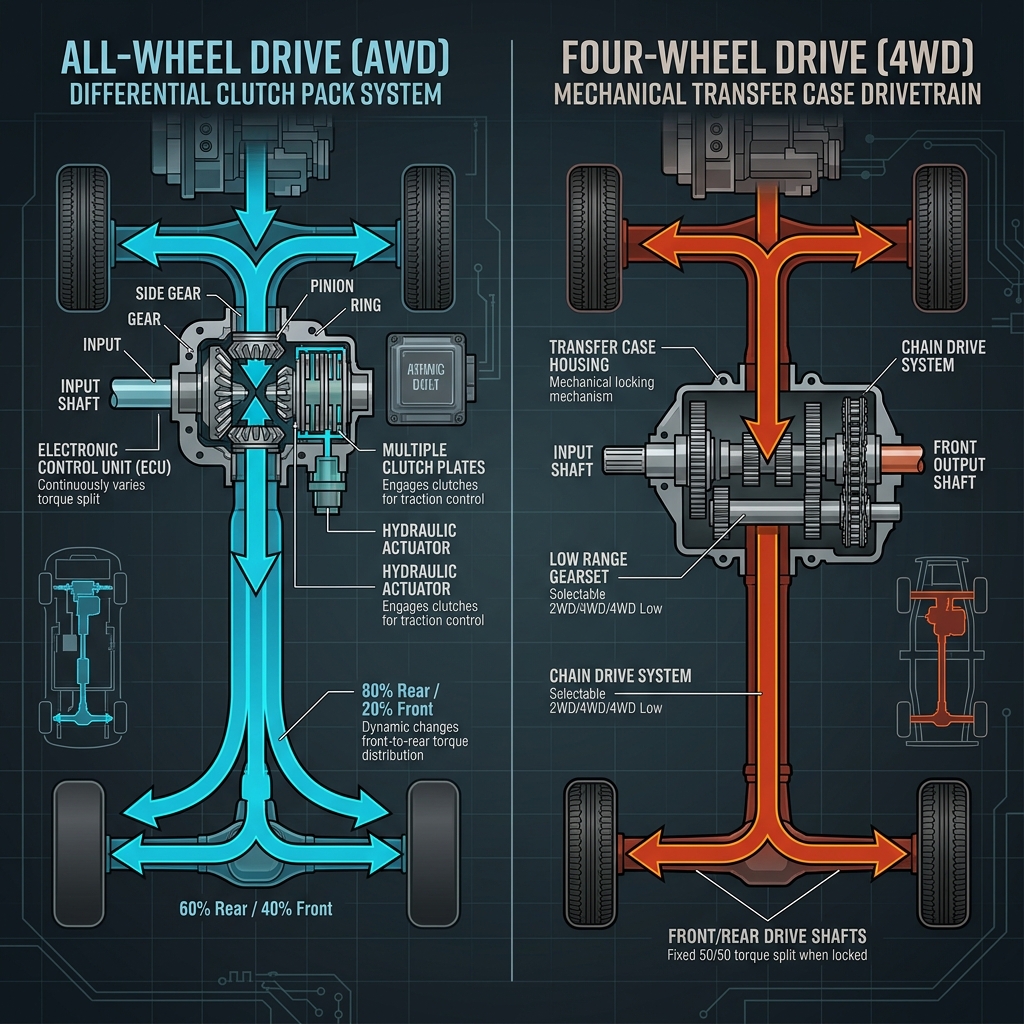
All-Wheel Drive (AWD): Automated Precision for Variable Highways Modern AWD systems utilize electronically controlled center differentials or multi-plate clutch packs monitored by advanced computer sensors. These sensors read wheel speed, steering angle, throttle position, and yaw rates hundreds of times per second. When cruising along I-70 during a patchy freeze event where clear asphalt rapidly alternates with slick black ice, AWD continuously adjusts torque front-to-back without any driver intervention. This seamless operation allows individual wheels to rotate at different speeds, maintaining smooth handling around highway curves and eliminating drivetrain binding.
Four-Wheel Drive (4WD): Heavy-Duty Locking Torque for Extreme Conditions Traditional 4WD systems lock the front and rear driveshafts together through a mechanical transfer case, forcing the front and rear axles to turn at identical speeds. Highly effective in deep unplowed snow, thick mud, or unpaved rural backroads across Geary and Dickinson counties, standard 4WD (in 4H or 4L settings) provides uncompromised low-speed traction. However, because it locks axle rotation speeds together, engaging traditional 4WD on dry or partially clear highway asphalt causes tire scrub and driveline stress. Families planning long highway journeys with variable conditions often benefit from hybrid 4WD systems—like those in modern Ford full-size platforms—that feature an Auto 4WD (4A) mode combining low-range mechanical durability with automated torque distribution.
Comparison diagram illustrating All-Wheel Drive (AWD) versus Four-Wheel Drive (4WD) mechanical drivetrain systems. (Representative image for illustration purposes only. Actual vehicle may vary based on trim and configuration.)
At a Glance: Driving Scenarios• Patchy Ice & Slippery Overpasses: AWD or 4 Auto (4A) is superior because it engages dynamically without binding on dry pavement. • Deep Snow Drifts & Unpaved Trails: 4WD High (4H) with a locked center differential provides maximum traction to cut through heavy drifts. • High-Speed Interstate Cruising: Disconnectable AWD or 2WD high-range modes deliver optimal fuel efficiency and quiet cabin acoustics.

What Features Make an SUV Best Equipped for All-Weather Family Road Trips?

When evaluating potential long-distance family transport, drivetrain capability is only one piece of the safety puzzle. A truly road-trip-ready SUV integrates active environmental controls, multi-terrain traction technologies, and driver support systems into a single cohesive cabin experience.

1. Multi-Terrain Drive Modes & Traction Control

Modern selectable drive mode systems (such as Ford's Terrain Management Systemâ„¢) alter throttle response, gear shift points, traction control intervention, and brake torque vectoring. Selecting Slippery Mode smooths out accelerator sensitivity to prevent wheelspin on packed snow, while Mud/Ruts Mode allows controlled wheel slip to clean tread patterns when traversing soft rural paths. For deeper exploration off the beaten path, vehicles like those in our Shop New Ford Bronco Inventory offer specialized G.O.A.T. Modesâ„¢ that adapt mechanical locking rear differentials for demanding, unpaved terrain.

2. Tri-Zone Climate & Heated Comfort Packages

Passenger comfort directly correlates with driver focus during long sub-zero road trips. Tri-zone automatic climate control allows front passengers and rear seat occupants to maintain personalized temperature zones without constant adjustment. Enhanced cold-weather convenience packages add heated front and second-row outboard seats, a heated steering wheel, and heated wiper park zones that melt windshield ice build-up before wiper blades tear. Rapid cabin heating elements warm interior air instantly before engine coolant reaches full operating temperature.

3. Intelligent Driver-Assist Safety Suites

Navigating heavy rainfall or blustery winds demands advanced driver assistance. Comprehensive suites like Ford Co-Pilot360â„¢ include Lane-Keeping Assist, Pre-Collision Assist with Automatic Emergency Braking, and Blind Spot Information System (BLIS) with Cross-Traffic Alert and trailer coverage. Adaptive Cruise Control with Stop-and-Go automatically maintains safe follow distances on highway routes, significantly reducing driver fatigue during multi-hour family journeys across Central Kansas.

Preparing Your Family Vehicle for Year-Round Travel at Valor Ford

Whether you are planning a winter holiday trip across state lines or preparing for seasonal road conditions around Junction City and Fort Riley, ensuring your vehicle is mechanically sound is vital. At Valor Ford, our factory-certified technicians conduct comprehensive multi-point inspections checking battery cold-cranking capacity, brake pad thickness, fluid conditions, and 4x4 transfer case operation. Looking to upgrade your family fleet? Explore our versatile selection of new and pre-owned 4WD SUVs tailored for all-weather confidence.

Are Three-Peak Mountain Snowflake (3PMSF) Rated Tires Necessary for Winter Family Travel?

A common misconception among family SUV owners is that having All-Wheel Drive or Four-Wheel Drive eliminates the need for specialized tires. In reality, four-wheel drive only aids acceleration and power delivery—it does not increase friction during braking or lateral cornering on ice and hard-packed snow. That is where tire rubber chemistry and official certification standards become paramount.
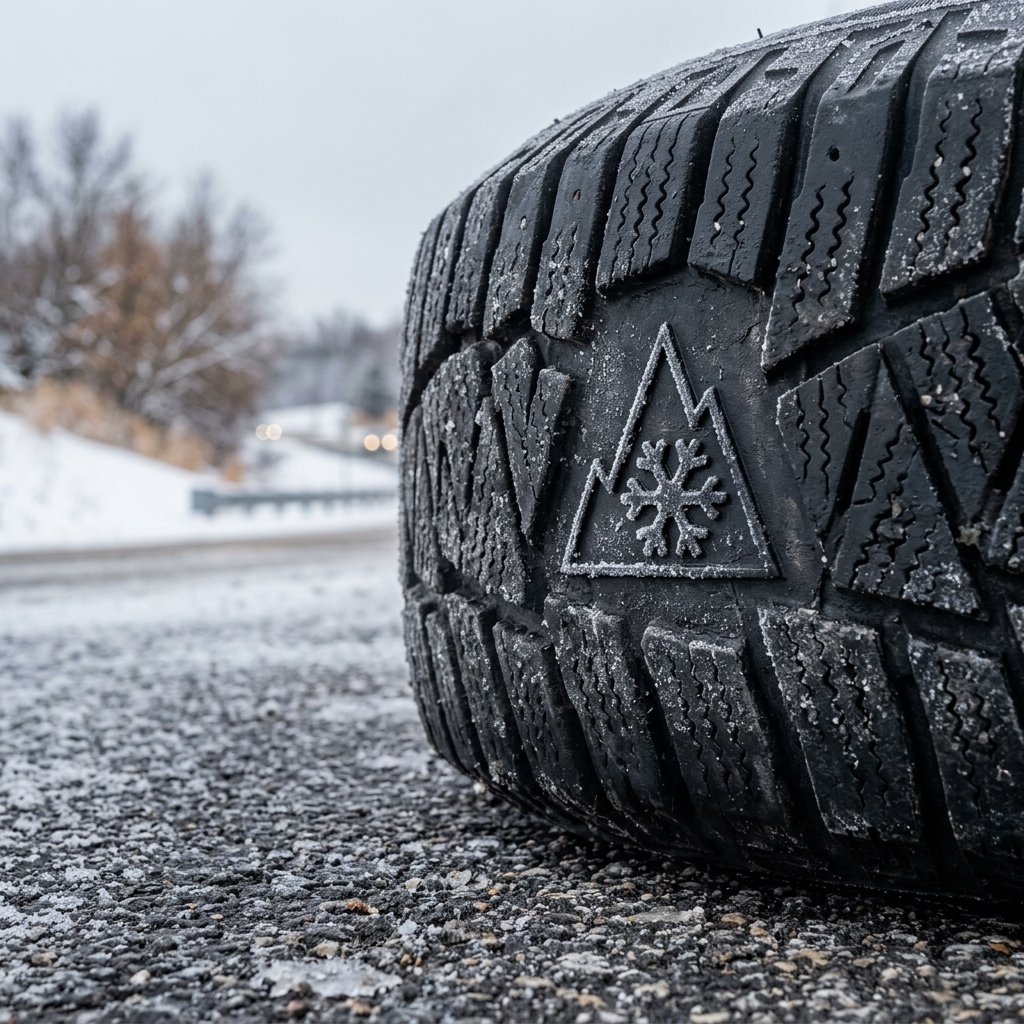
Understanding the 3PMSF Rating vs. Standard M+S Standard factory tires marked with 'M+S' (Mud and Snow) are designated based purely on physical geometry (void-to-rubber tread ratios) rather than verified cold-weather traction performance testing. In contrast, tires bearing the 3PMSF symbol (a mountain peak surrounding a snowflake) must pass standardized ASTM ice and packed-snow acceleration tests, proving at least 10% better traction than standard reference tires.
Silica Compounds & High-Density Siping Standard all-season rubber compounds harden when ambient temperatures drop below 45°F, turning brittle and glass-like, which drastically reduces grip. 3PMSF winter and all-weather tires feature specialized high-silica polymers that remain pliable in sub-freezing conditions. Coupled with thousands of microscopic 3D sipes (tiny slits in the tread blocks) that biting into ice, these tires dramatically decrease stopping distances.
Close-up of a black winter tire tread with a mountain snowflake symbol resting on a cold, frosty asphalt road. (Representative image for illustration purposes only. Actual vehicle may vary based on trim and configuration.)
Braking Distance Comparison at 30 MPH on Packed Snow:• Standard All-Season (M+S):~110 – 130 Feet • 3PMSF Rated All-Weather:~80 – 90 Feet • Dedicated Winter Tires:~65 – 75 Feet Saving 30 to 40 feet of stopping distance on an icy highway exit ramp is often the critical difference between a safe stop and a collision. Drivers can easily Order Genuine Ford Parts and factory-approved 3PMSF tire packages directly through our certified dealership parts desk.

Which SUV Type Offers More Cargo Room Behind the Third Row for Family Luggage?

Packing for a multi-passenger road trip requires balancing seating space with practical cargo volume. Piling duffel bags above seat headrests reduces driver visibility and poses safety hazards during sudden stops. Comparing cargo metrics across SUV classes helps families select the ideal footprint for their road trip needs.

Midsize 3-Row SUVs (e.g., Ford Explorer)

Midsize 3-row SUVs strike an outstanding balance between maneuverability, fuel efficiency, and versatile passenger room. Typically offering approximately 18 to 21 cubic feet of space behind the third row, these platforms easily fit weekend duffel bags, grocery hauls, or smaller strollers. With power-folding 50/50 third-row seats, capacity quickly expands when traveling with 4 or 5 passengers. Explore details via our Research Ford Explorer hub to see layout specs.

Full-Size Standard SUVs (e.g., Ford Expedition)

Full-size body-on-frame SUVs provide substantial upgrades in shoulder room, legroom, and rear storage depth. Standard wheelbase full-size SUVs deliver approximately 20 to 22.5 cubic feet behind the third row, featuring deeper cargo wells and wider floor dimensions. Integrated under-floor management bins hide emergency kits, tire inflators, and laptops out of sight, leaving the primary flat floor clear for upright rolling suitcases and coolers.

Extended Wheelbase SUVs (e.g., Expedition MAX)

For large families or extended cross-country road trips with 7 or 8 passengers, extended wheelbase models (like the Expedition MAX) are the gold standard. By extending body length by nearly a foot, these models expand cargo space behind the third row to a massive 36+ cubic feet. Full-size luggage sets, double strollers, and outdoor gear fit comfortably without sacrificing third-row legroom or roof box mounting limits.

How Do Modern Disconnectable AWD Systems Help Save Fuel on Highways?

Historically, choosing a 4WD or AWD vehicle meant accepting a permanent fuel economy penalty. Legacy systems continuously rotated front driveshafts, front differentials, and axle shafts even when driving in clear, dry summer weather. This rotational mass created significant mechanical drag—known as parasitic loss—that burned extra fuel across long highway stretches.
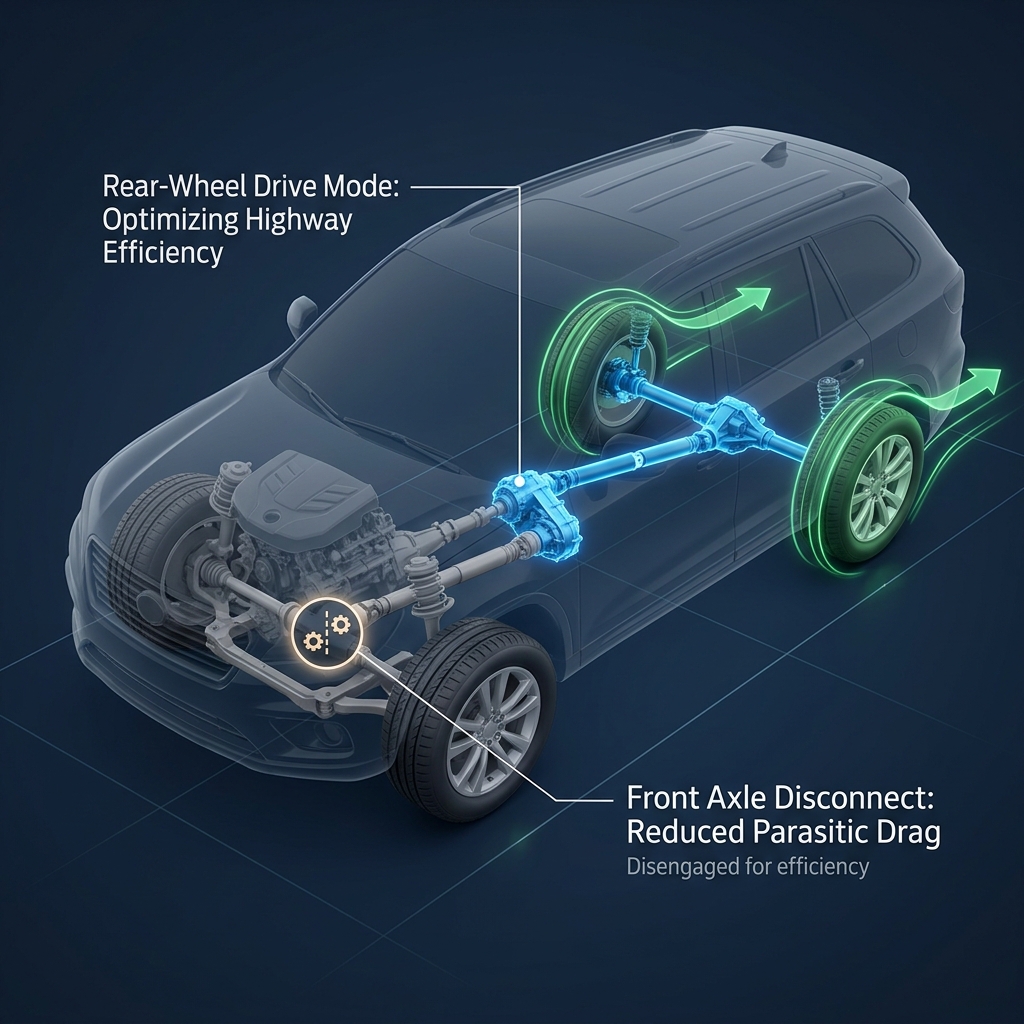
Mechanics of Driveline Disconnect Technology Modern intelligent AWD platforms utilize automated front or rear driveline disconnect systems. When an SUV is cruising at steady speeds along smooth highways like I-70 under favorable weather conditions, an electronic dog-clutch or actuator completely disengages the secondary axle and driveshaft at the transfer case.
By stopping the rotation of non-essential driveline components, the engine operates as a efficient two-wheel-drive platform, reducing drag and boosting fuel economy by 1 to 3 miles per gallon. Over a 2,000-mile family road trip, these savings add up substantially at the pump.
3D diagram of an SUV drivetrain highlighting rear-wheel drive mode and a disengaged front axle for fuel efficiency. (Representative image for illustration purposes only. Actual vehicle may vary based on trim and configuration.)
Milliseconds Re-Engagement Speed: The true brilliance of disconnectable AWD lies in its speed. Sophisticated sensors continually monitor road conditions, ambient temperature, windshield wiper status, and wheel slip. If the vehicle encounters sudden hydroplaning, loose gravel, or icy patches, the system mechanically re-engages four-wheel drive in in 10 to 20 milliseconds—faster than a human blink. Drivers enjoy maximum highway fuel economy with zero compromise in instant all-weather safety.

Get a Trade Appraisal and Upgrade to an All-Weather Ready SUV

Upgrading your current vehicle to a high-capability 4x4 or AWD SUV is straightforward at Valor Ford. Our digital tools allow you to receive a fast, transparent trade appraisal from the comfort of your home. We proudly serve active-duty military personnel stationed at Fort Riley and local family drivers throughout Geary County, offering current finance and lease options available to fit your needs.

Are Full-Time 4WD Vehicles Good for Long Highway Family Road Trips?

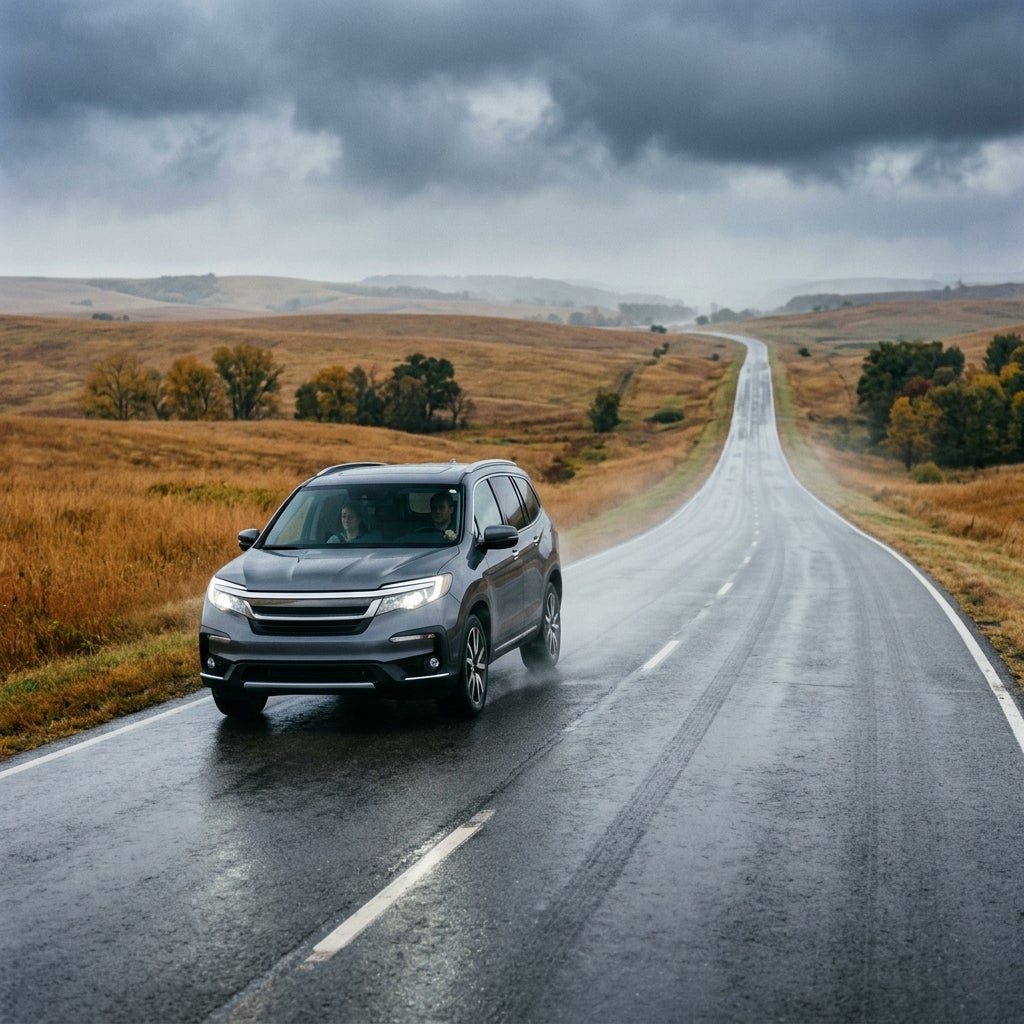
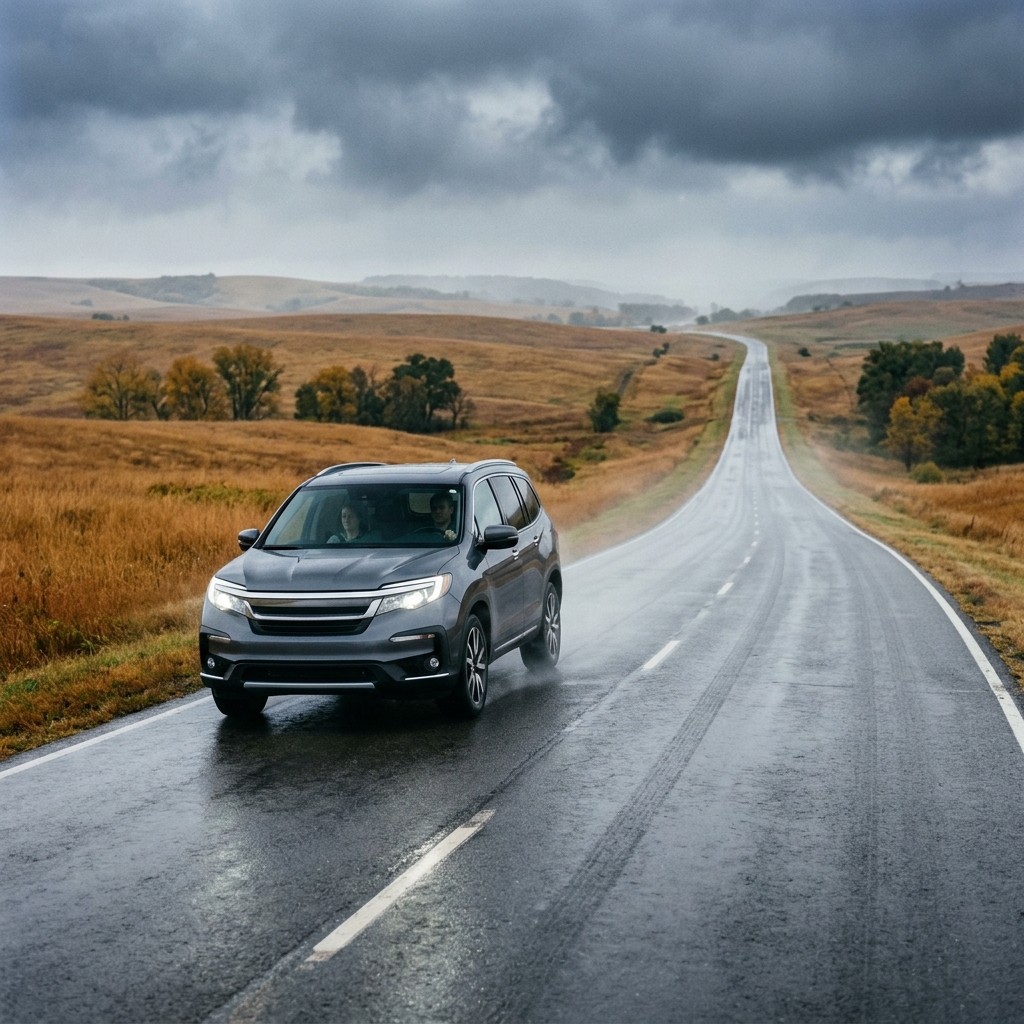
Dark grey SUV driving along a wet asphalt road through golden rolling hills under a stormy, overcast sky. (Representative image for illustration purposes only. Actual vehicle may vary based on trim and configuration.)
High-Speed Stability vs. Traditional Part-Time Systems Full-time 4WD platforms incorporate a center differential that allows the front and rear axles to turn at different speeds during high-speed cornering, making them completely safe for dry asphalt as well as wet or icy roads. This provides incredible high-speed tracking and crosswind resistance on open interstate routes.
Evaluating full-time 4WD platforms—such as full-size Expedition models or heavy-duty off-roaders like the Toyota 4Runner—requires examining ride comfort, cabin noise levels, and long-distance passenger dynamics.
Key Considerations for Family Comfort: 1. Suspension Tuning: Modern full-size SUVs utilizing independent rear suspensions (IRS) absorb pavement expansion joints far better than solid rear axle platforms, eliminating rear-seat 'hop' over rough highways. 2. Acoustic Insulation: Active noise cancellation, acoustic-laminated windshields, and isolated subframes keep cabin sound levels whisper-quiet during 70 MPH cruises. 3. Center Differential Lockability: Advanced full-time systems allow drivers to lock the center differential manually when off-roading, giving you the best of both worlds: highway refinement and extreme trail traction.
For families considering versatile midsize or full-size options, exploring vehicle specs like those in our Research Ford Explorer guide reveals how modern unibody and body-on-frame architectures deliver luxury-car comfort alongside authentic multi-terrain capability.

Navigating Flint Hills Terrain and Central Kansas Weather in Every Season

Central Kansas weather is famously dynamic, capable of shifting from clear prairie sunshine to severe crosswinds, torrential downpours, or sudden flash freezes in a matter of hours. Local drivers navigating Highway 77, I-70, or rural unpaved roads across Dickinson and Geary counties benefit from specific driving strategies tailored to regional geography.

Prairie Crosswinds on Interstate 70

The open topography of the Flint Hills region exposes drivers to strong 35+ MPH lateral gusts, especially when passing large commercial semi-trucks. Modern SUVs equipped with Sidewind Stabilization automatically apply light braking to wheels on the windward side, helping drivers keep their lane position centered without constant, tiring steering corrections.

Flash Freeze Events & Bridge Decks

Autumn rainstorms followed by sudden cold fronts quickly freeze standing water into invisible black ice on elevated overpasses along Highway 77. Utilizing intelligent AWD or Auto 4WD modes ensures immediate torque transfer to wheels with grip, preventing rear-end instability when traversing elevated structures.

Unpaved Gravel & Mud Commutes

Navigating agricultural bypasses or rural residential routes around Junction City involves loose gravel and deep mud after heavy rainfall. Engaging selectable 4x4 or Slippery/Grass/Gravel drive modes recalibrates ABS anti-lock braking algorithms to prevent wheel locking on loose aggregate surfaces.

Essential Pre-Trip All-Weather Inspection and Emergency Gear Checklist

Before loading up the family for a long road trip, completing a thorough pre-flight vehicle check prevents unexpected delays. Cold weather places extra strain on electrical batteries, rubber belts, windshield washer systems, and tire inflation pressures.
5-Point Vehicle Inspection Checklist: 1. Tread Depth Test: Ensure tire tread depth measures at least 5/32" (use a depth gauge or coin test). Winter traction drops significantly below 4/32". 2. Battery CCA Test: Cold temperatures reduce battery power output by up to 50%. Have your battery tested for Cold Cranking Amps (CCA). 3. Sub-Zero Washer Fluid: Flush summer bug wash with de-icing washer fluid rated to -20°F to prevent reservoir freezing. 4. Wiper Blade Flexibility: Replace streaking wiper blades with heavy-duty beam blades that resist snow clogging. 5. 4WD Transfer Case Fluid: Verify fluid levels in transfer cases and differentials, especially on vehicles with high towing mileage. Schedule Ford Service Today if overdue.
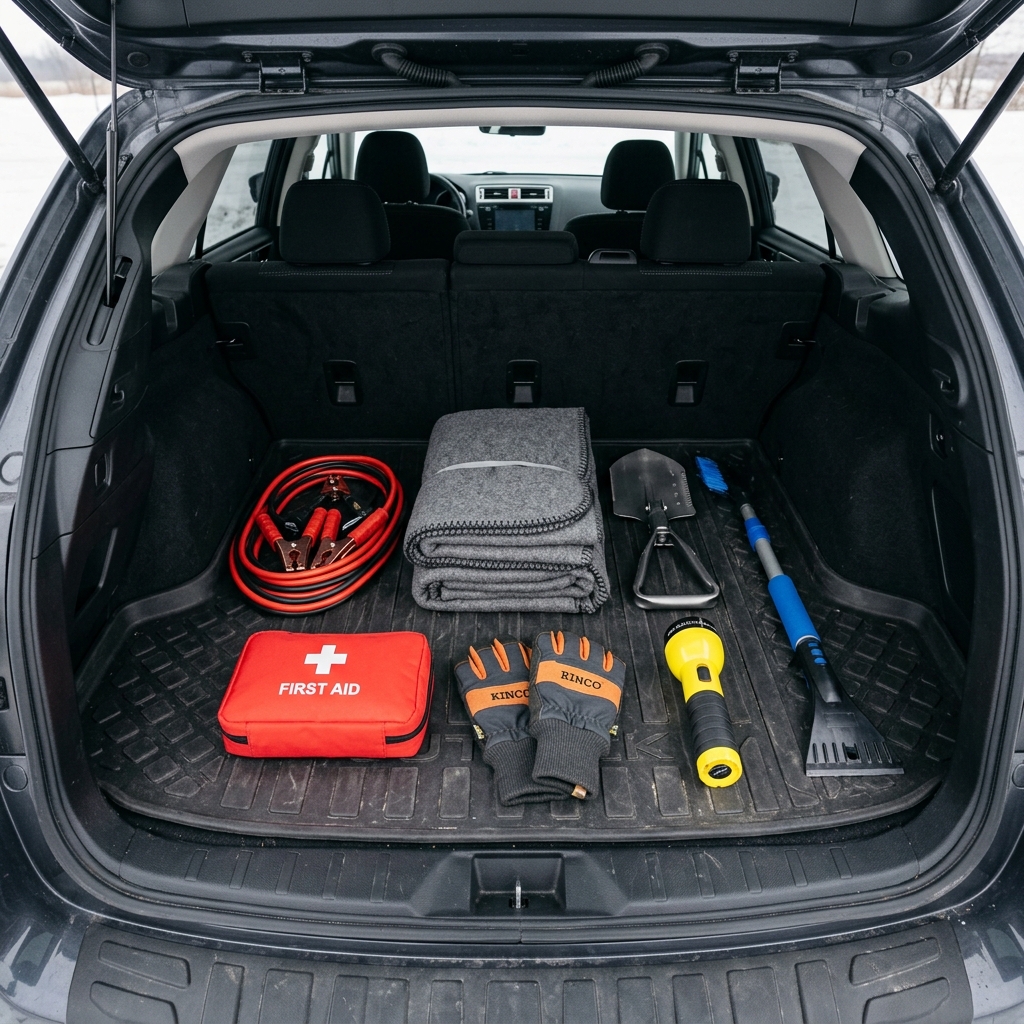
Open SUV trunk neatly packed with winter emergency supplies like jumper cables, a first aid kit, blanket, and ice scraper. (Representative image for illustration purposes only. Actual vehicle may vary based on trim and configuration.)
Must-Have Road Trip Emergency Gear Kit:• Heavy-duty jumper cables or portable lithium jump-starter pack • Folding snow shovel and traction recovery boards • Heavy-duty ice scraper with brass blade • Thermal wool blankets, gloves, and hand warmers • High-lumen LED flashlight with spare batteries • Non-perishable energy snacks and bottled water • First aid kit and portable phone power bank Busy schedule? You can easily Schedule Pickup and Delivery Service to have our team inspect your vehicle at your home or office before departure.

Plan Your Next Family Road Trip with Valor Ford in Junction City

At Valor Ford, we are proud to be your trusted partner for all automotive needs in Central Kansas. Whether you need expert advice on all-weather tire options, want to test drive an advanced AWD or 4x4 SUV, or need a quick pre-trip maintenance check, our experienced team is here to assist you every step of the way.
Visit us at our showroom located at 1825 Goldenbelt Blvd, Junction City, KS 66441. Click here to Get Directions to Valor Ford or give us a ring at Call us at (785) 238-5114 to speak directly with a sales advisor or service specialist today.

Posted in:

Related Posts

Bottom Line: How Cold Winter Temperatures Thicken Transfer Case Fluid and Impact 4WD Performance

Bottom Line: How Cold Winter Temperatures Thicken Transfer Case Fluid and Impact 4WD Performance

Bottom Line: How Cold Winter Temperatures Thicken Transfer Case Fluid and Impact 4WD Performance When sub-zero Kansas winter winds sweep across Junction City, Fort Riley, and Dickinson County, vehicle owner focus usually turns to battery life, tire tread, and antifreeze strength. However, one critical drivetrain component is frequently overlooked until severe weather strikes: your vehicle's 4WD transfer case fluid. As temperatures plunge below freezing, transfer case lubricant undergoes dramatic physical changes that directly impair four-wheel-drive engagement, front axle lockup, and internal mechanical reliability. Quick Takeaway from Valor Ford Service Director Mike Hogg: "When transfer case fluid gets cold, its viscosity rises exponentially. Instead of flowing freely to lubricate precision bearings, planetary gears, and electronic clutch packs, thickened fluid acts like cold molasses. This internal drag delays 4WD shift actuators, causes harsh gear clunks upon engagement, and starves vital components during initial cold starts. Servicing your fluid before severe winter weather hits is the single best insurance policy against a multi-thousand-dollar transfer case breakdown." Drivers operating heavy-duty trucks like those looking to Research Ford F-250 capabilities or light-duty daily drivers should prioritize cold-weather fluid health. Meet Mike Hogg: 20 Years of Drivetrain and 4WD Expertise in Junction City & Fort Riley With over two decades of dedicated automotive service leadership in Central Kansas, Mike Hogg serves as the Service Director at Valor Ford in Junction City, KS. Having spent twenty winter seasons diagnosing complex four-wheel-drive issues, Mike has seen firsthand how extreme Midwestern freeze-thaw cycles impact modern driveline systems. From daily military commuters navigating snow-covered routes around Fort Riley to agricultural operators traveling rutted rural gravel roads in Dickinson County, Mike's technical insights have saved hundreds of local drivers from catastrophic winter mechanical failures. He leads a team of factory-certified Ford technicians who specialize in precision drivetrain diagnostics, shift-on-the-fly transfer case overhauls, and winter preventative maintenance schedules. Q: How Do Sub-Zero Winter Temperatures Change Transfer Case Fluid Viscosity? Interviewer: Mike, let's dive into the physics of winter driving. What actually happens to transfer case fluid when temperatures drop below freezing here in Kansas? Mike Hogg: Viscosity is a fluid's resistance to flow. When fluid is warm, it flows effortlessly, coating every gear tooth, bearing, and clutch plate within milliseconds of movement. But when ambient temperatures drop to 15 degrees or below zero—as they frequently do across Junction City—conventional and aged synthetic fluids experience a dramatic rise in viscosity. In plain English, the oil thickens immensely. When you turn your dash dial to 4H on a freezing morning, an electric or vacuum shift actuator physically attempts to move shifting forks and engage sliding collars inside the transfer case. If the fluid is thick as gel, that actuator faces massive hydraulic resistance. You might experience a 5 to 10-second delay in engagement, or worse, partial engagement where gear teeth clash. Mike Hogg (continued): Furthermore, transfer cases use internal oil pumps or splash-feed channels to lubricate upper shaft bearings and planetary gear sets. Thick, cold fluid cannot travel quickly through these narrow galleries during initial vehicle operation. This temporary fluid starvation creates localized friction and metal-to-metal contact during the first few miles of driving. Over time, moisture accumulation inside old fluid compounds this issue. Water contamination freezes into microscopic ice crystals that can block internal fluid passages or damage delicate rubber seals. If you plan to Research Ford F-150 drivetrain technology, you will see how modern electronic transfer cases depend on clean, precise fluid viscosity to function seamlessly. Q: How Often Should Transfer Case Fluid Be Serviced for Rural Kansas Gravel and Snow-Covered Roads? Interviewer: Standard owner manuals often suggest long service intervals. Does rural Kansas driving alter that maintenance schedule? Mike Hogg: Standard owner manuals assume ideal highway driving under mild climate conditions. But rural Kansas driving—especially in Dickinson and Geary Counties—fits the manufacturer definition of 'Severe Duty Service.' Driving through mud, unpaved agricultural gravel roads, deep snow drifts, and towing winter trailers puts heavy continuous shear stress on transfer case fluid. Mike Hogg: We strongly recommend changing transfer case fluid every 30,000 miles for trucks and SUVs operating under these conditions. Early warning signs that your fluid is breakdown-prone include: • Audible high-pitched whining when 4WD is engaged • Stiff, delayed, or stubborn shift-on-the-fly execution • Sluggish front-axle engagement on cold starts • A burnt, acrid odor coming from undercarriage after highway cruising Addressing fluid degradation early prevents expensive internal mechanical failures. Schedule 4WD Fluid Maintenance Q: Can Mismatched Tire Tread Depths Cause Severe 4WD Transfer Case Damage? Interviewer: Many vehicle owners replace two worn tires instead of a full set of four. Can uneven tire wear actually destroy a transfer case during winter driving? Mike Hogg: Absolute agreement—mismatched tire tread depth is one of the most common secret killers of transfer cases. In a 4WD or AWD vehicle, all four tires must rotate at identical speeds when driving straight. If your front tires are brand new (say 10/32" tread depth) and your rear tires are worn down to 4/32", the rear tires have a smaller rolling circumference. To travel the exact same distance down Highway 77, the worn rear tires must spin faster than the front tires. The transfer case center differential or clutch pack detects this speed differential and assumes wheels are slipping on ice. Mike Hogg (continued): As a result, internal transfer case clutches slip constantly trying to equalize front and rear axle rotational speeds, even when traveling perfectly straight on dry asphalt. This constant friction generates intense internal thermal energy. When superheated internal temperatures meet cold winter air, rapid fluid breakdown occurs. The fluid turns black, loses friction modifiers, and breaks down viscosity polymers. Within months, internal clutch packs burn out or gear teeth bind catastrophically. Always maintain tire tread variance within 2/32" across all four positions. If you are considering upgrading your winter rig, you can Trade In Evaluation your current vehicle at Valor Ford. Q: What Is the Real Difference Between 4WD and AWD When Navigating Unpaved Winter Roads? Traditional Part-Time 4WD: • Mechanically locks front and rear driveshafts 50/50 ratio • Designed for loose traction: snow, mud, gravel, ice • Must be manually engaged via dash selector or lever • Can experience severe drivetrain binding on dry pavement • Ideal for severe Flint Hills winter conditions • Featured in heavy-duty trucks and rugged off-road SUVs like when you Shop New Ford Bronco Inventory. Full-Time Intelligent AWD: • Uses center differential or electronically managed clutch • Automatically redistributes torque between axles in milliseconds • Safe for continuous operation on mixed dry/icy roads • Requires zero driver input during sudden weather changes • Excellent for suburban driving around Fort Riley • Commonly engineered into versatile crossover models when you Research Ford Explorer. Q: Is It Safe to Switch Into 4 High While Driving on Ice at Highway Speeds? Interviewer: When drivers hit patchy ice on I-70 or K-18 at 55 mph, is it safe to shift into 4H on the fly? Mike Hogg: While modern vehicles feature electronic shift-on-the-fly transfer cases that permit engagement at speed, doing so while traveling 55+ mph on black ice carries major mechanical and safety risks. First, from a physical standpoint: shift-on-the-fly systems require an internal synchronizer or clutch pack to instantly accelerate the front driveshaft from zero rpm up to matching rear driveshaft speed. If transfer case fluid is thick and frigid, that mechanical synchronization encounters immense friction. Engaging at high speeds can cause gear shock, front axle binding, or shift actuator failure. Mike Hogg (continued): Second, from a vehicle control standpoint: if you engage 4H while tires are spinning across slick ice, the sudden torque transfer to the front wheels can break loose vehicle stability, triggering a skid. Mike's Winter Speed Rule: Ease your foot off the accelerator, reduce vehicle speed below 45 mph, ensure wheels are traveling straight, and then switch into 4 High. Once engaged, maintain smooth pedal inputs. Remember: 4WD helps you accelerate on snow and ice, but it does NOT help you stop any faster! If you're looking for pre-owned winter vehicles, Browse Used Inventory equipped with advanced driver-assist systems. Q: What Is Included in a Complete Pre-Winter 4WD Inspection and Fluid Service at Valor Ford? 1. Fluid Drain & Refill Complete removal of contaminated transfer case fluid. Thorough magnetic drain plug inspection for metal shavings. Refill with high-performance synthetic fluid matched to exact OEM viscosity specs. 2. Actuator & Seal Test Inspection of front axle vacuum disconnects, electronic shift solenoids, transfer case shaft seals, and breathers. Verification of tire circumference uniformity across all positions. You can also Order Genuine Ford Parts directly from our parts catalog. Book Pre-Winter 4WD Service Q: Is Pre-Winter 4WD Maintenance Worth the Cost Compared to Major Transfer Case Repairs? Interviewer: Drivers often weigh routine service costs against potential future repairs. How does the math break down for 4WD maintenance? Mike Hogg: It is a massive financial contrast. A preventative transfer case fluid service costs a small fraction of a mechanical replacement. Compare that to the real-world costs of neglecting your drivetrain: • Transfer Case Replacement: $2,800 to $4,500+ for parts and labor • Emergency Winter Towing: $250 to $500 during severe blizzard conditions • Vehicle Downtime: 3 to 7 days awaiting major component assembly delivery Mike Hogg (continued): Beyond financial figures, think about personal safety. Getting stuck on an isolated gravel road in Dickinson County during a sub-zero Kansas blizzard with a seized transfer case is dangerous for you and your family. Routine fluid inspection ensures your 4WD engages instantly when you need traction most. For added convenience, busy vehicle owners can Schedule Pickup and Delivery Service so your vehicle is serviced without interrupting your daily routine. Drivers considering financing upgrades can also contact the dealership for current financing information online. Q: What Winter-Specific Signs Indicate Your Transfer Case Needs Immediate Service? Interviewer: What physical symptoms should drivers watch out for as cold weather sets in? Mike Hogg: Be alert to these five red flags: 1. Grinding or Metallic Clunking: Hearing harsh noise when switching from 2H to 4H indicates thick fluid or worn shift forks. 2. Flashing 4WD Indicator Light: A flashing light signals that the transfer case encoder motor attempted to shift but failed due to mechanical resistance. 3. Oil Droplets in Fresh Snow: Dark fluid spots under your vehicle's midsection stand out brightly on white snow, signaling seal failure. 4. Burning Fluid Odor: Smelling pungent oil after driving at highway speeds indicates thermal degradation. 5. Drivetrain Binding in Turns: Feeling intense crow-hop or vehicle jerking while making low-speed turns on slick surfaces. Pre-Winter 4WD & Transfer Case Maintenance Checklist for Rural Kansas Drivers 1. Check Fluid Level & Clarity Verify transfer case lubricant level. Clean fluid should be clear red or amber; dark or cloudy fluid indicates immediate service is required. 2. Measure Tire Tread Depth Ensure all four tires are within 2/32" tread depth variation to prevent continuous transfer case clutch pack friction. 3. Test 4WD Engagement Engage 4H and 4L on a loose dirt or gravel surface before winter storms hit to verify actuator function. Schedule Ford Service Today Schedule Your Winter 4WD Inspection & Fluid Service at Valor Ford in Junction City, KS If winter temperatures have already set in, your transfer case fluid may need attention. Protect your truck or SUV's four-wheel-drive performance with expert maintenance from Mike Hogg and the certified team at Valor Ford. Located conveniently in Junction City, we serve drivers from Fort Riley, Manhattan, Abilene, and across Dickinson County. Visit us at 1825 Goldenbelt Blvd, Junction City, KS 66441 or Get Directions to Valor Ford. Have questions? Call us at (785) 238-5114 to speak directly with our service advisors. Schedule Your Service Appointment Now

2024 Ford Edge vs 2026 Nissan Murano Comparison

2024 Ford Edge vs 2026 Nissan Murano Comparison

The 2024 Ford Edge compares favorably in this comparison by offering substantially more performance, interior cargo volume, and overall value than the 2026 Nissan Murano. With a starting MSRP of $38,465 for the SE AWD, standard All-wheel drive, up to 335 hp, and about 39 cu ft of cargo space, the Ford Edge delivers superior practical capability and driving dynamics at a price point that undercuts the Murano Platinum AWD by over $11,000. Which SUV Offers the Best Value for Junction City Drivers: 2024 Ford Edge or 2026 Nissan Murano? The 2024 Ford Edge delivers vastly superior value, starting at $38,465 MSRP for the SE AWD, which undercuts the 2026 Nissan Murano Platinum AWD at $49,800 MSRP by $11,335 while offering standard all-wheel drive, higher horsepower, and greater cargo capacity. A detailed look at the pricing breakdown reveals how much further your budget goes with the Ford Edge lineup: 2024 Ford Edge SE AWD: $38,465 base MSRP 2024 Ford Edge SEL AWD: $39,665 base MSRP 2024 Ford Edge ST AWD: $47,205 base MSRP 2026 Nissan Murano Platinum AWD: $49,800 base MSRP All Ford Edge models feature a $1,495 destination charge, making the total starting prices $39,960 for the SE AWD, $41,160 for the SEL AWD, and $48,700 for the ST AWD. In contrast, the Nissan Murano Platinum AWD carries a $1,545 destination charge, pushing its total price to $51,345. Remarkably, even the top-of-the-line, performance-focused Ford Edge ST AWD with its 335 hp twin-turbo V6 engine costs $2,595 less in base MSRP than the single available Murano trim level. For households evaluating their overall vehicle budget in Junction City, this price gap represents strong value without sacrificing standard features or winter road confidence. To explore options for transitioning into a new crossover, local buyers can submit a trade-in evaluation online to see what their current vehicle is worth, or browse our pre-owned inventory for additional value-oriented alternatives. Pricing Manufacturer-listed pricing per trim, across compared vehicles. 2024 Ford Edge Trim MSRP 2026 Nissan Murano Trim MSRP SE AWD $38,465 Platinum AWD $49,800 Compare Inventory How Do the 2024 Ford Edge and 2026 Nissan Murano Compare in Price and Trim Options? The 2024 Ford Edge provides a far more flexible trim lineup with three distinct trim levels— SE AWD, SEL AWD, and ST AWD —spanning from $38,465 to $47,205, whereas the 2026 Nissan Murano Platinum AWD restricts buyers to a single, high-cost configuration priced at $49,800. By offering multiple trim tiers, Ford allows shoppers to select the exact level of luxury and performance they require: SE AWD ($38,465 MSRP): Includes standard All-wheel drive, the SelectShift 8-speed automatic transmission, 18-inch Sparkle Silver-painted aluminum wheels, cloth seating, dual-zone automatic climate control, and a 12 in center dashboard touchscreen. SEL AWD ($39,665 MSRP): Adds synthetic leather seating, an 8-way power driver's seat, heated front seats, LED front fog lights, and auto-dimming rearview mirror. Available packages include the Class II Trailer Tow Package with Trailer Sway Control ($53G) and the Ford Co-Pilot360 Assist Plus Package ($67D). ST AWD ($47,205 MSRP): Features a 2.7L EcoBoost V6 producing 335 hp and 380 lb-ft of torque, a sport-tuned suspension, 20-inch bright-machined aluminum wheels with premium dark painted pockets, leather-trimmed seats with Miko synthetic suede inserts, and a 12-speaker Bang & Olufsen sound system. Available packages include the ST Performance Brake Package ($66P) with 21-inch alloy wheels. Meanwhile, the 2026 Nissan Murano comes only as the Platinum AWD trim ( $49,800 MSRP), which means buyers are choosing a trim priced at nearly $50,000 regardless of whether they need top-tier luxury features. Those considering a larger family vehicle can also read our 2026 Ford Explorer research guide to evaluate three-row options. Additionally, long-term owners benefit from the ready availability to order genuine Ford parts directly through our dealership service network. View Pricing Which Model Provides More Cargo and Passenger Space for Families? The 2024 Ford Edge provides significantly more cargo capacity and rear passenger legroom, featuring about 39 cu ft of rear cargo space and 40.6 in of rear legroom compared to the 2026 Nissan Murano's about 33 cu ft of cargo space and 36.3 in of rear legroom. Interior dimensions play a critical role in daily usability, especially for active families and military personnel at Fort Riley who routinely haul equipment, strollers, and luggage: Rear Legroom: The Ford Edge offers 40.6 in vs. the Murano's 36.3 in —a substantial 4.3-inch advantage that translates to noticeably greater adult legroom in the second row. Rear Headroom: The Edge provides 40.3 in compared to 37.9 in in the Murano, offering 2.4 inches of extra vertical clearance. Rear Shoulder Room: The Edge measures 60.5 in vs. 58.5 in in the Murano, providing two extra inches of lateral space for three rear passengers. Cargo Capacity (Seats Up): The Edge holds about 39 cu ft vs. about 33 cu ft in the Murano, giving Ford owners 6.3 additional cubic feet of trunk space behind the second row. Cargo Capacity (Seats Folded): Folding the rear seats expands the Edge to about 73 cu ft vs. about 63.5 cu ft in the Murano—delivering nearly 10 extra cubic feet of maximum cargo volume. The Edge's wider body overall width of 75.9 in and generous interior layout ensure that passenger space is maximized across both rows. Shoppers interested in maximum off-road utility alongside passenger space can also explore our new Ford Bronco inventory to see our full lineup of rugged Ford SUVs. Dimensions & Capacity Capacity and dimensions by trim Specification 2024 Ford Edge 2026 Nissan Murano Seating 5 5 Cargo 39.2 cu ft 32.9 cu ft Curb weight 4,122 lbs 4,386 lbs Towing 1,500 lbs 1,500 lbs How Do the 2024 Ford Edge and 2026 Nissan Murano Perform on Kansas Roads and What Is Their Driving Experience? The 2024 Ford Edge outpowers the 2026 Nissan Murano across every configuration, generating 250 hp and 280 lb-ft of torque from its standard 2L EcoBoost engine compared to the Murano's 241 hp and 260 lb-ft, while the Edge ST AWD upgrades to a 335 hp 2.7L engine with 380 lb-ft of torque. The powertrain specifications highlight clear dynamic differences between the two vehicles: Base Engine Output: The Ford Edge 2L EcoBoost 4-cylinder produces 250 hp at 5,500 rpm and 280 lb-ft of torque at 3,000 rpm. The Nissan Murano 2L 4-cylinder produces 241 hp at 5,600 rpm and 260 lb-ft of torque at 4,400 rpm. The Edge achieves its peak torque 1,400 rpm lower in the rev range, offering stronger low-end acceleration. Performance Option: The Ford Edge ST AWD features a 2.7L twin-turbo EcoBoost V6 producing 335 hp at 5,550 rpm and 380 lb-ft of torque at 3,250 rpm. Nissan offers no high-output engine upgrade for the Murano. Transmission Technology: Ford equips the Edge SE AWD and SEL AWD with an 8-speed automatic SelectShift transmission, while the ST AWD utilizes a 7-speed automatic SelectShift gearbox. The Murano relies on an Xtronic continuously variable transmission. Towing Capability: The Edge ST AWD boasts a 3,500 lbs maximum towing capacity when equipped with towing gear, whereas the Nissan Murano Platinum AWD is capped at 1,500 lbs towing capacity. The Edge SE AWD and SEL AWD carry a standard 1,500 lbs towing capacity with a 4,122 lbs published curb weight vs. the Murano's 4,386 lbs curb weight. For drivers needing heavier towing muscle for trailers or equipment, you can also explore our 2026 Ford F-150 research overview to compare truck capabilities. Engine & Performance Powertrain specs by trim Specification 2024 Ford Edge 2026 Nissan Murano Transmission SelectShift Xtronic Drivetrain All-wheel drive All-wheel drive Engine 2L 2L Horsepower 250 hp 241 hp Torque 280 lb-ft 260 lb-ft Schedule a Test Drive Which SUV Delivers Better Fuel Economy and Range for Daily Commuting? The 2024 Ford Edge SE AWD and SEL AWD deliver 28 mpg on the highway, outperforming the 2026 Nissan Murano Platinum AWD's 27 mpg highway rating while matching its 21 city / 23 combined MPG standard fuel economy rating. Fuel economy and range figures across all compared models showcase efficient daily commuting performance: 2024 Ford Edge SE AWD / SEL AWD: 21 city / 28 hwy / 23 combined MPG; EPA calculated vehicle range of 426 mi from an 18.5 gal fuel tank. 2026 Nissan Murano Platinum AWD: 21 city / 27 hwy / 23 combined MPG; calculated vehicle range of 430 mi from an 18.7 gal fuel tank. 2024 Ford Edge ST AWD: 19 city / 25 hwy / 21 combined MPG; calculated vehicle range of 403 mi from an 18.5 gal fuel tank. With a higher highway rating of 28 mpg, the 2.0L Ford Edge models stretch fuel mileage further during long interstate highway trips. Even the high-performance Edge ST AWD maintains an efficient 21 combined MPG rating while supplying an extra 94 horsepower over the Murano. Fuel Economy Fuel economy and range by trim Specification 2024 Ford Edge 2026 Nissan Murano MPG 21 city / 28 hwy / 23 combined 21 city / 27 hwy / 23 combined How User-Friendly Are the Technology and Safety Features of the 2024 Ford Edge and 2026 Nissan Murano for Military Families? The 2024 Ford Edge comes standard across all trims with a large 12 in center touchscreen display running SYNC technology, wireless Apple CarPlay and Android Auto, and standard Pre-Collision Assist with Automatic Emergency Braking (AEB), offering accessible modern tech without forcing buyers into expensive top-tier packages. Key infotainment and active safety systems compared: Center Touchscreen: The Ford Edge features a standard vertical 12 in central touchscreen display on all trims ( SE AWD, SEL AWD, ST AWD). The Murano Platinum AWD features a 12.3-inch display screen. Connectivity: Both vehicles support wireless Apple CarPlay, wireless Android Auto, Bluetooth®, SiriusXM satellite radio, and 4G Wi-Fi hotspot capability ( 3 GB or 3-month trial included on Edge). The Edge includes 911 Assist® telematics and 2 front USB ports plus 2 rear USB ports. Active Driver Assist: The Edge includes standard Ford Co-Pilot360, featuring Pre-Collision Assist with Automatic Emergency Braking (AEB), Blind Spot Information System (BLIS®), Cross-Traffic Alert, and Lane-Keeping System. The Murano Platinum AWD includes ProPILOT Assist 1.1 and Automatic Emergency Braking. Passive Safety Protection: Both models come equipped with 8 airbags, including dual front intelligent airbags, front side-impact airbags, driver and passenger knee airbags, and side curtain airbags covering the front and rear rows. Crash Test Ratings: The 2024 Ford Edge earned a 5-Star Overall Safety Rating from the National Highway Traffic Safety Administration (NHTSA), including 5 stars in frontal crash and side impact testing, and a 4-star rollover rating. For drivers interested in heavy-duty safety and technology configurations for commercial or towing work, you can read our 2026 Ford F-250 research article. What Warranty and Maintenance Benefits Should Owners Expect from the 2024 Ford Edge and 2026 Nissan Murano? The 2024 Ford Edge includes 60 months or 60,000 miles of standard roadside assistance coverage, giving owners two full years and 24,000 miles of additional emergency protection over the 2026 Nissan Murano's 36 months or 36,000 miles roadside warranty. Manufacturer warranty terms compare as follows: Bumper-to-Bumper Warranty: Both manufacturers provide a 3-year / 36,000-mile whole vehicle OEM warranty ( 36 mth / 36000 mi). Powertrain Warranty: Both manufacturers provide a 5-year / 60,000-mile powertrain OEM warranty ( 60 mth / 60000 mi). Roadside Assistance Coverage: Ford provides 60 mth / 60000 mi of roadside assistance coverage vs. Nissan's 36 mth / 36000 mi coverage. Corrosion Protection: Both models include a 5-year / unlimited-distance anti-corrosion warranty ( 60 mth). Ford Roadside Assistance provides comprehensive manufacturer-backed coverage, including flat tire changes, battery jump-starts, lockout assistance, fuel delivery, and towing to the nearest authorized Ford service center using genuine OEM parts. Owners can access emergency services directly via Ford Roadside Assistance at (800) 241-3673. For routine maintenance, oil changes, or multi-point inspections, local drivers can conveniently schedule your Ford service appointment with our factory-trained technicians. Learn More 2024 Ford Edge vs 2026 Nissan Murano: Answers to Common Buyer Questions Q: Is the 2024 Ford Edge significantly less expensive than the 2026 Nissan Murano? The 2024 Ford Edge SE AWD starts at $38,465 MSRP, making it $11,335 less expensive than the 2026 Nissan Murano Platinum AWD at $49,800 MSRP. Even the step-up Edge SEL AWD ( $39,665 MSRP) saves buyers $10,135 while providing standard all-wheel drive, synthetic leather seating, and advanced driver-assist features. Q: Which SUV has more cargo capacity for road trips and family supplies? The 2024 Ford Edge offers considerably more cargo room, providing about 39 cu ft behind the second row and about 73 cu ft with the rear seats folded down. In comparison, the 2026 Nissan Murano Platinum AWD provides about 33 cu ft behind the rear seats and about 63.5 cu ft maximum cargo space—giving the Edge nearly 10 extra cubic feet of total cargo volume. Q: Which vehicle offers more horsepower and better towing capabilities? The Ford Edge leads in performance across its entire lineup. The standard 2.0L EcoBoost engine delivers 250 hp and 280 lb-ft of torque compared to the Murano's 241 hp and 260 lb-ft. Furthermore, the Edge ST AWD offers 335 hp, 380 lb-ft of torque, and 3,500 lbs of towing capacity, whereas the Murano is limited to 1,500 lbs of towing. Q: How do I test drive the 2024 Ford Edge at Valor Ford? You can experience the 2024 Ford Edge firsthand by visiting Valor Ford at 1825 Goldenbelt Blvd, Junction City, KS 66441. You can get directions to Valor Ford, give our sales team a call at (785) 238-5114, or get pre-approved for financing online before your visit to streamline your purchase experience. Contact Us Vehicle specification data © JATO Dynamics Limited.

2023 Ford Mustang vs. 2023 Chevrolet Camaro: Key Comparison Takeaways with Jace Grabouski

2023 Ford Mustang vs. 2023 Chevrolet Camaro: Key Comparison Takeaways with Jace Grabouski

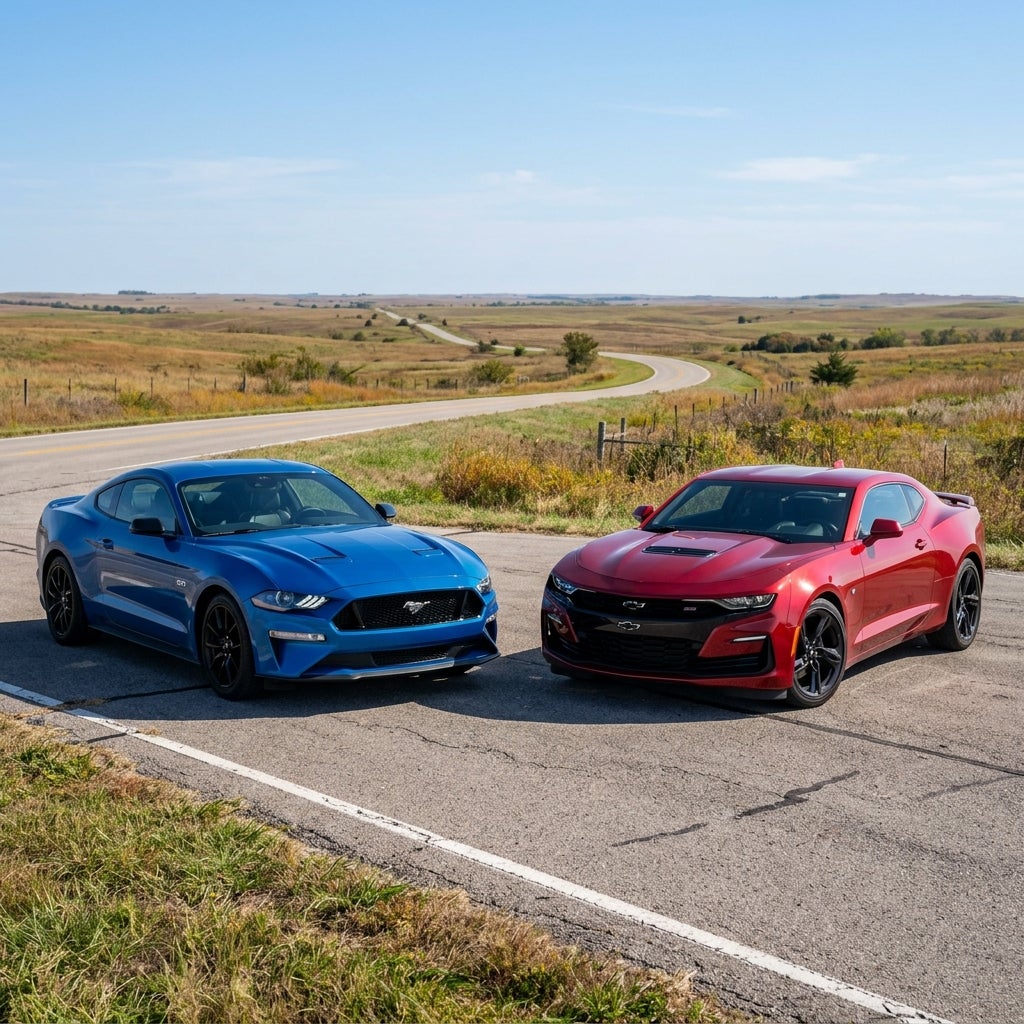
2023 Ford Mustang vs. 2023 Chevrolet Camaro: Key Comparison Takeaways with Jace Grabouski When legendary pony cars face off, automotive enthusiasts and everyday drivers in Central Kansas ask one question: which iconic machine delivers the best overall ownership experience? To settle the score between the 2023 Ford Mustang and the 2023 Chevrolet Camaro, we sat down with Jace Grabouski, General Manager at Valor Ford in Junction City, KS. With 25 years of automotive sales and performance experience, Jace offers an authoritative, practical breakdown of how these two American performance icons measure up on local highways and daily commutes. Direct Answer & Key Takeaways: While both vehicles bring impressive power to the asphalt, the 2023 Ford Mustang compares favorably with the Chevrolet Camaro in daily usability, outward driver visibility, versatile powertrain options, usable trunk space (13.5 cubic feet vs. Camaro's restricted 9 cubic feet), and long-term value retention in the Dickinson County market. For drivers navigating everything from I-70 cruising to quick trips around Fort Riley, the Mustang provides a complete package of classic muscle car heritage combined with modern comfort and technology. Expert Overview: Why the Pony Car Rivalry Matters in Junction City Interviewer: Jace, you've spent 25 years evaluating performance vehicles right here in Central Kansas. Why is the Mustang versus Camaro debate still so meaningful for local car buyers? Jace Grabouski: It comes down to real-world capability. Kansas drivers don't just store these cars in garage bubbles—they drive them. Whether commuting from Junction City down to Fort Riley, taking weekend drives across the Flint Hills, or running errands in Manhattan and Salina, people need a car that thrills on open stretches without frustrating them on daily routes. The rivalry between Mustang and Camaro forces both brands to innovate, but Ford really focused on how driver ergonomics, sightlines, and practical storage impact everyday satisfaction. If you're interested in exploring how Ford engineers its legendary performance models, you can dive into our Research Ford Mustang page or check out other lineup highlights like our Research Ford F-150 guides. Q: What engine options are available in the 2023 Ford Mustang and how much horsepower do they produce? Jace Grabouski: Ford designed the 2023 Mustang lineup around two foundational engines that cater to different driving preferences—the efficient 2.3L EcoBoost turbocharged 4-cylinder and the iconic 5.0L Coyote V8. Let me break down how these options compare to Chevy's multi-engine strategy in the 2023 Camaro. 2.3L EcoBoost (Standard & HPP) Standard EcoBoost delivers 310 horsepower and 350 lb-ft of torque. Opting for the High Performance Package boosts output to 330 horsepower using a Focus RS-derived block tuned specifically for responsive midrange power. 5.0L Coyote V8 (GT & Mach 1) The naturally aspirated 5.0L V8 pumps out 450 horsepower and 410 lb-ft of torque in the GT. In the track-honed Mach 1, output increases to 470 horsepower with dual fuel injection and Shelby GT350 intake hardware. Camaro Power Counterparts The 2023 Camaro offers a 2.0L Turbo (275 hp), 3.6L V6 (335 hp), and 6.2L LT1 V8 (455 hp). While Chevy offers a V6 step, Ford's EcoBoost easily out-torques the Camaro V6, delivering low-end thrust right where standard traffic demands it. Engine Spec 2023 Ford Mustang EcoBoost 2023 Ford Mustang GT / Mach 1 2023 Chevy Camaro LT1 / SS Base Power 310 hp / 350 lb-ft torque 450 hp (GT) / 470 hp (Mach 1) 455 hp / 455 lb-ft torque High Performance Option 330 hp HPP Package 470 hp Tremec 6-Speed 650 hp ZL1 (Supercharged) Transmission Options 6-Speed Manual / 10-Speed Auto 6-Speed Manual / 10-Speed Auto 6-Speed Manual / 10-Speed Auto Trunk Capacity 13.5 cu. ft. 13.5 cu. ft. 9.1 cu. ft. Q: What is included in the Mustang High Performance Package for EcoBoost? Jace Grabouski: The EcoBoost High Performance Package (HPP) is one of the more compelling examples of modern sports car engineering. It replaces the standard 2.3L block with a specially die-cast 2.3L engine developed by Ford Performance in Valencia, Spain—originally engineered for the Focus RS. This gives you 330 horsepower, a wider torque curve, and active valve performance exhaust with four selectable sound modes. Beyond engine enhancements, HPP adds larger front brake rotors from the Mustang GT, a strut tower brace, a 3.55 Torsen limited-slip rear axle, recalibrated steering, and heavy-duty front springs. On Flint Hills backroads near Junction City, this setup delivers precise cornering feel and agility that many V8 drivers will appreciate. Browse Pre-Owned Mustang Inventory Q: What is the 0-60 mph acceleration time for the 2023 Ford Mustang GT? Interviewer: Straight-line speed is a major selling point in the pony car category. How fast is the Mustang GT off the line compared to a Camaro SS? Jace Grabouski: When equipped with the 10-speed SelectShift automatic transmission and standard Launch Control, a 2023 Ford Mustang GT hits 0 to 60 mph in approximately 3.8 to 4.0 seconds in Drag Strip mode. The 6-speed manual GT completes the run in around 4.2 to 4.4 seconds depending on driver execution. The Camaro SS with its 6.2L LT1 V8 post similar acceleration numbers (around 3.9 to 4.1 seconds). However, Ford's 10-speed transmission software keeps the Coyote V8 right in its peak powerband during wide-open throttle acceleration. Furthermore, Mustang's electronic line lock makes track tire warming effortless for weekend strip drivers. If you plan to service or upgrade a high-performance Mustang drivetrain, our team can help you Order Genuine Ford Parts tailored specifically to performance specifications. Q: Is the Mach 1 worth the extra cost over a GT Performance Package? Tremec 6-Speed Manual The Mach 1 features the legendary Tremec TR-3160 6-speed manual with rev-matching and oil cooler, borrowed straight from the Shelby GT350. It feels noticeably crisp and handles aggressive track shifts with confidence. Shelby Cooling & Aerodynamics Includes GT500 rear subframe, rear axle cooler, transmission cooler, and optimized front splitter and underbody belly pan to minimize front-end lift and keep engine temps steady under heavy loads. Jace Grabouski's Take: Yes. If you intend to run HPDE track days or want maximum collector value, the Mach 1 bridges the gap between a standard GT and full Shelby models. Standard MagneRide damping recalculates chassis response 1,000 times per second, absorbing rough Kansas expansion joints while keeping body roll virtually nonexistent in hard corners. Q: How do the Mustang and Camaro compare for daily driving near Fort Riley? Outward Visibility & Greenhouse ergonomics Jace Grabouski: This is where the Mustang clearly pulls ahead for daily drivers around Fort Riley and Junction City. The Chevrolet Camaro has high beltlines and steep pillars, which can reduce rear visibility and make parking or highway lane changes less convenient. In contrast, the Mustang features lower window sills and a slimmer A-pillar, giving drivers superior all-around sightlines. Trunk Usability & Tech Interface Mustang offers 13.5 cubic feet of trunk volume with a wide opening that easily accommodates golf bags, gear bags, or groceries. The Camaro's 9.1 cubic foot trunk has a famously small opening. Additionally, Ford's SYNC 3 infotainment with Apple CarPlay and Android Auto provides intuitive controls that stay responsive during quick morning commutes. Q: Which 2023 Mustang trim retains the highest percentage of value? Jace Grabouski: Resale value in Central Kansas remains remarkably solid across the 2023 Mustang lineup. Historically, limited-run special editions like the Mustang Mach 1 retain the highest percentage of original MSRP over 3 to 5 years due to lower production volume and enthusiast demand for the Tremec manual box. However, for standard volume trims, the Mustang GT Premium with 5.0L V8 holds exceptionally strong trade-in values compared to Camaro LT1 trims. Because Chevrolet announced the sunsetting of the Camaro line, long-term buyer confidence and dealership parts accessibility favour the Mustang. If you are considering upgrading your current vehicle, perform a fast Trade In Evaluation on our website to see what your vehicle is worth today. Get Your Instant Trade Valuation Q: What is the typical price range for a pre-owned 2023 Ford Mustang? Jace Grabouski: Pre-owned 2023 Ford Mustang availability and pricing in Junction City vary by trim, mileage, condition, and options. Contact Valor Ford for current details. At Valor Ford, buyers can complete our secure online portal to Get Pre-Approved for Financing before visiting our lot. Contact our team for current financing information. Q: Can you comfortably drive a 2023 Mustang year-round in Dickinson County? Selectable Drive Modes Mustang's standard Snow/Wet Mode softens throttle response and adjusts traction control intervention thresholds, preventing sudden wheel spin on slick Kansas pavement during late fall or winter rain. AdvanceTrac & Stability Control Ford's electronic stability system constantly monitors yaw rate and steering angles. If wheels lose traction on icy roads near I-70, system brakes individual wheels to help keep the car tracking straight. Winter Tire Options Equipping your Mustang with a dedicated set of cold-weather tires makes all the difference. You can book wheel changeovers directly through our team when you Schedule Ford Service Today. Jace Grabouski's Verdict: Why the 2023 Mustang Wins the Modern Muscle Battle Jace Grabouski: "After 25 years in the automotive industry, I evaluate sports cars based on complete engineering harmony—not just headline horsepower numbers. While the Chevy Camaro is a formidable track tool, the 2023 Ford Mustang achieves a superior balance of raw muscle, daily visibility, trunk space, and lasting value retention. Whether you pick an EcoBoost for intelligent fuel economy or step up to the 5.0L V8 GT, Ford built a pony car that enhances your everyday drive across Dickinson County. Plus, with our support, you can even Schedule Pickup and Delivery Service for routine maintenance down the road. Schedule Your 2023 Ford Mustang Test Drive at Valor Ford in Junction City, KS Ready to experience the rumble of the 5.0L Coyote V8 or test out the sharp handling of an EcoBoost HPP? General Manager Jace Grabouski and the team at Valor Ford are here to deliver a seamless car-buying experience. Visit our dealership conveniently located at 1825 Goldenbelt Blvd in Junction City, KS 66441. Need directions or have direct questions? Click here to Get Directions to Valor Ford or Call us at (785) 238-5114 to speak with our sales specialists. Explore Pre-Owned Mustang Inventory