Blog / Maintenance & Service

Bottom Line: How Cold Winter Temperatures Thicken Transfer Case Fluid and Impact 4WD Performance

Bottom Line: How Cold Winter Temperatures Thicken Transfer Case Fluid and Impact 4WD Performance

Bottom Line: How Cold Winter Temperatures Thicken Transfer Case Fluid and Impact 4WD Performance

When sub-zero Kansas winter winds sweep across Junction City, Fort Riley, and Dickinson County, vehicle owner focus usually turns to battery life, tire tread, and antifreeze strength. However, one critical drivetrain component is frequently overlooked until severe weather strikes: your vehicle's 4WD transfer case fluid. As temperatures plunge below freezing, transfer case lubricant undergoes dramatic physical changes that directly impair four-wheel-drive engagement, front axle lockup, and internal mechanical reliability.
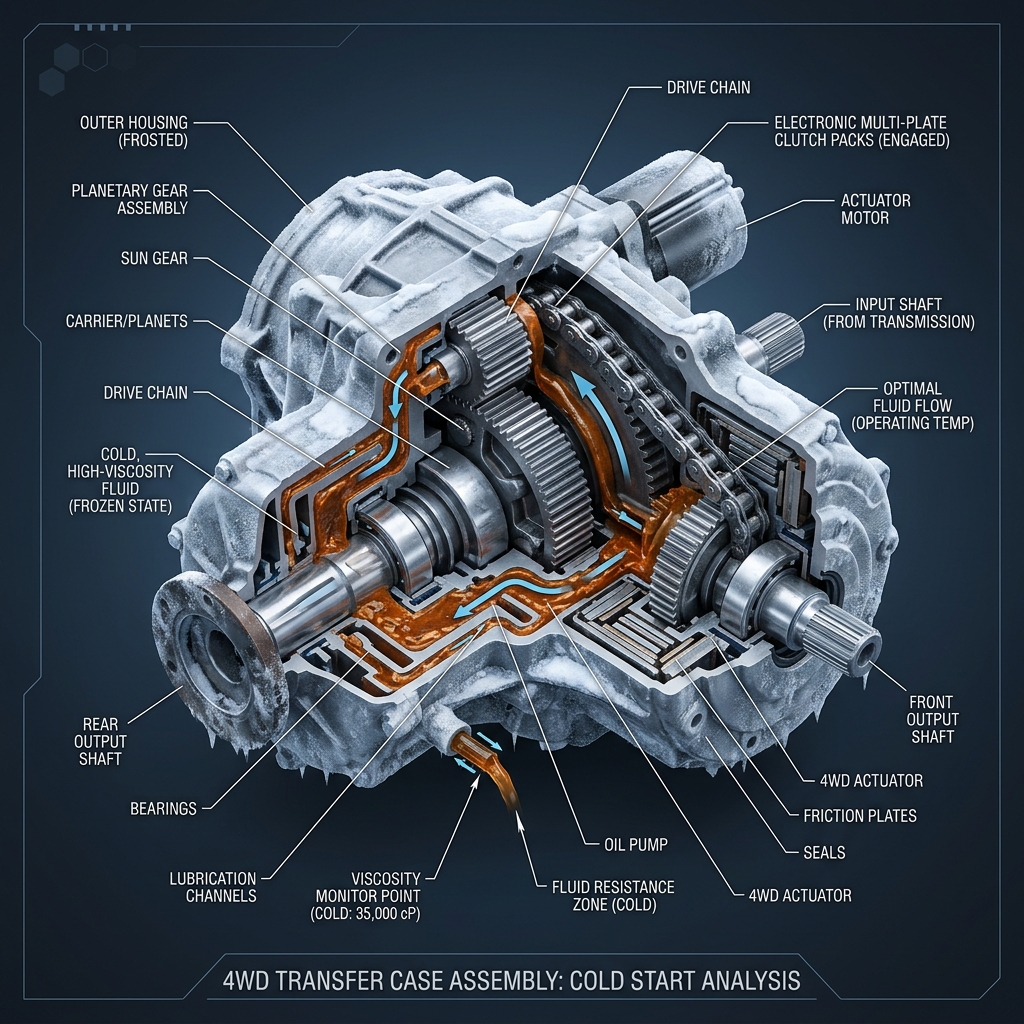
Cutaway illustration of a frosted 4WD transfer case assembly showing internal fluid flow during a cold start. (Representative image for illustration purposes only. Actual vehicle may vary based on trim and configuration.)
Quick Takeaway from Valor Ford Service Director Mike Hogg:"When transfer case fluid gets cold, its viscosity rises exponentially. Instead of flowing freely to lubricate precision bearings, planetary gears, and electronic clutch packs, thickened fluid acts like cold molasses. This internal drag delays 4WD shift actuators, causes harsh gear clunks upon engagement, and starves vital components during initial cold starts. Servicing your fluid before severe winter weather hits is the single best insurance policy against a multi-thousand-dollar transfer case breakdown." Drivers operating heavy-duty trucks like those looking to Research Ford F-250 capabilities or light-duty daily drivers should prioritize cold-weather fluid health.

Meet Mike Hogg: 20 Years of Drivetrain and 4WD Expertise in Junction City & Fort Riley

With over two decades of dedicated automotive service leadership in Central Kansas, Mike Hogg serves as the Service Director at Valor Ford in Junction City, KS. Having spent twenty winter seasons diagnosing complex four-wheel-drive issues, Mike has seen firsthand how extreme Midwestern freeze-thaw cycles impact modern driveline systems. From daily military commuters navigating snow-covered routes around Fort Riley to agricultural operators traveling rutted rural gravel roads in Dickinson County, Mike's technical insights have saved hundreds of local drivers from catastrophic winter mechanical failures. He leads a team of factory-certified Ford technicians who specialize in precision drivetrain diagnostics, shift-on-the-fly transfer case overhauls, and winter preventative maintenance schedules.
Man in a red Valor Automotive polo shirt standing in front of a company logo backdrop.

Q: How Do Sub-Zero Winter Temperatures Change Transfer Case Fluid Viscosity?

Interviewer: Mike, let's dive into the physics of winter driving. What actually happens to transfer case fluid when temperatures drop below freezing here in Kansas? Mike Hogg: Viscosity is a fluid's resistance to flow. When fluid is warm, it flows effortlessly, coating every gear tooth, bearing, and clutch plate within milliseconds of movement. But when ambient temperatures drop to 15 degrees or below zero—as they frequently do across Junction City—conventional and aged synthetic fluids experience a dramatic rise in viscosity. In plain English, the oil thickens immensely. When you turn your dash dial to 4H on a freezing morning, an electric or vacuum shift actuator physically attempts to move shifting forks and engage sliding collars inside the transfer case. If the fluid is thick as gel, that actuator faces massive hydraulic resistance. You might experience a 5 to 10-second delay in engagement, or worse, partial engagement where gear teeth clash.
Mike Hogg (continued): Furthermore, transfer cases use internal oil pumps or splash-feed channels to lubricate upper shaft bearings and planetary gear sets. Thick, cold fluid cannot travel quickly through these narrow galleries during initial vehicle operation. This temporary fluid starvation creates localized friction and metal-to-metal contact during the first few miles of driving. Over time, moisture accumulation inside old fluid compounds this issue. Water contamination freezes into microscopic ice crystals that can block internal fluid passages or damage delicate rubber seals. If you plan to Research Ford F-150 drivetrain technology, you will see how modern electronic transfer cases depend on clean, precise fluid viscosity to function seamlessly.

Q: How Often Should Transfer Case Fluid Be Serviced for Rural Kansas Gravel and Snow-Covered Roads?

Interviewer: Standard owner manuals often suggest long service intervals. Does rural Kansas driving alter that maintenance schedule? Mike Hogg: Standard owner manuals assume ideal highway driving under mild climate conditions. But rural Kansas driving—especially in Dickinson and Geary Counties—fits the manufacturer definition of 'Severe Duty Service.' Driving through mud, unpaved agricultural gravel roads, deep snow drifts, and towing winter trailers puts heavy continuous shear stress on transfer case fluid.
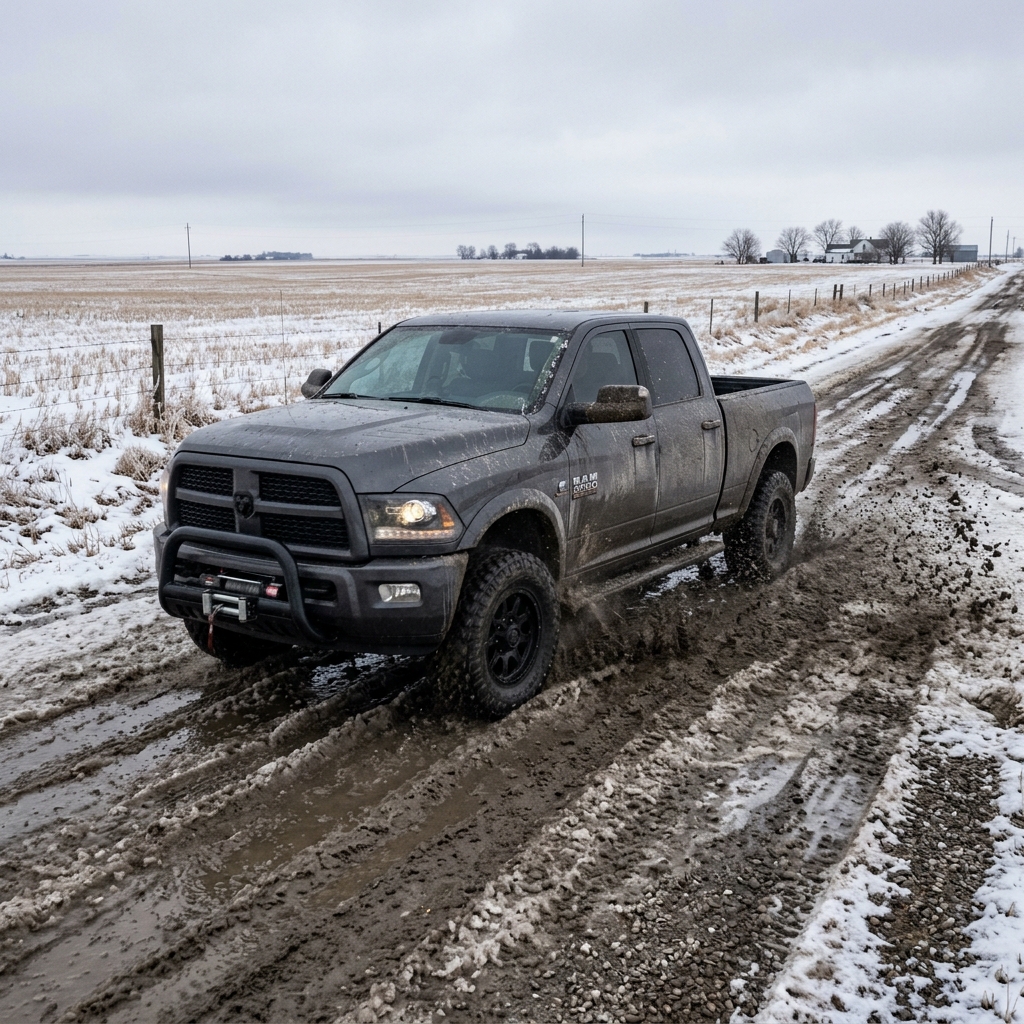
A dark gray Ram pickup truck driving through deep mud and slush on a snowy dirt road in a rural field. (Representative image for illustration purposes only. Actual vehicle may vary based on trim and configuration.)
Mike Hogg: We strongly recommend changing transfer case fluid every 30,000 miles for trucks and SUVs operating under these conditions. Early warning signs that your fluid is breakdown-prone include: • Audible high-pitched whining when 4WD is engaged • Stiff, delayed, or stubborn shift-on-the-fly execution • Sluggish front-axle engagement on cold starts • A burnt, acrid odor coming from undercarriage after highway cruising Addressing fluid degradation early prevents expensive internal mechanical failures.

Q: Can Mismatched Tire Tread Depths Cause Severe 4WD Transfer Case Damage?

Interviewer: Many vehicle owners replace two worn tires instead of a full set of four. Can uneven tire wear actually destroy a transfer case during winter driving? Mike Hogg: Absolute agreement—mismatched tire tread depth is one of the most common secret killers of transfer cases. In a 4WD or AWD vehicle, all four tires must rotate at identical speeds when driving straight. If your front tires are brand new (say 10/32" tread depth) and your rear tires are worn down to 4/32", the rear tires have a smaller rolling circumference. To travel the exact same distance down Highway 77, the worn rear tires must spin faster than the front tires. The transfer case center differential or clutch pack detects this speed differential and assumes wheels are slipping on ice.
Mike Hogg (continued): As a result, internal transfer case clutches slip constantly trying to equalize front and rear axle rotational speeds, even when traveling perfectly straight on dry asphalt. This constant friction generates intense internal thermal energy. When superheated internal temperatures meet cold winter air, rapid fluid breakdown occurs. The fluid turns black, loses friction modifiers, and breaks down viscosity polymers. Within months, internal clutch packs burn out or gear teeth bind catastrophically. Always maintain tire tread variance within 2/32" across all four positions. If you are considering upgrading your winter rig, you can Trade In Evaluation your current vehicle at Valor Ford.

Q: What Is the Real Difference Between 4WD and AWD When Navigating Unpaved Winter Roads?

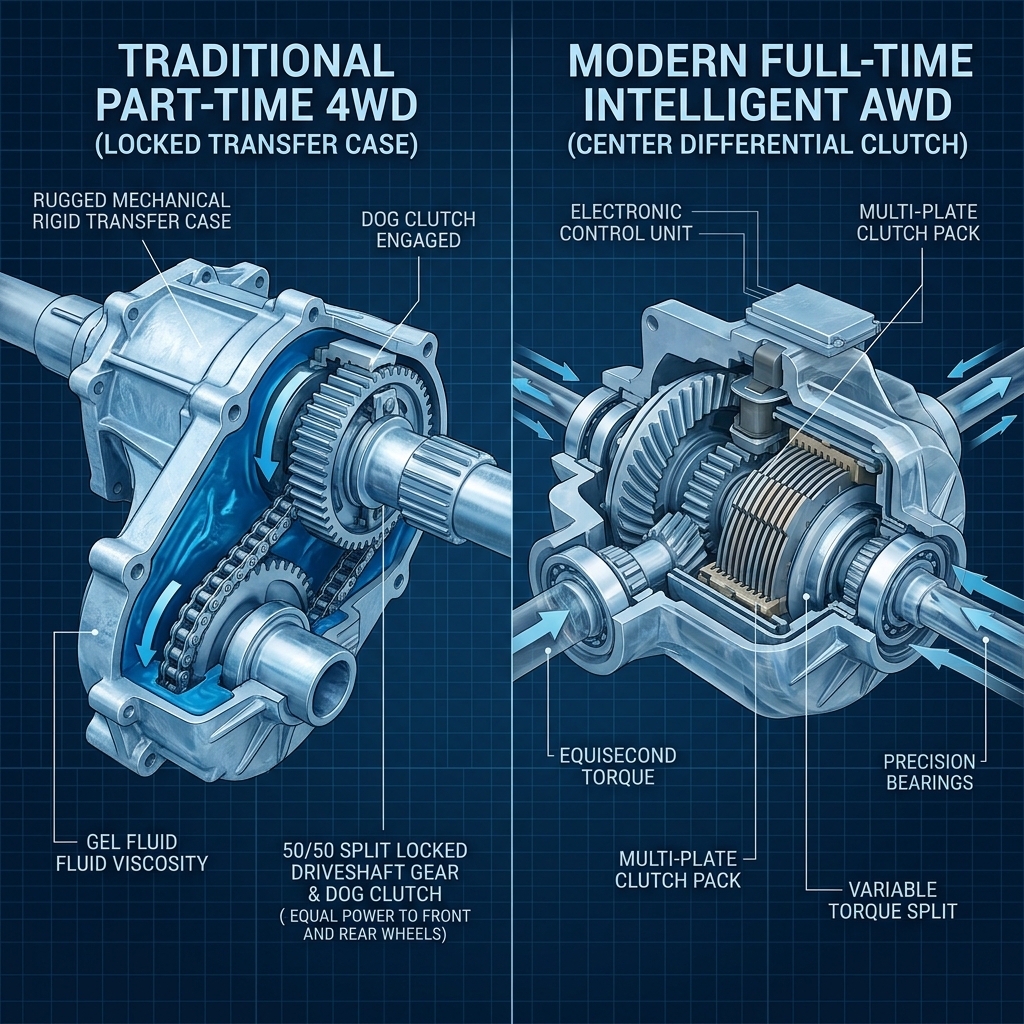
Traditional Part-Time 4WD:• Mechanically locks front and rear driveshafts 50/50 ratio • Designed for loose traction: snow, mud, gravel, ice • Must be manually engaged via dash selector or lever • Can experience severe drivetrain binding on dry pavement • Ideal for severe Flint Hills winter conditions • Featured in heavy-duty trucks and rugged off-road SUVs like when you Shop New Ford Bronco Inventory.
Diagram comparing traditional 4WD locked transfer case and modern intelligent AWD center differential clutch. (Representative image for illustration purposes only. Actual vehicle may vary based on trim and configuration.)
Full-Time Intelligent AWD:• Uses center differential or electronically managed clutch • Automatically redistributes torque between axles in milliseconds • Safe for continuous operation on mixed dry/icy roads • Requires zero driver input during sudden weather changes • Excellent for suburban driving around Fort Riley • Commonly engineered into versatile crossover models when you Research Ford Explorer.

Q: Is It Safe to Switch Into 4 High While Driving on Ice at Highway Speeds?

Interviewer: When drivers hit patchy ice on I-70 or K-18 at 55 mph, is it safe to shift into 4H on the fly? Mike Hogg: While modern vehicles feature electronic shift-on-the-fly transfer cases that permit engagement at speed, doing so while traveling 55+ mph on black ice carries major mechanical and safety risks. First, from a physical standpoint: shift-on-the-fly systems require an internal synchronizer or clutch pack to instantly accelerate the front driveshaft from zero rpm up to matching rear driveshaft speed. If transfer case fluid is thick and frigid, that mechanical synchronization encounters immense friction. Engaging at high speeds can cause gear shock, front axle binding, or shift actuator failure.
Mike Hogg (continued): Second, from a vehicle control standpoint: if you engage 4H while tires are spinning across slick ice, the sudden torque transfer to the front wheels can break loose vehicle stability, triggering a skid. Mike's Winter Speed Rule: Ease your foot off the accelerator, reduce vehicle speed below 45 mph, ensure wheels are traveling straight, and then switch into 4 High. Once engaged, maintain smooth pedal inputs. Remember: 4WD helps you accelerate on snow and ice, but it does NOT help you stop any faster! If you're looking for pre-owned winter vehicles, Browse Used Inventory equipped with advanced driver-assist systems.

Q: What Is Included in a Complete Pre-Winter 4WD Inspection and Fluid Service at Valor Ford?

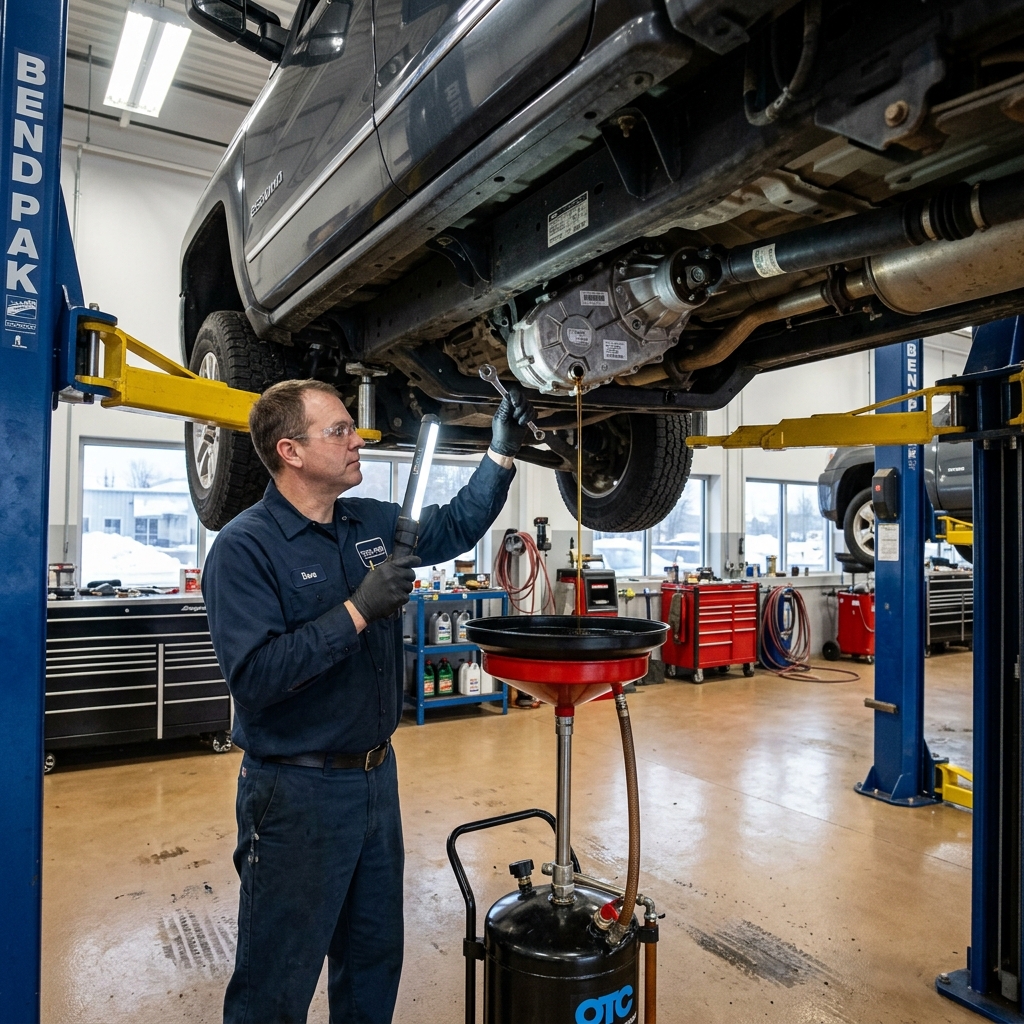
1. Fluid Drain & Refill Complete removal of contaminated transfer case fluid. Thorough magnetic drain plug inspection for metal shavings. Refill with high-performance synthetic fluid matched to exact OEM viscosity specs.
Mechanic wearing safety glasses drains fluid from a truck raised on a hydraulic lift in an auto repair shop. (Representative image for illustration purposes only. Actual vehicle may vary based on trim and configuration.)
2. Actuator & Seal Test Inspection of front axle vacuum disconnects, electronic shift solenoids, transfer case shaft seals, and breathers. Verification of tire circumference uniformity across all positions. You can also Order Genuine Ford Parts directly from our parts catalog.

Q: Is Pre-Winter 4WD Maintenance Worth the Cost Compared to Major Transfer Case Repairs?

Interviewer: Drivers often weigh routine service costs against potential future repairs. How does the math break down for 4WD maintenance? Mike Hogg: It is a massive financial contrast. A preventative transfer case fluid service costs a small fraction of a mechanical replacement. Compare that to the real-world costs of neglecting your drivetrain: • Transfer Case Replacement:$2,800 to $4,500+ for parts and labor • Emergency Winter Towing:$250 to $500 during severe blizzard conditions • Vehicle Downtime: 3 to 7 days awaiting major component assembly delivery
Mike Hogg (continued): Beyond financial figures, think about personal safety. Getting stuck on an isolated gravel road in Dickinson County during a sub-zero Kansas blizzard with a seized transfer case is dangerous for you and your family. Routine fluid inspection ensures your 4WD engages instantly when you need traction most. For added convenience, busy vehicle owners can Schedule Pickup and Delivery Service so your vehicle is serviced without interrupting your daily routine. Drivers considering financing upgrades can also contact the dealership for current financing information online.

Q: What Winter-Specific Signs Indicate Your Transfer Case Needs Immediate Service?

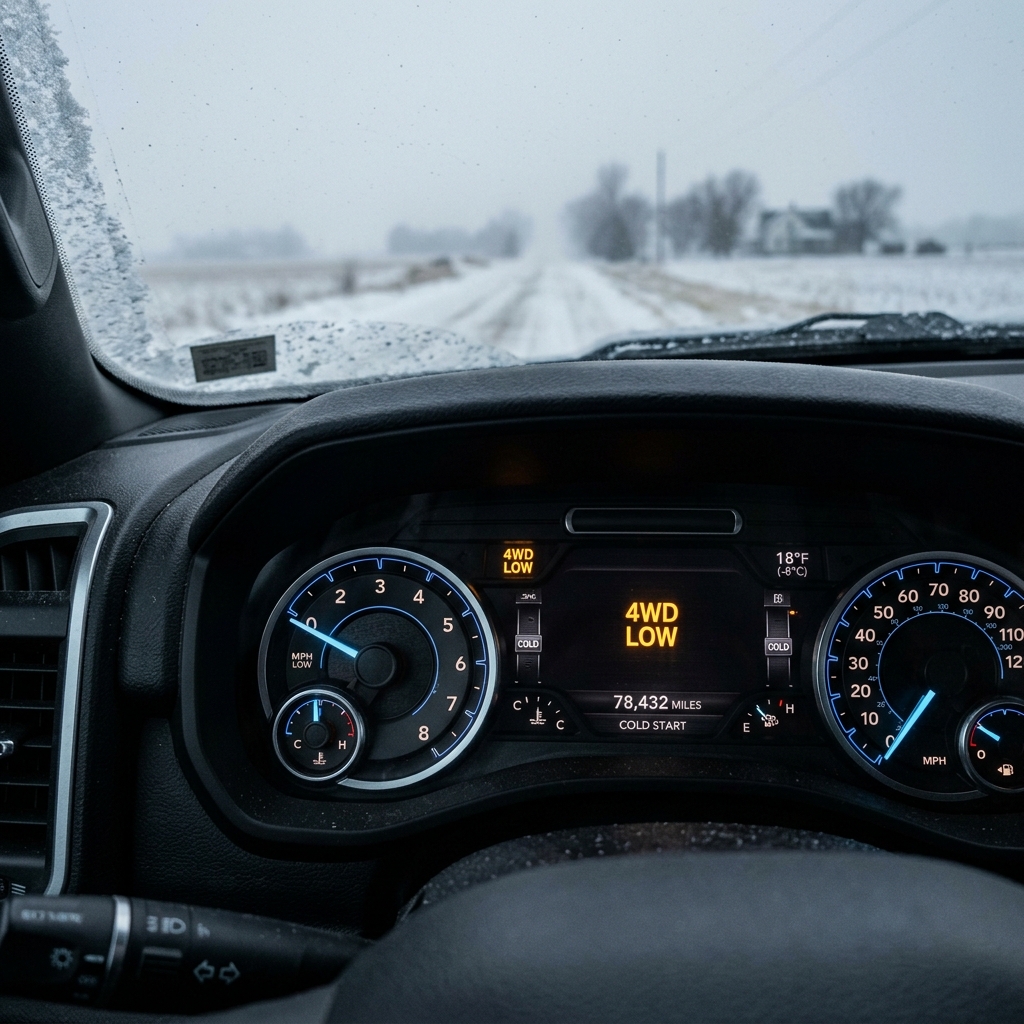
Interviewer: What physical symptoms should drivers watch out for as cold weather sets in? Mike Hogg: Be alert to these five red flags: 1. Grinding or Metallic Clunking: Hearing harsh noise when switching from 2H to 4H indicates thick fluid or worn shift forks. 2. Flashing 4WD Indicator Light: A flashing light signals that the transfer case encoder motor attempted to shift but failed due to mechanical resistance. 3. Oil Droplets in Fresh Snow: Dark fluid spots under your vehicle's midsection stand out brightly on white snow, signaling seal failure. 4. Burning Fluid Odor: Smelling pungent oil after driving at highway speeds indicates thermal degradation. 5. Drivetrain Binding in Turns: Feeling intense crow-hop or vehicle jerking while making low-speed turns on slick surfaces.
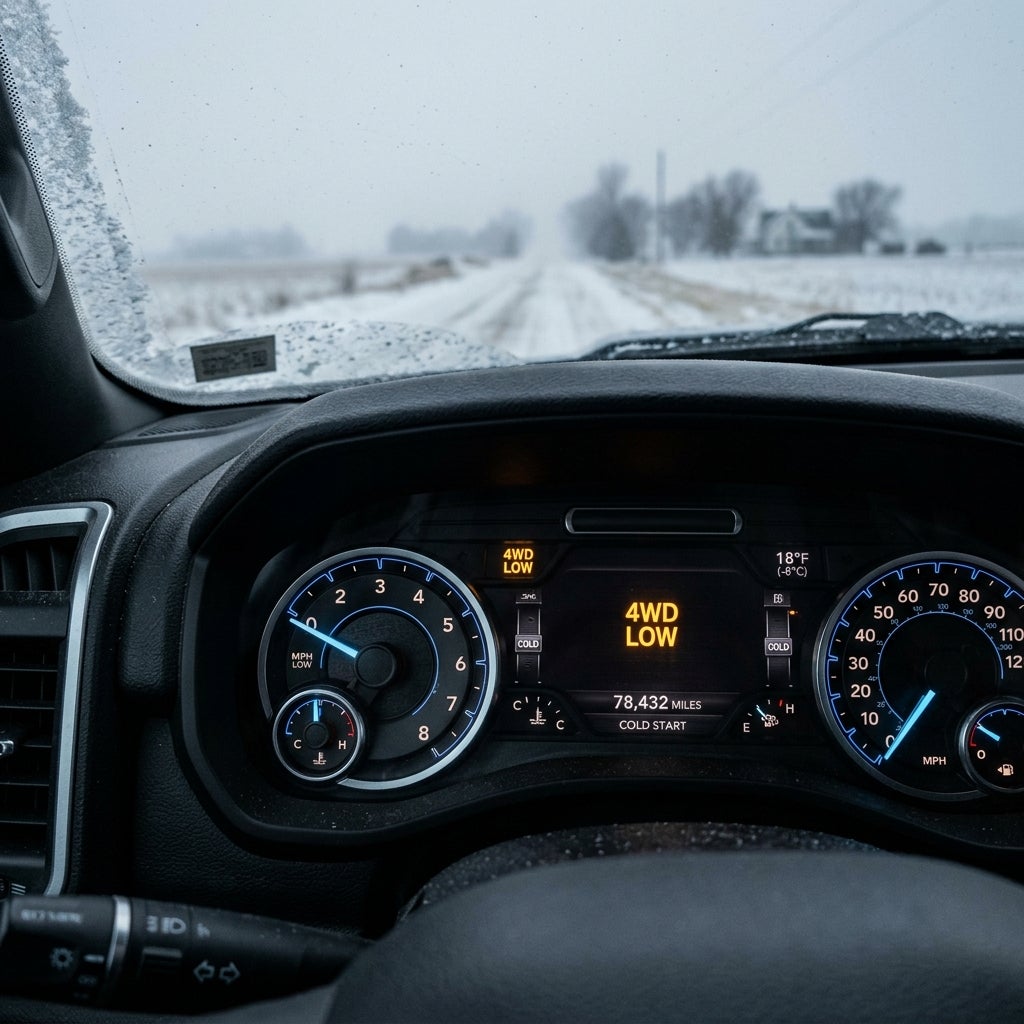
Car dashboard with 4WD LOW indicator illuminated, viewed while driving on a snow-covered road. (Representative image for illustration purposes only. Actual vehicle may vary based on trim and configuration.)

Pre-Winter 4WD & Transfer Case Maintenance Checklist for Rural Kansas Drivers

1. Check Fluid Level & Clarity Verify transfer case lubricant level. Clean fluid should be clear red or amber; dark or cloudy fluid indicates immediate service is required.
2. Measure Tire Tread Depth Ensure all four tires are within 2/32" tread depth variation to prevent continuous transfer case clutch pack friction.
3. Test 4WD Engagement Engage 4H and 4L on a loose dirt or gravel surface before winter storms hit to verify actuator function.

Schedule Your Winter 4WD Inspection & Fluid Service at Valor Ford in Junction City, KS

If winter temperatures have already set in, your transfer case fluid may need attention. Protect your truck or SUV's four-wheel-drive performance with expert maintenance from Mike Hogg and the certified team at Valor Ford. Located conveniently in Junction City, we serve drivers from Fort Riley, Manhattan, Abilene, and across Dickinson County. Visit us at 1825 Goldenbelt Blvd, Junction City, KS 66441 or Get Directions to Valor Ford. Have questions? Call us at (785) 238-5114 to speak directly with our service advisors.
Valor Automotive logo featuring a silver shield with a red 'V' and white 'A' monogram above the company name.

Posted in:

Related Posts

Understanding Motor Oil Viscosity Ratings: What Numbers Like 5W-30 Mean for Your Engine

Understanding Motor Oil Viscosity Ratings: What Numbers Like 5W-30 Mean for Your Engine

Understanding Motor Oil Viscosity Ratings: What Numbers Like 5W-30 Mean for Your Engine When you pull out the dipstick or look at a bottle of motor oil on the shelf in Junction City, those alphanumeric codes—like 5W-20, 5W-30, or 0W-20—can feel like a secret mechanical dialect. In simple terms, a motor oil viscosity rating measures the fluid's internal resistance to flow. Think of viscosity as the liquid's thickness: high-viscosity fluids flow slowly like warm molasses, while low-viscosity fluids flow rapidly like water. For your engine, maintaining the precise balance of fluid flow is the single most critical factor in preventing metal-to-metal contact, reducing mechanical friction, and dissipating destructive friction heat. Modern internal combustion engines operate under extreme pressure with tolerances measured in thousandths of a millimeter. The oil must be thin enough during a cold morning start in Kansas to instantly pump up into the top cylinder heads and overhead camshafts. Yet, once your vehicle reaches peak operating temperature while cruising along I-70, that very same oil must remain thick enough to form a durable protective cushion between rapidly moving internal components. Understanding how multi-grade viscosity works empowers you to make informed decisions for your vehicle's long-term health. If your engine is due for fresh fluid, you can easily Schedule Ford Service with our factory-trained specialists. Decoding the Numbers: How Cold-Flow and High-Temp Viscosity Protect Engine Parts The Society of Automotive Engineers (SAE) established the standardized numerical scale used on motor oil containers worldwide. Multi-grade oils use a two-number rating system separated by the letter 'W'. The 'W' strictly stands for **Winter**, not weight. The first number preceding the 'W' (such as 0W, 5W, or 10W) indicates the oil's flow capability at low winter temperatures. A lower number means better cold-flow performance, allowing the oil to reach engine bearings instantly upon ignition during freezing weather in Junction City. The second number following the hyphen (such as 20, 30, or 40) represents the oil's kinematic viscosity at 100°C (212°F)—the standard operating temperature of a fully warmed engine. Higher numbers indicate a thicker oil film at elevated temperatures, providing robust barrier protection under severe thermal strain. Using an oil with the incorrect cold rating can lead to dry startups, while an incorrect hot rating can cause oil film breakdown under heavy acceleration. How Kansas Weather and Flint Hills Driving Impact Oil Viscosity Performance Driving conditions across Dickinson County and Geary County put unique demands on your vehicle's lubrication system. Mid-western weather shifts dramatically throughout the year—from sub-zero winter blasts to scorching 100°F heat waves in peak summer. Extreme cold causes low-quality oils to thicken excessively, starving key components during start-up. Conversely, blistering summer heat accelerates thermal oxidation, causing oil molecules to break down into varnish and sludge. Furthermore, tackling steep inclines across the Flint Hills or pulling heavy equipment requires sustained high RPMs. This mechanical stress subjects the engine oil to extreme shear forces, which can physically tear apart polymer viscosity modifiers. When towing heavily in a truck like the powerful Research Ford F-150, oil sump temperatures rise rapidly. If the viscosity degrades below factory specifications, oil pressure drops, exposing crank journals and connecting rod bearings to dangerous metal contact. Regular fluid checks and timely oil changes ensure your engine maintains strong shear stability no matter how demanding the road or weather conditions become in central Kansas. Which Engine Types Strictly Require Full Synthetic Motor Oil? Turbocharged EcoBoost® Systems Turbochargers spin up to 200,000 RPM and are cooled directly by engine oil. Conventional oils can coking or char inside hot turbo bearings when turned off. Full synthetic oil provides superior thermal resistance, protecting turbo shaft seals against extreme heat degradation. Direct-Injection & High Compression Modern gasoline direct-injection (GDI) engines operate at elevated internal pressures and are prone to Low-Speed Pre-Ignition (LSPI). Full synthetic formulations meet strict API SP/ILSAC GF-6 standards engineered specifically to eliminate damaging LSPI knock events. Hybrid & Auto Stop-Start Vehicles Vehicles with automatic stop-start technology or hybrid powertrains, such as those found in the Research Ford Explorer, frequently cycle the engine on and off. Ultra-low viscosity synthetic oils ensure instant oil pressure delivered within milliseconds of restarting. Schedule Synthetic Oil Service What Components Are Inspected During a Standard Full-Service Oil Change? A standard oil change at Valor Ford is much more than simply draining old oil and pouring in fresh fluid. Every routine service includes a comprehensive evaluation designed to keep your vehicle running in peak condition: 1. **Drain & Replace Motor Oil:** Draining worn engine oil and refilling with exact OEM-recommended viscosity. 2. **Filter Replacement:** Installing a high-efficiency replacement filter. You can also Order Genuine Ford Parts directly through our parts center. 3. **Fluid Inspection & Top-Off:** Checking windshield washer fluid, engine coolant, brake fluid, and power steering levels. 4. **Belts & Hoses Check:** Inspecting serpentine belts and radiator hoses for cracks, swelling, or tension loss. 5. **Tire Pressure & Tread Depth:** Adjusting all four tires to correct PSI and measuring remaining tread thickness. 6. **Multi-Point Vehicle Health Inspection:** Reviewing battery health, wiper blades, intake air filters, and suspension alignment points. What Happens If I Delay or Skip Oil Changes Recommended by Junction City Service Advisors? Postponing your scheduled maintenance intervals triggers a chain reaction of mechanical wear inside your engine. Over time, heat exposure causes chemical breakdown of the oil's additive package. Anti-wear zinc compounds deplete, detergent additives saturate, and the base oil oxidizes into thick black engine sludge. As sludge accumulates, narrow lubrication passages—such as variable camshaft timing solenoids and oil pick-up screens—become clogged. Deprived of steady oil pressure, precision components begin friction-grinding against each other, creating metallic debris that circulates throughout the entire system. Skipping oil changes also severely impacts fuel economy. Worn, oxidized oil increases internal fluid friction, forcing your engine to work significantly harder just to turn the crankshaft. Piston rings can become gummed up and stick, leading to cylinder wall scoring, excessive oil consumption, loss of compression, and eventual catastrophic engine overheating. Protecting your investment requires maintaining steady drain intervals tailored to your specific driving habits in Junction City. What Factors Most Affect the Price of an Oil Change in Junction City, KS? Fluid Type & Formulation Full synthetic oils cost more upfront than synthetic blends or conventional oils due to advanced chemical refinement, but they offer significantly longer protection intervals and superior cold-weather flow. Engine Sump Capacity A compact sedan may require only 4 to 5 quarts of oil, whereas heavy-duty trucks like the PowerStroke® diesel require up to 13 to 15 quarts, directly impacting total fluid material costs. Filter Specification Genuine Motorcraft® high-efficiency filters utilize synthetic blend media designed to trap micro-particulates without restricting oil volume, offering premium protection over generic aftermarket filters. View Service Pricing Are Independent Garages Near Junction City Good Alternatives to Dealership Service? While quick-lube shops and corner independent repair garages are widespread, they often utilize one-size-fits-all bulk oils that fail to meet strict OEM engineering specs. Using a bulk 5W-30 formulation that lacks vehicle-specific chemical approvals can degrade engine seals and void factory oil life monitors. At Valor Ford, our service department is staffed by Senior Master-certified technicians who specialize exclusively in your vehicle's exact engine platform. We utilize specialized Ford Integrated Diagnostic System (IDS) tools, OEM recalibration software, and exact-fit Motorcraft fluids formulated specifically for your powertrain. Do Independent Auto Service Centers Void Manufacturer Vehicle Warranties? Under the federal **Magnuson-Moss Warranty Act**, vehicle owners are legally allowed to perform routine maintenance at independent facilities without automatically voiding their original manufacturer factory warranty. However, if an independent garage uses substandard fluid, incorrect viscosity, or an unapproved filter that leads to mechanical failure, the manufacturer reserves the right to deny warranty coverage for that repair. Furthermore, independent shops require you to manually collect, organize, and store physical paper receipts to prove maintenance compliance if a warranty claim arises years down the road. Servicing your vehicle at Valor Ford provides complete administrative peace of mind. Every service visit, fluid type, and multi-point inspection record is logged directly into Ford's centralized nationwide OASIS database. If you ever need warranty repairs anywhere in North America, your maintenance history is instantly verified with zero hassle or paperwork required. Why Should I Schedule an Oil Change Appointment Instead of Just Walking In? Reserved Bay Access Scheduling guarantees immediate vehicle check-in and dedicated service bay access, eliminating long waiting room delays for active military personnel from nearby Fort Riley. Pickup & Delivery Convenience Busy schedule? You can easily Schedule Pickup and Delivery Service where we pick up your vehicle from your home or office and return it fully serviced. Staged OEM Parts Pre-booked appointments allow our parts department to stage your exact motor oil viscosity specification and OEM filter prior to your arrival for rapid turnaround times. Reserve Your Service Time Slot Junction City Service & Oil Change Excellence: The Valor Ford Difference At Valor Ford, we take immense pride in serving the automotive needs of drivers throughout Junction City, Manhattan, and surrounding Kansas communities. Our commitment to vehicle longevity starts with our dedicated team of factory-certified service experts who treat your vehicle with the care and precision it deserves. Whether you need an exact-fit Motorcraft oil change, routine maintenance, or general diagnostic care, our modern service center provides service information and comfortable amenities. Stop by our dealership today or get in touch with our advisors: 📍 Get Directions to Valor Ford at 1825 Goldenbelt Blvd, Junction City, KS 66441. 📞 Questions? Call us at (785) 238-5114 to speak directly with a service advisor. Protect Your Engine: Schedule Your Next Oil Change at Valor Ford in Junction City Keep your engine performing at its best. Ensuring your vehicle uses the correct motor oil viscosity rating is the easiest way to preserve engine performance, maximize fuel economy, and extend vehicle lifespan. Experience the professional care, genuine Motorcraft components, and customer-first service that set Valor Ford apart. Schedule Factory-Backed Oil Service Today

Are Truck Bed Outlets Weatherproof and Safe to Use in Rain During a K-State Game Day Tailgate?

Are Truck Bed Outlets Weatherproof and Safe to Use in Rain During a K-State Game Day Tailgate?

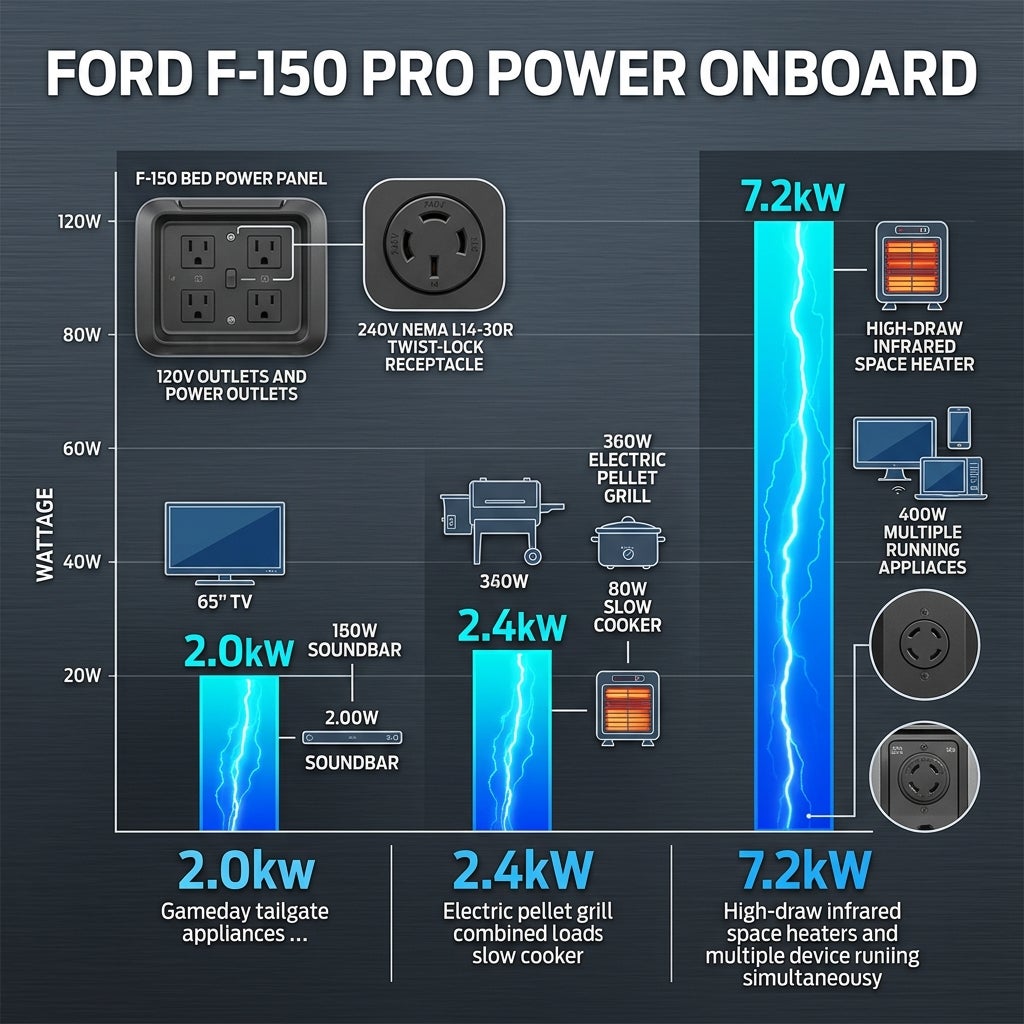
Are Truck Bed Outlets Weatherproof and Safe to Use in Rain During a K-State Game Day Tailgate? The Short Answer: Yes, Ford Pro Power Onboard bed outlets are designed with protective covers, seals, and GFCI-style protection intended to help support use in wet conditions when used as directed during Kansas game days. However, maintaining safe operation when tailgating in wet conditions outside Bill Snyder Family Stadium requires strict adherence to outdoor power management protocols. While the vehicle's onboard power system is thoroughly protected against moisture intrusion, your setup is only as safe as the extension cords, adapters, and appliances you plug into it. When sudden rain showers sweep across the Flint Hills during a September or October K-State football game day, Manhattan tailgate lots quickly transform into damp pavement and saturated grass. Ford's Pro Power Onboard system features hyper-sensitive millisecond circuit cutoffs that detect current imbalances down to 4 to 6 milliamperes. If moisture bridging occurs at an unsafe connection, the truck may shut down the outlet circuit to help protect users from electrical shock. To prevent unexpected power trips and keep your pellet smoker, big-screen TV, and sound system running without interruption, tailgaters must utilize heavy-duty outdoor SJTW extension cords, establish physical drip loops, and keep all connection points elevated off damp asphalt. Whether you are setting up in Lot 9 near Bramlage Coliseum or hosting a massive Wildcats pre-game celebration in the East Lot, understanding how your truck handles power distribution in bad weather ensures a seamless experience. At Get Directions to Valor Ford in nearby Junction City, our team regularly helps local truck owners configure their Research Ford F-150 models for extreme weather reliability and heavy-duty auxiliary power demands. Meet Mike Hogg: 20 Years of Master Ford Service Expertise in Junction City As the Service Director at Valor Ford in Junction City, Kansas, Mike Hogg brings two decades of hands-on technical diagnostic and service management experience to the Flint Hills automotive community. Over his 20-year career, Mike has overseen thousands of complex electrical diagnostic repairs, custom truck power builds, and routine maintenance procedures for Fort Riley military personnel, local agricultural operators, and diehard K-State Wildcats football fans. 'Living and working in Geary and Riley counties, you learn very quickly that North-Central Kansas weather respects no gameday schedule,' says Mike Hogg. 'We see 90-degree sunny kickoffs turn into violent wind-driven rainstorms in forty-five minutes. My job is making sure our customers know exactly how their Ford vehicles work so they can power their equipment safely without damaging sensitive onboard inverters or tripping GFCI breakers when the weather turns.' Mike's depth of technical knowledge regarding Ford's high-voltage hybrid architectures, pure sine wave power inverters, and IP-rated bed outlet assemblies makes him a trusted voice for truck owners throughout Manhattan, Junction City, and Salina. When he isn't inspecting vehicles in the Valor Ford service bay, you'll find him sharing practical technical advice with local owners on how to optimize their trucks for work and tailgate play. Need expert service before the next kickoff? You can Schedule Ford Service Today directly with Mike's certified master technician team or Call us at (785) 238-5114. How Does Ford Pro Power Onboard Work on the F-150 for Rain or Shine Tailgating? Ford Pro Power Onboard turns the F-150 into a mobile generator by leveraging the truck's powertrain engine and high-voltage battery systems. Unlike standard light-duty 12V accessories or traditional modified sine wave inverters found in older trucks, Pro Power Onboard utilizes a dedicated dual-channel digital inverter that generates pure sine wave AC electricity. This clean electrical current matches or exceeds the stable power delivered by residential wall outlets, protecting delicate microprocessors in modern 4K Smart TVs, digital pellet grill controllers, laptop chargers, and powered audio mixers. The bed-mounted outlet panel itself is engineered specifically for harsh exterior utility conditions. Each 120V (20A) and 240V (30A) receptacle features heavy-duty spring-loaded protective flap covers that maintain a physical barrier against dirt, debris, and horizontal rain spray when no plugs are inserted. Internal rubber perimeter seals tightly compress around the receptacle frame to isolate high-voltage wiring blocks from water ingress even under intense thunderstorm conditions in Manhattan parking lots. At the core of the system's wet-weather safety profile is an advanced integrated Ground Fault Circuit Interrupter (GFCI) module built into the power distribution architecture. The GFCI system continuously monitors electrical current flowing through the hot and neutral conductors of every active circuit. Under normal operation, the current leaving the outlet on the hot wire exactly equals the current returning on the neutral wire. If rainwater touches an unsealed extension cord connection lying on wet ground, a tiny electrical leakage path (ground fault) is created. The moment Pro Power Onboard detects a current discrepancy exceeding 4-6mA, the internal solid-state relay trips in less than 25 milliseconds—cutting all power to the bed outlets long before dangerous voltage can flow through a person or cause electrical arcing. If your circuit trips during a rainstorm, the SYNC 4 touchscreen inside the cab and your Ford App smartphone app immediately display a fault notification isolating which specific outlet bank experienced the surge. What Extension Cords and Heavy-Duty Adapters Are Recommended for F-150 Tailgating Setups? 1. SJTW Outdoor Cable Rating Never use cheap, indoor-rated lightweight extension cords. For reliable wet-weather tailgating, choose heavy-duty SJTW or SOW rated cords. The 'W' designation specifically certifies the outer PVC jacket as weather and water-resistant. Use 12-gauge (12/3) wire for standard 120V runs under 50 feet, or ultra-thick 10-gauge (10/3) wire for heavy high-wattage smoker and space heater loads to prevent voltage drop and cord overheating in wet grass. 2. NEMA L14-30P Twist-Lock Adapters If your F-150 is equipped with the 7.2kW Pro Power Onboard option, you have access to a 240V/30A NEMA L14-30R outlet in the bed. To distribute this massive power pool into multiple 120V gameday stations safely, use a weatherproof NEMA L14-30P twist-lock to 4x 5-20R breakout adapter cable. The rotating twist-lock mechanism locks tightly into the bed panel, forming a secure connection that is designed to help resist loosening in heavy wind. 3. Drip Loops & Elevated Connections Always form a downward-curving drip loop in extension cords right before they plug into the truck bed outlet panel or your appliances. Gravity forces water droplets down to the bottom curve of the loop where they drop onto the pavement, rather than tracking straight into the electrical plug face. Enclose all plug-to-plug cord connections inside clamp-style water-resistant outdoor connection safety boxes elevated off wet ground. Order Genuine Ford Weatherproof Accessories & Parts Service Director Mike Hogg on Wet Weather Safety: 'Protection Depends on Your Setup' "I talk to tailgate crews at Bill Snyder Family Stadium every single season who think because their F-150 bed outlets are waterproof, they can throw a inexpensive $5 orange indoor extension cord flat on wet pavement in a torrential downpour and expect things to stay dry. The truck's Pro Power system is robustly engineered, but it cannot fix unsafe consumer accessories plugged into it. When water infiltrates an unsealed cord plug resting in a puddle, the truck's GFCI sensor detects that ground fault instantaneously and cuts off power to help reduce shock risk. Then people wonder why their smoker turned off mid-brisket! The solution is simple: pair Ford's brilliant engineered outlets with IP65-rated twist-lock adapters, elevate your junction boxes on plastic crates off the stadium asphalt, and keep your primary tailgate tent canopy anchored over your power station. Do that, and you can cook, stream, and celebrate in a deluge without ever tripping a single circuit breaker." — Mike Hogg, Service Director at Valor Ford (20 Years Experience) Which Appliances Require the Extra Wattage of the 7.2kW System Versus 2.0kW or 2.4kW Options? Ford offers Pro Power Onboard across three distinct power output tiers on the F-150 lineup: 2.0kW (2,000 watts) on traditional EcoBoost gas engines, 2.4kW (2,400 watts) standard on the PowerBoost Full Hybrid powertrain, and the flagship 7.2kW (7,200 watts) optional system on PowerBoost models. Selecting the correct system depends on the total concurrent electrical load your Wildcat game day tailgate demands. The 2.0kW & 2.4kW Systems: Ideal for essential gameday comfort. A 2,000 to 2,400-watt power envelope easily supports a 65-inch LED TV (150W), a high-powered tailgate soundbar (100W), an electric pellet grill during continuous smoking operation (300W startup, 50W running), a slow cooker crockpot (250W), and multiple phone/laptop chargers simultaneously with ample headroom remaining. The 7.2kW Heavy-Duty System: Essential for ultra-large tailgate villages and extreme weather conditions. Late November game days in Manhattan often require high-draw heat sources. A single 1,500-watt infrared space heater or dual electric griddles (1,800W each) will instantly max out a 2.0kW system. The 7.2kW system gives you 7,200 total watts divided across four 120V/20A outlets and one 240V/30A NEMA L14-30R outlet—allowing you to run commercial blenders, portable air conditioners, electric space heaters, infrared warming lamps, and a full AV system at the same time without blowing a fuse. Tailgate Appliance / Equipment Startup Wattage Continuous Running Wattage Minimum Required Pro Power Tier 75-inch 4K Smart LED TV 200W 120W - 180W 2.0kW System Traeger / Camp Chef Pellet Grill 400W - 600W (Igniter On) 50W - 100W 2.0kW System Programmable Kitchen Crockpot 300W 150W - 250W 2.0kW System Ninja / Vitamix High-Speed Blender 1,400W 1,000W - 1,200W 2.4kW System Dual Electric Breakfast Griddle 1,800W 1,500W - 1,800W 7.2kW System 1,500W Outdoor Infrared Space Heater 1,800W 1,500W 7.2kW System Portable Commercial Air Conditioner 2,200W 1,400W - 1,700W 7.2kW System What Is the Max Wattage Output of the Toyota Tundra Bed Outlet Compared to the F-150? When comparing game day capability outside Bill Snyder Family Stadium, the difference between the Ford F-150 and the Toyota Tundra comes down to raw electrical power output. The Toyota Tundra offers a bed-mounted deck outlet capped at a maximum output of 400 watts (0.4kW) —and that 400-watt limit is only available when the vehicle is parked. When the Tundra is driving, output drops to just 100 watts. By comparison, the Ford F-150's base Pro Power Onboard system provides 2,000 watts (2.0kW) —500% more power than the Tundra. The F-150 PowerBoost Hybrid 7.2kW system delivers a staggering 7,200 watts, offering 18 times (1,800%) the total electrical capacity of Toyota's setup. What does a 400-watt limit mean in practical gameday terms? A Tundra owner can charge smartphones, power low-draw LED string lights, or power a small 32-inch TV. However, if a Tundra tailgater attempts to plug in a pellet smoker (400W-600W igniter burst), a blender (1,200W), a space heater (1,500W), or a crockpot (250W) at the same time, the Tundra's inverter instantly overloads and shuts down. The Ford F-150 Pro Power Onboard system allows you to run an entire Wildcat tailgate village off a single truck bed without carrying noisy, smelly gas generators in your cargo box. Power Metric / Feature Toyota Tundra Bed Outlet Ford F-150 Pro Power Onboard Max Wattage Capacity 400 Watts (0.4kW) 2,000W / 2,400W / 7,200W Available Voltage Outlets 120V AC Only 120V AC & 240V / 30A Twist-Lock Pure Sine Wave Technology Limited Output Standard Digital Pure Sine Wave Powers Space Heaters / Grills No (Overloads Circuit) Yes (Multiple Appliances Simultaneously) Run Time on Full Tank (Hybrid) N/A Up to 32 Hours Continuous at Max Load In-Cab & Mobile App Monitoring Basic Display Real-Time FordPass Wattage Tracking Research 2026 Ford F-150 Models Get Instant Trade In Evaluation Ready to upgrade your Kansas gameday experience with the power of Ford Pro Power Onboard? Visit Valor Ford at 1825 Goldenbelt Blvd in Junction City, KS 66441 or Contact us for financing information online today. Have questions about your truck's electrical capabilities or need a multi-point pre-season inspection? Schedule Ford Service Today or speak directly with Service Director Mike Hogg's team by calling Call us at (785) 238-5114.

VALOR Service & Oil Change Excellence: Protecting Your Vehicle in Any Season

VALOR Service & Oil Change Excellence: Protecting Your Vehicle in Any Season

VALOR Service & Oil Change Excellence: Protecting Your Vehicle in Any Season Most vehicle owners assume that 'severe driving conditions' apply only to extreme off-road rock crawling, commercial fleet haulers, or high-speed track racing. However, automotive engineers and manufacturers define severe driving duty quite differently. In reality, the vast majority of everyday drivers in Junction City, Fort Riley, and surrounding Dickinson County operate under severe service conditions without ever knowing it. Severe driving conditions include frequent short trips under 5 to 10 miles, repeated stop-and-go commuting, sub-zero winter morning cold starts, intense Flint Hills summer heat combined with heavy cargo or towing, extended idling periods, and driving on dusty, gravel, or unpaved rural roads. When your vehicle is subjected to these environments, motor oil degrades significantly faster, requiring shortened fluid maintenance and filter replacement intervals to preserve engine longevity. Short Trips and Stop-and-Go Commutes: Why Everyday Driving Might Be Severe When you take short trips—such as driving less than five miles to local shops in Junction City or running quick errands across Fort Riley—your vehicle's engine rarely hits full thermal equilibrium. An internal combustion engine needs sustained heat (typically around 195°F to 220°F) to burn off water vapor created as a combustion byproduct. On short drives, this moisture accumulates inside the crankcase, mixing with engine oil to form harmful black sludge. Additionally, frequent stop-and-go commuting causes fuel dilution. During cold starts, the engine computer sprays extra fuel to ensure steady combustion. If the drive ends before the engine warms completely, unburnt fuel escapes past piston rings into the oil sump, thinning the lubricant and reducing its viscosity grade. Routine long-distance cruising lets oil reach temperature and self-clean, whereas city stop-and-go driving forces your engine to work under constant fluid degradation. Climate Extrema in Kansas: Towing, Heavy Loads, and Extreme Temperatures Heavy Towing & Hauling Pulling trailers, livestock, or agricultural equipment across Dickinson County places continuous stress on powertrain fluids. High torque output generates extreme oil sumps and transmission fluid heat, rapidly oxidizing standard lubricants. Flint Hills Summer Heat High ambient summer temperatures combined with extended engine idling (such as waiting in traffic or running climate control) prevent Ram-air cooling through the radiator, pushing thermal loads to critical thresholds. Driving on dirt or gravel roads feeds fine airborne silica into the engine air filter and oil system, creating abrasive microscopic wear if filters aren't serviced frequently. How Does Full Synthetic Oil Perform During Sub-Zero Winter Starts? Kansas winter cold snaps often drop temperatures well below freezing. During a sub-zero cold start, conventional motor oil thickens substantially, taking precious extra seconds to flow from the oil pan through the pickup tube to overhead camshafts and valve gear. Up to 75% of lifetime engine wear occurs during these initial startup seconds when metal surfaces rub together before fluid pressure stabilizes. Full synthetic oil retains superior low-temperature fluid viscosity due to uniform molecular sizing and wax-free synthetic basestocks. It pumps effortlessly even at sub-zero temperatures, delivering immediate oil pressure to vital engine components and dramatically reducing dry-start friction. Schedule Winter Maintenance Service What Are the Technical Differences Between Conventional, Synthetic Blend, and Full Synthetic Oil? Conventional Motor Oil Refined directly from crude oil, conventional lubricants contain non-uniform molecules, natural waxes, and impurities. They offer adequate protection for gentle driving in older vehicles, but break down rapidly under high heat, extreme cold, or severe driving conditions. Synthetic Blend Oil A engineered mixture of synthetic basestocks and conventional crude. Synthetic blend oils offer upgraded thermal protection, anti-wear properties, and cold-flow capability over standard conventional oil at an intermediate price point. Full Synthetic Oil Synthesized entirely through advanced chemical processes for precise molecular uniformity. Full synthetic features exceptional oxidation stability, robust detergent and dispersant additive packages, and superior film strength required for severe duty schedules. What Type of Motor Oil Is Recommended for Modern Passenger Vehicles During an Oil Change? Modern passenger vehicles—especially modern turbocharged EcoBoost engines found across the Ford lineup—mandate exact fluid specifications. Modern engine designs utilize tight internal tolerances, variable camshaft timing phasers, and direct-injection fuel systems that rely on ultra-low viscosity fluids such as 0W-20, 5W-20, or 5W-30. To meet strict manufacturer warranties, oils must carry official OEM standard approvals such as Ford WSS-M2C961-A1 or API SP certification. Using an unapproved oil weight or grade can cause valve-train noise, reduced fuel efficiency, or premature turbocharger bearing degradation. Check your owner's manual or consult the certified specialists at Valor Ford to confirm the exact factory spec for your vehicle. Is Synthetic Oil More Cost-Effective Long-Term Than Conventional Oil? While a full synthetic oil change carries a slightly higher initial cost than standard conventional service, it represents significantly lower long-term cost of vehicle ownership. Synthetic oil provides a broader protective margin against internal friction, component varnish, thermal breakdown, and engine wear. Evaluation Criteria Conventional Oil Full Synthetic Oil Severe Duty Oil Life 3,000 - 5,000 miles 7,500 - 10,000 miles Thermal Stability Moderate (Breaks down at high temp) Extreme (Resists oxidation & varnish) Sub-Zero Cold Flow Sluggish startup flow Instant pressure ramp-up Fuel Economy Gain Standard benchmark 1-2% efficiency improvement Long-Term Repair Protection Basic friction protection Prevents costly turbo & timing chain wear Preventing major mechanical repairs—such as timing chain stretch, VCT solenoid failures, or turbo bearing wear—saves thousands of dollars over the lifetime of your vehicle. If you're considering updating your vehicle entirely, feel free to explore our Trade In Evaluation or check out legendary models like the Research Ford F-150. Value Your Trade-In Online Severe Driving Conditions Checklist: Does Your Daily Route Require Special Maintenance? Review this simple self-assessment to determine whether your daily driving habits around Junction City and Fort Riley qualify for severe duty maintenance schedules: • Do most of your trips cover fewer than 10 miles in normal weather? • Do you frequently drive in stop-and-go traffic during peak commute hours? • Do you tow a trailer, boat, camper, or haul heavy bed loads regularly? • Do you commute on unpaved gravel, dirt, or dusty country roads? • Does your vehicle experience extended idling (over 15-20 minutes daily)? • Do you drive in sub-zero winter temperatures or summer heat over 90°F? If you answered YES to two or more of these questions, your vehicle is operating under severe conditions. Following the severe maintenance schedule recommended by Ford engineers will safeguard your engine. What Services Are Usually Included in a High-Quality Oil Change at a Reputable Junction City Service Center? Fluid Drain & OEM Filter Complete crankcase drain and replacement with premium Motorcraft or recommended synthetic fluid, along with a genuine OEM filter engineered for optimal filtration efficiency. Multi-Point Inspection Thorough visual check of brake pads, suspension bushings, drive belts, coolant hoses, wiper blades, and battery health to spot prospective issues early. Fluid Top-Off & Tire Check Topping off windshield washer fluid, coolant overflow, power steering fluid, checking tire tread depth, and resetting tire pressures to factory specifications. What Should DIYers in Junction City Consider Before Changing Their Own Oil? Home mechanics in Junction City who prefer performing their own oil changes should be aware of essential best practices: 1. Torque Specifications: Over-tightening oil drain plugs can strip aluminum oil pan threads, leading to costly pan replacements. Always use a calibrated torque wrench. 2. Filter O-Ring Inspections: Ensure the old oil filter gasket isn't stuck to the engine block (double-gasketing) before installing the new filter to prevent total oil loss. 3. Environmental Disposal: Kansas state regulations dictate that used motor oil and contaminated filters must be recycled at an approved facility. If you need authentic parts or want to bypass the hassle of oil disposal, you can Order Genuine Ford Parts directly through Valor Ford or schedule a hassle-free appointment. Don't forget that you can also Schedule Pickup and Delivery Service for total convenience. Order Genuine Parts Online Junction City Service & Oil Change Excellence: Protecting Your Vehicle in Any Season At Valor Ford, located right here in Junction City, KS, our service department is built around factory-certified technicians who understand the rigorous demands of Kansas driving. Whether navigating Fort Riley dirt access roads or commuting on I-70 during seasonal temperature spikes, our team utilizes specialized diagnostic tools and authentic OEM Motorcraft fluids tailored specifically to your engine. We take pride in providing fast, accurate, and trustworthy maintenance. You can easily Get Directions to Valor Ford or Call us at (785) 238-5114 to discuss your severe duty service requirements with our service advisors today. How Severe Duty Maintenance Schedules Protect Resale Value and Warranty Coverage Maintaining accurate, documented maintenance records is essential for keeping your powertrain warranty active. If a major mechanical engine claim arises, manufacturers look for documented oil service intervals. If your driving habits meet severe duty criteria but maintenance was delayed to 10,000-mile intervals, warranty claims could face denial due to fluid neglect. Furthermore, a fully documented service history at a franchise dealership dramatically increases your car or truck's trade-in value when you're ready to upgrade. Prospective buyers and appraisal software place a premium on vehicles with clean digital service records showing timely fluid changes. Explore options like the Research Ford Explorer or Research Ford Maverick to see what your maintained vehicle could trade toward. Schedule Your Severe-Duty Oil Service at Valor Ford Today Don't let unaddressed severe driving habits shorten the lifespan of your engine. Protect your investment with expert service tailored to Junction City driving conditions. Visit our team at 1825 Goldenbelt Blvd or schedule online in under two minutes. Schedule Ford Service Today