Blog / Maintenance & Service

What Is the Absolute Minimum Safe Brake Pad Thickness Before Replacement Is Required?

What Is the Absolute Minimum Safe Brake Pad Thickness Before Replacement Is Required?

What Is the Absolute Minimum Safe Brake Pad Thickness Before Replacement Is Required?

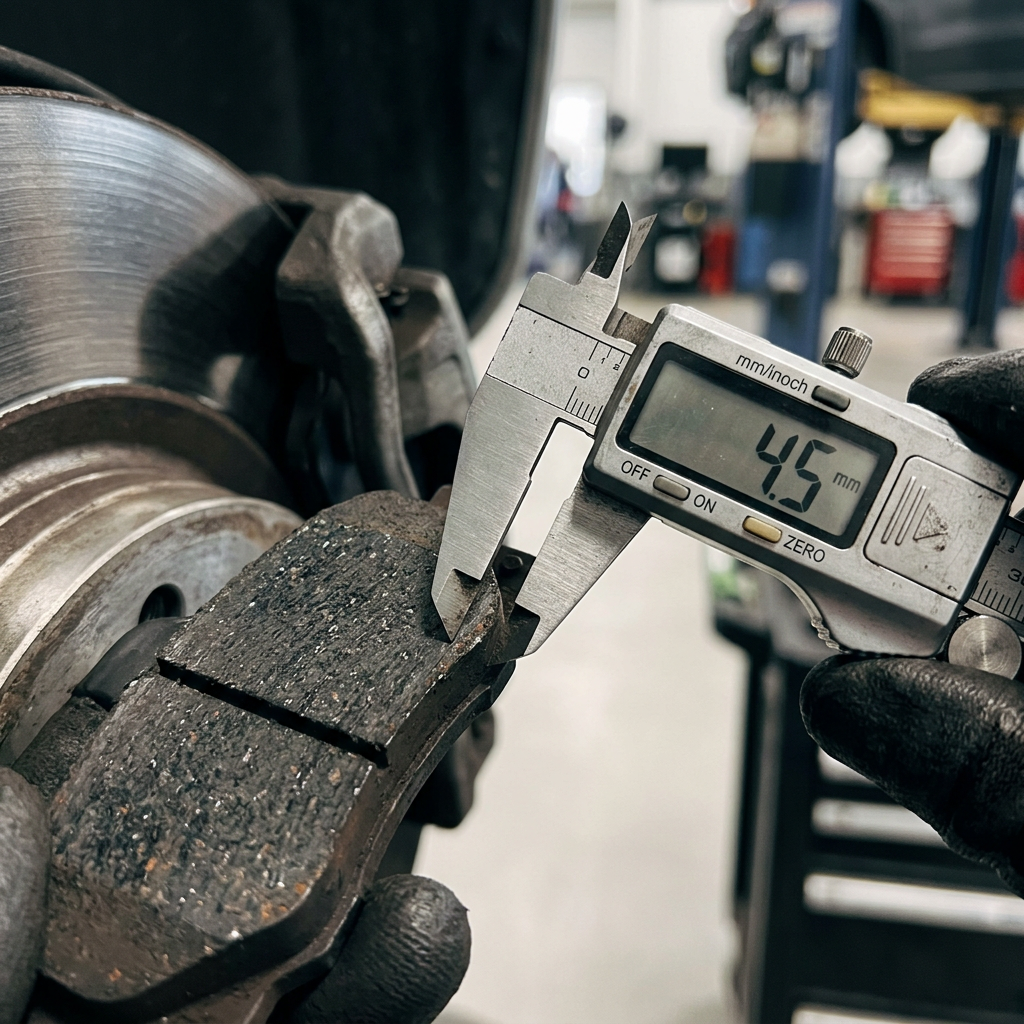
Mechanic measuring the remaining thickness of a worn brake pad using a digital caliper reading 4.5 mm. (Representative image for illustration purposes only. Actual vehicle may vary based on trim and configuration.)
When evaluated strictly by engineering specifications and automotive safety codes, the absolute minimum legal and physical safe limit for remaining brake pad friction material is 2 millimeters (2/32 in). Operating a vehicle once the pad wear drops to 2mm or below places your braking system in extreme peril: at this exact thickness, the steel backing plate is mere fractions of a millimeter away from making direct metal-to-metal contact with the brake rotor. When that contact occurs, friction coefficient drops rapidly, heat dissipation fails, and stopping distance increases exponentially while permanently damaging costly mechanical assemblies.
However, professional automotive technicians and safety agencies maintain a mandatory replacement threshold of 3 millimeters (3/32 in). The 3mm mark represents the critical professional buffer zone. At 3mm, friction material has lost its structural elasticity and capacity to effectively absorb and displace extreme kinetic heat during high-speed emergency stops. Driving anywhere between 3mm and 2mm is widely considered living on borrowed time.
To understand where your vehicle currently stands, it helps to understand the full life cycle of automotive brake pad thickness specs: • 10mm to 12mm (12/32 in): Brand New OEM Brake Pad. Full thickness delivering maximum friction, optimal heat displacement, and silent performance. • 6mm to 9mm (8/32 - 11/32 in): Green Zone / Normal Operation. Abundant friction material remaining; excellent thermal and mechanical reserve capacity. • 4mm to 5mm (5/32 - 6/32 in): Yellow Zone / Planned Maintenance Window. Friction material is roughly 60-70% consumed. It is safe for current daily commuting, but replacement should be scheduled within the next 1,000 to 3,000 miles. • 3mm (3/32 in): Red Zone / Mandatory Replacement Required. Wear indicator squealers engage; stopping distances begin expanding under hard braking. • 2mm or Less (2/32 in): Critical Danger Zone / Immediate Failure Risk. High probability of rotor gouging, piston overextension, and severe brake fade.

How to Measure Brake Pad Friction Material vs. Metal Backing Plate

A common mistake driver make during DIY vehicle inspections is measuring the total thickness of the brake pad assembly rather than isolating the friction block from the steel backing plate. A standard brake pad consists of a heavy steel backing plate (typically 4mm to 6mm thick) bonded to organic, semi-metallic, or ceramic friction lining. If you measure 8mm of total pad structure, but 5mm of that is solid steel backing plate, you actually only have 3mm of usable friction material remaining!
To measure accurately, technicians use specialized color-coded brake pad feeler gauges or digital vernier calipers. Place the gauge flat against the metallic rotor face and measure strictly the distance from the outer rotor surface to the steel backing plate seam. In a pinch, visual checks through open alloy wheel spokes using a manual 32nds-of-an-inch gauge can give a quick estimation, but inner pad wear (which often wears faster due to stuck caliper slide pins) requires removing the wheel or placing the vehicle on a service lift.
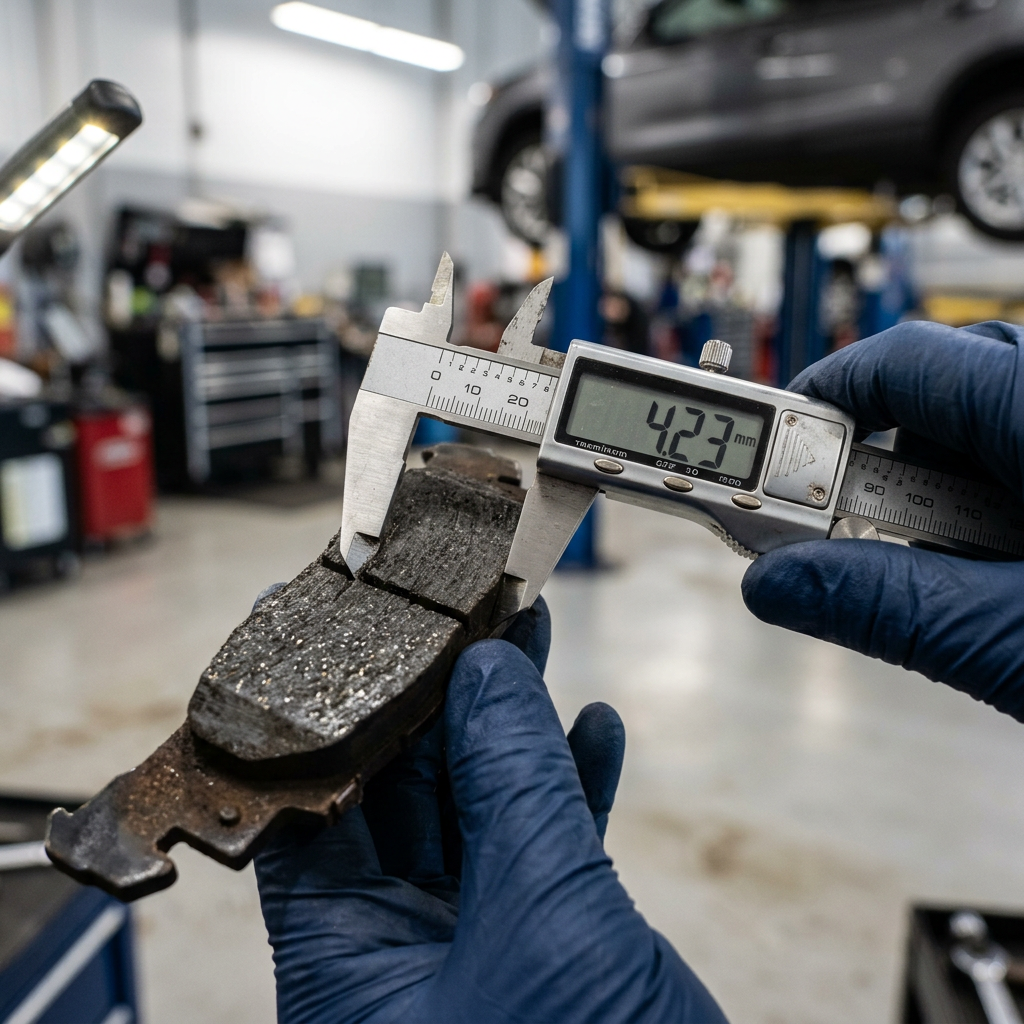
Gloved mechanic using a digital caliper to measure a worn vehicle brake pad showing 4.23 mm thickness. (Representative image for illustration purposes only. Actual vehicle may vary based on trim and configuration.)
Precision measurements ensure you never miscalculate remaining service life. A 1mm measurement error can mean the difference between safe stopping performance and catastrophic mechanical damage on high-speed rural highways.

Warning Signs That Brake Pads Have Dropped Below 3mm in Thickness

High-Pitched Squealing

Modern OEM brake pads include hardened spring-steel acoustic wear indicators (squealers). When friction material wears down to exactly 3mm, this small metal tab contacts the spinning brake rotor surface, producing a high-pitched metallic screeching sound under gentle or coasting deceleration. Ignoring this squeal guarantees transition into harsh mechanical wear.

Metal Grinding & Spongy Pedal

If the squealing stops and transitions into a deep, harsh mechanical grinding sound, your friction material is entirely depleted (under 1mm). The steel backing plate is actively gouging deep grooves into the iron rotor. Concurrently, increased hydraulic fluid volume demands in thin calipers cause a soft, spongy brake pedal travel.

Extended Stops & Dash Lights

As pads thin below 3mm, heat retention skyrockets, leading to severe brake fade during repeated slowdowns. Stopping distances can expand by 20 to 40 feet at highway speeds. Modern electronic wear sensors or master cylinder brake fluid level sensors will trigger yellow or red dashboard warnings.

Why Driving on Less Than 2mm Brake Pads Causes Catastrophic Damage

Continuing to drive once brake pad friction material drops below 2mm escalates a minor routine maintenance task into an expensive, dangerous mechanical failure. Without the thermal barrier provided by dense friction material, extreme temperatures (exceeding 1,000°F during emergency stops) transfer directly into the caliper assembly. This heat boils brake fluid, causing total loss of hydraulic brake pressure.
Furthermore, as the total pad thickness thins out, the caliper piston must extend far beyond its intended engineered travel distance to push the pad against the rotor. This hyper-extension damages rubber piston dust boots, ruins internal fluid seals, causes total fluid leaks, or can cause the piston to lock permanently into the bore, destroying the entire brake corner.

Kansas Deer Season and Rural Road Safety: Lighting and Brake Inspections for Nighttime Driving

Car headlights illuminating a deer standing on the side of a rural two-lane road at dusk. (Representative image for illustration purposes only. Actual vehicle may vary based on trim and configuration.)
Driving across Central Kansas—especially corridors along Interstate 70, K-18, US-77, and rural state routes in Geary and Dickinson Counties—presents extreme nighttime hazards during the autumn and winter months. As temperatures drop and daylight hours shrink, drivers commuting around Junction City and Fort Riley encounter a massive spike in wildlife traffic, specifically white-tailed deer crossing pitch-black county roads.
Avoiding a high-speed collision with a 200-pound animal demands two synchronized vehicle systems working at 100% capacity: uncompromised headlight clarity/aim(to spot wildlife eyes reflected at maximum distance) and flawless brake pad responsiveness (to decelerate quickly without wheel lockup or brake fade). If your brake pads are worn down to 3mm or less, your stopping distance at 65 mph can expand by as much as 30 to 50 feet—precisely the distance between a near-miss and a severe impact.

When Is Peak Deer Season in Kansas and When Are Collisions Most Likely to Occur?

According to Kansas Department of Transportation (KDOT) crash statistics, peak deer mating and migration season (commonly known as 'the rut') runs strictly from late October through mid-December, with November experiencing the absolute highest concentration of animal-vehicle collisions across the state. During this period, deer activity increases tenfold as animals move between agricultural fields and wooded river basins in search of mates.
Statistical analysis shows that over 65% of all deer-vehicle strikes in rural Kansas occur during the prime movement windows: dusk to 9:00 PM and 5:00 AM to dawn. Drivers commuting to and from Fort Riley military base early in the morning or traveling rural state highways surrounding Junction City after dark face maximum exposure. Having crisp headlight illumination and thick, responsive brake pads during these exact peak hours is your single best defense.

What Lighting and Braking Actions Do Kansas Officials Recommend When Driving Rural Roads During Deer Season?

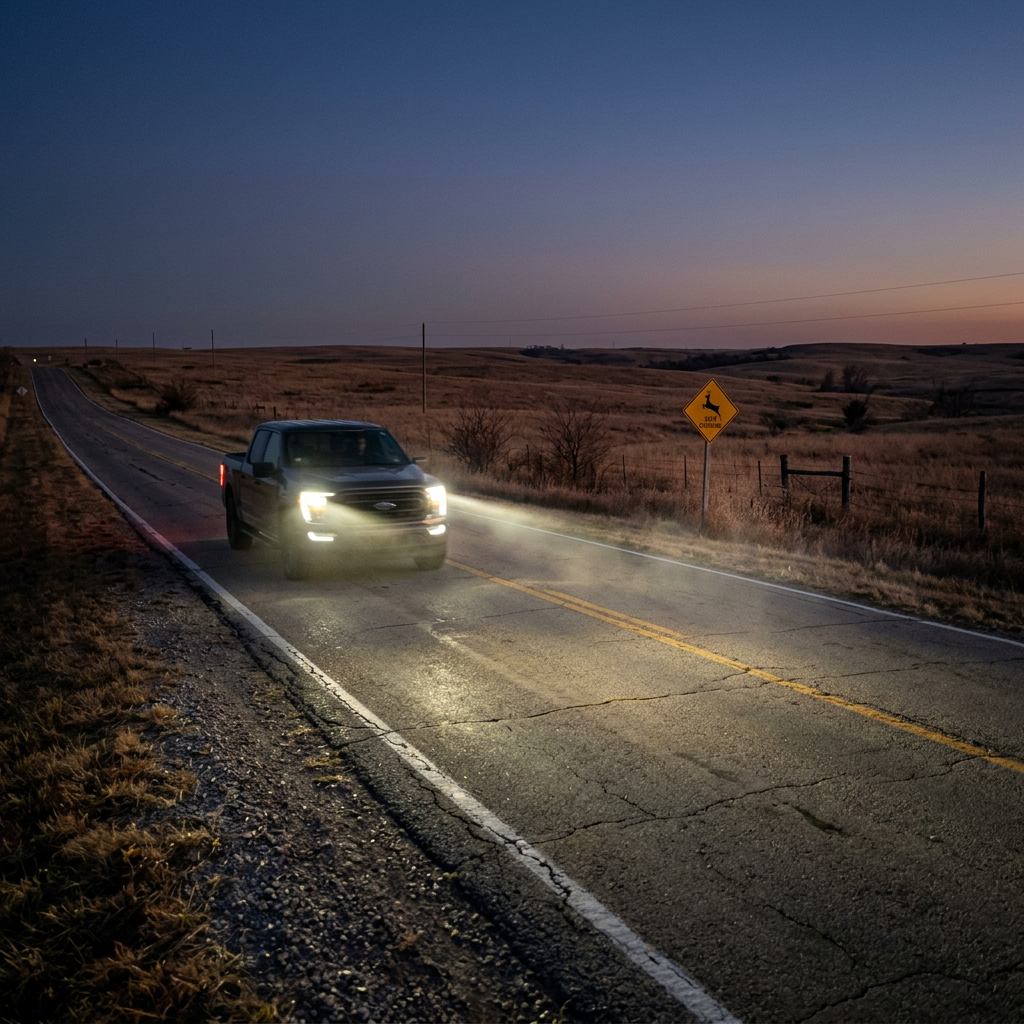
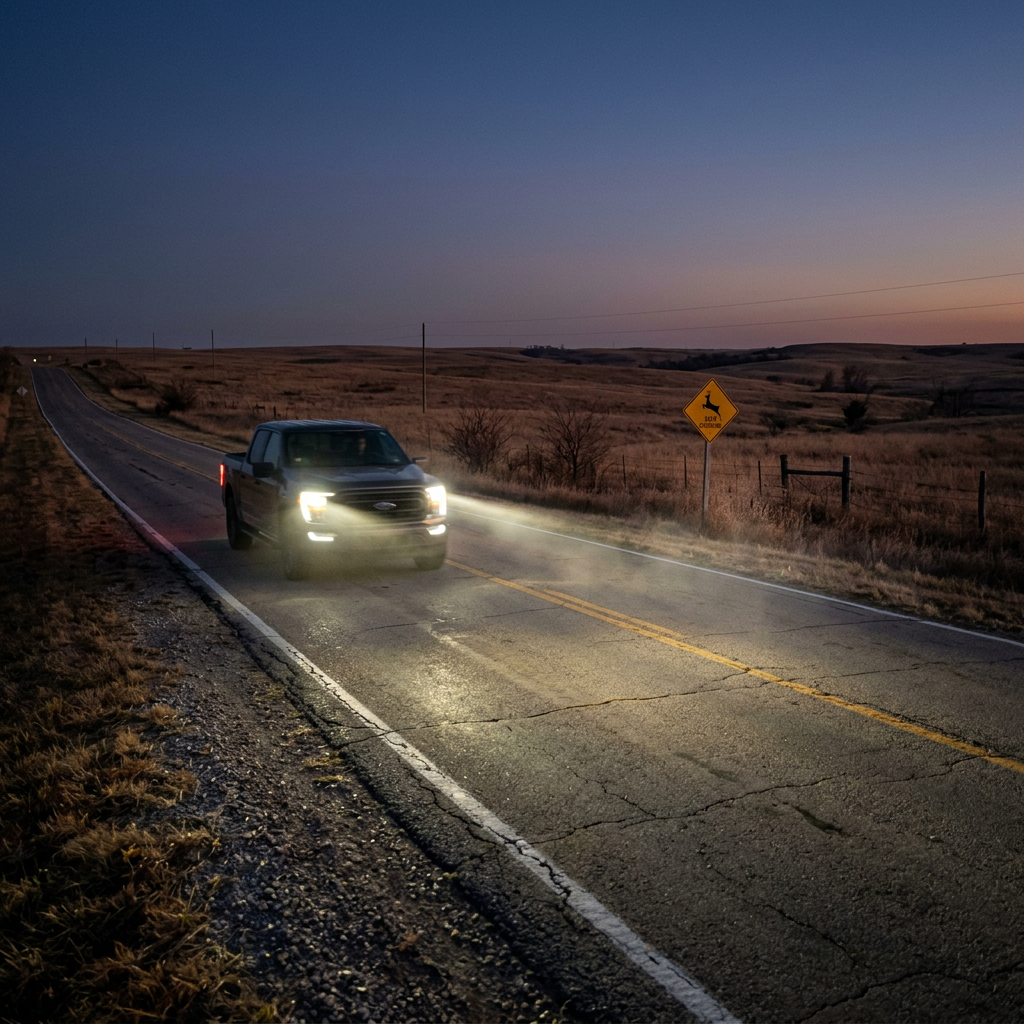
A Ford pickup truck driving down a rural country road at dusk with its headlights illuminating the path ahead. (Representative image for illustration purposes only. Actual vehicle may vary based on trim and configuration.)

Max High Beams

Use high-beam headlights continuously on unlit rural highways whenever oncoming traffic is more than 500 feet away. High beams reflect off deer eyes (tapetum lucidum) hundreds of feet earlier than standard low beams, granting vital seconds to react.

Scan Road Shoulders

Keep your eyes constantly scanning ditch lines and right-of-way fence boundaries. Deer rarely travel alone; if one deer crosses the road in front of you, expect two or three more to immediately follow directly behind it.

Brake Straight & Firmly

Kansas Highway Patrol explicitly warns: Never swerve sharply into oncoming lanes or ditch steep embankments. Swerving causes rollover crashes and head-on collisions. Execute maximum straight-line emergency braking instead.

What Should a Driver Do If a Deer Suddenly Jumps in Front of Their Vehicle on a Rural Road?

Step 1: Don't Swerve — Brake in a Straight Line. The immediate instinct to jerk the steering wheel away from an obstacle leads to tragic outcomes on rural Kansas roads. Swerving at 65 mph often causes tires to trip on loose gravel shoulders, initiating catastrophic vehicle rollovers or launching into oncoming traffic lanes. Keep your steering wheel pointed dead straight. Step 2: Stomp and Hold the Brake Pedal (Leverage ABS). Many modern Ford vehicles are equipped with advanced Anti-Lock Braking Systems (ABS). Press down with maximum force and do not pump the brake pedal. Let ABS modulate hydraulic pressure while you maintain continuous steering control.
Step 3: Release Brake Pressure Immediately Before Impact. If impact is completely unavoidable, release hard foot pedal pressure a split-second before contact. Hard braking causes the front nose of your vehicle to dip down significantly. Letting off the brake slightly allows the front suspension to rise back up, reducing the odds of the deer coming up over the hood and through the front windshield. Step 4: Pull Over Safely and Assess. After impact, bring the vehicle to a controlled stop on the right shoulder, activate hazard lights, stay inside the vehicle, and contact emergency services. Never approach an injured deer on the roadside.

What Is the Recommended Headlight Alignment Angle for Rural Nighttime Driving?

Proper headlight alignment is critical for navigating the rolling hills and unlit curves of the Flint Hills region. Factory engineering specifications state that low-beam headlight patterns should project downward with a vertical drop of 1 to 2 inches at a 25-foot distance from a flat wall target. If headlights aim too high, they blind oncoming drivers and bounce glare off fog; if aimed too low, your stopping distance easily outruns your illuminated field of vision.
Over time, driving over rough rural gravel roads, hitting potholes, or carrying heavy truck payloads can shift headlight housing adjusters out of alignment. Clouded or yellowed plastic headlight lenses can also reduce output lumens by up to 80%. A professional headlight restoration and optical aiming check ensures maximum beam penetration along dark rural ditch lines.
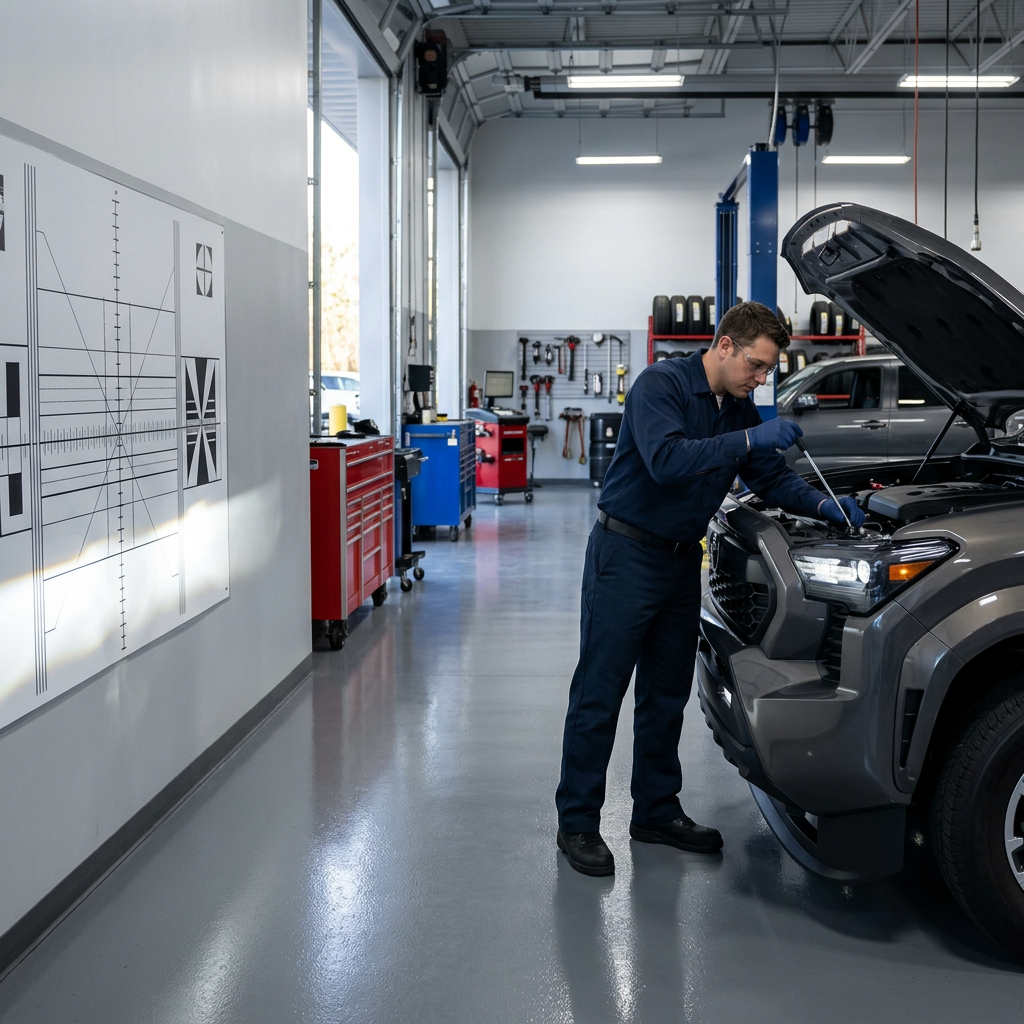
Auto mechanic adjusting headlight beam alignment on a pickup truck using a target chart on the wall. (Representative image for illustration purposes only. Actual vehicle may vary based on trim and configuration.)

How Much Does It Cost to Replace Worn Brake Pads and Rotors in Kansas?

Pads Only (Per Axle)

$150 - $275 (estimated; actual price may vary) Includes replacement of front or rear ceramic/semi-metallic brake pads, hardware kit replacement, and slide pin lubrication, provided existing rotors meet minimum discard thickness and remain unscored.

Pads & Rotors (Per Axle)

$350 - $550 (estimated; actual price may vary) Includes new OEM Motorcraft pads plus two brand-new high-carbon steel brake rotors, heavy-duty hardware clips, system bleed/flush if required, and complete digital road test.

Full 4-Wheel Overhaul

$700 - $1,100 Complete 4-wheel brake replacement including front and rear pads, four new rotors, caliper slide service, and complete brake fluid exchange. Service financing options available.

Front vs. Rear Brake Pad Wear Rates for Fort Riley Commuters and Rural Drivers

70/30 Weight Bias

Under deceleration, kinetic energy transfers momentum forward onto the front axle. As a result, front brake pads absorb nearly 70% of total vehicle stopping force, causing front pads to wear out roughly 1.5 to 2 times faster than rear pads under normal highway conditions.

Military Gate Traffic

Fort Riley commuters experiencing daily morning stop-and-go queueing at gate checkpoints accelerate brake wear. Frequent low-speed stopping keeps continuous thermal pressure on front brake calipers, burning through friction compound quickly.

Towing & Gravel Strain

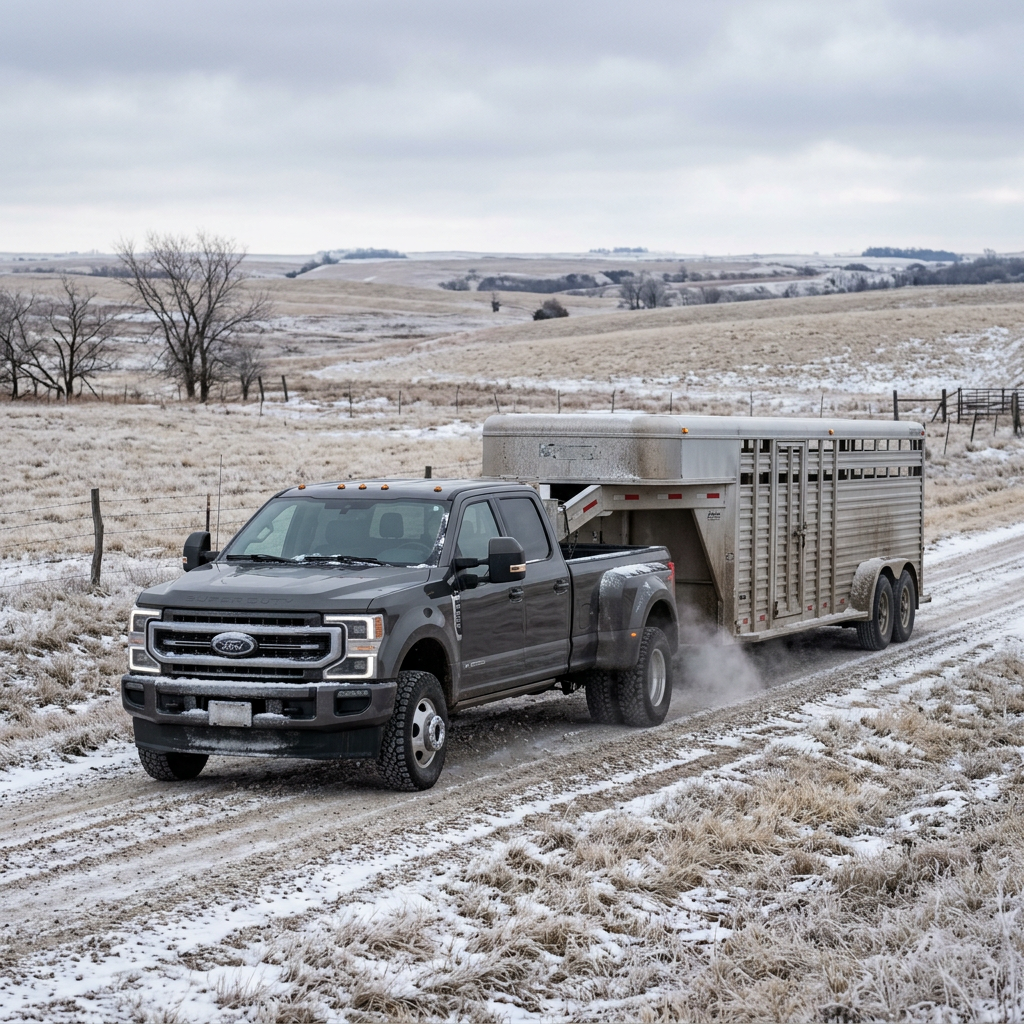
Rural truck owners towing livestock or farm trailers experience elevated rear pad wear due to Electronic Brake Force Distribution (EBD) systems counterbalancing heavy rear axle tongue loads during rural highway operation.

DIY Visual Brake Check vs. Professional Multi-Point Inspection at Valor Ford

A driveway visual inspection with a flashlight can give you a rough estimate of outer brake pad thickness, but it leaves major critical safety factors unexamined. You cannot visually inspect inner brake pad wear without pulling the wheel, nor can you measure rotor lateral runout (which causes steering wheel vibration) or test brake fluid moisture contamination levels.
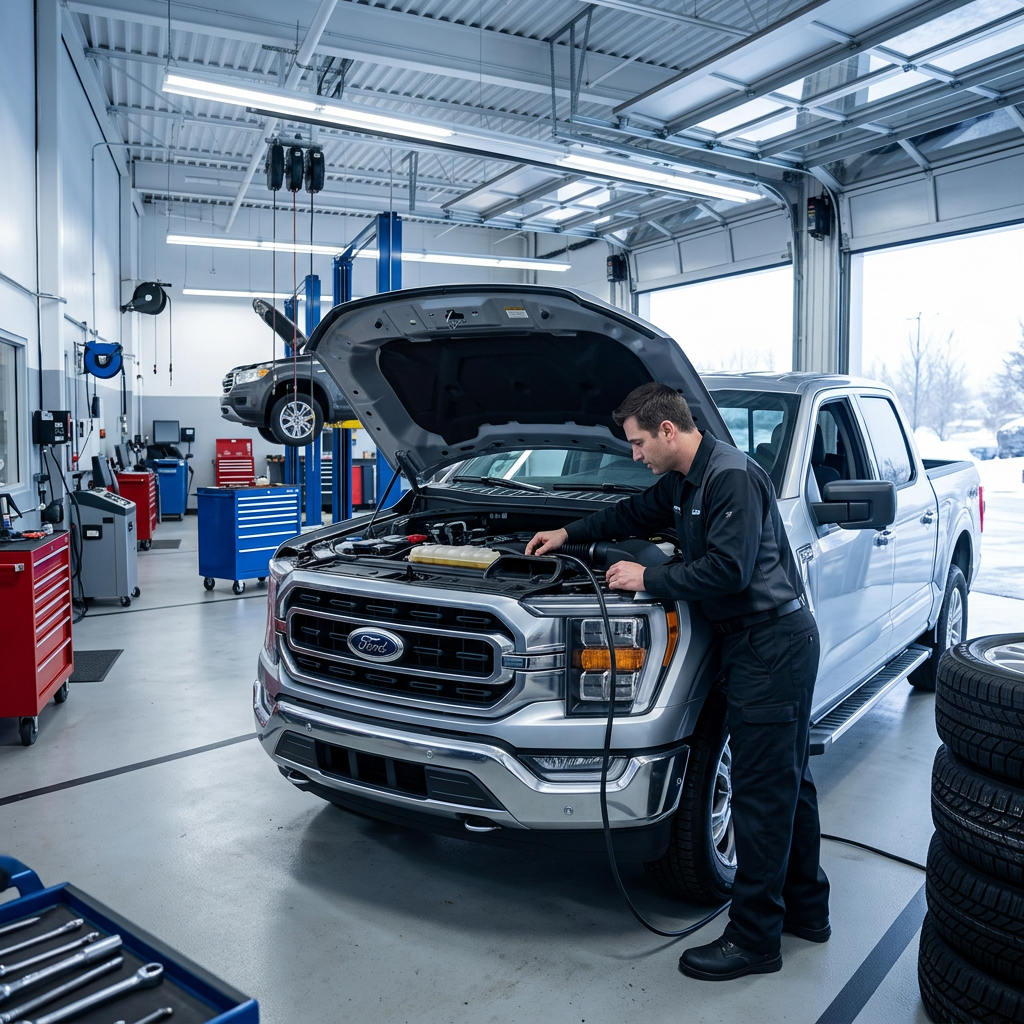
At Valor Ford in Junction City, our factory-certified Ford technicians execute a comprehensive Multi-Point Brake Inspection. We measure inner and outer pad friction material to exact tenths of a millimeter, inspect caliper slide pins and rubber dust boots, verify rotor discard thickness using precision micrometers, test hydraulic fluid boiling point, and perform headlight beam optical alignment tests.
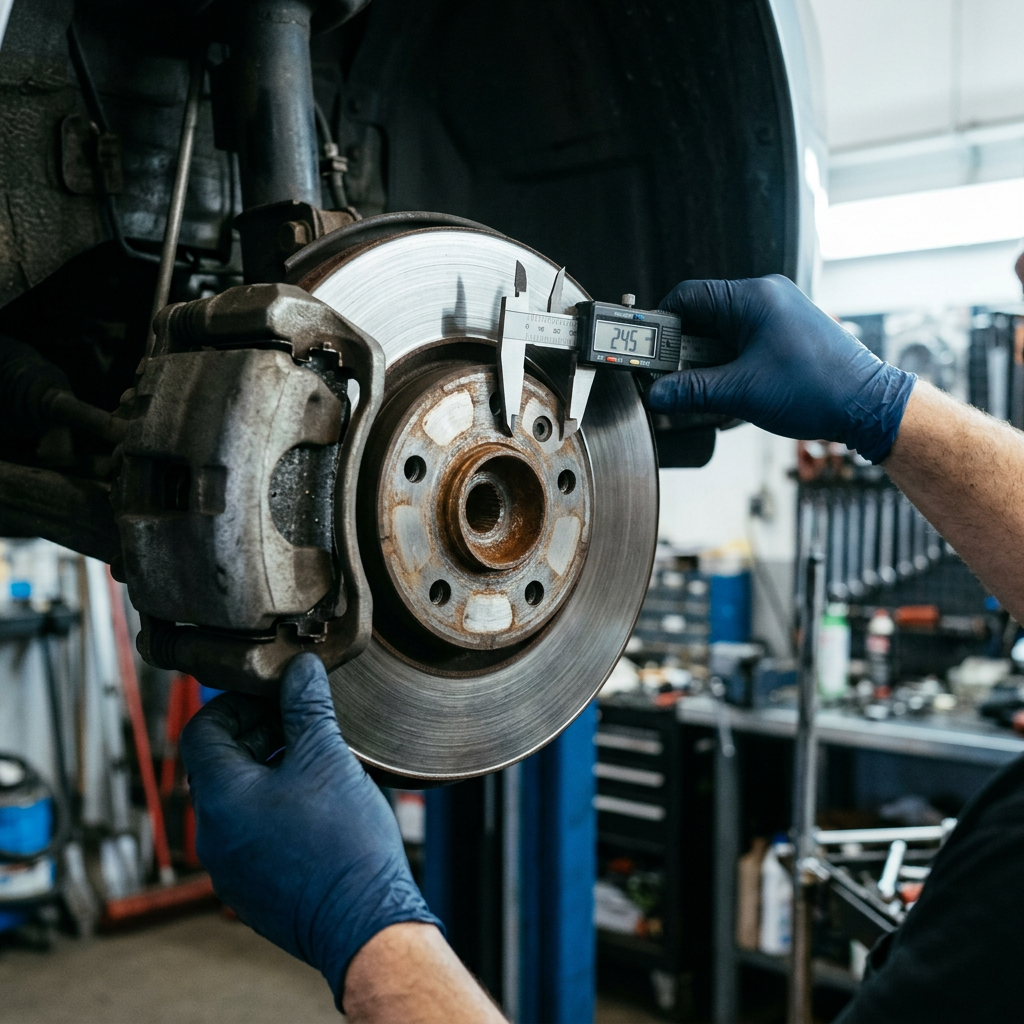
Mechanic in blue gloves measuring a car's brake rotor with a digital caliper in an auto repair shop. (Representative image for illustration purposes only. Actual vehicle may vary based on trim and configuration.)

Schedule Your Brake and Headlight Safety Inspection at Valor Ford in Junction City

Valor Automotive logo featuring a metallic shield with red V and white A monogram above bold black text.
Don't wait for screeching wear indicators or metal-on-metal grinding to compromise your safety on rural Kansas roads this fall. Ensure your vehicle has the stopping power and headlight visibility required to handle unexpected wildlife encounters and hazardous weather across Geary and Dickinson Counties.
Visit the certified service experts at Valor Ford located at 1825 Goldenbelt Blvd, Junction City, KS 66441 or Call (785) 238-5114 to book your service appointment today. Our team is dedicated to keeping your truck, SUV, or sedan operating at peak factory safety standards.

Posted in:

Related Posts

Navigating Engine Oil Viscosity in Kansas: Expert Insights from Valor Ford

Navigating Engine Oil Viscosity in Kansas: Expert Insights from Valor Ford

Navigating Engine Oil Viscosity in Kansas: Expert Insights from Valor Ford In multi-grade motor oils like 5W-30, the number before the "W" indicates low-temperature fluid mobility during cold winter starts, while the second number represents oil thickness at engine operating temperatures around 212 degrees Fahrenheit. Today, Mike Hogg, Service Director at Valor Ford with 20 years of technical automotive experience, explains how viscosity ratings and maintenance schedules impact vehicle protection in central Kansas. Q: What do the numbers in engine oil viscosity ratings like 5W-30 mean for Kansas drivers? A: The numbers in a viscosity rating represent how fluid flows under specific cold and hot operating conditions established by the Society of Automotive Engineers. The "W" stands for winter, not weight, and the number preceding it reflects how easily oil pumps through critical internal passages when an engine is cold. A lower winter rating means the fluid moves faster across moving parts on freezing mornings. The second number, such as the 30 in 5W-30, measures fluid thickness once the engine reaches its standard operating temperature of 212 degrees Fahrenheit. For commuters navigating cold morning starts in Junction City, using the correct winter viscosity ensures vital lubrication reaches overhead components before friction damage occurs. If you ever have questions about reading fluid labels or checking dipstick levels, you can visit our service center location on Goldenbelt Boulevard or simply give our service department a call. Q: How should I choose an engine oil viscosity for cold-weather starts in Junction City, KS? A: You should always choose the exact viscosity grade recommended in your vehicle's owner manual or official Ford oil application charts rather than selecting a grade based solely on outdoor temperatures. Modern engines are engineered with precise internal tolerances and hydraulic components that require specific fluid dynamics to maintain proper oil pressure. Selecting an unapproved lower viscosity in an attempt to improve cold flow can alter oil film strength when the engine reaches full temperature. The safest approach for cold weather protection is ensuring your vehicle has fresh, recommended fluid in the crankcase. Local owners can easily schedule a service appointment online to have our factory-trained technicians inspect fluid levels, or order official OEM engine components directly through our parts department. Q: Should drivers switch to a different oil viscosity or change their oil before winter? A: Vehicle owners should not change their oil viscosity grade simply because seasonal temperatures are dropping. Multi-grade oils are specifically formulated to operate across wide thermal windows, providing rapid flow during cold starts and robust protection at high engine operating temperatures. Switching to a different grade without manufacturer approval can void warranty coverage and compromise internal lubrication. You only need an oil change before winter if your vehicle is near its service interval, if the Intelligent Oil-Life Monitor signals that service is due, or if you have reached six months or 7,500 miles since your last visit. Taking care of scheduled maintenance before severe cold arrives helps ensure clean fluid is circulating through the oil filter and engine passages. Q: Why does an engine make knocking or ticking noises when started on cold mornings? A: Ticking or light knocking sounds during a cold start usually happen because thickened, cold oil takes several extra seconds to build hydraulic pressure and reach the top of the engine. Hydraulic valve lifters, overhead camshaft bearings, and timing chain tensioners rely on immediate oil pressure to operate quietly. When ambient temperatures drop significantly, fluid moves more slowly through internal oil galleries until the oil pump establishes full system circulation. While a brief moment of valve noise can occur on freezing mornings, persistent knocking or metallic sounds that continue after the engine warms indicate low fluid levels, improper fluid grade, or mechanical wear that requires immediate professional evaluation. "Cold engine oil moves much slower at startup, which is why those brief morning ticking sounds mean your hydraulic lifters are waiting for proper fluid pressure." Q: Which oil type provides the highest level of protection against extreme cold? A: Full synthetic oil delivers the maximum protection during extreme cold because of its uniform molecular structure and superior low-temperature fluid mobility. Unlike conventional oils, full synthetic formulas do not contain paraffin waxes that can crystallize and thicken when temperatures drop below freezing. This stability allows full synthetic fluid to pump effortlessly through internal channels during initial engine cranking, drastically reducing startup wear. Synthetic blend oils offer enhanced protection compared to standard conventional fluids, but full synthetic remains the benchmark for fast oil pressure development and thermal stability across severe Midwest temperature swings. Q: Can you safely mix synthetic blend and full synthetic oil in an emergency? A: Full synthetic and synthetic blend oils are chemically compatible and can be mixed in an emergency without causing engine damage. Both oil types utilize compatible base stocks and additive packages, allowing them to blend safely if you need to top off a low fluid level when the exact matching oil is unavailable. However, adding a synthetic blend to full synthetic dilutes the premium performance characteristics and cold-weather advantages of the full synthetic fluid. While this emergency mixture will safely protect internal moving components in the short term, you should schedule a complete oil and filter change using the factory-specified oil grade at your earliest convenience. Q: Does using correct low-viscosity engine oil improve fuel economy? A: Utilizing the manufacturer-specified low-viscosity engine oil, such as 0W-20 or 5W-20, improves fuel efficiency by reducing internal mechanical drag inside the engine. Thinner, highly refined oils require less energy from the crankshaft to pump through engine galleries and coat moving parts, which can increase fuel economy by roughly 1 percent to 2 percent compared to heavier, unapproved oil grades. For drivers operating agricultural or commercial light-duty trucks across Dickinson County, maintaining optimal fuel efficiency relies heavily on adhering to recommended fluid specifications and routine service intervals. Checking your dipstick monthly ensures proper oil volume and helps prevent performance losses caused by fluid breakdown. To verify your vehicle's oil specifications or schedule maintenance, feel free to stop by our physical showroom location or contact our service team directly. © 2026 Valor Ford. All rights reserved.

Essential Kansas Winter Freeze Preparation and Agricultural Towing Guide for Ford Super Duty

Essential Kansas Winter Freeze Preparation and Agricultural Towing Guide for Ford Super Duty

Essential Kansas Winter Freeze Preparation and Agricultural Towing Guide for Ford Super Duty As fall turns to late autumn across Central Kansas, agricultural operators in Dickinson County, Geary County, and the surrounding Flint Hills face one of the most demanding operational windows of the year. Kansas winter freezes bring sudden sub-zero wind chills, heavy frost, and ice-covered gravel lanes. For farmers, ranchers, and commercial haulers rely on the rugged strength of the Ford Super Duty lineup—including the F-250, F-350, and F-450—winter weather is not a reason to pause operations. Heavy grain trailers, livestock stock trailers, round balers, and seed tenders must continue moving regardless of the temperature display in the gauge cluster. To ensure your truck operates reliably when ambient temperatures plummet below freezing, proactive preparation is vital. Preparing your Ford Super Duty requires a dual-focused strategy: safeguarding the high-output 6.7L Power Stroke V8 Turbo Diesel powertrain against cold-weather fuel gelling and electrical strain, while optimizing heavy agricultural towing stability via Ford's available trailer and payload assistance features. Plugging in your factory engine block heater when overnight lows drop under 20°F, treating ultra-low sulfur diesel fuel with anti-gel additives, verifying dual battery cold-cranking amp capacity, and keeping gooseneck tongue weight precisely balanced are essential steps to keep your farm productive and safe. At Valor Ford in Junction City, KS, our team understands the exact pressures Kansas agricultural operations face. Whether you are moving livestock along US-77 or clearing access drives near Fort Riley, this guide details the exact steps needed to protect your Ford Super Duty engine, transmission, and towing assembly before the first sub-zero freeze arrives. What Cold Weather Features Come Standard or Optional on the Ford Super Duty Diesel for Winter Operation? The Ford Super Duty is engineered specifically to tackle extreme ambient conditions. Standard and available cold-weather packages turn the 6.7L Power Stroke V8 Turbo Diesel into an unyielding winter workhorse. Understanding how these features function allows farm operators to optimize efficiency and cabin comfort during early morning chores. available supplemental cab heater: Diesel engines produce exceptional torque but require time to reach optimal operating temperatures in sub-zero air. Ford’s available electric Supplemental Cab Heater provides immediate warm air to defrost windshields and heat the interior long before engine coolant fully warms up. Dual Alternator Systems & Heavy-Duty Glow Plugs: To power high-draw accessories, snowplows, and emergency lighting, Super Duty diesel models offer dual alternator configurations outputting up to 410 amps combined. Fast-acting ceramic glow plugs rapidly preheat cylinder combustion chambers for fast, clean cold starts. Engine Exhaust Brake & Heated Ergonomics: The driver-selectable Engine Exhaust Brake uses the variable-geometry turbocharger to create backpressure, providing controlled deceleration on slick downgrades without overheating friction brakes. Inside, available heated leather seats, heated steering wheels, and heated power-folding mirrors keep drivers focused and comfortable. If you are exploring upgrades for your fleet, you can Research Ford F-250 features directly through our online model guides. Where Is the Engine Block Heater Plug Located on a Ford Super Duty Truck? One of the most frequent questions our service advisors receive at Valor Ford when winter approaches is locating the engine block heater cord. On 6.7L Power Stroke diesel models, the block heater element is recessed into the engine block to heat engine coolant directly. The wiring harness routes forward to the front fascia. Locating the Plug: Look behind the front bumper, tucked into the lower grille opening on the passenger side or near the driver's side tow hook cover (depending on trim year and bumper configuration). The plug is protected by a weather-resistant plastic cap. If the cord is retracted or clipped back for summer driving, unclip the retaining fastener to pull the standard 3-prong plug forward. Best Practices for Extension Cords & Timers: • Always use a heavy-duty, outdoor-rated 10/3 or 12/3 SJOW grounded extension cord rated for 15 amps minimum. Thin household extension cords will overheat and create a fire hazard. • You do not need to run the block heater all night long. A heavy-duty outdoor timer set for 3 to 4 hours before your anticipated departure time provides full preheating benefit while saving electricity. • Plug in the heater whenever ambient overnight temperatures are forecasted to drop below 20°F (-7°C). Pre-warmed engine oil flows immediately upon startup, reducing engine wear and battery strain. What Is the Maximum Gooseneck Towing Capacity of the Ford Super Duty for Agricultural Equipment? When moving large livestock trailers, heavy tractors, or fully loaded grain hoppers across rolling Kansas topography, understanding your truck's Gross Combined Weight Rating (GCWR) and maximum gooseneck towing capabilities is vital for safety and compliance. The Ford Super Duty chassis is engineered with high-strength, fully boxed steel frames and heavy-duty axle assemblies designed to handle tremendous tongue weights. Super Duty Model Configuration Max Gooseneck Towing Max Conventional Towing Max Payload Ford F-250 Super Duty 6.7L Power Stroke V8 / SRW Up to 23,000 lbs Up to 22,000 lbs Up to 4,260 lbs Ford F-350 Super Duty 6.7L High Output Power Stroke / DRW Up to 38,000 lbs Up to 28,000 lbs Up to 8,000 lbs Ford F-450 Super Duty 6.7L High Output Power Stroke / DRW Up to 40,000 lbs Up to 30,000 lbs Up to 8,000 lbs Operating in winter demands extra margin. Snow accumulation on equipment and trailers adds hidden weight, while icy roads reduce traction. Always check your specific driver's door pillar door-jamb sticker for exact GVWR and GAWR figures before hitting the road. To compare towing capacities across our heavy-duty fleet, take a look at our Research Ford F-250 page or check out options for the larger F-350 and F-450. Research Ford F-250 Towing Specs How Do available trailer and payload assistance features Assist with Heavy Agricultural Loads? Real-Time Payload Estimation Ford's Onboard Scales measure real-time payload weight directly in the truck bed using integrated suspension sensors. As grain bags, seed pallets, or tools are loaded, the weight displays dynamically on the 12-inch SYNC 4 touchscreen or through the Ford App. Smart Hitch Tongue Weight Proper tongue weight percentage (10-15% for conventional, 15-25% for gooseneck) is critical to prevent dangerous trailer sway on icy rural roads. Smart Hitch calculates actual tongue weight and advises whether to shift cargo forward or rearward before you pull out. available trailer lighting features When loading equipment in remote pastures without looking at the cab screen, integrated LEDs within the taillights operate like a battery gauge. They illuminate progressively as weight approaches max capacity, flashing if payload limits are exceeded. Can the Ford Super Duty Support a Heavy-Duty Commercial Snowplow for Farm Driveway Clearing? Clearing long farm lanes, cattle feedlots, and private access roads around Junction City, Abilene, and Fort Riley requires serious clearing power. The Ford Super Duty is custom-engineered for heavy snowplow mounting when fitted with the factory Snow Plow Prep Package. Key Components of the Snow Plow Prep Package: • Pre-selected computer-matched heavy-duty front springs designed to handle up to 1,000 lbs of heavy steel V-plow equipment. • High-output alternator options (up to 410A dual alternators) to ensure plow hydraulic pumps do not drain battery reserves. • Heavy-duty frame crossmembers and pre-drilled frame mounting points for secure blade frame attachment. • Upfitter switches integrated into the overhead console, allowing seamless in-cab control of plow lighting, strobe safety lights, and salter/spreader equipment. Preventing Diesel Fuel Gelling and Fuel System Freeze-Ups in Central Kansas Sub-zero cold snaps in Kansas create a distinct hazard for diesel truck owners: fuel gelling. Ultra-Low Sulfur Diesel (ULSD) naturally contains paraffin wax. Under normal summer temperatures, this wax remains liquid. However, as ambient temperatures drop toward the fuel's 'Cloud Point' (typically around 15°F to 20°F), wax molecules begin crystallizing, plugging the fuel filter and starving the high-pressure fuel pump. Step-by-Step Diesel Freeze Prevention: 1. Use Motorcraft Anti-Gel Additive: Treat your fuel tank at every fill-up before freezing temperatures arrive. Anti-gel additives lower the Cold Filter Plugging Point (CFPP) down to -20°F or lower, keeping paraffin wax in liquid suspension. 2. Drain the Water-in-Fuel (WIF) Separator Bowl: Moisture condensation naturally forms inside fuel tanks. If water collects in the lower separator housing, it freezes solid, blocking fuel delivery. Use the drain valve located under the driver's side frame rail to purge water monthly. 3. Replace Primary and Secondary Fuel Filters: Old fuel filters containing trapped debris and residual moisture gel far faster than fresh filters. Replace both filters prior to the first cold front. You can easily Order Genuine Ford Parts including OEM Motorcraft fuel filters directly from our parts center. Order Motorcraft Anti-Gel & Fuel Filters Testing Dual Batteries and High-Output Alternators Before First Freeze Cold Cranking Amps (CCA) At 0°F, a battery loses up to 50% of its cranking power while thick cold engine oil doubles starting resistance. Dual 750+ CCA AGM batteries are necessary to turn over high-compression 6.7L diesel V8s. Digital Load Testing A single weak battery in a dual-battery diesel system will drag down the healthy battery, leading to click-no-start conditions in rural pastures. Individual digital conductance testing identifies failing cells early. Our technicians perform battery conductance testing to verify terminal cleanings, strap tightness, and alternator charging output. Selecting Winter All-Terrain Tires and Maintaining Brake Systems for Heavy Loads Traction is the primary constraint when hauling heavy agricultural loads across frozen pastures or icy highway routes. Standard highway-terrain tires harden in sub-zero cold, significantly lengthening stopping distances. Equipping your F-250 or F-350 with 3-Peak Mountain Snowflake (3PMSF) rated heavy-duty all-terrain tires provides rubber compounds designed to remain flexible below 45°F. Cold Tire Inflation Pressure Drop: Tire pressure drops roughly 1 to 2 PSI for every 10°F drop in outdoor temperature. Running underinflated heavy-duty load-range E or F tires under heavy gooseneck loads causes excessive sidewall flexing and heat buildup, raising blowout risks. Integrated Trailer Brake Controller & Exhaust Brake: • Calibrate your integrated trailer brake controller gain setting on snow or packed gravel. Excessive gain will lock up trailer brakes on slick patches, causing dangerous jackknifing. • Test your 6.7L engine exhaust brake before winter arrives. Selecting Auto mode allows the truck to automatically manage engine braking to maintain set speed down grades, keeping wheel brakes cool and preventing wheel lockup. Pre-Winter Fluid Changes and Undercarriage Corrosion Protection Synthetic Winter Engine Oil Switching to Motorcraft 5W-40 or 0W-40 Synthetic Heavy Duty Diesel Engine Oil ensures immediate oil pump pressure and rapid lubrication to critical turbocharger bearings during initial sub-zero startups. Differential & Transfer Case Service Heavy farm towing strains front/rear differentials and electronic transfer cases. Inspecting fluid levels for moisture contamination or metal shavings prevents costly winter drivetrain failures. Kansas road crews treat highways with liquid magnesium chloride and salt. Applying protective underbody barrier sprays protects steel frame rails and brake lines from chemical corrosion. Equipping Your Super Duty Cab for Extreme Winter Field Emergencies When operating across vast acreage or remote Flint Hills pastures, getting stranded in sub-zero wind chills is a serious safety concern. Equipping your lockable under-seat rear storage with a dedicated farm safety kit ensures you remain warm and self-sufficient until help arrives. Essential Emergency Field Kit Checklist: • Heavy-duty recovery kinetic tow rope (30,000+ lb capacity) and rated soft shackles. • Portable lithium-ion heavy-duty jump pack (capable of starting 6.7L diesels without a second vehicle). • Heavy-duty traction boards, folding snow shovel, and bag of ice-melt gravel. • Thermal emergency blankets, insulated work gloves, high-lumen headlamp, and non-perishable rations. FordPass Connect Remote Features: Leverage FordPass Connect to scheduled remote-start your Super Duty from your smartphone. Set cabin heating and defrosters to activate automatically, allowing the vehicle to reach full operating temperature before you step outside. If your busy schedule leaves little time for dealer visits, you can Schedule Pickup and Delivery Service for routine winter maintenance. Schedule Pickup & Delivery Service Expert Winterization and Heavy-Duty Truck Service in Junction City, KS Valor Ford is proud to serve as the premier heavy-duty truck hub for Junction City, Dickinson County, Geary County, and military families stationed at Fort Riley. Our state-of-the-art service facility features heavy-duty lifts and specialized diagnostic equipment designed specifically for commercial and agricultural Ford Super Duty trucks. Our factory-certified Senior Master Technicians receive specialized training on 6.7L Power Stroke diesels, TorqShift 10-speed automatic transmissions, and electronic 4WD systems. We stock genuine OEM Motorcraft filters, fluids, AGM batteries, and gooseneck hitch components to keep your downtime to a absolute minimum. Stop by our dealership at 1825 Goldenbelt Blvd or Get Directions to Valor Ford to speak directly with our commercial truck service advisors. Schedule Your Ford Super Duty Winterization and Towing Inspection at Valor Ford Don't wait until the first hard freeze locks up your fuel lines or drains your truck battery. Ensure your Ford F-250, F-350, or F-450 Super Duty is completely prepared to handle heavy agricultural towing and harsh winter weather this season. Contact our certified service team today to schedule your comprehensive pre-winter multi-point inspection, diesel fuel system service, battery load test, and gooseneck hitch alignment. Call us at (785) 238-5114 or use our online portal below. If you are also evaluating trade-in options for your current fleet, feel free to fill out our online Trade In Evaluation or Browse Used Inventory today. Schedule Ford Service Today


Preparing Your 4WD Ford Truck for Kansas Winter: Expert Service Advice from Valor Ford

Preparing Your 4WD Ford Truck for Kansas Winter: Expert Service Advice from Valor Ford

Preparing Your 4WD Ford Truck for Kansas Winter: Expert Service Advice from Valor Ford What is the Cost to Install an Engine Block Heater on a Ford F-150? Installing an engine block heater on a Ford F-150 typically costs between $150 and $350 for parts and labor when completed at a factory-authorized service center, whereas ordering the heating element pre-installed from the factory on a new truck build generally costs around $90 to $120. The total retrofit cost depends on your truck's engine configuration and whether additional wiring harnesses or coolant flushes are required during installation. In my 20 years managing truck maintenance in our service department, I have found that an engine block heater is one of the most cost-effective winter additions you can make for hard Kansas freezes. The heating element sits directly in an engine block freeze plug port, submerging into the engine coolant jacket. When plugged into a standard 110-volt household outlet, it warms the engine block and internal fluids, allowing motor oil to maintain fluid viscosity before you turn the key. Retrofitting an aftermarket heater requires draining the engine cooling system, removing a freeze plug or threading into a designated port on blocks like the 3.5L EcoBoost V6, mounting the element, routing the heavy-duty power cord safely through the front grille, and performing a full coolant vacuum refill. If you are reviewing 2026 Ford F-150 service details or getting your current truck ready for sub-zero mornings, our shop can complete this procedure in a single afternoon. For drivers scheduling maintenance in town, you can check our service center location or give us a quick call at (785) 238-5114 to verify current labor rates and part availability for your model year. Beyond effortless morning ignition, a block heater significantly reduces starter motor draw and cold-start cylinder wear. Because the engine block reaches operating temperature faster, your truck's climate control system starts blowing warm air into the cabin almost immediately, eliminating long idling periods on frozen driveways. Table of Contents How Long Should an Engine Block Heater Be Plugged In Before Starting? What is the Difference Between 4A and 4H and Which is Better on Icy Highways? Do 3-Peak Mountain Snowflake (3PMSF) Rated All-Terrain Tires Work Well in Kansas Winters? Are Dedicated Snow Tires Better Than All-Terrain Tires for Kansas Driving? Which 4WD-Specific Checks and Operating Cautions Matter Before Kansas Winter? How Long Should an Engine Block Heater Be Plugged In Before Starting? An engine block heater only needs to be plugged in for 2 to 3 hours prior to starting your truck to heat the engine block and coolant to optimal starting temperature. Leaving the heater plugged in all night provides no additional thermal benefit and unnecessarily increases your monthly electric bill. The heat transfer inside the engine reaches thermal equilibrium after roughly three hours. Once the block and coolant reach roughly 100 to 120 degrees Fahrenheit above ambient temperature, heat dissipates into the surrounding cold air as fast as the heating element generates it. Plugging the truck in for eight hours overnight simply draws electricity without raising engine oil or coolant temperatures any further. To simplify your morning routine, I always recommend using a heavy-duty outdoor grounding timer rated for at least 15 amps. You can set the timer to energize three hours before your morning commute. If you need a replacement power cord or factory terminal cap, our team can help you with ordering genuine Ford parts and accessories designed specifically for your truck's front bumper harness. Using a block heater for those two to three hours keeps internal engine lubricants flowing freely the moment the crankshaft turns. Standard motor oil thickens when ambient temperatures drop toward zero, forcing the oil pump to work harder to build upper valvetrain pressure. Pre-heating the engine protects vital internal bearings, Turbocharger feed lines, and valve actuators during those crucial first few seconds of cold operation. What is the Difference Between 4A and 4H and Which is Better on Icy Highways? The mechanical difference between 4A and 4H is that 4A (4WD Auto) utilizes an electronically controlled center clutch pack to dynamically distribute torque between the front and rear axles on demand, whereas 4H (4WD High) mechanically locks the front and rear driveshafts together at a rigid 50/50 torque split. For driving on icy highways with variable road conditions, 4A is vastly superior and safer because it allows the front and rear axles to rotate at different speeds during turns, eliminating dangerous driveline binding. Highway driving during a Midwestern winter rarely presents uniform surface conditions. You often encounter alternating stretches of packed snow, wet slush, black ice on bridge decks, and completely bare, dry asphalt. Operating in 4H on dry pavement causes severe driveline binding because your front tires must travel along a wider turning radius than your rear tires during lane changes or gentle curves. On high-traction surfaces, the locked transfer case cannot slip, forcing tires to hop—a phenomenon known as crowhopping—which places immense mechanical strain on axle shafts, universal joints, and internal transfer case gears. In contrast, 4A mode continuously monitors wheel speed sensors, throttle position, and steering angle. The system operates primarily in rear-wheel drive to optimize fuel efficiency, but instantly energizes the electromagnetic clutch to direct torque forward the millisecond rear wheel slip is detected. Across the rolling farmland and open prairie roads of Dickinson County, where ground winds drift snow across dry pavement without warning, 4A gives drivers automatic front-wheel pull precisely when needed without requiring manual lever or dial adjustments while driving. Reserve 4H strictly for continuous, unpaved ice or deep, unbroken snow where maximum, uninterrupted four-wheel traction is required at lower speeds. Do 3-Peak Mountain Snowflake (3PMSF) Rated All-Terrain Tires Work Well in Kansas Winters? 3-Peak Mountain Snowflake (3PMSF) rated all-terrain tires perform exceptionally well in Kansas winter conditions, delivering reliable acceleration and cornering stability in deep snow, slush, and light ice without the need to swap tires every spring. Unlike standard M+S (Mud and Snow) branded tires, 3PMSF-certified tires undergo rigorous standardized industry testing to prove they deliver at least 10 percent greater acceleration traction on medium-packed snow. The performance gap comes down to tread rubber compounding and siping density. Standard all-season tire rubber hardens when ambient temperatures drop below 45 degrees Fahrenheit, becoming stiff and losing its ability to grip subtle road imperfections. 3PMSF-rated all-terrain tires feature advanced silica-infused rubber compounds that remain flexible in sub-freezing temperatures, allowing the tread blocks to conform to icy road surfaces. Modern 3PMSF all-terrain tires incorporate high-density zigzag sipes—microscopic slits cut into the tread blocks—that bite into hard-packed snow and create snow-on-snow traction. Aggressive outer shoulder lugs and deep perimeter grooves also channel thick slush away from the tire footprint, preventing high-speed slushplaning on highway lanes. For truck owners who haul trailers, drive on gravel roads, or use their vehicles for work throughout the year, a 3PMSF-rated all-terrain tire offers impressive multi-season versatility. If you want to check your current tire tread depth or rubber pliability before winter hits, consider scheduling a winter tire inspection online with our certified technicians. Are Dedicated Snow Tires Better Than All-Terrain Tires for Kansas Driving? Dedicated winter snow tires outperform all-terrain tires on glare ice, hard-packed snow, and frozen asphalt because they utilize soft rubber compounds and dense siping designed exclusively for freezing friction. On sheer ice, dedicated winter tires can reduce braking distances by up to 30 percent compared to standard or all-terrain tires. While 3PMSF all-terrain tires excel in deep snow and off-road slush, dedicated winter tires feature a much softer tread compound packed with specialized microscopic sipes across every square inch of the tread face. These sipes create thousands of biting edges that slice through the microscopic water film created by friction on ice, granting superior lateral grip during emergency lane changes and sudden stops. Tire Type Best Surface Application Sub-Zero Rubber Flexibility Ice Braking Performance Year-Round Driving Suitability All-Season Tires Mild rain and dry pavement above 45°F Hardens in cold weather Moderate to poor stopping distances Excellent summer and fall wear 3PMSF All-Terrain Tires Deep snow, slush, gravel, and trail use Remains flexible below 45°F Strong snow traction; moderate ice grip Excellent year-round option Dedicated Snow Tires Glare ice, packed snow, and sub-zero roads Maximum softness in extreme cold Shortest stopping distance on ice Low (soft rubber wears fast above 45°F) The primary downside of dedicated winter tires on a heavy truck is rapid tread wear when driven on dry, warm asphalt. If you frequently tow heavy loads or drive long highway distances once roads clear, the ultra-soft rubber of a dedicated snow tire wears quickly. For most Kansas pickup owners, a high-quality 3PMSF-rated all-terrain tire provides the best practical balance between winter safety and long-term tread life. Which 4WD-Specific Checks and Operating Cautions Matter Before Kansas Winter? Preparing your truck's four-wheel-drive system for winter requires inspecting transfer case and differential fluids, testing integrated wheel end (IWE) vacuum actuators, verifying battery cold-cranking capacity, and calibrating terrain management modes like Slippery mode. Performing these checks before freezing weather arrives prevents slow front-axle engagement, vacuum leaks, and unexpected mechanical fault codes on frozen roads. Low ambient temperatures increase fluid viscosity inside driveline components. If your transfer case or differential fluid is old or contaminated with moisture, cold weather makes the fluid thick and sludge-like, delaying internal clutch engagement. Servicing transfer cases with factory-specified lubricants like Motorcraft MERCON LV protects internal planetary gear sets and multi-plate clutch packs from premature wear. Technicians also test front hub vacuum lines and IWE actuators to ensure smooth hub engagement when switching drive modes. Battery health is equally critical for modern electronic 4WD systems. Cold weather slows down internal battery chemical reactions, reducing cold-cranking amps right when the engine requires maximum electrical energy to turn over. Electronic transfer case shift motors and electromagnetic engagement clutches draw significant electrical current; a marginal battery can cause voltage drops that prevent the 4WD system from engaging properly during a cold start. Winter Driveline Inspection Checklist: 1. Transfer Case Lubricant: Check fluid level and clarity (recommend MERCON LV replacement every 30,000 to 60,000 miles). 2. Front & Rear Differentials: Inspect gear oil levels and check housing seals for fluid weeping. 3. Hub Actuators & Vacuum Lines: Test Integrated Wheel End (IWE) engagement and vacuum line integrity. 4. Battery Load Test: Verify Cold Cranking Amps (CCA) output and clean battery terminal posts. 5. Electronic Drive Modes: Test selector dial function to confirm smooth switching between 2H, 4A, 4H, and Slippery mode. In our shop, owners ask whether leaving 4A mode engaged full-time drops fuel economy during cold snaps—it can slightly lower efficiency depending on driving conditions, but the instant traction on variable winter roads is well worth it. For drivers managing daily commutes around Junction City, taking time for a seasonal driveline checkup ensures complete confidence when winter storms roll in. To get your truck ready for the cold months ahead, stop by for a quick checkup by visiting our dealership or reach out to our service team at (785) 238-5114 to reserve your appointment. © 2026 Valor Ford. All rights reserved. Vehicle specification data © JATO Dynamics Limited.