
Blog / Buying Guides

2026 Ford Mustang Mach-E vs 2026 Ford Mustang

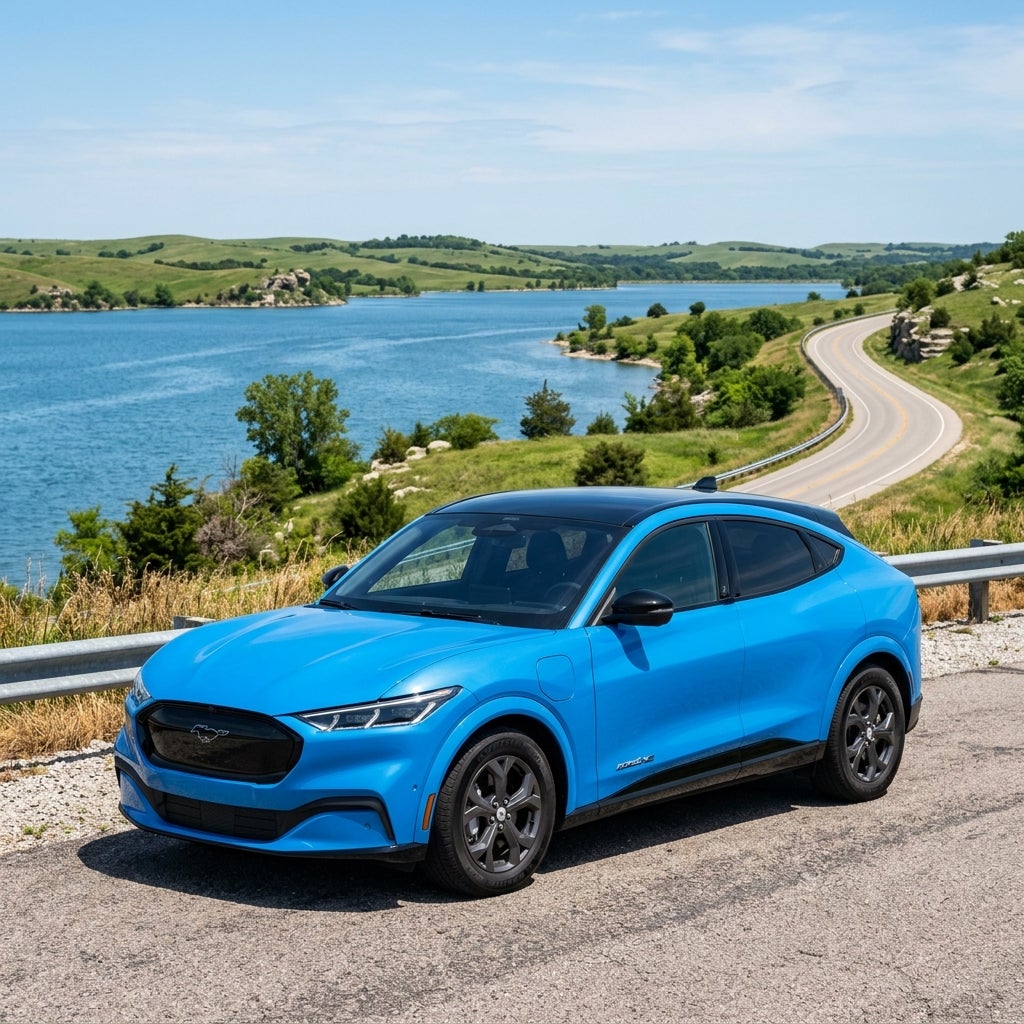
A blue Ford Mustang Mach-E parked on a roadside overlooking a scenic lake and rolling green hills. (Representative image for illustration purposes only. Actual vehicle may vary based on trim and configuration.)

2026 Ford Mustang Mach-E vs 2026 Ford Mustang

Choosing between a cutting-edge electric crossover and a traditional high-performance sports coupe represents one of the most exciting decisions in the modern automotive landscape. While both vehicles proudly wear the iconic pony badge, they serve vastly different lifestyles, balancing raw emotional power with everyday family utility. This comprehensive comparison explores how these two distinct engineering philosophies perform, protect, and deliver value for local drivers.

Why Junction City Drivers Are Choosing Between the 2026 Ford Mustang Mach-E and Mustang

Many of our customers who visit our showroom find themselves at a fascinating crossroads, balancing the practical demands of family life with a deep-seated passion for American performance heritage. Under its global platform, Ford is executing a disciplined shift toward purposeful, lifestyle-driven enablement, emphasizing the power of choice across diverse powertrains. This strategic pivot allows buyers to select the exact level of utility and performance they need. The 2026 Ford Mustang Mach-E is positioned as a stylish, tech-forward entry in the midsize electric crossover segment, bridging the gap between zero-emission family transit and engaging driving dynamics. Meanwhile, the traditional 2026 Ford Mustang coupe remains the definitive guardian of classic sports-car thrills, appealing to drivers who prioritize mechanical feel and track-bred capability.

For active households, military professionals, and daily commuters, deciding between these two models involves comparing their distinct trim structures and price points. The Mustang Mach-E lineup features the efficient Premium RWD starting at a base MSRP of $40,595, the versatile Premium AWD at $43,595, and the high-performance GT AWD at $53,890, with all trims sharing a destination charge of $2,045. The Mustang coupe offers the approachable EcoBoost starting at a base MSRP of $32,995, the upgraded EcoBoost Premium at $36,345, and the extreme, track-focused Dark Horse at $64,080, with a shared destination charge of $1,995. If you are ready to make the switch, our team can help you value your trade-in to see how your current vehicle's equity can transition seamlessly into a new model.


Engine & Performance

Powertrain specs by trim

Specification

2026 Ford Mustang Mach-E

2026 Ford Mustang

Engine

Dual Motor

5.0L

Horsepower

480 hp

500 hp

Torque

600 lb-ft

418 lb-ft

Transmission

single-speed

10-speed automatic

Drivetrain

All-wheel drive

Rear-wheel drive

Performance That Powers Your Flint Hills Weekend Drives
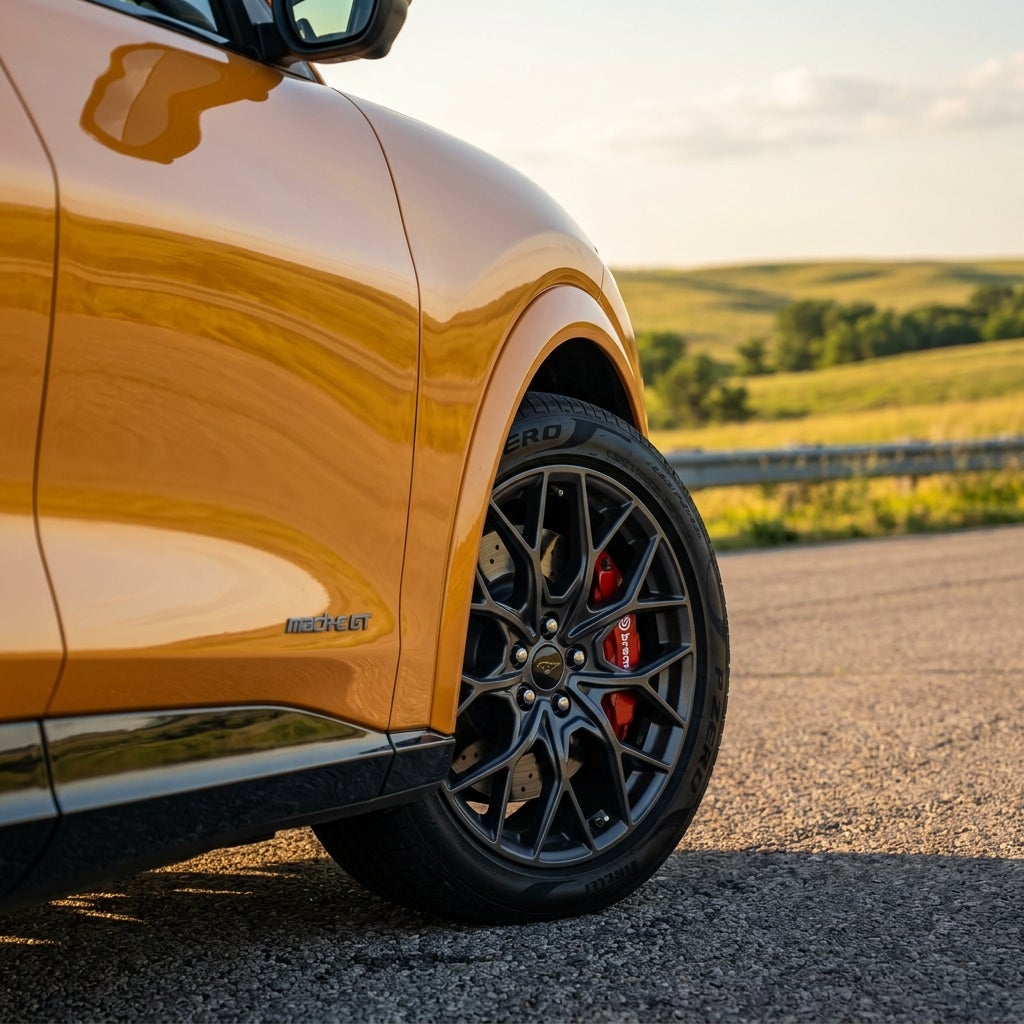
Close-up of a golden Mustang Mach-E GT front wheel with dark multi-spoke rims and a red Brembo brake caliper. (Representative image for illustration purposes only. Actual vehicle may vary based on trim and configuration.)

Have you ever wondered how an advanced all-electric dual-motor setup compares to a traditional high-output combustion engine when navigating rolling hills and scenic highway stretches? The Mustang Mach-E GT AWD utilizes an advanced Dual Motor configuration to generate a thrilling 480 hp and 600 lb-ft of torque, routed through a seamless single-speed transmission. Enthusiasts can elevate this output further with the optional Mustang Mach-E GT Performance Upgrade(package code 41G, priced at $1,295), which increases maximum torque to a staggering 700 lb-ft and enables a blistering 0-60 mph sprint in just 3.3 seconds. For everyday driving, the Mach-E's low-slung battery pack and instant electric torque deliver confident, linear acceleration and exceptional stability.

In contrast, the Mustang Dark Horse coupe represents the pinnacle of standard production combustion performance, featuring a modified fourth-generation 5.0L Coyote V8 engine that pumps out 500 hp and 418 lb-ft of torque. Power is sent exclusively to the rear wheels via a rapid-shifting 10-speed automatic transmission, delivering a classic rear-wheel-drive sports-car experience complete with a thumping exhaust note. For those seeking an efficient yet spirited daily driver, the Mustang EcoBoost trims utilize a turbocharged 2.3L four-cylinder engine to produce a highly capable 315 hp and 350 lb-ft of torque. While the Mustang coupe delivers unmatched mechanical drama and track-day precision, the Mach-E's available dual-motor all-wheel-drive system provides superior year-round traction and effortless acceleration that is better suited for handling diverse weather conditions and gravel back roads.

Cargo Space Perfect for Northeast Kansas Family Outings and Outdoor Gear

Working with families has shown me that everyday usability is often decided in the cargo bay and the rear seats, where real-world gear must fit without compromise. The Mustang Mach-E is built on a dedicated electric vehicle platform that maximizes interior volume, providing comfortable seating for 5 occupants and a highly versatile about 30 cu ft of rear cargo space behind the second row. To enhance outdoor utility, buyers can equip the Mach-E with the optional Frunk - Drainable(package code 76B, priced at $495), which adds a molded waterproof plastic front-trunk storage liner with an integrated bottom drain plug—an ideal space for packing ice and cold beverages for weekend picnics or storing muddy hiking boots after a trail run.
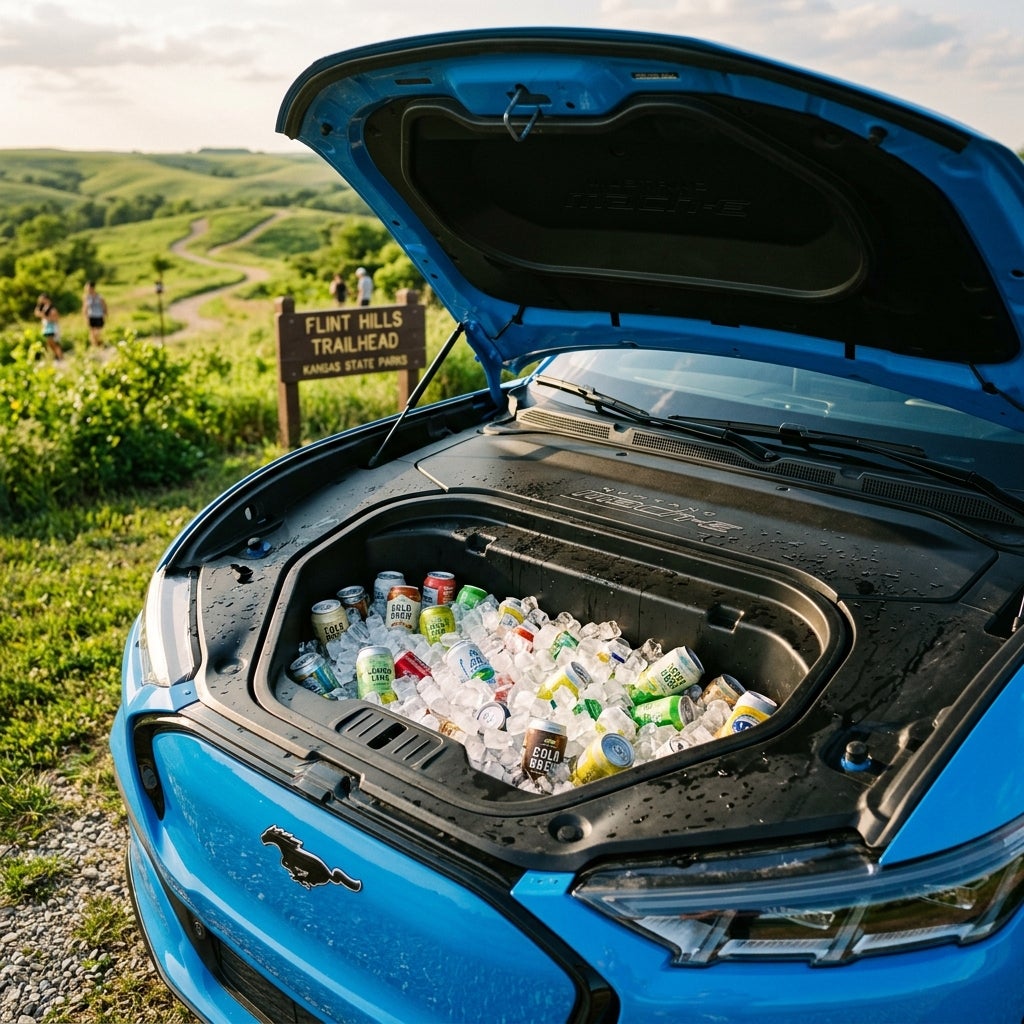
A blue Ford Mustang Mach-E with its front trunk open, filled with ice and canned drinks at a Kansas park trailhead. (Representative image for illustration purposes only. Actual vehicle may vary based on trim and configuration.)

The Mustang coupe, designed with a classic fastback silhouette, prioritizes driver-centric sports-car proportions, offering a 4-passenger seating configuration and a more compact about 13.5 cu ft trunk. Reflecting its lightweight performance focus, the Mustang Dark Horse has a curb weight of 3,949 lbs, compared to the Mach-E GT AWD's solid curb weight of 4,952 lbs. The Mach-E Premium RWD trim also provides a practical payload capacity of 890 lbs to handle heavy cargo loads. For active households that regularly carry strollers, groceries, and sports equipment, the Mach-E's spacious cabin, elevated ride height, and superior cargo flexibility make it the far more practical choice for daily family duties.


Dimensions & Capacity

Capacity and dimensions by trim

Specification

2026 Ford Mustang Mach-E

2026 Ford Mustang

Seating

5

4

Cargo

29.7 cu ft

13.5 cu ft

Curb weight

4,952 lbs

3,949 lbs

Payload

890 lbs

—

Towing

—

Not rated

Fuel Efficiency and Electric Range That Fit Manhattan Campus Commutes

With the rising cost of daily travel, matching your vehicle's energy consumption to your daily routine has never been more critical. The Mustang Mach-E GT AWD features a high-capacity 91 kWh battery pack that delivers an EPA-estimated EV range of 280 miles, allowing commuters to travel back and forth for days without needing to plug in. For those seeking maximum electric range, the Premium RWD trim utilizes a 73 kWh battery to deliver 260 miles of range, while the Premium AWD variant provides 240 miles of driving distance. The convenience of overnight home charging means Mach-E owners can start every morning with a 'full tank' of electric range, completely bypassing public fueling stations.

On the combustion side, the Mustang Dark Horse with its high-performance 5.0L V8 is rated at an EPA-estimated 14 city / 22 hwy / 17 combined MPG, reflecting its track-oriented engineering. For drivers seeking a more efficient traditional coupe, the EcoBoost and EcoBoost Premium trims utilize a turbocharged 2.3L engine to achieve a highly efficient 22 city / 33 hwy / 26 combined MPG. While the EcoBoost coupe offers excellent highway range for long-distance travel, the Mach-E's zero-emission electric powertrain delivers unmatched daily efficiency and substantial long-term fuel savings. You can explore our current new-vehicle inventory to find the exact range and battery configuration that matches your driving habits.
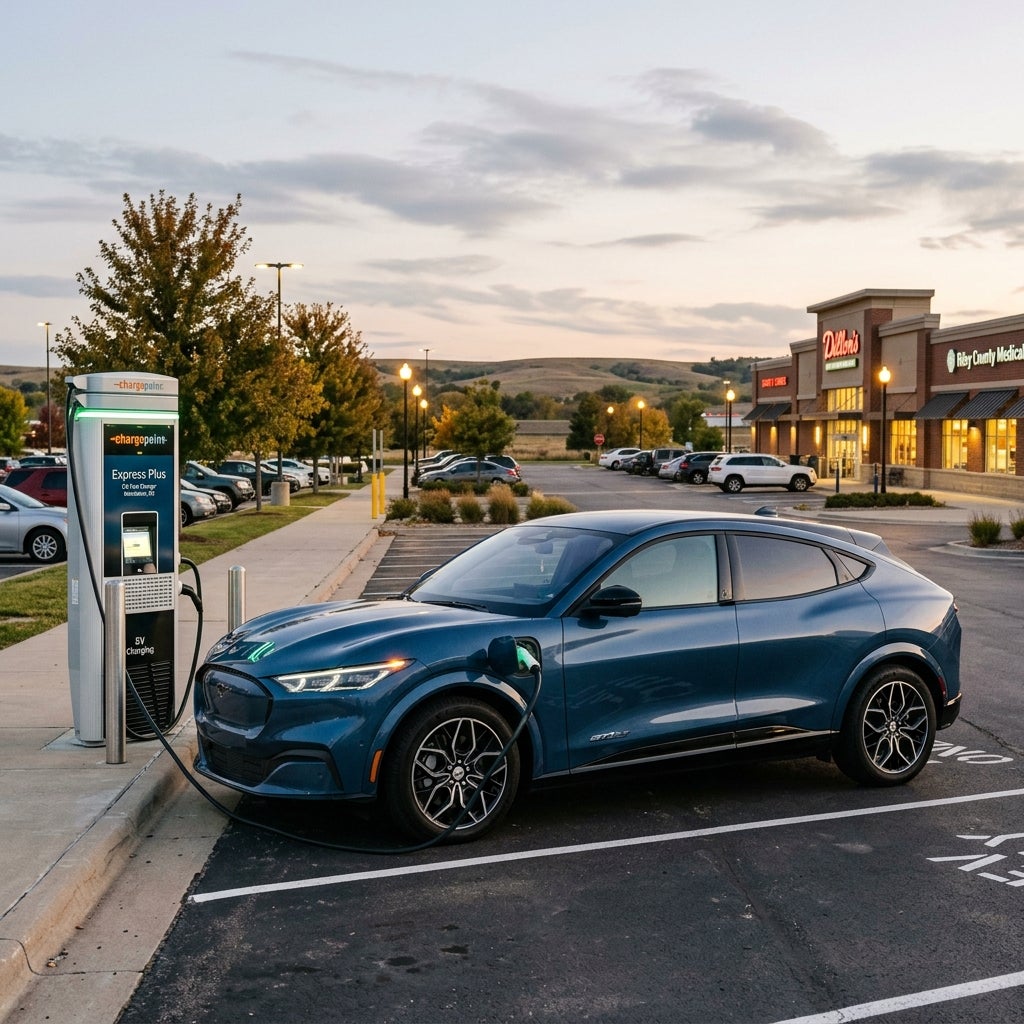
A blue Ford Mustang Mach-E charging at a ChargePoint Express Plus station in a parking lot at dusk. (Representative image for illustration purposes only. Actual vehicle may vary based on trim and configuration.)

Specification

2026 Ford Mustang Mach-E

2026 Ford Mustang

EV range

280 miles

—

Battery (kWh)

91

—

MPG

—

14 city / 22 hwy / 17 combined

Technology Features That Simplify Daily Life for Professionals

One of the first things you will notice when stepping inside either cabin is how Ford has seamlessly integrated cutting-edge digital interfaces to keep you connected and informed. The Mustang Mach-E features a massive, vertically oriented 15.5-inch Portrait Center Touchscreen with SYNC 4A and a sleek 10.2-inch Digital Instrument Cluster Display directly in the driver's line of sight. Audiophiles will appreciate the standard B&O Sound System by Bang & Olufsen, which delivers immersive sound through 10 speakers including a subwoofer. Standard integration includes Wireless Apple CarPlay & Android Auto and a wireless charging pad. Buyers can also opt for the Ford Connectivity Package(package code 50B, priced at $745), which bundles connected navigation with real-time routing, an unlimited 5G/4G Wi-Fi hotspot, and in-car streaming capabilities while parked.
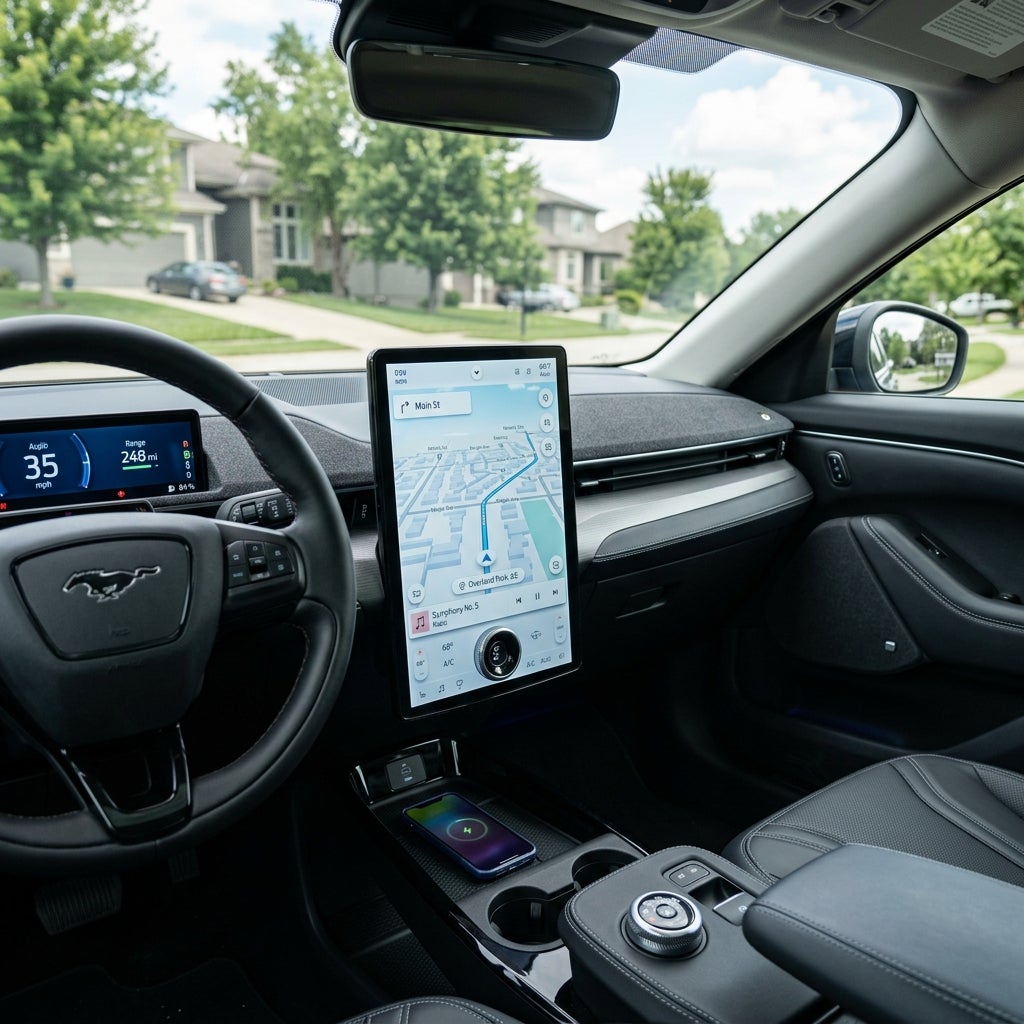
Interior of a Ford Mustang Mach-E showing a large vertical touchscreen, digital cluster, and wireless phone charger. (Representative image for illustration purposes only. Actual vehicle may vary based on trim and configuration.)

The Mustang coupe counters with a driver-focused cockpit featuring a 12.4-Inch LCD Digital Instrument Cluster and a 13.2-Inch Centerstack Touchscreen with SYNC 4. To create a seamless, high-tech visual interface, buyers of the EcoBoost Premium and Dark Horse trims can select the optional Magnesium Framed Curved Glass Display(package code 52V, priced at $1,000), which houses both screens behind a single sheet of premium glass. While both vehicles offer exceptional connectivity, the Mach-E's larger vertical screen, advanced EV-specific trip planning software, and standard over-the-air updates make it the ultimate high-tech mobile environment for busy professionals on the go.

Safety Designed for Military Families and University Communities

Imagine navigating a sudden winter storm or a busy highway corridor where unpredictable road conditions demand immediate vehicle intervention. The Mustang Mach-E GT AWD comes standard with Ford Co-Pilot360 Active 2.0 with BlueCruise hands-free highway driving technology (optional on Premium trims via the Technology Package, package code 52M, priced at $1,495). Standard active safety systems include a 360-Degree Camera System, Pre-Collision Assist with Autonomous Emergency Braking (AEB) & Intersection Assist, Blind Spot Information System (BLIS) with Rear Cross-Traffic Alert, and Reverse Brake Assist. Passive protection is anchored by a comprehensive Airbag System with 10 Airbags, helping the Mach-E earn a coveted Top Safety Pick rating from the Insurance Institute for Highway Safety (IIHS).

The Mustang coupe features standard Ford Co-Pilot360 with Pre-Collision Assist with AEB, BLIS, and Lane-Keeping System. The Dark Horse trim also includes an Active Anti-Theft System with intrusion and inclination sensors for maximum security. While both vehicles are engineered to protect their occupants, the Mach-E's advanced driver-assist systems, higher seating position, and standard all-wheel-drive traction provide superior peace of mind during daily family commutes and long highway road trips.

Top Safety Pick
Insurance Institute for Highway Safety (IIHS)

BlueCruise Hands-Free
Ford Co-Pilot360 Active 2.0

10 Airbags
Comprehensive Cabin Protection

Reliable Coverage Tailored for Active Lifestyles in Northeast Kansas

When I'm helping buyers navigate the transition to an electric vehicle, explaining the long-term ownership protections and manufacturer-backed support is key to building complete confidence. Both the Mustang Mach-E and the Mustang coupe are backed by a comprehensive manufacturer warranty package, including a 3-year/36,000-mile bumper-to-bumper warranty and a 5-year/60,000-mile powertrain warranty. The Mach-E adds a specialized 8-year/100,000-mile warranty on its high-voltage battery components, ensuring long-term peace of mind for EV owners.

To keep your vehicle running at peak performance, you can easily schedule a service appointment online with our certified technicians. For quick maintenance tasks like tire rotations or fluid checks, our dedicated express service lane provides rapid turnaround with no appointment necessary. Should your vehicle ever require replacement components or specialized accessories, our fully stocked parts department supplies genuine OEM parts designed specifically for your model.


Pricing

Manufacturer-listed pricing per trim, across compared vehicles.

2026 Ford Mustang Mach-E Trim

MSRP

2026 Ford Mustang Trim

MSRP

Premium RWD

$40,595

EcoBoost

$32,995

Premium AWD

$43,595

EcoBoost Premium

$36,345

GT AWD

$53,890

Dark Horse

$64,080

Answers to Your Top Questions About Owning a Mustang or Mach-E

Choosing between these two legendary nameplates often comes down to matching your daily driving habits with your long-term vehicle goals. Here are the answers to the most common questions shoppers ask when comparing these two exceptional models.

Is the 2026 Ford Mustang Mach-E worth the price premium over the Mustang EcoBoost?

Yes, for families and daily commuters who need year-round versatility, the Mach-E's standard five-passenger seating, expansive cargo space, and available all-wheel drive provide immense practical value. Additionally, the long-term savings on fuel and reduced maintenance costs associated with an electric vehicle quickly help offset the initial purchase price.

Which vehicle has more cargo space for active families?

The Mach-E is the clear winner in terms of utility, offering about 30 cu ft of rear cargo space compared to the Mustang coupe's about 13.5 cu ft trunk. The Mach-E also features a unique, drainable front trunk (frunk) that is perfect for storing wet gear or ice, making it far better suited for family road trips and outdoor adventures.

Can the 2026 Ford Mustang handle winter driving?

While the Mustang's rear-wheel-drive setup is engineered for dry-weather performance and driver engagement, the Mach-E's available dual-motor all-wheel-drive system provides superior traction and confidence on slick, snow-covered roads, making it the more dependable option for winter driving.

How do I get pre-approved for financing on these models?

You can contact our team to learn more about current financing options through our secure application portal.

If you want to compare these vehicles in person, we invite you to visit our showroom at 1825 Goldenbelt Blvd, Junction City, KS 66441. You can also give our friendly team a quick call at (785) 238-5114 to ask questions or set up a personalized demonstration. Beyond our new models, you can browse our high-quality used-vehicle listings to find great value on pre-owned options. For local business owners looking to expand their operations, we also maintain a dedicated commercial vehicle inventory tailored to meet vocational demands.


© 2026 Valor CDJR. All rights reserved.
Posted in:

Related Posts

Understanding Super Duty Payload Capacity: Expert Q&A With Valor Ford

Understanding Super Duty Payload Capacity: Expert Q&A With Valor Ford

Understanding Super Duty Payload Capacity: Expert Q&A With Valor Ford Cab style and bed length directly determine a heavy-duty truck's base curb weight, meaning every extra pound of cab structure, frame length, or drivetrain hardware subtracts from the available payload capacity on the vehicle certification label. To break down how cab selections, axle configurations, and equipment choices influence real-world hauling limits, we sat down with Jace Grabouski, General Manager at Valor Ford, who brings 25 years of automotive expertise to guide truck buyers through payload mechanics. Q: How Does Cab and Bed Configuration Affect Super Duty Payload Capacity? A: A truck's payload capacity comes down to curb weight subtracted from its gross weight rating. Choosing a larger cab or a longer cargo box adds heavy steel, glass, interior components, and frame length, which immediately consumes gross weight rating before any tools or passengers climb aboard. For maximum payload, a two-door Regular Cab with an 8-foot cargo box provides the lightest starting curb weight, leaving the greatest percentage of the truck's gross weight capacity dedicated solely to carrying cargo. When buyers configure a SuperCab or Crew Cab, that cab structure adds significant structural weight. A Crew Cab with four full doors, rear bench seating, and sound-deadening insulation weighs noticeably more than a bare Regular Cab work truck. Adding an extended 8-foot cargo box behind a Crew Cab further lengthens the fully boxed high-strength steel frame, adding additional chassis mass. Four-wheel-drive systems introduce a heavy transfer case, a front drive axle, and a front driveshaft, which further cuts available payload compared to a two-wheel-drive truck. For commercial drivers picking up machinery near the Kansas River in Junction City, configuring the right cab and box length marks the difference between staying fully legal and running overloaded. We regularly review equipment setups with buyers at our showroom on Goldenbelt Boulevard to align cab dimensions with mandatory job site payloads. Anyone wanting to review specific cab weights before ordering can also give our staff a call directly at (785) 238-5114. Q: Jace, What Is the Difference Between Payload Capacity and GVWR on a Super Duty? A: Gross Vehicle Weight Rating, commonly abbreviated as GVWR, represents the absolute maximum operating weight of the vehicle established by factory chassis engineers. That engineering figure encompasses the entire loaded truck, including its empty curb weight, a full tank of fuel, every passenger on board, all aftermarket gear, all cargo placed in the bed, and any trailer tongue weight pressing down on the hitch receiver. Payload capacity is the difference between that total gross rating and the empty operating weight of the vehicle. A common point of confusion occurs when drivers treat payload and towing as interchangeable numbers. Towing measures the rolling mass the truck pulls behind its hitch, while payload measures the vertical downward mass the truck carries across its front and rear axles. A heavy gooseneck livestock trailer might weigh 16,000 pounds, but fifteen to twenty-five percent of that trailer's total weight bears straight down onto the truck bed as pin weight, immediately counting against payload capacity. When reviewing our pre-owned truck inventory, shoppers often find trucks with identical gross weight ratings that feature different usable payload capacities. That variation happens because factory trim appointments like leather power seats, sunroof assemblies, and power running boards add physical weight to the cabin. That extra curb weight reduces the remaining payload margin pound for pound, making it essential to understand the math before hauling heavy loads. Q: Where Is the Exact Payload Certification Sticker Located on a Super Duty? A: You will find the exact payload certification label affixed directly to the driver-side B-pillar door jamb. Ford places two critical informational labels in this area: the federal Safety Compliance Certification label and the Tire and Loading Information label. The Tire and Loading Information sticker features a distinctive yellow and white border, and it states explicitly that the combined weight of occupants and cargo should never exceed a specific number in pounds and kilograms. That door jamb figure is unique to the exact Vehicle Identification Number stamped on the chassis. While sales brochures list the highest possible payload for a stripped-down baseline trim, the door jamb sticker accounts for every optional package, wheel design, and cab accessory installed on that truck at the assembly plant. A truck equipped with a panoramic glass roof, fifth-wheel prep package, and power tailgate will show a lower payload rating on its door jamb than an identical cab style built to base work-truck specifications. Checking this figure remains vital whenever you add accessories or bring your truck into our Ford service center for maintenance or suspension inspections. Tools, commercial steel service boxes, bed toppers, and heavy spray-in liners installed after the truck leaves the assembly line do not show up on the sticker. Every item added to the truck after purchase must be manually subtracted from that door jamb rating to calculate your true remaining cargo margin. "A set of helper springs might keep the rear bumper level under a heavy load, but it does not change the axle tubes, wheel bearings, or the legal weight rating on your door jamb." Q: Can an F-250 Be Modified With Aftermarket Parts to Match Legal F-350 Payload? A: No mechanical modification or aftermarket suspension kit can legally raise the Gross Vehicle Weight Rating or payload capacity stamped on the factory certification sticker. Drivers often install air helper springs, extra leaf springs, or stiffer rear anti-roll bars in an attempt to handle heavier loads. Those aftermarket accessories help level the truck's ride height and manage body lean under load, but they leave the legal door-jamb weight rating unchanged. The differences between three-quarter-ton and one-ton models run far deeper than an extra leaf spring pack in the rear suspension. An F-350 typically utilizes larger rear axle housings, thicker axle tubes, higher-capacity wheel bearings, heavy-duty brake friction material, and distinct wheel and tire load ratings engineered to manage elevated cargo stress. Adding air bags to an F-250 chassis leaves those critical driveline and braking components at their original factory load limits, creating premature component wear and safety concerns. If your commercial hauling requirements outgrow three-quarter-ton capabilities, our parts team can help with ordering genuine Ford components to maintain factory specifications, but the correct path to higher legal payload is moving into an F-350. You can review detailed capacity differences through our 2026 Ford F-250 model research to see if your current setup fits your hauling requirements. When upgrading becomes necessary, evaluating your trade-in online gives you a fast assessment of your current truck's value toward a properly rated platform. Q: Why Does the Ford Super Duty Achieve Higher Payload Ratings Than Competitors? A: The Super Duty achieves its payload advantage by pairing a high-strength, military-grade aluminum-alloy body with a fully boxed high-strength steel frame. By utilizing high-strength aluminum for the cab structure, doors, hood, and bed, Ford reduced overall body mass by several hundred pounds compared to traditional stamped steel bodies. Because the body itself is lighter, that weight savings transfers directly into usable payload capacity rather than dead metal the truck must carry around every day. Traditional steel cabs used by competitors carry substantial structural weight, which consumes gross vehicle weight rating before any payload is added. Ford engineers redirected the weight saved from the aluminum-alloy cab into strengthening the chassis where strength matters most. The Super Duty frame features high-strength steel crossmembers, reinforced spring perches, heavy-duty steering gear, and massive driveline components that withstand punishing cargo loads. For agricultural operations in Dickinson County, hauling round hay bales, feed totes, and heavy gooseneck stock trailers across rolling farm ground demands that structural rigidity. That combination of reduced cab curb weight and high-strength chassis engineering allows the Super Duty to handle demanding agricultural work without deflecting or fatiguing the frame. Buyers interested in exploring these engineering advantages can examine our Ford F-250 capability details before contact our team for financing information on a heavy-duty truck suited to their operations. Q: What Are the Published Super Duty Payload Ranges Across Engines and Trims? A: For the 2026 Super Duty lineup, published maximum payload reaches up to 8,000 pounds on properly equipped configurations. That maximum payload rating of 8,000 pounds requires an F-350 DRW two-wheel-drive Regular Cab equipped with the 7.3L gas V8 engine and the available F-350 Gas Heavy-Duty Payload Package. On single-rear-wheel configurations and standard passenger-oriented cabs, payload ratings scale progressively based on curb weight, axle configuration, and powertrain options. Engine selection plays a direct role in calculating net payload. The standard 6.8L gas V8 and available 7.3L gas V8 deliver the highest payload numbers because gasoline engine blocks weigh significantly less than heavy commercial diesels. The available 6.7L Power Stroke diesel V8 features a cast-iron engine block, massive turbocharging hardware, high-pressure fuel systems, and emissions equipment that add roughly 500 to 800 pounds of curb weight over the front axle. Because of that extra powertrain weight, the maximum diesel payload rating for an F-350 DRW two-wheel-drive Regular Cab sits at 6,952 pounds. While the diesel provides massive pulling power with up to 1,200 lb-ft of torque for heavy trailer hauling, a gas engine provides superior payload capacity for hauling heavy in-bed slide-in campers, commercial flatbeds, or utility service bodies. Choosing between gas and diesel requires balancing whether your primary workload involves pulling heavy rolling trailers or carrying heavy vertical bed loads. Q: What Should Truck Buyers Check Before Selecting a Super Duty at Valor Ford? A: Before picking a truck off the lot, calculate your total realistic payload demand by adding together the weight of your family, tools, aftermarket gear, and trailer tongue weight. Many drivers underestimate the weight of in-bed toolboxes, auxiliary fuel transfer tanks, fifth-wheel hitches, and steel bumpers, all of which deduct capacity directly from the door-jamb rating. Comparing those calculated weights against the factory yellow Tire and Loading Information label ensures the truck matches your daily operation safely and legally. Once you establish your target payload requirement, inspect the axle ratio and factory towing packages on the window sticker. Selecting an F-250 with a high-capacity trailer tow package or moving up to an F-350 dual-rear-wheel configuration provides the necessary spring packs, axle tubes, and tire load ratings to handle heavy commercial equipment. Our team can help calculate payload numbers and weigh trade-off options between single-rear-wheel daily usability and dual-rear-wheel cargo stability. When you are ready to evaluate a Super Duty firsthand, visit our Junction City showroom to review door-jamb ratings across our lineup, or give our sales staff a call at (785) 238-5114 with your trailer specifications. If your household also needs an off-road companion alongside a heavy-duty tow rig, you can browse our new Ford Bronco inventory during your visit. Verifying your numbers with our sales specialists ensures you drive away in a truck engineered to tackle your hardest work with absolute confidence. © 2026 Valor Ford. All rights reserved.

F-250 vs F-350: Choosing the Right Payload for Your Needs

F-250 vs F-350: Choosing the Right Payload for Your Needs

F-250 vs F-350: Choosing the Right Payload for Your Needs How Does Engine Choice Affect Payload Capacity in an F-250 vs F-350? Opting for a heavier diesel engine directly reduces available payload capacity compared to a gasoline engine on both the F-250 and F-350 because engine curb weight eats directly into the truck's Gross Vehicle Weight Rating (GVWR). On an identical 10,000-lb GVWR setup, choosing the diesel engine reduces carrying capacity by roughly 800 to 1,000 pounds compared to a gas V8. The curb weight difference between powertrains explains this gap. The standard 6.8L gas V8 and available 7.3L gas V8 are substantially lighter iron blocks than the 6.7L Power Stroke diesel and the 6.7L high-output diesel with its massive 500 hp and 1,200 lb-ft of torque. That heavy diesel hardware sits over the front axle, taking up allowable gross capacity before you even put a driver in the cab. For instance, in Ford's published specifications for a 2026 F-250 4x4 Crew Cab with a 175.9-inch wheelbase, opting for the 7.3L gas V8 yields a charted maximum payload of 3,196 lb, whereas equipping that exact configuration with the 6.7L high-output diesel drops maximum payload down to 2,415 lb within a standard 10,000-lb GVWR ceiling. Many truck shoppers focus exclusively on horsepower and pulling power without factoring in how those heavy powertrain components limit bed capacity. If you spend your workdays hauling bulk gravel or loading heavy ag supplies across Junction City, that gas engine preserves several hundred pounds of legal bed capacity that the diesel gives up to its cooling systems and emissions hardware. To map out how engine options align with your equipment needs, you can get directions to Valor Ford or give us a quick call to check configurations on our lot. Table of Contents Why Does the Ford F-350 Have a Higher Payload Capacity Than the F-250? What Is the Real Payload Capacity Difference Between the Ford F-250 and F-350? Is an F-350 SRW Worth the Upgrade Over an F-250 for Heavy Towing? When Is a Dual-Rear-Wheel F-350 Necessary Over an SRW Model? Is an F-250 or F-350 Better for Hauling a Slide-In Truck Camper? Where Can an Owner Locate the Exact Official Payload Capacity on a Ford Truck? Why Does the Ford F-350 Have a Higher Payload Capacity Than the F-250? The Ford F-350 carries a higher payload rating than the F-250 because it is engineered with a substantially higher Gross Vehicle Weight Rating, supported by a stiffer rear suspension pack and stouter axle components. While both trucks share the same fully boxed high-strength steel frame and cab dimensions, the F-350 is built to legally and mechanically support several thousand pounds of additional weight over its rear axle. Underneath the bed, the physical differences become clear. A single-rear-wheel F-350 typically utilizes an extra rear leaf spring along with auxiliary overload springs that remain disengaged during empty driving but engage as the suspension compresses under severe loads. The F-350 also receives heavy-duty rear axle assemblies with thicker axle tubes and larger wheel bearings designed to dissipate the heat and stress generated by heavy carrying tasks. These structural upgrades allow Ford to assign the F-350 a certified GVWR ranging from 11,000 pounds up to 14,000 pounds depending on cab and wheel setup, whereas standard F-250 configurations are frequently capped at a 10,000-lb GVWR class ceiling. If you are comparing heavy-duty models for commercial use, you can research Ford F-250 configurations in detail, or inspect our rotating inventory by browsing our selection of pre-owned work trucks to see how different spring packs hold up over time. What Is the Real Payload Capacity Difference Between the Ford F-250 and F-350? The real-world payload capacity difference between an F-250 and a single-rear-wheel F-350 ranges from roughly 800 pounds to over 1,500 pounds for identical cab and engine configurations. In maximum theoretical builds across the entire lineup, the gap is wider, spanning from 4,055 lb on a properly equipped F-250 single-rear-wheel up to 7,900 lb on a dual-rear-wheel F-350. Looking at matching truck builds demonstrates how this gap works on the ground. Ford's 2026 specification charts show that a four-wheel-drive Crew Cab long-bed F-250 equipped with the 7.3L gas V8 carries a maximum charted payload of 3,196 lb. An F-350 single-rear-wheel in the identical cab, bed, and engine configuration on 18-inch all-season tires jumps to 4,150 lb of maximum payload. That is a real-world gain of nearly a thousand pounds of capacity without changing the interior space, exterior footprint, or engine performance. Maintaining your truck's driveline components is essential when operating near these load limits, and our team is ready to schedule routine Ford maintenance to inspect your brakes and suspension. To explore specific towing configurations and options, take a moment to read through our Super Duty overview. Is an F-350 SRW Worth the Upgrade Over an F-250 for Heavy Towing? An F-350 single-rear-wheel is absolutely worth the upgrade over an F-250 if you plan to tow fifth-wheel trailers or heavy goosenecks where vertical pin weight quickly consumes your truck's cargo rating. While both trucks can pull immense weight behind the hitch, the F-350 provides the essential legal payload cushion needed to support a trailer that places 20 to 25 percent of its total weight directly into the bed. A fully loaded 15,000-pound fifth-wheel camper routinely generates a kingpin weight of 3,000 pounds. In a diesel-equipped F-250 Crew Cab with an available payload rating sitting around 2,400 to 2,800 pounds, hitching that trailer instantly puts the vehicle over its legal GVWR before you load passengers, fuel, or camping gear into the cabin. An F-350 SRW handles that same trailer with hundreds of pounds of surplus payload room on the certification label. Aftermarket suspension upgrades like helper springs or air bags can level the truck, but they never legally increase the certified GVWR stamped on the factory placard. Upgrading to an F-350 from the start protects your safety and legal compliance on the highway. If you are preparing to trade your current rig for more towing capability, you can request an online used vehicle trade-in valuation and start your purchase path to get pre-approved for automotive financing before visiting the lot. When Is a Dual-Rear-Wheel F-350 Necessary Over an SRW Model? A dual-rear-wheel F-350 becomes necessary when your cargo demands exceed a 4,500-pound payload requirement or when you are towing commercial gooseneck trailers with pin weights exceeding 4,000 pounds. Adding two extra tires across the rear axle doubles your tire contact patch, providing unmatched lateral stability and eliminating rear-tire overloading under extreme tongue weights. Dual rear wheels transform how a truck handles under heavy load. A dual-rear-wheel Regular Cab two-wheel-drive F-350 equipped with the 7.3L gas V8 and the Gas Heavy-Duty Payload Package reaches an industry-leading maximum payload rating of 7,900 lb against a 14,000-lb GVWR. Single-rear-wheel tires are typically limited to roughly 3,600 to 3,750 pounds of load capacity per tire, meaning two rear tires max out around 7,200 to 7,500 pounds of total supported rear axle load. Splitting that load across four rear tires prevents thermal breakdown, reduces sway in crosswinds, and offers an essential margin of safety if a tire suffers a blowout under load. Whether you need a dually for massive livestock trailers or prefer a weekend recreation vehicle like our new Ford Bronco inventory for off-road trails, selecting the correct chassis is critical. If your current truck requires replacement hardware or suspension components, you can easily order factory-approved replacement parts through our department. Is an F-250 or F-350 Better for Hauling a Slide-In Truck Camper? An F-350 is substantially better suited for hauling a hard-side slide-in truck camper because camper applications place 100 percent of their dry and wet weight directly inside the truck bed. Even mid-sized slide-in truck campers often exceed 3,000 pounds once you account for water tanks, propane cylinders, dual batteries, and outdoor gear, which pushes past the legal payload limits of most standard F-250 builds. When hauling heavy campers across the rolling terrain of Dickinson County, top-heavy cargo raises the truck's center of gravity. An F-350 features the stiffer spring rates and auxiliary overloads required to control severe body roll on uneven gravel roads or undulating highway surfaces. Loading a heavy camper into a softer F-250 often results in excessive rear-end sag, which unweights the front steer tires and degrades steering precision and braking performance. Truck buyers carrying larger multi-slide truck campers weighing over 4,000 pounds wet should consider skipping single-rear-wheel configurations entirely in favor of an F-350 dually. The wide rear track of a dual-rear-wheel truck provides the broad foundation required to anchor top-heavy campers in crosswinds without white-knuckle driving. Where Can an Owner Locate the Exact Official Payload Capacity on a Ford Truck? An owner can find the exact, certified payload rating for their specific vehicle on the yellow and white Tire and Loading Information placard located on the driver-side door jamb. That sticker features the explicit statement: "The combined weight of occupants and cargo should never exceed XXXX kg or XXXX lbs." Published brochures, advertising listings, and online specification sheets list theoretical maximum ratings for stripped-down, base-trim configurations. Factory options such as four-wheel-drive transfer cases, skid plates, power running boards, larger wheels, and luxury center consoles add weight to the bare chassis, reducing available cargo capacity pound for pound. Two trucks with identical trims on a dealer lot can carry distinct payload ratings if one is fitted with a fifth-wheel prep package, panoramic moonroof, or spray-in bedliner. Reviewing that door-jamb sticker is the only way to confirm legal capacity before hooking up heavy equipment. If you want our commercial sales staff to review your door sticker specifications or inspect your truck's ratings in person, visit our dealership showroom or connect directly with our specialists by making a phone inquiry today. © 2026 Valor Ford. All rights reserved.

What Should You Know Before Buying From a Local Ford Dealership?

What Should You Know Before Buying From a Local Ford Dealership?

What Should You Know Before Buying From a Local Ford Dealership? Before buying from a local dealership, confirm the specific vehicle configuration that matches your towing or passenger needs, compare factory financing or lease incentives through Ford Credit, and evaluate your trade-in allowance against net sales tax savings. In Kansas, trading in your vehicle directly reduces the taxable purchase price of your next car, keeping more money in your pocket than an outright private sale. Securing pre-approval before stepping onto the showroom floor clarifies your buying power and streamlines the paperwork. Navigating your vehicle purchase locally also ensures direct access to certified technicians, factory warranty support, and manufacturer-backed roadside care. Every new Ford includes factory roadside coverage, giving you direct access to help whenever needed nationwide through Ford Roadside Assistance: 1-800-241-3673. Drivers visiting our showroom at 1825 Goldenbelt Blvd can work directly with our staff to review window stickers, order custom options straight from the assembly plant, and inspect practical features like cab dimensions and hitch configurations. Whether you need directions or want to talk through current lot arrivals, you can check our showroom location or give our team a quick call to get started. Table of Contents What Financing Rates and Lease Deals Does Ford Credit Offer? What Towing Capacity and Performance Does the 2027 Ford F-150 Deliver Compared to the Chevrolet Silverado 1500? What Engine Powers the Ford Explorer ST and Which Family Features Stand Out? How Do Dealership Trade-In Values Compare to Private-Party Sales for Used Fords? Where Is the Dealership in Junction City and What Military Discounts Apply for Fort Riley Personnel? Common Questions About Shopping and Servicing at Our Dealership Plan Your Visit to Valor Ford and Schedule Your Next Test Drive What Financing Rates and Lease Deals Does Ford Credit Offer? Ford Credit may offer financing options and lease programs; contact the dealership for current details. Qualified retail buyers may be eligible for promotional financing offers on select new trucks and sport utility vehicles; contact the dealership for current details. Lease options may be available with varying terms and conditions; contact the dealership for current details. Navigating loan and lease approvals begins with an assessment of debt-to-income metrics, down payment reserves, and bureau ratings. Ford Credit structures tiers that reward higher credit scores with lower baseline money factors and subsidized rates. When prospective buyers prepare documentation in advance, including recent earnings statements, proof of residency, and trade-in titles, approval decisions move quickly through the underwriting system. While third-party lending institutions set rates strictly to broad retail market indicators, captive automotive financing through the manufacturer provides targeted promotional incentives tied directly to seasonal sales programs. Taking advantage of these programs is straightforward when you set up your profile early. You can streamline your purchase pathway by prequalifying online before scheduling a test drive. Setting up your financing framework ahead of time allows you to focus on choosing the proper trim level, drivetrain, and equipment packages. Once you bring your vehicle home, keeping it running at peak factory performance is equally simple when you schedule certified Ford maintenance with our factory-trained service technicians. What Towing Capacity and Performance Does the 2027 Ford F-150 Deliver Compared to the Chevrolet Silverado 1500? The 2027 Ford F-150 achieves a maximum conventional towing capacity of up to 13,500 pounds and a gas payload rating of up to 2,430 pounds when equipped with the 3.5L EcoBoost twin-turbo V6 engine and the Max Trailer Tow Package. That maximum towing rating edges out the Chevrolet Silverado 1500, which reaches an upper limit of 13,300 pounds when configured with its 6.2-liter V8 or 3.0-liter Duramax turbo-diesel. Beyond raw trailering limits, the high-strength, military-grade aluminum-alloy body of the F-150 delivers rust resistance and curb-weight efficiency that conventional steel truck beds cannot match. Powertrain versatility remains a cornerstone of the F-150 lineup. Across rural farming acreage in Dickinson County, hauling livestock, commercial equipment, and grain trailers demands sustained torque and electrical utility. The available 3.5L PowerBoost full hybrid engine generates 430 hp and 570 lb-ft of torque while introducing integrated job-site power through Pro Power Onboard. This system provides up to 7.2 kW of exportable electricity through 120-volt and 240-volt cab and bed outlets, functioning as a dedicated mobile generator capable of running plasma cutters, frame welders, and power tools without an auxiliary engine generator. Performance & Trailering Metric 2027 Ford F-150 (3.5L EcoBoost) Chevrolet Silverado 1500 (6.2L V8 / 3.0L Diesel) Maximum Conventional Towing 13,500 lbs 13,300 lbs Maximum Gas Payload Rating 2,430 lbs 2,260 lbs Peak Gas Engine Torque 500 lb-ft 460 lb-ft (6.2L V8) Mobile Generator System Pro Power Onboard (Up to 7.2 kW) Auxiliary bed outlets (Up to 400W) Cab and Bed Material High-strength aluminum alloy Roll-formed high-strength steel Drivers requiring dedicated equipment setups can explore complete engine and axle specs through our Ford F-150 research page. For custom electrical setups, heavy-duty hitch accessories, or fifth-wheel prep packages, you can also order authentic factory components directly through our parts counter. What Engine Powers the Ford Explorer ST and Which Family Features Stand Out? The performance-focused Ford Explorer ST is powered by an athletic 3.0L EcoBoost twin-turbo V6 engine generating 400 hp and 415 lb-ft of torque, mated to a calibrated 10-speed automatic transmission. This powertrain launches the three-row performance SUV from zero to 60 mph in roughly 5.1 seconds while sustaining a solid 5,000-pound maximum towing capacity with its standard Class III Towing package. Drivers seeking responsive acceleration without sacrificing family hauling capability get firm chassis dampening, sport-tuned steering gear, and selectable drive modes tailored for varied traction environments. Inside the cabin, three rows of versatile seating accommodate six or seven passengers depending on whether you choose second-row captain's chairs or the three-across bench configuration. Cargo management remains exceptionally functional: Up to 85 cubic feet of total cargo volume with both rear rows folded flat. About 46 cubic feet of dedicated storage behind the second-row seating. Roughly 18 cubic feet of usable space with all three rows occupied. One-touch E-Z Entry second-row captain's chairs that slide and tilt forward for easy third-row access. Standard Ford Co-Pilot360 active safety technology, including automated emergency braking and blind-spot monitoring with trailer coverage. Available Ford BlueCruise for hands-free highway driving on pre-mapped highway corridors. Families considering this high-output SUV can evaluate detailed cabin dimensions, standard equipment variations, and technology packages on our Ford Explorer model guide. How Do Dealership Trade-In Values Compare to Private-Party Sales for Used Fords? Dealership trade-in allowances often land roughly 10% to 15% below top private-party listings because an authorized dealer assumes all vehicle reconditioning expenses, safety certifications, and market-depreciation risk. Selling a vehicle privately requires you to detail the car, photograph the exterior and interior, manage online listings, screen prospective buyers, and coordinate strangers taking test drives. In contrast, trading in your vehicle at an established dealership completes the entire appraisal, title transfer, loan payoff, and purchase transaction in a single afternoon. The critical financial equalizer is the net sales tax benefit available under Kansas statute K.S.A. 79-3606. When trading in a car toward the purchase of a replacement vehicle at a licensed dealer, state and local sales tax is assessed strictly on the net difference between the purchase price and the trade-in allowance. Trade-in allowances can reduce the taxable purchase price of your next vehicle, subject to applicable laws and your specific transaction details. If you are planning to upgrade, you can check our current pre-owned vehicle selection to see what models match your driving routine. Before making any decisions, submit your vehicle's mileage and condition through our online trade-in appraisal form to calculate your exact equity position and sales tax offset. Where Is the Dealership in Junction City and What Military Discounts Apply for Fort Riley Personnel? Our dealership is located at 1825 Goldenbelt Blvd in Junction City, serving drivers across Geary County with sales, financing, and certified vehicle maintenance. The sales showroom opens Monday through Friday from 8:30 AM to 6:00 PM and Saturday from 9:00 AM to 5:00 PM. Our dedicated service and parts department operates Monday through Friday from 7:30 AM to 5:30 PM to handle scheduled maintenance, warranty inspections, and tire installations. Active-duty military members, veterans, and military retirees stationed nearby can take advantage of the Ford Military Recognition Program. This manufacturer program may provide bonus cash incentives toward the purchase or lease of eligible new Ford models. Our finance department can help qualifying service personnel review current incentive eligibility, trade-in equity, and financing options. Common Questions About Shopping and Servicing at Our Dealership Q: Can I custom order a new Ford directly from the factory? Factory custom ordering allows you to build a vehicle to your exact specifications, including paint color, interior upholstery, axle ratios, and specialized off-road or trailering packages. When you submit a custom order with our sales staff, your order receives priority factory scheduling and direct order-status tracking. Your promotional financing incentives and trade-in appraisals can be protected during assembly, ensuring no financial surprises when your new vehicle arrives on our transport lot. If you want an off-road-ready vehicle immediately, you can also explore our new Ford Bronco inventory to see what adventure-ready configurations are available today. Q: What documents are required when applying for Ford Credit financing? Applying for automotive financing requires a valid government-issued driver's license, proof of current automotive insurance, and your most recent pay stubs or verified income documentation. If you are trading in a vehicle with an active loan, bring your current lender statement containing the account number and payoff contact information. Bringing all primary and spare key sets alongside the vehicle title or registration ensures our team can process your paperwork and finalize your loan agreement efficiently. Q: What coverage is included with Ford Roadside Assistance? Manufacturer-backed roadside assistance is included with eligible new Ford vehicles for 5 years or 60,000 miles, whichever comes first. The program provides 24-hour emergency support, including flat tire changes using your vehicle's spare, battery jump-starts, fuel delivery if you run out of gas, lockout assistance, and complimentary towing to the nearest authorized Ford service facility. Service can be dispatched through the Ford App or by calling the dedicated toll-free roadside assistance phone line. Q: How does dealership vehicle reconditioning impact trade-in offers? Dealership trade-in offers reflect the necessary mechanical, structural, and cosmetic investments required to prepare a used vehicle for resale under manufacturer standards. Our certified technicians complete comprehensive multi-point safety inspections, replace worn brake pads and tires, complete scheduled fluid services, and perform professional exterior and interior detailing. These reconditioning investments ensure subsequent buyers receive a thoroughly inspected, roadworthy vehicle backed by dealer accountability. Q: What maintenance schedule should I follow for my Ford EcoBoost engine? EcoBoost turbocharged engines operate under precise thermal and pressure tolerances, making regular oil changes essential to long-term component durability. Ford recommends scheduling oil and filter changes every 5,000 to 7,500 miles under normal operating conditions, using motor oil that meets rigorous Ford engineering specifications. Routine multi-point inspections also verify air filter cleanliness, coolant levels, tire rotation wear patterns, and software calibrations to keep your powertrain running efficiently. Plan Your Visit to Valor Ford and Schedule Your Next Test Drive Selecting the ideal truck or family SUV comes down to hands-on experience behind the wheel. We invite you to visit our showroom at 1825 Goldenbelt Blvd, Junction City, KS 66441 to inspect cab configurations, test advanced digital touchscreens, and compare powertrain responses across our lot. Use our map link to pull up driving directions to our showroom or reach out with a phone call to our sales desk to schedule your test drive today. © 2026 Valor Ford. All rights reserved.