
Blog / Model Comparisons

2024 Ford Explorer XLT vs 2023 Dodge Durango SXT Plus

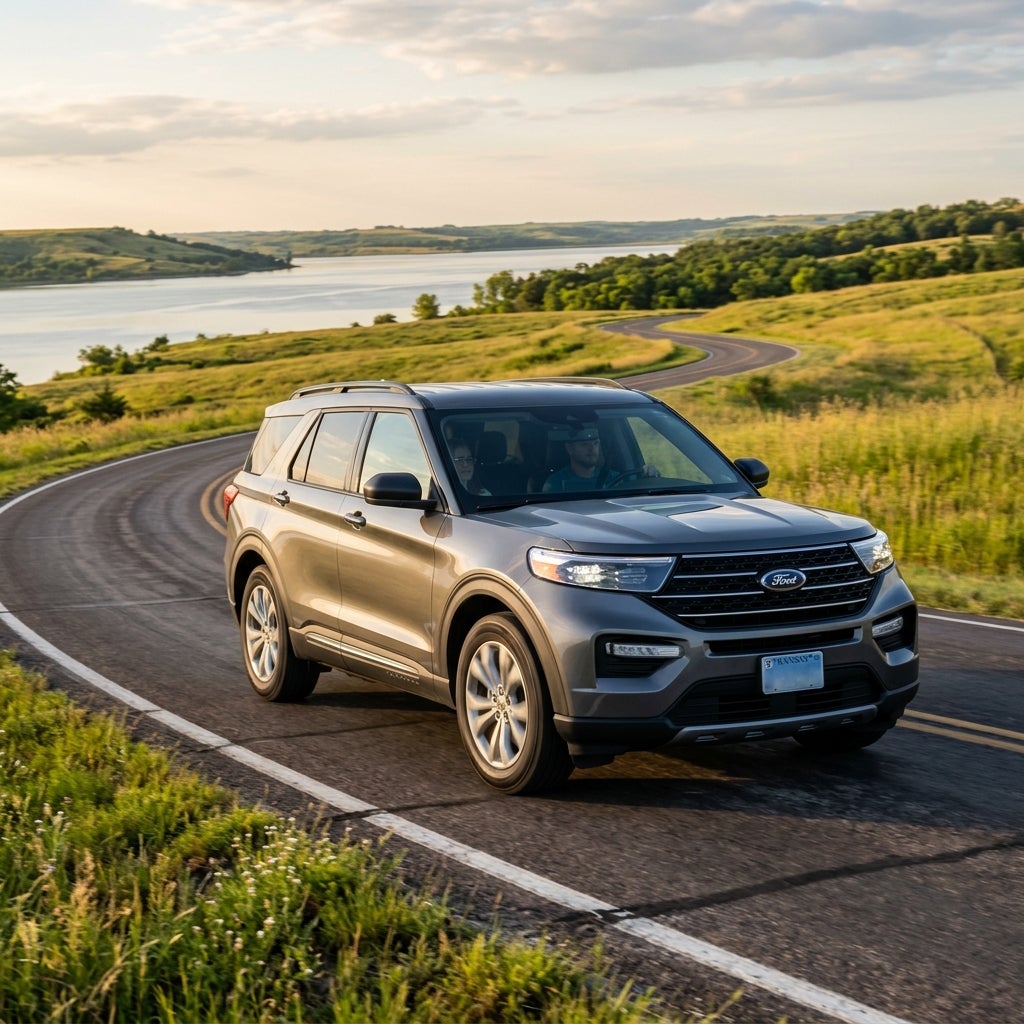
A metallic gray Ford Explorer drives on a winding scenic road through green hills alongside a lake at sunset. (Representative image for illustration purposes only. Actual vehicle may vary based on trim and configuration.)

2024 Ford Explorer XLT vs 2023 Dodge Durango SXT Plus

The 2024 Ford Explorer XLT is the stronger choice for midsize SUV shoppers, offering better fuel efficiency, higher output, superior safety ratings, and a lower starting price than the 2023 Dodge Durango SXT Plus AWD. With 300 horsepower from its 2.3L EcoBoost® I-4 engine, up to 27 MPG highway, an IIHS Top Safety Pick Plus award, and a base MSRP of $40,670, the Explorer XLT delivers unmatched value, modern capability, and daily versatility.

Which SUV Is the Best Choice for Junction City Families: 2024 Ford Explorer XLT or 2023 Dodge Durango SXT Plus AWD?

The 2024 Ford Explorer XLT emerges as the better overall choice for local families due to its lower starting price, higher horsepower, superior fuel economy, and higher safety scores compared to the 2023 Dodge Durango SXT Plus AWD. Entering the market at a starting MSRP of $40,670 for the XLT 4WD trim and $38,670 for the XLT RWD trim, the Explorer costs significantly less than the $44,235 Dodge Durango SXT Plus AWD while delivering more modern standard equipment. Beneath the hood, the Explorer's standard 2.3L EcoBoost® I-4 engine generates 300 horsepower and 310 lb-ft of torque, surpassing the Durango's 3.6L Pentastar V6, which produces 293 horsepower and 260 lb-ft of torque.
Beyond raw powertrain numbers, the Ford Explorer XLT provides superior passenger efficiency and everyday maneuverability. Built on Ford's CD6 architecture, the Explorer XLT delivers responsive handling with a tight 464.5-inch turning circle, whereas the longer Durango SXT Plus AWD requires a 492.1-inch turning radius. Inside, the Explorer XLT comes standard with a 2+2+2 seating configuration featuring 2nd-row captain's chairs for six passengers, making third-row access effortless during daily school drop-offs or carpools. Buyers can also opt for an available 2nd Row Bench package (option code 17U) to expand seating capacity to seven passengers.
Families shopping in the area can explore full Ford Explorer details to see how its about 88 cu ft of maximum cargo space out hauls the Durango's about 85 cu ft. For those looking to replace their current vehicle, taking time to value your trade-in online can make stepping into a brand-new 2024 Explorer XLT even more seamless.
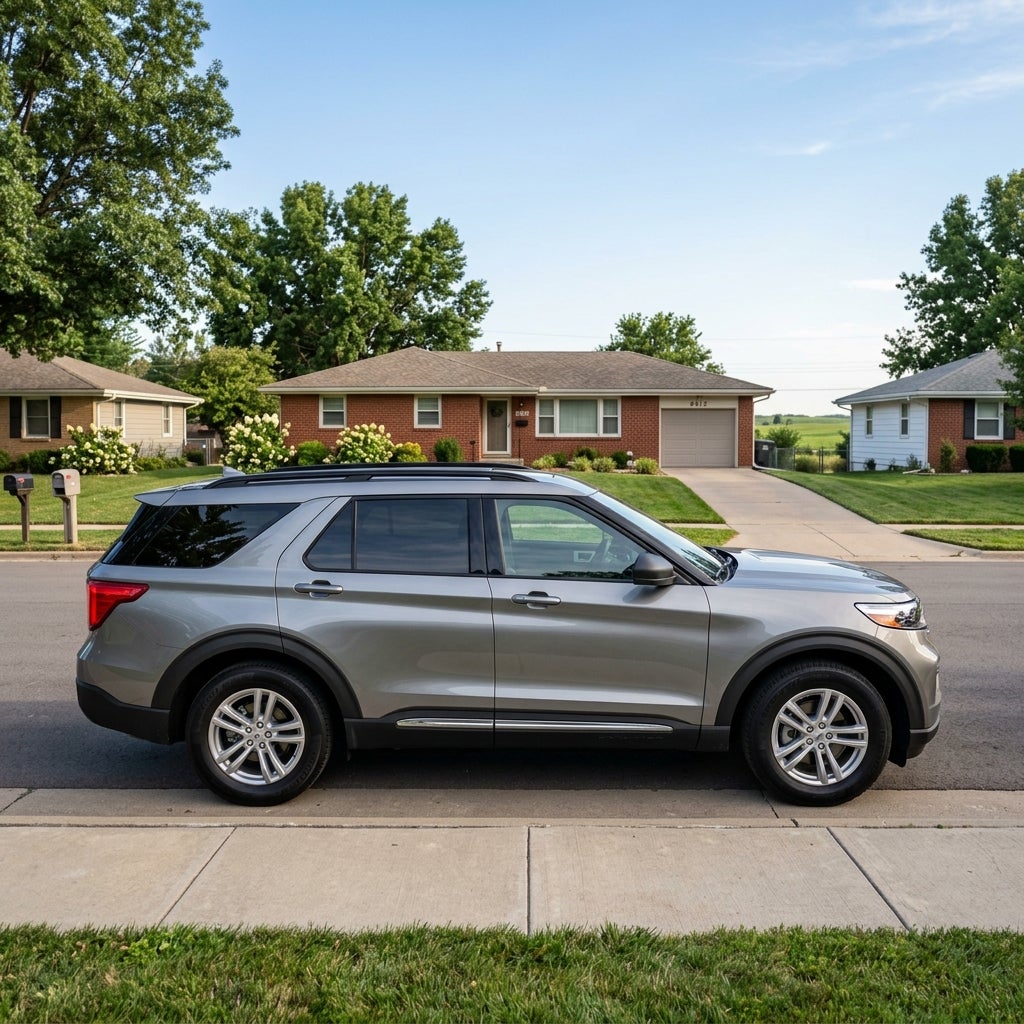
Side view of a silver SUV parked on a quiet suburban street in front of brick ranch-style houses. (Representative image for illustration purposes only. Actual vehicle may vary based on trim and configuration.)

Engine & Performance

Powertrain specs by trim

Specification

2024 Ford Explorer XLT

2023 Dodge Durango SXT Plus AWD

Engine

2.3L

3.6L

Horsepower

300 hp

293 hp

Torque

310 lb-ft

260 lb-ft

Transmission

SelectShift®

TorqueFlite®

Drivetrain

All-wheel drive

All-wheel drive

How Pricing and Trim Features Match Military Family Budgets

The 2024 Ford Explorer XLT offers a far more value-oriented purchasing threshold, saving buyers $3,565 on base MSRP compared to the 2023 Dodge Durango SXT Plus AWD. With the Explorer XLT 4WD priced at $40,670 and the XLT RWD trim starting at $38,670 (plus a $1,595 destination charge), drivers gain access to advanced turbocharged performance and standard driver-assist technology without paying a premium price tag. In contrast, the Dodge Durango SXT Plus AWD carries a base MSRP of $44,235 before adding its $1,595 destination fee, bringing its entry threshold to $45,830.
Value in the Explorer XLT extends far beyond the window sticker. Ford equips the Explorer XLT with standard heated driver and front passenger bucket seats, 10-way power adjustments for the driver, a 6.5-inch color instrument cluster display, tri-zone automatic climate control, and LED low- and high-beam headlights. Upgrading the Explorer with Equipment Group 202A adds ActiveX synthetic leather seating, a heated steering wheel, LED front fog lights, and a 4-way power front passenger seat.
Shoppers interested in stretching their investment further can browse our pre-owned SUV inventory or apply online to get pre-approved for financing before visiting our showroom. The Explorer XLT also boasts an impressive 3,455-pound maximum payload rating, drastically outpacing the Durango SXT Plus AWD's 1,677-pound payload capacity. While the Durango provides a higher maximum braked towing rating of 6,200 pounds compared to the Explorer XLT's standard 3,000-pound rating (which reaches 5,300 pounds when equipped with the Class IV Trailer Tow Package, code 52T), the Explorer's lower curb weight of 4,345 pounds versus the Durango's heavy 4,823 pounds yields noticeable efficiency savings at the pump.

Pricing

Manufacturer-listed pricing per trim, across compared vehicles.

2024 Ford Explorer XLT Trim

MSRP

2023 Dodge Durango SXT Plus AWD Trim

MSRP

XLT RWD

$38,670

SXT Plus AWD

$44,235

XLT 4WD

$40,670

—

—

Cargo and Passenger Space Weekend Adventures and School Runs
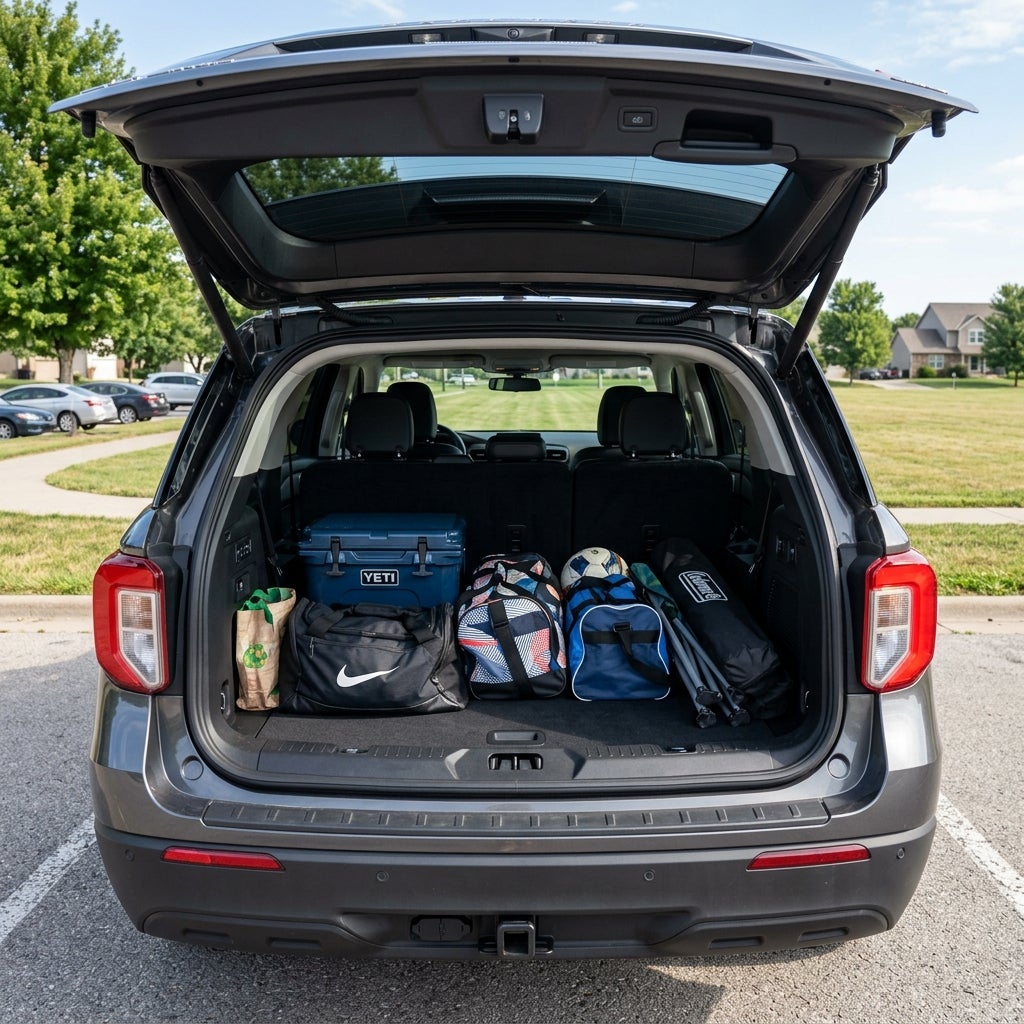
Open trunk of a grey SUV packed with a Yeti cooler, Nike duffel bags, a soccer ball, and folding lawn chairs. (Representative image for illustration purposes only. Actual vehicle may vary based on trim and configuration.)
The 2024 Ford Explorer XLT offers superior interior shoulder room, front legroom, and maximum cargo capacity over the Dodge Durango SXT Plus AWD, making it the more comfortable and versatile cabin for busy households. Up front, driver and passenger enjoy 43.0 inches of legroom and 61.8 inches of shoulder room in the Explorer, compared to 40.3 inches of front legroom and 58.5 inches of shoulder room in the Durango. Second-row passengers in the Explorer benefit from 39.0 inches of legroom and 61.9 inches of shoulder room, out-measuring the Durango's 38.6 inches of legroom and 57.7 inches of shoulder room.
When it comes to hauling luggage, sports gear, or utility supplies, the Explorer XLT provides about 18 cu ft of cargo space behind the third row, about 48 cu ft behind the second row, and a maximum volume of about 88 cu ft with all rear seats folded flat. The Durango SXT Plus AWD yields about 17 cu ft behind its third row and tops out at about 85 cu ft total. Furthermore, the Explorer features a lower cargo loading floor height of 31.1 inches and a wide 48.1-inch clearance between the rear wheelhouses, facilitating easier loading of bulky items.
To keep the cabin protected against mud, dirt, and wet weather gear, owners can order genuine Ford parts such as all-weather floor liners, cargo area management systems (option code 21F), or heavy-duty roof-rail crossbars. The Explorer's thoughtfully engineered interior layout ensures every passenger travels in comfort without compromising total utility.

Dimensions & Capacity

Capacity and dimensions by trim

Specification

2024 Ford Explorer XLT

2023 Dodge Durango SXT Plus AWD

Seating

6

7

Cargo

18.2 cu ft

17.2 cu ft

Towing

3,000 lbs

6,200 lbs

Curb weight

4,345 lbs

4,823 lbs

Payload

3,455 lbs

1,677 lbs

Performance and AWD Capability Built for Plains and Trails

The 2024 Ford Explorer XLT delivers superior engine output, faster torque responsiveness, and more sophisticated transmission technology than the 2023 Dodge Durango SXT Plus AWD. Powering the Explorer is Ford's 2.3L EcoBoost® I-4 engine, which leverages direct fuel injection and a single turbocharger to generate 300 horsepower at 5,500 RPM and 310 lb-ft of torque at 3,500 RPM. By comparison, the Durango's naturally aspirated 3.6L Pentastar V6 engine produces 293 horsepower at 6,400 RPM and 260 lb-ft of torque at 4,000 RPM.
Because the Explorer's EcoBoost® engine delivers 50 additional lb-ft of torque at an RPM threshold 500 RPM lower than the Durango, the Ford accelerates with significantly more urgency when passing or climbing steep highway grades. Mated to Ford's SelectShift® 10-speed automatic transmission (code 44T), the Explorer optimizes power delivery across a wide spread of gear ratios, ranging from a steep 4.71:1 first gear for rapid off-the-line launch to a high 0.64:1 tenth gear overdrive for quiet, low-RPM cruising. The Durango utilizes an 8-speed TorqueFlite® automatic transmission (code 850RE) with a 4.714:1 first gear and a 0.667:1 eighth gear.
For traction in challenging weather, the Explorer XLT 4WD model utilizes an Intelligent 4WD system paired with Terrain Management System adjustment, selectable drive modes, and Hill Descent Control. With 7.9 inches of unladen ground clearance, a 20.1-degree approach angle, and a 22.0-degree departure angle, the Explorer navigates unpaved country routes and snowy roads with composed confidence.

Fuel Economy

Fuel economy and range by trim

Specification

2024 Ford Explorer XLT

2023 Dodge Durango SXT Plus AWD

MPG

20 city / 27 hwy / 23 combined

18 city / 25 hwy / 21 combined

Fuel Economy and Range Considerations for Daily Commutes and Weekend Getaways

The 2024 Ford Explorer XLT 4WD achieves better EPA fuel economy estimates in every driving category compared to the 2023 Dodge Durango SXT Plus AWD. The Explorer XLT 4WD earns an EPA-estimated 20 MPG city, 27 MPG highway, and 23 MPG combined. Choosing the Explorer XLT RWD model increases efficiency figures to 21 MPG city, 28 MPG highway, and 24 MPG combined. The Dodge Durango SXT Plus AWD trails behind with EPA ratings of 18 MPG city, 25 MPG highway, and 21 MPG combined.
Operating on standard 87-octane regular unleaded gasoline, the Explorer XLT 4WD requires less fuel per mile, reducing annual fueling expenses for active commuters. Its 17.9-gallon fuel tank provides an EPA-calculated cruising range of 412 miles in 4WD trim and 430 miles in RWD trim. While the Durango SXT Plus AWD houses a larger 24.6-gallon fuel tank that offers a total range of 516 miles, its lower 21 MPG combined efficiency means drivers fill up more gallons over time. The Explorer's lighter curb weight and efficient 10-speed SelectShift® automatic transmission work together to minimize drag and reduce carbon emissions to 387 g/mi combined, compared to 430 g/mi for the V6 Durango.

Smart Technology That Keeps Drivers Connected and Safe

The 2024 Ford Explorer XLT offers a cleaner, more intuitive driver interface and comprehensive connectivity features designed for effortless daily operation. The center console features an 8.0-inch SYNC® 3 touchscreen display with fixed orientation, capacitive touch controls, Apple CarPlay, Android Auto, Bluetooth® hands-free pairing, and 911 Assist telematics capability. Driver information is displayed on a 6.5-inch color TFT instrument cluster screen positioned between analog dials.
For device power, the Explorer XLT comes standard with two front USB ports and two rear USB ports, alongside two 12-volt power outlets up front, one in the second row, and one in the cargo area. Upgrading to the available XLT Technology Package (option code 68D) upgrades the entertainment experience with a 12-speaker Bang & Olufsen® sound system delivering 780 watts of system power, a wireless charging pad, a 360-Degree Camera with Split View, front parking sensors, auto-dimming side mirrors, and an embedded universal garage door opener.
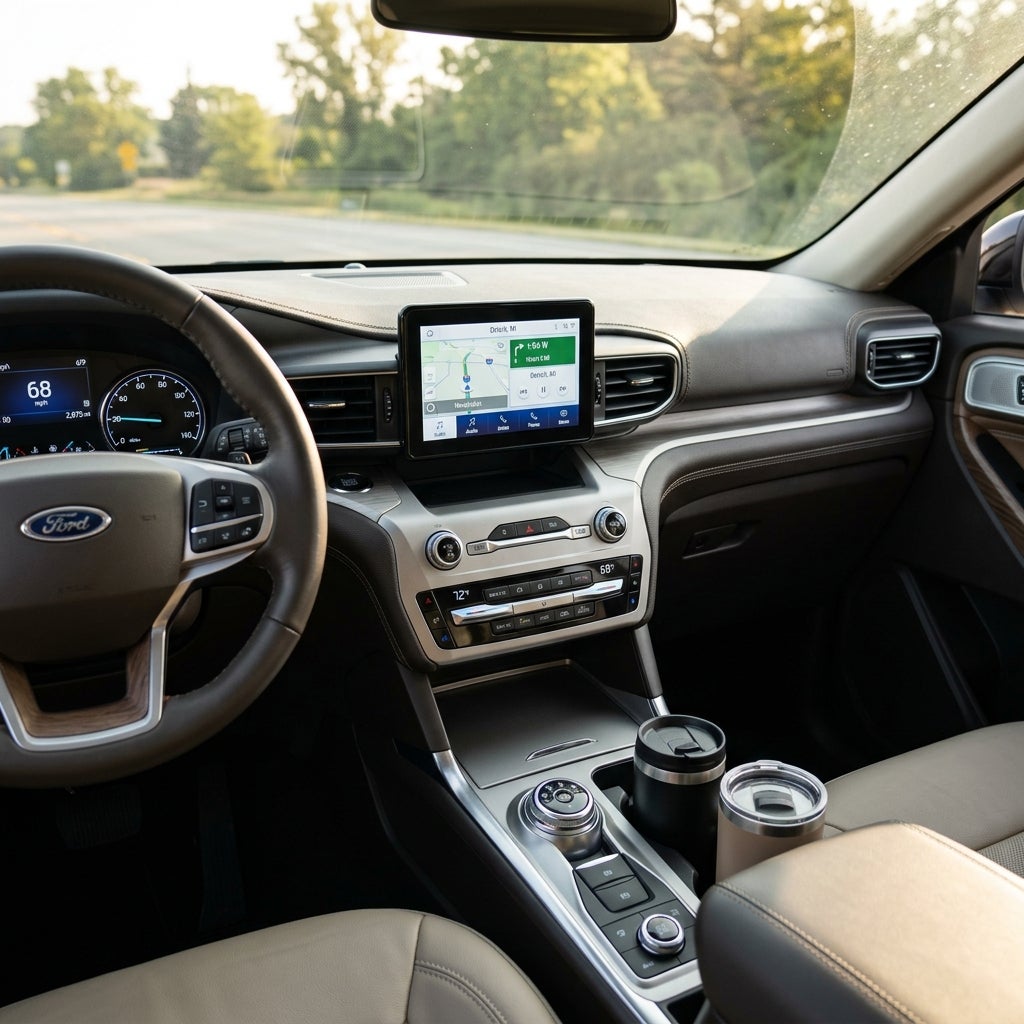
Interior view of a Ford SUV dashboard featuring a digital instrument cluster, touchscreen navigation, and center console. (Representative image for illustration purposes only. Actual vehicle may vary based on trim and configuration.)
IIHS TOP SAFETY PICK+
2024 Top Safety Award Winner
NHTSA 5-STAR RATING
Overall Frontal & Side Safety
Ford CO-PILOT360â„¢
Standard Advanced Safety Tech
Safety engineering is a distinct triumph for the Ford Explorer. The 2024 Explorer earned the prestigious 2024 TOP SAFETY PICK Plus award from the Insurance Institute for Highway Safety (IIHS), scoring "Good" ratings in moderate overlap front, small overlap front driver, side impact, and roof strength evaluations. It also earned a 5-Star Overall Safety Rating from the National Highway Traffic Safety Administration (NHTSA), with 5-star ratings in frontal and side crash tests. The Durango SXT Plus AWD received a lower 4-Star Overall NHTSA rating and a "Marginal" rating from the IIHS in the small overlap driver-side front crash test.
Standard safety hardware on the Explorer XLT includes eight airbags (intelligent driver and passenger front airbags, front side airbags, three-row side curtain airbags, and a driver knee airbag), Pre-Collision Assist with Automatic Emergency Braking (AEB), BLIS® (Blind Spot Information System) with Cross Traffic Alert, Lane-Keeping System, and Trailer Sway Control. Opting for the Ford Co-Pilot360 Assist+ package (code 65S) adds Adaptive Cruise Control with Stop-and-Go, Voice-Activated Touchscreen Navigation, Evasive Steering Assist, and Traffic Sign Recognition.

Warranty, Maintenance, and Service Options Tailored for Military Families

Both Ford and Dodge back their crossovers with competitive factory warranty packages, but Ford provides longer factory anti-corrosion protection. The 2024 Ford Explorer XLT comes with a 3-year/36,000-mile OEM whole-vehicle bumper-to-bumper warranty and a 5-year/60,000-mile OEM powertrain warranty. Roadside assistance coverage is included for 5 years or 60,000 miles, providing peace of mind during long highway trips. Ford's anti-corrosion warranty spans 5 years with unlimited mileage, whereas Dodge limits anti-corrosion coverage on the Durango to 3 years or unlimited miles.
Maintaining your Ford Explorer in peak mechanical condition is simple and convenient. Local drivers can easily schedule a service appointment online for routine oil changes, tire rotations, brake inspections, or multi-point vehicle checkups. Every new Ford vehicle includes Ford Roadside Assistance, providing 24/7 emergency towing, battery jump-starts, flat tire changes, fuel delivery, and lock-out assistance backed by factory-trained technicians and genuine OEM replacement parts. In the event of an emergency, drivers can contact Ford Roadside Assistance at (800) 241-3673 for immediate support.

Frequently Asked Questions: Comparing the 2024 Ford Explorer XLT and 2023 Dodge Durango SXT Plus AWD for Kansas Buyers

Q: Is the 2024 Ford Explorer XLT more powerful than the 2023 Dodge Durango SXT Plus AWD?

Yes, the 2024 Ford Explorer XLT generates more horsepower and torque than the 2023 Dodge Durango SXT Plus AWD. Its 2.3L EcoBoost® I-4 engine produces 300 horsepower and 310 lb-ft of torque, outperforming the Durango's 3.6L Pentastar V6, which yields 293 horsepower and 260 lb-ft of torque.

Q: Which SUV gets better fuel economy for commuters near Fort Riley?

The 2024 Ford Explorer XLT 4WD delivers superior fuel efficiency, earning EPA ratings of 20 MPG city, 27 MPG highway, and 23 MPG combined. The 2023 Dodge Durango SXT Plus AWD achieves lower efficiency figures of 18 MPG city, 25 MPG highway, and 21 MPG combined.

Q: How do the safety ratings compare between the Explorer XLT and Durango SXT Plus AWD?

The Ford Explorer holds a significant safety advantage. It achieved an IIHS 2024 TOP SAFETY PICK Plus award and a 5-Star Overall Safety Rating from the NHTSA. The 2023 Dodge Durango received a 4-Star Overall NHTSA score and scored "Marginal" in IIHS small overlap front driver-side crash testing.

Q: How much cargo space does the 2024 Explorer XLT offer compared to the Durango?

The Explorer XLT provides about 18 cu ft of cargo space behind the third row and about 88 cu ft with rear seats folded. The Durango SXT Plus AWD offers about 17 cu ft behind its third row and maxes out at about 85 cu ft.

Q: Where can I test drive the 2024 Ford Explorer XLT today?

You can test drive the 2024 Ford Explorer XLT at Valor Ford. You can visit our Junction City showroom located at 1825 Goldenbelt Blvd or give our sales team a quick call at (785) 238-5114. You can also explore other versatile models in our inventory, such as taking time to browse our new Ford Bronco lineup.

Why the 2024 Ford Explorer XLT Wins the Comparison

When evaluated across pricing, power, fuel efficiency, passenger room, safety accolades, and long-term warranty protection, the 2024 Ford Explorer XLT stands as the clear choice over the 2023 Dodge Durango SXT Plus AWD. With a starting MSRP of $40,670 for 4WD models ($38,670 for RWD), 300 turbocharged horsepower, up to 27 MPG highway, about 88 cu ft of maximum cargo space, and an IIHS TOP SAFETY PICK Plus designation, the Explorer XLT offers a superior balance of modern capability and everyday practical comfort.
Valor Ford is proud to serve military members, working families, and SUV enthusiasts with top-tier customer service, straightforward vehicle financing, and factory-certified Ford maintenance. Visit our dealership today at 1825 Goldenbelt Blvd to experience the 2024 Ford Explorer XLT firsthand with a test drive, or contact our team online to reserve your next vehicle.

© 2026 Valor Ford. All rights reserved.

Vehicle specification data © JATO Dynamics Limited.

Posted in:

Related Posts

2023 Ford Mustang GT vs Mach 1 Performance Comparison

2023 Ford Mustang GT vs Mach 1 Performance Comparison

2023 Ford Mustang GT vs Mach 1 Performance Comparison Bottom Line: How the 2023 Mustang Mach 1 Outperforms the GT on Track and Street When evaluating the S550 generation's peak naturally aspirated V8 evolution, the technical distinction between the 2023 Ford Mustang GT and the 2023 Ford Mustang Mach 1 extends far beyond standard trim badging. While the GT stands as America's quintessential 450-horsepower pony car, the Mach 1 is engineered from the ground up to bridge the void between daily street drivability and hardcore track capability. By borrowing key hardware components directly from the factory Shelby GT350 and GT500 parts bin, the Mach 1 delivers a tangible shift in thermal endurance, aerodynamic stability, and mechanical precision. At the heart of the performance gap is a 20-horsepower bump (470 hp vs 450 hp), achieved through an upgraded intake system featuring the Shelby GT350's open airbox, 87mm throttle body, and recalibrated engine management. However, engine output tells only half the story. The true magic of the Mach 1 lies in its track-ready chassis control: standard MagneRide active damping, upgraded subframe bushings, rear toe links from the Shelby GT350, and a heavy-duty cooling suite that includes dual fluid heat exchangers for the manual transmission and rear differential. For drivers negotiating Kansas backroads or pushing hot laps under July sun, the Mach 1 maintains peak thermal performance long after a standard GT would enter heat soak. Meet Mike Hogg: 20 Years of Ford Performance Service Experience Hi, I'm Mike Hogg, Service Director at Get Directions to Valor Ford in Junction City. Over the last two decades, I've spent thousands of hours under the hoods of Ford performance vehicles — from Modular 4.6L V8s to the high-revving 5.2L Voodoo and every generation of the 5.0L Coyote V8 platform. Throughout my 20 years servicing vehicles for drivers across Junction City, Fort Riley, and Manhattan, I've seen firsthand how factory engineering decisions impact long-term reliability and real-world performance. When custom-tuning suspensions or prepping Mustangs for hard driving through the Flint Hills, the physical structural upgrades under the skin make all the difference. If you ever want to chat about gear ratios, cooling upgrades, or fluid intervals, feel free to drop by our shop or Call us at (785) 238-5114. What Engines and Horsepower Ratings Power the 2023 Mustang GT vs Mach 1? Both the 2023 Mustang GT and Mach 1 utilize Ford's third-generation 5.0-liter Coyote V8 engine, featuring aluminum cylinder blocks, plasma transfer wire arc (PTWA) cylinder liners, and high-pressure dual-fuel injection (port and direct injection). However, internal breathing dynamics set the Mach 1 apart. By integrating the intake manifold from the Shelby GT350 paired with an expanded 87mm throttle body, air intake restriction is drastically reduced at high revs. In the standard 2023 Mustang GT, the 5.0L Coyote generates 450 horsepower @ 7,000 RPM and 410 lb-ft of torque @ 4,600 RPM. The Mach 1 increases output to 470 horsepower @ 7,250 RPM while maintaining torque at 410 lb-ft @ 4,800 RPM. This extra 20 horsepower is realized higher up the powerband, allowing the Mach 1 to pull harder toward redline with immediate throttle response. Equally important is thermal management. The Mach 1 inherits the GT350's auxiliary engine oil cooler, expanding oil cooling capacity by approximately 50 percent compared to a stock Mustang GT. This ensures that oil temperatures remain steady even during prolonged high-RPM highway cruising or aggressive track driving in hot weather. Engine Feature / Spec 2023 Mustang GT 2023 Mustang Mach 1 Engine Displacement 5.0L Gen 3 Coyote V8 5.0L Gen 3 Coyote V8 Horsepower Output 450 hp @ 7,000 RPM 470 hp @ 7,250 RPM Peak Torque 410 lb-ft @ 4,600 RPM 410 lb-ft @ 4,800 RPM Intake System Standard GT Air Intake & 80mm Body Shelby GT350 Intake & 87mm Throttle Body Engine Oil Cooling Standard Oil-to-Coolant Exchanger GT350 Auxiliary Air-to-Oil Cooler (+50% Capacity) How Fast Is the 0 to 60 mph Time for the 2023 Ford Mustang GT vs Mach 1? 2023 Mustang GT Acceleration When equipped with the Getrag MT-82 6-speed manual, the Mustang GT hits 0 to 60 mph in approximately 4.2 to 4.4 seconds, covering the quarter-mile in 12.5 seconds at 114 mph. Upgrading to the SelectShift 10-speed automatic drops the 0-60 mph time down to a blistering 3.8 to 3.9 seconds, thanks to rapid-fire gear shifts and aggressive initial torque delivery. 2023 Mustang Mach 1 Acceleration The Mach 1 manual utilizes the Tremec TR-3160 gear box with rev-matching, reaching 0 to 60 mph in 4.1 to 4.2 seconds with quarter-mile execution in 12.2 seconds at 117 mph. With the calibrated 10-speed automatic transmission and launch control engaged, sprint times reach 0-60 in as little as 3.7 to 3.8 seconds. Transmission & Launch Dynamics Straight-line speed numbers tell only part of the story. The Mach 1's standard sticky Michelin Pilot Sport 4S tires (or optional Cup 2s) combined with MagneRide launch control deliver significantly higher traction efficiency off the line than a standard GT, making aggressive launches far more repeatable. Research Ford Mustang Specs What Features Are Included in the 2023 Mustang GT Performance Package (PP1)? For buyers looking at the standard GT, Ford offers the GT Performance Package 1 (PP1). This package bridges a significant portion of the performance divide between the entry-level GT and the Mach 1. The PP1 upgrades the standard 4-piston brakes to heavy-duty 6-piston Brembo front calipers clamping onto 15-inch vented rotors, sharply decreasing thermal fade under hard braking. Additional chassis refinements in the GT PP1 include a K-brace, strut-tower brace, heavy-duty front springs, a larger rear sway bar, and an upsized radiator. Power is sent through a 3.73 (manual) or 3.55 (auto) Torsen limited-slip differential to optimize power application out of corners. If you are comparing pre-owned inventory, you can Research Ford Mustang models to verify original package options. While the PP1 transforms the base Mustang GT into a capable cornering machine, it still lacks the Mach 1's structural Shelby GT350 rear subframe mounts, standard adaptive MagneRide dampers (which are optional on PP1), GT500 rear diffuser cooling channels, and dedicated transmission/diff oil coolers. Tremec Manual vs Getrag MT-82 and Shelby Cooling Upgrade Comparison Ask any service technician who has prepped S550 Mustangs for heavy track usage, and they will highlight the manual transmission as the single biggest mechanical delta between the GT and the Mach 1. The standard Mustang GT utilizes the Getrag MT-82 6-speed. While suitable for spirited street driving, the MT-82 can suffer from gear lockout during high-RPM power shifts near redline when under heavy load. The Mach 1 drops the Getrag in favor of the motorsport-proven Tremec TR-3160 6-speed manual transmission straight out of the Shelby GT350. Featuring dual-disc clutch engagement, short-throw shifter linkage, and electronic rev-matching, the Tremec offers exceptionally crisp engagement with zero gear lockout under aggressive driving. Furthermore, the Mach 1 pairs this box with a dedicated transmission oil cooler and rear differential heat exchanger driven by an electric pump. Expert Quote: Why Service Director Mike Hogg Prefers the Mach 1 Hardware "From a service perspective, the Mach 1 isn't just a GT with tape stripes — it's built with structural components that prevent thermal breakdown. In the middle of a Kansas summer, oil and diff fluid temperatures in a standard GT will spike quickly if pushed continuously on high-speed sweeps. The Mach 1 solves that out of the factory. With the Tremec TR-3160 gear box, the stiffened rear subframe from the GT350, and factory fluid heat exchangers, it gives you peace of mind that the powertrain is engineered for endless punishment without degrading performance." — Mike Hogg, Service Director at Valor Ford (20 Years Experience) How Does the 2023 Ford Mustang GT & Mach 1 Compare to the Chevrolet Camaro SS? Power Delivery & Rev Characteristics The Chevrolet Camaro SS utilizes a pushrod 6.2L LT1 V8 producing 455 hp and 455 lb-ft of torque. While the Camaro delivers stronger low-end grunt under 3,500 RPM, Ford's dual-overhead-cam (DOHC) 5.0L Coyote in the GT (450 hp) and Mach 1 (470 hp) revs freely to 7,500 RPM, offering a wider top-end power band. Track Package Head-to-Head The Camaro SS equipped with the 1LE Track Package is a fierce competitor with Magnetic Ride Control. However, the Mustang Mach 1 matches the SS 1LE lap for lap while benefiting from significantly superior aerodynamic downforce (150% more than GT PP1) and better thermal stability during long sessions. Daily Usability & Ergonomics Where the Mustang GT and Mach 1 decisively beat the Camaro SS is daily livability. The Mustang S550 platform provides superior forward visibility, larger glass area, more trunk storage (13.5 cu ft vs 9 cu ft), and easier cabin egress for everyday driving around Kansas. Browse Pre-Owned Performance Inventory What Are the Routine Annual Maintenance Costs for a 2023 Ford Mustang GT vs Mach 1? Routine ownership expenses between the GT and Mach 1 are quite similar during low-mileage commuter driving, but diverge based on brake wear, high-grade oil capacities, and tire compound replacement cycles. Both V8 engines require 10 quarts of synthetic motor oil. However, the Mach 1 specifies Motorcraft 5W-50 full synthetic oil (matching GT350 specs) to withstand elevated thermal loads, whereas the GT typically runs 5W-20 or 5W-30. Brake maintenance on Mach 1 models and GT PP1s featuring 6-piston Brembo calipers involves larger 15-inch front rotors and high-friction pad compounds. Replacing pads and rotors on these performance setups runs slightly higher than standard GT single-piston or 4-piston setups, but yields superior stopping power. Tires represent the largest single maintenance cost variable. The Mach 1 comes equipped with sticky Michelin Pilot Sport 4S performance tires (or ultra-aggressive Michelin Pilot Sport Cup 2s with the Handling Package). Expect tread life of 15,000 to 25,000 miles under normal driving, compared to 30,000+ miles on standard GT touring tires. To maintain peak performance, you can Schedule Ford Service Today at Valor Ford. Is the 2023 Ford Mustang EcoBoost Less Expensive to Insure and Maintain Than the GT? For daily commuters navigating Interstate 70 between Junction City, Fort Riley, and Manhattan, total cost of ownership is a vital consideration. The 2.3L EcoBoost four-cylinder produces an impressive 310 horsepower and 350 lb-ft of torque while achieving EPA ratings of roughly 21 MPG city / 32 MPG highway, compared to the 5.0L V8's 15 MPG city / 24 MPG highway. Insurance premiums in Kansas for an EcoBoost Mustang average 15% to 25% lower than a Mustang GT or Mach 1 due to lower replacement values and smaller displacement classification. Furthermore, annual oil maintenance takes only 5.7 quarts of 5W-30 compared to 10 quarts in the 5.0L Coyote V8. However, for drivers seeking genuine V8 soundtrack and track longevity, the GT and Mach 1 justify their higher operating budget. Practical Advice: Should You Upgrade Your GT or Buy a Factory Mach 1? The Aftermarket Retrofit Trap Attempting to modify a standard Mustang GT to match Mach 1 specs gets expensive quickly. Sourcing a Tremec TR-3160 transmission swap, Shelby GT350 intake, auxiliary oil coolers, MagneRide calibration, and Brembo brakes easily exceeds $12,000 in parts and labor, while voiding factory powertrain warranties. Resale Value & Collectibility Factory Mach 1 models hold significantly higher long-term resale value compared to heavily modified GTs. Collectors and enthusiast buyers favor original VIN-certified Mach 1 hardware over aftermarket-built cars, making the Mach 1 a smarter financial hold over 3-5 years. Valor Ford Trade Strategy If you currently drive an S550 GT or EcoBoost, trading up to a clean pre-owned Mach 1 provides instant factory performance without warranty headaches. Get a complete Trade In Evaluation to see your vehicle's current market value. Value Your Current Trade Online Experience 2023 Ford Mustang Performance at Valor Ford in Junction City Whether you are looking for a daily-driven 5.0L Mustang GT or a track-focused Mustang Mach 1, our team at Valor Ford is here to assist. Located conveniently off Interstate 70 at 1825 Goldenbelt Blvd, Junction City, KS 66441, we proudly serve Mustang enthusiasts across Geary County, Fort Riley, and Dickinson County. Visit Service Director Mike Hogg's team for expert Coyote V8 maintenance, explore pre-owned Mustang inventory, or Get Directions to Valor Ford today. Questions? Call us at (785) 238-5114. Get Pre-Approved Online

Is the Explorer ST Significantly Larger Than the Edge ST? Quick Answer and Size Comparison

Is the Explorer ST Significantly Larger Than the Edge ST? Quick Answer and Size Comparison

Is the Explorer ST Significantly Larger Than the Edge ST? Quick Answer and Size Comparison The direct bottom-line answer is yes: the Ford Explorer ST is noticeably and substantially larger than the Ford Edge ST in nearly every key dimension. Engineered on a rear-wheel-drive-biased midsize 3-row platform, the Explorer ST measures 198.8 inches in overall bumper-to-bumper length. By comparison, the two-row Ford Edge ST comes in at 189.7 inches. That 9.1-inch difference in exterior body length creates two distinctly different driving and ownership experiences. Height and cargo availability tell a similar story. Standing 70.2 inches tall, the Explorer ST towers 4.2 inches over the 66.0-inch height of the Edge ST. For families and drivers around Junction City, Kansas who require maximal cargo carrying capability, the Explorer ST offers up to 88 cubic feet of maximum volume with both rear seating rows folded flat. The Edge ST provides a still-generous 73 cubic feet behind its front row. Below is a quick overview of how these two performance-engineered Ford SUVs compare at a glance. Dimension / Feature Ford Edge ST (2-Row) Ford Explorer ST (3-Row) Difference Overall Length 189.7 in 198.8 in Explorer +9.1 in Overall Height 66.0 in 70.2 in Explorer +4.2 in Overall Width (no mirrors) 75.9 in 78.9 in Explorer +3.0 in Wheelbase 112.2 in 119.1 in Explorer +6.9 in Max Cargo Volume 73.4 cu ft 87.8 cu ft Explorer +14.4 cu ft Seating Capacity 5 Passengers 6 to 7 Passengers Explorer +1 to +2 seats Exterior Size Breakdown: Bumper-to-Bumper Dimensions and Wheelbase Compared When evaluating how an SUV fits into daily life—from standard residential garages in Junction City to tight street parking downtown—the exterior footprint plays a major role. The Ford Edge ST sits on a front-wheel-drive-based architecture with transverse engine positioning. This layout allows for a compact nose and an efficient overall length of 189.7 inches with a 112.2-inch wheelbase. In contrast, the Ford Explorer ST features a longitudinal engine placement on a rear-wheel-drive-biased platform. This architecture demands a longer hood line and stretches the wheelbase out to 119.1 inches—nearly 7 inches wider between axle centers than the Edge ST. This extra wheelbase provides exceptional high-speed tracking along I-70 between Fort Riley and Salina, while giving the Explorer ST a commanding, athletic presence on the road. Width is another consideration. At 78.9 inches wide (excluding mirrors), the Explorer ST is 3.0 inches broader than the 75.9-inch Edge ST. Standard garage doors measure 96 inches wide, meaning the Edge ST leaves slightly more breathing room when pulling inside during severe Kansas winter weather. Ground clearance is closely matched between both performance SUVs. The Explorer ST offers approximately 8.2 inches of clearance compared to 8.0 inches on the Edge ST. Both models comfortably navigate unpaved gravel country roads across Dickinson County or snow-covered parking spots during local winter storms. Passenger Comfort and Cargo Volume: 3-Row Versatility vs. 2-Row Agility Step inside the cabin, and the practical impact of the Explorer ST's larger overall footprint becomes instantly clear. As a standard three-row SUV, the Explorer ST accommodates up to 7 passengers with the 2nd-row bench seat or 6 passengers when equipped with optional 2nd-row captain's chairs. First-row legroom reaches 43.0 inches, second-row legroom measures 39.0 inches, and third-row legroom offers 32.2 inches for kids or adults on shorter trips. The Ford Edge ST focuses exclusively on 5-passenger seating across two spacious rows. Because it does not accommodate a third row, rear passengers enjoy an impressive 40.6 inches of second-row legroom—out-legrooming the Explorer ST's second row by more than an inch. For couples or smaller families who prioritize maximum rear passenger stretch-out room without managing a third row, the Edge ST presents an exceptionally comfortable cabin environment. Cargo management reflects another major point of comparison. With all three seating rows active, the Explorer ST holds 18 cubic feet of cargo behind the third row—ideal for groceries or sporting gear. Fold the third row flat, and capacity opens up to 48 cubic feet. Fold both the second and third rows down, and total volume climbs to 88 cubic feet. The Edge ST supplies 39 cubic feet of dedicated cargo space directly behind its second-row seats—more than double the space of the Explorer ST when all seating rows are upright. Folding the Edge ST's 60/40 split-fold rear seats yields a maximum of 73 cubic feet of flat load floor space. If you're looking to upgrade your current vehicle to match your space needs, check out our easy Trade In Evaluation tool at Valor Ford. Value Your Current Trade-In What Engine and Horsepower Specs Does the Ford Edge ST Feature Compared to the Explorer ST? Ford Edge ST Powertrain The Ford Edge ST is powered by a specifically tuned 2.7-liter twin-turbocharged EcoBoost V6 engine. It produces an impressive 335 horsepower and 380 lb-ft of torque when running on 93-octane premium fuel. Mated to a 7-speed quick-shifting automatic transmission with steering-wheel-mounted paddle shifters, it routes power to all four wheels through an intelligent All-Wheel Drive system with disconnect capability. Ford Explorer ST Powertrain The larger Explorer ST ups the ante with a high-output 3.0-liter twin-turbocharged EcoBoost V6 engine tuned by Ford Performance. Delivering a blistering 400 horsepower and 415 lb-ft of torque, this engine pairs with a responsive 10-speed SelectShift automatic transmission. Its longitudinal RWD-based architecture provides dynamic power delivery to all four wheels with a distinct rear-biased performance feel. Drivetrain Comparison While both models bear the Ford Performance ST badge, their underlying architectures create different driving personalities. The Edge ST's transverse engine layout feels punchy and nimble on curvy two-lane Kansas roads, whereas the Explorer ST's 400-hp longitudinal powertrain offers relentless top-end pull and impressive high-speed passing acceleration. Ford Edge ST 0-60 Performance Specs and Straight-Line Acceleration A central question enthusiast drivers ask is: What is the 0-60 mph time for the Ford Edge ST? In independent instrumented testing under ideal weather and track conditions, the Ford Edge ST accelerates from 0 to 60 mph in approximately 5.7 seconds, completing the quarter-mile in roughly 14.3 seconds at 98 mph. For a two-row crossover weighing roughly 4,500 pounds, a sub-6-second 0-60 time delivers thrilling launch force off the line. The 2.7L EcoBoost V6 generates maximum torque early in the RPM band (at 3,250 RPM), pushing drivers back into their bolster-supported sport seats with zero hesitation. Despite its larger overall physical size and heavier curb weight of around 4,700 pounds, the Ford Explorer ST is actually faster in a straight-line sprint. Thanks to its 400-hp 3.0L V6 twin-turbo powerplant and launch-optimized 10-speed transmission, the Explorer ST launches from 0 to 60 mph in just 5.2 seconds, finishing the quarter-mile in 13.8 seconds. The Explorer ST's superior power-to-weight ratio (11.75 lbs/hp vs Edge ST's 13.5 lbs/hp) accounts for this half-second performance edge. However, both vehicles stand out as true performance utility vehicles capable of out-accelerating many traditional sport sedans on the highway. What Mode Optimizes 0-60 Launch Performance in the Edge ST and Explorer ST? To extract the absolute fastest acceleration times from either vehicle, drivers should engage Sport Mode. In both the Edge ST and Explorer ST, activating Sport Mode via the rotary gear shift dial or drive mode selector immediately reconfigures multiple vehicle control modules simultaneously. Specifically, Sport Mode sharpens throttle pedal response for instant engine mapping, holds gears longer into higher RPM bands, speeds up transmission shift execution, sharpens electronic power steering feedback, and enhances the cabin sound generator to amplify the EcoBoost V6 exhaust note. To explore more about Ford's performance lineage, take a moment to Research Ford Explorer model features. Explore Ford Explorer Performance Models How Much Faster Is the Edge ST Compared to the Edge ST-Line in 0-60 mph Tests? Authentic Ford Edge ST The authentic Ford Edge ST packs a 2.7L Twin-Turbo EcoBoost V6 producing 335 hp and 380 lb-ft of torque. It shoots from 0 to 60 mph in 5.7 seconds. It includes Ford Performance suspension tuning, available performance brake packages with red calipers, and true track-focused cooling hardware. Edge ST-Line (Style Focus) The Edge ST-Line provides the aggressive blacked-out exterior styling of the ST but retains the standard 2.0-liter EcoBoost Inline-4 engine (250 hp / 280 lb-ft of torque). The Edge ST-Line accelerates from 0 to 60 mph in approximately 6.8 seconds. 1.1-Second Performance Gap The true Edge ST is a full 1.1 seconds faster to 60 mph than the ST-Line. Drivers seeking real twin-turbo muscle and track-capable handling will want the full ST model, while those focused primarily on sporty design and fuel savings often prefer the ST-Line trim. How Much More Expensive Is the ST Compared to the SEL or Titanium Trims? Upgrading to a Ford Performance ST model represents a meaningful step up in engineering, equipment, and price compared to mid-level SEL or luxury-leaning Titanium trims. For the Ford Edge lineup, baseline SEL models typically start around $38,000 to $40,000, while the high-line Titanium trim lands near $43,000 to $45,000. The performance-flagship Ford Edge ST carries a starting MSRP of roughly $47,000 to $49,000 depending on optional packages—making it approximately $7,000 to $9,000 more expensive than an SEL and $3,000 to $5,000 above a Titanium. However, that price differential buys the 335-hp Twin-Turbo V6, tuned AWD system, leather/Miko suede sport seats, and upgraded suspension architecture. Similarly, in the Explorer lineup, the 400-hp Explorer ST commands a price premium over Explorer XLT or Limited trims. To review options, local buyers can quickly Get Pre-Approved for Financing online with Valor Ford. Towing Capacity and Utility for Junction City and Fort Riley Drivers For active drivers in Junction City, Fort Riley personnel, and outdoor enthusiasts taking weekend trips to nearby Milford Lake, trailering performance is often a critical factor. Here, the physical size and powertrain orientation of the Explorer ST provide a dramatic capability advantage. When equipped with the standard Class IV Trailer Tow Package, the 3.0L EcoBoost Ford Explorer ST boasts a maximum towing rating of 5,600 pounds. This allows owners to easily haul heavy ski boats, camper trailers, or double-axle utility trailers loaded with off-road equipment. The two-row Ford Edge ST comes standard with a Class II Trailer Tow Package capable of pulling up to 3,500 pounds. While 3,500 lbs easily handles small pop-up campers, jet skis, or lightweight utility gear, drivers needing serious weekend trailering power will appreciate the extra 2,100 lbs of towing capacity engineered into the Explorer ST. Military families at Fort Riley moving gear across state lines or taking advantage of outdoor recreational areas throughout central Kansas will find both vehicles versatile, but the Explorer ST remains the clear heavy-duty leader. Apply for Pre-Approved Financing Maneuverability and Parking: Navigating Junction City and Dickinson County Roads Turning Radius & Parking Thanks to its shorter 112.2-inch wheelbase and overall length, the Edge ST boasts a curb-to-curb turning radius of 39.3 feet. This makes parallel parking on Washington Street in Junction City or making U-turns in tight school drop-off lanes significantly easier. Explorer ST Dynamics The Explorer ST requires a turning circle of 40.8 feet due to its extended 119.1-inch wheelbase. While standard 360-degree camera systems make parking manageable, the extra 9 inches of body length requires extra care in compact parking lots. Highway Stability On open stretches of Kansas highway and cross-country road trips, the Explorer ST's longer wheelbase translates into outstanding high-speed directional stability and less susceptibility to crosswind buffeting during breezy midwestern afternoons. Fuel Efficiency and Long-Term Ownership Costs Compared When comparing operating costs over years of ownership, fuel consumption and routine maintenance play important roles. EPA ratings for the 2.7L V6 Ford Edge ST earn an estimated 19 MPG City / 25 MPG Highway / 21 MPG Combined. The larger, 400-hp 3.0L V6 Ford Explorer ST carries an EPA estimate of 18 MPG City / 24 MPG Highway / 20 MPG Combined in All-Wheel Drive configuration. Considering the Explorer ST provides 65 additional horsepower and 3-row capacity, the 1 MPG difference highlights the efficiency of Ford's 10-speed transmission. Both high-performance EcoBoost engines run optimally on 93-octane premium unleaded fuel to achieve advertised horsepower and torque figures. Synthetic motor oil changes, tire rotations, and brake system care keep both ST models operating at peak performance. Our certified technicians at Valor Ford specialize in maintaining EcoBoost twin-turbo powertrains and ST performance components. You can easily Schedule Ford Service Today or request convenient Schedule Pickup and Delivery Service for your maintenance appointments. Test Drive Ford ST Performance SUVs at Valor Ford in Junction City Choosing between the Ford Edge ST and Ford Explorer ST ultimately comes down to your priorities for seating, cargo volume, overall vehicle footprint, and towing power. If you desire agile two-row seating with 335 twin-turbo horsepower and easy garage fitment, the Edge ST is a superb sport crossover. If you need 3-row versatility, 5,600 lbs of towing capacity, and 400 horses under the hood, the larger Explorer ST is the ultimate family performance SUV. Valor Ford warmly invites drivers from Junction City, Fort Riley, Manhattan, and across Dickinson County to explore our full selection of pre-owned and new Ford ST models. Ready to feel the acceleration for yourself? Get Directions to Valor Ford at 1825 Goldenbelt Blvd, Junction City, KS 66441, or Call us at (785) 238-5114 to speak with our Ford sales experts. Browse Pre-Owned Performance Inventory

Which Has More Horsepower: The Mustang GT or Camaro SS?

Which Has More Horsepower: The Mustang GT or Camaro SS?

Which Has More Horsepower: The Mustang GT or Camaro SS? When comparing American muscle supremacy, the horsepower battle between the Ford Mustang GT and Chevrolet Camaro SS is legendary. If you are looking at the newest models, the 2024 Ford Mustang GT holds the horsepower victory, pushing out up to 486 horsepower from its refined 5.0-liter Coyote V8 engine equipped with the active valve performance exhaust. By comparison, the standard Chevrolet Camaro SS generates 455 horsepower from its 6.2-liter LT1 V8 engine. However, for pre-owned buyers exploring the 2023 model year, the numbers shift slightly. In 2023, the Camaro SS produced 455 horsepower and 455 lb-ft of torque, giving it a slight 5-horsepower edge over the 2023 Mustang GT's 450 horsepower and 410 lb-ft of torque. Regardless of which specific year you evaluate, both vehicles represent the absolute pinnacle of naturally aspirated V8 engineering. For drivers near Junction City, Fort Riley, and surrounding Geary County, understanding how these peak horsepower numbers translate to real-world street acceleration and highway merging on I-70 is critical. At Valor Ford, we break down every nuance of performance, power delivery, and engine architecture to help performance enthusiasts make an informed decision. Explore New Ford Mustang Models 2023 Ford Mustang Performance and Enthusiast Overview The S550 generation Ford Mustang represents one of the most technologically advanced rear-wheel-drive performance chassis ever crafted by Ford engineers. At the heart of its enthusiast appeal is the 4th-generation 5.0L Coyote V8 engine. Built with double overhead cams (DOHC) and four valves per cylinder, the Coyote V8 loves to rev high into the powerband, reaching its peak 450 horsepower at an exhilarating 7,500 RPM. Unlike traditional pushrod engines, Ford's high-revving architecture utilizes high-pressure direct injection combined with low-pressure port fuel injection. This dual-fuel system delivers crisp throttle response, clean combustion across all rev ranges, and linear power buildup that rewards drivers who like to hold gears through winding Kansas country roads. Engineered with a light power-to-weight ratio and precise independent rear suspension, the Mustang GT stays planted whether you are launching from a standstill or carving through high-speed sweepers. Combined with available MagneRide active damping, the car constantly monitors road conditions thousands of times per second to maximize traction. What Engine Options and Horsepower Ratings Are Available on the 2023 Ford Mustang? Ford designed the Mustang lineup to offer targeted performance tiers for every driving style, ranging from fuel-efficient daily turbocharged commuters to track-focused supercharged monsters. 2.3L EcoBoost® Turbo • 310 HP @ 5,500 RPM (330 HP with High Performance Package) • 350 lb-ft Torque @ 3,000 RPM • Available 6-speed manual or 10-speed SelectShift® automatic • Excellent fuel efficiency for daily military and city commutes. 5.0L Coyote V8 GT • 450 HP @ 7,500 RPM • 410 lb-ft Torque @ 4,600 RPM • Quad active valve exhaust boosts sound and response • Iconic exhaust note paired with Getrag 6-speed or 10-speed auto. Mach 1 & Shelby Tier • Mach 1: 470 HP / 410 lb-ft Torque (Track Tuned Coyote) • Shelby GT500: 760 HP / 625 lb-ft Torque (Supercharged 5.2L Predator V8) • Ultimate track dynamics, Tremec transmissions, and aerodynamics. Engine Variant Horsepower Torque Standard Transmission Available Axle Ratios 2.3L EcoBoost I4 310 hp 350 lb-ft 6-Speed Manual 3.15 / 3.31 / 3.55 2.3L EcoBoost HPP 330 hp 350 lb-ft 6-Speed Manual 3.55 Torsen® 5.0L Coyote V8 (GT) 450 hp 410 lb-ft 6-Speed Manual w/ Rev Match 3.15 / 3.55 / 3.73 Torsen® 5.0L Coyote V8 (Mach 1) 470 hp 410 lb-ft Tremec TR-3160 6-Speed 3.73 Torsen® 5.2L Predator V8 (GT500) 760 hp 625 lb-ft 7-Speed Dual-Clutch Tremec 3.73 Torsen® How Much Does a 2023 Ford Mustang GT Cost? When originally launched, the 2023 Ford Mustang GT Fastback carried a starting MSRP around $38,345, while the GT Premium trim started at approximately $43,365. On the pre-owned market in Geary and Dickinson counties, pre-owned Mustang GT pricing varies based on mileage, condition, optional equipment like the GT Performance Package, and active valve exhaust add-ons. The GT Premium trim adds substantial value through heated and cooled leather front seats, SYNC® 3 touchscreen infotainment, B&O Sound System, customizable digital gauge cluster, and enhanced driver assistance technologies. At Valor Ford, we can help you explore current financing options for a high-performance V8 muscle car. Whether you are active military personnel serving at Fort Riley or a local driver trading in a vehicle, our finance team can help you review available options and current rates. You can calculate your trade valuation online using our Trade In Evaluation tool to see how much equity you can apply toward your Mustang upgrade. Get Pre-Approved for Financing What Features Make the 2023 Ford Mustang Mach 1 Unique? The Mustang Mach 1 bridge the gap between the standard GT and the ultra-exclusive Shelby lineup. Powered by a specially tuned 5.0L Coyote V8 generating 470 horsepower, the Mach 1 borrows key structural and cooling components directly from the Shelby GT350 and GT500 to deliver turn-key track capability right off the showroom floor. Purists celebrate the inclusion of the track-proven Tremec TR-3160 6-speed manual transmission featuring rev-matching and oil cooling system, though a recalibrated 10-speed automatic with paddle shifters is also available. Underneath, it features GT500 rear subframe bushings, rear toe links, and a rear diffuser that significantly reduces lift at high speeds. Standard MagneRide damping, Brembo 6-piston front brake calipers with 15-inch rotors, and dedicated engine oil, transmission, and differential coolers ensure the Mach 1 can handle sustained sessions on track days without encountering thermal fade. What Is the Top Speed of the Ford Mustang Shelby GT500? The flagship supercar of the Mustang lineup, the Ford Mustang Shelby GT500, features an electronically limited top speed of 180 mph. Powered by a hand-built supercharged 5.2-liter 'Predator' V8 engine, it unleashes a staggering 760 horsepower and 625 lb-ft of torque. While the engine is capable of driving the vehicle even faster, Ford deliberately calibrated the top speed limiter to 180 mph in order to optimize aggressive functional downforce. The massive front splitter, functional hood vent, and optional carbon fiber track rear wing generate up to 550 lbs of downforce at maximum velocity, keeping the chassis glued to the road during high-speed cornering. Paired with a TREMEC 7-speed dual-clutch automatic transmission capable of executing gear shifts in under 80 milliseconds, the Shelby GT500 rocket launches from 0 to 60 mph in just 3.3 seconds and crosses the quarter-mile in 10.7 seconds. Mustang GT vs. Camaro SS: Torque, Acceleration, and Quarter-Mile Specs While peak horsepower garners the headlines, acceleration performance depends heavily on torque curves, transmission gearing, and launch control management systems. Torque Architecture The Camaro SS's larger displacement 6.2L LT1 V8 delivers 455 lb-ft of torque down low at 4,400 RPM, giving it punchy off-the-line surge. In contrast, the Mustang GT's 5.0L Coyote V8 builds its 410 lb-ft of torque progressively, continuing to build pull all the way to its 7,500 RPM redline. Launch Control & Electronics Both muscle cars offer factory electronic launch control and line-lock tire warmup features. Ford's Track Apps allow Mustang drivers to adjust launch RPM settings between 3,000 and 4,500 RPM depending on road traction conditions. Quarter-Mile Times When equipped with the 10-speed SelectShift automatic, both the Mustang GT and Camaro SS post near-identical quarter-mile drag strip times of 12.1 to 12.3 seconds at approximately 115-118 mph under optimal track testing. Performance Metric 2023 Ford Mustang GT 2023 Chevrolet Camaro SS 2024 Ford Mustang GT Engine Type 5.0L Coyote DOHC V8 6.2L LT1 Pushrod V8 5.0L Gen-4 Coyote DOHC V8 Peak Horsepower 450 hp @ 7,500 RPM 455 hp @ 6,000 RPM 486 hp @ 7,250 RPM Peak Torque 410 lb-ft @ 4,600 RPM 455 lb-ft @ 4,400 RPM 418 lb-ft @ 4,900 RPM 0-60 MPH Acceleration 3.9 - 4.2 seconds 3.9 - 4.1 seconds 3.8 - 4.1 seconds Quarter-Mile Time 12.2 sec @ 116 mph 12.2 sec @ 116 mph 12.0 sec @ 118 mph Redline 7,500 RPM 6,500 RPM 7,500 RPM Real-World Driving Dynamics Across Junction City and Fort Riley Highways Paper specifications only tell half the story. On real roads around Junction City, Manhattan, and Fort Riley, driver ergonomics and outward visibility play massive roles in daily driving satisfaction. The Ford Mustang GT consistently earns praise for its spacious greenhouse, lower beltline, and superior rear-quarter visibility compared to the high-door, narrow-window cockpit layout of the Camaro SS. For military commuters traveling daily along I-70 or K-18, the Mustang offers better long-distance comfort, easy blind-spot checking, and a standard 13.5 cubic-foot trunk capable of fitting military gear, luggage, or golf bags with ease. Selectable drive modes (Normal, Sport+, Track, Drag Strip, and Snow/Wet) allow you to adapt steering weight, throttle mapping, and exhaust volume at the push of a toggle switch, giving you quiet highway cruising when desired and loud performance power on demand. Browse Pre-Owned Mustang Inventory How Often Should You Change the Oil on a 2023 Mustang GT? Maintaining peak performance from a high-revving 5.0L V8 requires strict adherence to proper lubrication guidelines. Under normal commuter driving conditions, Ford recommends changing the full synthetic oil and filter every 7,500 to 10,000 miles or once per year, whichever comes first. However, Kansas driving conditions often qualify as severe usage due to high summer heat, dusty rural roads, short commuter trips, or spirited track driving. For optimal engine protection, our certified service team at Valor Ford recommends changing your oil every 5,000 miles or 6 months using factory-approved Motorcraft® SAE 5W-20 Full Synthetic motor oil (or 5W-50 for track-packaged models). The standard Intelligent Oil-Life Monitor™ system built into your digital dashboard constantly evaluates engine temperature, operating hours, towing load, and rev history to notify you when service is required. Essential Maintenance Schedules and Service Care for Ford V8 Engines Spark Plugs & Fuel System Replace platinum/iridium spark plugs every 100,000 miles (or 50,000 miles under severe track usage). Regular fuel system cleaning ensures the dual-port and direct injectors maintain optimal spray patterns for power and efficiency. Brembo® Brakes & Fluids High-performance Brembo brake pads and rotors require regular thickness inspections. Flush brake fluid every 3 years or prior to track events to remove moisture and prevent soft pedal feel under heavy braking. Drivetrain & Tires Rotate high-performance tires every 5,000 to 7,500 miles (non-staggered setups). Change rear differential and manual or automatic transmission fluid every 30,000 to 60,000 miles to preserve Torsen® differential lockup. Keep your V8 muscle performing at its peak. You can easily Schedule Ford Service Today with certified factory technicians at Valor Ford, or ask about our home and office pickup options through our Schedule Pickup and Delivery Service. Upgrading and Customizing Your Mustang GT at Valor Ford One of the greatest benefits of owning a Ford Mustang GT is the massive ecosystem of factory-backed Ford Performance accessories. Whether you want to turn up the volume of your V8 exhaust or sharpen your suspension turn-in response, Valor Ford's parts department has direct access to genuine OEM components. Popular upgrades include Ford Performance cold air intake kits, recalibrated performance tunes, active valve exhaust retrofits, lower drop springs, and heavy-duty sway bars that transform street handling without sacrificing daily comfort. Additionally,, installing official Ford Performance upgrades through an authorized dealer like Valor Ford preserves your vehicle's factory powertrain warranty peace of mind. Ready to personalize your ride? You can Order Genuine Ford Parts directly through our dealership online or speak with our master technicians today. Experience Ford Mustang Power at Valor Ford in Junction City, KS Whether you are driven by the raw horsepower output of the 5.0L Coyote V8, the iconic design heritage, or the superior daily usability, there is nothing quite like sitting behind the wheel of a Ford Mustang GT. At Valor Ford, we are proud to serve driver enthusiasts, military personnel at Fort Riley, and families across Junction City and Central Kansas. Visit our showroom at 1825 Goldenbelt Blvd, Junction City, KS 66441 to experience pure American muscle firsthand. Get Directions to Valor Ford or Call us at (785) 238-5114 to schedule your personal test drive today! Research Ford Mustang Lineup