Blog / Buying Guides

What Engine Options Are Available in the Ford F-150? Complete Powertrain Lineup

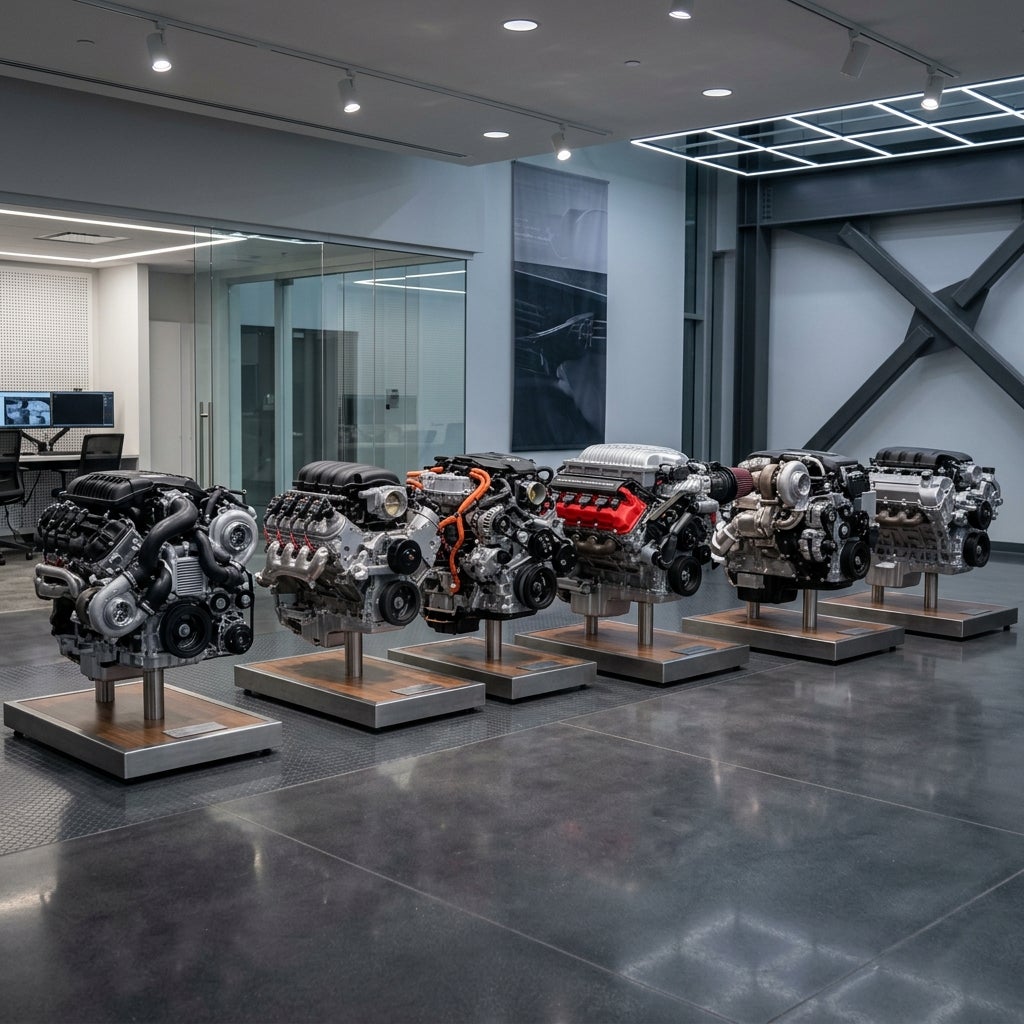
Six high-performance car engines displayed in a row on wooden pedestals inside a sleek modern facility. (Representative image for illustration purposes only. Actual vehicle may vary based on trim and configuration.)

What Engine Options Are Available in the Ford F-150? Complete Powertrain Lineup

Selecting the right powertrain for your Ford F-150 is one of the most critical vehicle ownership decisions you will make. Ford designs America's best-selling half-ton truck to accommodate an exceptionally broad array of driving demands, ranging from fuel-efficient daily commuting across Junction City to heavy-duty towing, agricultural work in Dickinson County, and off-road trail driving. Understanding the precise power delivery, displacement characteristics, and capability metrics of each engine option ensures you select a truck tailored exactly to your personal lifestyle, job site demands, and trailering requirements.
Currently, the Ford F-150 features six distinct engine architectures, each engineered with advanced technology such as dual port-fuel and direct-injection (PFDI) systems, twin turbochargers, variable cam timing, or high-output hybrid battery integration. Whether you favor the smooth, linear acceleration of a naturally aspirated V8 or the instant low-end torque of an EcoBoost V6, Ford's engine lineup provides optimized options for every type of driver.

Engine Option

Horsepower

Torque (lb-ft)

Max Towing Capability

2.7L EcoBoost V6

325 hp @ 5,500 rpm

400 lb-ft @ 3,000 rpm

Up to 8,400 lbs

5.0L Ti-VCT V8

400 hp @ 6,000 rpm

410 lb-ft @ 4,250 rpm

Up to 13,000 lbs

3.5L EcoBoost V6

400 hp @ 6,000 rpm

500 lb-ft @ 3,100 rpm

Up to 13,500 lbs

3.5L PowerBoost Hybrid V6

430 hp @ 6,000 rpm

570 lb-ft @ 3,000 rpm

Up to 12,700 lbs

3.5L High-Output EcoBoost V6

450 hp @ 5,850 rpm

510 lb-ft @ 3,000 rpm

Up to 8,200 lbs

5.2L Supercharged V8 (Raptor R)

720 hp @ 6,650 rpm

640 lb-ft @ 4,250 rpm

Up to 8,700 lbs

To explore detailed vehicle specifications or review current showroom models, feel free to check out our Research Ford F-150 resource center or visit Valor Ford directly in Junction City, KS.

2.7L EcoBoost V6 vs. 5.0L Ti-VCT V8: Balancing Fuel Economy and Classic V8 Power

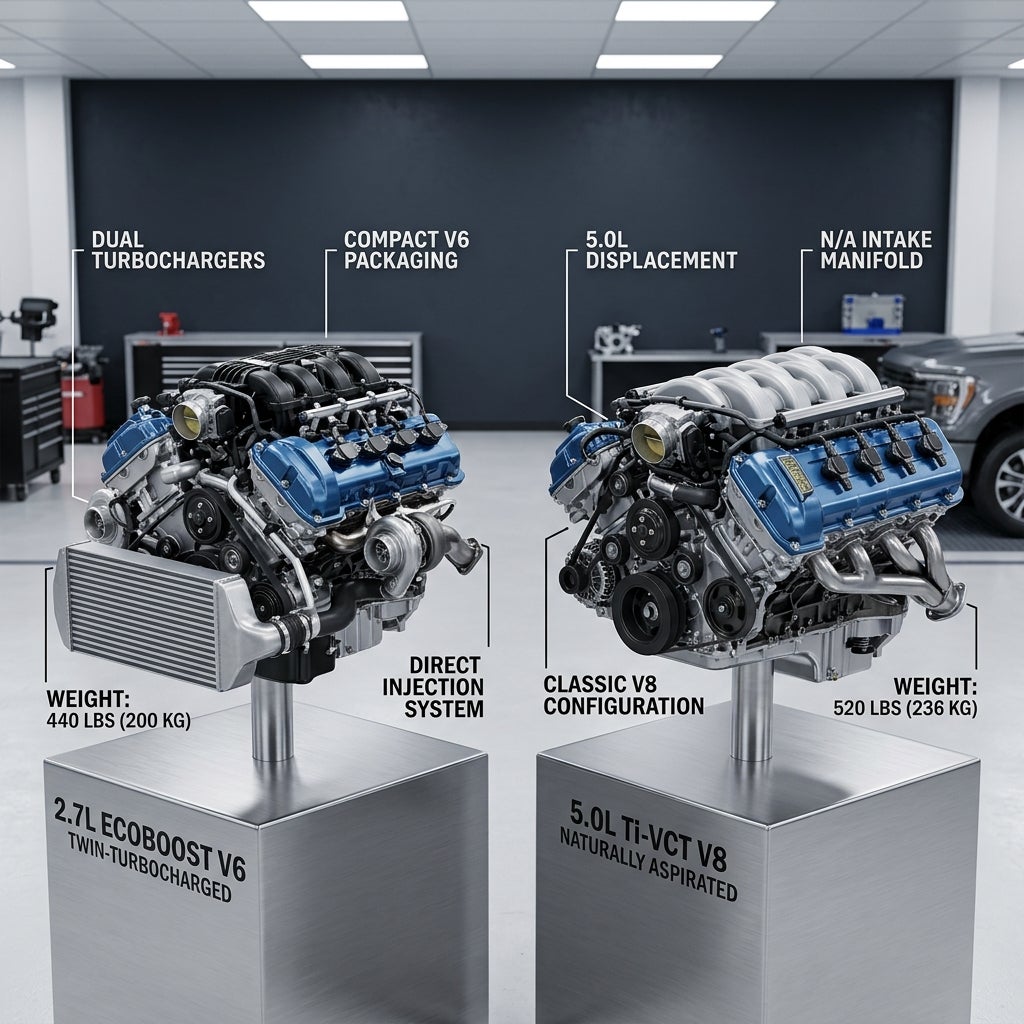
When comparing entry-level and traditional engine choices, truck shoppers frequently debate between the twin-turbocharged 2.7L EcoBoost V6 and the naturally aspirated 5.0L Ti-VCT 'Coyote' V8 engine. Both powerplants deliver impressive performance, but they cater to distinct driving preferences and work conditions. The 2.7L EcoBoost V6 is constructed from compacted graphite iron (CGI)—the same robust material used in Ford's heavy-duty Super Duty diesel blocks. Producing 325 horsepower and a stout 400 lb-ft of torque at just 3,000 rpm, this compact powerhouse reaches peak torque very early in the rev range. For daily commuting between Fort Riley and Junction City, running local errands, or pulling light utility trailers, the 2.7L engine provides exceptional responsiveness, quick acceleration off the line, and outstanding fuel economy.
In contrast, the 5.0L Ti-VCT V8 delivers classic American muscle with 400 horsepower and 410 lb-ft of torque. Featuring dual-overhead camshafts, twin independent variable camshaft timing, and an advanced dual-injection system, the Coyote V8 produces a high-revving, linear power curve accompanied by a rich exhaust note. Driver enthusiasm, linear throttle modulation when hauling bed loads, and proven naturally aspirated long-term simplicity make the 5.0L V8 a favorite among fleet owners and traditional truck purists.
Side-by-side display comparing a 2.7L EcoBoost V6 engine and a 5.0L Ti-VCT V8 engine with key specs labeled. (Representative image for illustration purposes only. Actual vehicle may vary based on trim and configuration.)
Key takeaways when deciding between these two options: • Fuel Efficiency: The 2.7L EcoBoost excels in city/highway combined EPA estimates during unloaded daily commuting. • Sound & Feel: The 5.0L V8 offers smooth power building higher in the RPM range alongside an iconic exhaust sound. • Payload Capacity: The 5.0L V8 configuration supports maximum payload specs when properly equipped with heavy-duty payload packages.

3.5L EcoBoost V6 Engine: High Torque Output for Heavy Towing and Hauling

For truck owners whose primary demand involves pulling heavy trailers, equipment, or agricultural supplies, the 3.5L Twin-Turbo EcoBoost V6 stands out as the ultimate conventional towing powerplant in the half-ton segment. Delivering 400 horsepower and a massive 500 lb-ft of torque, this engine surpasses many larger naturally aspirated V8s in pulling power.
The defining characteristic of the 3.5L EcoBoost is its flat torque curve. Reaching its peak 500 lb-ft at an accessible 3,100 rpm, the engine provides immense pulling force without needing to downshift aggressively or rev to extreme limits when climbing steep highway grades along Interstate 70 or navigating country roads across Dickinson County. Paired with Ford's smooth-shifting 10-speed SelectShift automatic transmission, the 3.5L EcoBoost keeps the engine constantly within its optimal power band.
When properly equipped with the Max Trailer Tow Package and 3.55 or 3.73 axle ratios, F-150 models powered by the 3.5L EcoBoost achieve a maximum towing capability of up to 13,500 lbs. High-capacity engine oil coolers, dual intercoolers, and enhanced radiator cooling fans enable the engine to handle continuous heavy loads under hot summer conditions in central Kansas without sacrificing performance or thermal efficiency.

3.5L PowerBoost Hybrid V6: Maximum Efficiency and Pro Power Onboard Capability

The 3.5L PowerBoost Full Hybrid V6 represents a major technological leap in half-ton pickup performance. By combining the proven 3.5L twin-turbo V6 engine with a 44-horsepower (33kW) electric motor integrated directly into the 10-speed modular hybrid transmission, Ford achieves a staggering total output of 430 horsepower and 570 lb-ft of torque—the highest torque rating available outside of the specialty Raptor R.
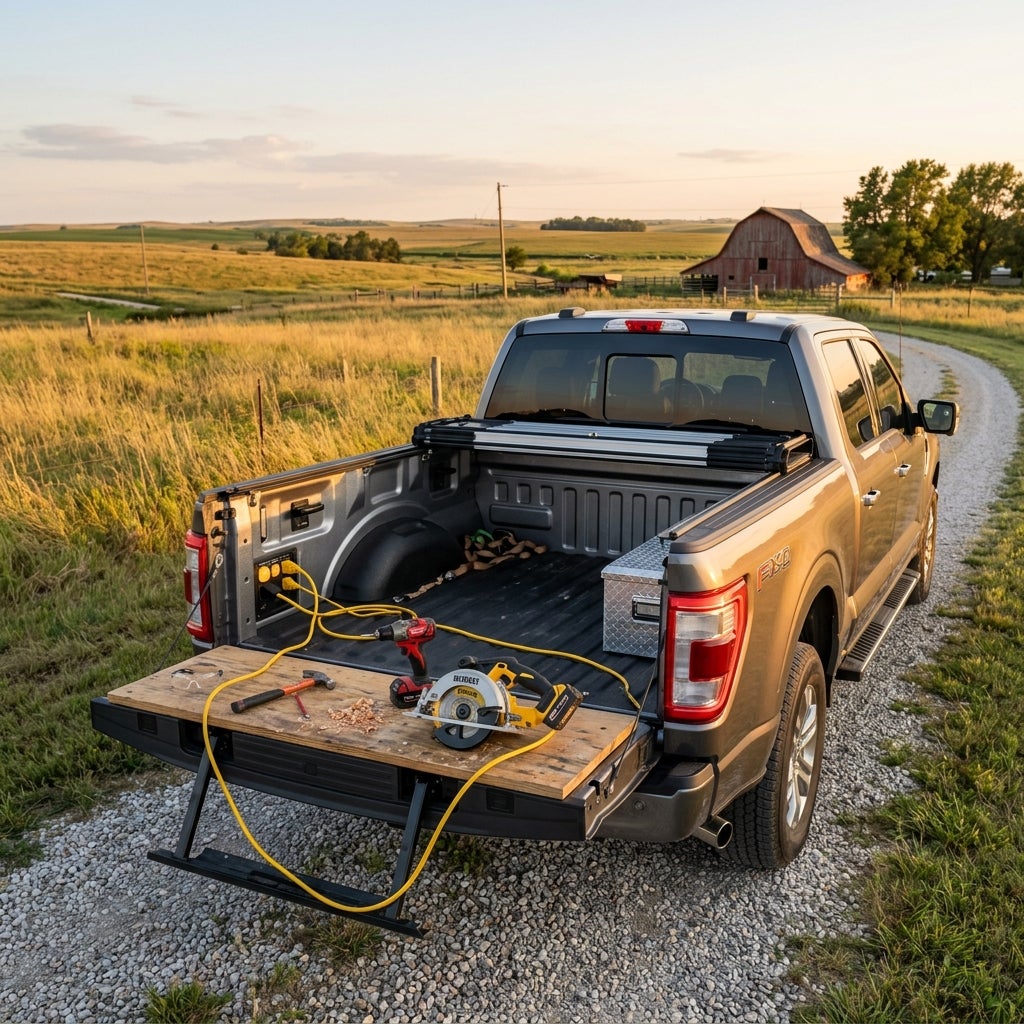
Beyond instant electric low-end torque and impressive EPA-estimated fuel economy, the headline feature of the PowerBoost hybrid is its revolutionary Pro Power Onboard system. Turning your truck into an active mobile generator, Pro Power Onboard provides accessible AC power through bed-mounted outlets. • 2.4kW System (Standard): Provides continuous power for power tools, air compressors, tailgating equipment, and electric saws. • 7.2kW System (Available): Delivers up to 7,200 watts of 120V/240V power—capable of running an entire construction job site, powering heavy MIG welders, or supplying emergency backup power to household appliances during storm outages.
A pickup truck tailgate setup as a workbench with power tools plugged into the bed's outlet in a rural setting. (Representative image for illustration purposes only. Actual vehicle may vary based on trim and configuration.)
If you are considering upgrading your current vehicle to a high-efficiency PowerBoost Hybrid, you can calculate your vehicle's trade value online with our instant Trade In Evaluation tool at Valor Ford.

What Is the Maximum Payload Capacity of the Ford F-150 Across Engine Options?

Cab & Bed Options

Payload capacity measures the total weight of cargo, passengers, and accessories placed directly in the truck bed and cabin. Cab selection heavily impacts net payload: Regular Cab models with 8-foot beds weigh less than 4-door SuperCrew cabs, resulting in higher overall payload limits.

GVWR & Axle Specs

Gross Vehicle Weight Rating (GVWR) determines maximum total weight allowed for truck and load combined. Selecting heavy-duty payload packages enhances leaf spring rates, reinforces rear axle housing thickness, upgrades brake cooling, and increases gross axle weight limits.

Engine Mass Differences

Engine weight affects net bed capacity. The naturally aspirated 5.0L V8 and 3.5L EcoBoost offer maximum payload ratings (up to 2,445+ lbs when properly configured), whereas the PowerBoost Hybrid's 1.5kWh lithium-ion battery adds curb weight, slightly decreasing net payload capacity.

High-Performance Powertrains: Raptor 3.5L High-Output and 5.2L Supercharged V8 Engine Options

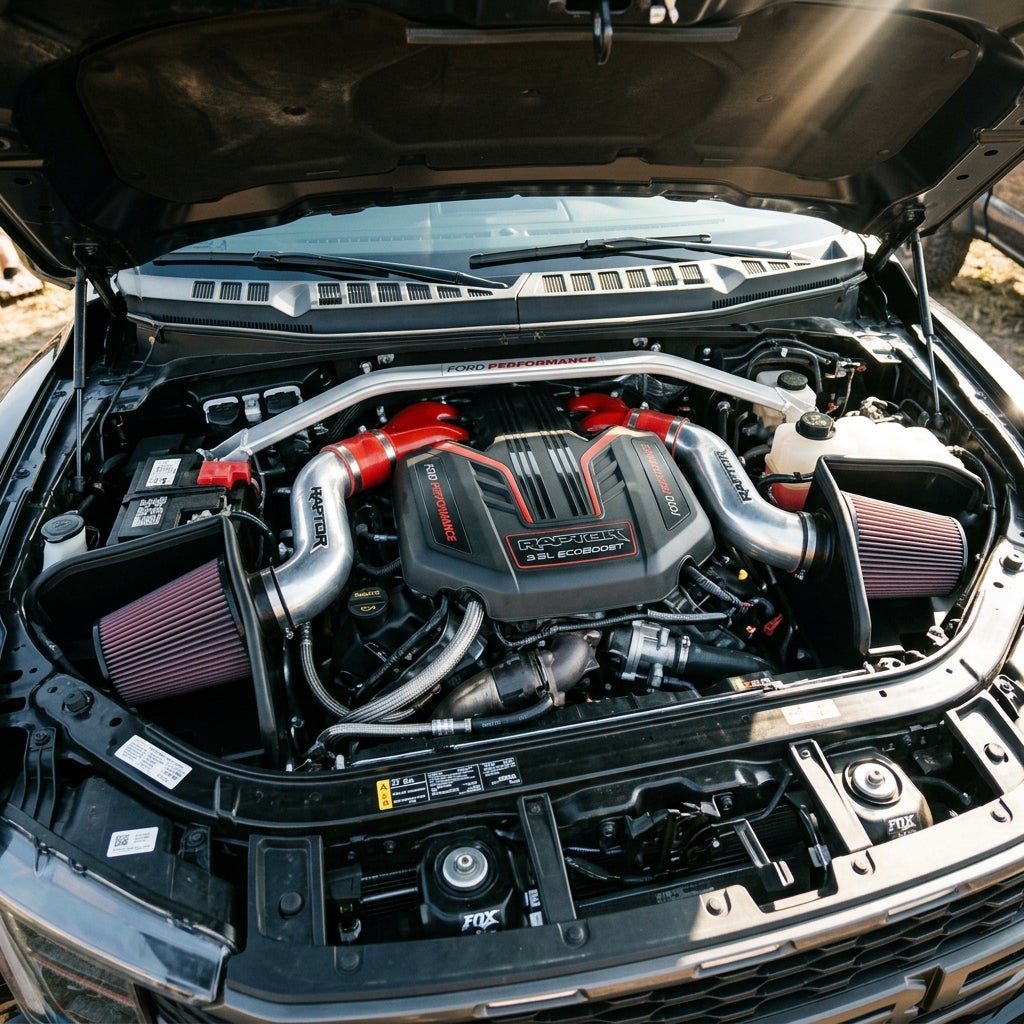
For off-road enthusiasts seeking extreme speed and desert racing performance, Ford Performance offers two specialized powertrains in the flagship F-150 Raptor lineup. The standard F-150 Raptor houses a specially tuned 3.5L High-Output EcoBoost V6 producing 450 horsepower and 510 lb-ft of torque. Engineered with upgraded turbochargers, high-flow exhaust manifolds, high-volume cooling fans, and Baja mode anti-lag engine tuning, this engine responds instantly across rocky terrain, sand dunes, and high-speed off-road trails.
At the top of the performance hierarchy sits the mighty F-150 Raptor R, powered by a supercharged 5.2L V8 engine generating an unbelievable 720 horsepower and 640 lb-ft of torque. Derived from Mustang Shelby engineering, this supercharged V8 utilizes a 2.65-liter Roots-type supercharger, cast-stainless steel exhaust headers, unique oil cooler systems, and extra-deep oil pan baffling designed to maintain lubrication under steep off-road lean angles.
Engine bay of a Ford Raptor featuring a 3.5L EcoBoost engine with dual red cone air filters and performance parts. (Representative image for illustration purposes only. Actual vehicle may vary based on trim and configuration.)

How Do Ford F-150 Trim Levels Differ in Features and Standard Engine Equipment?

Navigating the Ford F-150 trim walk is essential to securing the standard or optional powertrain that matches your driving expectations. Ford structures its trim levels so that work-ready trucks prioritize efficiency and durability, while mid-tier and high-luxury trims unlock advanced hybrid power options or specialized V8 architectures.

Trim Level

Standard Powertrain

Available Powertrain Upgrades

XL

2.7L EcoBoost V6

5.0L V8

STX

2.7L EcoBoost V6

5.0L V8

XLT

2.7L EcoBoost V6

5.0L V8 / 3.5L EcoBoost V6 / 3.5L PowerBoost Hybrid

Lariat

5.0L Ti-VCT V8

3.5L EcoBoost V6 / 3.5L PowerBoost Hybrid

King Ranch

3.5L EcoBoost V6

3.5L PowerBoost Hybrid V6

Platinum

3.5L EcoBoost V6

3.5L PowerBoost Hybrid V6

Tremor

5.0L Ti-VCT V8

3.5L Twin-Turbo EcoBoost V6

Raptor / Raptor R

3.5L High-Output EcoBoost V6

5.2L Supercharged V8 (Raptor R)

Work-oriented trims like the XL and STX deliver exceptional everyday value with the standard 2.7L EcoBoost V6. The versatile XLT trim provides access to nearly all mainstream engine options, making it the most configurable model in the F-150 lineup. Higher luxury models like King Ranch and Platinum standardise high-torque engines to match premium interior appointments.

What Are the Key Features and Trim Differences Buyers Should Understand When Choosing a Ford F-150?

Cabin & Technology

All modern F-150 trims feature a standard 12-inch touchscreen powered by SYNC 4 software, supporting wireless Apple CarPlay and Android Auto. High-tier trims add heated/ventilated leather seating, B&O Sound Systems, and Ford BlueCruise hands-free highway driving capability.

Drivetrain & Axles

Choosing between 4x2 and 4x4 systems involves selecting rear axle gear ratios. A 3.31 ratio maximizes highway fuel economy, while 3.55 and 3.73 electronic-locking rear axle ratios provide superior low-end mechanical leverage for heavy towing and off-road traction.

Towing Assist Tools

Advanced trailering technology includes Pro Trailer Backup Assist, Smart Hitch payload measurement scales, integrated trailer brake controllers, and Blind Spot Information System (BLIS) with extended trailer coverage.
Ready to explore flexible purchasing options or initiate pre-qualification? You can Get Pre-Approved for Financing directly online through Valor Ford's secure finance application.

When Should a Truck Buyer Upgrade From an F-150 to an F-250 Super Duty?

While the half-ton Ford F-150 offers impressive towing and payload limits, certain commercial, heavy agricultural, and fifth-wheel towing needs require the heavy-duty chassis of the Ford F-250 Super Duty. Key upgrade criteria include: • Fifth-Wheel & Gooseneck Towing: If your trailering setup involves heavy multi-horse livestock trailers, large fifth-wheel RV campers, or gooseneck machinery haulers exceeding 14,000 lbs, the heavy-duty fully boxed frame and higher pin-weight rating of an F-250 are mandatory. • Continuous Heavy Commercial Payload: Carrying high payload loads (over 3,000 lbs) daily subjects half-ton rear suspension springs to excessive wear. The F-250 features solid rear axles and heavy-duty leaf spring packs designed for sustained industrial hauling. • Extreme Diesel Performance: If maximum diesel torque is essential for long-distance highway hauling, upgrading to the 6.7L Power Stroke V8 Turbo Diesel in the Super Duty delivers up to 1,200 lb-ft of torque.
For more information regarding heavy-duty truck specs, check out our dedicated Research Ford F-250 page or speak with our commercial vehicle experts.
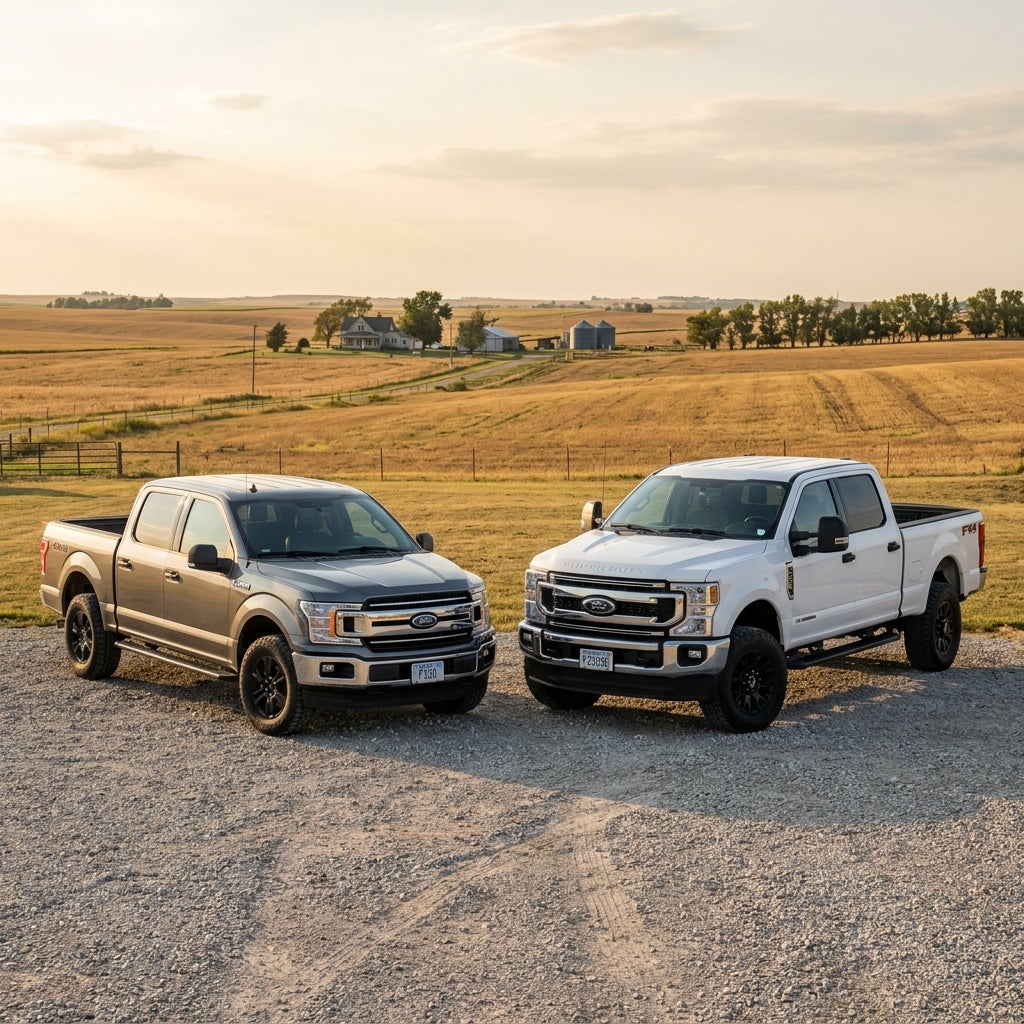
A gray Ford F-150 and a white Ford Super Duty truck parked side by side on gravel in a rural farm field. (Representative image for illustration purposes only. Actual vehicle may vary based on trim and configuration.)

What Ownership and Maintenance Questions Should I Ask Before Buying a Ford F-150?

Proper routine maintenance is essential to preserving the longevity, power output, and fuel efficiency of your Ford F-150 engine. Depending on whether you select a twin-turbocharged EcoBoost, a high-revving 5.0L V8, or a PowerBoost Hybrid, service schedules and preventive care requirements will vary.
Key Powertrain Maintenance Best Practices:• EcoBoost Turbo Care: Twin-turbocharged engines operate under high thermal conditions. Utilizing full-synthetic motor oil meeting Ford Motorcraft standards and sticking strictly to 5,000-to-7,500-mile oil change intervals preserves turbocharger bearing health and prevents oil thermal breakdown. • Spark Plug Maintenance: Turbocharged direct-injection engines create high cylinder pressure. Inspecting and replacing spark plugs every 45,000 to 60,000 miles maintains clean combustion and prevents misfires under heavy towing loads. • PowerBoost Hybrid Battery Coverage: Ford protects all PowerBoost high-voltage hybrid components—including the 1.5kWh lithium-ion battery pack and hybrid control module—with a dedicated 8-year/100,000-mile factory warranty. • 10-Speed Transmission Maintenance: Performing fluid changes and filter replacements at recommended service intervals ensures crisp, smooth gear shifts across demanding towing conditions.
Our factory-certified Ford technicians in Junction City are always available to maintain your vehicle. You can conveniently Schedule Ford Service Today or set up concierge pickup through our Schedule Pickup and Delivery Service program.

Why Is Reviewing the Vehicle History Report Important for a Used Ford F-150?

If you are purchasing a pre-owned Ford F-150, performing thorough vehicle history research guarantees you select a well-maintained truck free of hidden mechanical liabilities. A detailed CARFAX or AutoCheck report provides full visibility into former vehicle usage and service records.
Essential History Factors to Verify:• Routine Maintenance History: Verify regular oil change documentation, fluid flushes, and filter replacements—especially on turbo EcoBoost models. • Recall Completion: Confirm that all factory safety recalls or customer satisfaction programs have been addressed by an authorized Ford dealership. • Usage Type: Identify whether the pre-owned truck was driven as a personal commuter, commercial fleet truck, or heavy rental vehicle.
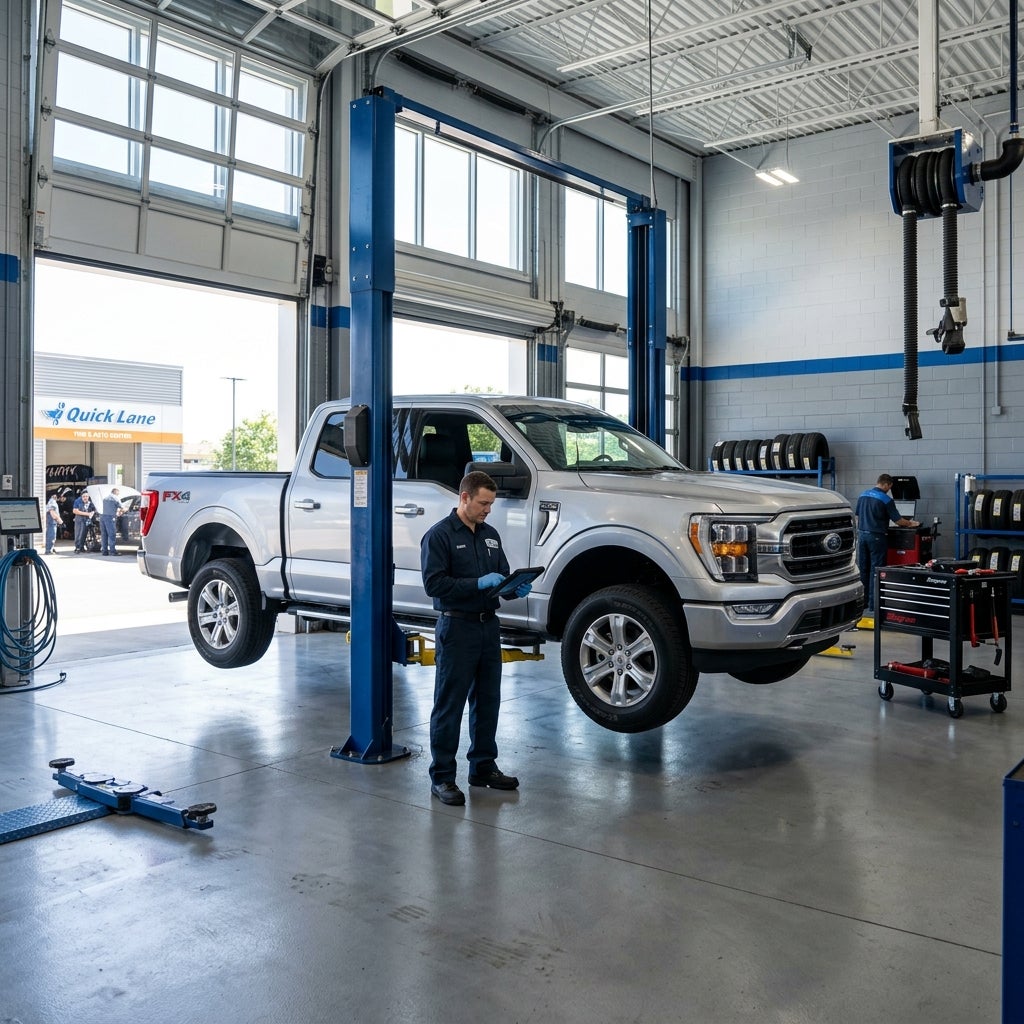
A mechanic using a digital tablet beside a silver pickup truck raised on a hydraulic lift in a service bay. (Representative image for illustration purposes only. Actual vehicle may vary based on trim and configuration.)
At Valor Ford, every used vehicle undergoes a comprehensive multi-point inspection. You can Browse Used Inventory online to discover clean-history pre-owned F-150 trucks currently available in Junction City.

Test Drive and Compare Ford F-150 Engine Options at Valor Ford in Junction City, KS

Reading specifications provides essential baseline knowledge, but nothing compares to experiencing the acceleration, smoothness, and cab comfort of a Ford F-150 firsthand. Whether you want to test the low-end pulling power of the 3.5L EcoBoost, experience the silent start and instant torque of the PowerBoost Hybrid, or feel the legendary performance of the 5.0L Coyote V8, our team at Valor Ford is ready to guide you.
We proudly serve drivers from Junction City, Fort Riley, Manhattan, and across Dickinson County with honest advice, competitive financing, and factory-trained service support. You can also explore our broader line of vehicles including options to Shop New Ford Bronco Inventory, or research other popular Ford models such as Research Ford Explorer, Research Ford Mustang, or Research Ford Maverick.
Visit our showroom at 1825 Goldenbelt Blvd, Junction City, KS 66441 ( Get Directions to Valor Ford) or Call us at (785) 238-5114 to schedule your test drive today!
Posted in:

Related Posts

F-250 vs F-350: Choosing the Right Payload for Your Needs

F-250 vs F-350: Choosing the Right Payload for Your Needs

F-250 vs F-350: Choosing the Right Payload for Your Needs How Does Engine Choice Affect Payload Capacity in an F-250 vs F-350? Opting for a heavier diesel engine directly reduces available payload capacity compared to a gasoline engine on both the F-250 and F-350 because engine curb weight eats directly into the truck's Gross Vehicle Weight Rating (GVWR). On an identical 10,000-lb GVWR setup, choosing the diesel engine reduces carrying capacity by roughly 800 to 1,000 pounds compared to a gas V8. The curb weight difference between powertrains explains this gap. The standard 6.8L gas V8 and available 7.3L gas V8 are substantially lighter iron blocks than the 6.7L Power Stroke diesel and the 6.7L high-output diesel with its massive 500 hp and 1,200 lb-ft of torque. That heavy diesel hardware sits over the front axle, taking up allowable gross capacity before you even put a driver in the cab. For instance, in Ford's published specifications for a 2026 F-250 4x4 Crew Cab with a 175.9-inch wheelbase, opting for the 7.3L gas V8 yields a charted maximum payload of 3,196 lb, whereas equipping that exact configuration with the 6.7L high-output diesel drops maximum payload down to 2,415 lb within a standard 10,000-lb GVWR ceiling. Many truck shoppers focus exclusively on horsepower and pulling power without factoring in how those heavy powertrain components limit bed capacity. If you spend your workdays hauling bulk gravel or loading heavy ag supplies across Junction City, that gas engine preserves several hundred pounds of legal bed capacity that the diesel gives up to its cooling systems and emissions hardware. To map out how engine options align with your equipment needs, you can get directions to Valor Ford or give us a quick call to check configurations on our lot. Table of Contents Why Does the Ford F-350 Have a Higher Payload Capacity Than the F-250? What Is the Real Payload Capacity Difference Between the Ford F-250 and F-350? Is an F-350 SRW Worth the Upgrade Over an F-250 for Heavy Towing? When Is a Dual-Rear-Wheel F-350 Necessary Over an SRW Model? Is an F-250 or F-350 Better for Hauling a Slide-In Truck Camper? Where Can an Owner Locate the Exact Official Payload Capacity on a Ford Truck? Why Does the Ford F-350 Have a Higher Payload Capacity Than the F-250? The Ford F-350 carries a higher payload rating than the F-250 because it is engineered with a substantially higher Gross Vehicle Weight Rating, supported by a stiffer rear suspension pack and stouter axle components. While both trucks share the same fully boxed high-strength steel frame and cab dimensions, the F-350 is built to legally and mechanically support several thousand pounds of additional weight over its rear axle. Underneath the bed, the physical differences become clear. A single-rear-wheel F-350 typically utilizes an extra rear leaf spring along with auxiliary overload springs that remain disengaged during empty driving but engage as the suspension compresses under severe loads. The F-350 also receives heavy-duty rear axle assemblies with thicker axle tubes and larger wheel bearings designed to dissipate the heat and stress generated by heavy carrying tasks. These structural upgrades allow Ford to assign the F-350 a certified GVWR ranging from 11,000 pounds up to 14,000 pounds depending on cab and wheel setup, whereas standard F-250 configurations are frequently capped at a 10,000-lb GVWR class ceiling. If you are comparing heavy-duty models for commercial use, you can research Ford F-250 configurations in detail, or inspect our rotating inventory by browsing our selection of pre-owned work trucks to see how different spring packs hold up over time. What Is the Real Payload Capacity Difference Between the Ford F-250 and F-350? The real-world payload capacity difference between an F-250 and a single-rear-wheel F-350 ranges from roughly 800 pounds to over 1,500 pounds for identical cab and engine configurations. In maximum theoretical builds across the entire lineup, the gap is wider, spanning from 4,055 lb on a properly equipped F-250 single-rear-wheel up to 7,900 lb on a dual-rear-wheel F-350. Looking at matching truck builds demonstrates how this gap works on the ground. Ford's 2026 specification charts show that a four-wheel-drive Crew Cab long-bed F-250 equipped with the 7.3L gas V8 carries a maximum charted payload of 3,196 lb. An F-350 single-rear-wheel in the identical cab, bed, and engine configuration on 18-inch all-season tires jumps to 4,150 lb of maximum payload. That is a real-world gain of nearly a thousand pounds of capacity without changing the interior space, exterior footprint, or engine performance. Maintaining your truck's driveline components is essential when operating near these load limits, and our team is ready to schedule routine Ford maintenance to inspect your brakes and suspension. To explore specific towing configurations and options, take a moment to read through our Super Duty overview. Is an F-350 SRW Worth the Upgrade Over an F-250 for Heavy Towing? An F-350 single-rear-wheel is absolutely worth the upgrade over an F-250 if you plan to tow fifth-wheel trailers or heavy goosenecks where vertical pin weight quickly consumes your truck's cargo rating. While both trucks can pull immense weight behind the hitch, the F-350 provides the essential legal payload cushion needed to support a trailer that places 20 to 25 percent of its total weight directly into the bed. A fully loaded 15,000-pound fifth-wheel camper routinely generates a kingpin weight of 3,000 pounds. In a diesel-equipped F-250 Crew Cab with an available payload rating sitting around 2,400 to 2,800 pounds, hitching that trailer instantly puts the vehicle over its legal GVWR before you load passengers, fuel, or camping gear into the cabin. An F-350 SRW handles that same trailer with hundreds of pounds of surplus payload room on the certification label. Aftermarket suspension upgrades like helper springs or air bags can level the truck, but they never legally increase the certified GVWR stamped on the factory placard. Upgrading to an F-350 from the start protects your safety and legal compliance on the highway. If you are preparing to trade your current rig for more towing capability, you can request an online used vehicle trade-in valuation and start your purchase path to get pre-approved for automotive financing before visiting the lot. When Is a Dual-Rear-Wheel F-350 Necessary Over an SRW Model? A dual-rear-wheel F-350 becomes necessary when your cargo demands exceed a 4,500-pound payload requirement or when you are towing commercial gooseneck trailers with pin weights exceeding 4,000 pounds. Adding two extra tires across the rear axle doubles your tire contact patch, providing unmatched lateral stability and eliminating rear-tire overloading under extreme tongue weights. Dual rear wheels transform how a truck handles under heavy load. A dual-rear-wheel Regular Cab two-wheel-drive F-350 equipped with the 7.3L gas V8 and the Gas Heavy-Duty Payload Package reaches an industry-leading maximum payload rating of 7,900 lb against a 14,000-lb GVWR. Single-rear-wheel tires are typically limited to roughly 3,600 to 3,750 pounds of load capacity per tire, meaning two rear tires max out around 7,200 to 7,500 pounds of total supported rear axle load. Splitting that load across four rear tires prevents thermal breakdown, reduces sway in crosswinds, and offers an essential margin of safety if a tire suffers a blowout under load. Whether you need a dually for massive livestock trailers or prefer a weekend recreation vehicle like our new Ford Bronco inventory for off-road trails, selecting the correct chassis is critical. If your current truck requires replacement hardware or suspension components, you can easily order factory-approved replacement parts through our department. Is an F-250 or F-350 Better for Hauling a Slide-In Truck Camper? An F-350 is substantially better suited for hauling a hard-side slide-in truck camper because camper applications place 100 percent of their dry and wet weight directly inside the truck bed. Even mid-sized slide-in truck campers often exceed 3,000 pounds once you account for water tanks, propane cylinders, dual batteries, and outdoor gear, which pushes past the legal payload limits of most standard F-250 builds. When hauling heavy campers across the rolling terrain of Dickinson County, top-heavy cargo raises the truck's center of gravity. An F-350 features the stiffer spring rates and auxiliary overloads required to control severe body roll on uneven gravel roads or undulating highway surfaces. Loading a heavy camper into a softer F-250 often results in excessive rear-end sag, which unweights the front steer tires and degrades steering precision and braking performance. Truck buyers carrying larger multi-slide truck campers weighing over 4,000 pounds wet should consider skipping single-rear-wheel configurations entirely in favor of an F-350 dually. The wide rear track of a dual-rear-wheel truck provides the broad foundation required to anchor top-heavy campers in crosswinds without white-knuckle driving. Where Can an Owner Locate the Exact Official Payload Capacity on a Ford Truck? An owner can find the exact, certified payload rating for their specific vehicle on the yellow and white Tire and Loading Information placard located on the driver-side door jamb. That sticker features the explicit statement: "The combined weight of occupants and cargo should never exceed XXXX kg or XXXX lbs." Published brochures, advertising listings, and online specification sheets list theoretical maximum ratings for stripped-down, base-trim configurations. Factory options such as four-wheel-drive transfer cases, skid plates, power running boards, larger wheels, and luxury center consoles add weight to the bare chassis, reducing available cargo capacity pound for pound. Two trucks with identical trims on a dealer lot can carry distinct payload ratings if one is fitted with a fifth-wheel prep package, panoramic moonroof, or spray-in bedliner. Reviewing that door-jamb sticker is the only way to confirm legal capacity before hooking up heavy equipment. If you want our commercial sales staff to review your door sticker specifications or inspect your truck's ratings in person, visit our dealership showroom or connect directly with our specialists by making a phone inquiry today. © 2026 Valor Ford. All rights reserved.

What Should You Know Before Buying From a Local Ford Dealership?

What Should You Know Before Buying From a Local Ford Dealership?

What Should You Know Before Buying From a Local Ford Dealership? Before buying from a local dealership, confirm the specific vehicle configuration that matches your towing or passenger needs, compare factory financing or lease incentives through Ford Credit, and evaluate your trade-in allowance against net sales tax savings. In Kansas, trading in your vehicle directly reduces the taxable purchase price of your next car, keeping more money in your pocket than an outright private sale. Securing pre-approval before stepping onto the showroom floor clarifies your buying power and streamlines the paperwork. Navigating your vehicle purchase locally also ensures direct access to certified technicians, factory warranty support, and manufacturer-backed roadside care. Every new Ford includes factory roadside coverage, giving you direct access to help whenever needed nationwide through Ford Roadside Assistance: 1-800-241-3673. Drivers visiting our showroom at 1825 Goldenbelt Blvd can work directly with our staff to review window stickers, order custom options straight from the assembly plant, and inspect practical features like cab dimensions and hitch configurations. Whether you need directions or want to talk through current lot arrivals, you can check our showroom location or give our team a quick call to get started. Table of Contents What Financing Rates and Lease Deals Does Ford Credit Offer? What Towing Capacity and Performance Does the 2027 Ford F-150 Deliver Compared to the Chevrolet Silverado 1500? What Engine Powers the Ford Explorer ST and Which Family Features Stand Out? How Do Dealership Trade-In Values Compare to Private-Party Sales for Used Fords? Where Is the Dealership in Junction City and What Military Discounts Apply for Fort Riley Personnel? Common Questions About Shopping and Servicing at Our Dealership Plan Your Visit to Valor Ford and Schedule Your Next Test Drive What Financing Rates and Lease Deals Does Ford Credit Offer? Ford Credit may offer financing options and lease programs; contact the dealership for current details. Qualified retail buyers may be eligible for promotional financing offers on select new trucks and sport utility vehicles; contact the dealership for current details. Lease options may be available with varying terms and conditions; contact the dealership for current details. Navigating loan and lease approvals begins with an assessment of debt-to-income metrics, down payment reserves, and bureau ratings. Ford Credit structures tiers that reward higher credit scores with lower baseline money factors and subsidized rates. When prospective buyers prepare documentation in advance, including recent earnings statements, proof of residency, and trade-in titles, approval decisions move quickly through the underwriting system. While third-party lending institutions set rates strictly to broad retail market indicators, captive automotive financing through the manufacturer provides targeted promotional incentives tied directly to seasonal sales programs. Taking advantage of these programs is straightforward when you set up your profile early. You can streamline your purchase pathway by prequalifying online before scheduling a test drive. Setting up your financing framework ahead of time allows you to focus on choosing the proper trim level, drivetrain, and equipment packages. Once you bring your vehicle home, keeping it running at peak factory performance is equally simple when you schedule certified Ford maintenance with our factory-trained service technicians. What Towing Capacity and Performance Does the 2027 Ford F-150 Deliver Compared to the Chevrolet Silverado 1500? The 2027 Ford F-150 achieves a maximum conventional towing capacity of up to 13,500 pounds and a gas payload rating of up to 2,430 pounds when equipped with the 3.5L EcoBoost twin-turbo V6 engine and the Max Trailer Tow Package. That maximum towing rating edges out the Chevrolet Silverado 1500, which reaches an upper limit of 13,300 pounds when configured with its 6.2-liter V8 or 3.0-liter Duramax turbo-diesel. Beyond raw trailering limits, the high-strength, military-grade aluminum-alloy body of the F-150 delivers rust resistance and curb-weight efficiency that conventional steel truck beds cannot match. Powertrain versatility remains a cornerstone of the F-150 lineup. Across rural farming acreage in Dickinson County, hauling livestock, commercial equipment, and grain trailers demands sustained torque and electrical utility. The available 3.5L PowerBoost full hybrid engine generates 430 hp and 570 lb-ft of torque while introducing integrated job-site power through Pro Power Onboard. This system provides up to 7.2 kW of exportable electricity through 120-volt and 240-volt cab and bed outlets, functioning as a dedicated mobile generator capable of running plasma cutters, frame welders, and power tools without an auxiliary engine generator. Performance & Trailering Metric 2027 Ford F-150 (3.5L EcoBoost) Chevrolet Silverado 1500 (6.2L V8 / 3.0L Diesel) Maximum Conventional Towing 13,500 lbs 13,300 lbs Maximum Gas Payload Rating 2,430 lbs 2,260 lbs Peak Gas Engine Torque 500 lb-ft 460 lb-ft (6.2L V8) Mobile Generator System Pro Power Onboard (Up to 7.2 kW) Auxiliary bed outlets (Up to 400W) Cab and Bed Material High-strength aluminum alloy Roll-formed high-strength steel Drivers requiring dedicated equipment setups can explore complete engine and axle specs through our Ford F-150 research page. For custom electrical setups, heavy-duty hitch accessories, or fifth-wheel prep packages, you can also order authentic factory components directly through our parts counter. What Engine Powers the Ford Explorer ST and Which Family Features Stand Out? The performance-focused Ford Explorer ST is powered by an athletic 3.0L EcoBoost twin-turbo V6 engine generating 400 hp and 415 lb-ft of torque, mated to a calibrated 10-speed automatic transmission. This powertrain launches the three-row performance SUV from zero to 60 mph in roughly 5.1 seconds while sustaining a solid 5,000-pound maximum towing capacity with its standard Class III Towing package. Drivers seeking responsive acceleration without sacrificing family hauling capability get firm chassis dampening, sport-tuned steering gear, and selectable drive modes tailored for varied traction environments. Inside the cabin, three rows of versatile seating accommodate six or seven passengers depending on whether you choose second-row captain's chairs or the three-across bench configuration. Cargo management remains exceptionally functional: Up to 85 cubic feet of total cargo volume with both rear rows folded flat. About 46 cubic feet of dedicated storage behind the second-row seating. Roughly 18 cubic feet of usable space with all three rows occupied. One-touch E-Z Entry second-row captain's chairs that slide and tilt forward for easy third-row access. Standard Ford Co-Pilot360 active safety technology, including automated emergency braking and blind-spot monitoring with trailer coverage. Available Ford BlueCruise for hands-free highway driving on pre-mapped highway corridors. Families considering this high-output SUV can evaluate detailed cabin dimensions, standard equipment variations, and technology packages on our Ford Explorer model guide. How Do Dealership Trade-In Values Compare to Private-Party Sales for Used Fords? Dealership trade-in allowances often land roughly 10% to 15% below top private-party listings because an authorized dealer assumes all vehicle reconditioning expenses, safety certifications, and market-depreciation risk. Selling a vehicle privately requires you to detail the car, photograph the exterior and interior, manage online listings, screen prospective buyers, and coordinate strangers taking test drives. In contrast, trading in your vehicle at an established dealership completes the entire appraisal, title transfer, loan payoff, and purchase transaction in a single afternoon. The critical financial equalizer is the net sales tax benefit available under Kansas statute K.S.A. 79-3606. When trading in a car toward the purchase of a replacement vehicle at a licensed dealer, state and local sales tax is assessed strictly on the net difference between the purchase price and the trade-in allowance. Trade-in allowances can reduce the taxable purchase price of your next vehicle, subject to applicable laws and your specific transaction details. If you are planning to upgrade, you can check our current pre-owned vehicle selection to see what models match your driving routine. Before making any decisions, submit your vehicle's mileage and condition through our online trade-in appraisal form to calculate your exact equity position and sales tax offset. Where Is the Dealership in Junction City and What Military Discounts Apply for Fort Riley Personnel? Our dealership is located at 1825 Goldenbelt Blvd in Junction City, serving drivers across Geary County with sales, financing, and certified vehicle maintenance. The sales showroom opens Monday through Friday from 8:30 AM to 6:00 PM and Saturday from 9:00 AM to 5:00 PM. Our dedicated service and parts department operates Monday through Friday from 7:30 AM to 5:30 PM to handle scheduled maintenance, warranty inspections, and tire installations. Active-duty military members, veterans, and military retirees stationed nearby can take advantage of the Ford Military Recognition Program. This manufacturer program may provide bonus cash incentives toward the purchase or lease of eligible new Ford models. Our finance department can help qualifying service personnel review current incentive eligibility, trade-in equity, and financing options. Common Questions About Shopping and Servicing at Our Dealership Q: Can I custom order a new Ford directly from the factory? Factory custom ordering allows you to build a vehicle to your exact specifications, including paint color, interior upholstery, axle ratios, and specialized off-road or trailering packages. When you submit a custom order with our sales staff, your order receives priority factory scheduling and direct order-status tracking. Your promotional financing incentives and trade-in appraisals can be protected during assembly, ensuring no financial surprises when your new vehicle arrives on our transport lot. If you want an off-road-ready vehicle immediately, you can also explore our new Ford Bronco inventory to see what adventure-ready configurations are available today. Q: What documents are required when applying for Ford Credit financing? Applying for automotive financing requires a valid government-issued driver's license, proof of current automotive insurance, and your most recent pay stubs or verified income documentation. If you are trading in a vehicle with an active loan, bring your current lender statement containing the account number and payoff contact information. Bringing all primary and spare key sets alongside the vehicle title or registration ensures our team can process your paperwork and finalize your loan agreement efficiently. Q: What coverage is included with Ford Roadside Assistance? Manufacturer-backed roadside assistance is included with eligible new Ford vehicles for 5 years or 60,000 miles, whichever comes first. The program provides 24-hour emergency support, including flat tire changes using your vehicle's spare, battery jump-starts, fuel delivery if you run out of gas, lockout assistance, and complimentary towing to the nearest authorized Ford service facility. Service can be dispatched through the Ford App or by calling the dedicated toll-free roadside assistance phone line. Q: How does dealership vehicle reconditioning impact trade-in offers? Dealership trade-in offers reflect the necessary mechanical, structural, and cosmetic investments required to prepare a used vehicle for resale under manufacturer standards. Our certified technicians complete comprehensive multi-point safety inspections, replace worn brake pads and tires, complete scheduled fluid services, and perform professional exterior and interior detailing. These reconditioning investments ensure subsequent buyers receive a thoroughly inspected, roadworthy vehicle backed by dealer accountability. Q: What maintenance schedule should I follow for my Ford EcoBoost engine? EcoBoost turbocharged engines operate under precise thermal and pressure tolerances, making regular oil changes essential to long-term component durability. Ford recommends scheduling oil and filter changes every 5,000 to 7,500 miles under normal operating conditions, using motor oil that meets rigorous Ford engineering specifications. Routine multi-point inspections also verify air filter cleanliness, coolant levels, tire rotation wear patterns, and software calibrations to keep your powertrain running efficiently. Plan Your Visit to Valor Ford and Schedule Your Next Test Drive Selecting the ideal truck or family SUV comes down to hands-on experience behind the wheel. We invite you to visit our showroom at 1825 Goldenbelt Blvd, Junction City, KS 66441 to inspect cab configurations, test advanced digital touchscreens, and compare powertrain responses across our lot. Use our map link to pull up driving directions to our showroom or reach out with a phone call to our sales desk to schedule your test drive today. © 2026 Valor Ford. All rights reserved.

2027 Ford SUV Lineup: Choosing Your Ideal Family Vehicle

2027 Ford SUV Lineup: Q&A with Valor Ford Finance Expert Nino Williams

2027 Ford SUV Lineup: Q&A with Valor Ford Finance Expert Nino Williams Starting prices for the 2027 Ford SUV lineup begin at approximately $29,000 for the compact Escape, $36,760 for the off-road capable Bronco Sport, $40,680 for the three-row Explorer, and $63,920 for the full-size Expedition. To help area buyers navigate these options, we sat down with Nino Williams, Finance Manager at Valor Ford, who brings 11 years of automotive finance experience to guide local families toward their ideal vehicle. Q: What is the starting price range for the 2027 Ford SUV lineup? A: The 2027 Ford SUV lineup spans from roughly $29,000 for the entry-level Escape up to $63,920 for the flagship Expedition. In the middle of the lineup, the 2027 Ford Bronco Sport starts at an MSRP of $36,760, while the popular three-row 2027 Ford Explorer begins at an MSRP of $40,680. These entry figures represent base trim levels with standard powertrains, giving buyers a broad spectrum of price points to fit different household budgets. When buyers visit us to compare models across the showroom floor, pricing structured around clear capability steps makes finding a match straightforward. An entry trim like the Explorer Active provides essential three-row utility at its base price, whereas moving into performance or luxury trims like the Explorer ST or Expedition Active adjusts the financial equation based on added power, luxury features, or advanced towing hardware. For drivers planning a visit to review current showroom inventory or test-drive specific trims, checking our Junction City showroom location provides direct access to our full sales team. You can also give our finance team a call directly to discuss custom orders, trade-in valuations, or current manufacturer incentives on any 2027 model. Q: Which 2027 Ford SUV offers the best overall value for value-focused families? A: The 2027 Ford Explorer in the Active or ST-Line trim delivers the strongest total value for growing families who need three-row seating without stretching into full-size SUV pricing. At a starting price of $40,680, the Explorer Active comes standard with a 2.3L EcoBoost four-cylinder engine generating 300 hp, three-row flexible seating, standard tri-zone automatic climate control, and the complete Ford Co-Pilot360 safety suite. For families in Junction City balancing school drop-offs, sports equipment, and daily errands, this midsize crossover avoids the higher fuel and purchase costs of larger full-size vehicles while still providing six or seven passenger seats. The ST-Line trim adds sporty aesthetic touches, larger 20-inch wheels, and access to hands-free highway driving tech while retaining the efficient four-cylinder engine, making it a sweet spot for long-term ownership value. Buyers seeking to maximize their budget can also explore our pre-owned vehicle inventory for certified choices or use our online trade-in evaluation tool to see how much equity from a current vehicle can be applied toward a new purchase. To streamline the purchase process before stepping onto the lot, shoppers can easily get pre-approved for financing online through our secure application. "Families often focus solely on the initial sticker price, but real value comes from choosing a vehicle whose standard equipment matches your daily driving needs for the next five years." Q: What are the towing capacities across the 2027 Ford SUV lineup? A: Towing capacities in the 2027 Ford SUV lineup range from 1,500 lbs on the compact Escape up to 9,300 lbs on the full-size Expedition when equipped with the Heavy-Duty Trailer Tow Package. The compact Ford Escape hauls up to 3,500 lbs when equipped with its available 2.0L EcoBoost engine, while the 2027 Ford Bronco Sport offers a maximum towing capacity of 2,700 lbs alongside standard 4x4 capability. Moving up to the three-row 2027 Ford Explorer, every model comes standard with a Class III Trailer Tow Package that enables a robust 5,000 lbs towing capacity across both the 2.3L EcoBoost and the 400 hp 3.0L EcoBoost V6 powertrains. For heavy-duty hauling, the full-size 2027 Ford Expedition features a standard tow rating of 6,000 lbs from its 3.5L EcoBoost V6, which increases to 9,300 lbs with the specialized tow package. For active-duty service members and outdoor enthusiasts around Fort Riley pulling camper trailers or utility rigs across the Flint Hills, having factory-integrated hitch hardware and trailer sway control standard on the Explorer eliminates the need for aftermarket modifications. Buyers interested in exploring off-road variants or tow-ready packages can check our new Ford Bronco inventory to compare specialized trail and hauling setups. Q: How does fuel economy compare across the 2027 Ford SUV lineup? A: Fuel efficiency varies significantly across the lineup, ranging from an EPA-estimated 42 mpg city on hybrid compact models down to 16 mpg city / 23 mpg highway on full-size V6 powertrains. The 2027 Ford Escape Hybrid leads the lineup in overall efficiency, while the 2027 Ford Bronco Sport delivers an EPA rating of 21 mpg city / 27 mpg highway with its standard 2.0L EcoBoost four-cylinder and SelectShift automatic transmission. The midsize 2027 Ford Explorer achieves an EPA-estimated 20 mpg city / 27 mpg highway in rear-wheel-drive configuration with the standard 2.3L EcoBoost engine, with all-wheel-drive models rating slightly lower at 20 mpg city / 27 mpg highway or 19 mpg city / 26 mpg highway depending on wheel size. Performance-focused Explorer models featuring the 3.0L EcoBoost V6 achieve 18 mpg city / 25 mpg highway. In full-size territory, the 2027 Ford Expedition delivers an EPA estimate of 16 mpg city / 23 mpg highway from its twin-turbocharged 3.5L EcoBoost V6. For drivers who cover extended highway miles, selecting a four-cylinder Explorer or a compact hybrid balances daily commuter efficiency with cabin utility. Q: How much cargo space is available behind the third row in the 2027 Ford Explorer? A: The 2027 Ford Explorer provides 16 cubic feet of cargo space directly behind the third-row seats. When extra gear requires more volume, folding the 50/50 split third-row seat flat expands the cargo capacity to approximately 48 cubic feet behind the second row, and folding both rear rows flat yields a maximum cargo volume of 85 cubic feet. An underfloor storage bin behind the third row keeps smaller items out of sight, and a reversible load floor with a washable plastic underside allows families to transport wet or dirty sports gear without staining carpeted surfaces. Standard second-row captain's chairs on trims like the ST-Line slide forward in one motion to clear a walk-through path to the back seat even when child safety seats are installed. To explore detailed interior dimensions, seating configurations, and cabin storage features before visiting the dealership, drivers can review our complete Ford Explorer research guide for comprehensive model insights. Q: How does the 2027 Ford Explorer compare to the Toyota Highlander and Honda Pilot? A: The 2027 Ford Explorer outperforms the Toyota Highlander and Honda Pilot in standard horsepower and towing capacity, delivering 300 hp and a 5,000 lbs tow rating standard compared to the Highlander's 265 hp four-cylinder and the Pilot's 285 hp V6. Additionally, the Explorer offers an available 400 hp 3.0L EcoBoost V6 on ST and Platinum trims, providing a high-performance engine tier that neither rival matches. Built on a rear-wheel-drive architecture with available four-wheel drive, the Explorer provides dynamic handling and balanced vehicle dynamics that set it apart from front-wheel-drive-based competitors. While the Honda Pilot offers slightly more total cargo volume with all seats folded, the Explorer counters with its standard Class III Trailer Tow Package, standard 13.2-inch touchscreen with integrated Google services, and optional hands-free highway driving tech. For buyers evaluating overall value, the Explorer provides a higher baseline of standard utility hardware and driver-assist safety technology across its entry and mid-tier trims than similarly priced competitive models. Q: Is Ford BlueCruise hands-free driving available on 2027 Ford SUVs? A: Yes, Ford BlueCruise hands-free highway driving is available on select trim levels of the 2027 Ford Explorer, 2027 Ford Expedition, and Mustang Mach-E. The system allows drivers to operate hands-free on over 130,000 miles of prequalified divided highways, known as Hands-Free Blue Zones, while a driver-facing camera monitors eye gaze to ensure attentiveness. On the 2027 Ford Explorer, BlueCruise capability comes equipped or available on ST-Line, ST, and Platinum trims. The system includes Lane Change Assist, which performs automated lane changes when the driver taps the turn signal, and In-Lane Repositioning, which subtly shifts the vehicle away from large trucks in adjacent lanes for added comfort. Owners can activate BlueCruise through available subscription and purchase options; contact the dealership for current pricing and availability. To experience hands-free driving technology firsthand on local highway routes or speak with our sales staff about model availability, shoppers can drop by our dealership showroom address or (785) 238-5114 to schedule a test drive today. Keep Your Vehicle Running Strong Keep your vehicle performing at its best with our service team: Schedule Pickup and Delivery Service Schedule Ford Service Today Order Genuine Ford Parts © 2026 Valor Ford. All rights reserved. Vehicle specification data © JATO Dynamics Limited.