
Blog / Buying Guides

How Ford Onboard Scales Measure Real-Time Payload on the 2025 F-150 and Super Duty

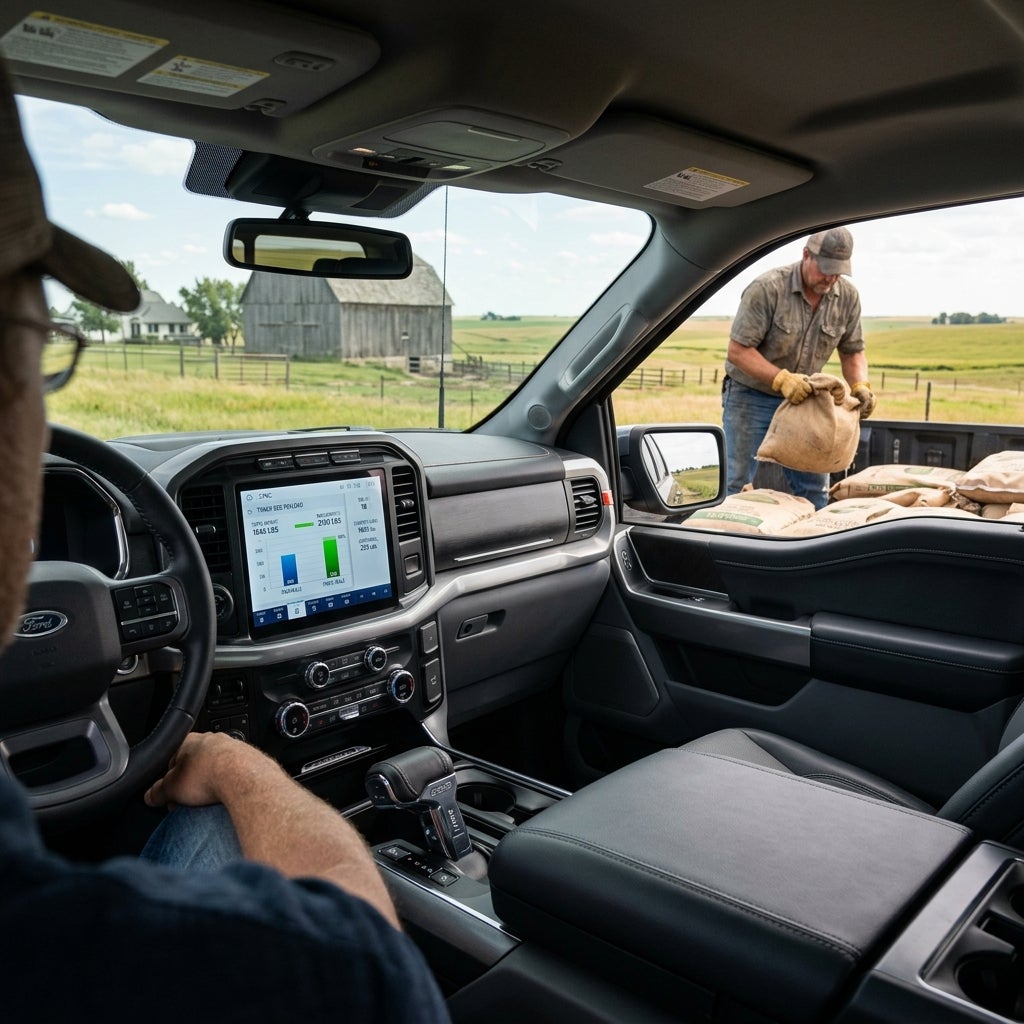
Interior view of a truck showing onboard payload scales on the screen while a man loads bags into the truck bed. (Representative image for illustration purposes only. Actual vehicle may vary based on trim and configuration.)

How Ford Onboard Scales Measure Real-Time Payload on the 2025 F-150 and Super Duty

For generations, truck owners across Dickinson County and Geary County have estimated bed payload through visual checks—watching how far the rear leaf springs crouch or feeling how heavy the steering becomes when hauling a bed full of gravel, seed bags, or fencing supplies. With the introduction of Ford Onboard Scales on the 2025 Ford F-150 and Super Duty lineup, guessing payload weight is officially a thing of the past. This system helps you monitor payload weight in real time and provides helpful feedback before you shift into drive.
The system operates through four discrete position sensors integrated directly into all four corners of the truck suspension. By measuring the physical deflection of the suspension springs relative to the chassis frame rails, the vehicle's onboard processing module cross-references sensor data against known suspension spring constants and calibrated curb weight constants. The precise weight calculation is instantly output across three dynamic interfaces: the vertical LED bars on the Smart Taillights, the 12-inch SYNC 4 central touchscreen, and remotely via the FordPass mobile smartphone app. Whether you are loading bulk grain at an auger in rural Kansas or stacking heavy palleted equipment near Fort Riley, Ford Onboard Scales deliver instantaneous feedback so you know exact cargo weights down to the pound.
To explore how these heavy-duty technology suites integrate into the newest truck lineup, drivers can Research Ford F-150 models or compare heavy commercial specs through our dedicated Research Ford F-250 guide before visiting Valor Ford in Junction City.

The Engineering Behind Ford's Suspension Sensors and Real-Time Weight Tracking

At the mechanical core of Ford Onboard Scales are rotary position sensors mounted between the axle housings and the frame structure at each wheel position. These hardware components are similar to the height-leveling sensors utilized by Ford's adaptive headlamps and continuous damping suspension systems. When cargo, tools, or aggregate materials are deposited into the truck bed, the springs compress, causing a linear movement in the sensor linkage arms.
The central processing software takes this raw vertical displacement data and runs mathematical algorithms that account for ambient temperature, suspension bushing resistance, and initial vehicle curb weight. By subtracting calibrated curb weight from the gross measured weight, the system isolates net payload mass instantly.
Because weight distribution is rarely uniform across the bed floor, having independent sensor channels on all four corners allows the vehicle control module to calculate lateral and longitudinal balance. If a heavy generator or skid of fertilizer is loaded too far toward the tailgate or off-center to the left rail, the system detects uneven axle loading and warns the operator.
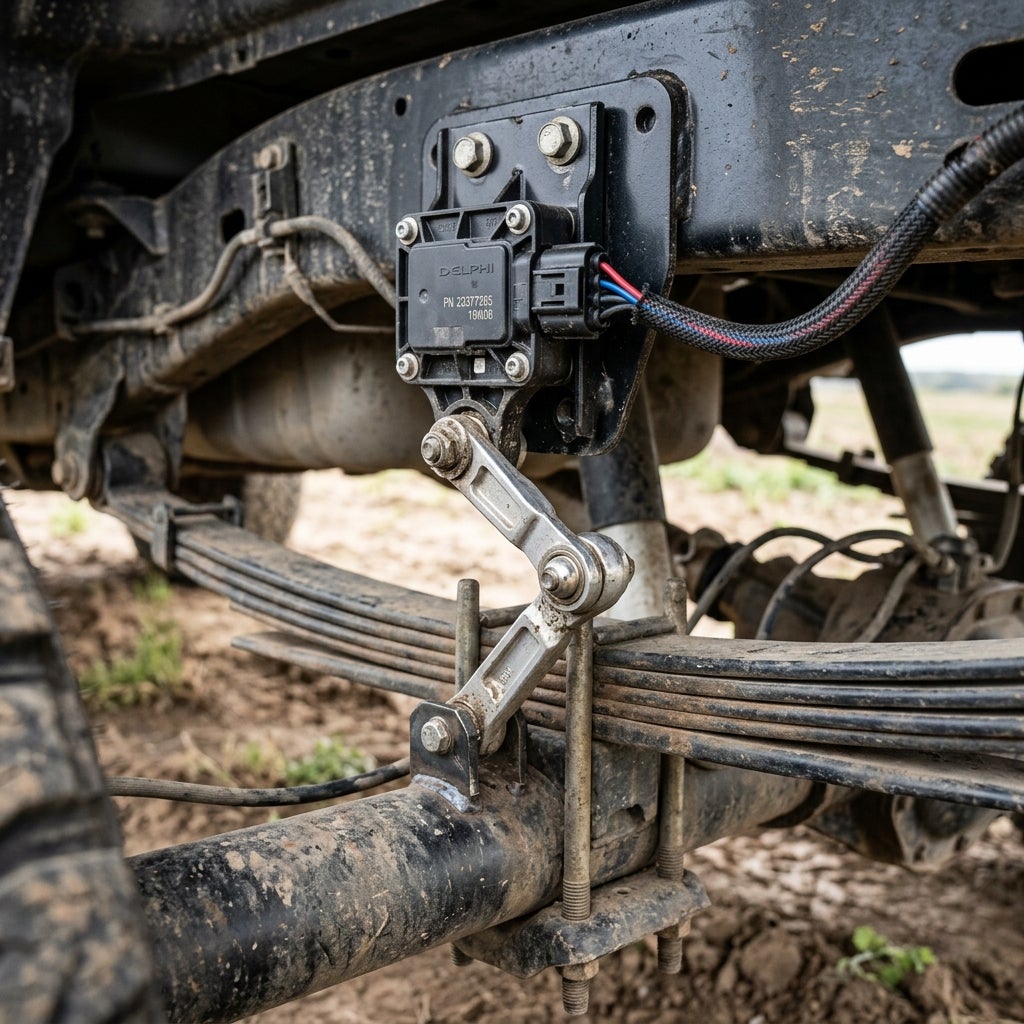
A Delphi suspension ride height sensor mounted on a truck frame rail with a mechanical linkage connected to the rear axle. (Representative image for illustration purposes only. Actual vehicle may vary based on trim and configuration.)
Furthermore, dynamic filtering algorithms prevent false weight readings caused by fuel sloshing, wind buffeting, or movement inside the cab while loading. Once the truck comes to a complete rest on level ground, the system stabilizes within seconds, providing accurate feedback comparable to many commercial weighing tools.

Reading Your Payload Weight: Smart Taillights, SYNC 4, and the FordPass App

Ford designed the Onboard Scale interaction model around real-world work environments where operators cannot constantly walk back into the vehicle cab to inspect numbers while working outside in the yard or field.

1. Smart Taillights Bar Graph

Integrated directly into the rear LED taillight assemblies are four vertical LED light strips. As you toss cargo into the bed, these LED bars illuminate progressively from bottom to top like a battery charge indicator. Each bar represents 25% of total payload capacity. When all four LEDs light up continuously, your truck is fully loaded. If you exceed maximum payload capacity, the top LED strip blinks rapidly to alert forklift operators or field hands immediately.

2. SYNC 4 Touchscreen Interface

Inside the cabin, the 12-inch SYNC 4 central display provides detailed digital metrics. Drivers can view exact weight readouts in pounds or kilograms, check percentage of maximum vehicle capacity, and observe balance indicators showing if cargo weight favors the front, rear, driver, or passenger side. The system automatically accounts for passenger weight sitting inside the vehicle cab to maintain total Gross Vehicle Weight Rating (GVWR) compliance.

3. FordPass Mobile App Remote View

Using the FordPass application on your smartphone, operators can monitor bed scale readouts remotely while operating farm machinery, skid steers, or grain augers. You can stand yards away from the truck tailgate while watching live weight progression on your phone screen, eliminating the need to climb down from agricultural machinery or run back and forth to inspect payload status.

Can You Scale Individual Payload Items Sequentially Using Scale Zeroing?

Yes, one of the most practical real-world features engineered into Ford Onboard Scales is the **Scale Zeroing** (tare) function, accessible directly through the SYNC 4 touchscreen screen or FordPass smartphone interface. Much like pressing the zero button on a digital kitchen scale or commercial shipping scale, scale zeroing resets the baseline reading back to zero pounds regardless of how much equipment or tools are already resting in the bed.
For agricultural producers or contractors making multi-stop pickup runs across Junction City, scale zeroing provides incredible precision. Suppose your F-150 or Super Duty is already loaded with 800 pounds of jobsite toolboxes, auxiliary diesel tanks, and hitch gear. By activating Scale Zeroing, the system temporarily ignores that 800-pound baseline and resets the display to 0 lbs.
Now, when you add a specific pallet of seed bags, fence posts, or concrete mix, the scale display measures *only* the new item being loaded. You can verify whether the supplier gave you exactly 500 lbs of seed or 1,200 lbs of fertilizer before leaving the supply yard. Once loading is complete, toggling off zero mode restores your total cumulative payload calculation relative to total GVWR limits.
If you want to evaluate your current truck payload or trade in your vehicle for a model with built-in scale zeroing technology, complete our easy online Trade In Evaluation to see what your vehicle is worth today.

Smart Agricultural Hauling: How Ford's Onboard Scales Protect Your Payload in Rural Kansas

Agricultural operations around Dickinson County, Geary County, and the surrounding Flint Hills farm country rely on heavy-duty pickup trucks to keep farms running efficiently. During harvest seasons and spring planting, farm trucks routinely haul dense bulk loads: loose corn, oats, bulk soybean seed, liquid tote containers, mineral blocks, and fencing supplies. Estimating dense agricultural cargo is notoriously difficult; moisture content alone can cause a scoop of soil or grain to weigh hundreds of pounds more than anticipated.
Ford Onboard Scales can serve as a helpful safeguard for Kansas farmers. Loading directly from grain augers or gravity wagons often leads to unintended overloading. Overloaded trucks traveling down rural gravel roads face extreme leaf spring strain, bent axle housings, and severe tire sidewall damage. When transitioning onto paved state highways like Highway 77 or I-70, an over-payload truck risks heavy fines from highway patrol commercial scale spot-checks and compromised stopping distances.
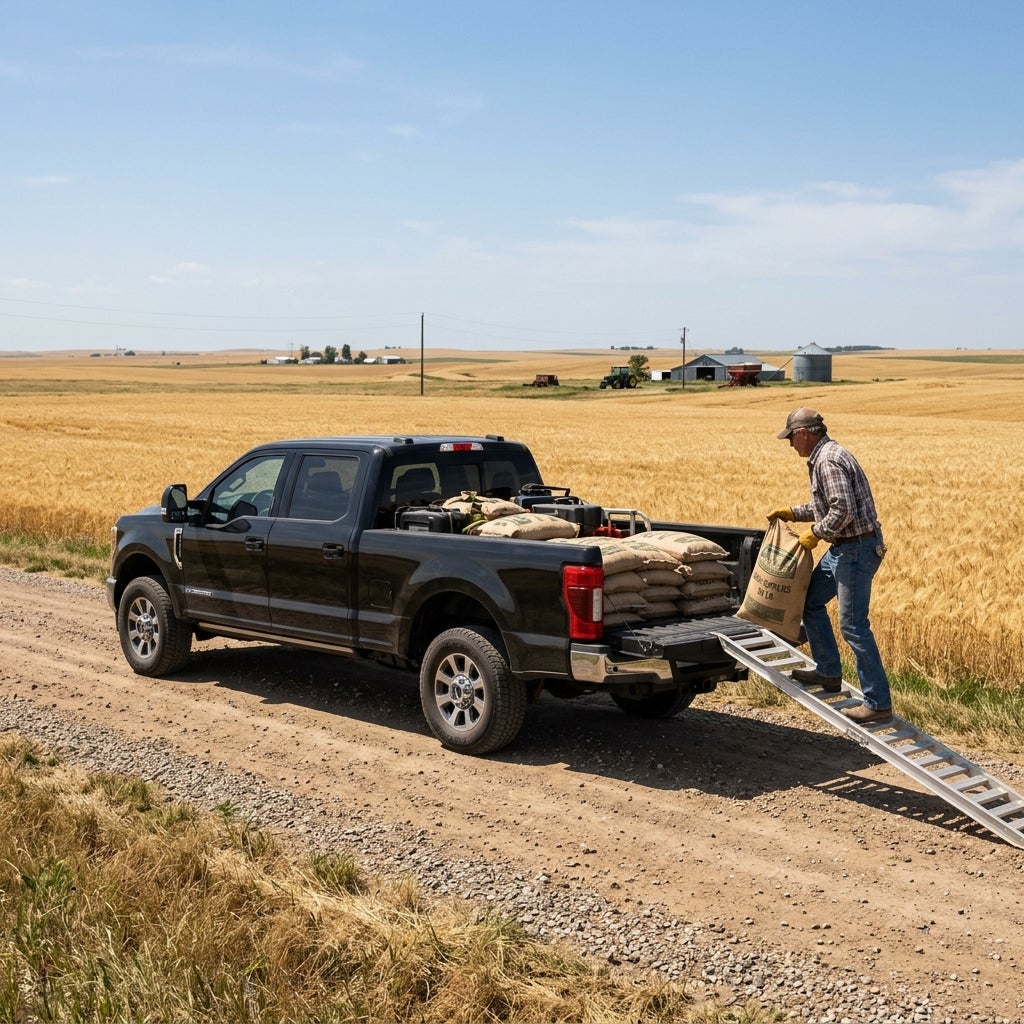
A farmer carrying a burlap sack down a metal ramp from the back of a black pickup truck on a dirt road. (Representative image for illustration purposes only. Actual vehicle may vary based on trim and configuration.)
By utilizing live Smart Taillight indicators during field loading, farm hands can signal the auger operator to shut off grain flow the instant the fourth light bar illuminates. This eliminates wasteful trips back to central elevator scales to dump off excess load and keeps farm equipment running smoothly within factory structural thresholds.

How Does the Accuracy of Ford's Factory Onboard Scales Compare to Aftermarket Air Scales?

Commercial fleet operators and truck enthusiasts often ask how Ford's factory-integrated sensor setup compares against traditional aftermarket pneumatic air bag scales or aftermarket strain gauge systems. Here is a direct technical comparison across key operational categories:

Feature / Metric

Ford Factory Onboard Scales

Aftermarket Pneumatic Air Scales

Measurement Method

Direct 4-Corner Optical/Position Suspension Sensors

Air Pressure Transducers in Helper Springs

System Accuracy

High Precision (+/- 50 lbs under level conditions)

Moderate (+/- 150-300 lbs, varies with temperature)

Display Integration

SYNC 4 Screen, Smart Taillights, FordPass App

Auxiliary Dash Gauges or Standalone Bluetooth Apps

Maintenance Needed

Zero Maintenance (Factory Sealed Units)

Requires Air Line Maintenance & Pressure Zeroing

Warranty Coverage

Full 3-Yr/36k-Mi Factory Bumper-to-Bumper Warranty

Aftermarket Manufacturer Limited Warranty

Factory Integration

Ford factory scales require no spliced wiring harnesses, aftermarket gauge pods drilled into your dashboard, or external air compressors. Everything communicates directly over the truck high-speed CAN bus computer network.

Precision Calibration

Unlike pneumatic helper springs whose pressure fluctuates wildly with ambient Kansas temperature changes, Ford position sensors measure exact physical spring deflection, eliminating thermal reading drift.

Factory Warranty Protection

Because Onboard Scales are standard or factory-installed options from Ford Motor Company, every sensor and module is covered under your factory warranty with support at Valor Ford.

How Onboard Scales Reduce Maintenance Costs and Axle Wear for Farm and Fleet Trucks

Operating a commercial truck or agricultural fleet past its rated gross vehicle weight causes rapid, compound mechanical degradation. Overloaded trucks put excess stress on rear leaf springs, coil springs, shock absorbers, and axle bearings. Repeated overload cycles lead to sagging rear suspensions, hair-line frame cracks, premature brake pad glazing, and severe transmission fluid overheating.
By providing real-time load visibility, Ford Onboard Scales help prevent accidental overload events. Over a 5-year fleet lifecycle in Junction City or Fort Riley, preventing structural overload cuts unexpected suspension repairs and brake wear costs by an estimated 25% to 35%. Fleet managers can enforce strict safety limits without slowing down jobsite productivity.
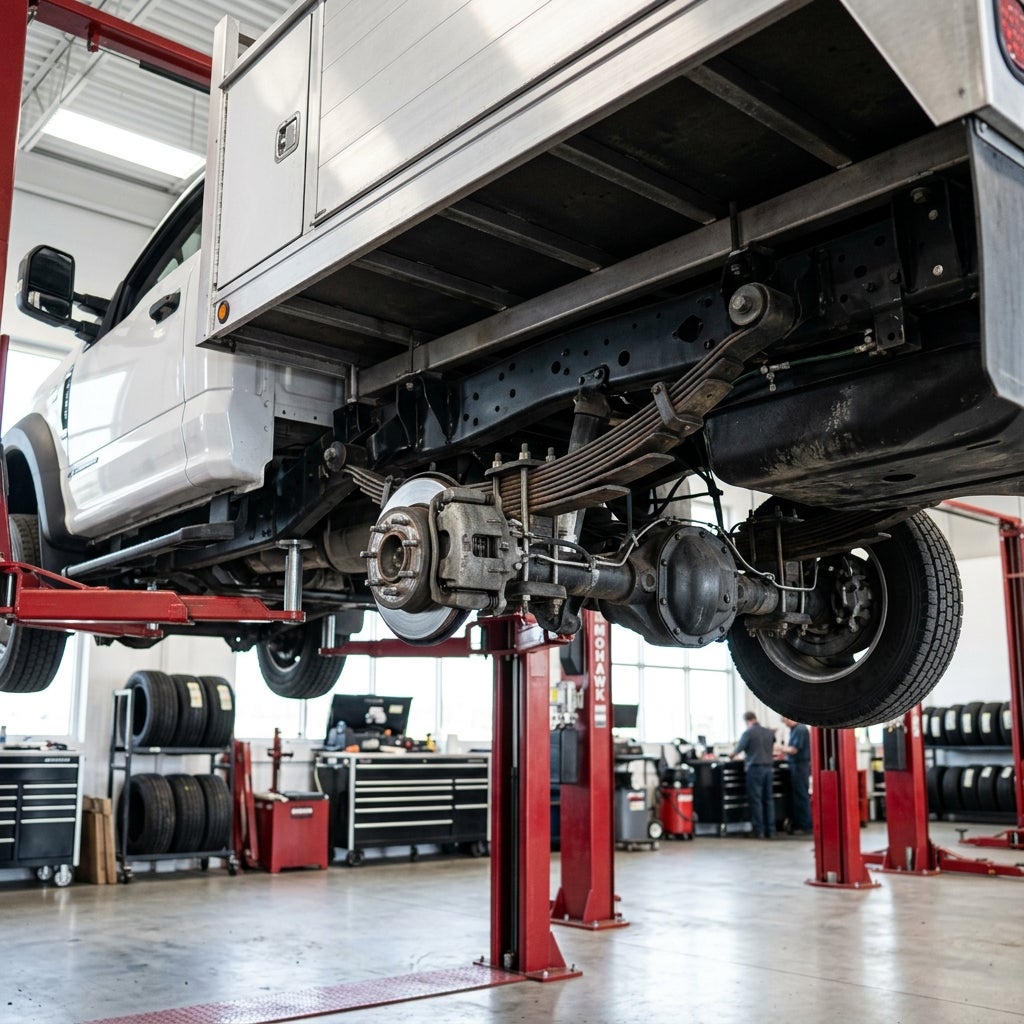
Bottom view of a utility service truck raised on a red hydraulic lift in an auto repair shop. (Representative image for illustration purposes only. Actual vehicle may vary based on trim and configuration.)
When routine service or replacement wear parts are required for your work trucks, our technicians are ready. You can easily Schedule Ford Service Today or order factory replacement components directly through our team to Order Genuine Ford Parts.

Combining Onboard Scales with Smart Hitch for Perfect Trailer Tongue Weight

Onboard Scales do not work in isolation—they pair seamlessly with Ford's available **Smart Hitch** technology. While payload scales measure cargo placed directly inside the bed, Smart Hitch measures the downward force (tongue weight) exerted by a connected trailer onto the receiver ball. Proper tongue weight ratio (typically 10% to 15% of total loaded trailer weight) is critical for preventing violent highway trailer sway.
When coupling a livestock trailer, flatbed equipment trailer, or camper to your 2025 F-150 or Super Duty, Smart Hitch displays real-time tongue weight status on the SYNC 4 screen. It explicitly guides you to move cargo forward or backward on the trailer floor until optimal tongue weight balance is achieved.
Combining live bed payload calculations with live Smart Hitch tongue weight data gives drivers total visibility over Gross Combined Weight Rating (GCWR). Whether you are hauling cattle up Highway 77 or towing heavy equipment along I-70 through Kansas crosswinds, this integrated tech suite can help support towing stability.
To see how Smart Hitch and Onboard Scales perform together on new inventory models, check out our current inventory options or Shop New Ford Bronco Inventory and truck lineups at Valor Ford.

Which 2025 F-150 and Super Duty Trims Include Onboard Scales?
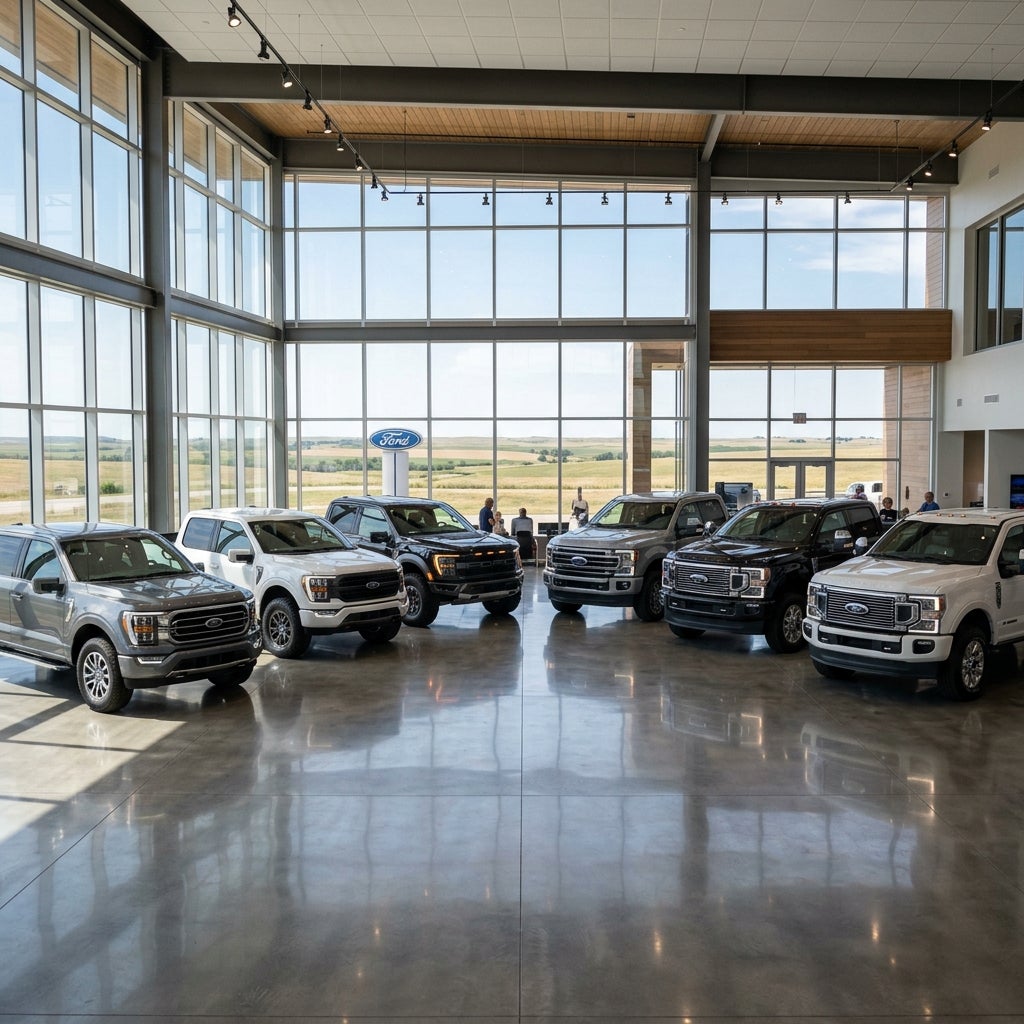
Six Ford pickup trucks parked on a polished floor inside a modern dealership showroom with large windows. (Representative image for illustration purposes only. Actual vehicle may vary based on trim and configuration.)

2025 F-150 Trims

On the 2025 Ford F-150, Onboard Scales with Smart Hitch come standard on high-tier luxury trims including King Ranch and Platinum. It is available as an optional tech package on Lariat, Tremor, and select XLT high-equipment configurations.

2025 Super Duty Trims

For Super Duty F-250 and F-350 trucks, Onboard Scales are standard equipment on King Ranch, Platinum, and Limited trims. On XL and XLT commercial fleet trims, it can be ordered with the High-Capacity Trailer Tow Package.

Used & Fleet Options

Looking for pre-owned models equipped with Smart Hitch or scale technology? You can Browse Used Inventory across our pre-owned truck inventory at Valor Ford to find late-model heavy-duty options.

Can Kansas Commercial Sales Teams Help Configure Ford Trucks with the Right Onboard Scales and Towing Packages?

Navigating package options, axle ratios, payload package codes, and gross combined weight ratings can be complex. The experienced commercial sales specialists at Valor Ford consult daily with Kansas agricultural producers, local construction fleets, and Fort Riley defense contractors to configure trucks tailored to their specific operational demands.
Our team analyzes your typical cargo requirements, trailer weight requirements, and terrain demands to ensure your new F-150 or Super Duty comes equipped with the exact scale technology and towing packages needed. We also offer tailored commercial lending solutions and fleet purchasing assistance.
To get started on your purchase or custom order, submit an application online to Contact Us for Financing Information in just a few simple steps.

Step-by-Step Checklist for Loading and Scaling Agricultural Gear Safely

Follow this practical 5-step operational checklist whenever loading heavy agricultural equipment, seed pallets, or aggregate material into your Ford truck bed: 1. **Park on Level Ground:** Park the truck on a flat, level surface in the yard or field with the transmission in Park and the engine running so sensor readings remain continuous. 2. **Zero the Scale (If Needed):** If you wish to weigh only the new cargo item, access the SYNC 4 screen or FordPass app and activate the Scale Zeroing tare feature. 3. **Monitor Smart Taillights:** Have ground personnel observe the LED Smart Taillights while loading. Stop loading once the 4th solid light bar illuminates. 4. **Verify Left/Right Balance:** Check the SYNC 4 touchscreen to ensure cargo weight is distributed evenly between the left and right bed rails to avoid uneven tire wear. 5. **Check Smart Hitch Tongue Weight:** If towing a trailer simultaneously, review Smart Hitch measurements to confirm tongue weight falls within the recommended green zone.
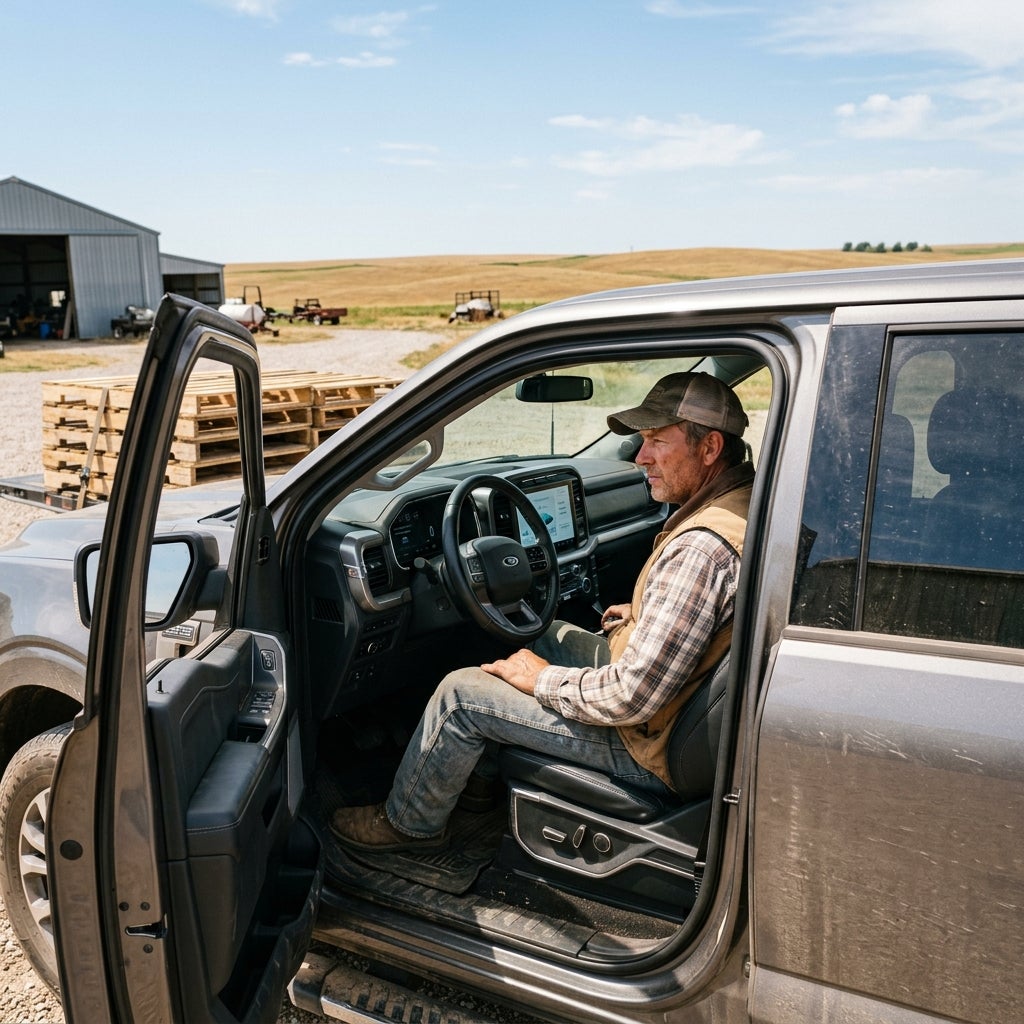
A farmer wearing a cap and plaid shirt sits in the driver's seat of a pickup truck with the door open on a farm. (Representative image for illustration purposes only. Actual vehicle may vary based on trim and configuration.)
To maintain optimal suspension alignment and sensor accuracy over years of heavy use, rely on our certified master technicians. You can easily Schedule Pickup and Delivery Service for routine vehicle maintenance without disrupting your work day.

Test Drive and Experience Ford Onboard Scales at Valor Ford in Junction City, KS

Nothing compares to experiencing Ford's cutting-edge truck technology in person. The sales team at Valor Ford invites farm operators, fleet managers, and truck owners across Junction City, Manhattan, Abilene, and Fort Riley to visit our showroom and test drive a 2025 Ford F-150 or Super Duty equipped with Onboard Scales and Smart Hitch.
During your visit, our truck experts will gladly demonstrate live payload scaling, walk you through SYNC 4 menu features, help evaluate your current trade-in, and guide you through available inventory options.
Visit our dealership located at 1825 Goldenbelt Blvd, Junction City, KS 66441. Need driving instructions? Get Directions to Valor Ford directly on Google Maps, or give our sales team a phone call today at Call us at (785) 238-5114.
Posted in:

Related Posts

f250

Ford F-250 vs. F-350 Long-Term Depreciation & Value Retention Analysis

Ford F-250 vs. F-350 Long-Term Depreciation & Value Retention Analysis When investing in a heavy-duty pickup truck, long-term equity and value retention are just as critical as raw towing specs and horsepower ratings. Multi-year resale price data across North American automotive markets conclusively reveals that Ford Super Duty models—specifically the F-250 and F-350—hold their value far better than light-duty trucks and traditional passenger cars. On average, a well-maintained Ford Super Duty retains an impressive 60% to 70% of its initial sticker price after 3 to 5 years of ownership. This remarkable residual performance drastically outpaces industry baselines, where standard passenger vehicles frequently lose 45% to 55% of their value over the same timeframe. Drivers who want to dive deeper into specs can Research Ford F-250 trim packages and capabilities at Valor Ford. A primary driver behind this shallow depreciation curve is the fundamental utility of heavy-duty trucks. Super Duty pickups are essential tools for agricultural, commercial, industrial, and towing applications. While light-duty retail vehicles are subject to shifting consumer stylistic trends, heavy-duty trucks maintain steady demand in the secondary market regardless of macro-economic fluctuations. Buyers searching the pre-owned market actively seek out low-mileage 3/4-ton and 1-ton trucks to bypass the initial steep retail depreciation while securing legendary workhorse capability. When comparing the F-250 directly against its heavier-duty sibling, the F-350, historical pricing data reveals a distinct value retention edge for the F-350. Across 3-year, 5-year, and 7-year ownership intervals, the F-350 consistently holds a 2% to 5% higher residual percentage than the F-250. This premium becomes even more pronounced when analyzing models equipped with the 6.7L Power Stroke® Turbo Diesel V8 engine and Dual Rear Wheel (DRW) configurations. The primary driver of this disparity is Class 3 commercial payload classification and maximum towing ratings. Commercial buyers and agricultural operators routinely pay a premium for used F-350 models that handle heavier gooseneck trailers, large livestock haulers, and high-capacity equipment beds without exceeding Gross Vehicle Weight Ratings (GVWR). Multi-Year Price History: How Ford Super Duty Trucks Beat Standard Vehicle Depreciation Examining historical pricing datasets from 3, 5, and 10-year horizons illustrates why the Ford Super Duty platform is viewed as a safe automotive investment. Standard light-duty passenger vehicles suffer their most aggressive depreciation in years 1 through 3, often shedding up to 20% in the first year alone and approaching 45% total loss by year three. In contrast, a Ford F-250 or F-350 typically loses only 12% to 15% in year one, holding roughly 68% to 74% of its original MSRP after three full years of service. By year five, when standard cars are worth barely 35% to 40% of their original window sticker, an F-250 retains approximately 58% to 62% of its value, while a clean F-350 diesel often sits closer to 63% to 67%. Even at the 10-year mark—a milestone where most standard vehicles have depreciated by 80% or more—well-maintained Ford Super Duty trucks frequently command 30% to 40% of their original retail value on secondary markets, particularly in regions where heavy-duty 4x4 capability is required daily. Ownership Horizon Standard Passenger Vehicle Ford F-250 Super Duty Ford F-350 Super Duty 1 Year 80% Retention 86% Retention 88% Retention 3 Years 55% Retention 68% Retention 72% Retention 5 Years 40% Retention 59% Retention 64% Retention 10 Years 18% Retention 32% Retention 37% Retention Several structural engineering advantages explain why Ford Super Duty trucks resist market depreciation so effectively. First, Ford's military-grade aluminum-alloy body structure introduced in 2017 eliminated panel rust and structural corrosion issues that plagued older steel-bodied trucks. Used truck buyers are willing to pay top dollar for a 7-year-old vehicle knowing the body panels remain structurally sound and pristine despite harsh winter salt and gravel exposure. Second, the fully boxed high-strength steel frame, heavy-duty axle assemblies (such as the Dana 60 front axle and Sterling/Dana rear axles), and overbuilt suspension components give Super Duty trucks an exceptionally long mechanical lifespan. Commercial buyers view a 100,000-mile Super Duty not as an aging vehicle on its last legs, but as a proven workhorse with hundreds of thousands of productive operating hours remaining. Finally, powertrain longevity plays an immense role. The combination of the heavy-duty 10-speed TorqShift® automatic transmission with high-output gasoline or diesel engines creates a powertrain package capable of enduring rigorous commercial duty cycles without premature failure, stabilizing secondary market pricing. F-250 vs. F-350 Resale Value: Key Differences Across Powertrains and Trims Workhorse Trims (XL & XLT) Entry-level XL and mid-tier XLT trims experience the lowest percentage dollar depreciation of any Super Duty configuration. Because their initial sticker prices are lower, they hit an early pricing floor that remains rock-solid for years. Commercial fleets, small business owners, and agricultural operations constantly seek out low-complexity XL and XLT models equipped with durable vinyl or cloth seating, heavy-duty floor coverings, and 4WD. On the pre-owned market, a 5-year-old F-250 XL or F-350 XLT commands an extremely high percentage of its initial purchase price because buyers value utility, tow capacity, and reliability far more than luxury technology upgrades. Luxury Trims (Lariat, King Ranch, Platinum) High-end trim levels like Lariat, King Ranch, Platinum, and Tremor Off-Road packages command higher initial retail prices due to premium leather seating, multi-contour seats, advanced SYNC infotainment, digital gauge clusters, and adaptive cruise control. While these luxury trims lose a slightly higher absolute dollar amount in years 1 through 3 compared to base models, their residual values plateau strongly. Premium 4x4 Crew Cab diesel trucks in King Ranch or Platinum trim remain highly desirable for private horse trailer owners, RV enthusiasts, and ranch owners who desire maximum towing power combined with luxury cabin comfort. Powertrain choices also alter trim depreciation dynamics. Gas-powered Lariat models suffer steeper depreciation than Power Stroke Diesel Lariat models because luxury towing buyers overwhelmingly prefer diesel torque. Choosing the right engine for high-tier trims is essential to preserving long-term equity. Does the Ford F-350 Retain Resale Value Better Than the F-250 in Heavy-Duty Workloads? When analyzing severe-duty workloads—such as pulling heavy gooseneck livestock trailers across Dickinson County or moving industrial construction equipment around Fort Riley—the Ford F-350 consistently outperforms the F-250 in market value retention. The technical reason stems directly from payload and towing limits. While both trucks can be equipped with the identical 6.7L Power Stroke V8 engine producing up to 500 horsepower and 1,200 lb-ft of torque, the F-350 features stiffer rear leaf springs, a heavier rear axle assembly, and a higher Gross Vehicle Weight Rating (GVWR) that often exceeds 11,000 lbs in Single Rear Wheel (SRW) models and reaches up to 14,000 lbs in Dual Rear Wheel (DRW) setups. An F-250 configured with high payload options can occasionally approach Class 3 payload boundaries, but its official sticker paper limits it to a 10,000 lb GVWR threshold to comply with specific state licensing or commercial registration cutoffs. On the pre-owned market, heavy buyers—such as cattle ranchers, commercial excavators, and hotshot truckers—specifically filter search results for F-350 models to stay legally compliant when hauling heavy pin-weight goosenecks and multi-car trailers. This focused commercial demand creates a broader buyer pool for used F-350s. While an F-250 caters primarily to retail buyers, light commercial operators, and recreational tower owners, a pre-owned F-350 appeals simultaneously to retail consumers AND heavy commercial industries. This dual-market demand acts as a financial buffer against depreciation. If you are currently driving an F-250 or F-350 and want to see how much equity you have built up in today's strong secondary market, you can start a Trade In Evaluation online with Valor Ford to receive an immediate market-backed valuation. Evaluate Your Trade-In Value Online Used Ford F-350 Prices in Kansas vs. National Averages Geographic region plays a major role in vehicle resale performance. National automotive market averages blend data from major urban centers, coastal metropolitan areas, and rural agricultural states. In urban coastal markets, heavy-duty 4x4 diesel trucks are often viewed as niche specialty vehicles, leading to higher initial depreciation. However, in Kansas—and specifically across the Junction City, Manhattan, Salina, and Dickinson County corridors—the story is entirely different. The combination of agricultural operations, livestock transportation, winter weather, and nearby Fort Riley military relocations maintains a constant, high-volume secondary market for four-wheel-drive Super Duty trucks. Pre-owned Ford F-350 models sold in Kansas often command a premium over national average wholesale and retail prices. Local agricultural producers require reliable 1-ton trucks to haul hay bales, move cattle trailers through muddy Flint Hills pastures, and transport heavy farm equipment. Furthermore, military personnel transferring into and out of Fort Riley create a fluid, active market for clean pre-owned 3/4-ton and 1-ton diesel pickups. Service members frequently seek dependable 4x4 trucks capable of cross-country vehicle transport and outdoor recreation. This consistent influx of qualified buyers keeps local resale values around Junction City exceptionally strong compared to broader national baselines. Key Factors That Drive High Super Duty Resale Values Over 5 to 10 Years 1. Power Stroke Diesel Reliability The legendary reputation of the 6.7L Power Stroke® Turbo Diesel V8 is the single largest equity anchor for pre-owned Super Duty trucks. Known for delivering massive low-end torque and operating reliably past 300,000 miles when properly maintained, diesel models consistently recoup a huge percentage of their original option cost when traded in or sold privately after 5 to 10 years. 2. 4WD Drivetrain & Flint Hills Terrain In Kansas and the Midwest, two-wheel-drive heavy-duty trucks suffer severe resale penalties. Four-wheel-drive (4x4) systems equipped with electronic shift-on-the-fly transfer cases and electronic-locking rear differentials are considered non-negotiable for local buyers facing winter snowstorms, muddy rural routes, and rough Flint Hills ranch terrain. 3. Crew Cab 4x4 Configuration While Regular Cab models serve specialized fleet roles, Crew Cab 4x4 configurations dominate secondary market demand. Offering seating for up to six adults alongside cavernous rear floor storage, Crew Cabs function seamlessly as family road-trip vehicles, work-crew movers, and weekend towing rigs, maximizing buyer demand. Gas vs. Power Stroke Diesel: Long-Term Depreciation Comparison for F-250 and F-350 One of the most frequent decisions Super Duty buyers face is selecting between Ford's gas engines—the 6.8L V8 or the high-output 7.3L Godzilla V8—and the 6.7L Power Stroke V8 Turbo Diesel. From a pure depreciation and value retention standpoint, the powertrain choice significantly impacts long-term financial equity. The 7.3L Godzilla V8 gas engine has gained massive popularity since its introduction. It offers incredible pushrod simplicity, low maintenance costs, and impressive gas towing specs (430 hp / 475 lb-ft torque). Gas models carry a lower initial purchase price, meaning buyers finance less upfront. For owners driving under 12,000 miles per year or doing moderate towing, a gas F-250 or F-350 offers an attractive total cost of ownership. After 5 years, a 7.3L gas Super Duty retains approximately 55% to 58% of its value. You can Browse Used Inventory to compare current market pricing for pre-owned gas and diesel models at Valor Ford. Explore Pre-Owned Inventory However, the 6.7L Power Stroke Diesel is the undisputed residual champion. While the diesel powertrain option adds roughly $10,000 to $12,000 to the original purchase price, historical resale data demonstrates that a diesel Super Duty retains $6,500 to $8,500 of that initial option cost after 5 years and 100,000 miles. When trading in a 100,000+ mile truck, diesel models consistently fetch 10% to 15% higher residual values than identical gas-powered counterparts. Prospective buyers planning to finance their purchase can Get Pre-Approved for Financing online to learn about current financing options for both new and pre-owned heavy-duty trucks. How Fleet Demand and Agricultural Needs in Dickinson County Protect F-350 Residual Value In agricultural heartlands like Dickinson County, Kansas, a heavy-duty pickup truck is far more than personal transportation—it is a piece of essential capital machinery required to run farming and ranching operations. From moving large round hay bales and grain hoppers to towing heavy livestock trailers and flatbeds loaded with tractors, local agricultural producers demand high payload capacity and rigid chassis stability. This local economic baseline creates a highly resilient secondary market for used F-350 trucks. Commercial fleets, municipal utilities, and independent agricultural contractors continuously enter the pre-owned market searching for 4- to 8-year-old F-350 models. Even higher-mileage F-350 trucks retain high minimum trade-in floors because local buyers know these trucks can be put directly to work on farms and job sites without requiring costly frame or suspension upgrades. This constant structural demand prevents the sharp price drop-offs seen in consumer-oriented vehicle segments, ensuring that F-350 owners in the Junction City area enjoy superior equity protection over long ownership periods. Maintenance Schedules and Service Records: Preserving Super Duty Trade-In Value 1. Strict Factory Service Schedules Adhering to strict factory maintenance schedules is vital for maximum resale value. Regular engine oil changes, transmission fluid flushes, transfer case servicing, and timely Diesel Exhaust Fluid (DEF) system maintenance prevent costly mechanical wear. Documented maintenance signals to future buyers and dealership appraisers that the truck was cared for responsibly. You can Schedule Ford Service Today with certified Ford technicians at Valor Ford. 2. Genuine OEM Parts & Records Utilizing genuine Motorcraft components and OEM replacement parts preserves mechanical integrity and protects factory warranties. Documented CARFAX maintenance histories displaying regular OEM filter replacements and brake servicing can increase trade-in valuation by $1,500 to $3,000 compared to undocumented trucks. Drivers looking for factory filters or components can easily Order Genuine Ford Parts directly through our dealership parts department. To make routine maintenance effortless for busy farmers and commercial operators, Valor Ford allows owners to Schedule Pickup and Delivery Service, ensuring your Super Duty stays in peak operational condition without interrupting your work schedule. Buying Used vs. New Super Duty: Calculating Total Cost of Ownership in Junction City When evaluating a Ford Super Duty purchase, understanding Total Cost of Ownership (TCO) is essential. Total cost of ownership includes initial acquisition cost, financing interest, insurance premiums, maintenance expenses, fuel consumption, and projected depreciation over your intended ownership period. Buying a brand-new F-250 or F-350 provides complete factory bumper-to-bumper warranty protection, custom order flexibility, and access to the latest technological innovations such as Pro Power Onboard and 360-degree towing camera systems. While a new truck takes its steepest single-year depreciation hit in year one (roughly 12% to 15%), buyers who hold their trucks for 6 to 10 years spread that depreciation cost thinly over a long, highly productive service life. Conversely, purchasing a 2- to 4-year-old pre-owned Super Duty allows you to bypass that initial first-year retail drop. A 3-year-old F-350 has already absorbed its initial depreciation curve, yet it retains 70%+ of its operational mechanical life. For commercial operators looking to maximize fleet return on capital, pre-owned Super Duty trucks offer exceptionally low net operational costs per mile. Whether you choose to purchase brand-new or pre-owned, our finance specialists at Valor Ford can structure competitive terms tailored to your budget. Take the first step today and Get Pre-Approved for Financing online in just a few minutes. Get Pre-Approved for Super Duty Financing Factory Upfits, Towing Packages, and Options That Yield the Highest ROI at Resale Not all vehicle options depreciate equally. When building or purchasing a Ford Super Duty, selecting high-ROI factory options significantly increases trade-in valuation down the road. Factory-installed towing and utility packages retain a much higher percentage of their original value compared to cosmetic exterior add-ons. Factory Option / Package Initial Cost (Est.) 5-Year Resale Value Retention Buyer Demand Rating 6.7L Power Stroke Diesel Engine $10,495 65% - 75% Retention Extremely High 5th-Wheel / Gooseneck Prep Package $550 85% - 95% Retention Essential for Heavy Towing FX4 Off-Road Package $495 70% - 80% Retention High (Midwest Demand) 360-Degree Camera Trailer Package $1,150 60% - 70% Retention High (Safety & Convenience) High-Capacity Trailer Tow Package $1,130 75% - 85% Retention Very High (F-250 Spec Upgrade) The 5th-Wheel / Gooseneck Prep Package is widely considered a mandatory option for pre-owned buyers in Kansas. Because installing aftermarket gooseneck hitches requires bed drilling and frame mounting, buyers actively seek out trucks equipped with clean factory-integrated bed pucks and electrical harnesses. Equipping your Super Duty with factory towing prep, FX4 skid plates, and trailer camera technology guarantees faster trade-in turnover and higher residual returns at Valor Ford. Trade In or Upgrade Your Ford Super Duty at Valor Ford in Junction City Whether you are a local livestock producer in Dickinson County, a commercial fleet operator, or a military service member stationed at Fort Riley, maximizing your vehicle equity is essential. Historical market pricing proves that the Ford F-250 and F-350 Super Duty lead the heavy-duty segment in long-term value retention and resale demand. At Valor Ford, we are proud to serve Junction City and surrounding Kansas communities as your trusted heavy-duty truck authority. We offer competitive trade-in valuations for pre-owned Super Duty trucks and maintain a premium inventory of new and pre-owned Ford vehicles. If you are exploring other lineup options, you can also Research Ford F-150 models, Shop New Ford Bronco Inventory, Research Ford Explorer SUVs, Research Ford Mustang sports cars, or Research Ford Maverick compact trucks. Visit our showroom at 1825 Goldenbelt Blvd, Junction City, KS 66441 to test drive a Super Duty today. Get Directions to Valor Ford or Call us at (785) 238-5114 to speak directly with our truck sales specialists. Value Your Super Duty Trade-In Today

When Rear Axle Limits Make the F-350 Diesel the Right Choice Over the F-250 Lariat in Junction City, KS

When Rear Axle Limits Make the F-350 Diesel the Right Choice Over the F-250 Lariat in Junction City, KS

When Rear Axle Limits Make the F-350 Diesel the Right Choice Over the F-250 Lariat in Junction City, KS For heavy haulers, ranchers, and commercial operators in Junction City, Geary County, and across Dickinson County, selecting between a 2025 Ford F-250 Lariat Diesel and an F-350 Super Duty comes down to a crucial engineering threshold: Rear Gross Axle Weight Rating (RGAWR) and actual door-jamb payload capacity. While the legendary 6.7L Power Stroke® V8 Turbo Diesel engine provides an astonishing 1,050 lb-ft of torque (or 1,200 lb-ft in High-Output trim), placing that heavy engine into a Lariat Crew Cab 4x4 configuration significantly alters your usable bed capacity before a trailer is ever dropped onto the hitch ball. In practical local terms, an F-350 diesel becomes the necessary and safer choice over an F-250 Lariat diesel once your loaded gooseneck pin weight exceeds roughly 2,200 to 2,500 lbs. In real-world agricultural and equipment hauling around Fort Riley and Abilene, this pin weight typically corresponds to gooseneck trailers with a Gross Vehicle Weight Rating (GVWR) between 12,000 and 14,000 lbs or higher. Because luxury Lariat features—such as leather seating, power-deployable running boards, dual-pane panoramic vista roofs, and B&O Sound Systems—add substantial curb weight, a fully optioned 2025 F-250 Lariat Crew Cab 4x4 diesel often leaves you with a door-sticker payload of only 2,000 to 2,400 lbs. When you factor in a cab full of work hands, 50 gallons of diesel fuel, a heavy-duty gooseneck hitch structure, and bed cargo, the remaining capacity on the F-250's rear axle is rapidly exhausted. Hooking up a 14,000 lb loaded livestock or equipment trailer pushes rear axle loads past legal and mechanical limits long before reaching Ford's maximum advertised Gross Combined Weight Rating (GCWR). If you're evaluating your current rig's capability, you can explore our Trade In Evaluation process to upgrade into an F-350 engineered specifically for high tongue-weight demands. Understanding Gross Axle Weight Rating (GAWR) vs. Total Towing Ratings One of the most frequent misconceptions among heavy trailer buyers in Junction City is relying solely on published 'Maximum Towing Capacity' brochures. Ford may advertise that an F-250 can tow upwards of 22,000 lbs under specific, ideal lab conditions. However, gooseneck and fifth-wheel trailering dynamics differ fundamentally from bumper-pull towing. Gooseneck hitches transfer approximately 15% to 25% of the total trailer weight directly over the truck's rear axle as downward pin weight. The vehicle's overall limits are governed by three distinct ratings: Gross Vehicle Weight Rating (GVWR), Gross Combined Weight Rating (GCWR), and Rear Gross Axle Weight Rating (RGAWR). The 6.7L Power Stroke V8 engine alone adds approximately 800 to 900 lbs over the front axle compared to the 6.8L gas engine, while the heavy-duty TorqShift® 10-speed transmission and 4x4 transfer case consume additional GVWR overhead. Consequently, an F-250 reaches its rear axle limit (RGAWR) long before reaching its maximum pulling power. When operating on Kansas highways like I-70 or US-77, exceeding your RGAWR causes severe rear suspension sag, shifts weight off the steering axle, compromises front braking efficiency, and accelerates tire thermal degradation. To learn more about proper truck specs, feel free to Call us at (785) 238-5114 to consult with our heavy-duty truck specialists at Valor Ford. 2025 F-250 Lariat Diesel 4x4 Capability Spotlight: Real-World Payload & Tow Figures The 2025 Ford F-250 Lariat Crew Cab 4x4 with the 6.7L Power Stroke® Diesel is a popular personal luxury work truck in North Central Kansas. It offers an capable driving experience, whisper-quiet cabin insulation, and unmatched highway passing power. However, buyers must pay close attention to the door-jamb Safety Compliance Certification Label. Most standard F-250 models are constrained to a 10,000 lb Class 3 GVWR cap (or an available 10,600/11,100 lb High Capacity Trailer Tow package rating depending on regional configuration). When equipped with the Lariat Ultimate Package, FX4 Off-Road package, 20-inch wheels, power tailgate, and leather interior, the unladen curb weight of an F-250 Diesel Crew Cab 4x4 frequently tops 7,600 to 7,900 lbs. Subtracting this curb weight from a 10,000 lb GVWR leaves an actual payload capacity between 2,100 and 2,400 lbs. Specification Parameter 2025 F-250 Lariat Diesel Crew Cab 4x4 Engine Option 6.7L Power Stroke V8 Turbo Diesel Standard GVWR Rating 10,000 lbs (Class 3 Cap) Typical Unladen Curb Weight 7,650 lbs - 7,880 lbs Usable Door-Sticker Payload 2,120 lbs - 2,350 lbs Rear GAWR (RGAWR) 6,340 lbs Max Recommended Gooseneck Pin Weight 1,600 lbs - 1,900 lbs (after passengers/gear) If you are planning to haul lighter fifth-wheels or bumper-pull horse trailers, you can Research Ford F-250 inventory to see if an F-250 fits your lifestyle. Calculating Gooseneck Pin Weights for Local Agricultural & Equipment Trailers Let's perform the real-world math that Junction City ranchers and contractors face every day when loading trailers at local co-ops, equipment yards, or auctions across Geary and Dickinson Counties. 10,000 lb Gooseneck Rig • Trailer Gross Weight: 10,000 lbs • Calculated Pin Weight (20%): 2,000 lbs • Passengers + Hitch Cargo: 450 lbs • Total Payload Demand: 2,450 lbs F-250 Result: Near 100% capacity limit. Manages okay, but leaves zero buffer for additional tools or fuel transfer tanks. 14,000 lb Stock / Flatbed • Trailer Gross Weight: 14,000 lbs • Calculated Pin Weight (20%): 2,800 lbs • Passengers + Bed Hardware: 500 lbs • Total Payload Demand: 3,300 lbs F-250 Result: EXCEEDED. Exceeds F-250 payload by ~1,000 lbs and overloads rear axle springs and tires. 18,000 lb Equipment Hauler • Trailer Gross Weight: 18,000 lbs • Calculated Pin Weight (20%): 3,600 lbs • Passengers + Gear: 500 lbs • Total Payload Demand: 4,100 lbs F-250 Result: DANGEROUS. Mandates an F-350 SRW or DRW to maintain legal axle loading and chassis control. Contact Us for F-350 Financing Information Comparing 2025 F-350 Super Duty SRW vs. DRW Diesel Gooseneck Ratings & Payload Ranges Stepping up from an F-250 to a 2025 Ford F-350 Super Duty unlocks significantly higher GVWR caps and Rear GAWR capacity without compromising interior luxury or daily drivability. In Single Rear Wheel (SRW) configuration, the F-350 Diesel Crew Cab 4x4 bumps the GVWR from 10,000 lbs up to 11,400 to 12,400 lbs depending on package options. This structural upgrade elevates usable payload into the 3,800 to 4,400 lb range. For maximum gooseneck stability, the F-350 Dual Rear Wheel (DRW 'Dually') increases GVWR up to 14,000 lbs and expands the Rear Gross Axle Weight Rating from ~6,340 lbs (SRW) to a massive 9,900 lbs (DRW). The dual rear wheel footprint creates an extraordinarily wide stance that eliminates lateral tire squirm when hauling tall livestock trailers or enclosed equipment rigs through the Flint Hills. If you currently own a late-model heavy-duty truck or pre-owned vehicle, you can check our Browse Used Inventory or contact Valor Ford to compare trade values against new Super Duty models. Navigating Flint Hills Terrain: Crosswinds, Grades, and Heavy Towing Stability Towing across Interstate 70, Highway 77, and rolling rural corridors near Junction City presents unique environmental challenges. The open terrain of the Flint Hills region is famous for severe prairie crosswinds that easily gust above 35 to 45 mph. When pulling a high-profile gooseneck cattle trailer or multi-vehicle flatbed, crosswinds exert severe side-force leverage on your truck's chassis. An F-250 operating right at its rear axle limit will experience suspension bounce, sway, and steering wander as the rear tires flex under lateral load. By contrast, the stiffer auxiliary rear leaf springs, upgraded rear stabilizer bar, and higher inflation pressures on an F-350 (especially DRW models) anchor the vehicle securely to the asphalt. Combined with Ford's integrated Engine Exhaust Brake and Smart Towing technology, the F-350 gives drivers added confidence during steep descents and wind-swept highway stretches. Engineering Under the Bed: Axle Sizes, Leaf Springs, and Tire Load Ratings What mechanical components create the capability gap between an F-250 and an F-350? Let's examine the heavy-duty chassis architecture engineered beneath the truck bed. Axle Housing & Shafts While standard F-250 models utilize Sterling or lighter Dana rear axle assemblies, F-350 diesel models incorporate heavy-duty Dana M275 (SRW) or Dana M300 (DRW) rear axles featuring larger ring gears, thicker axle tubes, and higher-capacity full-floating axle shafts built to withstand continuous heavy vertical pin weights. Rear Leaf Spring Packs F-350 trucks feature re-engineered rear leaf spring stacks incorporating factory auxiliary overload springs. As heavy gooseneck weight lowers the bed, these secondary leaf springs engage frame-mounted contact pads, preventing rear suspension bottoming and preserving proper driveline angles. Tires & Braking System F-350 models utilize high-capacity Load Range E or F tires designed for elevated PSI inflation limits (up to 80 PSI rear cold). Combined with massive 4-wheel power disc brakes and hydro-boost assistance, the system ensures rapid thermal dissipation under full GCWR braking loads. To maintain your Super Duty truck's heavy suspension, driveline fluids, and braking systems in top condition, you can easily Schedule Ford Service Today with our certified master technicians at Valor Ford. F-250 Lariat Diesel & F-350 Super Duty Capability Spotlight: A Local Buyer's Decision Matrix Use this straightforward decision guide when matching your trailer requirements to the right Ford Super Duty configuration at Valor Ford in Junction City: Your Primary Towing Needs Recommended Super Duty Setup Gooseneck under 11,000 lbs OR Bumper-Pull under 16,000 lbs F-250 Lariat Diesel 4x4 (Excellent comfort, fits daily garage parking) Gooseneck 12,000 - 16,000 lbs (Pin weight 2,200 - 3,200 lbs) F-350 SRW Lariat Diesel (Ideal balance of single-wheel versatility & payload) Gooseneck 16,000 - 24,000+ lbs (Pin weight 3,500+ lbs) F-350 DRW Dually Diesel (Maximum legal stability, 9,900 lb RGAWR rating) Browse New Super Duty Inventory Kansas Commercial Weight Regulations, Registration, and Farm Tag Considerations Operating heavy gooseneck setups in Junction City and across Dickinson and Geary Counties involves understanding state registration and KDOT regulations. In Kansas, trucks registering above 12,000 lbs GVWR fall into distinct tax and plate registration tiers. Furthermore, if your combined truck and trailer GCWR exceeds 26,000 lbs (or if your commercial vehicle combination exceeds 10,001 lbs in interstate commerce), USDOT markings, safety equipment, and driver licensing requirements (CDL) come into play. For agricultural producers utilizing Kansas Farm Tags, exemptions exist for personal farm transportation within specific mileage radii. However, Farm Tag exemptions do not override manufacturer Gross Axle Weight Ratings (GAWR) or safe tire load limits. State weigh station operators and highway patrol officers check axle compliance on public roads. Configuring your F-350 properly with factory 11,400 lb, 12,000 lb, or 14,000 lb GVWR packages ensures full legal compliance and protects your liability while hauling critical loads. Ready to test drive or configure your ideal Super Duty rig? Visit us today at 1825 Goldenbelt Blvd in Junction City, KS. You can easily Get Directions to Valor Ford or call our team directly at Call us at (785) 238-5114.

Bottom-Line Answer: Do You Need a CDL to Drive a Ford F-350?

Bottom-Line Answer: Do You Need a CDL to Drive a Ford F-350?

Bottom-Line Answer: Do You Need a CDL to Drive a Ford F-350? For the vast majority of personal, non-commercial drivers in Kansas and across the United States, the short answer is NO, you do not need a Commercial Driver License (CDL) to drive a Ford F-350 Super Duty. Standard state driver licenses allow citizens to operate personal vehicles with a Gross Vehicle Weight Rating (GVWR) up to 26,000 pounds. Because a standard single rear wheel (SRW) or dual rear wheel (DRW) Ford F-350 factory rating stays under this threshold, driving the truck itself for household chores, commuting, or weekend recreation requires only a standard Class C operator license. However, federal and state DOT laws look at the total gross weight ratings when you attach a heavy trailer or operate the vehicle in furtherance of a commercial business. A CDL becomes legally mandatory under specific federal FMCSA regulations if: (1) your F-350 is used for commercial purposes and its GVWR combined with a trailer's GVWR exceeds 26,001 lbs (where the towed unit exceeds 10,000 lbs GVWR), or (2) you are operating a heavy commercial fleet vehicle with a standalone GVWR over 26,000 lbs. If you have questions about commercial specifications, feel free to Call us at (785) 238-5114 to consult our heavy-duty truck specialists at Valor Ford. Understanding GVWR and GCWR: When Does Driving a Ford F-350 Legally Require a CDL? Key Weight Definitions You Must Know: • GVWR (Gross Vehicle Weight Rating): The maximum allowed total weight of the truck alone, including payload, passengers, fuel, and cargo. A 2026 Ford F-350 typically ranges from 10,000 lbs to 14,000 lbs GVWR depending on cab and axle choices. • GCWR (Gross Combined Weight Rating): The maximum allowable total weight of the truck, trailer, cargo, and occupants combined. Ford F-350 trucks offer GCWR ratings reaching up to 43,500+ lbs on select dually configurations. • The Magic 26,001-lb Threshold: Federal regulations specify that Class A CDLs are required when operating a combination vehicle with a Gross Combination Weight Rating (GCWR) of 26,001 or more pounds, provided the towed unit has a GVWR of more than 10,000 pounds when used commercially. Real-World Math Examples for F-350 Operators: 1. Scenario A (No CDL Needed): You drive a 2026 F-350 DRW (GVWR: 14,000 lbs) pulling a personal camper trailer (GVWR: 11,500 lbs). Total Combined Rating = 25,500 lbs. Because this is under 26,001 lbs and purely personal, no CDL is required. 2. Scenario B (Class A CDL Required): You operate a commercial construction business driving an F-350 DRW (GVWR: 14,000 lbs) pulling a flatbed equipment trailer carrying a skid steer (Trailer GVWR: 14,000 lbs). Total GCWR = 28,000 lbs. Since it is commercial and exceeds 26,001 lbs with a trailer over 10,000 lbs, your driver MUST hold a Class A CDL. If you are considering lighter payload options that stay comfortably away from heavy trailer classifications, you can also Research Ford F-250 specifications with our team. Commercial Use vs. Personal Use: How CDL Rules Apply to F-350 Drivers The boundary between personal driving and commercial hauling is one of the most critical factors officers evaluate during roadside inspections in Dickinson County, Geary County, and along I-70 near Fort Riley. Personal Recreation Exemption: If you are towing a personal fifth-wheel RV, horse trailer for non-profit leisure, or ski boat for weekend trips, federal regulations explicitly exempt non-commercial recreational vehicles from CDL mandates regardless of gross combined weight in most states. Commercial Hauling & Hotshot Trucking: If you receive compensation, haul items to market for profit, display business decals on your F-350, or operate hotshot transport services across state lines, you fall directly under FMCSA rules. Commercial vehicles over 10,000 lbs GVWR also require USDOT numbers, medical cards, and safety equipment even if total weight stays below CDL cutoffs. What Engine Options Are Available in the 2026 Ford F-350 Super Duty? 6.8L V8 & 7.3L Godzilla V8 Standard Gas Power: The 6.8L DEVCT NA PFI V8 generates robust low-end torque for daily fleet work. 7.3L Godzilla V8: Produces 430 horsepower and 485 lb-ft of torque. Ideal for heavy gas payloads, lower maintenance costs, and exceptional longevity without requiring diesel exhaust fluid (DEF). 6.7L Power Stroke V8 Diesel Standard Power Stroke Diesel: Pushes out 475 horsepower and 1,050 lb-ft of torque. Features a heavy-duty 10-speed TorqShift automatic transmission, integrated exhaust braking for steep downhill mountain towing, and relentless pulling power under heavy sustained loads. 6.7L High-Output Power Stroke High Diesel Performance: Delivers an astounding 500 horsepower and 1,200 lb-ft of torque. Features a unique water-cooled turbocharger and stainless steel exhaust headers designed specifically for maximum gooseneck and 5th-wheel pulling capability. Contact Us for F-350 Financing Information What Is the Maximum Towing Capacity of a 2026 Ford F-350? When properly equipped with the 6.7L High-Output Power Stroke Turbo Diesel engine and the Max Tow Package, the 2026 Ford F-350 Super Duty leads the heavy-duty segment with unmatched pulling capability across conventional, 5th-wheel, and gooseneck hitch setups. Conventional Bumper Towing: Up to 28,000 lbs on select DRW configurations. 5th-Wheel Towing: Up to 38,000+ lbs. Gooseneck Towing: Maximum towing capacity reaches up to 40,000 lbs on Regular Cab DRW 4x2 models equipped with high-capacity axle options. Compared against rival one-ton trucks like the Chevrolet Silverado 3500HD and Ram 3500, the Ford F-350 consistently offers top-tier gross combination ratings, making it the preferred choice for commercial operators and heavy equipment haulers in Junction City, KS. Configuration Max Conventional Max Gooseneck Max Payload F-350 SRW Gas 7.3L 18,200 lbs 22,500 lbs 4,958 lbs F-350 SRW Diesel 6.7L HO 23,000 lbs 27,200 lbs 4,310 lbs F-350 DRW Gas 7.3L 21,500 lbs 22,200 lbs 8,000 lbs F-350 DRW Diesel 6.7L HO 28,000 lbs 40,000 lbs 7,640 lbs Why Would Someone Choose an F-250 Over an F-350? Ride Quality & Unloaded Comfort The F-250 features softer rear leaf springs tuned for daily commuter comfort without heavy loads in the bed. If you rarely haul over 3,000 lbs of payload, the F-250 provides a smoother, less rigid highway ride when empty. Purchase Cost Comparison An F-250 typically carries a lower sticker price compared to an equivalently optioned F-350. Buyers who pull modest boats, bumper-pull horse trailers, or 25-foot travel trailers can reduce overall costs while retaining full Super Duty capability. Commercial & Weight Tier Limits In certain municipalities and commercial fleets, keeping a truck's GVWR under 10,000 lbs (standard F-250 classification) avoids elevated commercial vehicle registration fees, strict toll tariffs, and DOT medical card triggers required for heavier fleet units. What Are the Maintenance Cost Differences Between Gas and Diesel F-350 Trucks? Choosing between gas (6.8L / 7.3L V8) and Power Stroke diesel engines in your Ford F-350 affects long-term ownership expenses and maintenance schedules: Gas Engine Maintenance Profile: • Standard 7-13 quart synthetic oil changes at lower unit costs. • Simple air and oil filter replacements without fuel filter water-separator maintenance. • Lower initial purchase price and more economical routine service intervals. • Slightly lower fuel economy when pulling heavy loads. Diesel Engine Maintenance Profile: • Requires 13-15 quarts of specialized heavy-duty diesel oil. • Regular Fuel Filter Kit changes every 15,000 to 25,000 miles to protect high-pressure fuel injectors. • Periodic Diesel Exhaust Fluid (DEF) refills. • Exceptional resale value and enhanced fuel economy while towing heavy trailers over long highway distances. To keep your Super Duty performing at factory standards, you can Schedule Ford Service Today at our factory-certified maintenance center. Schedule Pickup and Delivery Service Farm, Military, and Recreational CDL Exemptions in Central Kansas 1. Kansas Covered Farm Vehicle Exemption: Agricultural producers operating within Dickinson County and surrounding Kansas farming communities enjoy specific CDL exemptions. Under state and federal law, active farmers, family members, and farm employees driving a farm-registered F-350 pulling stock trailers or grain wagons within 150 air miles of their farm do NOT require a CDL, provided the vehicle is transporting agricultural products, livestock, or machinery for farm operations. 2. Active Duty Military Exemption: Service members stationed at Fort Riley operating government-owned military tactical vehicles or heavy transports are exempt from civilian CDL requirements under 49 CFR 383.3 regulations. 3. Personal RV & Camper Exemption: If you are pulling a 40-foot 5th-wheel luxury camper or large horse trailer for personal pleasure across Kansas highways, state law grants a complete recreational vehicle exemption from CDL licensing requirements regardless of total combined gross weight. Important Caveat: Farm and recreational exemptions apply specifically to non-commercial operations. The moment you haul cargo for hire or conduct third-party commercial transport, full FMCSA CDL rules re-apply instantly. If you have an existing vehicle you want to upgrade for heavy farm or ranch duty, start by completing a quick Trade In Evaluation on our website. Single Rear Wheel vs. Dual Rear Wheel: Selecting the Right F-350 Configuration Single Rear Wheel (SRW) • GVWR: 10,000 – 12,400 lbs • Easier daily parking and narrow lane maneuverability. • Excellent off-road traction in mud and snow. • Ideal for bumper-pull trailers and moderate 5th-wheel campers up to 18,000 lbs. Dual Rear Wheel (DRW Dually) • GVWR: 14,000 lbs • Unmatched lateral stability in severe highway crosswinds. • Massive payload capacity up to 8,000 lbs in the bed. • Essential for heavy gooseneck trailers, multi-car haulers, and commercial construction fleets. Daily Drivability Balance Choosing between SRW and DRW comes down to your primary towing frequency. SRW models fit standard automatic car washes and suburban garages, while DRW duallys provide unmatched heavy-weight confidence on open interstate stretches. Financing, Trade-Ins, and Custom Ordering Your F-350 at Valor Ford At Valor Ford, we make acquiring your commercial fleet or personal Super Duty straightforward and tailored to your specific budget. • Commercial Vehicle Financing & Fleet Credit: We partner with Ford Credit Commercial Solutions to provide lines of credit, TRAC leases, and flexible commercial loan terms designed for small businesses and independent contractors. • Transparent Trade-In Appraisals: Upgrade your current truck or pre-owned vehicle with our competitive market valuations. • Factory Custom Ordering: Need a specific axle ratio (3.31, 3.55, 3.73, or 4.10 limited slip), 5th-Wheel/Gooseneck Prep Package, or Pro Power Onboard generator system? Our Super Duty ordering experts walk you through every option code to build your perfect rig directly from the assembly plant. If you want to explore pre-owned heavy-duty options, you can Browse Used Inventory available on our lot today. Value Your Trade-In Online Super Duty Towing Checklist: Weights, Registration, and Safety Steps 1. Verify Door-Jamb Tags Check your driver door-jamb Safety Compliance Certification Label. Confirm the exact GVWR and GAWR (Gross Axle Weight Rating) numbers before hooking up a new trailer setup. 2. Configure Trailer Brakes Set the Ford Integrated Trailer Brake Controller gain on your digital instrument cluster. Verify electric or surge trailer brake activation before entering high-speed highway traffic. 3. Check Safety Hitch Hardware Cross your heavy safety chains, connect the breakaway cable, check hitch pin torque, and ensure all LED trailer light connections function properly. If you need OEM towing components, you can Order Genuine Ford Parts directly through our dealership. Test Drive and Explore the Ford F-350 Super Duty at Valor Ford in Junction City Ready to experience the raw pulling power, advanced towing tech, and refined cabin comfort of the 2026 Ford F-350 Super Duty? Visit our showroom at 1825 Goldenbelt Blvd in Junction City, KS. Our heavy-duty truck specialists are here to analyze your payload demands, verify weight classifications, and help you select the exact axle ratio and engine package for your work or recreation. Get Directions to Valor Ford or contact our team directly at Call us at (785) 238-5114. Whether you are driving in from Fort Riley, Manhattan, Salina, or Abilene, Valor Ford is your premier Central Kansas destination for Super Duty excellence. Contact Valor Ford Truck Specialists