Blog / Seasonal Driving Tips

BTU Calculation for Enclosed Tailgating Canopies in Late-Season Kansas Weather

BTU Calculation for Enclosed Tailgating Canopies in Late-Season Kansas Weather

BTU Calculation for Enclosed Tailgating Canopies in Late-Season Kansas Weather

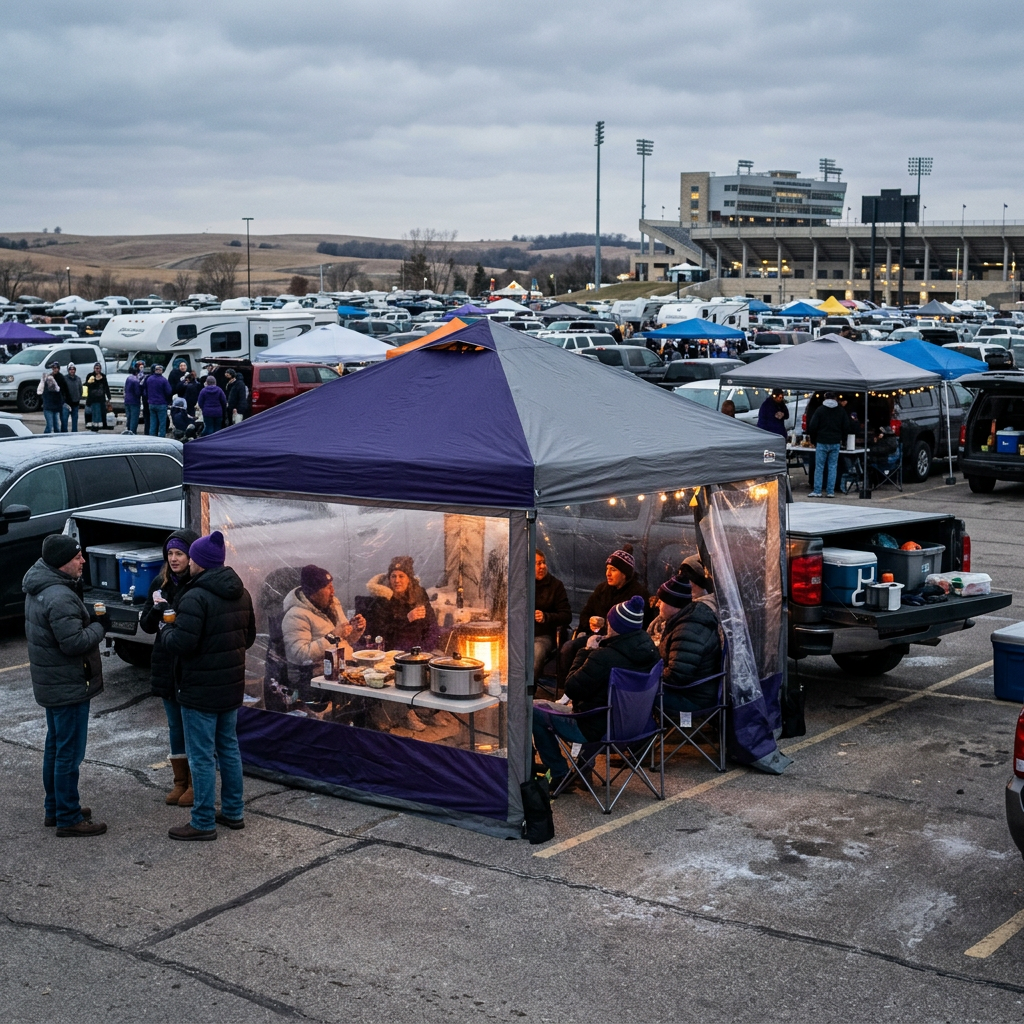
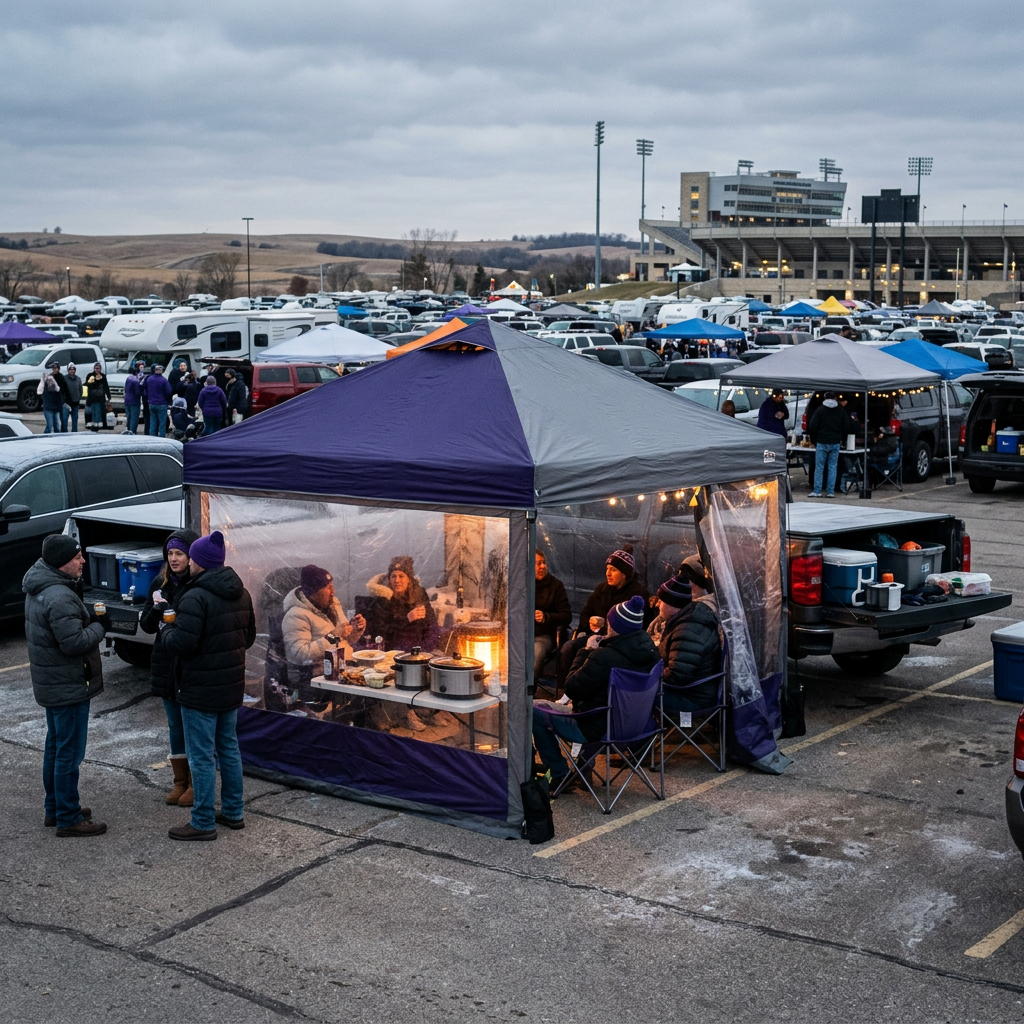
Tailgaters gather inside and outside a heated purple tent in a parking lot on a cold game day. (Representative image for illustration purposes only. Actual vehicle may vary based on trim and configuration.)
Late November game days in Manhattan, Kansas, offer an unmatched atmosphere, but the weather in the Flint Hills can quickly test the stamina of even the most dedicated Wildcats fans. When temperatures drop into the 20°F to 35°F range and a persistent 20-mph prairie breeze whips across the parking lots of Bill Snyder Family Stadium, keeping an enclosed canopy warm requires a realistic understanding of thermal requirements. A simple personal heater meant for a small patio will not suffice when cold air penetrates porous fabric sidewalls. To achieve a comfortable ambient interior temperature of 60°F to 65°F inside a standard 10x10 enclosed tailgating canopy under late-season Kansas weather conditions, you need a heater output ranging between 18,000 and 30,000 British Thermal Units (BTUs) per hour. If you step up to a larger 10x20 enclosed setup, your output requirements increase dramatically to 35,000 to 60,000 BTUs per hour.
The science behind heating a temporary shelter rests on three core variables: the total interior cubic volume, the desired temperature rise (delta T), and the thermal resistance (or lack thereof) of the enclosure material. Unlike residential rooms constructed with insulated drywall, commercial pop-up canopies utilize polyester or vinyl walls with zero insulating value (an R-value approaching 0). The fundamental formula for calculating required heat output is: Required BTUs = Volume (Cubic Feet) × Desired Temperature Rise (°F) × Insulation Loss Factor. For an uninsulated fabric canopy exposed to high Kansas winds, the insulation loss factor ranges from 0.25 to 0.35, depending on how tightly sealed the seams and floor skirts are.
Consider a standard 10x10 foot pop-up canopy with a peaked roof. The bottom square section measures 10x10x7 feet (700 cubic feet), while the roof peak adds approximately 150 cubic feet, yielding a total volume of 850 cubic feet. If the outside air temperature in Manhattan is a brisk 25°F and your goal is a cozy 65°F inside, your target temperature rise is 40°F. Multiplying 850 cubic feet by 40°F delta T gives a base value of 34,000. Applying the high exposure factor of 0.35 due to prairie wind infiltration yields approximately 11,900 base BTUs. However, because canopy zippers leak, doors open frequently for guests, and cold air seeps under the sidewalls, heating experts recommend applying a 1.5x to 2x real-world margin of safety. This brings your targeted heating requirement to approximately 18,000 to 24,000 BTUs for calm conditions, and up to 30,000 BTUs on gusty days along Highway 18.

Canopy Size

Est. Volume (Cu. Ft.)

Target Temp Rise (25°F Outside to 65°F Inside)

Recommended BTU/hr (Mild Wind)

Recommended BTU/hr (High Wind >20mph)

10' x 10' Enclosed

850 cu. ft.

40°F Delta T

18,000 BTUs

30,000 BTUs

10' x 15' Enclosed

1,275 cu. ft.

40°F Delta T

28,000 BTUs

42,000 BTUs

10' x 20' Enclosed

1,700 cu. ft.

40°F Delta T

35,000 BTUs

60,000 BTUs

Sizing Your Tailgate Heater: Calculating BTU Output by Canopy Size and Wind Factor

Volume vs. Square Footage Mechanics

A common misstep among game day organizers is sizing a heater purely on floor square footage. While a 100-square-foot room inside a home with 8-foot ceilings has a fixed volume, a 10x10 canopy features a vaulted peak that traps hot air overhead. Heat naturally rises, creating a thermal stratification layer where the warmest air sits 9 feet off the ground near the canopy apex while your guests' feet remain cold on the asphalt.
To counteract this, calculating heating loads based on total cubic volume rather than square footage ensures that you select a heater capable of circulating sufficient warm air downward. Utilizing a low-draw 12V hanging canopy fan or a battery-powered air circulator helps push trapped heat from the peak back down to seating level, effectively reducing your required BTU rating by up to 15%.

The Flint Hills Wind Chill Impact

The geography surrounding Manhattan and Junction City creates open terrain where cold northwesterly winds accelerate across the Flint Hills. Wind pressure acting on an enclosed tent forces cold air through stitched seams, door zippers, and gaps between the bottom skirt and the pavement. A 20-mph wind increases heat loss through fabric by more than 300% compared to dead-calm conditions.
To suppress air exchange rates, tailgate setups should incorporate weighted draft skirts along the perimeter. Securing wall bases with sandbags or PVC pipe weights prevents the 'bellows effect,' where wind pumps cold air under the walls and forces heated air out the top ventilation flaps.

How Long Will a Standard 20-lb Propane Tank Last on Continuous Medium Heat?

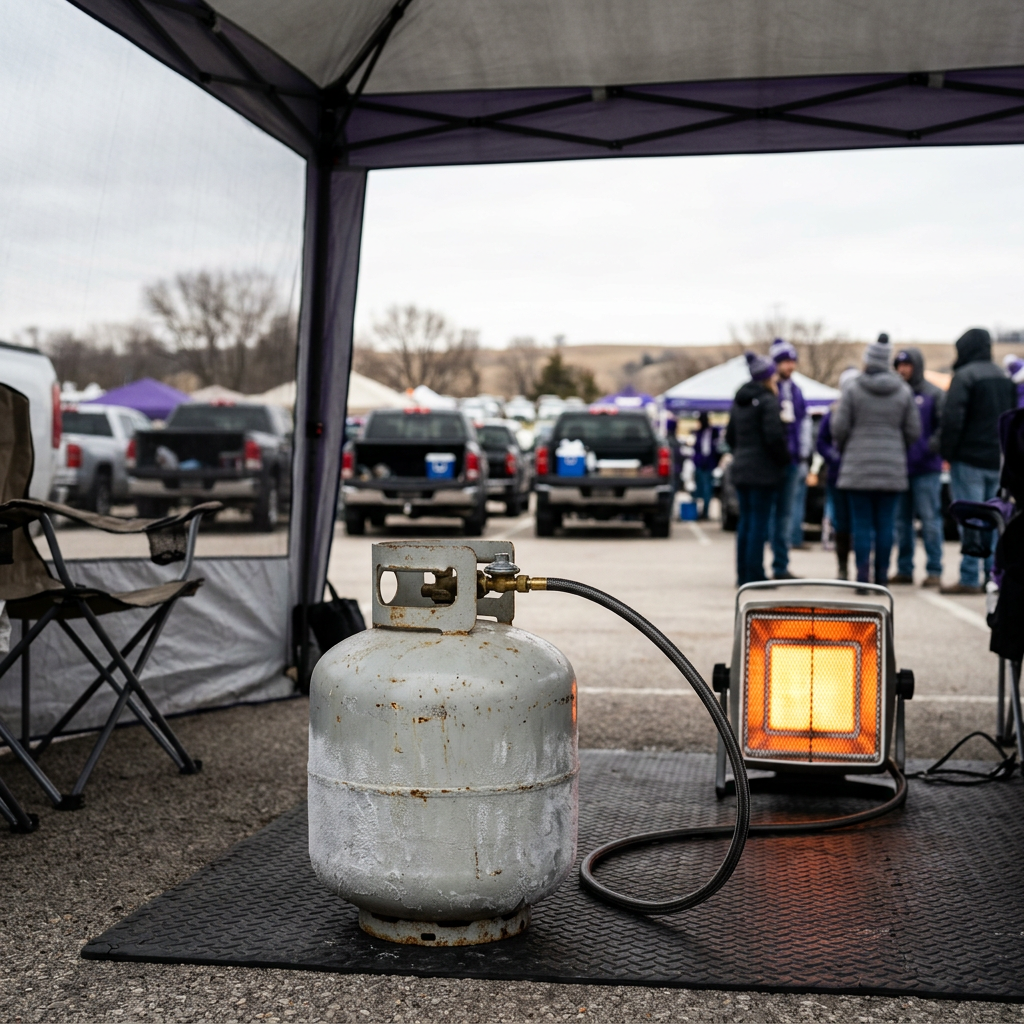
A propane tank connected to a glowing radiant space heater inside a tent at a parking lot tailgate. (Representative image for illustration purposes only. Actual vehicle may vary based on trim and configuration.)

Total Energy Capacity

A standard 20-pound propane cylinder filled to its 80% safety limit holds approximately 4 gallons of liquid propane. Liquid propane contains roughly 91,500 BTUs per gallon, giving a fully filled 20-lb tank a total thermal energy capacity of approximately 430,000 BTUs. Understanding this baseline allows you to calculate exact runtime based on your heater's consumption rate.

Estimated Burn Times

To calculate total runtime hours, divide total BTUs (430,000) by your heater's hourly rating. Running a heater continuous on a 30,000 BTU/hr medium setting yields roughly 14.3 hours of heat. Running on a maximum high setting of 40,000 BTU/hr yields approximately 10.7 hours. Pushing a heavy-duty 60,000 BTU forced-air heater depletes the cylinder in just 7.1 hours.

Cold Tank Vaporization

In sub-freezing Kansas temperatures, propane tank pressure drops as liquid struggles to vaporize. As heat is drawn out, the cylinder cools further, causing frost build-up on the tank exterior. At 20°F, a half-empty 20-lb tank may struggle to supply more than 25,000 BTUs/hr without freezing up. Keeping tanks insulated off cold concrete or using dual-tank manifold setups prevents pressure drop-offs.

Are Open-Flame Heaters Allowed in Bill Snyder Family Stadium Parking Lots?

Navigating game day regulations at Kansas State University requires attention to safety protocols established by university public safety and local fire marshals. Open-flame devices such as wood-burning fire pits, bonfire barrels, and uncontained open fires are strictly prohibited in all Bill Snyder Family Stadium parking lots. However, enclosed propane radiant heaters, catalytic safety heaters, and enclosed forced-air propane units equipped with automatic shut-off valves ARE permitted, provided they maintain proper clearances from flammable materials.
When positioning propane heaters inside or near an enclosed canopy, safety regulations require a minimum distance of 3 feet from fabric sidewalls and at least 5 feet of clearance from overhead canopy roofs. Carbon monoxide risks must also be addressed; fully sealed vinyl tents with zero ventilation can accumulate dangerous gas levels. Always ensure lower vent flaps remain cracked open to allow adequate fresh air exchange when operating propane heating equipment.
For tailgaters seeking to avoid propane open flames and tank freezing issues entirely, modern Ford truck technology offers an innovative alternative. Ford vehicles equipped with Pro Power Onboard—such as the Ford F-150 with its available 2.0kW, 2.4kW, or 7.2kW generator output—allow tailgaters to power heavy-duty electric radiant infrared heaters, heated seats, and commercial electric blankets directly from their truck bed without carrying auxiliary fuel tanks.

Do Lithium Power Stations Lose Capacity in Sub-Freezing Temperatures?

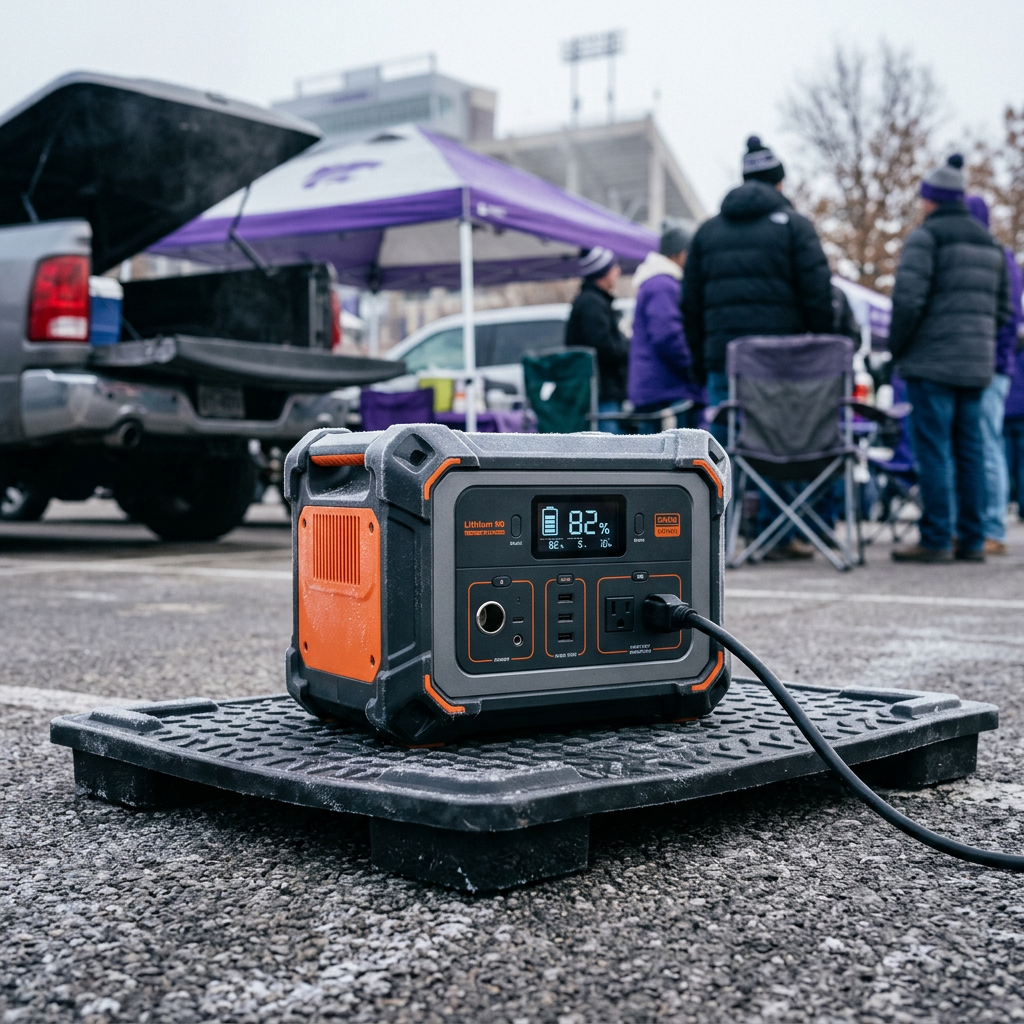
A portable power station sitting on a black plastic mat at a frosty tailgate party. (Representative image for illustration purposes only. Actual vehicle may vary based on trim and configuration.)

Battery Chemistry & Internal Resistance

Yes, lithium power stations (both Lithium Iron Phosphate / LiFePO4 and Lithium Nickel Manganese Cobalt / NMC) suffer noticeable capacity losses when exposed to sub-freezing temperatures. Cold ambient air increases internal electrochemical resistance inside the battery cells, hindering lithium-ion mobility during discharge. At 20°F (-6°C), a portable power station can experience an effective capacity reduction of 20% to 40%.
Furthermore, most smart BMS (Battery Management Systems) prohibit charging lithium cells when cell temperatures fall below 32°F to prevent permanent lithium plating damage. To mitigate performance drops when powering canopy blowers, TV screens, or crockpots in Manhattan, keep your power station elevated off freezing asphalt and store it inside an insulated cooler or neoprene thermal sleeve during operation.

What Towing Capacity Is Required for a Cold-Weather Game Day Tailgating Trailer?

1. Tailgate Setup Weights

A heavy-duty cold-weather setup adds up quickly. An enclosed single-axle 6x10 or 7x12 cargo trailer weighs between 1,200 and 2,200 lbs empty. Loading commercial steel frame canopies, extra sidewalls, multiple 20-lb and 40-lb propane tanks, generators, tables, chairs, and coolers adds another 800 to 1,500 lbs, pushing total trailer weight to 2,500 - 4,000 lbs.

2. Ford Vehicle Tow Ratings

The Ford Maverick offers up to 4,000 lbs towing with the 2.0L EcoBoost and 4K Tow Package—ideal for light trailers. The Ford Ranger easily pulls up to 7,500 lbs. For massive dual-axle rig setups with full outdoor kitchens, the Ford F-150 delivers up to 13,500 lbs max towing, while Super Duty F-250 models handle commercial rig loads effortlessly.

3. Tongue Weight & Sway

High crosswinds on I-70 between Junction City and Manhattan create trailer sway risks for tall enclosed trailers. Maintaining proper tongue weight (10% to 15% of total trailer weight) and utilizing Ford's standard Trailer Sway Control ensures stable highway handling when hauling heavy tailgating gear through Kansas prairie gusts.

What Is the Price Difference Between Factory Tow Packages and Aftermarket Hitches?

Factory Installed Tow Packages

Factory Ford trailer tow packages (typically ranging from $600 to $1,200 when equipped from the assembly plant) include far more than a physical receiver hitch. They integrate upgraded engine cooling radiators, auxiliary transmission fluid coolers, upgraded axle ratios, 7-pin/4-pin wiring harnesses, integrated Trailer Brake Controllers (TBC), and recalibrated anti-lock braking and stability control software.
In addition, factory packages feature Pro Trailer Backup Assist and BLIS (Blind Spot Information System) with trailer coverage, seamlessly protecting your vehicle and load under full factory powertrain warranty.
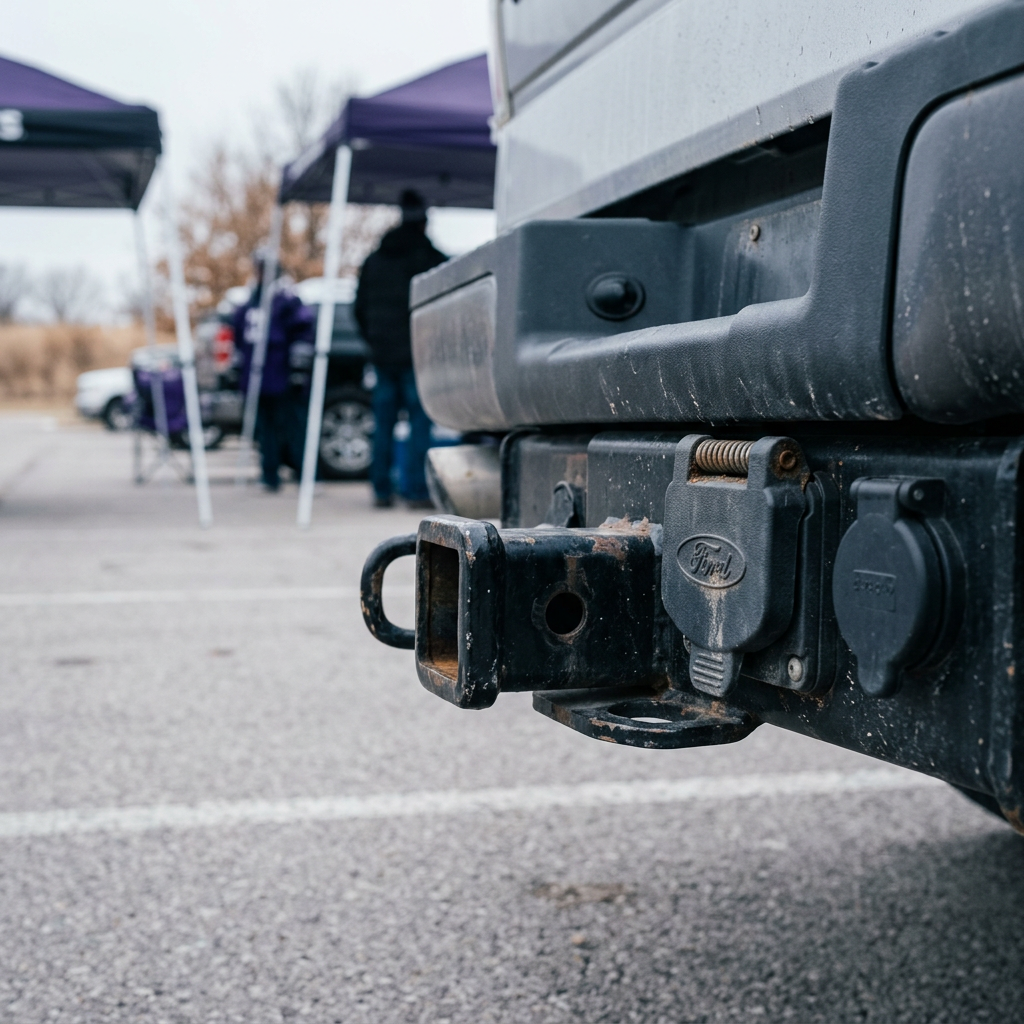
Close-up of a black Ford trailer hitch receiver and electrical connector cap on a truck's rear bumper. (Representative image for illustration purposes only. Actual vehicle may vary based on trim and configuration.)

Aftermarket Hitch Installation

An aftermarket bolt-on Class III receiver hitch costs roughly $200 to $350 for parts, plus $150 to $300 for labor and basic 4-pin wiring. While lower in initial upfront cost ($350 - $650 total), aftermarket solutions lack integrated transmission cooling, brake controllers, and vehicle ECU stability programming. Overloading a vehicle with an aftermarket hitch without cooling upgrades risks transmission overheating during cold-weather heavy pulls.

Why Vehicle Tire Pressure Drops During Cold Game Days in Manhattan, KS

As winter approaches in Geary and Riley counties, drivers frequently notice their Tire Pressure Monitoring System (TPMS) warning light illuminating on cold game day mornings. The underlying cause is rooted in gas physics: Gay-Lussac's Law dictates that air pressure inside a sealed rubber tire decreases proportionally as ambient temperature drops. For every 10°F drop in outside ambient temperature, tire inflation pressure decreases by approximately 1 PSI (pound per square inch).
If you checked your truck's tires in early October during 70°F weather and set them to 35 PSI, an early winter arctic front pushing Manhattan temperatures down to 20°F results in a 50°F temperature drop. This causes cold tire pressure to sink down to 30 PSI—a 14% pressure drop. Running underinflated tires while hauling heavy tailgating trailers along K-18 increases sidewall flexing, generates excessive tire heat under load, degrades cold-pavement braking traction, and unevenly wears expensive truck tread.

What Should Junction City Drivers Check Before Towing to a K-State Game During Winter Weather?

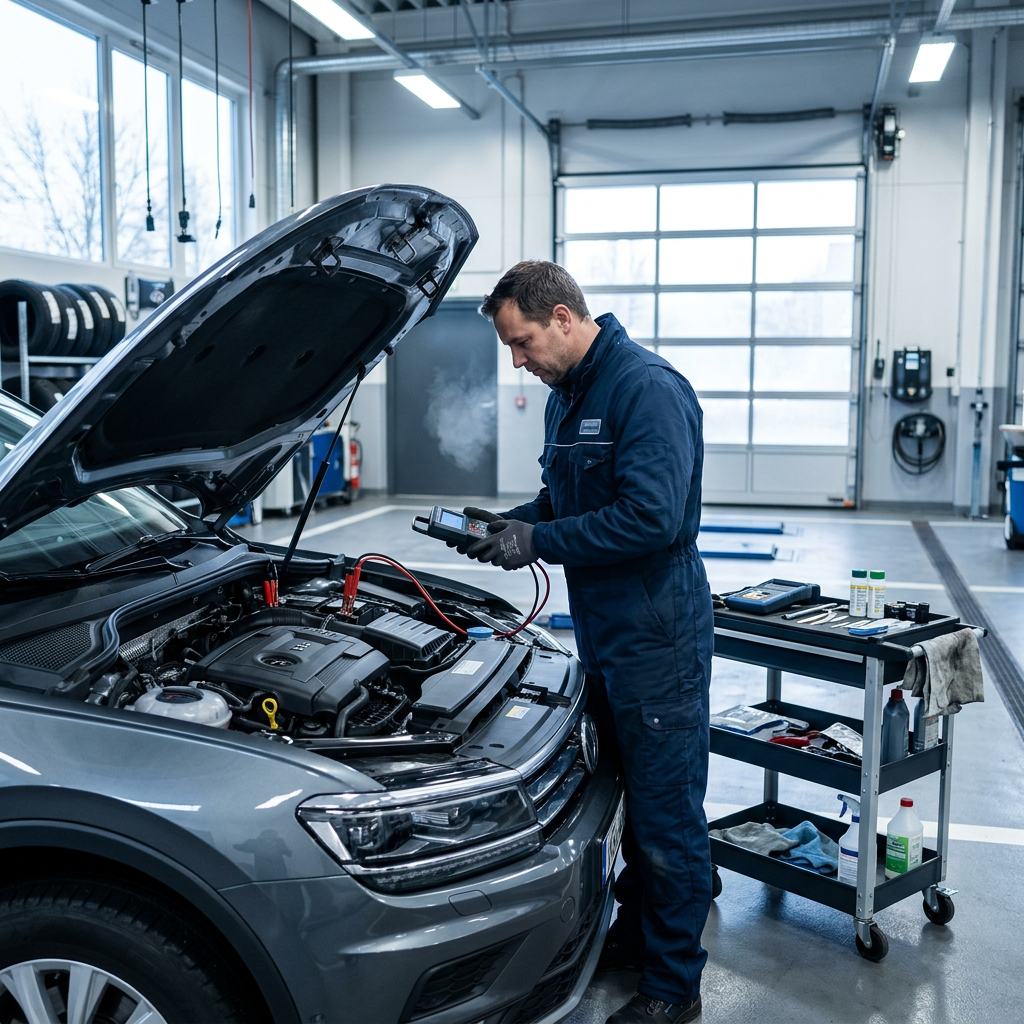
Mechanic wearing blue overalls using a diagnostic device on an open car engine in a modern repair workshop. (Representative image for illustration purposes only. Actual vehicle may vary based on trim and configuration.)

Battery & Electrical System

Sub-freezing temperatures sap vehicle battery output by up to 50% while engine cranking resistance increases. Have your battery tested for Cold Cranking Amps (CCA) at Valor Ford in Junction City before heading out to early morning tailgates.

Coolant Ratio & Fluids

Ensure your engine antifreeze coolant mix is set to a proper 50/50 concentration, protecting your block down to -34°F. Top off windshield washer fluid with winter-grade de-icing fluid capable of melting highway slush along K-18.

Hitch & Lighting Hardware

Inspect your hitch receiver locking pin, safety chains, and 7-pin electrical socket for road salt corrosion. Verify all trailer brake lights, turn signals, and electric brake actuators engage cleanly before departing Fort Riley or Dickinson County.

Cold-Weather K-State Game Day Setup: Towing and Tailgating Essentials in Manhattan

Positioning & Anchoring Against Wind

Park your truck or trailer to act as a primary windbreak against prevailing northwesterly winter winds in the stadium parking lot. Set up your canopy on the leeward side of the vehicle. Secure every canopy leg with heavy-duty anchors—minimum 40 lbs per leg using rubber weight plates, sandbags, or heavy ratcheting straps anchored to your truck's tie-down cleats.

Floor Insulation & Air Circulation

Cold concrete and asphalt suck heat rapidly from footwear. Laying down heavy foam interlocking floor mats, artificial turf rolls, or outdoor marine carpets inside your canopy creates a critical thermal barrier underfoot. Pair floor insulation with a small battery-powered air circulator aimed downward from the canopy peak to keep warm air evenly distributed across the entire tent.

Gear Storage and Hauling Solutions: Packing Heaters, Canopies, and Fuel Safely

1. Propane Transport Safety

Always transport propane cylinders in an upright, vertical position inside an open truck bed—never inside an enclosed passenger cabin or SUV trunk. Secure cylinders using heavy-duty ratchet straps or dedicated cylinder stabilizer bases to prevent tipping and valve damage during transit.

2. Bedliner & Cargo Tie-Downs

Heavy steel canopy frames and cast-iron tailgating cookware can scratch painted truck beds. Equipping your Ford truck with a factory Tough Bed spray-in bedliner provides durable slip protection and rust resistance. Utilize Ford's BoxLink tie-down cleats to anchor heavy gear low against the bed floor.

3. Electronics Weatherproofing

Protect expensive tailgate electronics, power stations, and TVs from freezing highway salt spray along I-70. Store sensitive equipment inside lockable, weather-sealed tonneau covers or heavy-duty gasketed cargo boxes mounted in the truck bed.

Prepare Your Truck for Cold-Weather Tailgating at Valor Ford in Junction City

Valor Automotive logo featuring a red and white VA monogram inside a silver shield.
Before you gear up for late-season game days in Manhattan, ensure your truck and towing equipment are fully prepared to handle winter weather in the Flint Hills. From multi-point pre-trip inspections, battery testing, and winter coolant flushes to installing factory Ford trailer hitches, brake controllers, and bed accessories, the expert certified technicians at Valor Ford are here to keep your game day trips safe and stress-free.
Visit us conveniently at 1825 Goldenbelt Blvd, Junction City, KS 66441 or call our service department at (785) 238-5114 to schedule your pre-game vehicle checkup today.

Posted in:

Related Posts

Is Buying Dedicated Winter Tires Cost-Effective for Northern Block Leave Travel?

Is Buying Dedicated Winter Tires Cost-Effective for Northern Block Leave Travel?

Is Buying Dedicated Winter Tires Cost-Effective for Northern Block Leave Travel? Every year as winter approaches, thousands of active-duty military personnel at Fort Riley prepare for annual Winter Block Leave. For service members heading home across northern states—navigating the icy expanses of Nebraska, Iowa, Minnesota, Wisconsin, the Dakotas, or Wyoming along I-70, I-80, and I-90—the trip presents severe weather challenges. A primary question facing drivers is whether purchasing dedicated winter tires is truly cost-effective for a single holiday road trip. The short answer is a definitive yes. Investing in a set of dedicated winter tires pays for itself when evaluating total risk. Preventing a single weather-related fender bender, heavy highway tow on an isolated stretch of northern interstate, or missed leave window far outweighs the upfront tire expense. Furthermore, because winter tires replace your primary all-season or summer tires during freezing months, you effectively double the tread life of your original set. At Valor Ford in Junction City, KS, we frequently help Fort Riley families evaluate winter readiness so they can travel north with complete confidence. The Math Behind Winter Tires: Total Cost vs. Insurance Deductibles and Delays Evaluating the true return on investment (ROI) of winter tires requires looking beyond the initial purchase price. A high-quality set of dedicated winter tires can vary depending on vehicle size and rim dimensions. Because winter tires are only driven 3 to 4 months out of the year, a single set typically lasts 4 to 5 winter seasons for average drivers. Contrast that controlled cost against the unexpected financial impact of a winter highway collision: comprehensive insurance deductibles, rural highway towing charges, out-of-network car rentals, and possible insurance premium increases after an at-fault weather crash. When combined with the non-refundable cost of lost leave days spent stranded in remote motel rooms waiting for repairs, dedicated winter tires represent an affordable insurance policy for your vehicle and schedule. Expense Category Dedicated Winter Tire Setup Single Minor Winter Incident Cost Upfront / Out-of-Pocket Cost $600 – $1,100 (lasts 4-5 seasons) $500 – $1,000 Insurance Deductible Emergency Towing / Recovery $0 (Avoided hazard) $250 – $600 (Rural Interstate Rate) Insurance Rate Increase $0 (No claims) $400 – $900 / year (Post-incident surge) Primary Tire Wear Protection Saves 30%–40% tread life None All-Season vs. Winter Tires: How Cold Temperatures Impact Traction Below 45°F Rubber Compound Physics All-season tire compounds undergo a physical change called the glass transition point when temperatures drop below 45°F (7°C). The tread rubber hardens and behaves like a rigid plastic puck, losing its ability to conform to road surface imperfections and drastically reducing mechanical grip even on completely dry pavement. High-Density Micro-Siping Winter tires feature hydrophilic rubber formulations infused with high concentrations of silica that remain pliable down to sub-zero temperatures. They feature thousands of microscopic slits (sipes) that flex open to bite directly into packed snow and slice through the thin film of water on ice surfaces to maintain road contact. Real-World Stopping Performance Independent safety tests demonstrate that at 30 mph on snow-covered roads, a car equipped with dedicated winter tires stops up to 30 feet shorter than the exact same car on all-season tires—often the precise distance between a safe, routine stop and a severe highway rear-end collision. What Tire Tread Depth is Required for Safe Winter Road Trips During Block Leave? While the federal legal minimum tread depth for highway driving is 2/32 of an inch, this threshold applies primarily to dry or lightly wet roads. For heavy snow, slush, and icy northern interstates, tire industry safety experts and Ford technicians recommend a minimum tread depth of 6/32 of an inch. Once tread wears down past 5/32", deep snow channels lose their capacity to evacuate slush, dramatically increasing your hydroplaning risk. You can quickly test your tread at home using Washington quarter: insert the coin head-first into the tread groove. If the top of Washington's head is covered by the tread block, you have at least 4/32" of tread remaining. If the top of his head is visible, your tires are unfit for winter cross-country driving. Schedule Ford Service Today Fort Riley Winter Block Leave Readiness: Essential Battery, Tire, and Fluid Service for Military Families Preparing for Winter Block Leave requires a comprehensive vehicle strategy beyond tire selection. Driving 500 to 1,500 miles across multiple state lines subjects your engine, electrical system, and cooling loop to extreme mechanical stress. When sub-zero wind chills hit the Plains, pre-existing mechanical vulnerabilities escalate into highway breakdowns rapidly. For Fort Riley personnel driving trucks like the Ford F-150 or family SUVs like the Ford Explorer, complete pre-flight maintenance ensures your holiday leave is spent with loved ones—not waiting inside an highway service garage. Whether you handle maintenance yourself or trust certified Ford technicians, completing these fundamental readiness checks before departing Junction City is strongly recommended for winter travel. What Battery and Tire Checks Should Fort Riley Families Complete Before Winter Leave Travel? Critical Pre-Trip Battery Testing Freezing temperatures rob automotive batteries of up to 50% of their cranking power while simultaneously increasing engine oil viscosity, making engines twice as hard to turn over. Have a digital conductive load test performed to check Cold Cranking Amps (CCA). Any battery older than three years should be replaced before embarking on multi-state northern routes. Tire Pressure & Cold Temperature Drops For every 10°F drop in ambient temperature, tire inflation pressure drops approximately 1 to 2 PSI. A tire properly set inside a warm garage in Kansas will be severely underinflated when driving through sub-zero blizzards in South Dakota. Always adjust tire inflation cold to recommended door-jamb placard specifications, and verify spare tire pressure before departure. What Ratio of Antifreeze to Water Should Be Used in Vehicle Coolant for Kansas Winters? Standard 50/50 Mixture Ratio A standard 50/50 mix of concentrated ethylene glycol coolant and distilled water provides freeze protection down to -34°F (-37°C) and boiling protection up to 265°F. This is ideal for normal Kansas winter conditions and moderate northern driving. Extreme Cold 60/40 Ratio If your Block Leave travel takes you into upper Midwestern states or high-altitude mountain passes where sub-zero wind chills plummet below -30°F, increase the mixture to 60% coolant concentrate and 40% water. This lowers freeze protection to maximum -62°F (-52°C). Critical Coolant Concentration Cap Never exceed a 70/30 coolant ratio. Pure concentrated antifreeze freezes at a higher temperature than a water-mixture (around +10°F) and lacks necessary heat-transfer capacity, risking catastrophic engine block cracking or radiator burst. What Winter Maintenance Tasks Are Safe and Simple to Complete DIY at Fort Riley Auto Skills Center? For hands-on military members looking to save money before taking leave, several high-impact pre-trip maintenance tasks can easily be completed in under an hour at the Fort Riley Auto Skills Center. Key DIY winter projects include installing beam-style silicone wiper blades that prevent ice buildup, flushing windshield washer fluid with -30°F rated de-icer fluid, replacing engine and cabin air filters, inspecting drive belts for cracking, and swapping exterior headlight/taillight bulbs. For replacement parts designed specifically for your vehicle, you can Order Genuine Ford Parts directly through Valor Ford prior to your work session. Order Genuine Ford Parts How Can Service Members Reserve Stall Time and Tools at the Fort Riley Auto Skills Center? The Fort Riley Auto Skills Center (located in Building 7854 on Custer Ave / Trooper Drive) is an incredible resource for active duty personnel, retirees, and military dependents. The facility features hydraulic vehicle lifts, complete mechanic hand-tool sets, tire mounting and balancing stations, diagnostic code readers, and fluid catch basins. To reserve stall time, patrons must first complete a brief 15-minute shop safety orientation card. Work bays and hydraulic lifts are available on both a walk-in basis and advanced reservation. Hourly bay rental fees are extremely budget-friendly (typically $6 to $10 per hour), making it easy to swap seasonal tires, flush radiator coolant, or perform brake service before Block Leave starts. Emergency Winter Road Trip Safety Gear for Long-Distance Northern Driving Traction & Recovery Gear Pack polymer traction mats or tire recovery tracks, a heavy-duty folding snow shovel, a 20,000-lb rated tow strap, and a 20-lb bag of coarse cat litter or rock salt for immediate wheel traction in deep roadside drifts. Electrical & Emergency Power Carry a portable lithium-ion jump starter pack (1000A peak minimum) so you are not dependent on another vehicle for a jump-start. Include LED magnetic roadside safety flares, high-lumen headlamps, and extra USB power banks. Thermal Survival Supplies Equip your vehicle with sub-zero rated sleeping bags, Mylar thermal emergency bivvies, chemical hand/foot warmers, high-protein non-perishable rations, and an insulated 1-gallon water container stored to prevent total freezing. Tire Storage Solutions: Where to Keep Your Summer or All-Season Set While Away A common obstacle military personnel encounter when buying dedicated winter tires is finding proper storage space for their primary tire set while living in garrison housing or off-post apartments in Junction City and Manhattan. To prevent rubber degradation, dry rot, and flat-spotting while stored: clean off all road salt and brake dust before storing. Store tires inside heavy-duty opaque plastic tire totes to block UV rays and ozone exposure. If tires remain mounted on wheels, stack them horizontally or hang them from rim hooks; if unmounted, store them standing vertically on tread faces. For service members residing in Fort Riley barracks or tight apartment spaces, local self-storage facilities in Junction City or Dickinson County offer climate-controlled MINI-units. Additionally, when you purchase seasonal tire sets at Valor Ford, our team can advise you on compact tire rack systems suitable for garage walls. Balancing Upfront Tire Costs with Long-Term Vehicle Trade-In and Resale Value Using dedicated seasonal tires directly protects your vehicle's long-term resale and trade-in valuation. Standard factory aluminum wheels subjected to harsh northern road salts and chemical de-icers frequently suffer severe rim corrosion, clearcoat peeling, and bead seal leaks within two winter seasons. By mounting winter tires on dedicated steel wheels or winter-rated alloy rims, you keep your primary factory wheels pristine. When preparing for a future Permanent Change of Station (PCS) move or upgrading your vehicle, presenting a car with immaculate wheels, clean undercarriage condition, and verifiable tire rotation history maximizes your instant trade-in offer. Trade In Evaluation Curious how much your current vehicle is worth prior to Block Leave? You can easily get a transparent Trade In Evaluation at Valor Ford. Whether you are looking to trade up to an AWD SUV or Browse Used Inventory, our team supports military personnel across Geary and Riley counties. Pre-Departure Winter Service Checklist for Drivers Departing Junction City and Fort Riley Before starting your engine and rolling out of Junction City for Block Leave, complete this 48-hour final pre-departure safety checklist: System / Component Required Pre-Departure Action Safety Goal Fuel Tank Level Maintain minimum 1/2 tank at all times Prevents fuel line condensation freeze & provides emergency heater power if delayed Windshield Washer Fluid Top off with -30°F rated De-Icer solution Prevents instant windshield icing at highway speeds Wheel Lug Nut Torque Torque to OEM spec (re-check after 50 miles) Ensures wheel security after seasonal tire mounting HVAC / Defrost System Verify A/C compressor engages on defrost settings Removes interior cabin moisture rapidly to keep glass clear Exterior Lighting Clean headlights, taillights, and turn signals Maximizes visibility during severe winter snowstorms Schedule Your Pre-Block Leave Winter Service and Tire Inspection at Valor Ford Don't leave your holiday travel to chance on icy northern highways. The factory-trained master technicians at Valor Ford are proud to serve Fort Riley military personnel, service families, and residents of Junction City and Dickinson County with expert vehicle maintenance. Whether you need a dedicated set of winter tires mounted, a free battery load check, coolant testing, or comprehensive pre-departure inspection, we are here to ensure your vehicle gets you home and back safely. Call (785) 238-5114 or schedule your service appointment online today! Schedule Pickup and Delivery Service

Essential Kansas Winter Freeze Preparation and Agricultural Towing Guide for Ford Super Duty

Essential Kansas Winter Freeze Preparation and Agricultural Towing Guide for Ford Super Duty

Essential Kansas Winter Freeze Preparation and Agricultural Towing Guide for Ford Super Duty As fall turns to late autumn across Central Kansas, agricultural operators in Dickinson County, Geary County, and the surrounding Flint Hills face one of the most demanding operational windows of the year. Kansas winter freezes bring sudden sub-zero wind chills, heavy frost, and ice-covered gravel lanes. For farmers, ranchers, and commercial haulers rely on the rugged strength of the Ford Super Duty lineup—including the F-250, F-350, and F-450—winter weather is not a reason to pause operations. Heavy grain trailers, livestock stock trailers, round balers, and seed tenders must continue moving regardless of the temperature display in the gauge cluster. To ensure your truck operates reliably when ambient temperatures plummet below freezing, proactive preparation is vital. Preparing your Ford Super Duty requires a dual-focused strategy: safeguarding the high-output 6.7L Power Stroke V8 Turbo Diesel powertrain against cold-weather fuel gelling and electrical strain, while optimizing heavy agricultural towing stability via Ford's available trailer and payload assistance features. Plugging in your factory engine block heater when overnight lows drop under 20°F, treating ultra-low sulfur diesel fuel with anti-gel additives, verifying dual battery cold-cranking amp capacity, and keeping gooseneck tongue weight precisely balanced are essential steps to keep your farm productive and safe. At Valor Ford in Junction City, KS, our team understands the exact pressures Kansas agricultural operations face. Whether you are moving livestock along US-77 or clearing access drives near Fort Riley, this guide details the exact steps needed to protect your Ford Super Duty engine, transmission, and towing assembly before the first sub-zero freeze arrives. What Cold Weather Features Come Standard or Optional on the Ford Super Duty Diesel for Winter Operation? The Ford Super Duty is engineered specifically to tackle extreme ambient conditions. Standard and available cold-weather packages turn the 6.7L Power Stroke V8 Turbo Diesel into an unyielding winter workhorse. Understanding how these features function allows farm operators to optimize efficiency and cabin comfort during early morning chores. available supplemental cab heater: Diesel engines produce exceptional torque but require time to reach optimal operating temperatures in sub-zero air. Ford’s available electric Supplemental Cab Heater provides immediate warm air to defrost windshields and heat the interior long before engine coolant fully warms up. Dual Alternator Systems & Heavy-Duty Glow Plugs: To power high-draw accessories, snowplows, and emergency lighting, Super Duty diesel models offer dual alternator configurations outputting up to 410 amps combined. Fast-acting ceramic glow plugs rapidly preheat cylinder combustion chambers for fast, clean cold starts. Engine Exhaust Brake & Heated Ergonomics: The driver-selectable Engine Exhaust Brake uses the variable-geometry turbocharger to create backpressure, providing controlled deceleration on slick downgrades without overheating friction brakes. Inside, available heated leather seats, heated steering wheels, and heated power-folding mirrors keep drivers focused and comfortable. If you are exploring upgrades for your fleet, you can Research Ford F-250 features directly through our online model guides. Where Is the Engine Block Heater Plug Located on a Ford Super Duty Truck? One of the most frequent questions our service advisors receive at Valor Ford when winter approaches is locating the engine block heater cord. On 6.7L Power Stroke diesel models, the block heater element is recessed into the engine block to heat engine coolant directly. The wiring harness routes forward to the front fascia. Locating the Plug: Look behind the front bumper, tucked into the lower grille opening on the passenger side or near the driver's side tow hook cover (depending on trim year and bumper configuration). The plug is protected by a weather-resistant plastic cap. If the cord is retracted or clipped back for summer driving, unclip the retaining fastener to pull the standard 3-prong plug forward. Best Practices for Extension Cords & Timers: • Always use a heavy-duty, outdoor-rated 10/3 or 12/3 SJOW grounded extension cord rated for 15 amps minimum. Thin household extension cords will overheat and create a fire hazard. • You do not need to run the block heater all night long. A heavy-duty outdoor timer set for 3 to 4 hours before your anticipated departure time provides full preheating benefit while saving electricity. • Plug in the heater whenever ambient overnight temperatures are forecasted to drop below 20°F (-7°C). Pre-warmed engine oil flows immediately upon startup, reducing engine wear and battery strain. What Is the Maximum Gooseneck Towing Capacity of the Ford Super Duty for Agricultural Equipment? When moving large livestock trailers, heavy tractors, or fully loaded grain hoppers across rolling Kansas topography, understanding your truck's Gross Combined Weight Rating (GCWR) and maximum gooseneck towing capabilities is vital for safety and compliance. The Ford Super Duty chassis is engineered with high-strength, fully boxed steel frames and heavy-duty axle assemblies designed to handle tremendous tongue weights. Super Duty Model Configuration Max Gooseneck Towing Max Conventional Towing Max Payload Ford F-250 Super Duty 6.7L Power Stroke V8 / SRW Up to 23,000 lbs Up to 22,000 lbs Up to 4,260 lbs Ford F-350 Super Duty 6.7L High Output Power Stroke / DRW Up to 38,000 lbs Up to 28,000 lbs Up to 8,000 lbs Ford F-450 Super Duty 6.7L High Output Power Stroke / DRW Up to 40,000 lbs Up to 30,000 lbs Up to 8,000 lbs Operating in winter demands extra margin. Snow accumulation on equipment and trailers adds hidden weight, while icy roads reduce traction. Always check your specific driver's door pillar door-jamb sticker for exact GVWR and GAWR figures before hitting the road. To compare towing capacities across our heavy-duty fleet, take a look at our Research Ford F-250 page or check out options for the larger F-350 and F-450. Research Ford F-250 Towing Specs How Do available trailer and payload assistance features Assist with Heavy Agricultural Loads? Real-Time Payload Estimation Ford's Onboard Scales measure real-time payload weight directly in the truck bed using integrated suspension sensors. As grain bags, seed pallets, or tools are loaded, the weight displays dynamically on the 12-inch SYNC 4 touchscreen or through the Ford App. Smart Hitch Tongue Weight Proper tongue weight percentage (10-15% for conventional, 15-25% for gooseneck) is critical to prevent dangerous trailer sway on icy rural roads. Smart Hitch calculates actual tongue weight and advises whether to shift cargo forward or rearward before you pull out. available trailer lighting features When loading equipment in remote pastures without looking at the cab screen, integrated LEDs within the taillights operate like a battery gauge. They illuminate progressively as weight approaches max capacity, flashing if payload limits are exceeded. Can the Ford Super Duty Support a Heavy-Duty Commercial Snowplow for Farm Driveway Clearing? Clearing long farm lanes, cattle feedlots, and private access roads around Junction City, Abilene, and Fort Riley requires serious clearing power. The Ford Super Duty is custom-engineered for heavy snowplow mounting when fitted with the factory Snow Plow Prep Package. Key Components of the Snow Plow Prep Package: • Pre-selected computer-matched heavy-duty front springs designed to handle up to 1,000 lbs of heavy steel V-plow equipment. • High-output alternator options (up to 410A dual alternators) to ensure plow hydraulic pumps do not drain battery reserves. • Heavy-duty frame crossmembers and pre-drilled frame mounting points for secure blade frame attachment. • Upfitter switches integrated into the overhead console, allowing seamless in-cab control of plow lighting, strobe safety lights, and salter/spreader equipment. Preventing Diesel Fuel Gelling and Fuel System Freeze-Ups in Central Kansas Sub-zero cold snaps in Kansas create a distinct hazard for diesel truck owners: fuel gelling. Ultra-Low Sulfur Diesel (ULSD) naturally contains paraffin wax. Under normal summer temperatures, this wax remains liquid. However, as ambient temperatures drop toward the fuel's 'Cloud Point' (typically around 15°F to 20°F), wax molecules begin crystallizing, plugging the fuel filter and starving the high-pressure fuel pump. Step-by-Step Diesel Freeze Prevention: 1. Use Motorcraft Anti-Gel Additive: Treat your fuel tank at every fill-up before freezing temperatures arrive. Anti-gel additives lower the Cold Filter Plugging Point (CFPP) down to -20°F or lower, keeping paraffin wax in liquid suspension. 2. Drain the Water-in-Fuel (WIF) Separator Bowl: Moisture condensation naturally forms inside fuel tanks. If water collects in the lower separator housing, it freezes solid, blocking fuel delivery. Use the drain valve located under the driver's side frame rail to purge water monthly. 3. Replace Primary and Secondary Fuel Filters: Old fuel filters containing trapped debris and residual moisture gel far faster than fresh filters. Replace both filters prior to the first cold front. You can easily Order Genuine Ford Parts including OEM Motorcraft fuel filters directly from our parts center. Order Motorcraft Anti-Gel & Fuel Filters Testing Dual Batteries and High-Output Alternators Before First Freeze Cold Cranking Amps (CCA) At 0°F, a battery loses up to 50% of its cranking power while thick cold engine oil doubles starting resistance. Dual 750+ CCA AGM batteries are necessary to turn over high-compression 6.7L diesel V8s. Digital Load Testing A single weak battery in a dual-battery diesel system will drag down the healthy battery, leading to click-no-start conditions in rural pastures. Individual digital conductance testing identifies failing cells early. Our technicians perform battery conductance testing to verify terminal cleanings, strap tightness, and alternator charging output. Selecting Winter All-Terrain Tires and Maintaining Brake Systems for Heavy Loads Traction is the primary constraint when hauling heavy agricultural loads across frozen pastures or icy highway routes. Standard highway-terrain tires harden in sub-zero cold, significantly lengthening stopping distances. Equipping your F-250 or F-350 with 3-Peak Mountain Snowflake (3PMSF) rated heavy-duty all-terrain tires provides rubber compounds designed to remain flexible below 45°F. Cold Tire Inflation Pressure Drop: Tire pressure drops roughly 1 to 2 PSI for every 10°F drop in outdoor temperature. Running underinflated heavy-duty load-range E or F tires under heavy gooseneck loads causes excessive sidewall flexing and heat buildup, raising blowout risks. Integrated Trailer Brake Controller & Exhaust Brake: • Calibrate your integrated trailer brake controller gain setting on snow or packed gravel. Excessive gain will lock up trailer brakes on slick patches, causing dangerous jackknifing. • Test your 6.7L engine exhaust brake before winter arrives. Selecting Auto mode allows the truck to automatically manage engine braking to maintain set speed down grades, keeping wheel brakes cool and preventing wheel lockup. Pre-Winter Fluid Changes and Undercarriage Corrosion Protection Synthetic Winter Engine Oil Switching to Motorcraft 5W-40 or 0W-40 Synthetic Heavy Duty Diesel Engine Oil ensures immediate oil pump pressure and rapid lubrication to critical turbocharger bearings during initial sub-zero startups. Differential & Transfer Case Service Heavy farm towing strains front/rear differentials and electronic transfer cases. Inspecting fluid levels for moisture contamination or metal shavings prevents costly winter drivetrain failures. Kansas road crews treat highways with liquid magnesium chloride and salt. Applying protective underbody barrier sprays protects steel frame rails and brake lines from chemical corrosion. Equipping Your Super Duty Cab for Extreme Winter Field Emergencies When operating across vast acreage or remote Flint Hills pastures, getting stranded in sub-zero wind chills is a serious safety concern. Equipping your lockable under-seat rear storage with a dedicated farm safety kit ensures you remain warm and self-sufficient until help arrives. Essential Emergency Field Kit Checklist: • Heavy-duty recovery kinetic tow rope (30,000+ lb capacity) and rated soft shackles. • Portable lithium-ion heavy-duty jump pack (capable of starting 6.7L diesels without a second vehicle). • Heavy-duty traction boards, folding snow shovel, and bag of ice-melt gravel. • Thermal emergency blankets, insulated work gloves, high-lumen headlamp, and non-perishable rations. FordPass Connect Remote Features: Leverage FordPass Connect to scheduled remote-start your Super Duty from your smartphone. Set cabin heating and defrosters to activate automatically, allowing the vehicle to reach full operating temperature before you step outside. If your busy schedule leaves little time for dealer visits, you can Schedule Pickup and Delivery Service for routine winter maintenance. Schedule Pickup & Delivery Service Expert Winterization and Heavy-Duty Truck Service in Junction City, KS Valor Ford is proud to serve as the premier heavy-duty truck hub for Junction City, Dickinson County, Geary County, and military families stationed at Fort Riley. Our state-of-the-art service facility features heavy-duty lifts and specialized diagnostic equipment designed specifically for commercial and agricultural Ford Super Duty trucks. Our factory-certified Senior Master Technicians receive specialized training on 6.7L Power Stroke diesels, TorqShift 10-speed automatic transmissions, and electronic 4WD systems. We stock genuine OEM Motorcraft filters, fluids, AGM batteries, and gooseneck hitch components to keep your downtime to a absolute minimum. Stop by our dealership at 1825 Goldenbelt Blvd or Get Directions to Valor Ford to speak directly with our commercial truck service advisors. Schedule Your Ford Super Duty Winterization and Towing Inspection at Valor Ford Don't wait until the first hard freeze locks up your fuel lines or drains your truck battery. Ensure your Ford F-250, F-350, or F-450 Super Duty is completely prepared to handle heavy agricultural towing and harsh winter weather this season. Contact our certified service team today to schedule your comprehensive pre-winter multi-point inspection, diesel fuel system service, battery load test, and gooseneck hitch alignment. Call us at (785) 238-5114 or use our online portal below. If you are also evaluating trade-in options for your current fleet, feel free to fill out our online Trade In Evaluation or Browse Used Inventory today. Schedule Ford Service Today


Key Takeaway: How Ford Terrain Management System Protects Winter Drivers on Interstate 70

Key Takeaway: How Ford Terrain Management System Protects Winter Drivers on Interstate 70

Key Takeaway: How Ford Terrain Management System Protects Winter Drivers on Interstate 70 Driving along Interstate 70 through Central Kansas during the winter months presents severe driving hazards. Freezing winds sweeping across open fields create sudden ground blizzards, black ice on elevated bridges like the Smoky Hill River crossing, and dense slush lanes between Junction City and Salina. The Ford Terrain Management System (TMS) is engineered specifically to eliminate driver uncertainty during these rapid weather shifts. By rotating a simple rotary dial inside the cabin, drivers can select tailored drive profiles such as Slippery or Deep Snow/Sand. This electronically recalibrates vehicle systems in real time—adjusting throttle sensitivity, delaying or accelerating transmission shift points, recalibrating anti-lock brakes (ABS), and modifying front-to-rear torque distribution via Ford Intelligent 4WD. Rather than relying on mechanical lever engagement or reactive wheel spin, Ford TMS acts as an intelligent co-pilot. In Slippery Mode, the vehicle dulls aggressive gas pedal inputs to prevent sudden torque spikes that break tire traction on packed ice. Simultaneously, the Intelligent 4WD transfer case proactively pre-loads power to the front axle before slip occurs. When encountering drifted snow banks along highway exit ramps near Fort Riley, switching to Deep Snow/Sand Mode allows momentum-sustaining wheel slip while aggressive brake-based traction control manages side-to-side power distribution. For drivers negotiating unpredictable prairie winter storms, TMS provides an essential shield against loss of control. Drive Mode Throttle Response Torque Split (Front/Rear) Traction & Stability Control Ideal I-70 Winter Scenario Normal Standard linear pedal mapping 100:0 (proactive auto-engage) Standard slip thresholds Dry pavement between winter storms Slippery Relaxed / reduced sensitivity 50:50 continuous pre-stage split Ultra-sensitive wheelspin prevention Black ice, freezing rain, slush on I-70 bridges Deep Snow / Sand Aggressive momentum response 50:50 locked dynamic distribution Allows controlled slip for momentum Un-plowed off-ramps, high drift snowbanks How Ford Terrain Management System Adjusts Vehicle Controls for Snow, Ice, and Slush Throttle Mapping & Shift Point Calibration When driving on low-friction surfaces like slush or refrozen snow, harsh accelerator inputs can instantly break tire traction. The Ford Terrain Management System alters the electronic throttle profile. In Slippery Mode, pressing the gas pedal yields a gradual, metered rise in engine torque rather than a sudden burst. Simultaneously, the SelectShift high-speed automatic transmission adjusts its shift logic. The system upshifts earlier in the RPM band to keep engine torque manageable and downshifts more smoothly to avoid sudden engine-braking shocks that could unseat rear-wheel traction while coasting down highway grades. ABS & Brake Vectoring Recalibration Traditional Anti-lock Braking Systems (ABS) pulse rapidly to prevent lockup, but packed snow and ice require refined brake pulses to maximize deceleration without causing loss of steering control. Ford TMS updates brake system parameters based on the selected mode. In Deep Snow Mode, the ABS permits brief locking of the wheels. This allows a small wedge of snow to build up in front of the tires, acting as a natural brake block to shorten stopping distances. Additionally, AdvanceTrac with Roll Stability Control works alongside torque vectoring to gently apply individual wheel brakes if yaw sensors detect vehicle rotation on icy I-70 lane changes. How Does Ford Intelligent 4WD Handle Snow and Ice on Winter Highways Like I-70? Older four-wheel-drive systems required drivers to notice loss of traction before manually shifting levers into 4H. Ford Intelligent 4WD operates continuously through predictive electronics. Sampling dozens of vehicle sensors hundreds of times per second, the system tracks individual wheel speed, steering wheel angle, lateral acceleration, windshield wiper activation, and ambient air temperatures. If you are traveling west on I-70 toward Abilene and hit a patch of black ice on an overpass, Intelligent 4WD doesn't wait for a wheel to spin. The system measures micro-slips before they escalate and routes up to 100% of available rear engine torque to the front wheels (or vice versa) via an electro-hydraulic clutch assembly. This seamless transfer of drive force maintains directional stability without driver intervention. What Is the Difference Between Ford Intelligent 4WD and Traditional 4WD High/Low Modes? Ford Intelligent 4WD (Single-Speed) Found on vehicles like the Explorer and Bronco Sport. Uses an electronic clutch pack for instant torque distribution on dry, wet, or icy roads without drivetrain binding. No low-range gear selection needed for highway winter conditions. Traditional 4x4 High / Low Modes Found on heavy-duty trucks like the F-150 and F-250 Super Duty. Features a mechanical transfer case with 2H, 4H, and 4L low-range gearing. Designed for heavy towing, deep mud, or unpaved snow conditions. Pavement Compatibility & Efficiency Intelligent 4WD can remain active permanently on dry asphalt without driveline wear or tire hopping during sharp turns. Traditional 4H must be turned off on dry pavement to prevent transfer case strain. Explore New Ford 4WD SUV Inventory Can Ford BlueCruise Be Used During Severe Winter Snowstorms or Icy Conditions? No, Ford BlueCruise hands-free highway driving should not be activated during severe winter snowstorms, active ice storms, or heavy slush conditions. BlueCruise relies on clear optical camera visibility to read painted lane markers along approved Hands-Free Blue Zones like I-70. When snow drifts cover pavement markings, radar sensors become caked with highway slush, or traction is compromised by black ice, BlueCruise will prompt the driver to resume manual control with visual and audible alerts. During winter weather, driving safety requires human judgement, manual throttle modulation, and tactile steering feedback. Always use hands-on driving when roads are slick. How Do You Clean Snow and Road Salt Off Ford BlueCruise Radar Sensors and Cameras? 1. Front Grille Radar Pod The front radar sensor is located in the center grille or lower bumper. Clear heavy snow build-up gently using a soft brush or microfiber towel. Never scrape radar covers with hard plastic ice scrapers as scratches can distort millimeter-wave radar signals. 2. Windshield Camera Housing The forward-facing camera sits behind the upper center windshield near the rearview mirror. Ensure your windshield defrost is running and keep windshield washer fluid topped off with low-freeze rated (-20°F) fluid to clear salt spray without smearing. 3. Side Mirror & Ultrasonic Sensors Side-view mirror cameras and bumper-mounted ultrasonic sensors collect road grime rapidly. Wipe camera lenses with a damp microfiber cloth and automotive-grade washer fluid to remove corrosive calcium chloride salt deposits. How Does Ford App Remote Start Help Melt Ice Off Sensor Camera Zones Before Driving? Pre-conditioning your vehicle is one of the most effective ways to prepare for a safe winter highway trip. Utilizing the Ford App Connect App, drivers can schedule pre-departure times or activate Remote Start directly from a smartphone. When engaged in sub-freezing temperatures, Ford Remote Start automatically powers up internal heating systems: full windshield defrosters, heated rear glass, side mirror heating elements, and heated wiper park zones. Radiating warmth thaws ice accumulation around upper windshield camera housings and mirror lenses before you ever step outside. This ensures your vehicle's driver-assist safety camera array is clear and operational prior to pulling onto I-70. If you have questions about syncing your smartphone, check our guides or Schedule Ford Service Today at Valor Ford. Schedule Winter Service Inspection Navigating I-70 Winter Conditions: Ford Intelligent 4WD and BlueCruise Driving Tips Navigating Interstate 70 between Junction City, Fort Riley, and Abilene during Kansas winter storms requires combining state-of-the-art vehicle technology with proactive driving habits. High prairie crosswinds regularly blow loose snow across the lanes, creating localized ground blizzards and unexpected drifts near highway bridges and overpasses. I-70 Hazard Location Environmental Condition Recommended Ford Mode / Feature Best Driver Action Smoky Hill River Bridge Flash black ice freeze Select Slippery Mode Maintain steady speed, avoid hard braking Open Prairie Corridors 40+ mph winter crosswinds AdvanceTrac & Side-Wind Stabilization Keep both hands firm on wheel, disable cruise control Exit Ramps (Junction City) Deep slush & plow windrows Select Deep Snow / Sand Mode Maintain momentum, turn into skid if tail breaks free How Much Does Ford Intelligent 4WD Add to the Total Vehicle Cost? When configuring a new Ford vehicle, adding Intelligent 4WD may affect MSRP on trims where front-wheel-drive or two-wheel-drive is standard. On popular Midwest utility models such as the Ford Bronco Sport, Explorer Timberline, and Expedition, Intelligent 4WD is standard equipment. From a long-term value perspective, four-wheel drive vehicles retain a significantly higher percentage of their value in Kansas and throughout the Great Plains region. Furthermore, the enhanced safety, capability, and winter peace of mind far outweigh the modest initial investment when commuting along snowy stretches of I-70. If you are curious about current trade valuation, check out our Trade In Evaluation tool. Preparing Your Ford Vehicle for Winter Highway Drives Across Central Kansas Tires & Tread Inspection Intelligent 4WD depends on tire friction. Ensure tread depth is above 5/32" for winter driving or upgrade to 3PMSF (Three-Peak Mountain Snowflake) rated tires available through our parts center. Battery & Electrical Test Cold temperatures reduce battery capacity by up to 50%. Have your Motorcraft battery conductance tested at Valor Ford before low winter temperatures arrive. Wiper Blades & Fluid Install heavy-duty beam wiper blades designed to resist ice buildup and top off with washer fluid rated to -20°F or lower to maintain clear camera sightlines. Order Genuine Ford Winter Parts Experience Ford Terrain Management System at Valor Ford in Junction City, KS Whether you are commuting along I-70 between Junction City and Fort Riley or planning winter family road trips, Valor Ford is your trusted winter driving authority in Central Kansas. Our certified Ford team can walk you through the Ford Terrain Management System, demonstrate Intelligent 4WD live, or inspect your vehicle before freezing weather arrives. Visit us today at 1825 Goldenbelt Blvd in Junction City, KS. Get Directions to Valor Ford or Call us at (785) 238-5114 to speak directly with our team. Contact Us About Financing