
2027 Ford Explorer vs. 2027 Ford Expedition: Choosing Your Family Hauler
Is a Full-Size SUV Like the Expedition Significantly Harder to Park and Maneuver Daily Than an Explorer?
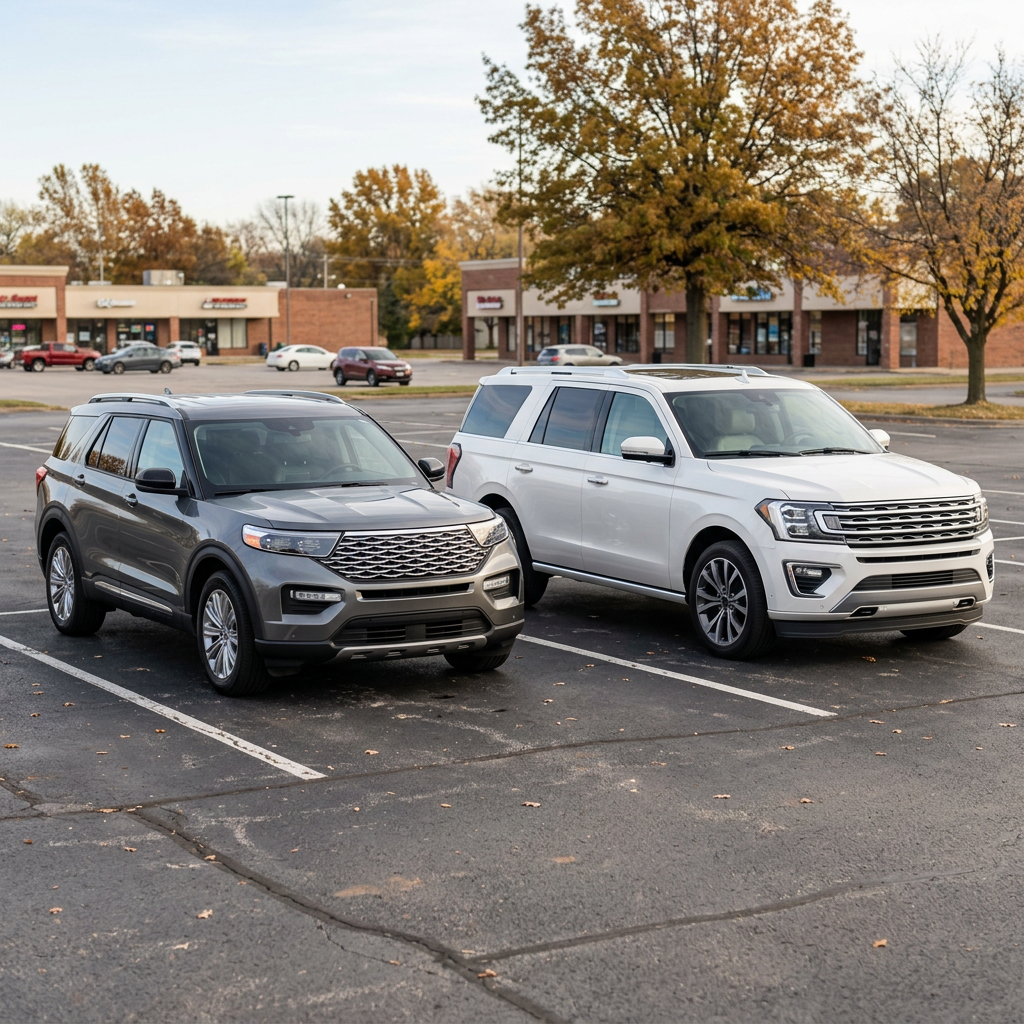
Yes, the 2027 Ford Expedition requires noticeably more effort to park and navigate through tight suburban spaces than the 2027 Ford Explorer. Standing over 15 inches longer and 5 inches wider with a larger 41-foot turning circle compared to the Explorer's 38-foot turning radius, the full-size Expedition demands larger parking spots and wider turning arcs. Drivers who regularly navigate congested school drop-off lanes or tight garage doors will find the midsize Explorer significantly more agile for daily errands.
During first-time test drives with local families, I usually suggest taking both SUVs through a busy parking lot to experience the physical footprint firsthand. The Explorer drives much like a midsize sedan with an elevated ride height, slotting easily into standard parking stalls. By contrast, the Expedition relies heavily on its available 360-degree camera system and front parking sensors to guide its truck-based frame into tight spaces.
For parents navigating tight parking garages or crowded shopping centers in Junction City, that dimensional gap is immediately obvious behind the wheel. If your daily route involves tight parking spaces or compact home garages, the Explorer offers a less demanding driving experience. If you need maximum interior space and are comfortable managing a larger vehicle, our team is always available at (785) 238-5114 or directly at our Goldenbelt Boulevard showroom to walk you through side-by-side parking demonstrations.
Table of Contents
- What Are the Seating Capacity and Interior Dimension Differences Between the 2027 Ford Explorer and Expedition?
- What Engine Performance and Fuel Efficiency Options Power the 2027 Explorer vs. Expedition?
- How Does Towing Capacity Compare Between the 2027 Ford Explorer and 2027 Expedition?
- Is Ford BlueCruise Hands-Free Driving Available on Both the Explorer and Expedition?
- Which Trim Level Offers the best balance for Families in the 2027 Ford Explorer Lineup?
- What Long-Term Maintenance and Service Requirements Should You Expect for Your Ford SUV?
What Are the Seating Capacity and Interior Dimension Differences Between the 2027 Ford Explorer and Expedition?
The 2027 Ford Expedition seats up to eight passengers with adult-friendly third-row legroom and up to 108 cubic feet of total cargo space, whereas the 2027 Ford Explorer seats up to seven passengers with a third row designed primarily for children. The standard-wheelbase Expedition offers about 22 cubic feet of cargo space behind its third row, expanding to 36 cubic feet in the long-wheelbase Expedition MAX, while the Explorer provides roughly 18 cubic feet behind its third row and up to 86 cubic feet total.
Cabin architecture represents the biggest structural difference between these two family haulers. The Explorer offers flexible seating configurations, including second-row captain's chairs on trims like the ST-Line, which creates a convenient pass-through aisle to the rear. The third row delivers 32 inches of legroom, making it ideal for younger kids or occasional adult use on short trips. Families looking to explore every seating layout can explore detailed Ford Explorer research to compare dimensions across the trim lineup.
The full-size Expedition elevates passenger room across all three rows, offering 36 inches of third-row legroom that comfortably accommodates adults on long highway trips. When all rear seats are folded flat, the Expedition creates a cavernous floor capable of hauling massive cargo items. For buyers evaluating overall cabin size and pre-owned alternatives, you can also browse our pre-owned SUV inventory to examine various passenger configurations in person.
What Engine Performance and Fuel Efficiency Options Power the 2027 Explorer vs. Expedition?
The 2027 Ford Explorer comes standard with a turbocharged 2.3-liter EcoBoost four-cylinder engine generating 300 hp, while the 2027 Ford Expedition packs a twin-turbo 3.5-liter EcoBoost V6 producing 400 hp and 460 lb-ft of torque. The Explorer delivers higher overall fuel efficiency with an EPA-estimated 21 mpg city / 28 mpg highway, whereas the full-size Expedition achieves an EPA-estimated 18 mpg combined rating ( 15 mpg city / 22 mpg highway for four-wheel-drive models).
For drivers seeking enhanced performance, Ford offers upgraded engine options on both vehicle platforms. The Explorer ST features a high-output 3.0-liter EcoBoost V6 pushing 400 hp and 415 lb-ft of torque, which is also available on the off-road Tremor and luxury Platinum trims. Power is managed smoothly through a 10-speed automatic transmission that balances crisp acceleration with highway cruising efficiency.
The Expedition offers its twin-turbo 3.5-liter EcoBoost V6 in a High-Output tune on select trims like the Tremor and Platinum, boosting output to 440 hp and 510 lb-ft of torque. This heavy-duty powertrain delivers effortless pass power and confident acceleration even when fully loaded with passengers. Buyers planning long highway commutes across Dickinson County often find that the Explorer's four-cylinder efficiency provides substantial savings at the pump over multi-year ownership. To evaluate payment structures for either powertrain, shoppers can get pre-approved online before taking a test drive.
How Does Towing Capacity Compare Between the 2027 Ford Explorer and 2027 Expedition?
A properly equipped 2027 Ford Expedition hauls up to 9,600 pounds of trailer weight, while the 2027 Ford Explorer maxes out at 5,000 pounds of towing capacity. That 4,600-pound capability gap dictates what kind of recreational equipment each SUV can pull, separating lightweight utility trailers and small speedboats from heavy double-axle travel trailers and full-size horse trailers.
Achieving the Expedition's maximum rating requires configuring a 4x4 model with the factory Heavy-Duty Trailer Tow Package, which integrates heavy-duty cooling components and trailer brake controls. The truck-based body-on-frame chassis absorbs tongue weight with minimal rear-end sag, maintaining vehicle composure when pulling large loads over highway passes. The Expedition MAX caps maximum towing slightly lower at 9,000 pounds due to its longer wheelbase and higher curb weight.
The Explorer utilizes a unibody platform that handles up to 5,000 pounds when equipped with the Class III Trailer Tow Package. This capacity easily manages ski boats, small camper trailers, or personal watercraft for weekend trips. If you plan to equip your SUV with specialized hitches or electrical harnesses, our parts department allows you to order genuine Ford towing parts direct from the factory.
Is Ford BlueCruise Hands-Free Driving Available on Both the Explorer and Expedition?
Yes, Ford BlueCruise hands-free highway driving technology is available on select upper trim levels for both the 2027 Ford Explorer and the 2027 Ford Expedition. The system operates on prequalified sections of divided highways known as Hands-Free Blue Zones, controlling steering, acceleration, and braking while maintaining lane centering and driver gaze monitoring.
Both vehicles utilize an advanced sensor suite featuring radar and camera inputs to manage highway driving tasks automatically. Features like Lane Change Assist allow the driver to initiate hands-free lane changes simply by tapping the turn signal, while In-Lane Repositioning subtly shifts the vehicle away from large semi-trucks in adjacent lanes. The driver-facing camera continuously verifies that the driver's eyes remain focused on the road ahead.
On long highway drives across Fort Riley, BlueCruise reduces driver fatigue significantly by handling routine lane maintenance and speed adjustments. The technology is available via flexible subscription structures or multi-year activation plans, giving owners options to fit their driving habits and travel schedules.
Which Trim Level Offers the best balance for Families in the 2027 Ford Explorer Lineup?
The ST-Line trim delivers a strong balance of features and styling in the 2027 Ford Explorer lineup. Positioned above the entry-level Active model, the ST-Line includes sporty exterior styling cues, standard second-row captain's chairs, upgraded interior upholstery, and the full suite of Ford Co-Pilot360 driver-assist features without the equipment level of the high-performance ST or range-topping Platinum.
While the base Active trim includes the 300-hp 2.3-liter EcoBoost engine and essential touchscreen technology, the ST-Line adds desirable family features like ActiveX seating surfaces, enhanced ambient lighting, and available Ford BlueCruise compatibility. For off-road enthusiasts, the Tremor trim adds steel deflector plates and an off-road tuned suspension, but for daily commuting and family hauling, the ST-Line strikes the absolute sweet spot.
Families considering different vehicle sizes or body styles can also browse our new Ford SUV lineup to explore all available three-row and off-road options. If you are preparing to trade in a current vehicle toward a new SUV purchase, you can easily value your trade-in to calculate your estimated equity beforehand.
What Long-Term Maintenance and Service Requirements Should You Expect for Your Ford SUV?
Both the Explorer and Expedition require routine preventative care centered around EcoBoost turbocharger health, transmission fluid maintenance, and brake component upkeep. Standard service intervals call for synthetic engine oil and filter changes every 7,500 to 10,000 miles, along with tire rotations and multi-point inspections to monitor suspension bushings and brake pad wear.
Because both vehicles utilize high-output turbocharged engines, maintaining clean oil and fresh air filters is critical for long-term turbocharger reliability and fuel efficiency. Higher-mileage Explorers typically require suspension bushing inspections and routine spark plug replacements around 60,000 miles. Expedition models that regularly tow heavy loads benefit from shortened fluid replacement intervals on the 10-speed transmission and rear differential.
Ford backs both models with a 3-year/36,000-mile basic warranty and a 5-year/60,000-mile powertrain warranty, complemented by five years of factory roadside assistance. When your vehicle is ready for routine maintenance, you can easily schedule a service appointment with our factory-trained technicians. Our service team is located at our Junction City dealership, and you can reach our service advisors directly at (785) 238-5114 to keep your family hauler running smoothly for years to come.