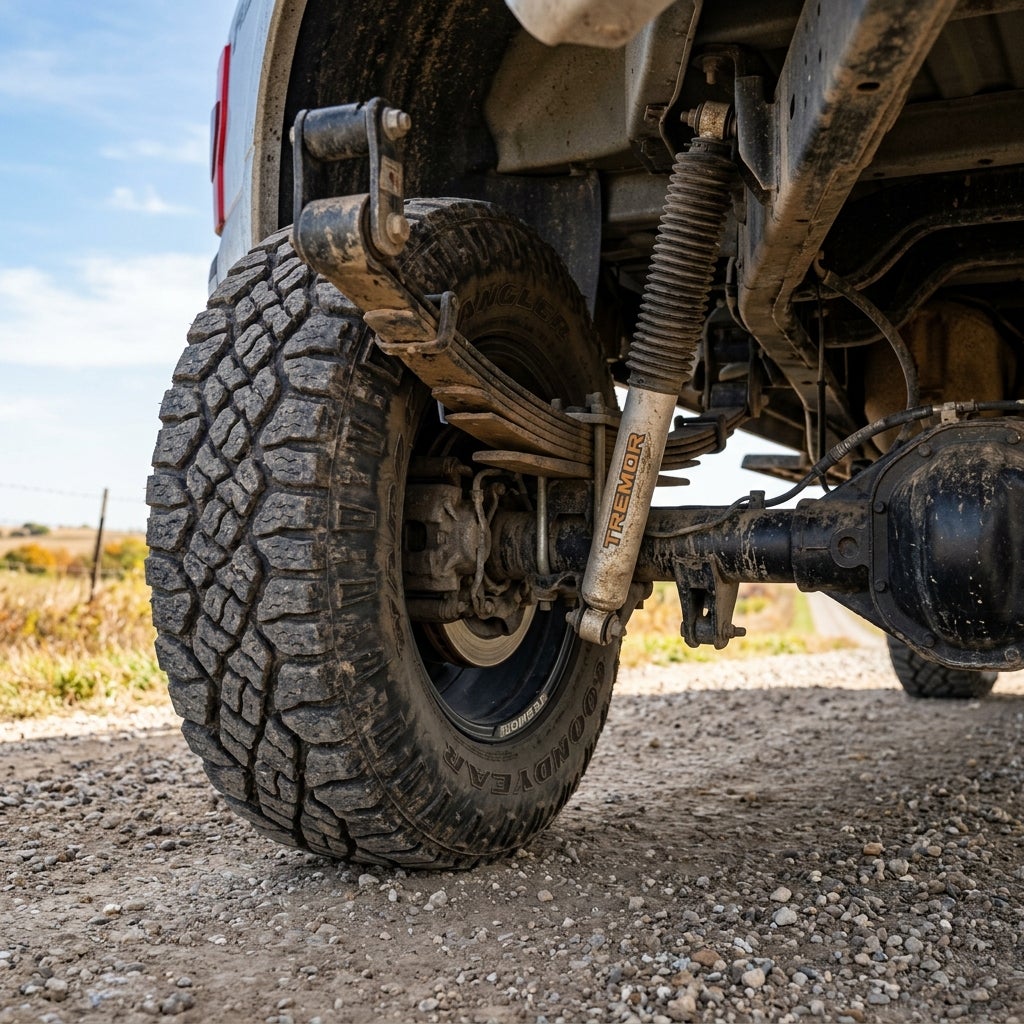
Why the 2023–2026 Ford F-350 Rides Firmer Than the F-250 When Empty If you have ever taken a test drive in a 2023, 2024, 2025, or 2026 Ford Super Duty without any gear in the bed, you likely noticed a distinct physical difference: the F-350 reacts with noticeably more firmness over bumps, road seams, and expansion joints than an F-250. This is not an optical illusion or a minor perception variance—it is the direct engineering result of heavy-duty spring rate selection, factory tire placard requirements, shock absorber valving, and frame structural tuning designed to support massive payload capacities. In short, the 2023–2026 Ford F-350 single rear wheel (SRW) rides firmer when unladen because its primary rear leaf spring pack carries a substantially higher spring constant (lbs/in), standard auxiliary overload leaves sit closer to engagement, shock absorber rebound valving is stiffer to control heavy axle mass, and factory cold tire inflation recommendations range up to 80 PSI in the rear versus 60–65 PSI on the standard F-250. Before choosing your next truck at Valor Ford in Junction City, KS, understanding these suspension nuances will help you select the precise configuration for your daily driving needs. Engineering Parameter Standard Ford F-250 SRW Standard Ford F-350 SRW Target GVWR Range 9,900 – 10,000 lbs 11,300 – 12,400 lbs Rear Spring Architecture Progressive main leaf pack (Soft unladen rate) High-rate main pack + standard overload leaf Rear Cold Tire Pressure Placard 60 – 65 PSI 75 – 80 PSI Unladen Suspension Deflection Higher compliance (Smoother ride) Minimal deflection (Firmer ride) Rear Shock Rebound Damping Tuned for comfort & moderate loads Heavy-duty damping for maximum payload control Research Ford F-250 Specs & Pricing Leaf Spring Architecture: Main Spring Rates and Auxiliary Overload Leaves The foundational reason the 2023–2026 Ford F-350 feels stiffer over road imperfections lies in its rear leaf spring assembly architecture. While both trucks utilize a solid rear axle setup with longitudinal leaf springs, the internal mechanical properties of these leaf packs are fundamentally distinct. On a standard F-250 single rear wheel, Ford engineers select a main spring bundle designed to flex under minimal force. The initial rate of initial compression allows the rear axle to absorb sharp road impacts—such as pot holes or asphalt expansion joints—without transmitting that sudden vertical energy into the frame and cab interior. When the truck bed is empty, the weight of the aluminum body and frame compresses the F-250 springs into their comfortable operating zone. In contrast, the F-350 SRW utilizes thicker individual leaf plates with an increased spring arch geometry. The initial spring rate (measured in pounds per inch of deflection) is drastically higher. Furthermore, almost all F-350 SRW models come standard with an auxiliary top-mounted overload leaf spring. In an unladen F-350, the gap between this auxiliary leaf and its frame contact pads is small. On sudden dips or medium bumps, the overload leaf contacts the frame bracket early in the compression stroke, instantly hardening the rear suspension rate and causing the characteristic 'kick' or rigid feeling associated with empty three-quarter and one-ton haulers. Interested in evaluating how these spring configurations feel in person? You can Research Ford F-250 trim variations or call our team directly to set up back-to-back road tests in Junction City. GVWR and RGAWR Rating Math: How Federal Load Ratings Force Stiffer Rear Springs To understand why Ford tunes the F-350 suspension so firmly, one must examine federal Gross Vehicle Weight Rating (GVWR) and Rear Gross Axle Weight Rating (RGAWR) standards. Heavy-duty trucks are engineered back from their maximum rated capabilities rather than tuned down from a luxury baseline. A standard 2023–2026 F-250 SRW is typically rated at a Class 2b GVWR limit of 10,000 lbs (though optional package upgrades exist). This rating requires the suspension to hold approximately 3,000 to 4,000 lbs of combined cargo and pin weight without exceeding safety thresholds. Because the targeted payload ceiling is moderate, Ford chassis engineers can specify a lower spring constant that yields pleasant unladen ride dynamics while maintaining full legal and safety compliance under load. The F-350 SRW steps into Class 3 territory, boasting GVWR choices from 11,300 lbs up to 12,400 lbs depending on cab, bed, engine (6.8L V8, 7.3L Godzilla, or 6.7L Power Stroke Diesel), and axle options. To legally certify a truck to carry over 4,500 lbs of bed payload or maintain control under heavy fifth-wheel tongue weight, the rear suspension cannot compress significantly under initial load. As a result, the springs must be extraordinarily stiff when zero load is present in the bed. Ready to calculate how much load capacity your operation requires? Visit our finance experts or submit a Trade In Evaluation to see how your current truck compares against modern Super Duty ratings. Shock Damping, Tire Pressures, and Frame Stiffening in Modern Super Duty Trucks OEM Shock Valving Damping curves in Ford OEM shock absorbers are calibrated to match spring rates. Because the F-350 has stiffer springs that store immense kinetic energy when compressed, its twin-tube or mono-tube shocks feature aggressive rebound damping. When driving empty over a crest or dip, the shocks forcefully retard spring extension, producing a swift, taut reaction rather than a slow, floating recovery. Tire Pressure Placards Tire sidewall stiffness plays a major role in ride compliance. Ford door placards for the F-350 recommend high cold tire pressures (75–80 PSI rear) to sustain max payload safely. Running 80 PSI in an empty load-range E or F tire creates an unyielding pneumatic cushion. The standard F-250 placard calls for 60–65 PSI rear, providing significantly more rubber flex over small road bumps. High-Strength Steel Frame The 2023–2026 Super Duty features a fully boxed frame constructed from over 95% high-strength steel. While this eliminates frame twist under extreme payload, it also prevents the chassis from absorbing harsh road vibrations. Every impulse from rigid F-350 springs and high-PSI tires travels directly into the cab mounts and seat frames. Get Pre-Approved for Financing Does the F-350 Ride Rougher Than the F-250 When Empty on Junction City Roads? Local driving conditions around Geary and Dickinson counties provide a clear real-world environment for testing ride quality differences between empty Super Duty models. Whether commuting along Interstate 70 toward Manhattan, maneuvering around Fort Riley, or navigating gravel county roads near Junction City, the dynamic difference is readily apparent. I-70 Concrete Expansion Joints: On concrete highway segments with rhythmic seams, an unladen F-350 can exhibit a sharp back-and-forth chatter often referred to as 'bed hop' or 'freeway jitter.' Because the high-rate rear leaf springs refuse to compress under an empty bed, the tires bounce over the seams. The F-250, by comparison, absorbs these rapid vertical cycles with smoother compression, keeping the vehicle cabin stable and calm. City Streets & Railroad Crossings: Driving down Washington Street or crossing railroad tracks in Junction City exposes the structural stiffness of the F-350 rear axle. Impact forces hit harder, and passengers will feel more lateral head toss. In an unladen F-250, the softer spring deflection cushions initial sharp bumps, delivering an experience closer to a full-size half-ton F-150. Gravel County Roads: On washboard gravel paths around rural Kansas, tire pressure and spring compliance dictate traction. An unladen F-350 at 80 PSI rear pressure tends to skid over loose gravel corrugated ridges, whereas an F-250 at 60 PSI allows the tire contact patch to conform to uneven surfaces, enhancing tracking and comfort. F-250 High Capacity Tow Package vs Standard F-350: Does an Upgraded F-250 Ride Just as Stiff? Standard F-250 Features standard 3-leaf main rear spring pack, standard rear axle shaft diameter, and no auxiliary overload leaves. Designed for maximum daily unladen comfort while providing full 10,000-lb GVWR capacity for light-to-medium hauling. F-250 with High Capacity Tow Pkg Adds upgraded rear axle, auxiliary overload leaf springs, and stiffer rear spring rates. This package essentially retrofits the F-350's rear suspension hardware onto an F-250 frame, causing its unladen ride stiffness to mimic an F-350 almost identically. Standard F-350 SRW Comes factory-equipped with the heavier rear axle shaft, high-rate spring bundle, standard overload leaves, and 11,300+ lb GVWR certification. Rides firm empty but handles immense payload without rear sag. Payload and Towing Trade-offs: Why the F-350's Stiff Unladen Ride Pays Off Under Heavy Loads While the F-350's firm unladen ride requires a slight compromise in empty-bed comfort, that rigidity transforms into pure stability the moment you drop 3,000 lbs into the bed or hook up a 18,000-lb gooseneck horse trailer or livestock haul across Kansas. Preventing Rear Squat: When heavy pin weight compresses the F-350 rear suspension, the high-rate main springs and immediate overload leaf engagement arrest downward travel quickly. The truck remains near level, keeping headlights properly aimed and preserving front suspension steering geometry. Eliminating Trailer Sway & Bottoming Out: Under heavy crosswinds or quick emergency maneuvers, the stiff spring rates and heavy shock rebound valving prevent dramatic body roll. An F-250 carrying maximum rated payload will utilize nearly all of its suspension travel, bringing it closer to bump-stop contact over severe highway dips. Need to discuss your specific towing requirements with a heavy-duty specialist? Call us at (785) 238-5114 to consult with our commercial truck team at Valor Ford. For Everyday Empty-Bed Driving Around Junction City, KS, Which 2026 Super Duty Offers the Smoother Ride? For drivers who use their Super Duty primary as a daily personal vehicle, commuter truck between Fort Riley and Topeka, or light-duty family hauler with occasional weekend towing under 12,000 lbs, the 2026 Ford F-250 SRW is overwhelmingly the smoother choice. Its progressive main spring rate and lower factory cold tire inflation recommendations (60–65 PSI) isolate the cabin from road harshness far more effectively. However, if your work demands daily bed payloads over 3,500 lbs, heavy gooseneck/fifth-wheel hauling across Dickinson County, or commercial registration compliance, the 2026 Ford F-350 SRW is worth the firmer empty ride. The peace of mind provided by its upgraded axle rating, payload headroom, and towing stability far outweighs unladen stiffness. Browse Used Super Duty Inventory Aftermarket and OEM Suspension Solutions: How to Soften an F-350's Unladen Ride Quality 1. Fine-Tune Unladen Tire PSI When driving completely empty without cargo, adjusting rear tire pressure down within tire manufacturer load-inflation table specs (e.g., dropping empty rear pressure to 60–65 PSI for non-towing highway commuting) significantly improves initial compliance over expansion joints. Remember to reinflate to door placard values (75–80 PSI) before hooking up heavy loads. 2. Sulastic Shackles & Bump Stops Installing rubber isolator shackles (such as Sulastic dampening shackles) at the rear spring hangers helps absorb high-frequency road vibrations before they hit the frame. Replacing hard OEM rubber bump stops with micro-cellular progressive urethane stops softens initial bottoming spikes. 3. Add Ballast or Order OEM Parts Placing 300 to 500 lbs of ballast (such as sandbags or heavy bed accessories) over the rear axle compresses the main spring initial arch and moves the truck into its intended sweet spot. To order factory service items or performance shocks, you can Order Genuine Ford Parts directly through Valor Ford. Comparing Trim Levels: Does Tremor or Lariat Suspension Tuning Impact Empty Ride Stiffness? Option packages and trim configurations play a major secondary role in how both F-250 and F-350 trucks behave when empty. Selecting specific packages can soften or stiffen either model. Tremor Off-Road Package: Available on XLT, Lariat, King Ranch, and Platinum trims, the Tremor package upgrades front springs to softer progressive-rate coils, fits custom-tuned 1.7-inch twin-tube shocks, and deletes the rear sway bar. Furthermore, the Tremor includes 35-inch Goodyear Wrangler Goodyear Territory RT tires with tall sidewalls. As a result, an F-350 Tremor actually rides surprisingly softer over minor bumps than a base F-350 FX4 on 20-inch wheels. Lariat, King Ranch & Platinum Trims: Higher luxury trims feature identical leaf spring part numbers to XL and XLT models with matching weight ratings. However, luxury cabs incorporate heavier sound-deadening materials, active noise cancellation, and hydraulic cab mounts that reduce the cabin perception of road harshness. Evaluating Total Cost of Ownership, Licensing, and Trade-In Value for F-250 vs F-350 Beyond ride comfort, practical ownership factors in Kansas should inform your decision between an F-250 and F-350 SRW. MSRP differences between comparably equipped F-250 and F-350 SRW models may vary; contact the dealership for current pricing. Kansas Registration & Weight Classes: In Kansas, vehicles rated over 10,000 lbs GVWR fall into Class 3 registration brackets. Depending on whether you register for personal farm use, personal non-commercial, or commercial haulage, annual tag fees may differ. An F-250 certified under 10,000 lbs GVWR keeps registration in standard passenger/light truck tiers. Resale & Commercial Demand: Used F-350 models often command a higher resale premium in agricultural and commercial construction markets across Dickinson and Geary counties due to their uncompromised GVWR capacity. Buying an F-350 upfront can preserve stronger trade-in values after years of heavy service. Ready to maintain or service your current fleet vehicle? Schedule Ford Service Today with our factory-certified technicians in Junction City. Test Drive 2023–2026 Ford Super Duty Trucks at Valor Ford in Junction City, KS Nothing compares to experiencing ride dynamics firsthand. Reading engineering spec sheets provides the math, but driving an empty 2026 F-250 and 2026 F-350 back-to-back over the same Junction City road surfaces provides immediate clarity for your decision. At Valor Ford, our sales consultants are true truck experts who understand spring rates, towing configurations, and regional Kansas work requirements. Stop by our showroom located at 1825 Goldenbelt Blvd, Junction City, KS 66441, or contact us today to test drive your preferred Super Duty configuration. Get Directions to Valor Ford | Call us at (785) 238-5114 Explore New Super Duty Inventory at Valor Ford