Blog / Buying Guides

The Harvest Weight Formula: How to Calculate Payload and Towing Limits Before Heading to the Field

The Harvest Weight Formula: How to Calculate Payload and Towing Limits Before Heading to the Field

The Harvest Weight Formula: How to Calculate Payload and Towing Limits Before Heading to the Field

As autumn approaches across central Kansas, farm operators in Dickinson County and surrounding areas prepare for intense hauling schedules. Knowing your truck's actual payload and towing limits is crucial for safety and vehicle longevity. The primary mathematical rule is straightforward: Payload equals Gross Vehicle Weight Rating (GVWR) minus your truck's true curb weight, which includes a full tank of fuel, driver, passengers, tools, and aftermarket accessories. Concurrently, Towing Capacity equals Gross Combined Weight Rating (GCWR) minus your truck's fully loaded operating weight.
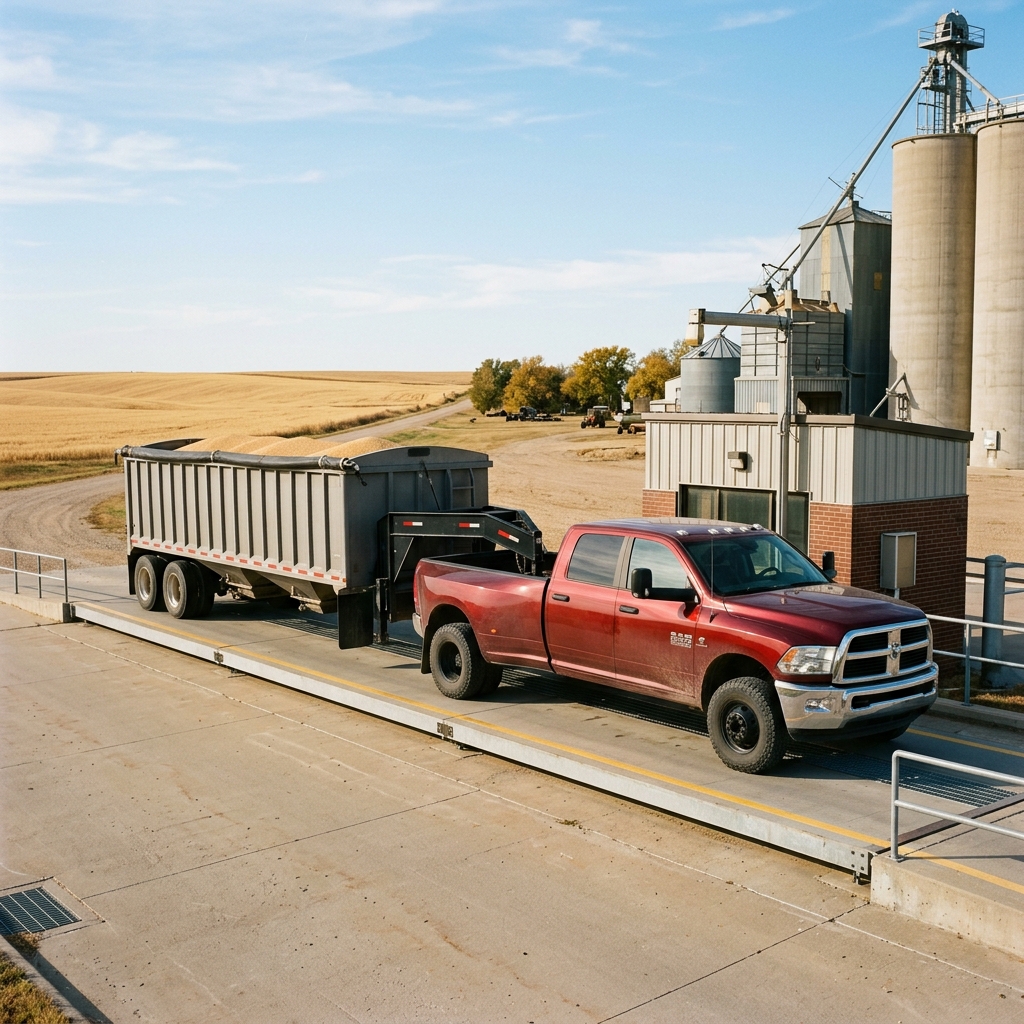
A common mistake during harvest is treating payload and towing capacity as separate, isolated limits. In reality, trailer tongue weight directly consumes payload capacity. When you hook up a loaded grain trailer or gooseneck flatbed, 10% to 25% of that trailer's total weight sits directly on your truck's rear axle. If your truck has 3,200 lbs of available payload and your gooseneck places 2,800 lbs on the hitch, you only have 400 lbs remaining for fuel, driver, and cab gear. Establishing these exact mathematical baselines before field operations begin prevents severe mechanical strain and costly downtime.
A red Ram dually pickup truck pulling a large grain trailer parked on a truck scale at a rural grain elevator. (Representative image for illustration purposes only. Actual vehicle may vary based on trim and configuration.)

20 Years in the Service Bay: Insights from Mike Hogg on Central Kansas Harvest Hauling

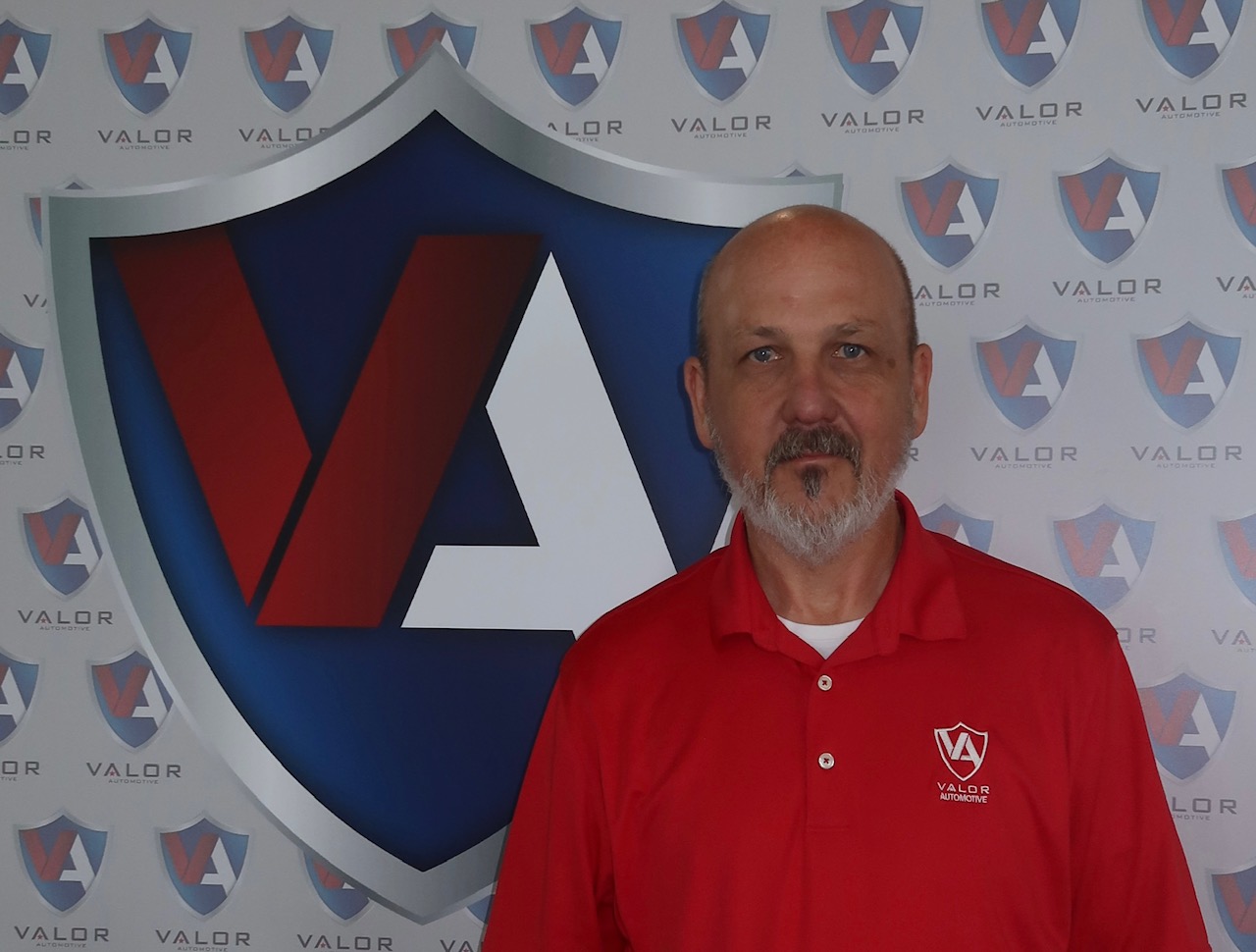
For over two decades, Service Director Mike Hogg has overseen mechanical maintenance and heavy fleet repairs at Valor Ford in Junction City. Having diagnosed hundreds of farm truck suspensions, transmissions, and axle assemblies throughout Geary and Dickinson counties, Mike brings a hands-on perspective to harvest prep.
"When September arrives, harvest hours become relentless," notes Mike Hogg. "We see trucks coming into the shop with sheared wheel studs, overheated transmission clutches, and bent rear axle housings. In almost every instance, the root cause was not a component flaw, but working beyond true weight thresholds without realizing how heavy wet corn or extra farm tools actually are."
Mike's practical approach helps agricultural operators protect their investments before peak harvest stress occurs. If you encounter mechanical concerns during season prep, you can Call us at (785) 238-5114 to consult directly with our heavy-duty technicians.

What Is the Difference Between Gross Vehicle Weight Rating (GVWR) and Gross Combined Weight Rating (GCWR)?

Understanding the doorjamb certification safety label is vital. Gross Vehicle Weight Rating (GVWR) is the maximum structural weight rating assigned to the truck alone. This figure includes the chassis, body, engine, fluids, driver, cargo in the bed, and tongue weight imposed by a trailer. Exceeding GVWR places excessive stress on wheel bearings, leaf springs, and brake rotors.
Gross Combined Weight Rating (GCWR) represents the total weight limit of the combined rig: truck, trailer, cargo, passengers, fuel, and gear. GCWR is determined by engine cooling capacity, transmission gearing, rear axle ratio, and frame structural rigidity. Exceeding GCWR risks transmission fluid breakdown, engine overheating on hills, and dangerously extended stopping distances.

Rating Term

Definition

Primary Risk Area

GVWR

Max weight of truck + cab load + bed load + tongue weight

Tires, axles, leaf springs, truck brakes

GCWR

Max combined weight of truck + fully loaded trailer

Transmission, cooling system, total braking distance

GAWR (Rear)

Max weight permitted on the rear axle assembly

Rear differential, axle shafts, dual wheels

Payload

GVWR minus true empty curb weight

Frame stress, handling stability

Mike Hogg's Harvest Golden Rule: Why Scales Don't Lie and Margin of Safety Matters

"The rated curb weight printed on your vehicle build sheet reflects a factory-fresh baseline with zero accessories. Once you add a heavy transfer tank, auxiliary toolboxes, front replacement bumpers, and mud on the undercarriage, your actual starting curb weight increases significantly. That's why I strongly advise every producer in Dickinson County to scale their truck light before harvest begins, and target a 10% safety margin below total GCWR and GVWR ratings."
Maintaining a 10% weight margin accounts for variable field conditions such as high grain moisture content, heavy clay soil sticking to trailer tires, and steep elevation changes throughout the Flint Hills region. If you are shopping for upgraded towing capacity, you can explore options like an updated Research Ford F-250 configuration engineered for heavy agricultural demands.

How to Calculate Safe Payload and Trailer Weight for Your Farm Truck Before Fall Harvest in Kansas

Step 1: Scale Your Rig

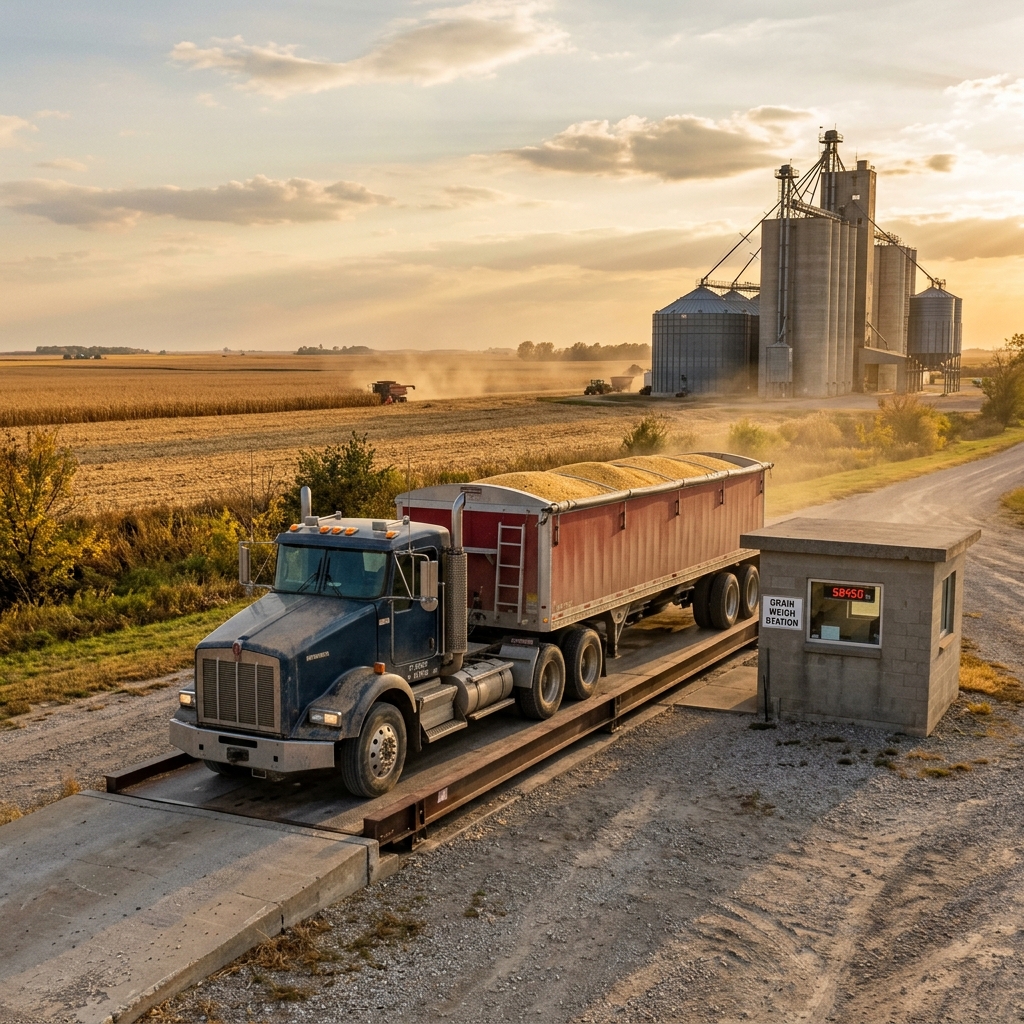
Drive your farm truck with a full fuel tank to a certified scale. Subtract this real-world unladen scale weight from the door tag GVWR. The remaining amount is your true available payload.

Step 2: Calculate Tongue Weight

Calculate trailer weight distribution. Bumper pull trailers require 10% to 15% of loaded weight on the tongue; gooseneck trailers require 15% to 25% over the rear axle center.

Step 3: Verify GCWR Limits

Add your actual truck weight to the total weight of the loaded trailer. Ensure this figure remains below your truck's published GCWR rating with a margin for field variables.
A blue semi-truck loaded with harvested grain sits on a scale at a rural weigh station near grain silos. (Representative image for illustration purposes only. Actual vehicle may vary based on trim and configuration.)

How Does a Weight Distribution Hitch Prevent Front Axle Lift on Heavy Bumper Pulls?

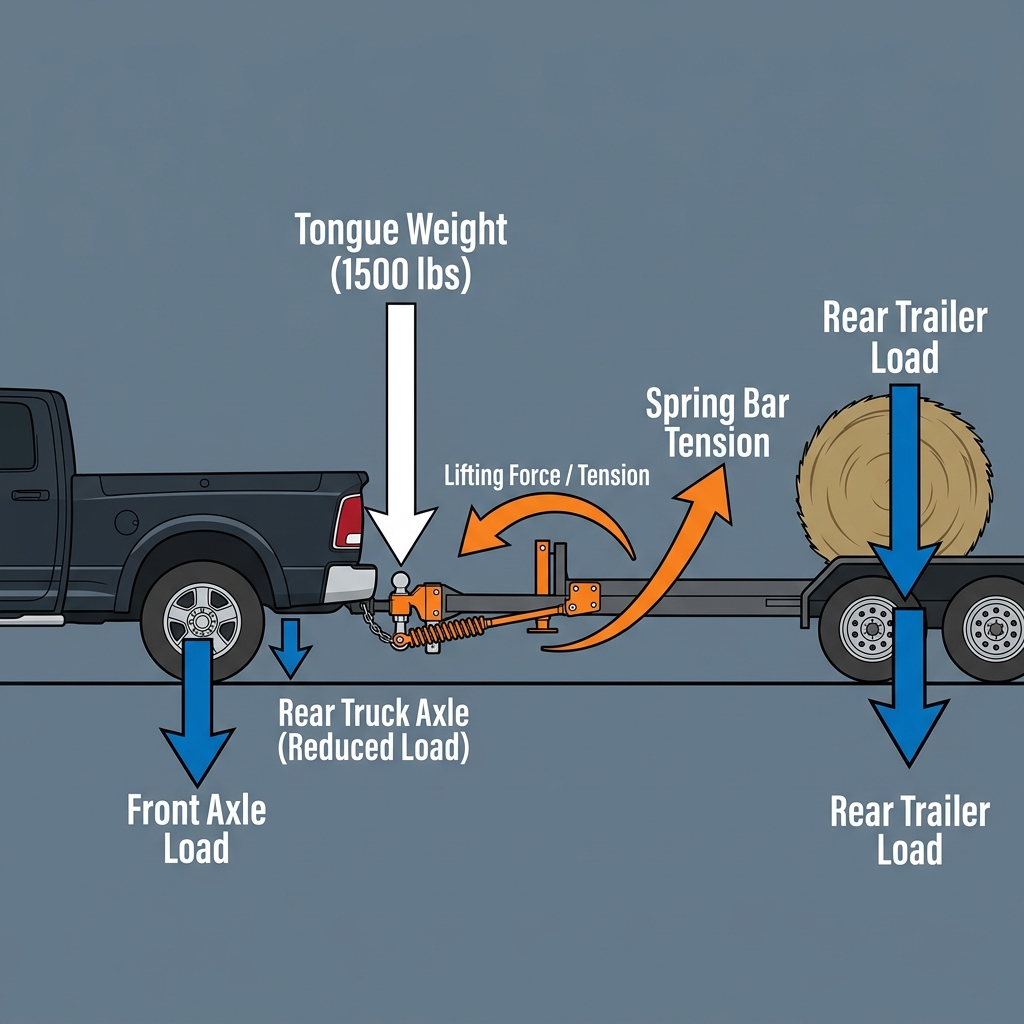
When bumper-pull trailers carry high tongue loads, the rear receiver acts as a fulcrum point behind the rear axle. This downward force leverages weight off your truck's front steering axle. The resulting front-end lift lightens steering response, reduces braking traction, and misaligns headlight beams on dark rural roads.
A properly rated weight distribution hitch utilizes spring bars to leverage tongue weight forward to the truck's front steering axle and backward to the trailer's axles. This leverage levels the chassis, restores steering control, and preserves emergency stopping capability when traveling state highways around Junction City.
Diagram showing weight distribution hitch mechanics, force vectors, and load transfer between a truck and trailer. (Representative image for illustration purposes only. Actual vehicle may vary based on trim and configuration.)

Is Load Range E Enough for My 3/4-Ton or Dually Farm Truck, or Should I Consider F-Rated Tires for Harvest Towing?

Standard 10-ply Load Range E tires (inflated to 80 PSI) handle typical 3/4-ton and 1-ton farm duties. However, continuous highway transport under heavy grain loads generates substantial sidewall flex and internal thermal friction.
Upgrading to 12-ply Load Range F tires (rated for 95 PSI) provides stiffer sidewall construction, reducing sway during heavy gooseneck maneuvers and offering higher puncture resistance against crop stubble in fields. You can consult our team or Order Genuine Ford Parts for heavy-duty commercial tire replacements.
Selecting tires with structural headroom above your peak rear axle load prevents high-temperature blowouts during highway grain shuttle runs. Always confirm wheel rim pressure limits before increasing tire inflation pressures past 80 PSI.

How Do You Properly Check Trailer Safety Chains and Breakaway Systems Before Driving?

Chain Rating & Cradle

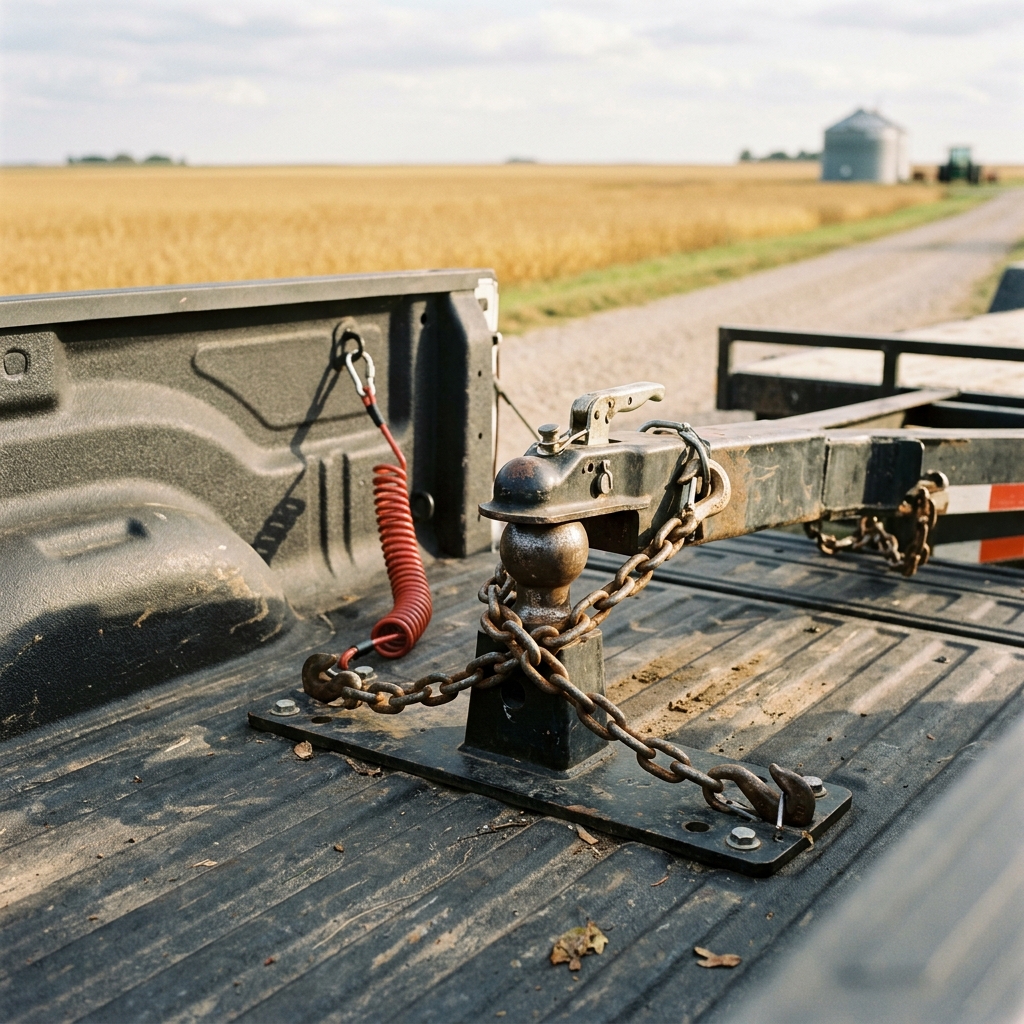
Ensure safety chains carry a Grade 70 transport stamp matching or exceeding gross trailer weight. Cross the chains beneath the trailer tongue to create a supportive cradle in case of coupler separation.

Breakaway Battery Voltage

Test your trailer's emergency breakaway battery with a voltmeter. It must maintain minimum 12-volt charge to actuate electric trailer brakes if decoupling occurs on public roads.

Cable Length & Attachments

Attach the breakaway lanyard directly to the truck frame, not to safety chains or hitch loops. Ensure sufficient slack for sharp turns without triggering accidental pin pulls.
Gooseneck trailer hitch with safety chains mounted in a pickup truck bed on a rural farm road. (Representative image for illustration purposes only. Actual vehicle may vary based on trim and configuration.)

What Should I Ask a Local Hitch Installer to Ensure My Setup Is Safe for Heavy Harvest Loads?

1. Is the Receiver Class Rating Sufficient?
Verify whether your bumper hitch receiver is Class IV (up to 10,000-12,000 lbs) or Class V Commercial Duty (up to 18,000-20,000 lbs). Heavy harvest equipment typically demands Class V hardware attached directly to chassis frame rails.
2. Is the Gooseneck Under-Bed Structure Frame-Mounted?
Ensure under-bed gooseneck hitches mount directly to the vehicle frame brackets rather than relying on bed sheet metal, which can warp under high dynamic loads.
3. How Is the Integrated Brake Controller Calibrated?
Inquire about proper gain setting procedures on integrated electric trailer brake controllers. The gain output must balance stopping power without locking trailer tires on gravel access roads.
4. Is Wiring Voltage Tested Under Load?
Ask for a continuity and voltage drop test across the 7-pin blade connector to ensure full amperage reaches auxiliary charging circuits and electric-over-hydraulic brake actuators.

Fall Crop Harvest Prep: Heavy Payload and Towing Maintenance for Central Kansas Trucks

Transmission & Fluid Service

Heavy towing generates elevated transmission temperatures. Replacing transmission fluid and filters prevents thermal degradation and varnish buildup within solenoid valves during long grain shuttle runs.

Differential & Axle Care

Inspect heavy-duty rear differential gear oil levels and check for metal sheen. High payload stress on ring-and-pinion gears demands clean, severe-duty synthetic gear lubricants.

Brake & Suspension Checks

Inspect brake pad friction material thickness, rotor surfaces for heat stress cracks, and leaf spring shackles for cracked bushings or sag before high-tonnage hauling begins.
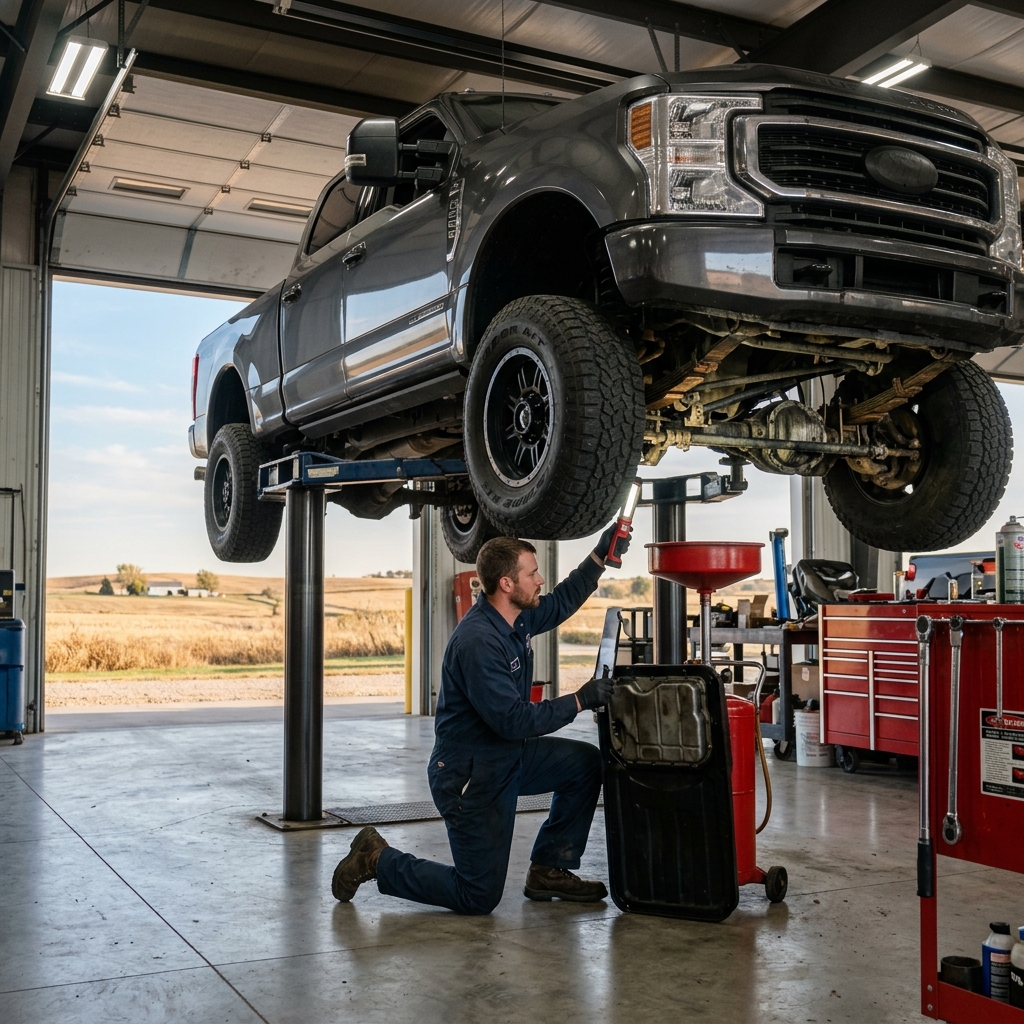
Mechanic inspecting the undercarriage of a lifted Ford pickup truck in a repair shop. (Representative image for illustration purposes only. Actual vehicle may vary based on trim and configuration.)

Navigating Flint Hills Slopes and Unpaved Agricultural Routes with Maximum Payload

Operating loaded harvest rigs in the rolling topography around Junction City and rural Dickinson County requires adaptive driving techniques. Descending steep grades near combined weight limits generates rapid brake rotor heating. Utilizing diesel engine exhaust brakes or lockup Tow/Haul mode maintains control while reducing mechanical brake wear.
Unpaved farm-to-market roads present reduced traction challenges, especially during wet fall weather. Maintain smooth acceleration inputs to avoid wheel spin on gravel grades, and ensure transfer case fluid is fresh if operating 4WD under continuous heavy load conditions.

Matching the Right Heavy-Duty Truck to Your Farm's Seasonal Hauling Demands

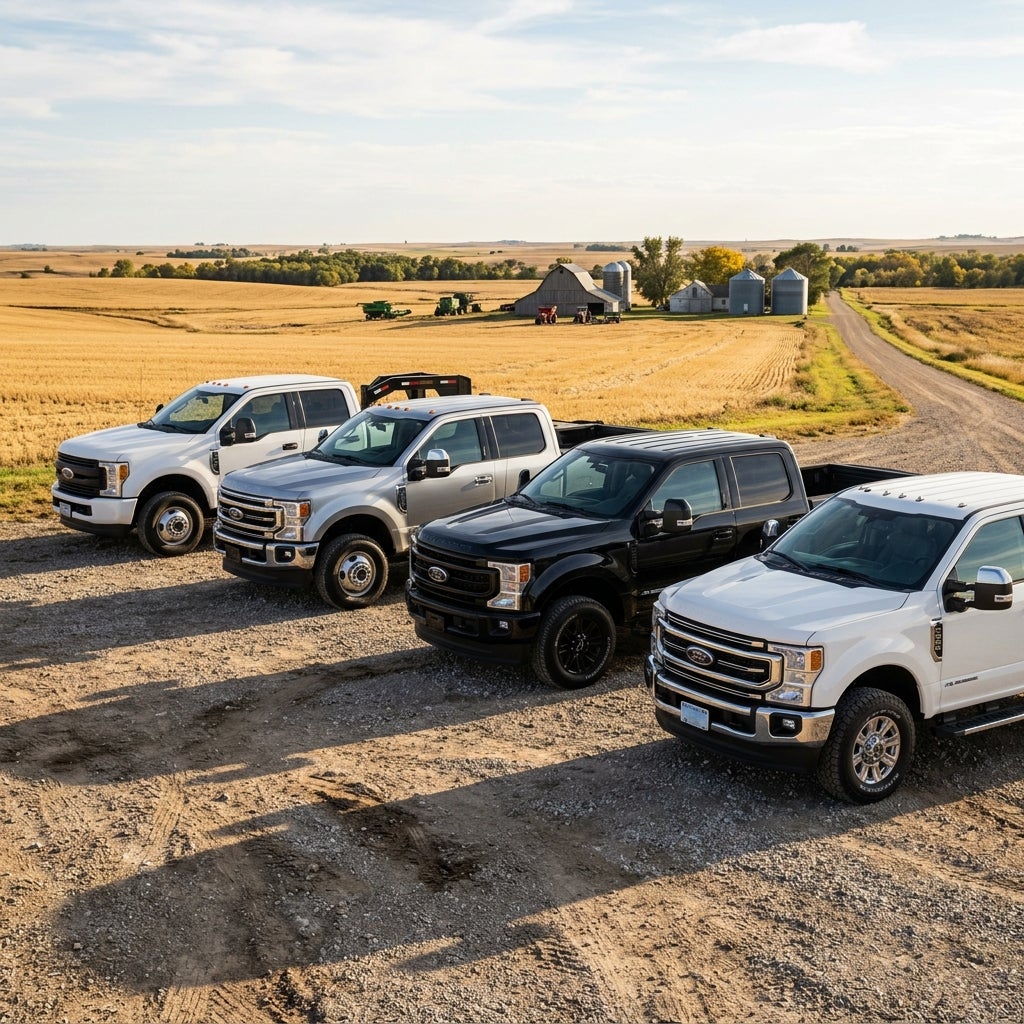
Choosing between Single Rear Wheel (SRW) and Dual Rear Wheel (DRW) configurations comes down to your primary trailer requirements. SRW setups offer excellent maneuverability around farms and mid-size goosenecks. However, heavy tandem-axle grain trailers exceeding 15,000 lbs benefit immensely from the lateral stability and high payload capacity of a DRW setup.
Selecting proper axle ratios also plays a critical role. A 3.73 axle ratio balances fuel efficiency with moderate towing, while a 4.10 or 4.30 rear end delivers maximum low-end torque for pulling heavy payloads out of soft crop fields. You can evaluate your vehicle's trade value with a Trade In Evaluation at Valor Ford.
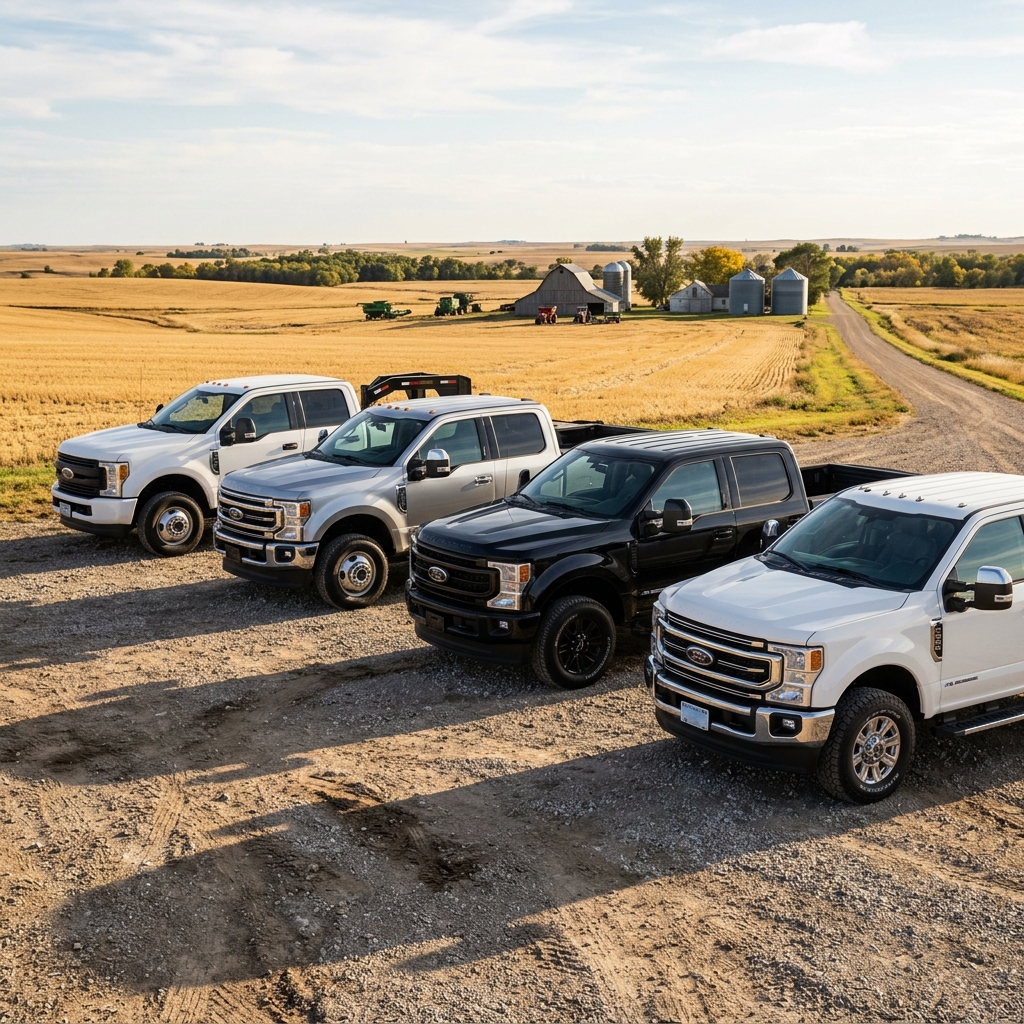
Four Ford Super Duty pickup trucks parked side by side on a gravel road next to open farm fields. (Representative image for illustration purposes only. Actual vehicle may vary based on trim and configuration.)

Get Your Harvest Truck Rigged and Weight-Certified at Valor Ford in Junction City

Keep your fall harvest productivity on track. Visit Valor Ford in Junction City, KS to consult with Service Director Mike Hogg and our heavy-duty truck specialists. Whether you need a pre-harvest safety inspection, hitch installation, or an upgraded fleet truck, our team is dedicated to keeping your agricultural operations moving smoothly.
Explore our options today: Contact us for financing information online, check out our pre-owned selection to Browse Used Inventory, or Get Directions to Valor Ford. For light duty farm options, you can also Research Ford F-150 capabilities.

Posted in:

Related Posts

2026 Ford F-150 STX vs 2026 Toyota Tundra Comparison

2026 Ford F-150 STX vs 2026 Toyota Tundra Comparison

.hrizn-visual-root a { color: #566BA1; } .hrizn-visual-root [data-hrizn-block="ButtonBlock"] a { color: inherit; } .hrizn-visual-root [data-hrizn-block="TextBlock"] p { margin: 0 0 1em; } .hrizn-visual-root [data-hrizn-block="TextBlock"] p:last-child { margin-bottom: 0; } @media (max-width: 640px) { .hrizn-visual-root [data-hrizn-block="ButtonBlock"] { text-align: center !important; } .hrizn-visual-root [data-hrizn-block="ButtonBlock"] a { display: block; width: 100%; max-width: 320px; margin-left: auto; margin-right: auto; box-sizing: border-box; } .hrizn-visual-root [data-hrizn-block="ButtonBlock"] + [data-hrizn-block="ButtonBlock"] a { margin-top: 8px; } } @media (max-width: 640px) { #hrizn-23-13-1 { flex-direction: column !important; align-items: stretch !important; } #hrizn-23-13-1 > .hrizn-col { flex: 1 1 100% !important; width: 100% !important; } } @media (max-width: 640px) { #hrizn-cols-1 { flex-direction: column !important; align-items: stretch !important; } #hrizn-cols-1 > .hrizn-col { flex: 1 1 100% !important; width: 100% !important; } } #hrizn-table-puck-table-injected-1 table{width:100%;table-layout:auto;border-collapse:collapse;font-family:'Open Sans',sans-serif;font-size:0.9rem} #hrizn-table-puck-table-injected-1 th,#hrizn-table-puck-table-injected-1 td{border:1px solid #e0e4ed;padding:8px;color:#595959;word-break:break-word;overflow-wrap:break-word} #hrizn-table-puck-table-injected-1 th{background:#fafafa;color:#1a1a22;font-weight:700;font-size:14px;text-align:left;vertical-align:middle;padding:8px} #hrizn-table-puck-table-injected-1 tr:nth-child(even) td{background:rgba(86,107,161,0.04)} #hrizn-table-puck-table-injected-1 .tableWrapper{overflow-x:hidden} #hrizn-table-puck-table-injected-2 table{width:100%;table-layout:auto;border-collapse:collapse;font-family:'Open Sans',sans-serif;font-size:0.9rem} #hrizn-table-puck-table-injected-2 th,#hrizn-table-puck-table-injected-2 td{border:1px solid #e0e4ed;padding:8px;color:#595959;word-break:break-word;overflow-wrap:break-word} #hrizn-table-puck-table-injected-2 th{background:#fafafa;color:#1a1a22;font-weight:700;font-size:14px;text-align:left;vertical-align:middle;padding:8px} #hrizn-table-puck-table-injected-2 tr:nth-child(even) td{background:rgba(86,107,161,0.04)} #hrizn-table-puck-table-injected-2 .tableWrapper{overflow-x:hidden} #hrizn-table-puck-table-injected-3 table{width:100%;table-layout:auto;border-collapse:collapse;font-family:'Open Sans',sans-serif;font-size:0.9rem} #hrizn-table-puck-table-injected-3 th,#hrizn-table-puck-table-injected-3 td{border:1px solid #e0e4ed;padding:8px;color:#595959;word-break:break-word;overflow-wrap:break-word} #hrizn-table-puck-table-injected-3 th{background:#fafafa;color:#1a1a22;font-weight:700;font-size:14px;text-align:left;vertical-align:middle;padding:8px} #hrizn-table-puck-table-injected-3 tr:nth-child(even) td{background:rgba(86,107,161,0.04)} #hrizn-table-puck-table-injected-3 .tableWrapper{overflow-x:hidden} @media (max-width: 640px) { #hrizn-13-23-1 { flex-direction: column !important; align-items: stretch !important; } #hrizn-13-23-1 > .hrizn-col { flex: 1 1 100% !important; width: 100% !important; } } #hrizn-table-puck-table-injected-4 table{width:100%;table-layout:auto;border-collapse:collapse;font-family:'Open Sans',sans-serif;font-size:0.9rem} #hrizn-table-puck-table-injected-4 th,#hrizn-table-puck-table-injected-4 td{border:1px solid #e0e4ed;padding:8px;color:#595959;word-break:break-word;overflow-wrap:break-word} #hrizn-table-puck-table-injected-4 th{background:#fafafa;color:#1a1a22;font-weight:700;font-size:14px;text-align:left;vertical-align:middle;padding:8px} #hrizn-table-puck-table-injected-4 tr:nth-child(even) td{background:rgba(86,107,161,0.04)} #hrizn-table-puck-table-injected-4 .tableWrapper{overflow-x:hidden} @media (max-width: 640px) { #hrizn-23-13-2 { flex-direction: column !important; align-items: stretch !important; } #hrizn-23-13-2 > .hrizn-col { flex: 1 1 100% !important; width: 100% !important; } } #hrizn-table-puck-tbl-warranty table{width:100%;table-layout:auto;border-collapse:collapse;font-family:'Open Sans',sans-serif;font-size:0.9rem} #hrizn-table-puck-tbl-warranty th,#hrizn-table-puck-tbl-warranty td{border:1px solid #e0e4ed;padding:8px;color:#595959;word-break:break-word;overflow-wrap:break-word} #hrizn-table-puck-tbl-warranty th{background:#fafafa;color:#1a1a22;font-weight:700;font-size:14px;text-align:left;vertical-align:middle;padding:8px} #hrizn-table-puck-tbl-warranty tr:nth-child(even) td{background:rgba(86,107,161,0.04)} #hrizn-table-puck-tbl-warranty .tableWrapper{overflow-x:hidden} 2026 Ford F-150 STX vs 2026 Toyota Tundra Comparison The 2026 Ford F-150 STX compares favorably in this full-size truck comparison by delivering incredible capability and everyday usability at a starting MSRP of $44,855, undercutting the 2026 Toyota Tundra 1794 Edition's $64,380 entry price by nearly twenty thousand dollars. With up to 25 MPG highway fuel economy, a about 62 cu ft cargo box capacity, and a responsive 2.7L EcoBoost® V6 engine producing 325 hp and 400 lb-ft of torque, the F-150 STX provides the ideal balance of performance, practical payload, and value for working drivers and active families. Research Ford F-150 Which Truck Is Best for Drivers: 2026 Ford F-150 STX or 2026 Toyota Tundra? The 2026 Ford F-150 STX is the overall better choice for daily drivers seeking an agile, capable, and value-oriented full-size pickup, boasting a lighter curb weight of 4,895 lbs in 4x4 trim and superior fuel economy compared to the 2026 Toyota Tundra's bulkier 5,730 lbs curb weight. Behind the wheel, truck buyers immediately notice how chassis weight affects everyday maneuvers. The F-150 STX 4x4 SuperCab weighs nearly 835 pounds less than a comparable Tundra, resulting in sharper steering response, composed braking performance, and smoother acceleration off the line. Ford pairs its lightweight high-strength aluminum-alloy body with an independent double-wishbone front suspension and a solid rear axle with leaf springs, ensuring a composed ride whether the cargo bed is empty or filled to its 1,600 lbs payload limit. Under the hood, the standard 2.7L EcoBoost® V6 engine features twin turbochargers that generate 325 hp at 5000 rpm and 400 lb-ft of torque at 3500 rpm. Power routes through Ford’s smooth-shifting SelectShift® 10-speed automatic transmission, which continuously optimizes gear selection for hill climbing or highway cruising. By contrast, the Toyota Tundra relies on a larger 3.4L twin-turbo V6 sending 389 hp and 479 lb-ft of torque through a 10-speed automatic. While the Tundra holds an advantage in sheer horsepower and maximum towing capacity at 11,050 lbs versus the F-150 STX's 7,400 lbs to 7,600 lbs ratings, the F-150 STX feels remarkably lively in city traffic and offers more than enough pulling power for utility trailers, light equipment, and recreational craft. For service members managing daily duty routines at Fort Riley, the F-150 STX provides an effortless driving experience that balances rugged utility with passenger comfort. Those interested in comparing Ford's lighter truck platform with other off-road options can check out our brand-new Ford Bronco inventory, or explore complete full-size pickup engineering details through our detailed 2026 Ford F-150 research page. Engine & Performance Powertrain specs by trim Specification 2026 Ford F-150 STX 2026 Toyota Tundra Engine 2.7L 3.4L Horsepower 325 hp 389 hp Torque 400 lb-ft 479 lb-ft Transmission SelectShift® ECT-i Drivetrain All-wheel drive All-wheel drive Dimensions & Capacity Capacity and dimensions by trim Specification 2026 Ford F-150 STX 2026 Toyota Tundra Seating 5 5 Cargo 62.3 cu ft — Curb weight 4,895 lbs 5,730 lbs Towing 7,400 lbs 11,050 lbs Payload 1,600 lbs 1,665 lbs Comparing Price and Trim Value for the 2026 Ford F-150 STX and Toyota Tundra The 2026 Ford F-150 STX represents an unmatched value proposition in the full-size truck segment, offering a feature-packed entry price of $44,855 MSRP for its base configuration compared to the 2026 Toyota Tundra 1794 Edition which commands a starting MSRP of $64,380. Ford structures the STX lineup to provide maximum choice in cab styles, bed lengths, and drive configurations without forcing buyers into expensive luxury packages. Every F-150 STX trim delivers working-grade durability combined with high-tech equipment like a standard 12 in central touchscreen and 20-inch gloss black aluminum wheels on Mid equipment groups. The complete trim breakdown for the 2026 Ford F-150 STX illustrates its exceptional affordability: STX SuperCab 6-1/2’ Box (Rear-wheel drive): $44,855 MSRP ( $47,650 including $2,795 destination charge) STX SuperCrew 5-1/2’ Box (Rear-wheel drive): $47,190 MSRP ( $49,985 including $2,795 destination charge) STX 4x4 SuperCab 6-1/2’ Box (All-wheel drive): $48,655 MSRP ( $51,450 including $2,795 destination charge) STX 4x4 SuperCrew 5-1/2’ Box (All-wheel drive): $51,070 MSRP ( $53,865 including $2,795 destination charge) In comparison, the 2026 Toyota Tundra trims in our dataset represent high-end luxury configurations: 1794 Edition CrewMax 5.5' Bed: $64,380 MSRP 1794 Edition 4WD CrewMax 5.5' Bed: $67,380 MSRP 1794 Edition 4WD CrewMax 6.5' Bed: $67,710 MSRP Choosing the F-150 STX allows truck buyers to save over $15,000 upfront while securing a brand-new vehicle equipped with aggressive sport styling, LED lighting, and advanced driver-assist features. Upgrading an F-150 STX with optional factory packages—such as the Tow Package (code 53T) with an Integrated Trailer Brake Controller, or the Mobile Office Package with a Main power supply inverter—adds specific utility for a fraction of the price of competitor luxury trims. Shoppers looking to transition from their current vehicle can utilize our online trade-in valuation tool to estimate their current vehicle's worth, or review budget-friendly pre-owned options in our quality pre-owned inventory. Pricing Manufacturer-listed pricing per trim, across compared vehicles. 2026 Ford F-150 STX Trim MSRP 2026 Toyota Tundra Trim MSRP STX SuperCab 6-1/2’ Box $44,855 1794 Edition CrewMax 5.5' Bed $64,380 STX SuperCrew 5-1/2’ Box $47,190 1794 Edition 4WD CrewMax 5.5' Bed $67,380 STX 4x4 SuperCab 6-1/2’ Box $48,655 1794 Edition 4WD CrewMax 6.5' Bed $67,710 STX 4x4 SuperCrew 5-1/2’ Box $51,070 — — Trade In Evaluation Cargo Capacity and Passenger Comfort for Military Families and Outdoor Enthusiasts in Junction City The 2026 Ford F-150 STX offers a superior combination of usable cargo volume and cabin space, featuring up to about 62 cu ft of cargo bed capacity in SuperCab models and a massive 43.6 in of rear legroom in SuperCrew configurations. Interior spatial layout is a crucial factor for active households and crews. The F-150 STX SuperCrew cab comfortably seats 5 passengers with front bucket seats ( Black Sport Cloth 40/Console/40 Front Seat) and a full floor console. Up front, passengers enjoy 40.8 in of headroom, 43.9 in of legroom, 62.5 in of hip room, and 66.7 in of shoulder room. In the rear row of the SuperCrew, passengers receive an expansive 40.4 in of headroom and 43.6 in of legroom, making long road trips relaxing for adults and growing children alike. When it comes to hauling gear, tools, or recreational equipment, the Ford F-150 STX box design maximizes structural efficiency: SuperCab 6-1/2’ Box: Cargo volume of about 62 cu ft, box length of 78.9 in, cargo height of 21.4 in, and width between wheelhouses of 50.6 in. Max payload is 1,600 lbs (4x4) or 1,670 lbs (RWD). SuperCrew 5-1/2’ Box: Cargo volume of about 53 cu ft, box length of 67.1 in, cargo height of 21.4 in, and width between wheelhouses of 50.6 in. Max payload is 1,650 lbs (4x4) or 1,685 lbs (RWD). The Toyota Tundra CrewMax offers strong passenger room but yields a lower maximum payload allowance of 1,665 lbs. Furthermore, the F-150 STX features practical bed utility additions, including standard load restraint hooks and available dealer accessories like the Pivot Storage Box by UnderCover, Bed Hooks - Retractable by Bull Accessories, and hard or soft rolling tonneau covers. For residents taking weekend family outings along the riverbanks in Junction City, the F-150 SuperCrew provides the perfect blend of weatherproof bed storage and passenger legroom. Buyers planning their vehicle purchase can start by completing our online credit pre-approval application. Performance and Fuel Efficiency: 2026 Ford F-150 STX vs Toyota Tundra The 2026 Ford F-150 STX delivers better EPA-estimated fuel economy across both rear-wheel drive and four-wheel drive configurations, attaining up to 19 city / 25 hwy / 21 combined MPG compared to the Toyota Tundra's 17 city / 22 hwy / 19 combined MPG. Efficiency numbers directly impact long-term operating costs. Thanks to its 2.7L EcoBoost® V6 engine and active Auto Start-Stop technology, the F-150 STX RWD model achieves 19 MPG in city driving and 25 MPG on the highway. Choosing the 4x4 drive system only slightly adjusts these metrics to 18 city / 23 hwy / 20 combined MPG. Equipped with a standard 36 gal main fuel tank, the 2026 F-150 STX boasts an EPA calculated highway cruising range of 720 mi in 4x4 trim and 756 mi in RWD trim, minimizing fuel stops during long-distance travels. The Toyota Tundra’s 3.4L twin-turbo engine generates more top-end output ( 389 hp and 479 lb-ft of torque), but its extra curb weight and larger engine displacement result in lower fuel economy ratings of 17 MPG city and 22 MPG highway. Over years of ownership, the F-150 STX saves drivers significant money at the pump while maintaining impressive dynamic performance. For drivers desiring alternative powertrain dynamics, the F-150 STX trim range offers optional engine upgrades, including: 5.0L V8 with Auto Start-Stop Technology (code 995): 400 hp at 6000 rpm and 410 lb-ft of torque at 4250 rpm. 3.5L PowerBoost Hybrid V6 Engine (code 99D): Total system output of 430 hp at 6000 rpm and 570 lb-ft of torque at 3000 rpm, combining twin turbocharging with a 44.88 hp electric motor powered by a 1.5 kWh lithium-ion battery. Drivers researching crossover efficiency alongside full-size trucks can view our 2026 Ford Explorer research overview, while current owners wanting to upgrade their truck's performance can use our genuine OEM Ford parts ordering form. Fuel Economy Fuel economy and range by trim Specification 2026 Ford F-150 STX 2026 Toyota Tundra MPG 18 city / 23 hwy / 20 combined 17 city / 22 hwy / 19 combined Contact Us for Financing Information Tech Features That Keep Drivers Connected and Safe in the 2026 Ford F-150 STX and Toyota Tundra The 2026 Ford F-150 STX sets a high benchmark for standard cabin technology and driver safety, incorporating a 12 in center touchscreen display and Ford's Pre-Collision Assist with Pedestrian Detection system as standard equipment. Inside the cockpit, every F-150 STX model benefits from the SYNC® 4 infotainment interface displayed on a 12 in dashboard touchscreen. Wireless Apple CarPlay and Android Auto allow seamless smartphone integration without cluttering cables, while embedded 4G Wi-Fi hotspot capability (with a 999 GB monthly allowance option) keeps mobile devices connected on the move. The driver instrument cluster includes a 4 in productivity screen in standard trim or a full 12 in digital TFT screen when equipped with Equipment Group 200A (STX Mid) or Equipment Group 201A (STX FX4). When evaluating driver assistance, Ford prioritizes comprehensive active safety technologies across all trim levels through the Ford Co-Pilot360® suite: Pre-Collision Assist with Pedestrian Detection: Includes automatic emergency braking, forward collision warning, and junction turning support active at speeds above 5 mph. BLIS® (Blind Spot Information System): Features radar sensors to monitor blind spots, including coverage extending along towed trailers. Lane-Keeping System: Monitors road lane markings to provide steering wheel alerts and corrective steering torque. Reverse Sensing System: Combines rear parking radar sensors with a high-resolution backup camera with guidance lines. Crash safety testing reinforces the F-150's structural integrity. The 2026 Ford F-150 earns an Overall 5-Star rating from the National Highway Traffic Safety Administration (NHTSA), achieving 5 stars in frontal crash, 5 stars in side impact, and 4 stars in rollover resistance tests. It also earns Insurance Institute for Highway Safety (IIHS) Top Safety Pick status ( T), receiving Good ( G) ratings in small overlap front, side impact, and headlight effectiveness tests. The Toyota Tundra also includes active safety systems through Toyota Safety Sense, but the F-150 STX provides a more user-friendly interface with physical backup knobs for primary climate and volume controls alongside its 12 in touchscreen. Truck shoppers comparing heavy-duty towing tech can read our 2026 Ford F-250 capability guide. Warranty, Maintenance, and Service Options for 2026 Ford F-150 STX and Toyota Tundra Owners Ford protects every 2026 F-150 STX with a comprehensive factory warranty package, highlighting a 60 mth / 60,000 mi powertrain warranty and 60 mth / 60,000 mi of 24/7 roadside assistance coverage. A side-by-side comparison of manufacturer warranty terms demonstrates strong factory backing for both vehicles: Warranty Coverage Category 2026 Ford F-150 STX Coverage 2026 Toyota Tundra Coverage Bumper-to-Bumper (Whole Vehicle) 36 mth / 36,000 mi 36 mth / 36,000 mi Powertrain Warranty 60 mth / 60,000 mi 60 mth / 60,000 mi Roadside Assistance Coverage 60 mth / 60,000 mi 24 mth / unlimited mi Anti-Corrosion / Perforation 60 mth / unlimited mi 60 mth / unlimited mi Paint Warranty 36 mth / 36,000 mi 36 mth / 36,000 mi Hybrid Component Warranty (PowerBoost) 96 mth / 100,000 mi 96 mth / 100,000 mi Ford’s Roadside Assistance program provides a distinct advantage by extending coverage for 5 full years or 60,000 miles—more than double the 24-month duration offered by Toyota. Included services cover emergency towing, flat tire changes, fuel delivery, jump starts, and lockout assistance. For immediate emergency roadside coordination, drivers can reach out directly via Ford Roadside Assistance: (800) 241-3673. Maintaining your pickup with factory-trained technicians ensures long-term reliability and preserves resale value. Vehicles serviced at certified Ford centers receive genuine OEM parts, specialized diagnostic scans, and factory software updates. Owners can easily book routine maintenance appointments through our online service scheduling portal. Schedule Ford Service Today Frequently Asked Questions: Choosing Between the 2026 Ford F-150 STX and Toyota Tundra Q: Is the 2026 Ford F-150 STX significantly less expensive than the Toyota Tundra? Yes, the 2026 Ford F-150 STX is substantially more affordable. The F-150 STX SuperCab RWD starts at an MSRP of $44,855, and the 4x4 SuperCrew model starts at $51,070. In comparison, the entry 2026 Toyota Tundra trim in our dataset—the 1794 Edition—starts at $64,380 MSRP. The F-150 STX offers essential full-size truck capability and modern tech at a lower purchase price. Q: Which truck achieves better fuel economy for daily driving? The 2026 Ford F-150 STX equipped with the standard 2.7L EcoBoost® V6 engine achieves better fuel economy ratings. Rear-wheel drive models earn EPA estimates of 19 city / 25 hwy / 21 combined MPG, while 4x4 models achieve 18 city / 23 hwy / 20 combined MPG. The 2026 Toyota Tundra AWD receives lower EPA ratings of 17 city / 22 hwy / 19 combined MPG. Q: How does cargo bed capacity compare between the F-150 STX and Toyota Tundra? The Ford F-150 STX SuperCab 6-1/2’ Box provides a generous cargo volume of about 62 cu ft and a maximum payload allowance of 1,670 lbs in RWD or 1,600 lbs in 4x4 configuration. The F-150 STX SuperCrew 5-1/2’ Box provides about 53 cu ft of cargo volume and up to 1,685 lbs payload capacity, surpassing the Toyota Tundra's 1,665 lbs maximum payload rating. Q: What safety ratings and collision avoidance features does the F-150 STX include? The 2026 Ford F-150 carries an Overall 5-Star safety rating from the NHTSA and IIHS Top Safety Pick status ( T). Standard driver assistance technology on the STX includes Pre-Collision Assist with Pedestrian Detection, BLIS® (Blind Spot Information System) with cross-traffic alert, Lane-Keeping System, and the Reverse Sensing System. Q: Where can I test drive the 2026 Ford F-150 STX? You can test drive the 2026 Ford F-150 STX at Valor Ford. Our showroom is located at 1825 Goldenbelt Blvd. To check current vehicle availability or schedule an appointment with our sales team, give us a quick call at (785) 238-5114. Final Verdict: Why the 2026 Ford F-150 STX Outshines the Toyota Tundra The 2026 Ford F-150 STX emerges as the clear winner in this full-size pickup comparison. By pairing an accessible starting MSRP of $44,855 with a responsive 325 hp twin-turbo 2.7L EcoBoost® V6, up to 25 MPG highway efficiency, and a spacious cabin with a standard 12 in touchscreen display, the F-150 STX gives truck buyers everything they need without requiring them to pay luxury-trim prices. While the 2026 Toyota Tundra offers strong towing figures, its $64,380 entry cost in this comparison and heavier curb weight make it far less practical for budget-conscious owners. When you choose Valor Ford for your next truck, you benefit from a dedicated team of automotive professionals committed to providing transparent pricing, knowledgeable guidance, and top-tier customer service. Our state-of-the-art facility features a vast selection of new Ford trucks, flexible purchasing options, and a factory-certified service center ready to maintain your vehicle for years to come. Experience the power, efficiency, and comfort of this popular full-size truck for yourself. Visit Valor Ford today to inspect the 2026 Ford F-150 STX, explore available packages, and take a test drive. Research Ford F-150 © 2026 Valor Ford. All rights reserved. Vehicle specification data © JATO Dynamics Limited.
Can a 2023 Ford Maverick Replace a Mid-Size or Full-Size Farm Truck on Kansas Farms?

Can a 2023 Ford Maverick Replace a Mid-Size or Full-Size Farm Truck on Kansas Farms?

.hrizn-visual-root a { color: #566BA1; } .hrizn-visual-root [data-hrizn-block="ButtonBlock"] a { color: inherit; } .hrizn-visual-root [data-hrizn-block="TextBlock"] p { margin: 0 0 1em; } .hrizn-visual-root [data-hrizn-block="TextBlock"] p:last-child { margin-bottom: 0; } @media (max-width: 640px) { .hrizn-visual-root [data-hrizn-block="ButtonBlock"] { text-align: center !important; } .hrizn-visual-root [data-hrizn-block="ButtonBlock"] a { display: block; width: 100%; max-width: 320px; margin-left: auto; margin-right: auto; box-sizing: border-box; } .hrizn-visual-root [data-hrizn-block="ButtonBlock"] + [data-hrizn-block="ButtonBlock"] a { margin-top: 8px; } } @media (max-width: 640px) { #hrizn-cols-1 { flex-direction: column !important; align-items: stretch !important; } #hrizn-cols-1 > .hrizn-col { flex: 1 1 100% !important; width: 100% !important; } } @media (max-width: 640px) { #hrizn-cols-2 { flex-direction: column !important; align-items: stretch !important; } #hrizn-cols-2 > .hrizn-col { flex: 1 1 100% !important; width: 100% !important; } } @media (max-width: 640px) { #hrizn-3cols-1 { flex-direction: column !important; align-items: stretch !important; } #hrizn-3cols-1 > .hrizn-col { flex: 1 1 100% !important; width: 100% !important; } } #hrizn-table-tbl-farm-specs table{width:100%;table-layout:auto;border-collapse:collapse;font-family:'Open Sans',sans-serif;font-size:0.9rem} #hrizn-table-tbl-farm-specs th,#hrizn-table-tbl-farm-specs td{border:1px solid #e0e4ed;padding:8px;color:#595959;word-break:break-word;overflow-wrap:break-word} #hrizn-table-tbl-farm-specs th{background:#1a1a22;color:#ffffff;font-weight:700;font-size:14px;text-align:left;vertical-align:middle;padding:10px} #hrizn-table-tbl-farm-specs tr:nth-child(even) td{background:rgba(86,107,161,0.04)} #hrizn-table-tbl-farm-specs .tableWrapper{overflow-x:hidden} @media (max-width: 640px) { #hrizn-cols-3 { flex-direction: column !important; align-items: stretch !important; } #hrizn-cols-3 > .hrizn-col { flex: 1 1 100% !important; width: 100% !important; } } @media (max-width: 640px) { #hrizn-cols-4 { flex-direction: column !important; align-items: stretch !important; } #hrizn-cols-4 > .hrizn-col { flex: 1 1 100% !important; width: 100% !important; } } @media (max-width: 640px) { #hrizn-cols-5 { flex-direction: column !important; align-items: stretch !important; } #hrizn-cols-5 > .hrizn-col { flex: 1 1 100% !important; width: 100% !important; } } @media (max-width: 640px) { #hrizn-3cols-2 { flex-direction: column !important; align-items: stretch !important; } #hrizn-3cols-2 > .hrizn-col { flex: 1 1 100% !important; width: 100% !important; } } @media (max-width: 640px) { #hrizn-cols-6 { flex-direction: column !important; align-items: stretch !important; } #hrizn-cols-6 > .hrizn-col { flex: 1 1 100% !important; width: 100% !important; } } @media (max-width: 640px) { #hrizn-cols-7 { flex-direction: column !important; align-items: stretch !important; } #hrizn-cols-7 > .hrizn-col { flex: 1 1 100% !important; width: 100% !important; } } Can a 2023 Ford Maverick Replace a Mid-Size or Full-Size Farm Truck on Kansas Farms? For generations across Dickinson, Geary, and surrounding Kansas counties, the default farm vehicle has been a heavy-duty three-quarter-ton or full-size half-ton pickup. Whether checking cattle fences, hauling feed sacks, driving into Junction City for supplies, or scouting crop conditions, farmers have traditionally relied on V8 or diesel workhorses. However, with rising fuel costs and expensive vehicle maintenance, many agricultural producers and small agribusiness owners are asking an important question: Can a compact 2023 Ford Maverick actually replace a mid-size or full-size farm truck? The bottom-line answer comes down to defining your daily workload. If your operation requires pulling a 14,000-pound gooseneck cattle trailer, hauling heavy round bales across muddy pastures, or carrying two tons of gravel in the bed, a compact pickup cannot replace a heavy-duty Ford F-250 or full-size Ford F-150. However, for 80% to 90% of daily farm tasks—including soil sampling, fence repair, vet runs, parts pickups, boundary checks, and rural commuting—the 2023 Ford Maverick excels remarkably. With a robust 1,500-pound payload capacity, available Intelligent All-Wheel Drive, and up to 40 MPG city fuel economy on hybrid models, the Maverick is proving to be the ultimate supplementary or primary chore truck for Central Kansas agricultural operations. At Valor Ford, we work closely with local farmers, ranchers, and rural business owners to build efficient fleet strategies. In this comprehensive breakdown, we examine real-world towing, bed dimensions, fuel savings, tax benefits, and off-road capability to help you determine if a pre-owned 2023 Maverick belongs on your property. You can also explore our detailed Research Ford Maverick guide for complete engineering specs. Which Maverick Engine Is Better for Towing and Daily Farm Chores? When evaluating a pre-owned 2023 Ford Maverick for agricultural work, choosing the right powertrain is critical to matching your farm's specific demands. Ford offered two distinct engine setups for the 2023 model year, each tailored to different operational needs: 1. Standard 2.5L Full Hybrid Powertrain: Delivering 191 total system horsepower, this hybrid engine is mated to an Electronic Continuously Variable Transmission (eCVT) in Front-Wheel Drive (FWD). It offers a standard towing capacity of 2,000 pounds and a full 1,500-pound bed payload limit. This engine is ideal for farm managers, agronomists, and livestock producers who cover high annual road miles traveling between pastures, livestock auctions, and agricultural suppliers. It easily pulls light utility trailers loaded with lawn mowers, ATV/UTV rigs, or small water tanks. 2. Optional 2.0L EcoBoost Turbocharged Gasoline Engine: Producing a punchy 250 horsepower and 277 lb-ft of torque, the 2.0L EcoBoost pairs with an 8-speed automatic transmission and offers optional Intelligent All-Wheel Drive (AWD). When equipped with the factory 4K Tow Package, towing capacity doubles to 4,000 pounds. This setup adds a transmission oil cooler, upgraded radiator, trailer brake controller, and a lower final drive ratio. For most Kansas farm operations that require pulling loaded utility trailers, small livestock feeders, or implements across wet pastures, the 2.0L EcoBoost AWD with the 4K Tow Package is the clear winner for maximum capability. Practical Farm Towing Scenarios (4,000 lbs Limit): • Tandem-axle utility trailers carrying 2-3 ATVs or a side-by-side UTV • Up to 80-100 square hay bales on a light tandem-axle trailer • Small 12-foot single-axle livestock or calf transport trailers • Portable diesel fuel transfer tanks and field service pumps • Compact tractor attachments, box blades, and rotary cutters How Long Is the Maverick Bed, and Will Standard Farm Materials Fit? At first glance, traditional farm operators might scoff at the Maverick's 4.5-foot steel bed floor. However, Ford engineered the 2023 Maverick around the innovative FLEXBED system, making it far more versatile than its external dimensions suggest. The bed measures 54.4 inches long with the tailgate closed and provides 42.6 inches of width between the wheelhouses. The key to its agricultural utility is the multi-position tailgate. By adjusting the tailgate support cables to the mid-position setting, the tailgate height aligns perfectly with the top of the wheel wells. This creates a flat, level surface capable of supporting standard 4x8 sheets of plywood, OSB, drywall, or rigid insulation across the bed floor and open tailgate, with up to 500 pounds of tailgate load capacity. For daily farm chores, the bed comfortably holds 12 to 18 standard square hay bales, several bundles of steel T-posts, multiple 50-lb feed sacks, or fence repair tools. The lower bed floor height (just 30.1 inches from the ground to the top of the bed rail) also makes hand-loading heavy mineral tubs or seed bags significantly easier on your back compared to high-riding 3/4-ton trucks. Key FLEXBED Engineering Features for Ag Use: • DIY Stamping Slots: Built-in vertical and horizontal pockets designed for standard 2x4 or 2x6 lumber. You can easily build custom bed dividers to keep toolboxes, milk crates, or chemical jugs from sliding around. • Integrated Tie-Down Cleats: Up to 10 strategically placed tie-down points keep fence wire rolls, seed bags, and equipment firmly secured on bumpy pasture lanes. • Dual 12V e-DIY Power Taps: Pre-wired 12-volt power sources behind bed side covers allow you to easily wire auxiliary LED work lights, a 12V sprayer pump, or electric fence chargers without tapping into vehicle wiring. • Available 110V/400W AC Outlet: Located directly in the bed wall, perfect for charging cordless power tool batteries, running soldering irons, or operating small shop lights in remote pastures. Payload vs. Towing Capacity: Where the Maverick Excels and Where Heavy Trucks Are Still Needed 2023 Ford Maverick Max Payload: 1,500 lbs Max Towing: 2,000 - 4,000 lbs Best Role: Daily farm chore vehicle, fence repair, scouting crops, town supply runs, high-mileage rural commuting. Ford Ranger (Mid-Size) Max Payload: ~1,860 lbs Max Towing: 7,500 lbs Best Role: Medium utility, pulling moderate livestock trailers, field service work, balanced daily capability. Ford F-150 / F-250 (Full-Size) Max Payload: 3,300+ lbs / 4,000+ lbs Max Towing: 14,000 - 22,000+ lbs Best Role: Heavy gooseneck trailers, round bale hauling, bulk grain transport, heavy machinery towing. Vehicle Specification 2023 Ford Maverick Ford Ranger (Mid-Size) Ford F-150 / F-250 (Full-Size) Max Payload Capacity Up to 1,500 lbs Up to 1,860 lbs Up to 3,315 lbs (F-150) / 4,000+ lbs (F-250) Max Towing Capacity 2,000 - 4,000 lbs Up to 7,500 lbs Up to 14,000 lbs (F-150) / 22,000+ lbs (F-250) EPA Fuel Economy (City/Hwy) 40/33 MPG (Hybrid) or 22/29 MPG (AWD) 20/26 MPG 16/22 MPG (F-150) / 12-16 MPG (F-250) Bed Length Options 4.5 Foot FLEXBED 5.0 or 6.0 Foot Bed 5.5, 6.5, or 8.0 Foot Bed Ideal Agricultural Role Daily chores, scouting, soil sampling, town runs Medium utility, light trailer pulling, field work Heavy trailer towing, round bales, heavy livestock The Smart 'Two-Truck' Farm Strategy: Many forward-thinking Kansas producers are discovering that adding a 2023 Maverick to their property dramatically reduces total operating costs. Instead of starting up a diesel Ford F-250 Super Duty just to grab oil filters in town or check a water tank three miles down the dirt road, farmers use the Maverick for 80% of daily trips. This preserves the heavy truck for actual heavy-towing tasks, reduces wear on expensive diesel emissions systems, and cuts annual farm fuel expenditure by thousands of dollars. Value Your Current Farm Truck Trade-In What Engine Options and Fuel Economy Does the 2023 Ford Maverick Offer? Fuel overhead is one of the highest variable costs on any agricultural operation or rural service business. Drive a typical gas V8 half-ton or 3/4-ton truck 20,000 miles per year across Kansas highways and dirt roads at an average of 14 MPG, and you will consume roughly 1,428 gallons of fuel annually. In contrast, the EPA ratings for the 2023 Ford Maverick illustrate remarkable efficiency: • 2.5L Hybrid (FWD): EPA-estimated 40 MPG City / 33 MPG Highway / 37 MPG Combined. Driving 20,000 miles per year in the Hybrid model consumes only ~540 gallons of fuel—potentially reducing fuel use significantly each year. • 2.0L EcoBoost (AWD): EPA-estimated 22 MPG City / 29 MPG Highway / 25 MPG Combined. Even with All-Wheel Drive and turbo power, driving 20,000 miles requires about 800 gallons, still beating traditional full-size farm trucks by hundreds of gallons annually. With a 13.8-gallon fuel tank on hybrid models (and 16.5 gallons on EcoBoost AWD models), the Maverick routinely achieves over 500 miles of total driving range on a single tank. That means fewer interruptions during busy planting and harvest seasons when time is at a premium. Real-World Central Kansas Driving Example: If a farm operator logs 25,000 miles annually commuting between pastures in Abilene, Clay Center, and Junction City: • Full-Size V8 Truck (15 MPG avg): Uses ~1,666 gallons fuel • Maverick Hybrid (37 MPG avg): Uses ~675 gallons fuel • Annual Fuel Savings: ~991 gallons! which can help reduce operating costs over time. 2023 Ford Maverick Real-World Utility: Compact Truck Capability for Kansas Farms and Small Businesses Beyond numbers on a spec sheet, true agricultural value is measured by day-to-day usability. The 2023 Ford Maverick was designed from the ground up with clever functional features that appeal directly to local contractors, agronomists, landscaping crews, and landowners managing rural properties around Fort Riley and Junction City. Low Step-In and Access Height: Climbing in and out of a lifted heavy-duty truck dozens of times a day takes a physical toll. The Maverick features a car-like unibody height that allows driver and crew to enter and exit effortlessly. Loading heavy chain binders, tool bags, or seed sacks into the bed requires minimal lifting height, reducing fatigue during long workdays. Maneuverability in Tight Spaces: With a overall length of 200.7 inches and a tight turning diameter of 40 feet, the Maverick navigates narrow pasture lanes, crowded barnyards, livestock sheds, and urban parking spots with ease. Where full-size long-bed pickups require multi-point turns around machinery sheds, the compact Maverick slips right through. On-Board Power Solutions: Available dual 110V/400W AC outlets (one in the bed wall and one on the rear center console) allow field technicians to recharge power tool battery packs between job sites, operate electric fence testers, run laptop diagnostic computers, or power portable air compressors. The pre-wired 12V e-DIY bed connections mean you can permanently mount 12V transfer pumps or auxiliary LED spotlights without running messy wires back to the main battery. How Much Rear-Seat Space Does the 2023 Maverick Have for Crew and Gear? A farm truck frequently serves as a mobile office, tool shed, and crew transport all in one. Every 2023 Ford Maverick comes standard in a SuperCrew four-door cabin configuration, providing comfortable seating for up to five adult passengers. In the rear seat, passengers enjoy 35.9 inches of legroom on Hybrid models and 36.9 inches of legroom on EcoBoost models, along with 39.6 inches of headroom and 55.6 inches of shoulder room. That provides ample space for full-sized farm hands, family members, or field inspectors equipped with heavy work boots and cold-weather gear. The cabin design emphasizes durable, easy-to-clean materials. Available ActiveX synthetic seating upholstery repels dirt, mud, and water spills, allowing you to wipe down seats after a dusty day in the field without damaging the interior. Flip-Up Rear Under-Seat Storage: Flipping up the rear bench seat cushion reveals generous, deep under-seat storage bins. These compartments keep valuable equipment hidden and protected from weather or theft, including: • Tow straps, hitch receivers, and tie-down ratchets • First aid kits, jumper cables, and portable battery boosters • Muddy work boots, rain gear, and gloves • Handheld GPS units, soil probes, and field tablet computers Can Small Businesses Claim Section 179 Tax Deductions on a 2023 Ford Maverick? For Kansas farm entities, sole proprietorships, partnerships, and small business owners, tax write-off strategies are essential considerations when adding vehicles to your commercial fleet. IRS Section 179 allows business entities to write off the purchase price of qualifying equipment and vehicles put into service during the tax year. Understanding GVWR Thresholds: Under IRS tax guidelines, vehicle write-off rules differ based on Gross Vehicle Weight Rating (GVWR): • Heavy Work Vehicles (Over 6,000 lbs GVWR): Full-size trucks like the F-150 and F-250 exceed 6,000 lbs GVWR and qualify for 100% first-year expensing under Section 179 (subject to annual IRS limits). • Light Duty Trucks & Passenger Vehicles (Under 6,000 lbs GVWR): The 2023 Ford Maverick has a GVWR ranging between 4,500 and 5,200 lbs depending on trim and powertrain. Because it falls under 6,000 lbs GVWR, the Maverick is categorized as a light passenger truck by the IRS. It is subject to passenger automobile depreciation caps, which still allow significant first-year depreciation deductions plus standard MACRS depreciation schedules over 5 years. Maximizing Business Tax Savings on a Maverick: • Qualified Business Use Percentage: To claim business tax deductions, the vehicle must be used more than 50% for qualified agricultural or commercial business operations. Logging mileage between farm locations, client job sites, and supply vendors establishes business percentage. • Standard Mileage vs. Actual Expenses: Business owners can choose between writing off actual operating expenses (depreciation, fuel, maintenance, insurance, interest) or taking the standard IRS mileage rate for every business mile driven. • Bonus Depreciation: Pre-owned vehicles acquired for commercial use may also qualify for federal bonus depreciation depending on current federal tax laws and election choices. Note: Tax laws change frequently. Valor Ford recommends consulting your CPA or tax professional in Dickinson or Geary County to verify exact tax deductions for your business. Get Pre-Approved for Commercial Financing Are Commercial Financing Options Available for Purchasing a Used Maverick for a Small Business? Business Credit & Lending At Valor Ford, our finance specialists work with Ford Credit Commercial Lending and local Kansas agricultural lenders. We help register vehicles under your business Tax ID (EIN) to build commercial credit without over-leveraging personal lines. Lines of Credit & Fleets If you need multiple vehicles for a growing service, agronomy, or landscaping company, we set up flexible commercial lines of credit. Add pre-owned Mavericks to your fleet seamlessly as your business scales across Central Kansas. Unlocking Working Capital Trading in an older, gas-heavy 3/4-ton truck often yields positive trade equity. Replacing it with a pre-owned Maverick may help reduce operating costs, improve efficiency, and free up working capital for seed, fertilizer, or equipment upgrades. You can start your finance application today from your farm or office. Visit our online portal to Get Pre-Approved for Financing or complete a quick Trade In Evaluation to see what your current truck is worth. Off-Road and All-Weather Performance on Kansas Dirt Roads and Pasture Lanes Kansas farm roads present demanding driving conditions throughout the year. Spring unpaved roads turn into sticky 'gumbo' mud, summer storms create washed-out rutted pastures, and winter brings icy blizzards across open fields in Geary and Dickinson counties. How does the 2023 Ford Maverick perform when paved asphalt ends? Intelligent All-Wheel Drive (AWD): Available on 2.0L EcoBoost models, Ford's Intelligent AWD system constantly monitors wheel traction. It automatically transfers torque to the rear wheels before slippage occurs, keeping momentum through slick mud, wet grass, and unplowed farm lanes. FX4 Off-Road Package: For farm operations requiring extra ruggedness, look for a pre-owned 2023 Maverick equipped with the factory FX4 Off-Road Package. This package adds: • Front steel skid plates to protect engine and oil pan from rocks and corn stubble • Off-road tuned front/rear suspension shocks for smoother ride over corrugated dirt roads • 17-inch aluminum wheels fitted with aggressive All-Terrain (A/T) tires • Heavy-duty engine cooling fan and higher-capacity radiator • Hill Descent Control for maintaining controlled speeds down steep pasture hills Selectable Drive Modes for Ag Conditions: • Normal: Optimized for everyday road driving • Tow/Haul: Adjusts shift points for heavy bed loads or trailers • Slippery: Tames throttle response on ice, packed snow, and slick mud • Mud/Ruts (FX4): Allows controlled wheel spin to clean mud from tire treads • Sand (FX4): Optimizes torque delivery in loose soil and dry creek beds Long-Term Service and Upkeep: Comparing Compact Truck Maintenance to Heavy-Duty Diesels One of the most overlooked benefits of shifting daily farm chores to a compact 2023 Ford Maverick is the dramatic reduction in long-term maintenance overhead compared to heavy-duty diesel or large V8 pickups. Oil Changes & Fluids: A typical 6.7L Power Stroke diesel requires 13 to 15 quarts of specialized diesel motor oil plus dual fuel filters at every service interval, costing upwards of $200–$350 per service. The Maverick's 2.0L EcoBoost or 2.5L Hybrid uses standard synthetic blend oil (5.7 quarts) and inexpensive filters, lowering per-service costs by more than 60%. Tires & Brakes: Heavy 3/4-ton trucks wear through expensive 10-ply E-load rated tires quickly under farm conditions. The Maverick rides on standard 17-inch or 18-inch light truck tires that cost significantly less to replace. Furthermore, the 2.5L Hybrid utilizes regenerative braking, which captures kinetic energy to recharge the hybrid battery while greatly reducing brake pad and rotor wear. No Emission System Headaches: Modern diesel work trucks are notorious for costly Diesel Exhaust Fluid (DEF) heater failures, DPF soot clogging from short farm trips, and EGR valve replacements. The Maverick operates on standard unleaded gas with zero DEF requirements. Certified Ford Service at Valor Ford in Junction City: When your farm vehicle requires routine maintenance or repairs, Valor Ford provides dedicated support to keep your operation moving: • Factory-Trained Ford Technicians: Experienced in hybrid drive systems, EcoBoost engines, and Intelligent AWD maintenance. • Genuine OEM Ford Parts: We stock factory filters, brake components, and accessories. You can Order Genuine Ford Parts directly through our parts department. • Pickup & Delivery Service: Ask our service advisors about scheduling pickup and delivery options for farm vehicles so you never lose valuable work time in the field. You can easily Schedule Ford Service Today through our convenient online service portal. Schedule Ford Service at Valor Ford Explore 2023 Ford Maverick Inventory and Test Drive at Valor Ford in Junction City, KS So, can a 2023 Ford Maverick replace a mid-size or full-size farm truck? While it won't haul your largest cattle trailers or giant round bales, it is unquestionably capable of handling 80% to 90% of daily farm and business tasks. By delivering a 1,500-lb payload, up to 4,000 lbs towing, available Intelligent AWD, and up to 40 MPG fuel economy, the Maverick is one of the smartest economic investments a Kansas agricultural producer or business owner can make. At Valor Ford, we are proud to serve farmers, ranchers, contractors, and families throughout Junction City, Abilene, Manhattan, Fort Riley, and Geary/Dickinson counties. Our team is ready to help you inspect pre-owned 2023 Ford Maverick models, evaluate your trade-in, and structure commercial financing tailored to your operation. Visit us at our dealership located at 1825 Goldenbelt Blvd, Junction City, KS 66441. Get Directions to Valor Ford or Call us at (785) 238-5114 to speak with our truck specialists today. You can also Browse Used Inventory online anytime to view our current pre-owned truck selection. Browse Pre-Owned Maverick Inventory

2026 Ford Bronco Sport Badlands

2026 Ford Bronco Sport Badlands vs 2026 Subaru Crosstrek

.hrizn-visual-root a { color: #566BA1; } .hrizn-visual-root [data-hrizn-block="ButtonBlock"] a { color: inherit; } .hrizn-visual-root [data-hrizn-block="TextBlock"] p { margin: 0 0 1em; } .hrizn-visual-root [data-hrizn-block="TextBlock"] p:last-child { margin-bottom: 0; } @media (max-width: 640px) { .hrizn-visual-root [data-hrizn-block="ButtonBlock"] { text-align: center !important; } .hrizn-visual-root [data-hrizn-block="ButtonBlock"] a { display: block; width: 100%; max-width: 320px; margin-left: auto; margin-right: auto; box-sizing: border-box; } .hrizn-visual-root [data-hrizn-block="ButtonBlock"] + [data-hrizn-block="ButtonBlock"] a { margin-top: 8px; } } @media (max-width: 640px) { #hrizn-23-13-1 { flex-direction: column !important; align-items: stretch !important; } #hrizn-23-13-1 > .hrizn-col { flex: 1 1 100% !important; width: 100% !important; } } @media (max-width: 640px) { #hrizn-13-23-1 { flex-direction: column !important; align-items: stretch !important; } #hrizn-13-23-1 > .hrizn-col { flex: 1 1 100% !important; width: 100% !important; } } @media (max-width: 640px) { #hrizn-cols-1 { flex-direction: column !important; align-items: stretch !important; } #hrizn-cols-1 > .hrizn-col { flex: 1 1 100% !important; width: 100% !important; } } #hrizn-table-puck-table-injected-2 table{width:100%;table-layout:auto;border-collapse:collapse;font-family:'Open Sans',sans-serif;font-size:0.9rem} #hrizn-table-puck-table-injected-2 th,#hrizn-table-puck-table-injected-2 td{border:1px solid #e0e4ed;padding:8px;color:#595959;word-break:break-word;overflow-wrap:break-word} #hrizn-table-puck-table-injected-2 th{background:#fafafa;color:#1a1a22;font-weight:700;font-size:14px;text-align:left;vertical-align:middle;padding:8px} #hrizn-table-puck-table-injected-2 tr:nth-child(even) td{background:rgba(86,107,161,0.04)} #hrizn-table-puck-table-injected-2 .tableWrapper{overflow-x:hidden} @media (max-width: 640px) { #hrizn-23-13-2 { flex-direction: column !important; align-items: stretch !important; } #hrizn-23-13-2 > .hrizn-col { flex: 1 1 100% !important; width: 100% !important; } } #hrizn-table-puck-table-injected-3 table{width:100%;table-layout:auto;border-collapse:collapse;font-family:'Open Sans',sans-serif;font-size:0.9rem} #hrizn-table-puck-table-injected-3 th,#hrizn-table-puck-table-injected-3 td{border:1px solid #e0e4ed;padding:8px;color:#595959;word-break:break-word;overflow-wrap:break-word} #hrizn-table-puck-table-injected-3 th{background:#fafafa;color:#1a1a22;font-weight:700;font-size:14px;text-align:left;vertical-align:middle;padding:8px} #hrizn-table-puck-table-injected-3 tr:nth-child(even) td{background:rgba(86,107,161,0.04)} #hrizn-table-puck-table-injected-3 .tableWrapper{overflow-x:hidden} #hrizn-table-puck-table-injected-4 table{width:100%;table-layout:auto;border-collapse:collapse;font-family:'Open Sans',sans-serif;font-size:0.9rem} #hrizn-table-puck-table-injected-4 th,#hrizn-table-puck-table-injected-4 td{border:1px solid #e0e4ed;padding:8px;color:#595959;word-break:break-word;overflow-wrap:break-word} #hrizn-table-puck-table-injected-4 th{background:#fafafa;color:#1a1a22;font-weight:700;font-size:14px;text-align:left;vertical-align:middle;padding:8px} #hrizn-table-puck-table-injected-4 tr:nth-child(even) td{background:rgba(86,107,161,0.04)} #hrizn-table-puck-table-injected-4 .tableWrapper{overflow-x:hidden} @media (max-width: 640px) { #hrizn-13-23-2 { flex-direction: column !important; align-items: stretch !important; } #hrizn-13-23-2 > .hrizn-col { flex: 1 1 100% !important; width: 100% !important; } } #hrizn-table-table-warranty-data table{width:100%;table-layout:auto;border-collapse:collapse;font-family:'Open Sans',sans-serif;font-size:0.9rem} #hrizn-table-table-warranty-data th,#hrizn-table-table-warranty-data td{border:1px solid #e0e4ed;padding:8px;color:#595959;word-break:break-word;overflow-wrap:break-word} #hrizn-table-table-warranty-data th{background:#fafafa;color:#1a1a22;font-weight:700;font-size:14px;text-align:left;vertical-align:middle;padding:8px} #hrizn-table-table-warranty-data tr:nth-child(even) td{background:rgba(86,107,161,0.04)} #hrizn-table-table-warranty-data .tableWrapper{overflow-x:hidden} @media (max-width: 640px) { #hrizn-cols-2 { flex-direction: column !important; align-items: stretch !important; } #hrizn-cols-2 > .hrizn-col { flex: 1 1 100% !important; width: 100% !important; } } 2026 Ford Bronco Sport Badlands vs 2026 Subaru Crosstrek The 2026 Ford Bronco Sport Badlands wins this head-to-head comparison over the 2026 Subaru Crosstrek by delivering significantly higher performance, off-road equipment, and interior utility. Powered by a 2.0L EcoBoost engine generating 238 hp and 277 lb-ft of torque, the Bronco Sport Badlands outpowers the Crosstrek's peak 194 hp while offering an impressive 2,700 lbs towing capacity, about 29 cu ft of rear cargo space, and specialized trail hardware that standard compact crossovers cannot match. Shop New Ford Bronco Inventory Which Is the Better Overall Choice for Drivers: 2026 Ford Bronco Sport Badlands or 2026 Subaru Crosstrek? The 2026 Ford Bronco Sport Badlands is the better overall vehicle for buyers who require authentic off-road capability, robust towing power, and advanced cargo versatility, offering advantages over the 2026 Subaru Crosstrek in several major capability areas. While the Subaru Crosstrek serves as an efficient compact hatchback-style crossover, the Ford Bronco Sport Badlands is engineered from the ground up as a dedicated trail vehicle featuring an advanced all-wheel drive system with a locking rear differential, an 8-speed SelectShift® automatic transmission, and an upright design that optimizes headroom and cargo volume. Drivers who frequently travel across rolling terrain or haul light trailers will immediately notice the performance gap between these two models. The Bronco Sport Badlands comes equipped with standard Trail Control™ for Off-Road, an engine skid plate, front tow recovery hooks, and terrain management drive modes that allow it to tackle steep inclines, mud, and loose gravel with absolute confidence. In contrast, the Subaru Crosstrek relies on a Lineartronic CVT and a pavement-oriented chassis that struggles under heavy loads or demanding off-road obstacles. For active buyers who alternate between weekday base commutes around Fort Riley and weekend trail runs, the Bronco Sport Badlands provides an uncompromised driving experience. Its elevated seating position affords excellent forward visibility, while its rugged build quality withstands harsh weather and rough trails effortlessly. Those considering larger family or commercial utility options in the Ford lineup can also research the Ford Explorer, explore Ford F-150 specs, or review Ford F-250 lineup research to compare heavy-duty capabilities, but for compact SUV buyers, the Badlands remains the undisputed segment leader. Value and Pricing for a Range of Buyers While the base 2026 Subaru Crosstrek CVT starts at a lower entry price of $26,995 MSRP, the 2026 Ford Bronco Sport Badlands 4X4 at $37,265 MSRP delivers far greater standard mechanical value, aggressive horsepower, and specialized factory trail hardware that would cost thousands more to add to a competitor. When factoring in destination charges— $1,995 for the Ford and $1,450 for the Subaru—the total starting MSRP including delivery stands at $39,260 for the Bronco Sport Badlands 4X4, $28,445 for the Crosstrek CVT, $34,445 for the Crosstrek Limited CVT ( $32,995 base MSRP), and $36,445 for the Crosstrek Limited Hybrid CVT ( $34,995 base MSRP). Subaru requires buyers to step up to higher trims like the Limited CVT or Limited Hybrid CVT to unlock basic comfort amenities, yet those models still lack the mechanical substance of the Ford. The Bronco Sport Badlands 4X4 includes standard 17-inch alloy wheels wrapped in all-terrain tires, a 2.0L turbocharged engine, heavy-duty suspension tuning, a 13.2 in center display screen, and a 12.3 in digital instrument cluster. Buyers can further enhance their vehicle with available options like the Sasquatch Package (code 67B), which increases unladen ground clearance from 8.1 in to 8.7 in, widens tire profile to 235/65R17 all-terrain rubber, and optimizes approach angles to 31.2 deg. For local buyers evaluating overall long-term investment, the Bronco Sport Badlands offers superior functional utility per dollar. It delivers a maximum payload allowance of 3,081 lbs and a 2,700 lbs gross trailer weight rating, compared to the Crosstrek's modest 1,500 lbs towing limit. Daily commuters and families in Junction City who plan to upgrade their primary household vehicle can explore our pre-owned vehicle inventory, apply to value your trade-in online, or browse our new Ford Bronco Sport inventory to find the exact configuration that fits their budget. Contact Us for Financing Information Cargo and Passenger Space for Military Families and Outdoor Enthusiasts The 2026 Ford Bronco Sport Badlands provides significantly more practical cargo room and passenger headroom than the 2026 Subaru Crosstrek, making it a far superior choice for packing sports gear, camping equipment, or luggage. With all five seats in place, the Bronco Sport Badlands yields about 29 cu ft of rear cargo volume compared to just about 20 cu ft in the Crosstrek. Folding the 60/40 split-fold rear bench down expands the Bronco Sport Badlands' cargo area to an expansive about 61 cu ft (or about 60 cu ft when configured with the Sasquatch Package), easily outpacing the Crosstrek's maximum about 55 cu ft capacity. Passenger space is equally biased in favor of the Ford thanks to its safari-style roof design. The Bronco Sport Badlands offers 41.5 in of front headroom and 41.7 in of rear headroom, allowing tall adult passengers to sit comfortably without feeling cramped. The Subaru Crosstrek limits headroom to 39.8 in up front and 38 in in the rear (which drops further to 38.7 in front with an available power moonroof). Front legroom is generous in both vehicles— 42.4 in in the Ford and 42.9 in in the Subaru—while rear legroom measures 36.9 in in the Bronco Sport and 36.5 in in the Crosstrek. Overall interior cabin volume favors the Bronco Sport Badlands at 2,990.3 liters (~about 106 cu ft) versus 2,845.8 liters (~about 100.5 cu ft) for the Crosstrek. Ford complements this raw volume with clever storage innovations. The available Cargo Management System (code 90A) includes a rigid rear parcel shelf that functions as a divider, shelf, or fold-out outdoor table. Standard rubberized flooring and durable seatback covers make cleanup simple after trips to dusty trails or muddy lakefronts. Buyers looking to secure flexible payment options for a well-equipped crossover can easily Contact Us for Financing Information before visiting the showroom. Dimensions & Capacity Capacity and dimensions by trim Specification 2026 Ford Bronco Sport Badlands 2026 Subaru Crosstrek Seating 5 5 Cargo 29.4 cu ft 19.9 cu ft Curb weight 3,809 lbs 3,296 lbs Towing 2,700 lbs 1,500 lbs Payload 3,081 lbs — Performance and Driving Experience The 2026 Ford Bronco Sport Badlands delivers commanding highway passing power and unmatched off-road capability thanks to its 2.0L EcoBoost turbocharged 4-cylinder engine, which generates 238 hp at 6000 rpm and 277 lb-ft of torque at 3000 rpm. The Subaru Crosstrek relies on a naturally aspirated 2.5L Subaru Boxer engine producing just 180 hp at 5800 rpm and 178 lb-ft of torque at 3700 rpm in its CVT and Limited CVT trims, or 194 hp and 154 lb-ft in the Limited Hybrid CVT. Power transmission represents another major point of differentiation. Ford pairs its EcoBoost engine with a responsive SelectShift® 8-speed automatic transmission featuring steering wheel-mounted paddle shifters, providing crisp gear changes and immediate engine braking control. The Subaru Crosstrek uses a Lineartronic CVT (continuously variable transmission) that often causes engine droning during hard acceleration and lacks the mechanical engagement needed for technical trail driving. Furthermore, the Bronco Sport Badlands features an advanced 4x4 system with a twin-clutch rear drive unit capable of locking the rear differential, sending power to either rear wheel independently to maintain momentum on slick or uneven terrain. Off-road geometry heavily favors the Ford. In standard trim, the Bronco Sport Badlands boasts a 30 deg approach angle and a 33.2 deg departure angle, resting on an 8.1 in unladen ground clearance. Equipping the Sasquatch Package bumps ground clearance to 8.7 in and increases the approach angle to 31.2 deg with a 21.7 deg breakover angle. The Subaru Crosstrek offers 8.7 in of ground clearance but suffers from a shallow 18 deg approach angle, leaving its front painted bumper vulnerable to scraping on steep trail entries. Owners looking to customize their vehicle with heavy-duty accessories or recovery gear can order genuine Ford parts directly through our dealership. Engine & Performance Powertrain specs by trim Specification 2026 Ford Bronco Sport Badlands 2026 Subaru Crosstrek Engine 2L 2.5L Horsepower 238 hp 180 hp Torque 277 lb-ft 178 lb-ft Transmission SelectShift® Lineartronic CVT Drivetrain All-wheel drive All-wheel drive Trade In Evaluation Fuel Efficiency and Range to Stretch Your Commute and Weekend Adventures While the 2026 Subaru Crosstrek holds an efficiency advantage for pure highway commuting with an EPA rating of 26 city / 33 hwy / 29 combined MPG (and up to 36 city / 36 hwy / 36 combined MPG on the Limited Hybrid CVT), the 2026 Ford Bronco Sport Badlands strikes a well-balanced compromise by delivering an EPA-estimated 21 city / 27 hwy / 23 combined MPG despite producing nearly 60 additional horsepower. The Bronco Sport Badlands carries a 16 gal main fuel tank, providing an EPA-calculated total driving range of 368 mi on a single fill-up of 87 octane regular unleaded fuel. The Crosstrek carries a 16.6 gal fuel tank that yields a 481 mi cruising range. While the Subaru appeals to drivers whose sole priority is minimizing trips to the pump, the Ford Bronco Sport Badlands justifies its fuel consumption by providing class-leading acceleration, a 2,700 lbs braked towing capacity, and substantial payload utility that a low-output crossover simply cannot provide. Fuel Economy Fuel economy and range by trim Specification 2026 Ford Bronco Sport Badlands 2026 Subaru Crosstrek MPG 21 city / 27 hwy / 23 combined 26 city / 33 hwy / 29 combined Technology Features That Simplify Daily Life The 2026 Ford Bronco Sport Badlands sets the benchmark for interior technology with its massive standard 13.2 in center dashboard touchscreen and a fully digital 12.3 in TFT instrument cluster display. The Subaru Crosstrek comes standard with dual 7 in display screens on base trims or an 11.6 in portrait touchscreen on Limited models, paired with a small 4.2 in instrument cluster display flanked by traditional analog gauges. Ford's SYNC® infotainment system provides seamless integration with wireless Apple CarPlay® and wireless Android Auto™, supported by standard over-the-air (OTA) OS update capability and embedded Wi-Fi hotspot functionality (includes 12 months or optional 84 months of data service). For trail navigation and parking maneuvering, the Bronco Sport Badlands features a standard Front 180-Degree Camera and a 360 Degree Camera with Split View, allowing drivers to see hidden trail obstacles directly in front of the front bumper. Acoustic performance is another highlight for Ford buyers. Adding the available Tech Package (code 96X) upgrades the cabin with a premium 10-speaker Bang & Olufsen® sound system powered by a 560-watt amplifier and a dedicated subwoofer. Subaru offers an available 10-speaker harman/kardon® system on upper packages, but lacks the expansive screen real estate and intuitive split-screen camera views that make the Bronco Sport Badlands so effortless to operate every day. Safety and Driver Assistance Tailored for Military Families and Rural Commuters Both crossovers earn top safety honors, but the 2026 Ford Bronco Sport Badlands provides a robust active driver-assistance suite engineered for high-speed highway stability and congested traffic monitoring. The Bronco Sport earned a 5-Star Overall Safety Rating from the National Highway Traffic Safety Administration (NHTSA), including 5 stars in frontal crash and side impact evaluations, alongside 4 stars in rollover resistance. Standard active safety technology on the Bronco Sport Badlands includes Pre-Collision Assist with Automatic Emergency Braking (active down to 3 mph), Blind Spot Information System (BLIS®), Lane Keeping System, Front Cross Traffic Alert (FCTA), and Rear Cross Traffic Braking. The vehicle is protected by 7 standard airbags, including dual front airbags, front seat-mounted side airbags, driver knee airbag, and full-length side curtain airbags covering both rows. Subaru equips the Crosstrek with its EyeSight® driver assist technology and 10 airbags. However, Ford's system integrates advanced features like AdvanceTrac® with RSC® (Roll Stability Control™) and a standard Trailer Stability Program, ensuring that when you take advantage of the Badlands' 2,700 lbs tow rating, your trailer remains stable even during sudden gusty crosswinds or emergency avoidance maneuvers. Warranty, Maintenance, and Local Service Options for 2026 Ford Bronco Sport Badlands and 2026 Subaru Crosstrek Owners The 2026 Ford Bronco Sport Badlands offers superior roadside peace of mind compared to the Subaru Crosstrek by providing 5 years or 60,000 miles of roadside assistance coverage, outlasting Subaru's 3-year or 36,000-mile roadside coverage by two full years. Both manufacturers back their vehicles with a standard 3-year/36,000-mile bumper-to-bumper warranty and a 5-year/60,000-mile powertrain warranty. Warranty Category 2026 Ford Bronco Sport Badlands 2026 Subaru Crosstrek Whole Vehicle (Bumper-to-Bumper) 36 mth / 36,000 mi 36 mth / 36,000 mi Powertrain Coverage 60 mth / 60,000 mi 60 mth / 60,000 mi Roadside Assistance Duration 60 mth / 60,000 mi 36 mth / 36,000 mi Corrosion Perforated Protection 60 mth / Unlimited mi 60 mth / Unlimited mi When emergency situations arise on the road, Ford owners enjoy exclusive manufacturer protection. You can connect directly with Ford Roadside Assistance at (800) 241-3673 for emergency towing, flat tire changes, or battery jump-starts backed by factory-trained technicians and genuine OEM replacement parts. To service your vehicle locally or schedule routine maintenance, visit our showroom located at 1825 Goldenbelt Blvd, Junction City, KS 66441, give our team a call at (785) 238-5114, or conveniently schedule a service appointment online. Schedule Ford Service Today Frequently Asked Questions About Bronco Sport Badlands vs Subaru Crosstrek Q: Is the 2026 Ford Bronco Sport Badlands worth the price premium over the Subaru Crosstrek? Yes, the 2026 Ford Bronco Sport Badlands easily justifies its $37,265 MSRP starting price by providing a high-output 238 hp turbocharged engine, an 8-speed SelectShift® automatic transmission, a twin-clutch locking rear differential, a massive 13.2 in touchscreen, and 2,700 lbs towing capacity—features completely unavailable on the lower-powered Subaru Crosstrek. Q: Which SUV has better off-road angles and trail clearance? The Ford Bronco Sport Badlands leads with a 30 deg approach angle and 33.2 deg departure angle in standard trim, which increases to a 31.2 deg approach angle and 8.7 in ground clearance when equipped with the Sasquatch Package. The Subaru Crosstrek offers 8.7 in ground clearance but has a shallow 18 deg approach angle that limits steep off-road climbing. Q: How do cargo volumes compare between the Bronco Sport Badlands and Crosstrek? The Bronco Sport Badlands offers significantly more cargo space, featuring about 29 cu ft behind the rear seats and up to about 61 cu ft with the rear seats folded. The Subaru Crosstrek provides only about 20 cu ft behind the second row and about 55 cu ft total maximum cargo space. Q: Can the Ford Bronco Sport Badlands tow more than the Subaru Crosstrek? Yes, the 2026 Ford Bronco Sport Badlands has a maximum braked towing capacity of 2,700 lbs, nearly doubling the Subaru Crosstrek's 1,500 lbs towing limit. Q: What size touchscreen displays come standard on these crossovers? The 2026 Ford Bronco Sport Badlands comes standard with a 13.2 in center touchscreen and a 12.3 in digital instrument cluster display. The Subaru Crosstrek features dual 7 in screens on base CVT models or an 11.6 in screen on Limited trims, paired with a small 4.2 in cluster screen. Why the 2026 Ford Bronco Sport Badlands Is the Clear Winner at Valor Ford The 2026 Ford Bronco Sport Badlands emerges as the definitive choice for compact crossover buyers who refuse to sacrifice power, trail performance, or cargo capacity. While the Subaru Crosstrek offers respectable efficiency for basic highway commuting, it cannot compete with the Badlands' 238 hp EcoBoost engine, advanced 4x4 system with locking rear differential, 2,700 lbs towing capability, and expansive 13.2 in touchscreen console. At Valor Ford, our sales specialists are ready to help you explore every feature of the 2026 Ford Bronco Sport Badlands. Visit our showroom today to take a test drive, evaluate available packages like the Sasquatch Package or Tech Package, and experience the ultimate compact adventure SUV firsthand. Shop New Ford Bronco Inventory Trade In Evaluation © 2026 Valor Ford. All rights reserved. Vehicle specification data © JATO Dynamics Limited.