
Blog / Buying Guides

Late Summer Overland and Camping Prep: Getting Your Ford Bronco Sport Ready for Kansas Trails

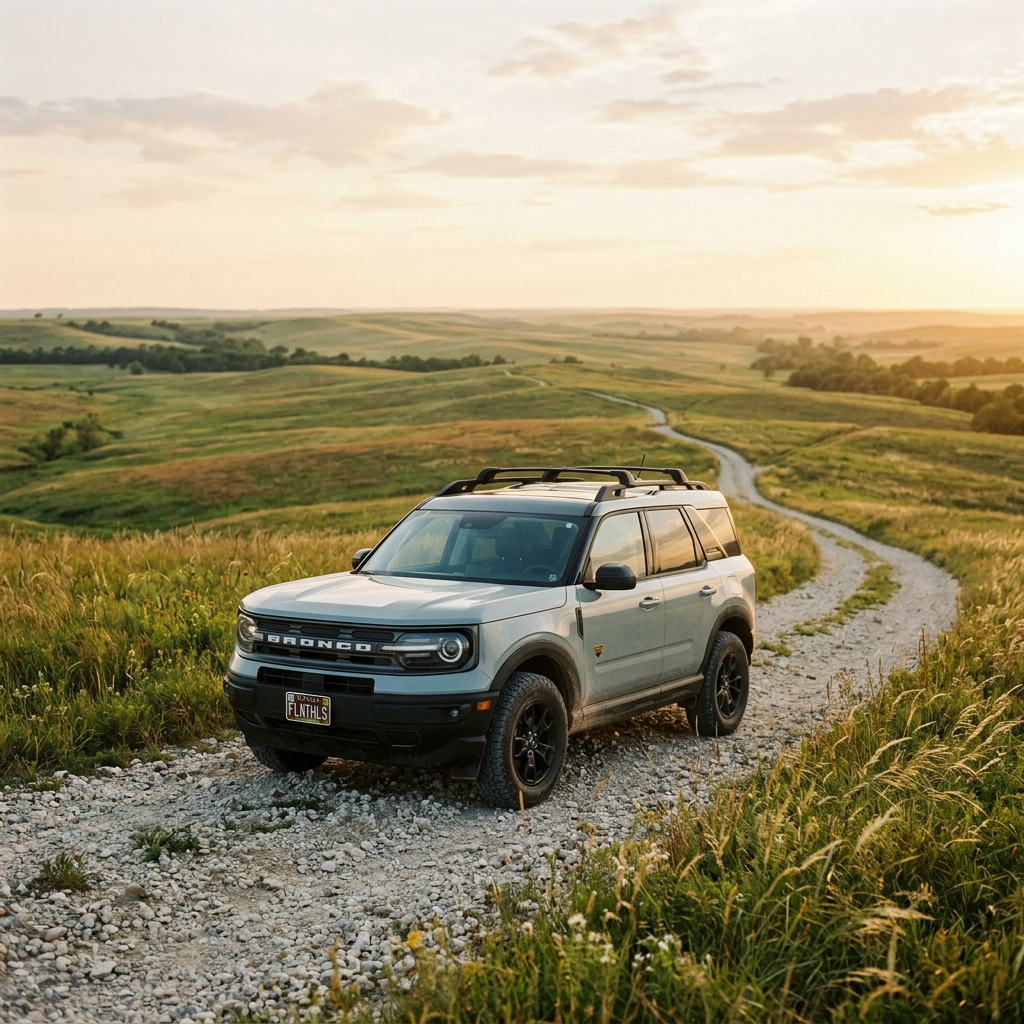
A silver Ford Bronco Sport parked on a gravel trail winding through rolling green hills at sunset. (Representative image for illustration purposes only. Actual vehicle may vary based on trim and configuration.)

Late Summer Overland and Camping Prep: Getting Your Ford Bronco Sport Ready for Kansas Trails

As the blistering heat of mid-summer begins its gradual transition into the golden, breezy days of late August and early September, the outdoor enthusiasts of Kansas feel an undeniable pull toward the wilderness. There is a sweet spot in the Kansas calendar—a window where the humidity breaks, the evening air turns refreshingly crisp, and the tallgrass prairie of the Flint Hills glows with a rich, amber hue. It is the ultimate time of year for overlanding, self-sustained camping, and trail exploration. However, venturing into the remote paths surrounding Junction City, Dickinson County, and the vast public lands near Fort Riley requires more than just a sleeping bag and a cooler. It demands a vehicle engineered to handle the unpredictable terrain, and more importantly, it requires proper preparation. Enter the Ford Bronco Sport. Far more than a stylish urban commuter, this compact SUV carries the legendary heritage of the Bronco brand, engineered specifically to bridge the gap between daily driveability and rugged, remote exploration. With its standard four-wheel-drive capability, intelligent terrain systems, and an architectural design that maximizes cargo and roof utility, the Bronco Sport is uniquely suited for navigating the limestone-strewn trails and dusty backroads of our home state. But before you load up and point your compass toward your next campsite, taking the time to thoroughly inspect, outfit, and prepare your vehicle is the difference between an unforgettable adventure and an frustrating weekend stranded on a dusty trail. In this comprehensive guide, we will dive deep into everything you need to know to get your Ford Bronco Sport fully prepared for late-summer Kansas overlanding. From analyzing its real-world off-road capabilities and understanding its critical mechanical specifications to performing vital pre-trip maintenance and choosing the right emergency gear, we have compiled the ultimate checklist. Whether you are planning a weekend escape to Milford State Park, a technical challenge at Tuttle Creek, or a multi-day journey along the unpaved grid of the historic Flint Hills, Valor Ford is here to ensure your vehicle is as ready for the adventure as you are. Let’s get your Bronco Sport trail-ready and gear up for the open road.

How Capable Is the 2024 Ford Bronco Sport on Kansas Trails?

To truly appreciate what the Ford Bronco Sport can do, you have to look past the pavement. The Kansas landscape is deceptively challenging. The Flint Hills region, for instance, is built on layers of dense limestone and highly abrasive chert. These sharp, loose rocks will quickly punish vehicles that lack proper suspension tuning and traction management. Fortunately, the 2024 Ford Bronco Sport is engineered from the ground up to conquer these exact conditions. At the heart of its off-road prowess is the High-Performance Off-Road Stability Suspension (HOSS) system. This specialized architecture features uniquely tuned front struts and hydraulic rebound stops that absorb the violent, high-speed impacts of washboard gravel roads, ensuring your tires stay in contact with the ground and your cabin remains stable and comfortable. Furthermore, the Bronco Sport features Ford's highly acclaimed Terrain Management System with G.O.A.T. (Goes Over Any Type of Terrain) Modes. With the turn of a simple dial, you can reconfigure the vehicle’s throttle response, transmission shift points, traction control, and steering feel. When navigating the dusty, loose-gravel trails around Fort Riley and Junction City, switching to 'Sand' or 'Slippery' mode optimizes power delivery to prevent wheel spin. For those driving the top-tier Badlands trim, the addition of 'Mud/Ruts' and 'Rock Crawl' modes provides highly specialized torque management, utilizing a twin-clutch rear drive unit that can send virtually all rear-axle torque to a single wheel with traction.

Another significant advantage of the Bronco Sport on local Kansas trails is its compact footprint. While full-size overland rigs often struggle with tight, overgrown trails, low-hanging branches, and narrow farm-gate entries, the Bronco Sport maneuvers with absolute agility. Its short front and rear overhangs provide impressive approach and departure angles, allowing you to climb over steep creek banks and dry washouts without scraping your bumpers. This maneuverability is especially valuable when exploring the public trail systems and unmaintained township roads of Dickinson County, where trails can narrow dramatically without warning. Ultimately, the capability of the Bronco Sport lies in its balance. It offers the confidence of a true off-roader without sacrificing the civilized ride quality needed to drive comfortably from Junction City down to the trailheads. It doesn't force you to choose between a bone-jarring daily commute and a capable trail machine; instead, it delivers both. By understanding how to utilize its advanced 4x4 systems and suspension design, you can confidently push deeper into the Kansas backcountry, reaching the secluded campsites and scenic vistas that ordinary crossovers simply cannot access.

What Are the Key Specs of the 2024 Ford Bronco Sport for Overlanding and Camping?

When planning an overlanding trip, understanding your vehicle's physical limits and dimensions is crucial for both safety and packing efficiency. Overlanding requires carrying your shelter, water, food, and recovery gear with you. Overloading a vehicle or packing it incorrectly can lead to poor handling, increased fuel consumption, or mechanical strain. Below, we break down the vital specifications of the 2024 Ford Bronco Sport that make it a premier choice for self-sustained camping.

Dimensions & Payload
The Bronco Sport features a highly maneuverable 105.1-inch wheelbase and a total length of 172.7 inches. With a payload capacity ranging between 1,000 and 1,170 lbs (depending on the trim and options), it easily accommodates two passengers, a full load of camping gear, water, and auxiliary equipment without exceeding mechanical safety limits.

Safari-Style Roof Capacity
The iconic safari-style roof isn't just for interior headroom; it increases structural roof strength. On models equipped with the standard steel roof, the dynamic roof load limit (while driving) is up to 150 lbs, which is perfect for gear baskets or kayaks. The static roof load limit (parked) jumps up to 600 lbs, easily supporting a heavy-duty rooftop tent and two adults.

Cargo Space & Utility
Behind the front seats, the Bronco Sport offers up to 65 cubic feet of cargo volume (61 cubic feet on Badlands). The cargo area features a flat load floor, built-in cargo tie-down loops, and an available cargo management system that doubles as a camp table, making organization effortless during multi-day trail stays.
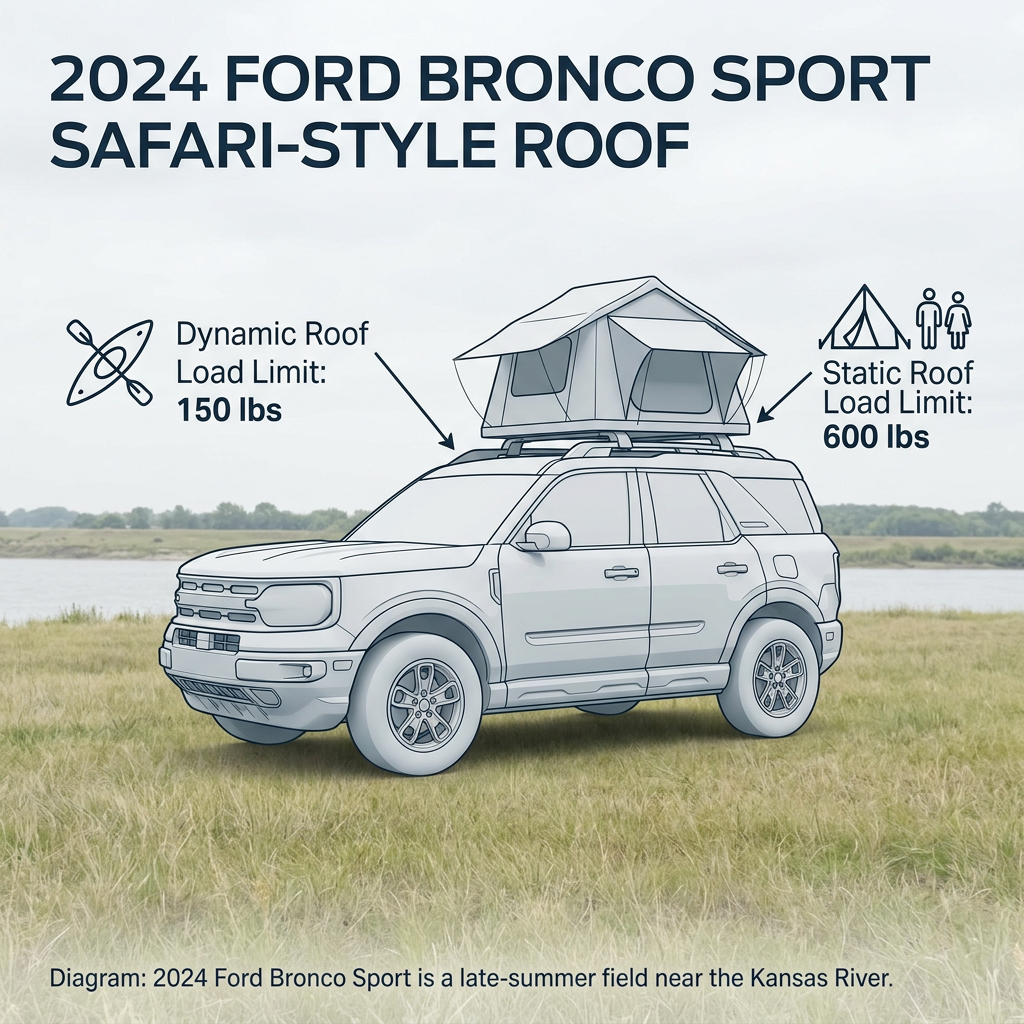
Diagram showing the dynamic and static roof load limits of a 2024 Ford Bronco Sport with safari-style roof. (Representative image for illustration purposes only. Actual vehicle may vary based on trim and configuration.)

Specification

Big Bend

Outer Banks

Badlands

Engine Option

1.5L EcoBoost I3

1.5L EcoBoost I3

2.0L EcoBoost I4

Horsepower / Torque

181 hp / 190 lb-ft

181 hp / 190 lb-ft

250 hp / 277 lb-ft

Ground Clearance

7.8 inches

7.8 inches

8.8 inches (with off-road tires)

Max Towing Capacity

2,000 lbs

2,000 lbs

2,200 lbs

Water Fording Depth

17.7 inches

17.7 inches

23.6 inches

Which 2024 Bronco Sport Trim Is Best for Serious Off-Road Prep?

While every 2024 Ford Bronco Sport comes standard with 4x4 capability, choosing the right trim depends entirely on how deep into the wild you plan to go. For casual campers who primarily stick to well-maintained gravel state park roads and established campgrounds, the Big Bend and Outer Banks trims offer a fantastic blend of daily fuel efficiency, comfort, and baseline capability. Powered by the peppy 1.5L EcoBoost engine, these trims handle dirt roads, muddy entries, and rain-slicked paths with absolute poise. However, if your dream of overlanding involves conquering rugged, unmaintained trails, climbing rocky ledges, and traversing deep washouts in the Flint Hills, one trim stands head and shoulders above the rest: the Bronco Sport Badlands. The Badlands trim is the ultimate manifestation of the Bronco Sport's off-road DNA. It replaces the 1.5L engine with a muscular 2.0L EcoBoost four-cylinder, churning out a robust 250 horsepower and 277 lb-ft of torque. This extra muscle is critical when climbing steep, loose inclines or crawling through deep mud. More importantly, the Badlands features an advanced 4x4 system with a twin-clutch rear drive unit. Unlike traditional systems, this setup can mimic a mechanical locking differential, sending power laterally to whichever rear wheel has the most grip. Combined with unique metal bash plates to protect vital engine components, off-road-tuned suspension, and standard all-terrain tires, the Badlands is built to take a beating on the trail.

In addition to mechanical upgrades, the Badlands trim adds two highly specialized G.O.A.T. modes: Mud/Ruts and Rock Crawl. These modes recalibrate the traction control and torque vectoring to deal with low-traction, high-torque situations, giving you the slow-speed control needed to climb over slippery limestone ledges. It also boasts an extra inch of ground clearance (bringing the total to 8.8 inches) and unique front-facing trail cameras that allow you to see exactly where your tires are tracking when climbing blind crests. Prepping a Badlands edition means you are starting with a vehicle that already has the foundation of a serious trail rig. You don't need to spend thousands of dollars on aftermarket lift kits or skid plates; it's all engineered, tested, and backed by Ford right out of the box. For those who want to buy with the peace of mind that their vehicle can handle anything Dickinson County throws at it, the Badlands is the gold standard of the lineup. Explore our latest options and Shop New Ford Bronco Inventory to find the perfect trim for your upcoming expeditions.

What Are the Practical Differences Between the Bronco Sport and the Bronco?

A common point of confusion for buyers exploring the Ford lineup is the distinction between the Bronco Sport and the larger, traditional Bronco. While they share a legendary nameplate and a rugged design aesthetic, they are built on entirely different platforms and serve different purposes. Understanding these differences is key to choosing the vehicle that fits your overlanding style and daily lifestyle. The Bronco Sport is built using a unibody construction (similar to the Ford Escape and Maverick). This design integrates the body and frame into a single, cohesive structure, which provides several massive advantages for the everyday driver. Unibody vehicles are inherently lighter, more fuel-efficient, and offer car-like ride comfort and handling. On the highway, the Bronco Sport is quiet, refined, and highly efficient, making it a joy to drive on your daily commute from Junction City. When you transition to the trails, its independent front and rear suspension provides a compliant, controlled ride over washboard gravel and uneven terrain. It is the perfect blend of modern comfort and active lifestyle capability.

In contrast, the full-size Bronco is a body-on-frame truck-based SUV. It is larger, heavier, and built for extreme, high-clearance off-roading, rock crawling, and open-air desert running. It features removable doors and roof panels, solid rear axles, and massive tire options. While it is an absolute beast on extreme rock crawls, it lacks the daily-driver fuel economy and refined highway manners of the Bronco Sport. It is also wider and taller, which can make navigating narrow trails or parking in tight garage spaces more challenging. For the vast majority of camping and overlanding enthusiasts in Kansas, the Bronco Sport is actually the more practical and comfortable tool for the job. It easily carries rooftop tents, holds a weekend's worth of gear, handles muddy and rocky trails with ease, and does so while saving you money at the fuel pump. It represents the perfect middle ground: highly capable when you want to play, yet quiet, comfortable, and efficient when you need to get to work.
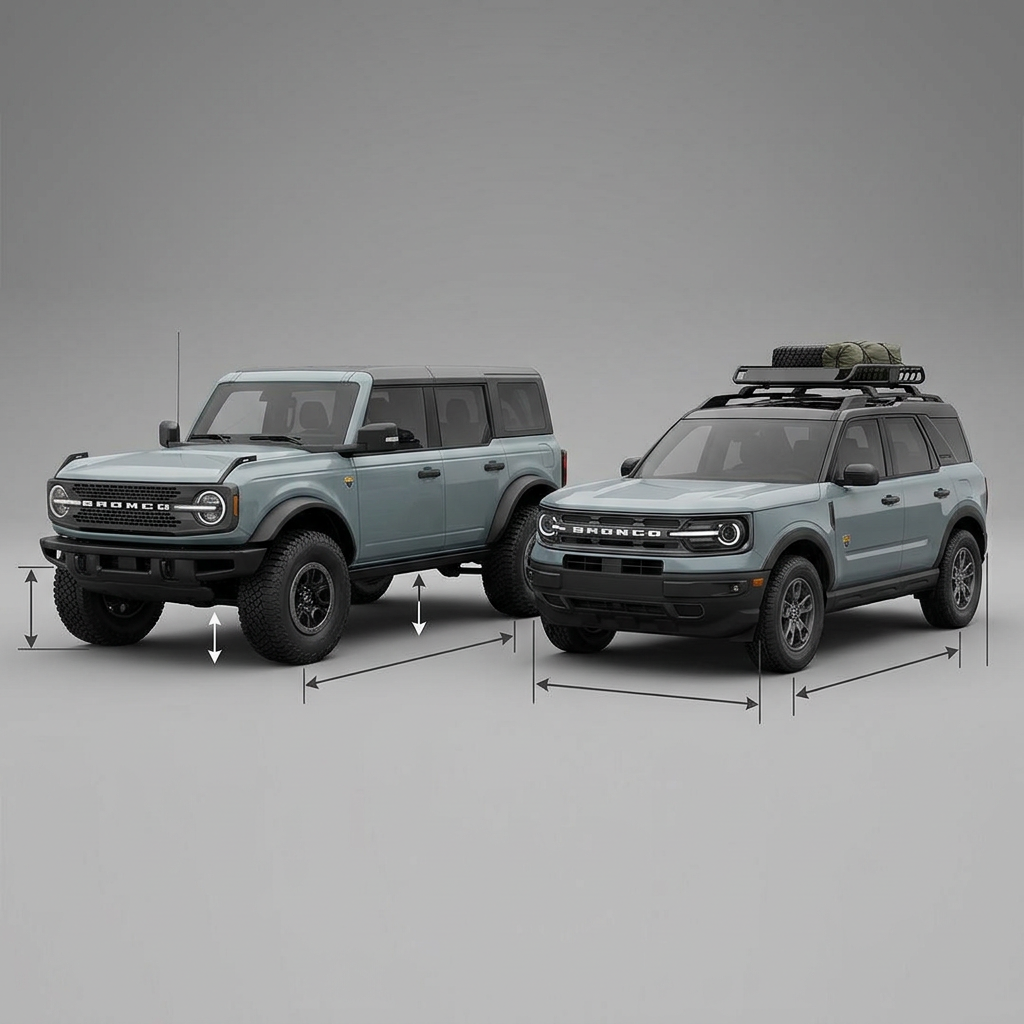
A Ford Bronco and a Ford Bronco Sport shown side-by-side with dimension arrows indicating size differences. (Representative image for illustration purposes only. Actual vehicle may vary based on trim and configuration.)

Essential Late-Summer Maintenance Before Taking Your Bronco Sport Camping in Kansas

A successful overlanding trip starts long before you reach the trailhead. Late summer in Kansas is notoriously harsh on vehicles. The combination of sustained high temperatures, high humidity, and extremely dusty farming roads puts extra strain on your engine, cooling systems, and filters. To ensure your Bronco Sport runs flawlessly under pressure, completing a pre-trip maintenance checklist is highly recommended.

Filters & Cooling Systems
Late-summer gravel roads kick up an incredible amount of fine, powdery dust. Inspect your engine air filter; a clogged filter chokes performance and drops fuel efficiency. Similarly, check your cabin air filter to keep the interior clean. Ensure your engine coolant is topped off and the radiator is free of debris and agricultural fluff.

Tires & Pressures
Hot summer pavement followed by rocky trails is tough on rubber. Inspect your tires for uneven wear, side-wall gashes, or embedded debris. Before hitting rocky trails, consider 'airing down' to roughly 20-25 PSI to increase traction and ride comfort, but ensure you have a way to air back up before returning to the highway.

Brakes & Suspension
Navigating steep descents and holding load weight puts heavy demands on your braking system. Check your brake pads and rotors for wear or debris. Inspect your suspension components, bushings, and steering linkages for play or damage, especially if you spent the early summer tackling rough roads.

Don't leave your safety to chance. Before packing up, let our factory-trained technicians perform a complete multi-point inspection on your vehicle. You can easily Schedule Ford Service Today to ensure your Bronco Sport is in prime operating condition, or utilize our convenient Schedule Pickup and Delivery Service to have us handle everything while you focus on packing.

Must-Have Accessories: Outfitting Your Bronco Sport for the Wilds of Dickinson County

Part of the joy of owning a Ford Bronco Sport is the ability to customize it to fit your specific adventure needs. The Ford OEM accessory catalog is packed with highly engineered, perfectly fitting options designed to elevate your camping and overlanding experience. Because these accessories are co-developed with Ford engineers, you can rest assured they won't compromise your vehicle’s structural integrity, safety systems, or factory warranty. First on the list of overland upgrades is a quality rooftop tent setup. By mounting a Yakima rooftop tent to your Bronco Sport’s heavy-duty roof rails, you instantly elevate your sleeping quarters off the cold, damp ground, away from nocturnal Kansas insects and wildlife. Inside the cabin, heavy-duty rubberized floor liners are essential for keeping muddy boots and spilled trail water from ruining your carpet. A cargo area liner and pet kennel system also help keep your gear clean and organized. For those planning to explore more remote, unmaintained sections of Dickinson County, adding custom-fit mud flaps and rock sliders helps protect your body panels from flying gravel and trail debris.

Additionally, auxiliary lighting is a highly popular upgrade for overlanding. Grille-mounted light bars or ditch lights mounted near the side mirrors significantly improve visibility during late-night trail arrivals or early-morning departures. Ford offers specialized wiring harnesses that integrate seamlessly with the Bronco Sport's electrical systems, preventing battery drain and clean installations. Ready to elevate your Bronco Sport’s camping game? Our parts department carries a wide variety of adventure gear and trail accessories. You can easily Order Genuine Ford Parts through Valor Ford to ensure you get the absolute best fitment and durability for your rugged Kansas travels.
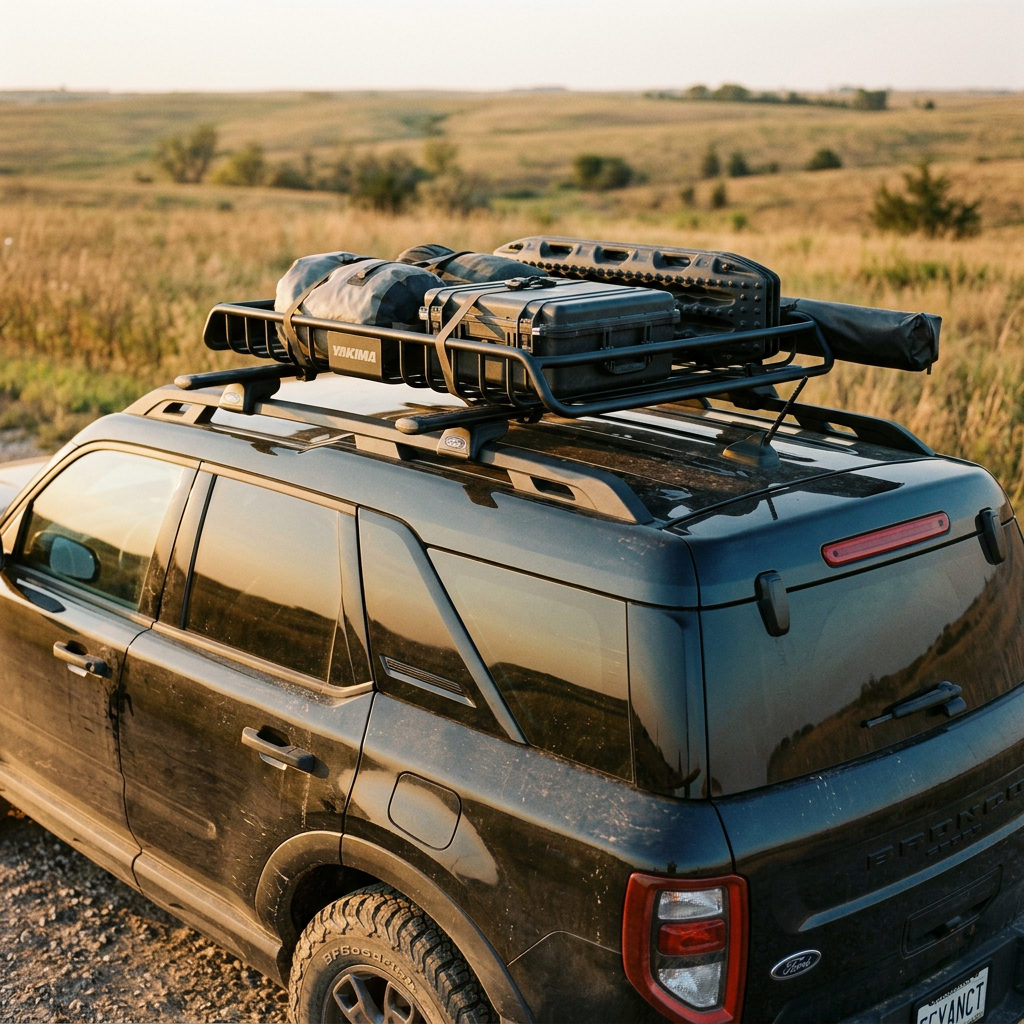
A black SUV equipped with a loaded Yakima roof basket parked in a grassy field at sunset. (Representative image for illustration purposes only. Actual vehicle may vary based on trim and configuration.)

What Emergency Gear Should I Bring for Kansas Trails?

No matter how capable your vehicle is, the golden rule of overlanding is self-sufficiency. When you venture off the beaten path, cell reception can fade quickly, and emergency services could be hours away. Packing a dedicated recovery and emergency kit is non-negotiable. Below is a comprehensive packing list optimized for the unique challenges of Kansas trails.

Traction & Recovery
If you find yourself stuck in deep mud or soft sand along a creek bed, traction boards are your best friend. Slip them under your tires for instant grip. Additionally, always carry a high-quality kinetic recovery strap. The Bronco Sport features robust front recovery points—ensure you have a strap and D-rings compatible with them.

Air & Power Management
A portable 12V air compressor is vital. It allows you to air back up to highway pressures after trail riding, preventing tire damage. Carry a portable lithium-ion jump starter pack as well; running camp lights, keeping phones charged, or leaving a door ajar can easily drain a battery overnight in remote areas.

Survival & Navigation
Late summer heat demands serious hydration. Pack at least two gallons of fresh water per person, per day. A well-stocked first-aid kit, a reliable multi-tool, a folding shovel, and offline mapping software (like OnX Offroad or Gaia GPS) are essential for navigating when cellular coverage drops completely.

Mapping Your Route: Top Late-Summer Camping Destinations Near Junction City

Now that your Bronco Sport is prepped, maintained, and packed, it’s time to choose your destination. Fortunately, Junction City is perfectly positioned as a gateway to some of the best outdoor recreation in the state. If you are looking for water-based activities and beautiful shoreline camping, Milford State Park is an absolute gem. Known as the 'Geary County Oasis,' Milford offers scenic, sandy trails, heavily wooded campsites, and excellent fishing. The sandy shoreline trails can sometimes get soft, but switching your Bronco Sport into 'Sand' G.O.A.T. mode will keep you moving forward with ease. For those seeking a bit more technical trail riding, the Tuttle Creek ORV Area near Randolph is a must-visit. This dedicated off-road park features steep hill climbs, deep ruts, and rocky ledge obstacles. It is the perfect place to test the limits of your Bronco Sport Badlands' suspension and advanced 4x4 systems. Remember to air down your tires to absorb the sharp impacts of the rocky terrain and take advantage of the slow-speed crawl controls.

If multi-day, self-sustained overlanding is your goal, look no further than the scenic gravel grids of the Flint Hills National Scenic Byway. Stretching south through Council Grove and beyond, this region offers hundreds of miles of unpaved, unmaintained county roads that cut through the largest remaining stand of tallgrass prairie in North America. Driving these historic routes during late summer offers spectacular views of rolling hills, roaming cattle, and beautiful stone architecture. Be sure to practice proper trail etiquette: respect private property gates, pack out all of your trash, and stay aware of changing weather conditions that can turn dry gravel roads into slick clay in a matter of minutes. No matter where you choose to explore, having a capable, prepared vehicle gives you the freedom to escape the crowds and find true solitude. Planning your route and checking local park websites for seasonal trail closures before you leave ensures a smooth, trouble-free adventure.
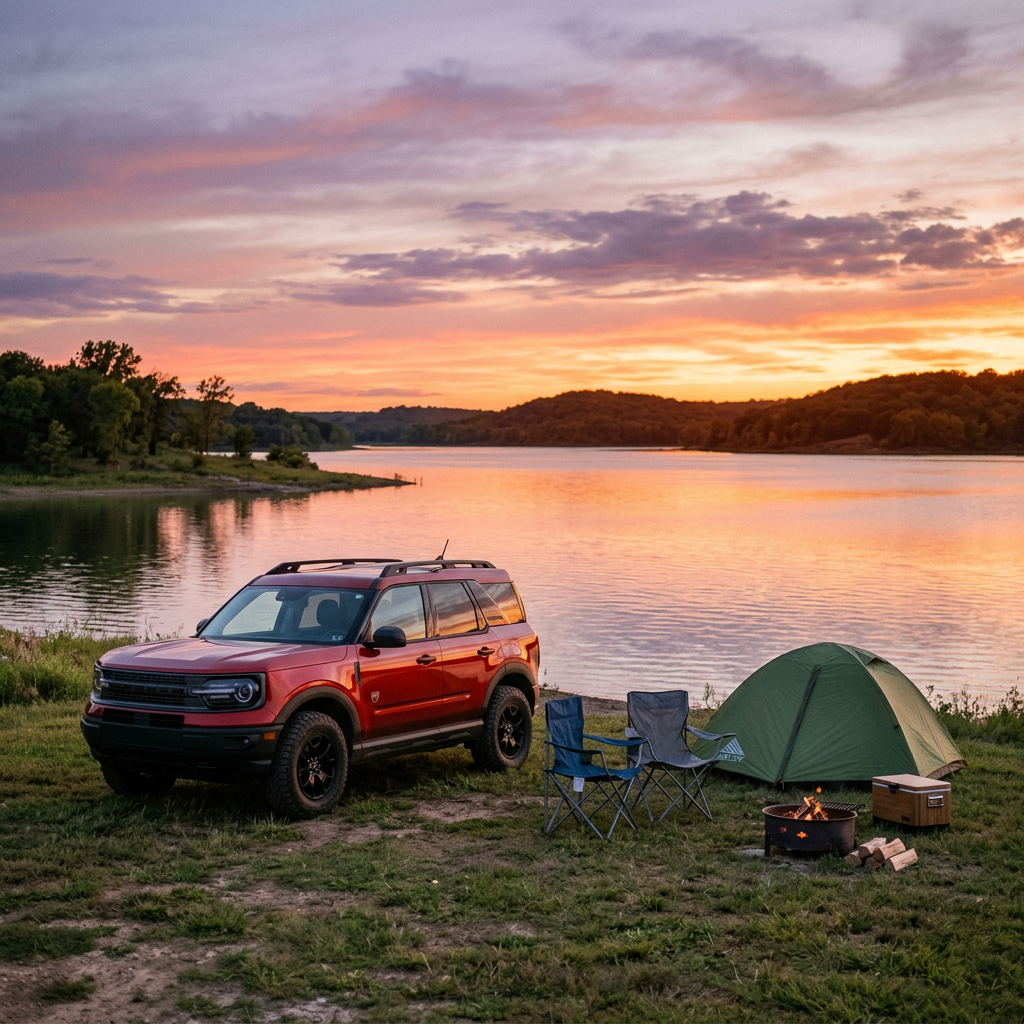
A red Ford Bronco Sport parked next to a green tent and campfire by a lake at sunset. (Representative image for illustration purposes only. Actual vehicle may vary based on trim and configuration.)

How Should I Shop Locally for a Bronco Sport Near Junction City?

If you are ready to transition from dreaming about overland adventures to actually living them, finding the right Ford Bronco Sport is the first step. At Valor Ford, we make the shopping process transparent, efficient, and tailored to your specific lifestyle. You can begin your journey right from the comfort of your home by exploring our extensive digital showroom. Whether you are looking for a brand-new Badlands edition equipped with all the off-road goodies, or a high-quality, certified pre-owned model, you can easily Browse Used Inventory or check out our latest new arrivals on our website. Once you find a few models that catch your eye, we recommend utilizing our convenient online tools to streamline your buying experience. If you plan to trade in your current vehicle to help fund your new adventure machine, you can receive an instant, highly accurate estimate using our online Trade In Evaluation tool. Knowing the value of your trade-in upfront allows you to plan your budget with absolute confidence, ensuring there are no surprises when you visit our physical showroom in Junction City.

Additionally, securing financing options is a crucial piece of the puzzle. Our experienced finance team works with a wide network of local and national lenders to secure the best possible rates and flexible terms for your budget. To save time at the dealership, you can easily fill out our secure digital application and Get Pre-Approved for Financing before you set foot on our lot. At Valor Ford, we focus on a straightforward, helpful shopping experience. Instead, our goal is to serve as a trusted resource for the local community, helping you find the vehicle, accessories, and maintenance services that perfectly align with your outdoor goals. Come visit us today, chat with our knowledgeable staff, and take a Bronco Sport for a spin to experience its impressive capabilities firsthand.
Logo for Valor Automotive featuring a blue and silver shield with 'VA' and the company name with a red star.

Gear Up and Head Out with Valor Ford in Junction City, KS

The late-summer wilderness is calling, and there has never been a better time to pack your gear, load up your vehicle, and hit the beautiful trails of Kansas. From the rolling hills of the Flint Hills to the scenic shorelines of Milford Lake, unforgettable memories are waiting to be made. But a safe, successful overland trip always begins with a well-prepared vehicle. Whether you are seeking a new adventure-ready Ford Bronco Sport, looking to outfit your current rig with high-quality OEM accessories, or needing a thorough pre-trip inspection, Valor Ford is your premier local partner. Our team is comprised of passionate automotive experts who live, work, and explore right here in the local community. We know the unique demands of Kansas roads and trails, and we are dedicated to ensuring you have the knowledge, equipment, and confidence to tackle your next journey safely. Don't leave your trail readiness to chance—stop by our dealership, speak with our service and parts specialists, and let us help you gear up for your next great escape. Have questions about inventory, parts, or trail prep? Call us at (785) 238-5114 to speak directly with our friendly team, or Get Directions to Valor Ford to visit our showroom located at 1825 Goldenbelt Blvd, Junction City, KS 66441. We look forward to helping you embark on your next Kansas trail adventure!
Posted in:

Related Posts

F-250 vs F-350: Choosing the Right Payload for Your Needs

F-250 vs F-350: Choosing the Right Payload for Your Needs

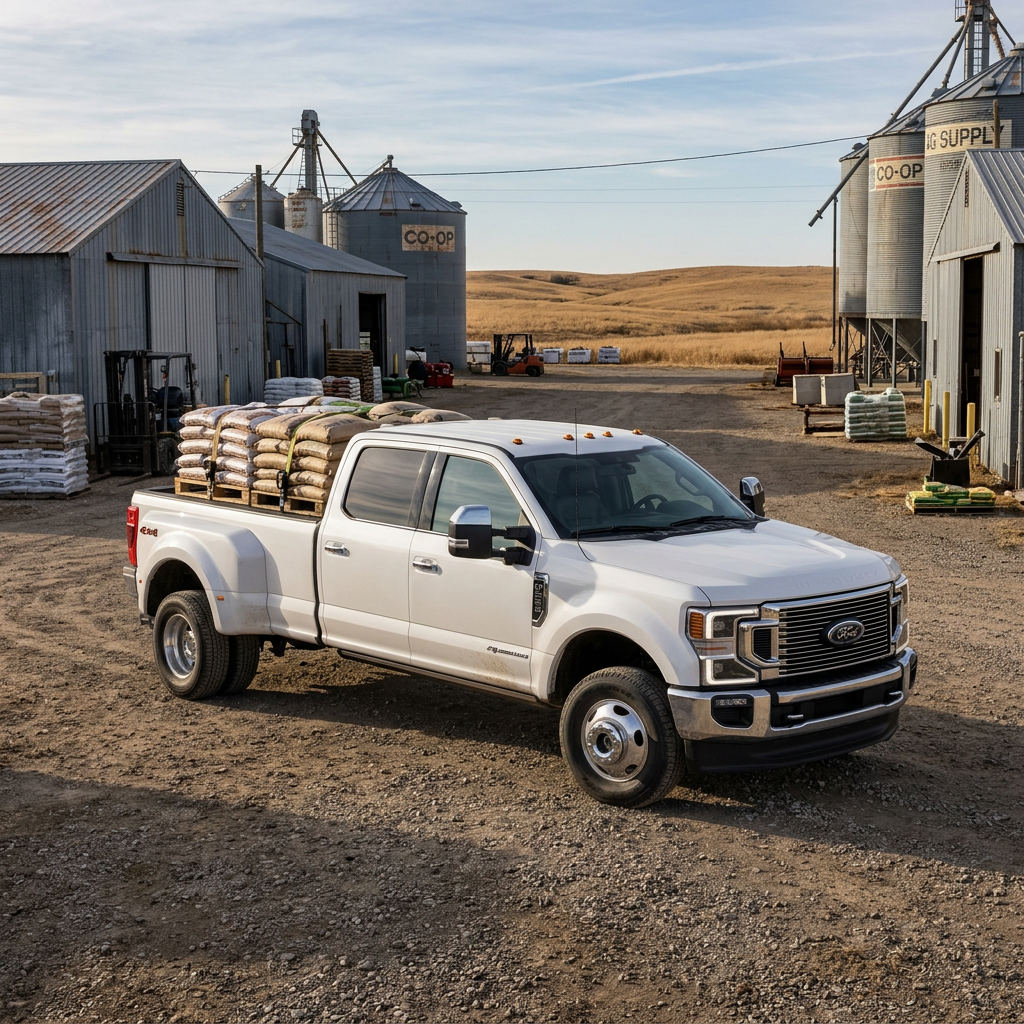
F-250 vs F-350: Choosing the Right Payload for Your Needs How Does Engine Choice Affect Payload Capacity in an F-250 vs F-350? Opting for a heavier diesel engine directly reduces available payload capacity compared to a gasoline engine on both the F-250 and F-350 because engine curb weight eats directly into the truck's Gross Vehicle Weight Rating (GVWR). On an identical 10,000-lb GVWR setup, choosing the diesel engine reduces carrying capacity by roughly 800 to 1,000 pounds compared to a gas V8. The curb weight difference between powertrains explains this gap. The standard 6.8L gas V8 and available 7.3L gas V8 are substantially lighter iron blocks than the 6.7L Power Stroke diesel and the 6.7L high-output diesel with its massive 500 hp and 1,200 lb-ft of torque. That heavy diesel hardware sits over the front axle, taking up allowable gross capacity before you even put a driver in the cab. For instance, in Ford's published specifications for a 2026 F-250 4x4 Crew Cab with a 175.9-inch wheelbase, opting for the 7.3L gas V8 yields a charted maximum payload of 3,196 lb, whereas equipping that exact configuration with the 6.7L high-output diesel drops maximum payload down to 2,415 lb within a standard 10,000-lb GVWR ceiling. Many truck shoppers focus exclusively on horsepower and pulling power without factoring in how those heavy powertrain components limit bed capacity. If you spend your workdays hauling bulk gravel or loading heavy ag supplies across Junction City, that gas engine preserves several hundred pounds of legal bed capacity that the diesel gives up to its cooling systems and emissions hardware. To map out how engine options align with your equipment needs, you can get directions to Valor Ford or give us a quick call to check configurations on our lot. Table of Contents Why Does the Ford F-350 Have a Higher Payload Capacity Than the F-250? What Is the Real Payload Capacity Difference Between the Ford F-250 and F-350? Is an F-350 SRW Worth the Upgrade Over an F-250 for Heavy Towing? When Is a Dual-Rear-Wheel F-350 Necessary Over an SRW Model? Is an F-250 or F-350 Better for Hauling a Slide-In Truck Camper? Where Can an Owner Locate the Exact Official Payload Capacity on a Ford Truck? Why Does the Ford F-350 Have a Higher Payload Capacity Than the F-250? The Ford F-350 carries a higher payload rating than the F-250 because it is engineered with a substantially higher Gross Vehicle Weight Rating, supported by a stiffer rear suspension pack and stouter axle components. While both trucks share the same fully boxed high-strength steel frame and cab dimensions, the F-350 is built to legally and mechanically support several thousand pounds of additional weight over its rear axle. Underneath the bed, the physical differences become clear. A single-rear-wheel F-350 typically utilizes an extra rear leaf spring along with auxiliary overload springs that remain disengaged during empty driving but engage as the suspension compresses under severe loads. The F-350 also receives heavy-duty rear axle assemblies with thicker axle tubes and larger wheel bearings designed to dissipate the heat and stress generated by heavy carrying tasks. These structural upgrades allow Ford to assign the F-350 a certified GVWR ranging from 11,000 pounds up to 14,000 pounds depending on cab and wheel setup, whereas standard F-250 configurations are frequently capped at a 10,000-lb GVWR class ceiling. If you are comparing heavy-duty models for commercial use, you can research Ford F-250 configurations in detail, or inspect our rotating inventory by browsing our selection of pre-owned work trucks to see how different spring packs hold up over time. What Is the Real Payload Capacity Difference Between the Ford F-250 and F-350? The real-world payload capacity difference between an F-250 and a single-rear-wheel F-350 ranges from roughly 800 pounds to over 1,500 pounds for identical cab and engine configurations. In maximum theoretical builds across the entire lineup, the gap is wider, spanning from 4,055 lb on a properly equipped F-250 single-rear-wheel up to 7,900 lb on a dual-rear-wheel F-350. Looking at matching truck builds demonstrates how this gap works on the ground. Ford's 2026 specification charts show that a four-wheel-drive Crew Cab long-bed F-250 equipped with the 7.3L gas V8 carries a maximum charted payload of 3,196 lb. An F-350 single-rear-wheel in the identical cab, bed, and engine configuration on 18-inch all-season tires jumps to 4,150 lb of maximum payload. That is a real-world gain of nearly a thousand pounds of capacity without changing the interior space, exterior footprint, or engine performance. Maintaining your truck's driveline components is essential when operating near these load limits, and our team is ready to schedule routine Ford maintenance to inspect your brakes and suspension. To explore specific towing configurations and options, take a moment to read through our Super Duty overview. Is an F-350 SRW Worth the Upgrade Over an F-250 for Heavy Towing? An F-350 single-rear-wheel is absolutely worth the upgrade over an F-250 if you plan to tow fifth-wheel trailers or heavy goosenecks where vertical pin weight quickly consumes your truck's cargo rating. While both trucks can pull immense weight behind the hitch, the F-350 provides the essential legal payload cushion needed to support a trailer that places 20 to 25 percent of its total weight directly into the bed. A fully loaded 15,000-pound fifth-wheel camper routinely generates a kingpin weight of 3,000 pounds. In a diesel-equipped F-250 Crew Cab with an available payload rating sitting around 2,400 to 2,800 pounds, hitching that trailer instantly puts the vehicle over its legal GVWR before you load passengers, fuel, or camping gear into the cabin. An F-350 SRW handles that same trailer with hundreds of pounds of surplus payload room on the certification label. Aftermarket suspension upgrades like helper springs or air bags can level the truck, but they never legally increase the certified GVWR stamped on the factory placard. Upgrading to an F-350 from the start protects your safety and legal compliance on the highway. If you are preparing to trade your current rig for more towing capability, you can request an online used vehicle trade-in valuation and start your purchase path to get pre-approved for automotive financing before visiting the lot. When Is a Dual-Rear-Wheel F-350 Necessary Over an SRW Model? A dual-rear-wheel F-350 becomes necessary when your cargo demands exceed a 4,500-pound payload requirement or when you are towing commercial gooseneck trailers with pin weights exceeding 4,000 pounds. Adding two extra tires across the rear axle doubles your tire contact patch, providing unmatched lateral stability and eliminating rear-tire overloading under extreme tongue weights. Dual rear wheels transform how a truck handles under heavy load. A dual-rear-wheel Regular Cab two-wheel-drive F-350 equipped with the 7.3L gas V8 and the Gas Heavy-Duty Payload Package reaches an industry-leading maximum payload rating of 7,900 lb against a 14,000-lb GVWR. Single-rear-wheel tires are typically limited to roughly 3,600 to 3,750 pounds of load capacity per tire, meaning two rear tires max out around 7,200 to 7,500 pounds of total supported rear axle load. Splitting that load across four rear tires prevents thermal breakdown, reduces sway in crosswinds, and offers an essential margin of safety if a tire suffers a blowout under load. Whether you need a dually for massive livestock trailers or prefer a weekend recreation vehicle like our new Ford Bronco inventory for off-road trails, selecting the correct chassis is critical. If your current truck requires replacement hardware or suspension components, you can easily order factory-approved replacement parts through our department. Is an F-250 or F-350 Better for Hauling a Slide-In Truck Camper? An F-350 is substantially better suited for hauling a hard-side slide-in truck camper because camper applications place 100 percent of their dry and wet weight directly inside the truck bed. Even mid-sized slide-in truck campers often exceed 3,000 pounds once you account for water tanks, propane cylinders, dual batteries, and outdoor gear, which pushes past the legal payload limits of most standard F-250 builds. When hauling heavy campers across the rolling terrain of Dickinson County, top-heavy cargo raises the truck's center of gravity. An F-350 features the stiffer spring rates and auxiliary overloads required to control severe body roll on uneven gravel roads or undulating highway surfaces. Loading a heavy camper into a softer F-250 often results in excessive rear-end sag, which unweights the front steer tires and degrades steering precision and braking performance. Truck buyers carrying larger multi-slide truck campers weighing over 4,000 pounds wet should consider skipping single-rear-wheel configurations entirely in favor of an F-350 dually. The wide rear track of a dual-rear-wheel truck provides the broad foundation required to anchor top-heavy campers in crosswinds without white-knuckle driving. Where Can an Owner Locate the Exact Official Payload Capacity on a Ford Truck? An owner can find the exact, certified payload rating for their specific vehicle on the yellow and white Tire and Loading Information placard located on the driver-side door jamb. That sticker features the explicit statement: "The combined weight of occupants and cargo should never exceed XXXX kg or XXXX lbs." Published brochures, advertising listings, and online specification sheets list theoretical maximum ratings for stripped-down, base-trim configurations. Factory options such as four-wheel-drive transfer cases, skid plates, power running boards, larger wheels, and luxury center consoles add weight to the bare chassis, reducing available cargo capacity pound for pound. Two trucks with identical trims on a dealer lot can carry distinct payload ratings if one is fitted with a fifth-wheel prep package, panoramic moonroof, or spray-in bedliner. Reviewing that door-jamb sticker is the only way to confirm legal capacity before hooking up heavy equipment. If you want our commercial sales staff to review your door sticker specifications or inspect your truck's ratings in person, visit our dealership showroom or connect directly with our specialists by making a phone inquiry today. © 2026 Valor Ford. All rights reserved.

What Should You Know Before Buying From a Local Ford Dealership?

What Should You Know Before Buying From a Local Ford Dealership?

What Should You Know Before Buying From a Local Ford Dealership? Before buying from a local dealership, confirm the specific vehicle configuration that matches your towing or passenger needs, compare factory financing or lease incentives through Ford Credit, and evaluate your trade-in allowance against net sales tax savings. In Kansas, trading in your vehicle directly reduces the taxable purchase price of your next car, keeping more money in your pocket than an outright private sale. Securing pre-approval before stepping onto the showroom floor clarifies your buying power and streamlines the paperwork. Navigating your vehicle purchase locally also ensures direct access to certified technicians, factory warranty support, and manufacturer-backed roadside care. Every new Ford includes factory roadside coverage, giving you direct access to help whenever needed nationwide through Ford Roadside Assistance: 1-800-241-3673. Drivers visiting our showroom at 1825 Goldenbelt Blvd can work directly with our staff to review window stickers, order custom options straight from the assembly plant, and inspect practical features like cab dimensions and hitch configurations. Whether you need directions or want to talk through current lot arrivals, you can check our showroom location or give our team a quick call to get started. Table of Contents What Financing Rates and Lease Deals Does Ford Credit Offer? What Towing Capacity and Performance Does the 2027 Ford F-150 Deliver Compared to the Chevrolet Silverado 1500? What Engine Powers the Ford Explorer ST and Which Family Features Stand Out? How Do Dealership Trade-In Values Compare to Private-Party Sales for Used Fords? Where Is the Dealership in Junction City and What Military Discounts Apply for Fort Riley Personnel? Common Questions About Shopping and Servicing at Our Dealership Plan Your Visit to Valor Ford and Schedule Your Next Test Drive What Financing Rates and Lease Deals Does Ford Credit Offer? Ford Credit may offer financing options and lease programs; contact the dealership for current details. Qualified retail buyers may be eligible for promotional financing offers on select new trucks and sport utility vehicles; contact the dealership for current details. Lease options may be available with varying terms and conditions; contact the dealership for current details. Navigating loan and lease approvals begins with an assessment of debt-to-income metrics, down payment reserves, and bureau ratings. Ford Credit structures tiers that reward higher credit scores with lower baseline money factors and subsidized rates. When prospective buyers prepare documentation in advance, including recent earnings statements, proof of residency, and trade-in titles, approval decisions move quickly through the underwriting system. While third-party lending institutions set rates strictly to broad retail market indicators, captive automotive financing through the manufacturer provides targeted promotional incentives tied directly to seasonal sales programs. Taking advantage of these programs is straightforward when you set up your profile early. You can streamline your purchase pathway by prequalifying online before scheduling a test drive. Setting up your financing framework ahead of time allows you to focus on choosing the proper trim level, drivetrain, and equipment packages. Once you bring your vehicle home, keeping it running at peak factory performance is equally simple when you schedule certified Ford maintenance with our factory-trained service technicians. What Towing Capacity and Performance Does the 2027 Ford F-150 Deliver Compared to the Chevrolet Silverado 1500? The 2027 Ford F-150 achieves a maximum conventional towing capacity of up to 13,500 pounds and a gas payload rating of up to 2,430 pounds when equipped with the 3.5L EcoBoost twin-turbo V6 engine and the Max Trailer Tow Package. That maximum towing rating edges out the Chevrolet Silverado 1500, which reaches an upper limit of 13,300 pounds when configured with its 6.2-liter V8 or 3.0-liter Duramax turbo-diesel. Beyond raw trailering limits, the high-strength, military-grade aluminum-alloy body of the F-150 delivers rust resistance and curb-weight efficiency that conventional steel truck beds cannot match. Powertrain versatility remains a cornerstone of the F-150 lineup. Across rural farming acreage in Dickinson County, hauling livestock, commercial equipment, and grain trailers demands sustained torque and electrical utility. The available 3.5L PowerBoost full hybrid engine generates 430 hp and 570 lb-ft of torque while introducing integrated job-site power through Pro Power Onboard. This system provides up to 7.2 kW of exportable electricity through 120-volt and 240-volt cab and bed outlets, functioning as a dedicated mobile generator capable of running plasma cutters, frame welders, and power tools without an auxiliary engine generator. Performance & Trailering Metric 2027 Ford F-150 (3.5L EcoBoost) Chevrolet Silverado 1500 (6.2L V8 / 3.0L Diesel) Maximum Conventional Towing 13,500 lbs 13,300 lbs Maximum Gas Payload Rating 2,430 lbs 2,260 lbs Peak Gas Engine Torque 500 lb-ft 460 lb-ft (6.2L V8) Mobile Generator System Pro Power Onboard (Up to 7.2 kW) Auxiliary bed outlets (Up to 400W) Cab and Bed Material High-strength aluminum alloy Roll-formed high-strength steel Drivers requiring dedicated equipment setups can explore complete engine and axle specs through our Ford F-150 research page. For custom electrical setups, heavy-duty hitch accessories, or fifth-wheel prep packages, you can also order authentic factory components directly through our parts counter. What Engine Powers the Ford Explorer ST and Which Family Features Stand Out? The performance-focused Ford Explorer ST is powered by an athletic 3.0L EcoBoost twin-turbo V6 engine generating 400 hp and 415 lb-ft of torque, mated to a calibrated 10-speed automatic transmission. This powertrain launches the three-row performance SUV from zero to 60 mph in roughly 5.1 seconds while sustaining a solid 5,000-pound maximum towing capacity with its standard Class III Towing package. Drivers seeking responsive acceleration without sacrificing family hauling capability get firm chassis dampening, sport-tuned steering gear, and selectable drive modes tailored for varied traction environments. Inside the cabin, three rows of versatile seating accommodate six or seven passengers depending on whether you choose second-row captain's chairs or the three-across bench configuration. Cargo management remains exceptionally functional: Up to 85 cubic feet of total cargo volume with both rear rows folded flat. About 46 cubic feet of dedicated storage behind the second-row seating. Roughly 18 cubic feet of usable space with all three rows occupied. One-touch E-Z Entry second-row captain's chairs that slide and tilt forward for easy third-row access. Standard Ford Co-Pilot360 active safety technology, including automated emergency braking and blind-spot monitoring with trailer coverage. Available Ford BlueCruise for hands-free highway driving on pre-mapped highway corridors. Families considering this high-output SUV can evaluate detailed cabin dimensions, standard equipment variations, and technology packages on our Ford Explorer model guide. How Do Dealership Trade-In Values Compare to Private-Party Sales for Used Fords? Dealership trade-in allowances often land roughly 10% to 15% below top private-party listings because an authorized dealer assumes all vehicle reconditioning expenses, safety certifications, and market-depreciation risk. Selling a vehicle privately requires you to detail the car, photograph the exterior and interior, manage online listings, screen prospective buyers, and coordinate strangers taking test drives. In contrast, trading in your vehicle at an established dealership completes the entire appraisal, title transfer, loan payoff, and purchase transaction in a single afternoon. The critical financial equalizer is the net sales tax benefit available under Kansas statute K.S.A. 79-3606. When trading in a car toward the purchase of a replacement vehicle at a licensed dealer, state and local sales tax is assessed strictly on the net difference between the purchase price and the trade-in allowance. Trade-in allowances can reduce the taxable purchase price of your next vehicle, subject to applicable laws and your specific transaction details. If you are planning to upgrade, you can check our current pre-owned vehicle selection to see what models match your driving routine. Before making any decisions, submit your vehicle's mileage and condition through our online trade-in appraisal form to calculate your exact equity position and sales tax offset. Where Is the Dealership in Junction City and What Military Discounts Apply for Fort Riley Personnel? Our dealership is located at 1825 Goldenbelt Blvd in Junction City, serving drivers across Geary County with sales, financing, and certified vehicle maintenance. The sales showroom opens Monday through Friday from 8:30 AM to 6:00 PM and Saturday from 9:00 AM to 5:00 PM. Our dedicated service and parts department operates Monday through Friday from 7:30 AM to 5:30 PM to handle scheduled maintenance, warranty inspections, and tire installations. Active-duty military members, veterans, and military retirees stationed nearby can take advantage of the Ford Military Recognition Program. This manufacturer program may provide bonus cash incentives toward the purchase or lease of eligible new Ford models. Our finance department can help qualifying service personnel review current incentive eligibility, trade-in equity, and financing options. Common Questions About Shopping and Servicing at Our Dealership Q: Can I custom order a new Ford directly from the factory? Factory custom ordering allows you to build a vehicle to your exact specifications, including paint color, interior upholstery, axle ratios, and specialized off-road or trailering packages. When you submit a custom order with our sales staff, your order receives priority factory scheduling and direct order-status tracking. Your promotional financing incentives and trade-in appraisals can be protected during assembly, ensuring no financial surprises when your new vehicle arrives on our transport lot. If you want an off-road-ready vehicle immediately, you can also explore our new Ford Bronco inventory to see what adventure-ready configurations are available today. Q: What documents are required when applying for Ford Credit financing? Applying for automotive financing requires a valid government-issued driver's license, proof of current automotive insurance, and your most recent pay stubs or verified income documentation. If you are trading in a vehicle with an active loan, bring your current lender statement containing the account number and payoff contact information. Bringing all primary and spare key sets alongside the vehicle title or registration ensures our team can process your paperwork and finalize your loan agreement efficiently. Q: What coverage is included with Ford Roadside Assistance? Manufacturer-backed roadside assistance is included with eligible new Ford vehicles for 5 years or 60,000 miles, whichever comes first. The program provides 24-hour emergency support, including flat tire changes using your vehicle's spare, battery jump-starts, fuel delivery if you run out of gas, lockout assistance, and complimentary towing to the nearest authorized Ford service facility. Service can be dispatched through the Ford App or by calling the dedicated toll-free roadside assistance phone line. Q: How does dealership vehicle reconditioning impact trade-in offers? Dealership trade-in offers reflect the necessary mechanical, structural, and cosmetic investments required to prepare a used vehicle for resale under manufacturer standards. Our certified technicians complete comprehensive multi-point safety inspections, replace worn brake pads and tires, complete scheduled fluid services, and perform professional exterior and interior detailing. These reconditioning investments ensure subsequent buyers receive a thoroughly inspected, roadworthy vehicle backed by dealer accountability. Q: What maintenance schedule should I follow for my Ford EcoBoost engine? EcoBoost turbocharged engines operate under precise thermal and pressure tolerances, making regular oil changes essential to long-term component durability. Ford recommends scheduling oil and filter changes every 5,000 to 7,500 miles under normal operating conditions, using motor oil that meets rigorous Ford engineering specifications. Routine multi-point inspections also verify air filter cleanliness, coolant levels, tire rotation wear patterns, and software calibrations to keep your powertrain running efficiently. Plan Your Visit to Valor Ford and Schedule Your Next Test Drive Selecting the ideal truck or family SUV comes down to hands-on experience behind the wheel. We invite you to visit our showroom at 1825 Goldenbelt Blvd, Junction City, KS 66441 to inspect cab configurations, test advanced digital touchscreens, and compare powertrain responses across our lot. Use our map link to pull up driving directions to our showroom or reach out with a phone call to our sales desk to schedule your test drive today. © 2026 Valor Ford. All rights reserved.

2027 Ford SUV Lineup: Choosing Your Ideal Family Vehicle

2027 Ford SUV Lineup: Q&A with Valor Ford Finance Expert Nino Williams

2027 Ford SUV Lineup: Q&A with Valor Ford Finance Expert Nino Williams Starting prices for the 2027 Ford SUV lineup begin at approximately $29,000 for the compact Escape, $36,760 for the off-road capable Bronco Sport, $40,680 for the three-row Explorer, and $63,920 for the full-size Expedition. To help area buyers navigate these options, we sat down with Nino Williams, Finance Manager at Valor Ford, who brings 11 years of automotive finance experience to guide local families toward their ideal vehicle. Q: What is the starting price range for the 2027 Ford SUV lineup? A: The 2027 Ford SUV lineup spans from roughly $29,000 for the entry-level Escape up to $63,920 for the flagship Expedition. In the middle of the lineup, the 2027 Ford Bronco Sport starts at an MSRP of $36,760, while the popular three-row 2027 Ford Explorer begins at an MSRP of $40,680. These entry figures represent base trim levels with standard powertrains, giving buyers a broad spectrum of price points to fit different household budgets. When buyers visit us to compare models across the showroom floor, pricing structured around clear capability steps makes finding a match straightforward. An entry trim like the Explorer Active provides essential three-row utility at its base price, whereas moving into performance or luxury trims like the Explorer ST or Expedition Active adjusts the financial equation based on added power, luxury features, or advanced towing hardware. For drivers planning a visit to review current showroom inventory or test-drive specific trims, checking our Junction City showroom location provides direct access to our full sales team. You can also give our finance team a call directly to discuss custom orders, trade-in valuations, or current manufacturer incentives on any 2027 model. Q: Which 2027 Ford SUV offers the best overall value for value-focused families? A: The 2027 Ford Explorer in the Active or ST-Line trim delivers the strongest total value for growing families who need three-row seating without stretching into full-size SUV pricing. At a starting price of $40,680, the Explorer Active comes standard with a 2.3L EcoBoost four-cylinder engine generating 300 hp, three-row flexible seating, standard tri-zone automatic climate control, and the complete Ford Co-Pilot360 safety suite. For families in Junction City balancing school drop-offs, sports equipment, and daily errands, this midsize crossover avoids the higher fuel and purchase costs of larger full-size vehicles while still providing six or seven passenger seats. The ST-Line trim adds sporty aesthetic touches, larger 20-inch wheels, and access to hands-free highway driving tech while retaining the efficient four-cylinder engine, making it a sweet spot for long-term ownership value. Buyers seeking to maximize their budget can also explore our pre-owned vehicle inventory for certified choices or use our online trade-in evaluation tool to see how much equity from a current vehicle can be applied toward a new purchase. To streamline the purchase process before stepping onto the lot, shoppers can easily get pre-approved for financing online through our secure application. "Families often focus solely on the initial sticker price, but real value comes from choosing a vehicle whose standard equipment matches your daily driving needs for the next five years." Q: What are the towing capacities across the 2027 Ford SUV lineup? A: Towing capacities in the 2027 Ford SUV lineup range from 1,500 lbs on the compact Escape up to 9,300 lbs on the full-size Expedition when equipped with the Heavy-Duty Trailer Tow Package. The compact Ford Escape hauls up to 3,500 lbs when equipped with its available 2.0L EcoBoost engine, while the 2027 Ford Bronco Sport offers a maximum towing capacity of 2,700 lbs alongside standard 4x4 capability. Moving up to the three-row 2027 Ford Explorer, every model comes standard with a Class III Trailer Tow Package that enables a robust 5,000 lbs towing capacity across both the 2.3L EcoBoost and the 400 hp 3.0L EcoBoost V6 powertrains. For heavy-duty hauling, the full-size 2027 Ford Expedition features a standard tow rating of 6,000 lbs from its 3.5L EcoBoost V6, which increases to 9,300 lbs with the specialized tow package. For active-duty service members and outdoor enthusiasts around Fort Riley pulling camper trailers or utility rigs across the Flint Hills, having factory-integrated hitch hardware and trailer sway control standard on the Explorer eliminates the need for aftermarket modifications. Buyers interested in exploring off-road variants or tow-ready packages can check our new Ford Bronco inventory to compare specialized trail and hauling setups. Q: How does fuel economy compare across the 2027 Ford SUV lineup? A: Fuel efficiency varies significantly across the lineup, ranging from an EPA-estimated 42 mpg city on hybrid compact models down to 16 mpg city / 23 mpg highway on full-size V6 powertrains. The 2027 Ford Escape Hybrid leads the lineup in overall efficiency, while the 2027 Ford Bronco Sport delivers an EPA rating of 21 mpg city / 27 mpg highway with its standard 2.0L EcoBoost four-cylinder and SelectShift automatic transmission. The midsize 2027 Ford Explorer achieves an EPA-estimated 20 mpg city / 27 mpg highway in rear-wheel-drive configuration with the standard 2.3L EcoBoost engine, with all-wheel-drive models rating slightly lower at 20 mpg city / 27 mpg highway or 19 mpg city / 26 mpg highway depending on wheel size. Performance-focused Explorer models featuring the 3.0L EcoBoost V6 achieve 18 mpg city / 25 mpg highway. In full-size territory, the 2027 Ford Expedition delivers an EPA estimate of 16 mpg city / 23 mpg highway from its twin-turbocharged 3.5L EcoBoost V6. For drivers who cover extended highway miles, selecting a four-cylinder Explorer or a compact hybrid balances daily commuter efficiency with cabin utility. Q: How much cargo space is available behind the third row in the 2027 Ford Explorer? A: The 2027 Ford Explorer provides 16 cubic feet of cargo space directly behind the third-row seats. When extra gear requires more volume, folding the 50/50 split third-row seat flat expands the cargo capacity to approximately 48 cubic feet behind the second row, and folding both rear rows flat yields a maximum cargo volume of 85 cubic feet. An underfloor storage bin behind the third row keeps smaller items out of sight, and a reversible load floor with a washable plastic underside allows families to transport wet or dirty sports gear without staining carpeted surfaces. Standard second-row captain's chairs on trims like the ST-Line slide forward in one motion to clear a walk-through path to the back seat even when child safety seats are installed. To explore detailed interior dimensions, seating configurations, and cabin storage features before visiting the dealership, drivers can review our complete Ford Explorer research guide for comprehensive model insights. Q: How does the 2027 Ford Explorer compare to the Toyota Highlander and Honda Pilot? A: The 2027 Ford Explorer outperforms the Toyota Highlander and Honda Pilot in standard horsepower and towing capacity, delivering 300 hp and a 5,000 lbs tow rating standard compared to the Highlander's 265 hp four-cylinder and the Pilot's 285 hp V6. Additionally, the Explorer offers an available 400 hp 3.0L EcoBoost V6 on ST and Platinum trims, providing a high-performance engine tier that neither rival matches. Built on a rear-wheel-drive architecture with available four-wheel drive, the Explorer provides dynamic handling and balanced vehicle dynamics that set it apart from front-wheel-drive-based competitors. While the Honda Pilot offers slightly more total cargo volume with all seats folded, the Explorer counters with its standard Class III Trailer Tow Package, standard 13.2-inch touchscreen with integrated Google services, and optional hands-free highway driving tech. For buyers evaluating overall value, the Explorer provides a higher baseline of standard utility hardware and driver-assist safety technology across its entry and mid-tier trims than similarly priced competitive models. Q: Is Ford BlueCruise hands-free driving available on 2027 Ford SUVs? A: Yes, Ford BlueCruise hands-free highway driving is available on select trim levels of the 2027 Ford Explorer, 2027 Ford Expedition, and Mustang Mach-E. The system allows drivers to operate hands-free on over 130,000 miles of prequalified divided highways, known as Hands-Free Blue Zones, while a driver-facing camera monitors eye gaze to ensure attentiveness. On the 2027 Ford Explorer, BlueCruise capability comes equipped or available on ST-Line, ST, and Platinum trims. The system includes Lane Change Assist, which performs automated lane changes when the driver taps the turn signal, and In-Lane Repositioning, which subtly shifts the vehicle away from large trucks in adjacent lanes for added comfort. Owners can activate BlueCruise through available subscription and purchase options; contact the dealership for current pricing and availability. To experience hands-free driving technology firsthand on local highway routes or speak with our sales staff about model availability, shoppers can drop by our dealership showroom address or (785) 238-5114 to schedule a test drive today. Keep Your Vehicle Running Strong Keep your vehicle performing at its best with our service team: Schedule Pickup and Delivery Service Schedule Ford Service Today Order Genuine Ford Parts © 2026 Valor Ford. All rights reserved. Vehicle specification data © JATO Dynamics Limited.