

Blog / Model Comparisons

What Is the Real Driving Range Difference While Towing Between Gas and Diesel Super Duty Trucks?

What Is the Maximum Towing Capacity of the 2026 RAM 1500 Ramcharger?

What Is the Real Driving Range Difference While Towing Between Gas and Diesel Super Duty Trucks?

No change needed.## What Is the Real Driving Range Difference While Towing Between Gas and Diesel Super Duty Trucks?

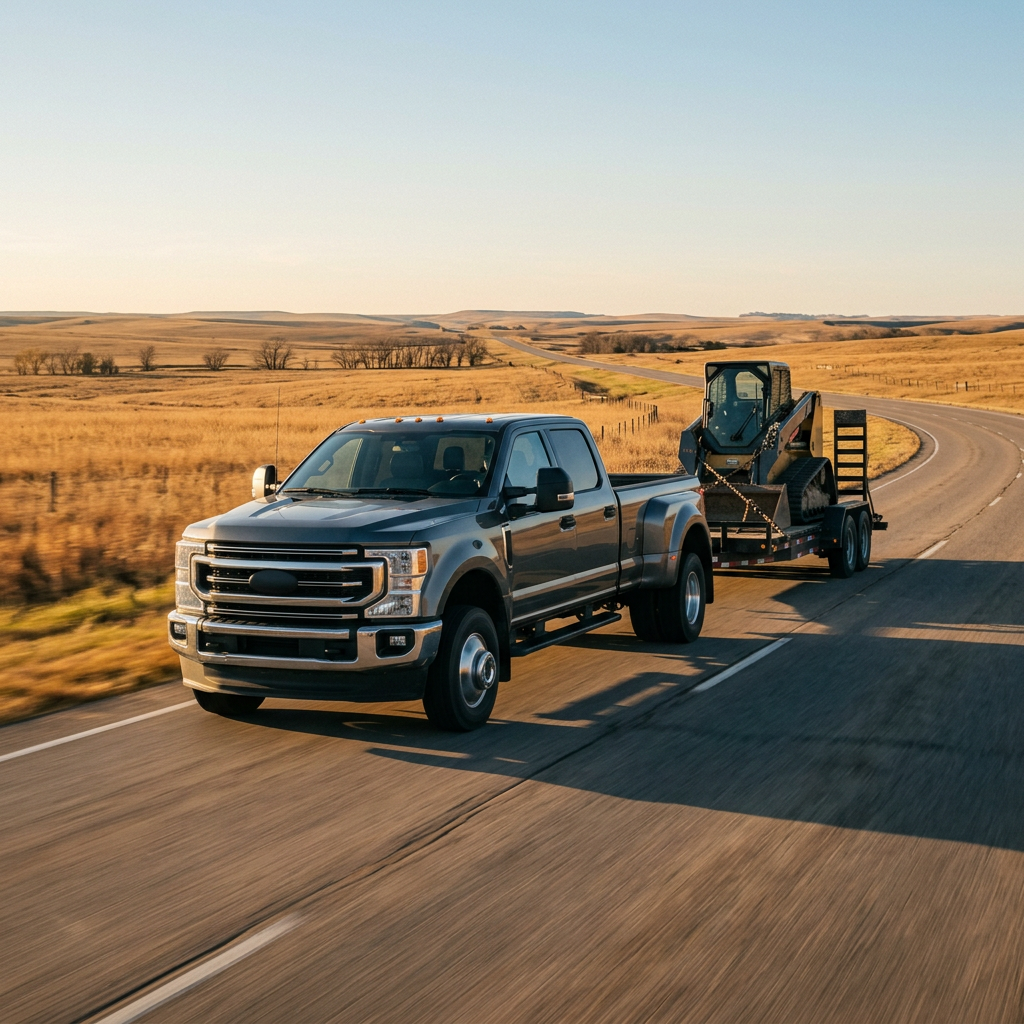
A 6.7L Power Stroke diesel Super Duty typically delivers between 350 and 500 miles of driving range while towing, whereas a comparable gas model towing an identical trailer usually requires fuel every 250 to 350 miles. This real-world range advantage stems directly from the superior thermal efficiency of diesel combustion combined with Ford's generous 34- to 48-gallon factory fuel tanks on long-wheelbase configurations.

Pulling a heavy trailer creates relentless aerodynamic drag and rolling resistance. When working against that sustained load, a gas engine must consume significantly more fuel volume to generate the required low-end work. By contrast, the high compression ratio and turbocharging of the Power Stroke platform allow it to maintain steady highway speeds under load while burning fewer gallons per hour. When pulling equipment past the open riverbanks and flat terrain around Junction City, that extra 100 to 150 miles per tank means skipping crowded fuel stops with a long trailer in tow.

Long-distance towing often turns fuel stops into logistical bottlenecks, especially when maneuvering a 35-foot travel trailer or commercial flatbed through tight service stations. Diesel drivers can use dedicated commercial truck lanes at travel plazas, which feature high-flow nozzles and wider turning radiuses that make refueling quick and stress-free. Gas-powered trucks must navigate standard retail lanes that often lack overhead clearance or sufficient turning space for large rigs.

If you want to map out exact fuel capacities and cab configurations in person, you can find us at our showroom address to review truck specs on the lot, or give our truck specialists a quick call to discuss how specific bed lengths impact tank sizing.

Table of Contents

Towing Capacity vs. Payload: Why Gas Trucks Often Carry More Than Diesels

Gas Super Duty trucks routinely offer between 800 and 1,000 pounds more maximum payload capacity than identically configured diesel models because the heavy cast-iron diesel engine and its exhaust aftertreatment hardware subtract directly from the truck's Gross Vehicle Weight Rating (GVWR). While a properly equipped diesel dominates raw pulling capability, the gas powertrain frequently wins the cargo-bed numbers game.

Maximum available towing reaches up to 40,000 pounds on a properly equipped F-450 running the 6.7L High Output Power Stroke diesel with the High-Capacity Gooseneck Tow Package, while the 7.3L gas V8 tops out at 22,500 pounds of towing. However, payload capacity follows an inverse rule. Every pound added to the front axle by turbochargers, heavy-duty cooling stacks, and emissions equipment is a pound deducted from the payload sticker on the driver door jamb. A gas F-250 or F-350 with the 7.3L gas V8 leaves far more available weight capacity for tongue weight, fifth-wheel pin weight, tools, and passengers.

Fifth-wheel and gooseneck trailers generally place 15 to 25 percent of their total weight directly over the rear axle as pin weight. If you tow a 14,000-pound fifth-wheel camper, your truck must absorb roughly 2,800 to 3,500 pounds of vertical load before accounting for passengers or gear in the cab. In an F-250 configuration, a diesel powertrain can push your rear axle dangerously close to its legal gross weight limit, whereas a gas model retains ample payload cushion for that same pin weight.

For buyers who need agile utility rather than heavy commercial gooseneck hauling, our team also carries versatile adventure options like our new Ford Bronco inventory. When calculating your setup, always verify your trailer's real-world pin weight against the specific truck's door tag rather than relying solely on brochure tow maximums.

How Exhaust Braking and Gas Downshifting Compare on Steep Grades

The 6.7L Power Stroke diesel utilizes an integrated smart exhaust brake that restricts exhaust flow via variable-vane turbocharger technology to deliver immense retarding force, whereas a gas Super Duty must rely solely on transmission downshifting to raise engine RPM for vacuum resistance.

Descending a six percent grade with a 15,000-pound trailer tests braking control far more than hill climbing tests engine output. The diesel smart exhaust brake features dedicated automatic and manual modes. In automatic mode, the truck monitors brake pedal pressure and road speed, instantly spooling the turbocharger vanes closed the moment you lift off the accelerator or tap the pedal. This builds backpressure in the exhaust manifold, creating substantial mechanical resistance that holds the entire rig at a steady descent speed without overheating the wheel brakes.

A gas engine relies on its 10-speed automatic to downshift aggressively into higher RPM ranges to generate engine braking. While Ford's 7.3L gas V8 handles grade descents reliably, holding high engine speeds between 4,000 and 5,000 RPM produces significant cabin noise and offers substantially less total holding power than the diesel turbo brake. Drivers in gas trucks find themselves applying service brakes more frequently on long descents, increasing pad wear and rotor temperatures over time.

Shoppers frequently evaluate these mechanical differences when inspecting our wide selection of quality pre-owned vehicles. Experiencing both setups on an open highway gives you direct insight into how each powertrain manages momentum under load.

DEF Consumption and Why Short Trips Challenge Modern Diesel Exhaust Systems

Diesel Super Duty trucks consume Diesel Exhaust Fluid (DEF) at an accelerated rate of roughly 2 to 3 percent of total fuel burned while towing, and short, unloaded trips can quickly lead to soot accumulation in the Diesel Particulate Filter (DPF).

Under normal unloaded driving, a full 7.4-gallon DEF tank can last between 5,000 and 7,500 miles. When you hook up a heavy trailer and work the engine hard, fuel consumption spikes, causing DEF injection rates to rise proportionally. During continuous heavy towing, that same tank may need a refill every 2,500 to 4,000 miles. Keeping spare DEF in your garage or tracking pump stations along your route becomes an essential habit for long-distance trailering.

Modern diesel emissions systems depend on heat to stay clear. When exhaust temperatures reach sufficient levels during steady highway hauling, the DPF burns off accumulated soot naturally through passive regeneration. However, if a diesel truck is used primarily for five-minute errands or stop-and-go driving without a load, the exhaust never reaches operating temperature. The system then forces active regeneration cycles by injecting raw diesel fuel to raise filter heat, which can lead to fuel dilution in the engine oil, lower efficiency, and premature filter clogging.

If your daily schedule consists of quick local runs between job sites, the simpler exhaust architecture of a gas V8 avoids these emissions hurdles completely. Planning your budget around operating habits is straightforward when you prequalify for financing online, letting you balance initial investment and daily duty cycles from the start.

Maintenance Expenses and Long-Term Resale Value: Counting the True Ownership Costs

Routine service expenses for a 6.7L Power Stroke diesel run roughly 30 to 50 percent higher per visit than for a gas V8, yet diesel Super Duty trucks historically retain a larger dollar amount of their original powertrain investment when traded in years later.

Maintaining a modern diesel involves precise, heavy-duty service intervals. The Power Stroke platform requires approximately 13 quarts of specialized motor oil, dual fuel filter replacements every 15,000 to 20,000 miles, regular DEF fluid refills, and specialized cooling system flushes for its dual radiators. Gas engines, such as the standard gas V8 and the available 7.3L gas V8, use smaller oil capacities, single fuel filters, and standard spark ignition components that keep shop visits simple. You can easily keep up with factory schedules by booking through our team to schedule Ford service or by choosing to order OEM Ford parts directly for your own maintenance garage.

Despite higher routine upkeep costs, diesel models hold exceptional strength on the secondary market. Buyers across farming and construction sectors actively seek pre-owned Power Stroke models for their durability and high-capacity pulling reputation, allowing sellers to recoup an estimated 60 to 75 percent of the initial diesel engine option cost after three to five years. You can check current market conditions right now by submitting your vehicle details for a fast online trade-in appraisal.

The following ownership breakdown outlines how key maintenance items compare across both powertrains:

  • Engine Oil Service: Diesel requires up to 13 quarts of specialized heavy-duty diesel oil per service; gas V8 models use standard synthetic-blend motor oil with lower volume requirements.
  • Fuel Filtration: Diesel systems demand primary and secondary fuel filter replacements at regular intervals to protect high-pressure common-rail injectors; gas models utilize maintenance-free in-tank filters.
  • Exhaust Aftertreatment: Diesel requires periodic DEF tank refills and eventual DPF inspection; gas exhaust systems rely on standard catalytic converters with no fluid refills.
  • Ignition Upkeep: Diesel engines use glow plugs that activate primarily during cold starts; gas engines require scheduled spark plug and ignition coil inspections over higher mileage.

Deciding Between Gas and Power Stroke Diesel for Occasional or Heavy Towing

Choosing between gas and diesel comes down to your annual mileage, your average trailer weight, and how frequently you pull that load across varying terrain.

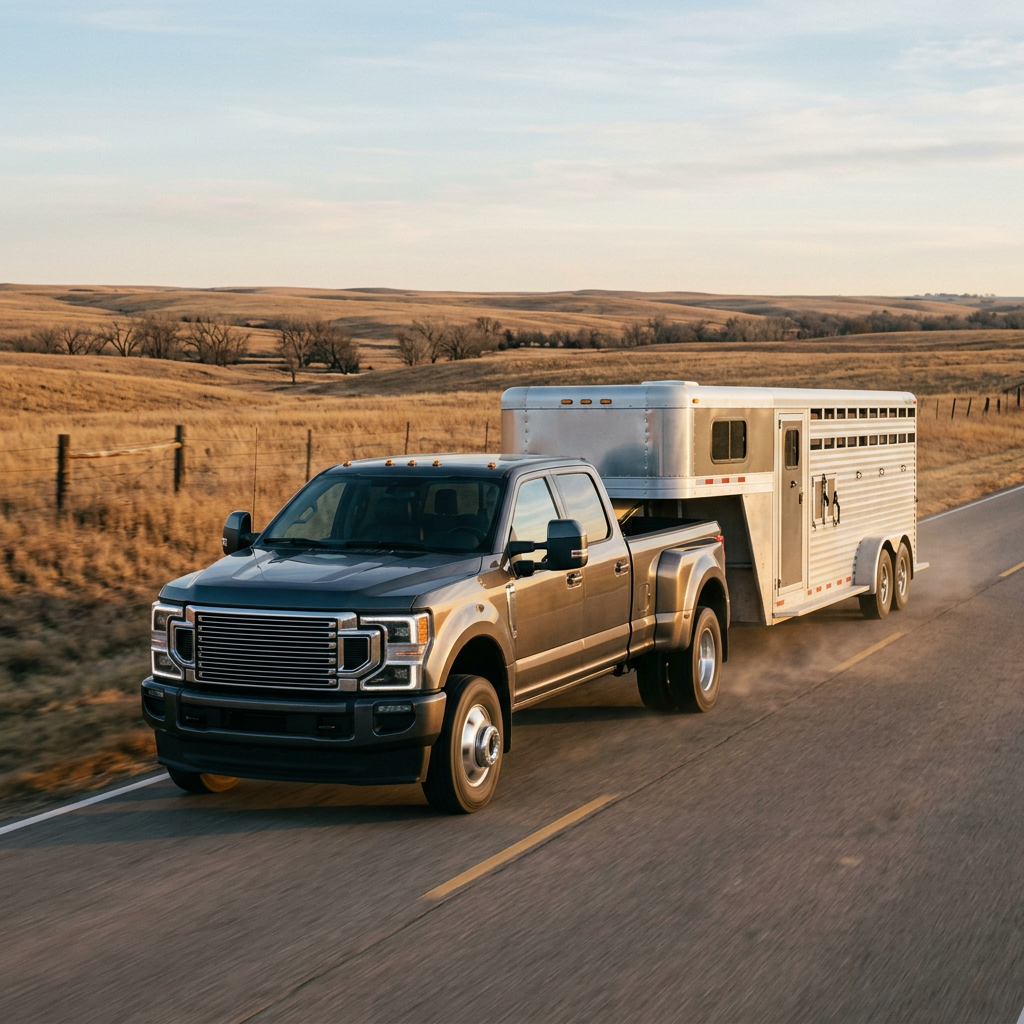
If you tow a travel trailer or livestock trailer weighing under 12,000 pounds just a handful of times per year, a gas Super Duty is usually the most economical and practical choice. The 7.3L gas V8 delivers 430 hp and 485 lb-ft of torque, offering more than enough muscle for recreational camping trips and seasonal hauls without the complex emissions considerations or added purchase price of a diesel. For owners navigating the rural acreage and working ranches of Dickinson County, a gas truck eliminates worries about soot buildup during short utility runs across pasture land.

Conversely, if you pull equipment trailers, large multi-horse trailers, or heavy fifth wheels weighing 15,000 to 20,000 pounds or more on a weekly basis, the 6.7L Power Stroke diesel is worth every penny. With up to 500 hp and 1,200 lb-ft of torque in its high-output configuration, the diesel handles steep highway grades effortlessly, provides superior downhill braking security, and delivers the extended cruising range that demanding towing operations require.

Before making a final choice, take the time to explore Ford Super Duty models on our site, or stop by to speak with our truck team in person. You can reach our sales desk directly at (785) 238-5114 or pull up turn-by-turn dealership directions to match your trailer specs to the perfect Super Duty platform today.

© 2026 Valor Ford. All rights reserved.


Posted in:

Related Posts

2026 Ford Explorer ST-Line vs. 2023 Ford Edge SEL

2026 Ford Explorer ST-Line vs. 2023 Ford Edge SEL

2026 Ford Explorer ST-Line vs. 2023 Ford Edge SEL The New 2026 Ford Explorer ST-Line wins for growing households requiring three rows, a 5,000 lbs towing capacity, and brand-new warranty protection, while the Used 2023 Ford Edge SEL is the smarter financial choice for budget-conscious buyers wanting two rows of spacious seating, standard all-wheel drive, and lower upfront acquisition costs. If seating for up to seven and pulling recreational trailers takes precedence, choose the Explorer; if low-cost two-row utility and about 39 cu ft of standard cargo space suffice, choose the Edge. Table of Contents Which Is the Better Fit: New 2026 Ford Explorer ST-Line or Used 2023 Ford Edge SEL? How Do the $48,749 New 2026 Ford Explorer ST-Line and $22,500 Used 2023 Ford Edge SEL Compare on Value? Which Vehicle Better Fits Geary County Family Space and Weekend Plans? How Do the New 2026 Ford Explorer ST-Line and Used 2023 Ford Edge SEL Feel on the Road—and What About Fuel Economy? Which Vehicle Makes Everyday Tech Easier for Busy Family Trips? How Can Each Vehicle’s Safety Features Support Everyday Drives? What Should Buyers Plan for Warranty, Service, and Maintenance? How Can You Compare Financing, Trade-In Value, and Test Drives Before Choosing? Which Is the Better Fit: New 2026 Ford Explorer ST-Line or Used 2023 Ford Edge SEL? The New 2026 Ford Explorer ST-Line serves buyers who prioritize fresh vehicle architecture, maximum passenger flexibility, and modern driver-assist systems, whereas the Used 2023 Ford Edge SEL suits commuters needing an accessible, midsize two-row footprint with established all-weather composure. Choosing between these vehicles comes down to how your household balances life stage, trailering requirements, and investment targets. The three-row Explorer ST-Line functions as an athletic sweet spot within the brand's midsize lineup. It provides assertive street styling alongside three functional rows of seating. When shopping for family SUVs, some drivers explore adventure-oriented alternatives like our new Ford Bronco selection, while others examine work capability through our 2026 Ford F-150 details. Still, the Explorer bridges everyday suburban life and road-trip convenience by packing a modern digital interface and 5,000 lbs of trailering strength into a unibody platform. Conversely, the 2023 Ford Edge SEL approaches practicality through efficient packaging. Eliminating a third row allows the Edge to provide expansive second-row legroom and an exceptional baseline cargo area without extending exterior dimensions. For owners maintaining an existing utility or installing genuine accessories, our service department provides access to official OEM components to keep your vehicle operating within factory tolerances. How Do the $48,749 New 2026 Ford Explorer ST-Line and $22,500 Used 2023 Ford Edge SEL Compare on Value? The Used 2023 Ford Edge SEL delivers an unbeatable upfront value at $22,500, cutting acquisition costs by more than half compared to the $48,749 listed price of the New 2026 Ford Explorer ST-Line. For shoppers seeking lower initial outlay and reduced overall depreciation, the pre-owned Edge offers incredible capability per dollar. At Valor Ford, unit stock #26FT156 represents a factory-fresh 2026 Explorer ST-Line with only 10 miles on the odometer. Finished in Space White Metallic with an Onyx ActiveX interior, it carries a listed price of $48,749 (against a catalog base MSRP of $45,155 with a $1,795 destination charge). This price reflects brand-new assembly, zero prior wear, factory-fresh mechanical integrity, and advanced connectivity like the Ford Connectivity Package and BlueCruise hardware. By comparison, unit stock #FP00573 is a pre-owned 2023 Ford Edge SEL with 50,519 miles priced at $22,500. Originally carrying a base MSRP of $39,345 with a $1,495 destination charge when new, this Oxford White crossover with an Ebony interior lets you bypass the initial steep depreciation curve. Shoppers can also compare heavy-hauling options via our 2026 Ford F-250 analysis or evaluate our extensive pre-owned vehicle inventory to see where the Edge SEL aligns with family budgeting targets. Pricing Manufacturer-listed pricing per trim, across compared vehicles. 2026 Ford Explorer ST-Line Trim MSRP 2023 Ford Edge SEL Trim MSRP ST-LINE RWD $45,155 SEL AWD $39,345 Which Vehicle Better Fits Geary County Family Space and Weekend Plans? The New 2026 Ford Explorer ST-Line accommodates large crews with its 7 passenger seating capacity, but the Used 2023 Ford Edge SEL provides more immediate gear space behind the rear passengers with about 39 cu ft of standard cargo volume. The physical difference between these two layouts alters daily usability. Measuring 198.7 in in overall length on a 119.1 in wheelbase, the Explorer ST-Line gives you three rows of seating. Up front, it treats driver and passenger to 40.7 in of headroom and 43 in of legroom. Second-row occupants enjoy 40.5 in of headroom and 39 in of legroom, while third-row riders receive 38.9 in of headroom and 32.2 in of legroom. Behind the third row, the Explorer retains about 16 cu ft of trunk volume, expanding to about 86 cu ft when folding down the back rows. For outdoor trips along the Kansas River or while transporting school sports gear, the Explorer's 5,000 lbs gross trailer weight braked capacity makes it capable of towing utility trailers, pop-ups, or small boats, while its 1,467 lbs payload rating supports carrying gear. The two-row Ford Edge SEL measures 188.8 in long on a 112.2 in wheelbase, trading the extra row for concentrated five-passenger comfort. Driver and front passenger receive 40.2 in of headroom and 42.6 in of legroom, while the rear bench provides 40.3 in of headroom and 57.5 in of hip room. With all seats in place, the Edge provides a massive about 39 cu ft cargo compartment, opening to about 73 cu ft with the second row folded flat. While its braked towing limit sits lower at 3,500 lbs, it claims a hefty catalog payload allowance of 4,231 lbs and an unladen curb weight of 4,069 lbs (versus the Explorer's 4,303 lbs). Dimensions & Capacity Capacity and dimensions by trim Specification 2026 Ford Explorer ST-Line 2023 Ford Edge SEL Seating 7 5 Cargo 16.3 cu ft 39.2 cu ft Curb weight 4,303 lbs 4,069 lbs Towing 5,000 lbs 3,500 lbs Payload 1,467 lbs 4,231 lbs How Do the New 2026 Ford Explorer ST-Line and Used 2023 Ford Edge SEL Feel on the Road—and What About Fuel Economy? The New 2026 Ford Explorer ST-Line delivers stronger acceleration with its 300 hp turbocharged engine, while the Used 2023 Ford Edge SEL balances 250 hp with confident, standard all-wheel-drive road composure. Under the Explorer's hood rests an EcoBoost 2.3L I-4 engine developing 300 hp at 5500 rpm and 310 lb-ft of torque at 3500 rpm. Paired with a 10-Speed Automatic SelectShift transmission, the Explorer provides responsive passing power. In standard catalog trim, the rear-wheel-drive architecture yields EPA ratings of 20 city / 29 hwy / 24 combined MPG, while the in-stock unit at Valor Ford features Intelligent 4WD full-time capability for four-season stability. Readers seeking detailed model updates can review our comprehensive 2026 Explorer research to see how its independent multi-link rear suspension handles rough pavement. The Edge SEL uses an EcoBoost 2L I-4 engine producing 250 hp at 5500 rpm and 280 lb-ft of torque at 3000 rpm, routed through an 8-Speed Automatic SelectShift transmission. With standard full-time all-wheel drive, the Edge manages 21 city / 28 hwy / 23 combined MPG. Its torque curve peaks slightly lower in the rev range, making stop-and-go maneuvers brisk. A tighter overall footprint helps the Edge negotiate narrow city parking easily, though its 471.7 in curb-to-curb turning circle is slightly wider than the Explorer's 464.5 in radius. Fuel Economy Fuel economy and range by trim Specification 2026 Ford Explorer ST-Line 2023 Ford Edge SEL MPG 20 city / 29 hwy / 24 combined 21 city / 28 hwy / 23 combined Which Vehicle Makes Everyday Tech Easier for Busy Family Trips? The New 2026 Ford Explorer ST-Line offers superior, updated cabin technology courtesy of a massive 13.2 in center touchscreen paired with a configurable 12.3 in digital cluster, eclipsing the older hardware inside the Used 2023 Ford Edge SEL. Inside the Explorer ST-Line, screens dominate the driver interface. The 13.2 in central touchscreen features embedded Google voice activation, integrated internet connectivity, over-the-air operating system updates, and wireless compatibility for Apple CarPlay and Android Auto. For audio, the Explorer includes a premium 10-speaker sound system by Bang & Olufsen with a dedicated subwoofer. Keeping family devices charged is effortless thanks to four front USB ports, two second-row ports, and two third-row ports, supplemented by three 12V power outlets. Stock #26FT156 also adds BlueCruise hands-free highway driving equipment (including a 1-year plus 90-day active plan) and a 360-Degree Camera with Split View. The 2023 Ford Edge SEL relies on a vertical 12 in center touchscreen running standard wireless Apple CarPlay and Android Auto. Its instrument cluster features dual 4.2 in driver displays flanking an analog speedometer. The sound system routes through a 6-speaker setup. Device charging includes two front USB ports, two rear USB ports, and two 12V outlets. While highly intuitive and user-friendly, the infotainment in the Edge lacks the high-definition graphics and high-speed processing built into Ford's latest software suite. Engine & Performance Powertrain specs by trim Specification 2026 Ford Explorer ST-Line 2023 Ford Edge SEL Standard engine 2.3L 2L Horsepower 300 hp 250 hp Torque 310 lb-ft 280 lb-ft Transmission SelectShift® SelectShift Drivetrain Rear-wheel drive All-wheel drive How Can Each Vehicle’s Safety Features Support Everyday Drives? Both vehicles earned top safety recognition, but the New 2026 Ford Explorer ST-Line features the updated TOP SAFETY PICK designation from the Insurance Institute for Highway Safety, alongside newer low-speed braking assist systems. The Explorer ST-Line incorporates Ford CoPilot360 Assist 2.0, which includes: Pre-Collision Assist with Automatic Emergency Braking, featuring low-speed front and rear braking, oncoming collision avoidance, and pedestrian/cyclist detection. BLIS (Blind Spot Information System) with cross-traffic alert and integrated rear cross-traffic braking. Lane-Keeping System with active steering intervention and lane-centering support. Seven standard airbags, including a dedicated driver's knee airbag and full-length side-curtain coverage across all three rows. NHTSA 5-star overall safety rating and IIHS "Good" marks across updated small overlap and side-impact evaluations. The 2023 Ford Edge SEL also carries a 2023 TOP SAFETY PICK award from the IIHS and a 5-star overall NHTSA rating. Its safety roster features eight airbags (adding a passenger-side knee airbag alongside the driver's unit) and standard Pre-Collision Assist with Automatic Emergency Braking (AEB). In addition to blind-spot monitoring with cross-traffic alert, the Edge SEL comes standard with a Lane-Keeping System and rear parking sensors. While lacking the 360-degree overhead cameras found on the newer Explorer, the Edge delivers rock-solid crash-test credentials for family protection. What Should Buyers Plan for Warranty, Service, and Maintenance? The New 2026 Ford Explorer ST-Line includes full factory coverage with a 3-year/36,000-mile bumper-to-bumper warranty and a 5-year/60,000-mile powertrain warranty, whereas the Used 2023 Ford Edge SEL has eclipsed its standard 36,000-mile bumper-to-bumper limit. When purchasing unit stock #26FT156, the factory warranty starts from mile zero. Ford backs the vehicle with: 3 years or 36,000 miles of whole-vehicle factory protection. 5 years or 60,000 miles of powertrain coverage. 5 years or 60,000 miles of roadside assistance coverage. 5 years or unlimited miles of anti-corrosion sheet metal coverage. For official roadside assistance needs, owners can contact Ford directly: Ford Roadside Assistance: 1-800-241-3673. With 50,519 miles, unit stock #FP00573 has passed its comprehensive 3-year/36,000-mile window, though its original 5-year/60,000-mile powertrain warranty provides remaining factory protection through 60,000 miles. Pre-owned buyers can consult our finance team to add extended protection plans or apply for financing pre-approval to roll warranty products into manageable monthly payments. Routine maintenance for both vehicles—such as tire rotations, multi-point inspections, and synthetic oil services—can be arranged easily when you schedule a service appointment with our certified factory technicians. How Can You Compare Financing, Trade-In Value, and Test Drives Before Choosing? Driving both vehicles back-to-back at Valor Ford is the fastest way to confirm whether the larger three-row layout of the 2026 Ford Explorer ST-Line or the lower payment profile of the 2023 Ford Edge SEL matches your family's routine. Quiet residential roads in Grandview Plaza offer an ideal setting to test low-speed ride smoothness, cabin noise insulation, and parking-space visibility. Evaluating the Explorer's third-row access and the Edge's low rear liftgate height will show clearly which format fits strollers, sporting equipment, or camping gear better. Before making your showroom visit, use our secure portal to request a professional used vehicle trade-in valuation. Getting accurate market numbers for your current car reduces guesswork and helps tailor your financing plan. If you have questions regarding unit availability, vehicle condition reports, or payment terms, call our sales staff at (785) 238-5114. To inspect both vehicles in person, map your trip to 1825 Goldenbelt Blvd, Junction City, KS 66441, where our team will have both keys ready on the lot. © 2026 Valor Ford. All rights reserved. Vehicle specification data © JATO Dynamics Limited.

At What Trailer Weight Is a Super Duty Diesel Strongly Recommended Over Gas?

At What Trailer Weight Is a Super Duty Diesel Strongly Recommended Over Gas?

At What Trailer Weight Is a Super Duty Diesel Strongly Recommended Over Gas? A diesel engine is strongly recommended once your regular trailer weight crosses 14,000 to 15,000 pounds. Below that threshold, a modern heavy-duty gas engine manages the load comfortably for occasional weekend trips or job-site runs. Once you consistently hook up to loads exceeding 15,000 pounds—especially enclosed horse trailers, large fifth wheels, or heavy equipment haulers—the diesel powertrain transforms the towing experience by delivering immense low-end pulling power, reduced engine strain, and active downhill engine braking. In my 11 years as a Finance Manager at Valor Ford, I walk customers through the financial and mechanical realities of their purchase every day. When truck shoppers sit down at my desk, the initial focus is often on raw maximum tow ratings. The real deciding factor is how often you tow, the terrain you navigate, and how much weight sits behind the bumper. If you haul heavy equipment across the rolling agricultural corridors around Junction City on a daily basis, opting for the diesel engine provides the long-term powertrain durability and composure that protects your investment over years of heavy use. Choosing the right powertrain upfront prevents expensive trading cycles later. If you buy a gas truck and routinely overload its sweet spot, you will face increased fuel stops, higher engine speeds on grades, and earlier wear on mechanical components. Our team can help you evaluate your equipment and trailer setup before you sign. You can stop by our showroom on Goldenbelt Boulevard to review window stickers and powertrain options, or give us a quick call to discuss current allocation. Table of Contents What Is the Towing and Payload Capacity Difference Between Super Duty Diesel and Gas? How Do Torque and Horsepower Compare Between the 6.7L Power Stroke and 7.3L Gas V8? How Does the Driving Experience Differ When Towing With Gas Versus Diesel? What Is the Real-World Towing Fuel Economy for Super Duty Diesel Versus Gas? How Many Miles Does It Take to Break Even on the Upfront Diesel Engine Cost? Finding and Financing Your Next Ford Super Duty at Valor Ford What Is the Towing and Payload Capacity Difference Between Super Duty Diesel and Gas? The Ford Super Duty diesel holds a substantial advantage in maximum gooseneck and fifth-wheel towing, while the gas engine often delivers higher available payload ratings. Properly equipped, the 7.3-liter gas V8 reaches a maximum towing capacity of 22,500 pounds, whereas the standard-output 6.7-liter Power Stroke diesel pulls up to 38,600 pounds, and the high-output diesel reaches an astounding 40,000 pounds. Achieving that headline 40,000-pound rating requires a specific build: an F-450 Regular Cab dual-rear-wheel configuration equipped with the High-Capacity Gooseneck Tow Package. In typical single-rear-wheel Crew Cab setups, the conventional towing differences are narrower. For example, in an F-250 Crew Cab 4x4 configuration, conventional bumper-pull towing is rated at 18,200 pounds with the 7.3-liter gas engine compared to 22,000 pounds with the diesel. Payload tells an equally important story that many buyers overlook during the ordering process. The 6.7-liter Power Stroke diesel engine and its aftertreatment system add roughly 800 to 1,000 pounds of curb weight to the front axle compared to the gas V8. Because Gross Vehicle Weight Ratings are fixed by class, that additional engine weight directly subtracts from available payload. A properly configured gas Super Duty offers up to 7,635 pounds of maximum payload, compared to 6,935 pounds on a high-output diesel model. If you tow a large fifth wheel or gooseneck, pin weight counts against your payload capacity, making the gas truck appealing for specific heavy-pin, moderate-trailer configurations. If your trailering requirements are much lighter and focused on weekend recreation, our lot also features alternatives like the new Ford Bronco, but for serious hauling tasks, matching Super Duty payload to trailer tongue weight is essential. How Do Torque and Horsepower Compare Between the 6.7L Power Stroke and 7.3L Gas V8? The primary operational difference between these two engines lies in peak torque delivery and the engine speed where that power occurs. The naturally aspirated 7.3-liter gas V8 produces 430 hp at 5,500 rpm and 485 lb-ft of torque at 4,000 rpm. The standard-output 6.7-liter Power Stroke diesel produces 475 hp and 1,050 lb-ft of torque, while the high-output variant elevates output to 500 hp and 1,200 lb-ft of torque starting at just 1,600 rpm. That massive torque gap fundamentally changes how each truck moves a load from a complete stop. While the 7.3-liter gas engine is a pushrod workhorse designed for commercial reliability and low maintenance, it requires higher engine revolutions to reach its powerband. The diesel engine delivers more than double the torque of the gas V8 right off idle. That allows the turbocharger to build boost quickly and pull heavy trailers up highway merge ramps without breaking a sweat. Both engines pair with Ford’s heavy-duty 10-speed automatic transmission, which provides tightly spaced gear ratios that optimize engine performance. The gas engine shifts more frequently to stay in the upper registers of its torque curve under heavy strain, whereas the diesel locks into a higher gear and uses its immense low-rpm torque to climb hills without downshifting. For shoppers exploring late-model options, our selection of pre-owned trucks and haulers frequently features both powertrain designs so you can evaluate the mechanical differences firsthand. How Does the Driving Experience Differ When Towing With Gas Versus Diesel? Towing with a diesel truck feels relaxed and quiet, while towing heavy with a gas truck demands more driver involvement and higher engine revolutions. When climbing a 6% grade with a 14,000-pound load, the 7.3-liter gas V8 will downshift several gears, causing engine speeds to jump past 4,000 rpm where the cabin experiences noticeable mechanical noise. The truck handles the grade safely, but the high-revving nature of a gas engine working near capacity can be fatiguing on long-distance hauls. The 6.7-liter Power Stroke diesel handles that same steep highway climb at 1,800 to 2,200 rpm in eighth or ninth gear. Acceleration is prompt, and passing slower traffic requires minimal throttle input. More importantly, the diesel engine includes a factory integrated exhaust brake. This system utilizes variable turbocharger geometry to create engine backpressure, slowing the truck and trailer smoothly on steep descents without overheating the wheel brakes. For commercial operators, cattle ranchers, and contractors moving stock through rural Dickinson County, the difference in descending control provides significant peace of mind. Instead of riding the service brakes and risking fade down rolling terrain, the exhaust brake holds the entire rig at a steady, preset speed. If you are considering trading in your current half-ton or older gas three-quarter-ton truck, our staff can run a prompt used vehicle trade valuation to determine your equity position before upgrading to a heavy-duty platform. What Is the Real-World Towing Fuel Economy for Super Duty Diesel Versus Gas? Fuel efficiency while towing is significantly higher with the diesel powertrain, helping balance out fuel pump price differences over extended mileage. When pulling an aerodynamic or moderate load between 10,000 and 15,000 pounds, the 6.7-liter Power Stroke diesel typically returns 10 to 13 mpg, depending on wind conditions and road speed. Under identical conditions, the 7.3-liter gas V8 generally achieves 7 to 9 mpg. Unladen highway driving reveals an even wider variance between the two powerplants. In independent 75-mph highway testing, an F-250 4x4 Crew Cab equipped with the high-output diesel achieved 20 mpg, yielding a cruising range of 680 miles. The same cab configuration with the 7.3-liter gas engine registered 15 mpg, delivering roughly 510 miles of highway range. The gas engine operates on standard 87-octane unleaded fuel, while the diesel requires ultra-low-sulfur diesel and regular replenishments of Diesel Exhaust Fluid. Fuel economy also impacts your daily driving schedule. A truck delivering 12 mpg while towing allows you to travel nearly 150 miles farther per tank than a truck averaging 8 mpg, cutting down on awkward stops at compact highway gas stations with a 35-foot trailer in tow. You can review full platform specs and cab combinations through our Ford Super Duty F-250 model breakdown to determine which tank size and wheelbase align with your regional travel needs. How Many Miles Does It Take to Break Even on the Upfront Diesel Engine Cost? From a strict fuel-savings perspective, most commercial and retail buyers need to tow between 120,000 and 150,000 miles before the diesel's superior fuel economy offsets its initial purchase premium. Upgrading from the gas engine to the standard 6.7-liter Power Stroke diesel adds roughly $9,995 to the window sticker, while the high-output version commands approximately $12,495. Calculating the true break-even horizon requires looking at the total cost of ownership rather than fuel alone: Fuel cost differentials: While diesel fuel often carries a per-gallon price premium over 87-octane gas, the diesel truck burns 25% to 35% less fuel when towing heavy trailers. Maintenance requirements: Diesel engines hold up to 13 quarts of specialized oil, require regular fuel filter replacements at shorter intervals, and consume Diesel Exhaust Fluid during heavy pulling. Resale value retention: In the finance department, we consistently see diesel Super Duty trucks command substantially higher trade-in values after four to six years on the road, recovering 60% to 75% of the original engine option cost at resale. Powertrain warranty protection: Ford backs the gas powertrain with a 5-year/60,000-mile warranty, whereas the diesel powertrain comes standard with a 5-year/100,000-mile warranty, offering extended protection for high-mileage drivers. If you drive fewer than 10,000 miles per year and only pull a camper on holiday weekends, the 7.3-liter gas engine is mathematically the smarter financial choice. The lower purchase price keeps your monthly payment manageable, and you avoid the extra cost of fuel filters and emissions fluids. If you log 25,000 miles annually with a commercial trailer hitched every week, the diesel's fuel savings, extended engine life, and strong resale value make it the superior purchase. Finding and Financing Your Next Ford Super Duty at Valor Ford Matching the right Super Duty engine to your trailering demands comes down to transparent numbers, real equipment weights, and personalized financing structures. At Valor Ford, our sales consultants and finance team work side by side to ensure you do not overspend on capabilities you will never use, or compromise on powertrain strength when your livelihood demands maximum towing performance. We partner with a wide array of local credit unions, regional lenders, and Ford Motor Credit to help you explore financing options that fit your needs. Whether you need an entry-level work truck with the 7.3-liter V8 or a fully optioned Lariat dualie with the high-output Power Stroke, we take the hassle out of the purchase process. You can start your paperwork ahead of time and apply for pre-approval online in just a few minutes. When you are ready to compare gas and diesel driving dynamics on the open road, plan a trip to see us in person at 1825 Goldenbelt Blvd, Junction City, KS 66441. You can stop in for a walk-around tour of our inventory or call our team directly at (785) 238-5114 to set up a dedicated commercial or retail consultation. Let us help you secure the capability and value you need before you hook up your next load. Keep Your Vehicle Running Strong Keep your vehicle performing at its best with our service team: Schedule Pickup and Delivery Service Schedule Ford Service Today Order Genuine Ford Parts © 2026 Valor Ford. All rights reserved.

What You Should Know About the 2027 Ford SUV Lineup from Valor Ford

What You Should Know About the 2027 Ford SUV Lineup from Valor Ford

What You Should Know About the 2027 Ford SUV Lineup from Valor Ford What SUV Models Are Included in the 2027 Ford SUV Lineup? The 2027 Ford SUV lineup includes the compact Bronco Sport, the midsize three-row Explorer, the full-size Expedition, the off-road-focused Bronco, and the all-electric Mustang Mach-E. The two-row Ford Edge remains discontinued in North America, while manufacturer specifications and availability details for a 2027 Ford Escape have not been officially confirmed. When customers walk into our showroom, they are often trying to match a specific size and capability to their daily routine. Ford has streamlined its crossover and SUV offerings so that every model serves a distinct purpose. For drivers needing agile city parking with all-weather traction, compact crossovers lead the way. Families requiring extra seating and heavy towing capacity naturally lean toward midsize and full-size platforms. Commuters navigating daily drives through Junction City along the Kansas River corridor frequently ask how these models compare in fuel efficiency and cabin flexibility. As Dealer Principal at Valor Ford, I have seen model lineups evolve over my 40 years in the automotive industry, and this year's family of crossovers is one of the most capable we have ever offered. Whether you need an efficient daily commuter or a vehicle ready to pull a boat on the weekend, exploring our new Ford SUV lineup gives you a clear view of how these models fit different lifestyle demands. If you want to check out these models in person, you can stop by our Junction City showroom or give our team a quick call to learn more. Table of Contents What Are the 2027 Ford Explorer Engine, Cargo, and Towing Specs? How Does 2027 Ford Explorer Third-Row Legroom Compare to Traverse and Highlander? What Is the Starting Price and Off-Road Capability for the 2027 Ford Bronco Sport? What Is the Maximum Driving Range and Tech Updates for the 2027 Ford Mustang Mach-E? How to Test Drive and Finance Your Next 2027 SUV at Valor Ford What Are the 2027 Ford Explorer Engine, Cargo, and Towing Specs? The 2027 Ford Explorer comes standard with a turbocharged 2.3L EcoBoost® four-cylinder engine generating 300 hp and 310 lb-ft of torque, paired with a 10-speed SelectShift® automatic transmission. Higher trims offer a 3.0L EcoBoost® V6 producing up to 400 hp, while cargo space measures 16 cubic feet behind the third row, expanding to 86 cubic feet with rear seats folded, and maximum towing capacity reaches 5,000 lbs. Engine performance on the Explorer varies by trim level to match different driving demands. The standard 2.3L EcoBoost® engine provides an EPA-rated 20 city / 27 hwy MPG in four-wheel drive configurations, making it a well-balanced choice for daily highway cruising and family errands. The available 3.0L EcoBoost® V6 comes standard on performance-oriented trims like the ST and is available on the rugged Tremor and luxurious Platinum editions. Power output on the V6 reaches up to 400 hp, though state emissions configurations in select areas may rate output at 385 hp. Cargo utility and trailering are primary reasons families select the Explorer. Behind the upright third row, you get 16 cubic feet of storage, which easily accommodates groceries or athletic bags. Lowering the second and third rows opens up a massive 86 cubic feet of flat cargo space. When properly equipped with the factory receiver hitch, the Explorer boasts a maximum towing rating of 5,000 lbs and a maximum payload capacity of 1,467 lbs. If you are comparing new options against pre-owned midsize crossovers, reviewing detailed Ford Explorer specifications helps clarify how recent engineering updates impact real-world utility, or you can browse our pre-owned vehicle inventory to see prior model years side-by-side. How Does 2027 Ford Explorer Third-Row Legroom Compare to Traverse and Highlander? The 2027 Ford Explorer provides 32 inches of third-row legroom, positioning it directly between the Chevrolet Traverse at 34 inches and the Toyota Highlander at 28 inches. Third-row legroom is a crucial metric for buyers who regularly carry older children or adult passengers in the back. While the Chevrolet Traverse offers slightly more overall legroom in the rearmost seats at 34 inches, the Explorer's 32 inches provides sufficient room for teenagers and adults on short to medium trips. By contrast, the Toyota Highlander's 28 inches of third-row legroom creates a much tighter squeeze, making its back row best suited for small children. Cabin flexibility in the Explorer extends beyond raw dimensions. Available in six-passenger or seven-passenger seating layouts, the second row can be configured with bench seats or tilt-and-slide captain's chairs. The slide mechanism allows second-row passengers to move their seats forward by several inches, balancing legroom across all three rows depending on who is riding along. Drivers hauling supplies across rural gravel routes in Dickinson County appreciate how quickly the third row folds flat into the load floor when cargo space takes priority over seating. If you are looking to trade in your current family vehicle for a three-row crossover, you can easily evaluate your trade-in online to see what your vehicle is worth toward a new model. What Is the Starting Price and Off-Road Capability for the 2027 Ford Bronco Sport? The 2027 Ford Bronco Sport starts at an estimated MSRP of $31,695 for the base Big Bend trim and scales up to $36,760 for the trail-ready Badlands trim. Off-road performance is standard across the entire Bronco Sport lineup thanks to standard four-wheel drive and Ford's terrain management system. Trim options include Big Bend, Heritage, Outer Banks, and Badlands. The first three trims feature a 1.5-liter EcoBoost three-cylinder engine outputting 180 hp and 200 lb-ft of torque, yielding an EPA-estimated 25 city / 30 hwy MPG. Five standard G.O.A.T. Modes® (Goes Over Any Type of Terrain)—Normal, Eco, Sport, Slippery, and Sand—allow drivers to adapt traction control and throttle response to changing surface conditions. For serious trail enthusiasts, the Badlands model upgrades to a 2.0-liter EcoBoost four-cylinder engine generating 250 hp and 280 lb-ft of torque. The Badlands also incorporates an advanced four-wheel-drive system with a twin-clutch rear drive unit, an off-road-tuned HOSS 2.0 suspension, steel skid plates, and two additional G.O.A.T. Modes®: Mud/Ruts and Rock Crawl. Inside, the cabin offers up to 29 cubic feet of cargo room behind the rear seats and up to 65 cubic feet with the rear seats folded down, making it as practical for grocery runs as it is for weekend camping trips. What Is the Maximum Driving Range and Tech Updates for the 2027 Ford Mustang Mach-E? The 2027 Ford Mustang Mach-E achieves an EPA-estimated maximum driving range of up to 320 miles when configured with the extended-range battery and rear-wheel drive. Battery configurations have been updated for 2027 to simplify ordering and improve standard capability. The entry-level Select and Premium trims now come standard with an 88-kWh battery pack, replacing the smaller standard-range pack from previous years. The high-performance GT and off-road-inspired Rally trims are equipped with a larger 91-kWh battery pack. Single-motor rear-wheel-drive models produce between 264 hp and 272 hp, while dual-motor all-wheel-drive variants output up to 480 hp and 700 lb-ft of torque in GT and Rally specs. DC fast charging capability allows the battery to charge at rates up to 150 kW, taking the pack from 10 to 80 percent in approximately 36 minutes at a public fast charger. Inside the cabin, technology is centered around a vertically oriented 15-inch central touchscreen running the latest Ford Digital Experience software. Standard features include wireless Apple CarPlay, Android Auto, and integrated navigation. Driver-assist technologies include standard automated emergency braking, blind-spot monitoring, and available BlueCruise hands-free highway driving. Prospective electric vehicle buyers can check out our detailed Mustang research guide to evaluate EV performance stats and interior dimensions. How to Test Drive and Finance Your Next 2027 SUV at Valor Ford Selecting the right SUV comes down to testing features on the road and setting up financing that fits your monthly budget. When you arrive for a test drive, our team takes time to demonstrate key features before hitting the road. We walk you through folding seat mechanisms, cargo load heights, screen menus, and driver-assist settings so you feel confident behind the wheel. On the road, you can experience how different engine choices accelerate, test braking responsiveness, and evaluate cabin noise levels under real driving conditions. Financing your next crossover is straightforward with our finance team. We work with a wide network of local and national lenders to secure competitive rates for every credit profile. You can start the process from home by choosing to get pre-approved online, saving you time at the dealership. If you have questions about specific models or want to schedule your test drive, stop by our showroom at 1825 Goldenbelt Blvd or give us a quick phone call today. Keep Your Vehicle Running Strong Keep your vehicle performing at its best with our service team: Schedule Pickup and Delivery Service Schedule Ford Service Today Order Genuine Ford Parts © 2026 Valor Ford. All rights reserved. Vehicle specification data © JATO Dynamics Limited.