

Blog / Model Comparisons

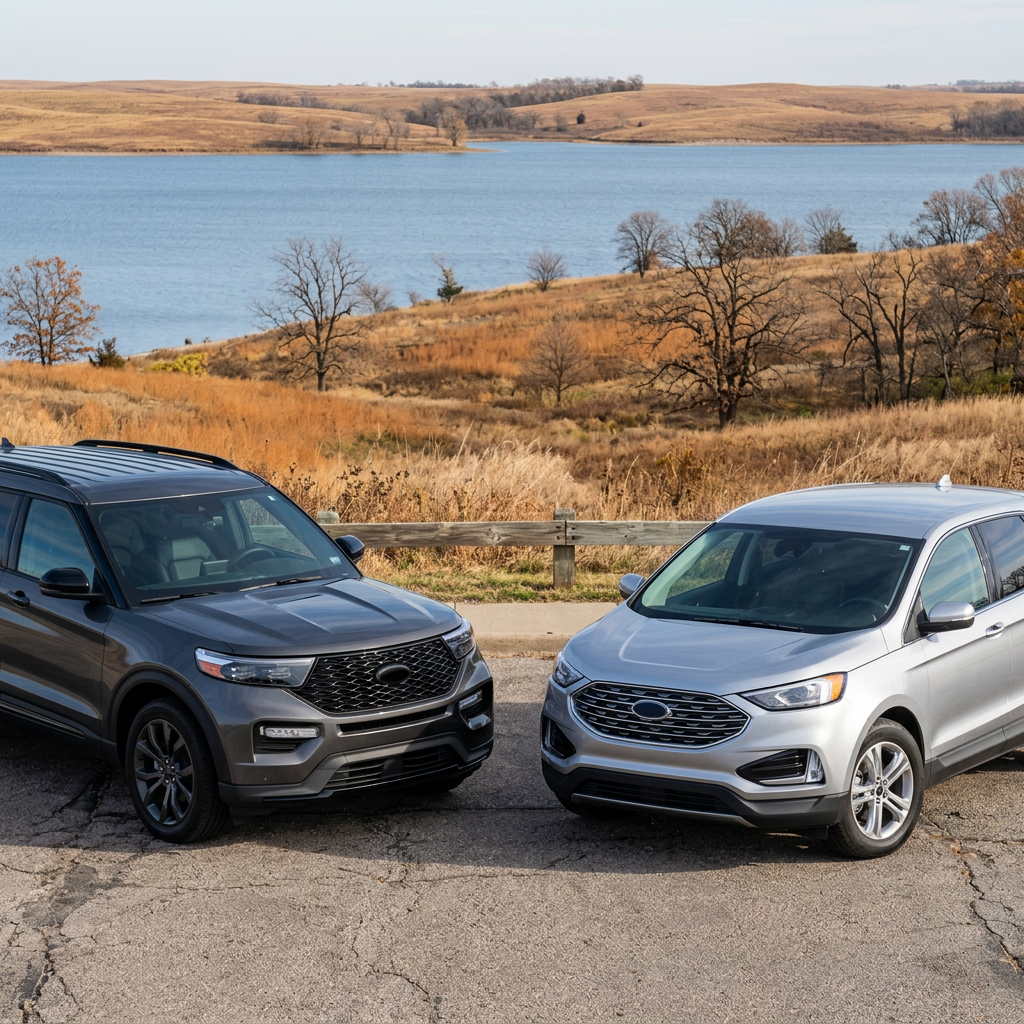
2026 Ford Explorer ST-Line vs. 2023 Ford Edge SEL

2026 Ford Explorer ST-Line vs. 2023 Ford Edge SEL

2026 Ford Explorer ST-Line vs. 2023 Ford Edge SEL

The New 2026 Ford Explorer ST-Line wins for growing households requiring three rows, a 5,000 lbs towing capacity, and brand-new warranty protection, while the Used 2023 Ford Edge SEL is the smarter financial choice for budget-conscious buyers wanting two rows of spacious seating, standard all-wheel drive, and lower upfront acquisition costs. If seating for up to seven and pulling recreational trailers takes precedence, choose the Explorer; if low-cost two-row utility and about 39 cu ft of standard cargo space suffice, choose the Edge.

Table of Contents

Which Is the Better Fit: New 2026 Ford Explorer ST-Line or Used 2023 Ford Edge SEL?

The New 2026 Ford Explorer ST-Line serves buyers who prioritize fresh vehicle architecture, maximum passenger flexibility, and modern driver-assist systems, whereas the Used 2023 Ford Edge SEL suits commuters needing an accessible, midsize two-row footprint with established all-weather composure. Choosing between these vehicles comes down to how your household balances life stage, trailering requirements, and investment targets.

The three-row Explorer ST-Line functions as an athletic sweet spot within the brand's midsize lineup. It provides assertive street styling alongside three functional rows of seating. When shopping for family SUVs, some drivers explore adventure-oriented alternatives like our new Ford Bronco selection, while others examine work capability through our 2026 Ford F-150 details. Still, the Explorer bridges everyday suburban life and road-trip convenience by packing a modern digital interface and 5,000 lbs of trailering strength into a unibody platform.

Conversely, the 2023 Ford Edge SEL approaches practicality through efficient packaging. Eliminating a third row allows the Edge to provide expansive second-row legroom and an exceptional baseline cargo area without extending exterior dimensions. For owners maintaining an existing utility or installing genuine accessories, our service department provides access to official OEM components to keep your vehicle operating within factory tolerances.

How Do the $48,749 New 2026 Ford Explorer ST-Line and $22,500 Used 2023 Ford Edge SEL Compare on Value?

The Used 2023 Ford Edge SEL delivers an unbeatable upfront value at $22,500, cutting acquisition costs by more than half compared to the $48,749 listed price of the New 2026 Ford Explorer ST-Line. For shoppers seeking lower initial outlay and reduced overall depreciation, the pre-owned Edge offers incredible capability per dollar.

At Valor Ford, unit stock #26FT156 represents a factory-fresh 2026 Explorer ST-Line with only 10 miles on the odometer. Finished in Space White Metallic with an Onyx ActiveX interior, it carries a listed price of $48,749 (against a catalog base MSRP of $45,155 with a $1,795 destination charge). This price reflects brand-new assembly, zero prior wear, factory-fresh mechanical integrity, and advanced connectivity like the Ford Connectivity Package and BlueCruise hardware.

By comparison, unit stock #FP00573 is a pre-owned 2023 Ford Edge SEL with 50,519 miles priced at $22,500. Originally carrying a base MSRP of $39,345 with a $1,495 destination charge when new, this Oxford White crossover with an Ebony interior lets you bypass the initial steep depreciation curve. Shoppers can also compare heavy-hauling options via our 2026 Ford F-250 analysis or evaluate our extensive pre-owned vehicle inventory to see where the Edge SEL aligns with family budgeting targets.

Pricing

Manufacturer-listed pricing per trim, across compared vehicles.

2026 Ford Explorer ST-Line Trim MSRP 2023 Ford Edge SEL Trim MSRP
ST-LINE RWD $45,155 SEL AWD $39,345

Which Vehicle Better Fits Geary County Family Space and Weekend Plans?

The New 2026 Ford Explorer ST-Line accommodates large crews with its 7 passenger seating capacity, but the Used 2023 Ford Edge SEL provides more immediate gear space behind the rear passengers with about 39 cu ft of standard cargo volume.

The physical difference between these two layouts alters daily usability. Measuring 198.7 in in overall length on a 119.1 in wheelbase, the Explorer ST-Line gives you three rows of seating. Up front, it treats driver and passenger to 40.7 in of headroom and 43 in of legroom. Second-row occupants enjoy 40.5 in of headroom and 39 in of legroom, while third-row riders receive 38.9 in of headroom and 32.2 in of legroom. Behind the third row, the Explorer retains about 16 cu ft of trunk volume, expanding to about 86 cu ft when folding down the back rows. For outdoor trips along the Kansas River or while transporting school sports gear, the Explorer's 5,000 lbs gross trailer weight braked capacity makes it capable of towing utility trailers, pop-ups, or small boats, while its 1,467 lbs payload rating supports carrying gear.

The two-row Ford Edge SEL measures 188.8 in long on a 112.2 in wheelbase, trading the extra row for concentrated five-passenger comfort. Driver and front passenger receive 40.2 in of headroom and 42.6 in of legroom, while the rear bench provides 40.3 in of headroom and 57.5 in of hip room. With all seats in place, the Edge provides a massive about 39 cu ft cargo compartment, opening to about 73 cu ft with the second row folded flat. While its braked towing limit sits lower at 3,500 lbs, it claims a hefty catalog payload allowance of 4,231 lbs and an unladen curb weight of 4,069 lbs (versus the Explorer's 4,303 lbs).

Dimensions & Capacity

Capacity and dimensions by trim

Specification 2026 Ford Explorer ST-Line 2023 Ford Edge SEL
Seating 7 5
Cargo 16.3 cu ft 39.2 cu ft
Curb weight 4,303 lbs 4,069 lbs
Towing 5,000 lbs 3,500 lbs
Payload 1,467 lbs 4,231 lbs

How Do the New 2026 Ford Explorer ST-Line and Used 2023 Ford Edge SEL Feel on the Road—and What About Fuel Economy?

The New 2026 Ford Explorer ST-Line delivers stronger acceleration with its 300 hp turbocharged engine, while the Used 2023 Ford Edge SEL balances 250 hp with confident, standard all-wheel-drive road composure.

Under the Explorer's hood rests an EcoBoost 2.3L I-4 engine developing 300 hp at 5500 rpm and 310 lb-ft of torque at 3500 rpm. Paired with a 10-Speed Automatic SelectShift transmission, the Explorer provides responsive passing power. In standard catalog trim, the rear-wheel-drive architecture yields EPA ratings of 20 city / 29 hwy / 24 combined MPG, while the in-stock unit at Valor Ford features Intelligent 4WD full-time capability for four-season stability. Readers seeking detailed model updates can review our comprehensive 2026 Explorer research to see how its independent multi-link rear suspension handles rough pavement.

The Edge SEL uses an EcoBoost 2L I-4 engine producing 250 hp at 5500 rpm and 280 lb-ft of torque at 3000 rpm, routed through an 8-Speed Automatic SelectShift transmission. With standard full-time all-wheel drive, the Edge manages 21 city / 28 hwy / 23 combined MPG. Its torque curve peaks slightly lower in the rev range, making stop-and-go maneuvers brisk. A tighter overall footprint helps the Edge negotiate narrow city parking easily, though its 471.7 in curb-to-curb turning circle is slightly wider than the Explorer's 464.5 in radius.

Fuel Economy

Fuel economy and range by trim

Specification 2026 Ford Explorer ST-Line 2023 Ford Edge SEL
MPG 20 city / 29 hwy / 24 combined 21 city / 28 hwy / 23 combined

Which Vehicle Makes Everyday Tech Easier for Busy Family Trips?

The New 2026 Ford Explorer ST-Line offers superior, updated cabin technology courtesy of a massive 13.2 in center touchscreen paired with a configurable 12.3 in digital cluster, eclipsing the older hardware inside the Used 2023 Ford Edge SEL.

Inside the Explorer ST-Line, screens dominate the driver interface. The 13.2 in central touchscreen features embedded Google voice activation, integrated internet connectivity, over-the-air operating system updates, and wireless compatibility for Apple CarPlay and Android Auto. For audio, the Explorer includes a premium 10-speaker sound system by Bang & Olufsen with a dedicated subwoofer. Keeping family devices charged is effortless thanks to four front USB ports, two second-row ports, and two third-row ports, supplemented by three 12V power outlets. Stock #26FT156 also adds BlueCruise hands-free highway driving equipment (including a 1-year plus 90-day active plan) and a 360-Degree Camera with Split View.

The 2023 Ford Edge SEL relies on a vertical 12 in center touchscreen running standard wireless Apple CarPlay and Android Auto. Its instrument cluster features dual 4.2 in driver displays flanking an analog speedometer. The sound system routes through a 6-speaker setup. Device charging includes two front USB ports, two rear USB ports, and two 12V outlets. While highly intuitive and user-friendly, the infotainment in the Edge lacks the high-definition graphics and high-speed processing built into Ford's latest software suite.

Engine & Performance

Powertrain specs by trim

Specification 2026 Ford Explorer ST-Line 2023 Ford Edge SEL
Standard engine 2.3L 2L
Horsepower 300 hp 250 hp
Torque 310 lb-ft 280 lb-ft
Transmission SelectShift® SelectShift
Drivetrain Rear-wheel drive All-wheel drive

How Can Each Vehicle’s Safety Features Support Everyday Drives?

Both vehicles earned top safety recognition, but the New 2026 Ford Explorer ST-Line features the updated TOP SAFETY PICK designation from the Insurance Institute for Highway Safety, alongside newer low-speed braking assist systems.

The Explorer ST-Line incorporates Ford CoPilot360 Assist 2.0, which includes:

  • Pre-Collision Assist with Automatic Emergency Braking, featuring low-speed front and rear braking, oncoming collision avoidance, and pedestrian/cyclist detection.
  • BLIS (Blind Spot Information System) with cross-traffic alert and integrated rear cross-traffic braking.
  • Lane-Keeping System with active steering intervention and lane-centering support.
  • Seven standard airbags, including a dedicated driver's knee airbag and full-length side-curtain coverage across all three rows.
  • NHTSA 5-star overall safety rating and IIHS "Good" marks across updated small overlap and side-impact evaluations.

The 2023 Ford Edge SEL also carries a 2023 TOP SAFETY PICK award from the IIHS and a 5-star overall NHTSA rating. Its safety roster features eight airbags (adding a passenger-side knee airbag alongside the driver's unit) and standard Pre-Collision Assist with Automatic Emergency Braking (AEB). In addition to blind-spot monitoring with cross-traffic alert, the Edge SEL comes standard with a Lane-Keeping System and rear parking sensors. While lacking the 360-degree overhead cameras found on the newer Explorer, the Edge delivers rock-solid crash-test credentials for family protection.

What Should Buyers Plan for Warranty, Service, and Maintenance?

The New 2026 Ford Explorer ST-Line includes full factory coverage with a 3-year/36,000-mile bumper-to-bumper warranty and a 5-year/60,000-mile powertrain warranty, whereas the Used 2023 Ford Edge SEL has eclipsed its standard 36,000-mile bumper-to-bumper limit.

When purchasing unit stock #26FT156, the factory warranty starts from mile zero. Ford backs the vehicle with:

  • 3 years or 36,000 miles of whole-vehicle factory protection.
  • 5 years or 60,000 miles of powertrain coverage.
  • 5 years or 60,000 miles of roadside assistance coverage.
  • 5 years or unlimited miles of anti-corrosion sheet metal coverage.

For official roadside assistance needs, owners can contact Ford directly: Ford Roadside Assistance: 1-800-241-3673.

With 50,519 miles, unit stock #FP00573 has passed its comprehensive 3-year/36,000-mile window, though its original 5-year/60,000-mile powertrain warranty provides remaining factory protection through 60,000 miles. Pre-owned buyers can consult our finance team to add extended protection plans or apply for financing pre-approval to roll warranty products into manageable monthly payments. Routine maintenance for both vehicles—such as tire rotations, multi-point inspections, and synthetic oil services—can be arranged easily when you schedule a service appointment with our certified factory technicians.

How Can You Compare Financing, Trade-In Value, and Test Drives Before Choosing?

Driving both vehicles back-to-back at Valor Ford is the fastest way to confirm whether the larger three-row layout of the 2026 Ford Explorer ST-Line or the lower payment profile of the 2023 Ford Edge SEL matches your family's routine.

Quiet residential roads in Grandview Plaza offer an ideal setting to test low-speed ride smoothness, cabin noise insulation, and parking-space visibility. Evaluating the Explorer's third-row access and the Edge's low rear liftgate height will show clearly which format fits strollers, sporting equipment, or camping gear better.

Before making your showroom visit, use our secure portal to request a professional used vehicle trade-in valuation. Getting accurate market numbers for your current car reduces guesswork and helps tailor your financing plan. If you have questions regarding unit availability, vehicle condition reports, or payment terms, call our sales staff at (785) 238-5114. To inspect both vehicles in person, map your trip to 1825 Goldenbelt Blvd, Junction City, KS 66441, where our team will have both keys ready on the lot.
© 2026 Valor Ford. All rights reserved.

Vehicle specification data © JATO Dynamics Limited.


Posted in:

Related Posts

At What Trailer Weight Is a Super Duty Diesel Strongly Recommended Over Gas?

At What Trailer Weight Is a Super Duty Diesel Strongly Recommended Over Gas?

At What Trailer Weight Is a Super Duty Diesel Strongly Recommended Over Gas? A diesel engine is strongly recommended once your regular trailer weight crosses 14,000 to 15,000 pounds. Below that threshold, a modern heavy-duty gas engine manages the load comfortably for occasional weekend trips or job-site runs. Once you consistently hook up to loads exceeding 15,000 pounds—especially enclosed horse trailers, large fifth wheels, or heavy equipment haulers—the diesel powertrain transforms the towing experience by delivering immense low-end pulling power, reduced engine strain, and active downhill engine braking. In my 11 years as a Finance Manager at Valor Ford, I walk customers through the financial and mechanical realities of their purchase every day. When truck shoppers sit down at my desk, the initial focus is often on raw maximum tow ratings. The real deciding factor is how often you tow, the terrain you navigate, and how much weight sits behind the bumper. If you haul heavy equipment across the rolling agricultural corridors around Junction City on a daily basis, opting for the diesel engine provides the long-term powertrain durability and composure that protects your investment over years of heavy use. Choosing the right powertrain upfront prevents expensive trading cycles later. If you buy a gas truck and routinely overload its sweet spot, you will face increased fuel stops, higher engine speeds on grades, and earlier wear on mechanical components. Our team can help you evaluate your equipment and trailer setup before you sign. You can stop by our showroom on Goldenbelt Boulevard to review window stickers and powertrain options, or give us a quick call to discuss current allocation. Table of Contents What Is the Towing and Payload Capacity Difference Between Super Duty Diesel and Gas? How Do Torque and Horsepower Compare Between the 6.7L Power Stroke and 7.3L Gas V8? How Does the Driving Experience Differ When Towing With Gas Versus Diesel? What Is the Real-World Towing Fuel Economy for Super Duty Diesel Versus Gas? How Many Miles Does It Take to Break Even on the Upfront Diesel Engine Cost? Finding and Financing Your Next Ford Super Duty at Valor Ford What Is the Towing and Payload Capacity Difference Between Super Duty Diesel and Gas? The Ford Super Duty diesel holds a substantial advantage in maximum gooseneck and fifth-wheel towing, while the gas engine often delivers higher available payload ratings. Properly equipped, the 7.3-liter gas V8 reaches a maximum towing capacity of 22,500 pounds, whereas the standard-output 6.7-liter Power Stroke diesel pulls up to 38,600 pounds, and the high-output diesel reaches an astounding 40,000 pounds. Achieving that headline 40,000-pound rating requires a specific build: an F-450 Regular Cab dual-rear-wheel configuration equipped with the High-Capacity Gooseneck Tow Package. In typical single-rear-wheel Crew Cab setups, the conventional towing differences are narrower. For example, in an F-250 Crew Cab 4x4 configuration, conventional bumper-pull towing is rated at 18,200 pounds with the 7.3-liter gas engine compared to 22,000 pounds with the diesel. Payload tells an equally important story that many buyers overlook during the ordering process. The 6.7-liter Power Stroke diesel engine and its aftertreatment system add roughly 800 to 1,000 pounds of curb weight to the front axle compared to the gas V8. Because Gross Vehicle Weight Ratings are fixed by class, that additional engine weight directly subtracts from available payload. A properly configured gas Super Duty offers up to 7,635 pounds of maximum payload, compared to 6,935 pounds on a high-output diesel model. If you tow a large fifth wheel or gooseneck, pin weight counts against your payload capacity, making the gas truck appealing for specific heavy-pin, moderate-trailer configurations. If your trailering requirements are much lighter and focused on weekend recreation, our lot also features alternatives like the new Ford Bronco, but for serious hauling tasks, matching Super Duty payload to trailer tongue weight is essential. How Do Torque and Horsepower Compare Between the 6.7L Power Stroke and 7.3L Gas V8? The primary operational difference between these two engines lies in peak torque delivery and the engine speed where that power occurs. The naturally aspirated 7.3-liter gas V8 produces 430 hp at 5,500 rpm and 485 lb-ft of torque at 4,000 rpm. The standard-output 6.7-liter Power Stroke diesel produces 475 hp and 1,050 lb-ft of torque, while the high-output variant elevates output to 500 hp and 1,200 lb-ft of torque starting at just 1,600 rpm. That massive torque gap fundamentally changes how each truck moves a load from a complete stop. While the 7.3-liter gas engine is a pushrod workhorse designed for commercial reliability and low maintenance, it requires higher engine revolutions to reach its powerband. The diesel engine delivers more than double the torque of the gas V8 right off idle. That allows the turbocharger to build boost quickly and pull heavy trailers up highway merge ramps without breaking a sweat. Both engines pair with Ford’s heavy-duty 10-speed automatic transmission, which provides tightly spaced gear ratios that optimize engine performance. The gas engine shifts more frequently to stay in the upper registers of its torque curve under heavy strain, whereas the diesel locks into a higher gear and uses its immense low-rpm torque to climb hills without downshifting. For shoppers exploring late-model options, our selection of pre-owned trucks and haulers frequently features both powertrain designs so you can evaluate the mechanical differences firsthand. How Does the Driving Experience Differ When Towing With Gas Versus Diesel? Towing with a diesel truck feels relaxed and quiet, while towing heavy with a gas truck demands more driver involvement and higher engine revolutions. When climbing a 6% grade with a 14,000-pound load, the 7.3-liter gas V8 will downshift several gears, causing engine speeds to jump past 4,000 rpm where the cabin experiences noticeable mechanical noise. The truck handles the grade safely, but the high-revving nature of a gas engine working near capacity can be fatiguing on long-distance hauls. The 6.7-liter Power Stroke diesel handles that same steep highway climb at 1,800 to 2,200 rpm in eighth or ninth gear. Acceleration is prompt, and passing slower traffic requires minimal throttle input. More importantly, the diesel engine includes a factory integrated exhaust brake. This system utilizes variable turbocharger geometry to create engine backpressure, slowing the truck and trailer smoothly on steep descents without overheating the wheel brakes. For commercial operators, cattle ranchers, and contractors moving stock through rural Dickinson County, the difference in descending control provides significant peace of mind. Instead of riding the service brakes and risking fade down rolling terrain, the exhaust brake holds the entire rig at a steady, preset speed. If you are considering trading in your current half-ton or older gas three-quarter-ton truck, our staff can run a prompt used vehicle trade valuation to determine your equity position before upgrading to a heavy-duty platform. What Is the Real-World Towing Fuel Economy for Super Duty Diesel Versus Gas? Fuel efficiency while towing is significantly higher with the diesel powertrain, helping balance out fuel pump price differences over extended mileage. When pulling an aerodynamic or moderate load between 10,000 and 15,000 pounds, the 6.7-liter Power Stroke diesel typically returns 10 to 13 mpg, depending on wind conditions and road speed. Under identical conditions, the 7.3-liter gas V8 generally achieves 7 to 9 mpg. Unladen highway driving reveals an even wider variance between the two powerplants. In independent 75-mph highway testing, an F-250 4x4 Crew Cab equipped with the high-output diesel achieved 20 mpg, yielding a cruising range of 680 miles. The same cab configuration with the 7.3-liter gas engine registered 15 mpg, delivering roughly 510 miles of highway range. The gas engine operates on standard 87-octane unleaded fuel, while the diesel requires ultra-low-sulfur diesel and regular replenishments of Diesel Exhaust Fluid. Fuel economy also impacts your daily driving schedule. A truck delivering 12 mpg while towing allows you to travel nearly 150 miles farther per tank than a truck averaging 8 mpg, cutting down on awkward stops at compact highway gas stations with a 35-foot trailer in tow. You can review full platform specs and cab combinations through our Ford Super Duty F-250 model breakdown to determine which tank size and wheelbase align with your regional travel needs. How Many Miles Does It Take to Break Even on the Upfront Diesel Engine Cost? From a strict fuel-savings perspective, most commercial and retail buyers need to tow between 120,000 and 150,000 miles before the diesel's superior fuel economy offsets its initial purchase premium. Upgrading from the gas engine to the standard 6.7-liter Power Stroke diesel adds roughly $9,995 to the window sticker, while the high-output version commands approximately $12,495. Calculating the true break-even horizon requires looking at the total cost of ownership rather than fuel alone: Fuel cost differentials: While diesel fuel often carries a per-gallon price premium over 87-octane gas, the diesel truck burns 25% to 35% less fuel when towing heavy trailers. Maintenance requirements: Diesel engines hold up to 13 quarts of specialized oil, require regular fuel filter replacements at shorter intervals, and consume Diesel Exhaust Fluid during heavy pulling. Resale value retention: In the finance department, we consistently see diesel Super Duty trucks command substantially higher trade-in values after four to six years on the road, recovering 60% to 75% of the original engine option cost at resale. Powertrain warranty protection: Ford backs the gas powertrain with a 5-year/60,000-mile warranty, whereas the diesel powertrain comes standard with a 5-year/100,000-mile warranty, offering extended protection for high-mileage drivers. If you drive fewer than 10,000 miles per year and only pull a camper on holiday weekends, the 7.3-liter gas engine is mathematically the smarter financial choice. The lower purchase price keeps your monthly payment manageable, and you avoid the extra cost of fuel filters and emissions fluids. If you log 25,000 miles annually with a commercial trailer hitched every week, the diesel's fuel savings, extended engine life, and strong resale value make it the superior purchase. Finding and Financing Your Next Ford Super Duty at Valor Ford Matching the right Super Duty engine to your trailering demands comes down to transparent numbers, real equipment weights, and personalized financing structures. At Valor Ford, our sales consultants and finance team work side by side to ensure you do not overspend on capabilities you will never use, or compromise on powertrain strength when your livelihood demands maximum towing performance. We partner with a wide array of local credit unions, regional lenders, and Ford Motor Credit to help you explore financing options that fit your needs. Whether you need an entry-level work truck with the 7.3-liter V8 or a fully optioned Lariat dualie with the high-output Power Stroke, we take the hassle out of the purchase process. You can start your paperwork ahead of time and apply for pre-approval online in just a few minutes. When you are ready to compare gas and diesel driving dynamics on the open road, plan a trip to see us in person at 1825 Goldenbelt Blvd, Junction City, KS 66441. You can stop in for a walk-around tour of our inventory or call our team directly at (785) 238-5114 to set up a dedicated commercial or retail consultation. Let us help you secure the capability and value you need before you hook up your next load. Keep Your Vehicle Running Strong Keep your vehicle performing at its best with our service team: Schedule Pickup and Delivery Service Schedule Ford Service Today Order Genuine Ford Parts © 2026 Valor Ford. All rights reserved.

What You Should Know About the 2027 Ford SUV Lineup from Valor Ford

What You Should Know About the 2027 Ford SUV Lineup from Valor Ford

What You Should Know About the 2027 Ford SUV Lineup from Valor Ford What SUV Models Are Included in the 2027 Ford SUV Lineup? The 2027 Ford SUV lineup includes the compact Bronco Sport, the midsize three-row Explorer, the full-size Expedition, the off-road-focused Bronco, and the all-electric Mustang Mach-E. The two-row Ford Edge remains discontinued in North America, while manufacturer specifications and availability details for a 2027 Ford Escape have not been officially confirmed. When customers walk into our showroom, they are often trying to match a specific size and capability to their daily routine. Ford has streamlined its crossover and SUV offerings so that every model serves a distinct purpose. For drivers needing agile city parking with all-weather traction, compact crossovers lead the way. Families requiring extra seating and heavy towing capacity naturally lean toward midsize and full-size platforms. Commuters navigating daily drives through Junction City along the Kansas River corridor frequently ask how these models compare in fuel efficiency and cabin flexibility. As Dealer Principal at Valor Ford, I have seen model lineups evolve over my 40 years in the automotive industry, and this year's family of crossovers is one of the most capable we have ever offered. Whether you need an efficient daily commuter or a vehicle ready to pull a boat on the weekend, exploring our new Ford SUV lineup gives you a clear view of how these models fit different lifestyle demands. If you want to check out these models in person, you can stop by our Junction City showroom or give our team a quick call to learn more. Table of Contents What Are the 2027 Ford Explorer Engine, Cargo, and Towing Specs? How Does 2027 Ford Explorer Third-Row Legroom Compare to Traverse and Highlander? What Is the Starting Price and Off-Road Capability for the 2027 Ford Bronco Sport? What Is the Maximum Driving Range and Tech Updates for the 2027 Ford Mustang Mach-E? How to Test Drive and Finance Your Next 2027 SUV at Valor Ford What Are the 2027 Ford Explorer Engine, Cargo, and Towing Specs? The 2027 Ford Explorer comes standard with a turbocharged 2.3L EcoBoost® four-cylinder engine generating 300 hp and 310 lb-ft of torque, paired with a 10-speed SelectShift® automatic transmission. Higher trims offer a 3.0L EcoBoost® V6 producing up to 400 hp, while cargo space measures 16 cubic feet behind the third row, expanding to 86 cubic feet with rear seats folded, and maximum towing capacity reaches 5,000 lbs. Engine performance on the Explorer varies by trim level to match different driving demands. The standard 2.3L EcoBoost® engine provides an EPA-rated 20 city / 27 hwy MPG in four-wheel drive configurations, making it a well-balanced choice for daily highway cruising and family errands. The available 3.0L EcoBoost® V6 comes standard on performance-oriented trims like the ST and is available on the rugged Tremor and luxurious Platinum editions. Power output on the V6 reaches up to 400 hp, though state emissions configurations in select areas may rate output at 385 hp. Cargo utility and trailering are primary reasons families select the Explorer. Behind the upright third row, you get 16 cubic feet of storage, which easily accommodates groceries or athletic bags. Lowering the second and third rows opens up a massive 86 cubic feet of flat cargo space. When properly equipped with the factory receiver hitch, the Explorer boasts a maximum towing rating of 5,000 lbs and a maximum payload capacity of 1,467 lbs. If you are comparing new options against pre-owned midsize crossovers, reviewing detailed Ford Explorer specifications helps clarify how recent engineering updates impact real-world utility, or you can browse our pre-owned vehicle inventory to see prior model years side-by-side. How Does 2027 Ford Explorer Third-Row Legroom Compare to Traverse and Highlander? The 2027 Ford Explorer provides 32 inches of third-row legroom, positioning it directly between the Chevrolet Traverse at 34 inches and the Toyota Highlander at 28 inches. Third-row legroom is a crucial metric for buyers who regularly carry older children or adult passengers in the back. While the Chevrolet Traverse offers slightly more overall legroom in the rearmost seats at 34 inches, the Explorer's 32 inches provides sufficient room for teenagers and adults on short to medium trips. By contrast, the Toyota Highlander's 28 inches of third-row legroom creates a much tighter squeeze, making its back row best suited for small children. Cabin flexibility in the Explorer extends beyond raw dimensions. Available in six-passenger or seven-passenger seating layouts, the second row can be configured with bench seats or tilt-and-slide captain's chairs. The slide mechanism allows second-row passengers to move their seats forward by several inches, balancing legroom across all three rows depending on who is riding along. Drivers hauling supplies across rural gravel routes in Dickinson County appreciate how quickly the third row folds flat into the load floor when cargo space takes priority over seating. If you are looking to trade in your current family vehicle for a three-row crossover, you can easily evaluate your trade-in online to see what your vehicle is worth toward a new model. What Is the Starting Price and Off-Road Capability for the 2027 Ford Bronco Sport? The 2027 Ford Bronco Sport starts at an estimated MSRP of $31,695 for the base Big Bend trim and scales up to $36,760 for the trail-ready Badlands trim. Off-road performance is standard across the entire Bronco Sport lineup thanks to standard four-wheel drive and Ford's terrain management system. Trim options include Big Bend, Heritage, Outer Banks, and Badlands. The first three trims feature a 1.5-liter EcoBoost three-cylinder engine outputting 180 hp and 200 lb-ft of torque, yielding an EPA-estimated 25 city / 30 hwy MPG. Five standard G.O.A.T. Modes® (Goes Over Any Type of Terrain)—Normal, Eco, Sport, Slippery, and Sand—allow drivers to adapt traction control and throttle response to changing surface conditions. For serious trail enthusiasts, the Badlands model upgrades to a 2.0-liter EcoBoost four-cylinder engine generating 250 hp and 280 lb-ft of torque. The Badlands also incorporates an advanced four-wheel-drive system with a twin-clutch rear drive unit, an off-road-tuned HOSS 2.0 suspension, steel skid plates, and two additional G.O.A.T. Modes®: Mud/Ruts and Rock Crawl. Inside, the cabin offers up to 29 cubic feet of cargo room behind the rear seats and up to 65 cubic feet with the rear seats folded down, making it as practical for grocery runs as it is for weekend camping trips. What Is the Maximum Driving Range and Tech Updates for the 2027 Ford Mustang Mach-E? The 2027 Ford Mustang Mach-E achieves an EPA-estimated maximum driving range of up to 320 miles when configured with the extended-range battery and rear-wheel drive. Battery configurations have been updated for 2027 to simplify ordering and improve standard capability. The entry-level Select and Premium trims now come standard with an 88-kWh battery pack, replacing the smaller standard-range pack from previous years. The high-performance GT and off-road-inspired Rally trims are equipped with a larger 91-kWh battery pack. Single-motor rear-wheel-drive models produce between 264 hp and 272 hp, while dual-motor all-wheel-drive variants output up to 480 hp and 700 lb-ft of torque in GT and Rally specs. DC fast charging capability allows the battery to charge at rates up to 150 kW, taking the pack from 10 to 80 percent in approximately 36 minutes at a public fast charger. Inside the cabin, technology is centered around a vertically oriented 15-inch central touchscreen running the latest Ford Digital Experience software. Standard features include wireless Apple CarPlay, Android Auto, and integrated navigation. Driver-assist technologies include standard automated emergency braking, blind-spot monitoring, and available BlueCruise hands-free highway driving. Prospective electric vehicle buyers can check out our detailed Mustang research guide to evaluate EV performance stats and interior dimensions. How to Test Drive and Finance Your Next 2027 SUV at Valor Ford Selecting the right SUV comes down to testing features on the road and setting up financing that fits your monthly budget. When you arrive for a test drive, our team takes time to demonstrate key features before hitting the road. We walk you through folding seat mechanisms, cargo load heights, screen menus, and driver-assist settings so you feel confident behind the wheel. On the road, you can experience how different engine choices accelerate, test braking responsiveness, and evaluate cabin noise levels under real driving conditions. Financing your next crossover is straightforward with our finance team. We work with a wide network of local and national lenders to secure competitive rates for every credit profile. You can start the process from home by choosing to get pre-approved online, saving you time at the dealership. If you have questions about specific models or want to schedule your test drive, stop by our showroom at 1825 Goldenbelt Blvd or give us a quick phone call today. Keep Your Vehicle Running Strong Keep your vehicle performing at its best with our service team: Schedule Pickup and Delivery Service Schedule Ford Service Today Order Genuine Ford Parts © 2026 Valor Ford. All rights reserved. Vehicle specification data © JATO Dynamics Limited.

2027 Ford Explorer vs. 2027 Ford Expedition: Choosing Your Family Hauler

2027 Ford Explorer vs. 2027 Ford Expedition: Choosing Your Family Hauler

2027 Ford Explorer vs. 2027 Ford Expedition: Choosing Your Family Hauler Is a Full-Size SUV Like the Expedition Significantly Harder to Park and Maneuver Daily Than an Explorer? Yes, the 2027 Ford Expedition requires noticeably more effort to park and navigate through tight suburban spaces than the 2027 Ford Explorer. Standing over 15 inches longer and 5 inches wider with a larger 41-foot turning circle compared to the Explorer's 38-foot turning radius, the full-size Expedition demands larger parking spots and wider turning arcs. Drivers who regularly navigate congested school drop-off lanes or tight garage doors will find the midsize Explorer significantly more agile for daily errands. During first-time test drives with local families, I usually suggest taking both SUVs through a busy parking lot to experience the physical footprint firsthand. The Explorer drives much like a midsize sedan with an elevated ride height, slotting easily into standard parking stalls. By contrast, the Expedition relies heavily on its available 360-degree camera system and front parking sensors to guide its truck-based frame into tight spaces. For parents navigating tight parking garages or crowded shopping centers in Junction City, that dimensional gap is immediately obvious behind the wheel. If your daily route involves tight parking spaces or compact home garages, the Explorer offers a less demanding driving experience. If you need maximum interior space and are comfortable managing a larger vehicle, our team is always available at (785) 238-5114 or directly at our Goldenbelt Boulevard showroom to walk you through side-by-side parking demonstrations. Table of Contents What Are the Seating Capacity and Interior Dimension Differences Between the 2027 Ford Explorer and Expedition? What Engine Performance and Fuel Efficiency Options Power the 2027 Explorer vs. Expedition? How Does Towing Capacity Compare Between the 2027 Ford Explorer and 2027 Expedition? Is Ford BlueCruise Hands-Free Driving Available on Both the Explorer and Expedition? Which Trim Level Offers the best balance for Families in the 2027 Ford Explorer Lineup? What Long-Term Maintenance and Service Requirements Should You Expect for Your Ford SUV? What Are the Seating Capacity and Interior Dimension Differences Between the 2027 Ford Explorer and Expedition? The 2027 Ford Expedition seats up to eight passengers with adult-friendly third-row legroom and up to 108 cubic feet of total cargo space, whereas the 2027 Ford Explorer seats up to seven passengers with a third row designed primarily for children. The standard-wheelbase Expedition offers about 22 cubic feet of cargo space behind its third row, expanding to 36 cubic feet in the long-wheelbase Expedition MAX, while the Explorer provides roughly 18 cubic feet behind its third row and up to 86 cubic feet total. Cabin architecture represents the biggest structural difference between these two family haulers. The Explorer offers flexible seating configurations, including second-row captain's chairs on trims like the ST-Line, which creates a convenient pass-through aisle to the rear. The third row delivers 32 inches of legroom, making it ideal for younger kids or occasional adult use on short trips. Families looking to explore every seating layout can explore detailed Ford Explorer research to compare dimensions across the trim lineup. The full-size Expedition elevates passenger room across all three rows, offering 36 inches of third-row legroom that comfortably accommodates adults on long highway trips. When all rear seats are folded flat, the Expedition creates a cavernous floor capable of hauling massive cargo items. For buyers evaluating overall cabin size and pre-owned alternatives, you can also browse our pre-owned SUV inventory to examine various passenger configurations in person. What Engine Performance and Fuel Efficiency Options Power the 2027 Explorer vs. Expedition? The 2027 Ford Explorer comes standard with a turbocharged 2.3-liter EcoBoost four-cylinder engine generating 300 hp, while the 2027 Ford Expedition packs a twin-turbo 3.5-liter EcoBoost V6 producing 400 hp and 460 lb-ft of torque. The Explorer delivers higher overall fuel efficiency with an EPA-estimated 21 mpg city / 28 mpg highway, whereas the full-size Expedition achieves an EPA-estimated 18 mpg combined rating ( 15 mpg city / 22 mpg highway for four-wheel-drive models). For drivers seeking enhanced performance, Ford offers upgraded engine options on both vehicle platforms. The Explorer ST features a high-output 3.0-liter EcoBoost V6 pushing 400 hp and 415 lb-ft of torque, which is also available on the off-road Tremor and luxury Platinum trims. Power is managed smoothly through a 10-speed automatic transmission that balances crisp acceleration with highway cruising efficiency. The Expedition offers its twin-turbo 3.5-liter EcoBoost V6 in a High-Output tune on select trims like the Tremor and Platinum, boosting output to 440 hp and 510 lb-ft of torque. This heavy-duty powertrain delivers effortless pass power and confident acceleration even when fully loaded with passengers. Buyers planning long highway commutes across Dickinson County often find that the Explorer's four-cylinder efficiency provides substantial savings at the pump over multi-year ownership. To evaluate payment structures for either powertrain, shoppers can get pre-approved online before taking a test drive. How Does Towing Capacity Compare Between the 2027 Ford Explorer and 2027 Expedition? A properly equipped 2027 Ford Expedition hauls up to 9,600 pounds of trailer weight, while the 2027 Ford Explorer maxes out at 5,000 pounds of towing capacity. That 4,600-pound capability gap dictates what kind of recreational equipment each SUV can pull, separating lightweight utility trailers and small speedboats from heavy double-axle travel trailers and full-size horse trailers. Achieving the Expedition's maximum rating requires configuring a 4x4 model with the factory Heavy-Duty Trailer Tow Package, which integrates heavy-duty cooling components and trailer brake controls. The truck-based body-on-frame chassis absorbs tongue weight with minimal rear-end sag, maintaining vehicle composure when pulling large loads over highway passes. The Expedition MAX caps maximum towing slightly lower at 9,000 pounds due to its longer wheelbase and higher curb weight. The Explorer utilizes a unibody platform that handles up to 5,000 pounds when equipped with the Class III Trailer Tow Package. This capacity easily manages ski boats, small camper trailers, or personal watercraft for weekend trips. If you plan to equip your SUV with specialized hitches or electrical harnesses, our parts department allows you to order genuine Ford towing parts direct from the factory. Is Ford BlueCruise Hands-Free Driving Available on Both the Explorer and Expedition? Yes, Ford BlueCruise hands-free highway driving technology is available on select upper trim levels for both the 2027 Ford Explorer and the 2027 Ford Expedition. The system operates on prequalified sections of divided highways known as Hands-Free Blue Zones, controlling steering, acceleration, and braking while maintaining lane centering and driver gaze monitoring. Both vehicles utilize an advanced sensor suite featuring radar and camera inputs to manage highway driving tasks automatically. Features like Lane Change Assist allow the driver to initiate hands-free lane changes simply by tapping the turn signal, while In-Lane Repositioning subtly shifts the vehicle away from large semi-trucks in adjacent lanes. The driver-facing camera continuously verifies that the driver's eyes remain focused on the road ahead. On long highway drives across Fort Riley, BlueCruise reduces driver fatigue significantly by handling routine lane maintenance and speed adjustments. The technology is available via flexible subscription structures or multi-year activation plans, giving owners options to fit their driving habits and travel schedules. Which Trim Level Offers the best balance for Families in the 2027 Ford Explorer Lineup? The ST-Line trim delivers a strong balance of features and styling in the 2027 Ford Explorer lineup. Positioned above the entry-level Active model, the ST-Line includes sporty exterior styling cues, standard second-row captain's chairs, upgraded interior upholstery, and the full suite of Ford Co-Pilot360 driver-assist features without the equipment level of the high-performance ST or range-topping Platinum. While the base Active trim includes the 300-hp 2.3-liter EcoBoost engine and essential touchscreen technology, the ST-Line adds desirable family features like ActiveX seating surfaces, enhanced ambient lighting, and available Ford BlueCruise compatibility. For off-road enthusiasts, the Tremor trim adds steel deflector plates and an off-road tuned suspension, but for daily commuting and family hauling, the ST-Line strikes the absolute sweet spot. Families considering different vehicle sizes or body styles can also browse our new Ford SUV lineup to explore all available three-row and off-road options. If you are preparing to trade in a current vehicle toward a new SUV purchase, you can easily value your trade-in to calculate your estimated equity beforehand. What Long-Term Maintenance and Service Requirements Should You Expect for Your Ford SUV? Both the Explorer and Expedition require routine preventative care centered around EcoBoost turbocharger health, transmission fluid maintenance, and brake component upkeep. Standard service intervals call for synthetic engine oil and filter changes every 7,500 to 10,000 miles, along with tire rotations and multi-point inspections to monitor suspension bushings and brake pad wear. Because both vehicles utilize high-output turbocharged engines, maintaining clean oil and fresh air filters is critical for long-term turbocharger reliability and fuel efficiency. Higher-mileage Explorers typically require suspension bushing inspections and routine spark plug replacements around 60,000 miles. Expedition models that regularly tow heavy loads benefit from shortened fluid replacement intervals on the 10-speed transmission and rear differential. Ford backs both models with a 3-year/36,000-mile basic warranty and a 5-year/60,000-mile powertrain warranty, complemented by five years of factory roadside assistance. When your vehicle is ready for routine maintenance, you can easily schedule a service appointment with our factory-trained technicians. Our service team is located at our Junction City dealership, and you can reach our service advisors directly at (785) 238-5114 to keep your family hauler running smoothly for years to come. © 2026 Valor Ford. All rights reserved.