Blog / Agricultural Fleet Service

Pre-Harvest Ford Super Duty Inspection: Getting Your F-250 and F-350 Ready for the Kansas Fields

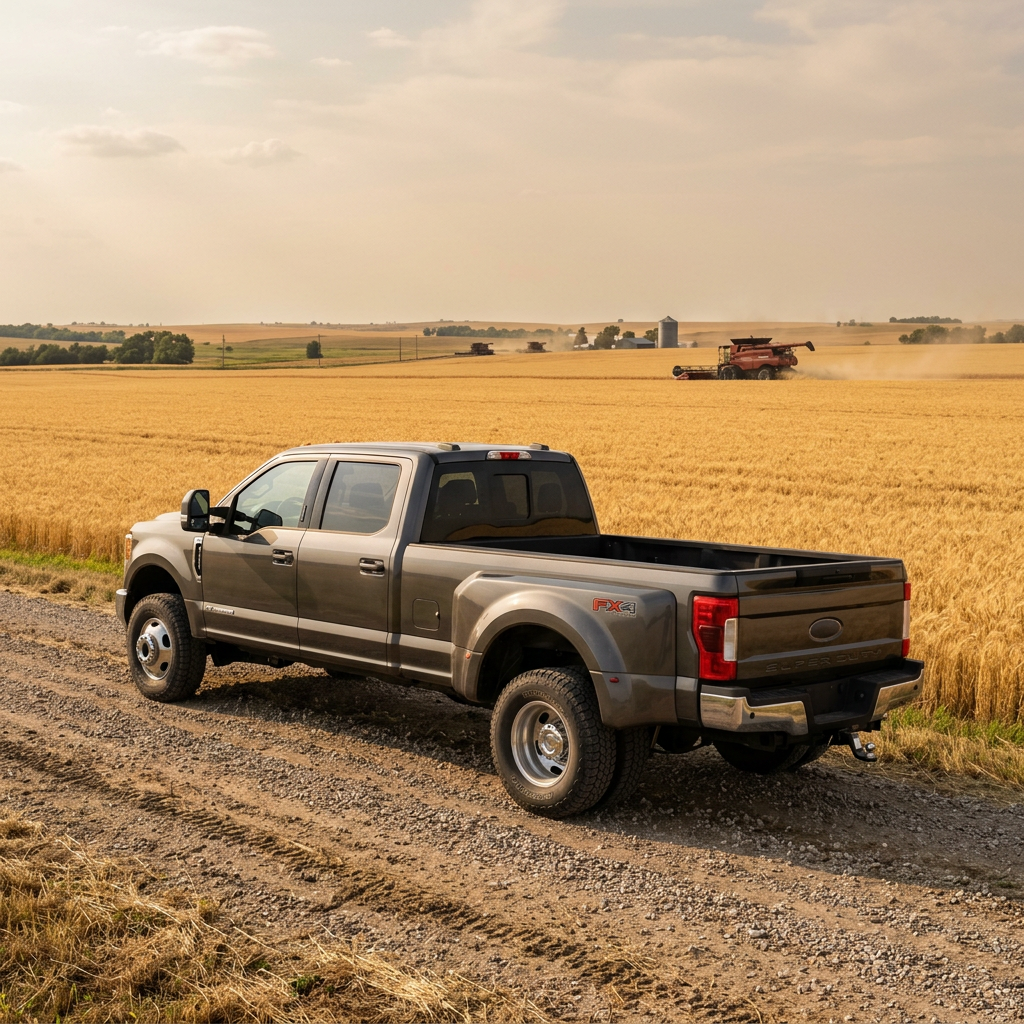
A gray Ford F-350 dual-rear-wheel pickup truck parked on a gravel path next to a golden wheat field with a combine harvester. (Representative image for illustration purposes only. Actual vehicle may vary based on trim and configuration.)

Pre-Harvest Ford Super Duty Inspection: Getting Your F-250 and F-350 Ready for the Kansas Fields

As the hot mid-summer sun beats down on Geary and Dickinson counties, Kansas farmers know that the most demanding time of the year is rapidly approaching. Harvest season is not just a period of intense labor; it is a high-stakes, time-sensitive window where every single hour of daylight translates directly to operational profitability. In this demanding landscape, your truck is not merely a mode of transportation. It is the absolute backbone of your agricultural operation. Whether you are operating a robust Ford F-250 or a dual-rear-wheel F-350, these heavy-duty workhorses are tasked with hauling massive seed tenders, moving loaded grain trailers, transporting heavy tillage equipment, and navigating rough, unpaved field boundaries. When a truck goes down in the middle of a harvest push, the entire workflow grinds to a devastating halt, costing thousands of dollars in delayed grain delivery, idle labor, and potential weather exposure for unharvested crops.

Proactive fleet and truck maintenance is the primary line of defense against these catastrophic, mid-season mechanical failures. In agriculture, we often talk about preventative maintenance on combines, tractors, and grain carts, but the trucks that link the field to the local co-op elevator are frequently overlooked until it is too late. The extreme summer heat of July, combined with the powdery, abrasive dust kicked up by harvesting machinery, creates a brutally hostile environment for internal combustion engines, cooling systems, and electrical components. A thorough, systematically executed pre-harvest inspection ensures that hidden vulnerabilities—such as micro-cracks in serpentine belts, degraded diesel exhaust fluid, or contaminated brake lines—are identified and corrected in the controlled environment of a service bay rather than under the stressful conditions of a remote dirt road.

At Valor Ford, located right here in Junction City, KS 66441, we understand the unique pressures of the Kansas agricultural calendar. We know that when the wheat, corn, or soybeans are ready, there is very little room for error. That is why we advocate for a comprehensive, multi-point pre-harvest inspection for every F-250 and F-350 operating in our community. By partnering with our factory-trained diesel and heavy-duty chassis specialists, you can head into the fields with the absolute confidence that your Super Duty is fully optimized to handle the punishing payloads and relentless towing demands of the season. To make sure you do not lose a single day of productivity, you can easily Schedule Pickup and Delivery Service with our team, allowing us to service your truck while you focus on setting up your grain handling equipment and prepping your combines.

Investing a small amount of time in preventative care today saves you from the immense headaches of emergency towing charges, premium rush-shipping fees on parts, and lost productivity tomorrow. Our specialized agricultural technicians are deeply integrated into the local farming community, meaning we know exactly which components fail first under local driving conditions. From the steep gravel hills surrounding Dwight and Alta Vista to the muddy bottomlands along the Republican River, we know how to prep your suspension, drivetrain, and electrical systems to handle the specific topography of central Kansas. Let's dive deep into the specific systems that require your immediate attention before the first header enters the field.

What are the key pre-harvest maintenance checks for a Ford Super Duty?

Pre-harvest truck prep is far more comprehensive than a standard quick-lube oil change. Because your F-250 or F-350 will be operating at or near its maximum Gross Vehicle Weight Rating (GVWR) and Gross Combined Weight Rating (GCWR) for weeks on end, every subsystem must be operating at peak efficiency. The combination of heavy payloads, slow speeds in dusty fields, and high ambient temperatures places an extraordinary thermal and mechanical load on the vehicle. Below, we break down the critical technical areas that our certified technicians evaluate during a professional pre-harvest inspection.

1. Cooling & Air Systems

Kansas summer heat combined with field chaff is a recipe for engine overheating. We perform a complete pressure test of the primary and secondary cooling loops (especially on the dual-radiator 6.7L Power Stroke). We also inspect the radiator fins for blockages, check the operation of the electrostatic cooling fan clutch, and evaluate the condition of all coolant hoses. Furthermore, we check your engine air filter and cabin air filter, replacing them with high-efficiency Motorcraft filters to keep abrasive field dust out of your combustion chambers and out of your lungs while driving down dusty dirt roads.

2. Heavy-Duty Braking

Stopping a loaded grain trailer or a heavy liquid fertilizer nurse tank requires immense stopping power. Our technicians measure brake pad thickness, inspect rotor surface wear for heat checking or grooving, and perform a complete brake fluid flush if moisture levels are high. Moisture in brake fluid can boil under the extreme heat of heavy hauling, leading to a soft pedal and terrifying brake fade. We also inspect the integrated trailer brake controller system, verifying that the signal outputs are correctly calibrated and communicating with your trailer's electric or hydraulic brakes.

3. Suspension & Electrical

A farm truck's suspension takes a beating over deep ruts and uneven terraces. We inspect the front twin-I-beam or solid axle leaf-spring assemblies, track bars, tie rods, and ball joints for excess play. We also examine the rear leaf springs, auxiliary helper springs, and shock absorbers to ensure they can handle high-payload tongue weights without sagging dangerously. Finally, we clean and test the battery terminals, inspect the alternator output, and verify the integrity of the 7-pin and 4-pin trailer wiring connectors, which are prone to corrosion from field moisture and road grime.

Beyond these three primary pillars, we also check tire tread depth and inflation pressures—specifically adjusting them to the maximum recommended cold PSI for high-load towing. Driving on underinflated tires while carrying a heavy payload is the leading cause of tire blowouts, which can be catastrophic on single-rear-wheel trucks navigating narrow highways. If your truck is due for fresh fluids, filters, or mechanical adjustments, contact us for service. You can quickly Order Genuine Ford Parts directly from our parts department to perform maintenance at home, or let our experienced team handle the dirty work for you.

Remember, a single failure of a $50 sensor or a split coolant hose can leave you stranded on the side of Highway 77, holding up an entire crew of combine operators, truck drivers, and grain cart operators. By addressing these weak points before the season begins, you protect your bottom line, ensure the safety of your operators, and maximize the operational longevity of your truck.

Evaluating Your Powertrain: What is the typical lifespan of a 6.7L Power Stroke diesel engine?
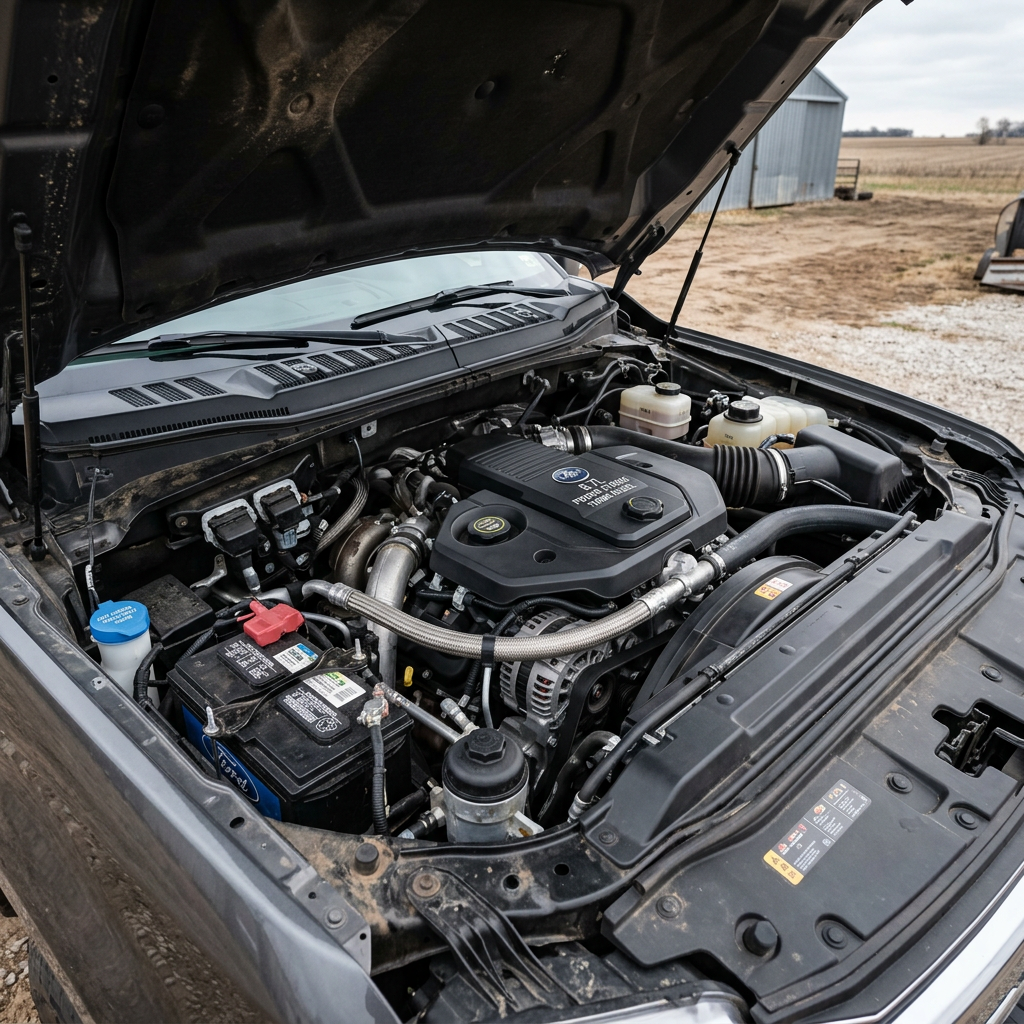
Open hood of a modern pickup truck revealing a clean, powerful diesel engine. (Representative image for illustration purposes only. Actual vehicle may vary based on trim and configuration.)

For many Kansas agricultural operations, the 6.7L Power Stroke V8 Turbo Diesel is the absolute gold standard of heavy-duty power. Known for its incredible low-end grunt and smooth power delivery, this engine is designed from the ground up for commercial-grade durability. When discussing longevity, the typical lifespan of a 6.7L Power Stroke diesel engine routinely exceeds 300,000 miles—and it is not uncommon to see meticulously maintained examples pushing past 400,000 or even 500,000 miles of hard farm use. However, achieving this legendary durability requires a strict adherence to heavy-duty maintenance schedules, particularly when the truck is subjected to the high-load, high-temperature, and extremely dusty conditions typical of Kansas field operations.

The secret to maximizing the lifespan of your Power Stroke diesel lies in your fluid and filtration maintenance habits. Unlike gasoline engines, modern clean-diesel engines utilize highly sophisticated high-pressure common-rail fuel injection systems operating at pressures exceeding 36,000 PSI. At these extreme tolerances, even micro-particles of dirt or trace amounts of water in the fuel can cause premature injector failure or high-pressure fuel pump (CP4) damage. Regularly draining the fuel-water separator and replacing both fuel filters every 15,000 miles is non-negotiable. Additionally, because diesel exhaust fluid (DEF) and complex emissions control systems are standard, avoiding prolonged, excessive idling is critical. Excessive idling leads to soot buildup in the Diesel Particulate Filter (DPF), which triggers frequent regeneration cycles and dilutes your engine oil with unburned fuel.

Furthermore, high-stress towing during harvest places extreme demands on your engine's lubricants. During peak harvest, your transmission and differential fluids are subjected to sustained high temperatures. Standard oil change intervals should be shortened under these 'severe duty' operating conditions. We highly recommend utilizing high-quality synthetic lubricants that offer superior thermal stability and shear resistance. While the diesel powertrain offers unmatched torque and long-term durability, Ford's rugged gasoline engines—such as the 7.3L Godzilla V8—also present an incredibly compelling, low-maintenance alternative for farms that do not accumulate massive annual highway mileage but still require substantial payload and towing capabilities. If you are considering adding another highly reliable truck to your farm fleet, you can Browse Used Inventory at Valor Ford to find a wide selection of thoroughly inspected gas and diesel Super Duty models ready to go to work.

Comparing Engine Capabilities: What is the difference in towing capacity between the 6.7L Power Stroke and the 7.3L gas V8?

To maximize operational efficiency during harvest, you must match your truck's mechanical capabilities to the specific payloads you intend to haul. Choosing between the torque-monster 6.7L Power Stroke Turbo Diesel and the highly reliable, naturally aspirated 7.3L Godzilla V8 is one of the most critical decisions Kansas farmers face when configuring their fleet. While both engines are exceptionally capable, they deliver their power in fundamentally different ways, which directly impacts their conventional and gooseneck towing capacities.

The 6.7L Power Stroke diesel is built for maximum towing limits and effortless long-distance hauling. With its massive torque output peaking low in the RPM range, the diesel engine makes pulling a 20,000-pound gooseneck livestock trailer or a heavy liquid fertilizer tank feel completely effortless, even when climbing the rolling hills of Geary County. On the other hand, the 7.3L gas V8 offers an exceptionally robust, simplified mechanical design that eliminates the complex emissions systems, diesel particulate filters, and DEF requirements of modern diesels. It is an incredibly popular choice for utility beds, service trucks, and farms where trucks undergo frequent short trips, start-and-stop cycles, and prolonged idling in the fields.

Engine Specification / Capability

6.7L Power Stroke V8 Diesel

7.3L 'Godzilla' Gas V8

Horsepower

475 hp (Standard) / 500 hp (High Output)

430 hp @ 5,500 RPM

Torque

1,050 lb-ft (Standard) / 1,200 lb-ft (H.O.)

485 lb-ft @ 4,000 RPM

Max Conventional Towing (F-350)

Up to 24,800 lbs

Up to 18,900 lbs

Max Gooseneck/5th Wheel Towing

Up to 38,000 lbs (F-450 / Max Spec F-350)

Up to 22,500 lbs (Max Spec F-350)

Fuel System / Recommended Use

Ultra-Low Sulfur Diesel + DEF / Heavy Towing

87 Octane Regular Unleaded / Versatile Utility

When evaluating these numbers, consider your daily operational realities. If your truck spends 80% of its time hooked to a heavy grain trailer, moving from field to elevator and back again all day long, the 6.7L Power Stroke is the undisputed king. Its exhaust braking capability also provides an immense safety advantage when bringing heavy loads down steep gravel hills, saving your service brakes from overheating. However, if your truck is primarily used for hauling fencing supplies, carrying a slip-tank of diesel to fuel up the combines, or pulling a light utility trailer, the 7.3L gas V8 provides more than enough towing capacity while significantly reducing your initial purchase price and long-term maintenance complexity. To research these specs in even greater detail, check out our comprehensive online guide to Research Ford F-250 capabilities.

Understanding the Muscle: What are the torque and horsepower specs of the 7.3L Godzilla V8?

For generations, heavy-duty gas engines were often viewed as compromised compromises—lacking the low-end torque of a diesel and the efficiency of smaller gas engines. That narrative completely changed when Ford introduced the 7.3L naturally aspirated pushrod V8, affectionately nicknamed the 'Godzilla' by Ford engineers and truck enthusiasts alike. This massive powerplant is engineered specifically for the brutal duty cycles of commercial fleets and agricultural operations. Delivering an impressive 430 horsepower at 5,500 RPM and a best-in-class 485 lb-ft of torque at 4,000 RPM, the Godzilla V8 stands as the most powerful naturally aspirated gas engine in its class, providing the muscle needed to tackle heavy farm chores without the added weight or cost of a diesel powertrain.

What makes the 7.3L Godzilla V8 so highly favored by ranchers and farmers in Dickinson County is its mechanical simplicity. In an era where engines are increasingly complex—featuring turbochargers, variable-geometry components, and ultra-high-pressure direct fuel injection—the Godzilla utilizes a classic, overhead-valve (OHV) pushrod design with a cast-iron block and aluminum cylinder heads. This heavy-duty, low-stress construction means there are far fewer components to fail over time. It operates on port fuel injection, which prevents carbon buildup on intake valves and is highly tolerant of varying fuel qualities. For a farm truck that may sit in a barn for weeks before being pressed into grueling daily service during harvest, this simplicity translated directly into rock-solid reliability and remarkably easy, low-cost maintenance.
A gray pickup truck parked on a dirt path next to a weathered red barn in a rural countryside landscape. (Representative image for illustration purposes only. Actual vehicle may vary based on trim and configuration.)

Ranchers also appreciate how the engine's torque curve is optimized for heavy hauling. Unlike high-revving sports car engines, the Godzilla V8 is designed to deliver a massive chunk of its torque low in the RPM range. This allows the truck to get heavy loads moving from a complete stop with minimal strain on the transmission. When paired with Ford's advanced TorqShift 10-speed automatic transmission, the powertrain maintains optimal gear ratios to keep the engine in its sweet spot, whether you are crawling through a muddy pasture or cruising down the interstate at 75 MPH. If you are interested in exploring how this engine compares to other options, you can Research Ford F-250 models online or speak with our sales experts in Junction City.

Power in the Field: Does Chevrolet have an equivalent to Ford's Pro Power Onboard?

When you are miles away from the nearest farm shop, a breakdown in the field requires immediate, on-the-spot repairs. Historically, this meant hauling heavy, noisy, gasoline-powered portable generators in the bed of your truck just to run an angle grinder, an air compressor, or a portable welder. Ford completely revolutionized field work by introducing Pro Power Onboard to the Super Duty lineup. This class-exclusive, integrated system transforms your F-250 or F-350 into a highly capable mobile generator, delivering clean, exportable electrical power directly from outlets in the truck bed. Available in 2.0 kW configurations on gas-powered models, it provides ample electricity to power heavy-duty power tools, battery chargers, portable lights, and field repair equipment simultaneously.

Many local farmers ask us: how does the competition stack up? Specifically, does Chevrolet have an equivalent to Ford's Pro Power Onboard on the Silverado HD? The short answer is that Silverado HD models offer available 120-volt outlets, while Ford's Pro Power Onboard provides an integrated exportable power system with higher output for jobsite use. Availability and output can vary by model and configuration. For a farmer trying to weld a broken brace on a tillage tool or run a heavy-duty impact wrench in the middle of a remote field, Ford's system is a game-changing feature that saves precious hours of downtime.

This level of integrated utility is exactly why the Ford Super Duty remains a popular choice for work-ready trucks. It is designed by people who understand that a truck is more than just a cab and a bed—it is a mobile command center and an active partner on the job site. If you want to experience this revolutionary technology firsthand, or if you need to upgrade your current farm truck before the harvest rush, we invite you to evaluate your current truck's trade value using our convenient Trade In Evaluation tool, helping you transition into a modern Super Duty with minimal hassle.

Harvest Tax Strategies: What is the GVWR threshold for the full Section 179 tax deduction?
A white Ford Super Duty dually truck parked in front of a rural Kansas Farm Supply building. (Representative image for illustration purposes only. Actual vehicle may vary based on trim and configuration.)

Running a successful Kansas agricultural operation requires keen financial planning alongside traditional agronomic expertise. As you prepare for the upcoming harvest, it is also the perfect time to evaluate your capital expenditures and formulate your end-of-year tax strategies. One of the most powerful financial tools available to American farmers and small business owners is the IRS Section 179 tax deduction. Under this provision, businesses can write off the entire purchase price of qualifying equipment—including heavy-duty trucks—in the tax year they are purchased and placed into service, rather than depreciating the cost over several years. However, to qualify for the full Section 179 write-off without the strict dollar-limit caps applied to standard passenger vehicles, the truck must meet a specific weight threshold.

The critical Gross Vehicle Weight Rating (GVWR) threshold for the full, uncapped Section 179 deduction is 6,000 pounds. Any vehicle with a manufacturer's GVWR between 6,000 and 14,000 pounds that is used more than 50% for business purposes qualifies for substantial immediate write-offs. Because every single Ford F-250 and F-350 in the Super Duty lineup features a GVWR that easily clears this 6,000-pound floor (typically starting at 10,000 pounds and scaling up to 14,000 pounds or more depending on configuration), these trucks are fully eligible for immediate, heavy-duty vehicle tax deductions. This means you can offset a substantial portion of your harvest earnings by upgrading your fleet with a highly capable work truck before December 31st.

By leveraging these tax strategies, local farmers can dramatically lower their net tax liability while simultaneously modernizing their operations with safer, more powerful, and more reliable equipment. It is always highly recommended to consult with your certified public accountant (CPA) or agricultural tax specialist to confirm how the Section 179 rules apply to your specific farm structure. To help streamline the acquisition process, we make it simple to secure financing early. You can easily Get Pre-Approved for Financing online through our secure finance department, allowing you to shop our inventory with confidence and contact us for current financing information before your heavy field work begins.

Planning Ahead: What is the current lead time for ordering a custom Super Duty in Kansas?

While we maintain a robust inventory of work-ready trucks on our lot in Junction City, we know that many farmers have very specific requirements for their fleet. You might need a precise cab-to-axle length for a custom flatbed, specific heavy-duty alternator packages to run auxiliary field equipment, or dual-rear-wheel configurations paired with the high-output diesel engine. For these specialized needs, custom ordering a Super Duty directly from the factory is the absolute best way to ensure your truck arrives configured exactly how you need it, without paying for features you don't require.

The current lead time for a custom factory order can vary based on component availability and overall production demand, but generally ranges from 12 to 24 weeks. Because of these manufacturing timelines, forward planning is absolutely essential. If you want a truck ready for spring planting, we recommend placing your custom order in the late fall. Conversely, if you want a new F-250 or F-350 fully outfitted and ready to work for next summer's harvest, placing your order during the preceding winter months ensures your truck is built, delivered, and outfitted with any necessary aftermarket beds or accessories well before the first fields are cut.

At Valor Ford, we specialize in navigating the commercial and agricultural fleet ordering process. Our experienced sales consultants work closely with Ford's regional representatives to secure priority build slots for local farming businesses, helping to minimize wait times and keep your fleet upgrades on schedule. We walk you through every option—from heavy-duty suspension upgrades to auxiliary upfitter switches—ensuring your custom truck is built to handle the unique demands of Kansas agriculture. If you'd like to explore other options in the Ford lineup while planning your next custom build, you can also Research Ford F-150 or even Research Ford Maverick configurations for lighter-duty utility roles around the farm.

Schedule Your Pre-Harvest Inspection at Valor Ford in Junction City
Logo for Valor Automotive featuring a blue and silver shield with 'VA' and the company name with a red star.

Don't let a preventable mechanical breakdown slow down your harvest momentum this season. The dedicated service department at Valor Ford is fully equipped with heavy-duty vehicle hoists, specialized diagnostic computers, and a team of factory-trained diesel technicians who understand your Super Duty inside and out. We carry an extensive inventory of OEM Motorcraft parts designed specifically for your F-250 and F-350, ensuring that any necessary repairs are completed using components that meet Ford's strict durability standards. Our goal is simple: to keep the hardworking agricultural community of Geary and Dickinson counties moving forward safely and efficiently.

Whether you need a quick engine oil analysis, a complex diesel emissions diagnostic, a heavy-duty brake replacement, or a complete suspension overhaul, we are here to help. You can easily book your service online using our Schedule Ford Service Today system, or take advantage of our convenient home-and-farm pickup options by choosing to Schedule Pickup and Delivery Service. If you prefer to speak directly with one of our service coordinators to discuss a custom maintenance plan for your entire farm fleet, please feel free to Call us at (785) 238-5114.

We invite you to visit us in person at our dealership located at 1825 Goldenbelt Blvd, Junction City, KS 66441. Our team is ready to provide you with the exceptional service, competitive pricing, and honest advice that you deserve from a local business partner. To find the easiest route to our service department, simply click here to Get Directions to Valor Ford. Let's work together to make this year's Kansas harvest your most successful, productive, and profitable one yet!
Posted in:

Related Posts

FORD Core Trucks & Workhorses

FORD Core Trucks & Workhorses

Which Ford Trucks Are Best Suited for Heavy Towing and Daily Commercial Work? Selecting the right vehicle for demanding commercial operations requires balancing max towing ratings, payload capacity, engine durability, and everyday operational costs. For enterprise buyers, agricultural operators, and job-site contractors across Kansas, the Ford Super Duty line—comprising the F-250, F-350, and F-450—stands out as the benchmark for heavy-duty towing and rigorous daily duty cycles. When configured with either the 7.3L Godzilla V8 gas engine or the formidable 6.7L High-Output Power Stroke® Turbo Diesel, these trucks deliver unmatched capability under extreme stresses. For lighter trade fleets and mobile service technicians needing maximum fuel efficiency paired with agile handling around urban job sites, the standard Ford F-150 remains a formidable asset. However, when payload demands surpass 4,000 pounds or gross combined weight ratings (GCWR) call for pulling heavy equipment trailers, agricultural equipment, or multi-car transports across Kansas highways, stepping up to the Super Duty family is essential. If you want to explore available configurations in person or review spec sheets with enterprise truck specialists, you can always Get Directions to Valor Ford in Junction City. Quick Summary of Optimal Work Configurations: • F-150: Light trades, municipal inspection, and service routes under 10,000 lbs towing. • F-250 Super Duty: Balanced daily driving, high payload requirements, and bumper-pull trailers up to 22,000 lbs. • F-350 Super Duty: The gold standard for commercial gooseneck towing, heavy machinery, dual-rear-wheel stability, and heavy payloads. • F-450 / Chassis Cab: Extreme commercial haulers requiring upfitted service bodies, dump beds, and Class 4 towing capabilities. Decoding the Core Ford Workhorse Trucks Across the Commercial Lineup Ford builds a specialized tool for every commercial application. Matching your vehicle purchase to your duty cycle ensures you do not overspend on capacity you do not need—or under-spec a vehicle and risk premature wear, safety issues, or costly fleet downtime. Here is how Ford positions its core truck models across the enterprise landscape. F-150 & F-250 Capabilities The Ford F-150 is ideal for field supervisors, electrical contractors, and residential trade fleets. With Pro Power Onboard generating mobile AC electricity, it acts as a rolling generator. Learn more when you Research Ford F-150 specifications. Stepping up to the F-250 Super Duty unlocks three-quarter-ton heavy-duty axles and upgraded frame rails, perfect for utility trailers, skid steers, and heavy payload boxes while retaining manageable ride quality. F-350 Heavy Towing Workhorse The F-350 Super Duty is the backbone of regional construction and agricultural enterprises. Available in Single Rear Wheel (SRW) and Dual Rear Wheel (DRW) configurations, it manages massive vertical tongue loads associated with fifth-wheel cattle trailers and gooseneck excavators. Read additional details when you Research Ford F-250 and F-350 specs. F-450 & Chassis Cab For maximum extreme-duty performance, the F-450 pickup and Chassis Cab variants provide commercial-grade wide-track front axles, tighter turning radii, 19.5-inch commercial tires, and massive brake rotors. These trucks are engineered for heavy upfits including service cranes, mechanics bodies, dump beds, and multi-car haulers. Powertrain Performance: 7.3L Gas V8 vs. 6.7L High-Output Power Stroke Diesel The engine under your truck's hood dictates not only how fast you can pull a hill with 20,000 pounds attached, but also your routine maintenance costs, fuel expenses, and overall operational budget. 7.3L 'Godzilla' Pushrod Gas V8: Engine design simplicity meets massive low-end power. Built with a cast-iron block, forged steel crankshaft, and variable cam timing, the 7.3L V8 delivers outstanding long-term durability with lower initial acquisition costs and simpler routine maintenance compared to modern diesels. It is widely favored by fleets that experience high idle times or short stop-and-go driving profiles where diesel exhaust fluid (DEF) systems might face challenges. 6.7L High-Output Power Stroke® Turbo Diesel: The undisputed champion of commercial pulling power. Generating a staggering 500 horsepower and 1,200 lb-ft of torque, this engine utilizes a water-jacketed turbocharger, upgraded exhaust manifolds, and high-pressure fuel injection to pull extreme loads effortlessly across rolling Kansas highways. Engine Option Displacement & Type Horsepower Torque (lb-ft) Best Commercial Application 6.8L DEVCT Gas V8 6.8L Pushrod Gas 405 hp @ 5,000 rpm 445 lb-ft @ 4,000 rpm Light fleet utility, municipal service, daily trade support 7.3L Godzilla V8 7.3L Pushrod Gas 430 hp @ 5,500 rpm 485 lb-ft @ 4,000 rpm Heavy payload utility, moderate gooseneck, high idle duty 6.7L Power Stroke V8 6.7L Turbo Diesel 475 hp @ 2,600 rpm 1,050 lb-ft @ 1,600 rpm Long-haul heavy equipment towing, high-mileage highway work 6.7L High-Output Diesel 6.7L HO Turbo Diesel 500 hp @ 2,600 rpm 1,200 lb-ft @ 1,600 rpm Maximum GCWR gooseneck/5th wheel loads, extreme commercial haul Why the Ford Super Duty XL Trim Features Make It a True Commercial Workhorse While luxury consumer trims emphasize soft leather and ambient lighting, commercial fleet operators value durability, ease of maintenance, and high functional utility. The Ford Super Duty XL trim is designed specifically from the ground up to handle demanding job-site conditions without unnecessary cost inflations. Key features standard on or available for XL commercial models include: • Heavy-Duty Black Vinyl Flooring: Built to endure mud, gravel, and heavy work boots, allowing effortless hose-out cleaning after a day in the field. • Durable High-Wear Cloth or Heavy Vinyl Seating: Designed to resist tearing and staining under severe daily trade use. • Standard Integrated Trailer Brake Controller: Fully syncs electric-over-hydraulic or electronic trailer brakes with truck pedal pressure for smooth stopping. • Ford Pro™ Telematics Integration: Every XL trim features embedded 5G Wi-Fi modems enabling fleet managers to monitor GPS tracking, driver behavior, fuel consumption, and proactive maintenance alerts in real time. • High-Strength Steel Frame & Aluminum-Alloy Cab: Combines structural rigidity under full frame twist with non-corroding body panels that resist severe Kansas winter road salt. • Upfitter Switches (6 Overhead): Factory-installed 15-amp to 40-amp fused circuits make connecting warning strobes, aux lighting, winches, and hydraulic pumps clean and seamless. To review fleet purchasing options or evaluate current stock, you can Call us at (785) 238-5114 to speak directly with our commercial desk. Contact us for commercial financing information How Ford Super Duty Reliability Stacks Up Against Silverado HD and Ram 2500/3500 In the competitive heavy-duty pickup market, uptime and long-term operating costs determine true vehicle value. When comparing Ford Super Duty trucks to heavy-duty entries from Chevrolet and Ram, key engineering distinctions highlight how Ford compares in commercial fleet applications. Military-Grade Aluminum Body Unlike Chevrolet Silverado HD and Ram 2500/3500 which utilize traditional steel cabs, Ford uses high-strength, military-grade aluminum alloy. This can help reduce body rust concerns from magnesium chloride winter de-icing and saves substantial weight that Ford reinvests into thicker box-frame steel rails, heavy axles, and higher gross vehicle weight ratings (GVWR). TorqShift® 10-Speed Transmission Ford's heavy-duty TorqShift 10-speed automatic features select gear ratios and selectable drive modes (Tow/Haul, Eco, Slippery, Deep Sand/Snow) optimized for high payload demands. Its thermal management system keeps transmission fluid cool under sustained steep uphill towing, providing smoother shift logic and higher durability than competitive 6-speed or 8-speed automatics. Axle Ratings & Brake Hardware Ford Super Duty models feature massive Sterling and Dana® rear axles rated for rigorous continuous weight cycles. Coupled with larger four-wheel disc brake rotors and heavy-duty brake pads, Ford trucks are designed to provide strong stopping performance and fade resistance when descending long highway grades under full GCWR capacity. Pricing and Trim Breakdown for Commercial Buyers and Business Fleets When evaluating commercial trucks, prudent business owners calculate Total Cost of Ownership (TCO) rather than focusing solely on upfront MSRP. Factors such as fuel efficiency, resale retention, warranty coverage, tax advantages, and maintenance schedule intervals play major roles in overall profitability. Trim Level Breakdown for Enterprise Operations: • XL Trim: The entry point for commercial operations. Offers maximum payload margin per dollar spent. Designed for standard job-site abuse with easy-clean interiors and robust exterior utility. • XLT Trim: Adds key convenience features like power cloth seats, power towing mirrors, SYNC® 4 touchscreen infotainment, and chrome grille accents. Popular among owner-operators and trade contractors who use their work truck as a mobile office and daily driver. • Lariat Trim: Merges heavy work capacity with premium luxury. Features leather seats, 360-degree camera views, power running boards, and advanced driver-assist features for operators who spend 8+ hours a day behind the wheel. Trim Level Key Target Audience Primary Standard Equipment TCO Advantage Super Duty XL Commercial Fleets, Municipal, Ag Vinyl flooring, SYNC 4, Trailer Brake Controller, 5G Telematics Lowest acquisition cost, maximum payload allowance, easy clean Super Duty XLT Subcontractors, Skilled Trades, Craftsmen Power driver seat, carpet floor, chrome trim, Co-Pilot360 High resale value retention, strong driver comfort balance Super Duty Lariat Business Owners, Enterprise Fleet Managers Leather upholstery, 360-deg camera, B&O Sound, PowerScope mirrors Premium driver retention tool, multi-purpose executive work truck Section 179 Tax Benefits & Capital Depreciation: Because Ford Super Duty F-250, F-350, and F-450 models feature Gross Vehicle Weight Ratings exceeding 6,000 pounds, qualifying business entities can may be eligible for certain tax deductions or accelerated depreciation, subject to IRS rules and your tax professional's advice under IRS Section 179 and Bonus Depreciation rules. Consult your tax professional to see how purchasing or leasing a new Super Duty as needed optimizes your fleet's tax position. Honest Pros and Cons of Owning a Ford Super Duty for Daily Commercial Operations Key Operational Advantages (Pros) • Class-Leading Pulling Capacity: Gooseneck towing limits up to 40,000 lbs on select F-450 configurations mean many trailer needs can be handled. • Pro Trailer Hitch Assist: Automatically aligns the hitch ball directly under the trailer coupler at the touch of a button. • Spacious SuperCrew Cabs: Best-in-class rear seat legroom allows four to five crew members to ride in total comfort with gear stored safely inside. • Unmatched Upfit Compatibility: Standardized frame widths and electrical pass-through grommets lower body-builder mounting times and cost. Real-World Considerations (Cons) • Wide Turning Radius on Long Wheelbase Models: Dual-rear-wheel Crew Cab models require extra maneuverability space in tight urban alleys or dense job sites. • Higher Diesel Maintenance Requirements: Fuel filters for 6.7L diesels require routine replacement every 15,000 miles, alongside ongoing DEF refills. • Overall Ride Stiffness When Empty: Heavy multi-leaf rear suspension springs are tuned for extreme payload weights, resulting in a firmer ride when driven unloaded. Request a Fleet Trade-In Valuation Work-Focused Truck Configurations Frequently Stocked Near Junction City and Dickinson County Central Kansas enterprise operations face unique climate conditions and terrain challenges. Between agricultural demands in Dickinson and Geary Counties, military infrastructure projects around Fort Riley, and regional highway transport along the I-70 corridor, commercial trucks must be spec'd for specific local duties. Agricultural 4x4 Configurations Kansas farming and ranching operations rely on F-250 and F-350 4x4 Crew Cabs equipped with the 7.3L gas or 6.7L diesel. Electronic shift-on-the-fly four-wheel drive and rear locking differentials ensure traction when traversing muddy pasture terrain and unpaved county roads. Fort Riley Military Contractors Federal contractors and infrastructure teams around Fort Riley require F-350 and F-450 service body upfits. Equipped with Knapheide or Reading utility bodies, onboard generator systems, and heavy vice mounts, these trucks serve as mobile repair bays. DRW Gooseneck Haulers For long-haul machinery transport along I-70, F-350 DRW (Dual Rear Wheel) models equipped with factory 5th-Wheel/Gooseneck Prep Packages provide lateral stability against high plains crosswinds while maintaining highway cruising speeds easily. Gooseneck vs. Conventional Towing Setup Guidelines for Heavy Workload Safety Operating heavy commercial trailers safely across Kansas requires a strict understanding of axle weight distribution, hitch mechanisms, and Gross Combined Weight Ratings (GCWR). Towing incorrectly risks vehicle instability, transmission strain, and regulatory fines. Conventional Bumper-Pull Towing: Ideal for loads under 20,000 lbs, such as enclosed cargo trailers, skid loaders on tandem-axle trailers, or commercial mowers. Always ensure weight-distributing hitch bars and sway control arms are utilized for tongue weights exceeding 10% of total trailer weight. Gooseneck & Fifth-Wheel Setup: Placing trailer tongue weight directly over the rear axle center point eliminates rear lever-arm strain, dramatically enhancing steering control and lateral trailer stability. Ford's factory 5th-Wheel/Gooseneck Prep Package includes five recessed bed mounting points flush with the load floor, allowing seamless conversion between flat box hauling and gooseneck towing. Axle Ratio Selection: Selecting a 3.73, 4.10, or 4.30 rear axle ratio determines your mechanical leverage advantage. Lower (higher numerical) axle ratios increase off-the-line pulling power and steep-grade climbing, whereas taller ratios maximize highway fuel economy. Maximizing Commercial Uptime with Scheduled Service and Fleet Care For commercial operators, time off the road equals lost revenue. Severe-duty operations—including heavy towing, dusty agricultural environments, high idle times, and extreme hot/cold seasonal swings—demand rigorous preventative maintenance adherence. Our dedicated technical team can help you maintain optimal fleet reliability; simply Schedule Ford Service Today to keep your fleet operating at peak performance. Service Item Standard Duty Interval Severe Workload / Commercial Interval Key Fleet Impact Engine Oil & Filter Change 7,500 – 10,000 miles 5,000 miles / 250 Engine Hours Prevents turbocharger sludge build-up & protects bearing surfaces Diesel Fuel Filters (Dual System) 20,000 miles 15,000 miles Protects high-pressure fuel injectors from water & particulate contamination TorqShift Transmission Fluid 60,000 miles 30,000 – 45,000 miles Maintains crisp gear shifts under sustained heavy towing load Front/Rear Differential Fluid 100,000 miles 50,000 miles Prevents differential gear scoring during high torque load distribution To further streamline business maintenance routines, commercial clients can Schedule Pickup and Delivery Service or utilize OEM replacement components directly through our team to Order Genuine Ford Parts for in-house fleet maintenance technicians. Schedule Commercial Fleet Maintenance Evaluating Upfits and Bed Options for Kansas Agriculture and Construction Trades A commercial truck cab and frame chassis are only as versatile as the upfit body attached to them. Ford's clean cab-to-axle (CA) frame dimensions enable seamless installation of specialized commercial bed bodies: • Flatbed Platform Bodies: Vital for agricultural hay transport, lumber yards, and pipe suppliers requiring unobstructed side-loading access via forklifts. • Service & Utility Bodies: Lockable weatherproof side compartments store high-value hand tools, diagnostic equipment, and pneumatic fittings safely on job sites. • Dump Bodies: Hydraulic dump beds on F-350 and F-450 chassis cabs allow quick offloading of gravel, topsoil, mulch, and demolition debris. Pro Power Onboard System Integration: Modern Ford Super Duty trucks offer exportable electrical power up to 2.0 kW directly from bed outlets. This allows field crews to run chop saws, air compressors, battery chargers, and floodlights directly off the truck's engine without hauling bulky standalone gasoline generators. Fleet Financing, Trade-In Valuations, and Inventory Access at Valor Ford Securing capital for business expanding operations requires flexible financing solutions tailored to commercial cash flow schedules. Valor Ford works directly with corporate financial institutions, Ford Credit Commercial Lending, and municipal purchasing boards to deliver custom commercial lines of credit, master leases, and TRAC leasing options. If you are rotating older enterprise units out of service, complete a quick online Trade In Evaluation to see how much equity you can roll directly into your new Super Duty purchase. Business owners seeking pre-owned vehicles can also Browse Used Inventory for certified commercial options. Commercial fleet managers can also look into other specialized models in the broader Ford lineup—whether you need light-duty support or executive transportation—such as when you Research Ford Maverick, Research Ford Explorer, Shop New Ford Bronco Inventory, or even Research Ford Mustang models for personal use. Build and Support Your Commercial Fleet with Valor Ford in Junction City Whether you need a single Ford Super Duty F-250 for your growing trade business or a fleet of F-350 dual-rear-wheel gooseneck haulers for regional agricultural transport, Valor Ford is your trusted commercial vehicle partner in central Kansas. Our dedicated enterprise team understands chassis cab specs, towing load matchings, upfit body installations, and commercial financing structures. Visit our showroom today at 1825 Goldenbelt Blvd, Junction City, KS 66441, or connect with our commercial sales specialists directly to schedule a test drive under load conditions. Get Directions to Valor Ford Call Commercial Team: (785) 238-5114

How the 2027 Ford Super Duty Pro Trailer Hitch Assist Simplifies Livestock Trailer Hookups

How the 2027 Ford Super Duty Pro Trailer Hitch Assist Simplifies Livestock Trailer Hookups

How the 2027 Ford Super Duty Pro Trailer Hitch Assist Simplifies Livestock Trailer Hookups For livestock producers and grain growers across Dickinson County and Geary County, hitching up a heavy stock rig or gooseneck trailer has historically been a tedious, two-person chore or a multi-try solo headache. The 2027 Ford Super Duty Pro Trailer Hitch Assist helps reduce the guesswork and frustration of trailer coupling by utilizing machine-learning computer vision, rear-facing optical cameras, and ultrasonic radar sensors to help guide the truck into alignment with the trailer coupler. Single-operator ranchers working near Junction City no longer need to jump out of the cab five times to check ball alignment, nor do they need a dedicated spotter when hauling cattle out to summer pasture in the Flint Hills. By simply holding down the hitch assist button located on the center console, the Super Duty calculates the trajectory, maneuvers the rear axle, and stops the hitch ball directly under the trailer coupler receiver with millimeter precision. Sensor Technology Behind Hands-Free Cattle Trailer Alignment in Central Kansas At the core of Ford's industry-exclusive Pro Trailer Hitch Assist is an advanced sensor fusion pipeline. The high-definition tailgate camera works in tandem with short-range rear corner radar modules to create a real-time 3D spatial map behind the rear bumper. Sophisticated image-processing algorithms continuously scan for the geometric shape of conventional ball hitches and gooseneck couplers, tracking distance, angle, and height elevation simultaneously. Agricultural environments present tough visual challenges, from dusty barnyards to low-light morning setups before livestock sales. Ford engineers calibrated the visual optics and infrared sensor spectrum so the system reliably locks onto coupler targets even when mud, light rain, or heavy farm dust obscures partial camera views. Whether you are hitching up inside a dimly lit hay barn or out in an unpaved prairie pen, the system maintains crisp detection capabilities. Step-by-Step Guide: Operating Pro Trailer Hitch Assist with Gooseneck and Conventional Stock Rigs Operating the system is intuitive for farmers and fleet operators alike: 1. Position the Vehicle: Reverse your Super Duty to within approximately 20 feet of your livestock trailer coupler. 2. Activate the System: Press and hold the Pro Trailer Hitch Assist button on the center console dashboard. 3. Select Trailer Type: On the SYNC 4 12-inch touchscreen, tap your target coupler type (bumper-pull ball hitch or gooseneck configuration). 4. Hold the Command Button: Keep your finger on the dashboard button while releasing the steering wheel, foot brake, and accelerator. The vehicle will independently steer, shift gears, and control speed. Once the truck comes to a full stop directly underneath the receiver, double-check your height clearance on the bed camera before cranking down the coupler lock ring and attaching your safety chains. Does the 2027 Super Duty Include Built-In Smart Hitch and Onboard Scales for Livestock Safety? Real-Time Smart Hitch Ford's hitch-assist and available towing technologies help provide helpful guidance on the SYNC 4 screen. Ranchers can verify if their gooseneck weight distribution is optimal before hitting highway speeds. Onboard Payload Scales Integrated Smart Scales calculate real-time cargo and livestock weight loaded into the truck bed or stock trailer. Taillight visual LED bars display payload percentage as animals board, preventing overloaded axles. Enhanced Safety & Compliance Uneven animal movement inside a trailer can shift weight dynamics rapidly. Monitoring live payload ensures compliance with Kansas Highway Patrol axle weight limits while reducing trailer sway risks on I-70. Research Ford F-250 Super Duty What Is the Maximum 2027 Ford Super Duty Gooseneck Towing Capacity for Hauling Grain or Livestock? Super Duty Model Max Gooseneck Towing Max Conventional Towing Max Payload Capacity Ford F-250 SRW Up to 23,000 lbs Up to 22,000 lbs Up to 4,268 lbs Ford F-350 SRW Up to 27,000 lbs Up to 25,000 lbs Up to 4,950 lbs Ford F-350 DRW (Dually) Up to 38,000 lbs Up to 28,000 lbs Up to 8,000 lbs Ford F-450 DRW Up to 40,000 lbs Up to 30,000 lbs Up to 8,000 lbs When transporting heavy grain hoppers or double-deck cattle trailers, towing capacity is paramount. The 2027 Ford Super Duty lineup offers extraordinary pulling muscle, capped by the F-450 DRW capable of towing up to 40,000 lbs with a gooseneck setup. Built on a high-strength, fully boxed steel frame engineered with up to 10 crossmembers, the Super Duty withstands extreme torsional twisting encountered when maneuvering fully loaded trailers across rough pastures in Dickinson County. How Do Ford Power Stroke Diesel Torque Ratings Compare to Chevy Duramax Engine Outputs? Ford 6.7L HO Power Stroke Outputting a massive 500 horsepower and 1,200 lb-ft of torque, Ford's High-Output Power Stroke V8 Turbo Diesel is positioned among the leading engines in the heavy-duty truck segment. Chevy 6.6L Duramax Diesel Chevy's 6.6L Duramax V8 produces 470 horsepower and 975 lb-ft of torque, leaving a 225 lb-ft torque gap compared to Ford's flagship High-Output engine output. Flint Hills Mud Performance That low-end 1,200 lb-ft torque advantage makes an enormous difference when pulling 25,000-lb cattle trailers out of sticky red clay pens or pulling heavy loads up steep pasture grades. What Maintenance Is Required for the 6.7L Power Stroke DEF System Prior to Farm Work? Before intense agricultural harvest seasons begin in Central Kansas, proactive maintenance on your Super Duty's Diesel Exhaust Fluid (DEF) system prevents unexpected engine power derating during peak farm operations. Dust, dirt, and moisture accumulation around DEF fill ports can contaminate the fluid, causing premature pump failures or injector clogging. We recommend inspecting DEF fluid quality, replacing DEF tank dosing filters at scheduled intervals, and verifying tank heater assembly operation prior to cold fall mornings. You can easily Schedule Ford Service Today with our factory-trained diesel technicians to help keep your emission systems running properly. Schedule Ford Service Today Fall Grain Harvest & Livestock Transport: Super Duty Towing Inspection Guide for Central Kansas As autumn grain harvest kicks into full swing around Junction City, preparing your heavy-duty truck for high-tonnage hauling is essential for road safety and equipment longevity. A complete pre-harvest inspection ensures your truck and trailer operate as a unified, safe unit under demanding conditions. Essential Pre-Harvest Towing Checklist: • Integrated Trailer Brake Controller: Test gain settings with loaded grain trailers. Re-calibrate gain response on SYNC 4 to match weight shifts. • Tire Load Range Inspection: Verify heavy-duty Load Range E or F tires are inflated to maximum cold PSI ratings to carry heavy tongue loads without sidewall flexing. • Emergency Breakaway Switch: Test pin engagement and battery charge levels on trailer safety breakaway kits before road transit. • 7-Pin & 12-Pin Electrical Harnesses: Clean corrosion from trailer plug contacts and test auxiliary live-feed video connections. • Cooling System Check: Flush engine coolant and check transmission fluid heat exchangers to handle extended heavy-load pulls in warm autumn temperatures. Need genuine replacement brake pads, heavy-duty hitch receivers, or trailer wiring adapters? You can conveniently Order Genuine Ford Parts directly through Valor Ford. What DOT Regulations Apply to Farm Trucks Towing Grain Trailers in Kansas? Navigating Kansas Department of Transportation (KDOT) and Kansas Highway Patrol commercial vehicle enforcement rules can be complex for agricultural producers. In Kansas, covered farm vehicles (CFVs) operated by farmers, family members, or farm employees enjoy specific CDL exemptions when transporting agricultural products, livestock, or machinery within a 150 air-mile radius of the farm. However, if your Gross Combination Weight Rating (GCWR) exceeds 26,001 lbs for non-exempt commercial operations, CDL requirements apply. Additionally, mandatory safety chain cross-latching, operable breakaway brakes, and properly displayed Kansas Farm Vehicle license plates are strictly enforced across Dickinson County highways. Navigating Flint Hills Pastures and Unpaved County Roads with Heavy Agricultural Loads Electronic-Locking Rear Axle Engage the electronic-locking rear differential at the press of a button to send 100% engine torque to both rear wheels when traversing slick prairie mud or steep creek crossings. Engine Exhaust Braking Ford's smart engine exhaust brake uses variable-geometry turbo backpressure to slow heavy livestock trailers on steep downhill grades, dramatically reducing foot brake heat and wear. Prairie Wind Stabilization Advanced Trailer Sway Control uses selective wheel braking and throttle adjustment to counteract sudden crosswinds common across open Central Kansas plains. Browse Used Heavy-Duty Trucks Essential OEM Towing Accessories and Upfits Available at Valor Ford To maximize the capabilities of your 2027 Ford Super Duty, Valor Ford offers a complete range of genuine Ford OEM towing accessories. One favorite among cattle ranchers is the Auxiliary Trailer Camera Kit, which mounts inside your livestock trailer and feeds live HD video directly into your SYNC 4 dashboard display so you can check on animals while driving. Additional popular farm upfits include factory-installed Gooseneck Hitch Prep Packages, heavy-duty spray-in bedliners, wheel well liners, and oversized rubber mud flaps designed to deflect gravel on unpaved county roads. Experience the 2027 Ford Super Duty at Valor Ford in Junction City At Valor Ford, we understand the demanding needs of Central Kansas agriculture. Whether you run a commercial cattle operation or manage a family grain farm, our dedicated commercial truck specialists are here to help you select, configure, and maintain the perfect Super Duty rig. Visit our showroom at 1825 Goldenbelt Blvd, Junction City, KS 66441 to test drive the 2027 Super Duty and experience Pro Trailer Hitch Assist in person. You can get started right now: request a Trade In Evaluation on your current truck, explore flexible financing to Contact us for financing information, or Get Directions to Valor Ford today. Prefer to speak directly with an agricultural truck expert? Call us at (785) 238-5114. Contact us for financing information

What Safety Recalls Affect the 2023 Ford Explorer?

What Safety Recalls Affect the 2023 Ford Explorer?

What Safety Recalls Affect the 2023 Ford Explorer? Primary safety recalls affecting the 2023 Ford Explorer center on two critical vehicle systems: the rearview camera display and the automatic transmission parking mechanism. Rearview camera recalls involve software errors, wiring harness faults, or 360-degree camera module glitches that cause a blue screen, blank display, or frozen image while reversing. Transmission recalls address a potential loose transmission bolt or parking pawl engagement issue that may prevent the vehicle from holding Park, creating a potential rollaway risk. All recall inspections and repairs are completed free of charge by factory-trained technicians at authorized Ford dealerships. When safety notices are released by the manufacturer, addressing open campaigns quickly preserves vehicle reliability and ensures driver safety. The stop-and-go driving along Washington Street in Junction City puts regular stress on reversing systems and drivetrain components, making routine safety checks vital for local drivers. Ford issues safety recalls whenever a component fails to meet federal motor vehicle safety standards or presents an unreasonable safety hazard during daily vehicle operation. Vehicle owners can inspect their service status at any time by checking their 17-digit Vehicle Identification Number (VIN). Our certified service department provides complete campaign verifications and performs all authorized factory repairs using specialized diagnostic equipment and OEM components. For complete details regarding open campaigns or to schedule an inspection, contact our team by calling (785) 238-5114 or visit our service center location at 1825 Goldenbelt Blvd, Junction City, KS 66441. Table of Contents What Are the Primary Rearview Camera and Transmission Recalls for the 2023 Ford Explorer? What Safety Ratings Did the 2023 Ford Explorer Receive Despite Recalls? How Does 2023 Ford Explorer Ownership and Service Compare to the 2023 Toyota Highlander? How Can You Verify Your VIN and Receive Free 2023 Ford Explorer Recall Repairs? Common Questions About 2023 Ford Explorer Recalls and Maintenance How to Schedule 2023 Ford Explorer Recall Service at Valor Ford in Junction City What Are the Primary Rearview Camera and Transmission Recalls for the 2023 Ford Explorer? The primary recalls for the 2023 Ford Explorer involve digital rearview camera signal loss and automatic transmission parking mechanism faults. Camera issues stem from manufacturing defects in the camera wiring harness, software glitches within the Image Processing Module, or internal failures in 360-degree camera units that lead to a blue screen or black display when shifting into Reverse. Transmission safety campaigns target a loose internal fastening bolt or park rod mechanism within the 10-speed automatic transmission, which can prevent the transmission from mechanically locking into Park even if the rotary gear shifter indicates the vehicle is parked. Factory remedies for the rearview camera vary depending on the specific build date and equipped camera package: Standard Rearview Camera Wiring Harness: Technicians inspect the wiring harness for loose splices or inadequate connectivity, repairing electrical leads or replacing damaged harness sections at no charge. Rearview Camera Software Update: For models experiencing digital processing delay or frozen image output, technicians reprogram the Image Processing Module with updated software to restore instant camera feeds. 360-Degree Camera Replacement: Models fitted with surround-view systems receive a full camera module replacement when internal video processing hardware loses signal output. Service members and families commuting from nearby Fort Riley rely on dependable parking engagement when staging loaded vehicles on sloped Flint Hills terrain, making transmission recall compliance essential. Recall 23S06 specifically covers transmission engagement safety. During this service visit, certified technicians inspect the transmission assembly to confirm the parking pawl and internal fasteners are secure. If damage or improper torque is detected, technicians replace affected park mechanism components or install a replacement transmission assembly if required. Our technicians frequently note during routine maintenance that owners often ask whether a camera glitch requires replacing the entire central infotainment display or simply updating module software. In most cases, targeted software reflashing or specific camera replacement fully resolves the display fault without disrupting the primary SYNC display console. Review comprehensive Ford Explorer technical details to learn more about standard vehicle features and mechanical specifications. What Safety Ratings Did the 2023 Ford Explorer Receive Despite Recalls? Despite active safety recalls, the 2023 Ford Explorer earned a 5-Star Overall Safety Rating from the National Highway Traffic Safety Administration (NHTSA) and was designated a Top Safety Pick by the Insurance Institute for Highway Safety (IIHS). Crash test evaluations performed by NHTSA yielded top marks across major crash categories, demonstrating exceptional structural integrity and occupant protection. Evaluation Category NHTSA Star Rating Assessment Summary Overall Safety Rating 5 Out of 5 Stars Combined rating across all crash impact tests Frontal Crash 5 Out of 5 Stars Evaluates driver and front passenger protection in head-on collisions Side Crash 5 Out of 5 Stars Combines side barrier and side pole collision testing Rollover Resistance 4 Out of 5 Stars Measures single-vehicle rollover risk during loss-of-control maneuvers Standard active safety technologies further reinforce safety performance. The standard Ford Co-Pilot360 driver-assist suite equips every model with driver-assist technologies engineered to prevent collisions before they occur: Pre-Collision Assist with Automatic Emergency Braking and Pedestrian Detection Blind Spot Information System (BLIS) with Rear Cross-Traffic Alert Lane-Keeping System with Lane Departure Warning Auto High-Beam Headlamps and Rear Parking Sensors When higher trim levels like the Limited, ST, or Platinum are equipped with optional Ford Co-Pilot360 Assist+, drivers benefit from Adaptive Cruise Control with Stop-and-Go, Lane Centering, and Evasive Steering Assist. These crash-avoidance systems operate independently of recall-affected systems like the rearview camera harness or mechanical transmission park pawl, providing active driver protection on every journey. How Does 2023 Ford Explorer Ownership and Service Compare to the 2023 Toyota Highlander? The 2023 Ford Explorer delivers higher standard horsepower, greater towing capacity, and a rear-wheel-drive platform architecture compared to the front-wheel-drive platform and lower power output of the 2023 Toyota Highlander. Powered by a standard 2.3L EcoBoost turbocharged 4-cylinder engine producing 300 hp and 310 lb-ft of torque paired with a SelectShift 10-speed automatic transmission, the Explorer outpowers the Highlander's standard 2.4L turbocharged 4-cylinder engine rated at 265 hp and 310 lb-ft of torque. Specification / Feature 2023 Ford Explorer ( 2.3L EcoBoost) 2023 Toyota Highlander (2.4L Turbo) Standard Horsepower 300 hp 265 hp Standard Torque 310 lb-ft 310 lb-ft Transmission 10-Speed SelectShift Automatic 8-Speed Automatic Maximum Towing Capacity 5,300 lbs ( 2.3L) / 5,600 lbs (V6) 5,000 lbs Standard Drive Architecture Rear-Wheel Drive (AWD Available) Front-Wheel Drive (AWD Available) EPA Fuel Economy (RWD/FWD) 20 city / 27 hwy mpg 22 city / 29 hwy mpg Front Legroom 43.0 inches 42.0 inches Maximum Cargo Volume 87.8 cubic feet 84.3 cubic feet From a maintenance and long-term ownership perspective, both three-row SUVs require strict adherence to scheduled fluid changes, tire rotations, and brake system care. The Explorer model's 5,300 lbs towing capacity on standard turbocharged models (increasing to 5,600 lbs on ST and Platinum twin-turbo V6 models) gives it an advantage for hauling heavy utility trailers compared to the Highlander model's 5,000-lb limit. Proper service care for the SelectShift transmission, including fluid inspections and prompt recall updates, preserves smooth shifting and optimal power delivery over high mileages. Owners can easily schedule Ford service online to keep engine, transmission, and braking systems operating at factory standards. How Can You Verify Your VIN and Receive Free 2023 Ford Explorer Recall Repairs? You can verify whether your 2023 Ford Explorer has open safety recalls by entering your vehicle's 17-character Vehicle Identification Number (VIN) into the official Ford Owner recall portal or the NHTSA recall lookup tool. The VIN is a unique alphanumeric code that identifies your specific vehicle build, option package, and production date. To locate your vehicle's VIN, check these primary locations: Lower Driver-Side Windshield: Look at the corner where the dashboard meets the windshield glass, readable from outside the car. Driver-Side Door Pillar: Locate the safety certification label attached to the door jamb inside the driver's door frame. Official Documentation: Review your state vehicle registration card, auto insurance policy card, or vehicle title paperwork. Federal law mandates that all safety recall inspections, software updates, and replacement parts must be provided completely free of charge to vehicle owners when performed at an authorized Ford dealership. There are no out-of-pocket costs for parts or factory labor associated with completing a recall campaign. If an inspection during a recall repair reveals worn related components that fall outside the campaign parameters, owners can also order genuine Ford parts through our parts department to ensure every repair utilizes factory-certified components. Common Questions About 2023 Ford Explorer Recalls and Maintenance Q: Are all recall repairs for the 2023 Ford Explorer completely free of charge? Yes, all safety recall repairs, software updates, and component replacements are performed at zero cost to the vehicle owner. Federal regulations require vehicle manufacturers to cover 100 percent of parts and labor expenses for safety recall campaigns when service is completed at an authorized dealership, regardless of vehicle mileage or current warranty expiration status. Q: How long does it take to complete the rearview camera and transmission recall service? Service duration depends on the specific campaign applicable to your VIN. A rearview camera software update typically takes under an hour, whereas physical wiring harness inspections or camera module replacements take between one and two hours. Transmission inspections usually take one to two hours; if full internal mechanism repair or assembly replacement is needed, service may require a full day. Q: Why does my 2023 Ford Explorer rearview camera display a blue or blank screen? A blue or blank display during reversing is caused by signal loss between the camera hardware and the central SYNC display screen. This failure stems from a manufacturing fault in the camera wiring harness splices, internal processing failure inside 360-degree camera modules, or a software glitch in the Image Processing Module that interrupts video transmission when Reverse gear is engaged. Q: Can I continue driving my 2023 Ford Explorer if it has an open recall notice? While many vehicles remain drivable, open safety recalls should be addressed as quickly as possible. A transmission rollaway recall presents a potential safety risk if the vehicle fails to hold Park on an incline. Drivers should always engage the electronic parking brake firmly when parking until the recall inspection and service are completed by a factory-certified technician. Q: Will completing a recall repair extend or affect my Ford factory warranty? Completing a safety recall does not shorten or alter your standard factory warranty coverage. The 2023 Ford Explorer includes a 3-year/36,000-mile bumper-to-bumper warranty and a 5-year/60,000-mile powertrain warranty. Recall repairs are documented in Ford's national service database, maintaining your complete vehicle service history and ensuring ongoing warranty compliance. How to Schedule 2023 Ford Explorer Recall Service at Valor Ford in Junction City Resolving active safety recalls on your 2023 Ford Explorer is straightforward when trusting our specialized service department. Our factory-trained technicians possess specific diagnostic equipment, specialized tools, and direct access to genuine OEM parts required to perform camera software updates, wiring repairs, and transmission inspections efficiently. Completing these open service actions ensures your vehicle operates according to factory specifications while protecting your family on every commute. Our service team provides convenient appointment scheduling, clear service timelines, and comprehensive multi-point vehicle inspections with every recall visit. To confirm open recalls for your VIN or reserve your service appointment, give our team a call at (785) 238-5114. For drivers planning a visit, get simple directions to our dealership at 1825 Goldenbelt Blvd, Junction City, KS 66441 and let our certified technicians keep your Ford running safely. © 2026 Valor Ford. All rights reserved. Vehicle specification data © JATO Dynamics Limited.