
Blog / Agricultural Vehicle Maintenance

Mastering the Payload: F-350 Tire Pressure for Heavy Grain Hauling

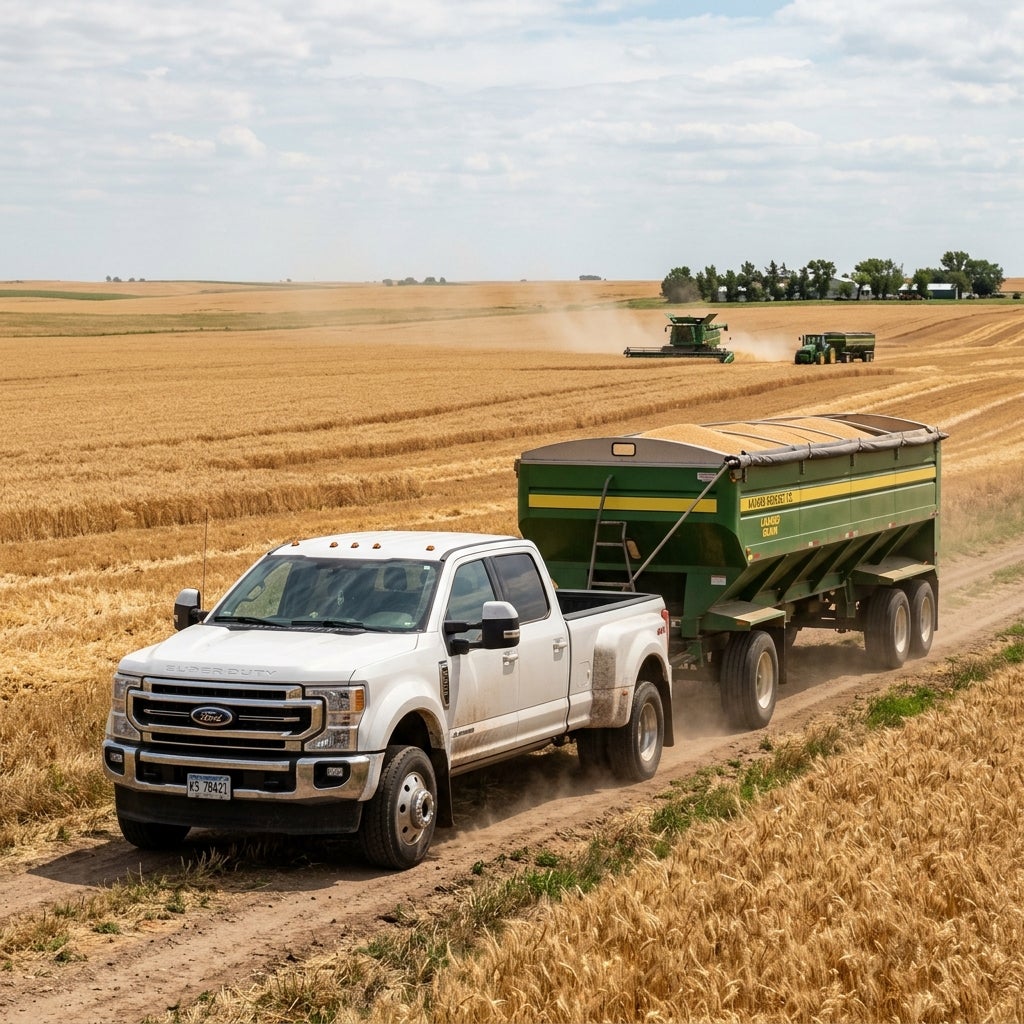
A white Ford Super Duty truck towing a green grain cart filled with wheat along a dirt path in a vast field. (Representative image for illustration purposes only. Actual vehicle may vary based on trim and configuration.)

Mastering the Payload: F-350 Tire Pressure for Heavy Grain Hauling

As hot summer days sweep across Kansas this July, local fields around Junction City and throughout Dickinson County are buzzing with harvest activity. Grain producers are working tirelessly to move massive yields from the fields to the local elevators. To get this crucial job done, agricultural operations rely heavily on the heavy-duty power of the Ford F-350 Super Duty. While these trucks are engineered to handle incredible payloads, pulling a fully loaded grain trailer places an immense amount of physical stress directly on your tires. Ensuring they are inflated to the exact right pressure is not just a detail—it is the line between a smooth, profitable harvest and a dangerous, costly roadside delay.

When you are hauling heavy grain, the safety of your truck, your cargo, and everyone else on our local rural routes depends on your tire footprint. Proper tire inflation optimizes traction, maintains vehicle stability, ensures responsive braking, and directly protects your suspension components from excessive wear. Our team at Valor Ford understands the unique demands of agricultural hauling, and we want to help you maximize your F-350's capabilities. If you are preparing your truck for a grueling harvest season, it is also a great time to perform a Trade In Evaluation on older fleet vehicles or ensure your current heavy-duty setup is ready to go.

Tire pressure is dynamic. It responds directly to external ambient temperatures, speed, and the sheer downforce exerted by heavy tongue weights. In this comprehensive guide, we will dive deep into everything you need to know about setting, managing, and maintaining your F-350's tire pressure when towing loaded grain trailers. Whether you operate a Single Rear Wheel (SRW) or Dual Rear Wheel (DRW) dually setup, understanding the physics of load-and-inflation is key to safeguarding your equipment and protecting your bottom line.

What is the recommended tire pressure for a Ford F-350 when hauling heavy grain trailers?

For a Ford F-350 tasked with hauling heavy grain trailers, the general recommended tire pressure is 60 to 75 PSI in the front tires and a maximum of 80 PSI in the rear tires(especially under full-load or dually configurations). However, the absolute baseline for your specific truck configuration should always be verified by checking the tire certification label located on your driver-side door jamb.

These pressures are calculated assuming you are using original equipment (OE) Load Range E tires. Under a heavy grain payload, your rear tires bear the brunt of the pin weight (for goosenecks) or the tongue weight (for bumper pulls). To support this intense vertical downforce without excessive tire sidewall flexing, the rear tires must be inflated to their maximum recommended capacity—which is typically 80 PSI cold. Keeping the front tires between 60 and 75 PSI preserves proper steering response and keeps the front contact patch balanced, preventing understeer or uneven wear.

It is important to remember that these numbers are 'cold' pressures. This means they should be measured before the vehicle has been driven, or at least three hours after it has been parked. Driving generates friction, which heats the air inside the tires and temporarily inflates the pressure reading. If you adjust your tires when they are already hot from a long run to the elevator, you will likely end up underinflating them once they cool down.

F-350 Setup

Front PSI (Cold)

Rear PSI (Cold)

Single Rear Wheel (SRW) Empty

60 PSI

65 PSI

Single Rear Wheel (SRW) Loaded

65-75 PSI

80 PSI

Dual Rear Wheel (DRW) Empty

60 PSI

55-60 PSI

Dual Rear Wheel (DRW) Loaded

65-75 PSI

80 PSI

Note: Dual Rear Wheel (DRW) trucks can distribute load across four rear tires, allowing for slightly lower rear tire pressures when empty to improve ride comfort. However, when hauling maximum capacity agricultural trailers, both SRW and DRW setups require the rear tires to be at 80 PSI to ensure maximum structural integrity and weight capacity.

What is the difference between recommended PSI and max PSI on my truck tire sidewall?
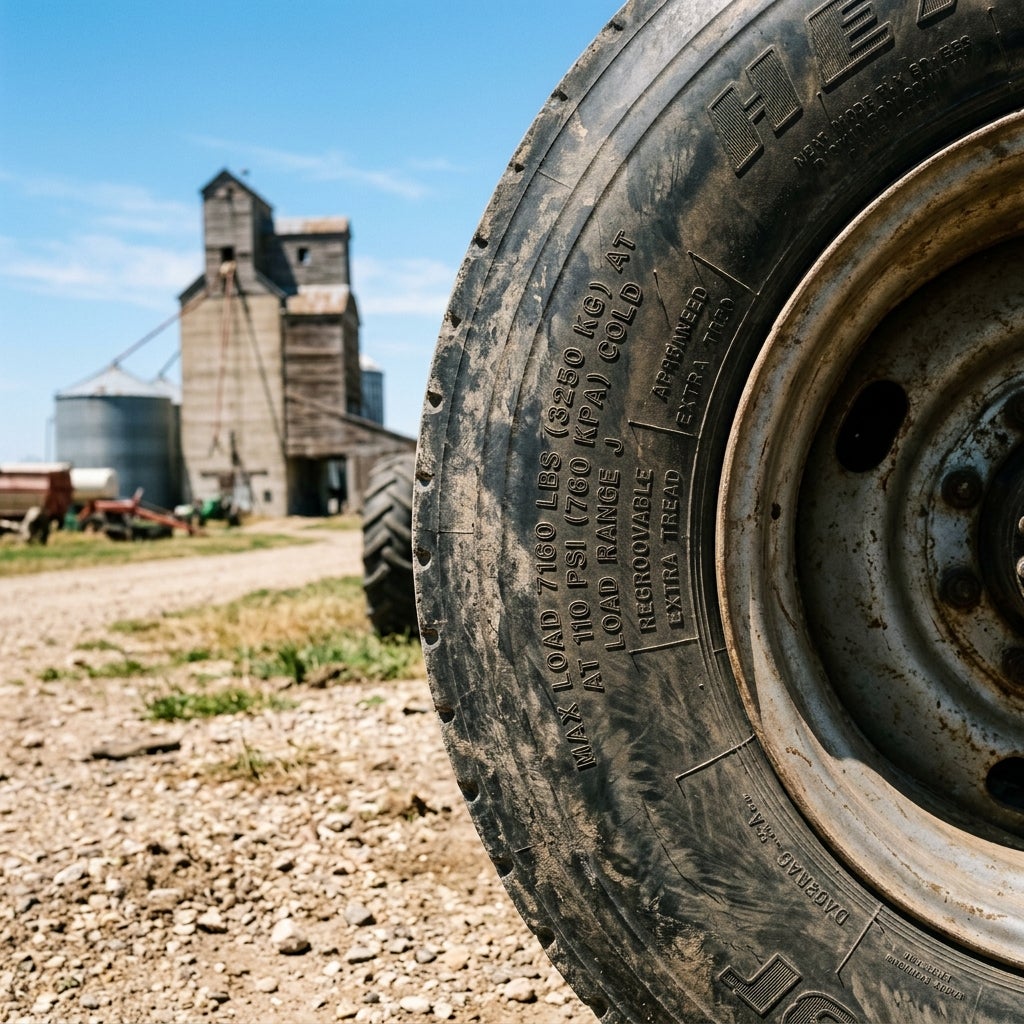
Close-up of a large vehicle tire with a weathered wooden grain elevator blurred in the background. (Representative image for illustration purposes only. Actual vehicle may vary based on trim and configuration.)

One of the most common points of confusion for farmers and fleet operators is the difference between the recommended tire pressure listed on the vehicle's door placard and the maximum PSI stamped directly onto the tire's sidewall. Misunderstanding these two numbers can lead to either dangerous over-inflation or severe under-inflation.

The recommended PSI on the door jamb placard is determined by Ford's engineering team. It represents the optimal inflation level for the vehicle's specific weight distribution, suspension tuning, handling characteristics, and braking performance. This recommendation ensures that under normal or maximum load conditions, the tire maintains an ideal contact patch with the road. It prevents the center of the tread from wearing out prematurely while guaranteeing the vehicle rides as comfortably as possible.

In contrast, the maximum PSI printed on the tire sidewall is a structural limitation set by the tire manufacturer. It tells you the absolute maximum pressure the tire carcass can safely handle to support its maximum rated load. For standard Load Range E tires, this is typically 80 PSI. You should never exceed this number. When hauling heavy grain trailers, you will often find that the rear recommended pressure matches this maximum limit (80 PSI) because the truck is being pushed to its maximum rear axle weight rating. However, inflating the front tires to the sidewall maximum when it is not needed can cause a harsh ride and reduced steering grip.

What is a tire load-and-inflation chart and how do I use it for my F-350?

A tire load-and-inflation chart is an industry-standard technical document produced by tire manufacturers (such as common tire manufacturers). It maps out exactly how much weight an individual tire can safely carry at a given inflation pressure. Since actual agricultural loads can vary significantly depending on whether your grain trailer is empty, half-full, or packed to the brim, these charts allow you to dial in your tire pressures with pinpoint accuracy.

To utilize these charts effectively, you first need to know the actual weight resting on your truck's axles. The most accurate way to do this is by visiting a local commercial scale in the Dickinson County area (such as a local grain elevator scale or a truck stop scale near Junction City). Drive your loaded F-350 onto the scale so you can get independent weights for your steer axle, drive axle, and trailer axles. Once you have these numbers, divide the drive axle weight by two (for an SRW truck) or by four (for a DRW dually) to determine the exact weight on each individual rear tire.

With your individual tire weight in hand, look up your specific tire size and load range on the manufacturer's load-and-inflation table. Find the weight that closely matches your measured load, and the chart will indicate the precise PSI required to support that weight. This prevents you from running a tire that is over-inflated for a lighter-than-expected load (which causes center tread wear) or under-inflated for a heavy load (which leads to catastrophic overheating).

If you are unsure how to read these charts or want an expert to inspect your tire wear patterns, our service professionals at Valor Ford are here to help. We can evaluate your truck's current tires, analyze your typical hauling weights, and provide a customized pressure schedule to keep your operations running safely. If you need financing information for a new set of high-capacity commercial tires, please contact our team before visiting our shop.

Why Weight Matters:• Prevents tire overheating • Optimizes the contact patch • Reduces drivetrain stress • Improves overall stability • Extends tread life

Should tire pressure be adjusted when towing a gooseneck vs. bumper pull trailer?

Yes, the type of trailer connection you use dramatically influences how weight is distributed across your Ford F-350's axles, which in turn dictates how you should manage your tire pressures. Gooseneck and bumper pull configurations apply forces to your truck's chassis in completely different ways.

Gooseneck Trailers: A gooseneck hitch places the trailer's pin weight directly over—or slightly ahead of—your F-350's rear axle. Because of this, a substantial portion of the trailer's tongue weight (often 15% to 25% of the total trailer weight) is transferred directly onto the truck's rear tires. This concentrated downward force requires your rear tires to be at their maximum load capacity pressure, typically 80 PSI cold. Because the weight is centered over the axle, it actually helps stabilize the truck's rear end, but it demands maximum structural support from the tire sidewalls to prevent dangerous flexing and heat buildup.

Bumper Pull Trailers: A bumper pull grain trailer attaches to the receiver hitch at the very back of the frame, well behind the rear axle. This creates a leverage effect. The tongue weight acts as a pivot, pushing down on the rear hitch while actually lifting some weight off the front steering axle. To counteract this and maintain control, you must use a high-quality weight-distribution hitch. When towing a heavy bumper pull, your rear tires still need to be highly pressurized (often 75-80 PSI) to handle the load, but you must also ensure your front tires are inflated correctly (typically around 65-70 PSI) to maintain steering traction. Since bumper pulls are more prone to sway, maintaining precise pressures on both axles is absolutely vital for highway safety.
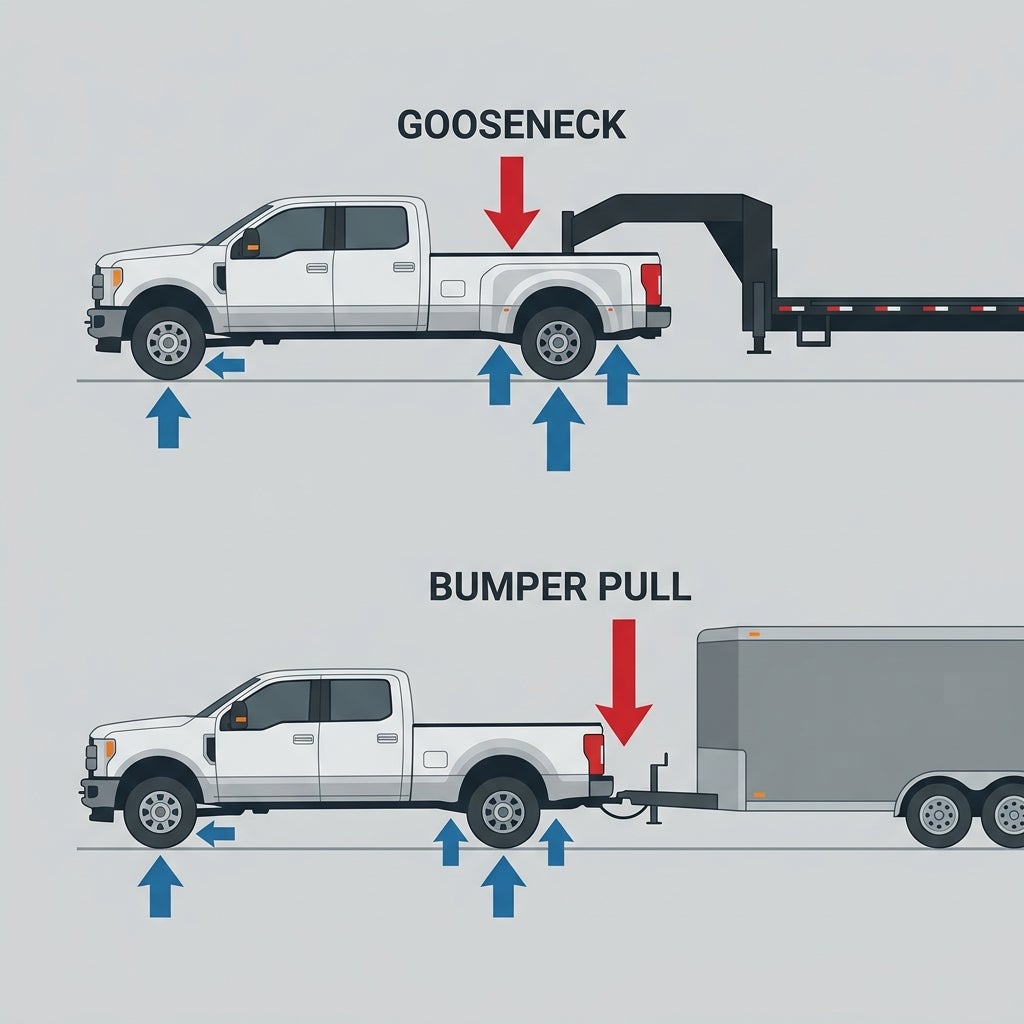
Diagram comparing the force distribution of gooseneck and bumper pull trailer hitches on a pickup truck. (Representative image for illustration purposes only. Actual vehicle may vary based on trim and configuration.)

Is underinflation a common cause of grain trailer tire blowouts?

Without a doubt, underinflation is the leading cause of tire blowouts on both towing vehicles and grain trailers. During the time-sensitive rush of harvest, grain trailers are often loaded to their absolute weight limits and driven across rough fields and hot asphalt. When a tire is underinflated, its structural integrity is severely compromised, setting off a chain reaction that frequently ends in a catastrophic blowout.

The science behind this is simple: excessive flexing and friction. When air pressure is too low, the tire's sidewalls flex excessively as the wheel rotates under a heavy load. This constant, aggressive flexing generates intense internal heat. Because rubber is an excellent insulator, it cannot easily dissipate this heat. As the temperature rises, the bonds holding the tire's rubber, steel belts, and nylon cords together begin to weaken. Eventually, the tire carcass suffers an internal separation, and the high pressure inside tears through the weakened sidewall, resulting in a sudden blowout at highway speeds.

Furthermore, underinflated trailer tires do not tracking straight. They tend to sway, adding significant lateral stress to your Ford F-350's rear suspension and hitch. This sway forces your truck's electronic stability control and braking systems to work overtime to keep the load lined up. A single trailer blowout can cause you to lose control, spill your valuable grain payload, or damage your trailer's axles and fenders—leading to expensive repairs and halting your harvest operations entirely. Keeping both your truck's and your grain trailer's tires fully pressurized is the easiest and most cost-effective insurance policy you can have against harvest-season downtime.

Does underinflation significantly increase fuel consumption when towing grain?

Yes, underinflated tires act as a constant, hidden drag on your truck's performance, significantly driving up your fuel costs. When you are pulling massive grain loads with a Ford F-350, your engine is already working hard to overcome aerodynamic drag and the heavy inertia of the trailer. If your tires are underinflated, you are adding an immense amount of rolling resistance to that equation.

Rolling resistance is the energy required to keep a tire rolling at a consistent speed. An underinflated tire sags, which increases its 'footprint' on the road. While a larger footprint might sound like it offers more grip, it actually increases the friction between the rubber and the asphalt. To overcome this extra drag, your truck's Power Stroke Turbo Diesel or gas engine must burn more fuel simply to maintain highway speeds.

Studies show that for every 1 PSI your tires are underinflated below their recommended level, you lose roughly 0.2% to 0.3% in fuel efficiency. If your rear tires are sitting at 60 PSI instead of the recommended 80 PSI, you are looking at a direct 4% to 6% drop in fuel economy. When you are making multiple long-distance runs from the fields of Dickinson County to regional grain elevators day after day, that extra fuel consumption adds up to hundreds of dollars in wasted operating costs over the course of a single harvest.
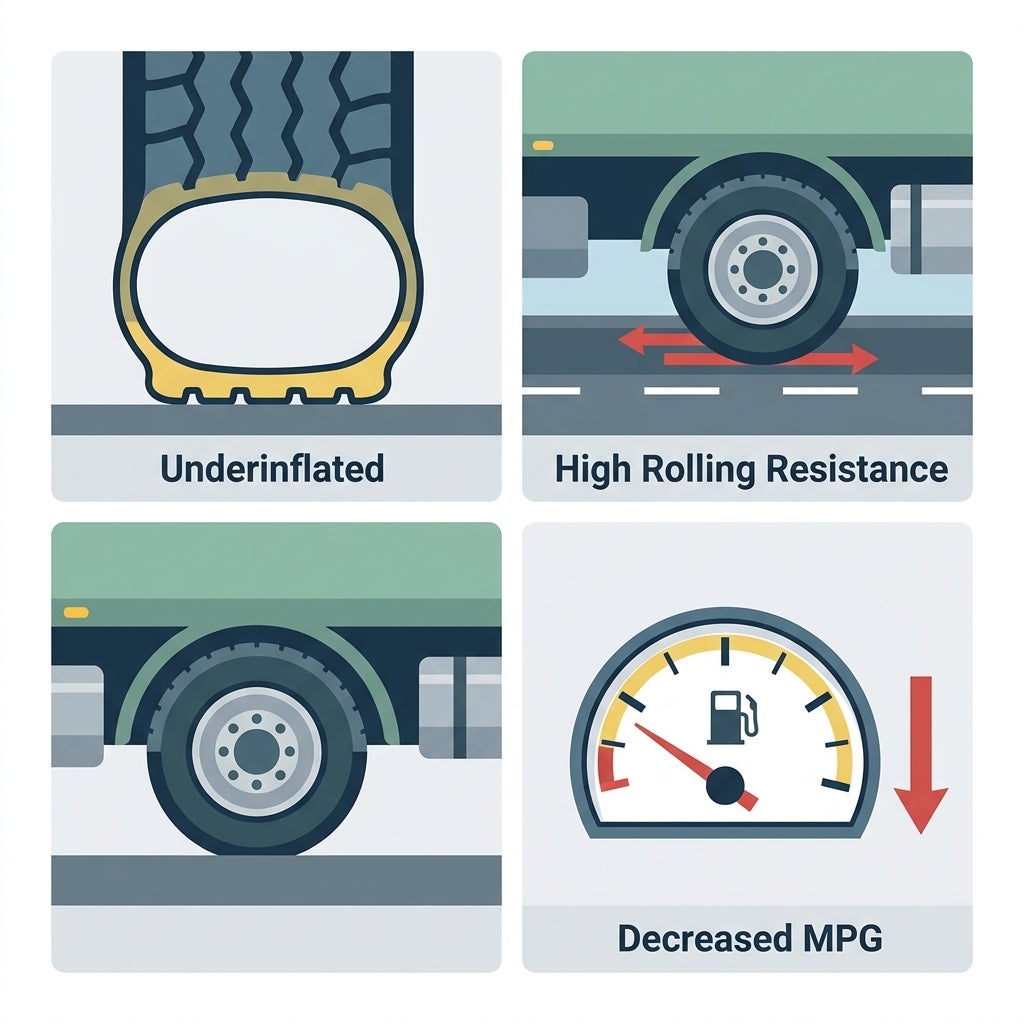
Infographic showing how underinflated tires lead to high rolling resistance and decreased MPG. (Representative image for illustration purposes only. Actual vehicle may vary based on trim and configuration.)

Is maintaining correct tire pressure on my F-350 and grain trailer cost-effective in the long run?

Absolutely. Treating tire pressure management as a daily priority is one of the most high-return investments you can make for your farm's bottom line. Heavy-duty commercial tires for a Ford F-350 represent a significant capital expense. When you run tires at incorrect pressures, you dramatically accelerate tread wear. Underinflation causes the outer edges of the tire to wear out prematurely, while overinflation wears out the center strip. Maintaining correct pressures ensures the tire wears evenly across its entire width, potentially extending its lifespan by thousands of miles.

Beyond tire replacement costs, proper tire management prevents unnecessary wear on your truck's steering and suspension components. Tires act as the primary dampening system for your truck. When they are incorrectly inflated, they cannot properly absorb road vibrations, transferring those harsh impacts directly into your ball joints, tie rods, shocks, and wheel bearings. This leads to premature suspension failure and expensive mechanical repairs.

To help monitor your setup, Valor Ford's parts department can help you source heavy-duty aftermarket Tire Pressure Monitoring Systems (TPMS) designed to monitor both your truck and your trailer's tires in real time from the cab. Investing in these preventive tools saves you from costly downtime and expensive repairs down the road. If you need replacement parts or monitoring equipment, we encourage you to Order Genuine Ford Parts directly through our website.

How local Dickinson County farm routes demand precise F-350 tire management

Driving conditions in the local Junction City and Dickinson County areas pose unique challenges for heavy-duty hauling. Farmers regularly transition from soft, uneven dirt or gravel fields straight onto high-speed asphalt highways. These rapid surface changes demand highly precise tire pressure management to ensure safety and traction on every stretch of your route.

When your F-350 is inside a soft, muddy field, a slightly larger tire contact patch is beneficial to prevent sinking and maintain traction. However, once you load up and pull onto paved county roads or highways like US-77, running underinflated tires is incredibly dangerous. The hard, hot asphalt quickly drives up internal tire temperatures, and the lack of proper inflation pressure will cause the loaded trailer to sway, making high-speed handling unstable.

To safely navigate these transitions, you must maintain a tire pressure setting that handles both environments effectively. Running your rear tires at 80 PSI cold ensures that when you hit the highway with a heavy load, your truck is perfectly balanced, stable, and ready to handle sudden stops. Don't let a poorly managed tire put your harvest at risk.
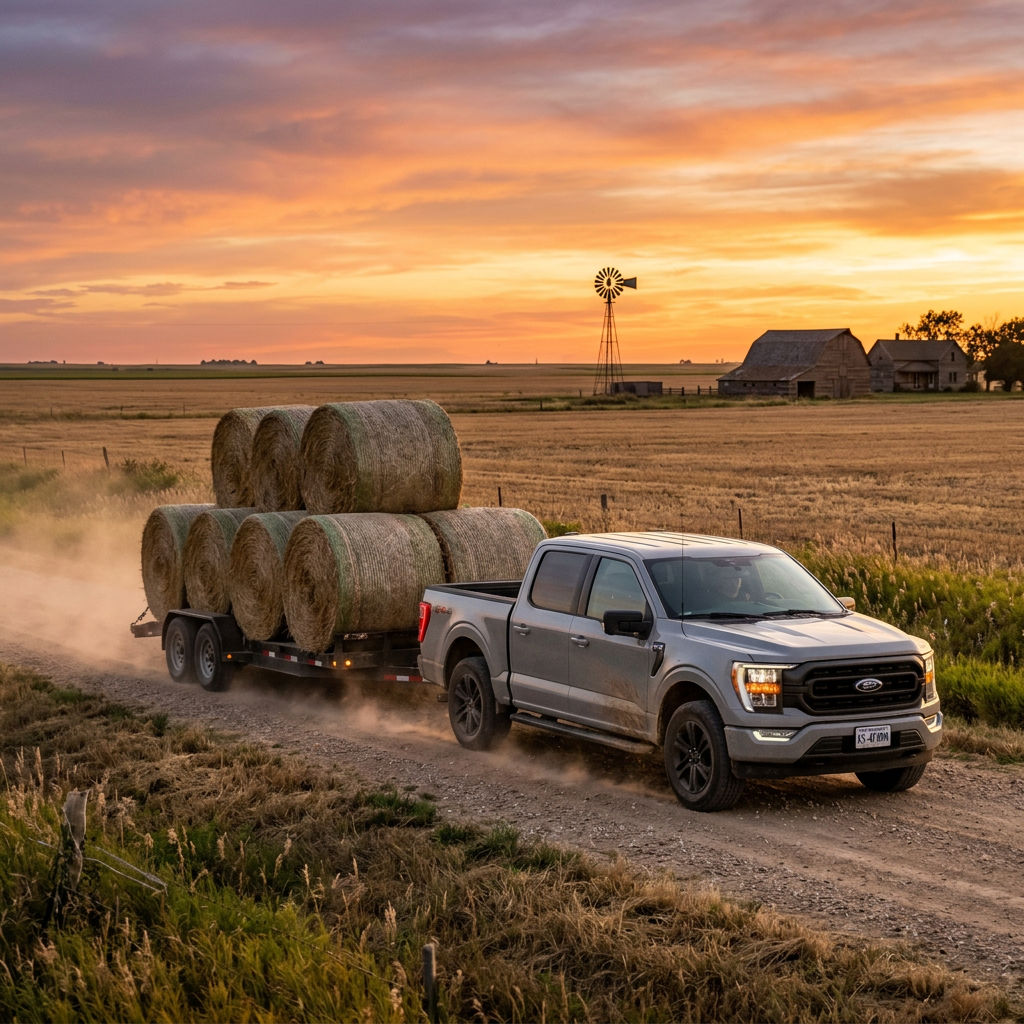
Silver pickup truck towing a trailer of large round hay bales on a dirt road at sunset. (Representative image for illustration purposes only. Actual vehicle may vary based on trim and configuration.)

A quick pre-haul tire checklist for Junction City grain producers

1. Check Pressures Cold Always measure your tire pressure first thing in the morning, before the truck has been driven or exposed to direct, hot sunlight. This gives you the most accurate baseline reading.

2. Inspect Valve Stems Heavy agricultural dust and mud can clog valve stems. Ensure all tires have high-quality, sealing metal valve caps to prevent slow, microscopic air leaks during long hauls.

3. Search for Dry Rot & Damage Farm equipment often sits parked for long periods. Inspect your truck and trailer tires for dry rot, cracks, and sidewall cuts caused by sharp crop stubble or rocky field entrances.

4. Verify Trailer Tire Pressure Never forget the trailer! Grain trailer tires (ST or LT rated) must also be inflated to their maximum recommended PSI to support the intense shifting weight of the grain.

5. Calibrate Your TPMS After adjusting your pressures for a heavy load, calibrate your Ford F-350's Tire Pressure Monitoring System through the SYNC infotainment screen so it recognizes the new baseline pressures.

6. Confirm Load Ratings Ensure both your truck and trailer tires have matching load capacities. Never mix load ranges on the same axle, as this will lead to highly unstable handling.

Get professional heavy-duty truck service and tire accessories at Valor Ford

At Valor Ford, we take immense pride in supporting our local Junction City agricultural community and the military families at nearby Fort Riley. We know that when harvest season arrives, you don't have time to waste on tire failures or mechanical issues. Our state-of-the-art service department is fully equipped to handle heavy-duty trucks, offering specialized commercial tire replacements, high-capacity alignments, suspension inspections, and professional towing setup advice.

Whether you need a new set of rugged, load-rated tires for your F-350, a commercial-grade pressure gauge, or a full safety inspection before you hook up your grain trailer, our factory-trained technicians are here to help. We stock a wide selection of genuine OEM parts and heavy-duty tire brands engineered specifically for the extreme demands of agricultural work. To make your maintenance as seamless as possible, you can easily Schedule Pickup and Delivery Service and let us take care of your truck while you focus on the fields.
Logo for Valor Automotive featuring a silver shield with red 'V' and white 'A' monogram inside, over a blue background.

Schedule your F-350 heavy-duty tire inspection at Valor Ford today

If you're noticing a warning light or want to stay ahead of tire issues, address your truck's tire needs. Ensure your Ford F-350 is fully prepared to handle the intense demands of the summer grain harvest. Our dedicated team is standing by to inspect your tread depth, analyze your wear patterns, verify your load ratings, and set your tires to the exact pressures needed for safe, efficient hauling. Schedule Ford Service Today, or stop by our dealership in Junction City to keep your harvest moving forward without interruption.

For personalized service or to speak directly with one of our truck service specialists, please Call us at (785) 238-5114. If you are ready to visit us in person, you can easily Get Directions to Valor Ford and find our dealership located at 1825 Goldenbelt Blvd, Junction City, KS 66441. We look forward to helping you keep your harvest moving safely and efficiently.
Posted in:

Related Posts

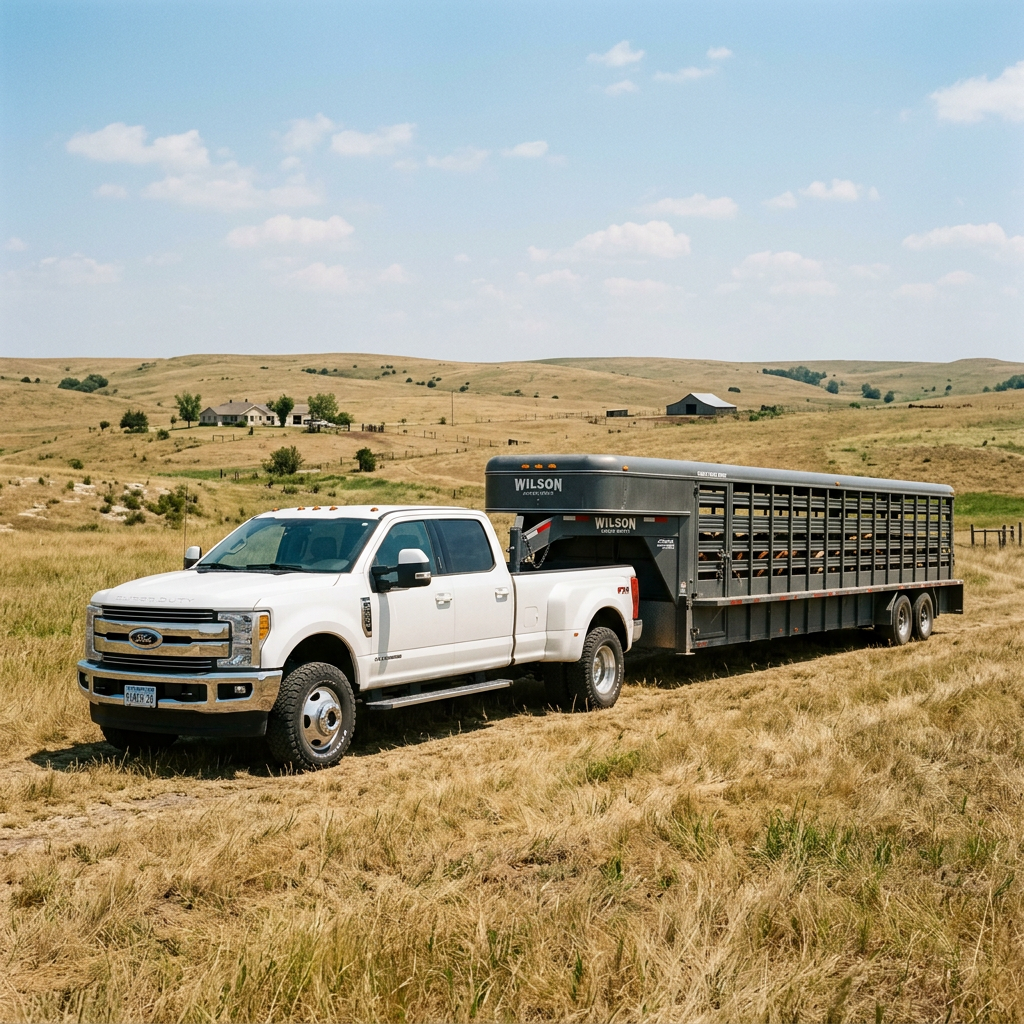
A white Ford Super Duty truck pulling a gray Wilson livestock trailer filled with cattle in a grassy pasture. (Representative image for illustration purposes only. Actual vehicle may vary based on trim and configuration.)

The Ultimate Heavy-Duty Towing Guide for Pottawatomie and Clay County Ranchers

A Heavy-Duty Towing Guide for Pottawatomie and Clay County Ranchers Operating a working cattle ranch or agricultural operation across the sweeping Flint Hills of Pottawatomie County and the fertile river valleys of Clay County is not a lifestyle for the faint of heart. It is a demanding, sun-up to sun-down commitment that requires grit, resilience, and equipment that simply refuses to quit. Out here in America's heartland, your heavy-duty truck is not just a daily commuter; it is a vital business partner, a mobile command center, and the lifeline that moves your livelihood from pasture to market. Whether you are hauling massive gooseneck stock trailers packed with black Angus cattle, shifting flatbeds loaded with thousands of pounds of fresh alfalfa bales, or transporting heavy excavators to clear out brush lines, you need more than just raw horsepower. You need a comprehensive understanding of heavy-duty towing principles, weight limits, and mechanical endurance. As the summer heat of July 2026 beats down on our Kansas pastures, the demands on your vehicle fleet multiply. High ambient temperatures, dusty gravel roads, and challenging topography can quickly push an under-prepared truck past its breaking point. That is where professional-grade engineering and local expertise come together. At Valor Ford, located proudly in Junction City, KS 66441, we have spent years working alongside local producers to understand the exact, uncompromising demands of Kansas agriculture. We know that when a thunderstorm is brewing on the horizon and you have fifty head of cattle to move, you cannot afford a transmission slip or a braking failure. This guide is built to serve as your definitive resource for mastering heavy-duty towing, choosing the absolute best rig configurations, and keeping your machinery running safely through every challenging season. If you are ready to experience this level of capability first-hand, feel free to Get Directions to Valor Ford and visit our showroom today. Our team is always on hand to talk payload, trailering setups, and powertrain choices. If you prefer to speak to a heavy-duty truck specialist directly from the comfort of your tractor cab, you can Call us at (785) 238-5114 to discuss your specific fleet needs. What is the maximum towing capacity of a 2026 Ford F-350 Super Duty for ranch work? When evaluating the sheer muscle required for serious agricultural work, the 2026 Ford F-350 Super Duty stands as an undisputed titan. For ranchers operating in Clay and Pottawatomie counties, understanding the absolute upper limits of your truck's capabilities is critical to both operational efficiency and on-road safety. Towing capacity is not just a single, static number printed on a brochure; it is a dynamic spectrum governed by your engine choice, axle ratio, drivetrain configuration, and the type of hitch mechanism you employ. To maximize your productivity, you must look closely at how conventional bumper-pull towing compares to gooseneck and fifth-wheel setups, which are the absolute lifelines of modern ranching operations. When configured with the legendary 6.7L High-Output Power Stroke® V8 Turbo Diesel engine, the 2026 F-350 is engineered to redefine what a heavy-duty truck can achieve. In a dual-rear-wheel (DRW) configuration with a gooseneck setup, the F-350 boasts an astronomical maximum towing capacity of up to 40,000 pounds. This massive rating allows you to pull the largest multi-car haulers, triple-axle cattle trailers packed with heavy mature bulls, or massive industrial flatbeds loaded down with dual-wheel tractors and tillage equipment. Even with conventional bumper towing, the F-350 achieves a class-leading capacity of up to 28,000 pounds when properly equipped. This means bumper-pull stock trailers, heavy-duty utility trailers, and large mobile fuel tanks can be moved around the farm without a second thought. For those who prefer the simplicity and quick throttle response of a gasoline engine, the 2026 F-350 offers the formidable 7.3L "Godzilla" V8. While diesel remains the undisputed king of absolute maximum pulling power, this heavy-duty gas engine is no slouch, delivering outstanding conventional and gooseneck towing limits that easily exceed 20,000 pounds. This makes it an incredibly cost-effective, low-maintenance workhorse for ranchers who run shorter local routes between the pasture and the local sale barn, or who need a reliable backup truck that can sit for periods without worrying about modern diesel emissions systems. No matter which powertrain you choose, matching the right gear ratio—such as the 3.55 or 4.10 limited-slip or electronic-locking rear axles—is key to unlocking these extreme tow ratings. To put these capacities in perspective, consider the real-world math of a Kansas cattle ranch. A standard 24-foot steel gooseneck stock trailer weighs roughly 6,000 to 7,000 pounds empty. Load it up with 25 feeder steers weighing an average of 800 pounds each, and you are looking at a total trailer weight of 26,000 to 27,000 pounds. A single-rear-wheel F-350 can handle this load comfortably, but stepping up to a dual-rear-wheel model provides that crucial safety margin and unmatched stability when crosswinds hit you on Highway 24. Knowing your limits prevents premature wear on your transmission, keeps your brakes from overheating, and ensures you remain fully legal and safe on public roads. Engine Option Max Conventional Towing Max Gooseneck/5th-Wheel Towing Best Suited Agricultural Task 6.7L HO Power Stroke V8 Diesel 28,000 lbs 40,000 lbs Hauling heavy livestock trailers & major commercial machinery over long distances 6.7L Standard Power Stroke Diesel 25,000 lbs 35,000 lbs Everyday stock hauling, heavy hay bale transport, and construction equipment 7.3L 'Godzilla' V8 Gasoline 21,000 lbs 22,500 lbs Frequent short-haul trips, feed delivery, utility work, and winter pasture idling 6.8L 2-Valve Devict V8 Gasoline 17,500 lbs 18,800 lbs Light-to-medium utility towing, fleet operations, and general farm service duties Does a dually ride significantly rougher than a single-rear-wheel truck when empty? This is one of the most common dilemmas we hear from ranchers standing on our showroom floor: 'If I buy a dual-rear-wheel (DRW) truck to handle my heaviest loads, am I going to regret it every time I drive it empty into town?' It is a highly practical question. Many farm trucks serve double-duty as the family vehicle, taking trips to the grocery store, running the kids to school events in Junction City, or making long supply runs to Manhattan. Historically, dually trucks had a well-deserved reputation for riding like an unloaded dump truck when there was nothing in the bed. The stiff rear leaf springs, designed to support massive payloads, had very little give, resulting in a jarring, bouncy ride over uneven pavement, washboard gravel roads, and deep pasture ruts. However, modern engineering has dramatically closed the comfort gap between single-rear-wheel (SRW) and DRW trucks. The 2026 Ford Super Duty lineup utilizes advanced, progressive-rate leaf springs and sophisticated shock tuning. When the truck is empty, only the primary spring pack is engaged, allowing for a surprisingly compliant and cushioned ride that mimics a standard heavy-duty pickup. It is only when you drop a heavy gooseneck trailer onto the ball or load up the bed with salt blocks that the helper springs engage to provide the extreme load-bearing support required. While you will still feel a slightly firmer response over sharp bumps compared to an SRW truck—primarily due to the wider, stiffer footprint of four rear tires—it is no longer the bone-jarring experience of the past. Where the dually truly shines, and where it easily earns its keep, is in its unparalleled lateral stability. If you have ever towed a double-deck stock trailer filled with shifting livestock down Highway 77 during a classic Kansas windstorm, you know the white-knuckle feeling of sway. A single-rear-wheel truck, while capable of pulling the weight, has more sidewall flex in the rear tires, allowing the trailer to steer the truck. A dually virtually eliminates this issue. The massive, wide stance of the dual rear wheels acts as an anchor, resisting lateral forces and keeping your rig tracking straight and true. For many ranchers, the absolute peace of mind and safety provided during those windy, high-stress hauls far outweigh the minor difference in unloaded ride quality. To help you decide which configuration is right for your ranch, let's look at a quick comparison of the trade-offs: • Single Rear Wheel (SRW): Easier to park in town, fits through standard automatic car washes, slightly better fuel economy when empty, and a smoother unloaded ride on rough gravel roads. • Dual Rear Wheel (DRW): Maximum payload capacity for heavy pin weights, unmatched stability against crosswinds and moving livestock, and extra safety redundancy (if you get a flat tire on one rear tire while hauling, the other can support the load until you reach safety). Find Your Next Workhorse in Our Heavy-Duty Inventory Whether your daily chores demand the ultimate pulling power of a dual-rear-wheel F-350 or the versatile, everyday capability of a single-rear-wheel F-250, Valor Ford has the rugged inventory to back you up. We specialize in configuring trucks that are purpose-built for the unique demands of Kansas agricultural operations. If you are looking for a truck that fits the job—get the exact powertrain, suspension, and towing package your ranch deserves. Explore our options online or stop by to test drive our current selection of heavy-duty trucks. Explore New Ford Super Duty Inventory Which truck offers better engine braking for descending steep grades with a heavy trailer? Towing a heavy trailer is only half the battle; stopping it safely is where the real engineering challenges lie. For ranchers in the Kansas River valley and the rolling hills of Clay County, descending steep, winding gravel roads with a fully loaded livestock trailer can quickly become dangerous if you rely solely on your service brakes. Friction brakes can overheat rapidly under heavy loads, leading to brake fade—a terrifying condition where the brakes lose their stopping power entirely. To combat this, modern heavy-duty trucks utilize engine braking systems to control downhill speed, save wear on your brake pads, and keep your rig under complete control. When it comes to pure, unrelenting engine braking performance, the 6.7L Power Stroke® V8 Turbo Diesel is the undisputed champion. Ford's diesel engine features a driver-activated smart exhaust brake. Unlike older, simpler exhaust brakes, this system utilizes a variable-geometry turbocharger (VGT) to restrict exhaust flow, creating backpressure in the cylinders. This backpressure forces the pistons to work harder against the compressed air, effectively slowing the vehicle's wheels through the drivetrain. The system operates in two modes: 'On' for continuous maximum braking, and 'Auto,' which monitors your speed and brake pedal application to automatically maintain your current speed down the hill. It is incredibly smooth and provides massive holding power, allowing you to descend steep pasture trails or highway grades without ever touching the brake pedal. Gasoline engines, such as the 7.3L V8, rely on a different physical mechanism called vacuum braking or compression braking. When you release the throttle on a gas truck, the throttle body closes, creating a strong vacuum in the intake manifold. The engine has to work hard to draw air against this closed valve, which creates a natural braking effect. Ford pairs this with aggressive tow/haul transmission programming, which automatically downshifts the 10-speed TorqShift® automatic transmission to raise engine RPMs and maximize this vacuum braking force. While highly effective for moderate loads and rolling hills, a gasoline engine simply cannot match the sheer retardation force generated by a turbocharged diesel exhaust brake. For agricultural operations that regularly tow near or above 15,000 pounds, the diesel exhaust brake is a game-changing safety feature. It not only prevents catastrophic brake failure but also drastically reduces your long-term maintenance costs. Instead of replacing warped rotors and worn brake pads every season due to heavy hauling, the exhaust brake handles the majority of the deceleration work, preserving your service brakes for when you truly need to come to a complete, sudden stop. If your ranching routes involve navigating the rolling terrain surrounding Tuttle Creek Lake or the steep descents down to the Kansas River, investing in the Power Stroke diesel with its smart exhaust brake is one of the smartest safety decisions you can make. How do you properly adjust an integrated trailer brake controller? Step 1: Connect and Verify Before making any adjustments, ensure your trailer is securely coupled, safety chains are crossed, and the electrical umbilical cord is firmly plugged into your truck's 7-pin connector. Start your Ford Super Duty and look at the productivity screen on your dashboard. The system should display a message confirming 'Trailer Connected.' If you see a warning or no connection message, double-check your physical connection and inspect the plug for any dirt, corrosion, or bent pins—common issues on working ranch trucks. Next, navigate the driver information screen using your steering wheel controls to select the correct trailer profile. Ford's advanced system allows you to save settings for multiple trailers, such as 'Gooseneck Stock' or 'Flatbed Utility.' This saves you from having to recalibrate from scratch every time you swap equipment. Step 2: Set Initial Gain Locate the integrated trailer brake controller on your center instrument panel. It features a manual squeeze-squeeze slider and physical '+' and '-' buttons to adjust the 'Gain' setting. Gain represents the amount of electrical power sent to the trailer's electric or electric-over-hydraulic brakes when you press the truck's brake pedal. For a starting point, set the gain to a moderate level, typically 5.0 on a scale of 1 to 10. If you are towing an exceptionally heavy or fully loaded livestock trailer, you may want to start slightly higher, around 6.5. If the trailer is empty or very light, start lower, around 3.0, to prevent the trailer tires from immediately locking up and dragging. Step 3: Road Test and Calibrate Find a safe, flat, open area with minimal traffic, such as an empty gravel staging area or a quiet country road. Accelerate your rig to approximately 20 to 25 mph. Keeping your hands on the steering wheel, use your right hand to gently but firmly squeeze the manual trailer brake slider completely together. Do not press the truck's foot brake pedal. Pay close attention to how the rig responds. If the trailer brakes lock up and slide the tires, your gain is set too high; press the '-' button to decrease the gain by 0.5. If the trailer barely slows the truck down, your gain is too low; press the '+' button to increase it. Repeat this test until you achieve maximum braking force just short of trailer wheel lock-up. This ensures the truck and trailer work in perfect harmony, stopping as a single, cohesive unit. Are there tax write-offs for heavy-duty ranch trucks under Section 179? Owning and operating a ranch is not just a way of life; it is a highly capital-intensive business. To remain profitable, smart financial management is just as important as good animal husbandry. Fortunately, the United States tax code offers a powerful incentive for agricultural producers looking to upgrade their work vehicles: Section 179 of the Internal Revenue Code. This tax provision allows qualifying businesses, including family farms and commercial ranches, to deduct the full purchase price of qualifying equipment—including heavy-duty trucks—directly from their gross income in the tax year the vehicle is purchased and placed into service. To qualify for the maximum Section 179 deduction, the vehicle must meet specific gross vehicle weight rating (GVWR) thresholds set by the IRS. Passenger cars and light-duty crossovers face strict caps on write-offs. However, vehicles with a GVWR between 6,000 pounds and 14,000 pounds—which includes the entire Ford F-250 and F-350 Super Duty lineup—qualify for substantial immediate expensing. For heavy-duty work trucks that are equipped with a cargo bed of at least six feet in interior length, or those modified for specific agricultural use (such as a flatbed feed truck), you can potentially deduct up to 100% of the purchase price in year one, subject to overall business income limits and annual deduction ceilings. This represents an incredible opportunity for ranchers in Clay and Pottawatomie counties to significantly lower their tax liability while simultaneously modernizing their fleet with safer, more capable towing machines. If you are operating with an older, unreliable truck that requires constant repairs, the tax savings from a Section 179 write-off can offset a massive portion of the acquisition cost of a brand-new 2026 Super Duty. Of course, because tax laws are complex and individual farm financial structures vary, we always advise consulting with a certified public accountant (CPA) or agricultural tax specialist who knows Kansas farm tax regulations inside and out to ensure you maximize your eligible savings. If you are planning to leverage these tax advantages before the end of the fiscal year, getting pre-approved for your commercial vehicle loan is a smart first step. Our finance department makes the process incredibly straightforward and transparent. You can easily Get Pre-Approved for Financing online from your office, allowing you to lock in competitive rates and contact our finance team for current financing options and terms. Apply for Commercial Financing Now How often should you grease the chassis and suspension components on a farm truck? The Harsh Reality of Farm Use Farm trucks operate in environments that would make standard highway vehicles shudder. Muddy pastures, deep river crossings, fine limestone dust on county roads, and winter road salt create a highly abrasive slurry that constantly attacks your truck's moving parts. Under these severe operating conditions, standard manufacturer maintenance schedules designed for average highway drivers simply do not apply. If you wait for the standard service interval to grease your chassis, you are likely setting yourself up for premature component failure, steering play, and dangerous trailering breakdowns. The Recommended Interval For farm trucks undergoing daily heavy agricultural use, you should inspect and grease key chassis and suspension components every 3,000 to 5,000 miles, or at least twice a year—ideally before the heavy spring planting season and ahead of the harsh winter freeze. If you frequently navigate deep mud or water crossings that submerge your axles, you should grease these components immediately afterward to purge any trapped water and contaminants. Regular greasing keeps steering responsive, prevents metal-on-metal wear, and ensures your heavy towing rig remains structurally sound. Critical Points to Grease When performing service, pay close attention to the following high-wear areas: • Tie-rod ends and steering drag links • Upper and lower ball joints (if greaseable) • Front drive axle U-joints (on 4x4 models) • Driveshaft slip yokes and universal joints Using a high-quality, water-resistant lithium complex grease is essential to provide lasting protection against the elements. If you prefer to have certified experts handle this, or need parts to do it yourself, you can easily Order Genuine Ford Parts from Valor Ford to ensure your truck gets the exact lubricants and replacement components it needs to survive the Kansas range. Schedule Your Next Heavy-Duty Service at Valor Ford Keeping your work truck in prime mechanical condition shouldn't take time away from your busy ranch schedule. At Valor Ford, our certified diesel and heavy-duty technicians understand the value of your time and the importance of a dependable truck. From routine chassis lubes and transmission flushes to complex diesel diagnostics, we handle it all with precision. To make maintenance completely hassle-free, we encourage you to Schedule Pickup and Delivery Service, allowing us to service your truck while you keep your operations moving on the farm. Schedule Ford Service Today Essential Rigging: Gooseneck vs. Fifth-Wheel Hitches for Agricultural Hauling Choosing the right physical connection between your truck and your trailer is one of the most critical decisions in heavy-duty towing. In the agricultural world, the choice almost always comes down to two primary systems: the gooseneck hitch and the fifth-wheel hitch. While both systems mount directly inside the truck bed over the rear axle to maximize stability and weight distribution, they are designed for vastly different use cases. Understanding these differences can save you countless hours of frustration when hooking up in muddy pastures or navigating tight, enclosed farmyards. The gooseneck hitch is the undisputed king of the working ranch. It utilizes a simple 2-5/16 inch ball that mounts directly in the center of your truck bed, coupling with a long tubular coupler on the trailer. The primary advantage of a gooseneck is its incredible versatility and off-road articulation. The ball-and-socket design allows the trailer to twist and tilt independently of the truck, which is absolutely essential when pulling a heavy cattle trailer through uneven pasture gates, deep ditches, or terraced fields. Furthermore, when you aren't towing, you can easily remove the ball or flip it upside down (using Ford's under-bed prep package), leaving you with a completely flat, unobstructed truck bed to load up with hay bales, feed bags, or fencing supplies. The fifth-wheel hitch, on the other hand, utilizes a massive horseshoe-shaped plate mechanism similar to those found on commercial semi-trucks, which couples with a kingpin on the trailer. Fifth-wheel hitches are engineered primarily for maximum on-road stability and smoothness, making them the preferred choice for massive RVs and heavy commercial flatbeds. However, they have major drawbacks for daily farm work. The hitch assembly itself is incredibly heavy, bulky, and difficult to remove from the truck bed when you need cargo space. Additionally, fifth-wheel hitches offer very limited lateral pivot, meaning that if you try to pull one over a steep ditch or uneven pasture terrain, you risk putting immense twisting stress on your truck's frame or damaging the hitch itself. For 90% of ranchers in Clay and Pottawatomie counties, the gooseneck is the clear winner. Ford makes utilizing this system easier than ever with the available 5th-Wheel/Gooseneck Hitch Prep Package, which includes five under-bed attachment points integrated directly into the frame. This allows you to drop in a gooseneck ball or a fifth-wheel hitch in seconds, giving you the ultimate flexibility to tackle any trailering job that comes your way. Get an Accurate Trade-In Value on Your Current Farm Truck Is your current farm truck struggling to keep up with the demands of the season? Upgrading your agricultural fleet doesn't have to be a hassle. At Valor Ford, we make trading in your old workhorse incredibly easy and transparent. We appreciate the value of solid, hard-working vehicles, and we want to ensure you get top dollar for your trade. Use our quick online valuation tool to get an instant, fair assessment, and let us help you transition into a powerful new Ford Super Duty designed to dominate the Kansas range. Get Your Trade-In Evaluation Dominate the Kansas Range with a Super Duty from Valor Ford Navigating the heavy-duty demands of agricultural life in Pottawatomie and Clay counties requires a truck that is as dedicated, resilient, and uncompromising as the ranchers who drive them. From understanding the raw limits of a 2026 Ford F-350's towing capacity to mastering the nuances of chassis maintenance and trailer brake calibration, being an informed owner is the key to a safe, productive, and profitable operation. As your local heavy-duty truck headquarters, Valor Ford is deeply committed to supporting the agricultural communities of Junction City, Geary County, and all surrounding ranchlands with the vehicles, parts, and expert service you need to succeed. Don't leave your towing safety and ranch productivity to chance. Whether you want to explore our rugged pre-owned truck fleet by checking out our Browse Used Inventory page, or you are ready to build a brand-new, customized workhorse, our team is here to help you every step of the way. Stop by our dealership today or get in touch with our commercial vehicle experts to find the perfect truck to power your ranching operations for years to come. Visit Valor Ford in Junction City

Grey Ford F-150 truck driving on a gravel dirt road through rolling hills at sunset. (Representative image for illustration purposes only. Actual vehicle may vary based on trim and configuration.)

Ford F-150 Special Offer Event at Valor Ford: Direct Savings & Financing Terms

Ford F-150 Special Offer Event at Valor Ford: Direct Savings & Financing Terms The summer sales event of the year has officially arrived in Junction City, KS! Valor Ford is proud to announce exclusive factory incentives, massive direct dealer discounts, and unbeatable low APR financing terms across our entire fleet of new Ford F-150 pickup trucks. Whether you need a dependable workhorse for the farm, a robust towing platform for equipment, or a feature-packed luxury truck for weekend family trips, there has never been a better time to upgrade your ride. For a limited time through August 31, 2026, take advantage of factory customer cash allowances, low promotional financing rates through Ford Credit, and enhanced trade-in valuations designed to put maximum money back in your pocket. Visit Valor Ford today at 1825 Goldenbelt Blvd in Junction City to explore our extensive F-150 inventory, compare package features, and take a personalized VIP test drive before these seasonal savings expire. View New Ford F-150 Sales Inventory How Much Can You Save on a New Ford F-150 During This Event? During the Ford F-150 Special Offer Event at Valor Ford, total customer savings combine national factory rebates, regional promotional bonus cash, and exclusive dealer discounts to deliver unmatched bottom-line value. Shoppers can choose between attractive low-APR financing packages or substantial direct cash back options. Whether you are interested in a classic Regular Cab, a versatile SuperCab, or a spacious SuperCrew, our pricing specialists will help you stack eligible incentives. Take a moment to Research Ford F-150 trim options to see how factory discounts apply across different cab configurations and bed lengths. F-150 Configuration Promotional Financing Customer Cash Allowance Estimated Total Savings Regular Cab (XL / XLT) Low APR Options Up to $1,500 Up to $3,500 SuperCab (XLT / STX) Low APR Options Up to $2,250 Up to $4,500 SuperCrew (Lariat / King Ranch) Low APR Options Up to $3,000 Up to $6,000 Which Ford F-150 Trims Are Included in the Junction City Sales Event? Work-Ready XL & XLT Engineered for maximum utility, durability, and daily efficiency. Standard SYNC 4 touchscreen technology, heavy-duty payload ratings, and Ford Co-Pilot360 suite make these models ideal for commercial work and everyday dependability across Kansas roads. Luxurious Lariat & King Ranch Experience premium leather seating, B&O Unleashed Sound Systems, heated and ventilated seats, and advanced highway towing assistance. Perfect for truck owners who demand high-end luxury without sacrificing full-size pickup performance. Off-Road Tremor & Raptor Conquer rugged terrain and off-road trails with specialized suspension setups, Fox Racing shocks, high-ground-clearance skid plates, and Trail Control systems. Available with special event upgrade packages at Valor Ford. Exclusive Military Bonus Cash & Savings for Fort Riley Service Members Valor Ford is proud to serve the men and women stationed at Fort Riley and surrounding military installations. During the F-150 Special Offer Event, active duty personnel, military retirees, veterans, and eligible family members can stack the Ford Military Recognition Bonus Cash directly on top of current sales event discounts. Our finance specialists understand military pay structures and offer expedited paperwork handling for active duty service members. Bring your military ID or DD-214 form to unlock these exclusive stacked savings on your new Ford F-150. Reserve Your F-150 Event Savings Voucher and Book a Test Drive High demand trim configurations and popular color choices are selling fast during this promotional window. Don't risk missing out on maximum event incentives. Reserve your personalized savings voucher online and lock in a priority VIP test drive appointment at Valor Ford today. Claim Your Event Savings Voucher Maximize Your Trade-In Value Towards a New Ford F-150 Pre-owned vehicle market values remain exceptionally high, and Valor Ford is offering aggressive trade-in bonuses throughout this event. By trading in your current car, truck, or SUV, you can substantially reduce your loan amount, lower your monthly payment, or cover your down payment entirely. Use our quick online tool for a complimentary Trade In Evaluation report in minutes, or bring your vehicle to our Junction City dealership for an instant top-dollar appraisal cash offer. F-150 Towing and Hauling Specs for Dickinson County Farms and Work Sites Farmers, contractors, and outdoor enthusiasts throughout Dickinson County and Geary County demand hard-working capabilities. The Ford F-150 features high-strength, military-grade aluminum-alloy body design paired with a fully boxed high-strength steel frame to handle severe payloads and heavy towing requirements. With innovative features like Pro Power Onboard mobile generator power outlets, Smart Hitch weight distribution sensors, and Pro Trailer Backup Assist, the F-150 turns tough jobs into manageable tasks. Engine Option Max Towing Capacity Max Payload Rating Pro Power Onboard 3.5L EcoBoost V6 Up to 13,500 lbs Up to 2,445 lbs 2.0 kW Available 5.0L Ti-VCT V8 Up to 13,000 lbs Up to 2,230 lbs 2.0 kW Available 3.5L PowerBoost Hybrid Up to 12,700 lbs Up to 2,120 lbs Up to 7.2 kW Standard/Avail. PowerBoost Hybrid vs. 3.5L EcoBoost vs. 5.0L V8 Engine Deal Comparison 3.5L PowerBoost Hybrid Delivers 430 horsepower and 570 lb-ft of torque. Combines gas efficiency with serious towing grunt and built-in electrical power for work tools or camping gear. 3.5L EcoBoost Twin-Turbo V6 Packs 400 horsepower and 500 lb-ft of torque. The go-to option for maximum towing rating and instant low-end torque pull for heavy trailering. 5.0L Ti-VCT V8 Classic V8 exhaust note producing 400 horsepower and 410 lb-ft of torque. Proven reliability with high payload capacity for traditional heavy haulers. Get Pre-Approved for Low APR Financing Online Before Visiting Valor Ford Save time at the dealership by starting your purchase from home. Complete our quick, encrypted application to Get Pre-Approved for Financing in minutes. Our finance specialists work with Ford Credit and multiple lending institutions to secure competitive interest rates and customized repayment terms for every budget. Start Online Finance Application Custom Accessories and Work-Ready Upgrades Available During the Sale Bed Protection & Covers Tough spray-in bedliners, folding hard tonneau covers, and bed cargo management systems bundleable directly into your new truck purchase package. Towing & Suspension Gear Heavy-duty trailer hitch receivers, integrated brake controllers, side step running boards, and enhanced off-road shock upgrades. Interior Protection All-weather floor liners, custom seat covers, and under-seat storage vaults. You can easily Order Genuine Ford Parts through our dealership catalog. What Checklist Documents Should You Bring to the F-150 Sales Event? To ensure a seamless, rapid delivery process on the day of your purchase, please bring the following key documents with you to Valor Ford: • Valid government-issued driver's license • Current auto insurance card • Recent pay stub or proof of income (or LES for active duty military) • Title and current registration for your trade-in vehicle If you plan to claim military discounts, remember your Military ID or DD-214 form. Having these items ready allows our team to finalize financing approvals and vehicle registration rapidly so you can drive home in your new F-150 without delay. Event Schedule, Location Hours, and Directions to Valor Ford in Junction City Valor Ford is conveniently located at 1825 Goldenbelt Blvd, Junction City, KS 66441. We are easily accessible from I-70, Fort Riley, Manhattan, and Abilene. Showroom Hours: Monday – Friday: 8:00 AM – 7:00 PM Saturday: 8:00 AM – 6:00 PM Sunday: Closed Have questions before your visit? Call us at (785) 238-5114 to speak with an F-150 specialist, or click here to Get Directions to Valor Ford directly on your mobile device. Claim Your Special Offer on a New Ford F-150 at Valor Ford Today The Ford F-150 Special Offer Event ends August 31, 2026. Don't wait until preferred trim levels, engine options, and color choices are claimed by someone else. Contact Valor Ford in Junction City now to secure maximum seasonal savings, competitive financing rates, and exceptional customer service. Claim Your F-150 Special Offer Now

2026 Ford Bronco Outer Banks

2026 Ford Bronco Outer Banks: Built for Kansas Roads and Beyond

2026 Ford Bronco Outer Banks: Built for Kansas Roads and Beyond The 2026 Ford Bronco Outer Banks is the right pick for military families, working professionals, and rural Kansas drivers who need genuine off-road capability without sacrificing daily comfort. The in-stock Avalanche Gray model at Valor Ford is equipped with the 2.3L EcoBoost four-cylinder producing 275 horsepower, a 10-speed automatic transmission, four-wheel drive, and the Sasquatch Package — all at an MSRP of $56,530. It returns 18 city / 22 highway MPG and seats five in leather-trimmed comfort. Shop New Ford Bronco Inventory How Well Does the 2026 Ford Bronco Outer Banks Serve Local Lifestyles? The 2026 Ford Bronco Outer Banks is purpose-built for exactly the kind of life Junction City and Fort Riley families actually live — balancing structured weekday routines with weekend freedom on Kansas's open terrain. This is not a crossover that merely looks rugged; it is engineered to back up that appearance with real-world versatility that matters when your week includes a school run, a base commute, and a Saturday trail drive through the Flint Hills. Military families stationed at Fort Riley often find themselves needing a vehicle that transitions seamlessly from on-base errands to off-road recreation. The Bronco Outer Banks does exactly that. Its part-time four-wheel drive system and Sasquatch Package upgrades make quick work of the rolling grasslands and gravel back roads that define this region's outdoor character, while the leather-trimmed interior keeps daily drives civilized and comfortable for the whole family. For farming households in Dickinson County, the Bronco's rugged build and cargo-ready layout translate directly to practical value — hauling gear to county fairs, navigating unpaved farm lanes, and loading up for hunting season all fall within this truck-inspired SUV's natural skill set. Shoppers who want to compare the Bronco's family-hauling credentials against a more traditional option can explore the 2026 Ford Explorer research page, while those with heavier towing or work-truck needs might find the 2026 Ford F-150 overview or the 2026 Ford F-250 guide equally useful for comparison. The Bronco Outer Banks sits in a distinct category of its own — a body-on-frame-inspired adventure SUV that doubles as a genuine family vehicle for the Kansas lifestyle. Rugged Looks Built for Trails and City Streets The Outer Banks trim sits at a compelling point in the Bronco lineup — it brings a more refined, coastal-influenced aesthetic to the Bronco's unmistakably tough silhouette. The boxy, upright body, flat hood, and round headlights are all deliberate design nods to the original Bronco's heritage, and they translate into a vehicle that looks at home whether it is parked outside a historic building in downtown Junction City or pointed toward a Flint Hills trailhead. The in-stock unit at Valor Ford wears Avalanche Gray, a neutral, sophisticated tone that reads as purposeful rather than flashy — a fitting choice for buyers who want presence without ostentation. Paired with the Black Appearance Package, the exterior takes on a sharper, more aggressive character: blacked-out trim elements create a high-contrast look against the gray body that stands out on both city streets and open prairie roads. Ride height, flared fenders, and the Sasquatch Package's upgraded wheel and tire combination give the Outer Banks a stance that signals capability before a single trail is attempted. The 18-inch Bright Machined Aluminum Wheels add a polished detail that keeps the truck from feeling purely utilitarian — a balance the Outer Banks trim is specifically designed to strike. Buyers who prefer to explore pre-owned options before committing to a new build can browse our pre-owned inventory to see what is currently available. For those ready to step into a new Outer Banks, the Avalanche Gray unit on the lot at Valor Ford is ready to drive today. Browse Used Inventory Powertrain That Handles Fort Riley Training Grounds and Prairie Roads Under the hood of the Valor Ford Outer Banks unit sits the 2.3L EcoBoost turbocharged four-cylinder engine — Ford's own marketing name for a powerplant that has earned a strong reputation for balancing output with efficiency in demanding applications. This engine produces 275 horsepower and pairs with a 10-speed automatic transmission to deliver smooth, confident power across a wide range of driving conditions. Specification Detail Engine EcoBoost 2.3L I-4, DOHC, Ti-VCT, intercooled turbo Horsepower 275 HP Transmission 10-Speed Automatic Drivetrain Four-Wheel Drive (Part-time 4WD) Fuel Type Regular Unleaded City MPG 18 Highway MPG 22 The part-time 4WD system is a key asset for this region. When the pavement gives way to gravel county roads, muddy river banks along the Kansas River, or the uneven terrain of the Flint Hills, engaging four-wheel drive transforms the Bronco from a capable daily driver into a confident trail machine. The Sasquatch Package further enhances this off-road readiness with hardware upgrades designed to handle terrain that would stop a standard crossover cold. Fuel economy of 18 city and 22 highway MPG is realistic for a vehicle of this capability and size. For Fort Riley personnel running daily base commutes or Junction City families managing multiple school and errand runs each week, that figure represents a reasonable trade-off for everything the Bronco brings to the table. Drivers who are weighing an upgrade from an older truck or SUV can start by getting a clear picture of what their current vehicle is worth using our trade-in evaluation tool — a straightforward first step before visiting the showroom. The 10-speed automatic deserves specific mention: it keeps the EcoBoost engine in its optimal power band whether you are accelerating onto a highway on-ramp or crawling through a technical off-road section at low speed. That range of capability in a single powertrain is exactly what makes the Bronco Outer Banks such a well-rounded choice for Kansas drivers. Trade In Evaluation Spacious Cabin for Military Families and Weekend Picnics Step inside the Outer Banks and the first thing that registers is that this is a truck-inspired interior done right. The leather and leatherette front seat upholstery — finished in a Venom Smoke Truffle and Black Seats combination — gives the cabin a polished feel that punches above the Bronco's adventure-ready exterior. It is the kind of interior that a military spouse can appreciate after a long day, and that holds up equally well when muddy boots climb in after a Flint Hills hike. The four-door body style provides genuine rear-seat access, making the Bronco Outer Banks a practical choice for families with children in car seats or teenagers who need legroom. The rear seat center 3-point seatbelt is a standard safety detail that matters for full five-passenger use, whether that is a school run or a weekend drive to the Kansas River for a family picnic. Storage and cargo capacity are practical considerations for buyers in this market. Farming families in Dickinson County who haul gear to local agricultural events, or military households that pack for weekend camping, will find the Bronco's cargo area functional and accessible. The upright body design maximizes interior volume relative to the vehicle's footprint, and the removable door and roof options — hallmarks of the Bronco platform — open up the cabin experience when Kansas weather cooperates. The 2 12V power outlets keep devices charged on longer drives, and the overall ergonomic layout keeps the driver oriented without distraction. For owners who want to personalize or protect the cabin over time, genuine Ford parts and accessories are available through Valor Ford to keep the interior in factory-quality condition. Air conditioning is standard, which matters during Kansas summers when temperatures climb and a loaded family vehicle needs to cool down quickly. The Outer Banks cabin is designed to be a comfortable home base for whatever the day brings. Order Genuine Ford Parts Smart Tech That Keeps Personnel Connected on and off Base The 2026 Bronco Outer Banks comes equipped with a technology package that meets the practical connectivity needs of military families and working professionals without overcomplicating the driving experience. The 7-speaker audio system delivers clear sound quality for daily commutes, long highway drives, and weekend trail runs alike — a meaningful upgrade over base-level setups. The Equipment Group 312A Mid Package included on the Valor Ford unit bundles a collection of technology and convenience upgrades that elevate the Outer Banks experience beyond the standard configuration. Retained accessory power keeps devices and accessories running after the ignition is off, a small but genuinely useful feature for anyone who regularly uses the vehicle as a mobile workspace or charging station. Smartphone integration is central to how Fort Riley personnel and Junction City residents stay connected during busy days. The Bronco's infotainment system supports the kind of hands-free connectivity that keeps a driver's attention on the road while staying in contact with family, work, and base communications. Navigation, media, and communication functions are accessible through the central display, reducing the need to reach for a phone while driving. The all-in-one remote fob consolidates key functions into a single, streamlined device — a practical convenience for busy households juggling multiple schedules. Accessory power management ensures that the vehicle's electrical system supports the modern driver's device-heavy lifestyle without unnecessary drain. For families who spend significant time in the vehicle — carpooling kids, running between base appointments, or covering ground across Dickinson County's rural roads — having reliable, intuitive technology reduces friction in daily life. The Bronco Outer Banks delivers these tools in a straightforward, driver-focused layout that does not require a learning curve to use effectively. Safety Built to Protect You on Kansas Plains and Stormy Days The 2026 Bronco Outer Banks arrives with a solid foundation of active and passive safety systems that are particularly relevant for Kansas driving conditions — where sudden weather changes, long open-road stretches, and occasional gravel surfaces all demand a vehicle that can respond predictably. Four-wheel antilock brakes (ABS) with a four-channel system are standard, providing controlled, stable stopping performance whether the road surface is dry pavement, wet grass, or loose gravel. This is not a minor detail in a region where unpaved roads are common and afternoon rain can change surface conditions without warning. The 4-wheel disc brake setup supports confident, even braking force distribution across all four corners of the vehicle. Passive safety is addressed through the Bronco's structural design and seatbelt system. The rear seat center 3-point seatbelt ensures that all five seating positions have proper restraint — a critical feature for families who regularly carry a full passenger load. The Bronco's body construction is engineered with occupant protection in mind, providing a robust safety cell around the cabin. The retained accessory power system, while primarily a convenience feature, also supports safety-adjacent functions by keeping vehicle systems accessible when needed after the engine is off. For military families who drive in all conditions — early morning base runs in fog, afternoon storms rolling across the plains, or evening returns from a Flint Hills trail — the Bronco's braking and stability systems provide a meaningful layer of protection. The part-time 4WD system also contributes to safety in low-traction situations, giving drivers the ability to engage additional grip when road conditions deteriorate. The Bronco Outer Banks is not just capable — it is designed to bring its occupants home safely, regardless of what Kansas weather or terrain puts in the way. Breaking Down 2026 Ford Bronco Outer Banks Pricing Buyers The Valor Ford Outer Banks unit carries an MSRP of $56,530, and that number reflects a well-equipped configuration — not a stripped base build. The included Sasquatch Package, Black Appearance Package, Equipment Group 312A Mid Package, and leather-trimmed interior represent significant added value over a base Outer Banks configuration, making this a strong starting point for buyers who want capability and comfort without spending time building out a custom order. Feature Detail MSRP $56,530 Exterior Color Avalanche Gray Interior Leather/Leatherette, Venom Smoke Truffle/Black Seats Key Packages Sasquatch Package, Black Appearance Package, Equipment Group 312A Mid Engine EcoBoost 2.3L I-4, 275 HP Transmission 10-Speed Automatic Drivetrain Part-time 4WD Fuel Economy 18 City / 22 Hwy MPG Condition New, 21 miles For military families operating on a structured household budget, understanding exactly what is included at this price point matters. The Sasquatch Package alone adds substantial off-road hardware that would otherwise require aftermarket investment — meaning buyers get trail-ready capability from the factory, not as an add-on expense down the road. Buyers who want to see the full current selection of new Bronco units at Valor Ford can browse our new Bronco inventory to compare available configurations and colors. For those ready to move forward, the first financial step is straightforward: getting pre-approved online takes just a few minutes and gives buyers a clear picture of their purchase position before stepping onto the lot. The Outer Banks trim occupies a premium position in the Bronco lineup, and the Valor Ford unit's equipment level justifies every dollar of its asking price. For Junction City and Fort Riley buyers who want a vehicle that handles the full range of Kansas life without compromise, this configuration delivers. Contact Us for Financing Information Warranty and Maintenance Insights for Long-Term Ownership Long-term ownership confidence matters especially for military families who may face PCS orders, deployment cycles, or other life changes that make reliability non-negotiable. Ford's factory warranty coverage provides a structured safety net for Bronco Outer Banks buyers, though specific coverage terms should be confirmed at the time of purchase since program details can vary. Generally speaking, Ford's new vehicle warranty program includes bumper-to-bumper coverage for the initial ownership period and powertrain coverage that extends beyond that — protecting the engine, transmission, and drivetrain components that are central to the Bronco's capability. For a vehicle equipped with the EcoBoost turbocharged engine and Sasquatch Package hardware, having that powertrain coverage in place is meaningful reassurance. Ford Roadside Assistance is included with new vehicle purchase, providing manufacturer-backed emergency support when a breakdown or flat tire occurs away from home. This is particularly relevant for Bronco owners who regularly venture onto unpaved terrain or rural roads where immediate help is not always nearby. Having factory-level roadside support — rather than relying on a third-party service — means technicians who understand the Bronco's specific systems are part of the response. Routine maintenance scheduling is a practical ownership consideration that is easy to overlook at purchase time but becomes important quickly. Staying current on oil changes, brake inspections, and drivetrain service keeps the Bronco performing at the level its engineering promises. Valor Ford's service team is equipped to handle all of this for Bronco owners, and scheduling Ford service is straightforward through the dealership's online system. For buyers who plan to use their Bronco hard — trail runs, farm roads, heavy cargo loads — maintaining the vehicle on schedule is the most cost-effective long-term ownership strategy. The Bronco is built to last, but it rewards owners who treat maintenance as part of the ownership experience, not an afterthought. Schedule Ford Service Today 2026 Ford Bronco Outer Banks Buyer Questions Answered for Kansas Drivers Q: What is the MSRP of the 2026 Ford Bronco Outer Banks at Valor Ford? The in-stock 2026 Ford Bronco Outer Banks at Valor Ford is priced at an MSRP of $56,530. That figure reflects a fully equipped unit in Avalanche Gray with the Sasquatch Package, Black Appearance Package, and Equipment Group 312A Mid Package all included. This is a new vehicle with 21 miles on the odometer, available now at 1825 Goldenbelt Blvd, Junction City, KS 66441. Buyers can stop by or (785) 238-5114 to confirm availability before making the drive. Q: Is the 2026 Bronco Outer Banks capable off-road, or is it mainly a street SUV? The Outer Banks is genuinely capable off-road, especially in the configuration on Valor Ford's lot. The Sasquatch Package adds hardware-level upgrades — including upgraded suspension and larger tires — that prepare the Bronco for the rolling Flint Hills terrain and gravel back roads common throughout this region. The part-time 4WD system with low-range capability handles technical off-road situations that would stop a standard crossover. This is a real trail vehicle, not a lifestyle prop. Q: What is the fuel economy on the 2026 Bronco Outer Banks? The EcoBoost 2.3L four-cylinder engine in the Outer Banks returns 18 MPG city and 22 MPG highway on regular unleaded fuel. For a four-wheel-drive SUV with 275 horsepower and genuine off-road hardware, those figures represent a practical balance between capability and efficiency. Buyers who run primarily highway miles between Junction City and surrounding areas will see economy closer to the higher end of that range. Q: What packages are included on the Valor Ford Outer Banks unit? The stock unit (VIN: 1FMEE8BH3TLB10631, Stock #26FT96) includes the Sasquatch Package, Black Appearance Package, and Equipment Group 312A Mid Package — three meaningful factory upgrades that add off-road hardware, visual distinction, and technology features respectively. These packages are built into the $56,530 MSRP, so buyers are not paying for a stripped vehicle and then adding options separately. Q: How do I get started purchasing the Bronco Outer Banks at Valor Ford? The simplest path is to visit Valor Ford at 1825 Goldenbelt Blvd in Junction City for a test drive, or give the team a call at (785) 238-5114 to ask about the current unit's availability and any applicable military purchase programs. Customers like Justin Grabouski have noted that the team "made everything easy and straightforward" — and that experience starts from the first contact, not just at signing. © 2026 Valor Ford. All rights reserved.