

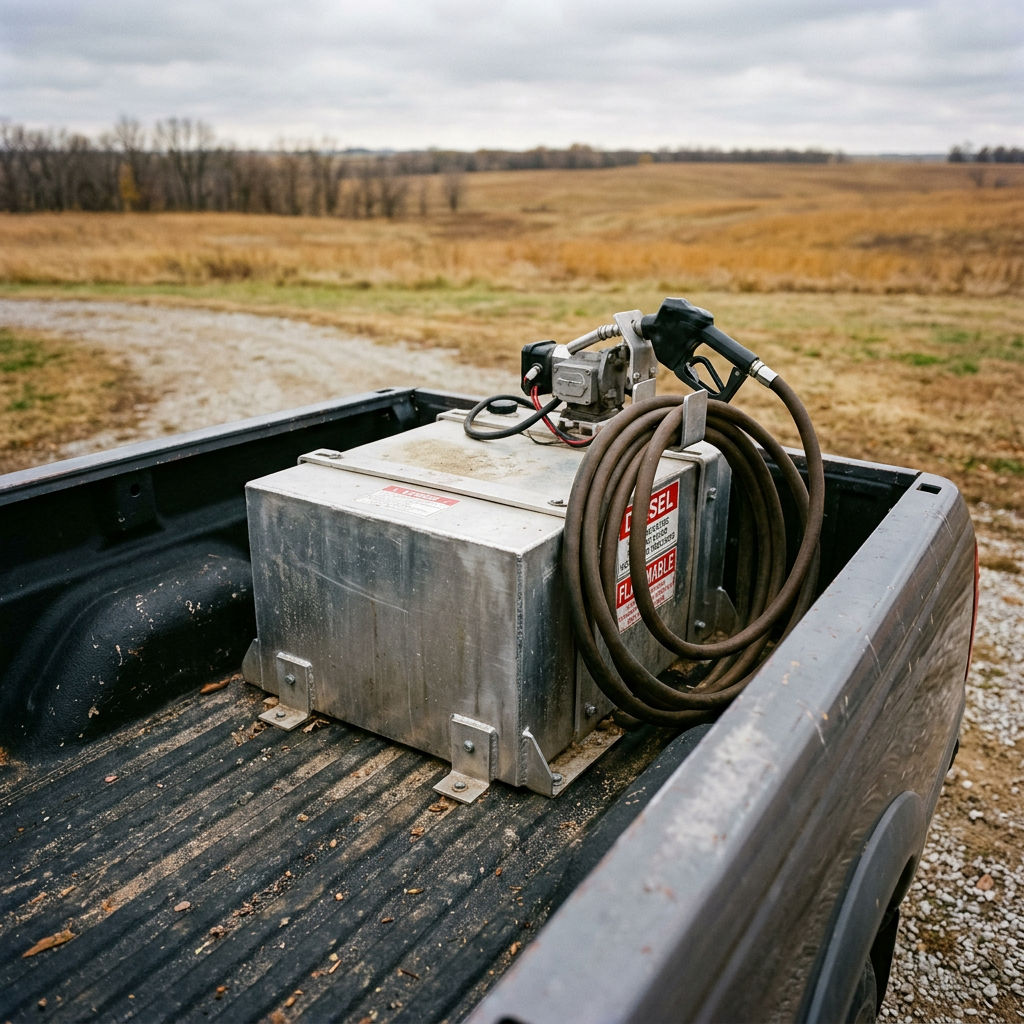
How Much Does 50 Gallons of Diesel Fuel Weigh?
At standard ambient conditions, 50 gallons of No. 2 diesel fuel weigh approximately 355 lb, calculated using an industry-standard density of roughly 7.1 lb per gallon at 60°F. This liquid mass excludes the weight of the fuel tank or transfer container, which typically adds another 80 lb to 110 lb if constructed of heavy-duty steel or heavy aluminum.
Understanding fuel weight is vital for truck operators, fleet managers, and outdoor drivers who carry auxiliary fuel or operate near maximum vehicle ratings. Diesel is denser and noticeably heavier than standard gasoline. While 50 gallons of gasoline weigh roughly 300 lb to 315 lb, the same volume of diesel adds roughly 40 lb to 50 lb of additional mass to the chassis. Whether mounting a bed-mounted transfer tank or filling an extended-range main tank, drivers must factor this fluid weight into overall haul calculations.
For heavy-duty truck owners hauling heavy machinery, livestock, or fifth-wheel campers across northeastern Kansas, accurate weight calculation prevents exceeding safe operating limits. To discuss vehicle load ratings or locate heavy-duty trucks equipped for high payload demands, visit our Junction City dealership or give our team a quick call today.
| Fuel Type & Volume | Standard Temperature (60°F) | Density per Gallon | Total Thermal Energy |
|---|---|---|---|
| 50 Gallons No. 2 Diesel | 355 lb | 7.1 lb/gal | 6,925,000 BTU |
| 50 Gallons Gasoline (E10) | 307 lb | 6.1 lb/gal | 5,700,000 BTU |
| 100 Gallons No. 2 Diesel | 710 lb | 7.1 lb/gal | 13,850,000 BTU |
Table of Contents
- What Is the Weight of Diesel Fuel per Gallon and How Does Temperature Affect It?
- Does Diesel Fuel Weight Count Toward Payload or Towing Capacity?
- How Do Weigh Stations Measure Diesel Fuel Weight on Commercial Trucks?
- How Many BTUs and Energy Density Are in 50 Gallons of Diesel Fuel vs Gasoline?
- Common Questions About Diesel Fuel Weight, Tank Sizes, and Performance
- Maximize Your Heavy-Duty Towing and Payload Performance
What Is the Weight of Diesel Fuel per Gallon and How Does Temperature Affect It?
The baseline weight of diesel fuel is approximately 7.1 lb per gallon at a standardized temperature of 60°F, but the actual weight shifts between 6.9 lb and 7.2 lb per gallon depending on fuel blend and ambient temperature. Liquid petroleum expands when heated and contracts when cooled, altering its density without changing the total energy output per pound.
As ambient air temperatures rise, diesel fuel expands, causing a fixed volume like a 50-gallon tank to contain slightly less physical mass. At 70°F, diesel density drops to roughly 7.06 lb per gallon, bringing a 50-gallon volume down to approximately 353 lb. Conversely, during cold Midwestern winter conditions around 40°F or lower, diesel fuel contracts and grows denser, weighing roughly 7.16 lb per gallon or about 358 lb for 50 gallons.
Seasonal winter blends also affect density. Refineries incorporate lighter kerosene fractions into winter-grade diesel to lower the pour point and prevent wax gelling. These lighter distillates slightly reduce fuel density compared to summer-grade No. 2 diesel fuel.
- 40°F (Cold Ambient): Dense fuel state weighing approximately 7.16 lb/gal ( 358 lb per 50 gal).
- 60°F (Standard Reference): Industry benchmark density weighing 7.09 lb/gal ( 355 lb per 50 gal).
- 70°F (Warm Ambient): Expanded fuel state weighing approximately 7.06 lb/gal ( 353 lb per 50 gal).
Understanding how temperature affects payload capacity helps drivers manage exact payload limits during long-distance trips. For active lifestyle drivers looking for capable off-road and towing rigs, explore our new Ford Bronco inventory to review performance capabilities built for all weather conditions.
Does Diesel Fuel Weight Count Toward Payload or Towing Capacity?
Full fuel tanks count directly against a truck's available payload capacity because vehicle payload represents the maximum allowable weight of all cargo, occupants, aftermarket accessories, and fluids added to the truck's published dry curb weight. Filling a 50-gallon diesel tank consumes roughly 355 lb of available payload before a single passenger or tool enters the vehicle.
Vehicle manufacturer specifications establish a Gross Vehicle Weight Rating (GVWR), which sets the maximum legal weight of the truck itself when fully loaded. When an auxiliary 50-gallon bed tank and its steel structure (totaling roughly 440 lb combined) are installed, that entire weight subtracts directly from the remaining payload margin. Truck owners comparing fuel transfer setups on our lot frequently ask whether adding a 50-gallon bed tank requires recalibrating their payload margin before hitching up a fifth-wheel trailer.
Regarding towing, onboard fuel weight does not directly subtract from published maximum trailer tow ratings, but it heavily impacts the Gross Combined Weight Rating (GCWR) and tongue weight allowances:
- GCWR Compliance: The total combined weight of truck, fuel, passengers, cargo, and trailer must not exceed the manufacturer GCWR ceiling.
- Tongue Weight Limits: Trailer tongue weight rests directly on the rear axle and counts toward overall payload. A heavy diesel fuel tank positioned over or behind the rear axle reduces the remaining payload capacity available for trailer tongue load.
- Axle Weight Ratings: Concentrated fluid weight in auxiliary bed tanks can push the rear gross axle weight rating past legal limits if not distributed evenly.
Drivers operating around Dickinson County often carry portable fuel tanks across rural farm routes. Balancing fuel placement with trailer tongue weight ensures stable handling and chassis safety. Browse our pre-owned vehicle inventory to find heavy-duty trucks engineered with high payload margins.
How Do Weigh Stations Measure Diesel Fuel Weight on Commercial Trucks?
Commercial scale houses and highway weigh stations measure overall vehicle weight using axle-scale platforms or weigh-in-motion sensors embedded in the roadway, capturing total gross weight and individual axle group weights simultaneously. Commercial enforcement officers do not weigh fuel tanks separately; instead, onboard diesel fuel is calculated as part of the vehicle's total operating weight on the steer, drive, and trailer axles.
Because large commercial rigs carry dual 150-gallon fuel tanks holding up to 300 gallons of diesel, full fuel loads add over 2,100 lb of liquid weight to the truck's chassis. Drivers must calculate their fuel weight carefully before leaving truck stops to avoid exceeding the federal 80,000-lb gross vehicle weight limit enforced by the Federal Motor Carrier Safety Administration (FMCSA) or breaching the standard 20,000-lb single-axle limit.
When commercial trucks burn fuel during long trips, their total gross weight decreases over time. A long-haul truck burning 100 gallons of diesel loses over 700 lb of overall mass, which can help a vehicle that left a depot near maximum weight stay safely under legal limits as it approaches state scales.
Proper maintenance of suspension components, tire pressures, and brake systems is vital when vehicles routinely operate near maximum gross weight limits. Truck operators can easily schedule a service appointment with our factory-trained technicians for comprehensive axle, brake, and suspension inspections.
How Many BTUs and Energy Density Are in 50 Gallons of Diesel Fuel vs Gasoline?
Fifty gallons of standard No. 2 diesel fuel produce approximately 6,925,000 BTUs of thermal energy, utilizing an average energy density of 138,490 BTU per gallon. By comparison, 50 gallons of conventional motor gasoline yield roughly 5,700,000 BTUs to 5,800,000 BTUs based on a lower energy density of approximately 114,000 BTU per gallon to 116,000 BTU per gallon.
Diesel fuel holds roughly 15% to 20% higher energy density per gallon than gasoline. This higher thermal density stems from diesel's heavier hydrocarbon molecular chain, which packs more carbon-hydrogen bonds into every gallon. Because diesel fuel is both heavier and chemically denser, compression-ignition diesel engines pull significantly more work output from every gallon consumed compared to spark-ignition gasoline engines.
| Energy Metric | No. 2 Diesel Fuel | Standard Gasoline (E10) | Difference |
|---|---|---|---|
| Weight per Gallon | 7.1 lb | 6.1 lb | Diesel is ~16% heavier |
| BTU per Gallon | 138,490 BTU | 115,000 BTU | Diesel yields ~20% more thermal energy |
| Total Energy in 50 Gallons | 6,925,000 BTU | 5,750,000 BTU | Diesel adds ~1,175,000 BTU per 50 gal |
| Weight of 50 Gallons | 355 lb | 307 lb | Diesel adds ~48 lb of fluid mass |
This superior energy density explains why heavy-duty diesel engines deliver outstanding low-end torque and long-range highway efficiency under heavy loads. Drivers upgrading to a heavy-duty tow rig can use our online trade-in evaluation tool to estimate their current vehicle's trade value toward a diesel truck.
Common Questions About Diesel Fuel Weight, Tank Sizes, and Performance
Q: How much does an empty 50-gallon fuel tank weigh before adding diesel?
An empty 50-gallon steel transfer or truck fuel tank generally weighs between 80 lb and 110 lb depending on plate thickness, internal baffling, and mounting hardware. Heavy-duty aluminum tanks are lighter, typically weighing 50 lb to 70 lb dry. Combining an empty steel tank with 50 gallons of diesel results in a total mounted weight between 435 lb and 465 lb.
Q: How much does 100 gallons of diesel fuel weigh on a heavy-duty pickup?
One hundred gallons of No. 2 diesel fuel weigh approximately 710 lb at standard 60°F ambient temperatures. When stored in an auxiliary bed-mounted transfer tank, the combined weight of fuel and tank assembly routinely approaches 820 lb to 850 lb, consuming a substantial portion of a three-quarter-ton truck's available payload rating.
Q: Does biodiesel weigh more per gallon than petroleum diesel?
Pure B100 biodiesel is slightly denser than conventional petroleum diesel, weighing roughly 7.3 lb per gallon at 60°F. A 50-gallon tank of pure B100 weighs approximately 365 lb, which is about 10 lb heavier than an equivalent volume of standard No. 2 ultra-low sulfur diesel. Common B20 blends weigh roughly 7.15 lb per gallon.
Q: How does fuel weight affect off-road handling and suspension balance?
Carrying 50 gallons of diesel fuel in a bed-mounted transfer tank shifts vehicle mass backward, placing extra static weight over the rear axle. This added weight can compress rear springs, slightly reduce front tire traction, and alter suspension rebound on uneven terrain. Ensuring proper tire inflation and utilizing heavy-duty shock absorbers maintains optimal handling stability.
Q: Will filling my diesel tank completely reduce my vehicle's towing capacity?
Filling your fuel tank does not change your truck's published maximum tow rating, but it directly consumes available payload and gross combined mass margins. If your vehicle is loaded near its GVWR or rear gross axle rating, carrying a full tank of diesel may force you to reduce tongue weight or cargo cabin payload to remain legally compliant.
Drivers exploring heavy-duty truck financing options can easily apply for online financing pre-approval through our secure dealership finance department.
Maximize Your Heavy-Duty Towing and Payload Performance
Accurately calculating diesel fuel weight ensures your truck operates safely within its engineered payload, axle, and towing capacities. Carrying 50 gallons of diesel adds roughly 355 lb of liquid payload to your chassis, plus the dry weight of any auxiliary transfer tank. Factoring fluid weight into your total load calculations protects your drivetrain, suspension, and braking systems during heavy hauling jobs.
Active service members commuting near Fort Riley or heavy-duty truck operators managing agricultural loads demand equipment that performs reliably under challenging real-world conditions. Equipping your vehicle with factory towing upgrades, helper springs, or heavy-duty transfer tanks ensures smooth performance on every trip.
Visit our showroom at 1825 Goldenbelt Blvd, Junction City, KS 66441 to test drive our latest heavy-duty Ford truck inventory. You can also give our team a quick call to speak with a truck specialist or order genuine Ford parts and heavy-duty accessories tailored to your vehicle.
© 2026 Valor Ford. All rights reserved.