
Blog / Buying Guides

How Ford Pro Power Onboard Redefines Mobile Utility for Rural Kansas Field Work

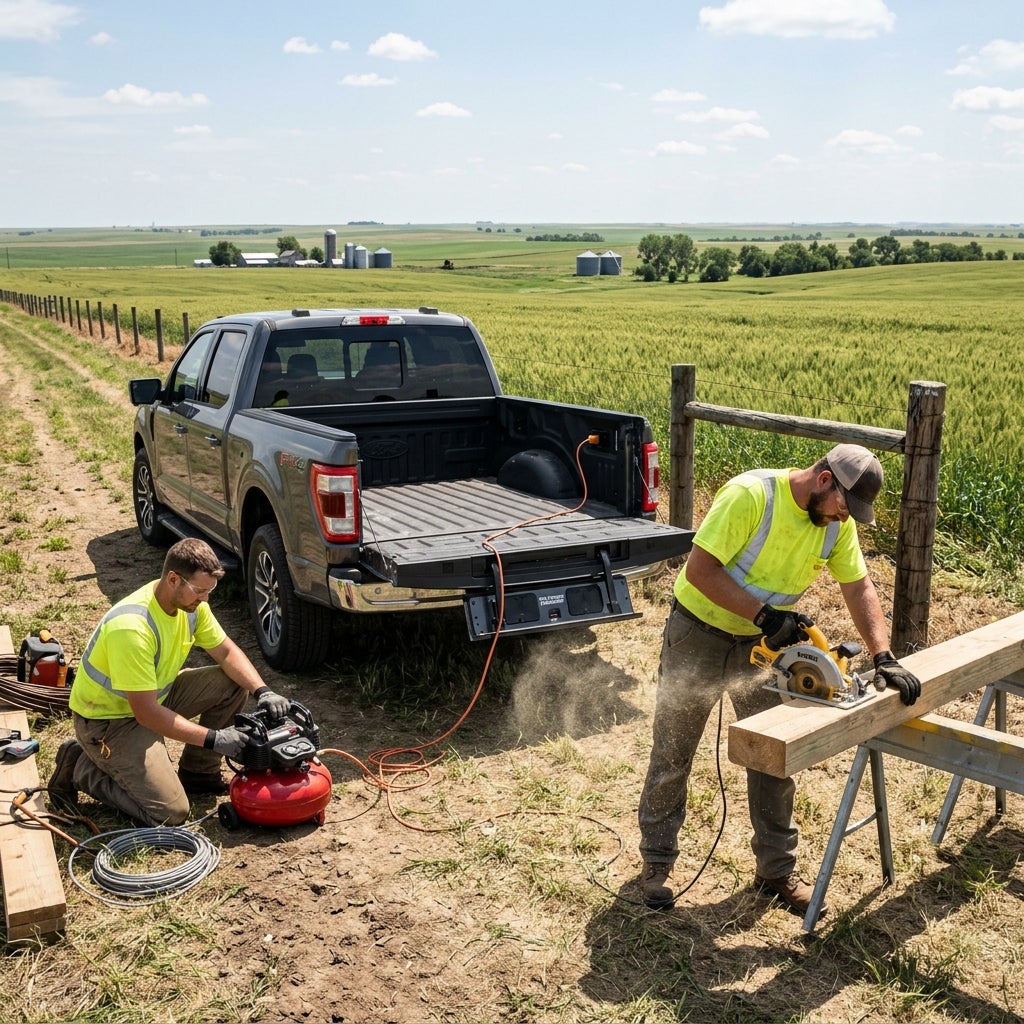
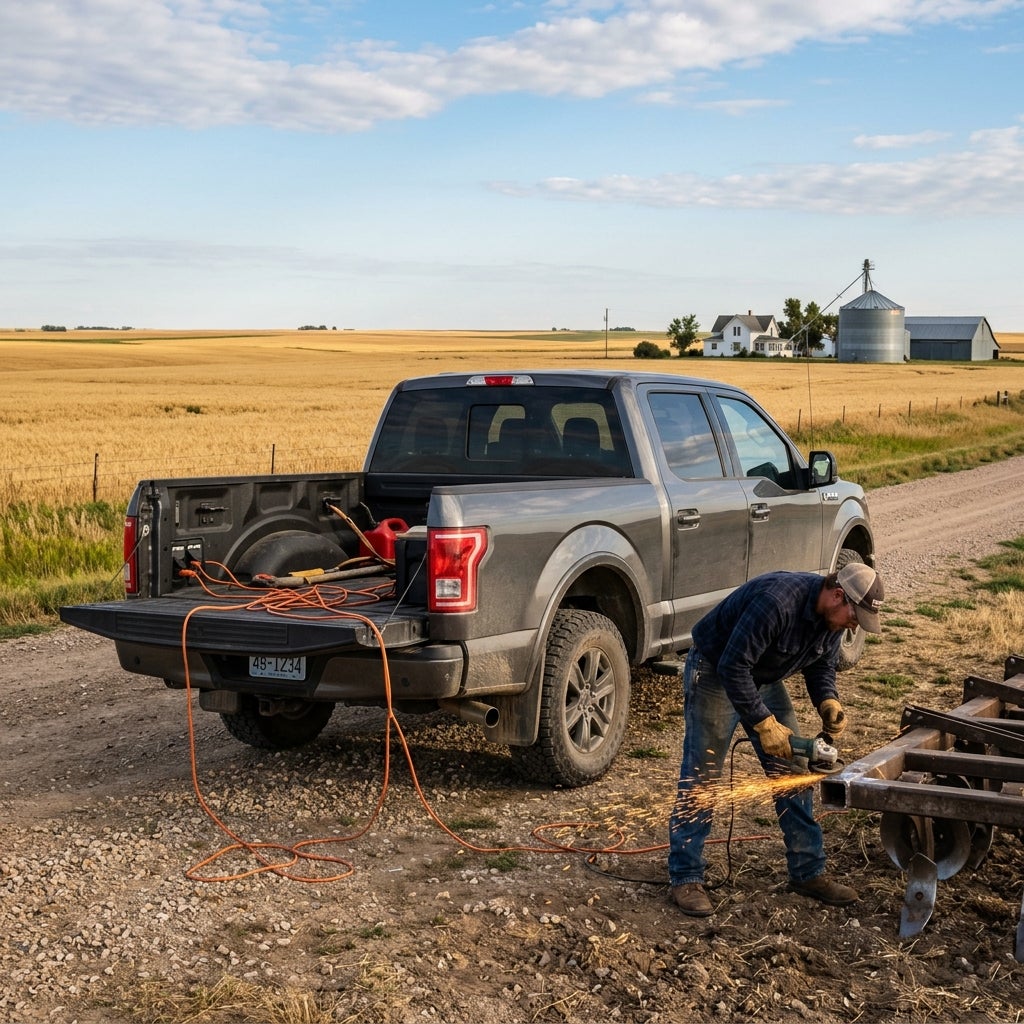
A man uses an angle grinder on farm equipment beside a grey pickup truck in a rural field. (Representative image for illustration purposes only. Actual vehicle may vary based on trim and configuration.)

How Ford Pro Power Onboard Redefines Mobile Utility for Rural Kansas Field Work

In the expansive agricultural heartland of Central Kansas, field work is defined by vast distances, severe weather shifts, and an unyielding demand for self-reliance. Farmers across Dickinson County, utility linemen servicing remote grid sectors near Fort Riley, and civil contractors working miles outside Junction City share a common operational challenge: accessing heavy-duty electrical power where no grid connection exists. Historically, solving this problem required hauling heavy, noise-polluting gas generators in truck beds, tying down volatile fuel cans, and sacrificing valuable payload space. Ford Pro Power Onboard significantly streamlines this workflow by transforming your truck into a high-output, mobile power plant.
By routing generator capability directly through the truck’s engine and high-voltage battery architecture, Ford Pro Power Onboard delivers reliable 120V and 240V electricity directly to bed-mounted and cabin outlets. Whether you opt for the 2.0 kW, 2.4 kW, 7.2 kW, or 9.6 kW system, you get an integrated power solution engineered to run 240V arc welders, heavy air compressors, high-draw battery charging stations, and severe emergency equipment anywhere your four-wheel-drive truck can travel. At Valor Ford, we see firsthand how this breakthrough system revolutionizes daily operations for Kansas producers and commercial fleets.
Beyond simple convenience, Pro Power Onboard represents a fundamental shift in operational economics for rural workers. When you don't have to carry a separate engine-driven generator, you eliminate hundreds of pounds of unnecessary ballast, free up valuable bed volume for seed bags or fencing materials, and remove the fire hazard associated with loose gasoline containers bouncing across gravel roads. To explore how this technology integrates seamlessly into iconic tough trucks, take a moment to Research Ford F-150 models available today in Junction City.

What Is Ford Pro Power Onboard and How Does the Integrated Generator System Work?

At its core, Ford Pro Power Onboard converts engine power or high-voltage battery energy into clean, regulated alternating current (AC) electricity. Unlike conventional aftermarket inverters wired directly to a standard 12V lead-acid starter battery—which quickly drain the battery and overheat—Pro Power Onboard utilizes engineered, factory-integrated dual inverters paired with dedicated energy storage systems.
On models like the F-150 PowerBoost Hybrid, the system seamlessly coordinates a 3.5L V6 EcoBoost engine with a 1.5 kWh lithium-ion battery. The vehicle draws electrical power from the lithium battery first. When the stored energy dips below a set threshold, the internal combustion engine automatically starts up to spin the high-output electric motor/generator, recharging the battery pack while maintaining continuous power delivery to your equipment.
Monitoring and controlling power usage is intuitive through the cabin's SYNC 4 touchscreen interface or remotely via the Ford App. Operators can observe real-time wattage output across individual circuits, receive instant alerts if a device draws near circuit limits, and remotely toggle power zones on or off without climbing back into the driver seat.
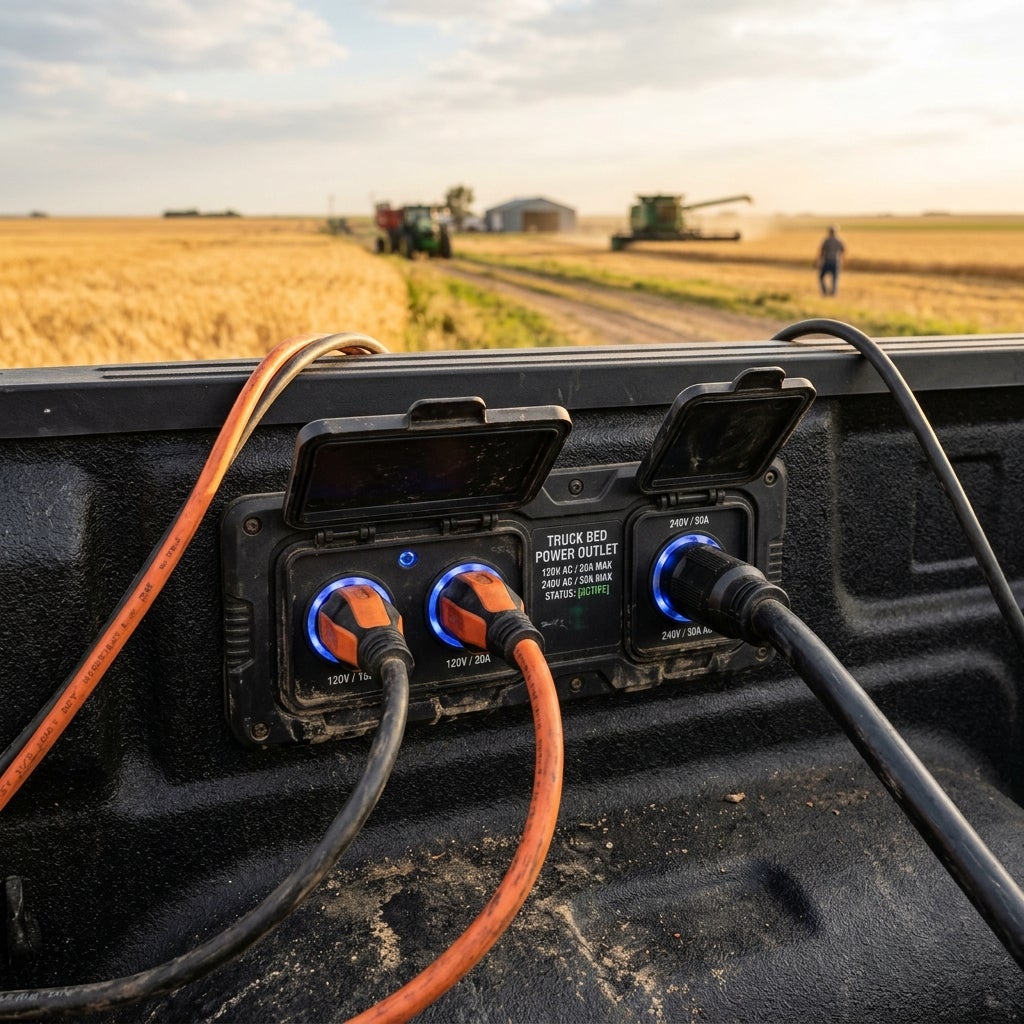
Power cords plugged into an illuminated truck bed power outlet panel with a wheat field and tractors in the background. (Representative image for illustration purposes only. Actual vehicle may vary based on trim and configuration.)
The bed-mounted electrical panel features dual 120V 20A outlets and a twist-lock NEMA L14-30 240V 30A outlet on 7.2 kW equipped models.

How Farmers and Agricultural Teams in Dickinson County Rely on Pro Power Onboard

Remote Fence & Gate Repairs

Cattle ranchers managing miles of perimeter fencing along the Smoky Hill River valley face frequent fence breaks caused by weather or livestock pressure. Utilizing the 7.2 kW system, ranch hands plug in a 240V portable arc welder directly into the bed outlet to repair broken steel gates and pipe corrals on the spot, avoiding hours spent trailering damaged equipment back to the farm shop.

Combine Field Maintenance

During intense Kansas summer wheat harvests, downtime costs hundreds of dollars per hour. When chaff and debris clog combine header sieves or hydraulic lines leak out in deep pastures, farmers run high-horsepower 120V air compressors and heavy-duty impact guns straight from the truck bed to clean machinery and swap damaged components in minutes.

Seed Tenders & Livestock Water

Transferring bulk seed during spring planting or pumping water to remote pasture livestock tanks requires continuous electrical power. Pro Power Onboard easily runs heavy electric seed augers and high-flow submersible water pumps without requiring a towed generator trailer, simplifying field transport logistics for ag crews.

What Heavy Equipment and Tools Can a 7.2 kW Pro Power Onboard System Operate?

The 7.2 kW Pro Power Onboard system—available on F-150 PowerBoost Hybrid models—delivers 7,200 watts of continuous AC power across multiple 120V 20A outlets and one NEMA L14-30 240V 30A outlet. To appreciate its capability, consider what field service contractors can operate concurrently on a remote job site without exceeding system capacity or tripping thermal breakers.

Tool / Equipment

Operating Voltage

Continuous Wattage

Plasma Cutter / MIG Welder

240V

2,000 W

12-Gallon Air Compressor

120V

1,800 W

Commercial Circular Saw

120V

1,500 W

Multi-Bay Battery Charger Bank

120V

1,000 W

High-Lumen LED Jobsite Tower

120V

500 W

Total Concurrent Load

120V / 240V Dual

6,800 W (Under 7.2 kW Cap)

Why Pro Power Onboard Outperforms Traditional Portable Gas Generators in Field Conditions

Traditional Standalone Generators

• Lost Payload Space: Heavy 7,000-watt commercial generators occupy up to 15-20 cubic feet of truck bed volume and weigh 250+ lbs.
• Fuel Logistics & Fire Risk: Requires transporting separate fuel cans, risking spillage and gasoline vapors near tools.
• High Noise & Idle Waste: Standalone engines run continuously at high RPM regardless of electrical load, creating extreme jobsite noise and burning fuel rapidly.
• Theft Vulnerability: Unattended portable units left on remote jobsites or in open truck beds are frequent targets for theft.

Ford Pro Power Onboard Advantage

• Zero Bed Space Impact: Inverters and wiring are integrated beneath the floor and sidewalls, keeping the full bed available for cargo.
• Integrated Fuel Tank Supply: Draws directly from the truck's 30.6-gallon fuel tank, providing days of runtime without loose gas cans.
• Smart Engine Auto-Cycling: On PowerBoost models, the engine shuts off and powers tools silently from the battery, cycling the engine only when needed.
• Built-In Security & Drive Locking: Utility Mode allows the system to generate full electrical power while the truck doors remain locked and secure.

How to Safely Operate Ford Pro Power Onboard in Remote Kansas Field Work

Operating heavy electrical machinery in rugged outdoor environments requires strict safety protocols, especially given the unpredictable weather conditions in Central Kansas. Wet soil, heavy rain squalls, and dust storms present potential electrical hazards if equipment is mismanaged. Ford engineered Pro Power Onboard with advanced safety systems, including integrated ground-fault circuit interrupter (GFCI) protection across all outlets and real-time monitoring.
To ensure maximum safety and uninterrupted operation on remote job sites: 1. Weatherproof Connections: Keep spring-loaded outlet covers snapped shut when not in use. When operating in damp field conditions, use NEMA 3R rain-tight extension cord connections. 2. Grounding Protocols: The system features a bonded neutral generator architecture. Always ensure high-draw tools use undamaged 10-gauge or 12-gauge grounded cords. 3. Monitoring Circuit Loads: Utilize the SYNC 4 display to verify draw distribution across Channel 1 and Channel 2 before striking heavy welding arcs or engaging heavy compressor motors. 4. Exhaust Safety: When using Utility Mode with the engine auto-cycling, ensure the truck tailpipe is parked away from dry wheat stubble or enclosed structures to prevent heat buildup and carbon monoxide hazards.
For regular electrical system inspections and factory diagnostics, you can easily Schedule Ford Service Today with certified technicians at Valor Ford in Junction City.
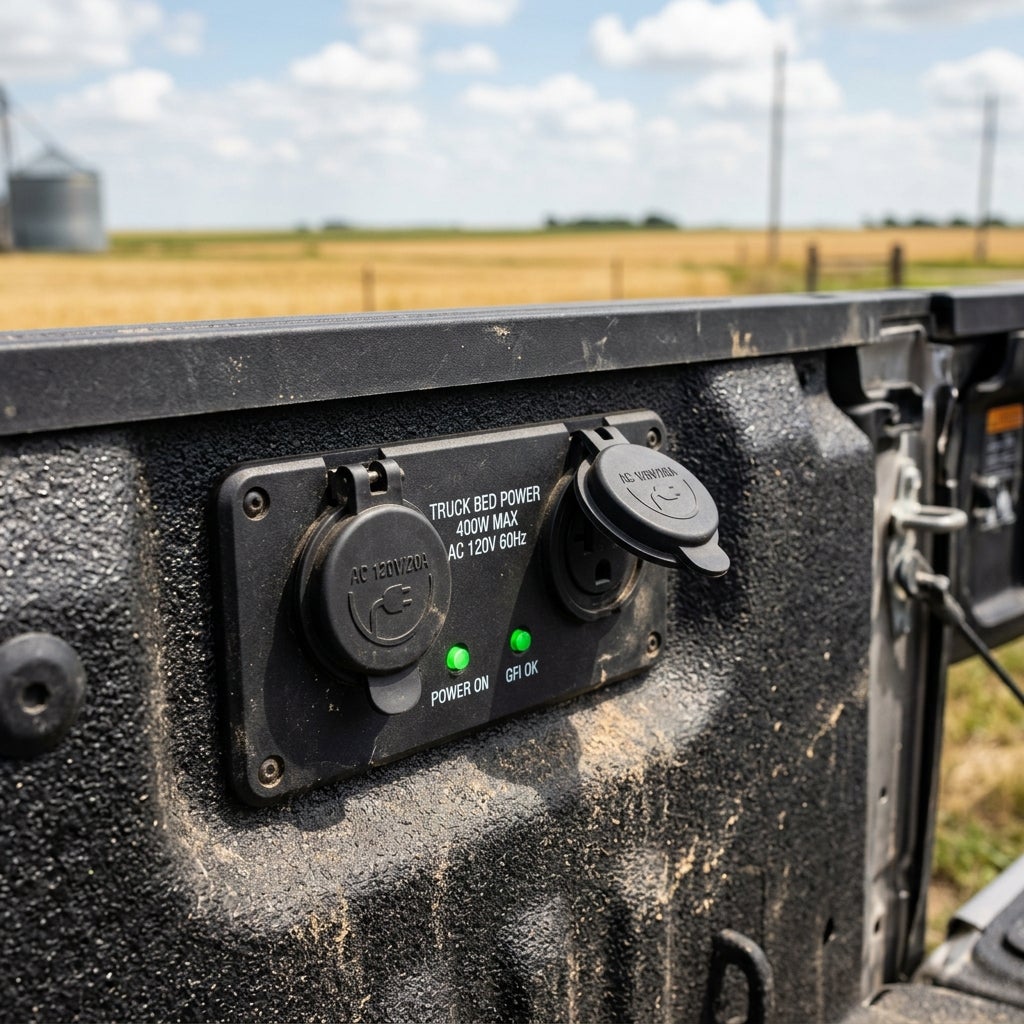
Built-in 120V AC power outlet panel with green indicator lights located inside a pickup truck bed. (Representative image for illustration purposes only. Actual vehicle may vary based on trim and configuration.)

Can Pro Power Onboard Provide Emergency Backup Power During Kansas Storm Outages?

Severe Storm Resilience

Kansas weather is notorious for sudden supercell thunderstorms, tornadoes, and severe winter ice storms that knock out rural power lines for days. Having a 7.2 kW or 9.6 kW generator built directly into your primary transport truck can help keep your property operational when grid power fails.

Agricultural Preservation

Grid failures put livestock and perishable goods at immediate risk. Pro Power Onboard supplies essential power to agricultural well pumps, automated livestock ventilation fans, milk cooling tanks, and heated brooders, protecting critical farm investments during prolonged utility grid blackouts.

Residential Emergency

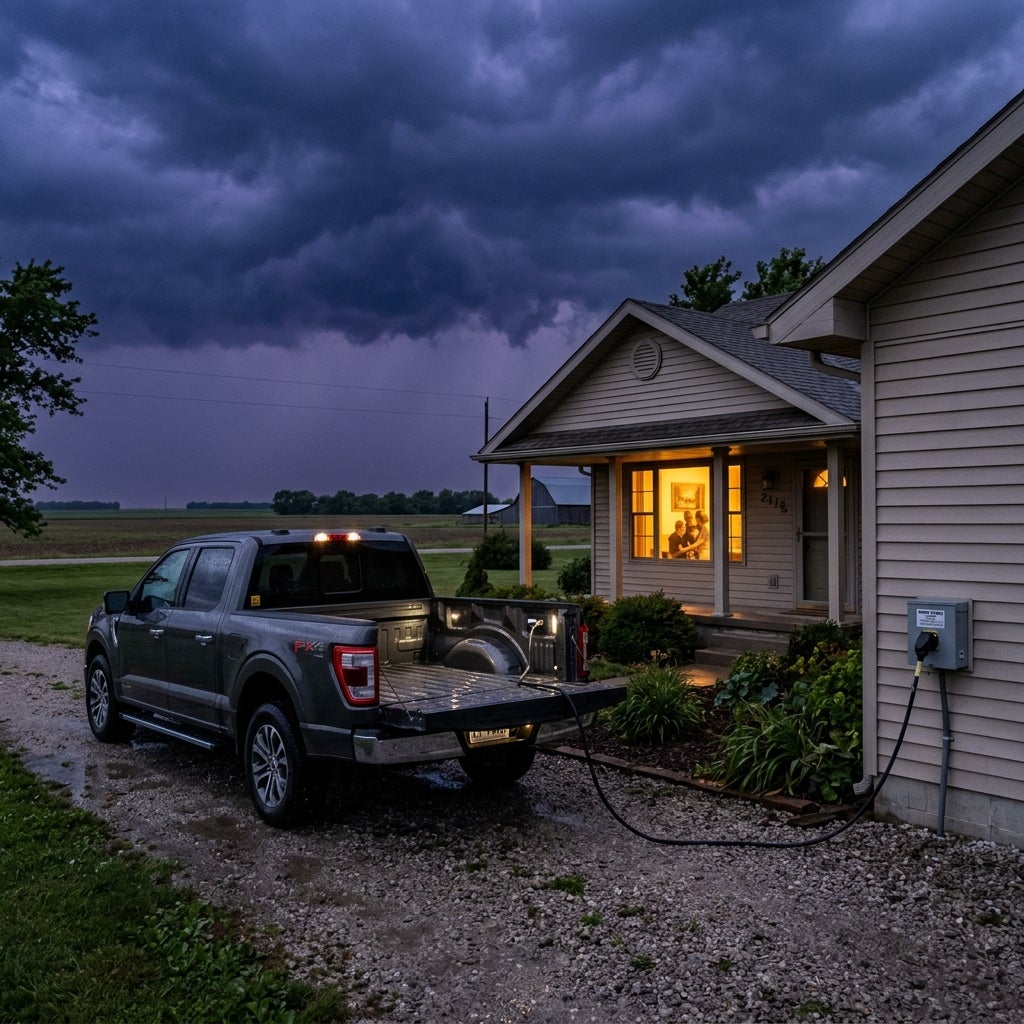
For rural homeowners near Junction City and Dickinson County, Pro Power Onboard seamlessly energizes home refrigeration, sump pumps, HVAC blower fans, lights, and essential medical equipment, keeping your family safe and comfortable while repair crews restore regional power transmission.

How to Power Your Rural Kansas House or Outbuilding During a Grid Outage

Connecting your Ford truck to power your home or farm workshop is straightforward when properly configured. Using the 240V 30A NEMA L14-30R outlet in the bed, you connect a heavy-duty generator cord directly to a pre-installed home manual transfer switch.
Step-by-Step Connection Process: 1. Install a licensed electrician-fitted manual transfer switch (neutral-switching configuration required for bonded-neutral truck generators). 2. Connect a 30-amp generator power cord from the truck bed 240V outlet to the home's outdoor inlet box. 3. Start the truck, enable Pro Power Onboard via the center display, and switch the home breaker panel to generator power. 4. Monitor load distribution on SYNC 4 to balance power across household circuits.
An F-150 PowerBoost Hybrid with a full 30.6-gallon tank can supply continuous home backup power for estimated at up to 32 hours under max continuous load (7.2 kW) or over 85 hours under typical light household loads (1,000–2,000 W).
Supporting Contractor and Defense Field Operations Support Around Fort Riley

Junction City sits adjacent to Fort Riley, a primary military installation supporting vast training ranges and civil defense projects. Defense contractors, civil engineering teams, and base maintenance crews operating across remote training sectors require dependable mobile electrical setups that operate with minimal thermal and acoustic signature.
Pro Power Onboard provides civil defense contractors with instant electrification for mobile command posts, laptop and satellite communication banks, field diagnostic scanners, and heavy electric tools during tactical infrastructure repairs.
Because hybrid and electric Ford trucks operate ultra-quietly when feeding electrical power from battery reserves, field units can run sensitive diagnostic equipment without the heavy vibration and noise interference caused by conventional diesel generators.
For organizations seeking pre-owned commercial fleet vehicles equipped with factory generator options, you can explore available options through our used inventory page at Valor Ford.

Which Ford Truck Trim and Engine Delivers the Best Pro Power Onboard Specs for You?

2.0 kW System (Gas F-150 & Super Duty)

Available across traditional EcoBoost V6 gas F-150 models and heavy-duty Ford Super Duty trucks. Features dual 120V 20A bed outlets. Ideal for charging cordless power tool batteries, running work lights, electric miter saws, and small air compressors.

2.4 kW / 7.2 kW Systems (F-150 PowerBoost Hybrid)

Standard 2.4 kW or optional 7.2 kW on PowerBoost Hybrid. The 7.2 kW system adds a 240V 30A twist-lock outlet alongside four 120V outlets. Designed for heavy construction crews, remote welding, and full home backup capability.

9.6 kW System (F-150 Lightning EV)

Standard on Extended Range Lightning EV models. Combines 10 120V outlets (bed, frunk, cabin) and a 240V 30A bed plug. Perfect for zero-emission indoor work, commercial job sites, and maximum emergency home electrification.
If your field operations require maximum towing capacity alongside mobile power output, take time to Research Ford F-250 specs and Super Duty options at Valor Ford.
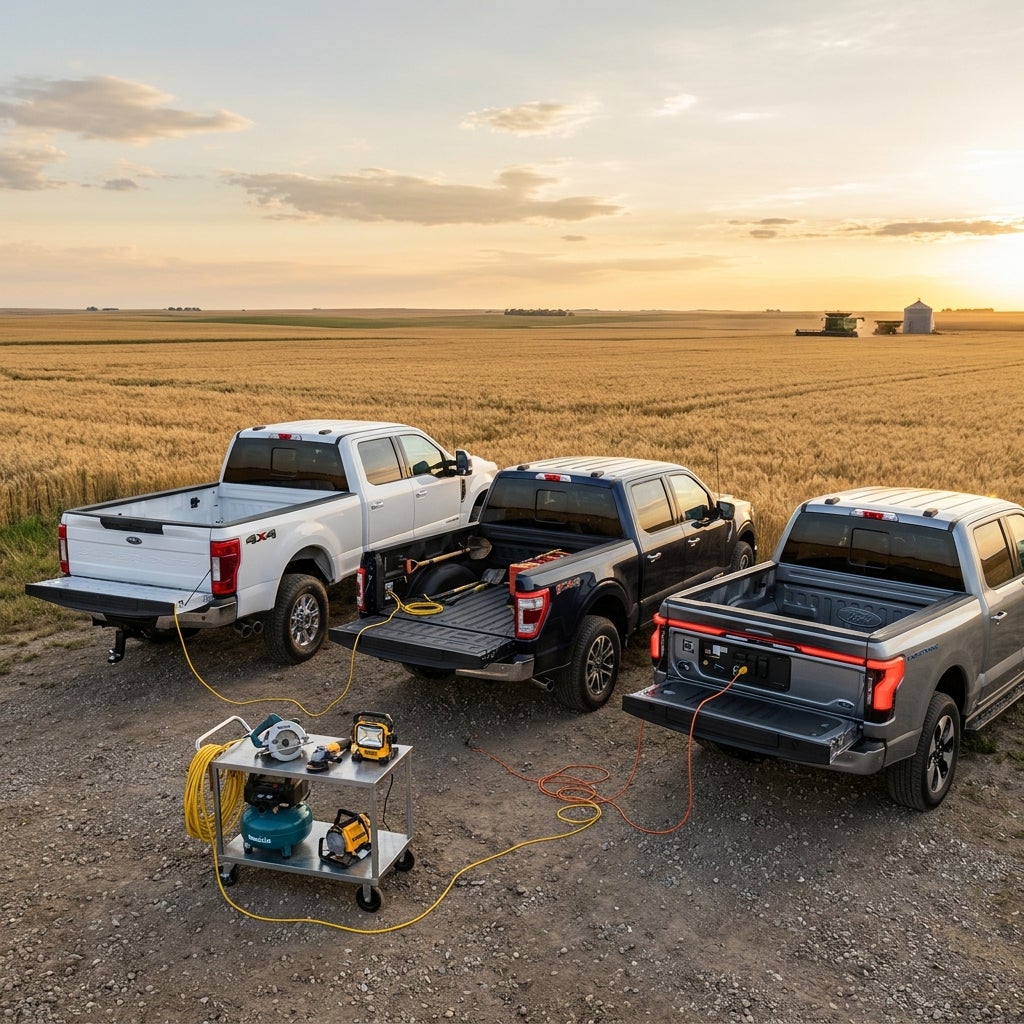
Three Ford pickup trucks parked near a wheat field at sunset, powering construction tools from their truck beds. (Representative image for illustration purposes only. Actual vehicle may vary based on trim and configuration.)

Calculating Fuel Efficiency and Financial ROI for Commercial Field Service Teams

For business owners managing field service fleets across Geary and Dickinson counties, vehicle investments must justify themselves on the balance sheet. Pro Power Onboard provides a clear, measurable return on investment through reduced fuel burn, eliminated capital expenditure on external generators, and lower maintenance costs.
1. Fuel Consumption Savings: Traditional gas generators run continuously at high RPMs, consuming approximately 0.5 to 1 gallons of gasoline per hour regardless of tool load. An F-150 PowerBoost Hybrid utilizing Pro Power Onboard auto-cycles its engine, using battery power when electrical loads are light. In a typical 8-hour workday, this auto-cycling cuts jobsite fuel consumption by up to 50%. 2. Capital & Maintenance Savings: Purchasing a standalone 7,000-watt commercial generator costs between $2,500 and $4,500 per service vehicle, plus ongoing maintenance fees for small engine oil changes, spark plugs, and carburetors. With Pro Power Onboard, that capital expenditure drops to zero. 3. Commercial Tax Advantages: Equipping heavy commercial pickup trucks for work purposes opens opportunities for Section 179 vehicle depreciation write-offs. To calculate the trade value of your current field service vehicles toward a new Ford truck, request a Trade In Evaluation from our team.

Maintaining Your Pro Power Onboard System with Valor Ford in Junction City

Because Pro Power Onboard is a factory-engineered component of your Ford powertrain, maintaining the system is simple and integrated directly into your vehicle’s routine maintenance schedule. There are no separate generator spark plugs to replace or carburetors to clean out.
During standard factory oil changes and tire rotations at Valor Ford, our Senior Master Technicians perform multi-point electrical inspections, verifying high-voltage inverter connections, outlet seal integrity, and software calibration.
Through Ford Power-Up Over-the-Air (OTA) software updates, your system continuously receives operational improvements and diagnostic updates automatically over cell connection. Busy field managers can also Schedule Pickup and Delivery Service to have their trucks serviced without leaving the farm or job site.
Logo for Valor Automotive featuring a silver shield with red 'V' and white 'A' monogram inside, over a blue background.

Upgrade Your Field Operations at Valor Ford in Junction City, KS

Ready to eliminate portable gas generators and transform how you work across rural Kansas? Visit Valor Ford in Junction City to experience Ford Pro Power Onboard in person. Our knowledgeable commercial sales team will help you evaluate your tool wattage requirements and pair you with the ideal F-150 or Super Duty truck trim for your field operations.
Valor Ford
1825 Goldenbelt Blvd, Junction City, KS 66441
Call us at (785) 238-5114| Get Directions to Valor Ford
Posted in:

Related Posts

F-250 vs F-350: Choosing the Right Payload for Your Needs

F-250 vs F-350: Choosing the Right Payload for Your Needs

F-250 vs F-350: Choosing the Right Payload for Your Needs How Does Engine Choice Affect Payload Capacity in an F-250 vs F-350? Opting for a heavier diesel engine directly reduces available payload capacity compared to a gasoline engine on both the F-250 and F-350 because engine curb weight eats directly into the truck's Gross Vehicle Weight Rating (GVWR). On an identical 10,000-lb GVWR setup, choosing the diesel engine reduces carrying capacity by roughly 800 to 1,000 pounds compared to a gas V8. The curb weight difference between powertrains explains this gap. The standard 6.8L gas V8 and available 7.3L gas V8 are substantially lighter iron blocks than the 6.7L Power Stroke diesel and the 6.7L high-output diesel with its massive 500 hp and 1,200 lb-ft of torque. That heavy diesel hardware sits over the front axle, taking up allowable gross capacity before you even put a driver in the cab. For instance, in Ford's published specifications for a 2026 F-250 4x4 Crew Cab with a 175.9-inch wheelbase, opting for the 7.3L gas V8 yields a charted maximum payload of 3,196 lb, whereas equipping that exact configuration with the 6.7L high-output diesel drops maximum payload down to 2,415 lb within a standard 10,000-lb GVWR ceiling. Many truck shoppers focus exclusively on horsepower and pulling power without factoring in how those heavy powertrain components limit bed capacity. If you spend your workdays hauling bulk gravel or loading heavy ag supplies across Junction City, that gas engine preserves several hundred pounds of legal bed capacity that the diesel gives up to its cooling systems and emissions hardware. To map out how engine options align with your equipment needs, you can get directions to Valor Ford or give us a quick call to check configurations on our lot. Table of Contents Why Does the Ford F-350 Have a Higher Payload Capacity Than the F-250? What Is the Real Payload Capacity Difference Between the Ford F-250 and F-350? Is an F-350 SRW Worth the Upgrade Over an F-250 for Heavy Towing? When Is a Dual-Rear-Wheel F-350 Necessary Over an SRW Model? Is an F-250 or F-350 Better for Hauling a Slide-In Truck Camper? Where Can an Owner Locate the Exact Official Payload Capacity on a Ford Truck? Why Does the Ford F-350 Have a Higher Payload Capacity Than the F-250? The Ford F-350 carries a higher payload rating than the F-250 because it is engineered with a substantially higher Gross Vehicle Weight Rating, supported by a stiffer rear suspension pack and stouter axle components. While both trucks share the same fully boxed high-strength steel frame and cab dimensions, the F-350 is built to legally and mechanically support several thousand pounds of additional weight over its rear axle. Underneath the bed, the physical differences become clear. A single-rear-wheel F-350 typically utilizes an extra rear leaf spring along with auxiliary overload springs that remain disengaged during empty driving but engage as the suspension compresses under severe loads. The F-350 also receives heavy-duty rear axle assemblies with thicker axle tubes and larger wheel bearings designed to dissipate the heat and stress generated by heavy carrying tasks. These structural upgrades allow Ford to assign the F-350 a certified GVWR ranging from 11,000 pounds up to 14,000 pounds depending on cab and wheel setup, whereas standard F-250 configurations are frequently capped at a 10,000-lb GVWR class ceiling. If you are comparing heavy-duty models for commercial use, you can research Ford F-250 configurations in detail, or inspect our rotating inventory by browsing our selection of pre-owned work trucks to see how different spring packs hold up over time. What Is the Real Payload Capacity Difference Between the Ford F-250 and F-350? The real-world payload capacity difference between an F-250 and a single-rear-wheel F-350 ranges from roughly 800 pounds to over 1,500 pounds for identical cab and engine configurations. In maximum theoretical builds across the entire lineup, the gap is wider, spanning from 4,055 lb on a properly equipped F-250 single-rear-wheel up to 7,900 lb on a dual-rear-wheel F-350. Looking at matching truck builds demonstrates how this gap works on the ground. Ford's 2026 specification charts show that a four-wheel-drive Crew Cab long-bed F-250 equipped with the 7.3L gas V8 carries a maximum charted payload of 3,196 lb. An F-350 single-rear-wheel in the identical cab, bed, and engine configuration on 18-inch all-season tires jumps to 4,150 lb of maximum payload. That is a real-world gain of nearly a thousand pounds of capacity without changing the interior space, exterior footprint, or engine performance. Maintaining your truck's driveline components is essential when operating near these load limits, and our team is ready to schedule routine Ford maintenance to inspect your brakes and suspension. To explore specific towing configurations and options, take a moment to read through our Super Duty overview. Is an F-350 SRW Worth the Upgrade Over an F-250 for Heavy Towing? An F-350 single-rear-wheel is absolutely worth the upgrade over an F-250 if you plan to tow fifth-wheel trailers or heavy goosenecks where vertical pin weight quickly consumes your truck's cargo rating. While both trucks can pull immense weight behind the hitch, the F-350 provides the essential legal payload cushion needed to support a trailer that places 20 to 25 percent of its total weight directly into the bed. A fully loaded 15,000-pound fifth-wheel camper routinely generates a kingpin weight of 3,000 pounds. In a diesel-equipped F-250 Crew Cab with an available payload rating sitting around 2,400 to 2,800 pounds, hitching that trailer instantly puts the vehicle over its legal GVWR before you load passengers, fuel, or camping gear into the cabin. An F-350 SRW handles that same trailer with hundreds of pounds of surplus payload room on the certification label. Aftermarket suspension upgrades like helper springs or air bags can level the truck, but they never legally increase the certified GVWR stamped on the factory placard. Upgrading to an F-350 from the start protects your safety and legal compliance on the highway. If you are preparing to trade your current rig for more towing capability, you can request an online used vehicle trade-in valuation and start your purchase path to get pre-approved for automotive financing before visiting the lot. When Is a Dual-Rear-Wheel F-350 Necessary Over an SRW Model? A dual-rear-wheel F-350 becomes necessary when your cargo demands exceed a 4,500-pound payload requirement or when you are towing commercial gooseneck trailers with pin weights exceeding 4,000 pounds. Adding two extra tires across the rear axle doubles your tire contact patch, providing unmatched lateral stability and eliminating rear-tire overloading under extreme tongue weights. Dual rear wheels transform how a truck handles under heavy load. A dual-rear-wheel Regular Cab two-wheel-drive F-350 equipped with the 7.3L gas V8 and the Gas Heavy-Duty Payload Package reaches an industry-leading maximum payload rating of 7,900 lb against a 14,000-lb GVWR. Single-rear-wheel tires are typically limited to roughly 3,600 to 3,750 pounds of load capacity per tire, meaning two rear tires max out around 7,200 to 7,500 pounds of total supported rear axle load. Splitting that load across four rear tires prevents thermal breakdown, reduces sway in crosswinds, and offers an essential margin of safety if a tire suffers a blowout under load. Whether you need a dually for massive livestock trailers or prefer a weekend recreation vehicle like our new Ford Bronco inventory for off-road trails, selecting the correct chassis is critical. If your current truck requires replacement hardware or suspension components, you can easily order factory-approved replacement parts through our department. Is an F-250 or F-350 Better for Hauling a Slide-In Truck Camper? An F-350 is substantially better suited for hauling a hard-side slide-in truck camper because camper applications place 100 percent of their dry and wet weight directly inside the truck bed. Even mid-sized slide-in truck campers often exceed 3,000 pounds once you account for water tanks, propane cylinders, dual batteries, and outdoor gear, which pushes past the legal payload limits of most standard F-250 builds. When hauling heavy campers across the rolling terrain of Dickinson County, top-heavy cargo raises the truck's center of gravity. An F-350 features the stiffer spring rates and auxiliary overloads required to control severe body roll on uneven gravel roads or undulating highway surfaces. Loading a heavy camper into a softer F-250 often results in excessive rear-end sag, which unweights the front steer tires and degrades steering precision and braking performance. Truck buyers carrying larger multi-slide truck campers weighing over 4,000 pounds wet should consider skipping single-rear-wheel configurations entirely in favor of an F-350 dually. The wide rear track of a dual-rear-wheel truck provides the broad foundation required to anchor top-heavy campers in crosswinds without white-knuckle driving. Where Can an Owner Locate the Exact Official Payload Capacity on a Ford Truck? An owner can find the exact, certified payload rating for their specific vehicle on the yellow and white Tire and Loading Information placard located on the driver-side door jamb. That sticker features the explicit statement: "The combined weight of occupants and cargo should never exceed XXXX kg or XXXX lbs." Published brochures, advertising listings, and online specification sheets list theoretical maximum ratings for stripped-down, base-trim configurations. Factory options such as four-wheel-drive transfer cases, skid plates, power running boards, larger wheels, and luxury center consoles add weight to the bare chassis, reducing available cargo capacity pound for pound. Two trucks with identical trims on a dealer lot can carry distinct payload ratings if one is fitted with a fifth-wheel prep package, panoramic moonroof, or spray-in bedliner. Reviewing that door-jamb sticker is the only way to confirm legal capacity before hooking up heavy equipment. If you want our commercial sales staff to review your door sticker specifications or inspect your truck's ratings in person, visit our dealership showroom or connect directly with our specialists by making a phone inquiry today. © 2026 Valor Ford. All rights reserved.

What Should You Know Before Buying From a Local Ford Dealership?

What Should You Know Before Buying From a Local Ford Dealership?

What Should You Know Before Buying From a Local Ford Dealership? Before buying from a local dealership, confirm the specific vehicle configuration that matches your towing or passenger needs, compare factory financing or lease incentives through Ford Credit, and evaluate your trade-in allowance against net sales tax savings. In Kansas, trading in your vehicle directly reduces the taxable purchase price of your next car, keeping more money in your pocket than an outright private sale. Securing pre-approval before stepping onto the showroom floor clarifies your buying power and streamlines the paperwork. Navigating your vehicle purchase locally also ensures direct access to certified technicians, factory warranty support, and manufacturer-backed roadside care. Every new Ford includes factory roadside coverage, giving you direct access to help whenever needed nationwide through Ford Roadside Assistance: 1-800-241-3673. Drivers visiting our showroom at 1825 Goldenbelt Blvd can work directly with our staff to review window stickers, order custom options straight from the assembly plant, and inspect practical features like cab dimensions and hitch configurations. Whether you need directions or want to talk through current lot arrivals, you can check our showroom location or give our team a quick call to get started. Table of Contents What Financing Rates and Lease Deals Does Ford Credit Offer? What Towing Capacity and Performance Does the 2027 Ford F-150 Deliver Compared to the Chevrolet Silverado 1500? What Engine Powers the Ford Explorer ST and Which Family Features Stand Out? How Do Dealership Trade-In Values Compare to Private-Party Sales for Used Fords? Where Is the Dealership in Junction City and What Military Discounts Apply for Fort Riley Personnel? Common Questions About Shopping and Servicing at Our Dealership Plan Your Visit to Valor Ford and Schedule Your Next Test Drive What Financing Rates and Lease Deals Does Ford Credit Offer? Ford Credit may offer financing options and lease programs; contact the dealership for current details. Qualified retail buyers may be eligible for promotional financing offers on select new trucks and sport utility vehicles; contact the dealership for current details. Lease options may be available with varying terms and conditions; contact the dealership for current details. Navigating loan and lease approvals begins with an assessment of debt-to-income metrics, down payment reserves, and bureau ratings. Ford Credit structures tiers that reward higher credit scores with lower baseline money factors and subsidized rates. When prospective buyers prepare documentation in advance, including recent earnings statements, proof of residency, and trade-in titles, approval decisions move quickly through the underwriting system. While third-party lending institutions set rates strictly to broad retail market indicators, captive automotive financing through the manufacturer provides targeted promotional incentives tied directly to seasonal sales programs. Taking advantage of these programs is straightforward when you set up your profile early. You can streamline your purchase pathway by prequalifying online before scheduling a test drive. Setting up your financing framework ahead of time allows you to focus on choosing the proper trim level, drivetrain, and equipment packages. Once you bring your vehicle home, keeping it running at peak factory performance is equally simple when you schedule certified Ford maintenance with our factory-trained service technicians. What Towing Capacity and Performance Does the 2027 Ford F-150 Deliver Compared to the Chevrolet Silverado 1500? The 2027 Ford F-150 achieves a maximum conventional towing capacity of up to 13,500 pounds and a gas payload rating of up to 2,430 pounds when equipped with the 3.5L EcoBoost twin-turbo V6 engine and the Max Trailer Tow Package. That maximum towing rating edges out the Chevrolet Silverado 1500, which reaches an upper limit of 13,300 pounds when configured with its 6.2-liter V8 or 3.0-liter Duramax turbo-diesel. Beyond raw trailering limits, the high-strength, military-grade aluminum-alloy body of the F-150 delivers rust resistance and curb-weight efficiency that conventional steel truck beds cannot match. Powertrain versatility remains a cornerstone of the F-150 lineup. Across rural farming acreage in Dickinson County, hauling livestock, commercial equipment, and grain trailers demands sustained torque and electrical utility. The available 3.5L PowerBoost full hybrid engine generates 430 hp and 570 lb-ft of torque while introducing integrated job-site power through Pro Power Onboard. This system provides up to 7.2 kW of exportable electricity through 120-volt and 240-volt cab and bed outlets, functioning as a dedicated mobile generator capable of running plasma cutters, frame welders, and power tools without an auxiliary engine generator. Performance & Trailering Metric 2027 Ford F-150 (3.5L EcoBoost) Chevrolet Silverado 1500 (6.2L V8 / 3.0L Diesel) Maximum Conventional Towing 13,500 lbs 13,300 lbs Maximum Gas Payload Rating 2,430 lbs 2,260 lbs Peak Gas Engine Torque 500 lb-ft 460 lb-ft (6.2L V8) Mobile Generator System Pro Power Onboard (Up to 7.2 kW) Auxiliary bed outlets (Up to 400W) Cab and Bed Material High-strength aluminum alloy Roll-formed high-strength steel Drivers requiring dedicated equipment setups can explore complete engine and axle specs through our Ford F-150 research page. For custom electrical setups, heavy-duty hitch accessories, or fifth-wheel prep packages, you can also order authentic factory components directly through our parts counter. What Engine Powers the Ford Explorer ST and Which Family Features Stand Out? The performance-focused Ford Explorer ST is powered by an athletic 3.0L EcoBoost twin-turbo V6 engine generating 400 hp and 415 lb-ft of torque, mated to a calibrated 10-speed automatic transmission. This powertrain launches the three-row performance SUV from zero to 60 mph in roughly 5.1 seconds while sustaining a solid 5,000-pound maximum towing capacity with its standard Class III Towing package. Drivers seeking responsive acceleration without sacrificing family hauling capability get firm chassis dampening, sport-tuned steering gear, and selectable drive modes tailored for varied traction environments. Inside the cabin, three rows of versatile seating accommodate six or seven passengers depending on whether you choose second-row captain's chairs or the three-across bench configuration. Cargo management remains exceptionally functional: Up to 85 cubic feet of total cargo volume with both rear rows folded flat. About 46 cubic feet of dedicated storage behind the second-row seating. Roughly 18 cubic feet of usable space with all three rows occupied. One-touch E-Z Entry second-row captain's chairs that slide and tilt forward for easy third-row access. Standard Ford Co-Pilot360 active safety technology, including automated emergency braking and blind-spot monitoring with trailer coverage. Available Ford BlueCruise for hands-free highway driving on pre-mapped highway corridors. Families considering this high-output SUV can evaluate detailed cabin dimensions, standard equipment variations, and technology packages on our Ford Explorer model guide. How Do Dealership Trade-In Values Compare to Private-Party Sales for Used Fords? Dealership trade-in allowances often land roughly 10% to 15% below top private-party listings because an authorized dealer assumes all vehicle reconditioning expenses, safety certifications, and market-depreciation risk. Selling a vehicle privately requires you to detail the car, photograph the exterior and interior, manage online listings, screen prospective buyers, and coordinate strangers taking test drives. In contrast, trading in your vehicle at an established dealership completes the entire appraisal, title transfer, loan payoff, and purchase transaction in a single afternoon. The critical financial equalizer is the net sales tax benefit available under Kansas statute K.S.A. 79-3606. When trading in a car toward the purchase of a replacement vehicle at a licensed dealer, state and local sales tax is assessed strictly on the net difference between the purchase price and the trade-in allowance. Trade-in allowances can reduce the taxable purchase price of your next vehicle, subject to applicable laws and your specific transaction details. If you are planning to upgrade, you can check our current pre-owned vehicle selection to see what models match your driving routine. Before making any decisions, submit your vehicle's mileage and condition through our online trade-in appraisal form to calculate your exact equity position and sales tax offset. Where Is the Dealership in Junction City and What Military Discounts Apply for Fort Riley Personnel? Our dealership is located at 1825 Goldenbelt Blvd in Junction City, serving drivers across Geary County with sales, financing, and certified vehicle maintenance. The sales showroom opens Monday through Friday from 8:30 AM to 6:00 PM and Saturday from 9:00 AM to 5:00 PM. Our dedicated service and parts department operates Monday through Friday from 7:30 AM to 5:30 PM to handle scheduled maintenance, warranty inspections, and tire installations. Active-duty military members, veterans, and military retirees stationed nearby can take advantage of the Ford Military Recognition Program. This manufacturer program may provide bonus cash incentives toward the purchase or lease of eligible new Ford models. Our finance department can help qualifying service personnel review current incentive eligibility, trade-in equity, and financing options. Common Questions About Shopping and Servicing at Our Dealership Q: Can I custom order a new Ford directly from the factory? Factory custom ordering allows you to build a vehicle to your exact specifications, including paint color, interior upholstery, axle ratios, and specialized off-road or trailering packages. When you submit a custom order with our sales staff, your order receives priority factory scheduling and direct order-status tracking. Your promotional financing incentives and trade-in appraisals can be protected during assembly, ensuring no financial surprises when your new vehicle arrives on our transport lot. If you want an off-road-ready vehicle immediately, you can also explore our new Ford Bronco inventory to see what adventure-ready configurations are available today. Q: What documents are required when applying for Ford Credit financing? Applying for automotive financing requires a valid government-issued driver's license, proof of current automotive insurance, and your most recent pay stubs or verified income documentation. If you are trading in a vehicle with an active loan, bring your current lender statement containing the account number and payoff contact information. Bringing all primary and spare key sets alongside the vehicle title or registration ensures our team can process your paperwork and finalize your loan agreement efficiently. Q: What coverage is included with Ford Roadside Assistance? Manufacturer-backed roadside assistance is included with eligible new Ford vehicles for 5 years or 60,000 miles, whichever comes first. The program provides 24-hour emergency support, including flat tire changes using your vehicle's spare, battery jump-starts, fuel delivery if you run out of gas, lockout assistance, and complimentary towing to the nearest authorized Ford service facility. Service can be dispatched through the Ford App or by calling the dedicated toll-free roadside assistance phone line. Q: How does dealership vehicle reconditioning impact trade-in offers? Dealership trade-in offers reflect the necessary mechanical, structural, and cosmetic investments required to prepare a used vehicle for resale under manufacturer standards. Our certified technicians complete comprehensive multi-point safety inspections, replace worn brake pads and tires, complete scheduled fluid services, and perform professional exterior and interior detailing. These reconditioning investments ensure subsequent buyers receive a thoroughly inspected, roadworthy vehicle backed by dealer accountability. Q: What maintenance schedule should I follow for my Ford EcoBoost engine? EcoBoost turbocharged engines operate under precise thermal and pressure tolerances, making regular oil changes essential to long-term component durability. Ford recommends scheduling oil and filter changes every 5,000 to 7,500 miles under normal operating conditions, using motor oil that meets rigorous Ford engineering specifications. Routine multi-point inspections also verify air filter cleanliness, coolant levels, tire rotation wear patterns, and software calibrations to keep your powertrain running efficiently. Plan Your Visit to Valor Ford and Schedule Your Next Test Drive Selecting the ideal truck or family SUV comes down to hands-on experience behind the wheel. We invite you to visit our showroom at 1825 Goldenbelt Blvd, Junction City, KS 66441 to inspect cab configurations, test advanced digital touchscreens, and compare powertrain responses across our lot. Use our map link to pull up driving directions to our showroom or reach out with a phone call to our sales desk to schedule your test drive today. © 2026 Valor Ford. All rights reserved.

2027 Ford SUV Lineup: Choosing Your Ideal Family Vehicle

2027 Ford SUV Lineup: Q&A with Valor Ford Finance Expert Nino Williams

2027 Ford SUV Lineup: Q&A with Valor Ford Finance Expert Nino Williams Starting prices for the 2027 Ford SUV lineup begin at approximately $29,000 for the compact Escape, $36,760 for the off-road capable Bronco Sport, $40,680 for the three-row Explorer, and $63,920 for the full-size Expedition. To help area buyers navigate these options, we sat down with Nino Williams, Finance Manager at Valor Ford, who brings 11 years of automotive finance experience to guide local families toward their ideal vehicle. Q: What is the starting price range for the 2027 Ford SUV lineup? A: The 2027 Ford SUV lineup spans from roughly $29,000 for the entry-level Escape up to $63,920 for the flagship Expedition. In the middle of the lineup, the 2027 Ford Bronco Sport starts at an MSRP of $36,760, while the popular three-row 2027 Ford Explorer begins at an MSRP of $40,680. These entry figures represent base trim levels with standard powertrains, giving buyers a broad spectrum of price points to fit different household budgets. When buyers visit us to compare models across the showroom floor, pricing structured around clear capability steps makes finding a match straightforward. An entry trim like the Explorer Active provides essential three-row utility at its base price, whereas moving into performance or luxury trims like the Explorer ST or Expedition Active adjusts the financial equation based on added power, luxury features, or advanced towing hardware. For drivers planning a visit to review current showroom inventory or test-drive specific trims, checking our Junction City showroom location provides direct access to our full sales team. You can also give our finance team a call directly to discuss custom orders, trade-in valuations, or current manufacturer incentives on any 2027 model. Q: Which 2027 Ford SUV offers the best overall value for value-focused families? A: The 2027 Ford Explorer in the Active or ST-Line trim delivers the strongest total value for growing families who need three-row seating without stretching into full-size SUV pricing. At a starting price of $40,680, the Explorer Active comes standard with a 2.3L EcoBoost four-cylinder engine generating 300 hp, three-row flexible seating, standard tri-zone automatic climate control, and the complete Ford Co-Pilot360 safety suite. For families in Junction City balancing school drop-offs, sports equipment, and daily errands, this midsize crossover avoids the higher fuel and purchase costs of larger full-size vehicles while still providing six or seven passenger seats. The ST-Line trim adds sporty aesthetic touches, larger 20-inch wheels, and access to hands-free highway driving tech while retaining the efficient four-cylinder engine, making it a sweet spot for long-term ownership value. Buyers seeking to maximize their budget can also explore our pre-owned vehicle inventory for certified choices or use our online trade-in evaluation tool to see how much equity from a current vehicle can be applied toward a new purchase. To streamline the purchase process before stepping onto the lot, shoppers can easily get pre-approved for financing online through our secure application. "Families often focus solely on the initial sticker price, but real value comes from choosing a vehicle whose standard equipment matches your daily driving needs for the next five years." Q: What are the towing capacities across the 2027 Ford SUV lineup? A: Towing capacities in the 2027 Ford SUV lineup range from 1,500 lbs on the compact Escape up to 9,300 lbs on the full-size Expedition when equipped with the Heavy-Duty Trailer Tow Package. The compact Ford Escape hauls up to 3,500 lbs when equipped with its available 2.0L EcoBoost engine, while the 2027 Ford Bronco Sport offers a maximum towing capacity of 2,700 lbs alongside standard 4x4 capability. Moving up to the three-row 2027 Ford Explorer, every model comes standard with a Class III Trailer Tow Package that enables a robust 5,000 lbs towing capacity across both the 2.3L EcoBoost and the 400 hp 3.0L EcoBoost V6 powertrains. For heavy-duty hauling, the full-size 2027 Ford Expedition features a standard tow rating of 6,000 lbs from its 3.5L EcoBoost V6, which increases to 9,300 lbs with the specialized tow package. For active-duty service members and outdoor enthusiasts around Fort Riley pulling camper trailers or utility rigs across the Flint Hills, having factory-integrated hitch hardware and trailer sway control standard on the Explorer eliminates the need for aftermarket modifications. Buyers interested in exploring off-road variants or tow-ready packages can check our new Ford Bronco inventory to compare specialized trail and hauling setups. Q: How does fuel economy compare across the 2027 Ford SUV lineup? A: Fuel efficiency varies significantly across the lineup, ranging from an EPA-estimated 42 mpg city on hybrid compact models down to 16 mpg city / 23 mpg highway on full-size V6 powertrains. The 2027 Ford Escape Hybrid leads the lineup in overall efficiency, while the 2027 Ford Bronco Sport delivers an EPA rating of 21 mpg city / 27 mpg highway with its standard 2.0L EcoBoost four-cylinder and SelectShift automatic transmission. The midsize 2027 Ford Explorer achieves an EPA-estimated 20 mpg city / 27 mpg highway in rear-wheel-drive configuration with the standard 2.3L EcoBoost engine, with all-wheel-drive models rating slightly lower at 20 mpg city / 27 mpg highway or 19 mpg city / 26 mpg highway depending on wheel size. Performance-focused Explorer models featuring the 3.0L EcoBoost V6 achieve 18 mpg city / 25 mpg highway. In full-size territory, the 2027 Ford Expedition delivers an EPA estimate of 16 mpg city / 23 mpg highway from its twin-turbocharged 3.5L EcoBoost V6. For drivers who cover extended highway miles, selecting a four-cylinder Explorer or a compact hybrid balances daily commuter efficiency with cabin utility. Q: How much cargo space is available behind the third row in the 2027 Ford Explorer? A: The 2027 Ford Explorer provides 16 cubic feet of cargo space directly behind the third-row seats. When extra gear requires more volume, folding the 50/50 split third-row seat flat expands the cargo capacity to approximately 48 cubic feet behind the second row, and folding both rear rows flat yields a maximum cargo volume of 85 cubic feet. An underfloor storage bin behind the third row keeps smaller items out of sight, and a reversible load floor with a washable plastic underside allows families to transport wet or dirty sports gear without staining carpeted surfaces. Standard second-row captain's chairs on trims like the ST-Line slide forward in one motion to clear a walk-through path to the back seat even when child safety seats are installed. To explore detailed interior dimensions, seating configurations, and cabin storage features before visiting the dealership, drivers can review our complete Ford Explorer research guide for comprehensive model insights. Q: How does the 2027 Ford Explorer compare to the Toyota Highlander and Honda Pilot? A: The 2027 Ford Explorer outperforms the Toyota Highlander and Honda Pilot in standard horsepower and towing capacity, delivering 300 hp and a 5,000 lbs tow rating standard compared to the Highlander's 265 hp four-cylinder and the Pilot's 285 hp V6. Additionally, the Explorer offers an available 400 hp 3.0L EcoBoost V6 on ST and Platinum trims, providing a high-performance engine tier that neither rival matches. Built on a rear-wheel-drive architecture with available four-wheel drive, the Explorer provides dynamic handling and balanced vehicle dynamics that set it apart from front-wheel-drive-based competitors. While the Honda Pilot offers slightly more total cargo volume with all seats folded, the Explorer counters with its standard Class III Trailer Tow Package, standard 13.2-inch touchscreen with integrated Google services, and optional hands-free highway driving tech. For buyers evaluating overall value, the Explorer provides a higher baseline of standard utility hardware and driver-assist safety technology across its entry and mid-tier trims than similarly priced competitive models. Q: Is Ford BlueCruise hands-free driving available on 2027 Ford SUVs? A: Yes, Ford BlueCruise hands-free highway driving is available on select trim levels of the 2027 Ford Explorer, 2027 Ford Expedition, and Mustang Mach-E. The system allows drivers to operate hands-free on over 130,000 miles of prequalified divided highways, known as Hands-Free Blue Zones, while a driver-facing camera monitors eye gaze to ensure attentiveness. On the 2027 Ford Explorer, BlueCruise capability comes equipped or available on ST-Line, ST, and Platinum trims. The system includes Lane Change Assist, which performs automated lane changes when the driver taps the turn signal, and In-Lane Repositioning, which subtly shifts the vehicle away from large trucks in adjacent lanes for added comfort. Owners can activate BlueCruise through available subscription and purchase options; contact the dealership for current pricing and availability. To experience hands-free driving technology firsthand on local highway routes or speak with our sales staff about model availability, shoppers can drop by our dealership showroom address or (785) 238-5114 to schedule a test drive today. Keep Your Vehicle Running Strong Keep your vehicle performing at its best with our service team: Schedule Pickup and Delivery Service Schedule Ford Service Today Order Genuine Ford Parts © 2026 Valor Ford. All rights reserved. Vehicle specification data © JATO Dynamics Limited.