Getting Your Show Stock to the Fair: Why Towing Prep Matters in Junction City and Beyond

Summer in Kansas signals a revered tradition: county fair season. From the bustling arenas of the Tri-County Fair in Herington to the highly competitive show rings at the Dickinson County Fair in Abilene, local 4-H members, FFA chapters, and multi-generational ranching families are preparing their prized livestock for exhibition. Months of early mornings, meticulous grooming, and rigorous feeding schedules culminate in these few critical days. However, before your cattle, sheep, swine, or horses can stand under the judge’s watchful eye, they must endure the journey from your farm to the fairgrounds. Transporting live animals is vastly different from hauling inert construction materials or flatbed cargo; it requires specialized equipment, a deep understanding of vehicle mechanics, and an unyielding commitment to safety.

At Valor Ford, located in the heart of Junction City, KS, we recognize that your truck is more than just a daily driver—it is the lifeblood of your agricultural operation. Hauling livestock down Highway 77 or along the rolling corridors of Interstate 70 demands a tow vehicle that is perfectly matched to its payload. If your truck is underprepared or incorrectly configured, you risk not only mechanical failure on the road but also the health and safety of your animal cargo. Shifting weight, summer humidity, and sudden stops create dynamic forces that will test the limits of any truck. That is why proper trailering preparation is non-negotiable.

Whether you are a seasoned livestock producer hauling a heavy 24-foot gooseneck with an F-350 Super Duty, or a proud parent taking your child’s first market lamb to the fair in a bumper-pull trailer behind an F-150, this guide is designed for you. We will dive deep into configuration choices, safety rules, legal requirements, and maintenance checks that guarantee a smooth arrival. If you need immediate assistance or want your rig professionally inspected before the big event, feel free to Get Directions to Valor Ford and visit our service center, or simply Call us at (785) 238-5114 to speak directly with our truck experts.
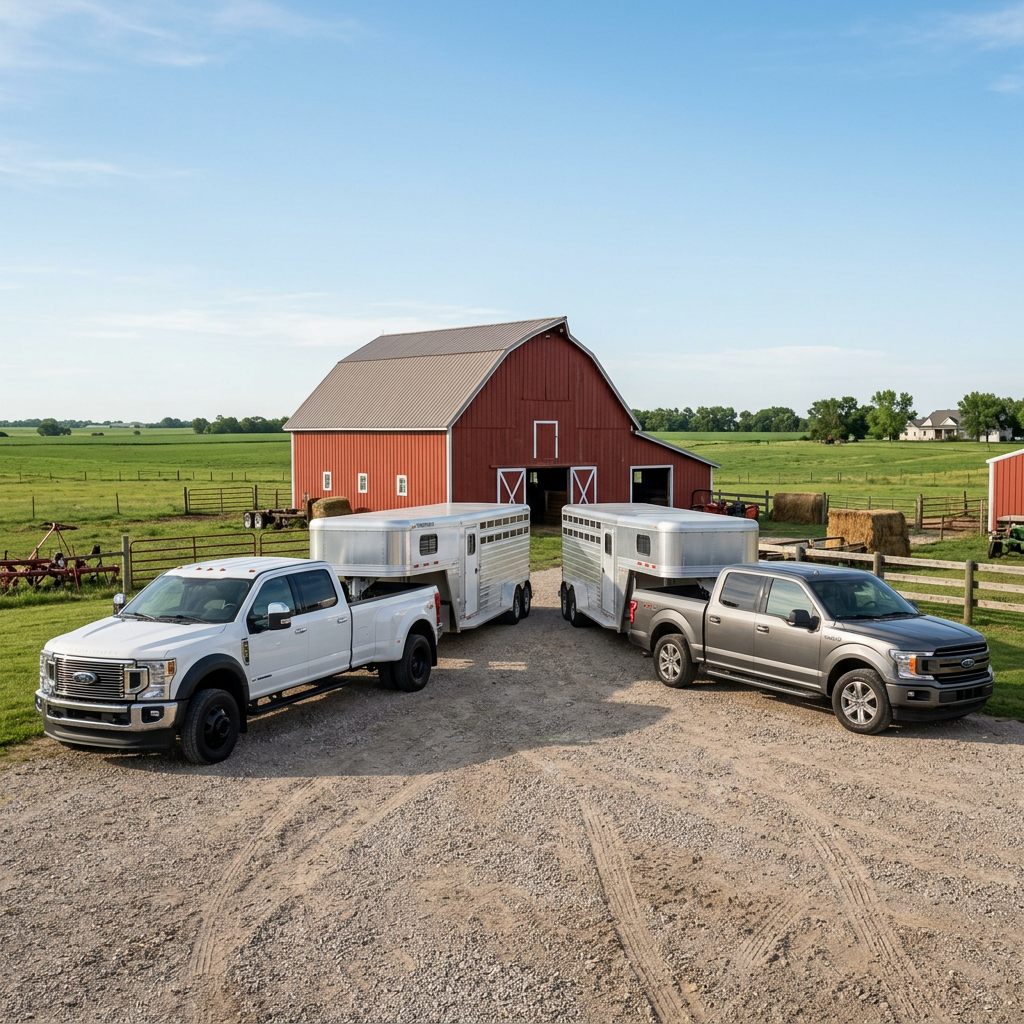
A white and a grey Ford pickup truck pulling silver horse trailers on a gravel driveway in front of a red barn. (Representative image for illustration purposes only. Actual vehicle may vary based on trim and configuration.)

At what trailer weight or size should you upgrade from an F-150 to an F-350?

Understanding the limits of your tow vehicle is the foundation of safe livestock trailering. While a properly configured Ford F-150 is an incredibly capable light-duty machine, it operates in a different class than the heavy-duty F-350 Super Duty. The primary dividing line between these two platforms isn’t just the raw maximum tow rating; it’s a combination of payload capacity, tongue weight, trailer length, and lateral stability. Livestock trailers are notoriously heavy, often built with rugged steel or thick aluminum, and the live weight inside behaves unpredictably. When animals move, they shift the trailer’s center of gravity, sending lateral and vertical forces directly to your truck’s chassis.

Generally, if your loaded trailer weight exceeds 8,000 to 9,000 pounds, or if the overall trailer length exceeds 20 to 22 feet, you should strongly consider stepping up to an F-350. At this threshold, tongue weight (which should represent 10% to 15% of a bumper-pull trailer’s weight, or up to 25% for a gooseneck) will quickly exhaust the payload limits of a half-ton truck once you factor in passengers, feed, tack, and show gear in the truck bed. An F-350 provides the structural mass, heavy-duty braking systems, and beefier suspension components required to counteract trailer sway and maintain absolute control.

Gooseneck trailers represent another major decision point. While a select few lightweight, aluminum two-horse goosenecks can theoretically be towed by a specially packaged F-150, the vast majority of gooseneck livestock trailers belong strictly in the domain of the F-350. A gooseneck places its hitch point directly over the truck’s rear axle, requiring immense payload capability. If you are regularly hauling more than three head of cattle or four to five horses, the tongue weight alone will crush a half-ton’s rear suspension. Upgrading to an F-350 ensures that your rear axle is engineered to bear these heavy vertical loads, keeping your front steering tires firmly planted on the pavement of Kansas highways.

Spec / Capability

Ford F-150 (Half-Ton)

Ford F-350 (One-Ton)

Max Tow Capacity

Up to 13,500 lbs

Up to 38,000 lbs

Max Payload

Up to 2,445 lbs (Heavy Duty Payload Pkg)

Up to 8,000 lbs+

Hitch Styles

Bumper Pull (Gooseneck highly discouraged)

Bumper Pull, 5th Wheel, & Gooseneck

Frame Construction

High-Strength Steel (Light Duty)

High-Strength Steel fully boxed (Heavy Duty)

Rear Axle Options

Single Rear Wheel (SRW) ONLY

SRW or Dual Rear Wheel (DRW) available

Which Ford F-150 configuration offers the maximum towing capacity for a livestock trailer?

If your fair setup involves a light to medium bumper-pull livestock trailer—perhaps a 14-foot or 16-foot aluminum stock trailer carrying smaller animals like sheep, goats, or swine—the Ford F-150 is more than capable of handling the task. However, you cannot simply hook up to any standard F-150 and expect peak performance. To achieve the absolute maximum towing capacity of 13,500 pounds, you must select a highly specific configuration of engine, cab, bed length, and factory-installed packages.

The Powertrain: 3.5L EcoBoost

The undisputed king of F-150 towing is the 3.5-liter EcoBoost V6 engine. Delivering a stout 400 horsepower and an incredible 500 lb-ft of torque, this twin-turbocharged powerhouse provides its peak torque low in the RPM band. This is exactly where you need it when pulling a loaded trailer up a highway ramp or keeping pace on hilly country roads. While the naturally aspirated 5.0L V8 is a legendary engine with a great exhaust note, the twin-turbo EcoBoost holds the crown for maximum towing capacity and effortless low-end grunt.

Cab & Bed: SuperCrew 4×4

To maximize stability and leverage, the optimal setup is the SuperCrew cab configuration with either the 5.5-foot or 6.5-foot bed, paired with a 4×4 drivetrain. The longer 157-inch wheelbase of the 6.5-foot bed version offers superior straight-line tracking and resists the ‘porpoising’ or bucking effect that shorter trucks can experience when pulling heavy bumper-pull trailers. The extra interior space of the SuperCrew is also perfect for securing expensive tack, show clothes, and climate-sensitive show gear.

The Max Trailer Tow Package

You must equip your truck with the factory Max Trailer Tow Package. This package adds crucial mechanical upgrades: an upgraded rear bumper, a class IV receiver hitch, an integrated trailer brake controller, a heavy-duty rear axle with a 3.55 electronic-locking differential, and enhanced cooling systems for both the engine and transmission. Without this package, your F-150’s tow rating is significantly lower, and attempting to tow heavy loads can lead to rapid transmission overheating and premature wear on critical components.

Before you hook up your trailer, make sure you know exactly what your truck can handle. If you’re considering buying or ordering a light-duty powerhouse, you can Research Ford F-150 specifications, packages, and interior features online to build the ultimate family show rig.
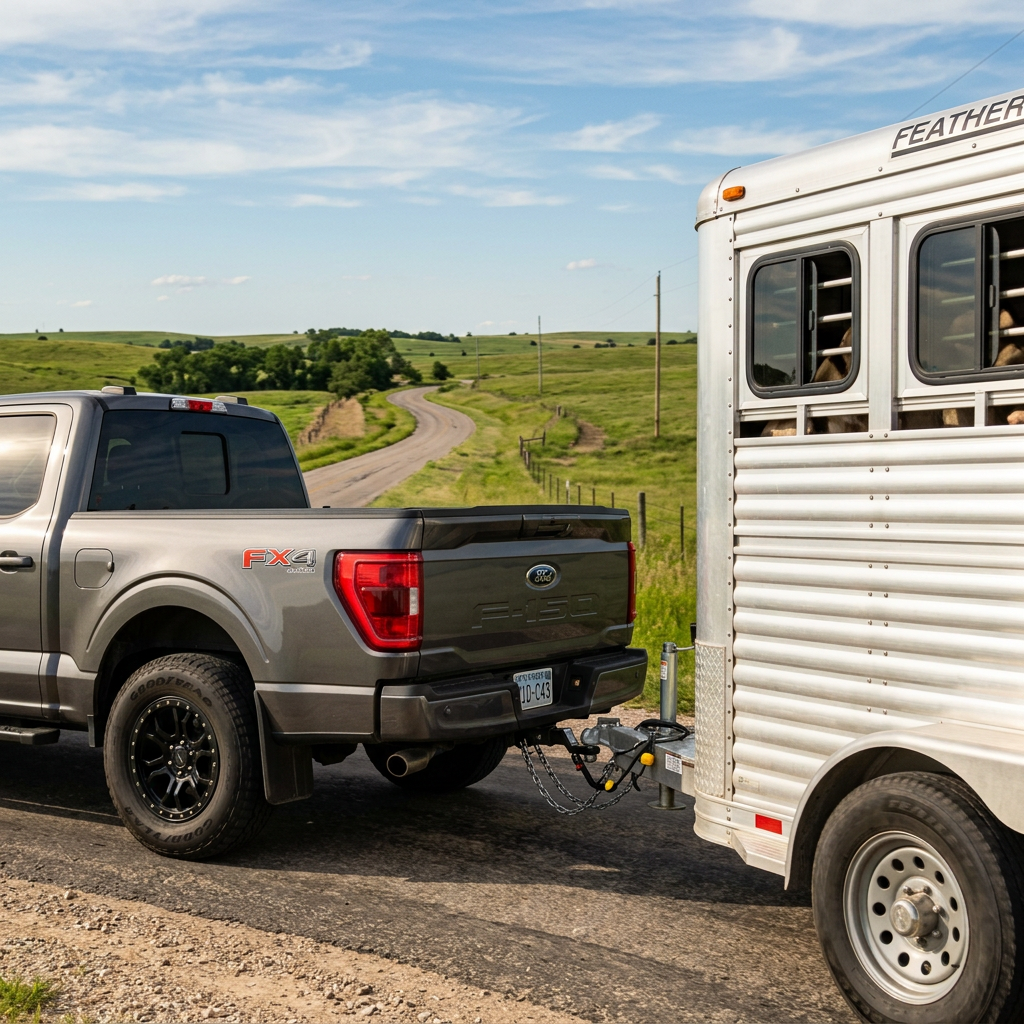
A grey Ford F-150 truck towing a silver Featherlite trailer along a rural road with green hills in the background. (Representative image for illustration purposes only. Actual vehicle may vary based on trim and configuration.)

Which Ford F-350 engine and axle setup provides the highest towing capacity for livestock trailers?

For serious livestock operations hauling multi-horse trailers, commercial stock trailers, or massive goosenecks loaded with market cattle, the Ford F-350 Super Duty is the undisputed gold standard. To unlock the absolute peak towing capacities of this heavy-duty workhorse—which tops out at an astronomical 38,000 pounds for gooseneck towing—you must select the correct engine, axle configuration, and gear ratio. The ultimate heavy-duty setup begins with the legendary High Output (H.O.) 6.7L Power Stroke® Turbo Diesel engine.

This beast of an engine produces a class-leading 500 horsepower and an earth-shaking 1,200 lb-ft of torque. This torque is fully available at extremely low engine speeds, meaning you can pull heavy, fully loaded stock trailers up steep grades or out of muddy fairground parking lots without the engine breaking a sweat. It is paired with a heavy-duty TorqShift® 10-speed automatic transmission designed specifically to manage these immense thermal and mechanical loads.

To translate that massive power to the ground and support the high pin weight of a large gooseneck trailer, you must configure the F-350 with a Dual Rear Wheel (DRW) axle setup. Known affectionately as a ‘dually,’ the DRW configuration adds two extra tires to the rear axle, drastically increasing lateral stability. This is crucial for livestock towing, as it eliminates the side-to-side sway caused by shifting cattle or high winds on open Kansas plains. Furthermore, selecting the 4.10 limited-slip or electronic-locking rear axle ratio optimizes the transmission’s gearing for maximum pulling power, ensuring you have the ultimate mechanical advantage from a dead stop.

At Valor Ford, we maintain a robust inventory of heavy-duty trucks ready to tackle the toughest agricultural demands. If you are looking to research standard three-quarter-ton options that balance daily driving with heavy pulling, we recommend you Research Ford F-250 options as well, which offer many of the same diesel powertrain advantages in a single-rear-wheel configuration.

Is the 80% towing rule widely recommended by towing experts?

When calculating towing capacities, many experienced towers and safety experts refer to the ‘80% rule.’ This guideline suggests that you should never load your trailer to more than 80% of your vehicle’s maximum rated towing capacity. For example, if your Ford F-150 has a maximum tow rating of 10,000 pounds, the 80% rule advises keeping your fully loaded trailer weight under 8,000 pounds. While this rule is not a legal requirement, it is highly recommended by towing professionals—especially when hauling live, shifting cargo like horses, cattle, or show stock.

Why is this safety margin so critical for livestock? Unlike static loads—such as a flatbed trailer stacked with lumber or a boat securely strapped to its trailer—animals move. When a cow steps backward, a horse shifts its weight to balance around a curve, or a group of market hogs moves to one side of the trailer, they create dynamic, unpredictable forces. This shifting weight changes the tongue load on your truck hitch and can initiate dangerous trailer sway. By maintaining a 20% safety buffer under your truck’s mechanical limits, you preserve the handling, steering, and braking capabilities needed to recover from sudden trailer movements or unexpected maneuvers on the highway.

Additionally, the 80% rule protects your truck’s mechanical longevity. Towing at the absolute limit of a vehicle’s capacity generates extreme heat in the transmission, places immense strain on the engine’s cooling system, and accelerates wear on brakes and suspension components. This is especially true during hot Kansas summers when ambient temperatures routinely exceed 90 degrees Fahrenheit. Operating with a comfortable safety margin guarantees that your truck will run cooler, last longer, and successfully deliver your prized livestock to the fairgrounds without mechanical incident.
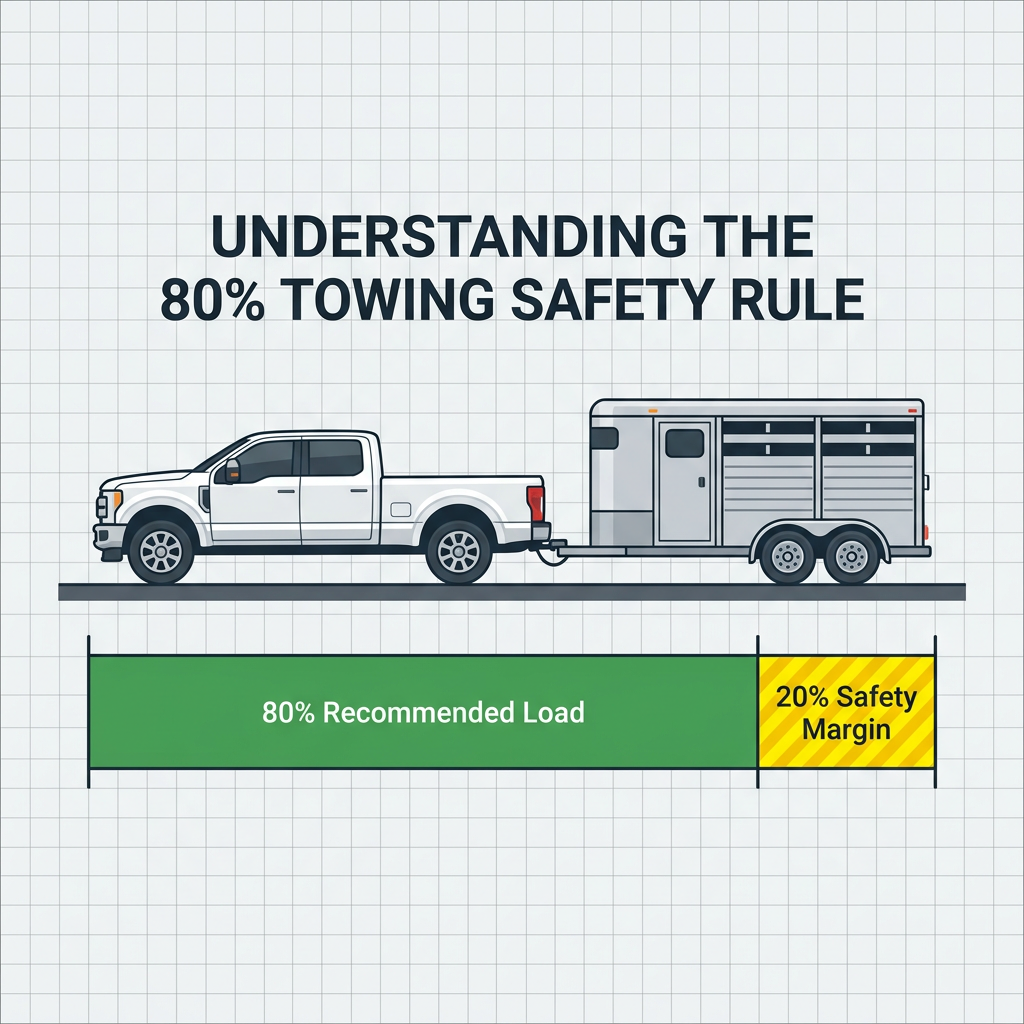
Infographic explaining the 80% towing safety rule, showing a truck towing a trailer with a 20% safety margin. (Representative image for illustration purposes only. Actual vehicle may vary based on trim and configuration.)

Do you need a Commercial Driver's License (CDL) to tow a livestock trailer to a Kansas county fair?

Navigating the legalities of towing a livestock trailer in Kansas can often feel confusing. Many farmers and 4-H families wonder if their large dually trucks and multi-car stock trailers push them into Commercial Driver’s License (CDL) territory. Under federal and Kansas state law, the general threshold that triggers a CDL requirement is a Gross Combined Weight Rating (GCWR)—the total weight of the truck and the trailer combined—of 26,001 pounds or more, provided the trailer’s Gross Vehicle Weight Rating (GVWR) is more than 10,000 pounds. If your truck and trailer combination stays below this 26,001-pound mark, a standard Class C driver’s license is completely sufficient.

However, what happens if your heavy-duty F-350 (which often has a GVWR of 11,500 to 14,000 pounds) is paired with a large gooseneck livestock trailer (GVWR of 14,000 pounds or more)? Mathematically, this combination can easily push your total GCWR past 26,001 pounds. Fortunately, Kansas law provides several crucial exemptions specifically tailored for the agricultural community. If you are operating as a farmer or rancher transporting your own livestock, feed, or equipment, you may qualify for the Kansas Covered Farm Vehicle (CFV) exemption.

Under the CFV guidelines, a farm-registered vehicle operated by a farmer, farm employee, or family member can be driven anywhere within the state of Kansas (and within 150 air miles of the farm across state lines) without a CDL, regardless of the vehicle’s weight. This exemption is designed to support the local agricultural economy and allows families to easily transport their own animals to county fairs, livestock shows, and local markets. It is important to note, however, that the vehicle must be registered as a farm vehicle and must not be used for hire or commercial transport outside of personal farm operations.

For youth exhibitors in 4-H or FFA, transporting show animals is typically classified as a recreational or educational endeavor, meaning it falls outside of commercial regulations. However, if you are sponsored by a business or are hauling animals for other people for a fee, you could be deemed a commercial operator and must comply with full CDL and Department of Transportation (DOT) registration requirements. To ensure you stay fully compliant with all local laws and registration needs, we highly recommend consulting with the Kansas Highway Patrol or contacting a local licensing office before hitting the road.

How often should you inspect and service your truck's trailer hitch and receiver?

Your truck’s trailer hitch and receiver are the single points of physical connection between your vehicle and your valuable cargo. Under the strain of livestock trailering, these mechanical connection points endure massive stress, friction, and vibration. Neglecting hitch maintenance is one of the most common causes of catastrophic trailer detachments. To guarantee safety, you must establish a rigorous inspection and service schedule.
Pre-Trip Visual Check

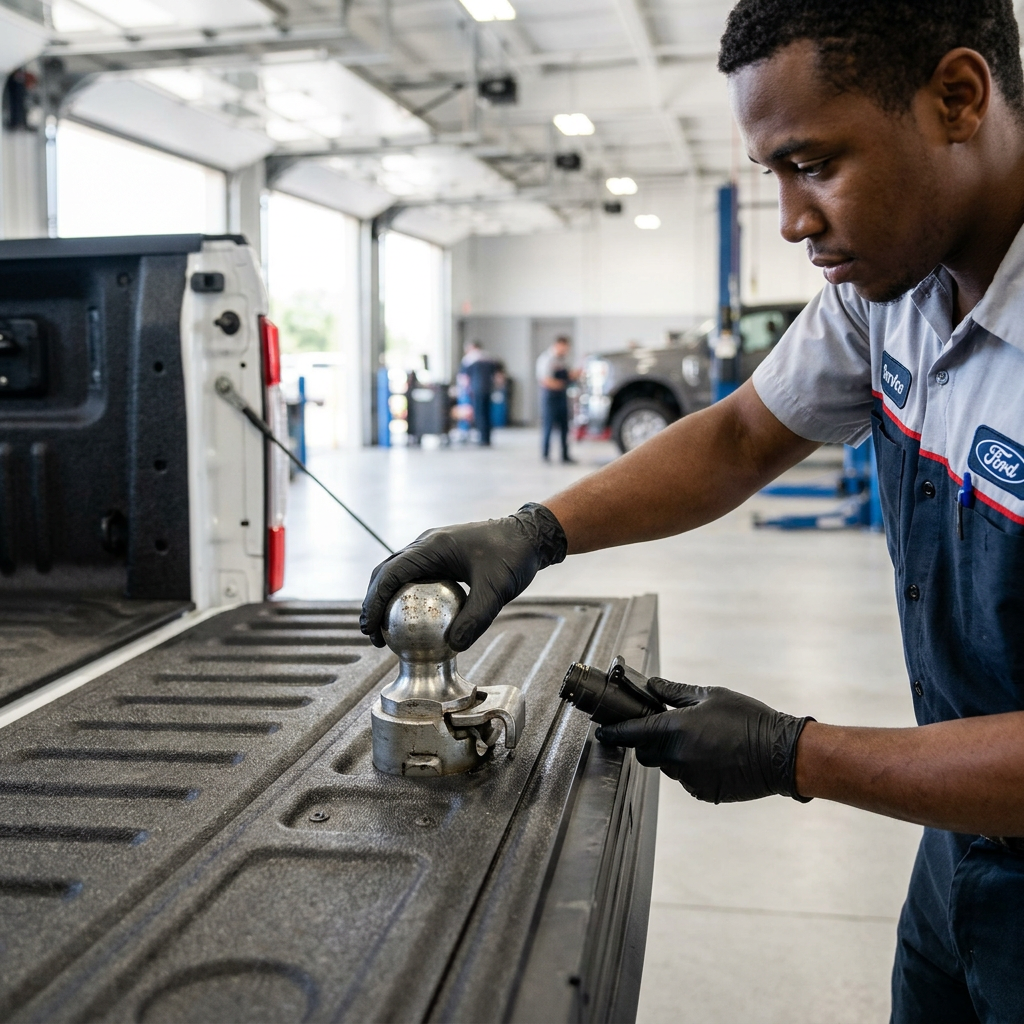
Every single time you hook up your trailer, perform a thorough visual inspection. Look closely at the hitch receiver tube on your truck for any signs of hairline cracks, rust-through, or metal fatigue. Check that the hitch pin and cotter clip are in perfect condition and securely locked in place. If you are using a bumper-pull setup, ensure the hitch ball is completely tight on the drawbar and shows no signs of pitting or excessive wear. For gooseneck setups, verify that the gooseneck ball is free of debris and that the locking mechanism operates smoothly.

Monthly Maintenance

On a monthly basis, or before every major long-distance trip, apply a thin layer of high-quality lithium grease to the hitch ball or gooseneck coupling mechanism. This lubrication minimizes metal-on-metal friction, preventing premature wear on both the trailer coupler and your truck’s hitch. Additionally, crawl beneath the rear of your truck and check the mounting bolts that secure the receiver assembly to the vehicle’s frame. Use a torque wrench to ensure these bolts are tightened to the manufacturer’s exact specifications.

Annual & Electrical

At least once a year, conduct a deep electrical and structural service. Clean the inside of the 7-way electrical connector plug on your truck with a dedicated electrical contact cleaner, and apply dielectric grease to prevent corrosion. Inspect the heavy steel loops where your trailer’s safety chains attach; these must be free of cracks or deformation. If you find any damaged hardware, you can easily Order Genuine Ford Parts through our dealership to replace worn-out components with factory-certified equipment.

A Ford service technician in uniform examining a trailer hitch ball and electrical plug on a pickup truck tailgate. (Representative image for illustration purposes only. Actual vehicle may vary based on trim and configuration.)

Navigating the Road to the Dickinson County Fair and Fort Riley Community Exhibits

Towing through the scenic rolling topography of the Flint Hills region presents unique challenges that every livestock exhibitor must plan for. While Kansas is often stereotyped as flat, local drivers know that navigating the hilly corridors of Dickinson, Geary, and Riley counties requires active driving and a highly prepared vehicle. If you are hauling a loaded trailer from Junction City to the Dickinson County Fairgrounds in Abilene, you will face steady climbs and rolling descents along Interstate 70. These sustained elevation changes generate immense heat in your truck’s transmission, making robust cooling systems and proper gear selection vital.

To successfully manage this terrain, always ensure your truck’s Tow/Haul mode is engaged. This factory Ford feature recalibrates transmission shift points, holding gears longer during climbs to prevent the transmission from constantly hunting for gears—a behavior that causes rapid thermal buildup. When descending hills, Tow/Haul mode automatically downshifts to provide engine braking, reducing the load on your brakes and preventing brake fade. Additionally, having a properly calibrated, integrated trailer brake controller ensures that your trailer slows down in perfect unison with your truck, preventing the trailer from pushing or jackknifing on slick, unpaved fairground entrances.

For those heading north toward the Fort Riley community exhibits or navigating the gravel access roads of Riley County, dust, dirt, and rough surfaces are common. These conditions demand that your truck’s suspension and air filtration systems are in peak health. Long gravel roads can clog engine air filters quickly, reducing fuel efficiency and pulling power. Furthermore, rough, washboard gravel roads will test your trailer’s suspension and tire integrity. Driving at reduced speeds, planning routes that minimize low-maintenance roads, and ensuring your tires are properly inflated for gravel travel will protect your livestock from a stressful, bumpy ride.

Before you set out on your next journey across the Flint Hills, let our certified technicians verify that your cooling systems, brakes, and transmission fluids are fully prepared for the heavy demands of the road. You can easily Schedule Ford Service Today to ensure your truck receives a comprehensive pre-trip inspection, giving you complete peace of mind.

The Pre-Fair Towing Checklist for Kansas Livestock Exhibitors

A successful trip to the county fair starts long before you pull out of your driveway. Experienced exhibitors know that a detailed pre-flight routine prevents breakdowns and protects the welfare of their animals. To help you stay organized, the truck and towing experts at Valor Ford have compiled this comprehensive, step-by-step checklist. Run through these critical inspections the day before you load your livestock to guarantee a stress-free journey.

1. Tire Pressure and Integrity (Truck & Trailer): Check the air pressure in all tires, including the spares. Under-inflated tires generate excessive heat, which is the leading cause of highway blowouts. Inspect tire sidewalls for dry rot, cracking, or embedded debris. 2. Braking Systems: Verify that your truck’s brake pads and rotors are in excellent condition. Test the trailer’s electronic brakes by manually sliding the override lever on your dashboard brake controller at a slow speed to ensure the trailer slows the truck down independently. 3. Electrical Connections: Connect your 7-way plug and have a helper verify that all running lights, brake lights, left and right turn signals, and hazard flashers are operating flawlessly. Clean away any corrosion on the metal pins. 4. Hitch and Coupler Security: Ensure the coupler is fully closed over the hitch ball and the locking latch is pinned shut. Cross your safety chains under the trailer tongue (forming an ‘X’ to catch the tongue if it detaches) and secure the breakaway switch cable to a solid point on the truck frame. 5. Fluid Levels: Check your engine oil, transmission fluid, coolant reservoir, and brake fluid. If you are driving a diesel F-350, ensure your Diesel Exhaust Fluid (DEF) tank is fully topped off. 6. Trailer Ventilation & Bedding: Open all sliding vents and windows to guarantee maximum airflow for your animals. Lay down a thick layer of clean wood shavings or straw to absorb moisture and provide traction, preventing slips and falls during transit. 7. Emergency Kit Essentials: Pack heavy-duty roadside flares or reflective triangles, a hydraulic bottle jack capable of lifting a loaded trailer, spare tire tools, wood blocks for wheel chocks, a flash light, extra trailer fuses, and a fully stocked livestock first aid kit.
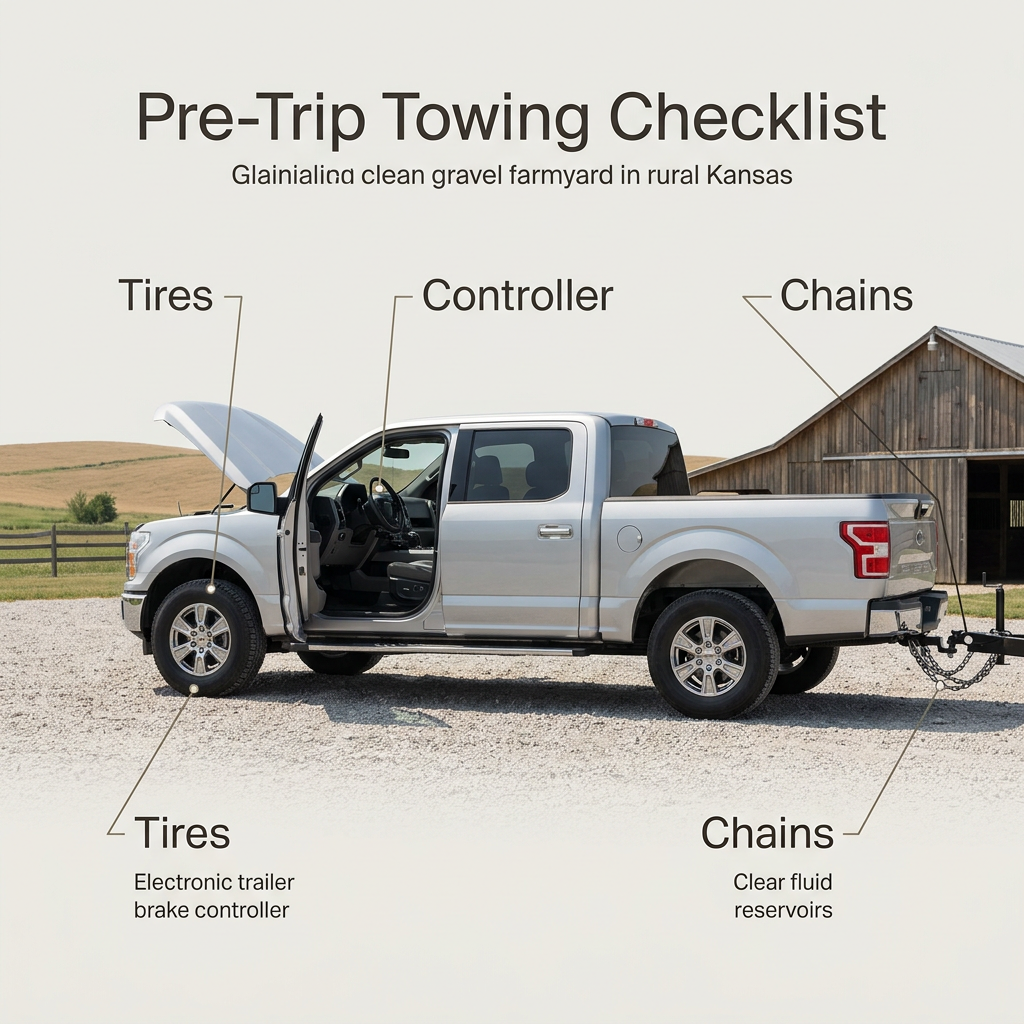
Infographic titled "Pre-Trip Towing Checklist" showing a silver pickup truck with misaligned labeling diagrams. (Representative image for illustration purposes only. Actual vehicle may vary based on trim and configuration.)

Essential Towing Accessories and Upgrades for Your Ford Truck

Extendable Towing Mirrors

Standard side mirrors simply do not provide the wide-angle visibility required to safely tow a wide livestock trailer. Upgrading to Ford’s OEM power-telescoping and power-folding trailering mirrors allows you to extend your field of view with the push of a button. These mirrors feature integrated spotter mirrors and blind-spot monitoring systems designed to detect vehicles alongside your trailer, ensuring safe highway lane changes.

Smart Camera Systems

Ford’s 360-degree camera package is a game-changer for solo hookups and tight fairground navigation. By utilizing multiple high-definition cameras strategically placed around the truck, this system provides a birds-eye view of your surroundings. Additionally, you can install an auxiliary Ford camera on the rear of your livestock trailer, transmitting a crystal-clear live video feed directly to your central touchscreen display for effortless backing.

Suspension Upgrades

If your F-150 or single-rear-wheel Super Duty experiences rear-end sag when loaded, upgrading your suspension can drastically improve ride quality. Installing OEM-approved helper springs, suspension stabilizers, or rear air helper bags will level your truck, restoring steering response and headlight alignment. To browse these upgrades and customize your rig, you can Order Genuine Ford Parts directly from our online catalog.

How Valor Ford Helps Junction City Farmers and Families Prep for Fair Season
At Valor Ford, we are deeply embedded in the local Junction City community. We understand that county fairs represent far more than just a weekend competition; they showcase the dedication, values, and hard work of our local youth and ranching families. That is why our commitment goes beyond selling and servicing vehicles. We are proud supporters of Geary County 4-H, local FFA chapters, and the agricultural initiatives that keep our rural communities thriving. Our team of certified Ford technicians is specifically trained in the heavy-duty service and maintenance required for agricultural use, making us the premier destination for truck and trailer preparation.

Our service department is equipped to handle everything from routine fluid changes and heavy-duty brake replacements to complete suspension diagnostic work and electrical harness repairs. We use specialized testing equipment to diagnose integrated trailer brake controller issues, ensuring your truck communicates seamlessly with your livestock trailer’s electric brakes. We understand that your time is valuable—especially during the hectic fair prep season—which is why we offer streamlined booking options and efficient turnarounds.

For families with tight schedules, we also offer our convenient pickup and delivery service. We can retrieve your truck directly from your farm or workplace, bring it to our state-of-the-art facility for service, and return it directly to you once the work is completed. To save valuable time and keep your preparation on track, you can easily Schedule Pickup and Delivery Service online. Let our professionals handle the mechanical details so you can focus on grooming, feeding, and preparing your livestock for a blue-ribbon performance.

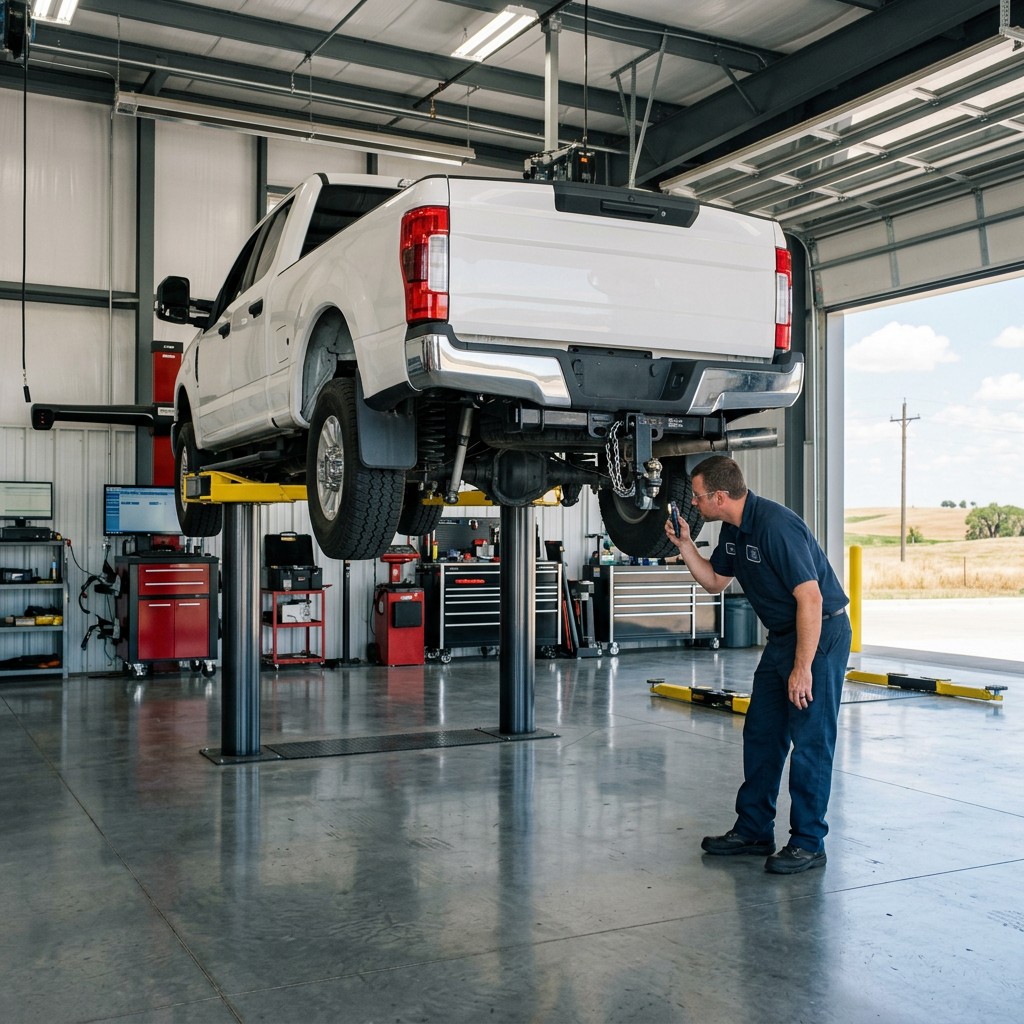
A mechanic in a blue uniform inspects the undercarriage of a white pickup truck raised on a hydraulic lift in a garage. (Representative image for illustration purposes only. Actual vehicle may vary based on trim and configuration.)

Ready to Tow? Schedule Your Pre-Fair Inspection or Upgrade Your Rig at Valor Ford Today

Schedule your service before fair season. Ensure your truck is fully prepared to transport your hard work and prized livestock safely across Kansas. Whether you need a comprehensive multi-point safety inspection on your current vehicle, replacement hitch parts, or are ready to upgrade to a high-capability F-150 or F-350 dually, the dedicated team at Valor Ford is here to help. Click below to schedule your service or evaluate your current truck’s trade-in value today!

Have questions about towing capacities, agricultural exemptions, or truck parts? Call us at (785) 238-5114 or Get Directions to Valor Ford to speak with our friendly team in person. We look forward to helping you make this fair season your most successful yet!

Finding the Best Ford F-150 Sale in Junction City: Your Guide to Deals, Trims, and Local Inventory- Only at Valor

There is a reason why the Kansas horizon is dotted with Ford trucks. From the wide-open pastures of Dickinson County to the busy thoroughfares surrounding Fort Riley, the Ford F-150 is much more than a vehicle—it is a trusted business partner, a family shuttle, and an indispensable tool for daily life. When you start searching for an active Ford f150 inventory, you are not just looking for a discount; you are looking for the right combination of legendary capability, modern comfort, and long-term value that fits the demanding Kansas lifestyle. Here at Valor Ford, we pride ourselves on being more than just a dealership. We are your local truck authority, dedicated to helping you navigate the exciting and diverse F-150 lineup with honesty and expertise.

Navigating the truck-buying process can sometimes feel overwhelming with the sheer number of trims, engines, and technological features available in the current model year. Whether you are a military service member stationed at Fort Riley looking for a rugged companion for weekend adventures, a farmer in Dickinson County needing a powerhouse for hauling heavy loads, or a commuter looking to save on fuel with the innovative PowerBoost Hybrid engine, this comprehensive guide is designed to answer your burning questions. We will dive deep into starting prices, towing capacities, dealership discounts, tech comparisons, and fuel economy ratings. If you want to dive even deeper into specific configurations, you can easily Research Ford F-150 models directly on our website to see how they line up.
{
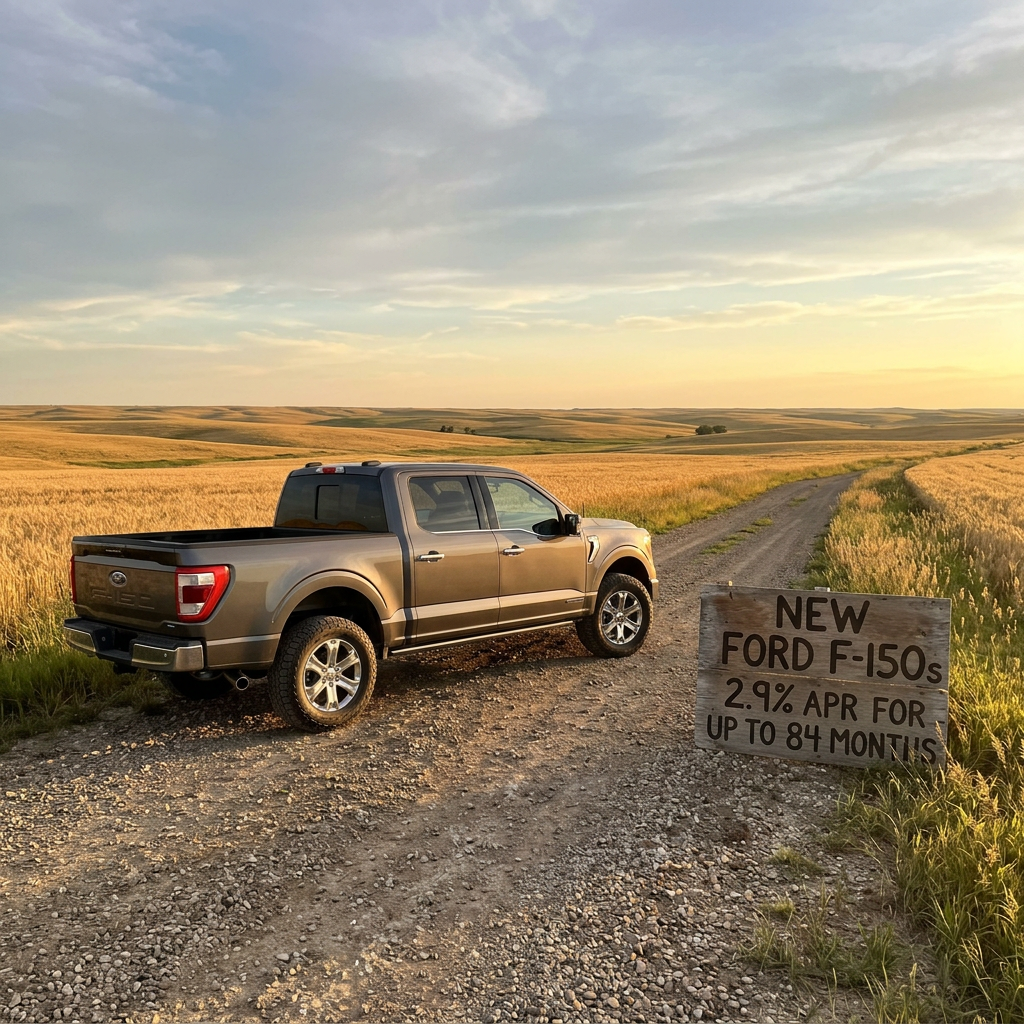
  "altText": "A Ford F-150 pickup truck parked on a gravel country road next to a wooden sign advertising financing offers. (Representative image for illustration purposes only. Actual vehicle may vary based on trim and configuration.)

What Is the Starting Price for the 2024 F-150 XLT Trim and Other Popular Models?

Understanding the pricing landscape is the first step toward finding the perfect truck for your budget. A very common question we receive from our customers in Junction City is, ‘What is the starting price for the 2024 F-150 XLT trim?’ Generally, the highly versatile XLT trim, which represents the sweet spot of features and value for most everyday truck buyers, starts in the high $40,000s to low $50,000s range, depending on your choice of cab configuration (SuperCab vs. SuperCrew) and drivetrain (4×2 vs. 4×4). The XLT trim brings a massive step up in interior refinement, standard safety tech, and exterior styling compared to the work-ready base XL model, which serves as the entry point into the F-150 lineup.

For those who require a pure, no-nonsense work truck, the entry-level XL trim typically starts in the low $40,000s. It features durable vinyl flooring, easy-to-clean surfaces, and the robust power of the standard EcoBoost engine, making it a favorite for commercial fleets and budget-conscious private buyers. However, many of our local drivers opt for the XLT because of the added utility and comfort features, such as the standard 12-inch touchscreen infotainment display, premium fabric seating, chrome bumpers, and Ford Co-Pilot360 safety technologies that make daily driving through Dickinson County a breeze.

But how much more expensive are higher trims than the base truck? As you move up the trim ladder toward luxury and extreme performance, the investment increases. The premium Lariat trim, which acts as the gateway to luxury with its standard leather seating, ventilated seats, and upgraded audio, typically starts in the mid $60,000s. If you desire the ultimate luxury or off-road adventure, the King Ranch, Platinum, and Tremor models range from the high $70,000s to well over $80,000. These higher-tier trims feature premium materials, advanced driver-assist systems, and heavy-duty mechanical upgrades designed for demanding tasks.

To bridge this gap, Valor Ford regularly offers competitive pricing and financing specials designed to make even the premium trims highly accessible. When evaluating these price differences, it is important to look at the long-term resale value, where the F-150 consistently leads the class. By choosing a trim level that matches your exact daily needs, you avoid paying for features you do not use while ensuring you have all the power and comfort required. If you are curious about pre-owned alternatives or budget-friendly options, you can Browse Used Inventory at our dealership to see a vast array of high-quality, thoroughly inspected late-model F-150s.

Which F-150 Trim Gives the Best Value for Kansas Drivers?

The STX: Sports-Inspired Value

For buyers who want an athletic appearance without paying luxury-tier prices, the STX package is a phenomenal choice. Built on the XL platform, it adds stylish 20-inch dark gray wheels, unique body-color bumpers, and sport-tuned interior accents. It provides the rugged capability of the F-150 while delivering a modern, aggressive aesthetic that looks fantastic on the streets of Junction City. It is a highly popular option for younger drivers and those looking to maximize their visual appeal and utility on a sensible budget.

The XLT: The Ultimate Sweet Spot

When answering the question, ‘Which F-150 trim gives the best value?’, the XLT is almost always the definitive winner for Kansas drivers. It beautifully balances advanced cabin technology with rugged utility. You get standard power features, the SYNC 4 infotainment system on a 12-inch screen, Chrome or Sport appearance packages, and available features like Pro Power Onboard. It is the perfect dual-purpose vehicle, transitioning seamlessly from a demanding Kansas farm workhorse during the day to a comfortable family cruiser at night.

The Lariat: Accessible Luxury

If you spend long hours behind the wheel traveling across Kansas, upgrading to the Lariat is a highly justified investment. It introduces high-end comfort features like heated and ventilated leather-trimmed front seats, a premium B&O Sound System, power-folding side mirrors, and the advanced 12-inch digital productivity screen. It offers the refined feeling of a luxury SUV while retaining all of the high-strength, military-grade aluminum-alloy body strength and towing capability of the F-150 lineup.

What Is the Towing Capacity of the 2024 Ford F-150 Across Different Engines?

For truck buyers in Dickinson County and Junction City, capability is paramount. When asking, ‘What is the towing capacity of the 2024 Ford F-150?’, the answer is highly impressive and depends on which powerful engine sits under the hood. Ford has engineered a diverse powertrain lineup that ensures you have the exact towing performance required for your specific lifestyle. From hauling lightweight recreational gear to moving heavy agricultural equipment, there is an F-150 configuration that makes the task feel effortless.

The base 2.7L EcoBoost V6 is an absolute powerhouse for its size, offering up to 8,400 pounds of towing capacity. This is perfect for pulling small camper trailers, jet skis, or landscaping utility trailers. For those who love the classic roar of a naturally aspirated engine, the legendary 5.0L V8 provides a robust 13,000-pound maximum towing capacity. The towing champion of the lineup is the legendary 3.5L EcoBoost V6, which peaks at a class-leading 13,500 pounds of maximum towing, ideal for heavy agricultural trailers and large boats. Finally, the PowerBoost Hybrid merges extreme efficiency with raw capability, providing up to 11,200 pounds of towing capacity alongside the game-changing Pro Power Onboard system.

F-150 Towing & Engine Specifications

Engine Option

Horsepower

Torque

Max Towing Capacity

2.7L EcoBoost V6

325 hp

400 lb-ft

8,400 lbs

5.0L Ti-VCT V8

400 hp

410 lb-ft

13,000 lbs

3.5L EcoBoost V6

400 hp

500 lb-ft

13,500 lbs

3.5L PowerBoost Hybrid

430 hp

570 lb-ft

11,200 lbs

Are Dealers Actually Discounting F-150s Below Sticker Price with Incentives?

Transparency is everything to us at Valor Ford. Buyers deserve straightforward answers to core financial questions like, ‘What discount can I expect on a new F-150?’, ‘Are there dealer incentives or rebate programs available for 2024 F-150 models?’, and most importantly, ‘Are dealers actually discounting F-150s below sticker price?’ The short answer is yes. We offer competitive manufacturer incentives and financing options that may be available on select vehicles, and pricing details are subject to change.

Manufacturer rebates and regional incentives change monthly, but they frequently include substantial customer cash-back offers, trade-in bonuses, and low-interest financing promotions that can save you thousands of dollars. Furthermore, we proudly support our local military community at Fort Riley with specialized Ford Military Appreciation cash offers. When combined with our competitive dealership pricing adjustments, buying a brand-new F-150 becomes a highly smart, budget-friendly decision. We believe in providing an stress-free, open pricing process so you always feel confident you are getting the absolute best deal in the Junction City area.
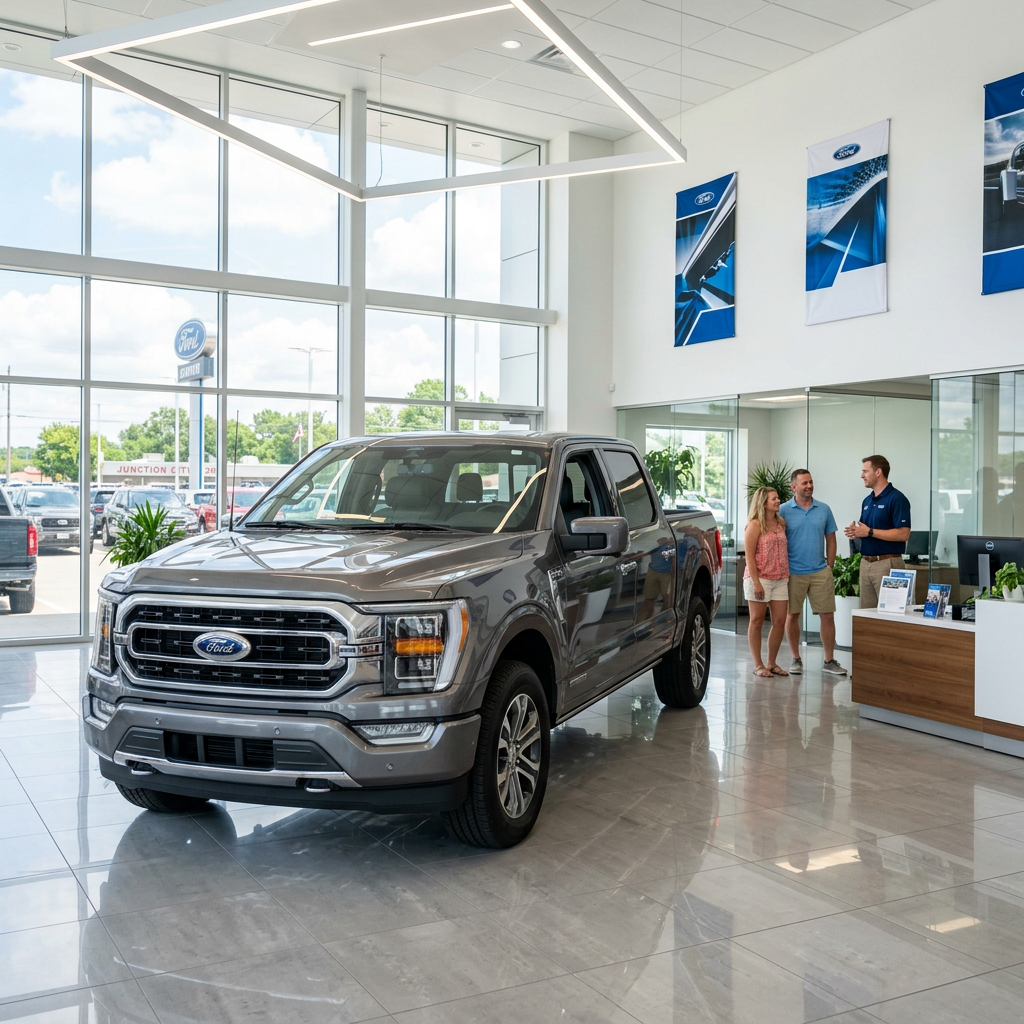
A grey Ford F-150 pickup truck on display inside a bright dealership showroom with a couple talking to a salesperson. (Representative image for illustration purposes only. Actual vehicle may vary based on trim and configuration.)

What Are Typical Promotional Interest Rates for a 2024 Ford F-150?

Securing competitive financing is just as critical as finding the right truck price. So, ‘What are typical promotional interest rates for a 2024 Ford F-150?’ During major sales events throughout the year, Ford Credit frequently offers highly competitive promotional Annual Percentage Rates (APR). Current promotional financing offers may be available for qualified buyers on select terms. Please contact the dealership for the latest rate and payment information.

These highly favorable promotional rates are designed to reward buyers with strong credit histories, but our expert finance team works hard to secure excellent rates for buyers across a wide variety of financial backgrounds. We maintain strong relationships with a vast network of local Kansas banks and national lenders to ensure you receive a personalized, budget-friendly auto loan that fits your unique lifestyle. We highly recommend using our secure online tools to get started ahead of time.

To streamline your truck-buying experience, you can easily secure your financing approval online before even stepping foot in our showroom. We highly encourage our customers to use our convenient portal to Get Pre-Approved for Financing. This not only saves you valuable time at the dealership but also gives you a clear understanding of your buying power, allowing you to shop our active Ford F-150 inventory with complete confidence and peace of mind.

How Do the Interior Infotainment Screens Compare: 2024 F-150 vs. Silverado?
Modern trucks are no longer just mechanical beasts; they are highly advanced rolling computers. When evaluating options, buyers often ask, ‘How do the interior infotainment screens compare between the 2024 F-150 and Silverado?’ Ford offers a standard 12-inch LCD capacitive touchscreen by offering a stunning 12-inch LCD capacitive touchscreen as standard equipment starting right at the base levels. This means you do not have to purchase a high-end luxury trim just to get a modern, highly functional screen interface.

The Ford F-150 runs on the highly intuitive SYNC 4 software, which features seamless wireless Apple CarPlay and Android Auto integration, advanced voice recognition, and over-the-air software updates that keep your truck’s systems modern over time. In contrast, while the Chevrolet Silverado offers an impressive 13.4-inch screen, it is not standard on some lower and mid-level configurations, so buyers may need to choose a higher trim to access that screen size. Ford’s layout is incredibly user-friendly, maintaining physical knobs for climate and audio controls so you can easily adjust settings without taking your eyes off the Kansas highways.

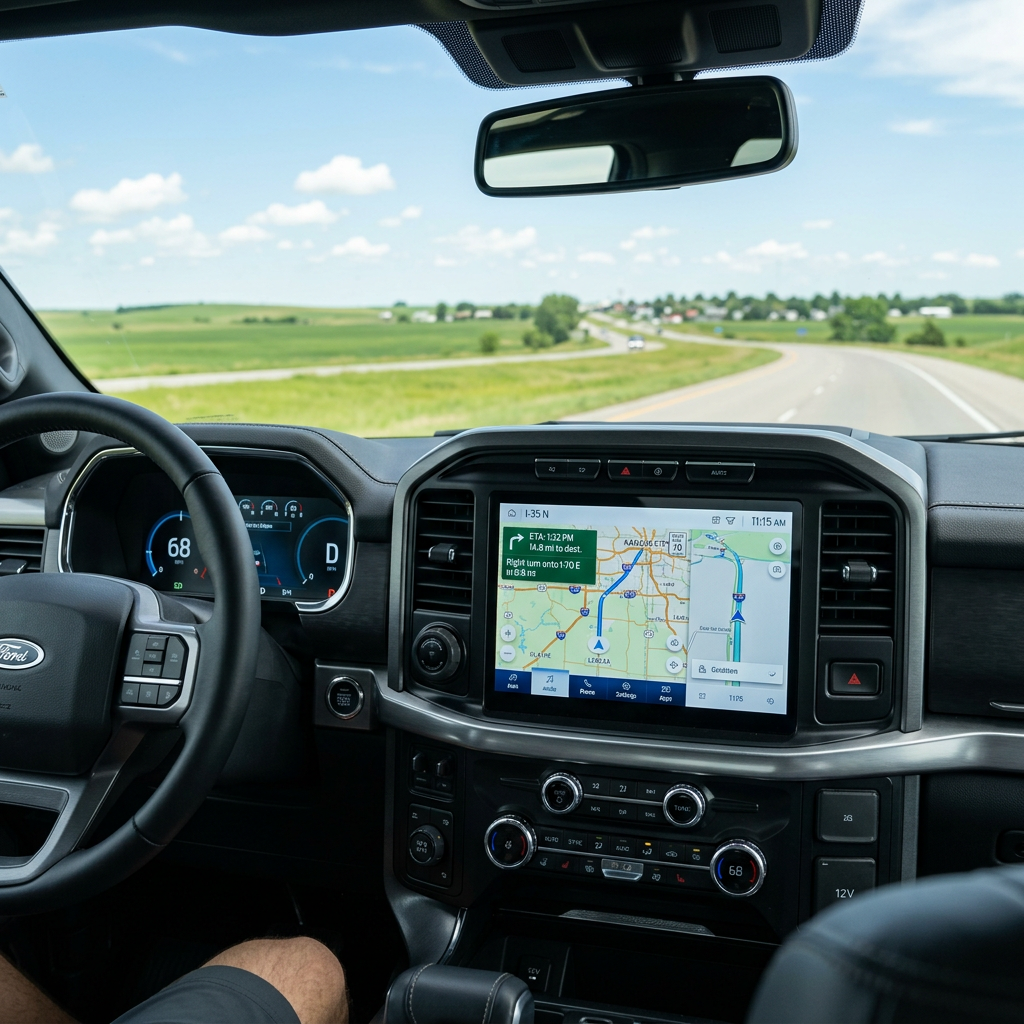
Driver's perspective inside a Ford truck navigating a curved highway through green fields with GPS on the dashboard. (Representative image for illustration purposes only. Actual vehicle may vary based on trim and configuration.)

Which Truck Offers Better Fuel Economy in Their Base Engines and Hybrids?

Base Engine Efficiency

When comparing ‘Which truck offers better fuel economy in their base engines?’, Ford’s 2.7L EcoBoost V6 stands out as a masterpiece of engineering. It delivers an EPA-estimated 19 mpg city and 25 mpg highway. This consistently outperforms the base engines of major competitors like the Chevrolet Silverado’s TurboMax, allowing you to save money during long highway drives across Kansas without sacrificing the rapid acceleration and low-end torque you need.

The PowerBoost Hybrid Advantage

For drivers looking to maximize their efficiency, the F-150’s available PowerBoost Full Hybrid V6 is an absolute game-changer. It delivers up to an EPA-estimated 22 mpg city and 24 mpg highway, putting it far ahead of standard full-size trucks. By combining electric power with twin-turbocharged performance, it offers unparalleled fuel savings without compromising on your heavy-duty payload and towing capacities.

Kansas Commuting Impact

With the wide-open spaces of Junction City, Dickinson County, and Fort Riley, daily travel distances quickly add up. Choosing a fuel-efficient truck like the F-150 EcoBoost or PowerBoost translates directly into hundreds of dollars saved at the pump each year. It is a highly practical choice for the budget-conscious truck owner who needs a reliable daily driver that handles both rugged farm chores and long highway road trips with ease.

How Does the Ford F-150 Compare with Other Full-Size Trucks?

When shopping for a new vehicle, it’s essential to understand ‘How does the Ford F-150 compare with other full-size trucks?’ and determine ‘Which full-size truck is the best value?’ For decades, the F-150 has maintained its position as America’s best-selling truck because it refuses to compromise. While the Ram 1500 is known for its coil-spring ride comfort and the Chevrolet Silverado offers strong utility, the F-150 offers a well-rounded package of towing power, high-strength build quality, cabin ergonomics, and long-term resale value.

Feature / Metric

Ford F-150

Chevy Silverado 1500

Ram 1500

Standard Screen Size

12-inch Touchscreen

7-inch Touchscreen (Base)

8.4-inch Touchscreen (Base)

Max Available Towing

13,500 lbs

13,300 lbs

11,580 lbs

Hybrid Powertrain

Full Hybrid Available

Not Available

Mild Hybrid Only

Cab Construction

Military-Grade Aluminum

Traditional Steel

Traditional Steel

Onboard Generator

Pro Power Onboard (Up to 7.2kW)

None

None

As shown in the head-to-head breakdown, the F-150 outclasses the competition in crucial areas like standard cabin technology, maximum available towing capacity, and innovative features like Pro Power Onboard—which transforms your truck’s bed into a mobile electrical generator. This unmatched versatility is what makes the F-150 the ultimate value proposition for Kansas drivers who demand their vehicle be both a comfortable daily driver and a highly capable mobile workspace.

Can a Dealer Tell Me What F-150s Are Arriving Soon at Valor Ford?

Because the F-150 is so incredibly popular, the most desirable configurations and colors can sell very quickly once they arrive on our physical lot. A very common and smart question buyers ask is, ‘Can a dealer tell me what F-150s are arriving soon?’ At Valor Ford, the answer is a resounding yes! We have direct, real-time access to Ford’s logistics pipeline, allowing us to see exactly which vehicles are scheduled for production, currently built, or in transit to our Junction City dealership.

By consulting with our expert sales team, you can look at the incoming vehicles weeks before they physically arrive. If you find an inbound truck that matches your desired trim level, engine choice, and color preference, we can easily reserve it in your name. This ensures that you secure on your perfect configuration and can take delivery the very day the transport truck rolls onto our lot here at 1825 Goldenbelt Blvd.

In addition to tracking inbound stock, we specialize in helping our customers custom-order their brand-new Ford trucks directly from the factory. If you have highly specific needs—such as a specific payload package, a hard-to-find exterior color, or a particular set of interior tech features—custom ordering is an excellent, stress-free route. It guarantees that you get the exact truck you want, down to the very last detail, without paying for features you don’t need.

Our team will guide you through the entire process, from selecting the initial specs to tracking the production phases and celebrating your vehicle’s final arrival. Whether you are tracking an inbound model or custom building your own, we are committed to making your experience incredibly exciting and fully transparent. If you have questions about the process or want to check on current incoming inventory, you can easily Call us at (785) 238-5114 to speak directly with one of our local truck specialists today.

How the F-150 Fits the Demands of Junction City, Fort Riley, and Dickinson County
Fort Riley Support

For our dedicated military personnel stationed at Fort Riley, life is fast-paced and demands absolute reliability. The Ford F-150 is the perfect companion, offering massive cargo volume in the bed to haul gear, robust four-wheel-drive capability to handle unpredictable Kansas weather and terrain, and a spacious SuperCrew cabin that keeps family and friends highly comfortable during weekend road trips or long holiday drives back home.

Dickinson County Farms

For Dickinson County farmers, a truck is an essential tool for daily work. The F-150’s high-strength, military-grade aluminum-alloy body resists dents and rust, while its heavy-duty towing capacity handles trailers full of livestock or feed with ease. Features like the Pro Access Tailgate and Pro Power Onboard turn the truck bed into an active mobile workshop, allowing you to run power tools in the middle of a remote pasture.

Kansas River Recreation

When the weekend arrives, Kansas offers some of the most beautiful outdoor recreation spots in the Midwest. Whether you are towing a camper to Milford Lake, hauling kayaks down to the Republican River, or exploring remote dirt roads, the F-150’s advanced terrain management system and trailer sway control make sure your journey is incredibly safe, smooth, and enjoyable for everyone inside the cabin.

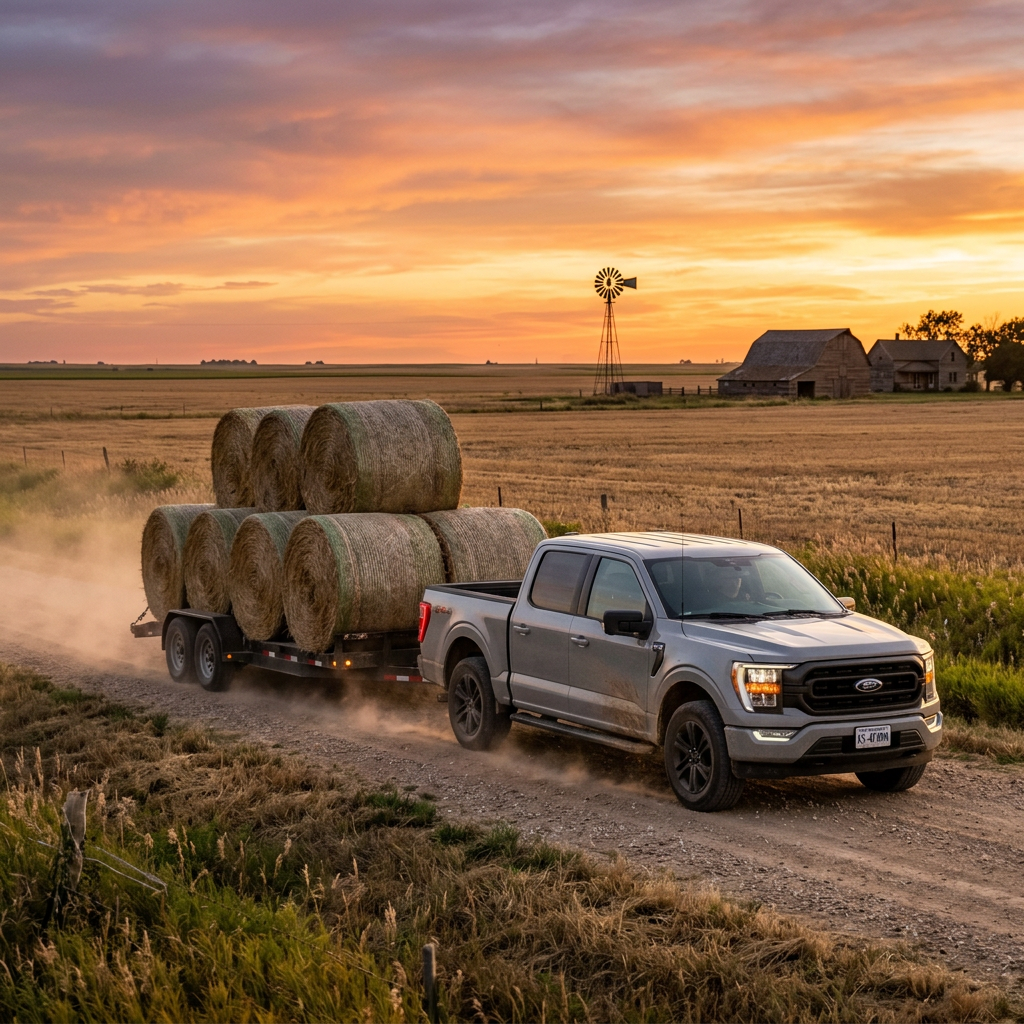
Silver pickup truck towing a trailer of large round hay bales on a dirt road at sunset. (Representative image for illustration purposes only. Actual vehicle may vary based on trim and configuration.)

Smart Strategies for Getting the Most Out of a Ford F-150 Sale

To truly maximize your savings and experience when shopping a fords f150 sale, it helps to approach the buying process with a few smart, proven strategies. First, pay close attention to the timing of your purchase. Major holiday weekends—such as Memorial Day, the Fourth of July, and Labor Day—frequently coincide with manufacturer incentives and financing options that may be available to qualified buyers. Additionally, the end of the calendar year is a phenomenal time to buy, as dealerships work hard to clear out the current model year inventory to make room for incoming models, often resulting in some of the some of the most competitive pricing opportunities of the entire year.

Another highly effective strategy is to maximize the value of your trade-in vehicle. Car values remain highly competitive, and trading in your current car, truck, or SUV can act as a massive down payment on your new F-150. To make this process as easy and transparent as possible, we invite you to use our online Trade In Evaluation tool. By entering a few basic details about your vehicle’s condition and history, you can receive a highly accurate, market-reflective estimate of its value, giving you clear leverage when finalizing your purchase.

Once you have secured your truck, protecting and personalizing your investment is the next logical step. Outfitting your F-150 with high-quality, genuine accessories—such as a custom-fit tonneau bed cover, heavy-duty drop-in or spray-in bed liners, or rugged all-weather floor mats—will help preserve its condition and boost its eventual trade-in value. You can easily find and Order Genuine Ford Parts directly through our specialized department, ensuring that every accessory you install fits your specific model with absolute engineering perfection.

Finally, the absolute best way to ensure your F-150 delivers decades of reliable service is to stick to a strict, professional maintenance schedule. Our state-of-the-art service center is staffed by factory-trained technicians who know your truck’s mechanical and electrical systems inside and out. To make maintaining your vehicle completely hassle-free, you can easily Schedule Ford Service Today online, or take advantage of our highly convenient Schedule Pickup and Delivery Service, where we handle everything while you focus on your busy day.

Ready to Find Your Next Truck? Explore the Fords F-150 Sale at Valor Ford Today

There has never been a better time to experience the unmatched power, luxury, and capability of the legendary Ford F-150. At Valor Ford, we are dedicated to providing our neighbors in Junction City, Fort Riley, and Dickinson County with a straightforward, transparent, and completely enjoyable truck-buying experience. Whether you want to test drive a rugged XLT, feel the raw efficiency of the PowerBoost Hybrid, or custom build your dream configuration, our friendly team is here to support you every single step of the way. To get started, Get Directions to Valor Ford and visit our beautiful showroom at 1825 Goldenbelt Blvd, or simply Call us at (785) 238-5114 to speak with a dedicated truck expert today. Let’s get you behind the wheel of America’s favorite truck!

Finding Your Next Ford in Junction City: A Complete Guide to Local Driving, Towing, and Ownership

Welcome to our comprehensive local automotive resource, designed specifically for the hardworking community of Junction City, Kansas, our neighbors stationed at Fort Riley, and the families running agricultural operations throughout Dickinson County. Navigating the unique landscape of the Sunflower State requires a vehicle that is as resilient, versatile, and dependable as the people who drive them. Whether you are daily commuting down the heavily traveled corridors of Interstate 70, pulling heavy equipment across rural farmsteads, or coordinating a major military relocation, finding the perfect automotive partner is essential to keeping your life in motion. Our local Kansas environment presents distinct challenges and opportunities. From our sweltering, humid summer months to the icy, unpredictable winter storms that sweep across the Great Plains, your vehicle is more than just a convenience—it is a critical tool for survival, productivity, and recreation. That is why so many of our neighbors trust the legendary durability and innovation of the Ford lineup. As your trusted local resource, we want to help you make an informed decision, ensuring you select a model that perfectly matches your lifestyle, budget, and performance needs.
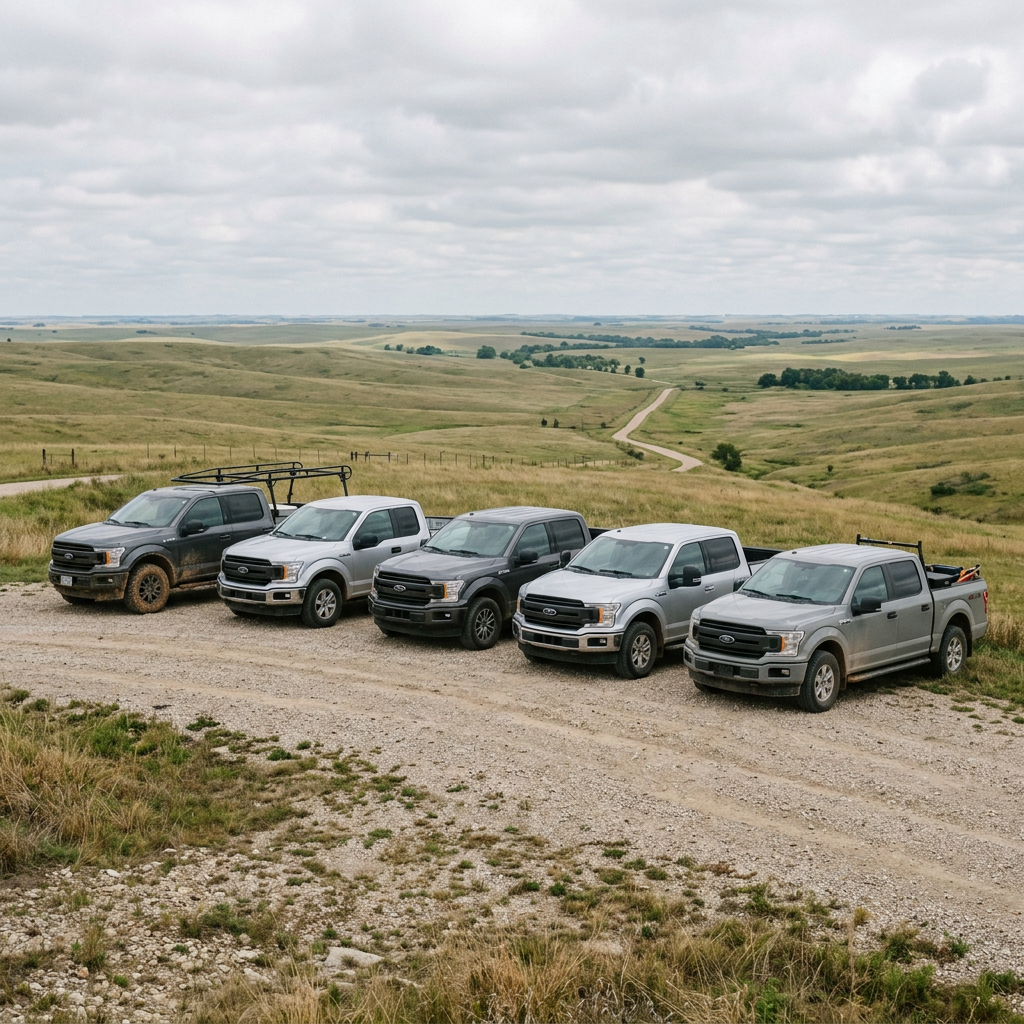
Five Ford F-150 pickup trucks parked in a row on a gravel road overlooking rolling hills. (Representative image for illustration purposes only. Actual vehicle may vary based on trim and configuration.)

Throughout this detailed ownership guide, we will dive deep into the specific questions that local drivers ask most. We will analyze the real-world capabilities of flagship models like the iconic Ford F-150, explore the differences between competing technology suites, unpack the details of vehicle financing, and lay out transparent expectations regarding ownership costs and dealer fees in Kansas. Our goal is to provide an educational, clear, and highly practical guide that empowers you to shop, finance, and service with total confidence. At Valor Ford, we believe in building lifelong relationships with our community. We do not just sell cars; we live here, work here, and support the families who make Junction City such an incredible place to call home. Read on to discover how to maximize your driving experience, find answers to your most pressing vehicle questions, and learn how to get the absolute most value out of your next vehicle investment.

Getting in Touch: What is the Phone Number for the Ford Dealership in Junction City, KS?

When you need direct, reliable assistance, having the correct point of contact is essential. For anyone searching for the premier Ford dealership in the area, you can easily reach our team. Our primary contact number is Call us at (785) 238-5114. We pride ourselves on answering your inquiries promptly, bypassing automated runarounds to connect you with real, knowledgeable local specialists who can help with your specific automotive needs. Whether you are looking to confirm vehicle availability, schedule a critical maintenance appointment, or inquire about genuine OEM parts, our departments are structured to streamline your experience. You can also easily find us in person by using our simple mapping link: Get Directions to Valor Ford.

Why Call Valor Ford? Our dedicated teams are organized to assist you across three primary areas: • Sales Team: Inquire about our latest new and pre-owned inventory, discuss special seasonal incentives, or set up a test drive. • Service Center: Speak with a certified Ford technician about diagnostics, scheduled maintenance, or recall updates. • Parts Department: Source certified Motorcraft parts and accessories tailored directly to your specific model. Stop by and visit our physical showroom located at 1825 Goldenbelt Blvd, Junction City, KS 66441 to experience our straightforward, community-first approach to customer service.

How Much Can a Ford F-150 Tow for Typical Use Around Junction City and Fort Riley?
For truck owners in Geary and Dickinson counties, towing capacity is not just a spec on a brochure—it is a regular weekend requirement. If you are planning to haul a pontoon boat or jet skis up to Milford Lake for a weekend of summer relaxation, tow a horse trailer across rural Kansas trails, or help a fellow military family move their household goods during a permanent change of station (PCS) at Fort Riley, understanding your truck’s capacity is vital for safety and efficiency. When properly equipped, the modern Ford F-150 delivers exceptional towing capabilities that lead its class. Depending on the engine configuration you select—ranging from the highly efficient 3.5L EcoBoost V6 to the legendary 5.0L Coyote V8 or the innovative PowerBoost Hybrid—the F-150 can achieve a maximum towing capacity of up to 13,500 pounds. For typical daily tasks and local recreation, this means you will have more than enough power to haul heavy trailers, campers, and equipment with total confidence.

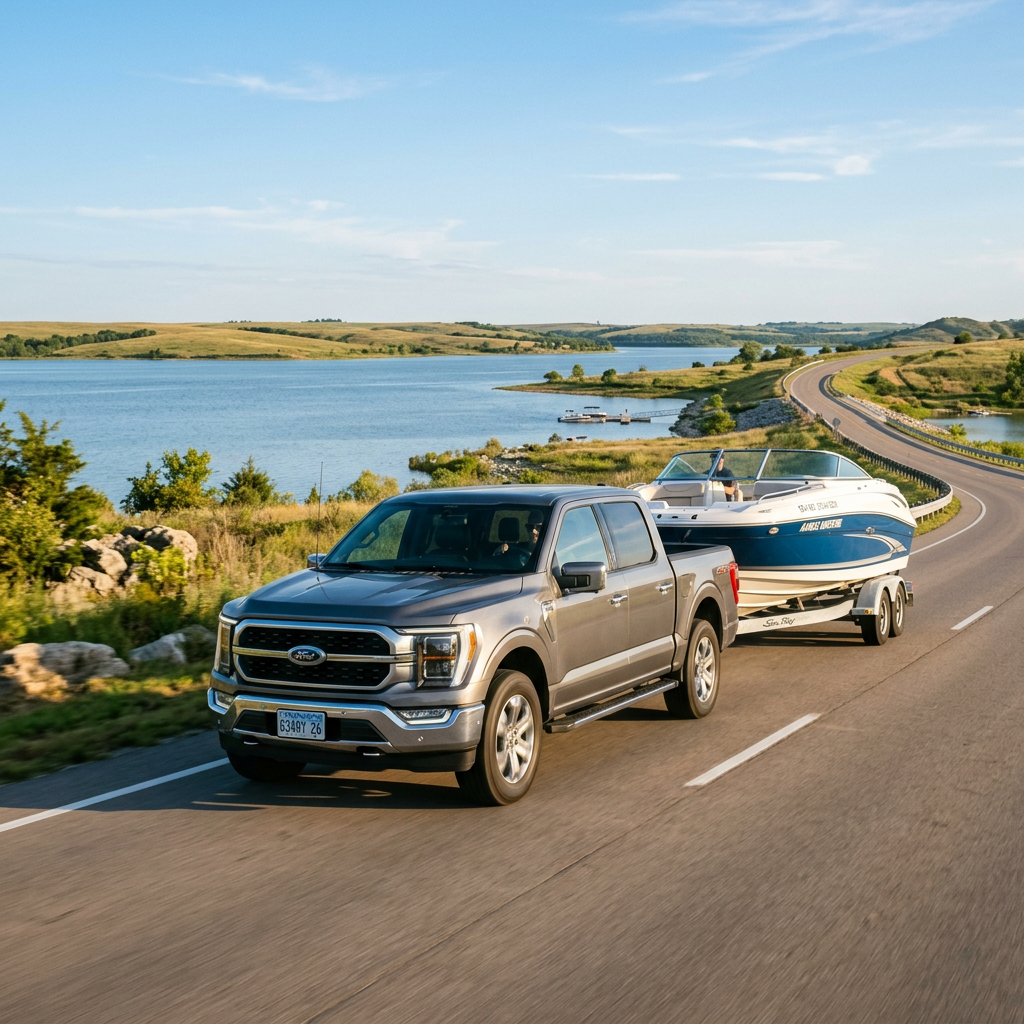
Grey Ford pickup truck towing a blue and white boat on a winding road next to a scenic lake. (Representative image for illustration purposes only. Actual vehicle may vary based on trim and configuration.)

To give you a better idea of how these towing configurations translate to real-world utility, let’s look at typical towing needs for Junction City drivers: • Recreational Watercraft: A typical boat and trailer setup for Milford Lake averages between 3,500 and 5,500 pounds. Any F-150 engine configuration can handle this with ease. • Travel Trailers & Campers: Standard medium-sized campers weigh between 5,000 and 8,000 pounds. An F-150 equipped with the 3.5L EcoBoost or 5.0L V8 and the Max Trailer Tow Package handles this without breaking a sweat. • Utility & Livestock Trailers: Flatbed utility trailers loaded with agricultural equipment or small livestock trailers typically range from 6,000 to 10,000 pounds, falling comfortably within the F-150’s capabilities. To explore these capabilities in deeper detail and find the exact configuration that fits your towing demands, you can Research Ford F-150 specifications directly through our research portal.

What is the Payload Capacity of the 2026 Ford F-150 for Heavy-Duty Local Projects?

While towing refers to the weight a truck can pull behind it, payload capacity measures the total weight the truck can carry inside its cabin and cargo bed. Understanding payload is absolutely critical for local landscaping projects, construction work around Fort Riley, and agricultural hauling in Dickinson County. Overloading a truck’s bed can strain the suspension, compromise braking distance, and cause premature wear on key drivetrain components. For the 2026 model year, the Ford F-150 continues to set the benchmark for light-duty trucks, offering a maximum payload capacity of up to 2,445 pounds when properly equipped with the heavy-duty payload package. This allows you to haul substantial cargo without needing to step up to a heavy-duty three-quarter-ton truck.

Agricultural Hauling Need to move feed bags, seed, or fencing supplies across your property? A payload capacity of over 2,000 pounds means you can easily carry a full pallet of supplies in the bed of your F-150, saving you multiple trips to the local farm supply store.

Home Improvement If you are tackling a backyard renovation or building a deck, the F-150 can safely transport loads of gravel, soil, concrete mixes, or pressure-treated lumber. Always distribute the weight evenly across the bed for optimal handling.

Military Moves When preparing for a PCS move, the payload capacity allows you to load up heavy toolboxes, household appliances, and secure storage containers directly into the bed, making the transition smoother and more efficient.

Engine Configuration

Max Towing (lbs)

Max Payload (lbs)

2.7L EcoBoost V6

8,400

1,785

5.0L Coyote V8

13,000

2,230

3.5L EcoBoost V6

13,500

2,445

Which Truck Has a More User-Friendly Infotainment System: F-150 or Silverado?
In the modern truck landscape, technology inside the cabin is just as important as mechanical performance. When comparing the Ford F-150 to the Chevrolet Silverado, one of the most frequent points of comparison is the user friendliness of their respective infotainment systems. Ford’s SYNC 4 system, paired with the large, high-resolution screens in the F-150, consistently ranks as a favorite among drivers who value intuitive, distraction-free operation on long Kansas highway drives. While the Silverado offers a capable system, Ford’s SYNC 4 provides fast processing speeds, crisp graphics, and intuitive menu structures. It features standard wireless Apple CarPlay and Android Auto, allowing you to connect your smartphone effortlessly without messy cords cluttering the center console. Furthermore, Ford’s system supports over-the-air software updates, meaning your vehicle’s technology continuously improves and stays current without requiring a trip to the dealership.

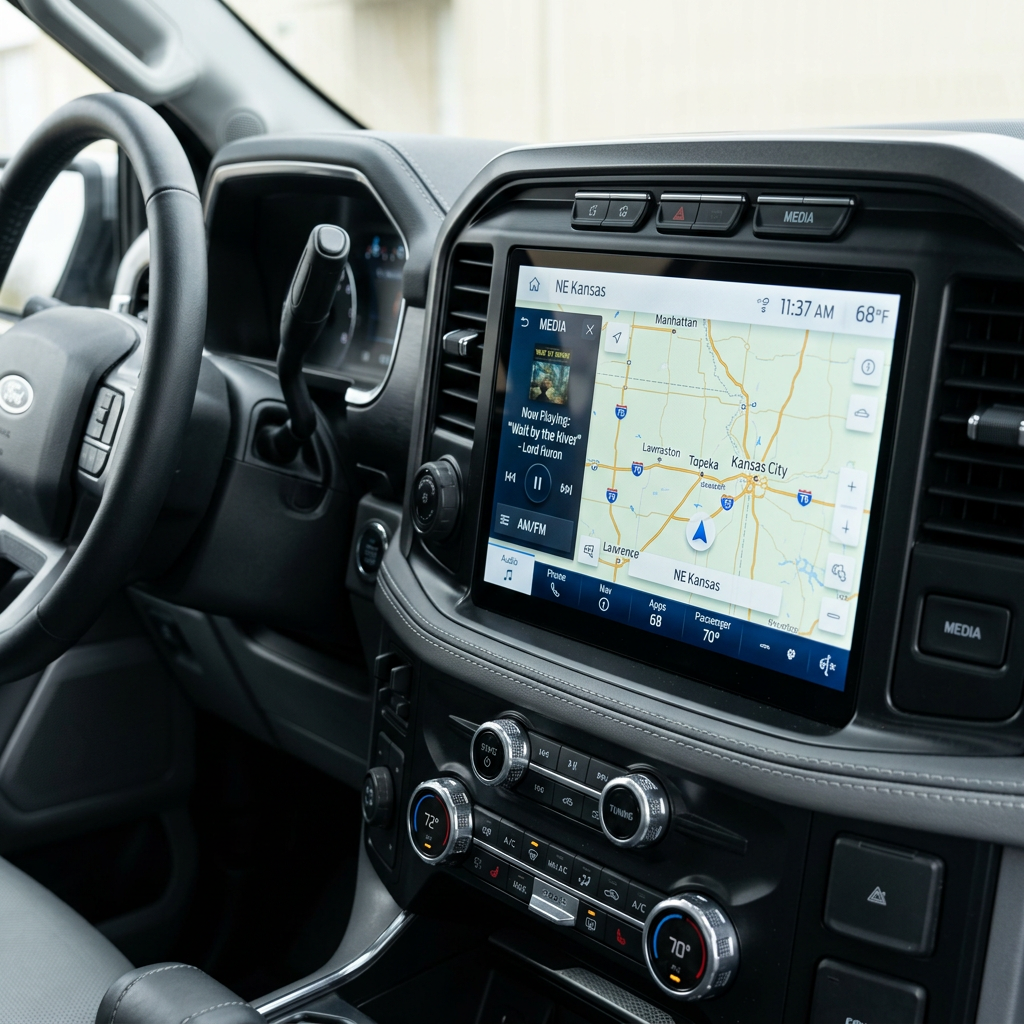
Ford F-150 dashboard featuring a large touchscreen displaying a navigation map of Northeast Kansas. (Representative image for illustration purposes only. Actual vehicle may vary based on trim and configuration.)

Another major advantage of the F-150’s system is the integration of physical controls. Unlike some competitors that force you to navigate through complex touch menus to adjust simple climate control or audio settings, Ford maintains physical knobs and buttons for primary functions. This ensures that you can adjust the cabin temperature or volume easily while keeping your eyes securely on the road ahead. If you are interested in exploring how Ford’s technology stacks up against the competition in person, you can Browse Used Inventory to compare various model years and trim levels of both trucks side by side on our lot.

Should I Get Pre-Approved for Financing Before Shopping for a Ford in Junction City?

Ask any financial expert or seasoned car buyer, and they will tell you that securing pre-approved financing is one of the smartest moves you can make before setting foot in a dealership. Getting pre-approved completely transforms your car-buying experience from a position of uncertainty to one of strength, clarity, and control. When you walk in with a pre-approval in hand, you are essentially shopping as a cash buyer, which simplifies the negotiation process and allows you to focus purely on finding the perfect vehicle. First and foremost, pre-approval helps you establish a realistic, rock-solid budget. Instead of wondering what price point you can afford, you will know exactly what loan amount, interest rate, and financing options available to you. This prevents you from falling in love with a vehicle that is outside your comfortable budget range and protects you from potential financial strain down the road. Furthermore, it saves you valuable time at the dealership. Because your credit and financial background have already been verified, the final paperwork process is streamlined, getting you behind the wheel of your new ride much faster. To make this process as convenient as possible, we offer an easy, secure online portal where you can get started from the comfort of your own home. Simply submit your information through our secure portal to Get Pre-Approved for Financing when you’re ready. Our dedicated finance team works with a wide network of local and national lenders, including special programs tailored specifically for our active-duty military personnel stationed at Fort Riley.

What Dealer Fees Should I Expect When Buying a Ford in Junction City, KS?

Transparency is the foundation of a great vehicle purchase. When budgeting for your next Ford, it is important to understand the typical fees and taxes associated with buying a vehicle in Kansas so there are no surprises when you sign the final paperwork. At Valor Ford, we believe in straightforward pricing and want to ensure you have a complete picture of your total investment. Here is a clear breakdown of what you should expect: • Documentation Fee (Doc Fee): This standard fee covers the administrative costs of preparing and processing your vehicle’s purchase agreements, title transfers, and financial paperwork. In Kansas, doc fees are determined by individual dealerships but generally range between $200 and $500. • State and Local Sales Tax: Sales tax is calculated based on where you register the vehicle, not where you buy it. For residents of Junction City and Geary County, the tax rate will combine state, county, and city sales taxes. If you are registering in a different county, like Dickinson or Riley, your local rates will apply. • Title and Registration Fees: These are state-mandated fees paid to the county treasurer to secure your license plates, vehicle registration, and state title. These fees vary depending on the vehicle’s weight and class. By understanding these costs upfront, you can build an accurate budget and feel confident throughout your purchasing journey. Our sales professionals are always happy to provide a complete, itemized breakdown of all costs associated with any vehicle you are interested in.

What Are the Typical Ownership and Maintenance Costs for a Ford in Junction City, KS?
Routine Maintenance Keeping up with scheduled oil changes, tire rotations, and brake inspections is the single best way to protect your investment. Ford vehicles are engineered for long-term durability, and following the recommended maintenance schedule keeps routine costs low and predictable.

Kansas Weather Impact Our extreme temperature swings—from freezing winters to humid summers—put extra stress on your battery, belts, and tires. Regular seasonal inspections help identify wear before it leads to costly repairs, ensuring your vehicle is always ready for the road.

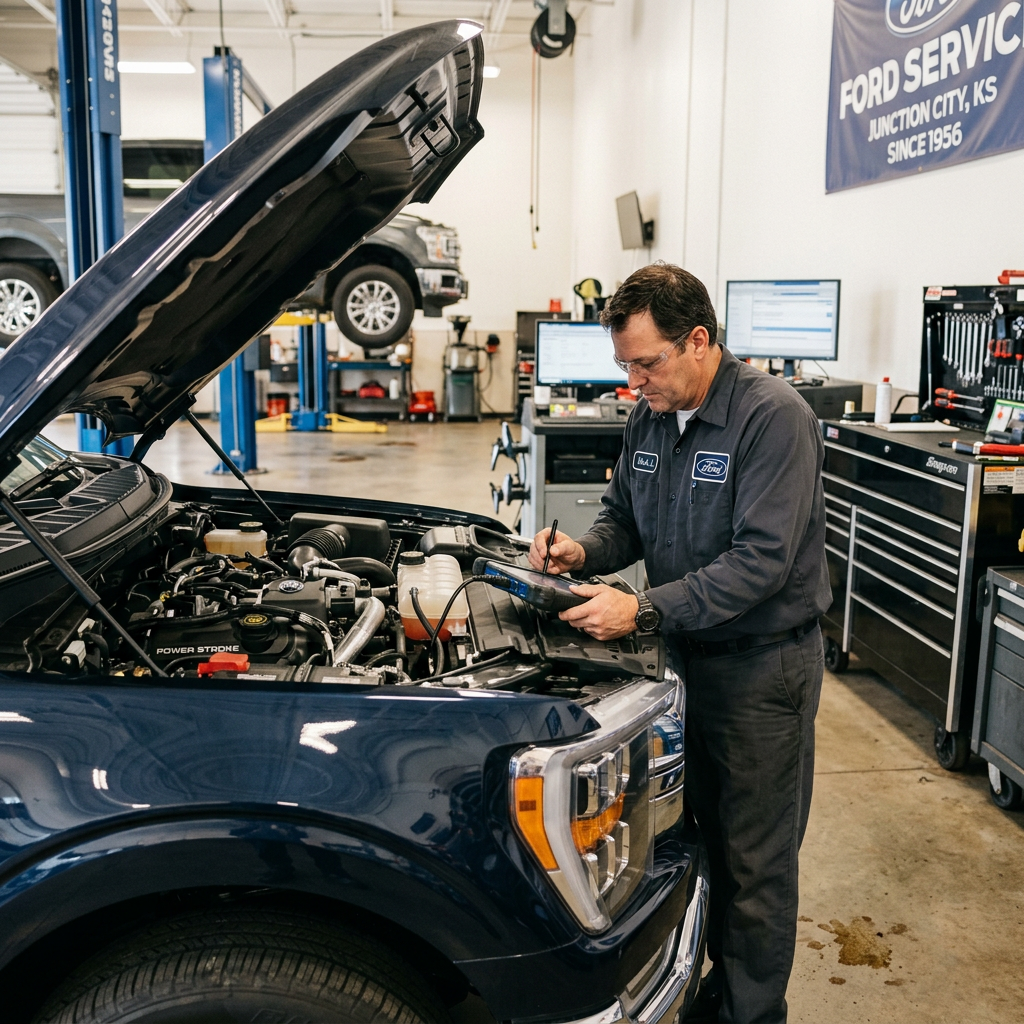
A Ford auto technician diagnostics tablet to service a blue Ford truck with its hood open in a dealership garage. (Representative image for illustration purposes only. Actual vehicle may vary based on trim and configuration.)

When repairs or replacements are necessary, using genuine parts is essential to maintaining your vehicle’s performance and safety standards. If you need replacement filters, spark plugs, or brake pads, you can easily Order Genuine Ford Parts directly from our specialized parts department. To make keeping up with your vehicle’s service as easy as possible, we offer convenient scheduling options. You can easily book an appointment online to Schedule Ford Service Today, or take advantage of our specialized convenience programs by opting to Schedule Pickup and Delivery Service. We will pick up your vehicle from your home or work, complete the required maintenance, and return it directly to you, saving you valuable time.

Matching Your Ford to the Kansas Landscape: From Flint Hills Trails to Dickinson County Farms

The geological and economic diversity of north-central Kansas means there is no single “perfect” vehicle for everyone. Different lifestyles demand different tools. For example, if you are a military family stationed at Fort Riley, you might prioritize a versatile, fuel-efficient, and spacious SUV that is perfect for daily commutes, school drop-offs, and road trips back home to visit family. For this, models like the versatile Research Ford Explorer or the compact Ford Escape offer the ideal balance of passenger comfort, safety technology, and cargo space. Conversely, if your life is centered around the agricultural heartlands of Dickinson County, your needs are driven by capability, raw power, and structural durability. For heavy-duty farming operations, hauling large round bales, or pulling commercial trailers, stepping up to a heavy-duty truck is often the right move. You can Research Ford F-250 and Super Duty options to find a truck built specifically for demanding commercial and agricultural labor.

For those who hear the call of the great outdoors, north-central Kansas offers incredible opportunities for exploration. From navigating the rugged trails of the Flint Hills to exploring the scenic pathways around the Kansas River and Milford Lake, you need a vehicle designed for adventure. If off-road capability is your priority, you can Shop New Ford Bronco Inventory to find a vehicle built to conquer tough terrain with ease. For drivers looking for a highly versatile option that blends urban utility with weekend adventure capability, you might also want to Research Ford Maverick configurations. This compact, clever pickup has become a local favorite for its exceptional fuel efficiency and highly adaptable truck bed.

How to Maximize Your Trade-In Value Before Upgrading Your Ride

When you are ready to upgrade your daily drive, maximizing the value of your current vehicle is one of the most effective ways to lower your overall investment. Your trade-in acts as a direct down payment toward your next purchase, helping to reduce the principal loan amount, and potentially improve your overall purchase terms. To get the absolute most value for your current vehicle, we recommend taking a few simple steps before bringing it to the dealership: • Detail and Clean: First impressions matter. Spending a little time thoroughly washing the exterior, vacuuming the cabin, and wiping down surfaces can make a significant difference in how your vehicle is valued. • Gather Maintenance Records: Having a documented history of regular oil changes, tire rotations, and general maintenance shows that the vehicle was well cared for, which increases its market value. • Address Simple Fixes: Replacing a burnt-out headlight bulb, topping off fluids, or fixing small chips can prevent minor deductions during the appraisal process. To get an immediate, transparent estimate of what your current vehicle is worth based on real-time market data in the Junction City area, use our convenient online tool for a quick Trade In Evaluation today.

Visit Valor Ford in Junction City, KS to Find Your Next Vehicle Today

Finding the perfect vehicle is a journey, and we are honored to be your trusted partner along the way. At Valor Ford, we pride ourselves on offering a transparent, stress-free dealership experience that puts your needs first. From exploring our extensive inventory of new and pre-owned Ford vehicles to securing financing options and providing certified long-term maintenance, our dedicated local team is here to support you at every stage of ownership. We invite you to visit our beautiful showroom, meet our friendly staff, and experience the difference of working with a dealership that truly cares about its community. Whether you are ready to test drive a rugged new truck, explore our highly capable SUV lineup, or simply want to speak with an expert about your automotive options, we look forward to welcoming you.
Logo for Valor Automotive featuring a silver shield with red 'V' and white 'A' monogram inside, over a blue background.

Late Summer Overland and Camping Prep: Getting Your Ford Bronco Sport Ready for Kansas Trails
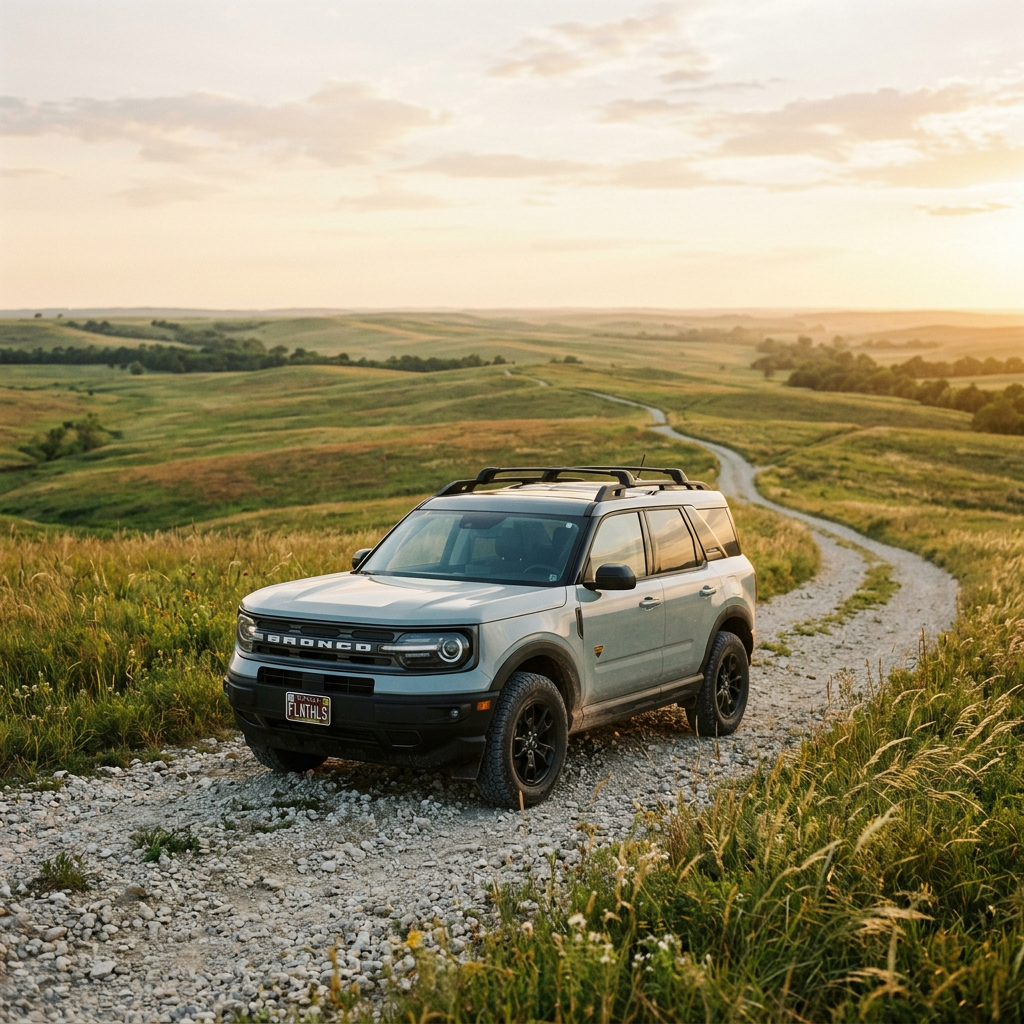
A silver Ford Bronco Sport parked on a gravel trail winding through rolling green hills at sunset. (Representative image for illustration purposes only. Actual vehicle may vary based on trim and configuration.)

As the blistering heat of mid-summer begins its gradual transition into the golden, breezy days of late August and early September, the outdoor enthusiasts of Kansas feel an undeniable pull toward the wilderness. There is a sweet spot in the Kansas calendar—a window where the humidity breaks, the evening air turns refreshingly crisp, and the tallgrass prairie of the Flint Hills glows with a rich, amber hue. It is the ultimate time of year for overlanding, self-sustained camping, and trail exploration. However, venturing into the remote paths surrounding Junction City, Dickinson County, and the vast public lands near Fort Riley requires more than just a sleeping bag and a cooler. It demands a vehicle engineered to handle the unpredictable terrain, and more importantly, it requires proper preparation. Enter the Ford Bronco Sport. Far more than a stylish urban commuter, this compact SUV carries the legendary heritage of the Bronco brand, engineered specifically to bridge the gap between daily driveability and rugged, remote exploration. With its standard four-wheel-drive capability, intelligent terrain systems, and an architectural design that maximizes cargo and roof utility, the Bronco Sport is uniquely suited for navigating the limestone-strewn trails and dusty backroads of our home state. But before you load up and point your compass toward your next campsite, taking the time to thoroughly inspect, outfit, and prepare your vehicle is the difference between an unforgettable adventure and an frustrating weekend stranded on a dusty trail. In this comprehensive guide, we will dive deep into everything you need to know to get your Ford Bronco Sport fully prepared for late-summer Kansas overlanding. From analyzing its real-world off-road capabilities and understanding its critical mechanical specifications to performing vital pre-trip maintenance and choosing the right emergency gear, we have compiled the ultimate checklist. Whether you are planning a weekend escape to Milford State Park, a technical challenge at Tuttle Creek, or a multi-day journey along the unpaved grid of the historic Flint Hills, Valor Ford is here to ensure your vehicle is as ready for the adventure as you are. Let’s get your Bronco Sport trail-ready and gear up for the open road.

How Capable Is the 2024 Ford Bronco Sport on Kansas Trails?

To truly appreciate what the Ford Bronco Sport can do, you have to look past the pavement. The Kansas landscape is deceptively challenging. The Flint Hills region, for instance, is built on layers of dense limestone and highly abrasive chert. These sharp, loose rocks will quickly punish vehicles that lack proper suspension tuning and traction management. Fortunately, the 2024 Ford Bronco Sport is engineered from the ground up to conquer these exact conditions. At the heart of its off-road prowess is the High-Performance Off-Road Stability Suspension (HOSS) system. This specialized architecture features uniquely tuned front struts and hydraulic rebound stops that absorb the violent, high-speed impacts of washboard gravel roads, ensuring your tires stay in contact with the ground and your cabin remains stable and comfortable. Furthermore, the Bronco Sport features Ford’s highly acclaimed Terrain Management System with G.O.A.T. (Goes Over Any Type of Terrain) Modes. With the turn of a simple dial, you can reconfigure the vehicle’s throttle response, transmission shift points, traction control, and steering feel. When navigating the dusty, loose-gravel trails around Fort Riley and Junction City, switching to ‘Sand’ or ‘Slippery’ mode optimizes power delivery to prevent wheel spin. For those driving the top-tier Badlands trim, the addition of ‘Mud/Ruts’ and ‘Rock Crawl’ modes provides highly specialized torque management, utilizing a twin-clutch rear drive unit that can send virtually all rear-axle torque to a single wheel with traction.

Another significant advantage of the Bronco Sport on local Kansas trails is its compact footprint. While full-size overland rigs often struggle with tight, overgrown trails, low-hanging branches, and narrow farm-gate entries, the Bronco Sport maneuvers with absolute agility. Its short front and rear overhangs provide impressive approach and departure angles, allowing you to climb over steep creek banks and dry washouts without scraping your bumpers. This maneuverability is especially valuable when exploring the public trail systems and unmaintained township roads of Dickinson County, where trails can narrow dramatically without warning. Ultimately, the capability of the Bronco Sport lies in its balance. It offers the confidence of a true off-roader without sacrificing the civilized ride quality needed to drive comfortably from Junction City down to the trailheads. It doesn’t force you to choose between a bone-jarring daily commute and a capable trail machine; instead, it delivers both. By understanding how to utilize its advanced 4×4 systems and suspension design, you can confidently push deeper into the Kansas backcountry, reaching the secluded campsites and scenic vistas that ordinary crossovers simply cannot access.

What Are the Key Specs of the 2024 Ford Bronco Sport for Overlanding and Camping?

When planning an overlanding trip, understanding your vehicle’s physical limits and dimensions is crucial for both safety and packing efficiency. Overlanding requires carrying your shelter, water, food, and recovery gear with you. Overloading a vehicle or packing it incorrectly can lead to poor handling, increased fuel consumption, or mechanical strain. Below, we break down the vital specifications of the 2024 Ford Bronco Sport that make it a premier choice for self-sustained camping.
Dimensions & Payload
The Bronco Sport features a highly maneuverable 105.1-inch wheelbase and a total length of 172.7 inches. With a payload capacity ranging between 1,000 and 1,170 lbs (depending on the trim and options), it easily accommodates two passengers, a full load of camping gear, water, and auxiliary equipment without exceeding mechanical safety limits.

Safari-Style Roof Capacity
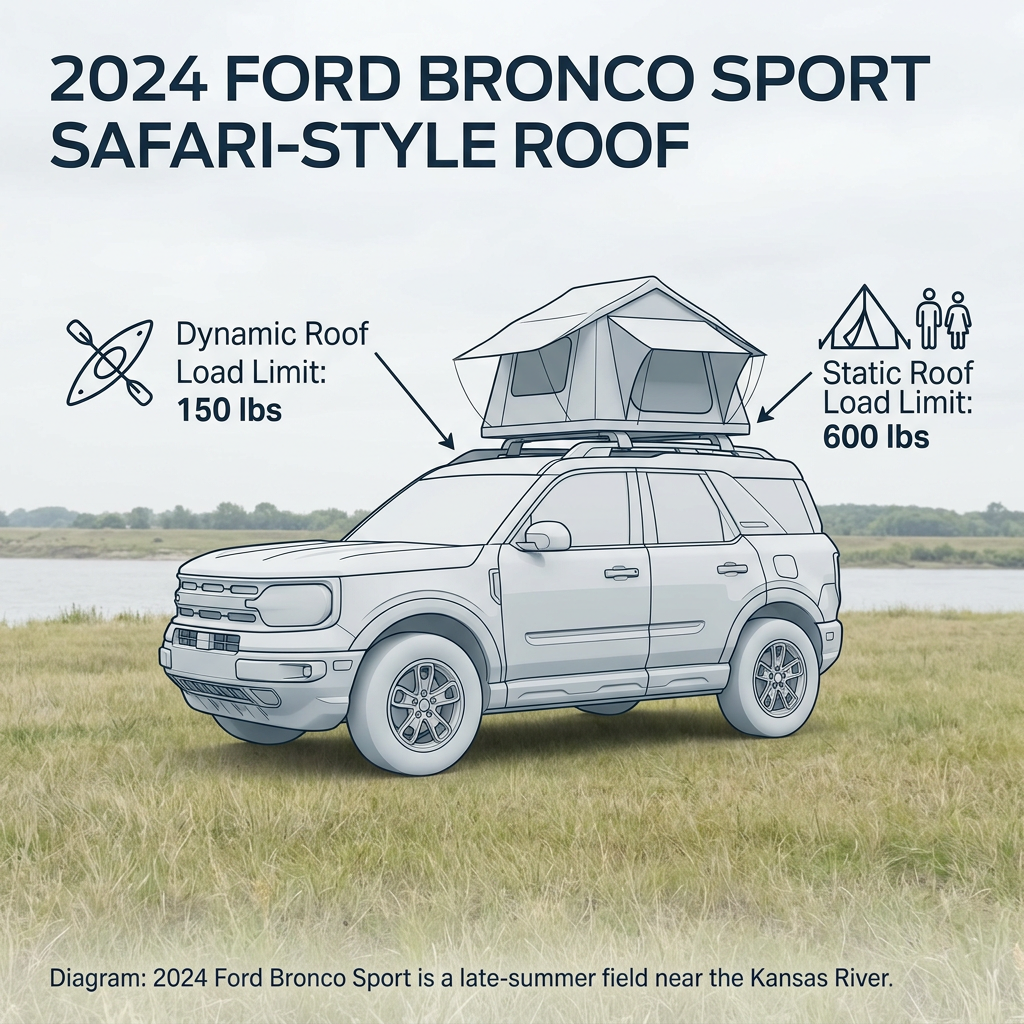
The iconic safari-style roof isn’t just for interior headroom; it increases structural roof strength. On models equipped with the standard steel roof, the dynamic roof load limit (while driving) is up to 150 lbs, which is perfect for gear baskets or kayaks. The static roof load limit (parked) jumps up to 600 lbs, easily supporting a heavy-duty rooftop tent and two adults.

Cargo Space & Utility
Behind the front seats, the Bronco Sport offers up to 65 cubic feet of cargo volume (61 cubic feet on Badlands). The cargo area features a flat load floor, built-in cargo tie-down loops, and an available cargo management system that doubles as a camp table, making organization effortless during multi-day trail stays.

Diagram showing the dynamic and static roof load limits of a 2024 Ford Bronco Sport with safari-style roof. (Representative image for illustration purposes only. Actual vehicle may vary based on trim and configuration.)

Specification

Big Bend

Outer Banks

Badlands

Engine Option

1.5L EcoBoost I3

1.5L EcoBoost I3

2.0L EcoBoost I4

Horsepower / Torque

181 hp / 190 lb-ft

181 hp / 190 lb-ft

250 hp / 277 lb-ft

Ground Clearance

7.8 inches

7.8 inches

8.8 inches (with off-road tires)

Max Towing Capacity

2,000 lbs

2,000 lbs

2,200 lbs

Water Fording Depth

17.7 inches

17.7 inches

23.6 inches

Which 2024 Bronco Sport Trim Is Best for Serious Off-Road Prep?

While every 2024 Ford Bronco Sport comes standard with 4×4 capability, choosing the right trim depends entirely on how deep into the wild you plan to go. For casual campers who primarily stick to well-maintained gravel state park roads and established campgrounds, the Big Bend and Outer Banks trims offer a fantastic blend of daily fuel efficiency, comfort, and baseline capability. Powered by the peppy 1.5L EcoBoost engine, these trims handle dirt roads, muddy entries, and rain-slicked paths with absolute poise. However, if your dream of overlanding involves conquering rugged, unmaintained trails, climbing rocky ledges, and traversing deep washouts in the Flint Hills, one trim stands head and shoulders above the rest: the Bronco Sport Badlands. The Badlands trim is the ultimate manifestation of the Bronco Sport’s off-road DNA. It replaces the 1.5L engine with a muscular 2.0L EcoBoost four-cylinder, churning out a robust 250 horsepower and 277 lb-ft of torque. This extra muscle is critical when climbing steep, loose inclines or crawling through deep mud. More importantly, the Badlands features an advanced 4×4 system with a twin-clutch rear drive unit. Unlike traditional systems, this setup can mimic a mechanical locking differential, sending power laterally to whichever rear wheel has the most grip. Combined with unique metal bash plates to protect vital engine components, off-road-tuned suspension, and standard all-terrain tires, the Badlands is built to take a beating on the trail.

In addition to mechanical upgrades, the Badlands trim adds two highly specialized G.O.A.T. modes: Mud/Ruts and Rock Crawl. These modes recalibrate the traction control and torque vectoring to deal with low-traction, high-torque situations, giving you the slow-speed control needed to climb over slippery limestone ledges. It also boasts an extra inch of ground clearance (bringing the total to 8.8 inches) and unique front-facing trail cameras that allow you to see exactly where your tires are tracking when climbing blind crests. Prepping a Badlands edition means you are starting with a vehicle that already has the foundation of a serious trail rig. You don’t need to spend thousands of dollars on aftermarket lift kits or skid plates; it’s all engineered, tested, and backed by Ford right out of the box. For those who want to buy with the peace of mind that their vehicle can handle anything Dickinson County throws at it, the Badlands is the gold standard of the lineup. Explore our latest options and Shop New Ford Bronco Inventory to find the perfect trim for your upcoming expeditions.

What Are the Practical Differences Between the Bronco Sport and the Bronco?
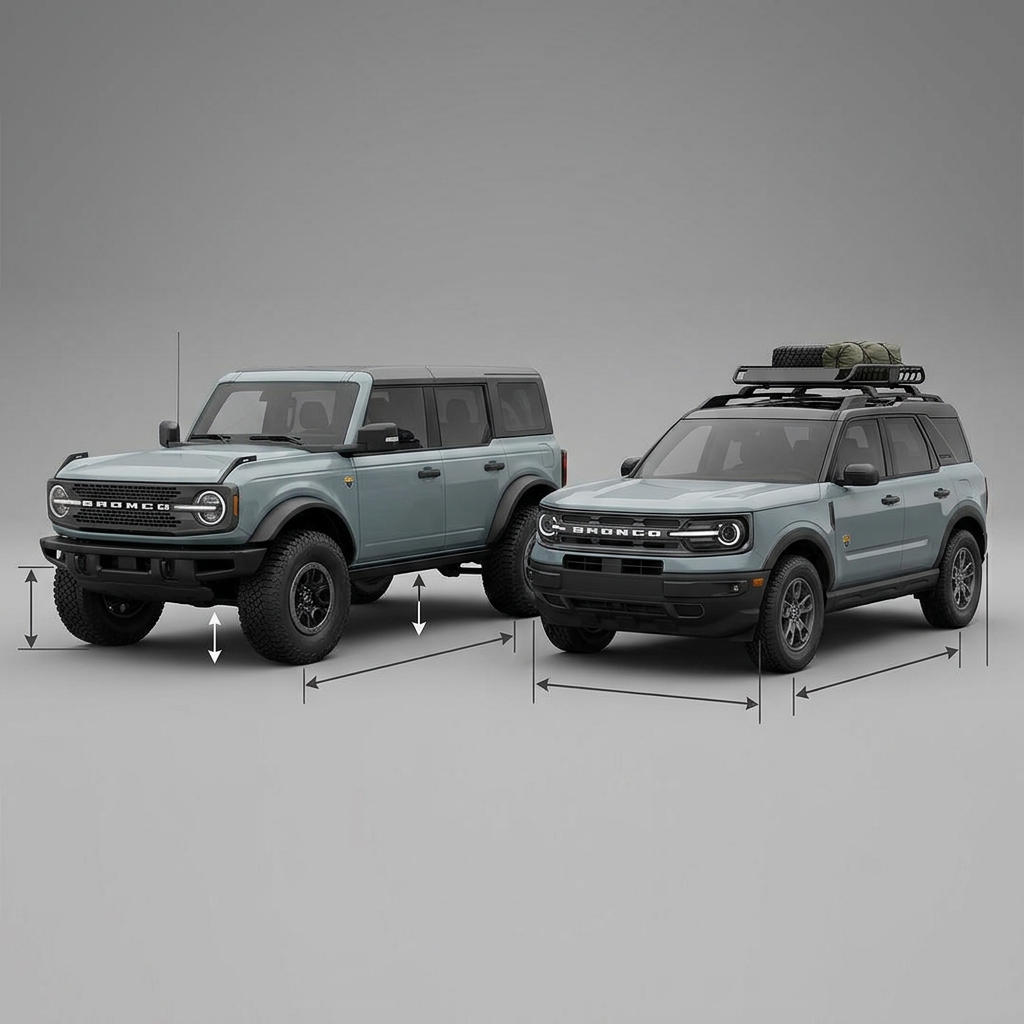
A common point of confusion for buyers exploring the Ford lineup is the distinction between the Bronco Sport and the larger, traditional Bronco. While they share a legendary nameplate and a rugged design aesthetic, they are built on entirely different platforms and serve different purposes. Understanding these differences is key to choosing the vehicle that fits your overlanding style and daily lifestyle. The Bronco Sport is built using a unibody construction (similar to the Ford Escape and Maverick). This design integrates the body and frame into a single, cohesive structure, which provides several massive advantages for the everyday driver. Unibody vehicles are inherently lighter, more fuel-efficient, and offer car-like ride comfort and handling. On the highway, the Bronco Sport is quiet, refined, and highly efficient, making it a joy to drive on your daily commute from Junction City. When you transition to the trails, its independent front and rear suspension provides a compliant, controlled ride over washboard gravel and uneven terrain. It is the perfect blend of modern comfort and active lifestyle capability.

In contrast, the full-size Bronco is a body-on-frame truck-based SUV. It is larger, heavier, and built for extreme, high-clearance off-roading, rock crawling, and open-air desert running. It features removable doors and roof panels, solid rear axles, and massive tire options. While it is an absolute beast on extreme rock crawls, it lacks the daily-driver fuel economy and refined highway manners of the Bronco Sport. It is also wider and taller, which can make navigating narrow trails or parking in tight garage spaces more challenging. For the vast majority of camping and overlanding enthusiasts in Kansas, the Bronco Sport is actually the more practical and comfortable tool for the job. It easily carries rooftop tents, holds a weekend’s worth of gear, handles muddy and rocky trails with ease, and does so while saving you money at the fuel pump. It represents the perfect middle ground: highly capable when you want to play, yet quiet, comfortable, and efficient when you need to get to work.

A Ford Bronco and a Ford Bronco Sport shown side-by-side with dimension arrows indicating size differences. (Representative image for illustration purposes only. Actual vehicle may vary based on trim and configuration.)

Essential Late-Summer Maintenance Before Taking Your Bronco Sport Camping in Kansas

A successful overlanding trip starts long before you reach the trailhead. Late summer in Kansas is notoriously harsh on vehicles. The combination of sustained high temperatures, high humidity, and extremely dusty farming roads puts extra strain on your engine, cooling systems, and filters. To ensure your Bronco Sport runs flawlessly under pressure, completing a pre-trip maintenance checklist is highly recommended.

Filters & Cooling Systems
Late-summer gravel roads kick up an incredible amount of fine, powdery dust. Inspect your engine air filter; a clogged filter chokes performance and drops fuel efficiency. Similarly, check your cabin air filter to keep the interior clean. Ensure your engine coolant is topped off and the radiator is free of debris and agricultural fluff.

Tires & Pressures
Hot summer pavement followed by rocky trails is tough on rubber. Inspect your tires for uneven wear, side-wall gashes, or embedded debris. Before hitting rocky trails, consider ‘airing down’ to roughly 20-25 PSI to increase traction and ride comfort, but ensure you have a way to air back up before returning to the highway.

Brakes & Suspension
Navigating steep descents and holding load weight puts heavy demands on your braking system. Check your brake pads and rotors for wear or debris. Inspect your suspension components, bushings, and steering linkages for play or damage, especially if you spent the early summer tackling rough roads.

Don’t leave your safety to chance. Before packing up, let our factory-trained technicians perform a complete multi-point inspection on your vehicle. You can easily Schedule Ford Service Today to ensure your Bronco Sport is in prime operating condition, or utilize our convenient Schedule Pickup and Delivery Service to have us handle everything while you focus on packing.

Must-Have Accessories: Outfitting Your Bronco Sport for the Wilds of Dickinson County
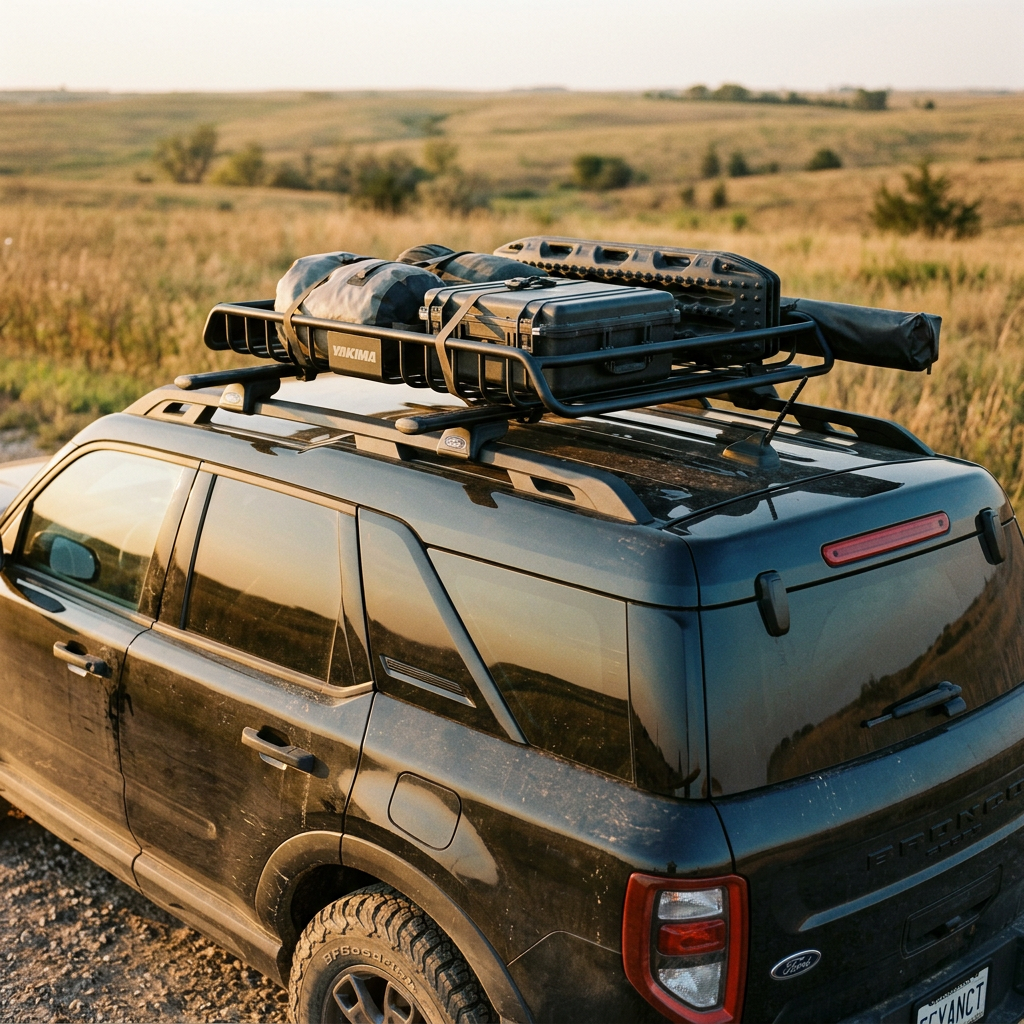
Part of the joy of owning a Ford Bronco Sport is the ability to customize it to fit your specific adventure needs. The Ford OEM accessory catalog is packed with highly engineered, perfectly fitting options designed to elevate your camping and overlanding experience. Because these accessories are co-developed with Ford engineers, you can rest assured they won’t compromise your vehicle’s structural integrity, safety systems, or factory warranty. First on the list of overland upgrades is a quality rooftop tent setup. By mounting a Yakima rooftop tent to your Bronco Sport’s heavy-duty roof rails, you instantly elevate your sleeping quarters off the cold, damp ground, away from nocturnal Kansas insects and wildlife. Inside the cabin, heavy-duty rubberized floor liners are essential for keeping muddy boots and spilled trail water from ruining your carpet. A cargo area liner and pet kennel system also help keep your gear clean and organized. For those planning to explore more remote, unmaintained sections of Dickinson County, adding custom-fit mud flaps and rock sliders helps protect your body panels from flying gravel and trail debris.

Additionally, auxiliary lighting is a highly popular upgrade for overlanding. Grille-mounted light bars or ditch lights mounted near the side mirrors significantly improve visibility during late-night trail arrivals or early-morning departures. Ford offers specialized wiring harnesses that integrate seamlessly with the Bronco Sport’s electrical systems, preventing battery drain and clean installations. Ready to elevate your Bronco Sport’s camping game? Our parts department carries a wide variety of adventure gear and trail accessories. You can easily Order Genuine Ford Parts through Valor Ford to ensure you get the absolute best fitment and durability for your rugged Kansas travels.

A black SUV equipped with a loaded Yakima roof basket parked in a grassy field at sunset. (Representative image for illustration purposes only. Actual vehicle may vary based on trim and configuration.)

What Emergency Gear Should I Bring for Kansas Trails?

No matter how capable your vehicle is, the golden rule of overlanding is self-sufficiency. When you venture off the beaten path, cell reception can fade quickly, and emergency services could be hours away. Packing a dedicated recovery and emergency kit is non-negotiable. Below is a comprehensive packing list optimized for the unique challenges of Kansas trails.

Traction & Recovery
If you find yourself stuck in deep mud or soft sand along a creek bed, traction boards are your best friend. Slip them under your tires for instant grip. Additionally, always carry a high-quality kinetic recovery strap. The Bronco Sport features robust front recovery points—ensure you have a strap and D-rings compatible with them.

Air & Power Management
A portable 12V air compressor is vital. It allows you to air back up to highway pressures after trail riding, preventing tire damage. Carry a portable lithium-ion jump starter pack as well; running camp lights, keeping phones charged, or leaving a door ajar can easily drain a battery overnight in remote areas.

Survival & Navigation
Late summer heat demands serious hydration. Pack at least two gallons of fresh water per person, per day. A well-stocked first-aid kit, a reliable multi-tool, a folding shovel, and offline mapping software (like OnX Offroad or Gaia GPS) are essential for navigating when cellular coverage drops completely.

Mapping Your Route: Top Late-Summer Camping Destinations Near Junction City
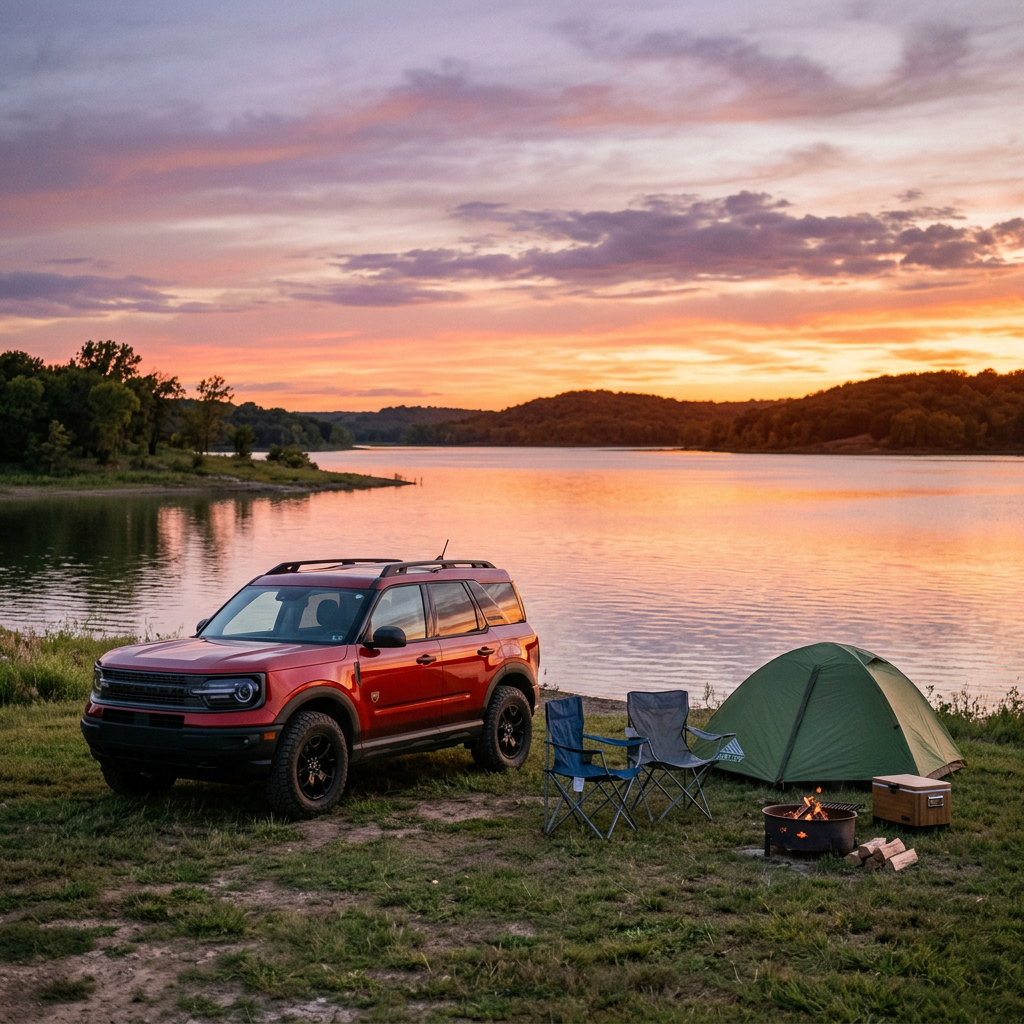
Now that your Bronco Sport is prepped, maintained, and packed, it’s time to choose your destination. Fortunately, Junction City is perfectly positioned as a gateway to some of the best outdoor recreation in the state. If you are looking for water-based activities and beautiful shoreline camping, Milford State Park is an absolute gem. Known as the ‘Geary County Oasis,’ Milford offers scenic, sandy trails, heavily wooded campsites, and excellent fishing. The sandy shoreline trails can sometimes get soft, but switching your Bronco Sport into ‘Sand’ G.O.A.T. mode will keep you moving forward with ease. For those seeking a bit more technical trail riding, the Tuttle Creek ORV Area near Randolph is a must-visit. This dedicated off-road park features steep hill climbs, deep ruts, and rocky ledge obstacles. It is the perfect place to test the limits of your Bronco Sport Badlands’ suspension and advanced 4×4 systems. Remember to air down your tires to absorb the sharp impacts of the rocky terrain and take advantage of the slow-speed crawl controls.

If multi-day, self-sustained overlanding is your goal, look no further than the scenic gravel grids of the Flint Hills National Scenic Byway. Stretching south through Council Grove and beyond, this region offers hundreds of miles of unpaved, unmaintained county roads that cut through the largest remaining stand of tallgrass prairie in North America. Driving these historic routes during late summer offers spectacular views of rolling hills, roaming cattle, and beautiful stone architecture. Be sure to practice proper trail etiquette: respect private property gates, pack out all of your trash, and stay aware of changing weather conditions that can turn dry gravel roads into slick clay in a matter of minutes. No matter where you choose to explore, having a capable, prepared vehicle gives you the freedom to escape the crowds and find true solitude. Planning your route and checking local park websites for seasonal trail closures before you leave ensures a smooth, trouble-free adventure.

A red Ford Bronco Sport parked next to a green tent and campfire by a lake at sunset. (Representative image for illustration purposes only. Actual vehicle may vary based on trim and configuration.)

How Should I Shop Locally for a Bronco Sport Near Junction City?
If you are ready to transition from dreaming about overland adventures to actually living them, finding the right Ford Bronco Sport is the first step. At Valor Ford, we make the shopping process transparent, efficient, and tailored to your specific lifestyle. You can begin your journey right from the comfort of your home by exploring our extensive digital showroom. Whether you are looking for a brand-new Badlands edition equipped with all the off-road goodies, or a high-quality, certified pre-owned model, you can easily Browse Used Inventory or check out our latest new arrivals on our website. Once you find a few models that catch your eye, we recommend utilizing our convenient online tools to streamline your buying experience. If you plan to trade in your current vehicle to help fund your new adventure machine, you can receive an instant, highly accurate estimate using our online Trade In Evaluation tool. Knowing the value of your trade-in upfront allows you to plan your budget with absolute confidence, ensuring there are no surprises when you visit our physical showroom in Junction City.

Additionally, securing financing options is a crucial piece of the puzzle. Our experienced finance team works with a wide network of local and national lenders to secure the best possible rates and flexible terms for your budget. To save time at the dealership, you can easily fill out our secure digital application and Get Pre-Approved for Financing before you set foot on our lot. At Valor Ford, we focus on a straightforward, helpful shopping experience. Instead, our goal is to serve as a trusted resource for the local community, helping you find the vehicle, accessories, and maintenance services that perfectly align with your outdoor goals. Come visit us today, chat with our knowledgeable staff, and take a Bronco Sport for a spin to experience its impressive capabilities firsthand.

Logo for Valor Automotive featuring a blue and silver shield with 'VA' and the company name with a red star.

Gear Up and Head Out with Valor Ford in Junction City, KS

The late-summer wilderness is calling, and there has never been a better time to pack your gear, load up your vehicle, and hit the beautiful trails of Kansas. From the rolling hills of the Flint Hills to the scenic shorelines of Milford Lake, unforgettable memories are waiting to be made. But a safe, successful overland trip always begins with a well-prepared vehicle. Whether you are seeking a new adventure-ready Ford Bronco Sport, looking to outfit your current rig with high-quality OEM accessories, or needing a thorough pre-trip inspection, Valor Ford is your premier local partner. Our team is comprised of passionate automotive experts who live, work, and explore right here in the local community. We know the unique demands of Kansas roads and trails, and we are dedicated to ensuring you have the knowledge, equipment, and confidence to tackle your next journey safely. Don’t leave your trail readiness to chance—stop by our dealership, speak with our service and parts specialists, and let us help you gear up for your next great escape. Have questions about inventory, parts, or trail prep? Call us at (785) 238-5114 to speak directly with our friendly team, or Get Directions to Valor Ford to visit our showroom located at 1825 Goldenbelt Blvd, Junction City, KS 66441. We look forward to helping you embark on your next Kansas trail adventure!

A Heavy-Duty Towing Guide for Pottawatomie and Clay County Ranchers

Operating a working cattle ranch or agricultural operation across the sweeping Flint Hills of Pottawatomie County and the fertile river valleys of Clay County is not a lifestyle for the faint of heart. It is a demanding, sun-up to sun-down commitment that requires grit, resilience, and equipment that simply refuses to quit. Out here in America’s heartland, your heavy-duty truck is not just a daily commuter; it is a vital business partner, a mobile command center, and the lifeline that moves your livelihood from pasture to market. Whether you are hauling massive gooseneck stock trailers packed with black Angus cattle, shifting flatbeds loaded with thousands of pounds of fresh alfalfa bales, or transporting heavy excavators to clear out brush lines, you need more than just raw horsepower. You need a comprehensive understanding of heavy-duty towing principles, weight limits, and mechanical endurance.

As the summer heat of July 2026 beats down on our Kansas pastures, the demands on your vehicle fleet multiply. High ambient temperatures, dusty gravel roads, and challenging topography can quickly push an under-prepared truck past its breaking point. That is where professional-grade engineering and local expertise come together. At Valor Ford, located proudly in Junction City, KS 66441, we have spent years working alongside local producers to understand the exact, uncompromising demands of Kansas agriculture. We know that when a thunderstorm is brewing on the horizon and you have fifty head of cattle to move, you cannot afford a transmission slip or a braking failure. This guide is built to serve as your definitive resource for mastering heavy-duty towing, choosing the absolute best rig configurations, and keeping your machinery running safely through every challenging season.
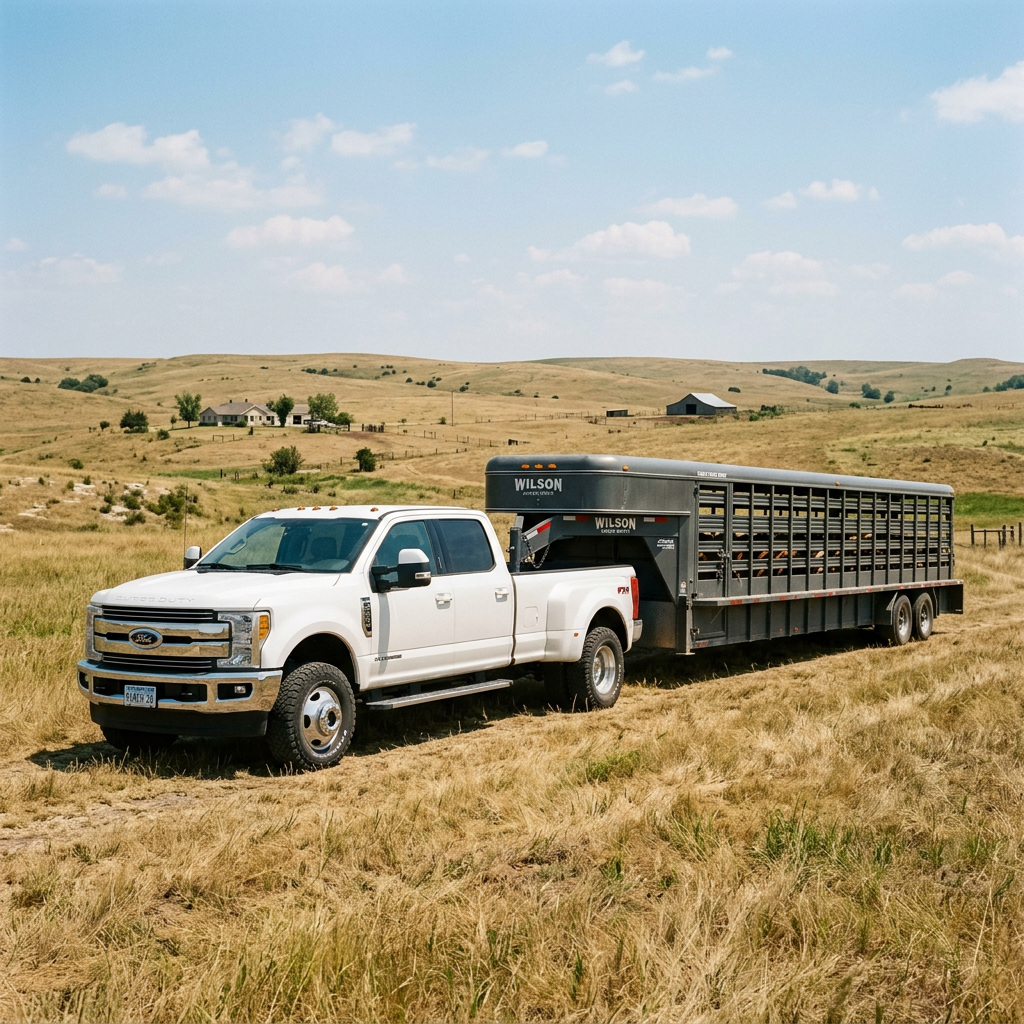
A white Ford Super Duty truck pulling a gray Wilson livestock trailer filled with cattle in a grassy pasture. (Representative image for illustration purposes only. Actual vehicle may vary based on trim and configuration.)

If you are ready to experience this level of capability first-hand, feel free to Get Directions to Valor Ford and visit our showroom today. Our team is always on hand to talk payload, trailering setups, and powertrain choices. If you prefer to speak to a heavy-duty truck specialist directly from the comfort of your tractor cab, you can Call us at (785) 238-5114 to discuss your specific fleet needs.

What is the maximum towing capacity of a 2026 Ford F-350 Super Duty for ranch work?

When evaluating the sheer muscle required for serious agricultural work, the 2026 Ford F-350 Super Duty stands as an undisputed titan. For ranchers operating in Clay and Pottawatomie counties, understanding the absolute upper limits of your truck’s capabilities is critical to both operational efficiency and on-road safety. Towing capacity is not just a single, static number printed on a brochure; it is a dynamic spectrum governed by your engine choice, axle ratio, drivetrain configuration, and the type of hitch mechanism you employ. To maximize your productivity, you must look closely at how conventional bumper-pull towing compares to gooseneck and fifth-wheel setups, which are the absolute lifelines of modern ranching operations.

When configured with the legendary 6.7L High-Output Power Stroke® V8 Turbo Diesel engine, the 2026 F-350 is engineered to redefine what a heavy-duty truck can achieve. In a dual-rear-wheel (DRW) configuration with a gooseneck setup, the F-350 boasts an astronomical maximum towing capacity of up to 40,000 pounds. This massive rating allows you to pull the largest multi-car haulers, triple-axle cattle trailers packed with heavy mature bulls, or massive industrial flatbeds loaded down with dual-wheel tractors and tillage equipment. Even with conventional bumper towing, the F-350 achieves a class-leading capacity of up to 28,000 pounds when properly equipped. This means bumper-pull stock trailers, heavy-duty utility trailers, and large mobile fuel tanks can be moved around the farm without a second thought.

For those who prefer the simplicity and quick throttle response of a gasoline engine, the 2026 F-350 offers the formidable 7.3L “Godzilla” V8. While diesel remains the undisputed king of absolute maximum pulling power, this heavy-duty gas engine is no slouch, delivering outstanding conventional and gooseneck towing limits that easily exceed 20,000 pounds. This makes it an incredibly cost-effective, low-maintenance workhorse for ranchers who run shorter local routes between the pasture and the local sale barn, or who need a reliable backup truck that can sit for periods without worrying about modern diesel emissions systems. No matter which powertrain you choose, matching the right gear ratio—such as the 3.55 or 4.10 limited-slip or electronic-locking rear axles—is key to unlocking these extreme tow ratings.

To put these capacities in perspective, consider the real-world math of a Kansas cattle ranch. A standard 24-foot steel gooseneck stock trailer weighs roughly 6,000 to 7,000 pounds empty. Load it up with 25 feeder steers weighing an average of 800 pounds each, and you are looking at a total trailer weight of 26,000 to 27,000 pounds. A single-rear-wheel F-350 can handle this load comfortably, but stepping up to a dual-rear-wheel model provides that crucial safety margin and unmatched stability when crosswinds hit you on Highway 24. Knowing your limits prevents premature wear on your transmission, keeps your brakes from overheating, and ensures you remain fully legal and safe on public roads.

Engine Option

Max Conventional Towing

Max Gooseneck/5th-Wheel Towing

Best Suited Agricultural Task

6.7L HO Power Stroke V8 Diesel

28,000 lbs

40,000 lbs

Hauling heavy livestock trailers & major commercial machinery over long distances

6.7L Standard Power Stroke Diesel

25,000 lbs

35,000 lbs

Everyday stock hauling, heavy hay bale transport, and construction equipment

7.3L ‘Godzilla’ V8 Gasoline

21,000 lbs

22,500 lbs

Frequent short-haul trips, feed delivery, utility work, and winter pasture idling

6.8L 2-Valve Devict V8 Gasoline

17,500 lbs

18,800 lbs

Light-to-medium utility towing, fleet operations, and general farm service duties

Does a dually ride significantly rougher than a single-rear-wheel truck when empty?
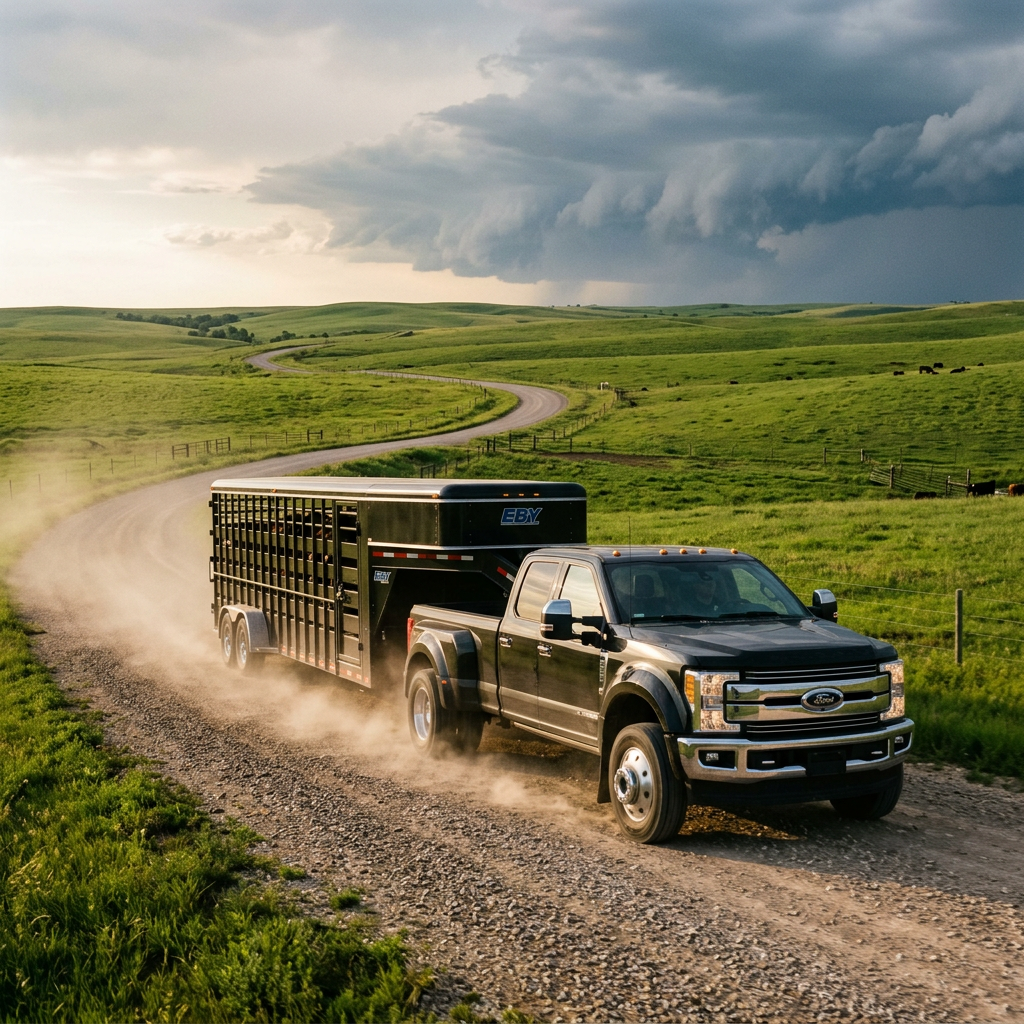
This is one of the most common dilemmas we hear from ranchers standing on our showroom floor: ‘If I buy a dual-rear-wheel (DRW) truck to handle my heaviest loads, am I going to regret it every time I drive it empty into town?’ It is a highly practical question. Many farm trucks serve double-duty as the family vehicle, taking trips to the grocery store, running the kids to school events in Junction City, or making long supply runs to Manhattan. Historically, dually trucks had a well-deserved reputation for riding like an unloaded dump truck when there was nothing in the bed. The stiff rear leaf springs, designed to support massive payloads, had very little give, resulting in a jarring, bouncy ride over uneven pavement, washboard gravel roads, and deep pasture ruts.

However, modern engineering has dramatically closed the comfort gap between single-rear-wheel (SRW) and DRW trucks. The 2026 Ford Super Duty lineup utilizes advanced, progressive-rate leaf springs and sophisticated shock tuning. When the truck is empty, only the primary spring pack is engaged, allowing for a surprisingly compliant and cushioned ride that mimics a standard heavy-duty pickup. It is only when you drop a heavy gooseneck trailer onto the ball or load up the bed with salt blocks that the helper springs engage to provide the extreme load-bearing support required. While you will still feel a slightly firmer response over sharp bumps compared to an SRW truck—primarily due to the wider, stiffer footprint of four rear tires—it is no longer the bone-jarring experience of the past.

Where the dually truly shines, and where it easily earns its keep, is in its unparalleled lateral stability. If you have ever towed a double-deck stock trailer filled with shifting livestock down Highway 77 during a classic Kansas windstorm, you know the white-knuckle feeling of sway. A single-rear-wheel truck, while capable of pulling the weight, has more sidewall flex in the rear tires, allowing the trailer to steer the truck. A dually virtually eliminates this issue. The massive, wide stance of the dual rear wheels acts as an anchor, resisting lateral forces and keeping your rig tracking straight and true. For many ranchers, the absolute peace of mind and safety provided during those windy, high-stress hauls far outweigh the minor difference in unloaded ride quality.

A black Ford Super Duty truck towing an Eby livestock trailer down a winding dirt road through green rolling hills. (Representative image for illustration purposes only. Actual vehicle may vary based on trim and configuration.)

To help you decide which configuration is right for your ranch, let’s look at a quick comparison of the trade-offs: • Single Rear Wheel (SRW): Easier to park in town, fits through standard automatic car washes, slightly better fuel economy when empty, and a smoother unloaded ride on rough gravel roads. • Dual Rear Wheel (DRW): Maximum payload capacity for heavy pin weights, unmatched stability against crosswinds and moving livestock, and extra safety redundancy (if you get a flat tire on one rear tire while hauling, the other can support the load until you reach safety).

Find Your Next Workhorse in Our Heavy-Duty Inventory

Whether your daily chores demand the ultimate pulling power of a dual-rear-wheel F-350 or the versatile, everyday capability of a single-rear-wheel F-250, Valor Ford has the rugged inventory to back you up. We specialize in configuring trucks that are purpose-built for the unique demands of Kansas agricultural operations. If you are looking for a truck that fits the job—get the exact powertrain, suspension, and towing package your ranch deserves. Explore our options online or stop by to test drive our current selection of heavy-duty trucks.

Which truck offers better engine braking for descending steep grades with a heavy trailer?

Towing a heavy trailer is only half the battle; stopping it safely is where the real engineering challenges lie. For ranchers in the Kansas River valley and the rolling hills of Clay County, descending steep, winding gravel roads with a fully loaded livestock trailer can quickly become dangerous if you rely solely on your service brakes. Friction brakes can overheat rapidly under heavy loads, leading to brake fade—a terrifying condition where the brakes lose their stopping power entirely. To combat this, modern heavy-duty trucks utilize engine braking systems to control downhill speed, save wear on your brake pads, and keep your rig under complete control.

When it comes to pure, unrelenting engine braking performance, the 6.7L Power Stroke® V8 Turbo Diesel is the undisputed champion. Ford’s diesel engine features a driver-activated smart exhaust brake. Unlike older, simpler exhaust brakes, this system utilizes a variable-geometry turbocharger (VGT) to restrict exhaust flow, creating backpressure in the cylinders. This backpressure forces the pistons to work harder against the compressed air, effectively slowing the vehicle’s wheels through the drivetrain. The system operates in two modes: ‘On’ for continuous maximum braking, and ‘Auto,’ which monitors your speed and brake pedal application to automatically maintain your current speed down the hill. It is incredibly smooth and provides massive holding power, allowing you to descend steep pasture trails or highway grades without ever touching the brake pedal.

Gasoline engines, such as the 7.3L V8, rely on a different physical mechanism called vacuum braking or compression braking. When you release the throttle on a gas truck, the throttle body closes, creating a strong vacuum in the intake manifold. The engine has to work hard to draw air against this closed valve, which creates a natural braking effect. Ford pairs this with aggressive tow/haul transmission programming, which automatically downshifts the 10-speed TorqShift® automatic transmission to raise engine RPMs and maximize this vacuum braking force. While highly effective for moderate loads and rolling hills, a gasoline engine simply cannot match the sheer retardation force generated by a turbocharged diesel exhaust brake.

For agricultural operations that regularly tow near or above 15,000 pounds, the diesel exhaust brake is a game-changing safety feature. It not only prevents catastrophic brake failure but also drastically reduces your long-term maintenance costs. Instead of replacing warped rotors and worn brake pads every season due to heavy hauling, the exhaust brake handles the majority of the deceleration work, preserving your service brakes for when you truly need to come to a complete, sudden stop. If your ranching routes involve navigating the rolling terrain surrounding Tuttle Creek Lake or the steep descents down to the Kansas River, investing in the Power Stroke diesel with its smart exhaust brake is one of the smartest safety decisions you can make.

How do you properly adjust an integrated trailer brake controller?
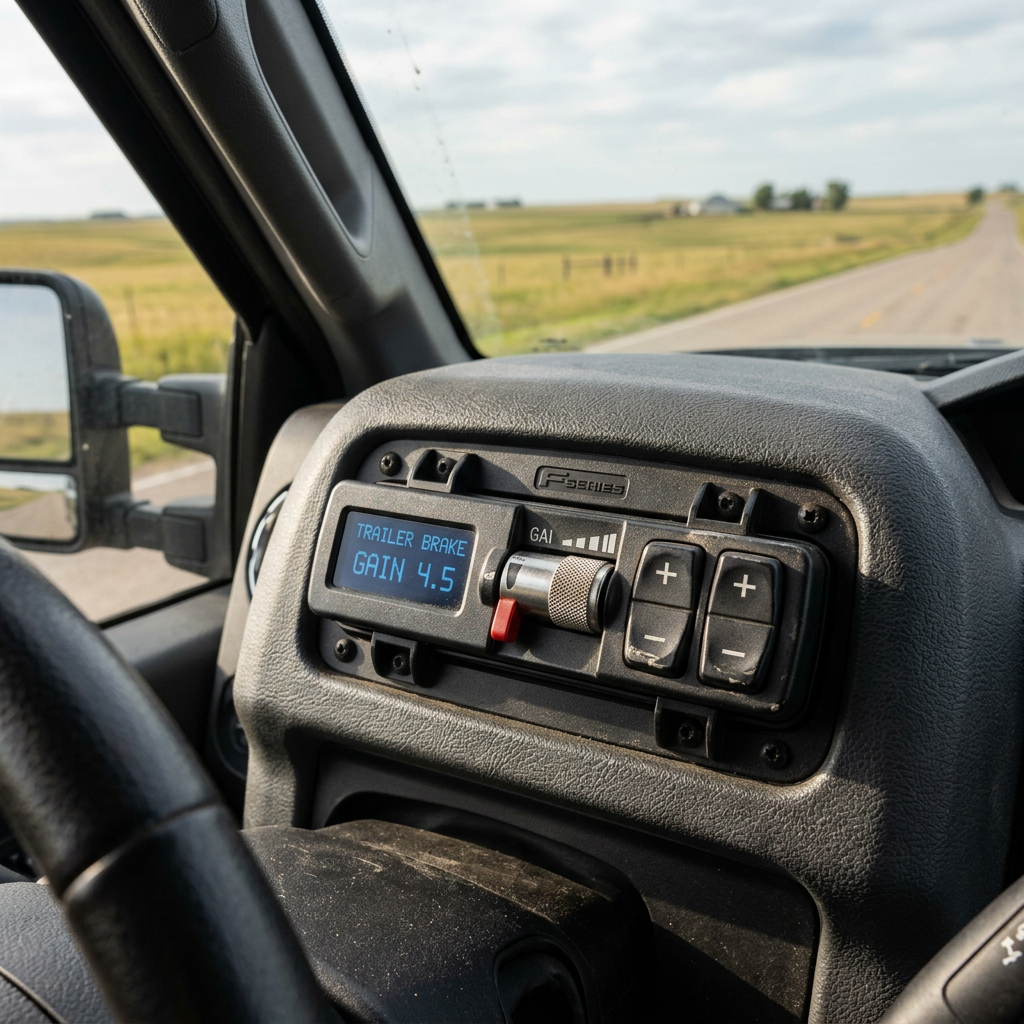
Step 1: Connect and Verify Before making any adjustments, ensure your trailer is securely coupled, safety chains are crossed, and the electrical umbilical cord is firmly plugged into your truck’s 7-pin connector. Start your Ford Super Duty and look at the productivity screen on your dashboard. The system should display a message confirming ‘Trailer Connected.’ If you see a warning or no connection message, double-check your physical connection and inspect the plug for any dirt, corrosion, or bent pins—common issues on working ranch trucks.

Next, navigate the driver information screen using your steering wheel controls to select the correct trailer profile. Ford’s advanced system allows you to save settings for multiple trailers, such as ‘Gooseneck Stock’ or ‘Flatbed Utility.’ This saves you from having to recalibrate from scratch every time you swap equipment.

Step 2: Set Initial Gain Locate the integrated trailer brake controller on your center instrument panel. It features a manual squeeze-squeeze slider and physical ‘+’ and ‘-‘ buttons to adjust the ‘Gain’ setting. Gain represents the amount of electrical power sent to the trailer’s electric or electric-over-hydraulic brakes when you press the truck’s brake pedal. For a starting point, set the gain to a moderate level, typically 5.0 on a scale of 1 to 10. If you are towing an exceptionally heavy or fully loaded livestock trailer, you may want to start slightly higher, around 6.5. If the trailer is empty or very light, start lower, around 3.0, to prevent the trailer tires from immediately locking up and dragging.

Integrated trailer brake controller mounted on a truck dashboard showing a gain setting of 4.5. (Representative image for illustration purposes only. Actual vehicle may vary based on trim and configuration.)

Step 3: Road Test and Calibrate Find a safe, flat, open area with minimal traffic, such as an empty gravel staging area or a quiet country road. Accelerate your rig to approximately 20 to 25 mph. Keeping your hands on the steering wheel, use your right hand to gently but firmly squeeze the manual trailer brake slider completely together. Do not press the truck’s foot brake pedal. Pay close attention to how the rig responds. If the trailer brakes lock up and slide the tires, your gain is set too high; press the ‘-‘ button to decrease the gain by 0.5. If the trailer barely slows the truck down, your gain is too low; press the ‘+’ button to increase it. Repeat this test until you achieve maximum braking force just short of trailer wheel lock-up. This ensures the truck and trailer work in perfect harmony, stopping as a single, cohesive unit.

Are there tax write-offs for heavy-duty ranch trucks under Section 179?

Owning and operating a ranch is not just a way of life; it is a highly capital-intensive business. To remain profitable, smart financial management is just as important as good animal husbandry. Fortunately, the United States tax code offers a powerful incentive for agricultural producers looking to upgrade their work vehicles: Section 179 of the Internal Revenue Code. This tax provision allows qualifying businesses, including family farms and commercial ranches, to deduct the full purchase price of qualifying equipment—including heavy-duty trucks—directly from their gross income in the tax year the vehicle is purchased and placed into service.

To qualify for the maximum Section 179 deduction, the vehicle must meet specific gross vehicle weight rating (GVWR) thresholds set by the IRS. Passenger cars and light-duty crossovers face strict caps on write-offs. However, vehicles with a GVWR between 6,000 pounds and 14,000 pounds—which includes the entire Ford F-250 and F-350 Super Duty lineup—qualify for substantial immediate expensing. For heavy-duty work trucks that are equipped with a cargo bed of at least six feet in interior length, or those modified for specific agricultural use (such as a flatbed feed truck), you can potentially deduct up to 100% of the purchase price in year one, subject to overall business income limits and annual deduction ceilings.

This represents an incredible opportunity for ranchers in Clay and Pottawatomie counties to significantly lower their tax liability while simultaneously modernizing their fleet with safer, more capable towing machines. If you are operating with an older, unreliable truck that requires constant repairs, the tax savings from a Section 179 write-off can offset a massive portion of the acquisition cost of a brand-new 2026 Super Duty. Of course, because tax laws are complex and individual farm financial structures vary, we always advise consulting with a certified public accountant (CPA) or agricultural tax specialist who knows Kansas farm tax regulations inside and out to ensure you maximize your eligible savings.

If you are planning to leverage these tax advantages before the end of the fiscal year, getting pre-approved for your commercial vehicle loan is a smart first step. Our finance department makes the process incredibly straightforward and transparent. You can easily Get Pre-Approved for Financing online from your office, allowing you to lock in competitive rates and contact our finance team for current financing options and terms.

How often should you grease the chassis and suspension components on a farm truck?

The Harsh Reality of Farm Use Farm trucks operate in environments that would make standard highway vehicles shudder. Muddy pastures, deep river crossings, fine limestone dust on county roads, and winter road salt create a highly abrasive slurry that constantly attacks your truck’s moving parts. Under these severe operating conditions, standard manufacturer maintenance schedules designed for average highway drivers simply do not apply. If you wait for the standard service interval to grease your chassis, you are likely setting yourself up for premature component failure, steering play, and dangerous trailering breakdowns.

The Recommended Interval For farm trucks undergoing daily heavy agricultural use, you should inspect and grease key chassis and suspension components every 3,000 to 5,000 miles, or at least twice a year—ideally before the heavy spring planting season and ahead of the harsh winter freeze. If you frequently navigate deep mud or water crossings that submerge your axles, you should grease these components immediately afterward to purge any trapped water and contaminants. Regular greasing keeps steering responsive, prevents metal-on-metal wear, and ensures your heavy towing rig remains structurally sound.

Critical Points to Grease When performing service, pay close attention to the following high-wear areas: • Tie-rod ends and steering drag links • Upper and lower ball joints (if greaseable) • Front drive axle U-joints (on 4×4 models) • Driveshaft slip yokes and universal joints Using a high-quality, water-resistant lithium complex grease is essential to provide lasting protection against the elements. If you prefer to have certified experts handle this, or need parts to do it yourself, you can easily Order Genuine Ford Parts from Valor Ford to ensure your truck gets the exact lubricants and replacement components it needs to survive the Kansas range.

Schedule Your Next Heavy-Duty Service at Valor Ford

Keeping your work truck in prime mechanical condition shouldn’t take time away from your busy ranch schedule. At Valor Ford, our certified diesel and heavy-duty technicians understand the value of your time and the importance of a dependable truck. From routine chassis lubes and transmission flushes to complex diesel diagnostics, we handle it all with precision. To make maintenance completely hassle-free, we encourage you to Schedule Pickup and Delivery Service, allowing us to service your truck while you keep your operations moving on the farm.
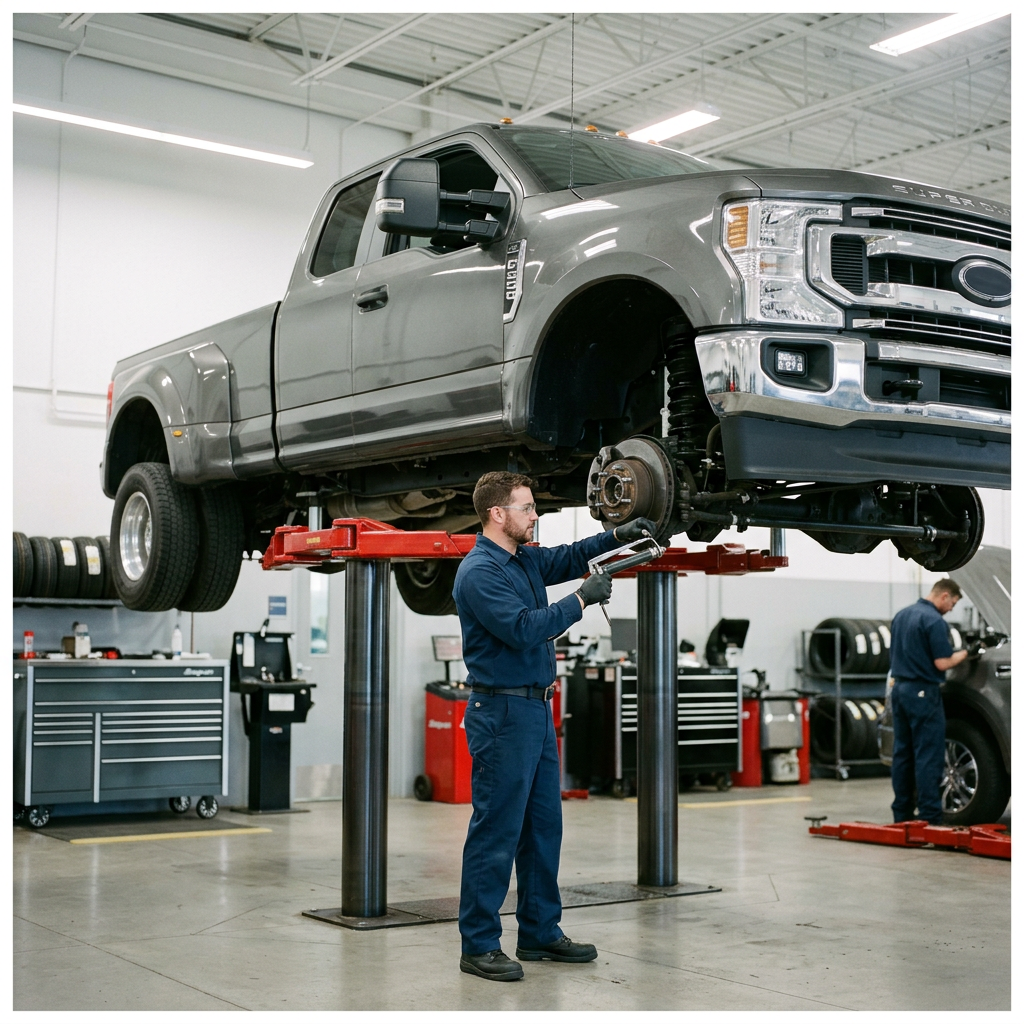
A mechanic working on the front brake assembly of a grey Ford Super Duty truck raised on a hydraulic lift. (Representative image for illustration purposes only. Actual vehicle may vary based on trim and configuration.)

Essential Rigging: Gooseneck vs. Fifth-Wheel Hitches for Agricultural Hauling

Choosing the right physical connection between your truck and your trailer is one of the most critical decisions in heavy-duty towing. In the agricultural world, the choice almost always comes down to two primary systems: the gooseneck hitch and the fifth-wheel hitch. While both systems mount directly inside the truck bed over the rear axle to maximize stability and weight distribution, they are designed for vastly different use cases. Understanding these differences can save you countless hours of frustration when hooking up in muddy pastures or navigating tight, enclosed farmyards.

The gooseneck hitch is the undisputed king of the working ranch. It utilizes a simple 2-5/16 inch ball that mounts directly in the center of your truck bed, coupling with a long tubular coupler on the trailer. The primary advantage of a gooseneck is its incredible versatility and off-road articulation. The ball-and-socket design allows the trailer to twist and tilt independently of the truck, which is absolutely essential when pulling a heavy cattle trailer through uneven pasture gates, deep ditches, or terraced fields. Furthermore, when you aren’t towing, you can easily remove the ball or flip it upside down (using Ford’s under-bed prep package), leaving you with a completely flat, unobstructed truck bed to load up with hay bales, feed bags, or fencing supplies.

The fifth-wheel hitch, on the other hand, utilizes a massive horseshoe-shaped plate mechanism similar to those found on commercial semi-trucks, which couples with a kingpin on the trailer. Fifth-wheel hitches are engineered primarily for maximum on-road stability and smoothness, making them the preferred choice for massive RVs and heavy commercial flatbeds. However, they have major drawbacks for daily farm work. The hitch assembly itself is incredibly heavy, bulky, and difficult to remove from the truck bed when you need cargo space. Additionally, fifth-wheel hitches offer very limited lateral pivot, meaning that if you try to pull one over a steep ditch or uneven pasture terrain, you risk putting immense twisting stress on your truck’s frame or damaging the hitch itself.

For 90% of ranchers in Clay and Pottawatomie counties, the gooseneck is the clear winner. Ford makes utilizing this system easier than ever with the available 5th-Wheel/Gooseneck Hitch Prep Package, which includes five under-bed attachment points integrated directly into the frame. This allows you to drop in a gooseneck ball or a fifth-wheel hitch in seconds, giving you the ultimate flexibility to tackle any trailering job that comes your way.

Get an Accurate Trade-In Value on Your Current Farm Truck

Is your current farm truck struggling to keep up with the demands of the season? Upgrading your agricultural fleet doesn’t have to be a hassle. At Valor Ford, we make trading in your old workhorse incredibly easy and transparent. We appreciate the value of solid, hard-working vehicles, and we want to ensure you get top dollar for your trade. Use our quick online valuation tool to get an instant, fair assessment, and let us help you transition into a powerful new Ford Super Duty designed to dominate the Kansas range.

Dominate the Kansas Range with a Super Duty from Valor Ford

Navigating the heavy-duty demands of agricultural life in Pottawatomie and Clay counties requires a truck that is as dedicated, resilient, and uncompromising as the ranchers who drive them. From understanding the raw limits of a 2026 Ford F-350’s towing capacity to mastering the nuances of chassis maintenance and trailer brake calibration, being an informed owner is the key to a safe, productive, and profitable operation. As your local heavy-duty truck headquarters, Valor Ford is deeply committed to supporting the agricultural communities of Junction City, Geary County, and all surrounding ranchlands with the vehicles, parts, and expert service you need to succeed.

Don’t leave your towing safety and ranch productivity to chance. Whether you want to explore our rugged pre-owned truck fleet by checking out our Browse Used Inventory page, or you are ready to build a brand-new, customized workhorse, our team is here to help you every step of the way. Stop by our dealership today or get in touch with our commercial vehicle experts to find the perfect truck to power your ranching operations for years to come.

Logo for Valor Automotive featuring a silver shield with red 'V' and white 'A' monogram inside, over a blue background.

Gear Up for the School Year: Essential August Maintenance for Junction City Families
A family of four loading bags into the trunk of an SUV parked in a driveway on a sunny day. (Representative image for illustration purposes only. Actual vehicle may vary based on trim and configuration.)

As the warm, lazy days of July transition into the focused energy of August, families across Junction City and the wider Geary County area are shifting their sights toward a familiar milestone: the back-to-school season. Preparing your household for this annual transition involves a familiar ritual of purchasing school supplies, organizing calendars, and adjusting sleep schedules. Yet, amidst the flurry of buying new backpacks and color-coded folders, one crucial element of your family’s daily routine is often overlooked until it is too late: the family vehicle. Your car is the silent partner in every early-morning drop-off, every afternoon pickup, and every weekend trip to school athletic events. Ensuring its reliability now, before the chaotic rhythm of the school year begins, is the single most effective way to prevent stressful morning breakdowns and costly emergency repairs.

The morning rush hour in Junction City has its own unique cadence. From the bustling drop-off lanes at Westwood Elementary and Junction City High School to the heavy commute along Eisenhower Drive and Washington Street, the sudden influx of school traffic demands your vehicle’s peak performance. Stop-and-go driving, idling in long car lines, and navigating the unpredictable weather transitions of late summer in Kansas can place immense stress on a vehicle that has spent the summer on long highway road trips. Preventative maintenance in August acts as a shield against these daily stressors. By addressing potential mechanical issues during the calmer weeks of late summer, you protect your family from the frustration of a car that refuses to start when the school bell is about to ring.

At Valor Ford, we view ourselves as more than just a dealership; we are a dedicated partner in keeping our local Junction City community safe, mobile, and secure. We understand that your family’s safety is non-negotiable. Our team of service professionals is committed to ensuring that your vehicle is fully prepared to handle the rigorous demands of the upcoming academic year. In this comprehensive guide, we will walk you through the essential maintenance tasks, technical specifications, and safety guidelines that every Geary County parent should know. From checking critical safety systems to navigating the transitions of local weather, we are here to provide the expert knowledge and dependable service your family deserves.

What Are the Most Critical Vehicle Maintenance Tasks for Back-to-School Season in Junction City?

A successful school year relies on structural organization, and your vehicle maintenance should be no different. The unique local terrain of Geary County, combined with the stop-and-go nature of school zones, places unique physical demands on your car, truck, or SUV. To help you navigate this transition, we have compiled a comprehensive checklist of high-priority maintenance items that require immediate attention before the first day of school. Addressing these key areas ensures that your vehicle remains a safe, dependable environment for your most precious cargo.

Braking Systems & Wear

School zones require rapid, unexpected stops as children cross streets and buses halt to unload passengers. Your braking system must be in flawless operating condition. Over the summer, heat and dust can degrade brake pads and rotor surfaces, leading to reduced stopping power.

Have our technicians measure your brake pad thickness. Pads with less than 3mm of friction material remaining should be replaced immediately. Additionally, we check for rotor warping, which can cause dangerous vibrations, and inspect brake fluid levels for signs of moisture contamination.

Battery Health & Charge

The intense Kansas summer heat is the primary catalyst for automotive battery degradation. High temperatures accelerate internal chemical reactions, leading to fluid evaporation and internal corrosion. Often, a battery damaged in July will fail completely during the first cool morning of early autumn.

A comprehensive battery test measures cold cranking amps (CCA) and overall voltage retention. We also clean terminal corrosion and ensure that the battery mounting bracket is secure, preventing damaging vibrations during your daily drives across Junction City.

Tires & Road Contact

Your tires are the only point of contact between your vehicle and the road. Wet late-summer roads and early autumn downpours require deep tire tread to channel water away and prevent hydroplaning in busy school drop-off lanes and residential neighborhoods.

We utilize precise depth gauges to ensure your tread is well above the minimum safety limit of 4/32 of an inch. Tire rotation is also crucial to promote even wear, extend tire lifespan, and guarantee optimal handling and fuel efficiency throughout the academic year.

Ignoring these foundational maintenance pillars can transform a minor, easily resolvable wear-and-tear issue into an unexpected mechanical failure. When you proactively manage your brakes, battery, and tires, you are laying a foundation of safety and reliability that will carry your family smoothly through the autumn months and beyond.

Beating the Kansas Heat: Specifications of a Healthy Automotive Cooling System for Summer-to-Fall Transition
The transition from the scorching heat of late August to the crisper, cooler mornings of September and October poses a hidden challenge to your vehicle’s cooling system. Many drivers assume that cooling systems are only critical during the peak of summer, but the thermal stress of transitioning between extreme temperatures is actually when cooling system failures are most common. A cooling system must maintain precise operating temperatures to prevent both engine overheating in slow-moving school traffic and inefficient fuel combustion during cold morning startups.

To ensure your engine operates within its designed thermal parameters, our factory-trained technicians analyze several technical specifications. First, we test the coolant pH level and concentration. Over time, coolant degrades, becoming acidic and losing its rust-inhibiting properties. A proper 50/50 water-to-antifreeze mixture ensures protection against both boiling over on hot afternoons and freezing on cold winter nights.

Additionally, we pressure test the cooling system, including the radiator pressure cap. A weak cap cannot hold the necessary pressure, causing the coolant boiling point to drop and leading to premature boil-overs in the drop-off line. We also conduct thorough physical inspections of all radiator hoses, looking for soft spots, cracks, or bulging that indicate imminent failure under pressure.

A female mechanic wearing safety glasses inspects a car engine with a pressure gauge in a well-lit auto shop. (Representative image for illustration purposes only. Actual vehicle may vary based on trim and configuration.)

Maintaining your cooling system’s health prevents embarrassing and dangerous engine overheating during the daily school commute.

Protecting Your Engine: What Is the Average Price of a Synthetic Oil Change and Filter Replacement?

Engine motor oil is the literal lifeblood of your vehicle. It reduces friction, dissipates heat, and prevents harmful carbon deposits from building up within your engine’s internal components. For modern vehicles, synthetic oil has become the industry standard due to its superior performance and longevity compared to traditional conventional oil. However, many cost-conscious parents in Junction City want to understand the exact financial commitment involved in upgrading or maintaining their routine oil change schedule as school expenses mount.

Oil Type

Average Local Price Range

Recommended Interval

Primary Practical Benefits

Conventional Oil

$45 – $65

3,000 – 5,000 Miles

Basic lubrication, lower upfront cost, suitable for older engines.

Synthetic Blend Oil

$65 – $85

5,000 – 7,500 Miles

Balanced protection, improved thermal stability, cost-effective intermediate option.

Full Synthetic Oil

$85 – $115

7,500 – 10,000 Miles

Maximum wear protection, superior high-heat tolerance, optimized fuel economy.

While the upfront cost of a full synthetic oil change may seem higher than a conventional oil change, the long-term value is undeniable. Full synthetic lubricants are engineered to resist thermal breakdown far more effectively than conventional options. This means they maintain their viscosity under extreme temperatures and do not degrade into harmful sludge. For Junction City families navigating stop-and-go school traffic and short, repetitive trips, synthetic oil offers unmatched protection against engine wear during critical startup sequences.

Furthermore, synthetic oil reduces internal engine drag, which translates directly to subtle but meaningful improvements in fuel economy. Over a school year of commuting, these fuel savings can easily offset the additional cost of the service. At Valor Ford, we frequently offer service specials and coupons to help our local families save even more on routine maintenance. Our service department is fully stocked with high-quality Motorcraft synthetic lubricants and OEM-spec oil filters designed specifically to keep your Ford running at peak efficiency.

The Daily Commute: How Does All-Wheel Drive Impact Fuel Efficiency Compared to Front-Wheel Drive?
Understanding Drivetrains

For families commuting from outlying areas like Milford, Chapman, or rural Dickinson County into Junction City, choosing the right drivetrain is a major decision. Front-Wheel Drive (FWD) channels all engine power to the front wheels, reducing weight and mechanical complexity. All-Wheel Drive (AWD) monitors traction across all four wheels, distributing power dynamically to maintain stability in adverse conditions.

The Fuel Economy Trade-Off

Historically, AWD vehicles suffered a significant fuel penalty due to the added weight of drive shafts and differentials, alongside ‘parasitic loss’ as the engine powered more moving parts. Modern AWD systems, however, are highly intelligent. Many operate in FWD mode until slippage is detected, minimizing the fuel economy gap to just 1 to 2 miles per gallon (MPG) compared to their FWD counterparts.

Safety vs. Budget Balance

Deciding between FWD and AWD requires balancing your monthly fuel budget against seasonal safety needs. While FWD is highly efficient for dry summer pavement, an AWD system offers unmatched peace of mind during unpredictable Kansas winter storms and rainy autumn mornings, helping navigate slick, unplowed rural county roads with absolute confidence.

A silver SUV driving on a wet, curving highway in rural country during a rainy day. (Representative image for illustration purposes only. Actual vehicle may vary based on trim and configuration.)

If you are considering upgrading your family vehicle to better handle the changing Kansas seasons, you can Browse Used Inventory at Valor Ford to compare FWD and AWD models. Our team can help you analyze the long-term fuel costs versus the immediate safety benefits of each drivetrain to find the perfect fit for your household’s unique driving route.

Schedule Your Pre-School Inspection at Valor Ford

The school year wait for no one, and the final weeks of August are always filled with last-minute errands. Don’t let your car’s safety be something you push off until a warning light flashes on your dashboard. Booking a preventative maintenance inspection today ensures that your vehicle is fully vetted and approved for the busy roads ahead. Our seamless online scheduling tool allows you to secure an appointment that perfectly matches your family’s hectic calendar, and our service team is standing by to get you back on the road quickly and safely.

Car Seat Safety 101: What Is the Weight and Age Cutoff for Transitioning from a Harness to a Booster Seat?
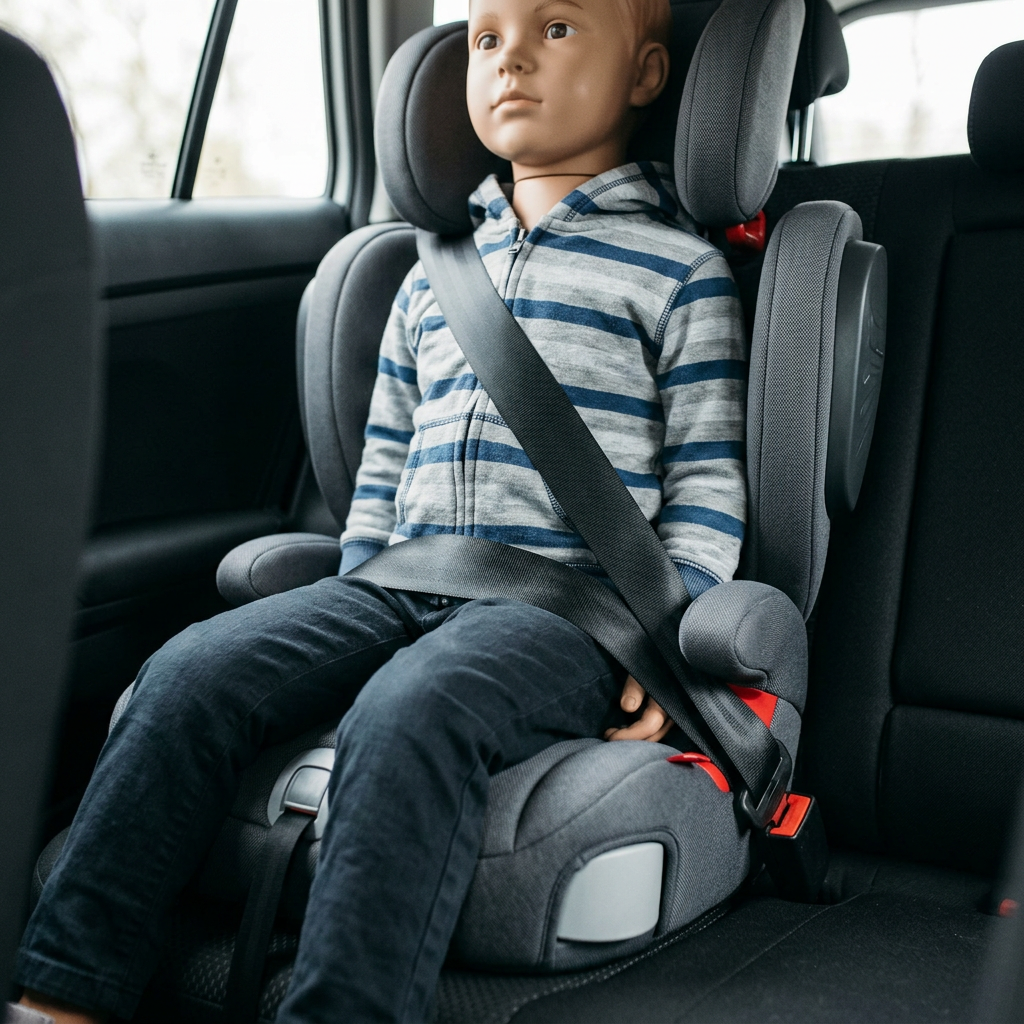
As your children grow, their safety needs inside your vehicle change dynamically. One of the most common points of confusion for parents is determining exactly when a child is physically ready to transition from a five-point harness car seat to a belt-positioning booster seat. Moving a child out of a harness too early is a widespread mistake that dramatically reduces their protection in the event of a collision. A five-point harness distributes crash forces across the strongest parts of a child’s skeletal structure (the shoulders and hips), whereas a booster seat relies entirely on the vehicle’s standard adult seat belt.

Safety standards and pediatric guidelines emphasize that children should remain in a forward-facing car seat with a five-point harness until they reach the maximum weight or height limits specified by their car seat manufacturer. Generally, children are not ready to transition to a booster seat until they are at least 4 years old and weigh at least 40 pounds. However, safety experts strongly recommend delaying this transition as long as possible—often up to 5 or 6 years of age, or until the child reaches 65 pounds, which is the upper limit of most modern convertible harness seats.

Beyond simple height and weight metrics, physical maturity and behavior are critical factors. A child in a booster seat must be mature enough to sit upright and relatively still for the entire duration of every car ride. If your child frequently slumps over, reaches for dropped toys, or pulls the shoulder belt behind their back, they are not yet ready for a booster seat and should remain in a secure five-point harness.

A mannequin child strapped into a high-back booster car seat in the back of a vehicle. (Representative image for illustration purposes only. Actual vehicle may vary based on trim and configuration.)

Ensuring proper seat belt alignment on a booster seat is critical to securing your growing child during every school journey.

Checking the Label: When Do Child Safety Seats Expire and How Do You Find the Expiration Date?

Many parents are surprised to learn that child safety seats have a strict lifespan and do, in fact, expire. Car seat expiration is not a marketing gimmick; it is a critical safety parameter based on material science and manufacturing engineering. The primary reason for expiration is plastic degradation. Over years of exposure to extreme temperature swings inside vehicles—such as the intense heat of a Kansas summer followed by freezing winter temperatures—the heavy-duty plastic frame of a car seat becomes brittle. This structural degradation can cause the seat to crack or fail entirely under the immense forces of a high-speed collision.

Furthermore, safety standards, crash-testing technology, and federal regulations change and improve over time. A car seat manufactured ten years ago does not feature the same advanced side-impact protection, material technology, or installation systems as a modern seat. Typically, most car seats expire six to ten years from their original date of manufacture, depending on the specific brand and model.

To locate your car seat’s expiration date, you must inspect the physical seat shell. Look for a white or silver manufacturer sticker or a stamp molded directly into the plastic on the back or underside of the seat. This label will list the brand name, model number, exact date of manufacture, and sometimes the explicit expiration date. If the sticker only lists the manufacture date, consult the owner’s manual or the manufacturer’s website to determine the specific model’s lifespan.

If you discover that your current car seat has expired, is damaged, or has been involved in a moderate-to-severe accident, it must be replaced immediately. Your child’s safety in the car pool lane is simply too important to compromise. If you need assistance finding or interpreting this label, our service staff at Valor Ford can help you locate it during your routine maintenance visit.

Why Credentials Matter: What Does ASE Certification Mean for an Automotive Technician?
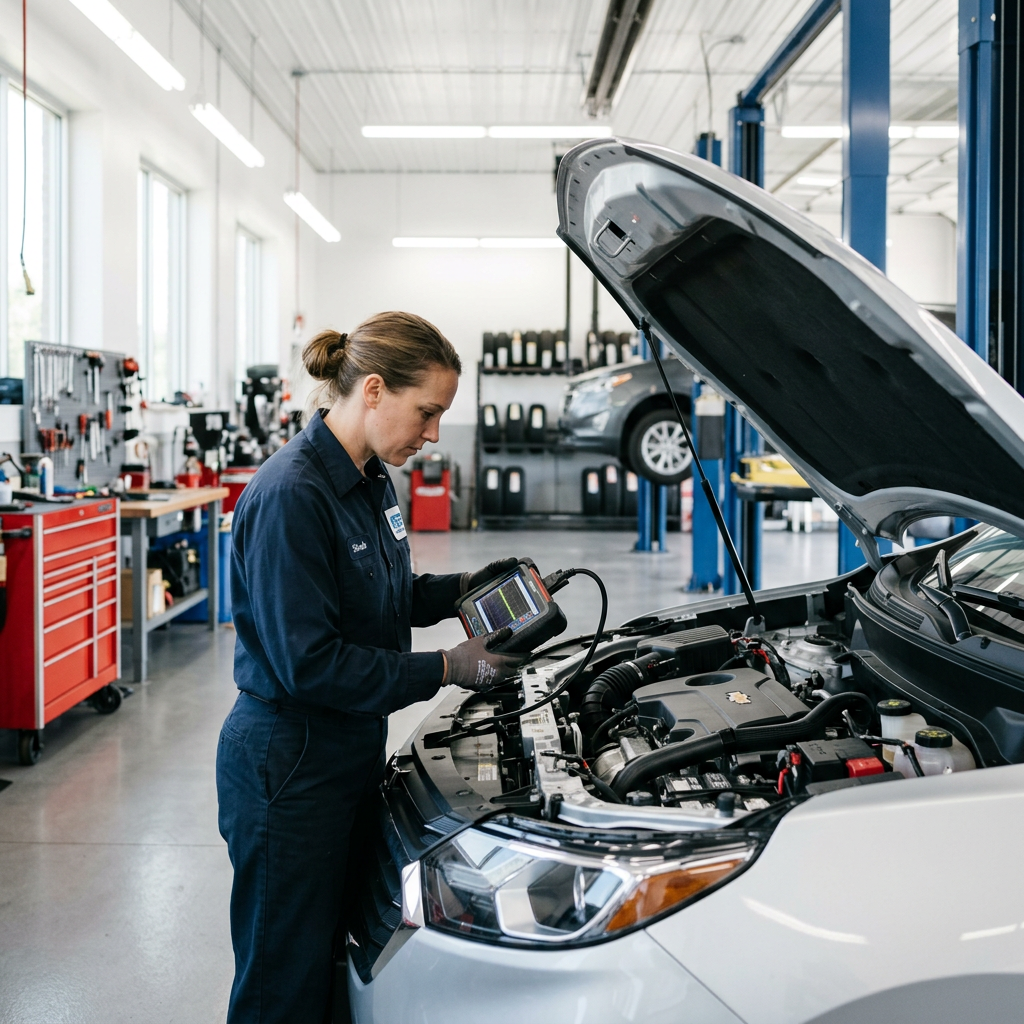
When you hand over your keys for service, you are trusting those individuals with your family’s safety. This is why professional credentials matter immensely. The gold standard of professional excellence in the automotive repair industry is certification from the National Institute for Automotive Service Excellence (ASE). When a technician is ASE-certified, it indicates that they have met rigorous, standardized requirements of technical expertise, experience, and professional dedication.

To earn ASE certification, a technician must complete at least two years of documented, hands-on professional work experience and pass a series of challenging specialty exams written by industry experts. These exams cover complex automotive systems, including engine repair, automatic transmissions, suspension and steering, brakes, electrical systems, heating and air conditioning, and engine performance. To maintain their certification, technicians must re-test every five years, ensuring they stay up-to-date with the rapid technological advancements of modern vehicles.

A female mechanic uses a diagnostic scanner on a car engine in a well-lit auto repair shop. (Representative image for illustration purposes only. Actual vehicle may vary based on trim and configuration.)

Our certified technicians undergo continuous training to ensure they possess the expert skills required to service your family vehicle safely.

At Valor Ford, we take incredible pride in our service team. Our service department is staffed by factory-trained, ASE-certified professionals who possess deep, specialized knowledge of Ford vehicles and all other major makes and models. When you choose us for your back-to-school service, you aren’t just getting a quick oil change—you are receiving elite mechanical service from certified professionals who understand exactly how to optimize your vehicle for safety and reliability. You can easily Schedule Pickup and Delivery Service to have our certified team handle your maintenance without interrupting your busy workday.

Upgrade Your Family Ride: Explore Safe and Spacious Vehicles in Junction City

Sometimes, regular maintenance is no longer the most cost-effective or safest path forward. If your current vehicle is struggling to keep pace with your family’s growing list of activities, or if you find yourself facing frequent, expensive repairs, it may be time to consider upgrading to a modern, safety-focused vehicle. A newer SUV or crossover offers advanced active safety features like blind-spot monitoring, pre-collision assist, and lane-keeping alerts that simply weren’t available a decade ago, providing a vital extra layer of protection during busy school commutes.
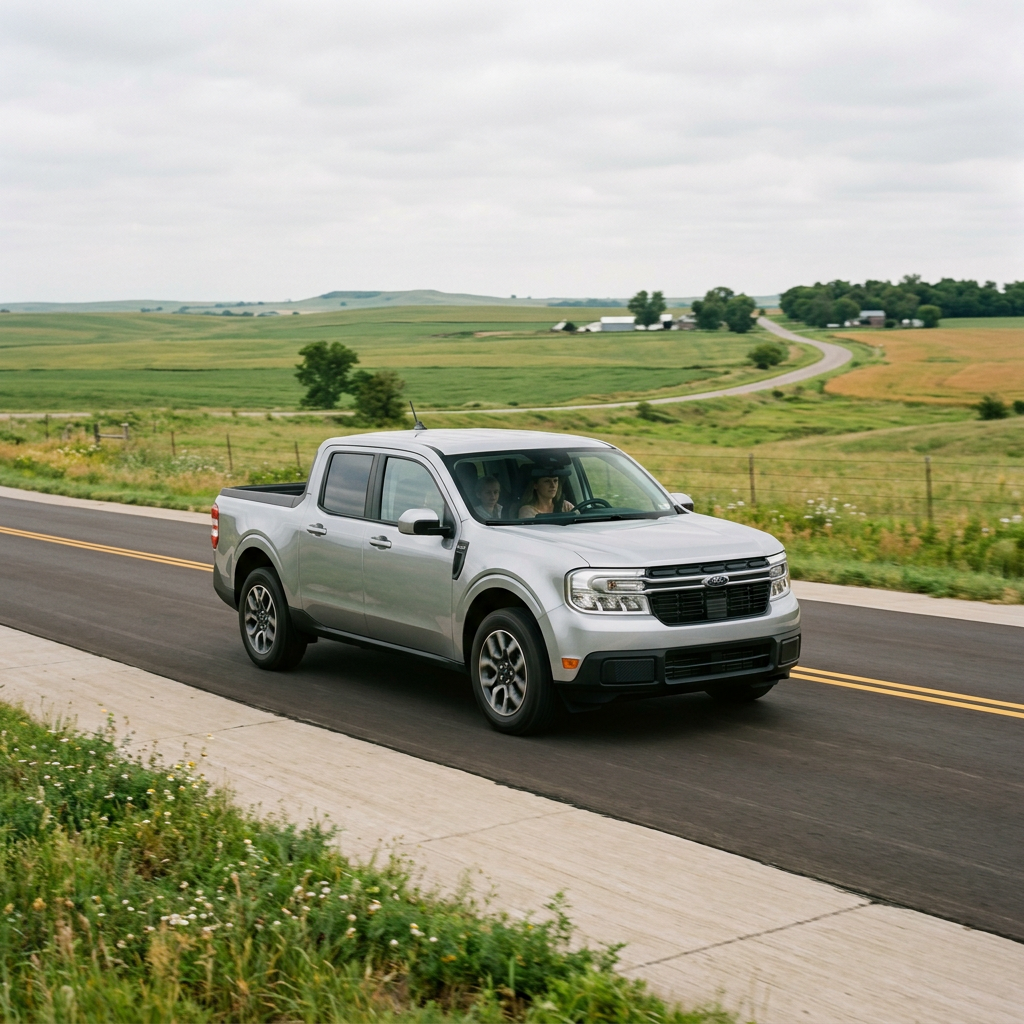
A gray Ford Explorer parked on a concrete driveway of a suburban house. (Representative image for illustration purposes only. Actual vehicle may vary based on trim and configuration.)

Ford Explorer

For growing families requiring flexible cargo space and comfortable three-row seating, the Ford Explorer is an industry benchmark. With advanced safety suites and room for up to seven passengers, it is built to master school carpools and weekend road trips alike. Learn more and Research Ford Explorer specifications to see why it remains a top choice for Junction City families.

A silver Ford Maverick pickup truck driving on a paved road through rolling green hills. (Representative image for illustration purposes only. Actual vehicle may vary based on trim and configuration.)

Ford Maverick

If you need a highly versatile vehicle that blends utility with incredible fuel economy, this compact pickup is a stellar option. Perfect for hauling sports gear and band equipment while delivering exceptional MPG, it is a smart choice for active families. You can Research Ford Maverick features to see if this versatile truck fits your lifestyle.

A gray Ford F-150 pickup truck parked on a gravel path next to a high school football field. (Representative image for illustration purposes only. Actual vehicle may vary based on trim and configuration.)

Ford F-150

For families who need massive cabin space, serious towing capacity for weekend toys, and maximum utility, America’s favorite truck is the answer. Modern SuperCrew models offer rear legroom that rivals luxury sedans, ensuring comfortable rides for teenagers. Take a moment to Research Ford F-150 trims and capability today.

Ready to explore your options? We make it simple to evaluate your next move. Get started online with a quick Trade In Evaluation of your current vehicle, or begin the process of upgrading by applying to Apply for Financing right from the comfort of your home.

August Car Care Planning Guide for Geary County Parents

To make your back-to-school vehicle prep as seamless as possible, we have mapped out a simple, chronological timeline for August. Breaking these tasks down week-by-week ensures you don’t find yourself overwhelmed during the final countdown to the first day of school.

Timeline

Key Tasks & Focus Areas

Why It Matters Now

Week 1: Early August

Schedule professional safety inspections, battery tests, and brake checks at Valor Ford.

Ensures you beat the late-August rush and can order any necessary replacement parts without delay.

Week 2: Mid-August

Inspect child safety seats, check expiration dates, and adjust harness strap heights for growing kids.

Gives you time to research and purchase new safety seats if your current ones are expired or outgrown.

Week 3: Late Mid-August

Perform fluid checks (coolant, oil, windshield washer fluid) and schedule synthetic oil changes.

Prepares the engine mechanicals for the high thermal stress of stop-and-go school idling lanes.

Week 4: Late August

Deep clean the vehicle interior, organize emergency road kits, and complete final tire pressure adjustments.

Sets a clean, organized, and stress-free environment for the first morning commute of the new school year.

By adhering to this structured timeline, you can transform a potentially stressful chore into an organized, manageable routine. If you need any assistance along the way, remember that you can easily Order Genuine Ford Parts directly through our website to keep your vehicle’s maintenance right on track.

Secure Your Peace of Mind: Visit Valor Ford for Your Back-to-School Service
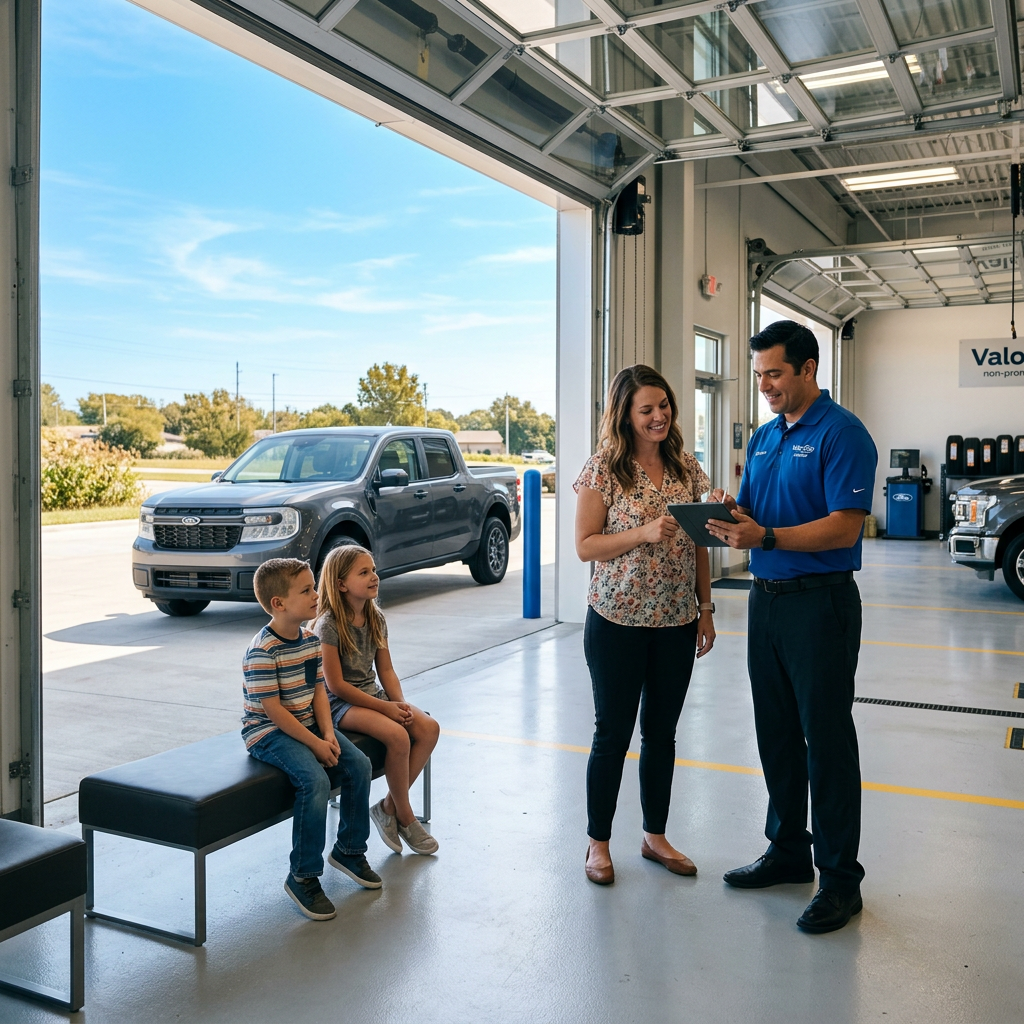
As you finalize your back-to-school shopping lists and prepare your family for the exciting challenges of the upcoming academic year, let Valor Ford take care of your peace of mind on the road. A reliable, fully inspected vehicle is the foundation of a safe, stress-free school routine. Don’t wait for a warning light or an unexpected breakdown to interrupt your morning schedule. Visit our professional facility in Junction City, KS, and let our factory-trained, ASE-certified team ensure your car, truck, or SUV is performing at its absolute best.

Need directions to our dealership? You can easily Get Directions to Valor Ford at 1825 Goldenbelt Blvd, Junction City, KS 66441. If you have questions about specific vehicle services or want to speak directly with our service advisors, please Call us at (785) 238-5114. We are here to support our local community and ensure that every school journey this year is a safe, dependable one.

A service advisor reviews a tablet with a female customer in an auto service bay while two kids sit nearby. (Representative image for illustration purposes only. Actual vehicle may vary based on trim and configuration.)

Welcome to Valor Ford: Your Premier Destination for New Ford Vehicles and Trusted Auto Sales in Junction City

For generations, the rolling hills and expansive plains of Geary County have demanded vehicles that are as resilient, hardworking, and dependable as the people who drive them. Here at Valor Ford, located in the heart of Junction City, KS, we don’t just sell cars, trucks, and SUVs; we build lasting relationships based on transparency, mutual respect, and an unwavering commitment to our local community. Whether you are commuting from nearby Fort Riley, heading out for a weekend of recreation at Milford State Park, or managing a demanding agricultural operation in Dickinson County, finding the right vehicle is paramount. We believe that the car-buying process should be clear, straightforward, and entirely free of stress, which is why we focus heavily on providing informative, transparent sales content to guide your research before you ever set foot on our showroom floor.

As your premier automotive partner, we understand that purchasing a new or pre-owned vehicle is a major financial milestone. Our experienced team is dedicated to empowering you with the exact specifications, real-world performance comparisons, and straightforward pricing structures you need to make an informed decision. We take great pride in serving our active-duty military personnel, veterans, local business owners, and growing families with tailored incentives and custom solutions. We invite you to explore our comprehensive guide below, designed to answer your most pressing automotive questions. When you’re ready to take the next step, please Get Directions to Valor Ford and visit us in person, or simply Call us at (785) 238-5114 to chat with one of our friendly sales professionals.

Our dealership at 1825 Goldenbelt Blvd is fully equipped to handle every aspect of your automotive journey, from initial research and flexible financing to certified mechanical service and genuine OEM parts. We believe in providing an informative, neighborly experience that honors the values of Junction City. In this detailed guide, we will break down the capabilities of the latest 2026 Ford Explorer, compare head-to-head interior dimensions against key rivals, outline F-150 pricing and cabin technology, explain our specialized military appreciation programs, and demonstrate how our home delivery services bring the ultimate dealership experience directly to your driveway in Manhattan or Abilene. Read on to discover the Valor Ford difference.

Logo for Valor Automotive featuring a blue and silver shield with 'VA' and the company name with a red star.

What Are the Key Performance Specs of the 2026 Ford Explorer?
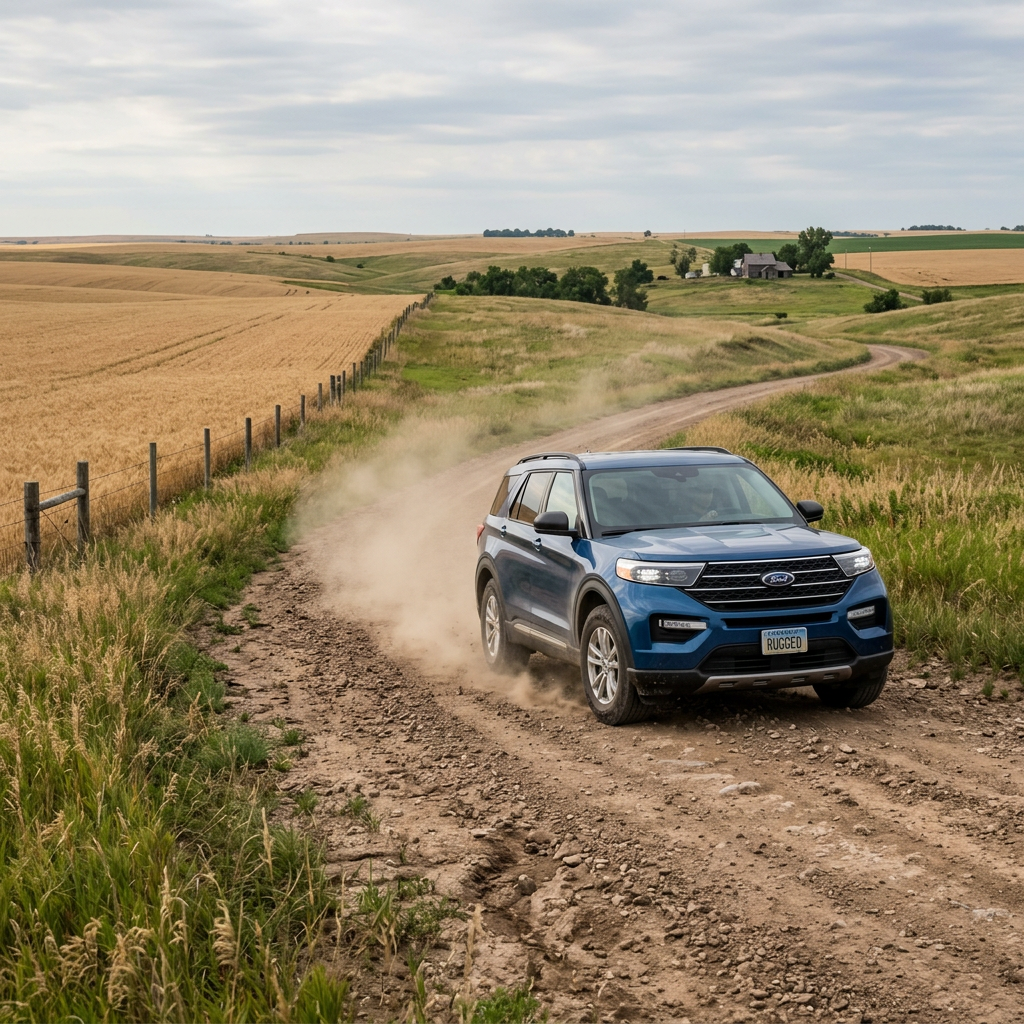
The 2026 Ford Explorer is engineered to conquer everything from fast-paced highway commuting along I-70 to rugged, off-the-beaten-path trails across the rolling plains of northeastern Kansas. For local drivers, having a vehicle that balances daily fuel efficiency with robust, dependable power is essential. The latest Explorer meets this demand head-on with two potent EcoBoost® engine options. The standard 2.3-liter EcoBoost I-4 engine delivers an impressive 300 horsepower and 310 lb-ft of torque, providing plenty of punch for passing maneuvers and highway merging. For those seeking maximum thrill and heavy-duty performance, the available 3.0-liter EcoBoost V6 engine pumps out a commanding 400 horsepower and 415 lb-ft of torque, making it a class-leading powerhouse.

Towing is another area where the Explorer shines. When properly equipped with the Class III Trailer Tow Package, both the 2.3L and 3.0L engines allow you to tow up to 5,000 pounds with ease. This means hauling your family camper, a pair of ATVs, or a speed boat down to the lake is completely stress-free. To help manage varying road conditions—such as sudden winter snowstorms or muddy gravel roads—the standard Intelligent 4WD system works in perfect harmony with the Terrain Management System™. This customizable drive-mode selector features up to seven distinct modes, including Normal, Eco, Sport, Tow/Haul, Slippery, Trail, and Deep Snow/Sand, instantly optimizing throttle response, transmission shift points, and traction control parameters to keep you firmly in control.

To learn more about how this versatile SUV handles and to explore custom packages, you can Research Ford Explorer in depth on our dedicated research portal. We always have a highly trained product specialist ready to walk you through these advanced engineering details in person.

A blue Ford Explorer kicks up dust while driving along a winding dirt road through rolling hills and fields. (Representative image for illustration purposes only. Actual vehicle may vary based on trim and configuration.)

Engine Option

Horsepower

Max Towing Capacity

2.3L EcoBoost® I-4

300 hp

Up to 5,000 lbs

3.0L EcoBoost® V6

400 hp

Up to 5,000 lbs

Which SUV Has More Third-Row Legroom: Explorer or Highlander?

For growing families in Geary County, interior space isn’t just a convenience—it’s a daily necessity. When comparing three-row midsize SUVs, the head-to-head match-up between the 2026 Ford Explorer and the Toyota Highlander is a frequent topic of discussion. While both vehicles are highly regarded, a closer look at the third-row comfort and cargo utility reveals why the Ford Explorer remains the superior choice for family road trips, grocery runs, and carpooling duties alike.

Third-Row Legroom

The 2026 Ford Explorer is meticulously designed to maximize passenger comfort in every row. It offers a generous 32.2 inches of third-row legroom, paired with a sculpted seatback design that allows teenagers and adults to sit comfortably during longer drives. In contrast, the Toyota Highlander restricts third-row passengers to a cramped 27.7 inches of legroom, making its rear seats suitable almost exclusively for very small children.

Cargo Versatility

Beyond sheer passenger room, the Explorer’s cargo area is highly adaptable. With the third-row seats folded flat, the Explorer opens up a massive cargo floor that easily accommodates sports gear, large coolers, or luggage. The vertical side walls and lower cargo load floor height mean loading bulky items is much easier in the Explorer than in the Highlander, which suffers from a narrower rear hatch opening and a more restrictive interior layout.

Cabin Experience

Ford’s commitment to cabin refinement is evident in the acoustic windshield and quiet-tuned interior materials that keep Kansas wind noise at bay. The second-row E-Z Entry seats slide forward effortlessly at the touch of a button, providing clear, wide access to the third row without struggling. The Highlander’s mechanical release levers are stiffer and the entry pathway is significantly narrower, complicating daily family use.

How Much Does the 2026 Ford F-150 Cost?
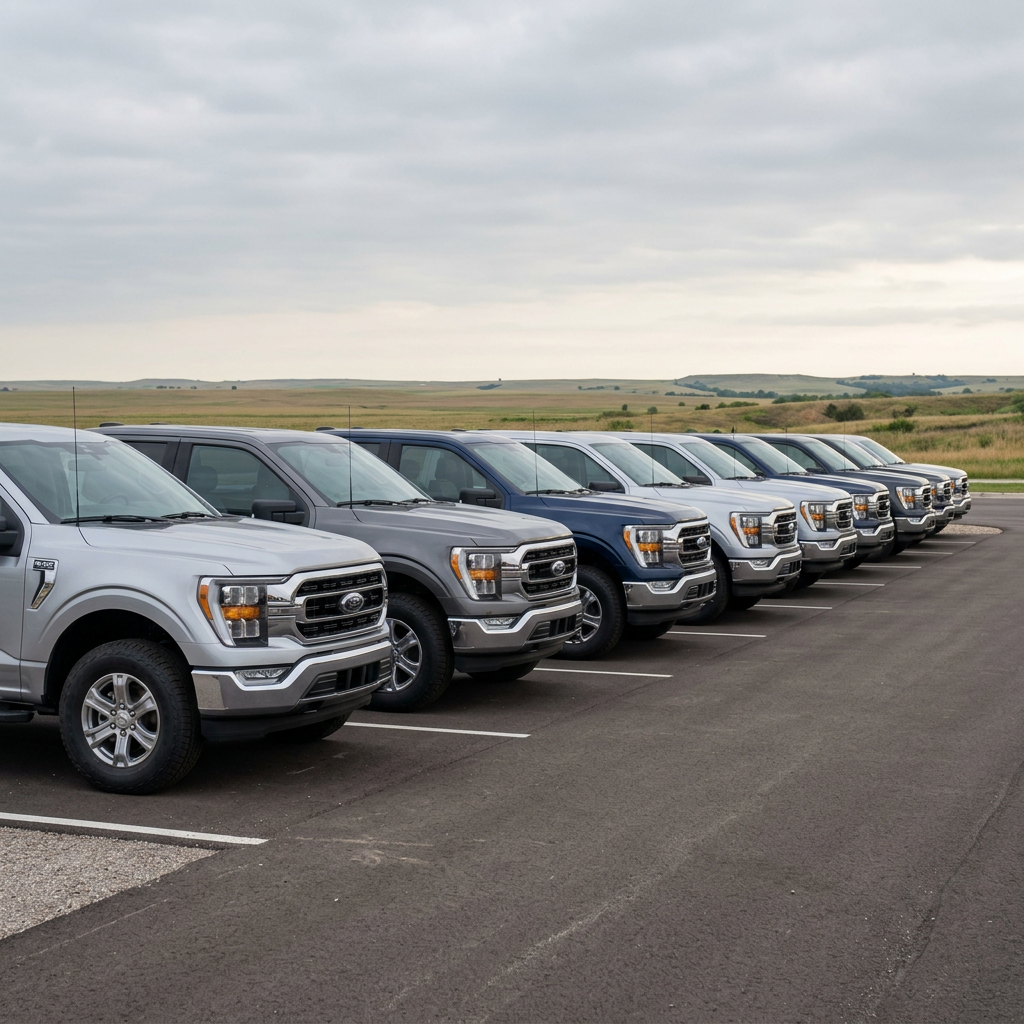
The Ford F-150 has been America’s best-selling pickup truck for decades because it offers a configurations for every lifestyle and budget. Whether you’re looking for a stripped-down, reliable work truck like the F-150 XL to manage tasks around the job site, or a luxurious, feature-packed mobile office like the Platinum, or even the high-flying off-road capability of the F-150 Raptor, there is a trim and price point tailored specifically for you.

Pricing for the 2026 Ford F-150 starts with very competitive entry-level MSRPs on work-ready trims, moving up through mid-tier options like the highly popular XLT and Lariat, and capping at the high-end luxury and performance trims. Because manufacturer packages, incentives, and current pricing change frequently, our sales team at Valor Ford works hard to provide completely transparent pricing structures with zero hidden fees. We help you navigate available powertrain choices, bed lengths, cab styles, and technology packages so you only pay for the features you truly need.

We make the financial planning process completely seamless with our suite of online finance tools. You can easily Get Pre-Approved for Financing from the comfort of your home, saving you valuable time at the dealership. Our finance department works with local Kansas banks and major national lenders to secure the most competitive interest rates and flexible terms for your budget.

A row of brand new Ford F-150 trucks parked in a lot under an overcast sky. (Representative image for illustration purposes only. Actual vehicle may vary based on trim and configuration.)

To explore specific trim configurations, technical specifications, and custom package upgrades, please take a moment to Research Ford F-150. Let our team help you design the perfect truck to fit your work demands and recreational needs.

Does the Silverado or F-150 Have a Better Interior Screen Setup?

Modern light-duty trucks serve as mobile offices, weekend adventure rigs, and daily family haulers all at once, making interior cabin technology more critical than ever. When comparing the digital experiences of the Ford F-150 versus the Chevrolet Silverado, screen size is only half of the story. The software responsiveness, intuitive physical button placement, and overall user interface design dictate how stress-free your daily commute or towing operations will be.

The Ford F-150 features an incredible, standard 12-inch capacitive touchscreen infotainment display running the state-of-the-art SYNC® 4 technology. What makes Ford’s screen setup stand out is the seamless split-screen capability, allowing you to view your navigation route on one side while managing your media playlist or towing monitors on the other. This standard 12-inch screen is matched with a highly customizable 12-inch digital productivity cluster directly behind the steering wheel, delivering all vital vehicle statistics, safety alerts, and off-road pitch/roll metrics in crystal-clear, high-definition graphics.

On the other hand, while the Chevrolet Silverado offers an impressive 13.4-inch display on its mid-to-high trims, the entry-level configurations are left with a smaller touchscreen on entry-level configurations. Furthermore, Chevrolet’s software depends heavily on Google built-in services, which can require ongoing subscription fees to utilize full offline mapping and voice assistant features. Ford’s SYNC® 4 system provides highly advanced, natural voice recognition and standard wireless Apple CarPlay® and Android Auto™ across all trims without forcing you into expensive long-term digital subscriptions.

Additionally, Ford masterfully balances modern touchscreen technology with physical knobs and buttons for primary climate control and audio volume adjustments. This thoughtful layout ensures that you can adjust temperature or radio volume while wearing heavy work gloves, a practical benefit that Chevrolet’s increasingly menu-dependent touch screen setup struggles to match.

Are There Military Discounts Available at Valor Ford?

Located just a short drive from the historic gates of Fort Riley, home of the legendary 1st Infantry Division (‘The Big Red One’), everyone at Valor Ford holds a deep sense of gratitude and respect for our active-duty service members, military veterans, and their families. We understand the unique challenges of military life—including frequent PCS moves, demanding deployments, and the need for reliable, versatile transportation that can keep up with your household. To honor your incredible service, we are proud to offer exclusive military appreciation bonus cash, specialized financing incentives, and tailored lease options designed to fit your unique financial situation.

Our military verification process is designed to be as fast, simple, and transparent as possible. By partnering with standard verification networks, we can quickly apply your military cash rewards and available financing options directly to your deal. Whether you are searching for a fuel-efficient daily driver, a rugged truck, or a spacious family SUV, our sales specialists will ensure you receive every dollar of savings you deserve. We also welcome military spouses and dependents to take advantage of these special programs, and we are happy to assist with remote paperwork processing if your spouse is currently deployed overseas.

Illustration of an American soldier in camouflage shaking hands with a smiling family against a US flag background. (Representative image for illustration purposes only. Actual vehicle may vary based on trim and configuration.)

Does Valor Ford Offer Vehicle Delivery to Nearby Cities Like Manhattan, KS?

Home Delivery Service

At Valor Ford, we understand that your schedule is incredibly busy. If you live in nearby Manhattan, KS, Abilene, or across Dickinson and Riley Counties, we make the buying process simple by offering convenient home delivery options. Once you finalize your paperwork online or over the phone, our professional delivery team will transport your new or pre-owned Ford vehicle directly to your driveway, sparkling clean and ready to drive.

Remote Purchase Process

You can complete nearly your entire automotive purchase online. From browsing our extensive inventory to valuing your trade-in, calculating your monthly payments, and securing financing, our secure online portal makes car buying entirely remote-friendly. We provide digital signatures for all required paperwork, allowing you to buy on your schedule and completely avoid dealership waiting rooms.

At-Home Test Drives

Unsure how a vehicle will fit in your home garage or handle on your daily neighborhood roads? We can arrange to bring the vehicle directly to your home or office for an at-home test drive. This allows you to experience the ride, check seat layouts, and test cargo dimensions in a pressure-free environment before making a final commitment, ensuring total satisfaction with your purchase.

Our commitment to seamless, modern retail is why so many customers in Geary and Riley Counties choose Valor Ford over dealerships located in larger metropolitan areas. If you prefer a traditional experience, you can always Get Directions to Valor Ford and visit us to browse our physical lot. We are always happy to answer your questions—simply Call us at (785) 238-5114 to get connected today.

Is the First Oil Change Free on a New Ford?
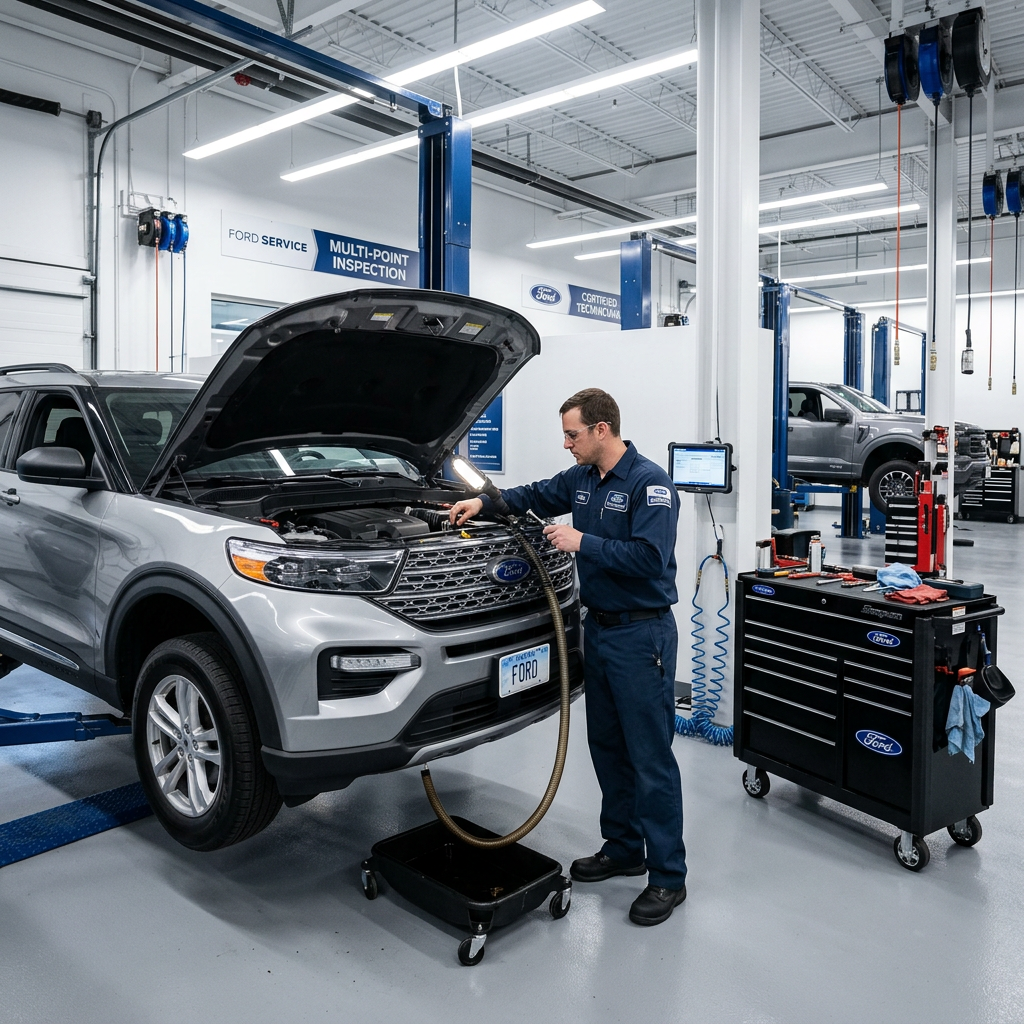
Keeping your new Ford running at peak performance is our top priority. One of the most frequent questions our service advisors receive is whether the first oil change is free. While policies can vary depending on specific purchase agreements and dealership promotions, every single customer who buys a brand-new vehicle from Valor Ford is automatically enrolled in the incredible FordPass™ Rewards program. This program is designed to make maintaining your new vehicle completely stress-free.

When you buy or lease a new Ford and activate your FordPass Connect™ account, you may be eligible to earn FordPass Rewards Points that can help offset eligible service visits, subject to current program terms.

Our state-of-the-art Junction City service center is staffed by factory-trained, Ford-certified technicians who use only genuine Motorcraft parts. When your vehicle is ready for its routine service, you can easily Schedule Ford Service Today online. To make your life even easier, we also offer convenient pickup and delivery options—you can easily Schedule Pickup and Delivery Service to have us collect, service, and return your vehicle while you work.

A Ford service technician performs maintenance on a silver SUV in a well-lit dealership service bay. (Representative image for illustration purposes only. Actual vehicle may vary based on trim and configuration.)

Additionally, if you ever need specific replacement components or custom accessories, you can directly Order Genuine Ford Parts from our certified parts catalog to ensure a perfect fit and long-term durability.

Value Your Trade-In and Maximize Your Buying Power in Junction City

Instant Market Analysis

Before you purchase a new vehicle, it’s vital to understand the exact value of your current ride. Our advanced trade-in tool analyzes real-time market data across Kansas to ensure you receive a fair, highly competitive valuation. Knowing this figure helps you plan your overall budget with complete clarity and precision.

Lower Your Down Payment

Trading in your current vehicle is one of the most effective ways to lower your overall monthly payment. By applying the positive equity of your trade directly to your down payment, you can reduce the principal amount financed, lower your interest costs over the life of your loan, and potentially qualify for better financing rates.

Tax Advantages

Did you know that trading in your vehicle can save you significant money on sales tax? In Kansas, you only pay sales tax on the net price of your purchase (the price of the new vehicle minus the value of your trade-in). This local tax advantage can instantly save you hundreds of dollars compared to selling your vehicle privately.

Ready to discover what your current vehicle is worth in the current market? Take just two minutes to complete our online Trade In Evaluation form. It is entirely secure, requires no obligation, and provides a market estimate that our team will review and confirm upon physical inspection.

Explore Our Current Inventory or Schedule Your Test Drive at Valor Ford Today

There has never been a better time to upgrade your drive. At Valor Ford, we are proud to offer an expansive selection of brand-new Ford vehicles, alongside an incredible inventory of high-quality, fully inspected pre-owned models. Whether you are searching for the rugged off-road capability of a Bronco, the unmatched capability of an F-150, or the spacious versatility of an Explorer, we are confident that the perfect vehicle is waiting for you on our sales lot in Junction City.

We invite you to browse our massive selection of pre-owned cars, trucks, and SUVs by exploring our online inventory—simply click here to Browse Used Inventory. If you are specifically hunting for a rugged, off-road champion, you can also Shop New Ford Bronco Inventory to check out our latest arrivals. No matter where you are in your research process, our team is here to support you with expert advice, friendly service, and straightforward pricing.
A Ford representative hands car keys to a military family next to a silver Ford Explorer in a dealership lot. (Representative image for illustration purposes only. Actual vehicle may vary based on trim and configuration.)

Visit Valor Ford at 1825 Goldenbelt Blvd, Junction City, KS 66441 or give us a call today. Let us show you how simple, transparent, and exciting buying a vehicle can truly be!

Pre-Harvest Ford Super Duty Inspection: Getting Your F-250 and F-350 Ready for the Kansas Fields
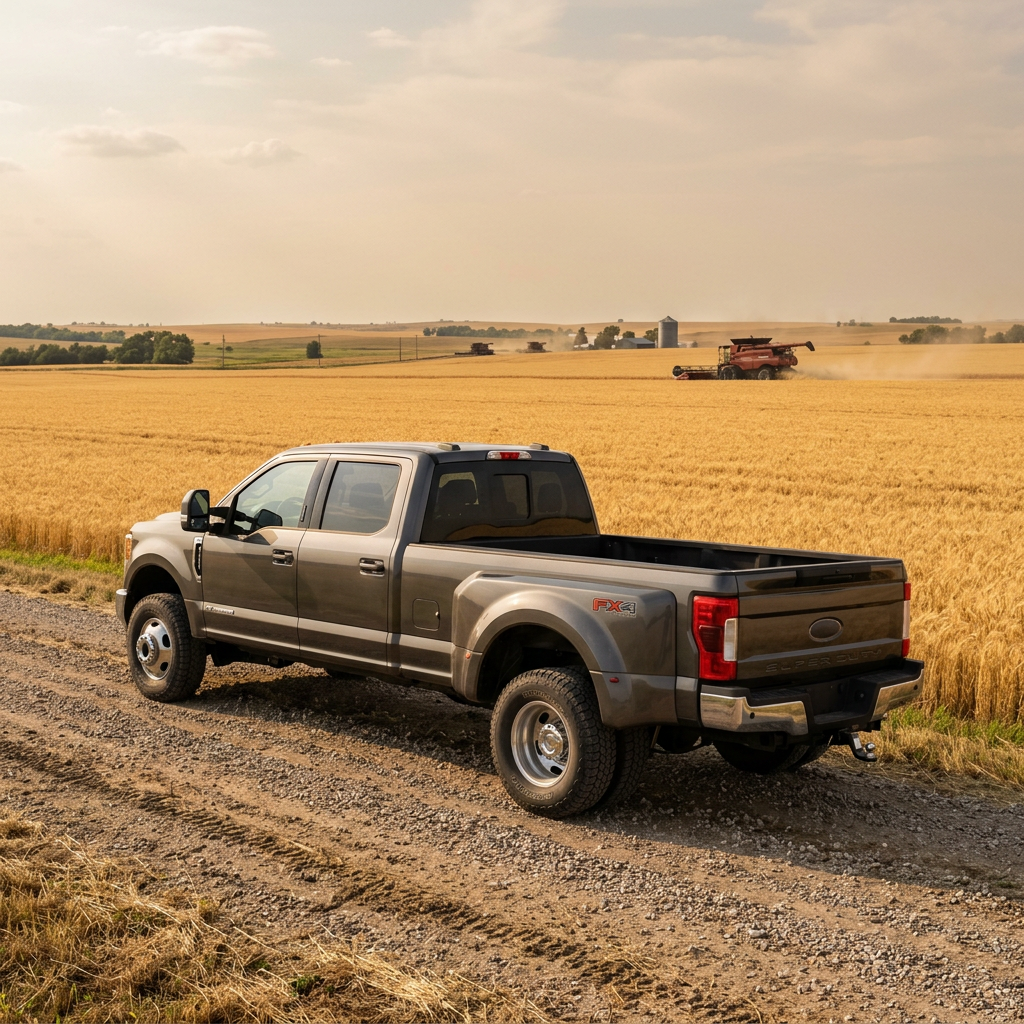
A gray Ford F-350 dual-rear-wheel pickup truck parked on a gravel path next to a golden wheat field with a combine harvester. (Representative image for illustration purposes only. Actual vehicle may vary based on trim and configuration.)

As the hot mid-summer sun beats down on Geary and Dickinson counties, Kansas farmers know that the most demanding time of the year is rapidly approaching. Harvest season is not just a period of intense labor; it is a high-stakes, time-sensitive window where every single hour of daylight translates directly to operational profitability. In this demanding landscape, your truck is not merely a mode of transportation. It is the absolute backbone of your agricultural operation. Whether you are operating a robust Ford F-250 or a dual-rear-wheel F-350, these heavy-duty workhorses are tasked with hauling massive seed tenders, moving loaded grain trailers, transporting heavy tillage equipment, and navigating rough, unpaved field boundaries. When a truck goes down in the middle of a harvest push, the entire workflow grinds to a devastating halt, costing thousands of dollars in delayed grain delivery, idle labor, and potential weather exposure for unharvested crops.

Proactive fleet and truck maintenance is the primary line of defense against these catastrophic, mid-season mechanical failures. In agriculture, we often talk about preventative maintenance on combines, tractors, and grain carts, but the trucks that link the field to the local co-op elevator are frequently overlooked until it is too late. The extreme summer heat of July, combined with the powdery, abrasive dust kicked up by harvesting machinery, creates a brutally hostile environment for internal combustion engines, cooling systems, and electrical components. A thorough, systematically executed pre-harvest inspection ensures that hidden vulnerabilities—such as micro-cracks in serpentine belts, degraded diesel exhaust fluid, or contaminated brake lines—are identified and corrected in the controlled environment of a service bay rather than under the stressful conditions of a remote dirt road.

At Valor Ford, located right here in Junction City, KS 66441, we understand the unique pressures of the Kansas agricultural calendar. We know that when the wheat, corn, or soybeans are ready, there is very little room for error. That is why we advocate for a comprehensive, multi-point pre-harvest inspection for every F-250 and F-350 operating in our community. By partnering with our factory-trained diesel and heavy-duty chassis specialists, you can head into the fields with the absolute confidence that your Super Duty is fully optimized to handle the punishing payloads and relentless towing demands of the season. To make sure you do not lose a single day of productivity, you can easily Schedule Pickup and Delivery Service with our team, allowing us to service your truck while you focus on setting up your grain handling equipment and prepping your combines.

Investing a small amount of time in preventative care today saves you from the immense headaches of emergency towing charges, premium rush-shipping fees on parts, and lost productivity tomorrow. Our specialized agricultural technicians are deeply integrated into the local farming community, meaning we know exactly which components fail first under local driving conditions. From the steep gravel hills surrounding Dwight and Alta Vista to the muddy bottomlands along the Republican River, we know how to prep your suspension, drivetrain, and electrical systems to handle the specific topography of central Kansas. Let’s dive deep into the specific systems that require your immediate attention before the first header enters the field.

What are the key pre-harvest maintenance checks for a Ford Super Duty?

Pre-harvest truck prep is far more comprehensive than a standard quick-lube oil change. Because your F-250 or F-350 will be operating at or near its maximum Gross Vehicle Weight Rating (GVWR) and Gross Combined Weight Rating (GCWR) for weeks on end, every subsystem must be operating at peak efficiency. The combination of heavy payloads, slow speeds in dusty fields, and high ambient temperatures places an extraordinary thermal and mechanical load on the vehicle. Below, we break down the critical technical areas that our certified technicians evaluate during a professional pre-harvest inspection.

1. Cooling & Air Systems

Kansas summer heat combined with field chaff is a recipe for engine overheating. We perform a complete pressure test of the primary and secondary cooling loops (especially on the dual-radiator 6.7L Power Stroke). We also inspect the radiator fins for blockages, check the operation of the electrostatic cooling fan clutch, and evaluate the condition of all coolant hoses. Furthermore, we check your engine air filter and cabin air filter, replacing them with high-efficiency Motorcraft filters to keep abrasive field dust out of your combustion chambers and out of your lungs while driving down dusty dirt roads.

2. Heavy-Duty Braking

Stopping a loaded grain trailer or a heavy liquid fertilizer nurse tank requires immense stopping power. Our technicians measure brake pad thickness, inspect rotor surface wear for heat checking or grooving, and perform a complete brake fluid flush if moisture levels are high. Moisture in brake fluid can boil under the extreme heat of heavy hauling, leading to a soft pedal and terrifying brake fade. We also inspect the integrated trailer brake controller system, verifying that the signal outputs are correctly calibrated and communicating with your trailer’s electric or hydraulic brakes.

3. Suspension & Electrical

A farm truck’s suspension takes a beating over deep ruts and uneven terraces. We inspect the front twin-I-beam or solid axle leaf-spring assemblies, track bars, tie rods, and ball joints for excess play. We also examine the rear leaf springs, auxiliary helper springs, and shock absorbers to ensure they can handle high-payload tongue weights without sagging dangerously. Finally, we clean and test the battery terminals, inspect the alternator output, and verify the integrity of the 7-pin and 4-pin trailer wiring connectors, which are prone to corrosion from field moisture and road grime.

Beyond these three primary pillars, we also check tire tread depth and inflation pressures—specifically adjusting them to the maximum recommended cold PSI for high-load towing. Driving on underinflated tires while carrying a heavy payload is the leading cause of tire blowouts, which can be catastrophic on single-rear-wheel trucks navigating narrow highways. If your truck is due for fresh fluids, filters, or mechanical adjustments, contact us for service. You can quickly Order Genuine Ford Parts directly from our parts department to perform maintenance at home, or let our experienced team handle the dirty work for you.

Remember, a single failure of a $50 sensor or a split coolant hose can leave you stranded on the side of Highway 77, holding up an entire crew of combine operators, truck drivers, and grain cart operators. By addressing these weak points before the season begins, you protect your bottom line, ensure the safety of your operators, and maximize the operational longevity of your truck.

Evaluating Your Powertrain: What is the typical lifespan of a 6.7L Power Stroke diesel engine?
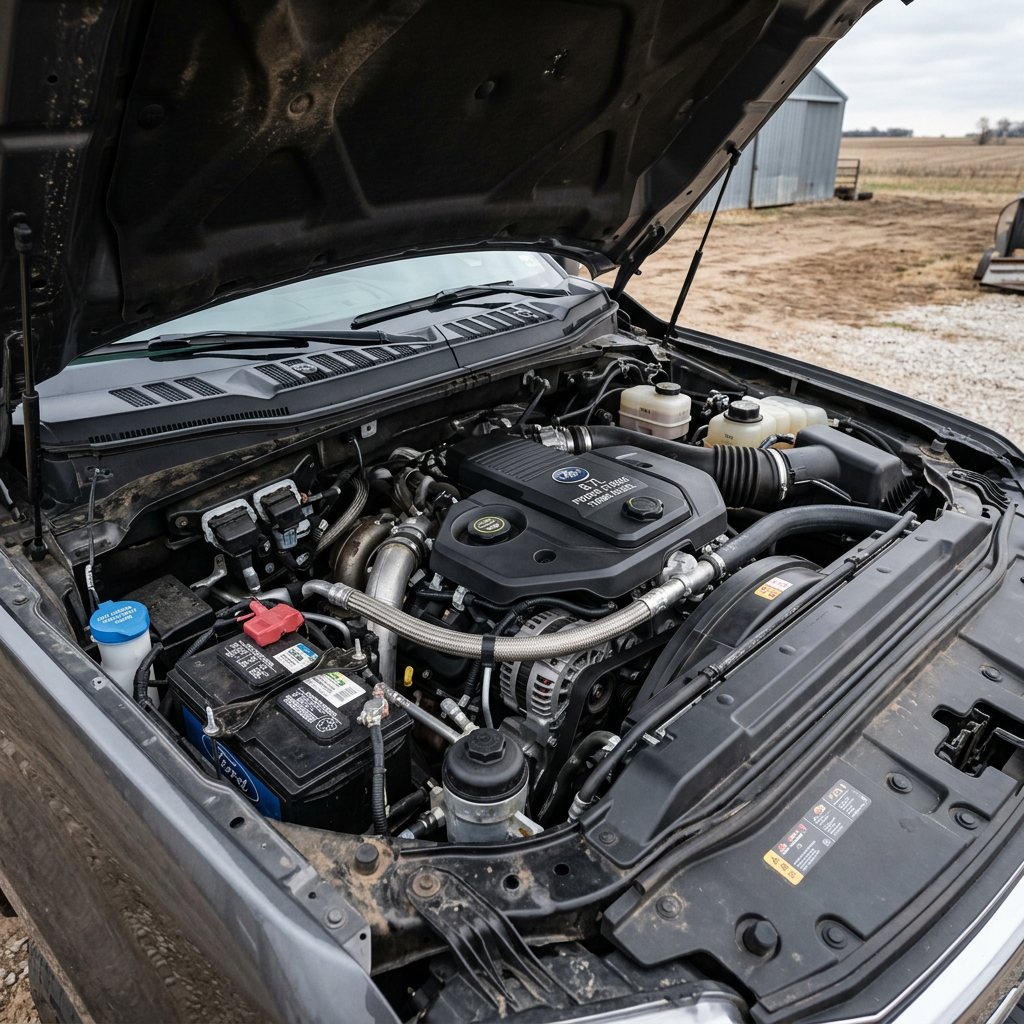
Open hood of a modern pickup truck revealing a clean, powerful diesel engine. (Representative image for illustration purposes only. Actual vehicle may vary based on trim and configuration.)

For many Kansas agricultural operations, the 6.7L Power Stroke V8 Turbo Diesel is the absolute gold standard of heavy-duty power. Known for its incredible low-end grunt and smooth power delivery, this engine is designed from the ground up for commercial-grade durability. When discussing longevity, the typical lifespan of a 6.7L Power Stroke diesel engine routinely exceeds 300,000 miles—and it is not uncommon to see meticulously maintained examples pushing past 400,000 or even 500,000 miles of hard farm use. However, achieving this legendary durability requires a strict adherence to heavy-duty maintenance schedules, particularly when the truck is subjected to the high-load, high-temperature, and extremely dusty conditions typical of Kansas field operations.

The secret to maximizing the lifespan of your Power Stroke diesel lies in your fluid and filtration maintenance habits. Unlike gasoline engines, modern clean-diesel engines utilize highly sophisticated high-pressure common-rail fuel injection systems operating at pressures exceeding 36,000 PSI. At these extreme tolerances, even micro-particles of dirt or trace amounts of water in the fuel can cause premature injector failure or high-pressure fuel pump (CP4) damage. Regularly draining the fuel-water separator and replacing both fuel filters every 15,000 miles is non-negotiable. Additionally, because diesel exhaust fluid (DEF) and complex emissions control systems are standard, avoiding prolonged, excessive idling is critical. Excessive idling leads to soot buildup in the Diesel Particulate Filter (DPF), which triggers frequent regeneration cycles and dilutes your engine oil with unburned fuel.

Furthermore, high-stress towing during harvest places extreme demands on your engine’s lubricants. During peak harvest, your transmission and differential fluids are subjected to sustained high temperatures. Standard oil change intervals should be shortened under these ‘severe duty’ operating conditions. We highly recommend utilizing high-quality synthetic lubricants that offer superior thermal stability and shear resistance. While the diesel powertrain offers unmatched torque and long-term durability, Ford’s rugged gasoline engines—such as the 7.3L Godzilla V8—also present an incredibly compelling, low-maintenance alternative for farms that do not accumulate massive annual highway mileage but still require substantial payload and towing capabilities. If you are considering adding another highly reliable truck to your farm fleet, you can Browse Used Inventory at Valor Ford to find a wide selection of thoroughly inspected gas and diesel Super Duty models ready to go to work.

Comparing Engine Capabilities: What is the difference in towing capacity between the 6.7L Power Stroke and the 7.3L gas V8?

To maximize operational efficiency during harvest, you must match your truck’s mechanical capabilities to the specific payloads you intend to haul. Choosing between the torque-monster 6.7L Power Stroke Turbo Diesel and the highly reliable, naturally aspirated 7.3L Godzilla V8 is one of the most critical decisions Kansas farmers face when configuring their fleet. While both engines are exceptionally capable, they deliver their power in fundamentally different ways, which directly impacts their conventional and gooseneck towing capacities.

The 6.7L Power Stroke diesel is built for maximum towing limits and effortless long-distance hauling. With its massive torque output peaking low in the RPM range, the diesel engine makes pulling a 20,000-pound gooseneck livestock trailer or a heavy liquid fertilizer tank feel completely effortless, even when climbing the rolling hills of Geary County. On the other hand, the 7.3L gas V8 offers an exceptionally robust, simplified mechanical design that eliminates the complex emissions systems, diesel particulate filters, and DEF requirements of modern diesels. It is an incredibly popular choice for utility beds, service trucks, and farms where trucks undergo frequent short trips, start-and-stop cycles, and prolonged idling in the fields.

Engine Specification / Capability

6.7L Power Stroke V8 Diesel

7.3L ‘Godzilla’ Gas V8

Horsepower

475 hp (Standard) / 500 hp (High Output)

430 hp @ 5,500 RPM

Torque

1,050 lb-ft (Standard) / 1,200 lb-ft (H.O.)

485 lb-ft @ 4,000 RPM

Max Conventional Towing (F-350)

Up to 24,800 lbs

Up to 18,900 lbs

Max Gooseneck/5th Wheel Towing

Up to 38,000 lbs (F-450 / Max Spec F-350)

Up to 22,500 lbs (Max Spec F-350)

Fuel System / Recommended Use

Ultra-Low Sulfur Diesel + DEF / Heavy Towing

87 Octane Regular Unleaded / Versatile Utility

When evaluating these numbers, consider your daily operational realities. If your truck spends 80% of its time hooked to a heavy grain trailer, moving from field to elevator and back again all day long, the 6.7L Power Stroke is the undisputed king. Its exhaust braking capability also provides an immense safety advantage when bringing heavy loads down steep gravel hills, saving your service brakes from overheating. However, if your truck is primarily used for hauling fencing supplies, carrying a slip-tank of diesel to fuel up the combines, or pulling a light utility trailer, the 7.3L gas V8 provides more than enough towing capacity while significantly reducing your initial purchase price and long-term maintenance complexity. To research these specs in even greater detail, check out our comprehensive online guide to Research Ford F-250 capabilities.

Understanding the Muscle: What are the torque and horsepower specs of the 7.3L Godzilla V8?
For generations, heavy-duty gas engines were often viewed as compromised compromises—lacking the low-end torque of a diesel and the efficiency of smaller gas engines. That narrative completely changed when Ford introduced the 7.3L naturally aspirated pushrod V8, affectionately nicknamed the ‘Godzilla’ by Ford engineers and truck enthusiasts alike. This massive powerplant is engineered specifically for the brutal duty cycles of commercial fleets and agricultural operations. Delivering an impressive 430 horsepower at 5,500 RPM and a best-in-class 485 lb-ft of torque at 4,000 RPM, the Godzilla V8 stands as the most powerful naturally aspirated gas engine in its class, providing the muscle needed to tackle heavy farm chores without the added weight or cost of a diesel powertrain.

What makes the 7.3L Godzilla V8 so highly favored by ranchers and farmers in Dickinson County is its mechanical simplicity. In an era where engines are increasingly complex—featuring turbochargers, variable-geometry components, and ultra-high-pressure direct fuel injection—the Godzilla utilizes a classic, overhead-valve (OHV) pushrod design with a cast-iron block and aluminum cylinder heads. This heavy-duty, low-stress construction means there are far fewer components to fail over time. It operates on port fuel injection, which prevents carbon buildup on intake valves and is highly tolerant of varying fuel qualities. For a farm truck that may sit in a barn for weeks before being pressed into grueling daily service during harvest, this simplicity translated directly into rock-solid reliability and remarkably easy, low-cost maintenance.

A gray pickup truck parked on a dirt path next to a weathered red barn in a rural countryside landscape. (Representative image for illustration purposes only. Actual vehicle may vary based on trim and configuration.)

Ranchers also appreciate how the engine’s torque curve is optimized for heavy hauling. Unlike high-revving sports car engines, the Godzilla V8 is designed to deliver a massive chunk of its torque low in the RPM range. This allows the truck to get heavy loads moving from a complete stop with minimal strain on the transmission. When paired with Ford’s advanced TorqShift 10-speed automatic transmission, the powertrain maintains optimal gear ratios to keep the engine in its sweet spot, whether you are crawling through a muddy pasture or cruising down the interstate at 75 MPH. If you are interested in exploring how this engine compares to other options, you can Research Ford F-250 models online or speak with our sales experts in Junction City.

Power in the Field: Does Chevrolet have an equivalent to Ford's Pro Power Onboard?

When you are miles away from the nearest farm shop, a breakdown in the field requires immediate, on-the-spot repairs. Historically, this meant hauling heavy, noisy, gasoline-powered portable generators in the bed of your truck just to run an angle grinder, an air compressor, or a portable welder. Ford completely revolutionized field work by introducing Pro Power Onboard to the Super Duty lineup. This class-exclusive, integrated system transforms your F-250 or F-350 into a highly capable mobile generator, delivering clean, exportable electrical power directly from outlets in the truck bed. Available in 2.0 kW configurations on gas-powered models, it provides ample electricity to power heavy-duty power tools, battery chargers, portable lights, and field repair equipment simultaneously.

Many local farmers ask us: how does the competition stack up? Specifically, does Chevrolet have an equivalent to Ford’s Pro Power Onboard on the Silverado HD? The short answer is that Silverado HD models offer available 120-volt outlets, while Ford’s Pro Power Onboard provides an integrated exportable power system with higher output for jobsite use. Availability and output can vary by model and configuration. For a farmer trying to weld a broken brace on a tillage tool or run a heavy-duty impact wrench in the middle of a remote field, Ford’s system is a game-changing feature that saves precious hours of downtime.

This level of integrated utility is exactly why the Ford Super Duty remains a popular choice for work-ready trucks. It is designed by people who understand that a truck is more than just a cab and a bed—it is a mobile command center and an active partner on the job site. If you want to experience this revolutionary technology firsthand, or if you need to upgrade your current farm truck before the harvest rush, we invite you to evaluate your current truck’s trade value using our convenient Trade In Evaluation tool, helping you transition into a modern Super Duty with minimal hassle.

Harvest Tax Strategies: What is the GVWR threshold for the full Section 179 tax deduction?
A white Ford Super Duty dually truck parked in front of a rural Kansas Farm Supply building. (Representative image for illustration purposes only. Actual vehicle may vary based on trim and configuration.)

Running a successful Kansas agricultural operation requires keen financial planning alongside traditional agronomic expertise. As you prepare for the upcoming harvest, it is also the perfect time to evaluate your capital expenditures and formulate your end-of-year tax strategies. One of the most powerful financial tools available to American farmers and small business owners is the IRS Section 179 tax deduction. Under this provision, businesses can write off the entire purchase price of qualifying equipment—including heavy-duty trucks—in the tax year they are purchased and placed into service, rather than depreciating the cost over several years. However, to qualify for the full Section 179 write-off without the strict dollar-limit caps applied to standard passenger vehicles, the truck must meet a specific weight threshold.

The critical Gross Vehicle Weight Rating (GVWR) threshold for the full, uncapped Section 179 deduction is 6,000 pounds. Any vehicle with a manufacturer’s GVWR between 6,000 and 14,000 pounds that is used more than 50% for business purposes qualifies for substantial immediate write-offs. Because every single Ford F-250 and F-350 in the Super Duty lineup features a GVWR that easily clears this 6,000-pound floor (typically starting at 10,000 pounds and scaling up to 14,000 pounds or more depending on configuration), these trucks are fully eligible for immediate, heavy-duty vehicle tax deductions. This means you can offset a substantial portion of your harvest earnings by upgrading your fleet with a highly capable work truck before December 31st.

By leveraging these tax strategies, local farmers can dramatically lower their net tax liability while simultaneously modernizing their operations with safer, more powerful, and more reliable equipment. It is always highly recommended to consult with your certified public accountant (CPA) or agricultural tax specialist to confirm how the Section 179 rules apply to your specific farm structure. To help streamline the acquisition process, we make it simple to secure financing early. You can easily Get Pre-Approved for Financing online through our secure finance department, allowing you to shop our inventory with confidence and contact us for current financing information before your heavy field work begins.

Planning Ahead: What is the current lead time for ordering a custom Super Duty in Kansas?

While we maintain a robust inventory of work-ready trucks on our lot in Junction City, we know that many farmers have very specific requirements for their fleet. You might need a precise cab-to-axle length for a custom flatbed, specific heavy-duty alternator packages to run auxiliary field equipment, or dual-rear-wheel configurations paired with the high-output diesel engine. For these specialized needs, custom ordering a Super Duty directly from the factory is the absolute best way to ensure your truck arrives configured exactly how you need it, without paying for features you don’t require.

The current lead time for a custom factory order can vary based on component availability and overall production demand, but generally ranges from 12 to 24 weeks. Because of these manufacturing timelines, forward planning is absolutely essential. If you want a truck ready for spring planting, we recommend placing your custom order in the late fall. Conversely, if you want a new F-250 or F-350 fully outfitted and ready to work for next summer’s harvest, placing your order during the preceding winter months ensures your truck is built, delivered, and outfitted with any necessary aftermarket beds or accessories well before the first fields are cut.

At Valor Ford, we specialize in navigating the commercial and agricultural fleet ordering process. Our experienced sales consultants work closely with Ford’s regional representatives to secure priority build slots for local farming businesses, helping to minimize wait times and keep your fleet upgrades on schedule. We walk you through every option—from heavy-duty suspension upgrades to auxiliary upfitter switches—ensuring your custom truck is built to handle the unique demands of Kansas agriculture. If you’d like to explore other options in the Ford lineup while planning your next custom build, you can also Research Ford F-150 or even Research Ford Maverick configurations for lighter-duty utility roles around the farm.

Schedule Your Pre-Harvest Inspection at Valor Ford in Junction City

Logo for Valor Automotive featuring a blue and silver shield with 'VA' and the company name with a red star.

Don’t let a preventable mechanical breakdown slow down your harvest momentum this season. The dedicated service department at Valor Ford is fully equipped with heavy-duty vehicle hoists, specialized diagnostic computers, and a team of factory-trained diesel technicians who understand your Super Duty inside and out. We carry an extensive inventory of OEM Motorcraft parts designed specifically for your F-250 and F-350, ensuring that any necessary repairs are completed using components that meet Ford’s strict durability standards. Our goal is simple: to keep the hardworking agricultural community of Geary and Dickinson counties moving forward safely and efficiently.

Whether you need a quick engine oil analysis, a complex diesel emissions diagnostic, a heavy-duty brake replacement, or a complete suspension overhaul, we are here to help. You can easily book your service online using our Schedule Ford Service Today system, or take advantage of our convenient home-and-farm pickup options by choosing to Schedule Pickup and Delivery Service. If you prefer to speak directly with one of our service coordinators to discuss a custom maintenance plan for your entire farm fleet, please feel free to Call us at (785) 238-5114.

We invite you to visit us in person at our dealership located at 1825 Goldenbelt Blvd, Junction City, KS 66441. Our team is ready to provide you with the exceptional service, competitive pricing, and honest advice that you deserve from a local business partner. To find the easiest route to our service department, simply click here to Get Directions to Valor Ford. Let’s work together to make this year’s Kansas harvest your most successful, productive, and profitable one yet!

Is the Brand New 2026 Ford Expedition Worth the Upgrade Over a Reliable 2023 Model?

For growing families in Junction City, navigating the rolling hills of Geary County, and embarking on long summer road trips, choosing the perfect full-size SUV is a major decision. The Ford Expedition has long stood as the strong choice of American family haulers, blending massive interior space, robust towing capabilities, and refined road manners. However, with the arrival of the heavily redesigned 2026 Expedition, local drivers are now faced with a classic automotive dilemma: should you invest in the cutting-edge, tech-forward 2026 model, or is a highly reliable, value-packed certified pre-owned 2023 Expedition the smarter financial move for your household?

At Valor Ford, we believe in helping our community make informed, practical decisions. The 2023 model represents the peak of the fourth-generation Expedition, a proven platform with a traditional physical dashboard, robust mechanical configurations, and a lower entry price point on the pre-owned market. On the other hand, the 2026 Expedition ushers in a new era of digital luxury, highlighted by a breathtaking pillar-to-pillar panoramic display, revised exterior styling, and family-centric cargo innovations. Both SUVs have undeniable strengths, and the right choice depends on your budget, technology preferences, and how you plan to use your vehicle around Kansas.

Throughout this comprehensive guide, we will break down every critical difference between these two model years. We’ll examine interior layouts, dashboard electronics, real-world powertrain performance, towing capacities, and specialized off-road packages like the 2023 Timberline and the 2026 Tremor. By comparing depreciation curves, warranty coverage, and overall long-term ownership costs, we aim to provide the ultimate reference guide for Kansas buyers. Whether you are leaning toward the tried-and-true utility of a 2023 model or the futuristic sophistication of the 2026 edition, our team is here to guide you every step of the way.
Two grey Ford Expedition SUVs parked side-by-side on a gravel path with a grassy rolling hills landscape behind them (Representative image for illustration purposes only. Actual vehicle may vary based on trim and configuration.)

What Are the Main Design and Interior Differences Between the 2023 and 2026 Ford Expedition?
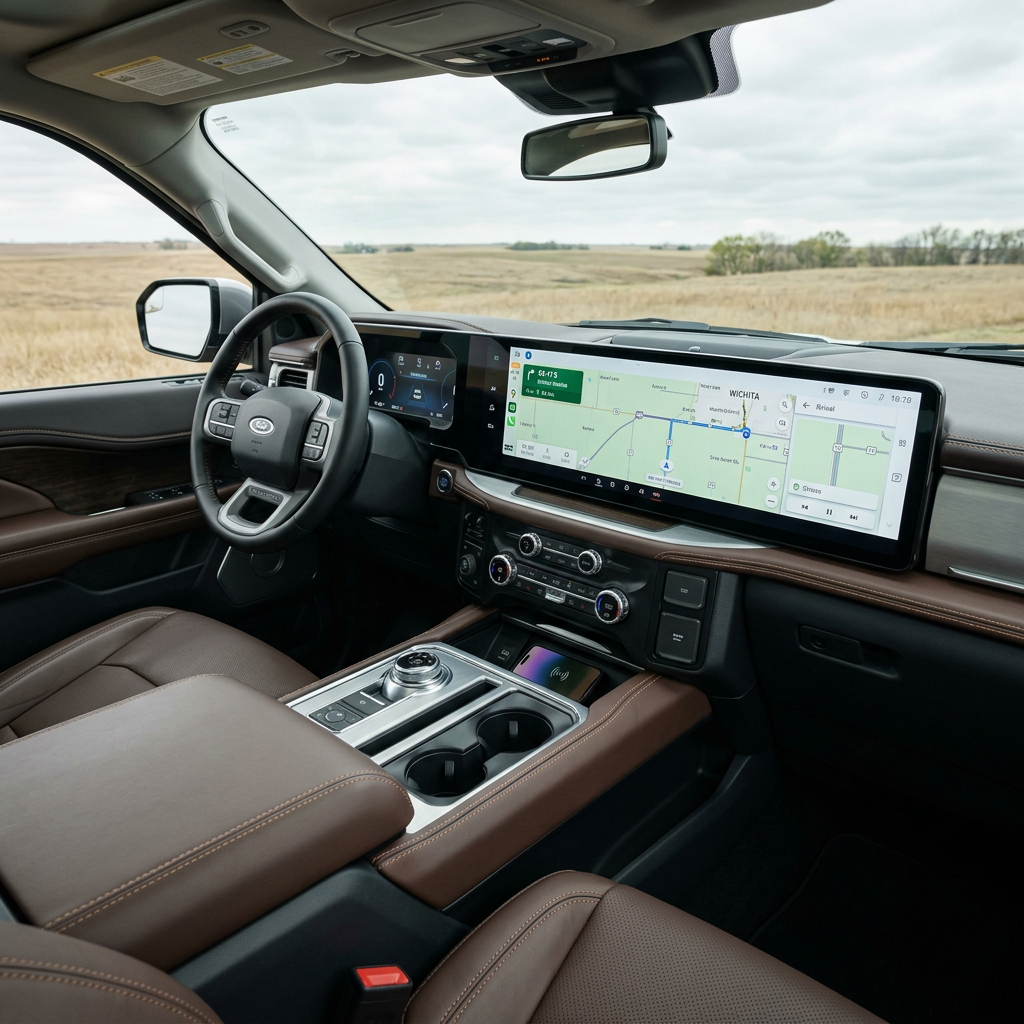
Step inside the 2023 Ford Expedition, and you are greeted by a classic, highly functional truck-based interior. The center stack is defined by physical climate control dials, large tactile buttons, and a choice of portrait or landscape touchscreen infotainment systems running Ford’s reliable SYNC® 4 software. For many Junction City drivers, this layout is highly preferred because it allows for muscle-memory adjustments of the cabin temperature, fan speed, and radio volume without taking your eyes off the highway. The seating is plush and supportive, designed for long-distance comfort, and the overall material quality across the XLT, Limited, and King Ranch trims reflects a premium, durable cabin built to withstand muddy boots, spilled juice boxes, and heavy family usage.

Contrast that with the 2026 Ford Expedition, which represents a massive paradigm shift in cabin architecture. The physical dashboard has been replaced by an ultra-modern, pillar-to-pillar digital display that sits high near the base of the windshield, delivering navigation, media, and vehicle telemetry directly into your line of sight. The center console has been completely streamlined, featuring a secondary control screen, ambient lighting accents, and premium soft-touch materials that push the Expedition closer to the luxury segment. Furthermore, the 2026 model introduces innovative seating adjustments, including multi-contour captain’s chairs and a redesigned third-row entry system, making it easier than ever for kids to climb into the back without disturbing child safety seats in the second row.

Modern interior of a Ford vehicle featuring premium brown leather seats, a digital instrument cluster, and a large widescreen infotainment display showing a navigation map. (Representative image for illustration purposes only. Actual vehicle may vary based on trim and configuration.)

On the exterior, the 2023 model sports a rugged, traditional look with boxy styling, a bold rectangular front grille, and distinct C-clamp LED headlights. The 2026 model transitions to a more aerodynamic, fluid design language. It features a sleeker front fascia, integrated active grille shutters, and updated rear tailgate designs that enhance airflow and reduce wind noise at highway speeds on I-70. If you prefer a traditional, analog-friendly cabin, the 2023 is outstanding. If you crave cutting-edge digital integration and a futuristic aesthetic, the 2026 is a masterpiece.

How Do the Engine and Performance Specs Compare Between the 2023 and 2026 Ford Expedition?

Under the hood, both the 2023 and 2026 Ford Expedition models utilize Ford’s formidable 3.5-liter twin-turbocharged EcoBoost® V6 engine. This highly reliable powerplant has earned a stellar reputation for delivering V8-like torque with the efficiency of a smaller engine. In the 2023 model, this engine is tuned to deliver 380 horsepower and 470 lb-ft of torque in standard configurations, while high-output variants on the Timberline and Stealth Performance packages boost those numbers to an impressive 440 horsepower and 510 lb-ft of torque. Power is routed through a smooth-shifting 10-speed automatic transmission, providing plenty of low-end grunt for merging onto highways and cruising through the rolling hills of Geary County.

For the 2026 model year, Ford has refined the EcoBoost® powertrain further, updating the engine mapping, improving thermal management, and optimizing the 10-speed transmission’s shift logic. Standard 2026 models see subtle increases in real-world efficiency and power delivery smoothness, while the newly introduced Tremor trim inherits the high-output version of the 3.5L engine. When it comes to pulling heavy loads, both generations are class leaders. A properly equipped 2023 Expedition boasts a maximum towing capacity of up to 9,300 pounds with the Heavy-Duty Trailer Tow Package, while the 2026 model matches or slightly exceeds this capability with advanced towing software, including Pro Trailer Backup Assist™ and Trailer Reverse Guidance, making it incredibly simple to launch boats at Milford Lake.

Let’s take a look at how the core performance metrics stack up side-by-side:

Specification

2023 Expedition

2026 Expedition

Standard Output

380 hp / 470 lb-ft

380 hp / 470 lb-ft

High Output

440 hp / 510 lb-ft

440 hp / 510 lb-ft

Transmission

10-speed Automatic

Refined 10-speed Auto

Max Towing Capacity

9,300 lbs

Up to 9,600 lbs

Ultimately, the powertrain story is one of incremental refinement rather than revolution. Both vehicles offer outstanding throttle response, confident passing power, and the mechanical muscle required to haul campers, trailers, and cargo without breaking a sweat.

Ready to Explore Our Current Ford SUV Lineup in Junction City?

Whether you are interested in a pre-owned pre-owned 2023 Expedition or want to place a custom order for a brand new 2026 model, Valor Ford is your premier destination. Our dedicated team is here to help you compare configurations, take a test drive, and find the perfect match for your family’s needs. Browse Used Inventory online today or contact us to discuss upcoming model reservations.

What Is the New 2026 Ford Expedition Tremor Trim Compared to the 2023 Timberline?
For outdoor enthusiasts in Dickinson and Geary counties who demand off-road capability alongside three-row utility, Ford has offered two distinct answers across these generations. The 2023 Ford Expedition Timberline was a breakthrough model, heavily borrowing components from the rugged Ford F-150 Raptor. It features 10.6 inches of ground clearance, robust underbody shielding (sourced directly from the Raptor), 33-inch Goodyear Wrangler Goodyear DuraTrac® all-terrain tires, and a unique 2-speed transfer case. The Timberline is an exceptional overland machine, perfectly suited for rural trails, muddy fields, and navigating harsh winter storms in Central Kansas with complete confidence.

For the 2026 model year, Ford has retired the Timberline nameplate and introduced the legendary Tremor trim to the Expedition lineup. The 2026 Expedition Tremor takes off-road capability to an even higher level of sophistication. While retaining the impressive ground clearance and standard high-output 440-horsepower engine, the Tremor adds advanced electronic features like Trail Turn Assist, Trail 1-Pedal Drive, and an upgraded Rock Crawl mode. Visually, the Tremor stands out with aggressive Raptor-inspired styling, signature orange tow hooks, integrated auxiliary switches inside the cabin, and heavy-duty running boards that double as side rock rails to protect the lower body panels.

A gray Ford Expedition Timberline off-roading on a rugged, rocky trail, kicking up dust. (Representative image for illustration purposes only. Actual vehicle may vary based on trim and configuration.)

Choosing between these two off-road champions comes down to a matter of design preference and software integration. The 2023 Timberline offers a slightly more understated, mechanical, and classic rugged feel. The 2026 Tremor, by contrast, wears its off-road DNA proudly on its sleeve with bold graphics, aggressive styling cues, and a suite of digital trail tools that make navigating tight country paths and loose gravel roads practically effortless.

Does the Chevrolet Tahoe Offer a Diesel Engine Unlike the Expedition?

The Chevy Tahoe Diesel Option

A common point of comparison for Kansas SUV buyers is the Chevrolet Tahoe, which offers an available 3.0-liter Duramax® turbo-diesel engine. This engine is highly praised for its exceptional fuel efficiency on long highway journeys and smooth, low-end torque. For drivers who prioritize maximum highway range and specialized diesel performance, the Tahoe remains a unique alternative in the full-size segment.

Ford's Twin-Turbo EcoBoost Power

In contrast, both the 2023 and 2026 Ford Expedition rely exclusively on the twin-turbocharged 3.5L EcoBoost V6 gasoline engine. While Ford does not offer a diesel, the EcoBoost engine delivers significantly higher horsepower and faster acceleration than the Duramax diesel. This translates to an incredibly responsive driving experience, allowing you to merge confidently and pass slow-moving farm equipment on rural Kansas highways with ease.

Towing and Maintenance Factors

Furthermore, gasoline engines offer simpler maintenance profiles and more convenient fueling options across the Midwest. The Ford Expedition also maintains a higher maximum towing rating compared to diesel-equipped Tahoes. For most families, the combination of high towing capacity, lower routine servicing complexity, and readily available regular gasoline makes the Expedition’s EcoBoost powertrain a practical long-term choice.

Is a Used 2023 Ford Expedition a Different Choice Than a Brand New 2026 Model?
From a purely financial perspective, purchasing a used or certified pre-owned (CPO) 2023 Ford Expedition represents an incredibly compelling value proposition. The steepest portion of a new vehicle’s depreciation curve occurs during its first two to three years. By purchasing a 2023 model today, the previous owner has already absorbed that initial depreciation hit. This allows you to secure a high-trim SUV—such as a luxurious Limited or a rugged Timberline—for a lower overall purchase cost than a brand new, entry-level 2026 model. You can Browse Used Inventory to see just how much you can save on a pre-owned model with low mileage.

Additionally, a 2023 Ford Blue Certified or Gold Certified pre-owned vehicle from Valor Ford comes with the peace of mind of a rigorous multi-point inspection, comprehensive limited warranty coverage, and 24/7 roadside assistance. Insurance premiums are also typically lower for a pre-owned vehicle compared to a brand-new one, helping you save money on your monthly household budget while still driving a modern, safe, and highly capable full-size family SUV.

A white Ford Expedition parked in an empty asphalt parking lot on a sunny day. (Representative image for illustration purposes only. Actual vehicle may vary based on trim and configuration.)

However, the 2026 model justified its premium price tag for buyers who want the absolute latest in automotive engineering. It offers a fresh factory warranty (3-year/36,000-mile bumper-to-bumper and 5-year/60,000-mile powertrain), the absolute newest safety technologies, and a cabin that will remain cutting-edge for the next decade. If you are a buyer who loves having the newest technology and plans to keep the vehicle for 8 to 10 years, the 2026 model is a fantastic long-term investment.

Value Your Trade-In and Calculate Your Payments at Valor Ford

Ready to see how a new or pre-owned Expedition fits into your monthly budget? We make it simple to plan ahead. Use our quick online tool for a professional Trade In Evaluation to see what your current vehicle is worth. Afterward, you can Get Pre-Approved for Financing from the comfort of your home, saving you time when you visit our showroom on Chestnut Street.

How Long Does a Custom Factory Order Take to Arrive in Kansas?

For buyers who decide that the cutting-edge 2026 Ford Expedition is the perfect fit, custom ordering is the best way to secure your dream vehicle. Instead of settling for whatever configurations happen to be sitting on dealer lots, a custom factory order allows you to select your exact exterior paint color, interior upholstery, seat configurations, and optional feature packages—such as the heavy-duty towing package or the premium Bang & Olufsen sound system. Our team at Valor Ford coordinates directly with the factory to submit your build, ensuring a transparent and seamless process from assembly line to our dealership.

Typically, a custom factory order takes anywhere from 8 to 12 weeks to arrive at our Junction City dealership, depending on factory production capacity, parts availability, and transport logistics. Throughout the process, we provide you with real-time tracking updates, including when your Expedition is scheduled for production, when it is built, and its transit status on the rail and transport trucks. Ordering custom also allows you to discuss current financing options with our team, giving you complete peace of mind while your brand-new SUV is being built to your exact specifications.

While waiting a few weeks for a custom vehicle requires some patience, the benefits are well worth it. You avoid paying for options you do not want, and you ensure you get the exact safety and convenience upgrades your family needs. If you need a vehicle immediately, we can always help you browse our existing on-lot inventory or coordinate a dealer trade to get you behind the wheel of a spectacular SUV today.

If you are curious about other modern Ford vehicles while exploring your options, you can also check out our research pages for other flagships like the legendary muscle car by looking at our Research Ford Mustang resource, or check out midsize SUV capabilities with our Research Ford Explorer guide.

Maintenance and Longevity: Keeping Your Expedition Running Across Geary County
Routine Scheduled Care

Whether you own a 2023 or a brand new 2026 Expedition, regular maintenance is the single most important factor in ensuring long-term reliability. Staying on top of scheduled oil changes, tire rotations, fluid checks, and brake inspections keeps your EcoBoost engine running smoothly. Our factory-trained technicians at Valor Ford know these vehicles inside and out, offering expert care to keep your family safe on the road.

Easily book your next maintenance slot with our quick online tool: Schedule Ford Service Today.

Genuine OEM Ford Parts

To maintain original performance and protect your resale value, always insist on genuine Motorcraft® and Ford Parts. These components are specifically engineered for your exact model year, ensuring a perfect fit, maximum durability, and full compliance with your vehicle’s factory warranty. From replacement filters to heavy-duty suspension parts, using OEM components ensures your Expedition remains 100% Ford.

Need replacement parts or accessories? You can easily Order Genuine Ford Parts directly through our website.

Pickup and Delivery Ease

We understand that your schedule is busy, which is why Valor Ford is proud to offer convenient pickup and delivery services for qualifying maintenance appointments. We will pick up your Expedition from your home or office in Junction City, perform the necessary services at our state-of-the-art facility, and return it directly to you, clean and ready for your next adventure.

To experience ultimate automotive convenience, try our Schedule Pickup and Delivery Service program.

{
  "altText": "Split-screen view of a blue Ford SUV on a dirt path and a grey Ford SUV on a modern paved driveway.",
  "titl (Representative image for illustration purposes only. Actual vehicle may vary based on trim and configuration.)

Which Large SUV Fits Your Kansas Lifestyle Best?

Who Should Choose the 2023 Expedition?

The 2023 Ford Expedition remains an absolute powerhouse and is the ideal choice for buyers who appreciate practical utility, classic tactile controls, and maximum financial efficiency. If you want to avoid the steep depreciation of a brand-new vehicle, or if you prefer traditional dials for climate and radio adjustments, a pre-owned 2023 model is hard to beat. It offers virtually the same towing capacity, passenger space, and robust engine performance as the brand-new model, but at a price point that leaves more room in the family budget.

It is also widely available right now for immediate delivery. If your family is growing quickly and you need a dependable, luxurious three-row SUV today, our certified pre-owned 2023 inventory is ready to drive home today.

Who Should Choose the 2026 Expedition?

The 2026 Ford Expedition is built for tech-savvy families who want to experience the absolute cutting edge of design and connectivity. If you want a dashboard that feels like a modern luxury lounge, advanced driver-assistance software, and a highly streamlined exterior, the 2026 model represents a generational leap forward. It is also the only way to experience the specialized off-road Tremor trim, which brings serious trail-ready hardware to a full-size SUV platform.

For buyers who plan to keep their vehicle for many years and want the security of a brand-new factory warranty, ordering or reserving a 2026 Expedition is a deeply satisfying and future-proof choice.

Visit Valor Ford in Junction City, KS to Compare Your Options Today

At Valor Ford, we are proud to serve drivers throughout Geary County and the surrounding Kansas communities. Our friendly, pressure-free team is here to walk you through the differences in person, answer your technical questions, and help you select the exact SUV that aligns with your family’s lifestyle and budget. Whether you want to test drive a pre-owned 2023 model or sit down to draft a custom factory order for a 2026 model, we are dedicated to providing an award-winning dealership experience.

Come see us at our showroom located at 1825 Goldenbelt Blvd, Junction City, KS 66441. Get Directions to Valor Ford or Call us at (785) 238-5114 to schedule your VIP appointment today.

Logo for Valor Automotive featuring a blue and silver shield with 'VA' and the company name with a red star.

2021 Ford F-150 Recall: STEERING:RACK AND PINION — What Valor Ford Customers Need to Know

As a proud owner of a 2021 Ford F-150, you know your truck is built to handle the toughest jobs across Junction City, Kansas, and the surrounding Geary County area. Whether you are hauling equipment to a job site, towing a trailer for a summer weekend getaway, or simply navigating your daily commute, you rely on your truck’s steering to be precise, responsive, and completely reliable. However, Ford Motor Company has identified a critical safety issue concerning the electronic power-assist steering (EPAS) rack and pinion assembly on certain 2021 F-150 models. At Valor Ford, we want to ensure you have all the facts, understand the potential safety risks, and know exactly how to get this resolved quickly and covered at no cost under the recall.

A steering recall can sound alarming, but it is important to remember that safety campaigns are designed to protect you before an issue leads to an accident. The core of this steering rack and pinion recall involves a manufacturing defect where certain internal components within the steering gear assembly may have been built out of specification. Under specific driving conditions, this can lead to an unexpected increase in steering effort or, in more severe cases, a sudden lock or restriction in the steering wheel’s range of motion. Because your safety on Kansas roads is our absolute highest priority, our team of factory-trained technicians here at Valor Ford is fully prepared to inspect, diagnose, and repair affected vehicles with genuine OEM parts.

For our customers in Junction City, Fort Riley, and nearby Dickinson County, addressing this recall promptly is vital for maintaining the structural and mechanical integrity of your truck. Operating a vehicle with a compromised steering gear is highly dangerous, especially at highway speeds where sudden maneuvers require absolute control. By partnering with our certified Ford service department, you can gain immediate peace of mind. We are here to walk you through every step of the recall process, from verifying your vehicle’s status to completing the precision repair work in our state-of-the-art facility. Read on for a comprehensive breakdown of the recall, its technical implications, and how you can protect your investment.

If you suspect your truck is affected, you do not have to wait to seek assistance. You can easily Call us at (785) 238-5114 to speak directly with our service advisors, or keep reading to find out how to locate your vehicle identification number and verify your status online. Our team is dedicated to providing transparent, friendly, and expert service to keep your F-150 running safely for years to come.
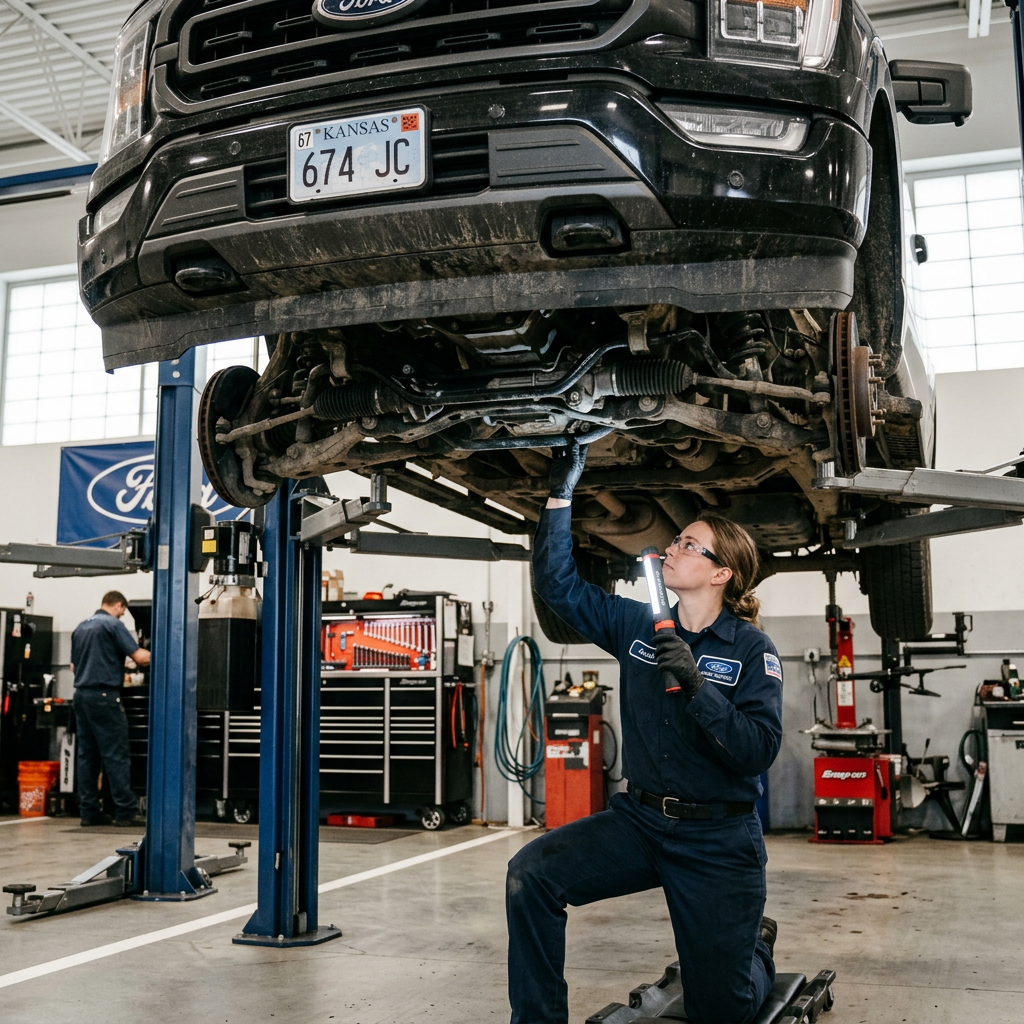
A female mechanic inspects the undercarriage of a black Ford truck raised on a hydraulic lift in an auto shop. (Representative image for illustration purposes only. Actual vehicle may vary based on trim and configuration.)

Which Specific 2021 F-150 Models Are Affected by the Steering Rack Recall?

Not every 2021 Ford F-150 rolling off the assembly line is included in this safety campaign. The recall is highly targeted and applies to specific production windows, particular trim levels, and select chassis configurations. Ford’s engineering teams traced the issue back to a specific batch of steering gear assemblies manufactured by an external supplier during a narrow timeframe in late 2020 and throughout 2021. Because of these precise manufacturing batches, trucks built at the Dearborn Truck Plant and the Kansas City Assembly Plant within those designated production dates are the primary focus of this campaign.

The mechanical issue itself stems from the internal ball nut assembly within the steering rack. During the supplier’s manufacturing process, some of these assemblies received structural components that were susceptible to premature wear or micro-cracking under heavy load. Over time, these micro-cracks can expand, leading to a structural failure of the steering gear teeth or the internal ball return system. When this occurs, the driver may experience a tight spot in the steering wheel or, in the worst-case scenario, the steering mechanism could bind completely, making it impossible to steer the truck without extreme physical effort.

This steering rack recall spans across multiple trim configurations, including popular variants like the work-ready XL, the versatile XLT, the luxurious Lariat, and even some high-end King Ranch or Platinum models. Additionally, both two-wheel drive (2WD) and four-wheel drive (4WD) configurations are represented, depending on the exact steering rack model installed during assembly. Because the steering system differs slightly based on engine selection—such as the 3.5L EcoBoost, the 5.0L V8, or the 3.5L PowerBoost Full Hybrid—it is crucial to cross-reference your specific drivetrain with the official recall database rather than assuming your model is exempt.

Because this involves a complex safety system, we strongly advise owners not to rely on guesswork. To help you identify if your vehicle is within the affected group, you can explore our comprehensive online research materials. To learn more about Ford’s engineering specifications for this model year, you can Research Ford F-150 models and their technical updates directly on our website, or contact our service desk to verify your vehicle’s specific build parameters.

How Do I Check If My Specific F-150 VIN Is Included in This Recall?
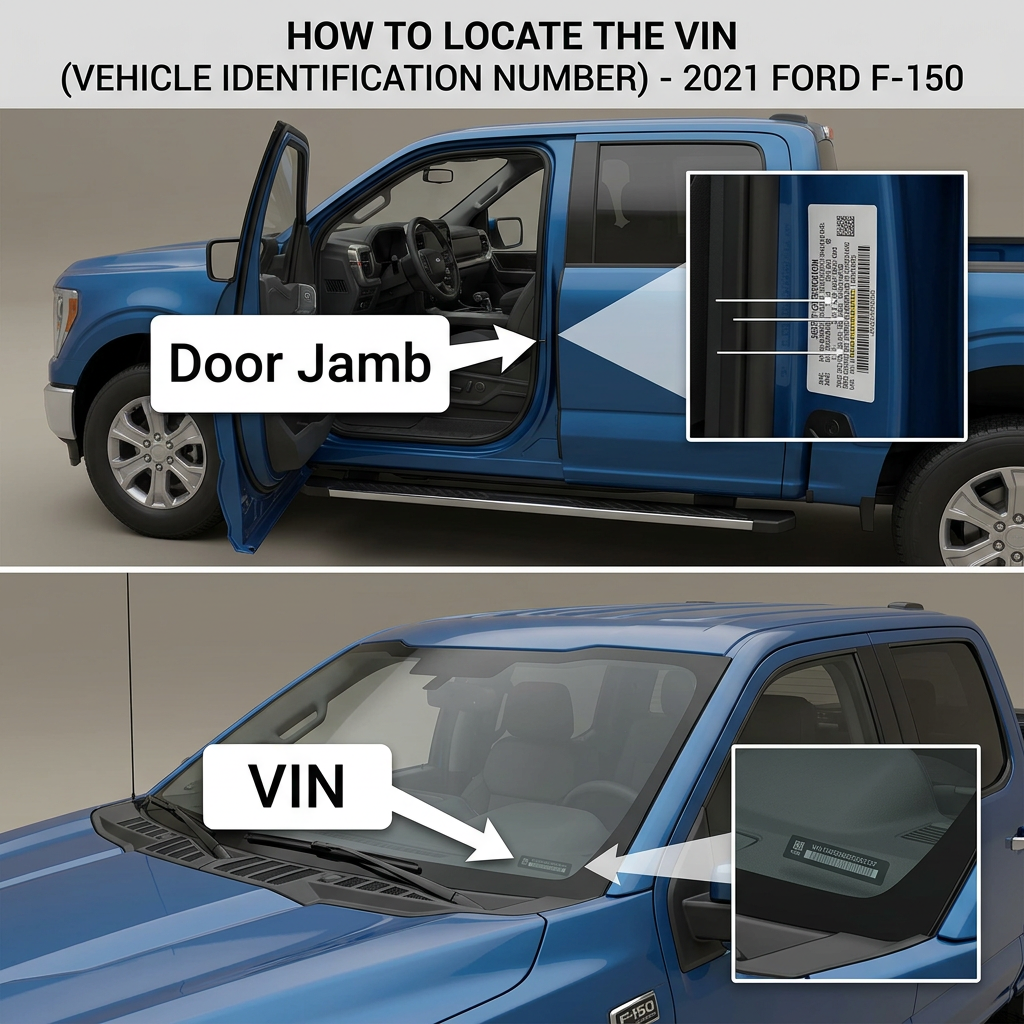
Checking whether your truck is part of this recall is a straightforward process that you can do from the comfort of your home in Junction City or Dickinson County. The single most accurate way to verify your F-150’s recall status is by using its unique 17-digit Vehicle Identification Number (VIN). Your VIN acts like your truck’s fingerprint, containing precise details about where it was built, its exact trim level, engine configuration, and manufacturing date. To find your VIN, look at the base of your driver’s side windshield from the outside of the truck, or check the safety certification label located on the driver’s side door B-pillar jamb.

Once you have written down your 17-digit VIN, you have several reliable lookup options. You can visit the National Highway Traffic Safety Administration (NHTSA) recall portal or the official Ford Owner website and enter your VIN into their search tools. Alternatively, you can bypass the online search completely and let the certified team at Valor Ford do the heavy lifting for you. By contacting our service advisors directly, we can instantly pull up your vehicle’s complete history, check for any open campaigns, and verify if the parts required for your specific steering rack replacement are currently in stock.

{
  "altText": "Diagram showing the two VIN locations on a blue 2021 Ford F-150: driver's side door jamb and lower driver's s (Representative image for illustration purposes only. Actual vehicle may vary based on trim and configuration.)

If you discover that your 2021 F-150 has an active steering recall, do not delay. We make the booking process as smooth as possible for our local drivers. You can schedule a convenient appointment online using our dedicated portal, or coordinate with us to have your vehicle picked up and returned to your home or office.

What Are the Key Mechanical Specs of the 2021 Ford F-150 Steering System?

The 2021 Ford F-150 features a highly advanced Electronic Power-Assist Steering (EPAS) system. Unlike older hydraulic steering pumps that continuously draw power from the engine, the EPAS system utilizes an electric motor to provide assist only when needed. This design significantly improves fuel efficiency and allows for dynamic steering tuning. Below is an overview of the technical specifications that define this sophisticated system:

EPAS Technology

The system features a rack-mounted electric motor that delivers variable assist based on vehicle speed. This provides lighter steering effort during low-speed parking maneuvers and a firmer, more stable feel at highway speeds across Geary County.

Active Nibble Control

Built-in software algorithms constantly monitor for minor vibrations or ‘nibbles’ caused by uneven road surfaces or tire imbalance. The steering gear automatically counters these forces to deliver a smooth, premium driving experience.

Pull-Drift Compensation

This advanced feature automatically detects consistent side-winds or heavily crowned roads that would normally cause a vehicle to drift. The system applies a subtle, continuous correction so the driver doesn’t have to fight the steering wheel.

Steering Parameter

Technical Specification

Driver Benefit

System Type

Rack-and-Pinion with Electric Power Assist (EPAS)

Saves fuel by eliminating constant hydraulic drag on the engine.

Turning Circle

41.2 to 47.8 feet (varies by wheelbase)

Provides excellent maneuverability for a full-size light-duty truck.

Steering Ratio

16.5:1 to 17.5:1 (ratio varies by trim)

Ensures highly responsive and predictable handling on Kansas highways.

Integration Support

ADAS & Pro Trailer Backup Assist Co-Pilot360

Enables automated steering inputs for parking, towing, and lane keeping.

Does the 2021 F-150 Have Lane-Keep Assist Integrated Into the Steering Rack?
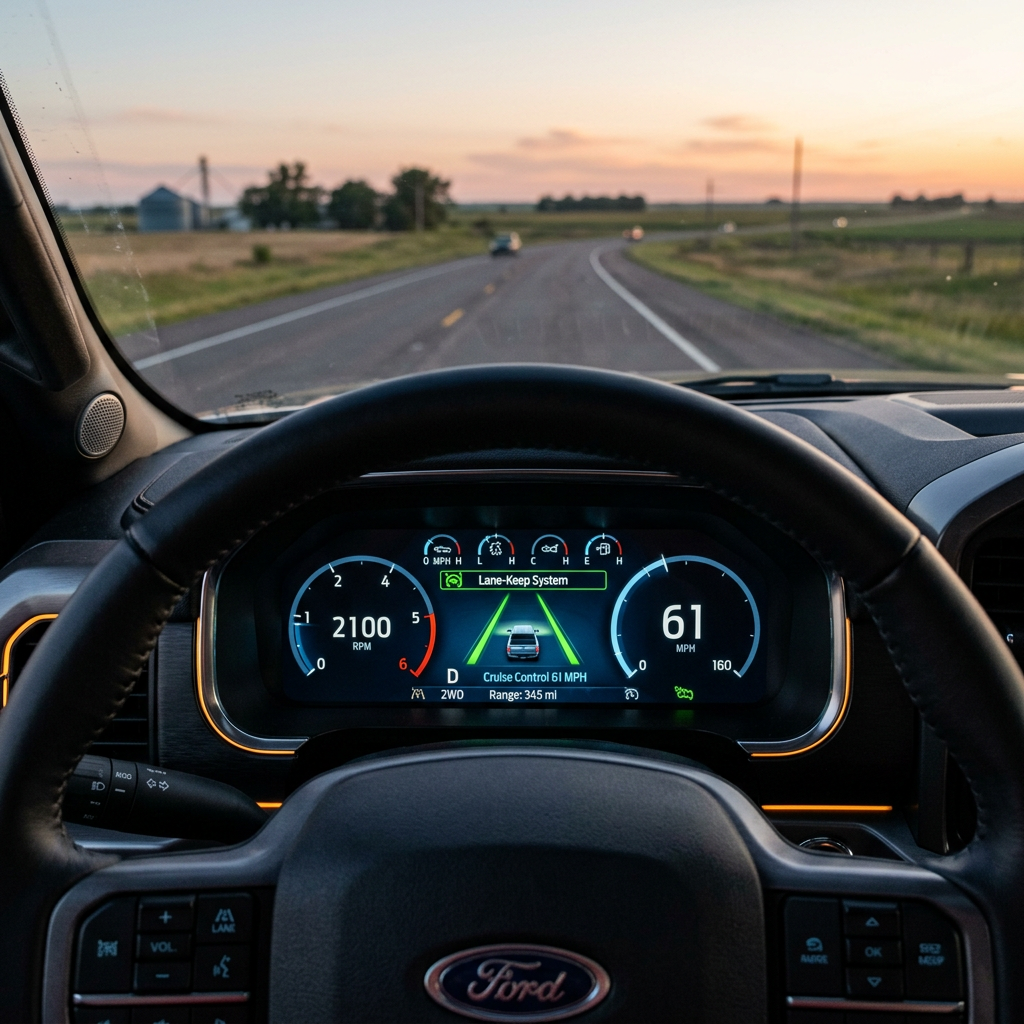
Yes, the 2021 Ford F-150’s modern driver-assist technologies are deeply integrated with the electronic power-assist steering (EPAS) rack and pinion system. Safety features like Lane-Keep Assist, Lane-Centering, and the highly acclaimed Pro Trailer Backup Assist do not operate independently of your physical steering gear; instead, they rely on digital commands sent directly to the electric motor mounted on the steering rack. This allows the vehicle’s computer to make microscopic steering adjustments on your behalf, helping you stay safely centered in your lane during long highway road trips.

Because of this close relationship between software and mechanical hardware, any physical fault within the steering rack assembly can immediately disrupt your truck’s advanced safety features. If the internal gear teeth or ball nut mechanism experiences binding or mechanical friction, the electronic steering motor will struggle to execute the precise commands sent by the Ford Co-Pilot360 system. This can trigger dashboard warning lights, disable driver-assist features, or even cause unexpected feedback through the steering wheel as the system attempts to overcome the physical resistance inside the gear.

View from the driver's seat of a Ford vehicle driving on a rural road at sunset, focusing on the digital dashboard. (Representative image for illustration purposes only. Actual vehicle may vary based on trim and configuration.)

Ensuring your physical steering rack is in flawless condition is key to keeping these safety systems working exactly as Ford designed them. If you are experiencing warning messages on your driver display or feel the Lane-Keep Assist pulling abnormally, it could be related to this underlying mechanical steering issue. Our team can quickly diagnose both the physical components and the electronic control modules to guarantee complete system harmony.

Does the Chevy Silverado Have Similar Steering Recalls to the F-150?

When mechanical issues like a steering recall surface, it is natural for truck owners to wonder if these problems are unique to Ford or if they represent broader industry challenges. The reality is that steering gear campaigns are common across the light-duty truck segment. Major manufacturers, including General Motors with the Chevrolet Silverado and GMC Sierra, have issued similar steering-related recalls over recent model years. This is largely because light-duty trucks carry massive loads, tow heavy trailers, and operate in challenging off-road conditions, putting immense stress on their steering components.

For instance, Chevrolet has faced past recalls involving sudden losses of electric power steering assist in the Silverado, often traced back to software bugs or electrical grounding issues. By comparing these industry campaigns, we can see that steering complexity is a challenge shared by all major automakers as they transition to fully electronic, software-defined steering systems. Ford’s recall of the 2021 F-150 reflects its safety monitoring process and ensures that structural and mechanical improvements are addressed before issues affect drivers on the road.

If you are currently driving a pre-owned truck or thinking about trading in your vehicle, we invite you to check out our extensive pre-owned selection. At Valor Ford, we ensure that every single vehicle in our inventory is thoroughly inspected and free of outstanding safety recalls before it ever hits our lot. You can confidently Browse Used Inventory online or evaluate your own truck’s trade value today.

How Long Does It Take for Valor Ford to Complete the Steering Rack Recall Repair?
At Valor Ford, we understand that your F-150 is a vital part of your daily life, and having it in the shop can disrupt your schedule. That is why our service team is committed to completing recall repairs as efficiently as possible without ever compromising on safety or quality. The physical replacement of the steering rack and pinion assembly is a highly technical procedure that typically takes our certified technicians between two to four hours of dedicated labor time. However, we ask that customers plan for their vehicle to be at our Junction City facility for a half-day to allow for thorough post-repair diagnostics and quality-control testing.

During the repair process, our master technicians will disconnect the battery, drain the necessary cooling or auxiliary lines if required by your truck’s specific engine configuration, and carefully extract the affected steering gear. We then install a brand-new, factory-authorized OEM steering rack assembly. Because the steering system is electronic, we must also connect your vehicle to our advanced Ford diagnostic computers to program the new EPAS module, calibrate the steering wheel angle sensor, and update any related software to ensure flawless communication with your driver-assist technologies.

A service advisor in a blue Ford uniform shakes hands with a male customer in front of a silver Ford SUV. (Representative image for illustration purposes only. Actual vehicle may vary based on trim and configuration.)

To guarantee that the replacement parts meet Ford’s strict engineering standards, we only use genuine OEM components directly from our parts warehouse. If you ever need additional replacement parts or custom accessories for your truck, you can easily Order Genuine Ford Parts through our website to maintain your vehicle’s factory specifications.

Do I Need an Alignment After Replacing the Steering Rack?

The short answer is: yes, absolutely. Whenever the steering rack and pinion assembly is unbolted, removed, or replaced, the physical geometry of your front suspension is altered. Even the slightest microscopic variation in how the new steering rack sits on the subframe can throw off your truck’s wheel alignment. To ensure your vehicle operates safely and efficiently after the recall repair, a complete wheel alignment is a non-negotiable step in the process. Here is why performing an alignment is so critical:

Prevents Tire Wear

An incorrect alignment will cause your front tires to scrub against the road, leading to rapid, uneven tire wear. Performing an alignment protects your investment in high-quality truck tires.

Ensures Straight Tracking

Without a precise alignment, your F-150 may pull or drift to one side, requiring constant steering correction. A proper alignment guarantees the truck tracks perfectly straight.

Calibrates Sensors

Our alignment process includes resetting the Steering Angle Sensor (SAS). This ensures that your truck’s electronic stability control and lane-keep features have an accurate center baseline.

Because the alignment is a necessary part of a successful steering rack replacement, it is covered under the recall campaign. You will not have to pay out of pocket for the replacement rack or the subsequent alignment. Our team uses state-of-the-art laser alignment racks to verify that your front toe, camber, and caster are set exactly to Ford’s original factory specifications before handing you back the keys.

Does a Recall History Hurt the Resale Value of a Used F-150?
A common concern among truck owners is how a safety recall might affect their vehicle’s history report, such as CARFAX or AutoCheck, and its ultimate resale or trade-in value. Many believe that having a recall listed on the vehicle record acts as a red flag to future buyers. However, the exact opposite is true. An open, uncompleted safety recall is indeed a negative mark on a vehicle’s history, but a fully documented, completed recall actually demonstrates responsible vehicle ownership and proactive maintenance.

When you bring your 2021 Ford F-150 to an authorized dealership like Valor Ford, we record the completed recall repair directly in Ford’s national database. This information is subsequently shared with vehicle history reporting agencies. When a prospective buyer or appraiser pulls your truck’s CARFAX report in the future, they will see that the steering rack recall was resolved by factory-certified technicians using genuine parts. This serves as proof that the truck has been maintained to the highest safety standards and that its most critical steering components are brand new.

A woman handing her car keys to a smiling Ford dealership representative next to a blue Ford SUV. (Representative image for illustration purposes only. Actual vehicle may vary based on trim and configuration.)

Completing recall work is one of the easiest ways to protect your truck’s residual value. If you are curious about what your F-150 is worth in today’s current market, we encourage you to get an instant appraisal. Use our quick online tool to receive a fair, competitive valuation for your vehicle.

Navigating Recalls in Dickinson County: Drive with Confidence

For truck owners living and working throughout Junction City, Geary County, and Dickinson County, local support makes all the difference when handling manufacturer recalls. We know that driving into a dealership for service can feel like a chore, which is why Valor Ford is dedicated to redefining the dealership experience. We don’t view recalls as mere transactions; we view them as an opportunity to support and protect the hard-working members of our Kansas community. Our service department is staffed by local professionals who understand the unique driving demands of our region—from agricultural hauling to daily highway commuting.

To ensure your recall experience is entirely stress-free, we offer a range of customer-first conveniences. If you cannot afford to take time out of your busy day, ask our team about our service pickup and delivery options. We can arrange to pick up your F-150 from your home or workplace, transport it safely to our service center, complete the entire steering rack replacement and alignment, and return it directly to you. This ensures your life keeps moving forward without interruption while our master technicians take care of your vehicle’s safety needs.

We invite you to experience the Valor Ford difference firsthand. Our facility is conveniently located and easy to access. If you need to stop by for an inspection, to check parts availability, or to discuss your truck’s history with our advisors, you can quickly Get Directions to Valor Ford and visit our team in Junction City today.

Schedule Your Recall 2021 Ford F-150 Recall Repair at Valor Ford Today

Your safety, your family’s safety, and the long-term reliability of your truck should never be left to chance. If you own a 2021 Ford F-150, taking action on this steering rack and pinion recall is the single best way to ensure your truck remains safe, capable, and responsive on every Kansas road. At Valor Ford, we are fully equipped with the factory parts, specialized tools, and certified expertise required to complete this critical service quickly, professionally, and entirely free of charge.

If you have concerns about steering symptoms, Contact our friendly service department today to verify your vehicle’s VIN and reserve your service appointment. You can schedule your appointment instantly using our online scheduling tool, or speak with our service team directly to coordinate your visit. Let us help you drive with confidence.

Logo for Valor Automotive featuring a blue and silver shield with 'VA' and the company name with a red star.