
What You Need to Know About Super Duty Towing
Can Ford Super Duty Trailer Navigation Account for Height and Propane Restrictions?
Yes, the embedded SYNC 4 connected navigation system in the Ford Super Duty accounts for both trailer height clearances and propane tunnel or bridge restrictions. Once you store your trailer's exterior dimensions and cargo profile in the touchscreen setup menu, the system calculates turn-by-turn routes that bypass low-clearance bridges, weight-limited roads, and tunnels that ban hazardous materials like recreational propane tanks.
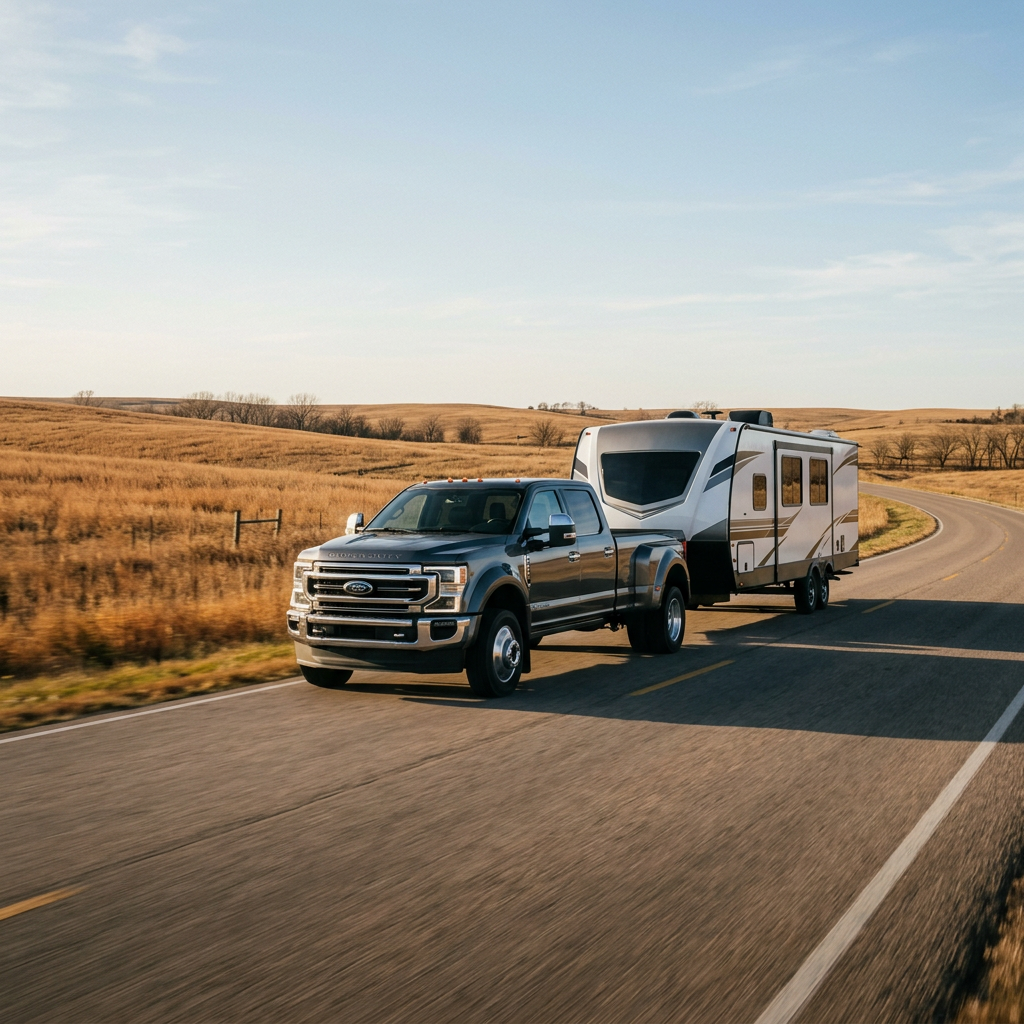
Setting up the system takes only a few minutes in your driveway. You measure your camper, horse trailer, or equipment hauler from the pavement to its highest point, noting roof air conditioners or vent covers, and enter that exact height along with overall width and length into the center display. You then select whether you are carrying combustible materials such as auxiliary propane bottles. If a scenic route or mountain pass contains an underpass lower than your trailer height or restricts propane containment vessels, the navigation engine automatically routes you around those hazards.
For folks pulling heavy fifth-wheels or camping rigs around the Kansas River near Junction City, this built-in capability eliminates the stress of scouting bridge clearances on a separate phone app. If you have questions about setting up trailer profiles or want to see the system demonstrated in person, our staff at 1825 Goldenbelt Blvd can walk you through the entire setup process. You can find your way to our showroom by getting directions to Valor Ford, or you can give our team (785) 238-5114 a call to schedule a hands-on walkthrough with one of our truck specialists.
Table of Contents
- How Do Ford Super Duty Towing Capacities Break Down by Hitch Type and Equipment?
- Can You Install an Aftermarket Fifth-Wheel Hitch Without the Factory Prep Package?
- What Driver-Assist and Trailering Tech Make Hauling Easier in a Super Duty?
- How Does Ford Super Duty Towing Compare to Silverado HD and Ram HD?
- Is the High-Output Power Stroke Diesel Worth the Upgrade Over the 7.3L Godzilla V8?
- Does the Power Stroke Diesel Deliver Higher Long-Term Resale Value?
How Do Ford Super Duty Towing Capacities Break Down by Hitch Type and Equipment?
When properly configured, the Ford Super Duty lineup delivers maximum available ratings of 40,000 pounds for gooseneck towing, 35,000 pounds for fifth-wheel towing, and 30,000 pounds for conventional bumper-pull setups. Achieving the top-tier 40,000-pound rating requires an F-450 Regular Cab 4x2 equipped with the 6.7L High Output Power Stroke V8 Turbo Diesel and the available High-Capacity Gooseneck Tow Package.
Towing performance across the lineup depends directly on the chassis, axle ratio, and engine you select:
- Ford F-250: Reaches up to 22,000 pounds of conventional towing and 23,000 pounds with a gooseneck or fifth-wheel hitch when equipped with the high-output turbodiesel and proper trailering hardware.
- Ford F-350: Steps up to a maximum rating of 38,000 pounds for gooseneck towing in dual-rear-wheel configurations with the high-output diesel, while single-rear-wheel models comfortably handle most large fifth-wheel RVs.
- Gasoline Powertrains: Models equipped with the standard 7.3L Godzilla gas V8 top out at 22,500 pounds of maximum towing, offering substantial muscle without diesel exhaust fluid requirements.
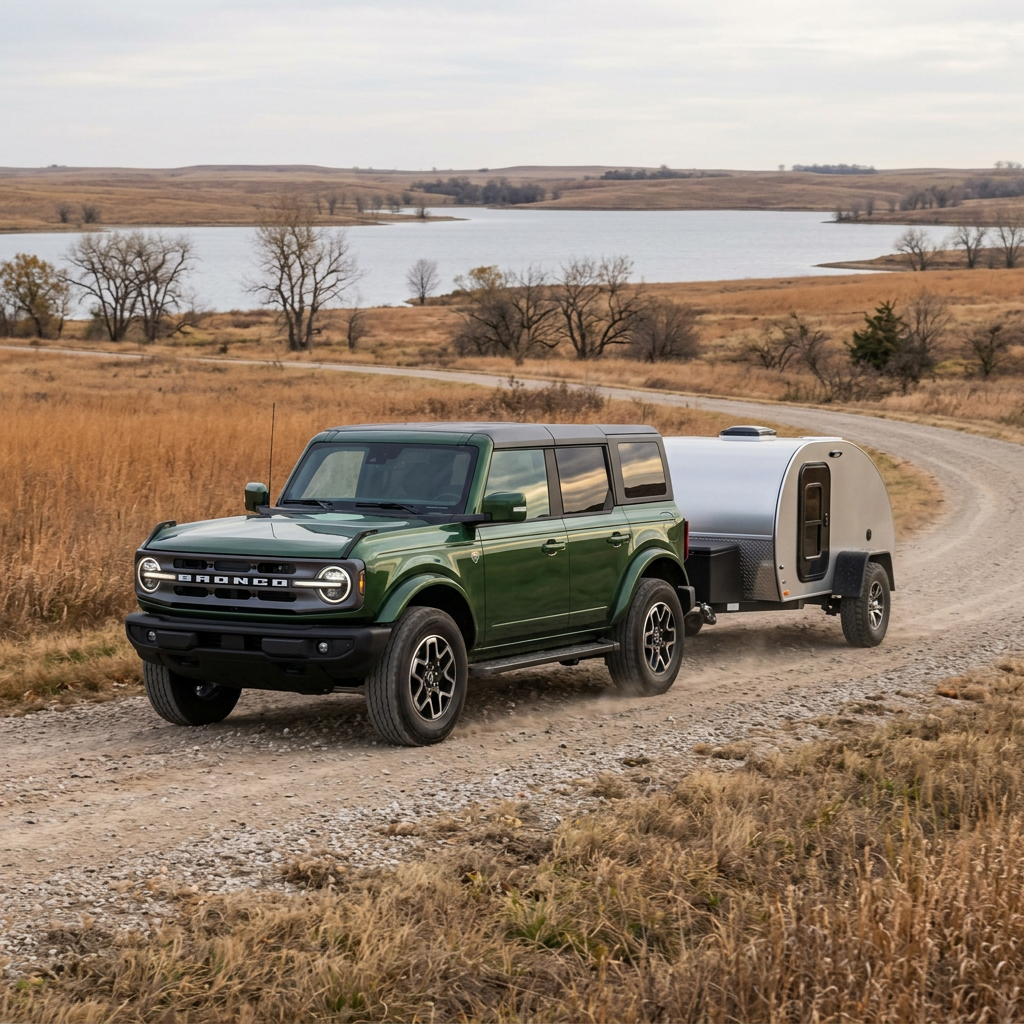
Selecting the right chassis configuration is essential because cab style, bed length, and drivetrain change the final payload and gross combined weight ratings. If you want to explore individual truck ratings before building your setup, you can research the Ford Super Duty F-250 to see exact axle and bed combinations. While heavy-duty trucks handle massive commercial tasks, customers looking for weekend trail driving rather than commercial hauling can explore our new Ford Bronco inventory for off-road recreation.
Can You Install an Aftermarket Fifth-Wheel Hitch Without the Factory Prep Package?
Yes, you can install an aftermarket fifth-wheel hitch on a Super Duty that lacks the factory prep package by using either traditional above-bed base rails or custom under-bed mounting kits. While aftermarket brackets bolt securely to the truck's high-strength steel frame, trucks equipped with the factory 5th-Wheel/Gooseneck Hitch Prep Package offer integrated under-bed crossmembers and flush puck mounts that leave your truck bed completely flat when the hitch is removed.
Standard aftermarket base rails sit permanently on top of the corrugated bed floor. While these rails provide an industry-standard foundation for most fifth-wheel hitches, they create raised ribs across your bed floor that can catch on pallets, lumber, or loose cargo when you are not trailering. Independent under-bed systems from reputable hitch manufacturers solve that issue by mounting below the bed floor, mirroring the clean utility of the factory package, though installation requires precise bed drilling and custom frame brackets.
Ranchers and agricultural contractors hauling livestock across Dickinson County often find that adding an aftermarket gooseneck or fifth-wheel setup gives an older truck a second working life. When you are looking at our pre-owned truck inventory, our team can check the build sheet of any truck on the lot to confirm whether it already carries the factory prep package or what hardware is required to get it ready for your trailer.
What Driver-Assist and Trailering Tech Make Hauling Easier in a Super Duty?
Ford integrates purpose-built driver-assist features into the Super Duty, highlighted by Pro Trailer Backup Assist, Pro Trailer Hitch Assist, Onboard Scales with Smart Hitch, and a 360-Degree Camera System. These systems use exterior sensors, radar, and visual cameras to eliminate the guesswork of hitching up, monitoring tongue weight, and managing tight reversing maneuvers.
Pro Trailer Hitch Assist is one of the most practical tools on the truck. By pressing and holding a dash button, the vehicle takes over steering, throttle, and braking to back up automatically and place the hitch ball directly beneath your trailer coupler. Once connected, the Smart Hitch feature measures trailer tongue weight in real time, displaying the balance directly on the touchscreen or through taillight LED indicators to verify that your cargo is distributed properly before you hit the highway.
While trailering, the Blind Spot Information System extends its radar coverage along the entire length of your trailer, alerting you to vehicles cruising in your blind spots before you attempt a lane change. When maintenance is due or trailering sensors need calibration, you can easily schedule a service appointment with our factory-trained technicians to keep all your towing systems running accurately. Every Super Duty also includes Ford roadside assistance coverage for 5 years or 60,000 miles, providing professional support if you ever need unexpected help while hauling. If an issue arises on the road, you can contact Ford Roadside Assistance: (800) 241-3673 for factory-backed support.
How Does Ford Super Duty Towing Compare to Silverado HD and Ram HD?
The Ford Super Duty leads the heavy-duty truck segment with an available maximum gooseneck tow rating of 40,000 pounds, exceeding the Ram 3500 HD maximum of 37,090 pounds and the Chevrolet Silverado 3500 HD peak of 36,000 pounds. Ford also holds a clear advantage in conventional towing, delivering up to 30,000 pounds on properly configured models compared to the Chevrolet Silverado 3500 HD rating of 20,000 pounds.
In the three-quarter-ton segment, the Ford F-250 achieves up to 23,000 pounds of maximum towing, remaining competitive against the Silverado 2500 HD maximum of 22,500 pounds and the Ram 2500 maximum of 20,000 pounds. Beyond top-line numbers, Ford’s high-strength aluminum-alloy body reduces curb weight, translating that weight savings directly into higher available payload capacities across comparable cab configurations.
Managing extreme loads safely requires matching truck capability with your commercial or recreational goals. Before selecting an equipment package, you can take advantage of our online finance tools to get pre-approved for financing, helping you budget for the exact engine, axle ratio, and towing packages needed to handle your heaviest trailers.
Is the High-Output Power Stroke Diesel Worth the Upgrade Over the 7.3L Godzilla V8?
The 6.7L High Output Power Stroke V8 Turbo Diesel is worth considering if you regularly pull loads over 15,000 pounds, tow through steep elevation changes, or use your truck for daily commercial hauling. Delivering 500 horsepower and a massive 1,200 lb-ft of torque, the high-output diesel accelerates smoothly under heavy loads and features an integrated engine exhaust brake that controls downhill momentum and preserves your foundation brakes.
By comparison, the standard 7.3L Godzilla gas V8 produces 430 horsepower and 485 lb-ft of torque using a rugged, pushrod design. For fleet operators, local trades, or personal drivers who tow boats, horse trailers, or equipment a few times a month, the gas engine provides plenty of power while avoiding higher diesel fuel costs, diesel exhaust fluid purchases, and complex aftertreatment systems.
Choosing between the two depends largely on your annual mileage and typical trailer weights. If you are preparing to upgrade your current work truck, you can submit an online trade-in evaluation to determine your vehicle's current equity. If you already own a Super Duty and need heavy-duty hitches, wiring adapters, or bed puck kits, our parts counter makes it easy to order genuine Ford parts tailored specifically to your truck's chassis.
Does the Power Stroke Diesel Deliver Higher Long-Term Resale Value?
Super Duty trucks equipped with the Power Stroke diesel consistently retain a larger dollar amount and hold a higher percentage of their initial engine option cost on the secondary market than gasoline models. Secondary buyers, commercial fleets, and independent hotshot haulers actively seek out diesel engines for their durability, creating strong market demand for well-maintained diesel trucks with 100,000 miles or more.
While the diesel option requires a higher upfront cost, that upfront cost is largely cushioned by higher trade-in and private-party valuations down the road. Gas models depreciate more steadily because commercial buyers prioritize the high torque and sustained towing efficiency of diesel powertrains for long-distance hauling.
If you are ready to review towing charts, compare rear axle ratios, or find the right Super Duty configuration for your trailer, visit our team at 1825 Goldenbelt Blvd. Drop by to see us using our simple dealership map and directions, or speak directly with our truck specialists by calling (785) 238-5114 today.