Blog / Maintenance & Service

VALOR Service & Oil Change Excellence: Protecting Your Vehicle in Any Season

VALOR Service & Oil Change Excellence: Protecting Your Vehicle in Any Season

VALOR Service & Oil Change Excellence: Protecting Your Vehicle in Any Season

Most vehicle owners assume that 'severe driving conditions' apply only to extreme off-road rock crawling, commercial fleet haulers, or high-speed track racing. However, automotive engineers and manufacturers define severe driving duty quite differently. In reality, the vast majority of everyday drivers in Junction City, Fort Riley, and surrounding Dickinson County operate under severe service conditions without ever knowing it.
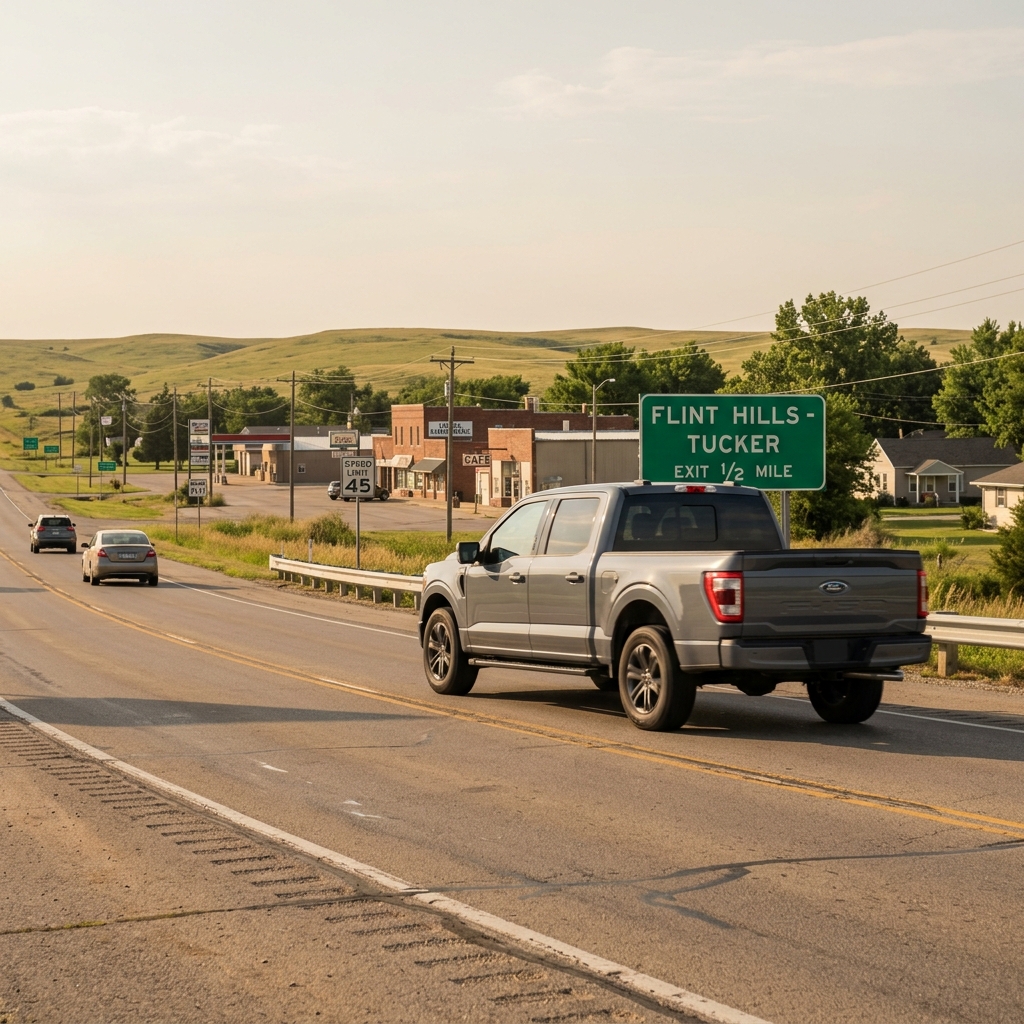
A gray Ford F-150 truck drives on a rural highway past a green sign reading Flint Hills - Tucker Exit 1/2 Mile. (Representative image for illustration purposes only. Actual vehicle may vary based on trim and configuration.)
Severe driving conditions include frequent short trips under 5 to 10 miles, repeated stop-and-go commuting, sub-zero winter morning cold starts, intense Flint Hills summer heat combined with heavy cargo or towing, extended idling periods, and driving on dusty, gravel, or unpaved rural roads. When your vehicle is subjected to these environments, motor oil degrades significantly faster, requiring shortened fluid maintenance and filter replacement intervals to preserve engine longevity.

Short Trips and Stop-and-Go Commutes: Why Everyday Driving Might Be Severe

When you take short trips—such as driving less than five miles to local shops in Junction City or running quick errands across Fort Riley—your vehicle's engine rarely hits full thermal equilibrium. An internal combustion engine needs sustained heat (typically around 195°F to 220°F) to burn off water vapor created as a combustion byproduct. On short drives, this moisture accumulates inside the crankcase, mixing with engine oil to form harmful black sludge.
Additionally, frequent stop-and-go commuting causes fuel dilution. During cold starts, the engine computer sprays extra fuel to ensure steady combustion. If the drive ends before the engine warms completely, unburnt fuel escapes past piston rings into the oil sump, thinning the lubricant and reducing its viscosity grade. Routine long-distance cruising lets oil reach temperature and self-clean, whereas city stop-and-go driving forces your engine to work under constant fluid degradation.

Climate Extrema in Kansas: Towing, Heavy Loads, and Extreme Temperatures

Heavy Towing & Hauling

Pulling trailers, livestock, or agricultural equipment across Dickinson County places continuous stress on powertrain fluids. High torque output generates extreme oil sumps and transmission fluid heat, rapidly oxidizing standard lubricants.

Flint Hills Summer Heat

High ambient summer temperatures combined with extended engine idling (such as waiting in traffic or running climate control) prevent Ram-air cooling through the radiator, pushing thermal loads to critical thresholds.
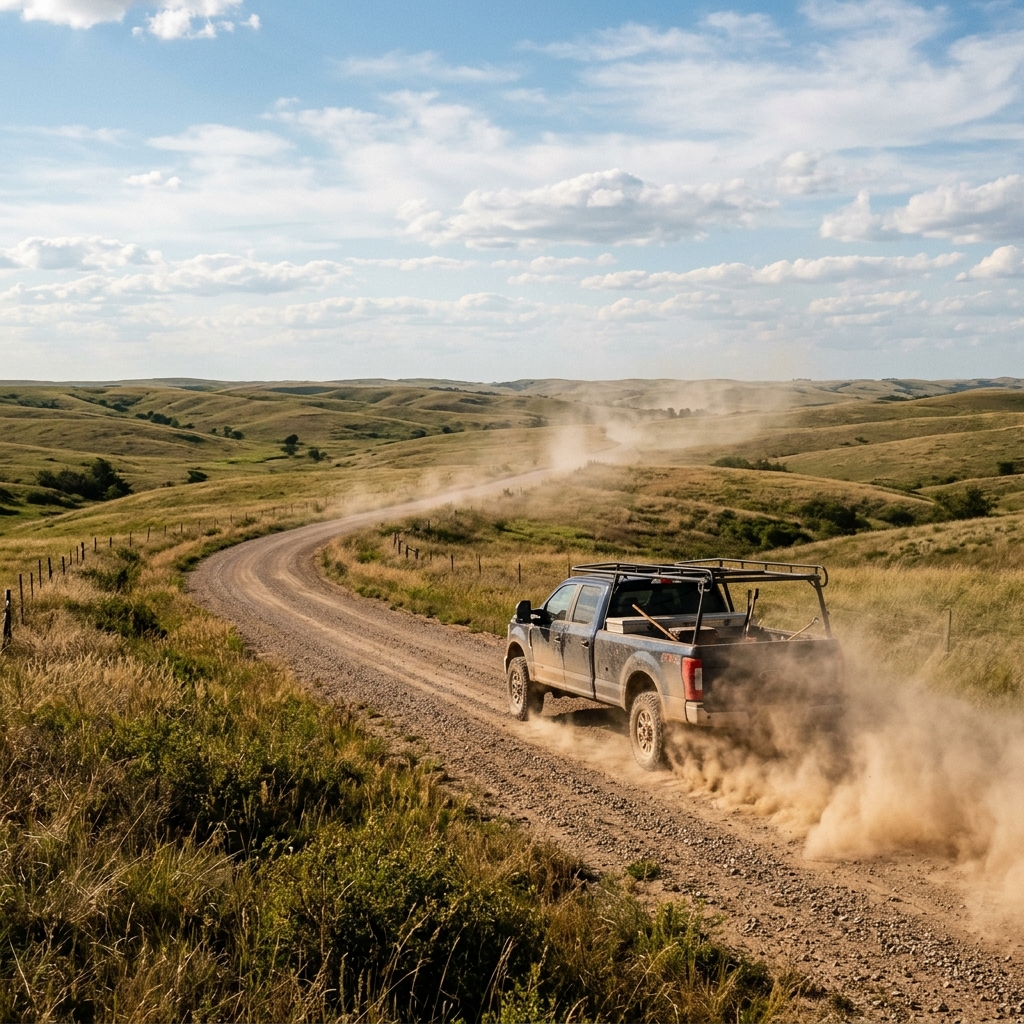
Blue pickup truck driving along a winding dirt road through rolling countryside hills, kicking up dust. (Representative image for illustration purposes only. Actual vehicle may vary based on trim and configuration.)
Driving on dirt or gravel roads feeds fine airborne silica into the engine air filter and oil system, creating abrasive microscopic wear if filters aren't serviced frequently.

How Does Full Synthetic Oil Perform During Sub-Zero Winter Starts?

Kansas winter cold snaps often drop temperatures well below freezing. During a sub-zero cold start, conventional motor oil thickens substantially, taking precious extra seconds to flow from the oil pan through the pickup tube to overhead camshafts and valve gear. Up to 75% of lifetime engine wear occurs during these initial startup seconds when metal surfaces rub together before fluid pressure stabilizes.
Full synthetic oil retains superior low-temperature fluid viscosity due to uniform molecular sizing and wax-free synthetic basestocks. It pumps effortlessly even at sub-zero temperatures, delivering immediate oil pressure to vital engine components and dramatically reducing dry-start friction.
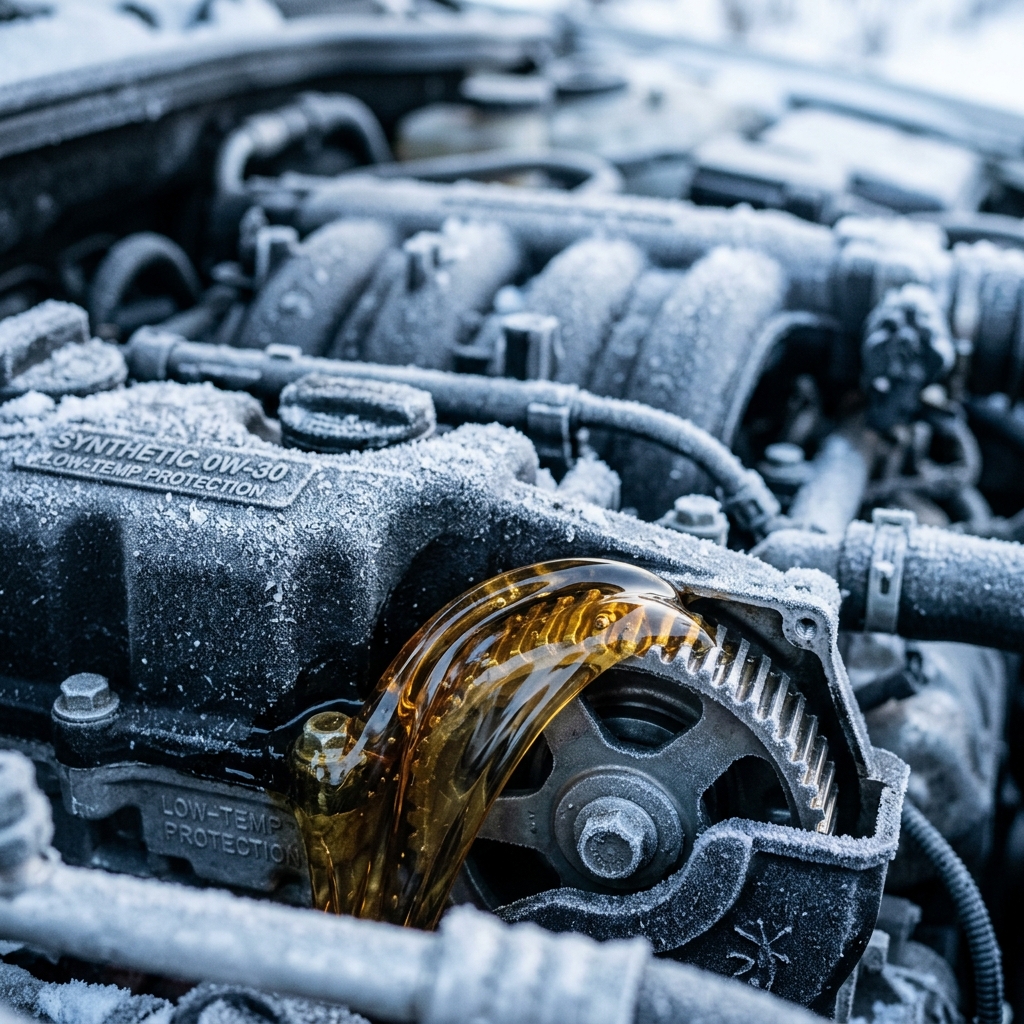
Golden motor oil pouring over a frost-covered engine gear in freezing cold conditions. (Representative image for illustration purposes only. Actual vehicle may vary based on trim and configuration.)

What Are the Technical Differences Between Conventional, Synthetic Blend, and Full Synthetic Oil?

Conventional Motor Oil

Refined directly from crude oil, conventional lubricants contain non-uniform molecules, natural waxes, and impurities. They offer adequate protection for gentle driving in older vehicles, but break down rapidly under high heat, extreme cold, or severe driving conditions.

Synthetic Blend Oil

A engineered mixture of synthetic basestocks and conventional crude. Synthetic blend oils offer upgraded thermal protection, anti-wear properties, and cold-flow capability over standard conventional oil at an intermediate price point.

Full Synthetic Oil

Synthesized entirely through advanced chemical processes for precise molecular uniformity. Full synthetic features exceptional oxidation stability, robust detergent and dispersant additive packages, and superior film strength required for severe duty schedules.

What Type of Motor Oil Is Recommended for Modern Passenger Vehicles During an Oil Change?

Modern passenger vehicles—especially modern turbocharged EcoBoost engines found across the Ford lineup—mandate exact fluid specifications. Modern engine designs utilize tight internal tolerances, variable camshaft timing phasers, and direct-injection fuel systems that rely on ultra-low viscosity fluids such as 0W-20, 5W-20, or 5W-30.
To meet strict manufacturer warranties, oils must carry official OEM standard approvals such as Ford WSS-M2C961-A1 or API SP certification. Using an unapproved oil weight or grade can cause valve-train noise, reduced fuel efficiency, or premature turbocharger bearing degradation. Check your owner's manual or consult the certified specialists at Valor Ford to confirm the exact factory spec for your vehicle.
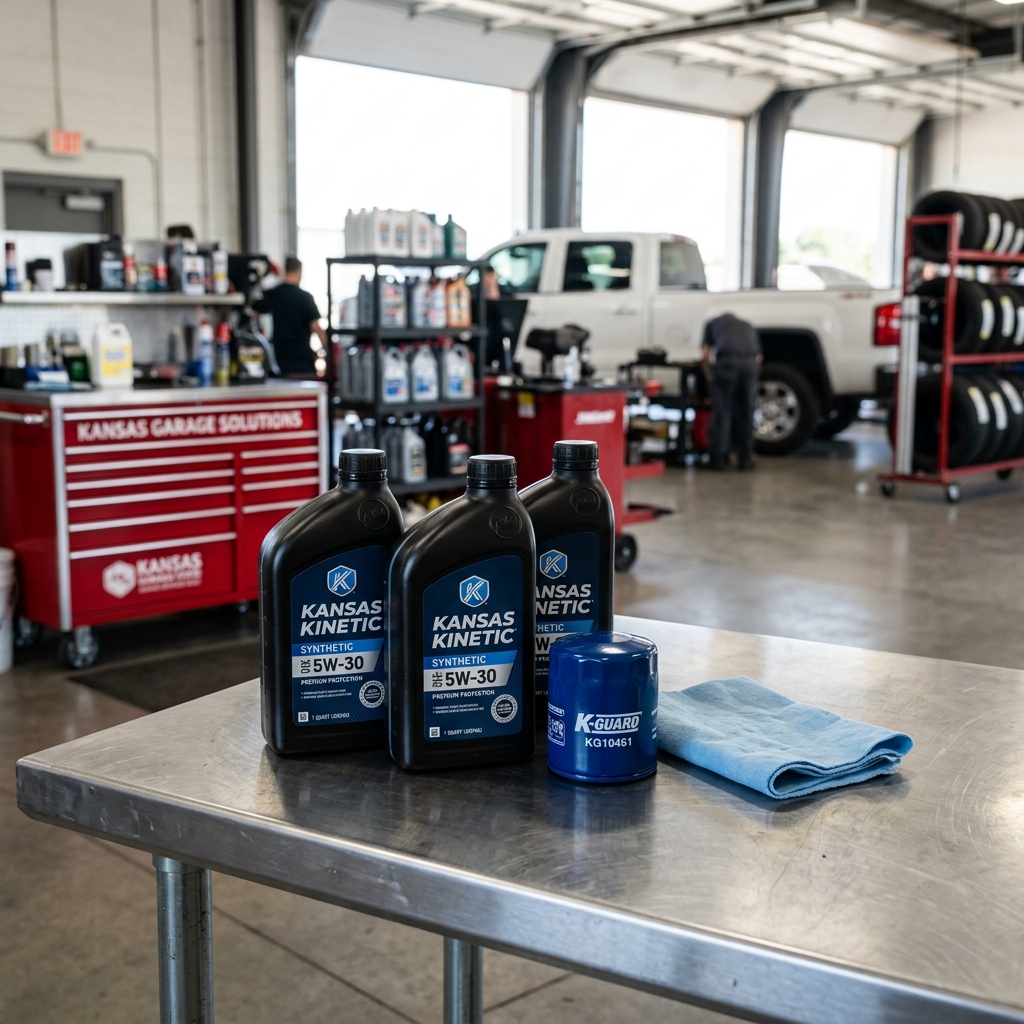
Three bottles of Kansas Kinetic 5W-30 motor oil, a blue oil filter, and a blue towel on a steel garage table. (Representative image for illustration purposes only. Actual vehicle may vary based on trim and configuration.)

Is Synthetic Oil More Cost-Effective Long-Term Than Conventional Oil?

While a full synthetic oil change carries a slightly higher initial cost than standard conventional service, it represents significantly lower long-term cost of vehicle ownership. Synthetic oil provides a broader protective margin against internal friction, component varnish, thermal breakdown, and engine wear.

Evaluation Criteria

Conventional Oil

Full Synthetic Oil

Severe Duty Oil Life

3,000 - 5,000 miles

7,500 - 10,000 miles

Thermal Stability

Moderate (Breaks down at high temp)

Extreme (Resists oxidation & varnish)

Sub-Zero Cold Flow

Sluggish startup flow

Instant pressure ramp-up

Fuel Economy Gain

Standard benchmark

1-2% efficiency improvement

Long-Term Repair Protection

Basic friction protection

Prevents costly turbo & timing chain wear

Preventing major mechanical repairs—such as timing chain stretch, VCT solenoid failures, or turbo bearing wear—saves thousands of dollars over the lifetime of your vehicle. If you're considering updating your vehicle entirely, feel free to explore our Trade In Evaluation or check out legendary models like the Research Ford F-150.

Severe Driving Conditions Checklist: Does Your Daily Route Require Special Maintenance?

Review this simple self-assessment to determine whether your daily driving habits around Junction City and Fort Riley qualify for severe duty maintenance schedules: • Do most of your trips cover fewer than 10 miles in normal weather? • Do you frequently drive in stop-and-go traffic during peak commute hours? • Do you tow a trailer, boat, camper, or haul heavy bed loads regularly? • Do you commute on unpaved gravel, dirt, or dusty country roads? • Does your vehicle experience extended idling (over 15-20 minutes daily)? • Do you drive in sub-zero winter temperatures or summer heat over 90°F?
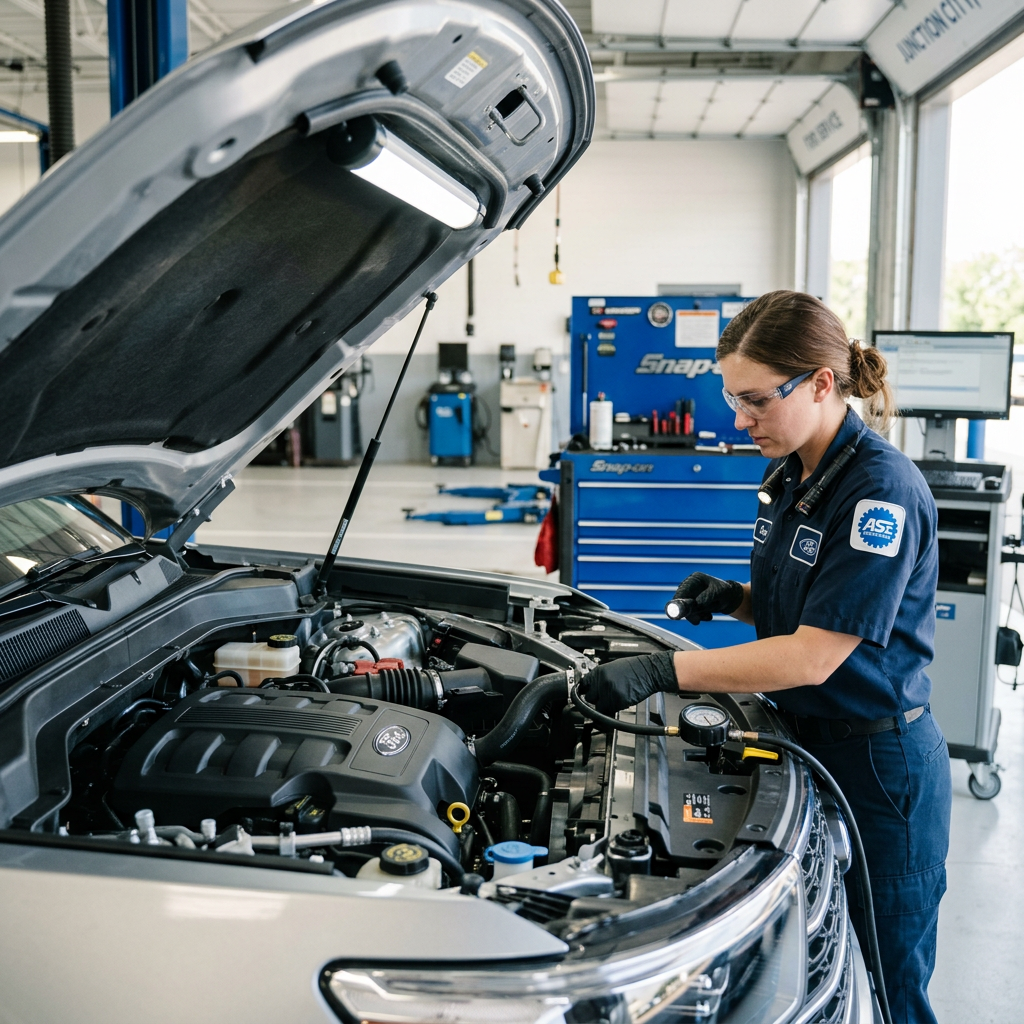
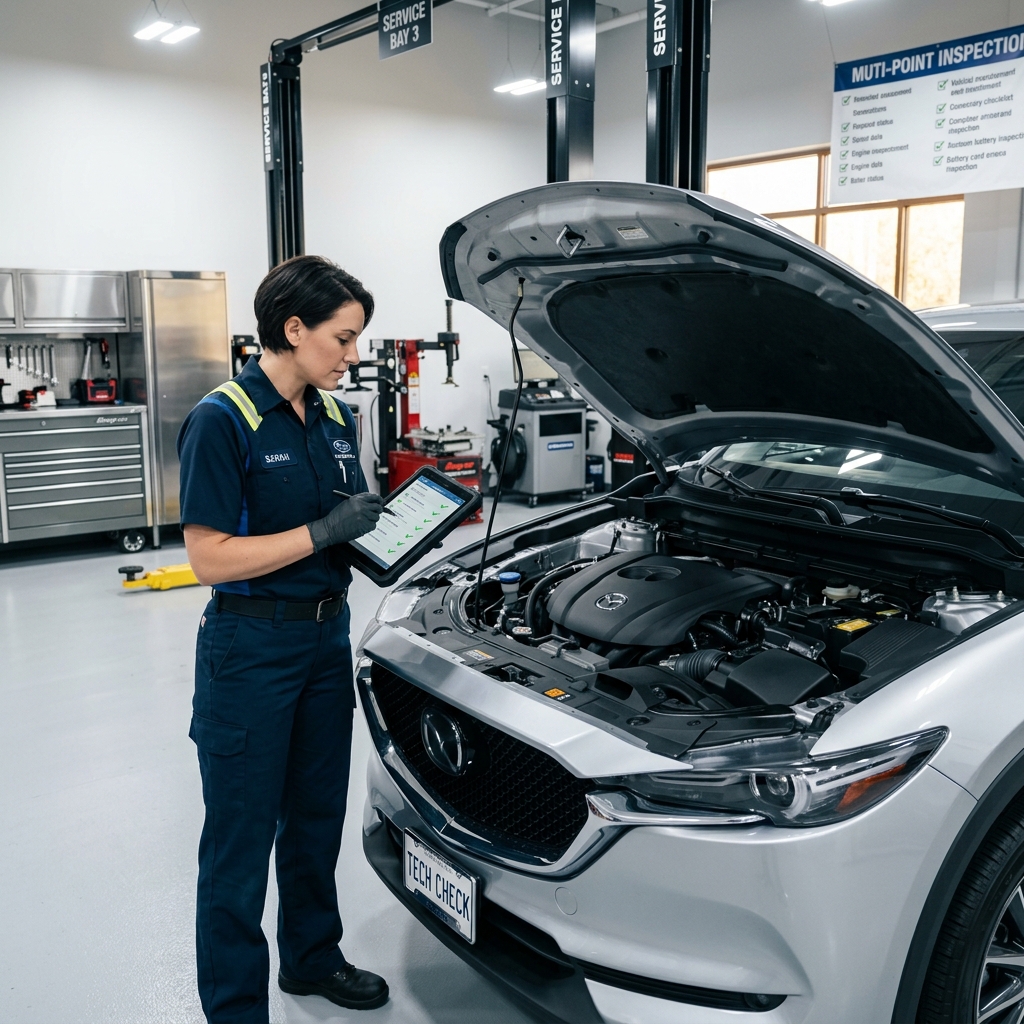
Female auto mechanic using a tablet to inspect a silver car with open hood in a service bay. (Representative image for illustration purposes only. Actual vehicle may vary based on trim and configuration.)
If you answered YES to two or more of these questions, your vehicle is operating under severe conditions. Following the severe maintenance schedule recommended by Ford engineers will safeguard your engine.

What Services Are Usually Included in a High-Quality Oil Change at a Reputable Junction City Service Center?

Fluid Drain & OEM Filter

Complete crankcase drain and replacement with premium Motorcraft or recommended synthetic fluid, along with a genuine OEM filter engineered for optimal filtration efficiency.

Multi-Point Inspection

Thorough visual check of brake pads, suspension bushings, drive belts, coolant hoses, wiper blades, and battery health to spot prospective issues early.

Fluid Top-Off & Tire Check

Topping off windshield washer fluid, coolant overflow, power steering fluid, checking tire tread depth, and resetting tire pressures to factory specifications.

What Should DIYers in Junction City Consider Before Changing Their Own Oil?

Home mechanics in Junction City who prefer performing their own oil changes should be aware of essential best practices: 1. Torque Specifications: Over-tightening oil drain plugs can strip aluminum oil pan threads, leading to costly pan replacements. Always use a calibrated torque wrench. 2. Filter O-Ring Inspections: Ensure the old oil filter gasket isn't stuck to the engine block (double-gasketing) before installing the new filter to prevent total oil loss. 3. Environmental Disposal: Kansas state regulations dictate that used motor oil and contaminated filters must be recycled at an approved facility.
If you need authentic parts or want to bypass the hassle of oil disposal, you can Order Genuine Ford Parts directly through Valor Ford or schedule a hassle-free appointment. Don't forget that you can also Schedule Pickup and Delivery Service for total convenience.

Junction City Service & Oil Change Excellence: Protecting Your Vehicle in Any Season

At Valor Ford, located right here in Junction City, KS, our service department is built around factory-certified technicians who understand the rigorous demands of Kansas driving. Whether navigating Fort Riley dirt access roads or commuting on I-70 during seasonal temperature spikes, our team utilizes specialized diagnostic tools and authentic OEM Motorcraft fluids tailored specifically to your engine.
Logo for Valor Automotive featuring a blue and silver shield with 'VA' and the company name with a red star.
We take pride in providing fast, accurate, and trustworthy maintenance. You can easily Get Directions to Valor Ford or Call us at (785) 238-5114 to discuss your severe duty service requirements with our service advisors today.

How Severe Duty Maintenance Schedules Protect Resale Value and Warranty Coverage

Maintaining accurate, documented maintenance records is essential for keeping your powertrain warranty active. If a major mechanical engine claim arises, manufacturers look for documented oil service intervals. If your driving habits meet severe duty criteria but maintenance was delayed to 10,000-mile intervals, warranty claims could face denial due to fluid neglect.
Furthermore, a fully documented service history at a franchise dealership dramatically increases your car or truck's trade-in value when you're ready to upgrade. Prospective buyers and appraisal software place a premium on vehicles with clean digital service records showing timely fluid changes. Explore options like the Research Ford Explorer or Research Ford Maverick to see what your maintained vehicle could trade toward.

Schedule Your Severe-Duty Oil Service at Valor Ford Today

Don't let unaddressed severe driving habits shorten the lifespan of your engine. Protect your investment with expert service tailored to Junction City driving conditions. Visit our team at 1825 Goldenbelt Blvd or schedule online in under two minutes.

Posted in:

Related Posts

What Safety Recalls Affect the 2023 Ford Explorer?

What Safety Recalls Affect the 2023 Ford Explorer?

What Safety Recalls Affect the 2023 Ford Explorer? Primary safety recalls affecting the 2023 Ford Explorer center on two critical vehicle systems: the rearview camera display and the automatic transmission parking mechanism. Rearview camera recalls involve software errors, wiring harness faults, or 360-degree camera module glitches that cause a blue screen, blank display, or frozen image while reversing. Transmission recalls address a potential loose transmission bolt or parking pawl engagement issue that may prevent the vehicle from holding Park, creating a potential rollaway risk. All recall inspections and repairs are completed free of charge by factory-trained technicians at authorized Ford dealerships. When safety notices are released by the manufacturer, addressing open campaigns quickly preserves vehicle reliability and ensures driver safety. The stop-and-go driving along Washington Street in Junction City puts regular stress on reversing systems and drivetrain components, making routine safety checks vital for local drivers. Ford issues safety recalls whenever a component fails to meet federal motor vehicle safety standards or presents an unreasonable safety hazard during daily vehicle operation. Vehicle owners can inspect their service status at any time by checking their 17-digit Vehicle Identification Number (VIN). Our certified service department provides complete campaign verifications and performs all authorized factory repairs using specialized diagnostic equipment and OEM components. For complete details regarding open campaigns or to schedule an inspection, contact our team by calling (785) 238-5114 or visit our service center location at 1825 Goldenbelt Blvd, Junction City, KS 66441. Table of Contents What Are the Primary Rearview Camera and Transmission Recalls for the 2023 Ford Explorer? What Safety Ratings Did the 2023 Ford Explorer Receive Despite Recalls? How Does 2023 Ford Explorer Ownership and Service Compare to the 2023 Toyota Highlander? How Can You Verify Your VIN and Receive Free 2023 Ford Explorer Recall Repairs? Common Questions About 2023 Ford Explorer Recalls and Maintenance How to Schedule 2023 Ford Explorer Recall Service at Valor Ford in Junction City What Are the Primary Rearview Camera and Transmission Recalls for the 2023 Ford Explorer? The primary recalls for the 2023 Ford Explorer involve digital rearview camera signal loss and automatic transmission parking mechanism faults. Camera issues stem from manufacturing defects in the camera wiring harness, software glitches within the Image Processing Module, or internal failures in 360-degree camera units that lead to a blue screen or black display when shifting into Reverse. Transmission safety campaigns target a loose internal fastening bolt or park rod mechanism within the 10-speed automatic transmission, which can prevent the transmission from mechanically locking into Park even if the rotary gear shifter indicates the vehicle is parked. Factory remedies for the rearview camera vary depending on the specific build date and equipped camera package: Standard Rearview Camera Wiring Harness: Technicians inspect the wiring harness for loose splices or inadequate connectivity, repairing electrical leads or replacing damaged harness sections at no charge. Rearview Camera Software Update: For models experiencing digital processing delay or frozen image output, technicians reprogram the Image Processing Module with updated software to restore instant camera feeds. 360-Degree Camera Replacement: Models fitted with surround-view systems receive a full camera module replacement when internal video processing hardware loses signal output. Service members and families commuting from nearby Fort Riley rely on dependable parking engagement when staging loaded vehicles on sloped Flint Hills terrain, making transmission recall compliance essential. Recall 23S06 specifically covers transmission engagement safety. During this service visit, certified technicians inspect the transmission assembly to confirm the parking pawl and internal fasteners are secure. If damage or improper torque is detected, technicians replace affected park mechanism components or install a replacement transmission assembly if required. Our technicians frequently note during routine maintenance that owners often ask whether a camera glitch requires replacing the entire central infotainment display or simply updating module software. In most cases, targeted software reflashing or specific camera replacement fully resolves the display fault without disrupting the primary SYNC display console. Review comprehensive Ford Explorer technical details to learn more about standard vehicle features and mechanical specifications. What Safety Ratings Did the 2023 Ford Explorer Receive Despite Recalls? Despite active safety recalls, the 2023 Ford Explorer earned a 5-Star Overall Safety Rating from the National Highway Traffic Safety Administration (NHTSA) and was designated a Top Safety Pick by the Insurance Institute for Highway Safety (IIHS). Crash test evaluations performed by NHTSA yielded top marks across major crash categories, demonstrating exceptional structural integrity and occupant protection. Evaluation Category NHTSA Star Rating Assessment Summary Overall Safety Rating 5 Out of 5 Stars Combined rating across all crash impact tests Frontal Crash 5 Out of 5 Stars Evaluates driver and front passenger protection in head-on collisions Side Crash 5 Out of 5 Stars Combines side barrier and side pole collision testing Rollover Resistance 4 Out of 5 Stars Measures single-vehicle rollover risk during loss-of-control maneuvers Standard active safety technologies further reinforce safety performance. The standard Ford Co-Pilot360 driver-assist suite equips every model with driver-assist technologies engineered to prevent collisions before they occur: Pre-Collision Assist with Automatic Emergency Braking and Pedestrian Detection Blind Spot Information System (BLIS) with Rear Cross-Traffic Alert Lane-Keeping System with Lane Departure Warning Auto High-Beam Headlamps and Rear Parking Sensors When higher trim levels like the Limited, ST, or Platinum are equipped with optional Ford Co-Pilot360 Assist+, drivers benefit from Adaptive Cruise Control with Stop-and-Go, Lane Centering, and Evasive Steering Assist. These crash-avoidance systems operate independently of recall-affected systems like the rearview camera harness or mechanical transmission park pawl, providing active driver protection on every journey. How Does 2023 Ford Explorer Ownership and Service Compare to the 2023 Toyota Highlander? The 2023 Ford Explorer delivers higher standard horsepower, greater towing capacity, and a rear-wheel-drive platform architecture compared to the front-wheel-drive platform and lower power output of the 2023 Toyota Highlander. Powered by a standard 2.3L EcoBoost turbocharged 4-cylinder engine producing 300 hp and 310 lb-ft of torque paired with a SelectShift 10-speed automatic transmission, the Explorer outpowers the Highlander's standard 2.4L turbocharged 4-cylinder engine rated at 265 hp and 310 lb-ft of torque. Specification / Feature 2023 Ford Explorer ( 2.3L EcoBoost) 2023 Toyota Highlander (2.4L Turbo) Standard Horsepower 300 hp 265 hp Standard Torque 310 lb-ft 310 lb-ft Transmission 10-Speed SelectShift Automatic 8-Speed Automatic Maximum Towing Capacity 5,300 lbs ( 2.3L) / 5,600 lbs (V6) 5,000 lbs Standard Drive Architecture Rear-Wheel Drive (AWD Available) Front-Wheel Drive (AWD Available) EPA Fuel Economy (RWD/FWD) 20 city / 27 hwy mpg 22 city / 29 hwy mpg Front Legroom 43.0 inches 42.0 inches Maximum Cargo Volume 87.8 cubic feet 84.3 cubic feet From a maintenance and long-term ownership perspective, both three-row SUVs require strict adherence to scheduled fluid changes, tire rotations, and brake system care. The Explorer model's 5,300 lbs towing capacity on standard turbocharged models (increasing to 5,600 lbs on ST and Platinum twin-turbo V6 models) gives it an advantage for hauling heavy utility trailers compared to the Highlander model's 5,000-lb limit. Proper service care for the SelectShift transmission, including fluid inspections and prompt recall updates, preserves smooth shifting and optimal power delivery over high mileages. Owners can easily schedule Ford service online to keep engine, transmission, and braking systems operating at factory standards. How Can You Verify Your VIN and Receive Free 2023 Ford Explorer Recall Repairs? You can verify whether your 2023 Ford Explorer has open safety recalls by entering your vehicle's 17-character Vehicle Identification Number (VIN) into the official Ford Owner recall portal or the NHTSA recall lookup tool. The VIN is a unique alphanumeric code that identifies your specific vehicle build, option package, and production date. To locate your vehicle's VIN, check these primary locations: Lower Driver-Side Windshield: Look at the corner where the dashboard meets the windshield glass, readable from outside the car. Driver-Side Door Pillar: Locate the safety certification label attached to the door jamb inside the driver's door frame. Official Documentation: Review your state vehicle registration card, auto insurance policy card, or vehicle title paperwork. Federal law mandates that all safety recall inspections, software updates, and replacement parts must be provided completely free of charge to vehicle owners when performed at an authorized Ford dealership. There are no out-of-pocket costs for parts or factory labor associated with completing a recall campaign. If an inspection during a recall repair reveals worn related components that fall outside the campaign parameters, owners can also order genuine Ford parts through our parts department to ensure every repair utilizes factory-certified components. Common Questions About 2023 Ford Explorer Recalls and Maintenance Q: Are all recall repairs for the 2023 Ford Explorer completely free of charge? Yes, all safety recall repairs, software updates, and component replacements are performed at zero cost to the vehicle owner. Federal regulations require vehicle manufacturers to cover 100 percent of parts and labor expenses for safety recall campaigns when service is completed at an authorized dealership, regardless of vehicle mileage or current warranty expiration status. Q: How long does it take to complete the rearview camera and transmission recall service? Service duration depends on the specific campaign applicable to your VIN. A rearview camera software update typically takes under an hour, whereas physical wiring harness inspections or camera module replacements take between one and two hours. Transmission inspections usually take one to two hours; if full internal mechanism repair or assembly replacement is needed, service may require a full day. Q: Why does my 2023 Ford Explorer rearview camera display a blue or blank screen? A blue or blank display during reversing is caused by signal loss between the camera hardware and the central SYNC display screen. This failure stems from a manufacturing fault in the camera wiring harness splices, internal processing failure inside 360-degree camera modules, or a software glitch in the Image Processing Module that interrupts video transmission when Reverse gear is engaged. Q: Can I continue driving my 2023 Ford Explorer if it has an open recall notice? While many vehicles remain drivable, open safety recalls should be addressed as quickly as possible. A transmission rollaway recall presents a potential safety risk if the vehicle fails to hold Park on an incline. Drivers should always engage the electronic parking brake firmly when parking until the recall inspection and service are completed by a factory-certified technician. Q: Will completing a recall repair extend or affect my Ford factory warranty? Completing a safety recall does not shorten or alter your standard factory warranty coverage. The 2023 Ford Explorer includes a 3-year/36,000-mile bumper-to-bumper warranty and a 5-year/60,000-mile powertrain warranty. Recall repairs are documented in Ford's national service database, maintaining your complete vehicle service history and ensuring ongoing warranty compliance. How to Schedule 2023 Ford Explorer Recall Service at Valor Ford in Junction City Resolving active safety recalls on your 2023 Ford Explorer is straightforward when trusting our specialized service department. Our factory-trained technicians possess specific diagnostic equipment, specialized tools, and direct access to genuine OEM parts required to perform camera software updates, wiring repairs, and transmission inspections efficiently. Completing these open service actions ensures your vehicle operates according to factory specifications while protecting your family on every commute. Our service team provides convenient appointment scheduling, clear service timelines, and comprehensive multi-point vehicle inspections with every recall visit. To confirm open recalls for your VIN or reserve your service appointment, give our team a call at (785) 238-5114. For drivers planning a visit, get simple directions to our dealership at 1825 Goldenbelt Blvd, Junction City, KS 66441 and let our certified technicians keep your Ford running safely. © 2026 Valor Ford. All rights reserved. Vehicle specification data © JATO Dynamics Limited.

How Should You Prepare a Ford Battery for Sub-Freezing Kansas Weather?

How Should You Prepare a Ford Battery for Sub-Freezing Kansas Weather?

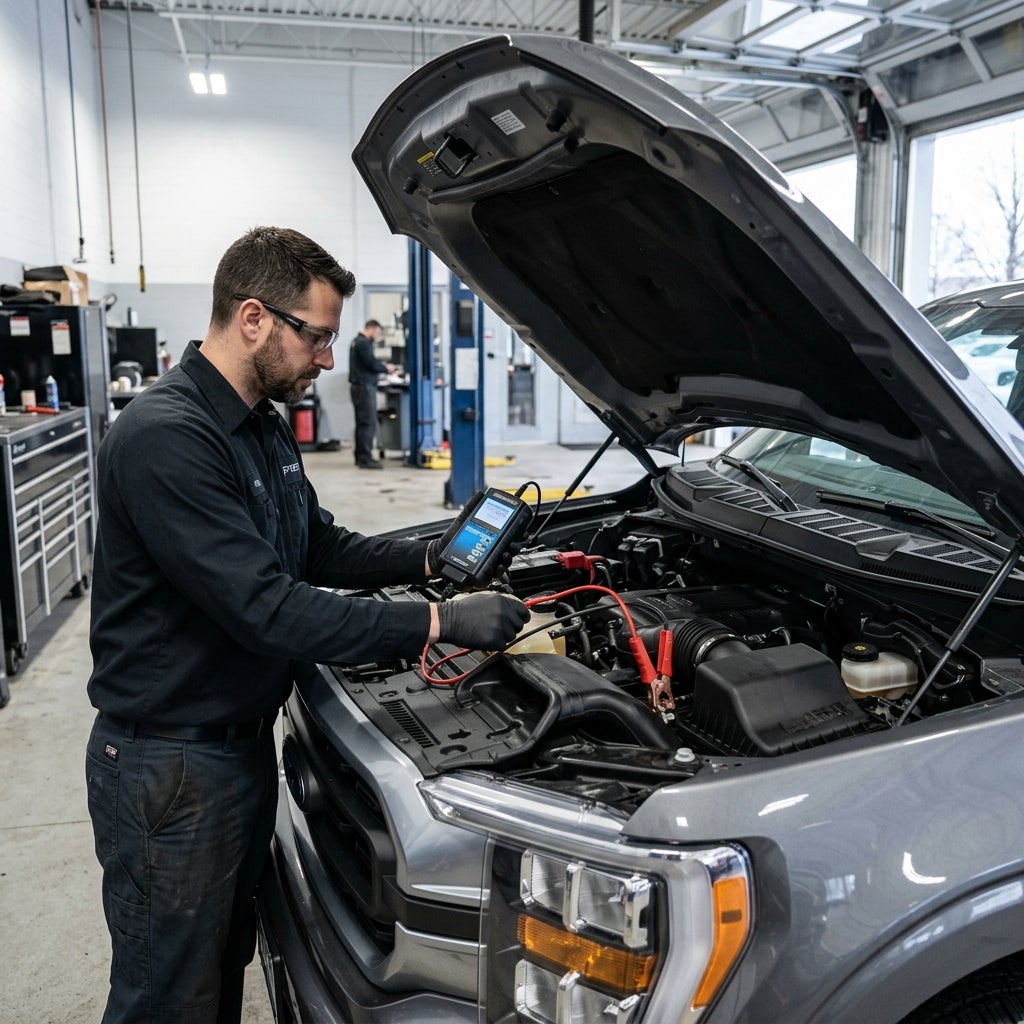
How Should You Prepare a Ford Battery for Sub-Freezing Kansas Weather? The Bottom Line: To prepare your Ford battery for sub-freezing Kansas weather, schedule a comprehensive digital load test before the first severe freeze hits Geary and Dickinson counties. Clean any surface terminal corrosion with a baking soda wash, verify a minimum Cold Cranking Amps (CCA) rating of at least 650 CCA for sedans or 750–850 CCA for Ford F-150 and Super Duty trucks, maintain continuous open-circuit voltage above 12.4V, and upgrade to an Absorbent Glass Mat (AGM) battery if your vehicle is parked outdoors overnight near Fort Riley or Junction City. Early cold-weather prep guarantees reliable morning starts when arctic cold fronts sweep across the Flint Hills. When sub-zero arctic air masses drop southward across the Kansas plains, automotive batteries face a severe double whammy: internal chemical reactions slow down dramatically while engine oil thickens, requiring significantly higher amperage to turn over the crankshaft. A battery that functioned adequately during mild October autumn mornings can fail without warning when temperatures drop into the single digits along the I-70 corridor. Taking proactive measures—testing state-of-charge, inspecting cables, securing terminal connections, and assessing cold cranking capacity—prevents sudden winter strandings at home, at work, or on rural gravel roads. Schedule Ford Battery Test Today Meet the Expert: Service Director Mike Hogg on Kansas Winter Preparedness For over 20 years, Service Director Mike Hogg has guided vehicle owners across Junction City, Fort Riley, and surrounding Dickinson County through demanding Kansas weather extremes. Having handled thousands of winter service appointments, Mike understands how sudden overnight freezes impact vehicle electrical systems, turbos, fluids, and mechanical components. "Kansas winters are notoriously unforgiving because of extreme temperature swings," notes Mike. "You can go from 60°F on Tuesday afternoon down to 4°F with wind chills well below zero by Wednesday morning. That rapid thermal contraction puts immense strain on battery plates, terminal post seals, and starting systems. My goal in this Q&A is to give Ford drivers practical, actionable advice that prevents cold-weather breakdowns before they happen." Whether you commute daily across Geary County, tow livestock trailers along rural unpaved routes, or park on base at Fort Riley during field training deployments, Mike's real-world insights provide the blueprint for uninterrupted winter mobility. Q: How Should You Prepare a Ford Battery for Sub-Freezing Kansas Weather and What CCA Rating Is Recommended? Interviewer: Mike, let's dive right into the core issue. When Kansas weather plunges below zero, why do so many batteries suddenly fail, and how should Ford owners prepare their vehicles ahead of time? Mike Hogg: It comes down to basic electrochemistry and mechanical resistance. At 32°F, a standard lead-acid battery loses approximately 20% of its available starting power. When the thermometer drops to 0°F, that loss jumps to roughly 50%. At the exact moment your battery has lost half its capacity, your engine requires up to twice as much current to crank over because motor oil thickens in cold temperatures. To prepare properly, start with a professional conductive digital load test—not just a simple voltmeter check. Voltmeter readings only tell you surface voltage, whereas a digital load test measures the internal conductance and reserve capacity of the cell plates. Secondly, ensure your battery cable terminals are completely free of oxidation and torqued tightly. Corrosion creates electrical resistance, which generates heat and reduces amperage delivery to your starter motor. Interviewer: What Cold Cranking Amperage (CCA) ratings do you recommend for drivers in Junction City and Fort Riley? Mike Hogg: Cold Cranking Amps measure the number of amperes a 12-volt battery can deliver at 0°F for 30 seconds while maintaining a voltage of at least 7.2 volts. Here is what we mandate for Midwest winter driving: • Sedans & Compact Crossovers (e.g., Ford Escape, Fusion): Minimum 650 CCA. An AGM battery with 700 CCA is ideal. • Mid-Size SUVs & Light Trucks (e.g., Ford Explorer, Ranger, Maverick): Minimum 700 to 750 CCA. • Full-Size Trucks & Heavy Duty (e.g., Ford F-150, F-250, F-350 Super Duty): Minimum 750 to 850+ CCA per battery. For Super Duty Power Stroke Diesel models equipped with dual-battery setups, both batteries must be tested together and replaced in matched pairs to prevent uneven charging loads. If you park outdoors overnight in Dickinson or Geary County, upgrading to a high-CCA Motorcraft AGM battery is one of the single best investments you can make. Ford Vehicle Category Recommended Minimum CCA Battery Type Recommendation Primary Kansas Winter Benefit Compact SUV / Sedan (Escape, Edge, Fusion) 650 - 700 CCA Motorcraft Tested Tough MAX / AGM Reliable daily starting in sub-zero driveways Mid-Size SUV / Truck (Explorer, Ranger, Maverick) 700 - 750 CCA Motorcraft AGM High reserve capacity for heated seats & defrost Full-Size Truck (F-150 EcoBoost / V8) 750 - 800 CCA Motorcraft AGM Group 65/48 Supplies auto start-stop & high starting load Super Duty Diesel (F-250 / F-350 6.7L) 800 - 850 CCA (Dual Array) Dual Matched Motorcraft AGM Powers glow plugs & grid heaters in sub-zero cold Q: What Specific Services Are Included in Ford's Winter Maintenance Package? Interviewer: Mike, when a customer books a winter readiness inspection at Valor Ford, what technical checks and maintenance services are performed to safeguard their vehicle? Electrical & Battery Diagnostics We conduct a comprehensive Motorcraft digital conductance test checking CCA capacity, internal cell resistance, starter draw, and alternator charging output. We clean terminal posts, apply anti-corrosion protection sealant, and verify battery tie-down security against rough gravel road vibrations. Coolant & Fluid Freeze Protection Using a calibrated optical refractometer, we test your Ford Yellow Coolant concentration to guarantee freeze protection down to -35°F or lower. Diluted engine coolant can freeze inside radiator cores or engine blocks, leading to catastrophic internal cracks during deep Kansas freezes. Safety, Brakes & Visibility We perform a thorough 83-point check inspecting brake pad thickness, hydraulic lines, wiper blade rubber flexibility, washer fluid reservoir fill with sub-zero de-icing fluid (-20°F rated), suspension bushings, headlight clarity, and tire tread depth across all four wheels. Prevent unexpected breakdown expense by scheduling your seasonal inspection early. Drivers can easily Schedule Ford Service Today at Valor Ford online or Call us at (785) 238-5114 to speak directly with our service desk. Schedule Winter Service Package Q: What Belongs on a Pre-Winter Readiness Checklist for Kansas Freeze and Gravel Roads? Interviewer: Rural driving around Dickinson County presents unique challenges like unpaved corrugated gravel, mud slush, and sudden drifts. What essential items belong on every driver's winter checklist? Mike Hogg: Driving in central Kansas requires preparing for both cold weather and rugged surface conditions. Here is our master checklist: 1. Battery Open-Circuit Voltage & Mount Inspection: Verify static voltage is above 12.4V (ideally 12.6V+). Gravel road vibration can loosen battery hold-down brackets, causing internal plate damage. Ensure the battery clamp is secure. 2. Tire Pressure Monitoring (TPMS): Ambient temperature drops reduce tire pressure by roughly 1 PSI for every 10°F drop. Underinflated tires wear rapidly on gravel roads and reduce traction on snow. 3. Suspension & Shock Absorber Inspection: Washboards on county gravel roads beat up strut mounts, ball joints, and shocks. Worn shocks reduce tire contact patch area on slick ice. 4. Sub-Zero Washer Fluid Top-Off: Summer washer fluid will freeze solid, cracking fluid reservoirs and pump lines. Fill with -20°F or -30°F rated de-icer fluid. 5. Winter Emergency Roadside Kit: Tow strap, heavy jumper cables, portable lithium booster pack, thermal blankets, flashlight, folding shovel, and traction sand or cat litter. Q: Are 3-Peak Mountain Snowflake Rated All-Terrain Tires Adequate for Kansas Winters? Interviewer: Many Ford truck and SUV owners fit 3-Peak Mountain Snowflake (3PMSF) rated all-terrain tires like the BFGoodrich KO2 or Falken Wildpeak. Are these adequate for Kansas winters, or should drivers invest in dedicated snow tires? Mike Hogg: That is one of our most common customer questions. The short answer is: 3PMSF all-terrain tires are excellent for about 85% of Kansas winter conditions, especially on packed snow, light slush, and muddy unpaved roads. However, drivers need to understand the technical distinctions. The 3PMSF rating certifies that a tire meets or exceeds a specific acceleration traction threshold on medium-packed snow. The rubber compound in a 3PMSF all-terrain tire remains more flexible in cold weather than standard all-season highway tires. If you drive a Ford F-150 or Ford Bronco on rural gravel and highway routes around Junction City, high-quality 3PMSF all-terrain tires provide strong multi-season versatility. Mike Hogg (continued): Where dedicated winter tires (like the Bridgestone Blizzak or Michelin X-Ice) outperform 3PMSF all-terrains is on pure black ice and hard-packed freezing rain, particularly on high-speed bridges like the Kansas River overpasses on I-70 or Highway 77. Dedicated winter tires utilize ultra-soft hydrophilic rubber compounds infused with millions of microscopic sipes that create micro-pumping action to suck away thin surface water films on ice. A 3PMSF all-terrain tire has stiffer tread blocks designed for rock and gravel durability, so it cannot match a dedicated winter tire's stopping distance on smooth glare ice. If your daily commute involves early morning highway driving before salt trucks arrive, dedicated winter tires offer maximum stopping confidence. If you frequently drive unpaved gravel roads with heavy rock wear, a durable 3PMSF all-terrain tire is often the more practical year-round choice. Q: Is It Cheaper to Install Winter Tires on Spare Wheels for Seasonal Swapping? Interviewer: Mike, is it more cost-effective over time to buy a dedicated set of spare steel or OEM wheels for winter tires, or should owners just demount and remount tires twice a year on their factory wheels? Twice-Yearly Remount Costs Demounting, mounting, balancing, and replacing valve stems twice per year costs roughly $120 to $180 per season ($240-$360 annually). Over a 4-year tire lifespan, labor alone totals $960 to $1,440. Repeated dismounting also increases wear on aluminum wheel bead seats and rubber TPMS seals. Dedicated Wheel Package Purchasing dedicated OEM Ford steel wheels or takeoff rims with pre-programmed TPMS sensors requires an upfront investment, but pre-mounted seasonal swaps only cost $30-$50 per visit (or can be performed easily in your home garage). The package pays for itself in under 3 years. In addition to direct labor savings, dedicated winter wheels protect your expensive primary factory alloy wheels from harsh magnesium chloride road salts, flying gravel chips, and curb scrapes during winter ice storms. You can easily Order Genuine Ford Parts including OEM steel wheels, winter wheel packages, and TPMS sensors directly through Valor Ford. Order OEM Winter Wheels & Parts Q: What Is the Difference Between Rubberized and Oil-Based Rust Undercoating? Interviewer: Kansas highway departments heavily treat I-70, US-77, and local roads with liquid magnesium chloride and rock salt. What undercoating method provides superior protection for Ford boxed frames and underbody components? Mike Hogg: Rust protection is critical for long-term vehicle durability in Kansas. The two primary aftermarket technologies are hard rubberized undercoating and fluid oil-based (or lanolin-based) rust inhibitors. Understanding how each behaves over time is key to preserving your vehicle. Rubberized Undercoating: Traditional rubberized coatings dry into a hard, thick black outer shell. While they look great initially, gravel impact on unpaved roads can chip or crack the hardened layer. Moisture, salt brine, and dirt then seep behind the cracked rubber shell, trapping liquid directly against bare frame steel. Because the outer rubber traps the moisture inside, rust can silently eat away frame metal underneath completely unnoticed. Oil-Based / Lanolin Undercoating: Liquid-wax and lanolin-based compounds (such as Woolwax or Fluid Film) do not harden. They remain active, self-healing, creeping barrier films. When gravel strikes an oil-treated frame, the surrounding oil creeps back over the exposed metal. Key advantages of oil-based undercoating: • Active Creep: Penetrates tight frame boxed sections, pinch welds, rocker panels, and electrical ground points. • Moisture Displacement: Active petroleum/lanolin molecules displace standing water and air, preventing oxidation. • No Moisture Trapping: Will never chip, dry out, or trap corrosive saltwater against vehicle steel. For trucks like the Ford F-250 Super Duty or Ford Maverick that regularly encounter highway salt spray and gravel roads, we strongly recommend active oil-based undercoating treatments applied annually each fall. Q: What Features Make Ford Vehicles Well-Suited for Winter Driving and Gravel Roads in Kansas? Interviewer: From an engineering standpoint, what factory features give modern Ford trucks and SUVs an edge when navigating winter weather and gravel roads? Intelligent 4WD & Slippery Mode Ford's Terrain Management System features dedicated Selectable Drive Modes like Slippery and Deep Snow/Sand. Slippery mode softens throttle response, optimizes 4WD torque split, and adjusts traction control intervention thresholds to prevent wheel spin on snow and wet gravel. Active Grille Shutters Automatic active grille shutters close off air entry into the engine compartment during cold start-ups. This allows EcoBoost and V8 engines to reach optimum operating temperature up to 30% faster in sub-freezing weather, delivering rapid cabin heat and reducing cold-engine cylinder wear. Heavy-Duty Motorcraft AGM Ford equips modern vehicles with Absorbent Glass Mat (AGM) batteries engineered with micro-glass fiber separators. AGM units endure 3x the cycle life of traditional flooded batteries and offer superior resistance to intense chassis vibration caused by washboard gravel roads. Models like the Ford Explorer and Ford Super Duty F-250 combine intelligent mechanical engineering with robust cold-climate electronic controls to deliver unmatched stability across central Kansas. Q: How Should Active-Duty Military at Fort Riley and Rural Commuters Prevent Winter Battery Drain? Interviewer: Junction City is home to many active-duty military personnel serving at Fort Riley who face multi-week field deployments where vehicles sit outdoors in arctic cold. What strategies prevent battery drain while deployed or during long shift parking? Mike Hogg: Parasitic parasitic battery drain is a huge concern for soldiers deployed to the field or shift workers parked in open lots at Fort Riley. Modern Ford vehicles maintain active telemetry modules, security sensors, and keyless entry receivers that slowly draw 20 to 50 milliamperes continuous current. When a vehicle sits parked in 10°F weather for two to three weeks without starting, that continuous parasitic draw combined with cold capacity loss will deplete even a healthy battery down below starting threshold. Mike Hogg's Practical Battery Maintenance Tips: 1. Use a Smart Trickle Charger / Battery Tender: If parked near an outlet, attach a microprocessor-controlled 1.5A to 3A smart tender. It monitors state-of-charge and automatically enters float mode without overcharging. 2. Ford App Remote Pre-Conditioning: For daily commuters, schedule automatic start times via the Ford App while plugged in or parked. Pre-conditioning warms the battery, engine block, and cabin prior to driving, reducing battery discharge during startup. 3. Solar Maintenance Chargers: For vehicles parked on base without AC outlet access, quality dashboard solar trickle chargers plugged into non-switched power ports help offset parasitic telemetry draw. 4. Valor Pickup & Delivery Service: If deployed or working long shift hours, utilize our convenient concierge service. You can Schedule Pickup and Delivery Service and our team will pick up your Ford, perform winter maintenance, and return it safely to your residence. Schedule Pickup & Delivery Service Q: What Signs Indicate Your Motorcraft Battery Needs Immediate Replacement Before Winter? Interviewer: Mike, what early warning signs should drivers look and listen for that indicate a battery is about to fail before they get stranded in a cold parking lot? Mike Hogg: Batteries rarely fail without giving subtle warning signals first. Paying attention to these symptoms in October and November will save you from stranded mornings in December and January: • Sluggish Engine Crank: If the engine turns over slowly ("rrm... rrm... vroom") instead of crisp immediate starting, battery reserve capacity is depleted. • Dim Headlights or Flickering Cabin Displays: Headlights that brighten when revving the engine indicate the alternator is carrying electrical load because the battery cannot hold charge. • Battery Age Over 3 to 5 Years: The average lifespan of a vehicle battery in Midwest heat and cold cycles is 3 to 4 years. If your battery is over 36 months old, get it tested immediately. • Swollen or Bulging Battery Case: Extreme summer heat causes internal plate warping and case swelling, which accelerates sudden cold-weather short circuits. • Pungent Sulfur / Rotten Egg Smell: Indicates internal overheating and gas venting, requiring immediate replacement. Key Takeaways: Expert Summary for Winter-Proofing Your Ford in Junction City To summarize Service Director Mike Hogg's expert advice for winterizing your Ford vehicle before sub-freezing Kansas weather arrives: 1. Test Before the Freeze: Schedule a digital conductance load test at Valor Ford before temperatures hit 32°F. 2. Verify CCA Ratings: Ensure at least 650 CCA for sedans, 750 CCA for light trucks, and 800+ CCA dual arrays for Super Duty diesels. 3. Upgrade to AGM: Absorbent Glass Mat batteries resist gravel road vibration and hold voltage far better in extreme sub-zero cold. 4. Protect Frame Steel: Choose active oil-based undercoating over hard rubberized coatings to avoid trapping corrosive magnesium chloride road salt. 5. Dedicated Winter Wheels: Mounting winter tires on spare OEM steel wheels saves money long-term and protects alloy rims. 6. Inspect Coolant & Fluids: Verify engine coolant concentration guarantees freeze protection down to -35°F. 7. Maintain Smart Charging: Utilize FordPass pre-conditioning and smart trickle chargers during Fort Riley deployments. Schedule Your Winter Battery Test and Inspection at Valor Ford Today Don't wait for the first severe Kansas freeze to leave you stranded. The factory-certified service team at Valor Ford is ready to inspect your battery, test coolant strength, check tires, and prepare your vehicle for winter driving across Junction City, Fort Riley, and Dickinson County. Visit our state-of-the-art service center at 1825 Goldenbelt Blvd, Junction City, KS 66441 or contact our team directly. Get Directions to Valor Ford or Call us at (785) 238-5114. You can also explore our pre-owned inventory with a Browse Used Inventory link or check trade values with a Trade In Evaluation. Schedule Ford Service Today

Recommended All-Terrain Tires for Central Kansas Winter and Dirt Roads

Recommended All-Terrain Tires for Central Kansas Winter and Dirt Roads

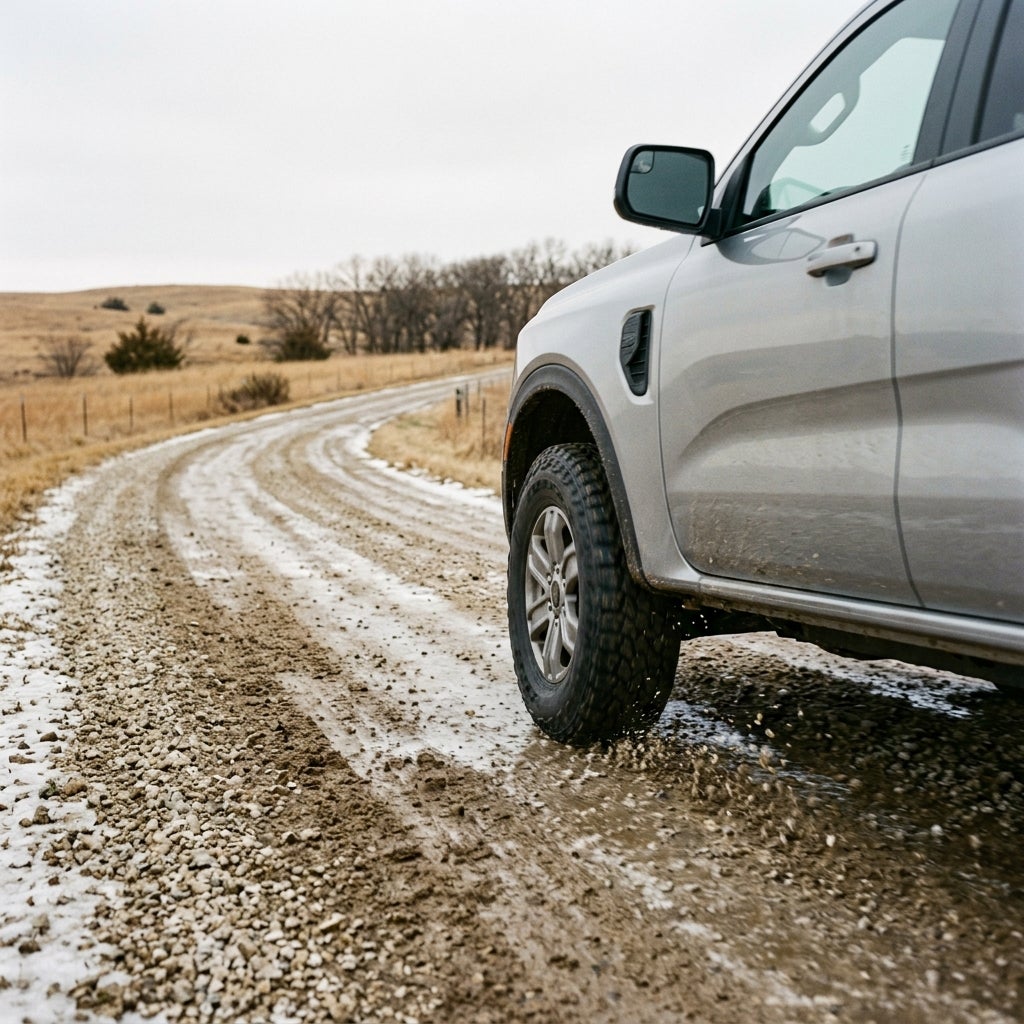
Recommended All-Terrain Tires for Central Kansas Winter and Dirt Roads For Central Kansas drivers tackling sticky rural clay mud, jagged Flint Hills limestone gravel, and unpredictable snow-slicked roads around Junction City, Fort Riley, and Dickinson County, standard highway tires simply will not cut it. The ultimate tire setup requires models bearing the Three-Peak Mountain Snowflake (3PMSF) rating, paired with rugged chip-resistant rubber compounds and deep tread voiding. Our top recommended all-terrain tires for Central Kansas conditions are the Falken Wildpeak A/T4W, BFGoodrich All-Terrain T/A KO3, and Goodyear Wrangler DuraTrac. When mounted on a midsize powerhouse like the 2026 Ford Ranger XLT, these tire options deliver exceptional siping for freezing winter ice, shoulder lug traction for sticky county farm mud, and heat-resistant tread longevity against sharp gravel. Navigating Dickinson County Dirt Roads and Flint Hills Winter Weather Driving in Dickinson County and across the Flint Hills region presents a unique mix of road surface challenges. Unpaved rural routes are heavily surfaced with crushed limestone gravel. While limestone provides an economical roadway, its sharp, multi-angular edges slice through soft highway tire treads, leading to premature wear, tread chipping, and sidewall punctures. When temperature fluctuations strike during Kansas winters, freeze-thaw cycles convert gravel roads into thick, heavy slush and unpaved farm lanes into deep mud ruts. On high-speed corridors like Interstate 70 and Highway US-77, sudden winter squalls create treacherous black ice bridges and packed snow drifts that demand extreme lateral grip. Why Highway Tires Fail: Standard all-season highway tires rely on tight tread blocks optimized for pavement fuel efficiency. In Central Kansas mud, these tight grooves quickly clog, turning tires into slick slicks. Furthermore, sub-freezing temperatures harden highway tire rubber compounds, eliminating ice friction when you need it most. Top 3PMSF All-Terrain Tires Tested for Gravel, Mud, and Snow To earn the Three-Peak Mountain Snowflake (3PMSF) emblem, a tire must exceed standardized severe snow traction tests by at least 10% over reference tires. Here is how our top three recommended models compare across Central Kansas driving demands: Falken Wildpeak A/T4W Engineered for maximum gravel endurance and severe snow capability. Features full-depth 3D canyon siping and heavy-duty heat-diffusing technology to prevent tread tearing on sharp Flint Hills rock while delivering outstanding packed-snow grip. BFGoodrich KO3 Built with CoreGard technology and split-resistant sidewall rubber derived from off-road racing. The newly optimized tread pattern reduces irregular wear from gravel roads and provides locking 3D sipes for confidence on icy highway overpasses. Goodyear DuraTrac Uses aggressive shoulder blocks and TractiveGroove Technology to offer enhanced traction in deep farm mud and unplowed county snow. Ideal for truck owners who spend equal time in fields and on rural highway routes. Tire Model 3PMSF Rated Sidewall Protection Gravel Chip Resistance Deep Mud Performance Falken Wildpeak A/T4W Yes High (DURASPEC 3-Ply) Excellent Very Good BFGoodrich T/A KO3 Yes Maximum (CoreGard) Excellent Good Goodyear Wrangler DuraTrac Yes High Good Maximum (TractiveGroove) 2026 Ford Ranger XLT Feature Breakdown: Capability, Tech, and Utility for Central Kansas Pairing superior all-terrain tires with a highly capable truck chassis is key to mastering Kansas winters. The 2026 Ford Ranger XLT features a robust 9.3 inches of standard ground clearance, enabling drivers to clear high snow drifts, deep mud ruts, and washed-out gravel paths without high-centering or damaging critical underbody components. Equipped with an advanced Electronic-Shift-on-the-Fly 4x4 system, selectable drive modes (Grass/Gravel/Snow, Mud/Ruts, Sand, Normal, Eco), and available factory FX4 Off-Road packages, the Ranger XLT optimizes throttle response and traction control specifically for slick local terrain. Get Pre-Approved for Financing What Engine Options and Performance Specifications Are Available on the 2026 Ford Ranger XLT? The 2026 Ford Ranger XLT brings exceptional powertrain choices tailored to work and recreation across Central Kansas. The standard powertrain is the proven 2.3L EcoBoost Inline-4, outputting a healthy 270 horsepower and 310 lb-ft of torque. For truck buyers needing extra passing power and heavy towing strength, Ford offers the available 2.7L EcoBoost V6 engine, delivering an impressive 315 horsepower and 400 lb-ft of torque. Both engines are paired with a smooth 10-speed automatic transmission. Low-End Torque Advantages: High low-RPM torque is essential when navigating unpaved Kansas roads. Having torque available early in the rev band allows the Ranger XLT to crawl out of sticky clay mud or heavy snow drifts without spinning wheels out of control. Engine Spec 2.3L EcoBoost I4 2.7L EcoBoost V6 Horsepower 270 hp 315 hp Torque 310 lb-ft 400 lb-ft Transmission 10-Speed Automatic 10-Speed Automatic Max Towing Capacity 7,500 lbs 7,500 lbs Bed Width and Cargo Capacity: Can a Standard 4x8 Sheet of Plywood Fit Flat in the 2026 Ford Ranger Bed? Yes! Standard 4x8 sheets of plywood and drywall lay flat between the wheel wells in the 2026 Ford Ranger bed when the tailgate is lowered or placed in the half-open supported position. Ford widened the distance between the rear wheel arches to 44.8 inches, allowing building materials, hay bales, and farm utility equipment to load seamlessly. Practical bed features include an integrated 400W in-bed power outlet for operating power tools or air compressors out in the field, sturdy tie-down cleats, available spray-in bedliners, and integrated rear bumper side steps for easy cargo access. How Does the Ford Ranger XLT Compare in Rear Seat Legroom to the Toyota Tacoma? Interior comfort is a primary consideration for truck owners commuting between Fort Riley and Junction City or taking family trips across Kansas. When comparing cabin roominess, the 2026 Ford Ranger XLT outshines the Toyota Tacoma in critical rear-seat metrics. The Ford Ranger XLT offers a generous 34.6 inches of rear legroom compared to the Toyota Tacoma Double Cab's tighter 33.7 inches (and even tighter configurations on underlying trims). This extra space provides adult passengers and carpooling service members with significantly superior knee and leg clearance on longer journeys. Interior Metric 2026 Ford Ranger XLT 2026 Toyota Tacoma Rear Legroom 34.6 in 33.7 in Rear Headroom 38.3 in 38.0 in Rear Shoulder Room 56.7 in 56.3 in Under-Seat Storage Yes (Fold-Flat) Limited What Technology and Infotainment Features Are Included in the 2026 Ford Ranger XLT? SYNC 4A Touchscreen Features a standard 12-inch center display screen running SYNC 4A with enhanced voice recognition, intuitive cloud-connected navigation, and dynamic off-road pitch/roll telemetry displays. Ford App Remote Start Use Ford App Connect on freezing Junction City mornings to remotely start your truck, warm the cabin, defrost windshields, and check real-time individual tire pressures (TPMS) directly from your smartphone. Seamless Connectivity Standard wireless Apple CarPlay and Android Auto integration keep your maps and communications clear. Customize your rig with genuine Ford accessories ordered through our dealership team. Order Genuine Ford Parts Maintaining Correct Tire Pressure and Tread Depth Through Kansas Winter Spells As autumn turns to winter in Central Kansas, ambient temperatures drop sharply. For every 10°F drop in outside temperature, tire inflation drops approximately 1 to 2 PSI. Under-inflated tires severely compromise steering precision, tread wear, and winter emergency braking. To prevent uneven wear patterns from rough gravel roads, schedule tire rotations every 5,000 miles. Furthermore, while the legal minimum tread depth is 2/32 of an inch, winter and dirt road safety calls for replacing tires once tread drops below 4/32 of an inch. Visit the certified service center at Valor Ford in Junction City for expert tire inspections, mounting, balancing, and alignment services. Get Directions to Valor Ford or Call us at (785) 238-5114 to speak directly with our tire experts today. Schedule Ford Service Today