
Blog / Buying Guides

Late-Summer Move-In Guide: How the Ford Transit-250 and Explorer Make Manhattan Student and Military Moves Easier

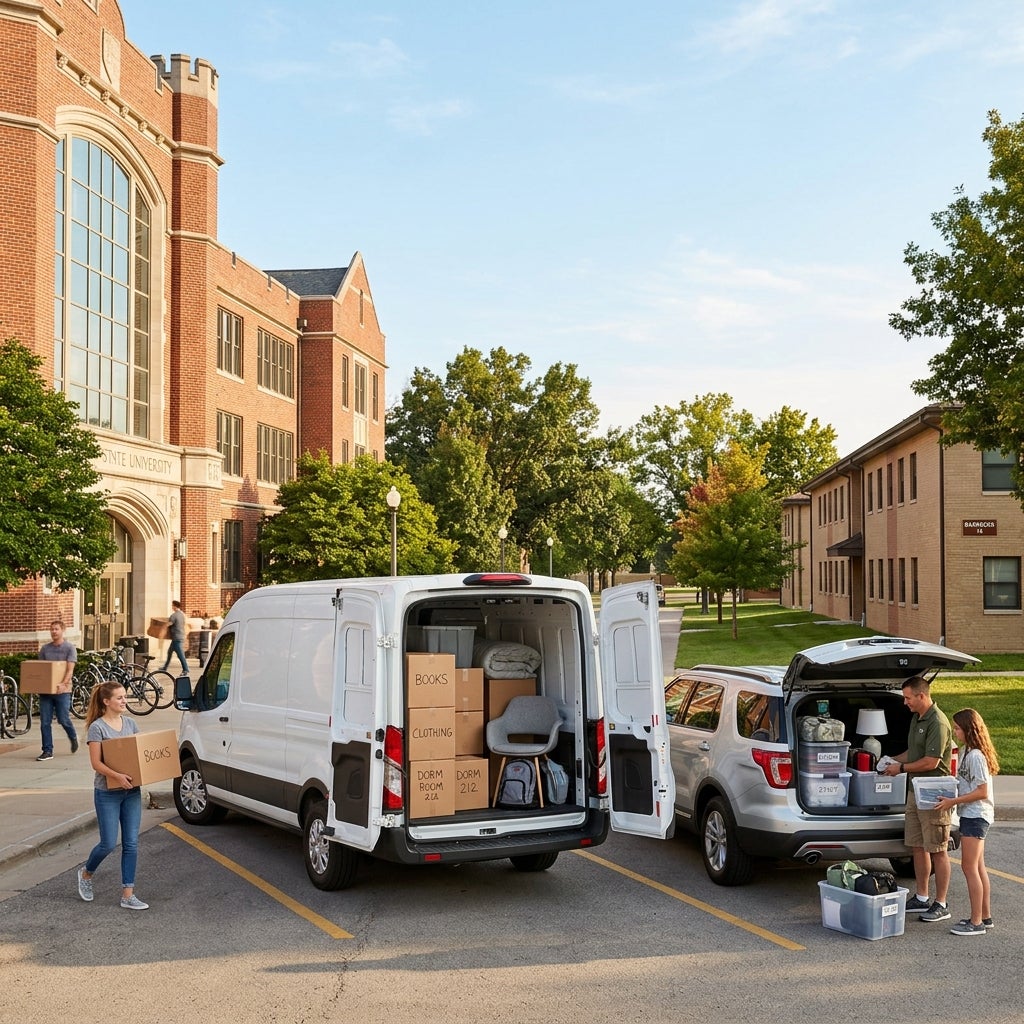
Students and parents unloading a white van and a silver SUV on a sunny college campus move-in day. (Representative image for illustration purposes only. Actual vehicle may vary based on trim and configuration.)

Late-Summer Move-In Guide: How the Ford Transit-250 and Explorer Make Manhattan Student and Military Moves Easier

Late summer in the Flint Hills brings a unique, electric energy. As August approaches, the roads around Junction City, Manhattan, and Fort Riley come alive with a massive influx of people. Kansas State University is preparing to welcome thousands of returning and first-year students to the Little Apple, while active-duty military families at Fort Riley navigate their summer PCS (Permanent Change of Station) cycles. Moving is a monumental task under any circumstances, but trying to transport your entire life in the sweltering late-summer heat of Kansas adds an extra layer of challenge. That is why having the right vehicle isn't just a matter of convenience—it is the difference between a stressful, multi-trip ordeal and a smooth, organized transition. At Valor Ford, we understand these local challenges, and we are proud to showcase how versatile powerhouses like the Ford Transit-250 and the Ford Explorer are engineered to conquer the toughest moving days.

Conquering the Late-Summer Rush: Why Fort Riley and K-State Moves Demand the Right Vehicle

The Junction City, Fort Riley, and Manhattan tri-county area experiences an incredible logistical bottleneck every August. For K-State students, the scramble to move into residence halls like Wefald or Derby, or off-campus apartments in Aggieville and the West Loop, means navigating narrow streets, congested parking lots, and tight time slots. For military personnel reporting to Fort Riley's 1st Infantry Division, packing up a household to settle on-post or in surrounding residential neighborhoods requires handling heavy, high-volume government-issued gear, household goods, and family valuables. Doing this in 90-degree Kansas humidity requires efficiency. You do not want to make five trips back and forth along Highway 18 because your compact car can only hold three cardboard boxes and a MINI-fridge.

Relying on rental trucks is often a costly and inflexible headache. Rental rates skyrocket during peak moving weeks, and coordinating pick-up and drop-off times around strict military check-ins or university housing windows can be highly stressful. Investing in a highly capable vehicle—or utilizing one already in your household—grants you total freedom over your schedule. The massive interior volume of a cargo van like the Ford Transit-250 or the refined, flexible three-row configuration of the Ford Explorer lets you pack, transport, and unpack on your own terms. Whether you are transporting a queen-sized mattress and a semesters worth of gear, or organizing a tactical military relocation, having the right Ford vehicle at your disposal ensures you are fully prepared for the journey ahead.

What are the cargo dimensions and total volume of the 2024/2025 Ford Transit-250 cargo van?

For maximum cargo utility, nothing compares to the purpose-built design of the 2024/2025 Ford Transit-250. This commercial-grade cargo van is engineered to maximize every square inch of space, providing a cavernous interior that can easily ingest entire apartments or significant portions of a military household shipment. Let's break down the exact dimensions and total volume configurations to show you just how much gear you can fit.

Unmatched Load Length
The regular wheelbase Transit-250 offers a cargo load length of up to 126.7 inches along the floor. If you opt for the long wheelbase version, that floor length stretches to 143.7 inches. This provides ample space to slide in full-sized couches, dining tables, or heavy-duty storage racks without having to disassemble them.

Generous Cargo Width
With a maximum cargo width of 70.2 inches and a comfortable 54.8 inches of clearance between the rear wheelwells, the Transit-250 easily accommodates standard 4x8 building sheets, large military gear containers, and wide furniture pieces laying completely flat on the floor.
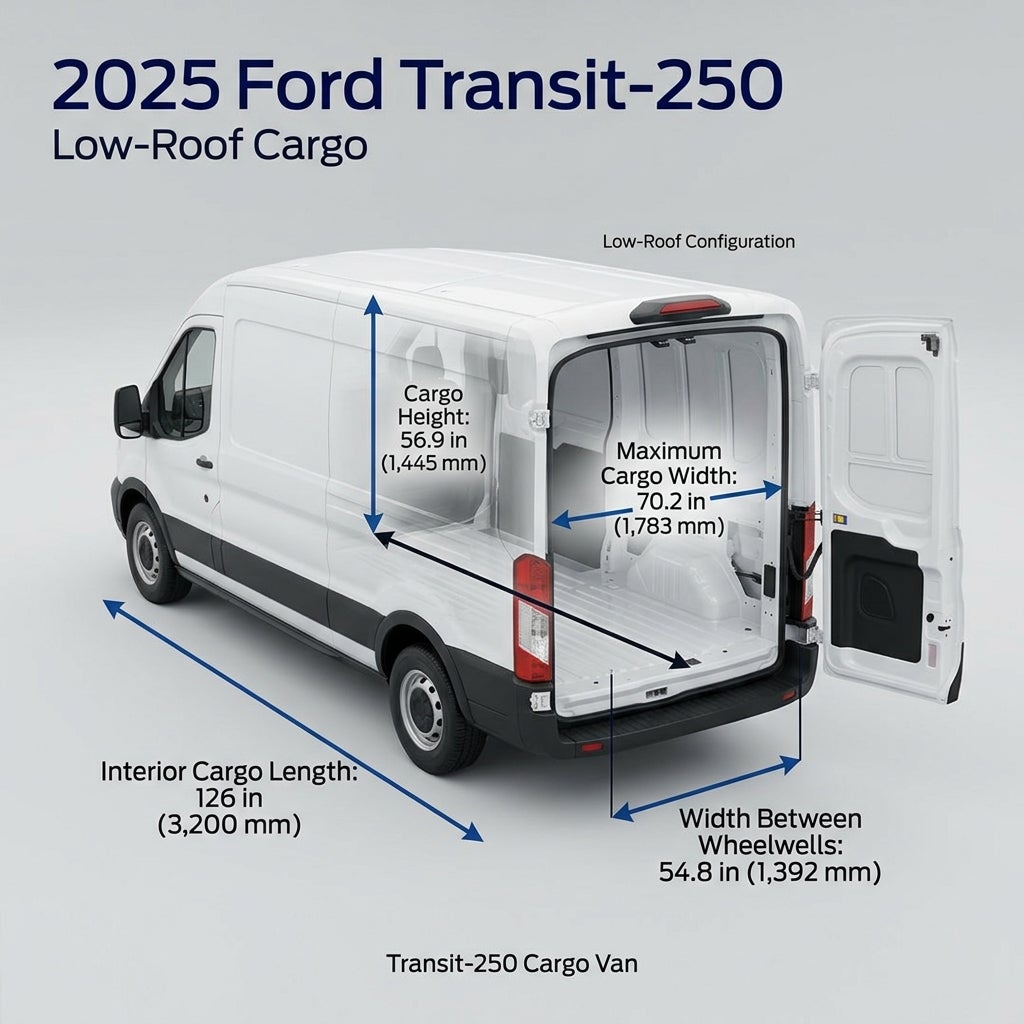
Diagram of a 2025 Ford Transit-250 Low-Roof Cargo van showing interior dimensions like length, height, and width. (Representative image for illustration purposes only. Actual vehicle may vary based on trim and configuration.)

Transit-250 Configuration

Max Cargo Volume (cu. ft.)

Cargo Height (in.)

Max Payload Capacity (lbs.)

Low Roof / Regular Wheelbase

246.7

56.9

3,500 - 4,000

Medium Roof / Regular Wheelbase

315.2

72.0

3,400 - 3,900

High Roof / Long Wheelbase

404.3

81.5

3,200 - 3,700

How much cargo space does the low-roof 2025 Ford Transit-250 have for boxes and dorm furniture?

While the medium and high-roof configurations of the Ford Transit-250 are excellent for standing upright inside the vehicle, the low-roof model is often the unsung hero for residential and collegiate moves. Offering an impressive 247 cubic feet of maximum cargo volume behind the front seats, the low-roof Transit-250 provides a massive space that easily accommodates multiple mattresses, large study desks, bookshelves, and dozens of stacked wardrobe boxes. This volume is more than double what you'll find in even the largest full-sized SUVs, making it the perfect single-trip vehicle for moving into a K-State dorm or an apartment in Junction City.

The major advantage of the low-roof configuration is its exterior height. Standing at approximately 83 inches (depending on exact wheel and tire setups), the low-roof Transit-250 is highly maneuverable. It can comfortably navigate standard parking garages around Manhattan, KS, such as the K-State Student Union parking deck, and fits easily under low-hanging tree branches in older residential neighborhoods. This means you can drive right up to the entrance of your building, reducing the distance you have to carry heavy furniture in the summer heat.

Ready to find the perfect high-capacity vehicle for your commercial or personal needs? You can Browse Used Inventory at Valor Ford to explore our current selection of versatile cargo vans and high-capacity haulers.

What is the cargo space behind the third row of the 2025 Ford Explorer?

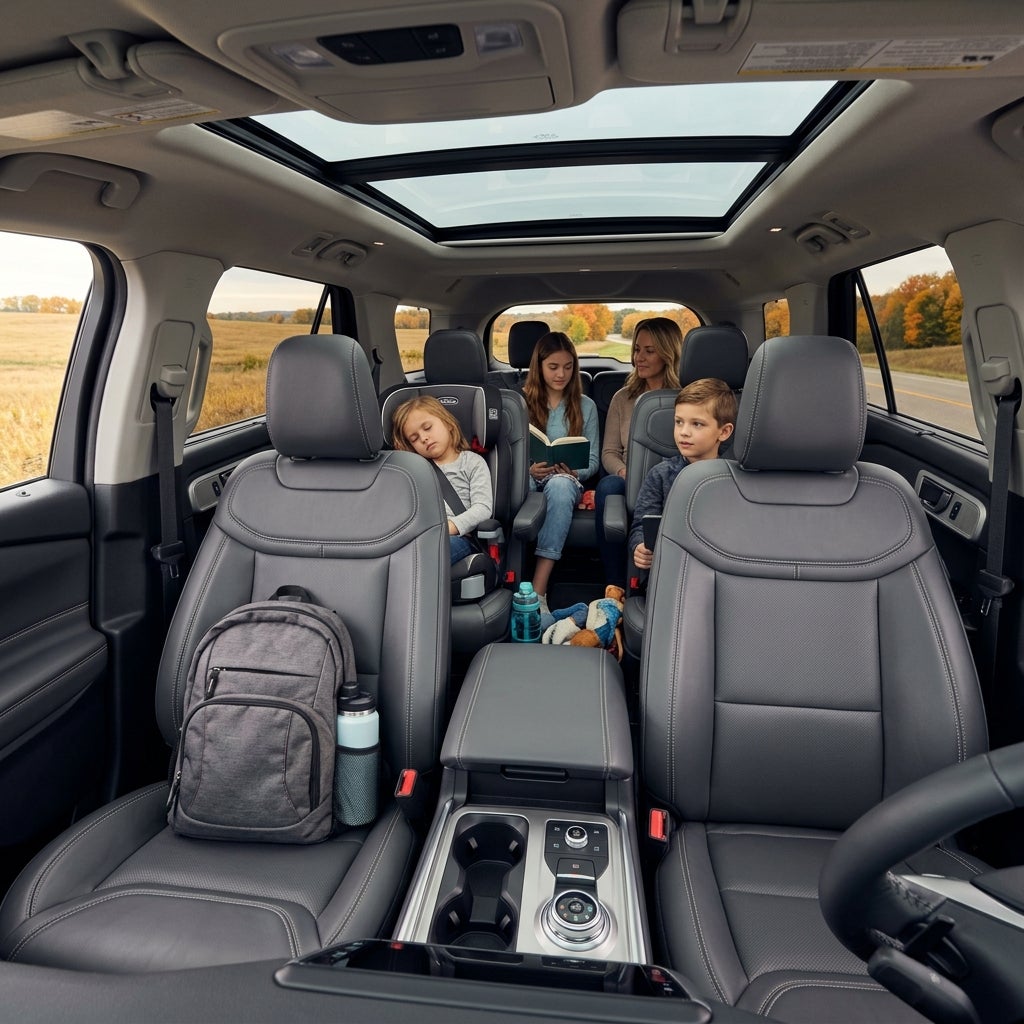
While a dedicated cargo van is incredible for moving days, many families and service members prefer a vehicle that excels at daily family life while still offering robust cargo capacity when called upon. The 2025 Ford Explorer is the ultimate dual-purpose vehicle. When you have a full crew of family or classmates on board, the Explorer still provides highly functional space in the rear cargo area.

16 Cubic Feet of Utility
Behind the upright third-row seats, the 2025 Ford Explorer delivers 16 cubic feet of cargo space. This area is deeper and wider than it looks, making it perfect for holding several immediate-need suitcases, backpacks, groceries, or a couple of heavy-duty military duffle bags during a quick trip.
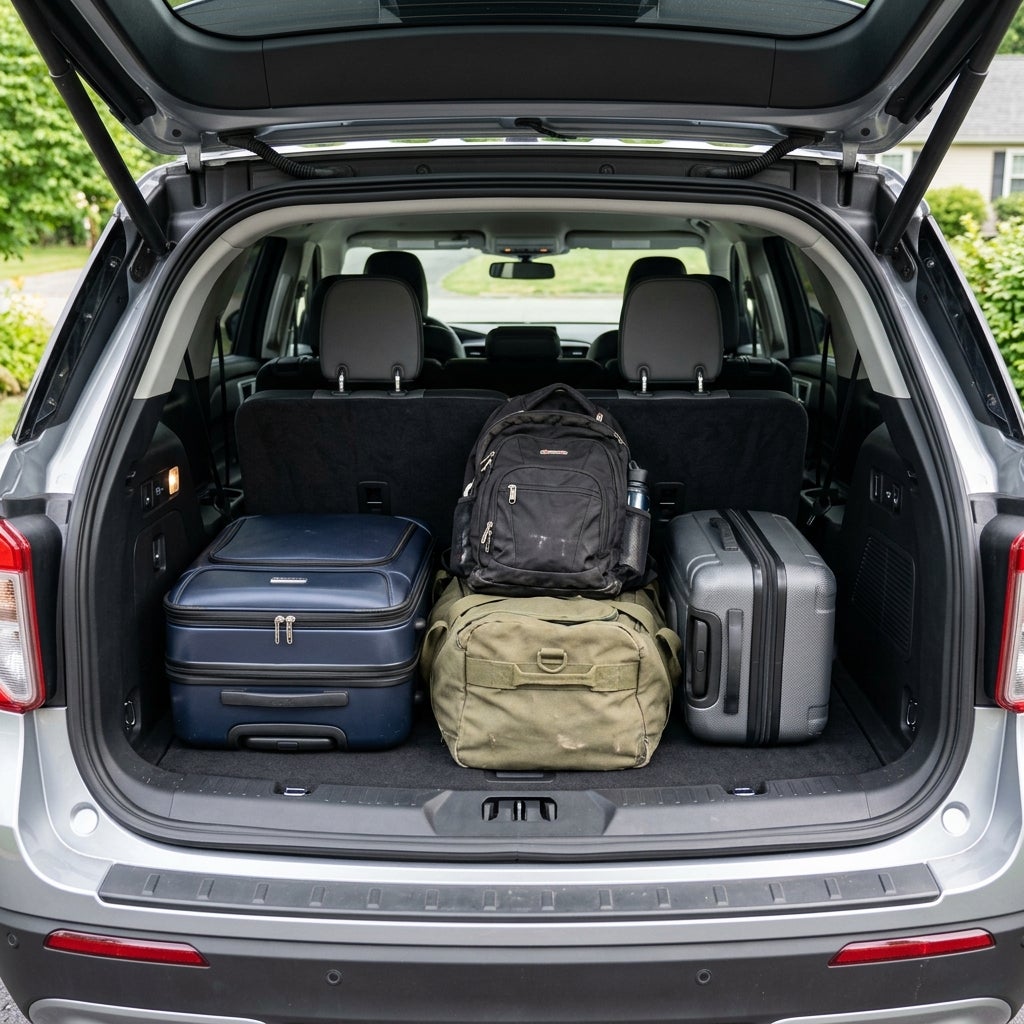
An open trunk of a silver SUV packed with a blue suitcase, green duffel bag, black backpack, and grey suitcase. (Representative image for illustration purposes only. Actual vehicle may vary based on trim and configuration.)

Smart Underfloor Storage
The Explorer features a clever reversible cargo floor and an underfloor storage compartment. This is ideal for tucking away valuable electronics, documents, military folders, or tools safely out of sight while keeping the main cargo floor clean and flat for boxes.

Can a Ford Explorer carry enough boxes for a typical dorm move if I fold all the seats?

The short answer is absolutely yes. When you fold down both the second and third rows of the 2025 Ford Explorer, the vehicle transforms into a highly spacious cargo hauler. It opens up a massive 86 cubic feet of total cargo volume with a completely flat load floor. For a typical college student moving into a dorm or a shared apartment, this is more than enough space to pack a semester's worth of clothing, bedding, a compact refrigerator, a microwave, storage bins, and several large cardboard boxes. The wide rear liftgate opening makes loading bulky items like desk chairs or flat-packed furniture surprisingly easy.

For K-State parents helping their student move, the Explorer offers the perfect balance. You can drive to Manhattan with the second row upright, carrying your student and a family member comfortably. Once you arrive at the residence hall, you can fold the rear seats flat to transport all the gear from a local storage unit or hotel directly to the dorm. This flexibility saves you from the expense of renting a trailer or commercial truck, and lets you travel in premium comfort with Ford's advanced technology and smooth ride quality. To learn more about this versatile SUV, you can Research Ford Explorer models and find the configuration that best fits your active lifestyle.

Is a Ford Explorer usually cheaper to buy and own than a Transit-250?

When deciding between purchasing a Ford Explorer or a Ford Transit-250, it is important to analyze both the initial purchase price and the long-term cost of ownership. Generally, a Ford Explorer is aligned with standard passenger vehicle use and ownership costs. Because the Explorer is designed for retail consumers, it may be eligible for financing options and tends to have lower commercial-class insurance premiums compared to the Transit-250, which is classified as a commercial work van.

Fuel economy is another major factor where the Explorer may offer an advantage. Powered by efficient EcoBoost® engines, the Explorer achieves significantly better highway MPG ratings than the larger, heavier, and less aerodynamic Transit-250. However, if your primary goal is maximizing cargo-carrying capability for a business, heavy military gear, or large-scale moves, the Transit-250 offers specialized utility that can easily justify its commercial ownership costs. Let's compare their general specifications side-by-side.
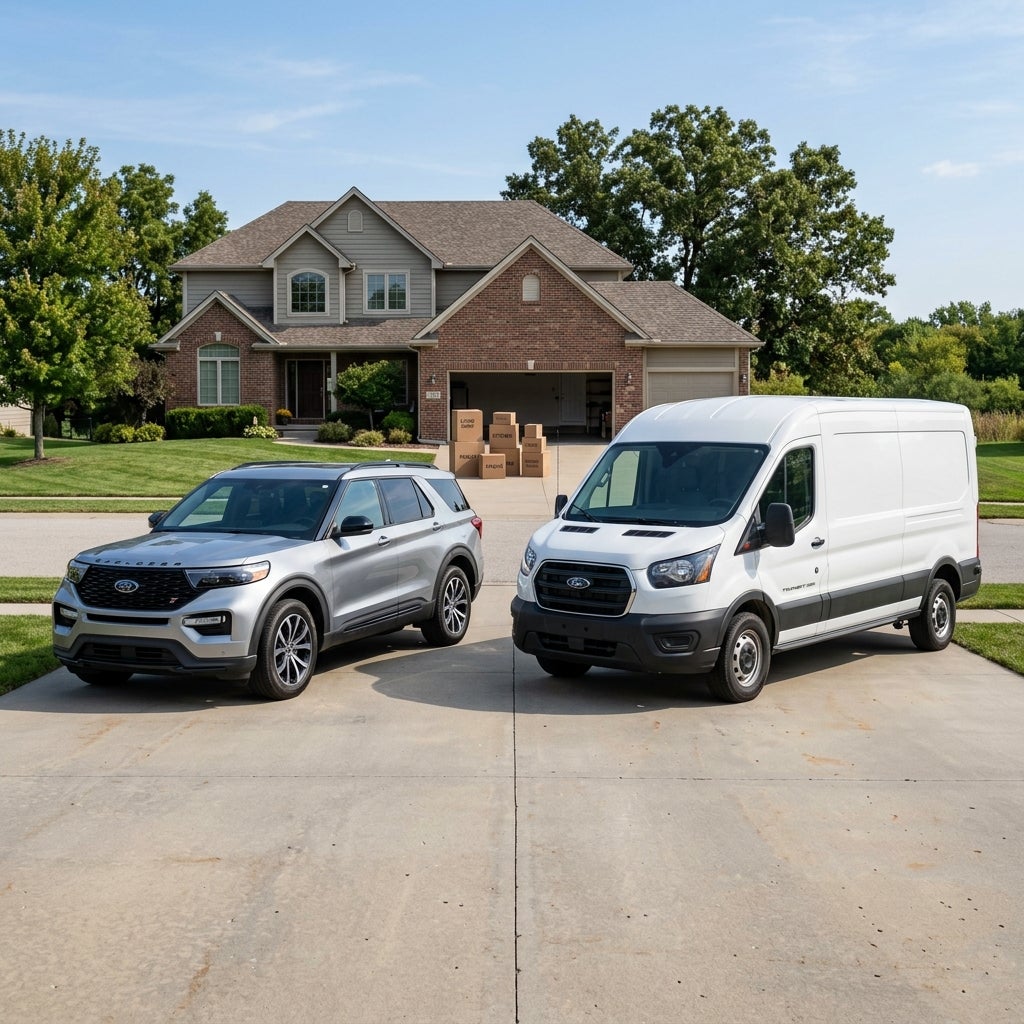
A silver Ford Explorer SUV and a white Ford Transit cargo van parked on a driveway in front of a brick house. (Representative image for illustration purposes only. Actual vehicle may vary based on trim and configuration.)

Feature / Metric

Ford Explorer SUV

Ford Transit-250 Cargo Van

Primary Focus

Passenger Comfort & Versatility

Maximum Cargo Capacity & Utility

Max Seating Capacity

Up to 7 Passengers

2 Passengers (Cargo Config)

Max Cargo Volume

85.8 cu. ft. (Seats Folded)

246.7 - 404.3 cu. ft.

Fuel Efficiency (MPG)

Excellent (EcoBoost Options)

Moderate (Commercial V6 / EcoBoost)

Insurance Class

Standard Passenger SUV

Commercial / Heavy Utility Van

Long-Term Versatility

High (Daily Driving, Road Trips)

Specialized (Hauling, Deliveries, Work)

What do personal property shipment resources cover for a military move near Fort Riley?

For active-duty service members stationed at Fort Riley, navigating a Permanent Change of Station (PCS) involves understanding Personally Procured Moves (PPM), formerly known as a DITY (Do-It-Yourself) move. Under a PPM, the government reimburses you for moving your household goods yourself instead of using government-contracted movers. This can help service members better understand eligible reimbursement amounts. Government personal property resources cover a percentage of what it would have cost the military to move you, based on your rank, dependency status, and the total weight of your shipment. Reimbursable expenses typically include packing materials, rental equipment, fuel, tolls, and even temporary storage fees. By choosing to move yourself with a reliable personal vehicle like a Ford Explorer, or a highly capable hauler like a Ford Transit, you can often pocket a significant portion of your allowance while maintaining complete control over how your fragile and valuable personal belongings are packed and transported.

Planning your next military PCS or family move and need to secure financing for a highly capable vehicle? You can Get Pre-Approved for Financing today through Valor Ford to simplify your buying process.

What tire checks are most important before loading a Ford with heavy moving boxes?

Adjust Cold PSI for Heavy Loads
When loading a Ford Explorer or Transit-250 with heavy boxes, furniture, or military gear, check your tires' cold PSI. Refer to the sticker on the driver's door jamb—not the max pressure on the tire sidewall. Heavy loads require optimal pressure to prevent overheating and blowout risks on hot Kansas highways.

Inspect Tread Depth & Wear
A heavy vehicle puts extra stress on your tires' contact patch. Perform the penny test to ensure you have adequate tread depth. Check for uneven wear, cracking, or bulging along the sidewalls. These signs of degradation can escalate quickly when subjected to high summer heat and heavy cargo weights.
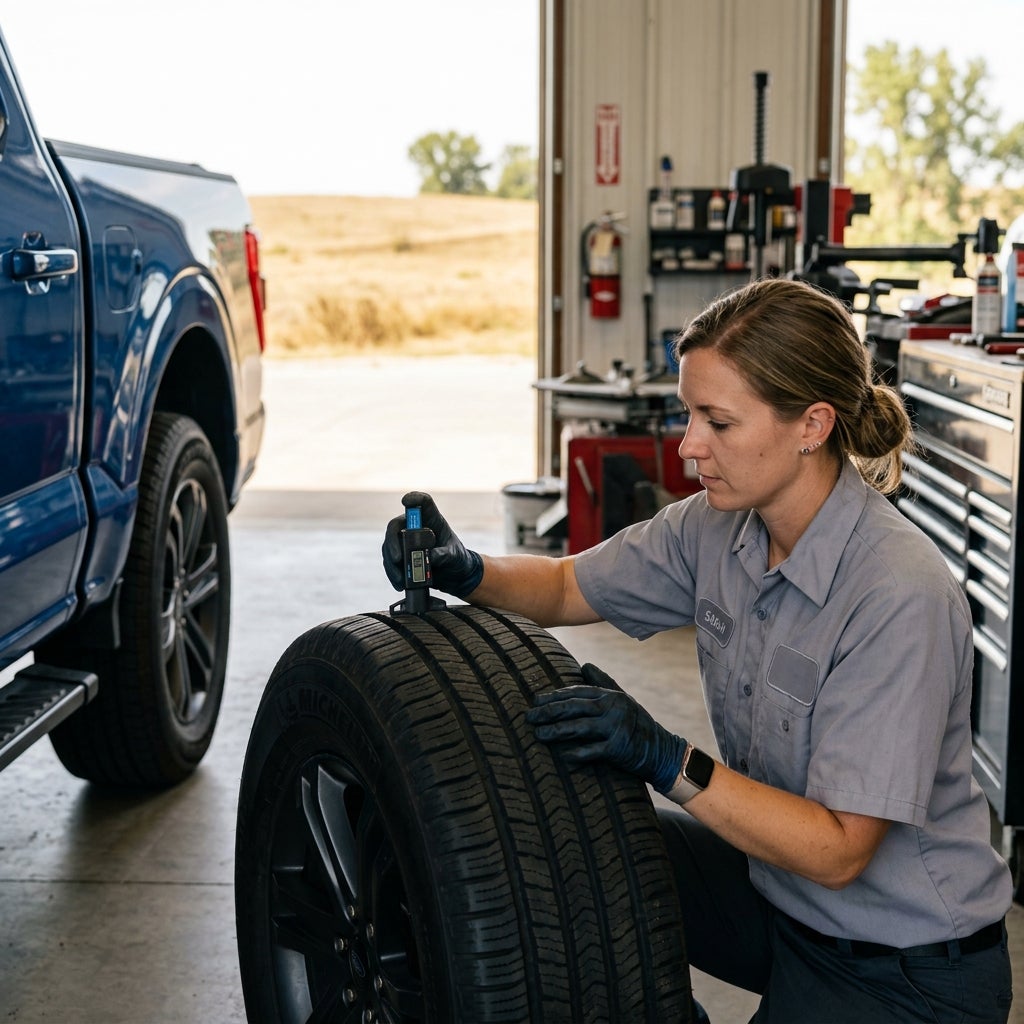
A female mechanic wearing gloves uses a digital gauge to measure the tread depth of a tire in an auto repair shop. (Representative image for illustration purposes only. Actual vehicle may vary based on trim and configuration.)

Before you load up and hit the road, make sure your vehicle is in peak safety condition. You can Schedule Ford Service Today at Valor Ford to have our certified technicians perform a professional multi-point inspection, check tire pressure, rotate your tires, and inspect your brake system.

Why upgrading your vehicle at Valor Ford makes sense for seasonal transitions

Major life transitions, such as starting college at K-State or executing military PCS orders at Fort Riley, are the perfect times to evaluate your current vehicle's reliability and capability. Relying on an older vehicle with high mileage or limited space can lead to unexpected breakdowns, stressful roadside emergencies, and the added expense of renting moving trucks. Upgrading to a new or certified pre-owned Ford vehicle gives you peace of mind, advanced driver-assist safety technologies like Ford Co-Pilot360â„¢, and the modern convenience features you need to navigate heavy traffic and long highway drives with ease.

At Valor Ford, we make upgrading your ride exceptionally easy. Our showroom in Junction City is located just minutes away from Fort Riley and Manhattan, making us a highly convenient resource for local military families and students. You can start the process online by getting an instant Trade In Evaluation for your current vehicle, which can be applied directly toward your purchase. Our expert team is proud to offer competitive military offers, flexible student financing options, and a hassle-free purchasing process. To get started, Get Directions to Valor Ford and visit our showroom today.

Your Quick-Reference Checklist for a Stress-Free Manhattan and Fort Riley Move-In

To help you stay organized during the chaotic late-summer moving season, we've compiled a quick-reference checklist of essential tasks to complete before, during, and after your move-in day:

  • Pre-Move Vehicle Inspection: Check engine oil, coolant levels, and wiper blades. Ensure all tires (including the spare) are inflated to the recommended PSI. If you're overdue for maintenance, Schedule Pickup and Delivery Service with our team.

  • Smart Packing: Place heavy items on the bottom of your cargo area, keeping them as close to the center of the vehicle as possible to maintain a low center of gravity. Secure loose items with tie-down straps.

  • Route Planning: Check local traffic reports on Highway 18 and K-177. Plan around peak K-State move-in hours to avoid delays. If moving onto Fort Riley, ensure you have proper identification and vehicle registration ready for gate security.

  • Safety Supplies: Pack a small emergency kit containing a first-aid kit, jumper cables, flashlight, and plenty of bottled water to stay hydrated in the summer heat.

Infographic checklist titled 'Late-summer Move' with columns for vehicle preparation, packing, and route planning. (Representative image for illustration purposes only. Actual vehicle may vary based on trim and configuration.)

Simplify Your Next Move with a Ford from Valor Ford in Junction City

Moving marks the beginning of an exciting new chapter, whether you are pursuing a degree at Kansas State University or serving our nation at Fort Riley. Don't let the logistical stress of moving day overshadow these milestone moments. With a highly capable and versatile Ford vehicle from Valor Ford, you can tackle the late-summer moving rush with confidence, comfort, and ease. Our dedicated team is here to support you at every stage of your automotive journey, from vehicle service to trade-ins and premium financing. Call us at (785) 238-5114 or stop by our dealership to explore our inventory, test drive a Ford Explorer, or get your current vehicle prepped for the big move.
Posted in:

Related Posts

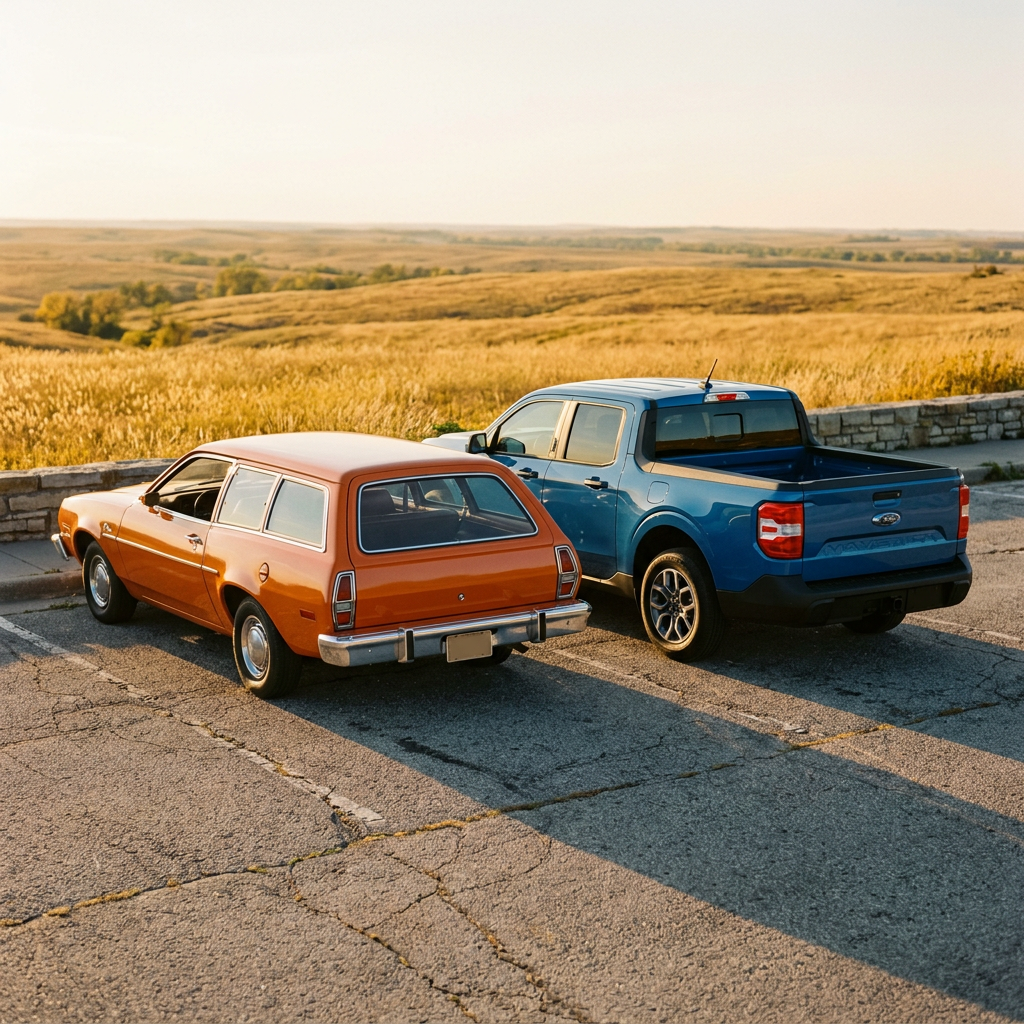
How Ford Redefined Compact Utility from the 1970s Pinto to the Modern Maverick

How Ford Redefined Compact Utility from the 1970s Pinto to the Modern Maverick

How Ford Redefined Compact Utility from the 1970s Pinto to the Modern Maverick For more than five decades, American drivers have sought the elusive sweet spot of automotive engineering: maximum practical utility packaged within an affordable, fuel-efficient, and easy-to-park footprint. Long before the modern crossover boom dominated suburban driveways, Ford Motor Company pioneered the concept of right-sized utility for everyday Americans. In the early 1970s, as rising gas prices and changing suburban lifestyles forced a re-evaluation of massive full-size sedans, Ford introduced the subcompact Pinto—later expanding its practical appeal with the popular Pinto Cruising Wagon. That early experiment proved that commuters, young families, and weekend tinkerers did not always require a heavy-duty work vehicle to fulfill their daily errands and adventure needs. Fast forward to today, and Ford has completely redefined the segment once again with the revolutionary Ford Maverick. Built on Ford's advanced unibody C2 architecture, the modern Maverick bridges the historical gap between frugal passenger economy cars and full-capability pickup trucks. Delivering up to 1,500 lbs of standard payload capacity, an available target-busting 42 MPG city hybrid powertrain, and a genius 54.4-inch FLEXBED™ cargo system, the Maverick offers genuine truck capability without forcing drivers into a massive full-size frame or a hefty fuel bill. For daily commuters traveling along Interstate 70 in Kansas, military service members stationed nearby at Fort Riley, and local DIY enthusiasts across Dickinson and Geary counties, the Maverick represents the ultimate evolution of Ford's small-vehicle engineering heritage. By blending lightweight car-like handling with true light-duty utility, Ford has delivered a vehicle that honors its value-focused ancestors while meeting every demand of modern 21st-century life. At Valor Ford in Junction City, we take pride in connecting local drivers with this legendary lineage of American innovation. How Did Ford Transition from Compact Vehicles Like the Pinto to the Modern Maverick Compact Truck? The journey from the subcompact 1970s Ford Pinto to the high-tech Ford Maverick of today is a masterclass in reading customer demand and engineering trends. In 1971, Ford introduced the Pinto to battle incoming overseas imports. Realizing that American drivers needed more cargo flexibility, Ford added the Pinto Wagon and the iconic Pinto Cruising Wagon—featuring distinctive bubble side windows and flipped-down rear seats for hauling gear, tools, and sports equipment. As the 1980s approached, Ford evolved its small-vehicle strategy with the front-wheel-drive Escort and the original body-on-frame Ford Ranger compact pickup. The Ranger served as the backbone of small truck utility for three decades, appealing to contractors and homesteaders who wanted rugged durability without the footprint of an F-150. However, as midsize trucks steadily grew larger, heavier, and more expensive over the 2000s and 2010s, a wide void emerged in the marketplace: urban drivers and budget-conscious buyers were left without an affordable, fuel-efficient utility vehicle with an open cargo bed. To solve this gap, Ford leveraged its unibody crossover technology to create the Maverick. By utilizing a rigid monocoque body structure rather than a traditional heavy steel frame, Ford eliminated thousands of pounds of unnecessary mass while maintaining exceptional structural integrity. The result is a seamless lineage: from the budget wagon practicality of the 1970s to a versatile modern compact truck engineered specifically for modern everyday lifestyles. Whether you are hauling hardware supplies home in Junction City or moving across base at Fort Riley, the modern Maverick represents the pinnacle of five decades of compact utility development. What Is the Maximum Payload Capacity of the Ford Maverick for Everyday Work and Hauling? Despite its car-like comfort and nimble footprint, the Ford Maverick is built to handle serious work. Every standard Ford Maverick model comes equipped with an impressive 1,500-lb maximum payload capacity. To put that in perspective, 1,500 pounds allows you to comfortably carry roughly 37 bags of 40-lb bags of concrete, a full bed of mulch for spring landscaping in Dickinson County, or all the heavy gear, footlockers, and field supplies needed for military deployments at Fort Riley. Engineers achieved this capability by optimizing the rear suspension layout and reinforcing high-stress load zones along the unibody frame structure. Compared to classic compact passenger cars or station wagons of yesteryear—which suffered under heavy rear axle loads—the Maverick maintains level ride height, confident braking, and crisp steering response even when loaded close to its payload rating. In addition to payload strength, when properly equipped with the available 2.0L EcoBoost® engine and 4K Tow Package, the Maverick boasts up to 4,000 lbs of conventional towing capacity. That is enough grunt to pull pop-up campers, personal watercraft bound for Milford Lake, or utility trailers loaded with lawn equipment. The table below demonstrates how the Maverick compares to traditional expectations in the small vehicle category: Capability Metric 1970s Pinto Wagon (Historical) 2026 Ford Maverick Standard 2026 Maverick EcoBoost (4K Tow) Standard Payload Rating Approx. 750 lbs 1,500 lbs 1,500 lbs Maximum Towing Capacity Approx. 1,000 lbs 2,000 lbs 4,000 lbs Bed / Cargo Volume 30.5 cu ft (Enclosed) 33.3 cu ft (Open Bed) 33.3 cu ft (Open Bed) Primary Architecture Rear-Wheel Drive Unibody Car Front/AWD Unibody Truck Platform Front/AWD Unibody Truck Platform What Are the Estimated Annual Fuel Savings of the Maverick Hybrid vs a V6 Truck? City Efficiency Breakthrough The standard 2.5L Hybrid engine in the Ford Maverick delivers an EPA-estimated 42 MPG in the city. Combined with regenerative braking, stop-and-go commuting through Junction City or Manhattan consumes a fraction of the fuel used by traditional gas trucks. Traditional V6 Comparison Traditional midsize and full-size trucks equipped with V6 engines typically average between 18 and 20 MPG combined. Driving 15,000 miles per year in a 19 MPG vehicle requires over 789 gallons of gasoline annually. Real Financial Savings By comparison, a Maverick Hybrid driving 15,000 miles uses only around 405 gallons annually. At average gas prices, Kansas drivers can easily pocket $1,000 to $1,500 every single year in fuel savings alone while enjoying over 500 miles of range per tank. Upgrading to a new fuel-efficient Maverick from an older gas-guzzling vehicle is easier than ever. Evaluate what your current car or truck is worth today with our quick online assessment. Trade In Evaluation Is All-Wheel Drive Available with the Ford Maverick Hybrid Engine? One of the most frequent questions we receive from northeastern Kansas drivers is whether they can combine hybrid fuel economy with all-weather traction. The answer is a resounding yes! Ford listened directly to customer feedback and updated the powertrain lineup to make Intelligent All-Wheel Drive (AWD) available directly with the 2.5L Hybrid powertrain. In northeastern Kansas, winter weather can change in an instant. From icy mornings on I-70 to slick gravel backroads across Dickinson County, the Maverick Hybrid AWD system continuously monitors road conditions and wheel slippage. It seamlessly shifts torque from the front wheels to the rear wheels in milliseconds when extra stability is needed. This technology gives local drivers the ultimate combination: hybrid efficiency during daily commutes into Junction City or Manhattan, paired with total confidence during snowy Midwest winters or rainy mud season. Is the Ford Maverick Easier to Park Than a Midsize Truck in Tight Urban and Military Base Lots? Navigating packed parking structures, narrow residential garages, or crowded parking lots around Fort Riley can be a stressful chore in a modern full-size or heavy-duty pickup truck. With overall lengths often exceeding 230 inches, larger trucks require multi-point turns and tight maneuvers just to center inside standard parking stalls. The Ford Maverick measures roughly 200 inches in total length—nearly two feet shorter than typical full-size trucks and significantly narrower than conventional midsize options. With a tight turning radius of just 40 feet, parallel parking in downtown Junction City, whipping into tight grocery spots, or fitting into standard suburban garages becomes completely effortless. Drivers transitioning from traditional midsize trucks frequently comment on how much easier the Maverick is to maneuver in daily traffic. You get the upright seating position, superior forward visibility, and open cargo utility of a truck without the bulk, blind spots, or stress when parking in confined quarters. Which Vehicle Has a Longer Truck Bed, the Maverick or the Santa Cruz? When comparing compact unibody trucks, shoppers often pit the Ford Maverick against the Hyundai Santa Cruz. While both vehicles offer modern unibody comfort, the Ford Maverick takes a decisive lead in functional bed space and usability. The Ford Maverick features a 54.4-inch bed floor length, compared to the Hyundai Santa Cruz's 52.1-inch bed. That extra length, combined with the Maverick's flatter wheel wells and square tailgate profile, makes a significant real-world difference. With the multi-position tailgate set to half-closed, the Maverick can support standard 4x8-foot sheets of plywood flat across the wheel wells—a critical feature for weekend woodworkers and contractors. Furthermore, Ford's FLEXBED™ system includes built-in vertical and horizontal slots stamped into the steel bed walls, allowing owners to slide 2x4s in place to create custom 2-tier storage dividers or bike racks without buying expensive aftermarket rails. What Is the Starting Price Across Ford Maverick Trim Levels (XL, XLT, Lariat, and Tremor)? Maverick XL & XLT XL: Pure work-ready value featuring an 8-inch touchscreen, Apple CarPlay®, Android Auto™, and Ford Co-Pilot360™ safety features. XLT: The most popular trim, adding 17-inch aluminum wheels, upgraded cloth seating, bed tie-downs, and power locking tailgate. Maverick Lariat Lariat: Premium comfort featuring ActiveX® synthetic leather seats, dual-zone climate control, power driver seat, B&O® Premium Sound system, and adaptive cruise control for relaxed highway travel. Maverick Tremor Tremor Off-Road: Built for trail adventure with an off-road tuned suspension, 1-inch lift, advanced twin-clutch rear differential, Trail Control™, and orange exterior tow accents. At Valor Ford, we make buying or leasing a Maverick simple. Contact us for current financing, lease, and military program information. Get Pre-Approved for Financing How Does Maverick's Unibody Architecture Compare to Classic Body-on-Frame Compacts? Historically, compact trucks like the original 1980s Ford Ranger were constructed using body-on-frame architecture: a heavy ladder-style steel frame underneath with a separate cab and bed mounted on top. While great for extreme off-roading, body-on-frame designs come with inherent drawbacks: high curb weight, stiffer ride quality, body roll through turns, and higher wind and road noise. The modern Ford Maverick utilizes Ford's rigid C2 unibody platform—the same structural engineering foundation found in sleek crossover SUVs. By integrating the cab and bed frame into one cohesive high-strength steel shell, unibody construction provides dramatic advantages: • Smooth Sedan-Like Ride: Four-wheel independent suspension absorbs bumps and highway expansion joints effortlessly. • Lower Step-In Height: Passengers slide in and out comfortably without climbing up. • Enhanced Cabin Quietness: Seamless structural rigidity reduces rattles, squeaks, and wind turbulence at 75 MPH on Kansas highways. • Superior Crash Safety: Modern crumple zones engineered directly into the unibody shell absorb kinetic energy efficiently. Customizing Your Maverick Bed for Gear, Work, and Outdoor Recreation in the Flint Hills 110V Bed Power Plug in power tools at the job site or run portable refrigerators and air pumps during tailgating parties using the available 110V/400W bed power outlet. Milford Lake Adventure Add factory bed extenders, kayak racks, or bed-mounted bike carriers from our parts department to secure camping and water gear for weekends at Milford State Park. Secure Cargo Protection Choose from hard folding, soft roll-up, or retractable tonneau covers to keep valuable luggage and expensive tools dry and safe from the Kansas elements. Need genuine accessories or customized cargo organization solutions? You can Order Genuine Ford Parts directly through our specialized customer center. Why Fort Riley and Junction City Drivers Are Choosing the Maverick at Valor Ford The central Kansas community surrounding Junction City and Fort Riley demands vehicles that are hard-working, versatile, and economical. Service members relocating to Fort Riley appreciate the Maverick's ability to handle PCS moves with ease while keeping monthly fuel expenses low during weekend trips home. At Valor Ford, located conveniently at 1825 Goldenbelt Blvd in Junction City, KS 66441, we understand the distinct needs of our local community. From supporting military incentive programs to providing straightforward maintenance, our team is dedicated to serving you. If you have questions about current inventory or wish to speak with our experts directly, Call (785) 238-5114 today. Research Ford Maverick Test Drive the Modern Ford Maverick at Valor Ford in Junction City, KS From the value-focused Pinto Cruising Wagon of the 1970s to the tech-loaded hybrid Maverick of today, Ford's commitment to compact utility leadership has never wavered. Experience the ultimate mix of car-like handling, 42 MPG city hybrid efficiency, and 1,500-lb payload capability for yourself. Visit Valor Ford in Junction City today to take a test drive, evaluate your trade-in, or explore our complete lineup of new and pre-owned Ford trucks. Browse Used Inventory

What to Know When Shopping for a Used Ford EcoSport

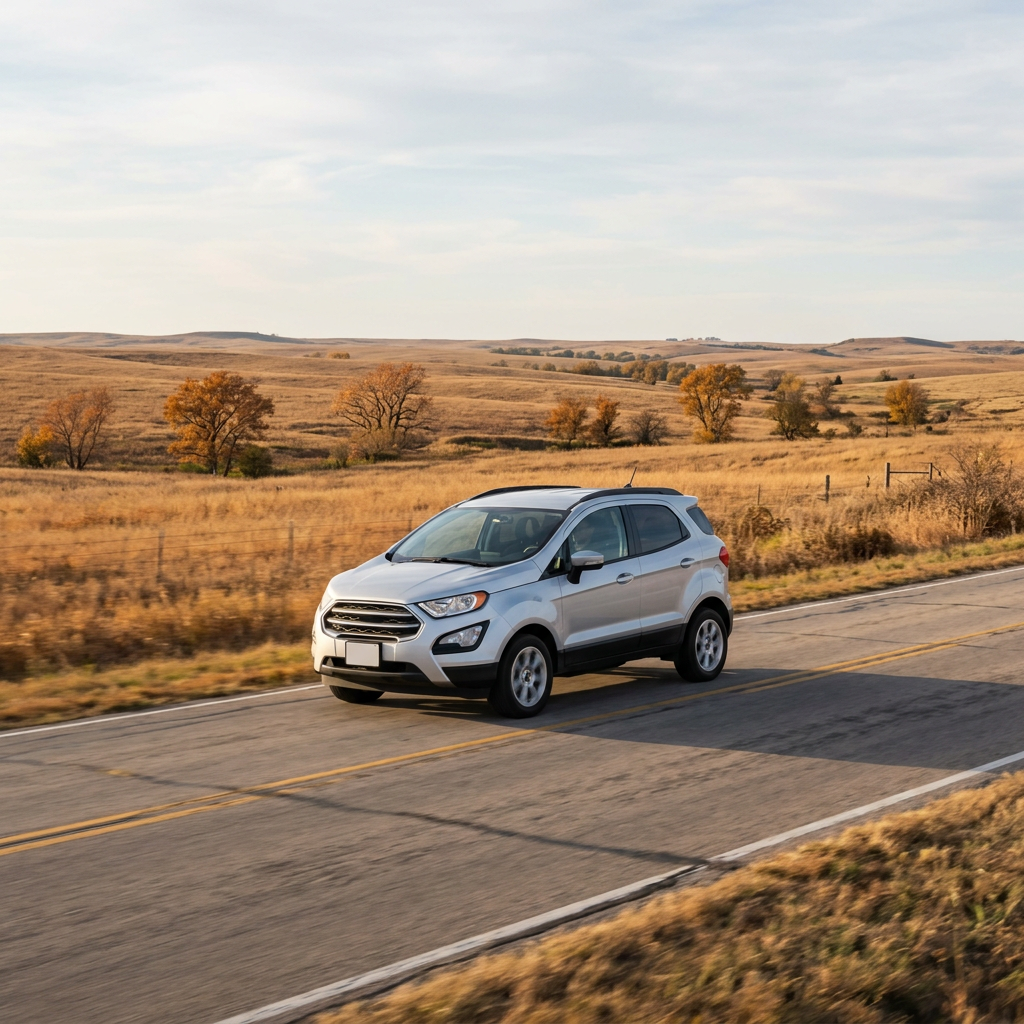
What to Know When Shopping for a Used Ford EcoSport

What to Know When Shopping for a Used Ford EcoSport Which Trim Level of the Used Ford EcoSport offers strong overall value? The EcoSport SE trim delivers the strongest balance of features and long-term value on the pre-owned market. Upgrading from the base EcoSport S introduces essential modern technology, including the SYNC 3 system with an 8-inch touchscreen, Apple CarPlay and Android Auto integration, heated front seats, a power moonroof, and automatic climate control without a major increase in cost. In my 25 years as General Manager at Valor Ford, I have walked hundreds of buyers through subcompact crossover options. The Ford EcoSport lineup originally spanned four distinct trim levels: EcoSport S, EcoSport SE, EcoSport SES, and EcoSport Titanium. While the entry-level EcoSport S offers functional transportation, its basic infotainment display and manual climate settings leave out many convenience features that modern drivers expect. On the higher end of the spectrum, the EcoSport SES adds a sport-tuned suspension and distinct exterior accents, while the EcoSport Titanium brings leather upholstery and a premium audio system. However, those upper trims commanded significantly higher prices when new, which carries over into used market pricing. For commuters navigating daily traffic through Junction City, the EcoSport SE stands out as a balanced choice by pairing desirable technology with approachable pre-owned pricing. If you are looking to trade in your current vehicle to lower your payments on a pre-owned crossover, our team can help you value your trade-in online before you visit. You are always welcome to check out our inventory in person at our Goldenbelt Boulevard showroom address or reach out by phone at (785) 238-5114 with any trim questions anytime. Table of Contents What Engine and Drivetrain Options Are Available on the Ford EcoSport? Is a Used Ford EcoSport Reliable for Daily Driving Around Junction City? What Buyers Should Verify About the 1.0-Liter EcoSport Timing Belt Before Buying How Does the Ford EcoSport Compare to the Larger Ford Escape and Subcompact Rivals? What Are the Interior Dimensions and Cargo Capacity of the Ford EcoSport? What Engine and Drivetrain Options Are Available on the Ford EcoSport? Pre-owned Ford EcoSport models feature two primary engine configurations: a 1.0-liter EcoBoost three-cylinder rated at 123 hp with front-wheel drive, and a naturally aspirated 2.0-liter Ti-VCT four-cylinder producing 166 hp paired with standard Intelligent AWD. For the final 2022 model year, Ford simplified the lineup by making the 2.0-liter four-cylinder engine and Intelligent AWD standard across all trims alongside a 6-speed automatic transmission. The baseline 1.0-liter EcoBoost three-cylinder engine was offered on front-wheel-drive models from 2018 through 2021. This powertrain delivers energetic low-end response around town, but drivers who frequently haul heavier loads or drive in adverse weather will prefer the 2.0-liter Ti-VCT four-cylinder. Delivering 149 lb-ft of torque, the larger four-cylinder engine provides smooth power delivery and pairs exclusively with all-wheel drive to monitor traction continuously. Fuel economy remains consistent across the lineup. Models equipped with the 2.0-liter four-cylinder engine and Intelligent AWD achieve an EPA-estimated 23 mpg city / 29 mpg highway and 25 mpg combined. Another substantial advantage of the four-cylinder powertrain is utility: when properly equipped, the four-cylinder EcoSport boasts a 2,000-pound maximum towing capacity, which easily leads most subcompact crossover competitors in its class. Is a Used Ford EcoSport Reliable for Daily Driving Around Junction City? A pre-owned Ford EcoSport powered by the 2.0-liter Ti-VCT four-cylinder engine is a dependable daily driver for commuters navigating Midwest weather and routine highway travel. Models equipped with this non-turbo engine and Intelligent AWD avoid the wet timing belt maintenance concerns of the earlier entry-level engine while maintaining low average annual ownership costs. When commuters visit our lot to test-drive small crossovers, they usually ask how the all-wheel-drive system handles winter roads before taking it out on the highway. Ford's Intelligent AWD system continuously evaluates road conditions, routing power between the front and rear wheels before wheel slip even occurs. This provides reassuring stability during sudden heavy rain or icy morning drives. In terms of overall longevity, a well-maintained Ford EcoSport engine routinely reaches between 150,000 and 200,000 miles. Ownership costs also remain manageable, with industry data showing average annual maintenance and repair expenses around $487, which comes in lower than the overall subcompact crossover segment average of $521. Buyers browsing our pre-owned vehicle inventory will find that a late-model four-cylinder EcoSport represents an economical path to reliable, all-weather transportation. What Buyers Should Verify About the 1.0-Liter EcoSport Timing Belt Before Buying Buyers considering a 2018 to 2021 Ford EcoSport with the 1.0-liter EcoBoost engine should verify the vehicle's timing belt service history and check its VIN for open customer satisfaction programs. Federal investigations by NHTSA revealed that oil-immersed timing belt material can degrade prematurely, potentially clogging the oil pump pickup screen and causing engine oil pressure loss if not serviced. The mechanical design of the 1.0-liter engine places the timing belt inside the engine crankcase where it runs in engine oil. As the belt material breaks down over time, loose debris can collect on the oil pump strainer screen. Because this pickup screen is housed inside the oil pan and cannot be cleaned during routine maintenance without removing major engine components, belt degradation directly threatens oil circulation. To address this issue, Ford established a customer satisfaction program that revised the belt replacement interval down to 100,000 miles or six years. When evaluating a pre-owned 1.0-liter EcoSport, always request documented oil change receipts and belt replacement records. If you prefer to explore alternative compact utility options backed by factory coverage, you can check out our new Ford Bronco lineup or contact our team about current financing options. How Does the Ford EcoSport Compare to the Larger Ford Escape and Subcompact Rivals? The Ford EcoSport stands out against subcompact competitors like the Honda HR-V and Hyundai Kona by offering a compact overall exterior length of 161 inches, a side-swinging rear cargo door, and a superior 2,000-pound maximum towing capacity. Compared to the larger Ford Escape, the EcoSport offers a tighter turning radius and easier maneuverability in tight spaces at a significantly lower pre-owned price point. Size is the primary differentiator when comparing the EcoSport to the Ford Escape. The Escape spans roughly 180 inches in length, providing greater legroom for rear passengers and larger maximum cargo volume. However, the EcoSport's 99-inch wheelbase and 35-foot turning diameter make it far simpler to park in crowded lots or maneuver through narrow garrison gates at Fort Riley. Against non-Ford competitors, the EcoSport holds distinct practical advantages. While rivals like the Honda HR-V offer strong cabin flexibility and the Hyundai Kona presents aggressive urban styling, neither matches the EcoSport's tow rating when equipped with the 2.0-liter Ti-VCT four-cylinder engine. Furthermore, safety features such as available blind-spot monitoring and rear cross-traffic alert give the EcoSport driver-assist technology on par with larger utility vehicles. What Are the Interior Dimensions and Cargo Capacity of the Ford EcoSport? The Ford EcoSport maximizes interior room within its subcompact footprint, offering 43 inches of front legroom, 37 inches of rear legroom, and 91 cubic feet of total passenger volume. Cargo flexibility is a key strength, providing 21 cubic feet of cargo space behind the second row and expanding to 50 cubic feet when the 60/40 split-folding rear seats are stowed flat. Despite its small exterior size, the EcoSport features an upright seating position that provides excellent outward visibility and generous front headroom measuring nearly 40 inches. Storage solutions are integrated throughout the cabin, including a unique climate-controlled glovebox that taps into the air conditioning ductwork to keep beverages cool during summer road trips. The rear cargo area utilizes a side-swinging tailgate rather than a traditional overhead liftgate, allowing easy access when loading gear in low-clearance parking structures. The rear cargo floor can also be adjusted to multiple height positions to create a hidden under-floor compartment or a completely flat load floor when folding the rear seats. To test out these interior dimensions in person, visit our Junction City dealership location or give our team a call at (785) 238-5114 to arrange a walk-around. Keep Your Vehicle Running Strong Keep your vehicle performing at its best with our service team: Schedule Pickup and Delivery Service Schedule Ford Service Today Order Genuine Ford Parts © 2026 Valor Ford. All rights reserved.

2026 ford explorer

2026 Ford Explorer: Trims, Pricing, and Family Capability Guide

The 2026 Ford Explorer is the right three-row SUV for families who need real towing capacity, genuine all-wheel drive, and room for six passengers without crossing into full-size truck territory. Starting at $38,465 for the Active RWD 100A and stretching to $56,905 for the ST 4WD, the Explorer covers a wide range of budgets and use cases. Every trim rated here pulls up to 5,000 lbs and returns up to 29 mpg highway on rear-wheel-drive configurations, making it a practical daily driver and weekend workhorse. How Well Does the 2026 Ford Explorer Serve Families and Outdoor Enthusiasts in Geary County? The 2026 Ford Explorer is purpose-built for exactly the kind of life common to families in Geary County: six-passenger seating, 5,000 lbs of towing on most trims, and available Intelligent 4WD for dirt roads, river access points, and variable Kansas weather. For military households rotating through Fort Riley, the Explorer offers a consistent, practical platform that handles school runs, weekend fishing trips along the Kansas River, and gear-loaded hunting excursions with equal competence. The standard cargo area measures about 16 cu ft behind the third row, expanding to about 86 cu ft with the rear seats folded — enough room for a full cooler, rods, and waders on a Saturday morning departure. The EcoBoost four-cylinder found across most trims delivers 300 hp and 310 lb-ft of torque, while the ST and ST 4WD step up to a twin-turbocharged 3.0L EcoBoost V6 producing 400 hp and 415 lb-ft. That range covers everyone from the budget-conscious family looking for reliability to the performance-minded buyer who wants something more spirited on the highway. Shoppers who want to dig into the full specification breakdown before visiting can explore our 2026 Ford Explorer research pages for detailed trim comparisons. Those still weighing options might also browse our pre-owned Explorer inventory to see if a recent model fits the budget better. The Explorer competes directly with the Chevrolet Traverse, Jeep Grand Cherokee L, and Kia Telluride — but its combination of towing capacity, available AWD, and a wide trim ladder from value-oriented to performance-focused gives it a distinctive edge for buyers who want one vehicle to do many jobs. Research Ford Explorer Bold Exterior Styling of the 2026 Ford Explorer Tailored for Plains and River Valleys The 2026 Explorer presents a clean, upright silhouette — 198.7 inches long, 78.9 inches wide, and 70.2 inches tall on 4WD-equipped trims — that reads as confident without being aggressive. Painted bumpers front and rear, LED projector headlights with auto high-beam, LED daytime running lights, and LED rear and brake lights are standard across the lineup. The result is a cohesive, modern face that looks equally appropriate in a Fort Riley parking lot and on a gravel road heading toward the Kansas River. The Active trims wear black roof rails and a roof spoiler, giving them a slightly sportier stance. ST-LINE trims lean further into the athletic direction with black exterior accents and 18-inch alloy wheels. The ST and ST 4WD push hardest on presence, with a front fascia tuned for performance intent, painted brake calipers, and a more aggressive lower body treatment. At the top of the luxury tier, the Platinum and Platinum 4WD add chrome roof rails, chrome mirror caps with integrated turn signals, and auto-dimming side mirrors, creating a refined, polished exterior that suits a professional's commute as naturally as it suits a weekend drive through the rolling plains of Leavenworth County. Color choices across the lineup include metallic options such as Vapor Blue Metallic, Star White Metallic Tri-Coat, and Rapid Red Metallic Tinted Clearcoat, among others. The Tremor 4WD adds its own visual identity with off-road-specific styling cues. If your current vehicle is ready for a change, it's worth getting a trade-in estimate before you configure your next Explorer. Shoppers who also want to compare Ford's truck-based body-on-frame alternative should check out the 2026 Ford F-150 research pages to understand where each vehicle's strengths begin and end. Power and Towing Performance of the 2026 Ford Explorer for Military and Rural Driving Most 2026 Explorer trims — Active 4WD, Active 4WD 100A, Active RWD, Active RWD 100A, Platinum, Platinum 4WD, ST-LINE 4WD, ST-LINE RWD, and Tremor 4WD — run a 2.3L turbocharged four-cylinder EcoBoost engine producing 300 hp and 310 lb-ft of torque, paired with a 10-speed SelectShift automatic. The ST and ST 4WD swap in a 3.0L twin-turbocharged EcoBoost V6 rated at 400 hp and 415 lb-ft. Both engines use regular 87-octane fuel. The Utility Police Interceptor 4x4 carries its own powertrain calibration suited to its duty-cycle mission. Towing capacity is 5,000 lbs on every consumer trim except the Utility Police Interceptor 4x4, which is rated at 3,500 lbs. That 5,000-lb figure covers a fishing boat, a small travel trailer, or a loaded cargo trailer — practical for the kind of weekend use common among families near the Kansas and Missouri River corridors. Payload varies more meaningfully across trims: the heavier ST and ST 4WD carry 1,139 lbs, while the Active, Platinum, and ST-LINE configurations all rate at 1,467 lbs. The Tremor 4WD sits at 1,346 lbs, and the Utility Police Interceptor 4x4 tops the chart at 2,108 lbs. The table below captures the full picture across all covered trims: Feature Active 4WD Active 4WD 100A Active RWD Active RWD 100A Platinum Platinum 4WD ST ST 4WD ST-LINE 4WD ST-LINE RWD Tremor 4WD Utility Police Interceptor 4x4 Seating 6 6 6 6 6 6 6 6 7 7 6 7 Cargo (all seats up) 16.3 cu ft 16.3 cu ft 16.3 cu ft 16.3 cu ft 16.3 cu ft 16.3 cu ft 16.3 cu ft 16.3 cu ft 16.3 cu ft 16.3 cu ft 16.3 cu ft 52.0 cu ft Curb Weight 4,303 lbs 4,303 lbs 4,303 lbs 4,303 lbs 4,303 lbs 4,303 lbs 4,631 lbs 4,631 lbs 4,303 lbs 4,303 lbs 4,424 lbs 4,732 lbs Towing 5,000 lbs 5,000 lbs 5,000 lbs 5,000 lbs 5,000 lbs 5,000 lbs 5,000 lbs 5,000 lbs 5,000 lbs 5,000 lbs 5,000 lbs 3,500 lbs Payload 1,467 lbs 1,467 lbs 1,467 lbs 1,467 lbs 1,467 lbs 1,467 lbs 1,139 lbs 1,139 lbs 1,467 lbs 1,467 lbs 1,346 lbs 2,108 lbs Drivetrain choices matter here. The Active 4WD and Active 4WD 100A use Ford's Intelligent 4WD system, which operates in full-time and part-time modes for automatic traction management on wet or loose surfaces. The Active RWD and Active RWD 100A deliver rear-wheel drive with a lighter curb weight and slightly better fuel economy — 24 mpg combined versus 23 mpg for the 4WD variants. Buyers who want the most capable off-road-oriented Explorer should look at the Tremor 4WD, which adds specific off-road tuning and terrain management on top of the Intelligent 4WD base. Families considering the Explorer for serious towing who also want to compare a purpose-built towing platform can review the 2026 Ford F-250 research pages. When you're ready to move forward on financing, prequalifying online takes only a few minutes and can simplify the buying process considerably. Spacious Interior Comfort of the 2026 Ford Explorer for Family Outings Six passengers fit comfortably in most Explorer trims, with the ST-LINE 4WD, ST-LINE RWD, and Utility Police Interceptor 4x4 offering seven-seat configurations. The cabin dimensions are generous throughout: 43 inches of front leg room, 39 inches in the second row, and 32.2 inches in the third row. Front headroom measures 40.7 inches, second-row headroom 40.5 inches, and third-row headroom 38.9 inches. Shoulder room is 62.1 inches up front and 61.9 inches in the second row, with 54.6 inches in the third — wide enough to seat adults without the shoulder-to-shoulder squeeze common in smaller three-row crossovers. Seating materials climb noticeably as you move up the trim ladder. The Active 100A trims start with upgraded cloth in Dark Gray/Onyx. The standard Active 4WD and Active RWD add the optional Active Comfort Package, which upgrades the passenger seat to four-way power adjustment and swaps the cloth for ActiveX synthetic leather — a durable, easy-to-clean surface that holds up well to fishing gear, muddy boots, and the general chaos of family life. The Platinum and Platinum 4WD feature heated and ventilated front seats, heated second-row seats, memory seating for the driver, and a leather-trimmed steering wheel with electric adjustment. The ST uses an ActiveX material with Miko suede-like inserts and an ST logo for a sport-focused look. Climate control is tri-zone automatic across all trims, with rear passenger controls standard. USB charging ports are distributed throughout: 4 front, 2 rear, and 2 third-row on the Active 4WD and Active RWD configurations. The Platinum adds a wireless charging pad and a 110-volt household-style power outlet — useful for charging laptops or running small electronics on longer road trips. Keeping the interior in top condition over time is straightforward with access to genuine Ford replacement parts and accessories for floor liners, cargo management systems, and other wear items. Tech Features That Keep You Connected Between Fort Riley and Home in the 2026 Ford Explorer Every 2026 Explorer in this lineup ships with a 13.2-inch center touchscreen and a 12.3-inch digital instrument cluster as standard equipment. The infotainment system supports wireless Apple CarPlay and wireless Android Auto — both included for the life of the vehicle — so drivers can navigate, stream, and take calls without plugging in a phone. Voice control via Google Assistant is built in, and the system includes a built-in internet browser and OEM data plan connectivity via an embedded SIM card. The Ford Connectivity Package is available as a one-time purchase across the Active trims, extending the embedded Wi-Fi hotspot subscription to 84 months with up to 999 GB per month of data — practical for families who want a reliable in-vehicle network for kids' devices on longer drives. Standard remote services include remote start, lock/unlock, vehicle location, theft alert, vehicle diagnostics, and driving history analysis, all accessible through the Ford App. These services come with a 12-month included subscription. The telematics system also includes 911 Assist, which automatically contacts emergency services following a detected collision. The Platinum and Platinum 4WD add traffic sign recognition to the instrument cluster, a feature that reads posted speed limits and displays them in the driver's sightline — useful on rural Kansas roads where speed limits change frequently. The ST Sun and Sound Package, available on the ST trim, upgrades the audio system to a 14-speaker Bang & Olufsen setup with a subwoofer, surround sound, and 980 watts of output — a meaningful step up from the standard system. Over-the-air software updates keep the system current without requiring a service visit, and the platform supports programmable smart key settings tied to individual driver profiles. Safety Systems Designed for Military Families and Local Commuters in the 2026 Ford Explorer Every 2026 Explorer covered here comes standard with Ford CoPilot360 Assist+ or the upgraded Ford CoPilot360 Assist 2.0, depending on trim. At the base level, CoPilot360 Assist+ delivers adaptive cruise control with stop-and-go capability, automatic emergency braking (front low-speed), Rear Cross Traffic Braking using radar, BLIS (Blind Spot Information System), the Lane-Keeping System, and Rear Parking Sensors with camera guidance. The system activates as low as 3 mph, which matters in parking lots, school pickup lines, and slow-moving traffic around base gates. The Platinum, Platinum 4WD, and ST trims step up to Ford CoPilot360 Assist 2.0, which adds front and rear low-speed automatic emergency braking — covering both directions of a potential collision — alongside the full suite above. The Platinum trims also include a 360-Degree Camera with Split View, providing a bird's-eye perspective that is genuinely useful when parking in tight spaces or navigating unfamiliar terrain. BlueCruise hands-free highway driving technology is available as an optional add-on on the Platinum, Platinum 4WD, and ST trims, enabling hands-free lane centering on pre-mapped highway sections. The airbag count is 7 across all covered trims, including front, front-side, driver knee, and side curtain airbags covering all three rows. The structure includes four-wheel ventilated disc brakes, ABS, brake assist, cornering brake control, hill hold, electronic parking brake with auto-hold, and AdvanceTrac with RSC (Roll Stability Control) on every trim. NHTSA rates the Explorer at 5 stars overall, with 5-star frontal and side impact scores and a 4-star rollover rating. IIHS testing returns Good scores on moderate overlap front, small overlap front driver side, side impact, headlights, and seat belt reminder categories. 2026 Ford Explorer Trim Pricing Breakdown Perfect for Working Families The 2026 Explorer's twelve-trim lineup spans a wide price range, giving families flexibility to match their budget to their needs. The Active RWD 100A starts at $38,465 — the most affordable entry point in this group — while the ST 4WD tops the consumer lineup at $56,905. Every trim carries a $1,795 destination charge, except the Utility Police Interceptor 4x4, which carries a $1,695 destination charge. Feature Active 4WD Active 4WD 100A Active RWD Active RWD 100A Platinum Platinum 4WD ST ST 4WD ST-LINE 4WD ST-LINE RWD Tremor 4WD Utility Police Interceptor 4x4 Base MSRP $42,585 $40,465 $40,585 $38,465 $50,965 $52,965 $54,905 $56,905 $47,155 $45,155 $48,965 $48,550 Destination Charge $1,795 $1,795 $1,795 $1,795 $1,795 $1,795 $1,795 $1,795 $1,795 $1,795 $1,795 $1,695 A few pricing patterns worth noting: the 100A suffix on the Active trims represents a lower-content build that saves roughly $2,000 to $2,100 compared to the standard Active versions. Shoppers who want AWD capability at the lowest possible price should look at the Active 4WD 100A at $40,465. Those who prioritize fuel economy and are comfortable without AWD will find the Active RWD 100A at $38,465 the lowest MSRP entry point into the Explorer lineup. The ST-LINE trims — $45,155 for RWD and $47,155 for 4WD — offer sport exterior styling and seven-passenger seating at a price point well below the ST's performance-focused powertrain premium. The Tremor 4WD at $48,965 slots between the ST-LINE 4WD and Platinum, adding off-road capability for buyers who frequently travel on gravel or unpaved terrain. The Platinum and Platinum 4WD are the luxury tier, with the 4WD version commanding a $2,000 premium over the rear-wheel-drive Platinum. All prices shown are base MSRP before options, packages, and dealer-installed accessories. Contact Us for Financing Information Warranty, Maintenance, and Service Insights for 2026 Ford Explorer Owners The 2026 Ford Explorer carries a 3-year/36,000-mile bumper-to-bumper warranty and a 5-year/60,000-mile powertrain warranty across all covered trims. Roadside assistance coverage matches the powertrain term at 5 years/60,000 miles, which means owners have manufacturer-backed help available for the first five years of ownership — a meaningful benefit for families who put consistent miles on their vehicles through commuting, school runs, and weekend travel. The corrosion/perforation warranty extends to 5 years with unlimited mileage. Paint is covered for 3 years/36,000 miles. The Explorer also supports over-the-air OS-level software updates, which means the infotainment system and connected features can be improved without a dealership visit. Remote services — including remote start, vehicle diagnostics, and theft alert — come with a 12-month included subscription, after which owners can evaluate renewal options based on their usage. Ford's 911 Assist telematics system is included and operates independently of subscription status once activated. For owners in Geary County and the surrounding area, keeping up with scheduled maintenance at an authorized Ford dealer ensures warranty coverage remains intact and that any technical service bulletins are applied promptly. The team at Valor Ford at 1825 Goldenbelt Blvd, Junction City, KS 66441 handles Explorer service for the local community. Booking routine maintenance — oil changes, tire rotations, brake inspections — is straightforward through our Ford service scheduling page. Staying current on maintenance intervals also helps retain resale value, which matters when it comes time to trade in or sell. Schedule Ford Service Today Awards and Expert Recognition Highlighting the 2026 Ford Explorer's Strengths for Kansas Drivers No specific awards data was provided in the catalog for the 2026 Ford Explorer, so this section draws on the verified crash test ratings and safety scores confirmed in the specification data. The Explorer's independently verified safety performance is one of its strongest selling points for buyers who prioritize protection for their families. NHTSA awarded the Explorer an overall 5-star rating, with 5-star scores in both the frontal crash and side impact categories, and a 4-star rollover rating. IIHS testing returned Good ratings — the highest available — across the moderate overlap front test, small overlap front driver-side test, side impact, headlights, and seat belt reminder evaluations. These ratings carry real weight for military families and local commuters who regularly drive rural two-lane highways, navigate post-gate traffic, and share roads with farm equipment and commercial trucks. A 5-star NHTSA frontal rating means the vehicle's structure and restraint systems performed at the highest measured level in standardized frontal crash scenarios. The IIHS Good headlight rating confirms the Explorer's LED projector system illuminates the road adequately at highway speeds — a practical advantage on unlit rural roads after dark. For families comparing the Explorer against the Chevrolet Traverse, Jeep Grand Cherokee L, or Kia Telluride, this safety profile is a concrete differentiator worth factoring into the decision alongside price and feature content. Frequently Asked Questions from Buyers About the 2026 Ford Explorer The Active RWD 100A at $38,465 is the most affordable entry point and still includes the full Ford CoPilot360 Assist+ safety suite, a 13.2-inch touchscreen, wireless Apple CarPlay and Android Auto, tri-zone automatic climate control, and a 5-year/60,000-mile powertrain warranty. Families who want AWD capability without a large price jump should consider the Active 4WD 100A at $40,465, which adds Intelligent 4WD for about $2,000 more. Both 100A trims sacrifice some comfort features — the passenger seat is manual rather than powered — but deliver the core capability and safety technology the Explorer is known for. Yes. Every consumer trim except the Utility Police Interceptor 4x4 is rated at 5,000 lbs of towing capacity. A typical aluminum fishing boat with trailer weighs between 1,500 and 3,500 lbs, well within that limit. The Explorer comes standard with trailer towing preparation and a trailer stability program across all trims. For heavier trailers, payload capacity matters too: most trims carry 1,467 lbs of payload, though the ST and ST 4WD drop to 1,139 lbs due to their heavier curb weight. Yes. Both the ST-LINE 4WD and ST-LINE RWD are configured with seven-passenger seating — a 2+3+2 layout — making them the most affordable trims in this lineup with that capacity. The standard Active and Platinum trims seat six in a 2+2+2 captain's chair configuration. A second-row bench with E-Z entry is available as an option on several trims to convert to seven seats if preferred. The rear-wheel-drive Active trims (Active RWD and Active RWD 100A) return 20 city / 29 highway / 24 combined mpg. The all-wheel-drive Active trims (Active 4WD and Active 4WD 100A) return 20 city / 27 highway / 23 combined mpg. The difference is 2 mpg on the highway and 1 mpg combined — modest, but meaningful over tens of thousands of miles of commuting. The ST and ST 4WD, powered by the 3.0L EcoBoost V6, return 18 city / 25 highway / 21 combined mpg. Valor Ford is located at 1825 Goldenbelt Blvd, Junction City, KS 66441. You can also reach the team directly at (785) 238-5114 to ask about current inventory, trim availability, and scheduling a test drive. Shoppers who are also considering a more off-road-focused Ford platform may want to look at the new Ford Bronco Badlands inventory as an alternative for buyers who prioritize open-air capability over three-row family seating. Research Ford Explorer Vehicle specification data © JATO Dynamics Limited.