What Is the Best Order for a Pre-Harvest Truck Check? The Complete Sequence
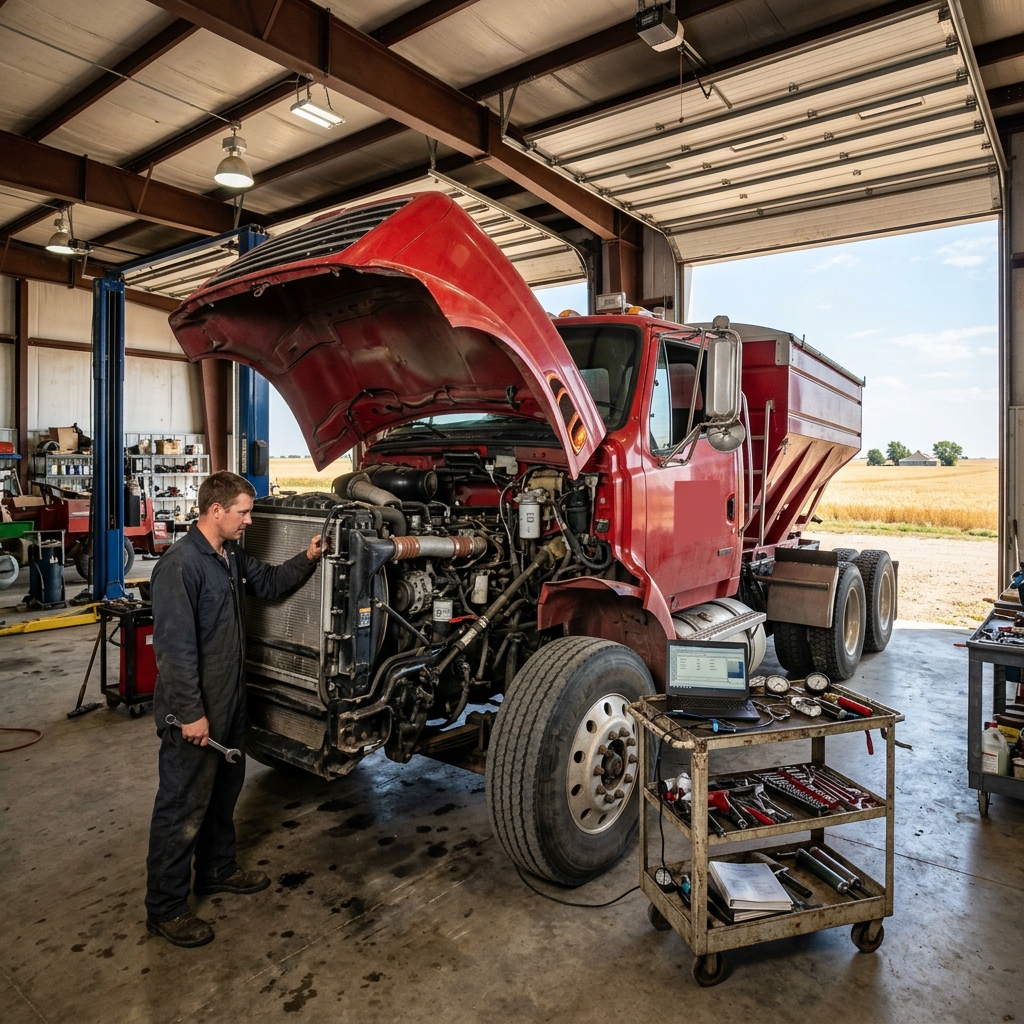
When fall harvest begins across Dickinson County and the Flint Hills, there is zero tolerance for unexpected commercial vehicle downtime. A loaded grain truck idling in a dirt turnout with a blown radiator hose or an overheated brake chamber costs time, money, and momentum during a tight weather window. The key to preventing disastrous field breakdowns lies not just in inspecting your farm trucks and heavy haulers, but in adhering to a strict, disciplined sequence. Conducting a pre-harvest truck check in a haphazard fashion guarantees that critical secondary components get missed.
The definitive, industry-proven sequence follows a logical 5-step order from top-to-bottom and front-to-back: (1) Under-hood fluids, ELC coolant, and drive belts; (2) Cab safety gear and Kansas DOT documentation; (3) Brake system and air line pressure test; (4) Exterior walk-around, tires, frame, and hitch; and (5) Operational road test under load. Starting cold under the hood ensures you capture accurate engine fluid levels before thermal expansion occurs, while ending with a loaded road test verifies foundation stability under actual hauling conditions. Whether you are running a severe-duty fleet or operating a single vehicle like a commercial haul rig or a heavy-duty chassis—such as those explored in our Research Ford F-150 and Research Ford F-250 guides—this exact sequence protects your bottom line.
Meet Mike Hogg: 20 Years of Agricultural Truck Service in Central Kansas
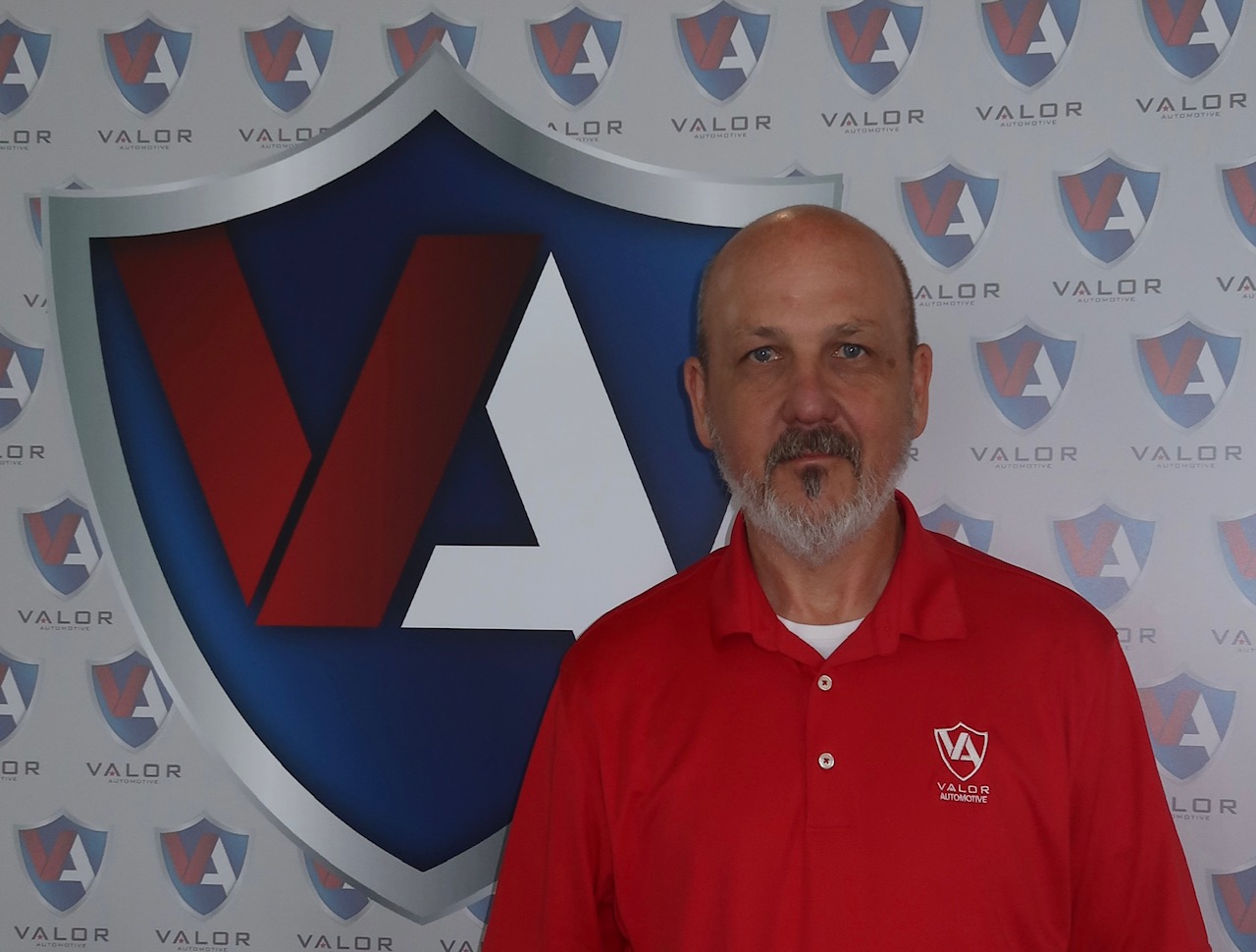
For over two decades, Mike Hogg has stood on the service frontlines in Central Kansas, diagnosing, repairing, and optimizing heavy-duty grain haulers, farm pickup fleets, and commercial workhorses. As Service Director at Valor Ford in Junction City, Mike has seen firsthand the severe mechanical strain that Kansas harvest conditions impose on farm vehicles. From high August heat and thick field dust to steep grade hauls carrying 80,000-pound payloads, Mike knows that agricultural truck maintenance requires a specialized, proactive approach.
‘In agricultural truck maintenance, hope is not a strategy,’ says Mike Hogg. ‘When grain elevators have two-hour wait lines and ambient temperatures hit 95 degrees, a weak water pump belt or an untested brake air line will fail. My goal is simple: ensure every farm crew in Dickinson County and around Fort Riley gets through harvest without a single preventable mechanical delay.’ You can easily reach out to Mike’s master-certified technicians or Call us at (785) 238-5114 for tailored agricultural fleet consultations.
Mike Hogg
Service Director, Valor Ford
20+ Years Heavy-Duty Agricultural Service Expertise
Step 1: Under the Hood — What Is the Difference Between Extended Life Coolant (ELC) and Conventional Coolant?
1. Under-Hood Cold Diagnostics
Why start under the hood? Engine cooling and lubrication systems must be checked cold before thermal expansion masks accurate fluid levels or pressure drops. Pulling dipsticks on engine oil, power steering fluid, and transmission fluid before starting the engine gives a true baseline. Look for milkiness in the oil indicating coolant cross-contamination, or a burnt smell signaling thermal breakdown during last season’s heavy work.
2. Organic Acid Technology (ELC)
Extended Life Coolant (ELC) utilizes Nitrated Organic Acid Technology (NOAT) or Organic Acid Technology (OAT) to provide superior wet-sleeve cylinder liner cavitation protection without dropping supplemental coolant additives (SCAs). ELC forms a resilient protective barrier on metal surfaces, resisting extreme temperature spikes when hauling maximum legal grain loads up steep grades.
3. Conventional Coolant Risks
Conventional heavy-duty coolants rely on inorganic silicates and require constant chemical monitoring. Over time, silicate drop-out creates abrasive sludge that clogs radiator passages and destroys water pump seals under heavy fall loads. Mixing conventional coolant with ELC dilutes corrosion inhibitors and can cause rapid gelation, overheating your grain truck right in the middle of field operations.
Step 1 (Continued): What Belt Problems Should You Watch For Before Hauling Grain?
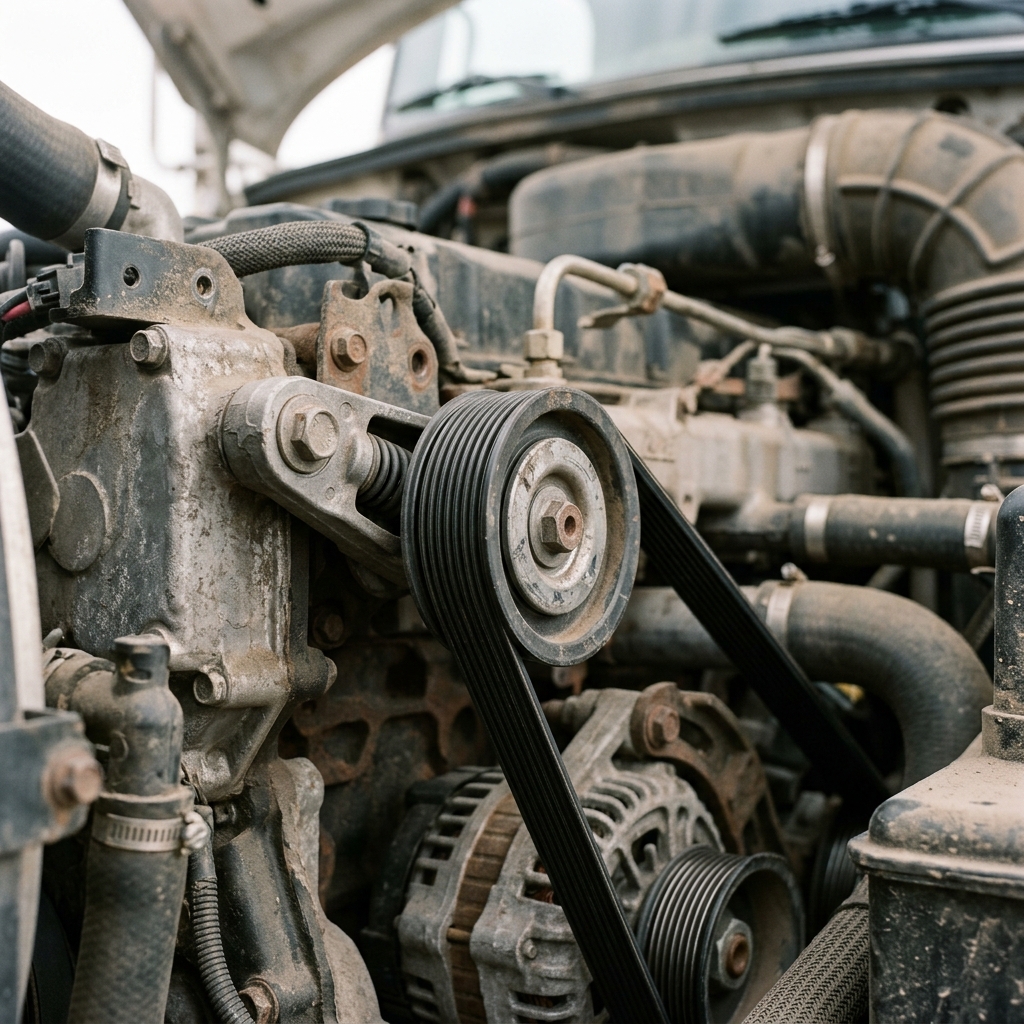
Drive belts drive essential auxiliary components: your water pump, alternator, power steering pump, and air compressor. During intense Kansas summer heat, rubber compounds experience micro-thermal degradation. When checking serpentine and V-belts prior to harvest, visually inspect every inch using a flashlight and a bright mirror.
Key warning signs include: Micro-cracking across ribs(if there are three or more cracks in a three-inch span, replace immediately); Glazing and shiny contact surfaces caused by slippage under high alternator load; Edge fraying or rib chunking, which indicates pulley misalignment or tensioner bearing collapse; and Dry rot cracking from prolonged ultraviolet exposure. Always check tensioner damping arms for smooth travel.
If you detect belt rib separation or tensioner pulley play, stock up on factory-spec replacements before harvest starts. You can easily Order Genuine Ford Parts directly from our commercial parts portal.
Mike Hogg's Golden Rule: Why Sequence and Timing Prevent Field Breakdowns
‘In 20 years of servicing harvest trucks, 80% of the severe field breakdowns I see come down to human skipping—inspecting tires first because they’re visible, while neglecting the cold fluid checks or cab air pressure rates until the truck is already running hot under a 400-bushel load. When you follow a fixed front-to-back, top-to-bottom sequence every single morning before harvest ignition, you eliminate human error. Sequence creates consistency, and consistency keeps grain moving from field to elevator without roadside drama.’
— Mike Hogg, Service Director at Valor Ford in Junction City
Step 2: Cab & Compliance — What Documents Are Required to Pass a State DOT Commercial Vehicle Inspection in Kansas?
Kansas DOT In-Cab Documents
To satisfy Kansas Highway Patrol DOT officers during roadside harvest weigh-station checks, every commercial or farm vehicle over 26,001 lbs must carry valid cab paperwork: Medical Examiner’s Certificate (or self-certification affidavit), current vehicle registration, proof of commercial liability insurance, and valid USDOT numbers properly displayed.
In-Cab Emergency Equipment
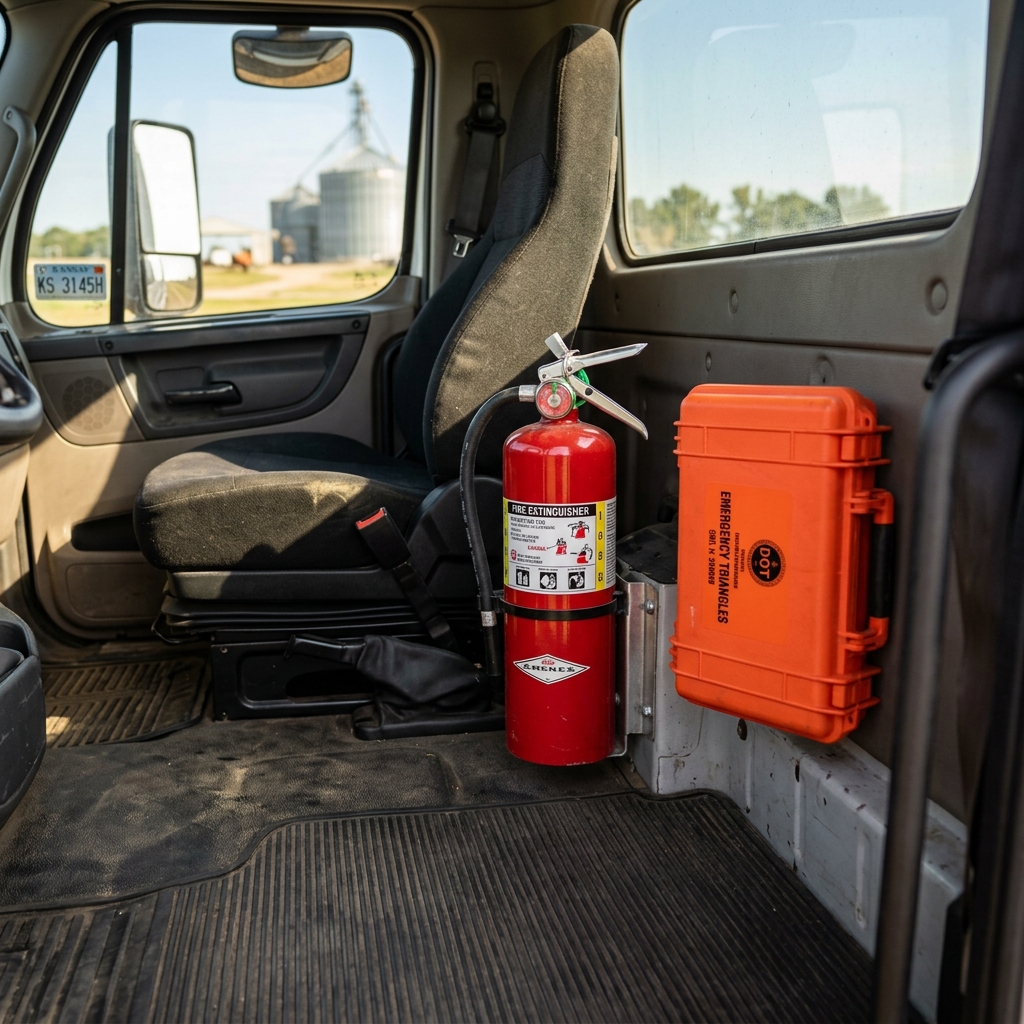
Verify that your cab contains a properly mounted, fully charged fire extinguisher (minimum 5 B:C rating with intact safety seal), three red emergency reflective warning triangles, and spare electrical fuses matching the truck’s central junction box specs. Missing safety items lead to immediate roadside out-of-service citations.
HVAC & Visibility Check: Ensure cab defrosters, wiper blades, windshield washer pumps, and horn units function cleanly to combat dusty field conditions.
Step 3: What Is Included in a Pre-Harvest Brake Inspection?
Air Brake System Pressure & Leak-Down Test
Step 3 moves to system pressure testing. Start the engine to build air reservoir pressure to governor cut-out (typically 120–145 PSI). Drain primary and secondary air tanks manually to discharge accumulated condensation and oil emulsion; moisture in air lines damages relay valves and causes winter brake freeze-ups.
Perform a static and applied leak-down test: turn off the engine with full pressure, release parking brakes, and monitor pressure loss over one minute (should not exceed 2 PSI for single vehicles or 3 PSI for combinations). Next, hold firm foot pedal brake application for one minute (max 3 PSI drop single / 4 PSI combination). Test low-air warning buzzers and automatic parking brake spring pop-out controls.
Foundation Brakes & Mechanical Hardware
Underneath the vehicle, perform a direct physical inspection of foundation brake components on every axle. Brake shoe friction lining thickness must measure greater than 1/4 inch (6.3 mm) at the thinnest point above the shoe table; hydraulic disc brake pads must maintain ample pad thickness.
Inspect brake drums for deep heat checking, circumferential scoring, or structural cracking extending to the outer rim. Measure pushrod stroke lengths on automatic slack adjusters to prevent stroke over-travel, which drastically reduces stopping force on fully loaded grain trucks navigating farm-to-market road intersections.
Step 4: Ground Walk-Around — Tires, Suspension, Frame, and Towing Rigging
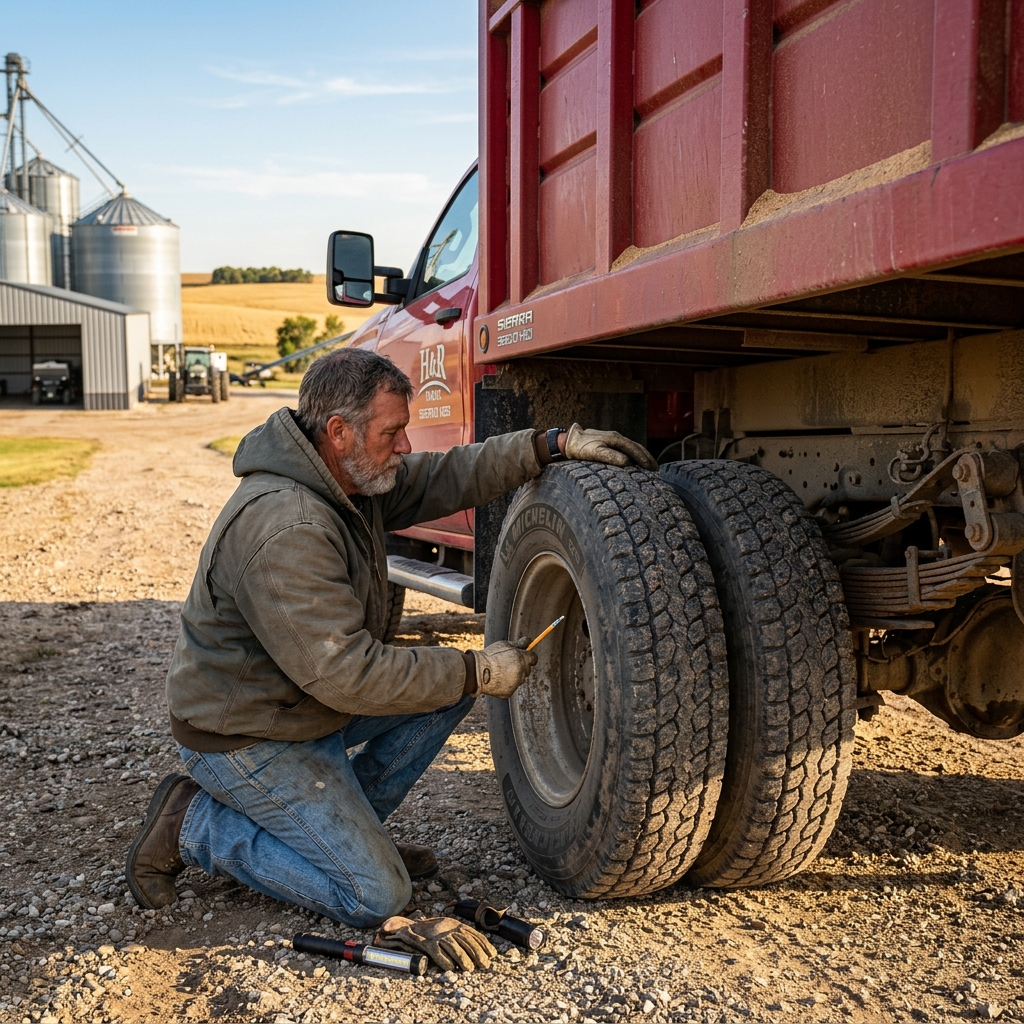
The ground walk-around is a rigorous physical inspection around the perimeter of the vehicle. Start at the front left wheel and proceed clockwise around the vehicle, checking tires, suspension hardware, main frame rails, and heavy towing hitches.
|
Component Category
|
Critical Pre-Harvest Inspection Checkpoints
|
Failure Threshold / Action Required
|
|
Steer & Dual Tires
|
Inflation pressure with calibrated gauge, tread depth (>4/32″ steer, >2/32″ drive), sidewall cuts, inner dual clearance.
|
Underinflation exceeding 10 PSI; sidewall belt exposure; mismatched dual diameters exceeding 1/4 inch.
|
|
Wheel End & Lug Nuts
|
Lug nut tightness, rust streaks behind nuts indicating movement, oil hub sight glass fluid level.
|
Loose lug nuts; hub cap seal leaks; milky or contaminated hub oil requiring immediate seal replacement.
|
|
Suspension & Frame
|
Leaf spring main leaves, U-bolts, air spring bags, kingpin bushing play, main frame rail crossmembers.
|
Broken or shifted spring leaves; cracked air bags; frame rail cracks near spring hangers or crossmember rivets.
|
|
Fifth-Wheel & Hitch
|
Fifth-wheel locking jaws engagement, pintle hook safety latch, safety chain attachment loops, trailer electrical cord.
|
Excessive jaw play; damaged safety latches; chafed 7-way electrical wiring or leaking emergency gladhand seals.
|
For specialized Ford heavy-duty commercial chassis and towing platforms, such as those covered in our Research Ford F-250 overview, confirming exact lug nut torque (typically 150–165 lb-ft on heavy-duty pickups, higher on commercial medium-duty chassis) is vital prior to pulling heavy grain carts or trailers.
Pre-Harvest Truck Maintenance: Cooling System and Brake Inspections Before Fall Grain Hauling
Heavy Payloads & Gravel Road Dynamics
Hauling harvested grain across unpaved county roads in Dickinson County subjects chassis frames and cooling stacks to immense vibration. Fine dirt particles fill radiator and charge air cooler fins, reducing airflow efficiency by up to 35%. Combined with ambient summer heat and maximum gross vehicle weight, an unchecked cooling system will rapidly push engine oil and coolant temperatures into critical warning zones.
The Financial ROI of Preventive Maintenance
An emergency roadside service call on Highway 77 during harvest peak can cost over $1,500 in towing fees alone—not including lost harvest daylight or grain elevator delay penalties. In contrast, replacing a suspect water pump hose, flushing degraded conventional coolant, or renewing brake shoes beforehand costs a fraction of roadside repairs and keeps your combines rolling without bottlenecking.
And when harvest wraps up, keep track of our iconic performance vehicles through the Research Ford Mustang page.
Should You Schedule a Shop Inspection Before Harvest Starts?
On-Farm Driveway Checks
On-farm driveway checks are essential for daily operational monitoring, fluid top-offs, and detecting obvious physical damage. However, inspecting heavy foundation brakes, kingpin tolerance, and electronic engine control modules without professional lifts or diagnostic scanners leaves hidden vulnerabilities unnoticed.
Professional Shop Diagnostics
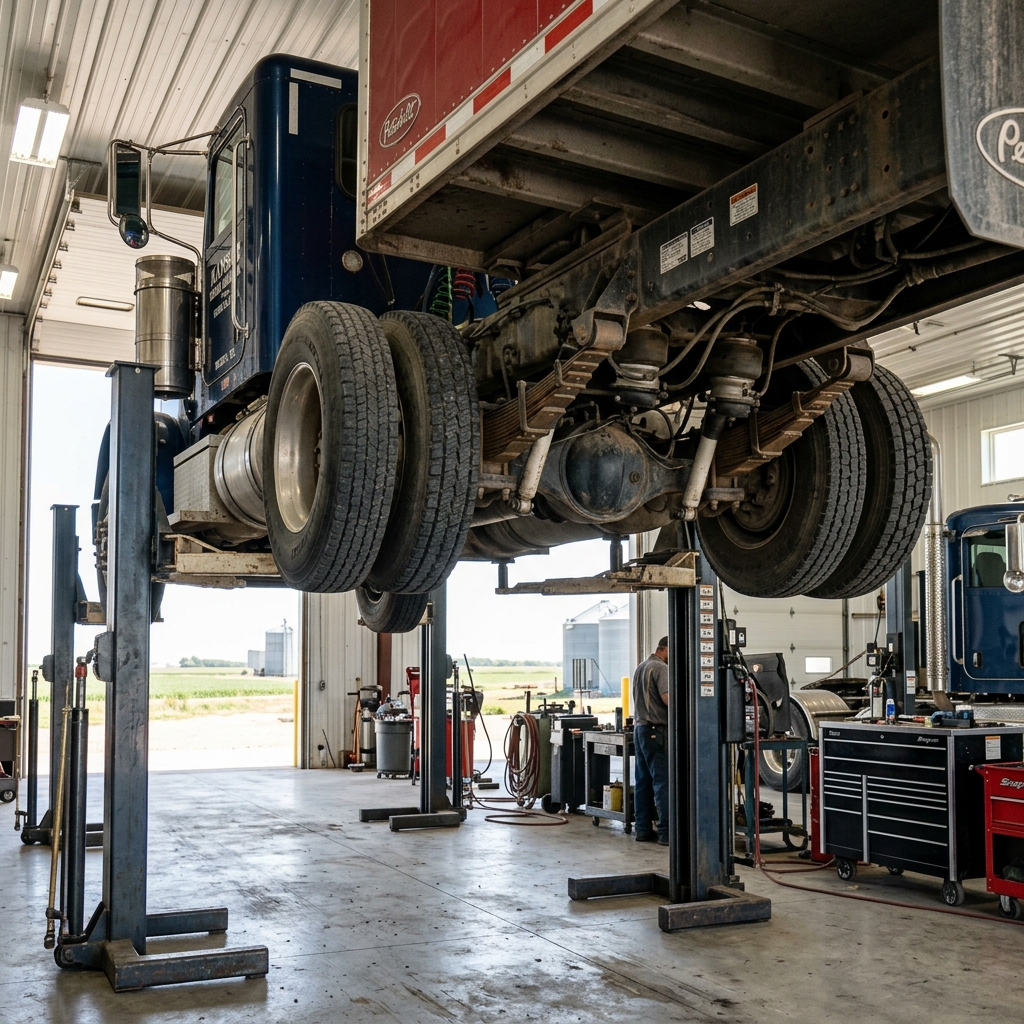
A certified heavy-duty shop inspection utilizes commercial vehicle lifts, computerized brake roller testers, coolant refraction meters, and Ford OEM diagnostic equipment. Technicians uncover hidden micro-cracks in frame crossmembers and electronic sensor fault codes before they cause mid-field engine shutdowns.
Timing Strategy: Book professional shop service 3 to 4 weeks prior to harvest kick-off. This guarantees sufficient lead time for specialized replacement parts delivery without risking crop delays. Work with our team to Schedule Pickup and Delivery Service for hassle-free maintenance.
Preparing Your Grain Fleet for Kansas Harvest Operations
Fleet Management Across Junction City & Fort Riley
Managing multi-vehicle farm fleets requires structured staging. Stagger individual truck inspections so that half your fleet remains active while the other half undergoes pre-harvest service. Valor Ford supports local agricultural operations with dedicated commercial bay priority, OEM Motorcraft filtration kits, and fast turnarounds.
Upgrading aging grain haulers? Explore trade-in options with our simple Trade In Evaluation tool to maximize your fleet capital.
Commercial Financing & Vehicle Acquisition
Schedule Your Pre-Harvest Truck Inspection at Valor Ford in Junction City, KS
Don’t leave your fall harvest productivity to chance. Trust Mike Hogg and the master-certified commercial service technicians at Valor Ford to get your grain trucks, service pickups, and heavy trailers 100% harvest-ready. Located right here in Junction City at 1825 Goldenbelt Blvd, Junction City, KS 66441, we provide complete pre-harvest safety checks, heavy-duty cooling system flushes, air brake overhauls, and genuine Ford Motorcraft parts.
Tags: agricultural truck maintenance, agricultural vehicle care, brake system maintenance, commercial truck safety, commercial vehicle inspection, coolant system flush, drive belt inspection, farm truck repair, fleet maintenance tips, heavy hauler servicing, heavy-duty truck service, pre-harvest truck check
Posted in
Automotive Parts & Accessories, Maintenance & Service, Safety Features, Seasonal Driving Tips, Technology & Innovation |
No Comments »