Keeping Your Ford Super Duty Running Strong: The Ultimate Guide to Power Stroke Fuel Filter Maintenance
When you own a Ford Super Duty equipped with the legendary 6.7L Power Stroke diesel engine, you are piloting a highly capable, high-torque truck. Whether you are hauling massive trailers down the highway, operating heavy equipment in Junction City, or managing a demanding agricultural workload in Dickinson County, your truck relies on a highly advanced, ultra-high-pressure common-rail injection system to deliver its staggering horsepower and torque. This system operates at pressures exceeding 30,000 PSI. At these extreme tolerances, even the smallest speck of dirt, rust, or microscopic water droplet can act like a sandblaster inside your fuel injectors, leading to catastrophic engine damage and immense repair bills. That is why clean diesel fuel is not just a preference—it is an absolute necessity for the survival of your Power Stroke engine.
Operating conditions around Fort Riley and Junction City present a unique set of challenges for diesel truck owners. From intense summer heat and dust on gravel roads to freezing winter temperatures that cause fuel tank condensation, your fuel filters work overtime to protect your engine’s fuel system. In this comprehensive guide, we will break down exactly how often you should change your fuel filters, why the dual-filter system is designed the way it is, the science behind OEM filtration, and how proactive maintenance at Valor Ford can save you thousands of dollars over the lifetime of your truck.
How Often Should You Change the Fuel Filters on a Ford Super Duty Power Stroke Diesel?
Ford Motor Company outlines a standardized maintenance schedule for the 6.7L Power Stroke diesel engine, recommending that both fuel filters be replaced every 15,000 to 22,500 miles, or every third oil change, or every 600 hours of engine operation—whichever comes first. However, this general recommendation is split into two distinct categories: ‘Normal Operating Conditions’ and ‘Severe Duty Operating Conditions.’ Knowing which category your driving habits fall into is critical for maintaining optimal fuel system health and ensuring your warranty remains fully intact. For drivers who primarily use their Super Duty for long-distance highway cruising with minimal cargo, normal operating intervals of up to 22,500 miles may be sufficient. But in Kansas, very few heavy-duty trucks experience such an easy life. Most local truck owners find that their daily routines push their vehicles directly into the severe duty category, which demands much stricter maintenance timelines.
What constitutes severe duty? If you frequently tow heavy trailers, idle for extended periods (common on job sites and military maneuvers around Fort Riley), operate in dusty off-road environments, or use B20 biodiesel blends, Ford recommends changing your fuel filters at the 15,000-mile mark. Agricultural hauling across Dickinson County is a prime example of severe duty. Pulling grain trailers or stock trailers through dirt roads exposes your fuel system to fine particulate dust, while frequent stop-and-go heavy hauling increases fuel throughput and subjects filters to a larger volume of potentially contaminated fuel. To keep track of your vehicle’s health easily, we recommend checking the Intelligent Oil-Life Monitor on your dashboard, but always track your mileage manually for fuel filters, as the truck does not always have a direct sensor to measure physical filter clogging until fuel pressure drops.
How Many Fuel Filters Does a 6.7L Power Stroke Diesel Have?
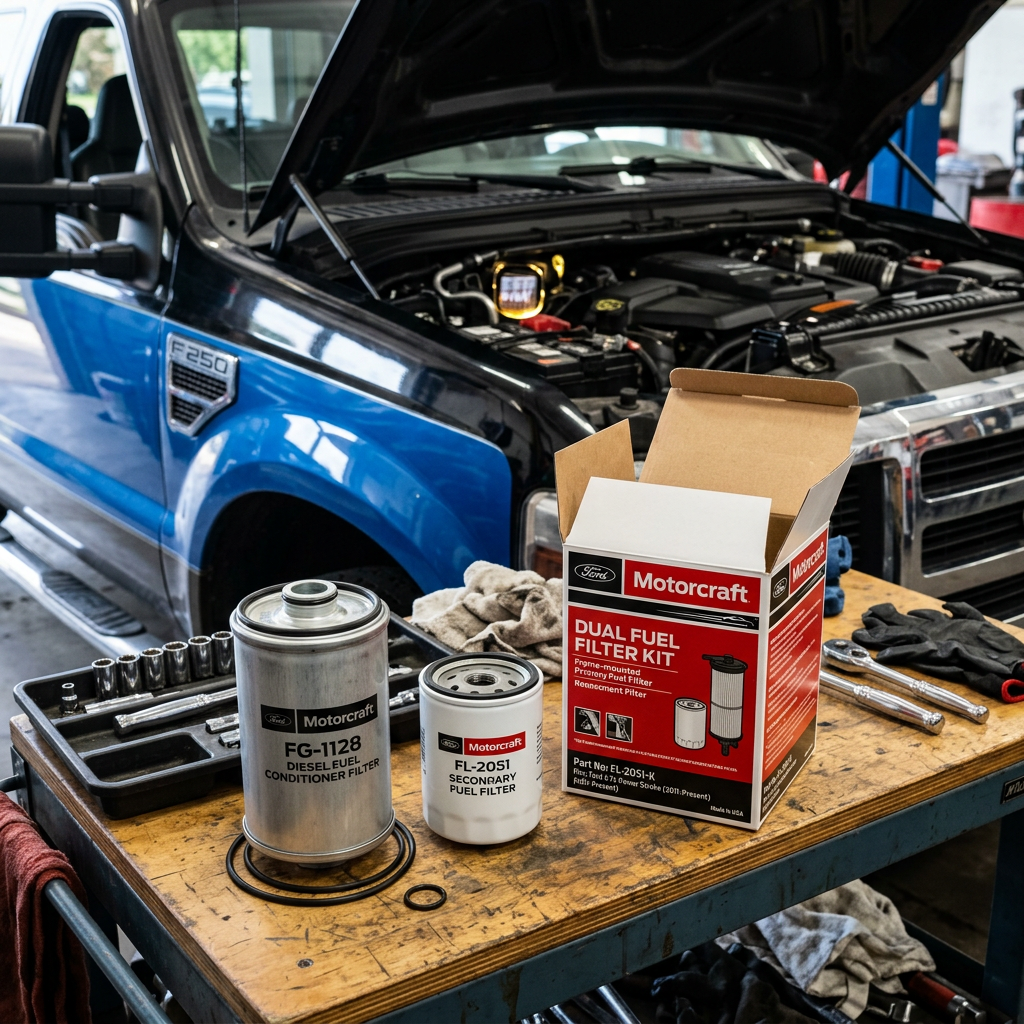
To provide maximum protection for the ultra-precise high-pressure fuel pump and common-rail injectors, Ford utilizes a dual-filter architecture on the 6.7L Power Stroke diesel engine. This means your truck has two distinct fuel filters that must *always* be replaced together as a matched set. Replacing only one filter defeats the purpose of the dual-stage system and leaves your fuel system highly vulnerable to premature wear or sudden failure.
1. Primary Filter / Water Separator
The primary filter is housed within the Diesel Fuel Conditioner Module (DFCM), which is mounted directly to the vehicle’s frame rail underneath the driver’s side cab. Because diesel fuel naturally attracts moisture, water contamination is a constant threat. This primary filter acts as a water separator, utilizing hydrophobic media to repel water droplets, causing them to pool at the bottom of the housing where they can be drained safely. It also screens out larger debris, rust, and tank scale before the fuel is pumped forward.
2. Secondary Under-Hood Filter
The secondary fuel filter is located directly in the engine bay, mounted near the top-front of the engine block. After fuel passes through the primary frame filter, it is sent under low pressure to this secondary unit. The secondary filter is designed to catch ultra-fine particulates that are too small for the primary filter. It serves as the final line of defense, ensuring that only the cleanest, completely water-free fuel enters the high-pressure fuel pump (CP4) and the fuel injection rails.
What Micron Rating Do the Motorcraft 6.7L Power Stroke Fuel Filters Have?
Filtration efficiency is measured in microns (one-millionth of a meter). To put this in perspective, a single strand of human hair is approximately 70 microns in diameter, and the human eye cannot typically see anything smaller than 40 microns. However, within the common-rail fuel system of your Power Stroke diesel, clearances between moving parts are as tight as 1 to 2 microns. This is why standard filtration is simply not enough. Genuine OEM Motorcraft filters are engineered to meet strict Ford engineering specifications. The primary frame-mounted filter features a 10-micron rating, meaning it filters out larger debris and holds the bulk of the particulate load. The secondary under-hood filter possesses a highly advanced 4-micron rating, designed to capture microscopic contaminants before they can damage the high-pressure pump or clog the fuel injector nozzles.
Many aftermarket filters claim to fit the 6.7L Power Stroke, but they often utilize inferior filter media with higher micron ratings (such as 15 or 20 microns) or lack the necessary water-coalescing properties. Using an aftermarket filter with improper micron specifications allows abrasive particles to flow directly into the high-pressure system, causing premature wear, fuel injector tip erosion, and eventual pump failure. To safeguard your investment, it is highly recommended to only use genuine OEM Motorcraft filters. Ready to pick up a set of factory-certified Motorcraft filters for your truck? You can easily Order Genuine Ford Parts directly through the Valor Ford Parts Department in Junction City, ensuring your fuel system has the exact protection Ford engineers designed for it.
How Do You Know When It Is Time to Change the Fuel Filters on a Power Stroke Diesel?
While mileage is the most reliable metric for filter replacements, your truck will often communicate when its fuel flow is restricted. Recognizing these warning signs early can help you avoid being stranded on the side of the road with a clogged fuel system.
-
Loss of Power Under Load: If you are pulling a heavy trailer up a hill and feel the truck hesitating or failing to accelerate, restricted fuel filters are a primary suspect. The engine demands high fuel volume under load, and clogged filters choke that supply.
-
Engine Hesitation and Rough Idle: Restricted fuel flow causes pressure drops in the common rail, leading to uneven fuel delivery, rough idling, or brief engine stumbles during acceleration.
-
Hard Starting or Extended Cranking: If your Power Stroke takes longer to fire up in the morning, it may be struggling to build the initial fuel rail pressure required for combustion due to restricted filters.
-
‘Water in Fuel’ Dashboard Alert: This critical alert indicates that the water separator chamber in your frame-mounted DFCM is full. It must be drained immediately. If the light persists after draining, the primary filter media is likely saturated and requires replacement.
-
Low Fuel Pressure Trouble Codes: A restricted filter can trigger diagnostic codes like P0087 (Fuel Rail Pressure Too Low), illuminating the check engine light.
Is It Cost-Effective to Change the Fuel Filter More Often Than the Minimum Recommendation?
To put it simply: absolutely yes. Many diesel owners wonder if changing fuel filters early is just an unnecessary expense. To understand the financial math, we must look at the cost of proactive maintenance versus the catastrophic cost of fuel system failure. On a 6.7L Power Stroke, the high-pressure fuel pump (CP4.2) is lubricated solely by the diesel fuel passing through it. If fuel flow is restricted, or if microscopic water bypasses a saturated filter, the pump will lose lubrication. When a CP4 pump runs dry or becomes contaminated, it physically self-destructs, sending a torrent of microscopic metal shavings throughout the entire fuel system.
Once metal shavings enter the fuel lines, they contaminate the fuel rails, the return lines, the fuel tank, and all eight precision injectors. To repair this, the entire fuel system must be stripped, cleaned, or replaced entirely, which includes buying a new high-pressure pump, eight new injectors, high-pressure lines, and thoroughly dropping and cleaning the fuel tank. Repair costs can vary widely depending on parts and labor. By contrast, a genuine Motorcraft fuel filter kit costs a fraction of that amount, and replacing them takes less than an hour. Changing your filters every 15,000 miles (or even 10,000 miles if you operate in extremely dusty Kansas agricultural conditions) is one of the most cost-effective maintenance choices for your Power Stroke engine.
|
Maintenance Action
|
Estimated Cost Range
|
Frequency / Impact
|
Long-Term Protection Value
|
|
OEM Motorcraft Fuel Filter Kit
|
$80 – $120 (Parts Only)
|
Every 15,000 Miles
|
Excellent – Prevents water & debris bypass
|
|
Professional Filter Service at Valor Ford
|
$180 – $280 (Parts & Labor)
|
Every 15,000 Miles
|
Outstanding – Done by certified diesel techs, worry-free warranty
|
|
Catastrophic CP4 Pump Failure Repair
|
$8,000 – $12,000+
|
Occurs due to fuel starvation, water, or poor filtration
|
None – Catastrophic financial and operational loss
|
What Tools Are Required to Perform a DIY Fuel Filter Change on a Power Stroke?
Required Hand Tools
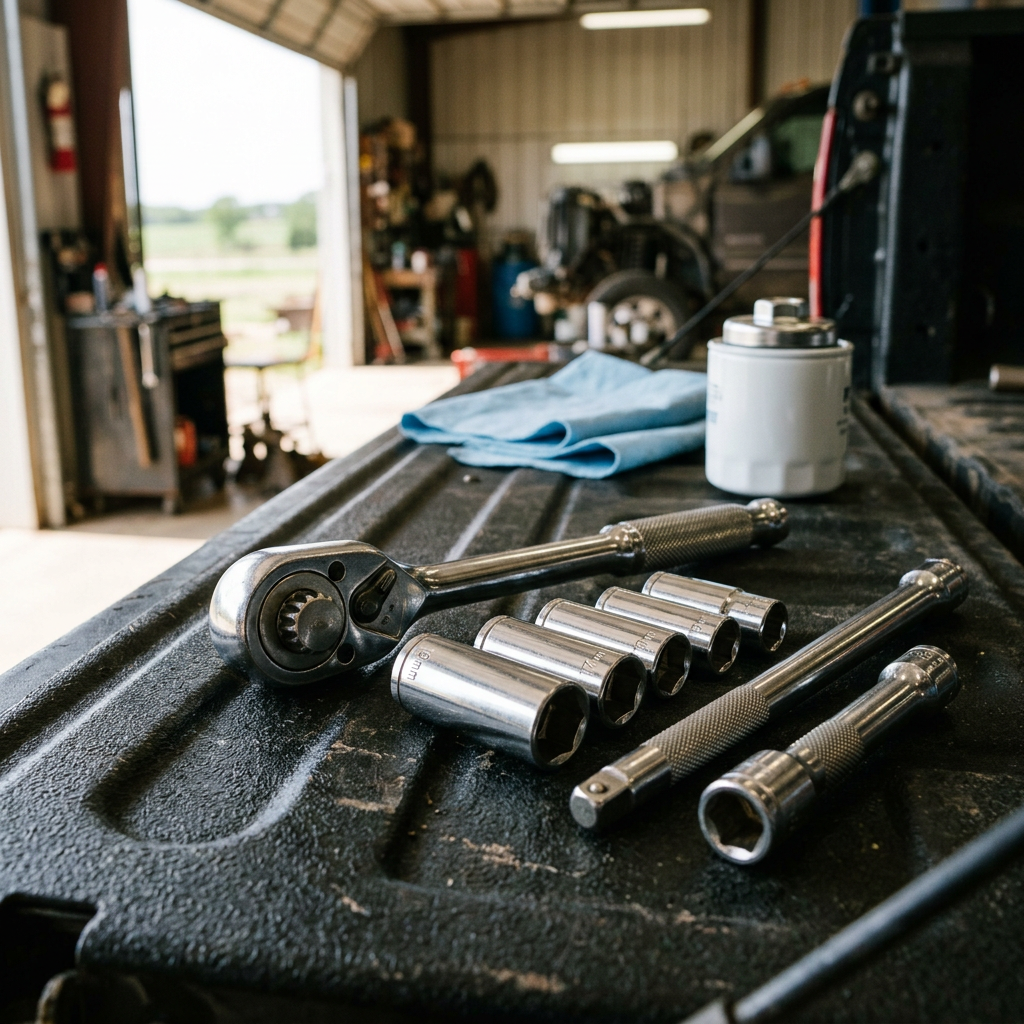
To change the fuel filters on your 6.7L Power Stroke, you will need a few specific tools to make the job clean and safe:
-
32mm Socket: Essential for removing the primary filter cap under the frame rail without stripping the plastic hex nut.
-
Socket Extensions & Ratchet: A 3/8-inch or 1/2-inch drive ratchet with a medium extension to reach the frame housing comfortably.
-
8mm Socket: Required to remove the small mounting bracket bolts on certain model year under-hood filters.
Safety & Clean-Up Gear
Diesel fuel is highly slippery, hard to wash out of clothing, and can irritate skin upon prolonged contact. Make sure you have:
-
Fuel Catch Pan: A wide-mouth oil or fuel drain pan to catch escaping diesel fuel from the DFCM water drain.
-
Nitrile Gloves & Safety Glasses: Protects your skin and eyes from pressurized fuel spray.
-
Shop Rags or Microfiber Towels: For wiping down fuel lines and the housing areas to prevent dirt entry.
While changing fuel filters is a popular weekend project for experienced DIYers, doing it incorrectly can lead to severe fuel leaks, air introduction into the high-pressure system, or cracked plastic filter housings. If you prefer to bypass the mess and let factory-certified diesel technicians handle the job with professional precision, we invite you to Schedule Ford Service Today with the experts at Valor Ford.
The Proper Procedure to Change Both Power Stroke Fuel Filters Safely
Step 1: Drain the Water Separator Housed in the DFCM Before unscrewing any housings, place your fuel catch pan underneath the frame-mounted DFCM filter. Locate the yellow drain valve on the bottom of the housing. Slowly turn the valve counter-clockwise to allow the fuel and settled water to drain fully into your catch pan. Once the flow stops, turn the drain valve clockwise to close it securely. This prevents a massive, messy splash when you proceed to remove the filter cap.
Step 2: Remove the Frame-Mounted Filter Cap Using your 32mm socket and extension, place it squarely onto the plastic nut molded into the bottom of the frame-mounted filter cap. Slowly turn counter-clockwise. The housing cap may feel stiff initially, but proceed carefully to avoid cracking the plastic. Once unscrewed, pull the cap and the attached filter cartridge straight down. Pop the old filter element out of the cap, clean the inside of the cap thoroughly with a clean rag, and install the new O-ring included in your Motorcraft kit. Crucial Tip: Lubricate the new O-ring with clean diesel fuel or clean engine oil to ensure a perfect, airtight seal. Click the new filter cartridge into the cap, then screw the assembly back onto the DFCM housing, hand-tightening it first, then torquing it to 19 lb-ft (or until the cap stops rotating against the physical stop). Do not overtighten.
Step 3: Replace the Under-Hood Secondary Fuel Filter Move to the engine bay. Locate the secondary filter near the front-left of the engine. Wipe down the quick-connect fuel fittings to prevent any dust or dirt from falling into the open lines. Disconnect the fuel line clips by squeezing the colored tabs and pulling gently. Some residual fuel may spray slightly, so keep a rag handy. Once the lines are disconnected, unbolt the filter bracket or twist the filter assembly counter-clockwise (depending on your specific model year) to remove it. Install the new secondary filter in reverse order, ensuring the mounting bracket is secure, and firmly click the quick-connect fuel lines back into place. You will hear an audible click when they lock. Double-check that the line clips are fully engaged to prevent fuel leaks under pressure.
What Is the Proper Procedure to Prime the Fuel System After Replacing the Power Stroke Fuel Filters?
Once both fuel filters are replaced, the fuel lines and filter housings are filled with air instead of fuel. Do not start the engine immediately after replacing the filters. Attempting to start the truck dry will pull air into the high-pressure fuel pump (CP4), causing metal-on-metal friction and immediate, catastrophic damage. You must prime the fuel system using the low-pressure fuel pump to purge all air back to the fuel tank. To prime the system correctly, follow this simple sequence:
-
Insert your key into the ignition (or use the push-button start without pressing your foot on the brake pedal).
-
Turn the ignition to the ‘ON’ (or Run) position. Do *not* crank the engine.
-
You will hear the electric low-pressure fuel pump hum from underneath the cab. Let it run for 30 seconds until the hum stops.
-
Turn the ignition back to the ‘OFF’ position.
-
Repeat this cycle 6 to 10 times. You will hear the pitch of the pump change as the housings fill with fuel and air bubbles are pushed back to the tank.
After completing 8 to 10 key cycles, press the brake pedal and crank the engine. It should start smoothly within a few seconds. If the engine starts but stumbles or dies immediately, you likely have trapped air left in the system. Turn the truck off and perform another 5 priming cycles before attempting to restart. Once the engine is running smoothly, let it idle for a couple of minutes. Slide under the truck and inspect the frame-mounted primary filter cap, and check the under-hood connections to ensure there are absolutely no active fuel leaks. If you notice any wet spots or fuel dripping, shut down the engine immediately, clean the area, and verify the O-ring seals or quick-connect fittings are seated correctly.
Why Junction City, Fort Riley, and Dickinson County Conditions Demand Stricter Maintenance
Agricultural Dust & Gravel Roads
Dickinson County is home to active farming, ranching, and miles of dry gravel roads. As trucks traverse these dusty paths during planting and harvesting seasons, microscopic airborne dust settles on the fuel tank filler neck. When refueling, this fine agricultural dust can fall directly into the tank, accelerating fuel filter restriction and requiring more frequent replacements.
Military Training & Heavy Towing
Fort Riley military families and contractors utilize Super Duty trucks for demanding, high-load towing operations and extended off-grid utility work. Heavy payloads and prolonged engine idling dramatically increase the volume of fuel passing through the filter media. More fuel processed means more particulate capture, reducing the effective life of the filter.
Extreme Kansas Temperature Swings
Kansas is famous for dramatic seasonal temperature swings. Warm, humid days followed by cool nights create condensation inside steel and plastic fuel tanks. Water in diesel fuel breeds microbial growth and forms slime that quickly plugs fuel filters. Ensuring fresh filters are installed before major seasonal transitions is key to avoiding issues.
Don’t let Kansas weather and tough road conditions compromise your Power Stroke’s performance. For peace of mind, let us perform a complete diesel system check-up. You can easily book a hassle-free appointment online by choosing our convenient Schedule Pickup and Delivery Service, allowing you to stay focused on your busy day while we handle the dirty work.
When Fuel System Wear Suggests It May Be Time to Consider an Upgrade for Your Super Duty
While regular maintenance keeps a 6.7L Power Stroke running strong for hundreds of thousands of miles, older models—especially high-mileage first-generation 6.7L trucks or older 6.0L and 6.4L platforms—can eventually reach a point where fuel system wear becomes an ongoing, expensive headache. Injector bodies wear down internally, high-pressure pumps lose efficiency, and fuel tank linings can degrade. When you find yourself facing major repair bills for high-pressure pumps, injectors, or advanced emissions equipment, it is often highly cost-effective to consider upgrading to a newer, more efficient model. Modern Ford Super Duty models boast significantly upgraded fuel delivery systems, redesigned high-pressure pumps with vastly improved reliability, and robust factory warranties that eliminate the fear of unexpected, multi-thousand-dollar repair bills.
If you are curious about what your current truck is worth in today’s strong truck market, we can help. Our team at Valor Ford offers a straightforward, transparent Trade In Evaluation to give you a fair, competitive value for your current rig. From there, you can explore our cutting-edge heavy-duty lineup, including the robust and incredibly capable Ford F-250 models. Whether you decide to check out our Research Ford F-250 page or want to browse our extensive and ready-to-work Browse Used Inventory, our expert finance and sales teams are here to help you make the smartest financial decision for your business, farm, or family.
Keep Your Power Stroke Performing Flawlessly at Valor Ford in Junction City
At the end of the day, your Ford Super Duty is more than just a truck—it is your livelihood, your adventure machine, and your partner on the demanding roads of Kansas. Taking care of its advanced fuel system by performing timely, high-quality fuel filter changes with genuine Motorcraft components is the absolute key to unlocking maximum engine longevity, fuel efficiency, and legendary performance. Don’t leave your fuel system’s survival to chance with inferior aftermarket filters or delayed maintenance schedules. Our team of factory-trained, certified Ford diesel technicians at Valor Ford has the specialized knowledge, state-of-the-art diagnostic tools, and genuine OEM parts inventory required to keep your Power Stroke performing flawlessly. Whether you need a quick filter replacement, a comprehensive multi-point inspection, or are ready to explore upgrading to a brand new Super Duty, we are proud to serve as your premier local diesel resource. Stop by our dealership today, Get Directions to Valor Ford, or Call us at (785) 238-5114 to chat with our friendly service coordinators.
Tags: 6.7L Power Stroke service, diesel engine fuel system care, diesel fuel contamination prevention, diesel fuel system diagnostics, diesel truck maintenance tips, Ford Super Duty maintenance, fuel filter change intervals, fuel filter water separator service, heavy-duty truck fuel system, OEM Motorcraft fuel filters, Power Stroke fuel filter replacement, professional diesel service
Posted in
Automotive Repair, Diesel Engine Care, Genuine OEM Parts & Accessories, Maintenance & Service, Seasonal Vehicle Maintenance |
No Comments »