

Jul 31, 2026

Navigating Clay, Gravel, and Highway: Finding the Ultimate All-Terrain Truck Tire for North-Central Kansas

Driving a truck in North-Central Kansas isn’t just a simple daily commute; it is a test of mechanical endurance and adaptability. On any given Tuesday, you might find yourself navigating the slick, waterlogged bottomlands of the Republican River in Clay County, tackling miles of razor-sharp limestone gravel roads in rural Ottawa County, and then opening it up to seventy-five miles per hour on Interstate 70 as you head towards Fort Riley or Manhattan. Each of these surfaces places vastly different, often conflicting demands on your truck’s tires. Sticky clay requires wide, open tread voids to prevent packing; sharp gravel demands ultra-tough, cut-and-chip resistant rubber compounds with reinforced sidewalls; and the highway demands a tight, continuous tread pattern that minimizes road noise, heat buildup, and rolling resistance. Finding a single tire that can handle all three environments without wearing out in ten thousand miles is the ultimate goal for Kansas truck owners.

For generations, drivers in communities like Minneapolis, Clay Center, Wakefield, and Delphos have had to make tough compromises. If you chose a dedicated mud tire, your highway commute became a loud, vibrating chore, and the soft rubber compounds would disintegrate on the gravel. If you chose a smooth highway tire, you’d find yourself hopelessly stuck in the first wet clay field entrance or farm lane you encountered. Fortunately, modern tire engineering has made incredible strides. Today’s hybrid and advanced all-terrain tires use sophisticated materials science and variable tread geometries to bridge these gaps. Here at Valor Ford in Junction City, we understand the unique regional soil conditions and driving habits of our agricultural, military, and commercial customers. We’re here to help you dissect the physics of tire design so you can make an educated investment in your vehicle’s safety, efficiency, and capability.
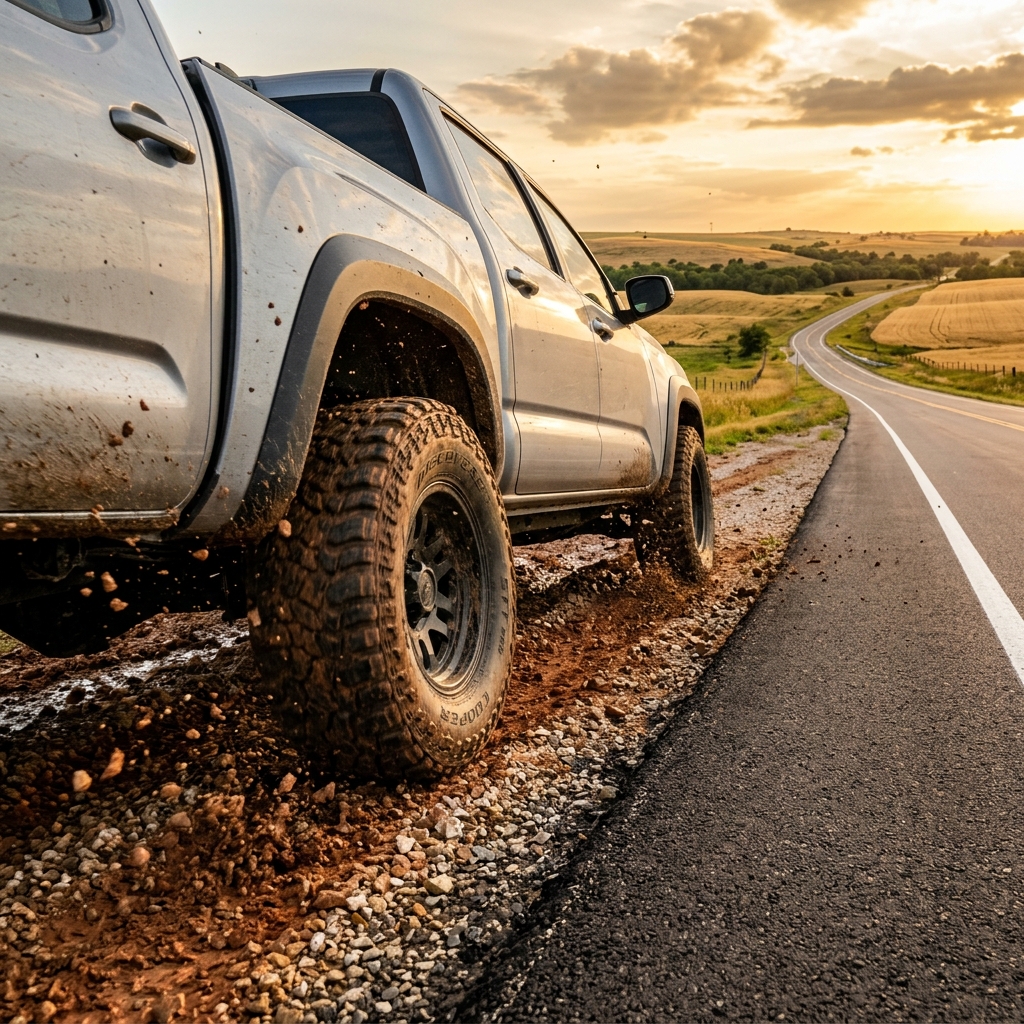
Silver pickup truck kicks up mud while driving along a paved country road shoulder at sunset. (Representative image for illustration purposes only. Actual vehicle may vary based on trim and configuration.)

To truly master this terrain, you must understand how your truck’s power translates to the ground. Your tires are the only contact point between thousands of pounds of American steel and the unpredictable Kansas soil. Whether you’re hauling a load of hay, commuting to the base, or heading out for weekend recreation, selecting the right tire is a critical decision. Let’s look closely at how the different tire classifications perform when subjected to our local conditions, helping you find the absolute perfect match for your daily routes and workloads.

Which Tire Type Works Best If I Drive Mud, Gravel, and Highway All in One Week?

The modern light truck tire market is broadly segmented into three primary categories: Highway Terrain (HT), All-Terrain (AT), and Mud-Terrain (MT). In recent years, a fourth ‘Rugged Terrain’ (RT) or hybrid category has emerged specifically to address the needs of drivers who find themselves split evenly between demanding off-road tasks and high-speed pavement driving. To choose the right one, let’s break down the structural and performance differences of these tire styles when faced with the tri-hazard drive of mud, gravel, and highway.

Highway Terrain (HT)

The Pavement Specialist: Highway terrain tires are engineered with closely spaced, continuous tread ribs designed to maximize the rubber contact patch on asphalt. This design reduces tread squirm, optimizes fuel efficiency, and keeps cabin noise to a whisper. While they offer superb lifespan on clean roads, their shallow tread depth and tight grooves are easily packed solid with wet clay, instantly turning your tire into a slick. On gravel, their softer, fuel-conscious rubber compounds are vulnerable to slicing and chipping.

All-Terrain (AT)

The Balanced Performer: All-Terrain tires represent the sweet spot for many Kansas drivers. They feature interlocking, blocky tread designs that are deep enough to bite into loose soil and gravel, yet arranged carefully to maintain stable, reasonably quiet contact on the highway. High-quality AT tires use harder, specialized rubber compounds that resist stone chipping. While they can handle moderate mud, extremely thick, wet clay can still overwhelm their self-cleaning capabilities if you don’t maintain wheel spin.

Mud-Terrain & Hybrids

The Off-Road Warrior: Mud-Terrain (MT) and Hybrid (RT) tires feature massive tread blocks, deep voids, and aggressive shoulder lugs designed to scoop away heavy mud and throw it clear of the tire. Hybrids pull the best elements of AT and MT tires together: they keep a slightly tighter center tread pattern to reduce highway hum while maintaining giant, scoop-like shoulder blocks for deep ruts. For drivers spending significant time on rural farm paths and unpaved county roads, these offer the ultimate insurance policy against getting stuck.

If your weekly schedule involves commuting forty miles down US-81, pulling a stock trailer down five miles of sharp Ottawa County limestone gravel, and then backing into a muddy pasture to hook up to an implement, a high-quality All-Terrain or Hybrid (RT) tire is almost always your best bet. These tires provide the structural durability to survive the gravel, the biting edges to escape the mud, and the advanced tread pitch sequences necessary to keep your sanity on the long highway drive back home. Let’s look into the specific engineering details that make these tires work.

Conquering Sticky Clay: How Do Self-Cleaning Tread Blocks Keep You from Getting Stuck?
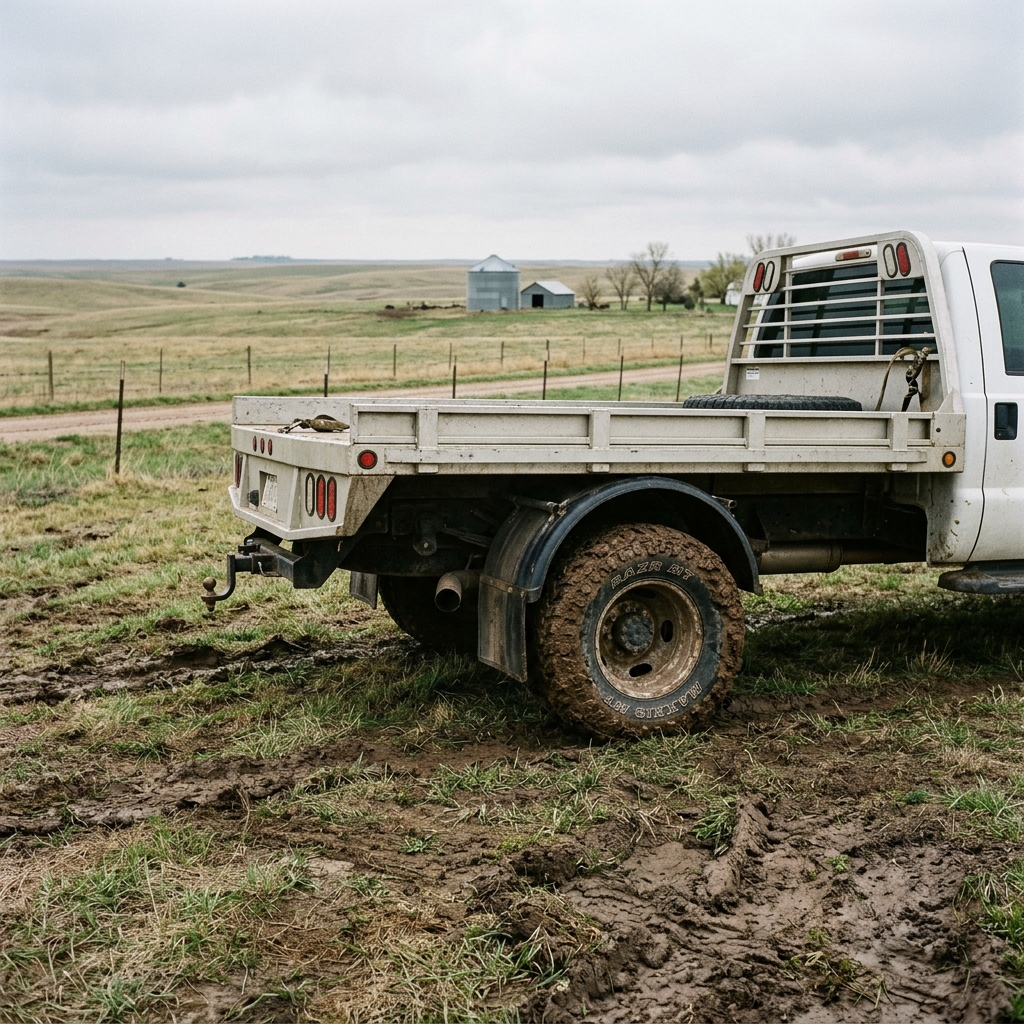
Anyone who has driven through the Republican River valley after a heavy summer rain knows that Kansas clay is unlike almost any other substance on earth. It is highly cohesive, chemically sticky, and heavy. When a standard tire rolls through this clay, the pressure of the vehicle packs the mud deep into the tread channels. If the tire cannot shed this mud, the tread voids quickly fill up completely. Within a few wheel rotations, your aggressive truck tire is transformed into a completely smooth cylinder of slick mud. With no open channels left to bite into the ground, traction drops to zero, and your truck is officially stuck. To prevent this, off-road and high-end all-terrain tires are engineered with self-cleaning tread designs. The secret lies in a combination of tread void geometry, tapered tread block walls, and specialized mud ejector bars. Tread voids are the open spaces between the solid rubber blocks. By designing these channels to widen as they move outward toward the shoulder of the tire, centrifugal force naturally flings the mud out of the tread as the tire spins. Tapered walls ensure that the mud cannot easily grip the rubber, allowing it to slide out smoothly under pressure.

A white flatbed pickup truck with a muddy rear tire parked in a rutted, muddy field with rolling hills in the background. (Representative image for illustration purposes only. Actual vehicle may vary based on trim and configuration.)

Additionally, many modern truck tires incorporate raised ridges at the bottom of the tread channels known as mud ejector bars or stone ejectors. As the tire rolls and flexes under the weight of the truck, these bars compress and decompress, breaking the suction of the mud and pushing it upward and out. This continuous flexing and clearing action ensures that every time your tire rotates back down to meet the ground, it presents clean, open tread blocks ready to dig into the slick surface and keep your vehicle moving forward through the slickest farm lanes.

What Tire Load Range Is Recommended for Hauling Heavy Loads Over Sharp Gravel in Ottawa County?

When you are hauling heavy agricultural payloads, stock trailers, or construction equipment over the unpaved roads of Ottawa County, the physical load rating of your tires is just as important as the tread design. Gravel roads in this region are often surfaced with crushed limestone or flint rock. These stones have extremely sharp edges that can easily slice through the thin carcass of a standard passenger-rated (P-metric) tire, especially when that tire is compressed under a heavy load. For any serious truck work, you must look at Light Truck (LT) metric tires, which are classified by their load range.

For three-quarter-ton and one-ton trucks (like the Ford F-250 and F-350 Super Duty), as well as heavily loaded half-ton trucks (like the F-150), we almost universally recommend Load Range E tires. Commonly referred to as ’10-ply rated’ tires, Load Range E tires are built with robust internal construction. While they no longer contain ten actual layers of cotton plies like tires of the past, they utilize high-strength steel belts and heavy-duty polyester cords that provide equivalent structural strength. This heavy-duty construction serves two vital purposes on gravel roads: first, it prevents the tire from flexing excessively under load, which keeps the tread flat and reduces the likelihood of rocks puncturing the carcass; second, it provides incredibly tough sidewalls that resist tearing when scraped against deep gravel ruts or jagged rocks.

Tire Metric Type

Load Range Designation

Internal Construction

Best Suited For

P-Metric (Passenger)

Standard Load (SL)

4 to 6-ply equivalent, thinner sidewalls

Light commuting, light duty half-ton trucks, smooth highway

LT-Metric (Light Truck)

Load Range C

6-ply equivalent, reinforced casing

Midsize trucks, light off-roading, occasional gravel driving

LT-Metric (Light Truck)

Load Range D

8-ply equivalent, high-strength belts

Half-ton trucks towing moderate trailers, mixed gravel use

LT-Metric (Light Truck)

Load Range E

10-ply equivalent, heavy steel belts

3/4 and 1-ton trucks, heavy farm hauling, sharp flint gravel

Choosing a Load Range E tire does result in a slightly firmer ride when the truck is empty because the sidewalls do not flex as easily as passenger tires. However, the peace of mind and puncture resistance they offer when you are miles out in the country are well worth it. If you’re ready to upgrade your truck’s durability, you can explore specialized tire options or Order Genuine Ford Parts directly through our website to find the perfect heavy-duty set.

Preventing Tread Damage: Are There Specific Tread Compounds Designed to Resist Stone Drilling?
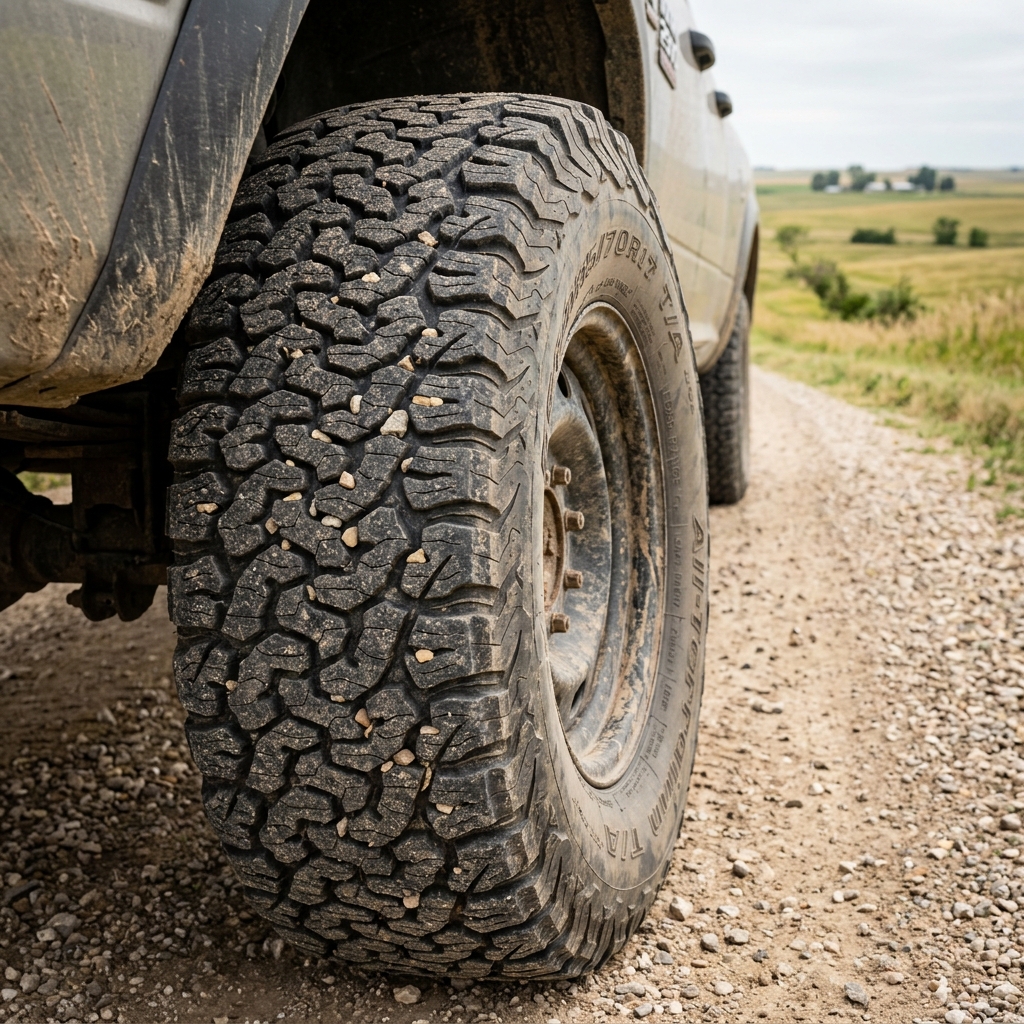
Close-up of a rugged all-terrain truck tire with gravel stuck in its deep tread on a dirt road. (Representative image for illustration purposes only. Actual vehicle may vary based on trim and configuration.)

When driving on crushed limestone roads, small, sharp pebbles can get tightly wedged inside your tire’s tread grooves. This phenomenon is known as ‘stone retention’. If these stones remain trapped, the continuous flexing of the tire as it rotates forces the sharp rock deeper into the rubber carcass, eventually boring a hole through the protective steel belts—a destructive process known as ‘stone drilling’.

To prevent this costly damage, tire manufacturers have developed advanced rubber chemistry and specific mechanical designs. Premium all-terrain and mud-terrain tires are formulated with specialized cut-and-chip resistant tread compounds. These compounds utilize high-density polymer chains, silica, and carbon black structures that make the rubber incredibly tough and resilient. Unlike standard passenger car tires which use highly pliable rubber optimized solely for warm-weather asphalt grip, cut-and-chip resistant compounds act like an armored shield, resisting the slicing and gouging actions of sharp flint and limestone. Mechanically, these tires incorporate ‘stone ejectors’—small angled steps or triangular ridges built into the bottom of the tread grooves. As the tire rotates and compresses, these ejectors change the angle of the groove walls, mechanically popping trapped stones out of the tread before they can begin drilling into the casing. When shopping for tires at Valor Ford, always look for options that explicitly feature chip-resistant compounding and stone-ejecting technology if you spend significant time on county gravel roads.

How Does Tire Pressure Affect Puncture Resistance on Sharp Gravel Roads?

Tire pressure (measured in Pounds per Square Inch, or PSI) is one of the most critical, yet frequently overlooked variables in off-highway driving. The amount of air inside your tire dictates how the rubber footprint interacts with the road surface. On sharp gravel roads, maintaining the wrong tire pressure can drastically increase your susceptibility to punctures, uneven wear, and vehicle instability.

The Risk of Over-Inflation

When a tire is over-inflated to its maximum cold pressure (such as a higher cold inflation pressure on a Load Range E tire when the truck is empty), the tread surface becomes extremely rigid and drum-tight. When this rock-hard tire hits a sharp piece of limestone, the rubber cannot flex or absorb the impact. Instead, the sharp rock concentrates all of the truck’s weight onto a tiny, unyielding point, easily punching through the tread or sidewall. Over-inflation also causes harsh ride quality and rapid center tread wear.

The Danger of Under-Inflation

Conversely, running a tire with too little pressure causes the sidewalls to bulge excessively. On gravel roads, this exposes the vulnerable, unarmored sidewall area to sharp rocks kick-started by your front tires. Under-inflation also leads to ‘pinch flats’, where hitting a deep rut or pothole compresses the tire so severely that the inner tube or liner is pinched against the steel wheel rim, causing an instant, unrepairable tear. It also creates extreme heat on the highway.

The Sweet Spot Strategy

For mixed-use driving, you want to find the optimal balance. When running empty or light on gravel, dropping your pressure slightly (for example, from 80 PSI down to 50-55 PSI on heavy-duty rear tires, depending on manufacturer load tables) allows the tire to act as an active suspension component. The rubber can slightly envelope sharp stones rather than resisting them, drastically reducing puncture rates and keeping the truck tracking straight. Always re-inflate to recommended specs before hauling heavy loads on the highway.

Decoding Winter Traction: What Does the Three-Peak Mountain Snowflake (3PMSF) Symbol Mean?
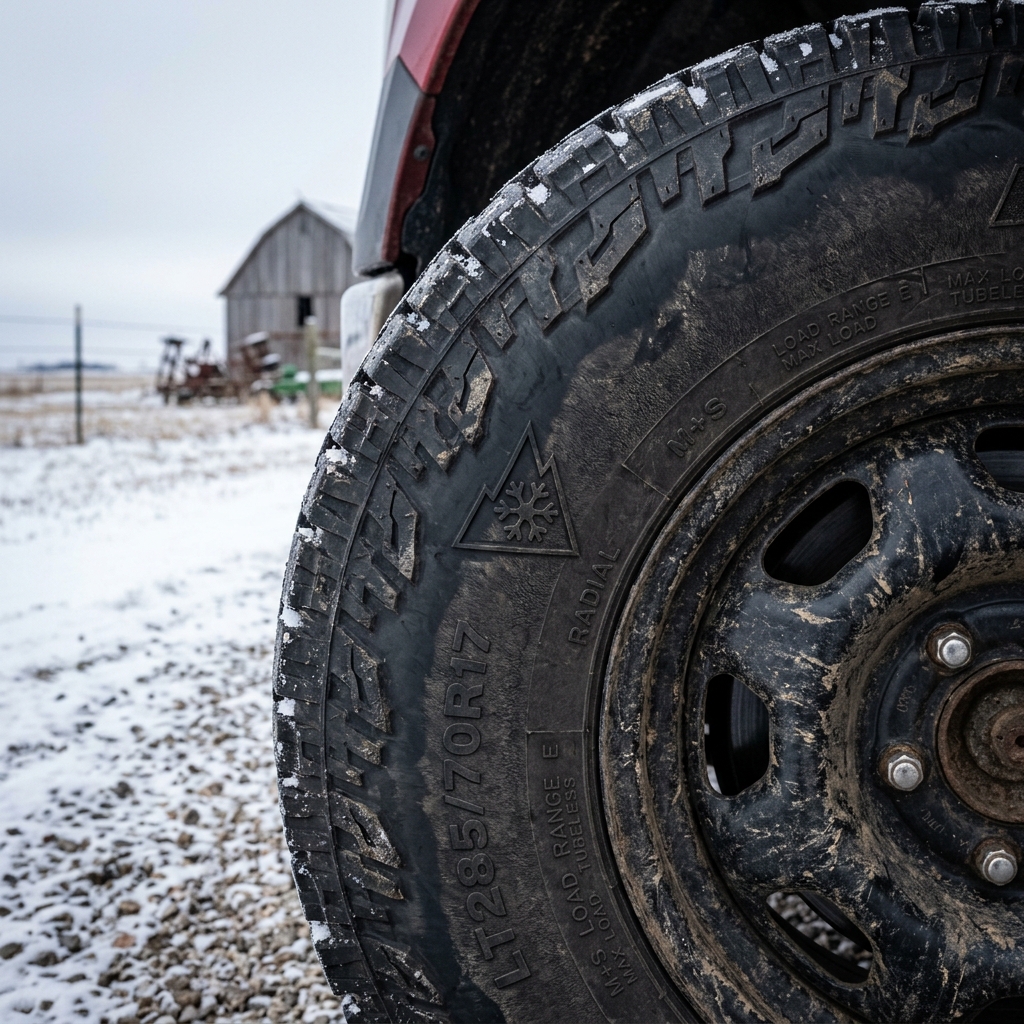
Kansas winters are notorious for their volatility. One day you are driving through dry, freezing winds, and the next you are navigating several inches of heavy, wet snow transitioning into dangerous black ice. For truck owners who must get to work regardless of the weather, understanding tire traction ratings is absolutely essential. Many drivers see the ‘M+S’ (Mud and Snow) rating stamped on their sidewall and assume they are fully protected. However, the M+S designation is based purely on a geometric formula of the tread design—specifically, that the tread has a certain percentage of open space. It does not involve any physical performance testing in actual winter conditions. To find a tire that truly excels in severe snow and ice, you must look for the Three-Peak Mountain Snowflake (3PMSF) symbol. This icon of a snowflake inside a three-peaked mountain outline indicates that the tire has undergone rigorous physical testing on packed snow and has met or exceeded specific traction performance requirements. Tires with the 3PMSF rating use specialized rubber compounds that remain soft and pliable even when temperatures drop well below freezing, ensuring the tread can still grip the road.

Close-up of an LT285/70R17 truck tire on a muddy black wheel with a snowy barn in the background. (Representative image for illustration purposes only. Actual vehicle may vary based on trim and configuration.)

Furthermore, 3PMSF-rated all-terrain tires feature extensive ‘siping’—tiny, microscopic slits cut across the tread blocks. When these slits contact ice or packed snow, they open up, acting like hundreds of tiny claws that bite into the surface and wick away the thin layer of water that causes sliding. For Kansas drivers, choosing a 3PMSF-rated all-terrain tire gives you excellent year-round capability, eliminating the need to swap between summer and dedicated winter tires.

What Questions Should I Ask a Tire Dealer Before Buying Tires for Mud and Gravel Use?

Purchasing a new set of truck tires is a significant financial investment, and walking into a dealership unprepared can lead to choosing a tire that doesn’t fit your real-world needs. To ensure you get the absolute best match for your specific driving mix in Clay and Ottawa counties, it helps to ask targeted questions. Here is a handy checklist of questions to ask our experts at Valor Ford when you visit us for your next set of rubber:

  • Is this tread compound rated for cut-and-chip resistance? Ensure the tire has the chemistry required to withstand sharp gravel without shredding.

  • What is the mileage warranty on this tire, and does it cover gravel road wear? Many manufacturers void or reduce mileage warranties if the tire is driven extensively on unpaved roads. It is vital to know this upfront.

  • Does this tire feature integrated stone ejector ribs? Make sure the tire has built-in mechanisms to prevent stone drilling.

  • What cold PSI do you recommend I run when empty versus fully loaded? Get precise inflation targets tailored to your truck’s weight and your primary driving surfaces.

  • What are my options for road hazard protection? Sharp gravel can occasionally beat even the toughest tire; having a robust road hazard warranty provides valuable peace of mind.

  • How noisy is this tire on the highway at 75 MPH? Ask about the tire’s tread pitch sequencing and how it manages cabin vibration.

At Valor Ford, our service advisors are trained to ask you about your driving habits, load weights, and terrain preferences before suggesting a tire. We carry a wide selection of top brands and can help you weigh the pros and cons of each model. If you are experiencing vibration, uneven wear, or suspect it is time for a new set, you can easily Schedule Ford Service Today to have our team perform a professional tire inspection.

Matching Your Tires to Your Territory: Real-World Scenarios from Fort Riley to Dickinson County
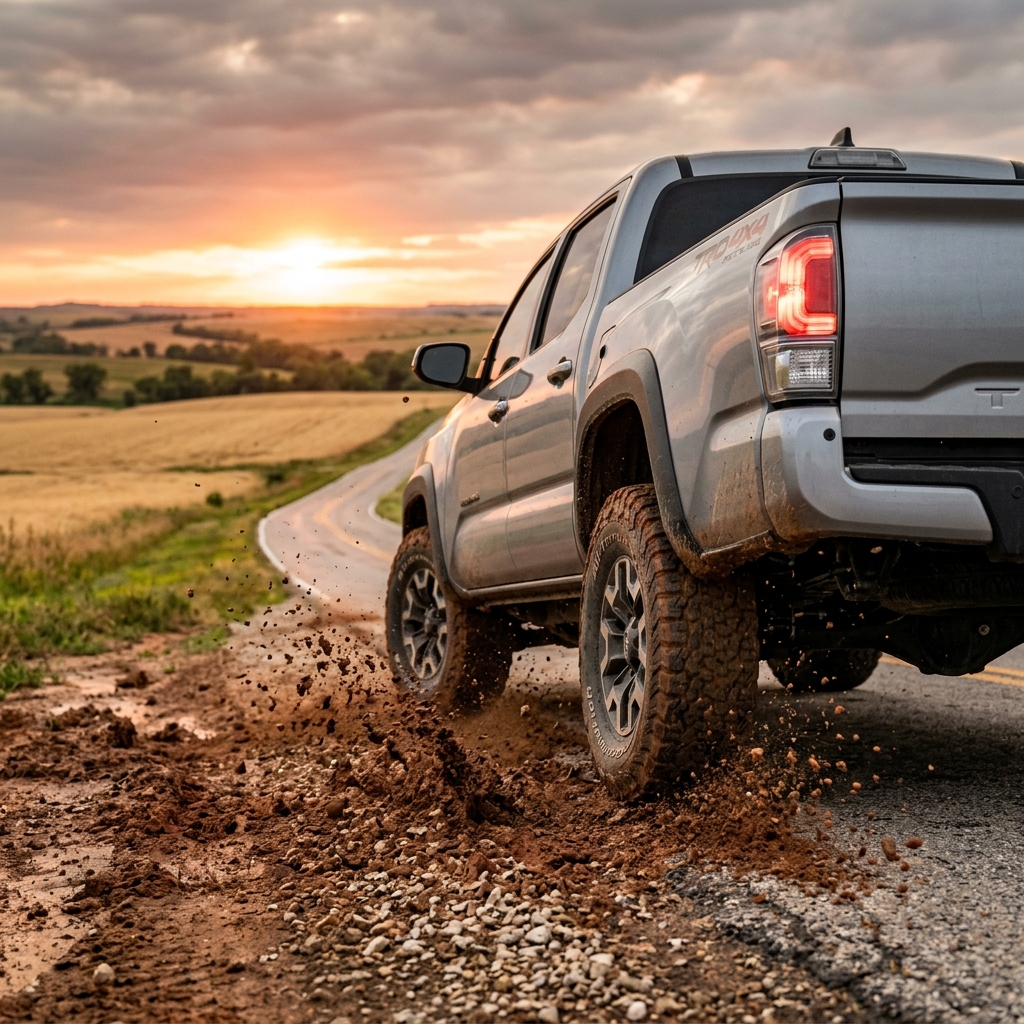
Silver pickup truck kicking up mud on a rural road at sunset. (Representative image for illustration purposes only. Actual vehicle may vary based on trim and configuration.)

The Fort Riley Commuter

90% Highway / 10% Off-Road: Meet Sgt. Miller, who commutes daily from Clay Center to Fort Riley. He drives mostly on paved highways but loves hunting and camping near Milford Lake on weekends. For this profile, a premium All-Terrain tire with a tight center tread is ideal. It offers low rolling resistance, excellent wet-braking performance on highway asphalt, and a quiet ride during his daily commute, while still providing the mud traction he needs to navigate lakeside access trails without getting stuck.

The Mixed-Use Contractor

50% Highway / 50% Gravel & Construction Site: Sarah manages rural construction projects across Ottawa and Dickinson counties. She splits her time evenly between traveling at high speeds on Interstate 70 and hauling heavy equipment over unpaved county roads. We recommend a Load Range E Hybrid (RT) tire. This configuration provides the extreme sidewall protection and cut-and-chip resistance needed on limestone gravel, combined with stable highway handling that doesn’t sacrifice her truck’s fuel economy.

The Dickinson County Farmer

20% Highway / 80% Mud, Gravel & Fields: David operates a family farm near Solomon. His truck spends almost its entire life on loose gravel, dirt field entrances, and deep mud pastures. For David, a dedicated, aggressive Mud-Terrain (MT) tire is the only logical choice. The massive open tread blocks and self-cleaning mud ejector bars ensure he can pull heavy stock trailers through thick clay without spinning out, while the high ply rating guards against tire punctures from crop stubble and sharp flint stones.

Maximizing Your Tire Investment: Rotation, Alignment, and Balancing for Mixed-Terrain Drivers

Driving on a mix of sharp gravel, slick mud, and high-speed pavement places immense stress on your tires and suspension system. If you want your new set of tires to last forty, fifty, or sixty thousand miles, a strict maintenance schedule is non-negotiable. Aggressive tread designs, particularly on all-terrain and mud-terrain tires, are highly susceptible to ‘feathering’ or ‘cupping’ if they are not rotated regularly. This uneven wear is caused by the tread blocks flexing as they contact the road, and once an uneven wear pattern starts, it is nearly impossible to correct. For trucks driven on gravel and unpaved roads, we recommend a tire rotation interval of 5,000 miles—which aligns perfectly with your regular oil change interval. Regular rotation ensures that all four tires wear down at an even rate, extending the overall lifespan of the set. Additionally, because gravel roads often feature deep washboards and potholes, your truck’s steering alignment can easily get knocked out of spec. An out-of-alignment truck drags the tires slightly sideways down the road, scrubbing off valuable tread in a matter of months.

Wheel balancing is another crucial maintenance step. As you drive through mud and clay, small clumps of dirt can stick to the inner barrel of your wheels. Even after the mud dries and falls off, it can leave behind a weight imbalance that causes a noticeable vibration at highway speeds. This vibration isn’t just annoying; it accelerates wear on your shocks, struts, ball joints, and wheel bearings. Whenever you bring your truck to Valor Ford, our master technicians don’t just rotate your tires—they inspect your entire suspension system, check for uneven wear patterns, and perform precision high-speed balancing. This comprehensive care ensures your truck drives as smoothly down I-70 as it does down a flat paved road, safeguarding your investment and keeping you safe on every journey.

Why Northern Kansas Truck Owners Trust Valor Ford for Expert Tire Selection and Installation
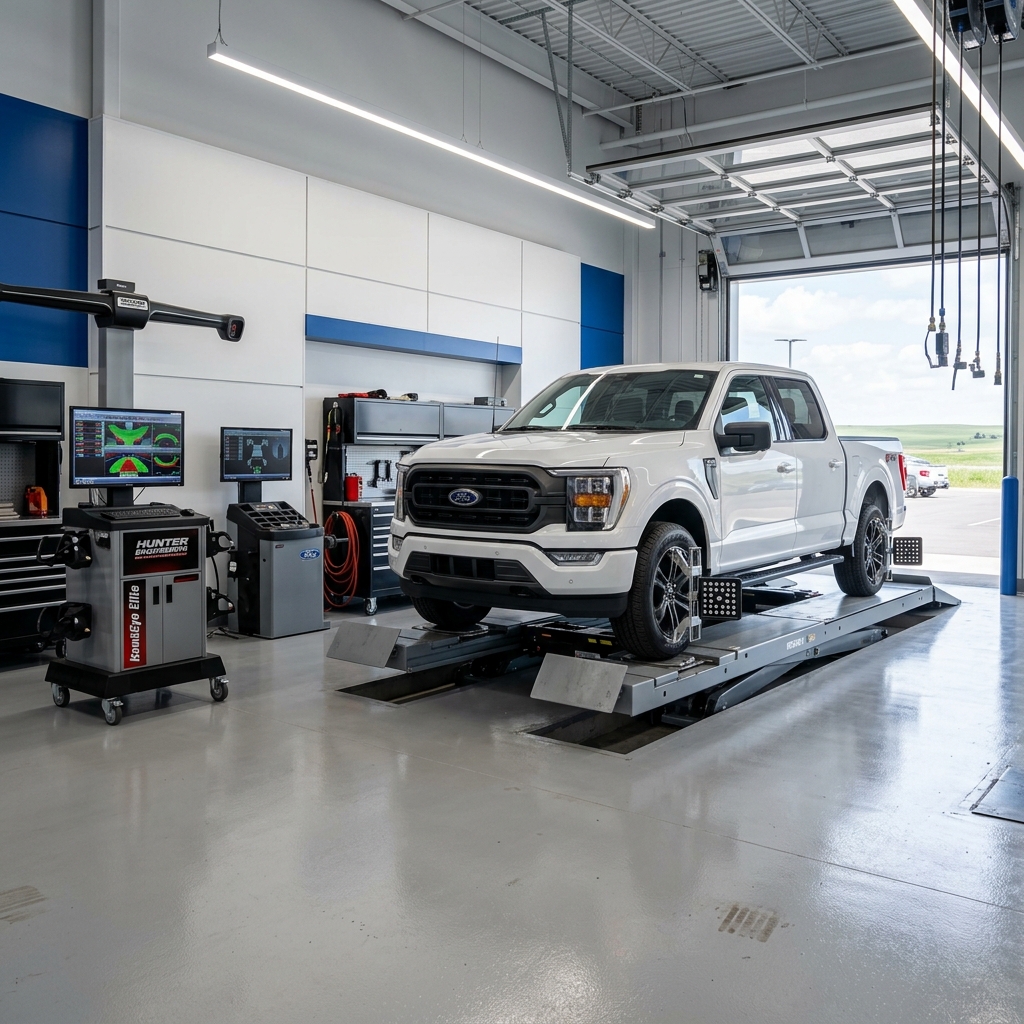
A white Ford F-150 pickup truck undergoing a professional wheel alignment on a lift in a modern service bay. (Representative image for illustration purposes only. Actual vehicle may vary based on trim and configuration.)

Selecting the right tires is only half the battle; proper installation, balancing, and alignment are what make those tires perform. At Valor Ford, we pride ourselves on being more than just a dealership—we are your local automotive resource. Our service center in Junction City is staffed by Ford-certified technicians who undergo continuous training to stay at the cutting edge of truck engineering. We utilize state-of-the-art diagnostic, mounting, and balancing equipment to ensure that your new tires are installed with absolute precision. We have direct access to a vast inventory of top-tier tire brands, including Goodyear, Michelin, BFGoodrich, Hankook, and Toyo. Because we service hundreds of trucks from Clay, Ottawa, and Dickinson counties every single week, we know exactly how each of these tires performs in our local soils and gravel. We don’t just sell you what’s on the shelf; we help you select the exact tire, load range, and tread pattern designed to conquer your unique driving routes.

To make your experience as seamless as possible, we offer specialized amenities including our Schedule Pickup and Delivery Service. This convenient service allows us to pick up your truck from your home or workplace, perform the tire installation, balancing, and alignment, and return it to you fully serviced—allowing you to stay focused on your farm, business, or family. When you choose Valor Ford, you choose a team dedicated to keeping you moving safely and efficiently on every Kansas road.

Ready for an Upgrade? Let Valor Ford Equip Your Truck with the Perfect Set of Tires Today

If you are ready to explore new tire options, our team can help you prepare for muddy clay lanes or rural gravel roads. Investing in the right tires today means securing safety, performance, and peace of mind for tens of thousands of miles to come. Whether you are driving a brand-new Ford F-150, a heavy-duty F-250 Super Duty, or a rugged Ford Bronco, our tire experts at Valor Ford are ready to help you make the perfect selection. Stop by our dealership at 1825 Goldenbelt Blvd, Junction City, KS 66441 to speak with our team in person. You can easily Get Directions to Valor Ford or Call us at (785) 238-5114 to ask questions, check our current tire stock, or schedule an appointment. Let us help you equip your truck to conquer every mud lane, gravel road, and highway in North-Central Kansas with absolute confidence.