
Do Any Electric Trucks Offer Factory Infrared Thermal Night-Vision Cameras?
No consumer electric pickup currently leaves the factory with an integrated infrared thermal night-vision camera system. Mass-production electric trucks, including the Ford F-150 Lightning, Rivian R1T, Tesla Cybertruck, and GMC Hummer EV, do not include thermal imaging hardware in their factory equipment packages. Drivers wanting thermal imaging to detect wildlife heat signatures beyond normal headlight reach install aftermarket FLIR or specialized automotive thermal sensors on external mounts, displaying the video feed through dedicated dash monitors or auxiliary screens.
Factory automotive thermal night-vision remains limited to a select group of luxury passenger vehicles, primarily from European manufacturers like Audi, BMW, and Mercedes-Benz, alongside select Cadillac SUVs. Mainstream full-size pickup platforms rely instead on visible-spectrum optical cameras paired with forward-facing radar units. The 2026 Ford F-150 Lightning includes Ford Co-Pilot360 2.0 as standard equipment, which powers optical driver assists like Pre-Collision Assist with Automatic Emergency Braking and pedestrian detection. Optical and radar setups identify physical shapes and contrasting silhouettes against illuminated pavement, but they do not register long-range body heat radiating from a deer hidden in roadside brush.
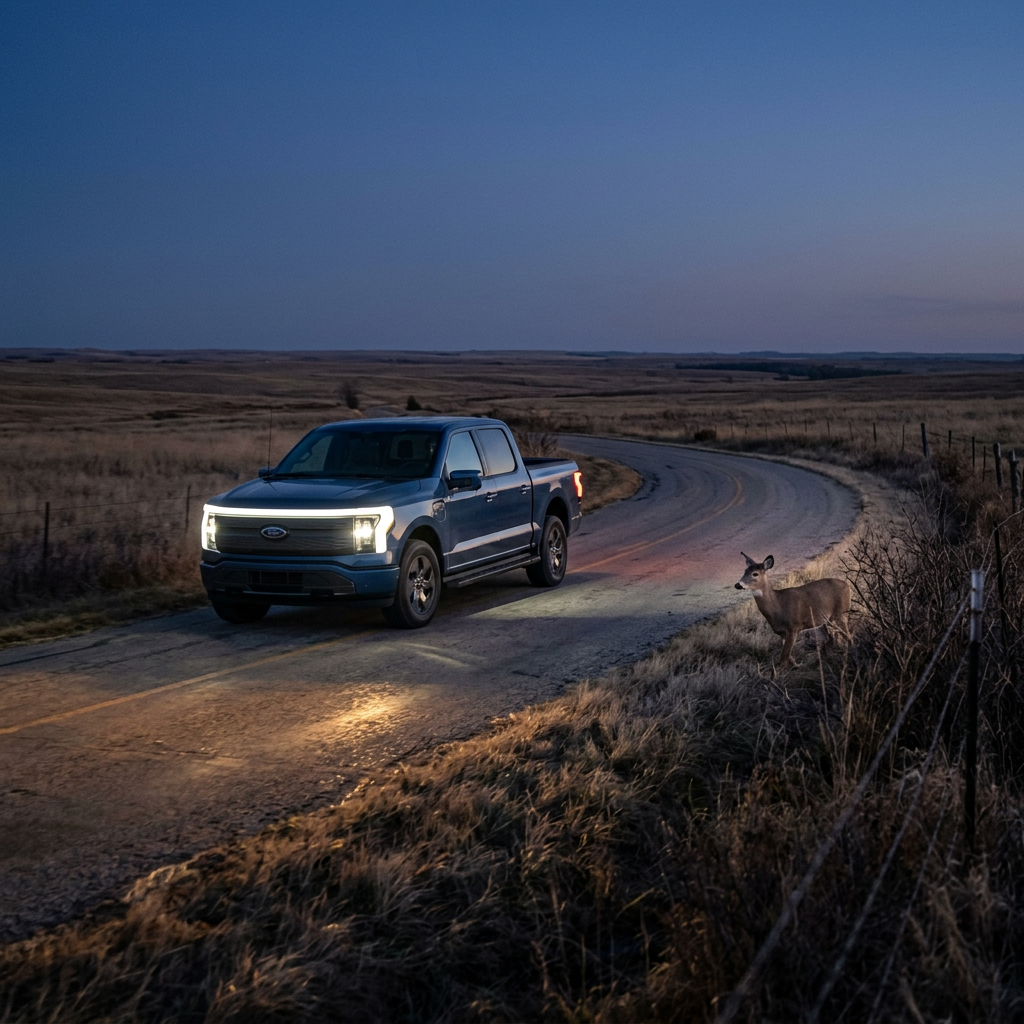
Aftermarket thermal camera systems detect electromagnetic radiation in the far-infrared spectrum, translating heat differentials into a high-contrast black-and-white video feed. A deer standing against cold autumn prairie foliage glows brightly on a thermal display long before conventional headlamps illuminate its physical body. Integrating an aftermarket setup onto an electric pickup requires mounting an enclosed thermal sensor behind the front grille or on a brush guard, routing water-sealed cabling through the firewall, and powering the receiver off the 12-volt auxiliary system. Drivers navigating rural highway routes after dusk often ask our technicians about cleanly wiring these systems, and you can discuss installation requirements by (785) 238-5114.
Table of Contents
- Understanding Kansas Deer Collision Risks During the November Peak
- How Ford F-150 Lightning LED Projector Headlights Enhance Rural Nighttime Visibility
- Highway Driving Tactics and Insurance Coverage for Wildlife Encounters
- Stopping Distance Realities: Comparing the Ford Lightning to Gas-Powered Pickups
- Choosing Tires to Handle Electric Truck Weight and Cold Pavement
- Preparing Your Truck Braking and Lighting Systems for Rural Highway Travel
Understanding Kansas Deer Collision Risks During the November Peak
Kansas drivers encounter the year's highest deer-strike hazard in November, when the whitetail breeding rut prompts intense, erratic animal movements across open highways. Kansas recorded 10,742 deer-related motor vehicle crashes in 2025, representing a significant portion of all statewide roadway incidents. Collision frequency spikes sharply during the ninety minutes surrounding sunrise and sunset, coinciding with standard morning and evening commutes across rural counties.
Agricultural corridors amplify this hazard as autumn crop harvesting strips cover from farm ground, pushing wildlife toward timbered river bottoms and grassy highway rights-of-way. In Dickinson County, broad expanses of cultivated fields meet prairie waterways, creating natural transit funnels where herds cross two-lane state highways without hesitation. Whitetail deer rarely travel in isolation during November; a buck frequently chases a doe across asphalt, meaning that slowing down for a single visible animal only mitigates half the danger.
Understanding these migratory behaviors helps drivers prepare their vehicles for unexpected encounters before hitting two-lane rural blacktop. If you are exploring all-weather utility vehicles designed for open country travel, browse our new Ford Bronco Badlands inventory to see factory lighting and off-road protection packages built for unpredictable terrain.
How Ford F-150 Lightning LED Projector Headlights Enhance Rural Nighttime Visibility
The dynamic bending LED projector headlamps on equipped Ford F-150 Lightning pickups illuminate rural road margins by physically swiveling beam output into corners and casting a broader lateral light spread. Unlike standard reflector housings that deliver fixed forward illumination, projector lenses focus light through specialized optics to generate crisp cutoffs and wide peripheral coverage. This lateral light throw brightens the grassy shoulders and drainage ditches where deer congregate before darting onto the road.
Complementing this physical beam spread is standard Auto High-Beam technology, which operates via a windshield-mounted optical sensor behind the rearview mirror. The system automatically engages high beams on unlit rural corridors and dips them when detecting oncoming headlights or preceding taillights. In national safety testing, the 2026 Lightning earned an Acceptable headlight evaluation alongside a Good rating for front pedestrian crash prevention, reflecting the system's ability to maximize roadway visibility without blinding oncoming motorists. Drivers can fine-tune high-beam automation through the central SYNC 4A touchscreen under the Lighting menu to adapt sensitivity for rural driving.
Factory auxiliary features like Zone Lighting offer 360-degree illumination around the perimeter of the truck cab and bed, though this system is restricted to stationary use at campsites or worksites and turns off once vehicle speed exceeds 5 mph. For highway cruising, forward vision relies entirely on the projector housings. To learn more about standard lighting hardware across different powertrain packages, read our 2026 Ford F-150 model research, or evaluate earlier model years within our pre-owned truck selection.
Highway Driving Tactics and Insurance Coverage for Wildlife Encounters
When a deer leaps into your path on a rural highway, state wildlife officials and highway safety troopers advise holding your lane and braking firmly rather than swerving. Veering sharply at highway speeds frequently leads to vehicle rollovers, ditch impacts, or head-on collisions with oncoming traffic, all of which carry far higher casualty rates than striking an animal head-on. Sounding a single continuous blast of your vehicle horn helps scare wildlife off the road, whereas flashing high beams can cause deer to freeze directly in your lane.
Repairing bodywork after an animal strike falls strictly under the comprehensive section of an auto insurance policy, not standard collision coverage. A direct animal strike is classified as a comprehensive loss, meaning policyholders pay their agreed comprehensive deductible without the automatic fault assessment that follows a two-vehicle crash. However, if a motorist swerves to avoid a deer and collides with a guardrail, culvert, or oncoming vehicle, insurance adjusters categorize the incident as a collision claim, which often triggers higher out-of-pocket costs and rate surcharges.
Following an unavoidable impact, drivers must move their truck to a safe shoulder location, activate hazard flashers, and inspect critical components before continuing. A front-end animal strike can compromise radiator cooling lines, dislodge forward radar sensors, or shatter headlight assemblies. If collision damage prompts you to consider replacement options rather than extensive frame and body repair, start by using our online trade-in evaluation tool to assess your current truck's value.
Stopping Distance Realities: Comparing the Ford Lightning to Gas-Powered Pickups
Panic stops from 70 mph in a Ford F-150 Lightning require approximately 175 to 185 feet, which measures roughly 5 to 10 feet longer than an equivalent gasoline-powered F-150. This variance stems directly from the battery pack integrated into the ladder frame, pushing curb weight between 6,000 and 6,900 pounds depending on battery size. Gas-powered half-ton pickups generally weigh between 4,700 and 5,500 pounds, meaning the electric platform must manage substantially more kinetic energy during emergency deceleration.
To arrest this mass safely, the 2026 Ford F-150 Lightning employs heavy-duty four-wheel disc brakes with ABS combined with an electronic regenerative braking system. In emergency panic stops, hydraulic brake fluid pressure clamps large multi-piston calipers onto ventilated rotors while the electric drive motors reverse resistance to capture kinetic energy. The anti-lock brake calibration modulates line pressure rapidly, preventing wheel lockup on frost-dusted rural asphalt and maintaining steering control while the truck comes to a halt.
Because of this vehicle mass, maintaining proper following distances and scanning several seconds ahead down rural blacktop is critical during high-risk seasons. Drivers transitioning from older gas trucks quickly adapt to the pedal feel, which delivers confident stopping authority despite the extra curb weight. Shoppers evaluating electric capability for their regional driving routines can apply for financing pre-approval online to explore ownership options with our finance specialists.
Choosing Tires to Handle Electric Truck Weight and Cold Pavement
Selecting replacement tires for the Ford F-150 Lightning demands high-load XL or E-load rated rubber engineered to withstand electric curb weight and immediate motor torque. The 2026 Lightning Pro produces 536 horsepower and 775 lb-ft of torque, delivering instant rotational force that shreds standard passenger-rated truck tires and elongates cold-weather braking distances. Reinforced sidewalls prevent excessive tire squirm under heavy lateral loads and preserve straight-line stability during emergency stops.
Premium highway and all-terrain options like the Michelin Defender LTX M/S2 and Goodyear Wrangler Territory AT utilize silica-rich tread compounds that remain pliable when autumn temperatures drop toward freezing. Standard all-season rubber hardens on cold asphalt, reducing the tire contact patch right when deer activity peaks. Dedicated winter or severe-snow-rated tires bearing the three-peak mountain snowflake symbol deliver optimal mechanical grip on frozen rural surfaces, dramatically shortening stopping distance compared to worn factory rubber.
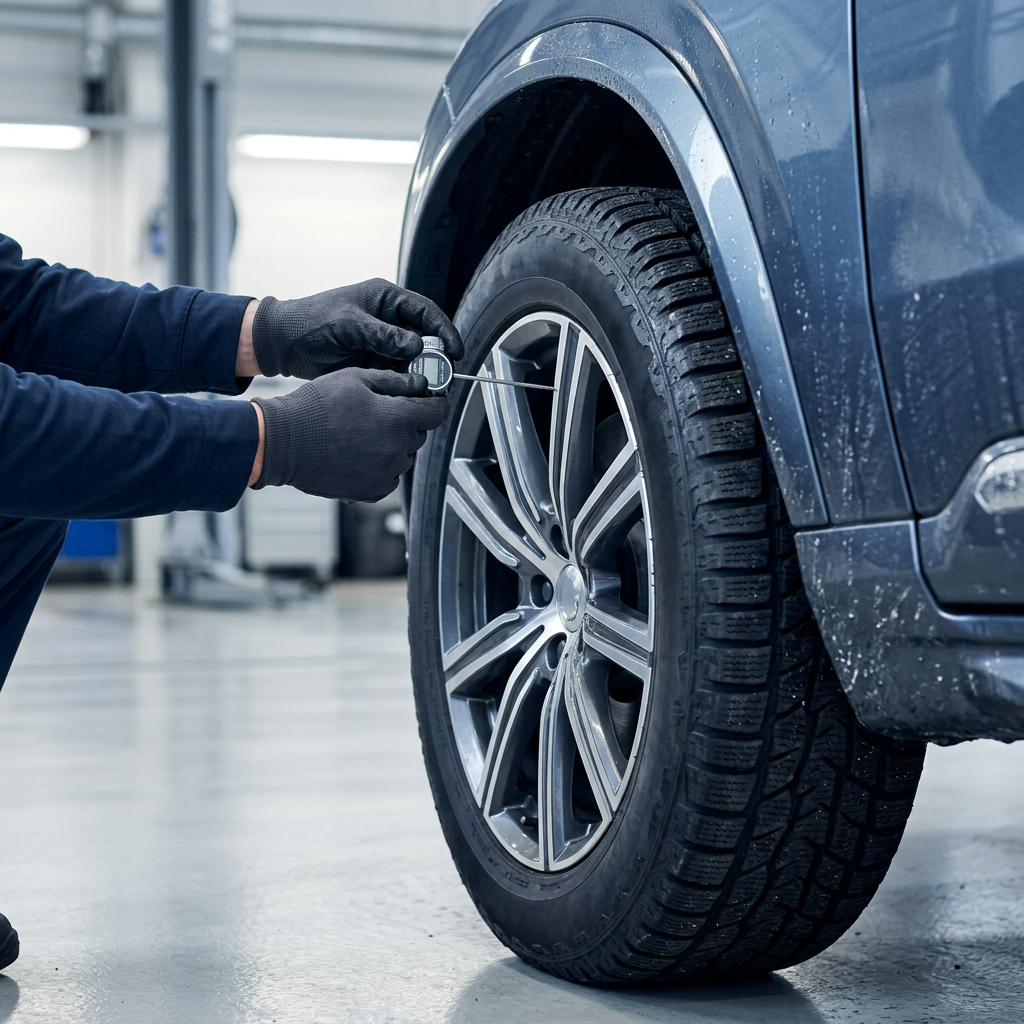
Tire tread depth should measure at least 5/32 of an inch before entering late autumn to ensure adequate water and slush evacuation along rural highway routes. You can schedule a service appointment to have our technicians inspect tread wear and perform a computer-balanced rotation. Our parts center also assists owners with ordering genuine Ford parts and factory-approved load-rated wheel assemblies matched to your truck's specifications.
Preparing Your Truck Braking and Lighting Systems for Rural Highway Travel
Consistent maintenance of your truck's forward lighting and braking hardware ensures optimal reaction time on dark country highways. Road grime, dried bug splatter, and dried road salt build up on outer headlight lenses, scattering the focused beam of LED projector lamps and cutting forward visibility by up to thirty percent. Keeping outer lens covers clean and verifying headlight aim ensures your low and high beams illuminate roadside ditches without glaring oncoming traffic.
Inspecting brake pad thickness and rotor condition is equally critical before embarking on long evening highway drives. While regenerative braking extends friction brake pad longevity on the Lightning, physical calipers and slide pins require routine cleaning and lubrication to prevent corrosion and uneven pad drag. For emergency assistance should a breakdown or collision occur on Kansas highways, drivers benefit from manufacturer-backed protection by calling Ford Roadside Assistance: 1-800-241-3673, which coordinates authorized towing and technical support directly through certified brand centers.
Our service department inspects sensor alignment, aims headlight housings, and checks brake pad wear to keep your truck road-ready for peak wildlife seasons. Drivers along the Kansas River plains in Junction City can prepare their vehicles for autumn travel by finding our showroom on Goldenbelt Boulevard, where our team is available to assist with all your Ford maintenance needs.